
Last Updated May 5, 2026
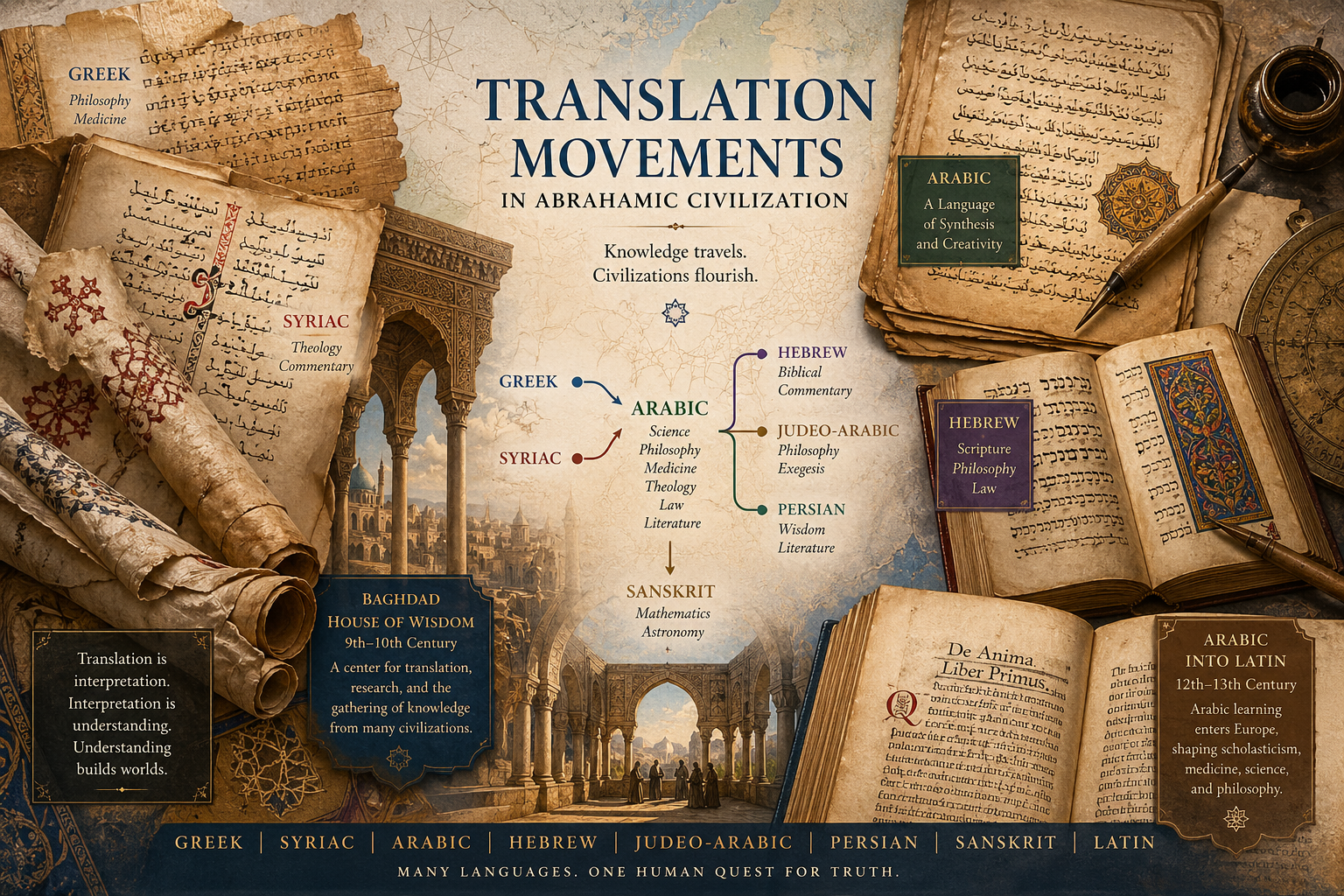
Translation movements in Abrahamic civilization were not merely technical exercises in moving words from one language into another. They were acts of preservation, interpretation, transformation, argument, intellectual renewal, and communal survival. Through translation, Greek medicine entered Syriac and Arabic. Syriac Christian scholarship shaped Arabic scientific vocabulary. Jewish thinkers wrote biblical commentary, philosophy, law, poetry, and communal correspondence in Arabic and Judeo-Arabic. Muslim philosophers, theologians, jurists, physicians, mathematicians, astronomers, grammarians, and spiritual writers expanded inherited knowledge in Arabic. Later, Arabic works moved into Hebrew and Latin, influencing Jewish philosophy, Christian scholasticism, European medicine, and the wider history of science.
Within the Abrahamic Traditions sequence, this article belongs to the shared knowledge worlds cluster: the study of overlapping intellectual, linguistic, scientific, legal, philosophical, devotional, and communal environments in which Jews, Christians, and Muslims preserved, translated, debated, adapted, and transformed knowledge. It follows naturally from Arabic as a Shared Language of Jewish, Christian, and Muslim Knowledge, Law, State Power, and Religious Freedom in Abrahamic History, Covenant, Commandment, and Conscience in Abrahamic Ethics, and Comparative Sacred Themes. Those articles examined language, law, conscience, pluralism, and shared sacred memory. This article turns to translation itself: how knowledge crossed languages without becoming culturally neutral, and how communities remained distinct while sharing intellectual worlds.
Translation is one of the clearest ways to see Abrahamic civilization as both distinct and interconnected. Muslims, Christians, and Jews did not become the same community because they shared texts, concepts, and languages. They remained divided by real theological differences over revelation, law, Jesus, Muhammad, prophecy, incarnation, church authority, rabbinic authority, and the finality of scripture. Yet they also inhabited shared worlds of grammar, philosophy, medicine, astronomy, law, scriptural interpretation, and sacred language. Translation made those worlds possible.
A culturally fair account must also resist the Western chauvinist habit of treating translation history as valuable only because it eventually “fed” Europe. Arabic, Syriac, Hebrew, Judeo-Arabic, Persian, Greek, and Latin knowledge worlds did not exist merely to prepare the way for European modernity. Muslim, Christian, Jewish, Syriac, Persian, and other scholars were not passive transmitters of someone else’s civilization. They were creators, critics, translators, physicians, philosophers, scribes, jurists, theologians, teachers, and interpreters in their own right. Translation was not a waiting room for Western knowledge. It was one of the great engines of world knowledge.
Current Library
Religious Studies
Article Map
Abrahamic Traditions
Related Topic
Arabic Knowledge Worlds
Series context: This article is part of the Abrahamic Traditions: Prophecy, Revelation, Law, and Sacred History knowledge series. For the broader category structure, return to the Religious Studies category.
The Arabic word Allah is used by Arabic-speaking Muslims, Christians, and Jews as the word for God. This matters for translation history because it shows that shared language did not erase doctrinal difference, but it did create a common vocabulary for speaking about divine reality, scripture, law, reason, prophecy, and moral order. The same Arabic word could appear in Qur’anic recitation, Arabic Christian theology, Arabic biblical translation, and Judeo-Arabic Jewish philosophy, while each community remained faithful to its own doctrine and practice.
Translation as Civilizational Practice
Translation is often imagined as a secondary activity: the copying of an original meaning into a new language. In the history of Abrahamic civilization, however, translation was far more powerful than that. It created new scholarly vocabularies, preserved endangered texts, reshaped theology, moved medical knowledge across institutions, enabled philosophical debate, and allowed communities to argue across religious boundaries. Translation was not merely a bridge between finished worlds. It helped build the worlds themselves.
Every act of translation requires judgment. A translator must decide whether to preserve foreign terms, create new technical vocabulary, use older scriptural language, adapt concepts to local usage, or explain difficult ideas through commentary. When Greek philosophical terms entered Arabic, translators and scholars had to decide how to render substance, form, soul, intellect, nature, cause, and demonstration. When biblical texts entered Arabic, Jewish and Christian translators had to decide how to render Hebrew, Aramaic, Greek, and Syriac theological language in a world shaped by Qur’anic Arabic. When Arabic philosophy entered Hebrew and Latin, translators had to decide how to carry concepts formed in Islamic civilization into Jewish and Christian intellectual systems.
Translation therefore belongs at the center of shared Abrahamic knowledge. It reveals that religious traditions are not sealed containers. They are textual, linguistic, institutional, and interpretive worlds. They preserve inherited revelation and law, but they also encounter other languages, other arguments, other sciences, and other communities. Translation is one of the main ways those encounters become durable.
Translation also shows that knowledge is communal. A book does not move across languages by itself. It requires scribes, patrons, teachers, copyists, physicians, monks, rabbis, jurists, philosophers, merchants, libraries, schools, hospitals, courts, monasteries, synagogues, mosques, and households. Translation is therefore not only linguistic work. It is institutional work and communal labor.
This matters because translators are often pushed to the margins of intellectual history. The philosopher, physician, theologian, or ruler may be remembered, while the translator, scribe, copyist, manuscript corrector, bilingual assistant, teacher, or student disappears. Yet without those mediating figures, entire civilizations of knowledge would be inaccessible. Translation history asks readers to honor the hidden labor that made learning possible.
Translation also resists the myth of pure origins. Knowledge rarely survives as an untouched inheritance. It moves through commentary, adaptation, dispute, correction, loss, recovery, and reinterpretation. Greek knowledge became Syriac knowledge, Arabic knowledge, Hebrew knowledge, Latin knowledge, and later European scholastic knowledge not by remaining unchanged, but by being rethought. Translation made continuity possible through transformation.
Languages of Abrahamic Knowledge
Abrahamic civilization has always been multilingual. Hebrew, Aramaic, Greek, Syriac, Arabic, Coptic, Armenian, Geʽez, Persian, Latin, Judeo-Arabic, Ottoman Turkish, and many other languages have carried scripture, commentary, prayer, law, philosophy, medicine, science, and poetry. No single language exhausts Abrahamic sacred history. Even traditions that give one language a special sacred role often live through many languages in practice.
Hebrew carried the Torah, prophetic literature, poetry, law, liturgy, rabbinic commentary, medieval philosophy, and modern Jewish thought. Aramaic carried parts of biblical literature, targumic translation, rabbinic discussion, Syriac Christianity, and many forms of eastern Christian theology. Greek carried the Septuagint, the New Testament, patristic theology, philosophy, medicine, and science. Syriac became one of the great languages of eastern Christianity and a crucial medium for translation into Arabic. Arabic became the language of the Qur’an and one of the great languages of law, theology, philosophy, science, medicine, poetry, administration, and interreligious debate.
The movement among these languages was not incidental. It shaped what communities could know, how they could argue, and how they imagined the relation between revelation and reason. A Jewish thinker writing in Judeo-Arabic could engage Islamic kalām and Greek philosophy while remaining rooted in Torah and rabbinic tradition. A Christian scholar writing in Arabic could defend Trinitarian doctrine in a language also used for Islamic theology. A Muslim philosopher writing in Arabic could engage Aristotle and Plotinus while asking questions about creation, prophecy, intellect, and divine unity. Translation made these layered intellectual identities possible.
These language worlds also show that human dignity is tied to language. A community’s sacred memory depends on its ability to teach, translate, read, recite, copy, interpret, and transmit. When a language is suppressed, manuscripts are lost, scripts are forgotten, schools disappear, or minority archives are neglected, entire communities can be made less visible. Translation is therefore not only an intellectual act. It can be an act of cultural survival.
The Abrahamic traditions also show that sacred language and translated language need not be enemies. Islam preserves the unique sacred status of Qur’anic Arabic while also producing translations and explanations of Qur’anic meaning. Judaism preserves Hebrew and Aramaic while also producing Greek, Arabic, Judeo-Arabic, and vernacular traditions. Christianity begins with Greek New Testament texts emerging from a Jewish Hebrew-Aramaic world and then moves through Syriac, Coptic, Armenian, Latin, Arabic, Geʽez, and many other languages. Sacred language anchors memory; translation extends access.
This multilingual history challenges modern identity categories. “Jewish,” “Christian,” “Muslim,” “Arabic,” “Greek,” “Hebrew,” “Syriac,” “European,” “Middle Eastern,” “Western,” and “Islamic” do not map neatly onto one another. A single manuscript may carry multiple layers of identity: Greek philosophical content, Syriac Christian mediation, Arabic translation, Jewish commentary, Hebrew script, Latin reception, and Christian scholastic interpretation. Translation history forces us to think in networks rather than boxes.
The Syriac Bridge between Greek and Arabic
Syriac Christianity played a central role in the movement of Greek learning into Arabic. Syriac-speaking Christian communities had long cultivated theological, philosophical, medical, and scientific learning before the rise of the great Arabic translation movements. They translated Greek texts into Syriac, commented on them, taught them, and incorporated them into schools, monasteries, medical circles, and theological debate.
This Syriac bridge mattered because many Greek works did not pass into Arabic directly from Greek alone. Some moved through Syriac intermediaries. Syriac translators and scholars helped form the technical vocabulary that would later become Arabic philosophical and medical terminology. This was especially important in medicine, where Galenic and Hippocratic traditions required precise language for anatomy, physiology, diagnosis, regimen, drugs, and disease.
Syriac Christian scholars were therefore not marginal assistants to an Islamic story. They were active intellectual agents. Their work belongs to Christian history, Islamic civilization, and the global history of science at the same time. They did not merely hand over Greek learning. They interpreted it, taught it, revised it, and helped make it usable for Arabic-speaking scholars of multiple religious communities.
The Syriac bridge also shows how minority communities can shape majority civilization. Syriac Christians often lived under changing political conditions: Roman, Byzantine, Persian, early Islamic, Abbasid, and later regional powers. Their intellectual contribution cannot be reduced to political dominance. They shaped knowledge through schools, monasteries, manuscript culture, medicine, and translation. Their influence came through learned labor, not imperial conquest.
This matters for a site committed to foregrounding marginalized voices. Syriac translators, monks, physicians, and scholars often appear only as background figures in large stories of empire. But without them, the Arabic philosophical and scientific lexicon would have developed differently. They were not ornamental intermediaries. They were architects of translation.
The Syriac case also complicates Western Christian self-understanding. Christianity was never only Latin Europe or Greek Byzantium. Syriac Christianity was one of the great intellectual and devotional traditions of the Abrahamic world. Its role in translation movements reminds readers that Christian history includes eastern, Semitic, multilingual, and Arabic-connected forms that modern Western narratives often neglect.
The Arabic Translation Movement
The Arabic translation movement associated especially with Abbasid Baghdad was one of the great intellectual transformations of the medieval world. Greek philosophical, scientific, medical, mathematical, and astronomical works were translated into Arabic, often through Syriac mediation. Persian administrative and wisdom traditions, Indian mathematical and astronomical materials, and other bodies of knowledge also entered Arabic scholarly culture. The result was not a simple library of inherited texts, but a new intellectual ecosystem.
Arabic became a language in which Aristotle, Galen, Euclid, Ptolemy, Plato, Plotinus, Hippocrates, Persian court literature, Indian astronomy, and Islamic theological debates could interact. This encounter helped generate major developments in philosophy, medicine, astronomy, optics, mathematics, logic, pharmacology, theology, grammar, and law. It also gave rise to new questions: How should Greek metaphysics relate to Qur’anic revelation? What is the relation between reason and prophecy? Can medicine be practiced as a rational science within a religiously ordered world? How should inherited philosophy be corrected, Islamized, rejected, or transformed?
This translation movement also changed Arabic itself. New technical vocabularies had to be created. Terms for logic, metaphysics, astronomy, medicine, mathematics, and natural philosophy were refined through use. Arabic was already a language of revelation, poetry, grammar, law, and administration. Through translation, it also became one of the most important scientific and philosophical languages of world history.
The Qur’an’s Arabic form gave Arabic an unparalleled sacred place in Islam, but the language’s later intellectual expansion did not remain confined to one discipline. Arabic became a language for law, theology, medicine, mathematics, astronomy, optics, metaphysics, ethics, grammar, literature, geography, history, and statecraft. Translation did not dilute Arabic. It expanded its conceptual reach.
Qur’anic Text
إِنَّا أَنزَلْنَاهُ قُرْآنًا عَرَبِيًّا لَّعَلَّكُمْ تَعْقِلُونَSurely We have sent it down as an Arabic Qur’an, so that you may understand.Qur’an 12:2. Arabic text with poetic English rendering.
The Qur’an’s Arabic form is central to Islam. The later use of Arabic for science, philosophy, medicine, and translation expanded Arabic’s intellectual life without diminishing its sacred role.
The Arabic translation movement should also be understood as a sign of civilizational confidence. A weak civilization may fear foreign knowledge as contamination. A strong civilization can translate, examine, debate, correct, and absorb without surrendering itself. The translation movement did not make Islamic civilization less Islamic. It showed that Islamic civilization could engage inherited knowledge through its own institutions, questions, and standards of truth.
Beyond the House of Wisdom Myth
The translation movement is often associated with the famous Bayt al-Ḥikmah, or House of Wisdom. This association is useful but can become misleading if treated too simplistically. Modern scholarship has questioned the popular image of the House of Wisdom as a single modern-style academy, university, or centralized translation institute responsible for the entire movement. The reality was broader, more diffuse, and more interesting.
Translation took place through patronage networks, court circles, private libraries, scholarly households, medical families, monasteries, schools, hospitals, and individual commissions. Caliphs and elites played important roles, but so did physicians, translators, scribes, copyists, patrons, theologians, philosophers, and booksellers. Baghdad was crucial, but it was not the only place where translation and knowledge transmission mattered. Damascus, Cairo, Harran, Jundishapur, al-Andalus, Sicily, Toledo, and other centers also became part of wider networks of transmission.
This correction strengthens rather than weakens the historical significance of the translation movement. The point is not that one building saved civilization. The point is that an entire multilingual scholarly culture developed the capacity to seek, translate, compare, criticize, and expand knowledge. That is a deeper civilizational achievement than the legend of a single institution.
The House of Wisdom can remain a meaningful symbol, but it should not replace the larger ecosystem. Real knowledge movements depend on people and practices that are harder to visualize: manuscript acquisition, patronage contracts, oral teaching, textual comparison, dictation, commentary, corrections, copying, technical vocabulary, debates over accuracy, and the labor of students and scribes. A building may become famous, but the movement lived through networks.
This also matters ethically. Myths of a single great institution can erase the many communities that made translation possible. Monks, Jewish scholars, Christian physicians, Muslim patrons, Persian administrators, booksellers, scribes, copyists, and students all belonged to the story. A more accurate account gives voice to the distributed labor of knowledge.
Modern institutions often prefer heroic origin stories: one library, one ruler, one academy, one golden age. Translation history resists that simplification. It shows knowledge as collective, multilingual, uneven, fragile, and dependent on social conditions. Civilizational achievement is rarely the product of one institution alone. It is the result of many forms of labor sustained across generations.
Christian Translators and the Making of Arabic Science
Christian scholars were central to the making of Arabic science and medicine. Ḥunayn ibn Isḥāq is the most famous example. A Christian physician and translator associated with the ninth century, he worked with Greek, Syriac, and Arabic texts and became especially important for the translation and organization of Galenic medicine. His method was philological as well as medical. He compared manuscripts, revised earlier translations, clarified terminology, and helped make Greek medical learning teachable in Arabic.
Ḥunayn’s significance is not merely that he translated many texts. He helped create a disciplined translation culture. Medical translation required more than linguistic competence. It required understanding anatomy, disease, therapy, logic, and the structure of Galen’s arguments. A poor translation could produce bad medicine. A careful translation could become a foundation for generations of physicians.
Other Christian translators and medical families also contributed. The Bukhtīshūʿ family, associated with court medicine, illustrates how Christian physicians could occupy positions of high status in Islamic political and medical culture. Syriac Christian scholars helped move Greek knowledge into Arabic not as outsiders to civilization, but as participants within it. Their work shows that Islamic civilization was shaped by Muslims, but not produced by Muslims alone.
This should not be interpreted as a concession against Islam. It is part of the strength of Islamic civilization that Christian scholars could help create Arabic scientific culture within a world shaped by Islam. Civilizations are not diminished by the participation of minorities. They are enriched by it. The Arabic translation movement shows a civilizational order in which religious difference did not prevent intellectual contribution.
Christian translators also remind readers that Arabic Christian history belongs to Christian history itself. Western Christian narratives often emphasize Greek and Latin while treating Arabic Christianity as peripheral. That is historically inadequate. Arabic-speaking and Syriac-speaking Christians were central to the transmission, transformation, and creation of knowledge in the medieval world.
Their role also has modern ethical significance. Communities now described as “minorities” were not minor in intellectual importance. They preserved manuscripts, translated medicine, shaped scientific vocabulary, served as physicians, debated theology, and contributed to public life. Giving voice to marginalized traditions means refusing to treat them as footnotes to Muslim or European history. They were makers of knowledge.
Jewish Translation Worlds: Arabic, Hebrew, and Judeo-Arabic
Jewish communities also participated deeply in Arabic translation and knowledge culture. In many Islamic lands, Jews used Arabic for daily life, commerce, philosophy, biblical commentary, legal thought, poetry, medicine, and correspondence. Judeo-Arabic, Arabic written in Hebrew script, became one of the major vehicles of medieval Jewish intellectual life. It allowed Jews to think in Arabic while preserving a visibly Jewish scriptural and communal identity.
Saadia Gaon wrote major theological and exegetical works in Arabic. His translation and interpretation of the Hebrew Bible into Arabic helped Jewish communities understand scripture within an Arabic-speaking world. Maimonides wrote The Guide for the Perplexed in Judeo-Arabic, using philosophical vocabulary shaped by Arabic and Islamic thought to address Jewish theology, divine attributes, prophecy, law, creation, and interpretation. Judah Halevi’s Kuzari also belongs to the broader Jewish-Arabic intellectual environment, even where it resists some philosophical tendencies.
Later, many Arabic Jewish works were translated into Hebrew, especially as Jewish communities in Christian Europe encountered the intellectual achievements of Jews from Islamic lands. This Hebrew translation movement helped carry Arabic Jewish philosophy, science, medicine, and biblical interpretation into new settings. Translation therefore moved in multiple directions: Hebrew into Arabic, Arabic into Hebrew, Arabic into Latin, Greek into Syriac, Syriac into Arabic, and sometimes back again through commentary and adaptation.
Judeo-Arabic translation worlds are especially important because they reveal layered identity rather than assimilation. A Jewish scholar could write in Arabic, use Hebrew script, cite Torah, interpret rabbinic tradition, engage Islamic theology, draw on Greek philosophy, and address Jewish communal concerns. This was not loss of identity. It was a sophisticated form of Jewish intellectual life in an Arabic-speaking environment.
The Cairo Genizah provides a vivid archive of this world. Letters, contracts, medical notes, legal documents, poems, philosophical texts, and everyday writings show Jewish communities moving through Arabic-speaking social and commercial life while preserving Jewish law and memory. Translation was not only for elite philosophy. It was part of the texture of daily life.
Recovering Jewish translation worlds also challenges modern narratives that separate Jews from Arabic civilization. Jewish history did not unfold only in Christian Europe, and Arabic was not foreign to Jewish life. Judeo-Arabic reminds readers that Jewish and Arabic identities were not always opposed categories. Many Jewish communities lived, traded, wrote, prayed, argued, and thought within Arabic worlds while remaining deeply Jewish.
Qur’an, Bible, and Scriptural Translation
Scriptural translation raises different questions from medical or philosophical translation. For Muslims, the Qur’an’s Arabic form has a uniquely sacred status. Translations of the Qur’an may convey meanings, but they do not replace the Arabic Qur’an in prayer, recitation, or classical Islamic understanding. This makes Qur’anic translation a theologically sensitive act: useful for comprehension, but not equivalent to the revealed Arabic recitation.
Jewish and Christian traditions developed different but equally complex translation histories. The Hebrew Bible moved into Greek through the Septuagint, into Aramaic through the Targums, into Syriac, Latin, Arabic, and many other languages. The New Testament itself was written in Greek while emerging from a Jewish world shaped by Hebrew and Aramaic. Syriac Christianity translated and interpreted scripture in Syriac. Arabic-speaking Christians translated the Bible into Arabic, producing texts that allowed Christian scripture and theology to be articulated in the language of Islamic civilization.
Arabic biblical translation is especially important for Abrahamic studies. It shows that Arabic was not only the language of the Qur’an, but also a language of the Bible for Arabic-speaking Christians and Jews. Arabic-speaking Christians used Arabic to explain the Trinity, incarnation, Christology, scripture, liturgy, and ecclesial identity. Arabic-speaking Jews used Arabic and Judeo-Arabic to translate, interpret, and discuss the Hebrew Bible. These translations made scripture part of a shared Arabic intellectual world, even when communities disagreed sharply over interpretation.
The word Allah is one of the clearest examples of this shared scriptural language. Arabic-speaking Christians use Allah for God in biblical translation and prayer. Arabic-speaking Jews also used Arabic religious vocabulary in Jewish contexts. Muslims use Allah in Qur’anic recitation, worship, theology, and ordinary speech. The shared word does not erase doctrinal difference, but it corrects the false claim that Muslims speak of a different deity simply because they use Arabic.
Scriptural translation also creates authority questions. Who has the right to translate? What counts as a faithful rendering? Can sacred rhythm, sound, ambiguity, and divine name be carried into another language? Does translation make scripture more accessible or expose it to distortion? These questions are not merely academic. They shape prayer, doctrine, law, education, preaching, and communal identity.
For marginalized communities, scriptural translation can be a form of survival. A community that can hear scripture in its own language can teach children, preach, argue, pray, and preserve identity under changing political conditions. Arabic biblical translation, Judeo-Arabic exegesis, Syriac liturgy, and vernacular scripture traditions all show that translation can protect religious life, not merely communicate information.
Medicine, Philosophy, and Science in Translation
Medicine was one of the most important fields shaped by translation. Greek medical works associated with Hippocrates and Galen entered Syriac and Arabic. Arabic medical authors such as al-Rāzī, Ibn Sīnā, al-Zahrāwī, Ibn al-Nafīs, and many others then reorganized, criticized, expanded, and applied inherited medical knowledge. Christian translators and physicians helped create medical Arabic; Muslim physicians developed major theoretical and clinical works; Jewish physicians wrote and practiced within Arabic and Judeo-Arabic medical cultures.
Philosophy was equally transformed. Greek philosophical texts entered Arabic, but they did not remain unchanged. Aristotle, Plato, Plotinus, and later commentators were read through Arabic categories, Islamic theological debates, and late antique traditions. Philosophers such as al-Kindī, al-Fārābī, Ibn Sīnā, Ibn Rushd, Maimonides, and others developed new arguments about God, intellect, soul, causality, prophecy, creation, and metaphysics. Translation made this possible, but philosophy did not end with translation. It became a new tradition.
Science and mathematics also moved through translation and transformation. Euclidean geometry, Ptolemaic astronomy, Indian numerals and mathematical techniques, Persian astronomical materials, and Arabic innovations all interacted. The result was a scholarly world in which astronomy, optics, algebra, geography, pharmacology, and natural philosophy could be studied across religious boundaries. Translation opened the door, but critical inquiry, commentary, correction, and original research kept the tradition alive.
Medicine reveals the ethical value of translation especially clearly. Translation could save lives. A medical text badly rendered could mislead diagnosis or treatment. A carefully translated and commented text could train physicians, guide hospitals, improve pharmacology, and help communities treat illness. The translator was therefore not merely a literary figure. In medicine, the translator could become part of healing.
Philosophy and science also show that religious civilization does not require hostility to reason. Muslim, Christian, and Jewish thinkers debated how far reason could go, where revelation corrected philosophy, and how inherited sciences should be judged. Some rejected aspects of philosophy; others incorporated it; others criticized it from within. Translation did not create one uniform rationalism. It created a field of disciplined disagreement.
Modern readers should avoid the patronizing formula that Arabic civilization “preserved” Greek science for Europe. Preservation mattered, but it is not enough. Arabic-speaking scholars organized hospitals, wrote medical encyclopedias, criticized Galen, developed optics, refined astronomy, advanced mathematics, produced pharmacological knowledge, and built philosophical systems. They did not merely carry a torch. They added fuel, shaped the flame, and lit new lamps.
Latin Translations and the Transmission of Arabic Learning
From the eleventh through thirteenth centuries and beyond, Arabic works moved into Latin through translation centers and multilingual environments in places such as Toledo, Sicily, southern Italy, and the Crusader and Mediterranean contact zones. Translators working with Arabic, Hebrew, Romance languages, and Latin helped carry Arabic philosophical, medical, astronomical, mathematical, and scientific works into Christian Europe.
These Latin translations had enormous consequences. Ibn Sīnā’s Canon of Medicine, al-Rāzī’s medical writings, Ibn Rushd’s commentaries on Aristotle, works of al-Fārābī, al-Kindī, and many others entered Latin scholastic culture. Latin Europe did not simply receive “Greek thought” directly from antiquity. It often received Greek thought after it had been translated, interpreted, criticized, and expanded in Arabic. This means that Jewish, Christian, and Muslim scholars in Islamic civilization helped shape European medieval intellectual life.
Hebrew also played an important role in transmission. Jewish translators moved Arabic philosophical, scientific, and medical works into Hebrew. In some cases, Hebrew versions later influenced Latin readers. Jewish scholars in Christian lands became mediators between Arabic and Latin intellectual worlds. Again, translation moved through multiple communities, and each movement changed the meaning, vocabulary, and authority of the texts being transmitted.
The Latin translation movement should therefore not be described as Europe simply recovering its own lost heritage. That framing erases the centuries of Arabic interpretation, Islamic philosophical debate, Jewish mediation, Christian Syriac labor, and original scholarly contribution that transformed the materials being received. Latin scholasticism was shaped not only by Greek antiquity, but by Arabic and Hebrew routes of transmission.
Toledo, Sicily, and other translation centers reveal the importance of multilingual borderlands. Knowledge often moves where languages meet: frontier cities, port towns, courts, libraries, religiously mixed regions, trade routes, and conquered territories. Such spaces can be marked by inequality and violence, but they can also produce intense intellectual exchange. Translation history is therefore often borderland history.
Latin reception also produced conflict. Some Arabic and Aristotelian materials were welcomed; others were condemned, restricted, debated, or absorbed cautiously. Christian scholasticism did not simply accept Arabic philosophy whole. It argued with it. That argument was itself a sign of influence. A text powerful enough to be condemned, commented on, or disputed has already entered the intellectual bloodstream.
Translation, Theology, and Doctrinal Difference
Translation often intensified theological debate. When Christians wrote in Arabic, they had to explain doctrines such as Trinity, incarnation, sonship, and salvation in a linguistic environment shaped by Islamic monotheism and Qur’anic critique. When Muslims engaged biblical materials in Arabic, they debated revelation, textual alteration, prophecy, law, and the identity of Jesus. When Jews wrote in Arabic, they defended Torah, rabbinic tradition, creation, divine unity, and prophecy while engaging Islamic kalām and Greek philosophy.
Shared language did not produce doctrinal agreement. In fact, it often made disagreement sharper because communities could understand one another more directly. Arabic Christian theologians had to answer Muslim objections. Muslim theologians had to respond to Christian and Jewish claims. Jewish philosophers had to articulate the distinctiveness of Judaism in a language shared with Muslim theology and philosophy. Translation created proximity, and proximity created both exchange and polemic.
This is why translation history must be approached without sentimentality. It was not simply a story of harmony. It included rivalry, critique, hierarchy, legal inequality, patronage, censorship, misunderstanding, and polemical pressure. Yet it was also not merely a story of conflict. It included collaboration, shared education, textual preservation, medical care, philosophical borrowing, technical refinement, and intellectual admiration. Translation is one of the places where the complexity of Abrahamic civilization becomes visible.
Theological translation also reveals the limits of literalism. A word may be technically accurate but doctrinally misleading. A phrase may carry one meaning in Greek, another in Syriac, another in Arabic, and another in Latin. Translators of scripture and theology had to decide whether to preserve inherited terminology or adapt it for new audiences. These decisions could shape doctrine for centuries.
Doctrinal difference should not be treated as a failure of translation. Sometimes translation made disagreement more honest. A Muslim theologian and Christian theologian using Arabic could disagree more precisely. A Jewish philosopher writing in Judeo-Arabic could define Jewish belief in relation to Islamic and philosophical arguments. Shared language made the boundaries clearer as well as the connections deeper.
That is an important lesson for comparative study. Respect is not sameness. Jews, Christians, and Muslims do not need to dissolve their differences in order to share knowledge. Translation shows a more mature model: communities can preserve doctrine, argue forcefully, borrow concepts, translate texts, and remain answerable to their own sacred traditions.
Translation as Interpretation
No translation is neutral. Every translation interprets. This is especially true for sacred and philosophical language. A translator must decide whether a word means God, lord, deity, intellect, spirit, soul, law, wisdom, justice, mercy, covenant, prophecy, or command. Each decision can carry theological consequences. To translate is to make a claim about meaning.
In scriptural translation, this is obvious. Rendering Hebrew divine names, Greek Christological titles, Syriac theological vocabulary, or Qur’anic Arabic into another language requires doctrinal judgment. In philosophy, translating Greek nous, logos, ousia, psyche, and physis into Syriac, Arabic, Hebrew, or Latin creates new conceptual possibilities. In medicine, translating technical terms for organs, humors, faculties, diseases, and treatments can change how bodies are understood and treated.
Translation is therefore not inferior to original authorship. It is a form of authorship under discipline. The translator is bound to another text, but the translator also gives that text a new life. The history of Abrahamic knowledge would be impossible without translators who were also interpreters, philologists, theologians, physicians, philosophers, scribes, teachers, and cultural mediators.
This is why translation movements should be treated with intellectual seriousness. Translators did not merely move content from one container to another. They created vocabularies, chose metaphors, standardized technical terms, corrected earlier versions, added commentary, compared manuscripts, and trained readers. Translation often became the hidden infrastructure of philosophy, medicine, theology, and law.
Translation also has a moral dimension because it can either honor or distort the other. A faithful translation tries to let a text speak intelligibly in another language without erasing its strangeness. A polemical translation may intentionally bend meaning. A careless translation may flatten a tradition. An imperial translation may domesticate another community’s knowledge for domination. Translation is therefore an ethical act as well as a linguistic one.
At its best, translation is disciplined hospitality. It receives another text, gives it room in a new language, and allows a new community to encounter it. That hospitality does not require surrendering judgment. Translators can disagree with what they translate. But they must still listen closely enough to render meaning with care.
Translation, Rights, and Marginalized Voices
Translation is also a question of human dignity. Communities have the right to preserve, teach, translate, and transmit their sacred and intellectual inheritance. A people cut off from its language, script, archives, scriptures, commentaries, and educational institutions is not merely losing information. It is losing memory, authority, continuity, and voice.
This is especially important for marginalized Abrahamic communities. Syriac Christians, Arabic-speaking Christians, Judeo-Arabic Jewish communities, Mizrahi and Sephardi Jews, Coptic-Arabic communities, manuscript scribes, minority physicians, women in households preserving oral and devotional memory, and displaced communities often appear at the edges of grand civilizational narratives. Translation history brings many of them closer to the center.
The Cairo Genizah, for example, does not only preserve elite theology. It preserves letters, contracts, business records, legal documents, poems, medical materials, and everyday traces of Jewish life in Arabic-speaking environments. These materials reveal a community whose knowledge was legal, commercial, familial, religious, and practical. Translation and multilingual writing were woven into daily survival.
Christian translators in Arabic and Syriac worlds also deserve more than passing mention. They did not merely serve Muslim patrons. They preserved Christian learning, transmitted Greek medicine, shaped Arabic vocabulary, wrote theology, and helped build the intellectual culture of the societies in which they lived. Their minority status did not prevent major contribution.
Muslim scholars also require protection from a different kind of marginalization: the Western habit of treating them as intermediaries rather than originators. The phrase “transmission of Greek knowledge” can hide the fact that Arabic-speaking Muslim scholars criticized, corrected, expanded, and transformed what they received. They were not simply useful to Europe. They were thinkers within their own civilizational horizon.
Translation rights also matter today. Communities displaced by war, colonialism, nationalism, migration, and assimilation often lose access to ancestral languages and scripts. Preserving Judeo-Arabic, Syriac, Coptic, Arabic Christian, Ottoman, Persian, Hebrew, and other manuscript worlds is not antiquarian nostalgia. It is part of restoring historical voice to communities whose memories have been fragmented.
A serious knowledge project should therefore ask: whose translations are remembered, whose are forgotten, whose manuscripts survive, whose archives are digitized, whose language is treated as prestigious, whose language is treated as backward, and whose intellectual labor is absorbed into someone else’s civilizational story? Translation history is one place where justice and scholarship meet.
Modern Importance: Translation against Civilizational Amnesia
The modern importance of these translation movements is considerable. They undermine simplistic stories about isolated civilizations. Jewish, Christian, and Muslim knowledge did not develop in sealed compartments. Greek philosophy became Arabic philosophy, Arabic philosophy shaped Jewish philosophy, Jewish and Arabic philosophical texts moved into Latin, and Latin scholasticism later became part of Christian intellectual history. Medicine moved across Greek, Syriac, Arabic, Hebrew, and Latin environments. Biblical translation made Arabic a language of Jewish and Christian scripture as well as Islamic revelation.
This history also corrects misleading claims about “Judeo-Christian” and “Islamic” civilization as though they were entirely separate worlds. Arabic-speaking Jews and Christians were part of Islamic civilization. Muslim philosophers and physicians engaged Greek and Syriac inheritances. Jewish translators transmitted Arabic works into Hebrew. Christian translators transmitted Arabic works into Latin. The boundaries were real, but they were porous.
Translation history also challenges Western triumphalist narratives. European scholasticism and later European intellectual life did not develop from a sealed internal source. They were shaped by Arabic, Hebrew, Syriac, Greek, and Islamic intellectual mediations. This does not mean Europe contributed nothing; it means Europe was part of a wider history of translation and dependence. Intellectual humility requires acknowledging the non-Western and minority communities that made later developments possible.
At the same time, translation history challenges simplistic anti-Western reversal. The answer to Western chauvinism is not another chauvinism. It is a more truthful account of shared human knowledge: Greek, Syriac, Arabic, Persian, Sanskrit, Hebrew, Latin, and many other traditions interacted. No civilization owns reason. No language owns wisdom. No community has developed knowledge without receiving from others.
Finally, translation history offers an ethical lesson. Communities can disagree deeply and still learn through shared texts. They can preserve distinct identities while participating in common inquiry. They can debate fiercely while depending on one another’s languages, manuscripts, institutions, and technical skills. Translation does not erase difference. It disciplines difference by forcing communities to listen, render, explain, and respond.
In an age of polarization, translation is more than a historical topic. It is a model of intellectual responsibility. To translate is to admit that another language has something to say. To study translation movements is to remember that knowledge grows when communities are willing to cross boundaries without pretending those boundaries do not exist.
Comparative Cautions
Several cautions are necessary. First, the translation movements should not be romanticized as pure interfaith harmony. They occurred within real political conditions, including empire, hierarchy, patronage, minority status, and sometimes coercion or inequality. Jews and Christians in Islamic lands could participate in high intellectual culture while also living under differentiated legal and social conditions that varied by time and place.
Second, the Islamic character of the Arabic translation movement should not be erased. Muslim patronage, Qur’anic Arabic, Islamic institutions, Islamic law, and Muslim scholarly demand were central to the development of Arabic intellectual culture. Recognizing Jewish and Christian participation does not diminish Islamic civilization. It shows the breadth of the world Islam helped shape.
Third, the role of Christians and Jews should not be reduced to transmission alone. Christian translators did not merely pass Greek learning to Muslims. Jewish philosophers did not merely receive Islamic philosophy. Muslim scholars did not merely preserve Greek thought. All three communities interpreted, criticized, transformed, and created knowledge.
Fourth, the House of Wisdom should be handled carefully. It is historically important as a symbol of Abbasid learning and patronage, but the translation movement should not be reduced to a single institution. The actual networks were broader: courtly, medical, monastic, scholarly, commercial, and multilingual.
Fifth, translation should not be treated as a loss of purity. Sacred traditions often fear that translation dilutes original meaning. Sometimes that fear is justified, especially when translation is careless or polemical. But translation can also preserve, clarify, extend, and deepen understanding. Abrahamic civilization has always lived through the tension between sacred original languages and the need to teach, argue, heal, govern, and pray across many tongues.
Sixth, Qur’anic translation should be distinguished from the Qur’an’s Arabic revelation. In Islam, translations of Qur’anic meanings can help readers understand, but they do not replace the Arabic Qur’an in its sacred, liturgical, and revelatory status.
Seventh, Arabic biblical translation should not be treated as secondary merely because Arabic is associated with Islam. Arabic-speaking Christians and Jews used Arabic to translate, interpret, teach, and defend scripture. Their work belongs to the central history of Abrahamic translation.
Eighth, Latin reception of Arabic learning should not be framed as Europe simply reclaiming Greek knowledge. By the time many works entered Latin, they had passed through Arabic interpretation, Islamic debate, Syriac mediation, Jewish commentary, and original scholarly development.
Ninth, translators should not be treated as invisible technicians. They were often intellectual agents: philologists, physicians, theologians, philosophers, scribes, teachers, and mediators. Their labor shaped the history of thought.
Finally, marginalized voices should not be added as an afterthought. Syriac Christians, Arabic-speaking Christians, Judeo-Arabic Jews, Jewish translators, Muslim commentators, manuscript scribes, medical families, women preserving language in households, and displaced communities all belong to the story. Translation movements are not only histories of famous books. They are histories of communities struggling to preserve and share knowledge across time.
Why This Article Matters
Translation movements in Abrahamic civilization were among the most important engines of intellectual history. They carried Greek medicine into Syriac and Arabic, Arabic philosophy into Hebrew and Latin, biblical scripture into Arabic, Jewish theology into Judeo-Arabic, Christian apologetics into Arabic, and Islamic philosophical and scientific works into Europe. They created shared vocabularies for medicine, metaphysics, astronomy, grammar, law, and theology. They allowed communities to preserve difference while participating in common inquiry.
The story is not one of simple harmony, nor one of isolated civilizations. It is a story of layered exchange. Muslims, Christians, Jews, Syriac scholars, Persian administrators, Greek philosophers, Indian mathematicians, Latin scholastics, Hebrew translators, Arabic physicians, and many others contributed to the movement of knowledge. Some translated to defend their faith. Some translated to heal bodies. Some translated to serve patrons. Some translated to understand scripture. Some translated because wisdom, once encountered, demanded a new language.
For the Abrahamic Traditions knowledge series, this article deepens the shared-knowledge-world arc. Arabic as a Shared Language of Jewish, Christian, and Muslim Knowledge showed how Arabic carried multiple Abrahamic intellectual traditions. This article shows how translation moved knowledge across even wider language worlds: Greek, Syriac, Arabic, Hebrew, Judeo-Arabic, Persian, Sanskrit, and Latin. Together, these articles challenge the idea that Abrahamic traditions lived in sealed compartments.
For the Abrahamic traditions, translation reveals a central truth: revelation may arrive in particular languages, but human understanding travels through many languages. Sacred law, prophecy, theology, philosophy, medicine, and science all require interpretation. Translation is one of the places where interpretation becomes visible. It shows that knowledge is inherited, contested, revised, and shared. It also shows that the search for wisdom before the one God has never belonged to one language alone.
Seen from the perspective of marginalized voices, translation history restores people who are often erased: Syriac Christian translators, Arabic-speaking Christian theologians, Judeo-Arabic Jewish philosophers, Jewish merchants and letter writers, Muslim physicians and commentators reduced by Western narratives to “transmitters,” scribes whose names are lost, and communities whose manuscripts survive only in fragments. Their work reminds readers that civilization is not built only by rulers and famous authors. It is also built by those who carry words across boundaries.
The final value of this article is that it treats translation as a form of dignity. To translate is to preserve memory, extend knowledge, make argument possible, and allow communities to speak across difference without surrendering themselves. Translation does not erase truth claims. It makes them audible in another language. In Abrahamic civilization, that audibility shaped theology, medicine, philosophy, science, law, and the long search for wisdom before God.
Related Reading
- Abrahamic Traditions: Prophecy, Revelation, Law, and Sacred History
- Arabic as a Shared Language of Jewish, Christian, and Muslim Knowledge
- Law, State Power, and Religious Freedom in Abrahamic History
- Comparative Sacred Themes
- Jewish, Christian, and Muslim Physicians in the Medieval Islamic World
- Luqman, Wisdom, and Moral Counsel in the Qur’an
- Khidr, Hidden Knowledge, and the Limits of Human Understanding
- Religion and Society
- Religion and Law
Further Reading
- Burnett, C. (2001) “The Coherence of the Arabic-Latin Translation Program in Toledo in the Twelfth Century,” Science in Context, 14(1–2), pp. 249–288. Available at: https://www.cambridge.org/core/journals/science-in-context
- D’Ancona, C. (ed.) (2007) The Libraries of the Neoplatonists. Leiden: Brill. Available at: https://brill.com/
- Endress, G. (1987) “The Circle of al-Kindī: Early Arabic Translations from the Greek and the Rise of Islamic Philosophy,” in Endress, G. and Kruk, R. (eds.) The Ancient Tradition in Christian and Islamic Hellenism. Leiden: Research School CNWS. Available through academic libraries.
- Freudenthal, G. (ed.) (2011) Science in Medieval Jewish Cultures. Cambridge: Cambridge University Press. Available at: https://www.cambridge.org/
- Griffith, S.H. (2013) The Bible in Arabic: The Scriptures of the “People of the Book” in the Language of Islam. Princeton: Princeton University Press. Available at: https://press.princeton.edu/books/paperback/9780691168081/the-bible-in-arabic
- Gutas, D. (1998) Greek Thought, Arabic Culture: The Graeco-Arabic Translation Movement in Baghdad and Early Abbasid Society. London: Routledge. Available at: https://www.routledge.com/
- Hasse, D.N. (2016) Success and Suppression: Arabic Sciences and Philosophy in the Renaissance. Cambridge, MA: Harvard University Press. Available at: https://www.hup.harvard.edu/
- Kraemer, J.L. (2008) Maimonides: The Life and World of One of Civilization’s Greatest Minds. New York: Doubleday. Available at: https://www.penguinrandomhouse.com/
- Nasr, S.H. (1968) Science and Civilization in Islam. Cambridge, MA: Harvard University Press. Available at: https://www.hup.harvard.edu/
- Pormann, P.E. and Savage-Smith, E. (2007) Medieval Islamic Medicine. Edinburgh: Edinburgh University Press. Available at: https://edinburghuniversitypress.com/
- Saliba, G. (2007) Islamic Science and the Making of the European Renaissance. Cambridge, MA: MIT Press. Available at: https://mitpress.mit.edu/
- Wisnovsky, R. (2003) Avicenna’s Metaphysics in Context. Ithaca: Cornell University Press. Available at: https://www.cornellpress.cornell.edu/
References
- Britannica (2026) Arabic Language. Available at: https://www.britannica.com/topic/Arabic-language
- Britannica (2026) Bayt al-Hikmah. Available at: https://www.britannica.com/place/Bayt-al-Hikmah
- Britannica (2026) Ḥunayn ibn Isḥāq. Available at: https://www.britannica.com/biography/Hunayn-ibn-Ishaq
- Cambridge Digital Library (n.d.) Cairo Genizah Collection. Available at: https://cudl.lib.cam.ac.uk/collections/genizah/1
- Cambridge University Library (n.d.) Taylor-Schechter Genizah Research Unit. Available at: https://www.lib.cam.ac.uk/collections/departments/taylor-schechter-genizah-research-unit
- Corpus Coranicum (n.d.) The Qur’an in Context. Available at: https://corpuscoranicum.de/en
- Griffith, S.H. (2013) The Bible in Arabic: The Scriptures of the “People of the Book” in the Language of Islam. Princeton: Princeton University Press. Publisher information available at: https://press.princeton.edu/books/paperback/9780691168081/the-bible-in-arabic
- Gutas, D. (1998) Greek Thought, Arabic Culture: The Graeco-Arabic Translation Movement in Baghdad and Early Abbasid Society. London: Routledge. Publisher information available at: https://www.taylorfrancis.com/books/mono/10.4324/9780203017432/greek-thought-arabic-culture-dimitri-gutas
- Jewish Encyclopedia (1906) Arabic Language among Jews, Use of. Available at: https://www.jewishencyclopedia.com/articles/1686-arabic-language-among-jews-use-of
- National Library of Medicine (n.d.) Islamic Medical Manuscripts: Medieval Islam. Available at: https://www.nlm.nih.gov/hmd/arabic/med_islam.html
- Princeton Geniza Project (n.d.) Resources. Available at: https://geniza.princeton.edu/en/about/resources/
- Qatar Digital Library (n.d.) Making Medical Manuals: The “Questions and Answers” Format in Ḥunayn Ibn Isḥāq’s Medical Manuals. Available at: https://www.qdl.qa/en/making-medical-manuals-questions-and-answers-format-%E1%B8%A5unayn-ibn-is%E1%B8%A5%C4%81q%E2%80%99s-medical-manuals
- Quran.com (n.d.) Surah Yusuf 12:2. Available at: https://quran.com/12/2
- Quran.com (n.d.) Surah Fussilat 41:3. Available at: https://quran.com/41/3
- Sefaria (n.d.) Guide for the Perplexed. Available at: https://www.sefaria.org/Guide_for_the_Perplexed
- Stanford Encyclopedia of Philosophy (2007) Influence of Arabic and Islamic Philosophy on Judaic Thought. Available at: https://plato.stanford.edu/entries/arabic-islamic-judaic/
- Stanford Encyclopedia of Philosophy (2009) Greek Sources in Arabic and Islamic Philosophy. Available at: https://plato.stanford.edu/entries/arabic-islamic-greek/
- Stanford Encyclopedia of Philosophy (2012) Arabic and Islamic Metaphysics. Available at: https://plato.stanford.edu/entries/arabic-islamic-metaphysics/
- Stanford Encyclopedia of Philosophy (2023) Arabic and Islamic Philosophy of Religion. Available at: https://plato.stanford.edu/entries/arabic-islamic-religion/
- Yale University Press (n.d.) Saadia Gaon: The Book of Beliefs and Opinions. Available at: https://yalebooks.yale.edu/book/9780300044904/saadia-gaon/