
Last Updated May 5, 2026
Medicine in the medieval Islamic world was one of the great shared knowledge fields of Abrahamic civilization. Muslim, Christian, and Jewish physicians worked across languages, courts, hospitals, libraries, pharmacies, translation circles, scholarly networks, households, and urban institutions of care. They inherited Greek, Syriac, Persian, Indian, and local medical traditions; wrote and translated in Arabic, Syriac, Hebrew, Judeo-Arabic, Persian, and Latin; and developed forms of clinical practice that linked theory, observation, regimen, pharmacology, ethics, and public welfare.
Within the Abrahamic Traditions sequence, this article belongs to the shared knowledge worlds cluster: the study of overlapping intellectual, scientific, legal, philosophical, medical, and ethical environments in which Jews, Christians, and Muslims preserved, translated, debated, and expanded knowledge. It follows naturally from Arabic as a Shared Language of Jewish, Christian, and Muslim Knowledge, Translation Movements in Abrahamic Civilization, Law, State Power, and Religious Freedom in Abrahamic History, and Comparative Sacred Themes. Those articles explored language, translation, communal rights, plural knowledge, and religious difference. This article turns to medicine: how Abrahamic communities served the fragile human body within a world shaped by Islam, Arabic, translation, institutional patronage, and practical care.
The phrase “medieval Islamic world” should be understood carefully. It refers to a civilizational world shaped by Islam, Arabic, Qur’anic learning, Islamic law, Muslim patronage, and institutions under Muslim rule. But it was not populated only by Muslims, and its knowledge traditions were not produced by Muslims alone. Jewish and Christian physicians were deeply involved in translation, medical practice, hospital culture, court medicine, pharmacology, and scientific writing. Their work did not weaken the Islamic character of this civilization; rather, it shows how expansive and intellectually generative that civilization became.
A culturally fair account should also reject the Western chauvinist habit of treating medieval Islamic medicine as valuable only because it later influenced Europe. Arabic medicine was not merely a bridge to the Renaissance. It was a major knowledge world in its own right: institutional, multilingual, empirical, philosophical, ethical, and practical. Muslim, Christian, and Jewish physicians did not simply preserve older learning. They translated it, criticized it, expanded it, taught it, practiced it, and adapted it to the needs of living patients.
Current Library
Religious Studies
Article Map
Abrahamic Traditions
Related Topic
Arabic Knowledge Worlds
Series context: This article is part of the Abrahamic Traditions: Prophecy, Revelation, Law, and Sacred History knowledge series. For the broader category structure, return to the Religious Studies category.
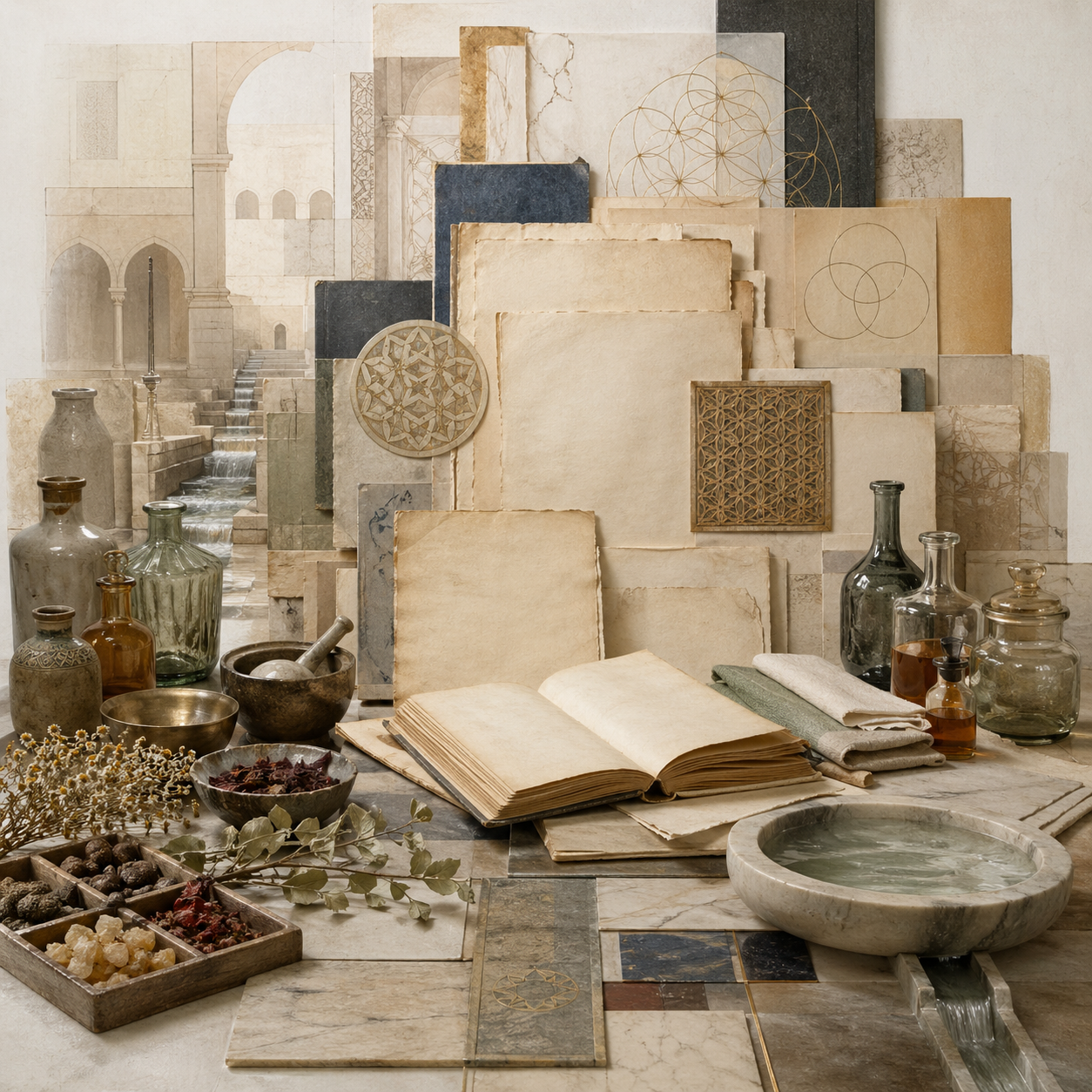
Medicine is also a field where human rights can be understood in a thicker, non-reductionist way. Care for the sick is not only a modern bureaucratic right or a private charitable sentiment. It is also a communal, religious, institutional, and ethical responsibility. The medieval Islamic medical world shows that human dignity can be protected through hospitals, charitable endowments, medical translation, professional ethics, pharmacology, public care, and the recognition that the sick body has a claim upon the community.
Medicine as a Shared Abrahamic Knowledge World
Medicine is one of the clearest examples of how Jewish, Christian, and Muslim communities participated in a shared intellectual world without becoming the same community. Physicians could disagree about revelation, scripture, law, prophecy, Jesus, Muhammad, church authority, rabbinic authority, or Islamic jurisprudence, while still reading the same medical authorities, treating the same diseases, using overlapping pharmacological materials, and serving patients across communal boundaries.
This shared medical world was not merely theoretical. It existed in hospitals, households, courts, marketplaces, pharmacies, libraries, teaching circles, and manuscript cultures. Physicians examined urine, checked pulses, prescribed compound medicines, debated Galenic theory, studied anatomy as it was understood in their time, wrote manuals for students, translated texts, composed formularies, and treated the sick. Their work reminds modern readers that medieval religious life did not prevent scientific and medical exchange. In many cases, religious civilization created the institutions, patronage, and ethical frameworks through which such exchange became possible.
The medieval Islamic world was especially important because Arabic became a common language of learned medicine. Greek medical works were translated into Syriac and Arabic; Syriac Christian translators helped shape medical Arabic; Muslim physicians wrote major encyclopedias and clinical treatises; Jewish physicians wrote in Arabic and Judeo-Arabic; and later Latin translators carried Arabic medical texts into Europe. Medicine therefore linked the Abrahamic traditions not only through shared theology, but through shared bodies, illness, care, and practical knowledge.
This medical world also challenges narrow ideas of what counts as religious history. If Abrahamic traditions are studied only through doctrine, scripture, polemic, and law, the sick body can disappear from view. Yet illness, childbirth, pain, aging, disability, plague, wounds, fever, blindness, mental distress, and hunger shaped daily religious life. Physicians, pharmacists, nurses, caregivers, and patients belong to sacred history because human vulnerability belongs to sacred history.
Medicine was also one of the places where religious difference became practical rather than abstract. A Muslim ruler might employ a Christian physician. A Jewish doctor might treat Muslim or Christian patients. A Christian translator might make Greek medicine usable for Arabic-speaking physicians of multiple communities. A hospital might operate inside Islamic urban life while drawing on inherited Greek and Syriac traditions. The patient’s body created a shared field of responsibility that did not erase doctrine but did require care.
Seen this way, medieval Islamic medicine was not merely “science” in a modern secular sense, nor merely “religion” in a narrow devotional sense. It was a civilizational practice where learning, mercy, patronage, institutional care, professional discipline, translation, and embodied human need came together. It shows that religious civilization can produce not only theology and law, but also organized care for bodies.
The Islamic Civilizational Context
Islamic civilization gave medicine a distinctive institutional and moral setting. The Qur’an is not a medical textbook, but Islamic religious culture placed high value on knowledge, mercy, cleanliness, care for the vulnerable, and moral accountability. Muslim rulers, patrons, scholars, and physicians helped support hospitals, libraries, translation movements, and court medical practice. Cities such as Baghdad, Damascus, Cairo, Rayy, Cordoba, and later many others became important centers of medical activity.
The Islamic world also inherited earlier traditions. Greek medicine, especially Hippocratic and Galenic medicine, formed a major theoretical foundation. Syriac Christian scholarly culture served as a crucial bridge between Greek and Arabic. Persian administrative and court cultures shaped institutions and patronage. Indian materials entered through translation and exchange. Local practices, materia medica, and clinical experience also mattered. Arabic medicine was therefore not a simple copy of Greek medicine. It was a synthesis, critique, adaptation, and expansion.
The term “Islamic medicine” should therefore be used with precision. It does not mean medicine practiced only by Muslims, nor does it mean that every medical idea was derived directly from Islamic revelation. It refers to medicine cultivated within Islamic civilization: a world in which Islam shaped institutions, language, ethics, patronage, law, and intellectual priorities, while Muslims, Christians, Jews, and others contributed to the medical sciences.
This is one of the strengths of Islamic civilization, not an embarrassment to it. A civilization shaped by Islam could still incorporate Greek medicine, Syriac Christian translation, Persian administrative forms, Indian mathematical and medical materials, Jewish physicians, Christian court doctors, and local therapeutic knowledge. Its greatness lies partly in its ability to receive knowledge without merely copying it, and to build institutions that allowed knowledge to become practical care.
The Arabic language was central to this process. Arabic carried Qur’anic revelation and Islamic law, but it also became a language of anatomy, pharmacology, regimen, diagnosis, case observation, hospital administration, and medical instruction. The sacred and the scientific were not identical, but they inhabited the same civilizational space. A physician could write in Arabic about pulse and urine while also living in a world shaped by prayer, law, charity, and divine accountability.
A culturally fair reading should therefore avoid both secular reduction and religious simplification. Medieval Islamic medicine was not modern biomedicine, and it should not be judged as though its value depends only on anticipating modern science. It was also not merely pious healing. It was a historically specific knowledge system that joined inherited theory, clinical practice, translation, pharmacology, institutions, ethics, and communal responsibility.
Translation, Transmission, and the Making of Arabic Medicine
The translation movement was foundational for the development of Arabic medicine. Greek medical works, especially those associated with Hippocrates and Galen, entered Arabic through complex multilingual processes. Syriac-speaking Christians often played a major role, translating Greek texts into Syriac and then Arabic, or working directly between Greek and Arabic. This was not mechanical copying. Translators had to create technical vocabulary, interpret difficult concepts, compare manuscripts, and make older medical traditions usable in a new intellectual environment.
Ḥunayn ibn Isḥāq is one of the most important figures in this story. A Christian Arab physician, translator, and scholar of the ninth century, he translated and revised works of Galen, Hippocrates, and Greek philosophy into Syriac and Arabic. His work helped make Greek medicine accessible to Arabic-speaking scholars and physicians. His importance lies not only in the number of works associated with him, but in the quality of his philological method and his effort to produce accurate, coherent, teachable medical texts.
Translation also changed the receiving culture. Once Greek medical literature entered Arabic, it became subject to commentary, criticism, practical adaptation, and new synthesis. Muslim, Christian, and Jewish physicians did not simply preserve ancient knowledge in a museum-like form. They reorganized it, used it in clinical settings, taught it to students, combined it with pharmacological experience, and tested it against practice. Arabic medicine became a living tradition.
Medical translation required a special kind of responsibility because error could harm patients. A mistranslated drug name, dosage, disease category, anatomical term, or regimen could produce real consequences. The translator was therefore part of the chain of care. Philology and healing were connected. Accuracy was not only an intellectual virtue; it was a medical necessity.
Translation also created new professional communities. A student trained in Arabic medical vocabulary could enter a world of texts, case discussions, pharmacological recipes, hospital practice, and philosophical medicine that crossed religious boundaries. The shared vocabulary did not make all physicians agree, but it gave them a common technical language through which disagreement and instruction could occur.
The making of Arabic medicine is therefore best understood as an act of civilizational transformation. Greek and Syriac materials entered Arabic; Arabic medicine then developed its own authors, institutions, commentaries, clinical traditions, and pharmacological systems. Translation opened the door, but original scholarship built the house.
Christian Physicians, Translators, and Medical Families
Christian physicians were central to the medical culture of the medieval Islamic world. Syriac-speaking Christian communities had long-standing connections to Greek learning and medical education. Under Abbasid and later patronage, Christian translators and physicians became essential intermediaries in the movement of Greek and Syriac medicine into Arabic. Their role challenges modern assumptions that Islamic civilization was intellectually closed or that Christian history belongs only to Greek, Latin, or European contexts.
The Bukhtīshūʿ family is one of the best-known Christian medical families associated with Abbasid court medicine. Members of the family served caliphs, directed hospitals, participated in translation and medical teaching, and became symbols of the high status that some Christian physicians could achieve. Their prominence also shows how court medicine could cross religious boundaries when rulers valued medical skill, learned reputation, and institutional experience.
Ḥunayn ibn Isḥāq and his circle represent another dimension of Christian participation. Their work in translation helped create the technical language through which Arabic medicine developed. Ḥunayn also wrote medical works, including influential material on ophthalmology. The importance of such figures lies in their double identity: they were Christian scholars and physicians, and they were also major contributors to Arabic scientific civilization. Their work belongs to Christian history, Islamic civilization, and world medical history at the same time.
Other Christian physicians, including figures such as Ibn Buṭlān and Ibn al-Quff, contributed to medical writing, regimen, surgery, dietetics, and practical care. They worked in an Arabic intellectual world while preserving Christian communal identity. Their careers show that medicine was one of the fields in which religious difference could coexist with shared expertise, though not always under equal social conditions.
Christian physicians should not be described merely as assistants to Muslim intellectual achievement, nor should their participation be used to deny the Islamic character of the civilization in which they worked. The better reading is more expansive: Islamic civilization created conditions in which Christian scholars could contribute to Arabic medicine while remaining Christian. Their work reveals the strength of a shared knowledge world in which minority communities could serve, translate, teach, and shape major intellectual traditions.
Recovering these physicians also gives voice to eastern Christian traditions often marginalized in Western memory. Christianity was not only Latin and Greek Europe. Syriac and Arabic Christianity were central to translation, medicine, theology, and learned culture in the medieval Middle East. When these communities are omitted, the history of both Christianity and Islamic civilization becomes distorted.
The Christian medical role also complicates modern civilizational rhetoric. It is historically false to imagine “Christian” and “Islamic” civilization as sealed opposites. Christian physicians helped build Arabic medicine under Muslim patronage. Muslim civilization gave space, status, and demand to many Christian medical experts. The relationship was not always equal, but it was real, productive, and intellectually significant.
Jewish Physicians, Judeo-Arabic Medicine, and the Genizah
Jewish physicians were also deeply embedded in the medical culture of the medieval Islamic world. In Arabic-speaking lands, many Jewish communities used Arabic and Judeo-Arabic for philosophy, law, commerce, correspondence, and medicine. Jewish physicians could serve courts, hospitals, communities, and private patients. They wrote medical works, copied prescriptions, studied Arabic medical texts, and participated in the wider scientific culture of their time.
Maimonides is the most famous Jewish physician associated with this world. Known in Jewish tradition as Moses ben Maimon or the Rambam, he was a rabbinic authority, philosopher, communal leader, and physician in Egypt. His medical writings, composed in Arabic, include works on regimen, asthma, poisons, and practical care. His career makes visible the overlap between Jewish law, Arabic philosophy, Islamic courtly society, and medical practice. Maimonides cannot be understood only as a Jewish legal thinker; he also belongs to the medical and philosophical world of Arabic civilization.
The Cairo Genizah provides unusually rich evidence for Jewish medical life in medieval Egypt and the eastern Mediterranean. Genizah fragments include medical recipes, prescriptions, materia medica, notebooks, letters, legal documents, and references to physicians and patients. These sources help historians move beyond famous names to the ordinary texture of medical practice: the prescription, the consultation, the complaint, the purchase of ingredients, the illness in the household, and the relationship between theory and care.
Ibn Abī al-Bayān, a Jewish physician in Cairo, offers another important example. He composed a dispensary for use in the Nāṣirī hospital and also wrote on medical experiences. His career shows that Jewish physicians could contribute directly to hospital pharmacology and institutional medicine within an Islamic urban setting. Jewish medical life was therefore not limited to private practice or communal care; it could be integrated into wider Arabic medical institutions.
Jewish medical participation also reveals the importance of Judeo-Arabic as a language of practical life. Judeo-Arabic was not only a vehicle for philosophy or biblical commentary. It could carry prescriptions, letters, remedies, medical notes, trade in materia medica, and records of ordinary suffering. This matters because medical history is not only about famous treatises. It is also about the handwritten trace of a patient seeking help, a physician recording a recipe, or a family navigating illness.
Jewish physicians in Islamic lands also challenge modern narratives that separate Jewish history from Arabic and Islamic civilization. Many Jewish communities flourished intellectually within Arabic-speaking environments while maintaining Torah, rabbinic law, synagogue life, communal authority, and distinct identity. Their use of Arabic did not make them less Jewish. It made possible a rich Jewish intellectual and practical life within the wider medical culture of the Islamic world.
At the same time, Jewish success in medicine should not be used to romanticize all conditions of Jewish life. Some physicians achieved courtly prestige and institutional influence, while ordinary Jewish communities could still face vulnerability, taxation, social hierarchy, or local hostility depending on time and place. The history is strongest when it holds both truths: real contribution and real constraint, genuine participation and differentiated status.
Muslim Physicians and the Expansion of Medical Knowledge
Muslim physicians played major roles in expanding, systematizing, and transforming medical knowledge. Al-Rāzī, known in Latin as Rhazes, was one of the great clinicians and medical authors of the Islamic world. He wrote on smallpox and measles, clinical observation, pharmacology, and medical ethics. His work is often associated with a strong empirical sensibility and a commitment to distinguishing diseases through careful description.
Ibn Sīnā, known in Latin as Avicenna, became one of the most influential physician-philosophers in world history. His Canon of Medicine organized medical knowledge into a vast and systematic framework. It became influential not only in the Islamic world but also in Latin Europe, where it shaped medical education for centuries. Ibn Sīnā’s importance lies in the integration of medicine, philosophy, logic, psychology, and natural philosophy. For him, medicine belonged to a wider account of nature, body, soul, cause, and order.
Al-Zahrāwī, associated with al-Andalus, became famous for surgical knowledge and instruments. His work influenced later surgical traditions in both Arabic and Latin contexts. Ibn al-Nafīs, working in the thirteenth century, is especially remembered for his account of pulmonary circulation, which revised earlier Galenic assumptions. These figures show that Muslim medical scholarship was not simply a matter of reception. It involved observation, classification, critique, technical practice, and original argument.
At the same time, the achievements of Muslim physicians should not be isolated from the shared intellectual world around them. Their works were written in conversation with Greek medicine, Syriac translation, Christian and Jewish colleagues, courtly patronage, hospital practice, and broader philosophical debates. The greatness of Islamic medicine lies partly in its ability to absorb inherited traditions and generate new forms of medical knowledge.
Muslim physicians also show that religious civilization and rational medicine were not opposites. A physician could work within a world shaped by Islamic belief while studying causes, symptoms, pulse, urine, drugs, diet, climate, temperament, and anatomy as understood in the medical science of the time. The created body could be studied because creation was meaningful, ordered, and worthy of care.
Islamic medical authors also developed genres that supported teaching and practice: encyclopedias, summaries, case observations, formularies, pharmacological works, surgical manuals, ophthalmological treatises, regimen texts, and ethical advice for physicians. These genres made medicine portable, teachable, and institutionally useful. They allowed knowledge to move from scholar to student, court to hospital, manuscript to bedside.
It is important not to make Muslim physicians valuable only because later Latin Europe read them. Their first importance belongs to the societies in which they worked: the patients they treated, the students they taught, the hospitals they shaped, the books they wrote, and the intellectual world they expanded. Their later influence in Europe is significant, but it is not the measure of their worth.
Bīmāristāns, Hospitals, and Public Care
The bīmāristān, or hospital, was one of the most important institutions of medieval Islamic medical life. Hospitals existed in different forms across regions and periods, but they could include wards, pharmacies, teaching spaces, salaried physicians, clinical training, charitable care, and administrative organization. These institutions were not identical to modern hospitals, but they represented a major development in organized medical care.
Bīmāristāns also created shared professional environments. Physicians of different religious backgrounds could work within the same urban medical culture, even if their status and access varied. Hospitals linked theory and practice by bringing students, patients, physicians, medicines, and institutional records into contact. They also connected medicine to public responsibility: illness was not only a private family matter, but a concern of urban welfare, patronage, and social order.
Hospital culture also shaped pharmacology. Formularies and dispensaries were needed for institutional medicine. Compound drugs, materia medica, dosage, substitutions, and preparation methods had to be recorded and standardized. The career of Ibn Abī al-Bayān in Cairo illustrates this link between Jewish medical expertise and hospital pharmacological practice. The hospital was therefore not merely a building for treatment; it was a knowledge system.
The bīmāristān also shows that premodern Islamic societies developed institutional forms of care that should be understood as part of a broader appreciation for human dignity. Modern human rights language did not yet exist, but the sick, poor, vulnerable, traveler, and urban resident could still be recognized as persons with claims upon communal and charitable institutions. Care was not simply a market transaction. It could be organized through patronage, endowment, public welfare, professional vocation, and religiously shaped mercy.
This is important because modern Western narratives often treat human rights as though they emerged only through secular liberal citizenship. The history of hospitals in Islamic civilization suggests a broader view. Human dignity can be protected through communal institutions, charitable obligations, religious endowments, medical ethics, and public care. These are not identical to modern rights frameworks, but they reflect a serious moral concern for the vulnerable body.
Hospitals also made medicine visible as a public good. A society that builds institutions for the sick is making a claim about what bodies are worth. It is saying that illness deserves organized response, that knowledge should be trained and transmitted, and that the suffering person should not be abandoned entirely to household resources or private wealth. The details varied, but the institutional imagination was significant.
Pharmacology, Prescriptions, and Practical Care
Medieval medicine in the Islamic world was deeply practical. It involved diet, regimen, compound medicines, simples, syrups, electuaries, ointments, baths, cautery, surgery, pulse reading, urine examination, and environmental advice. Medical knowledge was not confined to elite theoretical treatises. It circulated through notebooks, formularies, prescriptions, letters, marketplace transactions, household care, and professional apprenticeship.
The Cairo Genizah is especially valuable because it preserves this practical layer. Medical fragments show how drugs were prescribed, copied, adapted, and used. They reveal the connection between learned medicine and daily illness. They also show that medical care was economically and socially embedded. Patients needed access to physicians, ingredients, money, family support, and trustworthy preparation.
Pharmacology was one of the areas where cross-cultural exchange was especially intense. Greek, Syriac, Arabic, Persian, Indian, and local botanical traditions all contributed to materia medica. Physicians and pharmacists had to know names, substitutions, qualities, preparations, and effects. The shared language of Arabic allowed many of these traditions to be organized into medical literature that could circulate across religious communities.
Practical care also reminds us that medicine was not only the work of famous male physicians. Household caregivers, women, servants, midwives, pharmacists, herb sellers, copyists, students, and patients themselves participated in medical life. Remedies circulated orally and textually. Ingredients moved through markets. Families negotiated cost, availability, trust, and access. The history of medicine is therefore a history of hidden labor as well as celebrated authors.
Prescriptions are especially revealing because they sit between theory and need. A prescription translates medical reasoning into a concrete intervention: a syrup, powder, ointment, dietary change, bath, purge, or regimen. It also depends on access. The best medical theory is useless to a patient who cannot afford ingredients, reach a physician, or trust the preparation. Medieval medicine, like modern medicine, was always shaped by social conditions.
Pharmacology also connected medicine to trade and ecology. Drugs came from plants, minerals, animals, and processed materials; they moved through local markets and long-distance networks. The physician’s knowledge depended on farmers, merchants, collectors, translators, pharmacists, and textual authorities. Healing was therefore never purely individual. It depended on a wide material and social world.
Ethics, Religion, and the Physician’s Vocation
Medicine in the medieval Islamic world was also an ethical vocation. Physicians were expected to care for the sick, protect life, maintain professional discipline, and practice with moral seriousness. Greek medical ethics, especially Hippocratic traditions, interacted with Islamic, Christian, and Jewish moral worlds. Each tradition had its own theological understanding of mercy, responsibility, suffering, and the dignity of the human person.
For Muslims, medicine could be understood within a world ordered by Allah’s wisdom, mercy, and creation. The body was part of divine creation, and care for the sick could be understood as an act of responsibility before God. For Christians, healing carried associations with charity, mercy, the care of bodies and souls, and the example of Christ’s healing ministry. For Jews, medicine intersected with law, preservation of life, communal responsibility, and the ethical obligation to heal. These frameworks differed, but they often converged in practical care.
Religious difference did not make the body different. Muslim, Christian, and Jewish patients suffered fever, pain, wounds, childbirth complications, eye disease, digestive illness, plague, injury, and aging. Physicians from different communities faced the same human vulnerability. Medicine therefore created a shared ethical field: not because doctrine disappeared, but because care required attention to the embodied creature before God.
The physician’s vocation also involved humility. Medical knowledge could be powerful, but it was limited. Physicians worked within the theories and tools available to them, and they faced uncertainty, failure, death, and suffering that could not always be cured. Religious frameworks could deepen this humility by reminding physicians that knowledge is entrusted, not possessed absolutely.
This ethical dimension matters for the history of human rights. Care for the sick is one of the basic tests of a society’s moral order. A community that honors God while neglecting the ill, disabled, poor, and vulnerable has misunderstood worship. Medicine does not replace theology, but it tests theology: does belief produce mercy, discipline, skill, and service, or only slogans?
For Abrahamic traditions, the body is not disposable. It may be mortal, fragile, and dependent, but it is still worthy of care. The physician stands near one of the deepest truths of religious anthropology: human beings are not invulnerable minds. They are embodied, dependent creatures who need one another. Medicine is one of the practices through which that dependence becomes responsibility.
Court Medicine, Patronage, and Social Power
Court medicine was another important setting for Jewish, Christian, and Muslim physicians. Rulers needed skilled physicians, and medical expertise could provide access to power. Christian and Jewish physicians sometimes achieved extraordinary prominence because rulers valued their learning and reliability. Maimonides, the Bukhtīshūʿ family, and other court physicians demonstrate how medical skill could cross communal boundaries.
Yet court medicine should not be romanticized. Proximity to power could bring influence, wealth, and protection, but also danger. Court physicians could become vulnerable to political intrigue, envy, accusations, and shifting patronage. Their success did not erase the subordinate or precarious status that non-Muslim communities might face in many Islamic legal and social contexts. High-ranking individuals could flourish while ordinary communities still experienced restriction or vulnerability.
Patronage also shaped the production of knowledge. Rulers, viziers, and wealthy patrons commissioned translations, supported hospitals, employed physicians, collected manuscripts, and funded institutions. This patronage helped make medical scholarship possible, but it also linked knowledge to power. A responsible history must therefore see both generosity and hierarchy, both learning and politics.
Court medicine also reveals a paradox of minority expertise. A Christian or Jewish physician could become indispensable to a ruler while belonging to a community that remained legally differentiated. This does not make the society simple to judge. It shows how skill, trust, knowledge, dependency, and hierarchy could coexist. A ruler might depend on a physician across religious lines while the broader legal order preserved distinctions between communities.
Medical authority could also produce ethical tensions. The court physician might serve the ruler’s body while living among ordinary people who lacked access to the same care. Elite medicine and public medicine were not identical. The history of court physicians should therefore be balanced by attention to hospitals, pharmacies, household remedies, ordinary patients, and the poor.
Still, patronage should not be dismissed. Many great translation and medical projects required resources: manuscripts, salaries, libraries, teaching spaces, instruments, drug supplies, copyists, and time. Patronage created the conditions for scholarship. The moral question is how such power was used: to hoard prestige, to serve rulers alone, or to build institutions of wider benefit.
Knowledge across Religious Boundaries
The medical world of Islamic civilization challenges modern categories that separate religious traditions too sharply. A Christian translator could make Galen available in Arabic. A Muslim philosopher-physician could systematize medicine in a form later studied by Jews and Christians. A Jewish physician could write in Arabic for a hospital in Cairo. A Latin translator could later render Arabic medical works into Latin for European universities. Knowledge moved across boundaries repeatedly.
This movement did not erase identity. Ḥunayn remained Christian. Maimonides remained Jewish. Ibn Sīnā remained Muslim. Their intellectual worlds overlapped without becoming identical. That distinction is crucial for Abrahamic studies. Shared knowledge is not the same as doctrinal agreement. It is possible to disagree deeply about revelation and still participate in common inquiry about the body, disease, healing, and the created order.
Medicine also demonstrates that Islamic civilization was not intellectually derivative in the simplistic sense sometimes claimed. It inherited Greek and Syriac materials, but it transformed them. It received Indian and Persian materials, but it adapted them. It included Jewish and Christian contributors, but within institutions and languages profoundly shaped by Islam. Its achievement lies in this complex, layered, and generative synthesis.
The movement of medical knowledge also shows that human vulnerability can create shared responsibility across religious boundaries. Illness does not ask whether the physician and patient share a creed. A fever, wound, eye disease, childbirth danger, or epidemic can force communities into practical relations of care. Medicine does not erase theological difference, but it can create a moral space in which the suffering body must be addressed before polemic takes over.
This is not sentimental interfaith harmony. Physicians could compete, disagree, serve elites, participate in hierarchy, or write polemically. But the practical structure of medicine still required shared texts, shared training, shared drugs, shared institutions, and sometimes shared patients. The body created an arena where knowledge had to become service.
Knowledge across boundaries also requires humility in modern interpretation. It is inaccurate to say that Muslim civilization alone created this medical world if that erases Christians and Jews. It is equally inaccurate to treat Jewish and Christian physicians as the true source of achievement while minimizing Islamic institutions, Arabic scholarly culture, and Muslim physicians. The stronger account is shared but asymmetrical, plural but Islamic in civilizational setting, collaborative but shaped by real power.
Limits, Inequalities, and Historical Caution
Several cautions are necessary. First, the presence of Jewish and Christian physicians in Islamic civilization should not be used to create a sentimental picture of perfect coexistence. Conditions varied by dynasty, region, period, ruler, and local politics. Non-Muslim communities could experience legal differentiation, taxation, restrictions, social vulnerability, and occasional persecution. Intellectual collaboration did not abolish hierarchy.
Second, those limits should not be framed through Western chauvinism as though premodern Islamic pluralism must be judged only by modern secular liberal categories. Jewish and Christian physicians often lived within communal structures that provided protection, identity, worship, law, education, and internal authority. Their status was not modern equal citizenship, but it could include meaningful communal recognition and opportunities for intellectual contribution that many other historical settings did not provide.
Third, the contribution of Jewish and Christian physicians should not be used to minimize Muslim achievement. The medical world was shared, but Islamic institutions, Arabic scholarly culture, Muslim patronage, and Muslim physicians were central to its development. The point is not to replace one exclusive story with another. The point is to describe the actual shared structure of knowledge.
Fourth, medicine should not be treated as purely secular in a modern sense. Medieval physicians often moved within religious, philosophical, and cosmological assumptions very different from contemporary biomedicine. Their medicine included humoral theory, regimen, astrology in some contexts, philosophical psychology, and theological ideas about creation and providence. Modern readers can recognize their historical achievement without pretending their conceptual world was identical to modern scientific medicine.
Fifth, famous names should not obscure ordinary practice. The history of medicine is not only the history of al-Rāzī, Ibn Sīnā, Ḥunayn, Maimonides, Ibn Abī al-Bayān, Ibn al-Nafīs, or al-Zahrāwī. It is also the history of pharmacists, copyists, nurses, patients, women caregivers, household remedies, hospital workers, students, merchants of materia medica, and unnamed practitioners whose labor made care possible.
Sixth, medical achievement should not be treated as morally pure simply because it was intellectually impressive. Court medicine could serve power. Hospitals could depend on patronage. Access to care could vary by class, gender, geography, and status. Medical theories could be wrong. Treatments could fail. Ethical medicine requires honest attention to both achievement and limitation.
Finally, historical caution should not become historical diminishment. Naming limitations does not require minimizing the extraordinary achievements of medieval Islamic medicine. It requires a mature account: this was a complex civilization that produced hospitals, translations, medical encyclopedias, pharmacology, clinical observation, interreligious medical practice, and shared knowledge across communities, while also existing within the hierarchies and constraints of its time.
Medicine, Rights, and Marginalized Voices
Medicine is one of the strongest places to connect Abrahamic history with human dignity. The sick person is vulnerable. The patient may be poor, foreign, female, enslaved, elderly, disabled, mentally distressed, displaced, imprisoned, or socially powerless. A medical system reveals its moral character not only through famous physicians and courtly treatises, but through its treatment of those who lack power.
Medieval Islamic medicine offers important resources for thinking about care as a communal responsibility. Hospitals, charitable endowments, pharmacies, teaching institutions, and medical ethics all suggest that the suffering body could make claims on public and communal life. This was not modern Western liberalism, but it did reflect an appreciation for human dignity expressed through institutions of care, public welfare, professional responsibility, and religiously shaped mercy.
That distinction matters. Human rights should not be treated as the exclusive property of modern Western secular thought. The right to care, the duty to heal, the obligation to preserve life, and the communal responsibility to protect the vulnerable can be grounded in religious and civilizational traditions as well. In Islamic, Jewish, and Christian frameworks, the human being is not merely an autonomous individual before the state; the human being is a creature, neighbor, patient, member of a community, bearer of dignity, and recipient of moral obligation.
Marginalized voices also change how medical history is told. A court physician’s career matters, but so does the patient’s letter in the Genizah. A hospital’s founding matters, but so do the unnamed attendants, pharmacists, cleaners, cooks, and caregivers who made care possible. A famous medical encyclopedia matters, but so do the practical notebooks that show how medicine was used. A ruler’s patronage matters, but so does the poor person’s access to medicine.
Women’s roles require special attention. Formal medical authorship was often male-dominated, but women participated in care as patients, mothers, midwives, household healers, transmitters of remedies, and caregivers. Childbirth, fertility, menstruation, lactation, infant care, and household medicine were central to lived health. A history that remembers only male physicians and elite institutions leaves much of embodied medical life invisible.
Disability and chronic illness also matter. Medieval medicine was not only about dramatic cures. It dealt with aging, eye disease, paralysis, respiratory illness, digestive distress, mental disturbance, pain, and long-term vulnerability. Patients living with chronic conditions remind us that medicine is not only a conquest over disease. It is also accompaniment, regimen, adjustment, mercy, and practical support.
A serious Abrahamic medical history should therefore ask: who received care, who provided it, who paid for it, who was excluded, whose remedies were recorded, whose pain was believed, whose manuscripts survived, and whose bodies became visible in the archive? Medicine is a knowledge field, but it is also a moral test of whether civilization attends to the vulnerable.
Modern Significance: Healing beyond Civilizational Boundaries
This history matters today because it resists false civilizational boundaries. Modern polemics often divide “Islam” from “Judeo-Christian civilization” as though Jews, Christians, and Muslims did not spend centuries living, writing, translating, healing, and arguing in shared languages and institutions. The medical history of the Islamic world shows the inadequacy of that separation. Jewish and Christian physicians were part of Islamic civilization; Muslim physicians were part of a wider Abrahamic and global history of knowledge.
It also matters for the history of science. Medieval Islamic medicine was not a decorative prelude to modern Europe. It was a major knowledge tradition in its own right. It organized inherited medical theory, supported hospitals, developed pharmacology, produced clinical writings, transmitted and transformed Greek medicine, influenced Latin Europe, and preserved a multilingual record of care. Its history belongs to global medicine.
Modern medicine often imagines itself as secular, technical, and institutionally neutral. The medieval Islamic medical world reminds us that healing has always been moral and communal as well as technical. Medical knowledge requires trust, language, institutions, ethics, funding, training, social access, and a view of what the human person is. Those questions remain alive in modern hospitals, public health systems, insurance systems, refugee clinics, disability care, and global health inequalities.
This history also offers a corrective to anti-Muslim stereotypes. Islamic civilization was not hostile to medicine, reason, or science. It produced major physicians, hospitals, translations, pharmacological systems, surgical knowledge, and clinical traditions. It also gave space, under varied and imperfect conditions, for Jewish and Christian physicians to contribute to shared medical life. That is a more historically truthful picture than polemical claims that oppose Islam to knowledge.
At the same time, the history challenges narrow religious pride. No community created this medical world alone. Muslims, Christians, Jews, Syriac scholars, Greek authors, Persian administrators, Indian sources, Latin translators, Hebrew translators, pharmacists, patrons, and patients all contributed to the movement of medical knowledge. A serious account honors Islam’s civilizational centrality while also naming the plural labor through which medicine developed.
Finally, this history matters ethically. Medicine is a field where shared vulnerability can become shared responsibility. Religious communities may disagree about doctrine, but sickness reveals a common human condition. The physician’s task is not to erase theology, but to serve life within the moral horizon of creaturely dependence. In the medieval Islamic world, Jewish, Christian, and Muslim physicians often did that work side by side, sometimes unequally, sometimes polemically, but often through a shared commitment to healing.
Comparative Cautions
Several cautions are necessary. First, the phrase “Islamic medicine” should be used carefully. It refers to medicine cultivated within Islamic civilization, not medicine produced only by Muslims or derived only from Islamic revelation.
Second, Jewish and Christian participation should not be used to diminish Muslim achievement. Muslim physicians, institutions, patrons, scholars, and Arabic medical authors were central to the development of this knowledge world.
Third, Muslim achievement should not be framed as merely preserving Greek medicine for Europe. Arabic medicine translated, criticized, reorganized, expanded, and applied inherited knowledge. It was creative, not merely custodial.
Fourth, Christian physicians and translators should not be treated as footnotes. Syriac and Arabic-speaking Christian scholars helped make Arabic medicine possible and belong to Christian history, Islamic civilization, and world medical history at the same time.
Fifth, Jewish physicians should not be separated from Arabic civilization. Judeo-Arabic medicine, Maimonides’ medical writings, Genizah medical fragments, and Jewish hospital pharmacology show that Jewish medical life was deeply embedded in Arabic-speaking environments.
Sixth, coexistence should not be romanticized. Shared medical work occurred within real social conditions, including hierarchy, court politics, patronage, legal differentiation, and occasional vulnerability for minority communities.
Seventh, hierarchy should not be exaggerated into a simple story of oppression that erases the real communal recognition, professional opportunity, intellectual contribution, and institutional participation that Jewish and Christian physicians often experienced.
Eighth, medieval medicine should not be judged only by modern biomedical standards. It included humoral theory, philosophical psychology, regimen, pharmacology, and assumptions that differ from modern science. Its achievement should be understood historically rather than dismissed anachronistically.
Ninth, famous physicians should not obscure ordinary medical labor. Pharmacists, caregivers, patients, women, copyists, hospital workers, merchants of materia medica, students, and anonymous practitioners belong to the history of medicine.
Finally, marginalized voices should not be added as an afterthought. The sick, poor, disabled, displaced, chronically ill, women caregivers, minority physicians, manuscript copyists, and ordinary patients reveal whether medicine served only elite knowledge or became a practice of human dignity.
Why This Article Matters
Jewish, Christian, and Muslim physicians in the medieval Islamic world participated in one of the great shared knowledge traditions of Abrahamic history. Christian translators and physicians helped transmit Greek and Syriac medical learning into Arabic. Muslim physicians expanded medical theory, clinical practice, pharmacology, surgery, ophthalmology, hospital medicine, and philosophical medicine. Jewish physicians wrote, practiced, prescribed, served courts and hospitals, and preserved evidence of ordinary medical life in Judeo-Arabic and Genizah materials.
This shared medical world should be understood neither as perfect harmony nor as accidental coexistence. It was a complex civilizational field shaped by Islam, Arabic, patronage, law, hospitals, translation, religious difference, hierarchy, and practical need. Its greatest lesson is that knowledge can cross boundaries without dissolving identity. Jews remained Jews, Christians remained Christians, Muslims remained Muslims, and yet medicine created a common space of inquiry and care.
For the Abrahamic Traditions knowledge series, this article deepens the shared-knowledge-world arc. Arabic as a Shared Language of Jewish, Christian, and Muslim Knowledge showed how Arabic carried Jewish, Christian, and Muslim intellectual traditions. Translation Movements in Abrahamic Civilization showed how knowledge crossed Greek, Syriac, Arabic, Hebrew, Judeo-Arabic, Persian, Sanskrit, and Latin language worlds. This article shows how those linguistic and intellectual movements became practical care for the sick body.
For Abrahamic sacred history, this matters deeply. Revelation, law, and doctrine are central, but so are bodies, illness, mercy, and healing. The physician stands at the place where theology meets vulnerability. In the medieval Islamic world, that place was often shared. Jewish, Christian, and Muslim physicians inherited different scriptures and communities, but they served the same fragile human body, studied many of the same medical texts, and helped build a knowledge world whose legacy still belongs to all three traditions.
Seen from the perspective of marginalized voices, this history also restores the hidden labor of care. It remembers not only famous physicians, but also translators, pharmacists, scribes, patients, women caregivers, hospital workers, poor sufferers, manuscript fragments, and minority communities whose medical knowledge was preserved in fragile archives. Medicine becomes a way of hearing those whose lives are often absent from grand theological and imperial narratives.
The final value of this article is that it treats medicine as a form of human dignity. To heal is to recognize that the vulnerable body has a claim upon knowledge, institution, community, and mercy. Medieval Islamic medicine did not express that claim in modern Western rights language, but it often embodied a serious appreciation for care, learning, public welfare, and the moral value of the patient. That is why this history belongs not only to the past, but to any serious account of human rights, religious civilization, and shared Abrahamic responsibility.
Related Reading
- Abrahamic Traditions: Prophecy, Revelation, Law, and Sacred History
- Arabic as a Shared Language of Jewish, Christian, and Muslim Knowledge
- Translation Movements in Abrahamic Civilization
- Law, State Power, and Religious Freedom in Abrahamic History
- Comparative Sacred Themes
- Mary / Maryam in Christian and Qur’anic Sacred Memory
- Luqman, Wisdom, and Moral Counsel in the Qur’an
- Khidr, Hidden Knowledge, and the Limits of Human Understanding
- Religion and Society
- Religion and Law
Further Reading
- Conrad, L.I., Neve, M., Nutton, V., Porter, R. and Wear, A. (1995) The Western Medical Tradition: 800 BC to AD 1800. Cambridge: Cambridge University Press. Available at: https://www.cambridge.org/
- Dols, M.W. (1984) Medieval Islamic Medicine: Ibn Riḍwān’s Treatise “On the Prevention of Bodily Ills in Egypt”. Berkeley: University of California Press. Available at: https://www.ucpress.edu/
- Fancy, N. (2013) Science and Religion in Mamluk Egypt: Ibn al-Nafīs, Pulmonary Transit and Bodily Resurrection. London: Routledge. Available at: https://www.routledge.com/
- Gutas, D. (1998) Greek Thought, Arabic Culture: The Graeco-Arabic Translation Movement in Baghdad and Early Abbasid Society. London: Routledge. Available at: https://www.routledge.com/
- Levey, M. (1973) Early Arabic Pharmacology: An Introduction Based on Ancient and Medieval Sources. Leiden: Brill. Available at: https://brill.com/
- Lev, E. and Amar, Z. (2008) Practical Materia Medica of the Medieval Eastern Mediterranean According to the Cairo Genizah. Leiden: Brill. Available at: https://brill.com/
- Pormann, P.E. and Savage-Smith, E. (2007) Medieval Islamic Medicine. Edinburgh: Edinburgh University Press. Available at: https://edinburghuniversitypress.com/
- Ragab, A. (2015) The Medieval Islamic Hospital: Medicine, Religion, and Charity. Cambridge: Cambridge University Press. Available at: https://www.cambridge.org/
- Savage-Smith, E. (1996) “Medicine,” in Rashed, R. and Morelon, R. (eds.) Encyclopedia of the History of Arabic Science. London: Routledge. Available at: https://www.routledge.com/
- Siraisi, N.G. (1990) Medieval and Early Renaissance Medicine: An Introduction to Knowledge and Practice. Chicago: University of Chicago Press. Available at: https://press.uchicago.edu/
References
- Britannica (2026) Al-Rāzī. Available at: https://www.britannica.com/biography/al-Razi
- Britannica (2026) Avicenna. Available at: https://www.britannica.com/biography/Avicenna
- Britannica (2026) The Canon of Medicine. Available at: https://www.britannica.com/topic/The-Canon-of-Medicine
- Britannica (2026) Ḥunayn ibn Isḥāq. Available at: https://www.britannica.com/biography/Hunayn-ibn-Ishaq
- Cambridge Digital Library (n.d.) Cairo Genizah: Letter; medical. Available at: https://cudl.lib.cam.ac.uk/view/MS-TS-NS-00321-00034/1
- Cambridge University Library (n.d.) Medicine in Medieval Egypt. Available at: https://www.lib.cam.ac.uk/collections/departments/taylor-schechter-genizah-research-unit/projects/medicine-medieval-egypt
- Cambridge University Press (2013) Lev, E., “Mediators between Theoretical and Practical Medieval Knowledge: Medical Notebooks from the Cairo Genizah and their Significance,” Medical History, 57(4), pp. 487–515. Available at: https://www.cambridge.org/core/services/aop-cambridge-core/content/view/23A8EFD468CD5344BDB462D117A801A8/S0025727313000562a.pdf/mediators_between_theoretical_and_practical_medieval_knowledge_medical_notebooks_from_the_cairo_genizah_and_their_significance.pdf
- National Library of Medicine (n.d.) Islamic Medical Manuscripts: Medieval Islam. Available at: https://www.nlm.nih.gov/hmd/arabic/med_islam.html
- National Library of Medicine (n.d.) Islamic Medical Manuscripts: Bio-Bibliographies — I. Available at: https://www.nlm.nih.gov/hmd/arabic/bioI.html
- National Library of Medicine (n.d.) Islamic Medical Manuscripts: Welcome. Available at: https://www.nlm.nih.gov/hmd/arabic/welcome.html
- National Library of Medicine / PMC (2014) Lakhtakia, R., “A Trio of Exemplars of Medieval Islamic Medicine: Al-Rāzī, Avicenna and Ibn al-Nafīs,” Sultan Qaboos University Medical Journal, 14(4), pp. e455–e459. Available at: https://pmc.ncbi.nlm.nih.gov/articles/PMC4205055/
- National Library of Medicine / PMC (2007) Lev, E., “Practice versus Theory: Medieval Materia Medica according to the Cairo Genizah,” Medical History, 51(4), pp. 507–526. Available at: https://pmc.ncbi.nlm.nih.gov/articles/PMC2518780/
- Sefaria (n.d.) Guide for the Perplexed. Available at: https://www.sefaria.org/Guide_for_the_Perplexed
- Stanford Encyclopedia of Philosophy (2007) Influence of Arabic and Islamic Philosophy on Judaic Thought. Available at: https://plato.stanford.edu/entries/arabic-islamic-judaic/