
Last Updated May 5, 2026
Salih stands in Qur’anic sacred history as a prophet of monotheism, moral reform, public warning, ecological restraint, sacred trust, and accountability before God, sent to the people of Thamud. His story follows naturally after Hud and the people of ‘Ad because both narratives concern powerful Arabian peoples who inherited strength, land, skill, settlement, and memory, yet turned divine bounty into arrogance. Where ‘Ad is remembered for strength, lofty building, and wind-swept ruin, Thamud is remembered for carved dwellings, settled confidence, the sign of the she-camel, and destruction after defiant rejection.
Like Hud, Salih is not a biblical prophet. He belongs to the Qur’an’s wider sacred geography, where God sends messengers not only to Israelite communities, but to many peoples across human history. This matters for the Abrahamic frame of this series. Prophecy is not a narrow ethnic possession. The One God sends guidance wherever human beings need warning, reform, mercy, and moral accountability.
In the Qur’an, Salih’s message is clear: worship Allah, the One God; there is no god besides Him. He reminds Thamud that they have been settled in the land after ‘Ad, that they build palaces on the plains and carve homes in the mountains, and that they must remember God’s bounties and stop making corruption in the land. Their trial centers on a sign: the she-camel, which is to be left free as a trust from God. When they violate that sign, their rejection becomes final.
This article reads Salih and the people of Thamud through a Qur’an-centered Abrahamic lens. It treats the she-camel not as an occasion for legendary embellishment, but as a sacred sign of moral restraint: a test of whether a powerful society can respect a living trust that does not belong to it. Salih teaches that carved stone cannot protect a corrupt people, technical mastery cannot replace obedience, and prosperity becomes dangerous when it forgets the One God.
Series context: This article is part of the Abrahamic Traditions: Prophecy, Revelation, Law, and Sacred History knowledge series. For the broader category structure, return to the Religious Studies category.
Qur’anic Text
وَإِلَىٰ ثَمُودَ أَخَاهُمْ صَالِحًا ۚ قَالَ يَا قَوْمِ اعْبُدُوا اللَّهَ مَا لَكُم مِّنْ إِلَٰهٍ غَيْرُهُAnd to Thamud We sent their brother Salih. He said: O my people, worship Allah; you have no god besides Him.Qur’an 7:73. Arabic text with English rendering.
Salih’s mission begins with kinship and monotheism. He speaks from within his people, but his authority comes from the One God.
Salih as a Qur’anic Prophet
Salih is one of the prophets whose sacred memory is preserved primarily through the Qur’an. He is not a patriarch of Genesis, a prophet of Israel, a king of Judah, or a figure of the Gospel. He belongs to the Qur’an’s wider prophetic horizon, where God’s guidance reaches communities that do not appear in the biblical canon. This makes Salih indispensable for understanding Islam’s universal view of revelation.
The Qur’an teaches that every people receives guidance appropriate to its condition. Some prophets are named; others are not. Some communities are preserved in Jewish and Christian scripture; others are remembered in the Qur’an; still others are known only to God. Salih’s story therefore widens sacred history beyond the familiar biblical corridor.
Salih is sent to Thamud as their brother. This Qur’anic phrase is important. It means that he is not an imperial outsider or detached accuser. He arises from within the people he warns. He knows their place, speech, pride, strengths, and failures. Prophetic warning is therefore not foreign domination. It is moral reform from within the community’s own world.
Qur’anic Text
وَإِلَىٰ ثَمُودَ أَخَاهُمْ صَالِحًا ۚ قَالَ يَا قَوْمِ اعْبُدُوا اللَّهَ مَا لَكُم مِّنْ إِلَٰهٍ غَيْرُهُAnd to Thamud We sent their brother Salih. He said: O my people, worship Allah; you have no god besides Him.Qur’an 7:73. Arabic text with English rendering.
Salih’s mission begins with kinship and monotheism. He speaks from within his people, but his authority comes from the One God.
His message belongs to the same prophetic pattern seen throughout this series. Noah warns before judgment. Hud calls ‘Ad away from arrogance. Abraham turns from idols. Moses confronts tyranny. Elijah exposes public idolatry. Jonah teaches repentance and mercy. Jesus calls people back to the One God. Muhammad completes prophetic revelation through the Qur’an. Salih belongs to the same chain of guidance: worship the One God, remember divine bounties, stop corruption, and heed warning before consequence becomes unavoidable.
Salih’s distinctiveness lies in the sign entrusted to his people. Thamud is not tested only by words. It is tested by how it treats a living sign of God placed before it. Their failure becomes a lesson about power, restraint, public corruption, ecological trust, and the violation of a sacred boundary.
The People of Thamud
The people of Thamud are remembered in the Qur’an as a powerful Arabian community that came after ‘Ad. They were settled in the land, able to build on open plains and carve dwellings into the mountains. Their story is therefore not a story of primitive weakness. It is a story of technical skill, settlement, architecture, confidence, and social power.
Like ‘Ad, Thamud receives divine bounty but fails to translate blessing into gratitude. Their land, dwellings, skills, and social organization should have made them humble. Instead, their settled power becomes a foundation for arrogance. They act as if their carved homes can protect them from judgment, as if human craft can outlast moral law.
The Qur’anic account of Thamud is highly compressed, but its moral force is clear. The people are not condemned because they build. They are condemned because they corrupt. Their architectural achievement is not the sin. Their moral disorder is the sin. The Qur’an does not oppose civilization; it opposes civilization detached from worship, gratitude, justice, restraint, and care for divine signs.
Thamud’s story is also a reminder that the visible remains of a civilization are not the same as its moral success. A people can leave behind carved stone and still be remembered as a warning. A ruin can be technically impressive and spiritually devastating. In sacred history, the question is not only what a society leaves behind, but what its remains testify to.
Thamud therefore becomes a mirror for every society that trusts its infrastructure more than its conscience. Their carved houses survive as signs, but signs of warning, not triumph.
Al-Hijr and the Sacred Geography of Warning
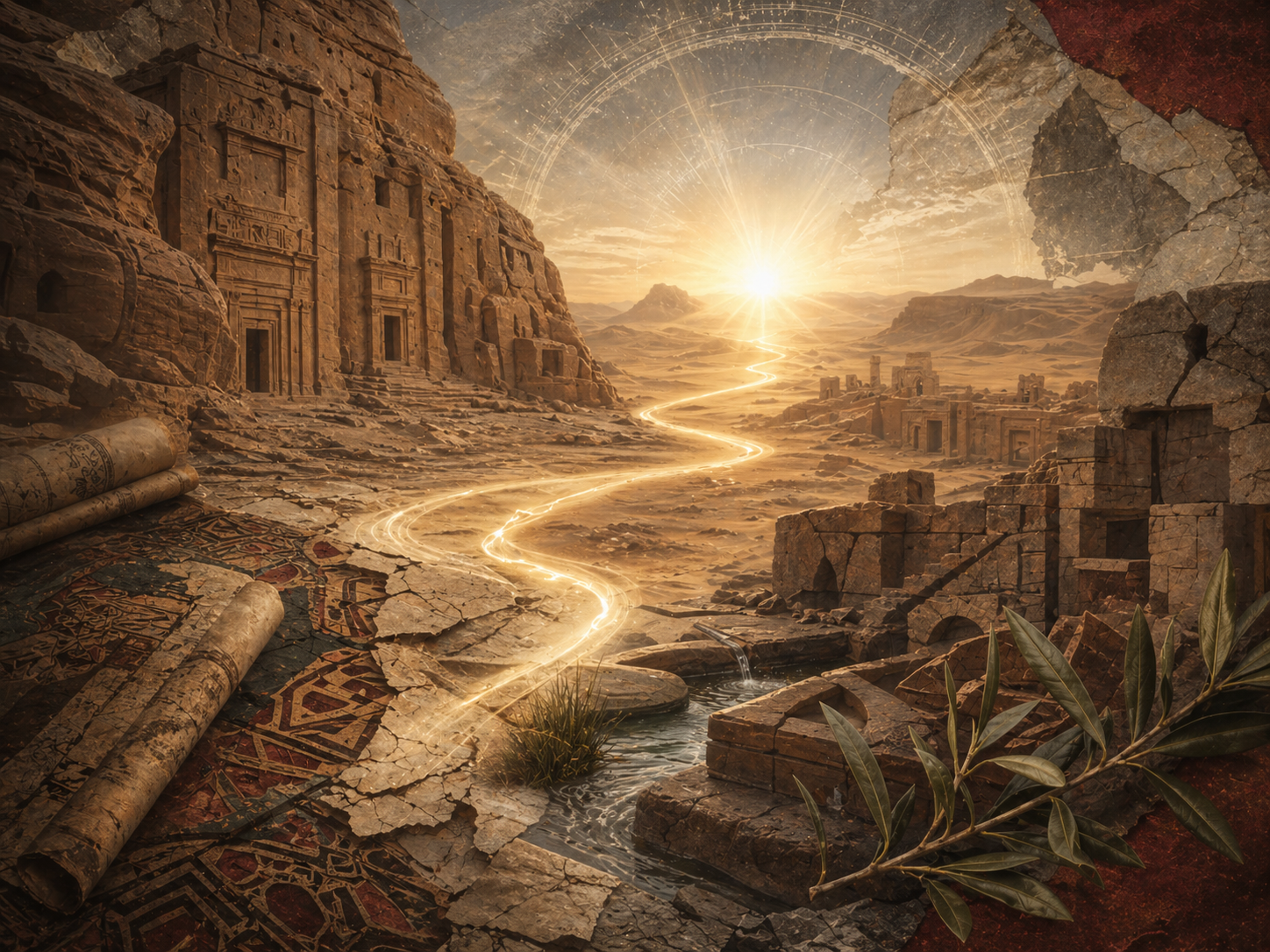
The Qur’an associates Thamud with al-Hijr, a region in the northwestern Arabian sacred landscape known for rock-cut remains and later associated with Hegra / Madā’in Ṣāliḥ. This geography matters because it places the story within Arabia’s own moral memory. As with Hud and al-Ahqaf, the Qur’an makes desert geography a site of warning.
Al-Hijr is a geography of stone, passage, ruin, and memory. Travelers may see carved dwellings and imagine permanence, but revelation teaches them to read differently. These are not merely archaeological curiosities. They are signs of a people that once felt secure and was not secure.
Qur’anic Text
وَلَقَدْ كَذَّبَ أَصْحَابُ الْحِجْرِ الْمُرْسَلِينَ
وَآتَيْنَاهُمْ آيَاتِنَا فَكَانُوا عَنْهَا مُعْرِضِينَ
وَكَانُوا يَنْحِتُونَ مِنَ الْجِبَالِ بُيُوتًا آمِنِينَThe people of al-Hijr denied the messengers. We gave them Our signs, but they turned away from them. They used to carve houses from the mountains, feeling secure.Qur’an 15:80–82. Arabic text with English rendering.
The passage connects place, rejection, signs, stone-cut architecture, and false security. Al-Hijr becomes sacred geography as warning.
The Qur’an repeatedly asks people to travel through the earth and consider the fate of those before them. This is not antiquarian interest. It is moral pedagogy. Ruins teach because they contradict pride. The stone that once seemed permanent becomes testimony that human settlement is fragile before divine judgment.
This mattered especially for Muhammad’s first audience. The story of Thamud was not distant in the way some Israelite narratives might have seemed. It belonged to the Arabian sphere of remembered peoples, routes, and ruins. The Qur’an’s warning therefore reached the Quraysh through a geography they could recognize: others before you were strong, settled, and confident, and they fell.
Al-Hijr is therefore not only a place. It is memory embedded in stone. It shows that the land itself can preserve revelation’s moral lesson after a civilization has disappeared.
At the same time, the article should distinguish Qur’anic sacred geography from modern archaeology. Hegra / Madā’in Ṣāliḥ is historically important as a Nabataean archaeological site, while the Qur’anic memory of Thamud carries a sacred moral meaning within Islamic revelation. The two should be discussed with care: archaeology can illuminate Arabian history and landscape, but the Qur’anic purpose remains ethical, theological, and prophetic.
Successors After ‘Ad
The Qur’an describes Thamud as successors after ‘Ad. This continuity is crucial. ‘Ad had already become a warning about strength without gratitude, architecture without humility, and wind-swept judgment after the rejection of Hud. Thamud inherits a world in which that lesson should have mattered.
Yet history often fails to teach those most in need of it. Thamud repeats the moral pattern of ‘Ad, but under different material conditions. ‘Ad is associated with great strength and lofty building; Thamud is associated with settlement, plains, and carving homes in the mountains. Both mistake material security for moral security.
Qur’anic Text
وَاذْكُرُوا إِذْ جَعَلَكُمْ خُلَفَاءَ مِن بَعْدِ عَادٍ وَبَوَّأَكُمْ فِي الْأَرْضِ تَتَّخِذُونَ مِن سُهُولِهَا قُصُورًا وَتَنْحِتُونَ الْجِبَالَ بُيُوتًا ۖ فَاذْكُرُوا آلَاءَ اللَّهِ وَلَا تَعْثَوْا فِي الْأَرْضِ مُفْسِدِينَRemember when He made you successors after ‘Ad and settled you in the land: you make palaces on its plains and carve houses in the mountains. So remember the bounties of Allah, and do not go about making corruption in the land.Qur’an 7:74. Arabic text with English rendering.
Salih turns succession into accountability. Settlement, architecture, and inherited land are not proof of exemption; they are reasons to remember God.
Succession is therefore a form of test. To come after a ruined people is to receive warning as inheritance. The question is whether the next civilization will remember what destroyed the previous one. Will it treat inherited land as trust, or as entitlement? Will it use skill with gratitude, or convert skill into arrogance?
The tragedy of Thamud is that it lives after warning and still rejects warning. Its people are not merely ignorant. They are spiritually inattentive to the moral pattern before them. The memory of ‘Ad does not reform them because pride makes inherited history seem irrelevant.
This is one of the deepest lessons of sacred history. Human beings often inherit ruins and build new arrogance beside them. Revelation asks whether memory can become humility before judgment arrives.
Carved Houses and the Illusion of Security
Thamud’s rock-cut dwellings are one of the most striking features of the Qur’anic account. The people carve homes into the mountains, suggesting skill, durability, labor, engineering, and confidence in stone. They do not merely live lightly upon the land. They cut into it and shape it as an architectural claim.
There is nothing inherently wrong with such skill. Human craft can serve shelter, beauty, community, and civilization. The Qur’an is not anti-architecture. It does not condemn technical mastery in itself. The danger begins when mastery becomes pride and pride becomes moral exemption.
Stone can create a powerful illusion. It makes human beings imagine that what is hard is permanent, that what is carved is secure, that what is engineered is beyond consequence. Thamud’s homes in the mountains become symbols of this illusion. They appear safer than tents, stronger than wood, more enduring than ordinary dwellings. Yet they cannot protect a people that has corrupted its covenant with God.
Qur’anic Text
وَتَنْحِتُونَ مِنَ الْجِبَالِ بُيُوتًا فَارِهِينَAnd you carve houses from the mountains with skill and pride.Qur’an 26:149. Arabic text with English rendering.
The warning is not against skill itself. It is against technical mastery turned into pride, luxury, and the illusion of permanence.
This is a key distinction. The houses do not fail as buildings. They fail as moral refuge. The people who lived in them imagined that material security could protect spiritual rebellion. The Qur’an reverses that assumption: security belongs to God, not stone.
Thamud’s carved houses therefore become one of the most powerful architectural warnings in scripture. A society can be highly skilled and still spiritually ruined. It can carve the mountain and fail to govern the heart.
The modern parallel is not difficult to see. Human beings still build systems that appear unassailable: financial systems, border systems, data systems, military systems, infrastructure systems, and elite enclaves of security. The Qur’anic question remains: are these systems governed by gratitude and justice, or by pride and fear?
Salih’s Message
Salih’s message begins where all prophetic messages begin: worship Allah, the One God; there is no god besides Him. This should be understood within the shared Abrahamic and Semitic field of monotheism. Allah is not a tribal deity, but the Arabic word for God, used by Muslims and also by Arabic-speaking Jews and Christians. Salih calls Thamud to the Creator, Lord, and Judge of all.
His message also includes remembrance. He reminds them that God settled them in the land, enabled them to build, and gave them bounties. Memory is central to Qur’anic ethics. To forget the source of blessing is to become ungrateful; to become ungrateful is to misuse blessing; to misuse blessing is to corrupt the land.
Salih’s warning against corruption in the land is especially important. The phrase joins theology to public ethics. False worship is not merely a private mistake; it produces social disorder. When a people forgets God, it begins to organize power around desire, hierarchy, extraction, domination, and impunity.
The prophet’s message is therefore not a narrow ritual instruction. It is civilizational reform. Worship the One God. Remember the bounties of God. Use settlement and architecture rightly. Do not make mischief. Do not violate the trust placed before you.
Like Hud, Salih warns before judgment. This means that warning itself is mercy. A prophet comes while repentance is still possible. The tragedy of Thamud is not that God gives no sign; it is that the people violate the sign after it has been given.
In this sense, Salih’s message moves from doctrine to practice. It is not enough for Thamud to hear the call to worship. They must show whether worship has become moral restraint. The she-camel turns their response into a public test: can they leave untouched what God has placed beyond their domination?
The She-Camel as a Sign
The she-camel is the defining sign in Salih’s story. Later traditions sometimes surround the she-camel with elaborate legendary details, but the Qur’an itself is more restrained. It treats her as a sign from God, a test, and a trust. The people are told to let her graze and drink, and not to harm her.
This restraint is important. The she-camel should not be reduced to spectacle. Her theological force lies in what she reveals about the people. Can a powerful society leave room for a sign that it does not own? Can it respect a living creature whose right has been established by God? Can it restrain itself when its arrogance wants control?
Qur’anic Text
قَدْ جَاءَتْكُم بَيِّنَةٌ مِّن رَّبِّكُمْ ۖ هَٰذِهِ نَاقَةُ اللَّهِ لَكُمْ آيَةً ۖ فَذَرُوهَا تَأْكُلْ فِي أَرْضِ اللَّهِ ۖ وَلَا تَمَسُّوهَا بِسُوءٍ فَيَأْخُذَكُمْ عَذَابٌ أَلِيمٌA clear proof has come to you from your Lord: this is Allah’s she-camel, a sign for you. So leave her to eat in Allah’s earth, and do not touch her with harm, lest a painful punishment seize you.Qur’an 7:73. Arabic text with English rendering.
The she-camel is a living sign. The test is whether Thamud can honor a boundary set by God within land and life it wrongly imagines it controls.
The she-camel is therefore a sign of divine sovereignty. She does not belong to Thamud merely because she appears within their territory. The land belongs to God. The water belongs to God. The creature belongs to God. The people’s treatment of her reveals whether they recognize any limit higher than their own will.
Her presence also introduces an ecological and moral dimension. The sign is not a monument, weapon, palace, or throne. It is living, vulnerable, dependent on water and pasture. The test is not whether Thamud can admire power. The test is whether Thamud can protect vulnerability under divine command.
In this sense, the she-camel becomes one of the Qur’an’s most profound signs of restraint. She exposes a civilization’s relation to life, land, water, and sacred trust.
Water, Pasture, and the Ethics of Restraint
The Qur’anic she-camel sign is inseparable from water. In a desert setting, water is not a symbolic detail added for ornament. It is life, survival, settlement, economy, and power. Whoever controls water controls the conditions of existence. The she-camel’s drinking right therefore becomes a direct challenge to Thamud’s possessive imagination.
The people are not merely told to tolerate an animal. They are told to recognize a divinely established claim upon shared resources. The water is not entirely theirs to command. A living sign of God has a portion. Their obedience is measured through restraint in relation to land, pasture, and water.
Qur’anic Text
إِنَّا مُرْسِلُوا النَّاقَةِ فِتْنَةً لَّهُمْ فَارْتَقِبْهُمْ وَاصْطَبِرْ
وَنَبِّئْهُمْ أَنَّ الْمَاءَ قِسْمَةٌ بَيْنَهُمْ ۖ كُلُّ شِرْبٍ مُّحْتَضَرٌWe are sending the she-camel as a trial for them, so watch them and be patient. Inform them that the water is to be shared between them; each drinking turn is to be attended.Qur’an 54:27–28. Arabic text with English rendering.
The sign includes a water ethic. The test is whether a settled, powerful people can accept limits on resource use when those limits are commanded by God.
This makes the story remarkably relevant to ecological interpretation. The Qur’an does not present the she-camel as an abstract theological puzzle. It places her within a world of grazing, drinking, land, and public obedience. The sign is ecological because it concerns how a community treats living beings and shared resources. It is moral because the community has the power to violate the trust.
Water-sharing is therefore not incidental. It reveals whether Thamud’s society is capable of acknowledging a claim beyond its own appetite. A people that cannot share water with a sign of God is not merely impatient. It is spiritually unfit for the trust of settlement.
Salih’s story turns resource restraint into revelation. To obey God is not only to believe correctly, but to honor boundaries in the material world.
This is why the she-camel should be read with more seriousness than a decorative miracle story. She embodies a theological claim about ownership: the earth is not absolute human property. Water is not morally empty matter. Living beings are not merely instruments of human convenience. A creature named by God as a sign becomes a test of whether human power can bow before divine limit.
Do Not Touch Her with Harm
Salih’s command regarding the she-camel is direct: do not touch her with harm. This is not only a rule about one animal. It is a test of obedience, restraint, and reverence for a sign that belongs to God.
The command is simple precisely because the people’s moral condition is complex. A corrupt society often needs an unmistakable test. The she-camel stands before them as a visible boundary. They may argue about Salih’s authority, mock his message, and question his motives, but the sign makes their defiance concrete. To harm her is to cross a line knowingly.
The instruction also challenges possessiveness. Thamud has carved houses, settled land, and organized power. It may imagine that everything within its territory exists for its use. The she-camel interrupts that assumption. She says, in effect, that not everything in the land is yours to dominate.
Qur’anic Text
فَقَالَ لَهُمْ رَسُولُ اللَّهِ نَاقَةَ اللَّهِ وَسُقْيَاهَاThe messenger of Allah said to them: Allah’s she-camel — and her drink.Qur’an 91:13. Arabic text with English rendering.
The warning is compressed into a sacred boundary: the she-camel belongs to God, and her right to drink must not be violated.
This is why the sign has enduring moral power. Every society encounters limits it does not create: the rights of the vulnerable, the claims of the poor, the integrity of land and water, the sanctity of life, the command of God, and the consequences of injustice. A society’s morality is revealed by whether it honors limits when it has the power to violate them.
Thamud fails because it treats the boundary as an insult. Instead of receiving restraint as mercy, it interprets restraint as threat. The people are not asked to perform an impossible act of piety. They are asked not to harm. Their rebellion therefore exposes the violence hidden inside possessive pride.
Public Corruption and the Nine Leaders
The Qur’an refers to a group of corrupt leaders in the city who make mischief in the land and do not act rightly. They are associated with plotting against Salih and his household. This detail matters because Thamud’s rejection is not only popular disbelief. It is organized corruption.
Public evil often becomes most dangerous when it is led by influential factions. A whole people may be weak, confused, afraid, or divided, but corrupt leadership can organize defiance into policy. It can turn resentment into violence, mockery into plot, and disbelief into public action.
Qur’anic Text
وَكَانَ فِي الْمَدِينَةِ تِسْعَةُ رَهْطٍ يُفْسِدُونَ فِي الْأَرْضِ وَلَا يُصْلِحُونَThere were in the city nine men who made corruption in the land and did not set things right.Qur’an 27:48. Arabic text with English rendering.
Thamud’s rebellion is not only private disbelief. It is organized public corruption led by powerful actors who refuse reform.
The nine leaders in Salih’s story represent this pattern. They are not merely mistaken individuals. They are agents of corruption in the land. Their power lies not only in what they believe, but in what they coordinate. They make evil collective.
This explains why the killing of the she-camel is not a random act of cruelty. It belongs to a broader political and moral atmosphere. The sign is harmed because the people’s corrupt leadership has chosen defiance. The attack on the she-camel and the plot against Salih belong to the same rebellion against divine warning.
Salih’s story therefore exposes the public structure of sin. Civilizational collapse does not always begin with visible disaster. It may begin with leaders who normalize corruption, despise limits, and organize society against the voice of conscience.
This remains a modern warning. Corruption in the land is rarely only private vice. It is often coordinated by people with influence: political actors, economic elites, armed factions, ideological leaders, or cultural gatekeepers who turn public systems against reform. Thamud’s nine leaders show how a society can become dangerous when power organizes itself against truth.
The Killing of the She-Camel
The killing of the she-camel marks the decisive rupture in the story of Thamud. The people have received warning. They have seen the sign. They have been told not to harm her. They know the boundary. When they violate it, the moral argument is over. Their rejection has become action.
In the Qur’anic frame used here, the killing of the she-camel should not be buried beneath later legendary detail. Its core significance is clearer and stronger without embellishment. A society entrusted with a sign destroys it. A people warned against harm commits harm. Those told to restrain themselves choose transgression.
Qur’anic Text
فَكَذَّبُوهُ فَعَقَرُوهَا فَدَمْدَمَ عَلَيْهِمْ رَبُّهُم بِذَنبِهِمْ فَسَوَّاهَاBut they denied him and hamstrung her; so their Lord brought destruction upon them for their sin and leveled it.Qur’an 91:14. Arabic text with English rendering.
The killing of the she-camel turns rejection into public violation. The sign is no longer merely denied; it is attacked.
The act also reveals contempt for prophetic authority. To kill the she-camel is to say that Salih’s warning does not matter, that God’s sign does not matter, that restraint does not matter, and that the powerful may do what they wish. It is a public declaration of rebellion.
The killing may also be read in connection with the wider plot against Salih himself. Once a people violates the sign, the messenger is next. The harm done to the she-camel becomes a sign that the people have moved from denial to aggression. They are no longer simply refusing belief; they are preparing to erase the warning.
That is why judgment follows. The issue is not merely animal cruelty, though cruelty is present. The deeper issue is violated revelation, rejected mercy, organized corruption, and the refusal of a powerful people to accept any limit before God.
The she-camel’s death also exposes the violence hidden behind civilization’s self-image. A people may describe itself as settled, skilled, practical, and secure. But when it destroys a living sign because that sign limits its freedom, its real condition is revealed. The carved house can hide the corrupt heart only for a time.
The Cry, the Earthquake, and Judgment
The Qur’an describes the destruction of Thamud through images of earthquake, overwhelming cry, thunderous blast, and sudden collapse. These descriptions are not contradictions in moral meaning. They evoke a catastrophic judgment that overturns the people’s imagined security.
The form of judgment is significant. Thamud has carved homes in mountains and trusted in solid ground. Yet the earth itself becomes unstable. The people who sought security in stone are shaken. The structures that seemed protective cannot save them. The land they corrupted becomes the field of consequence.
Qur’anic Text
فَأَخَذَتْهُمُ الرَّجْفَةُ فَأَصْبَحُوا فِي دَارِهِمْ جَاثِمِينَThen the earthquake seized them, and they became lifeless in their dwelling-place.Qur’an 7:78. Arabic text with English rendering.
The people who trusted settlement and stone are overtaken in the very place where they imagined themselves secure.
As with all prophetic judgment narratives, this should not be used carelessly to interpret every earthquake or disaster as punishment. The Qur’an is narrating a specific revealed history: a prophet warned, a sign was given, a people defied, and judgment came. The story is moral instruction, not permission for cruelty toward victims of natural catastrophe.
Still, the symbolism is powerful. Earthquake and cry both expose the limits of human control. Human beings build on the earth, but they do not own the earth. They speak loudly in pride, but a cry greater than theirs can silence them. They carve stone, but stone is not God.
The judgment of Thamud therefore completes the warning of Salih. Architecture without obedience cannot save. Settlement without gratitude cannot endure. A sign violated becomes a witness against those who violated it.
Qur’anic Text
كَذَّبَتْ ثَمُودُ بِطَغْوَاهَا
إِذِ انبَعَثَ أَشْقَاهَا
فَقَالَ لَهُمْ رَسُولُ اللَّهِ نَاقَةَ اللَّهِ وَسُقْيَاهَا
فَكَذَّبُوهُ فَعَقَرُوهَاThamud denied through its transgression, when its most wretched one rose up. The messenger of Allah said to them: Allah’s she-camel and her drink. But they denied him and hamstrung her.Qur’an 91:11–14. Arabic text with English rendering.
The Qur’an places the catastrophe after transgression, warning, boundary, and violation. Judgment follows the rejection of mercy.
The collapse of Thamud should therefore be read as theological warning and moral pedagogy. It teaches that the created order is not morally neutral in relation to human arrogance. The earth on which people build remains God’s earth, and a civilization that corrupts its trust cannot make itself safe by cutting deeper into stone.
Salih and the Universality of Prophecy
Salih’s story matters because it reinforces the Qur’an’s universal doctrine of prophecy. God’s guidance is not confined to the biblical record. Prophets are sent to communities outside the Israelite narrative, and those communities are morally accountable to the same One God.
This universality is one of Islam’s most important contributions to Abrahamic sacred history. It allows the Qur’an to honor biblical prophets while also preserving prophetic memories unknown to the Bible. Hud and Salih are not lesser because they are not biblical. They are signs that revelation is wider than one archive.
This does not mean that Jewish and Christian traditions must incorporate Salih into their own canon. It means that, from the Qur’anic perspective, sacred history is broader than the canon of any one community. The Lord of the worlds sends messengers to peoples known and unknown.
Salih also shows that the content of prophecy is unified even where the historical settings differ. Whether the prophet is sent to Israel, Egypt, Makkah, ‘Ad, or Thamud, the moral structure remains: worship God, reject false gods, honor divine signs, do justice, stop corruption, and remember the final accountability of human action.
In this way, Salih becomes both local and universal. He is sent to Thamud, but his warning belongs to every people that builds, settles, prospers, and begins to believe that God’s limits no longer apply.
Qur’anic Text
وَمَا كَانَ رَبُّكَ مُهْلِكَ الْقُرَىٰ حَتَّىٰ يَبْعَثَ فِي أُمِّهَا رَسُولًا يَتْلُو عَلَيْهِمْ آيَاتِنَا ۚ وَمَا كُنَّا مُهْلِكِي الْقُرَىٰ إِلَّا وَأَهْلُهَا ظَالِمُونَYour Lord would not destroy towns until He had sent in their mother-city a messenger reciting Our signs to them; and We do not destroy towns except while their people are wrongdoers.Qur’an 28:59. Arabic text with English rendering.
The Qur’anic pattern links accountability to warning. Judgment is not arbitrary; it follows moral corruption after guidance has been made clear.
The universality of prophecy also creates humility. No community can claim that God’s guidance belongs only to itself. Every people stands under the same divine accountability. Salih’s story widens the Abrahamic imagination by preserving the memory of a prophet outside biblical canon but inside the mercy and justice of the One God.
Salih, Hud, and Muhammad
Salih’s story is closely linked with Hud’s because Thamud follows ‘Ad in the Qur’anic memory of Arabian prophetic warning. Hud addresses a powerful people destroyed by wind; Salih addresses a settled people destroyed after violating a sign. Together, they form a paired warning about strength and settlement, architecture and arrogance, warning and rejection.
Their stories also speak directly to Muhammad’s audience. The Qur’an’s first hearers in Arabia were being reminded that divine warning had come to Arab peoples before. The Quraysh could not dismiss prophecy as something foreign, Israelite, or irrelevant. The history of ‘Ad and Thamud stood as warning within their own broader sacred landscape.
Muhammad’s mission is final and universal, but the earlier Arabian prophets prepare the moral ground. Hud and Salih show that Arabia is not outside prophetic history. The Qur’an does not introduce revelation into an empty land. It restores and completes a divine pattern already present in Arabian memory.
Salih also prefigures Muhammad in the experience of rejection. The messenger is accused, mocked, opposed, and threatened. Corrupt leaders plot. The powerful resent limits. The prophet warns without seeking worldly reward. God vindicates the messenger after patient warning.
The relationship between Salih and Muhammad therefore reveals continuity and completion. Salih warns Thamud; Muhammad receives the Qur’an that preserves Salih’s warning for all peoples. The local sign becomes universal recitation.
That transformation matters. The she-camel was a sign for Thamud in one sacred geography. The Qur’an makes her a sign for every reader. What Thamud did in one land becomes a permanent test of how all peoples treat divine boundaries, living vulnerability, and shared resources.
Salih as Sacred Anthropology
Salih belongs to sacred anthropology because his story reveals the human community under conditions of settlement, skill, resource control, public corruption, and defiance of restraint. Adam reveals humanity as created and guided. Noah reveals warning before collapse. Abraham reveals faith against idolatry. Moses reveals liberation from tyranny. David and Solomon reveal the testing of power, kingship, and splendor. Hud reveals civilization intoxicated by strength. Salih reveals civilization intoxicated by security.
The people of Thamud are not weak. They have land, settlement, technical skill, carved dwellings, leadership, water systems, and confidence. Their problem is not incapacity. Their problem is moral misdirection. They know how to shape stone, but not how to restrain desire. They know how to inhabit land, but not how to receive land as trust. They know how to build, but not how to obey.
The she-camel reveals the human being before a vulnerable sign. This is one of the deepest features of the story. Many societies can admire strength. Fewer can protect what is weak, dependent, inconvenient, or placed beyond their ownership. The she-camel tests whether power can coexist with reverence.
The water-sharing command deepens this anthropology. Human beings often treat shared resources as private possession when power allows them to do so. Revelation interrupts that illusion. The land is God’s earth. The water is not morally ownerless. The living creature has a claim because God establishes it.
As sacred anthropology, Salih teaches that human beings are judged not only by what they build, but by what they refuse to violate. A civilization’s true character appears at the boundary: when it is told, “Do not touch this with harm.”
Salih also reveals that human technical skill is spiritually ambiguous. The same capacity that can carve shelter from mountains can also deepen the illusion of self-sufficiency. Skill becomes sacred when governed by gratitude, service, and restraint. Skill becomes dangerous when it teaches a people that it no longer needs God.
Marginalized Voices: Nonbiblical Prophecy, Living Signs, and Resource Justice
Salih matters for marginalized voices because he preserves sacred memory beyond the biblical canon. A comparative Abrahamic project can too easily focus only on figures recognized within Jewish and Christian textual traditions. The Qur’an expands that frame. Salih’s prophetic dignity shows that divine warning is not limited to the communities whose archives became most familiar to the later Abrahamic world.
This does not require Jewish or Christian readers to accept Salih as a prophet within their own canon. It means that Islamic sacred history gives voice to a wider map of revelation. Forgotten peoples, desert communities, non-Israelite prophets, and Arabian landscapes are not outside God’s concern. Salih’s story helps resist the assumption that sacred history belongs only to the most textually dominant or institutionally preserved traditions.
The she-camel also brings marginalized life into the center of theology. The sign is not a king, warrior, palace, book, or priestly institution. It is a living creature with a right to pasture and water. The vulnerable body becomes the test of a powerful society. This is spiritually important. The weak, dependent, inconvenient, and nonhuman are often where the truth of power is revealed.
Resource justice is also central. The water-sharing command means that the sign of God makes a claim on public life. Thamud cannot treat water as merely a private resource controlled by the powerful. The test is whether a settled society will accept that access to life-sustaining resources is morally governed. This speaks directly to contemporary struggles over water, land, food systems, extractive development, ecological damage, and the unequal distribution of environmental harm.
The nine corrupt leaders show another marginalized-voices dimension. Oppression is often coordinated from above. The vulnerable suffer when elite factions convert public systems into instruments of impunity. Salih’s story names that pattern without hiding it behind vague moral language: there were leaders who corrupted the land and did not set things right.
From this perspective, Salih and Thamud are not only ancient. They speak wherever living beings, poor communities, Indigenous communities, desert peoples, rural populations, migrants, animals, water systems, and fragile ecologies are sacrificed to the confidence of the powerful. The she-camel still asks whether a society can honor a boundary it has the power to violate.
Jewish, Christian, Sunni, Shia, and Ahmadi Perspectives
Jewish and Christian traditions do not preserve Salih as a canonical prophet. This absence marks a real difference in sacred memory. From a comparative perspective, Salih can still be understood as an Islamic witness to a broader prophetic principle: God holds all peoples accountable, and powerful societies are judged by justice, gratitude, restraint, and worship of the One God.
For Jewish and Christian readers, the themes of Salih’s story resonate with biblical prophetic concerns even if Salih himself is not a biblical figure. The critique of arrogance, corruption, false security, exploitation of land, rejection of warning, and organized leadership against truth is deeply familiar across biblical prophecy.
Sunni Islamic tradition honors Salih as a prophet sent to Thamud. His story is read as a warning against shirk, arrogance, corruption, and defiance of divine signs. The she-camel is remembered as a sign from God, and the destruction of Thamud as a judgment after repeated warning.
Shia perspectives also honor Salih as one of the prophets in the chain of divine guidance. His struggle against corrupt leaders, organized mischief, and rejection of a divine sign resonates with broader themes of truth against unjust authority, divine proof against denial, and the vulnerability of God’s servants before worldly power.
Lahore Ahmadiyya interpretation emphasizes the Qur’an’s moral clarity and restraint. The she-camel is treated as a sign without requiring later legendary elaboration, and the story is read as a lesson in righteousness, divine warning, ecological restraint, and the uprooting of evil rather than as spectacle. Salih and Thamud become a moral pattern: a powerful people violates trust, rejects reform, and collapses under the consequences of its own defiance.
Across these perspectives, Salih’s importance lies partly in his nonbiblical status. He helps show that Islam’s sacred history honors the Hebrew Bible and Gospel while also preserving prophetic memories outside them. The Qur’anic map of revelation is not narrower than the biblical map; it is wider, extending warning and mercy to peoples whose records may otherwise be forgotten.
Why Salih and Thamud Matter Today
Salih and Thamud matter today because modern societies also trust carved stone. They may not carve houses into mountains in the same way, but they build towers, dams, highways, data centers, ports, campuses, financial districts, gated communities, and fortified systems of wealth. They confuse infrastructure with righteousness and durability with wisdom.
They matter because the she-camel remains a living symbol of violated trust. Every society has signs it is told not to harm: vulnerable people, water, land, animals, public truth, moral limits, sacred memory, ecological systems, and the rights of those without power. A civilization reveals itself by whether it protects what it can easily destroy.
They matter because corruption in the land is still one of the great spiritual diagnoses. The phrase speaks not only to private sin, but to public disorder: extractive economies, environmental damage, political impunity, social cruelty, religious hypocrisy, and elite coordination against truth. Salih’s warning is therefore not ancient only. It names the structure of many modern crises.
They matter because powerful factions still organize rejection of warning. Scientists, reformers, prophets, journalists, jurists, activists, religious witnesses, and moral critics are often dismissed or threatened when they challenge a system’s confidence. Thamud’s corrupt leaders show how public corruption turns warning into a target.
They matter because technical mastery can become spiritually dangerous. A people that can carve mountains may begin to think it is beyond judgment. A people that can engineer systems may begin to think moral law is obsolete. Salih’s story says otherwise. Skill is a gift, not a guarantee. Settlement is a trust, not a possession.
The final lesson of Salih and the people of Thamud is that civilization is judged by how it treats the trust of God. The people built on plains and carved into mountains, but they could not carve themselves out of accountability. Their ruins teach what their pride refused to learn: worship the One God, remember His bounties, do not corrupt the land, and do not violate the sign placed before you.
Comparative Cautions
Several cautions are necessary. First, Salih should be presented as a Qur’anic prophet, not retroactively forced into Jewish or Christian canon. His importance belongs to Islamic sacred history, while his themes can still be compared with wider Abrahamic prophetic concerns.
Second, Thamud should not be treated only as a lost-civilization mystery. Archaeology, geography, inscriptions, and ancient Arabian history are relevant, but the Qur’an’s primary purpose is moral warning, not speculative reconstruction.
Third, al-Hijr / Hegra / Madā’in Ṣāliḥ should be discussed carefully. The UNESCO-recognized archaeological site is historically important, especially in relation to Nabataean remains, while the Qur’anic Thamud narrative functions as sacred warning. The article should avoid collapsing archaeology, later Islamic memory, and Qur’anic revelation into one simplistic claim.
Fourth, the she-camel should not be overburdened with legendary embellishment when the Qur’anic text already gives a powerful moral structure: sign, water-sharing, restraint, warning, violation, and judgment.
Fifth, the story should not be used to interpret every earthquake, cry, disaster, drought, or environmental crisis as divine punishment. The Qur’anic account concerns a specific people, prophet, sign, and rejection. Modern applications should be ethical and reflective, not accusatory toward victims.
Sixth, the ecological reading should remain grounded in the text. The she-camel, water-sharing, pasture, land, and harm language support a serious ecological and resource-justice interpretation, but the article should not pretend that the story is only about modern environmentalism.
Seventh, Salih’s nonbiblical status should be framed constructively. His story widens sacred geography and helps show that Qur’anic revelation preserves prophetic memories beyond the Bible.
Eighth, original-language quotations should support close reading. Arabic should be used where it clarifies the Qur’anic argument, not merely as ornament.
Finally, Salih should challenge the reader morally. The question is not only what happened to Thamud. The question is where contemporary societies repeat Thamud’s pattern: technical mastery without humility, settlement without gratitude, resource control without restraint, and sacred trust violated by organized power.
Why This Article Matters
Salih matters because he expands the Abrahamic map beyond the biblical corridor. His story shows that the Qur’an preserves prophetic memories outside Jewish and Christian canon while still teaching the same central moral demand: worship the One God, honor divine signs, reject corruption, and live under accountability.
This article matters because Thamud is one of the Qur’an’s clearest warnings about technical civilization. The people are not remembered as weak or incapable. They are remembered as skilled, settled, confident, and secure in carved stone. Their failure is therefore not a failure of engineering. It is a failure of gratitude, restraint, and obedience.
For the Abrahamic Traditions knowledge series, this article builds on Hud and the People of ‘Ad, Noah / Nuh, Judgment, and Survival, Muhammad and the Completion of Prophetic Revelation, Jonah / Yunus, Repentance, and Mercy, Abraham / Ibrahim as Patriarch, Model of Faith, and Friend of God, and What Is Prophecy in the Abrahamic Traditions?. It prepares later articles on Shu‘ayb and Madyan, Arabian sacred geography, Qur’anic warning narratives, ecological ethics, and the moral meaning of destroyed civilizations.
Seen from the perspective of marginalized voices, this article matters because the she-camel places living vulnerability at the center of sacred history. A powerful people is tested by how it treats a creature, water, pasture, and a boundary it has the ability to violate. The story therefore speaks to every system that sacrifices the vulnerable to the convenience of the powerful.
The final value of Salih’s story is that it teaches sacred restraint. A civilization may build greatly, settle securely, and master its landscape, but it is still judged by what it refuses to harm. Thamud carved houses in mountains, but could not carve itself free from accountability. Salih’s warning still stands: remember God’s bounties, do not corrupt the land, and do not touch the trust of God with harm.
Related Reading
- Hud and the People of ‘Ad
- Muhammad and the Completion of Prophetic Revelation
- Jesus / ‘Isa in Biblical and Qur’anic Sacred History
- Jonah / Yunus, Repentance, and Mercy
- Noah / Nuh, Judgment, and Survival
- Abraham / Ibrahim as Patriarch, Model of Faith, and Friend of God
- What Is Prophecy in the Abrahamic Traditions?
- Monotheism, Revelation, and Sacred History
- The Promise of the Abrahamic Frame: One God, Shared Revelation, and Sacred History
- Abrahamic Traditions: Prophecy, Revelation, Law, and Sacred History
- Religion and Ecology
- Religion and Law
- Comparative Sacred Themes
Further Reading
- Ali, M.M. (n.d.) History of the Prophets. Lahore: Ahmadiyya Anjuman Isha‘at Islam. Available at: https://www.alahmadiyya.org/books-islam-ahmadiyya/english-books/history-of-the-prophets/
- Ali, M.M. (2010) English Translation of the Holy Quran with Explanatory Notes. Edited by Zahid Aziz. Wembley: Ahmadiyya Anjuman Lahore Publications. Available at: https://www.ahmadiyya.org/quran/english-quran-with-short-commentary.htm
- Armstrong, K. (1993) A History of God: The 4,000-Year Quest of Judaism, Christianity and Islam. New York: Knopf. Available at: https://www.penguinrandomhouse.com/
- Berkey, J.P. (2003) The Formation of Islam: Religion and Society in the Near East, 600–1800. Cambridge: Cambridge University Press. Available at: https://www.cambridge.org/
- Hoyland, R.G. (2001) Arabia and the Arabs: From the Bronze Age to the Coming of Islam. London: Routledge. Available at: https://www.routledge.com/
- Nasr, S.H. et al. (eds.) (2015) The Study Quran: A New Translation and Commentary. New York: HarperOne. Available at: https://www.harpercollins.com/
- Neuwirth, A. (2019) The Qur’an and Late Antiquity: A Shared Heritage. Oxford: Oxford University Press. Available at: https://global.oup.com/
- Robin, C.J. (2015) ‘Arabia and Ethiopia’, in Johnson, S.F. (ed.) The Oxford Handbook of Late Antiquity. Oxford: Oxford University Press. Available at: https://global.oup.com/
- Sinai, N. (2017) The Qur’an: A Historical-Critical Introduction. Edinburgh: Edinburgh University Press. Available at: https://edinburghuniversitypress.com/
- UNESCO World Heritage Centre (n.d.) ‘Hegra Archaeological Site (al-Hijr / Madā’in Ṣāliḥ)’. Available at: https://whc.unesco.org/en/list/1293/
References
- Ali, M.M. (n.d.) History of the Prophets. Lahore: Ahmadiyya Anjuman Isha‘at Islam. Available at: https://www.alahmadiyya.org/books-islam-ahmadiyya/english-books/history-of-the-prophets/
- Ali, M.M. (2010) English Translation of the Holy Quran with Explanatory Notes. Edited by Zahid Aziz. Wembley: Ahmadiyya Anjuman Lahore Publications. Available at: https://www.ahmadiyya.org/quran/english-quran-with-short-commentary.htm
- Quran.com (n.d.) Surah Al-A‘raf 7:73–79. Available at: https://quran.com/7/73-79
- Quran.com (n.d.) Surah Hud 11:61–68. Available at: https://quran.com/11/61-68
- Quran.com (n.d.) Surah Al-Hijr 15:80–84. Available at: https://quran.com/15/80-84
- Quran.com (n.d.) Surah Al-Isra 17:59. Available at: https://quran.com/17/59
- Quran.com (n.d.) Surah Ash-Shu‘ara 26:141–159. Available at: https://quran.com/26/141-159
- Quran.com (n.d.) Surah An-Naml 27:45–53. Available at: https://quran.com/27/45-53
- Quran.com (n.d.) Surah Al-Qasas 28:59. Available at: https://quran.com/28/59
- Quran.com (n.d.) Surah Fussilat 41:17–18. Available at: https://quran.com/41/17-18
- Quran.com (n.d.) Surah Adh-Dhariyat 51:43–45. Available at: https://quran.com/51/43-45
- Quran.com (n.d.) Surah Al-Qamar 54:23–31. Available at: https://quran.com/54/23-31
- Quran.com (n.d.) Surah Al-Haqqah 69:4–5. Available at: https://quran.com/69/4-5
- Quran.com (n.d.) Surah Ash-Shams 91:11–15. Available at: https://quran.com/91/11-15
- UNESCO World Heritage Centre (n.d.) ‘Hegra Archaeological Site (al-Hijr / Madā’in Ṣāliḥ)’. Available at: https://whc.unesco.org/en/list/1293/
- Encyclopaedia Britannica (n.d.) ‘Thamūd’. Available at: https://www.britannica.com/topic/Thamud
- Ahmad, H.M.G. (2003) The Ark of Noah. Trinidad and Tobago: Muslim Literary Trust. Available at: https://www.alahmadiyya.org/books-islam-ahmadiyya/english-books/the-ark-of-noah/
- Al-Islam.org (n.d.) Ahlul Bayt Digital Islamic Library Project. Available at: https://www.al-islam.org/
- Sunnah.com (n.d.) Hadith Collections. Available at: https://sunnah.com/
- Sefaria (n.d.) Jewish Texts and Rabbinic Interpretation. Available at: https://www.sefaria.org/texts