
Last Updated May 28, 2026
Moral psychology, propaganda, and political polarization belong together because propaganda does not work only by transmitting falsehood. It works by shaping attention, emotion, trust, salience, identity, and the moral categories through which people interpret public life. Political polarization, meanwhile, is not simply the coexistence of different opinions. It is the hardening of moral and social division through antagonistic identity, selective trust, and mutually reinforcing narratives about threat, betrayal, legitimacy, corruption, purity, and danger.
When propaganda enters polarized environments, it often does more than persuade. It reorganizes the moral world in which persuasion occurs. It tells people which harms matter, which authorities can be trusted, which institutions are corrupt, which groups are innocent, which groups are dangerous, and which forms of exclusion or punishment feel morally necessary. In that sense, propaganda is not only an informational problem. It is a moral-psychological problem.
A serious account of this subject must therefore move beyond the narrow picture of propaganda as crude top-down deception. Propaganda can be subtle, ambient, aesthetic, repetitive, identity-confirming, emotionally charged, or epistemically corrosive. It may aim not only to make citizens believe a specific claim, but to shape what seems credible, what feels urgent, who appears trustworthy, and which groups are imagined as morally dangerous. In polarized political life, these effects matter immensely because they influence not only belief but moral perception itself.
Main Library
Publications
Article Map
Moral Psychology
Related Topic
Social Psychology
Related Topic
Political Philosophy & Justice
Related Topic
Institutional Psychology
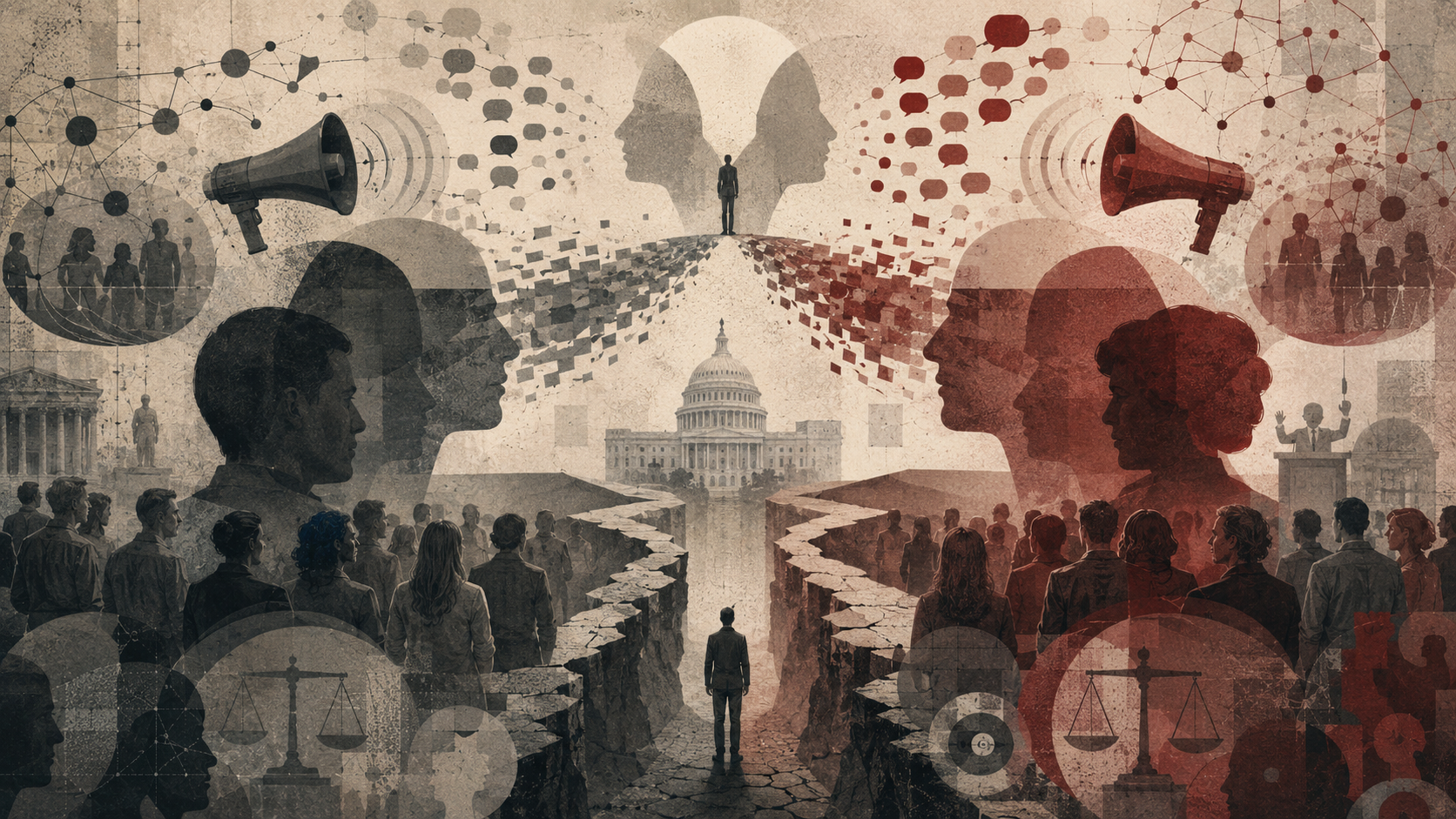
This article argues that propaganda is most dangerous when it changes the moral conditions under which citizens interpret reality. It can make cruelty appear defensive, exclusion appear protective, humiliation appear deserved, and democratic disagreement appear existential. It can weaken shared standards of evidence, narrow the circle of legitimate concern, and turn political identity into a moral filter through which every institution, source, opponent, and public event is interpreted.
Understanding propaganda therefore requires more than fact-checking, although fact-checking matters. It requires attention to moral emotion, group identity, trust allocation, threat perception, dehumanization, repetition, selective exposure, social media dynamics, ideology, and the civic conditions under which people remain capable of hearing one another. Moral psychology helps explain why propaganda succeeds, why polarization makes it more durable, and why democratic repair must be moral and institutional as well as informational.
What Moral Psychology, Propaganda, and Political Polarization Are
Moral psychology studies how people perceive wrongdoing, assign blame, interpret fairness, respond to threat, evaluate harm, and organize moral judgment. It asks how people come to see some actions as wrong, some groups as trustworthy, some harms as urgent, some institutions as legitimate, and some responses as justified. Propaganda refers to strategic communication that seeks to shape public consciousness, perception, and allegiance in politically consequential ways. Political polarization refers to the widening divergence of identities, judgments, and affective orientations across political groups, often accompanied by distrust, hostility, and reduced willingness to treat opponents as legitimate members of a shared public.
These concepts intersect because propaganda often works by exploiting the same psychological processes that sustain moral and political division: group identification, threat sensitivity, motivated reasoning, selective trust, outrage, and moralized narratives about innocence and corruption. Political conflict is therefore not merely a battle over facts. It is often a struggle over what kind of moral reality citizens inhabit.
In polarized environments, political messages are rarely received as neutral information. They are interpreted through prior loyalties, trusted sources, group memories, perceived injuries, social identities, religious or ideological commitments, class experience, racialized histories, and institutional trust or distrust. A message that appears absurd to one group may feel self-evident to another because it resonates with a different moral story about who has been betrayed, who is dangerous, and what institutions are hiding.
Moral psychology is essential here because propaganda often acts on pre-rational and social layers of judgment. It does not simply ask people to evaluate a proposition. It invites them to feel threatened, betrayed, humiliated, proud, purified, endangered, loyal, or enraged. It organizes attention before argument. It distributes trust before evidence. It names enemies before deliberation. That is why propaganda can endure even when particular claims are debunked: the deeper moral frame remains intact.
| Concept | Core meaning | Moral-psychological significance |
|---|---|---|
| Moral psychology | Study of moral judgment, emotion, blame, responsibility, identity, and action | Explains how citizens perceive harm, threat, legitimacy, and responsibility. |
| Propaganda | Strategic communication that shapes political consciousness and allegiance | Works through salience, repetition, identity, fear, trust, and moral framing. |
| Political polarization | Hardening of political identity, distrust, and affective division | Turns disagreement into moral antagonism and reduces shared civic interpretation. |
| Epistemic fragmentation | Breakdown of shared standards of trust, evidence, and credibility | Makes moral disagreement harder to adjudicate through common facts. |
| Moral exclusion | Removal of groups from the circle of legitimate concern | Weakens restraints against cruelty, humiliation, repression, or violence. |
Why Propaganda Must Be Understood Morally
Propaganda must be understood morally because its power often lies in its ability to shape who is seen as victim, aggressor, patriot, traitor, pure, corrupt, deserving, or dangerous. It does not merely tell people what to think about policies. It helps organize moral maps. It tells citizens which harms matter, which indignities count, whose suffering is visible, and which authorities deserve trust.
This is why propaganda is especially potent in polarized settings. Once politics becomes moralized, messages no longer function only as information. They function as cues about threat, loyalty, contamination, betrayal, and belonging. Political communication then works not only on belief but on conscience, disgust, fear, anger, resentment, pride, humiliation, and group identity.
A propaganda system succeeds when it makes moral interpretation feel immediate. It gives people a ready-made structure for judging events: who did this, why they did it, what it proves, whom to distrust, whom to defend, and what response is justified. In this way, propaganda shortens the distance between perception and condemnation. It turns complexity into moral certainty.
That certainty can be emotionally satisfying. It relieves ambiguity, names enemies, preserves group innocence, and transforms anxiety into purposeful anger. But it is dangerous because it can detach moral confidence from evidence. People may feel morally clear precisely when their perception has been narrowed. They may experience propaganda not as manipulation, but as awakening, courage, loyalty, or truth-telling.
The moral danger is not only that propaganda makes people believe false things. It can make them feel righteous while ignoring harm, excusing cruelty, or participating in exclusion. It can shift the boundaries of sympathy. It can make some suffering vivid and other suffering invisible. It can transform democratic opponents into enemies of the people, contaminants, criminals, invaders, parasites, or existential threats. Once that happens, the psychological conditions for ordinary democratic disagreement weaken.
| Propagandistic move | Moral-psychological effect | Political consequence |
|---|---|---|
| Victim inversion | Dominant or powerful groups are framed as uniquely persecuted | Defensive aggression becomes easier to justify. |
| Enemy construction | Opponents are framed as corrupt, dangerous, or subhuman | Democratic disagreement becomes moral combat. |
| Selective harm visibility | Some suffering is amplified while other suffering disappears | Public concern becomes morally uneven. |
| Trust redirection | Only in-group sources are treated as credible | Shared evidence standards weaken. |
| Outrage repetition | Anger becomes a habitual mode of political attention | Polarization becomes emotionally self-reinforcing. |
Propaganda Beyond Simple Falsehood
It is a mistake to treat propaganda as equivalent to obvious lying. Propaganda can include selective truth, emotional framing, repeated cues, symbolic imagery, identity affirmation, conspiratorial suggestion, historical distortion, strategic omission, aesthetic mood, and the narrowing of what seems thinkable. In some cases, its aim is not even to make one particular claim believable, but to create confusion, cynicism, or epistemic exhaustion so that shared standards of judgment weaken.
This broader understanding is especially important now because modern propaganda often mixes truth, half-truth, rumor, affect, and repetition. It may not need total control to be effective. It may only need to tilt trust, shift salience, or make democratic publics more vulnerable to moral and epistemic fragmentation.
Propaganda can work through truthful facts arranged in misleading patterns. It can repeat isolated incidents until they feel representative. It can pair images with captions that produce moral outrage before context is considered. It can ask leading questions that imply conspiracy without making falsifiable claims. It can frame institutional complexity as deliberate betrayal. It can turn uncertainty into suspicion and suspicion into identity.
This is one reason propaganda is hard to defeat with fact correction alone. A specific claim can be corrected while the interpretive frame remains. The audience may not merely believe a false fact; they may inhabit a narrative in which institutions are corrupt, opponents are malicious, and only the in-group sees clearly. Within that narrative, correction from outside sources may appear as further evidence of conspiracy.
Propaganda also works aesthetically. Images, music, slogans, rituals, uniforms, memes, symbols, flags, heroic poses, humiliating caricatures, and repeated visual contrasts can shape moral mood. Aesthetic propaganda does not always argue. It makes a world feel noble, degraded, threatened, betrayed, purified, or reborn. Moral psychology matters because political judgment is shaped not only by propositions, but by affective atmosphere.
Identity, Trust, and Political Reception
Political messages are rarely received in a neutral cognitive space. They are filtered through identity, prior allegiance, and social trust. People are more likely to accept claims that align with their group attachments and more likely to distrust information that comes from perceived outgroups or alien institutions. Propaganda therefore succeeds not only because of message content, but because it enters already structured environments of belonging and suspicion.
This means persuasion is often less about changing core values from scratch than about activating, confirming, and sharpening existing moral identities. A message that tells people who they are, who threatens them, and which side deserves moral loyalty can be more effective than one that merely supplies isolated factual claims.
Trust allocation is central. Citizens do not personally verify most political claims. They rely on institutions, journalists, experts, community leaders, religious figures, parties, family networks, influencers, and social peers. Propaganda works by redirecting trust: away from shared institutions and toward identity-confirming sources. Once trust is sorted by group, information no longer circulates in the same civic environment. Each camp develops its own authorities, evidence cues, and suspicion habits.
Identity also changes what evidence feels like. Information from an outgroup may feel contaminated. Criticism of one’s group may feel like attack. Evidence that harms the group may be scrutinized aggressively, while evidence that confirms group narratives may be accepted quickly. This is not simply stupidity or bad faith. It is a moral-psychological pattern: people defend groups that help define who they are and where they belong.
Propaganda exploits this by framing acceptance as loyalty and doubt as betrayal. To question the message is to betray the group, dishonor the cause, side with enemies, or show weakness. This is one of propaganda’s most dangerous moves: it makes epistemic independence feel morally suspect.
Moral Framing, Threat, and the Construction of Enemies
Propaganda often works by framing political opponents or outgroups as moral threats rather than mere competitors. Once a group is seen as dangerous, corrupting, subversive, impure, criminal, traitorous, or civilization-destroying, ordinary democratic disagreement becomes harder to sustain. Opponents no longer appear as fellow citizens with different views. They appear as agents of moral ruin.
This frame is psychologically powerful because threat compresses complexity. It simplifies the social world into defenders and enemies. It also intensifies the appeal of punitive, exclusionary, or extraordinary responses, since those responses can now be interpreted as morally protective rather than merely partisan.
Threat framing is especially effective when paired with moral injury narratives. A group is told that it has been humiliated, betrayed, displaced, silenced, robbed, contaminated, or treated with contempt. Whether or not the account is accurate, it creates an emotional structure in which anger feels restorative. Propaganda then offers a target: the traitor, invader, elite, minority, dissenter, journalist, academic, bureaucrat, foreigner, activist, religious outgroup, or ideological enemy.
The construction of enemies often depends on repetition. The outgroup is repeatedly associated with danger, corruption, crime, disease, treason, decadence, or moral collapse. Over time, these associations can become intuitive. People do not need to reason through the claim each time. The emotional association is already available.
This matters because democracy depends on the possibility of legitimate opposition. A society can contain intense disagreement and remain democratic if opponents are still recognized as members of a shared civic order. Propaganda threatens that recognition by converting disagreement into existential danger. Once the opponent becomes a moral enemy, compromise can feel like betrayal and restraint can feel like weakness.
| Enemy frame | Psychological mechanism | Democratic risk |
|---|---|---|
| Traitor | Turns dissent into betrayal | Delegitimizes opposition and criticism. |
| Contaminant | Uses disgust and purity language | Encourages exclusion and moral panic. |
| Invader | Creates fear of replacement or takeover | Justifies emergency politics and repression. |
| Criminal collective | Assigns guilt to an entire group | Weakens individual rights and due process. |
| Corrupt elite | Redirects distrust toward institutions | Can collapse trust in shared civic systems. |
Propaganda and Polarized Moral Salience
Political polarization is intensified when competing groups are led to attend to radically different moral features of the same reality. One side sees existential threat, the other manufactured panic. One sees justified protection, the other authoritarian escalation. One sees patriotic loyalty, the other democratic breakdown. One sees moral courage, the other dangerous extremism.
Propaganda contributes to this not only by supplying narratives, but by shaping what becomes morally salient enough to notice at all. It trains attention. It tells people what to see first, what to ignore, whose pain to feel, whose fear to discount, which institutions to suspect, and which explanations are already disqualified.
In this sense, propaganda does not only persuade already formed moral agents. It partially constructs the field in which moral judgment occurs. It tells people what counts as the real issue, who the real victims are, and which moral language should dominate interpretation.
Moral salience is especially important because people cannot attend to everything. Public life contains too much information, too many crises, too many harms, and too many interpretations. Propaganda works by selecting. It does not need to invent everything; it can elevate some events and bury others. It can repeat one form of suffering until it feels like the central truth of the age, while other suffering remains marginal or invisible.
This selective salience produces moral asymmetry. Groups come to inhabit different moral landscapes. They may not simply disagree about what should be done; they may disagree about what is happening, what matters, who is suffering, and what kind of danger is most real. When moral salience diverges this deeply, argument becomes difficult because each side experiences the other as blind to the obvious.
Ideology, Group Belief, and Legitimating Narrative
Propaganda also intersects with ideology. Ideology can function as worldview, legitimating discourse, partisan doctrine, moral vocabulary, or belief system that supports group identity and social power. Propaganda often operates inside ideological structures, reinforcing the stories through which people interpret institutions, history, legitimacy, and conflict. It can stabilize a group’s sense that its own dominance, grievance, or exceptionalism is morally warranted.
This matters because propaganda is rarely most effective when it feels alien. It is strongest when it harmonizes with a familiar ideological grammar. Messages that resonate with preexisting narratives about nation, danger, destiny, corruption, moral decline, sacred order, betrayal, or heroic restoration are easier to absorb and retransmit.
Ideology gives propaganda depth. It supplies the background story that makes particular claims feel plausible. A rumor about institutional corruption is more persuasive if the audience already inhabits an ideology in which institutions are presumed captured. A fear-based message about migration is more persuasive if the audience already inhabits a narrative of cultural replacement. A message about repression is more persuasive if the audience already believes its group is silenced by hostile elites.
Legitimating narratives are especially powerful because they explain inequality or domination as moral necessity. They can present hierarchy as natural order, exclusion as protection, surveillance as security, censorship as truth defense, punishment as purification, or violence as restoration. Propaganda does not always create these narratives. Often it activates and intensifies them.
Moral psychology helps explain why ideological propaganda is difficult to dislodge. It is not only a set of beliefs. It is a structure of identity, memory, trust, grievance, status, and belonging. To challenge the propaganda may feel like challenging the person’s place in the moral world.
Misinformation, Disinformation, and Epistemic Fragmentation
In contemporary politics, propaganda often overlaps with misinformation and disinformation, but the concepts are not identical. Misinformation concerns false or misleading content regardless of intent. Disinformation more often implies strategic intent to mislead. Propaganda is broader: it includes manipulative but not always false communication aimed at shaping political consciousness and allegiance.
What unites these forms is their ability to fragment shared epistemic ground. When publics can no longer agree on trustworthy institutions, credible evidence, or minimal reality standards, moral disagreement becomes harder to adjudicate. Polarization is then reinforced because each side lives in a partially separate informational and moral environment.
Epistemic fragmentation is not simply disagreement about facts. It is disagreement about who can establish facts. One group trusts courts, universities, journalists, scientific agencies, or civil servants; another sees those same institutions as captured or corrupt. One group sees correction as accountability; another sees it as censorship. One group sees expertise; another sees manipulation. Propaganda thrives when the institutions that could resolve disagreement are themselves turned into objects of suspicion.
This produces a deep democratic problem. Public deliberation requires some shared capacity to test claims, revise beliefs, and recognize error. When propaganda convinces citizens that all inconvenient evidence is hostile, correction becomes nearly impossible. The result is not merely false belief, but a breakdown in the moral discipline of public reasoning.
Epistemic fragmentation also encourages cynicism. If all sources are corrupt, all claims are propaganda, and all institutions are captured, then citizens may stop seeking truth and retreat into identity. Cynicism can feel sophisticated, but it often benefits propagandists because it disables accountability. When nothing is trustworthy, power becomes harder to contest with evidence.
| Information disorder | Core feature | Moral-political effect |
|---|---|---|
| Misinformation | False or misleading content without necessary intent to deceive | Can distort judgment even when shared carelessly. |
| Disinformation | False or misleading content strategically used to deceive | Weaponizes falsehood against public trust. |
| Propaganda | Communication designed to shape consciousness and allegiance | Can manipulate salience, identity, emotion, and moral categories even when not wholly false. |
| Epistemic fragmentation | Breakdown of shared standards of credibility | Makes democratic correction and mutual recognition harder. |
| Cynical exhaustion | Loss of confidence that truth can be publicly known | Benefits power by weakening accountability. |
Selective Exposure, Repetition, and Persuasion
Recent experimental work suggests that the effects of propaganda vary depending on whether exposure is forced or selective. Selective exposure matters because modern citizens often encounter political messaging through semi-voluntary, identity-driven media habits rather than through direct coercion alone. People choose channels, influencers, communities, platforms, and information environments that already match their political and moral orientation.
This complicates older models of propaganda as one-way broadcast. Contemporary propaganda often works through motivated selection. People return to sources that validate their grievances, intensify their fears, and confirm their moral identity. They may experience this not as manipulation, but as finally hearing the truth that others suppress.
Repetition is also crucial. Messages repeated across outlets, peers, feeds, symbols, jokes, memes, speeches, and everyday conversation become familiar, and familiarity itself can alter perceived credibility or normality. A propagandistic message does not always need to win argument once; it may instead become ambient enough that resistance weakens over time.
Repeated exposure also changes emotional baseline. What once sounded extreme can become ordinary. What once felt cruel can become acceptable. What once seemed implausible can become “something people are saying.” Repetition lowers friction. It makes moral categories available, ready-made, and easier to use.
Selective exposure and repetition combine powerfully in polarized systems. People choose sources that repeat identity-confirming frames, then experience those repeated frames as independent confirmation. The result is a loop: selection produces repetition, repetition produces familiarity, familiarity produces credibility, and credibility reinforces selection.
Social Media, Propaganda, and Networked Outrage
Social media has given propaganda new pathways. Networked systems reward engagement, identity signaling, and emotionally charged content, which means propagandistic communication can piggyback on outrage, moral condemnation, humiliation, ridicule, and viral sharing. This does not require a centralized propaganda ministry in the old sense. Distributed users, influencers, partisan communities, bot-like amplification, media ecosystems, and platform dynamics can jointly perform propagandistic functions by amplifying narratives that polarize and morally sort the public.
This is one reason contemporary propaganda is often participatory. People do not merely consume it. They help perform it, remix it, authenticate it for their networks, and embed it in group-based moral storytelling. Propaganda becomes social practice rather than just broadcast technique.
Networked outrage is especially important because moral emotion travels quickly online. Anger, disgust, contempt, humiliation, and mockery are easy to signal, reward, and repeat. A person who shares outrage may feel they are defending justice, exposing corruption, or protecting the group. But the platform environment may reward escalation more than accuracy, speed more than context, and moral performance more than reflection.
Social media also collapses scale. A local event becomes national symbol. A single clip becomes evidence of civilizational decay. A misleading frame becomes identity marker. A rumor becomes proof of what “they” are like. Propaganda thrives in this environment because it can convert fragments into moral narratives rapidly.
The danger is not that online outrage is always illegitimate. Public anger can expose injustice, mobilize solidarity, and challenge institutional silence. The danger is that propagandistic systems can harness moral emotion while stripping away context, proportionality, and accountability. Moral psychology helps distinguish outrage as democratic signal from outrage as manipulative infrastructure.
Dehumanization, Moral Exclusion, and Political Violence Risk
Perhaps the most dangerous moral effect of propaganda is dehumanization. When outgroups are repeatedly portrayed as verminous, traitorous, contaminating, criminally collective, parasitic, diseased, invasive, or outside the circle of legitimate concern, the moral barriers against cruelty weaken. Polarization becomes not just separation but moral exclusion.
This matters because political violence does not usually emerge from disagreement alone. It becomes thinkable when opponents are no longer imagined as full participants in a shared civic order. Propaganda can help create that condition by making exclusion, humiliation, repression, or violence feel morally necessary rather than morally alarming.
Moral exclusion works by narrowing the circle of concern. A group’s suffering becomes less real, less deserved of sympathy, or even satisfying. Their humiliation becomes entertainment. Their rights become technicalities. Their deaths become statistics. Their fear becomes manipulation. Once this happens, the ordinary moral emotions that inhibit cruelty—empathy, guilt, shame, responsibility, and hesitation—can weaken.
Dehumanization also changes responsibility attribution. Harm against the outgroup may be blamed on the outgroup itself: they provoked it, invited it, deserved it, forced the response, or revealed their true nature. Propaganda often prepares this logic in advance. It tells audiences that any harsh response is defensive, any criticism is betrayal, and any restraint is weakness.
Political violence risk rises when dehumanization combines with threat, moral certainty, institutional distrust, weaponized grievance, and narratives of urgent rescue. Moral psychology matters because it can identify the processes through which citizens move from disagreement to contempt, from contempt to exclusion, and from exclusion to support for extraordinary measures.
| Escalation stage | Moral-psychological shift | Warning sign |
|---|---|---|
| Disagreement | Opponents are wrong but legitimate | Normal democratic contestation remains possible. |
| Contempt | Opponents are foolish, corrupt, or inferior | Mockery and humiliation replace persuasion. |
| Moral exclusion | Opponents fall outside ordinary concern | Rights, suffering, and dignity are discounted. |
| Dehumanization | Opponents are framed as vermin, disease, invaders, or traitors | Cruelty becomes easier to imagine. |
| Violence legitimation | Extraordinary harm is framed as defense or purification | Repression or violence appears morally necessary. |
Democracy, Polarization, and Epistemic Loss
Political polarization has epistemic costs as well as moral ones. Polarization’s harms are not located only in individual false beliefs. They also appear at the system level, where democratic orders lose diversity of perspective, shared standards of trust, and the capacity to learn from disagreement. This is an important insight for propaganda analysis because propaganda often worsens polarization by narrowing the range of voices treated as legitimate or trustworthy.
When publics sort into mutually distrustful camps, democratic learning weakens. Each side becomes less able to hear problem-signaling from the other. Propaganda thrives in this environment because it can present narrowing as clarity and exclusion as moral defense. The result is a democracy that becomes less capable of self-correction.
Democracy depends on more than voting. It depends on public capacities: shared reality-testing, trust in fair procedures, acceptance of legitimate opposition, institutional accountability, protection of dissent, and the ability to revise judgment in light of evidence. Propaganda attacks these capacities indirectly by moralizing distrust and converting correction into enemy action.
Epistemic loss also damages marginalized groups. When propaganda narrows whose voices are credible, communities already treated as suspect may become easier to dismiss. Their testimony about harm can be framed as exaggeration, manipulation, disloyalty, or threat. A morally serious account of polarization must therefore ask whose knowledge is excluded, whose suffering is made invisible, and which communities are repeatedly cast as dangers to the public order.
Democratic repair requires more than better information delivery. It requires rebuilding moral and epistemic conditions under which citizens can recognize evidence, tolerate correction, hear vulnerable communities, distinguish criticism from treason, and treat opponents as political adversaries rather than existential enemies. Moral psychology helps explain why this work is hard and why it is necessary.
Mathematical Lens: Modeling Propaganda and Polarization
Political propaganda can be modeled as a force that shifts trust, threat perception, and moral salience rather than merely changing isolated factual beliefs. Let \(J_i\) represent the moral-political judgment of person \(i\):
J_i = \alpha V_i + \beta T_i + \gamma G_i + \delta P_i
\]
Interpretation: Moral-political judgment is shaped by value profile, trust allocation, group-identity salience, and propaganda exposure.
where \(V_i\) is value profile, \(T_i\) is trust allocation across sources, \(G_i\) is group-identity salience, and \(P_i\) is propaganda exposure. This captures the idea that judgment is shaped not only by values but by who is trusted and how strongly political identity structures perception.
Polarization between groups \(A\) and \(B\) can be represented as:
\Pi = |\bar{J}_A – \bar{J}_B|
\]
Interpretation: Polarization can be represented as the absolute distance between average moral-political judgments across groups.
where larger values indicate greater average divergence in moral-political judgment. This is a simplified representation, but it clarifies that polarization is not only individual extremity. It is also relational distance between groups.
A feedback model can describe escalation over time:
\Pi_{t+1} = \Pi_t + \lambda E_t + \mu O_t – \rho D_t
\]
Interpretation: Polarization increases with enemy-framing and outrage amplification, and decreases when democratic deliberation, cross-group trust, or institutional credibility interrupt escalation.
where \(E_t\) is propagandistic enemy-framing, \(O_t\) is outrage amplification, and \(D_t\) is democratic cross-group deliberation or institutional trust. As enemy-framing and outrage intensify, polarization grows unless dampened by trusted institutions and meaningful cross-group epistemic contact.
A moral-exclusion risk model can also be written as:
R_i = \sigma(\theta_1 H_i + \theta_2 D_i + \theta_3 X_i – \theta_4 C_i)
\]
Interpretation: The risk of moral exclusion rises with threat perception, dehumanizing language, and identity fusion, and decreases with cross-group contact, institutional trust, and civic recognition.
where \(R_i\) is moral-exclusion risk, \(H_i\) is perceived threat, \(D_i\) is dehumanizing propaganda, \(X_i\) is identity fusion, and \(C_i\) is cross-group civic contact or recognition. This model is not a diagnostic tool. It is a conceptual scaffold for thinking about how propaganda can move political life from disagreement toward exclusion.
| Model term | Meaning | Interpretive role |
|---|---|---|
| \(T_i\) | Trust allocation | Determines which sources are treated as credible or corrupt. |
| \(G_i\) | Group-identity salience | Shapes whether evidence is processed as information or group threat. |
| \(P_i\) | Propaganda exposure | Represents repeated strategic messaging that shifts salience and allegiance. |
| \(E_t\) | Enemy-framing | Converts opponents into moral threats. |
| \(O_t\) | Outrage amplification | Reinforces polarizing moral emotion over time. |
| \(D_t\) | Democratic deliberation or institutional trust | Represents dampening mechanisms that preserve shared civic interpretation. |
R Workflow: Modeling Propaganda Exposure and Moral Polarization
The following R workflow simulates identity, trust, threat perception, propaganda exposure, and outrage, then estimates their relationship to polarized moral-political judgment. The dataset is synthetic and intended for conceptual demonstration, reproducible teaching, and article-level analytical scaffolding.
# Moral Psychology, Propaganda, and Political Polarization
# R workflow for synthetic propaganda and moral-polarization modeling
# Educational and reproducible research scaffold only.

library(tidyverse)
library(broom)

set.seed(42)

# ------------------------------------------------------------
# 1. Simulate propaganda and polarization variables
# ------------------------------------------------------------

n <- 2500

df <- tibble(
  participant_id = 1:n,
  group = sample(c("Group_A", "Group_B"), n, replace = TRUE),
  value_profile = rnorm(n, 0, 1),
  trust_allocation = rnorm(n, 0, 1),
  identity_salience = rnorm(n, 0, 1),
  propaganda_exposure = rnorm(n, 0, 1),
  threat_perception = rnorm(n, 0, 1),
  outrage_amplification = rnorm(n, 0, 1),
  democratic_trust = rnorm(n, 0, 1),
  cross_group_contact = rnorm(n, 0, 1)
) %>%
  mutate(
    moral_political_judgment = case_when(
      group == "Group_A" ~
        0.30 * value_profile +
        0.20 * trust_allocation +
        0.25 * identity_salience +
        0.30 * propaganda_exposure +
        0.25 * threat_perception +
        0.20 * outrage_amplification -
        0.15 * democratic_trust -
        0.10 * cross_group_contact +
        rnorm(n(), 0, 0.8),

      TRUE ~
        -0.20 * value_profile -
        0.15 * trust_allocation +
        0.30 * identity_salience +
        0.30 * propaganda_exposure +
        0.30 * threat_perception +
        0.20 * outrage_amplification -
        0.15 * democratic_trust -
        0.10 * cross_group_contact +
        rnorm(n(), 0, 0.8)
    ),

    moral_exclusion_risk = plogis(
      0.35 * threat_perception +
      0.30 * propaganda_exposure +
      0.25 * outrage_amplification +
      0.20 * identity_salience -
      0.25 * democratic_trust -
      0.20 * cross_group_contact
    )
  )

# ------------------------------------------------------------
# 2. Estimate judgment model
# ------------------------------------------------------------

model_polarization <- lm(
  moral_political_judgment ~ group + value_profile + trust_allocation +
    identity_salience + propaganda_exposure + threat_perception +
    outrage_amplification + democratic_trust + cross_group_contact,
  data = df
)

polarization_summary <- tidy(model_polarization, conf.int = TRUE)
polarization_fit <- glance(model_polarization)

print(summary(model_polarization))
print(polarization_summary)

# ------------------------------------------------------------
# 3. Estimate moral-exclusion model
# ------------------------------------------------------------

model_exclusion <- lm(
  moral_exclusion_risk ~ propaganda_exposure + threat_perception +
    outrage_amplification + identity_salience +
    democratic_trust + cross_group_contact,
  data = df
)

exclusion_summary <- tidy(model_exclusion, conf.int = TRUE)

print(summary(model_exclusion))
print(exclusion_summary)

# ------------------------------------------------------------
# 4. Group summary for divergence
# ------------------------------------------------------------

group_summary <- df %>%
  group_by(group) %>%
  summarise(
    mean_judgment = mean(moral_political_judgment),
    mean_propaganda = mean(propaganda_exposure),
    mean_threat = mean(threat_perception),
    mean_outrage = mean(outrage_amplification),
    mean_moral_exclusion_risk = mean(moral_exclusion_risk),
    .groups = "drop"
  )

polarization_distance <- abs(diff(group_summary$mean_judgment))

print(group_summary)
print(paste("Synthetic polarization distance:", round(polarization_distance, 3)))

# ------------------------------------------------------------
# 5. Prediction grid across propaganda and trust
# ------------------------------------------------------------

pred_grid <- expand_grid(
  propaganda_exposure = seq(-2, 2, length.out = 100),
  trust_allocation = c(-1, 0, 1),
  group = c("Group_A", "Group_B"),
  value_profile = 0,
  identity_salience = 0,
  threat_perception = 0,
  outrage_amplification = 0,
  democratic_trust = 0,
  cross_group_contact = 0
)

pred_grid$predicted_judgment <- predict(
  model_polarization,
  newdata = pred_grid
)

pred_grid <- pred_grid %>%
  mutate(
    trust_label = case_when(
      trust_allocation == -1 ~ "Low institutional trust",
      trust_allocation == 0 ~ "Average institutional trust",
      TRUE ~ "High institutional trust"
    )
  )

# ------------------------------------------------------------
# 6. Plot predicted divergence
# ------------------------------------------------------------

plot_predicted_judgment <- ggplot(
  pred_grid,
  aes(x = propaganda_exposure, y = predicted_judgment)
) +
  geom_line(linewidth = 1) +
  facet_grid(group ~ trust_label) +
  labs(
    title = "Predicted Moral-Political Judgment under Propaganda Exposure",
    subtitle = "Propaganda shifts judgment through identity, trust, and threat",
    x = "Propaganda exposure",
    y = "Predicted moral-political judgment"
  ) +
  theme_minimal(base_size = 12)

print(plot_predicted_judgment)

# ------------------------------------------------------------
# 7. Export outputs
# ------------------------------------------------------------

dir.create("outputs", showWarnings = FALSE)
dir.create("outputs/tables", recursive = TRUE, showWarnings = FALSE)
dir.create("outputs/figures", recursive = TRUE, showWarnings = FALSE)

write_csv(df, "outputs/tables/propaganda_polarization_simulated_data.csv")
write_csv(polarization_summary, "outputs/tables/propaganda_polarization_model.csv")
write_csv(polarization_fit, "outputs/tables/propaganda_polarization_model_fit.csv")
write_csv(exclusion_summary, "outputs/tables/moral_exclusion_model.csv")
write_csv(group_summary, "outputs/tables/propaganda_polarization_group_summary.csv")
write_csv(pred_grid, "outputs/tables/propaganda_polarization_predictions.csv")

ggsave(
  filename = "outputs/figures/predicted_judgment_under_propaganda_exposure.png",
  plot = plot_predicted_judgment,
  width = 11,
  height = 7,
  dpi = 300
)
This workflow is useful because it models propaganda as altering trust, identity, threat, outrage, and moral exclusion risk rather than merely inserting isolated false statements. It also makes visible the system-level nature of polarization: group divergence is shaped not only by values, but by communication environments, institutional trust, perceived threat, and the moral status assigned to opponents.
Python Workflow: Simulating Propaganda-Driven Moral Divergence
The Python workflow below simulates how propaganda exposure, trust, identity, threat, outrage, democratic trust, and cross-group contact interact to produce polarized political judgment. The example uses synthetic data for reproducible demonstration and should not be interpreted as an empirical estimate of real political groups.
# Moral Psychology, Propaganda, and Political Polarization
# Python workflow for synthetic propaganda-driven moral divergence
# Educational and reproducible research scaffold only.

from pathlib import Path

import numpy as np
import pandas as pd

np.random.seed(42)

# ------------------------------------------------------------
# 1. Set up output folders
# ------------------------------------------------------------

output_tables = Path("outputs/tables")
output_tables.mkdir(parents=True, exist_ok=True)

# ------------------------------------------------------------
# 2. Simulate propaganda and polarization variables
# ------------------------------------------------------------

n = 2600

df = pd.DataFrame({
    "participant_id": np.arange(1, n + 1),
    "group": np.random.choice(["Group_A", "Group_B"], size=n),
    "value_profile": np.random.normal(0, 1, n),
    "trust_allocation": np.random.normal(0, 1, n),
    "identity_salience": np.random.normal(0, 1, n),
    "propaganda_exposure": np.random.normal(0, 1, n),
    "threat_perception": np.random.normal(0, 1, n),
    "outrage_amplification": np.random.normal(0, 1, n),
    "democratic_trust": np.random.normal(0, 1, n),
    "cross_group_contact": np.random.normal(0, 1, n)
})

# ------------------------------------------------------------
# 3. Generate moral-political judgments
# ------------------------------------------------------------

judgments = []

for _, row in df.iterrows():
    if row["group"] == "Group_A":
        judgment = (
            0.30 * row["value_profile"] +
            0.20 * row["trust_allocation"] +
            0.25 * row["identity_salience"] +
            0.30 * row["propaganda_exposure"] +
            0.25 * row["threat_perception"] +
            0.20 * row["outrage_amplification"] -
            0.15 * row["democratic_trust"] -
            0.10 * row["cross_group_contact"] +
            np.random.normal(0, 0.8)
        )
    else:
        judgment = (
            -0.20 * row["value_profile"] -
            0.15 * row["trust_allocation"] +
            0.30 * row["identity_salience"] +
            0.30 * row["propaganda_exposure"] +
            0.30 * row["threat_perception"] +
            0.20 * row["outrage_amplification"] -
            0.15 * row["democratic_trust"] -
            0.10 * row["cross_group_contact"] +
            np.random.normal(0, 0.8)
        )

    judgments.append(judgment)

df["moral_political_judgment"] = judgments

# ------------------------------------------------------------
# 4. Generate moral exclusion risk
# ------------------------------------------------------------

exclusion_latent = (
    0.35 * df["threat_perception"] +
    0.30 * df["propaganda_exposure"] +
    0.25 * df["outrage_amplification"] +
    0.20 * df["identity_salience"] -
    0.25 * df["democratic_trust"] -
    0.20 * df["cross_group_contact"]
)

df["moral_exclusion_risk"] = 1 / (1 + np.exp(-exclusion_latent))

# ------------------------------------------------------------
# 5. Summarize by group
# ------------------------------------------------------------

summary = (
    df.groupby("group")
      .agg(
          mean_judgment=("moral_political_judgment", "mean"),
          mean_propaganda=("propaganda_exposure", "mean"),
          mean_threat=("threat_perception", "mean"),
          mean_identity=("identity_salience", "mean"),
          mean_outrage=("outrage_amplification", "mean"),
          mean_moral_exclusion_risk=("moral_exclusion_risk", "mean")
      )
      .reset_index()
)

print(summary)

if len(summary) == 2:
    polarization_distance = abs(
        summary.loc[0, "mean_judgment"] -
        summary.loc[1, "mean_judgment"]
    )
    print(f"Synthetic polarization distance: {polarization_distance:.3f}")

# ------------------------------------------------------------
# 6. Scenario grid across propaganda and threat
# ------------------------------------------------------------

scenario_rows = []

for group in ["Group_A", "Group_B"]:
    for propaganda in np.linspace(-2, 2, 41):
        for threat in [-1, 0, 1]:
            for democratic_trust in [-1, 0, 1]:
                if group == "Group_A":
                    judgment = (
                        0.30 * propaganda +
                        0.25 * threat -
                        0.15 * democratic_trust
                    )
                else:
                    judgment = (
                        0.30 * propaganda +
                        0.30 * threat -
                        0.15 * democratic_trust
                    )

                exclusion = 1 / (1 + np.exp(-(
                    0.35 * threat +
                    0.30 * propaganda -
                    0.25 * democratic_trust
                )))

                scenario_rows.append({
                    "group": group,
                    "propaganda_exposure": propaganda,
                    "threat_perception": threat,
                    "democratic_trust": democratic_trust,
                    "predicted_judgment": judgment,
                    "predicted_moral_exclusion_risk": exclusion
                })

scenario_df = pd.DataFrame(scenario_rows)

print(scenario_df.head(12))

# ------------------------------------------------------------
# 7. Identify high-risk synthetic cases
# ------------------------------------------------------------

high_risk_cases = (
    df.sort_values("moral_exclusion_risk", ascending=False)
      .head(25)
      .reset_index(drop=True)
)

# ------------------------------------------------------------
# 8. Export outputs
# ------------------------------------------------------------

df.to_csv(output_tables / "propaganda_polarization_python.csv", index=False)
summary.to_csv(output_tables / "propaganda_polarization_summary.csv", index=False)
scenario_df.to_csv(output_tables / "propaganda_polarization_scenarios.csv", index=False)
high_risk_cases.to_csv(output_tables / "propaganda_polarization_high_risk_cases.csv", index=False)
This workflow is useful because it shows how propaganda can intensify political divergence by jointly shifting threat, trust, identity, outrage, and group-conditioned judgment. It also models moral exclusion risk as a function of propaganda exposure, threat perception, outrage amplification, democratic trust, and cross-group contact. The point is not to score real people, but to make the structure of the argument explicit and reproducible.
In a full article repository, this Python workflow can be extended into notebooks, SQL schema, synthetic datasets, validation notes, and additional language examples. R can support statistical modeling and visualization; Python can support simulation and data pipelines; SQL can preserve structured scenario metadata; Julia can support dynamic polarization simulation; and C, C++, Fortran, Go, and Rust can support reproducible command-line tools, validation utilities, and computational demonstrations.
GitHub Repository
The companion repository for this article provides a reproducible code scaffold for modeling propaganda exposure, threat perception, trust allocation, identity salience, outrage amplification, democratic trust, cross-group contact, moral-political judgment, and moral exclusion risk.
This article’s companion repository includes reproducible workflows, synthetic datasets, model documentation, computational examples, and outputs for exploring how propaganda can reshape moral perception, intensify polarization, weaken shared trust, and increase moral exclusion risk.
The repository structure should support a full research workflow rather than a single script. The article folder can include language-specific examples in python, r, julia, sql, c, cpp, fortran, go, and rust, along with data, docs, notebooks, and outputs. This structure makes the article reproducible, inspectable, and extensible for readers who want to move from conceptual argument to analytical demonstration.
Conclusion
Moral psychology, propaganda, and political polarization belong together because propaganda works most powerfully when it reshapes the moral and epistemic conditions of public life rather than merely inserting isolated falsehoods. It alters trust, threat perception, identity, salience, outrage, and the boundaries of legitimate concern. Polarization then makes those shifts more durable by sorting citizens into antagonistic moral worlds.
The strongest lesson is that democratic vulnerability is not only informational but moral. Publics become easier to manipulate when they can no longer share basic standards of trust, hear problem-signaling across group lines, or recognize opponents as participants in a common civic order. Understanding propaganda psychologically therefore requires attention not just to belief, but to the moral architecture of political perception itself.
That moral architecture includes who is seen as victim, who is seen as enemy, whose suffering counts, which institutions are trusted, which sources are dismissed, and what kinds of harm become thinkable in the name of protection. Propaganda becomes dangerous when it changes those categories. It does not merely distort facts; it can distort conscience.
A humane democratic response must therefore be broader than correction alone. It must defend evidence, but also rebuild trust. It must counter falsehood, but also resist dehumanization. It must protect institutions, but also make them worthy of confidence. It must expose propaganda, but also address the grievances, inequalities, humiliations, and exclusions that propaganda exploits. Moral psychology helps clarify why this work is difficult: it asks citizens and institutions to repair not only what people believe, but how they see one another.
Related articles
- Social Identity, Group Life, and Moral Polarization
- Social Media, Outrage, and Networked Moral Life
- Moral Disagreement and the Psychology of Pluralism
- Cross-Cultural Moral Psychology
- Hypocrisy, Dehumanization, and the Psychology of Moral Failure
- Responsibility, Blame, and Moral Accountability
- Moral Psychology in Organizations and Institutions
- Justice, Fairness, and Distributive Moral Judgment
Further reading
- Van Bavel, J.J. et al. (2024) ‘Social Media and Morality’, Annual Review of Psychology, 75, pp. 311–340. Available at: https://www.annualreviews.org/content/journals/10.1146/annurev-psych-022123-110258.
- Benson, J. (2024) ‘Democracy and the Epistemic Problems of Political Polarization’, American Political Science Review. Available at: https://www.cambridge.org/core/journals/american-political-science-review/article/democracy-and-the-epistemic-problems-of-political-polarization/A1B13D1D4845FE5A440CCD3F5895063F.
- Shen, X. (2025) ‘The Effects of Forced Versus Selective Exposure to Propaganda in China’, Political Science Research and Methods. Available at Cambridge Core: https://www.cambridge.org/core/journals/political-science-research-and-methods/article/effects-of-forced-versus-selective-exposure-to-propaganda-in-china/32E2A545BFF5132B3DCAB4E2114447AF.
- Van Mulukom, V. (2025) ‘Social biases, identity-based reasoning, and trust in scientists’, Current Opinion in Psychology. Available at: https://www.sciencedirect.com/science/article/pii/S2352250X25002453.
- Jaeggi, R. and Celikates, R. (2025) ‘Ideology’, in The Stanford Encyclopedia of Philosophy. Available at: https://plato.stanford.edu/entries/ideology/.
References
- Benson, J. (2024) ‘Democracy and the Epistemic Problems of Political Polarization’, American Political Science Review. Available at: https://www.cambridge.org/core/journals/american-political-science-review/article/democracy-and-the-epistemic-problems-of-political-polarization/A1B13D1D4845FE5A440CCD3F5895063F.
- Jaeggi, R. and Celikates, R. (2025) ‘Ideology’, in The Stanford Encyclopedia of Philosophy. Available at: https://plato.stanford.edu/entries/ideology/.
- Shen, X. (2025) ‘The Effects of Forced Versus Selective Exposure to Propaganda in China’, Political Science Research and Methods. Available at Cambridge Core: https://www.cambridge.org/core/journals/political-science-research-and-methods/article/effects-of-forced-versus-selective-exposure-to-propaganda-in-china/32E2A545BFF5132B3DCAB4E2114447AF.
- Van Bavel, J.J. et al. (2024) ‘Social Media and Morality’, Annual Review of Psychology, 75, pp. 311–340. Available at: https://www.annualreviews.org/content/journals/10.1146/annurev-psych-022123-110258.
- Van Mulukom, V. (2025) ‘Social biases, identity-based reasoning, and trust in scientists’, Current Opinion in Psychology. Available at: https://www.sciencedirect.com/science/article/pii/S2352250X25002453.