
Last Updated May 28, 2026
Social identity, group life, and moral polarization belong together because people do not reason morally only as isolated individuals. They reason as members of groups, communities, traditions, parties, professions, movements, religious communities, nations, institutions, and publics. Social identity shapes who is trusted, who is seen as harmed, what counts as betrayal, which norms feel sacred, which authorities appear legitimate, and which actions seem justified or intolerable. Moral polarization emerges when these group-based moral perceptions harden into mutually reinforcing worlds of judgment, suspicion, selective concern, and moral threat.
A serious moral psychology of polarization must therefore move beyond the idea that conflict is simply a matter of different opinions. In polarized settings, group identity reorganizes perception itself. The same event may appear as justice to one side and persecution to another, principled dissent to one side and dangerous disorder to another, compassion to one side and moral weakness to another, public accountability to one side and partisan revenge to another. The issue is not merely disagreement over conclusions. It is disagreement over salience, interpretation, trust, belonging, threat, and the moral meaning of social reality.
This article argues that social identity is one of the central mechanisms through which moral life becomes collective, protective, biased, solidaristic, exclusionary, courageous, defensive, and polarized. Group life can sustain ethical obligation, mutual aid, shared memory, moral education, collective resistance, and public accountability. But it can also narrow concern, reward conformity, intensify outgroup suspicion, distort evidence, excuse ingroup harm, and turn disagreement into a battle over legitimacy and moral worth. Moral polarization is not simply too much morality in politics or public life. It is morality organized through antagonistic identity.
Main Library
Publications
Article Map
Moral Psychology
Related Topic
Social Psychology
Related Topic
Political Philosophy & Justice
Related Topic
Cognitive Psychology
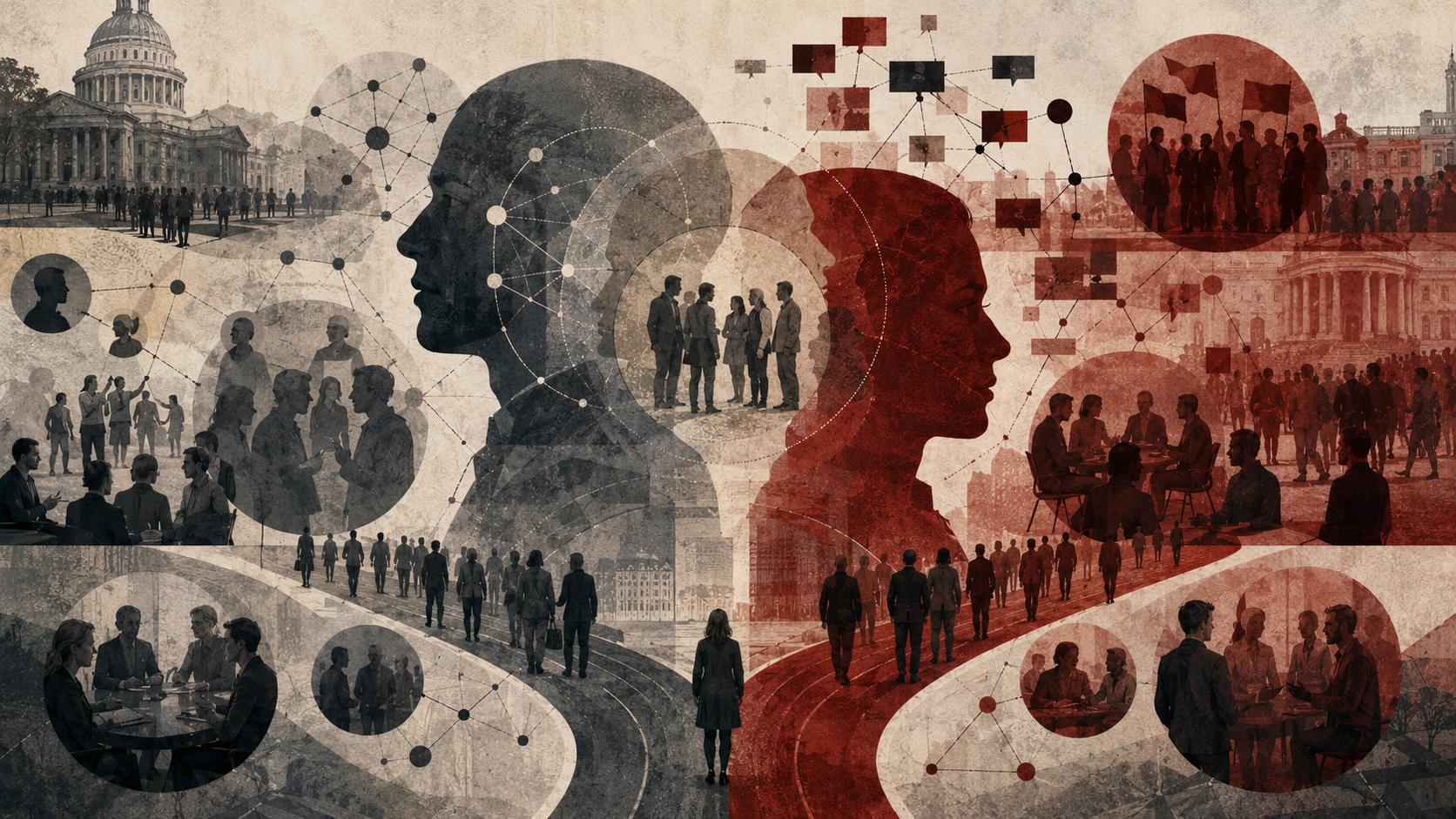
Group identity gives moral life emotional force and social location. It tells people who “we” are, what “we” have suffered, what “we” must defend, which stories matter, which threats are urgent, and whose violations deserve forgiveness or punishment. In many situations, this is not pathological. Human beings need belonging, shared norms, memory, trust, mutual obligation, and collective meaning. Moral communities can cultivate courage, solidarity, care, and resistance to injustice. But the same processes that sustain moral community can also organize selective perception, asymmetric judgment, suspicion of outsiders, and moralized hostility.
Polarization becomes especially difficult to address when people no longer disagree only about policies or facts, but about the moral character of groups themselves. Opponents become corrupt, dangerous, weak, cruel, irrational, elitist, immoral, disloyal, oppressive, impure, or existentially threatening. Compromise then feels like betrayal. Correction feels like attack. Nuance feels like weakness. Institutional procedures feel illegitimate when they protect the other side. In this condition, public life is no longer merely divided; it is morally sorted.
What Social Identity, Group Life, and Moral Polarization Are
Social identity refers to the part of the self understood through group membership: who one is as a member of a people, party, profession, religion, nation, movement, institution, or other collective. Group life refers to the norms, loyalties, shared narratives, sanctions, expectations, rituals, memories, and moral languages that shape behavior inside such memberships. Moral polarization arises when these identities and group processes become morally charged in ways that intensify opposition, reduce trust, and produce increasingly divergent judgments about what is right, wrong, dangerous, fair, legitimate, corrupt, or worthy of protection.
This means polarization is not only disagreement. It is a restructuring of moral and social perception through identity. Polarized actors often see themselves as defending what is decent, threatened, innocent, sacred, or legitimate, while viewing opponents not merely as mistaken but as morally compromised, dangerous, corrupting, malicious, or incapable of good faith. Group conflict thus becomes moralized rather than remaining a simple contest of interests, preferences, or policy priorities.
Social identity is powerful because it joins self-understanding to collective meaning. To criticize the group may feel like criticizing the self. To threaten the group may feel like threatening the moral order one depends on. To defend the group may feel not only strategic but righteous. In this sense, polarization is not only a political condition; it is a moral-psychological condition in which identity, judgment, loyalty, and threat become fused.
Group life also shapes moral memory. Communities remember injuries, betrayals, victories, humiliations, exclusions, sacrifices, and acts of courage. These memories may be historically grounded, mythologized, selectively emphasized, or politically mobilized. But they matter because they influence what present events are taken to mean. A current dispute may be interpreted not as isolated conflict, but as the latest episode in a longer story of oppression, betrayal, resistance, decline, restoration, exclusion, or survival.
| Concept | Core meaning | Moral-psychological significance |
|---|---|---|
| Social identity | Self-understanding through group membership | Shapes trust, loyalty, moral salience, threat perception, and belonging. |
| Group life | Shared norms, narratives, sanctions, expectations, and collective memory | Teaches what is admirable, shameful, sacred, dangerous, or disloyal. |
| Moral polarization | Hardening of group-based moral divergence and suspicion | Turns disagreement into conflict over legitimacy, virtue, and threat. |
| Ingroup favoritism | Greater charity, trust, and leniency toward one’s own group | Produces asymmetry in blame, forgiveness, credibility, and concern. |
| Outgroup moral distance | Reduced empathy, trust, and interpretive generosity toward outsiders | Makes opponents easier to blame, dismiss, mock, punish, or dehumanize. |
Why Group Life Matters for Morality
Group life matters because morality is learned, enforced, expressed, and remembered in social settings. People acquire norms through families, peers, schools, religious communities, professions, political publics, workplaces, digital networks, movements, and institutions. They learn who deserves loyalty, what counts as betrayal, when dissent is admirable, which violations require sanction, which harms are urgent, and which virtues define membership. Moral psychology therefore cannot treat the agent as socially unembedded.
Groups do more than transmit norms. They shape attention, interpretation, emotion, memory, and identity. A group can make some harms vivid and others invisible, some authorities legitimate and others suspect, some obligations sacred and others negotiable. It can teach members to feel shame at one kind of violation and pride at another kind of defiance. It can define what courage looks like, what cowardice looks like, and what silence means. This is one reason moral conflict often intensifies as group identity strengthens: people do not merely defend interests; they defend morally meaningful worlds.
Group life also provides moral language. People do not invent all moral categories privately. They inherit vocabularies of justice, loyalty, dignity, holiness, betrayal, purity, solidarity, responsibility, freedom, fairness, discipline, care, sovereignty, and harm. These vocabularies can liberate perception by naming injustice that would otherwise remain invisible. They can also narrow perception by making some interpretations appear morally impossible before they are examined.
Belonging has ethical force because it creates obligations that are not reducible to abstract principle. People often sacrifice for family, community, faith, movement, profession, or nation because group identity makes obligation emotionally concrete. But belonging can also distort judgment when loyalty to the group becomes stronger than responsibility to truth, fairness, or outsiders. The moral task is not to escape group life entirely, which is neither possible nor desirable, but to understand how group life can sustain solidarity without collapsing into exclusion.
| Function of group life | Constructive moral role | Polarizing risk |
|---|---|---|
| Belonging | Creates solidarity, support, shared responsibility, and moral identity | Can make criticism feel like betrayal or exile. |
| Norm enforcement | Maintains standards of care, fairness, truth, and accountability | Can punish dissent, nuance, or moral independence. |
| Collective memory | Preserves injustice, sacrifice, survival, and moral learning | Can harden grievance narratives or selective innocence. |
| Shared language | Names harms and duties that individuals may not see alone | Can turn complex reality into rigid moral scripts. |
| Mutual defense | Protects vulnerable communities and contested rights | Can redefine aggression as protection under threat. |
Social Identity and Moral Perception
Social identity shapes moral perception by influencing what people notice as morally relevant in the first place. A member of one group may immediately see insult, degradation, betrayal, injustice, domination, erasure, or threat where another sees necessary order, ordinary competition, justified defense, neutral procedure, or exaggerated grievance. Identity enters before explicit reasoning is complete. It helps determine the moral features that stand out.
This is especially important because polarization often appears irrational to outsiders precisely when they do not share the same salience structure. If one side sees existential threat and the other sees procedural normality, the conflict will not be resolved merely by repeating conclusions. Their moral worlds are already organized differently at the perceptual and interpretive level. The dispute concerns not only what should be done, but what is happening.
Moral perception is also shaped by trusted testimony. People rely heavily on group-based sources to interpret events they cannot personally verify. They learn what counts as credible evidence from leaders, peers, institutions, media, scholars, clergy, activists, professionals, influencers, family members, and local communities. When trust is sorted by group, moral perception becomes sorted as well. A claim may be accepted quickly when it comes from one’s own group and rejected immediately when it comes from a distrusted outgroup or institution.
The result is not always conscious bias. Often it is a feeling of obviousness. The ingroup’s interpretation feels realistic, morally alert, and grounded in lived experience. The outgroup’s interpretation feels naive, manipulative, corrupt, cruel, hysterical, or dangerous. This feeling of obviousness is one of the strongest features of moral polarization because it makes disagreement appear not as a normal feature of pluralism, but as evidence of the other side’s moral defect.
| Identity-shaped perception | How it works | Polarizing consequence |
|---|---|---|
| Selective salience | Group identity makes some harms or threats immediately visible | Groups disagree about what the real issue is. |
| Selective trust | Ingroup sources are treated as more credible or morally serious | Shared evidence standards weaken. |
| Selective memory | Historical injuries and victories are recalled through group narratives | Present conflict is absorbed into inherited grievance or defense stories. |
| Selective charity | Ingroup motives are interpreted more generously | Outgroup actions are more quickly moralized as malicious. |
| Selective concern | Some suffering is felt as urgent while other suffering is minimized | Moral care becomes unevenly distributed across group lines. |
Ingroup Favoritism and Outgroup Moral Distance
One of the most robust features of group psychology is ingroup favoritism. People tend to judge their own groups more charitably, interpret ingroup wrongdoing more generously, and extend greater trust or moral patience to those perceived as “one of us.” Outgroups, by contrast, are more easily judged through suspicion, dispositional blame, moral simplification, or collective guilt.
This asymmetry matters morally because it affects who is treated as fully credible, fully harmed, fully responsible, or fully worthy of explanation. In polarized environments, the moral distance between groups widens. Outgroup suffering may become abstract, outgroup fear may seem manipulative, and outgroup norms may appear either irrational or sinister. Moral evaluation becomes unevenly distributed across social boundaries.
Ingroup favoritism does not always look like explicit hatred. Often it appears as patience, contextualization, and empathy for one’s own side, paired with impatience, abstraction, and suspicion toward the other side. One group’s harmful act is “complicated,” “understandable,” “provoked,” “taken out of context,” or “not representative.” The outgroup’s harmful act is “revealing,” “typical,” “proof,” “what they really believe,” or “who they are.”
Outgroup moral distance grows when groups encounter one another mainly through symbolic episodes: viral clips, partisan headlines, extreme representatives, scandals, insults, or decontextualized examples. The outgroup becomes known through its worst visible moments, while the ingroup remains known through personal relationships, internal diversity, and self-explanation. This produces a moral asymmetry that feels like realism from within the group but functions as distortion at the level of public life.
| Judgment domain | Ingroup pattern | Outgroup pattern |
|---|---|---|
| Wrongdoing | Contextualized as exception, pressure, misunderstanding, or provocation | Interpreted as revealing character, ideology, or collective danger |
| Suffering | Experienced as vivid, credible, and morally urgent | Seen as exaggerated, strategic, deserved, or less relevant |
| Anger | Understood as justified moral alarm | Interpreted as irrationality, hatred, manipulation, or extremism |
| Leadership | Granted benefit of the doubt or strategic interpretation | Judged as corrupt, dangerous, hypocritical, or bad faith |
| Dissent | Praised when it protects the group’s moral image | Dismissed when it challenges the group’s preferred narrative |
Polarization as Moral Reorganization
Moral polarization is best understood not simply as “more disagreement,” but as a reorganization of moral judgment through group conflict. Issues once treated as pragmatic, technical, or negotiable become markers of virtue and vice. Compromise starts to feel like betrayal. Opponents are no longer just people with different priorities, but carriers of threat to the moral order one identifies with.
At that point, polarization changes the emotional and moral meaning of public life. Political disagreement becomes identity defense. Policy dispute becomes character judgment. Social conflict becomes existentialized. This helps explain why polarization can persist even when factual disputes are partially resolved: the conflict is no longer only about facts but about who belongs on the side of decency, legitimacy, and trust.
Moral reorganization also changes the meaning of procedure. In less polarized settings, procedures may be treated as imperfect but legitimate ways to manage disagreement. In deeply polarized settings, procedures themselves become moralized. Courts, elections, universities, media organizations, scientific agencies, school boards, professional associations, and public-health institutions may be judged less by process and more by whether they appear to favor or threaten the group. Institutional trust becomes group-conditioned.
Once polarization becomes moral reorganization, ordinary democratic losses can feel intolerable. Losing a vote may feel like being ruled by evil. A court ruling may feel like moral capture. A school policy may feel like civilizational betrayal. A protest may feel like liberation to one group and disorder to another. The social world becomes organized through moral alarm.
| Before moral reorganization | After moral reorganization | Effect on public life |
|---|---|---|
| Policy disagreement | Moral conflict over decency and legitimacy | Compromise becomes harder to justify. |
| Opposition party or movement | Threat to the moral order | Opponents are treated as dangerous rather than mistaken. |
| Institutional procedure | Evidence of capture or betrayal | Shared rules lose credibility across group lines. |
| Pluralism | Dangerous tolerance of evil or disorder | Coexistence becomes morally suspect. |
| Correction | Attack on identity or group narrative | Learning becomes defensive rather than reflective. |
Identity Threat, Defensiveness, and Moral Escalation
When group identity is threatened, psychological defensiveness often rises. Threatened groups may become more punitive, more morally certain, more resistant to nuance, and more willing to reinterpret criticism as attack. Moral escalation can follow because threat sharpens boundaries and increases the appeal of simple narratives about loyalty and corruption.
This is one reason morally framed conflicts can intensify so rapidly. Once criticism is experienced not as challenge but as humiliation or delegitimation of the group itself, moral conversation becomes harder. Defensive identity protection can then reinforce the very behaviors that make outsiders distrust the group, producing a feedback loop of escalation.
Identity threat may be based on real vulnerability, perceived status loss, historical memory, demographic change, institutional exclusion, cultural humiliation, symbolic insult, or political mobilization. It may be grounded in genuine injustice, distorted by propaganda, or intensified by selective media exposure. Regardless of source, its moral-psychological effect is similar: the group becomes more alert to danger and less tolerant of ambiguity.
Defensiveness often appears as moral certainty. A threatened group may insist that hesitation is weakness, compromise is betrayal, and criticism is enemy speech. Internal dissenters may be treated as traitors because they disrupt the group’s defensive unity. Outsiders may be interpreted through suspicion because threat has lowered the threshold for moral alarm. The group’s moral world becomes less open to self-correction.
| Threat condition | Defensive response | Escalation risk |
|---|---|---|
| Status threat | Perception that the group is losing recognition, authority, or respect | Restoration narratives may justify exclusion or domination. |
| Identity insult | Criticism is experienced as humiliation of the group | Correction becomes moral attack. |
| Security threat | Opponents are framed as dangerous or destabilizing | Harsh measures appear protective. |
| Norm threat | Group values appear under attack | Pluralism is reinterpreted as moral collapse. |
| Internal dissent | Members question group narratives or leadership | Dissenters are punished as disloyal. |
Partisan Bias and Political Judgment
Political partisanship is one of the clearest contemporary examples of group-shaped moral judgment. People systematically interpret evidence, credibility, transgression, hypocrisy, fairness, and threat through partisan filters. The same act may seem scandalous when performed by opponents and understandable when performed by allies. This is not simply factual bias. It is often moral bias as well.
Partisan bias matters because it shifts the standards by which blame, fairness, threat, and legitimacy are assessed. People may sincerely believe they are applying principle while in practice distributing moral leniency and moral outrage along group lines. Polarization thus becomes self-reinforcing: each side experiences the other not only as wrong, but as selectively moral and therefore untrustworthy.
Partisan moral bias is especially corrosive when it creates asymmetric accountability. A group may condemn corruption, cruelty, censorship, incivility, violence, institutional manipulation, hypocrisy, or disinformation when committed by opponents, while minimizing, contextualizing, or ignoring similar conduct by allies. This does not require conscious hypocrisy. It may arise from motivated attention, selective trust, identity protection, and different standards of moral explanation.
The danger is not that people care about politics. Political commitment can be principled and necessary. The danger is that partisan identity can become the hidden organizer of moral principle. When that happens, people may treat principle as stable while applying it through group loyalty. The group becomes the filter through which moral consistency is silently redistributed.
| Partisan judgment pattern | How it appears | Moral consequence |
|---|---|---|
| Motivated evidence evaluation | Evidence against one’s side receives more scrutiny | Truth becomes filtered through loyalty. |
| Asymmetric blame | Allies receive context while opponents receive condemnation | Accountability becomes group-conditioned. |
| Selective outrage | Comparable harms produce unequal emotional response | Moral concern becomes politically sorted. |
| Identity-protective reasoning | Threatening facts are resisted because they endanger group self-image | Correction becomes difficult. |
| Institutional sorting | Institutions are trusted or rejected based on perceived partisan alignment | Shared public authority weakens. |
Norms, Group Loyalty, and Moral Conformity
Groups do not maintain themselves by identity alone. They also rely on norms: what members should say, defend, denounce, ignore, prioritize, forgive, or punish. These norms are often moralized. Loyalty becomes virtue, criticism becomes betrayal, and public compliance becomes a sign of belonging. In polarized settings, this can produce intense conformity pressures.
Moral conformity can be psychologically stabilizing for the group, but epistemically and ethically costly. It reduces space for internal correction, rewards performative certainty, and punishes morally complex judgment. Once group belonging depends on publicly recognizable moral alignment, dissent becomes harder even for members who privately retain reservations.
Norms are powerful because they do not always need formal enforcement. People anticipate judgment. They know which opinions will be applauded, which questions will be treated as suspicious, which concerns will be read as betrayal, and which forms of silence will be interpreted as complicity. The group’s moral expectations become internalized as self-monitoring.
Social norms can also support justice. Movements against exploitation, discrimination, abuse, corruption, and institutional violence often depend on norms of solidarity, courage, truth-telling, and refusal. The problem is not norms themselves. The problem is when group norms protect identity more than truth, loyalty more than accountability, and symbolic alignment more than moral repair.
| Group norm | Constructive form | Polarizing form |
|---|---|---|
| Loyalty | Commitment to shared responsibility and mutual care | Demand for silence, defense, or conformity |
| Dissent | Internal correction that strengthens integrity | Interpreted as betrayal or weakness |
| Solidarity | Support for vulnerable members under real threat | Uncritical defense of all ingroup actions |
| Sanction | Accountability for genuine harm | Purity policing or reputation destruction |
| Consensus | Shared commitment after reflection and debate | Public alignment produced by fear of exclusion |
Media, Information Environments, and Polarized Morality
Modern media environments can intensify moral polarization by amplifying identity cues, moral outrage, selective exposure, and perceived norm consensus. When people mainly encounter opponents in their most inflammatory forms, moral distance increases. When they mainly encounter allies in morally affirming environments, ingroup certainty grows.
This does not mean media causes polarization by itself. But it can accelerate identity sorting, sharpen symbolic boundaries, reward the public performance of group morality, and create feedback loops of outrage. In information environments structured by speed, brevity, algorithmic visibility, influencer incentives, and constant signaling, morally complex interpretations struggle to survive against simpler identity-confirming frames.
Media environments matter because they shape which examples become representative. A person may rarely encounter the ordinary, moderate, conflicted, or morally complex members of an outgroup. Instead, the outgroup is seen through the most viral, extreme, foolish, cruel, or humiliating examples. This produces a distorted moral sample. The outgroup becomes not a community of persons but a curated set of threats and scandals.
Selective exposure also affects group confidence. People who inhabit morally homogeneous information spaces may overestimate how much reasonable people agree with them. They may interpret dissent not as evidence of pluralism, but as evidence of corruption, ignorance, or hostility. Media environments can therefore produce both false consensus within groups and exaggerated danger between groups.
| Media dynamic | Effect on identity | Effect on moral polarization |
|---|---|---|
| Selective exposure | People consume identity-confirming sources | Opposing views become less intelligible. |
| Outrage amplification | Emotionally charged content travels farther | Threat and contempt become more salient. |
| Viral exemplars | Extreme examples become symbols of whole groups | Outgroup moral distance increases. |
| Norm visibility | Users infer group expectations from visible online behavior | False consensus and conformity pressures grow. |
| Identity signaling | Posts signal belonging and moral alignment | Public moral performance can crowd out reflection. |
Moral Polarization and Dehumanization
Polarization becomes especially dangerous when it drifts into dehumanization. Once opponents are seen as less rational, less sincere, less redeemable, less feeling, less deserving, or less fully worthy of moral regard, disagreement hardens into moral exclusion. At that point, punishment, humiliation, disregard, repression, or cruelty can begin to feel justified not only strategically but morally.
This development is not inevitable, but it is a recurring risk. Social identity can deepen solidarity and shared purpose, yet under conflict it can also shrink the circle of recognition. Moral polarization becomes most corrosive when it no longer leaves room for the thought that opponents remain persons with claims to fair treatment, even amid serious disagreement.
Dehumanization can be blatant or subtle. Blatant forms compare opponents to animals, disease, contamination, vermin, enemies, invaders, traitors, or existential threats. Subtle forms treat opponents as incapable of moral reasoning, immune to evidence, undeserving of empathy, or collectively defined by their worst representatives. Both forms weaken the restraints that normally preserve dignity in conflict.
Moral exclusion also affects institutional life. If one group is imagined as outside the circle of legitimate concern, its rights become obstacles, its testimony becomes manipulation, its suffering becomes strategy, and its fear becomes deserved. The moral psychology of dehumanization therefore matters not only for interpersonal hostility, but for law, policy, violence, policing, education, media, and public administration.
| Escalation stage | Moral-psychological shift | Warning sign |
|---|---|---|
| Disagreement | Opponents are wrong but legitimate | Argument and persuasion remain possible. |
| Suspicion | Opponents are assumed to act in bad faith | Evidence is interpreted through distrust. |
| Contempt | Opponents are seen as inferior, foolish, corrupt, or degraded | Humiliation replaces persuasion. |
| Moral exclusion | Opponents fall outside ordinary concern | Their rights, suffering, and dignity are discounted. |
| Dehumanization | Opponents are treated as threats, contaminants, or less than persons | Cruelty becomes easier to justify. |
Similarities Across Ideological Sides
Although polarization often emphasizes difference, research also suggests meaningful similarities across ideological sides. Competing groups may differ in emphasis, policy priorities, moral vocabularies, demographic composition, institutional location, historical experience, and issue alignment while still sharing capacities for motivated reasoning, norm defense, outrage, group favoritism, selective trust, and defensive identity protection. This matters because it complicates flattering narratives in which one side uniquely transcends the psychology of identity.
Recognizing such similarities does not erase real differences among groups. It does not imply false equivalence between every movement, ideology, institution, or political project. Substantive differences matter. Power matters. History matters. Some harms are asymmetrical. Some institutions and movements produce greater danger than others. But moral psychology also reveals recurring patterns in how human groups defend identity, interpret threat, justify allies, condemn opponents, and protect collective self-image.
This distinction is important because moral polarization often encourages each group to see itself as uniquely principled and the other side as uniquely biased. But many mechanisms of bias are not exclusive possessions of one ideological camp. People across groups can overtrust allies, overread enemies, weaponize examples, ignore inconvenient harm, and experience their own indignation as moral clarity. The content differs, but the structure can recur.
A morally serious treatment of polarization must therefore avoid both false symmetry and self-flattering exceptionalism. It should ask where differences are real, where power is unequal, where historical injury matters, and where shared psychological mechanisms are also at work. This combination is harder than partisan simplification, but it is essential for intellectual honesty.
| Shared mechanism | How it appears across groups | Why it matters |
|---|---|---|
| Motivated reasoning | Evidence is interpreted in ways that protect prior commitments | Correction becomes difficult across ideological boundaries. |
| Identity defense | Criticism of the group feels like attack on the self | Disagreement becomes psychologically threatening. |
| Selective trust | Ingroup sources are trusted more readily than outgroup sources | Shared epistemic ground weakens. |
| Moralized norms | Group expectations are treated as signs of virtue or betrayal | Internal dissent becomes costly. |
| Outgroup simplification | Opponents are known through stereotypes or extreme examples | Pluralism becomes harder to sustain. |
Institutions and the Management of Polarization
Institutions matter because polarization is not solved at the level of individual attitude alone. Democracies, courts, schools, professional bodies, workplaces, media systems, religious institutions, universities, civic organizations, and public agencies must manage conflict under conditions of identity-based disagreement. They do so through procedures, representation, accountability, protected rights, shared rules, deliberative norms, and forms of contestation that make conflict less destructive.
Institutional design cannot eliminate moral polarization, but it can shape whether disagreement becomes domination, fragmentation, or durable coexistence. Where institutions lose legitimacy, polarization often worsens because group identity becomes a substitute for shared public trust. Where institutions remain credible enough to structure conflict, pluralism has a better chance of remaining difficult without becoming unlivable.
Institutions manage polarization by separating disagreement from annihilation. They provide procedures through which groups can lose without being destroyed, criticize without being criminalized, win without permanently humiliating opponents, and contest policy without treating every conflict as civilizational collapse. This is not sentimental moderation. It is the structural work required for plural societies to survive moral disagreement.
But institutions cannot demand trust while behaving in untrustworthy ways. If institutions are captured, unequal, opaque, hypocritical, corrupt, exclusionary, or indifferent to marginalized communities, appeals to institutional legitimacy will ring hollow. The management of polarization therefore requires both procedural stability and substantive accountability. Institutions must be strong enough to structure conflict and humble enough to repair injustice.
| Institutional function | Polarization-management role | Failure mode |
|---|---|---|
| Fair procedure | Allows conflict to be resolved without domination | Procedure is seen as captured or selectively applied. |
| Representation | Gives groups a voice in shared decision-making | Exclusion intensifies identity threat and distrust. |
| Rights protection | Protects opponents and minorities from majoritarian punishment | Rights become conditional on group popularity. |
| Public accountability | Corrects institutional harm and abuse | Unrepaired hypocrisy destroys legitimacy. |
| Deliberative norms | Preserve disagreement without dehumanization | Public life becomes spectacle, contempt, or threat theater. |
Mathematical Lens: Modeling Moral Polarization
Moral polarization can be modeled as group-conditioned divergence in moral judgment. Let \(J_{ig}\) represent the moral judgment of person \(i\) in group \(g\):
J_{ig} = \alpha V_i + \beta I_g + \gamma N_g + \delta T_i + \varepsilon_{ig}
\]
Interpretation: Moral judgment is shaped by individual values, group identity strength, group norm pressure, perceived threat, and unobserved variation. This captures the idea that judgment is not only personal; it is socially and group-conditionally organized.
where \(V_i\) is the individual’s value profile, \(I_g\) is group identity strength, \(N_g\) is group norm pressure, and \(T_i\) is perceived threat. This model is intentionally simplified, but it makes visible the article’s central claim: personal values matter, but identity and group life shape how those values are interpreted and expressed.
Polarization between two groups \(g_1\) and \(g_2\) can be expressed as:
P = \left| \bar{J}_{g_1} – \bar{J}_{g_2} \right|
\]
Interpretation: Polarization is represented as the absolute distance between average moral judgments across two groups. Larger values indicate greater group-level divergence.
This measure is not a complete account of polarization because it does not capture hatred, trust loss, dehumanization, institutional legitimacy, or within-group conformity. But it helps clarify one dimension of polarization: average moral judgment can diverge across groups as identity, norms, and threat become more strongly organized.
A feedback model can represent escalation over time:
P_{t+1} = P_t + \lambda O_t + \mu Q_t – \rho C_t
\]
Interpretation: Polarization increases when outgroup threat framing and within-group conformity pressure rise, and decreases when cross-group contact, institutional credibility, or deliberative moderation dampen escalation.
where \(O_t\) is exposure to outgroup threat framing, \(Q_t\) is conformity pressure within groups, and \(C_t\) is cross-group contact, civic recognition, or institutional moderation. This reflects the idea that polarization grows through reinforcement loops but may be dampened by credible institutions and non-hostile contact.
A moral-exclusion model can also be written as:
ME_i = \sigma(\theta_1 T_i + \theta_2 D_i + \theta_3 L_i – \theta_4 R_i)
\]
Interpretation: Moral exclusion risk rises with threat perception, dehumanizing rhetoric, and loyalty pressure, and falls with recognition of shared dignity, rights, or institutional restraint.
where \(ME_i\) is moral exclusion risk, \(T_i\) is threat perception, \(D_i\) is dehumanizing language or imagery, \(L_i\) is loyalty pressure, and \(R_i\) is recognition of shared rights, dignity, or civic standing. This model is not an assessment tool. It is a conceptual scaffold for thinking about how polarization can move from disagreement toward exclusion.
| Model term | Meaning | Moral-psychological role |
|---|---|---|
| \(V_i\) | Individual value profile | Represents personal moral priorities, commitments, or concerns. |
| \(I_g\) | Group identity strength | Captures how strongly group membership organizes judgment. |
| \(N_g\) | Group norm pressure | Represents expectations about what members should say, defend, or condemn. |
| \(T_i\) | Perceived threat | Intensifies defensiveness, certainty, and outgroup suspicion. |
| \(O_t\) | Outgroup threat framing | Reinforces narratives of danger, betrayal, or moral contamination. |
| \(Q_t\) | Conformity pressure | Reduces internal dissent and increases public alignment. |
| \(C_t\) | Contact or institutional moderation | Potentially dampens polarization by preserving recognition and trust. |
| \(ME_i\) | Moral exclusion risk | Represents movement from disagreement toward diminished concern for opponents. |
R Workflow: Modeling Social Identity and Moral Polarization
The following R workflow simulates value profiles, group identity strength, norm pressure, perceived threat, institutional trust, cross-group contact, moral judgment, polarization distance, and moral exclusion risk. The dataset is synthetic and intended for reproducible article support, not empirical claims about real political groups or communities.
# Social Identity, Group Life, and Moral Polarization
# Synthetic R workflow for modeling group-conditioned moral divergence.
# Educational and reproducible research scaffold only.

suppressPackageStartupMessages({
  library(tidyverse)
  library(broom)
})

set.seed(42)

# ------------------------------------------------------------
# 1. Set up output folders
# ------------------------------------------------------------

dir.create("outputs", showWarnings = FALSE)
dir.create("outputs/tables", recursive = TRUE, showWarnings = FALSE)
dir.create("outputs/figures", recursive = TRUE, showWarnings = FALSE)

# ------------------------------------------------------------
# 2. Simulate group-based moral profiles
# ------------------------------------------------------------

n <- 2400

df <- tibble(
  participant_id = 1:n,
  group = sample(c("Group_A", "Group_B"), n, replace = TRUE),
  value_profile = rnorm(n, 0, 1),
  identity_strength = rnorm(n, 0, 1),
  norm_pressure = rnorm(n, 0, 1),
  threat_perception = rnorm(n, 0, 1),
  institutional_trust = rnorm(n, 0, 1),
  cross_group_contact = rnorm(n, 0, 1),
  dehumanizing_rhetoric = rnorm(n, 0, 1),
  loyalty_pressure = rnorm(n, 0, 1)
) %>%
  mutate(
    moral_judgment = case_when(
      group == "Group_A" ~
        0.35 * value_profile +
        0.30 * identity_strength +
        0.20 * norm_pressure +
        0.25 * threat_perception -
        0.15 * institutional_trust -
        0.10 * cross_group_contact +
        rnorm(n(), 0, 0.8),

      TRUE ~
        -0.20 * value_profile +
        0.35 * identity_strength +
        0.25 * norm_pressure +
        0.30 * threat_perception -
        0.15 * institutional_trust -
        0.10 * cross_group_contact +
        rnorm(n(), 0, 0.8)
    ),

    moral_exclusion_risk = plogis(
      0.35 * threat_perception +
      0.30 * dehumanizing_rhetoric +
      0.25 * loyalty_pressure +
      0.20 * identity_strength -
      0.25 * institutional_trust -
      0.20 * cross_group_contact
    )
  )

# ------------------------------------------------------------
# 3. Estimate judgment model
# ------------------------------------------------------------

model_polarization <- lm(
  moral_judgment ~ group + value_profile + identity_strength +
    norm_pressure + threat_perception + institutional_trust +
    cross_group_contact,
  data = df
)

polarization_summary <- tidy(model_polarization, conf.int = TRUE)
polarization_fit <- glance(model_polarization)

print(polarization_summary)
print(polarization_fit)

# ------------------------------------------------------------
# 4. Estimate moral-exclusion model
# ------------------------------------------------------------

model_exclusion <- lm(
  moral_exclusion_risk ~ threat_perception + dehumanizing_rhetoric +
    loyalty_pressure + identity_strength + institutional_trust +
    cross_group_contact,
  data = df
)

exclusion_summary <- tidy(model_exclusion, conf.int = TRUE)

print(exclusion_summary)

# ------------------------------------------------------------
# 5. Summarize group-level divergence
# ------------------------------------------------------------

group_summary <- df %>%
  group_by(group) %>%
  summarise(
    mean_judgment = mean(moral_judgment),
    mean_identity = mean(identity_strength),
    mean_norm_pressure = mean(norm_pressure),
    mean_threat = mean(threat_perception),
    mean_moral_exclusion_risk = mean(moral_exclusion_risk),
    .groups = "drop"
  )

polarization_distance <- abs(diff(group_summary$mean_judgment))

polarization_distance_tbl <- tibble(
  metric = "polarization_distance",
  value = polarization_distance
)

print(group_summary)
print(polarization_distance_tbl)

# ------------------------------------------------------------
# 6. Prediction grid across threat and group
# ------------------------------------------------------------

pred_grid <- expand_grid(
  threat_perception = seq(-2, 2, length.out = 100),
  group = c("Group_A", "Group_B"),
  value_profile = 0,
  identity_strength = c(-1, 0, 1),
  norm_pressure = 0,
  institutional_trust = 0,
  cross_group_contact = 0
)

pred_grid$predicted_judgment <- predict(
  model_polarization,
  newdata = pred_grid
)

pred_grid <- pred_grid %>%
  mutate(
    identity_label = case_when(
      identity_strength == -1 ~ "Low identity strength",
      identity_strength == 0 ~ "Average identity strength",
      TRUE ~ "High identity strength"
    )
  )

# ------------------------------------------------------------
# 7. Plot predicted divergence
# ------------------------------------------------------------

plot_predicted_judgment <- ggplot(
  pred_grid,
  aes(x = threat_perception, y = predicted_judgment)
) +
  geom_line(linewidth = 1) +
  facet_grid(group ~ identity_label) +
  labs(
    title = "Predicted Moral Judgment by Group, Threat, and Identity Strength",
    subtitle = "Threat perception and group identity amplify moral divergence",
    x = "Threat perception",
    y = "Predicted moral judgment"
  ) +
  theme_minimal(base_size = 12)

print(plot_predicted_judgment)

# ------------------------------------------------------------
# 8. Export outputs
# ------------------------------------------------------------

write_csv(df, "outputs/tables/social_identity_moral_polarization_simulated_data.csv")
write_csv(polarization_summary, "outputs/tables/social_identity_moral_polarization_model.csv")
write_csv(polarization_fit, "outputs/tables/social_identity_moral_polarization_model_fit.csv")
write_csv(exclusion_summary, "outputs/tables/social_identity_moral_exclusion_model.csv")
write_csv(group_summary, "outputs/tables/social_identity_moral_polarization_group_summary.csv")
write_csv(polarization_distance_tbl, "outputs/tables/social_identity_moral_polarization_distance.csv")
write_csv(pred_grid, "outputs/tables/social_identity_moral_polarization_predictions.csv")

ggsave(
  filename = "outputs/figures/predicted_moral_judgment_by_identity_and_threat.png",
  plot = plot_predicted_judgment,
  width = 12,
  height = 8,
  dpi = 300
)
This workflow is useful because it models polarization as structured divergence shaped by identity, norms, threat, institutional trust, and cross-group contact rather than as random disagreement. It also separates moral judgment from moral exclusion risk, making clear that divergence and dehumanization are related but not identical.
Python Workflow: Simulating Group-Based Moral Divergence
The Python workflow below simulates how identity strength, norm pressure, perceived threat, institutional trust, cross-group contact, and dehumanizing rhetoric can generate polarized moral judgments and moral exclusion risk across groups. The example uses synthetic data for reproducible demonstration and should not be interpreted as an assessment of real communities, parties, or ideological groups.
# Social Identity, Group Life, and Moral Polarization
# Python workflow for synthetic group-based moral divergence.
# Educational and reproducible research scaffold only.

from pathlib import Path

import numpy as np
import pandas as pd

np.random.seed(42)

# ------------------------------------------------------------
# 1. Set up output folders
# ------------------------------------------------------------

output_tables = Path("outputs/tables")
output_tables.mkdir(parents=True, exist_ok=True)

# ------------------------------------------------------------
# 2. Simulate group-based moral profiles
# ------------------------------------------------------------

n = 2600

df = pd.DataFrame({
    "participant_id": np.arange(1, n + 1),
    "group": np.random.choice(["Group_A", "Group_B"], size=n),
    "value_profile": np.random.normal(0, 1, n),
    "identity_strength": np.random.normal(0, 1, n),
    "norm_pressure": np.random.normal(0, 1, n),
    "threat_perception": np.random.normal(0, 1, n),
    "institutional_trust": np.random.normal(0, 1, n),
    "cross_group_contact": np.random.normal(0, 1, n),
    "dehumanizing_rhetoric": np.random.normal(0, 1, n),
    "loyalty_pressure": np.random.normal(0, 1, n)
})

# ------------------------------------------------------------
# 3. Generate group-conditioned moral judgments
# ------------------------------------------------------------

noise = np.random.normal(0, 0.8, n)

group_a = df["group"] == "Group_A"

df["moral_judgment"] = np.where(
    group_a,
    (
        0.35 * df["value_profile"] +
        0.30 * df["identity_strength"] +
        0.20 * df["norm_pressure"] +
        0.25 * df["threat_perception"] -
        0.15 * df["institutional_trust"] -
        0.10 * df["cross_group_contact"] +
        noise
    ),
    (
        -0.20 * df["value_profile"] +
        0.35 * df["identity_strength"] +
        0.25 * df["norm_pressure"] +
        0.30 * df["threat_perception"] -
        0.15 * df["institutional_trust"] -
        0.10 * df["cross_group_contact"] +
        noise
    )
)

# ------------------------------------------------------------
# 4. Generate moral exclusion risk
# ------------------------------------------------------------

exclusion_latent = (
    0.35 * df["threat_perception"] +
    0.30 * df["dehumanizing_rhetoric"] +
    0.25 * df["loyalty_pressure"] +
    0.20 * df["identity_strength"] -
    0.25 * df["institutional_trust"] -
    0.20 * df["cross_group_contact"]
)

df["moral_exclusion_risk"] = 1 / (1 + np.exp(-exclusion_latent))

# ------------------------------------------------------------
# 5. Summarize by group
# ------------------------------------------------------------

summary = (
    df.groupby("group")
      .agg(
          mean_judgment=("moral_judgment", "mean"),
          mean_identity=("identity_strength", "mean"),
          mean_norm_pressure=("norm_pressure", "mean"),
          mean_threat=("threat_perception", "mean"),
          mean_moral_exclusion_risk=("moral_exclusion_risk", "mean")
      )
      .reset_index()
)

print(summary)

if len(summary) == 2:
    polarization_distance = abs(
        summary.loc[0, "mean_judgment"] -
        summary.loc[1, "mean_judgment"]
    )
else:
    polarization_distance = np.nan

polarization_distance_df = pd.DataFrame({
    "metric": ["polarization_distance"],
    "value": [polarization_distance]
})

print(polarization_distance_df)

# ------------------------------------------------------------
# 6. Build scenario grid
# ------------------------------------------------------------

scenario_rows = []

for group in ["Group_A", "Group_B"]:
    for threat in np.linspace(-2, 2, 41):
        for identity in [-1, 0, 1]:
            for contact in [-1, 0, 1]:
                if group == "Group_A":
                    judgment = (
                        0.30 * identity +
                        0.25 * threat -
                        0.10 * contact
                    )
                else:
                    judgment = (
                        0.35 * identity +
                        0.30 * threat -
                        0.10 * contact
                    )

                exclusion = 1 / (1 + np.exp(-(
                    0.35 * threat +
                    0.20 * identity -
                    0.20 * contact
                )))

                scenario_rows.append({
                    "group": group,
                    "threat_perception": threat,
                    "identity_strength": identity,
                    "cross_group_contact": contact,
                    "predicted_judgment": judgment,
                    "predicted_moral_exclusion_risk": exclusion
                })

scenario_df = pd.DataFrame(scenario_rows)

print(scenario_df.head(12))

# ------------------------------------------------------------
# 7. Identify high-risk synthetic cases
# ------------------------------------------------------------

high_exclusion_cases = (
    df.sort_values("moral_exclusion_risk", ascending=False)
      .head(25)
      .reset_index(drop=True)
)

# ------------------------------------------------------------
# 8. Export outputs
# ------------------------------------------------------------

df.to_csv(output_tables / "social_identity_moral_polarization_python.csv", index=False)
summary.to_csv(output_tables / "social_identity_moral_polarization_summary.csv", index=False)
polarization_distance_df.to_csv(
    output_tables / "social_identity_moral_polarization_distance.csv",
    index=False
)
scenario_df.to_csv(
    output_tables / "social_identity_moral_polarization_scenarios.csv",
    index=False
)
high_exclusion_cases.to_csv(
    output_tables / "social_identity_moral_polarization_high_exclusion_cases.csv",
    index=False
)

print("Synthetic social identity and moral polarization data written to:", output_tables)
This workflow is useful because it makes visible how group-conditioned threat, identity strength, and norm pressure can transform ordinary disagreement into polarized moral divergence. It also shows how moral exclusion risk can rise when threat and loyalty pressure increase while institutional trust and cross-group recognition decline.
In a full article repository, this Python workflow can be extended into notebooks, SQL schema, synthetic datasets, validation notes, cross-group contact scenarios, and additional language examples. R can support statistical modeling and visualization; Python can support simulation and data pipelines; SQL can preserve structured scenario metadata; Julia can support dynamic polarization feedback simulations; and C, C++, Fortran, Go, and Rust can support reproducible command-line tools, validation utilities, and computational demonstrations.
GitHub Repository
The companion repository for this article provides a reproducible code scaffold for modeling value profiles, group identity strength, norm pressure, perceived threat, institutional trust, cross-group contact, dehumanizing rhetoric, moral judgment, moral exclusion risk, and polarization distance.
This article’s companion repository includes reproducible workflows, synthetic datasets, model documentation, computational examples, and outputs for exploring how social identity and group life shape moral judgment, polarization, outgroup distance, conformity pressure, and moral exclusion risk.
The repository structure should support a full research workflow rather than a single script. The article folder can include language-specific examples in python, r, julia, sql, c, cpp, fortran, go, and rust, along with data, docs, notebooks, and outputs. This structure makes the article reproducible, inspectable, and extensible for readers who want to move from conceptual argument to analytical demonstration.
Conclusion
Social identity, group life, and moral polarization reveal that moral judgment is never wholly private. People perceive and evaluate the social world through group memberships that shape trust, salience, loyalty, fear, memory, blame, dignity, and belonging. Polarization intensifies when these identities become morally charged and mutually oppositional, turning ordinary disagreement into contests over legitimacy, betrayal, danger, and moral worth.
The strongest moral psychology of polarization therefore treats conflict as more than a clash of abstract opinions. It is a structured interaction among identity, norms, threat, media, institutions, historical memory, moral emotion, and social interpretation. Understanding that structure does not solve polarization automatically, but it helps explain why it is so resilient and why moral life under group conflict can become so hard to stabilize.
Group life can be ethically generative. It can sustain solidarity, preserve memory, protect vulnerable communities, demand justice, and give people courage that they would not have alone. But it can also distort judgment, reward conformity, excuse ingroup harm, intensify outgroup suspicion, and shrink the circle of moral concern. The task is not to imagine a morality without groups. The task is to cultivate forms of group life that remain accountable to truth, dignity, repair, and plural coexistence.
Institutions matter because they help determine whether polarized groups can disagree without dehumanizing one another. When institutions are credible, accountable, inclusive, and capable of correction, they can structure conflict without requiring enemies. When institutions are captured, hypocritical, exclusionary, or indifferent, group identity may become the only trusted source of moral meaning. A humane politics of polarization must therefore work at both levels: the psychology of identity and the design of institutions that make plural moral life possible.
Related articles
- Moral Disagreement and the Psychology of Pluralism
- Cross-Cultural Moral Psychology
- Personality, Character, and Individual Differences in Moral Life
- Hypocrisy, Dehumanization, and the Psychology of Moral Failure
- Justice, Fairness, and Distributive Moral Judgment
- Responsibility, Blame, and Moral Accountability
- Moral Psychology in Organizations and Institutions
- Care, Empathy, and Relational Moral Life
Further reading
- Spears, R. (2021) ‘Social Influence and Group Identity’, Annual Review of Psychology, 72, pp. 367–390. Available at: https://doi.org/10.1146/annurev-psych-070620-111818.
- Ditto, P.H. and Liu, B.S. (2025) ‘Partisan Bias in Political Judgment’, Annual Review of Psychology, 76. Available at: https://www.annualreviews.org/content/journals/10.1146/annurev-psych-030424-122723.
- Kteily, N.S. and Brandt, M.J. (2025) ‘Ideology: Psychological Similarities and Differences Across the Ideological Spectrum Reexamined’, Annual Review of Psychology, 76, pp. 501–529. Available at: https://www.annualreviews.org/content/journals/10.1146/annurev-psych-020124-115253.
- Gray, K. and Pratt, S. (2025) ‘Morality in Our Mind and Across Cultures and Politics’, Annual Review of Psychology, 76, pp. 663–691. Available at: https://www.annualreviews.org/content/journals/10.1146/annurev-psych-020924-124236.
- Wenzel, M., Woodyatt, L. and McLean, B. (2025) ‘The Power and Pitfalls of Social Norms’, Annual Review of Psychology, 76, pp. 583–611. Available at: https://www.annualreviews.org/content/journals/10.1146/annurev-psych-020124-120310.
References
- Ditto, P.H. and Liu, B.S. (2025) ‘Partisan Bias in Political Judgment’, Annual Review of Psychology, 76. Available at: https://www.annualreviews.org/content/journals/10.1146/annurev-psych-030424-122723.
- Gray, K. and Pratt, S. (2025) ‘Morality in Our Mind and Across Cultures and Politics’, Annual Review of Psychology, 76, pp. 663–691. Available at: https://www.annualreviews.org/content/journals/10.1146/annurev-psych-020924-124236.
- Kteily, N.S. and Brandt, M.J. (2025) ‘Ideology: Psychological Similarities and Differences Across the Ideological Spectrum Reexamined’, Annual Review of Psychology, 76, pp. 501–529. Available at: https://www.annualreviews.org/content/journals/10.1146/annurev-psych-020124-115253.
- Spears, R. (2021) ‘Social Influence and Group Identity’, Annual Review of Psychology, 72, pp. 367–390. Available at: https://doi.org/10.1146/annurev-psych-070620-111818.
- Wenzel, M., Woodyatt, L. and McLean, B. (2025) ‘The Power and Pitfalls of Social Norms’, Annual Review of Psychology, 76, pp. 583–611. Available at: https://www.annualreviews.org/content/journals/10.1146/annurev-psych-020124-120310.