
Last Updated May 28, 2026
Responsibility, blame, and moral accountability belong together, but they are not the same thing. Moral responsibility concerns whether an agent is a fitting target of praise, blame, answerability, or moral appraisal for what they have done, failed to do, intended, permitted, ignored, enabled, or allowed. Blame is a moral response to wrongdoing or to something of negative normative significance in a person’s action, omission, attitude, character, role performance, or institutional participation. Accountability is broader still: it is the interpersonal, social, legal, organizational, and institutional practice through which persons and groups are called to answer for what they have done and may be judged, sanctioned, corrected, required to repair, or asked to change the conditions that made harm possible.
A strong account of this domain must therefore distinguish at least three questions. First, was the agent responsible in the relevant sense? Second, what kind of blame, if any, is fitting? Third, how should accountability be enacted in actual relationships, communities, organizations, and institutions? These questions overlap, but they do not collapse into one another. A person may be causally involved in harm without being fully morally responsible. A person may be responsible yet not appropriately blamed to the same degree under all circumstances. An institution may speak the language of accountability while distributing responsibility unevenly, protecting powerful actors, or obscuring answerability through procedure.
This article argues that responsibility, blame, and moral accountability should be understood as a layered moral architecture. Responsibility asks whether conduct can be attributed to an agent under conditions of control, knowledge, role, and agency. Blame asks whether a negative moral response is fitting, proportionate, relationally legitimate, and responsive to the nature of the wrong. Accountability asks what social practice should follow: explanation, apology, sanction, restitution, institutional reform, public acknowledgment, repair, prevention, or changed conduct. Moral psychology is incomplete if it treats these as one undifferentiated reaction. Serious moral life depends on knowing when to distinguish them.
Main Library
Publications
Article Map
Moral Psychology
Related Topic
Ethics & Moral Philosophy
Related Topic
Social Psychology
Related Topic
Organizational Psychology
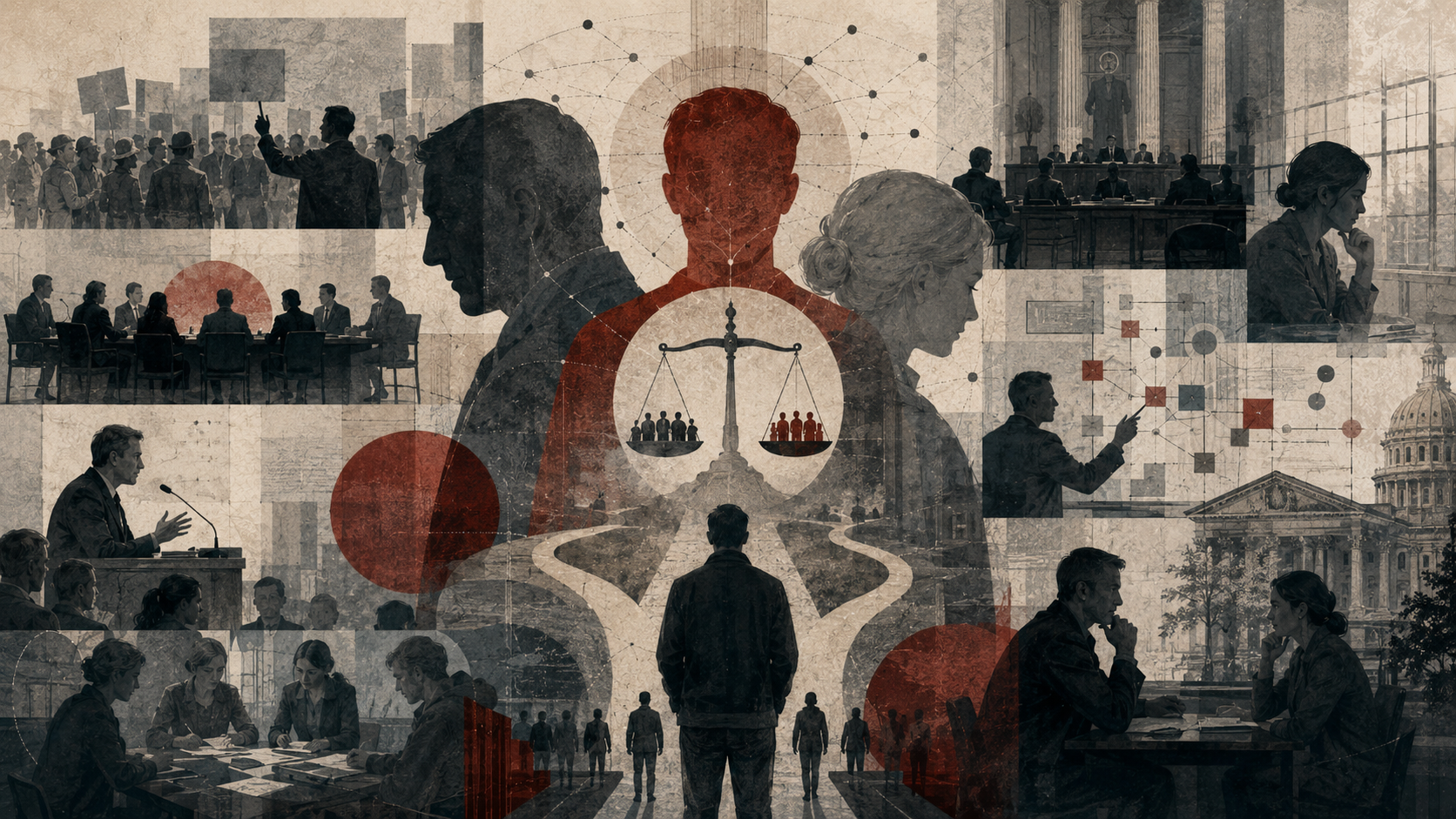
Responsibility is one of the central concepts through which human beings treat one another as moral agents. To hold someone responsible is not merely to say that their body was present in a causal chain. It is to say that the action, omission, decision, or pattern of conduct can be attributed to them in a way that makes a moral response fitting. That response may be praise, blame, rebuke, correction, demand for explanation, expectation of repair, or institutional sanction. Responsibility is therefore tied to agency, but agency itself is shaped by knowledge, control, power, role, social position, and institutional context.
Blame is one possible response to responsibility, but it is not the whole of accountability. Blame can express moral protest, resentment, condemnation, disappointment, distrust, or a demand that the wrongdoer recognize the wrong. Yet blame can also become excessive, displaced, hypocritical, punitive, or politically useful to those who want a single culprit rather than a serious account of failure. Accountability is broader because it asks how answerability should be enacted. Sometimes accountability requires blame. Sometimes it requires explanation, prevention, restitution, structural reform, public acknowledgment, or repair more than emotional condemnation.
What Responsibility, Blame, and Accountability Are
Moral responsibility is commonly understood as a status in virtue of which an agent is appropriately subject to praise or blame for what they have done. It concerns the fittingness of moral appraisal: whether the conduct can be attributed to the person in a way that makes response appropriate. Responsibility may attach to actions, omissions, decisions, intentions, negligence, reckless disregard, role failures, cultivated ignorance, or patterns of conduct. It may also attach to persons acting inside systems, where responsibility is shaped by authority, office, knowledge, role obligation, and capacity to intervene.
Blame is more specific. It is a negative moral response directed toward an agent because of something wrong, harmful, negligent, disrespectful, unjust, cruel, dishonest, reckless, or otherwise morally defective in what they did or failed to do. Blame can include resentment, indignation, reproach, loss of trust, withdrawal, demand for explanation, public criticism, or sanction. But blame is not merely the recognition that something bad happened. It is directed toward someone as answerable.
Accountability is wider than both. It refers to the practices through which answerability is enacted. Accountability may involve being called to explain oneself, facing consequences, apologizing, making restitution, changing conduct, repairing harm, resigning from authority, accepting sanction, participating in reform, or submitting to public review. Accountability can be interpersonal, professional, legal, political, organizational, or institutional. It may involve blame, but it may also involve non-punitive forms of responsibility, prevention, transparency, and repair.
These distinctions matter because moral response becomes crude when the concepts collapse. Someone may be responsible but only partially blameworthy because they lacked full knowledge, acted under pressure, or had limited control. Someone may be blameworthy but not the only accountable party because institutional conditions enabled the harm. A system may demand accountability while directing blame toward a convenient scapegoat. Conversely, reducing blame may not eliminate accountability. A person may deserve mitigation and still owe explanation, apology, restitution, or changed conduct.
| Concept | Core question | Primary concern | Possible response |
|---|---|---|---|
| Moral responsibility | Can this conduct be attributed to the agent in a morally relevant way? | Agency, control, knowledge, intention, role, omission, capacity | Praise, blame, explanation, answerability, appraisal |
| Blame | Is a negative moral response fitting? | Wrongdoing, responsibility, motive, excuse, harm, standing | Reproach, resentment, criticism, condemnation, distrust, sanction |
| Accountability | How should answerability be enacted? | Explanation, consequence, repair, prevention, transparency, reform | Apology, restitution, sanction, institutional change, public reporting |
| Wrongness judgment | Was the act wrong? | Norm violation, harm, injustice, disrespect, breach of duty | Moral evaluation of the action |
| Repair | What must be restored, changed, or prevented? | Victim recognition, trust, restitution, structural reform, future safety | Amends, reform, compensation, public acknowledgment, changed practice |
Why These Distinctions Matter
These distinctions matter because moral life is full of cases in which people conflate involvement, responsibility, blame, and accountability. One common mistake is to assume that if someone is causally involved in a bad outcome, they should be blamed to the fullest extent. Another is to assume that reducing blame eliminates accountability altogether. Both errors flatten the moral landscape. Responsibility judgments, wrongness judgments, and blame judgments are related, but they are not identical.
The distinction is especially important where harm occurs under complex conditions. A nurse may follow a flawed protocol. A manager may fail to respond to warnings. A public official may inherit a broken system and then make it worse. A worker may participate in a process whose harmful consequences are obscured. A bystander may lack authority but not moral relevance. A corporation may blame one employee while preserving the incentives that produced misconduct. In such cases, a serious moral analysis asks not only who touched the harm, but who knew, who could act, who had authority, who benefited, who ignored warnings, and what form of answerability is appropriate.
Distinguishing the concepts also protects against two opposite failures. The first is overblame: treating every participant in a harmful outcome as equally culpable, regardless of knowledge, control, intention, coercion, role, or capacity. The second is evasion: allowing responsibility to disappear because no single person appears fully responsible for the entire harm. Complex systems require a more granular vocabulary. Moral accountability must be able to assign different kinds and degrees of responsibility without either scapegoating or dissolving responsibility into procedure.
The distinction also matters for repair. A community may need public acknowledgment that a wrong occurred even when blame is mitigated. A harmed person may need restitution even if the wrongdoer lacked malice. An institution may need reform even if no single individual intended harm. Accountability is not exhausted by blame because the moral point is not only to condemn. It is to answer for harm, correct failure, restore trust where possible, and prevent recurrence.
| Confusion | Why it is wrong | Better question |
|---|---|---|
| Causal involvement equals full blame | People may contribute causally without equal control, knowledge, or authority. | What kind and degree of responsibility attaches to this agent? |
| Reduced blame eliminates accountability | Mitigation may reduce condemnation without removing duties of repair or explanation. | What form of answerability remains appropriate? |
| Accountability means finding one villain | Institutional failures often involve many roles and structural conditions. | How is responsibility distributed across persons, offices, and systems? |
| Institutional process equals accountability | Procedure can obscure responsibility if it protects power or avoids repair. | Does the process produce truth, consequence, reform, and prevention? |
| Blame is always destructive | Blame can express moral protest and defend violated norms. | Is blame fitting, proportionate, and connected to repair? |
Moral Responsibility as Answerability
One of the most durable ways of understanding moral responsibility is as answerability. To be responsible is to be an appropriate subject of moral questions: Why did you do this? What did you know? What did you intend? What could you have done differently? What role did you occupy? What obligations did you have? What did you ignore? What should you now do to repair or prevent harm? Answerability does not reduce responsibility to punishment. It frames responsibility as participation in a moral practice of giving reasons and being responsive to reasons.
This answerability model is important because it avoids reducing responsibility to mere causation. A falling tree may cause harm, but it is not answerable. A human agent may be answerable when action or omission reflects agency, judgment, negligence, intention, disregard, role failure, or avoidable ignorance. Answerability therefore asks whether the conduct can be attributed to the agent as something for which reasons, explanations, excuses, justifications, apologies, or amends may be demanded.
Answerability also explains why responsibility is relational. To hold someone responsible is not only to classify them internally. It is to place them in a moral relation to those harmed, to observers, to institutions, and to shared norms. The responsible agent is not merely the cause of an event. They are someone who may be called to respond. This response may include apology, explanation, repair, acceptance of consequence, or participation in reform.
Responsibility as answerability also scales upward. Officeholders, professionals, managers, teachers, clinicians, engineers, public servants, and institutional leaders can be answerable not only for what they personally intend, but for duties attached to role, oversight, care, prevention, warning, and response. The more power an agent has over others, the more responsibility may attach to omissions, negligence, and failure to maintain safe or just conditions.
| Answerability question | What it investigates | Why it matters |
|---|---|---|
| What did the agent do or fail to do? | Action, omission, decision, negligence, participation | Responsibility often attaches to omissions as well as actions. |
| What did the agent know or should they have known? | Knowledge, foresight, warning, epistemic position | Ignorance may excuse, mitigate, or aggravate depending on how it arose. |
| What control did the agent have? | Capacity, authority, alternatives, coercion, power | Control shapes the fittingness and degree of responsibility. |
| What role did the agent occupy? | Office, profession, duty, relationship, institutional authority | Roles create specific obligations beyond ordinary causation. |
| What response is now required? | Explanation, apology, sanction, restitution, reform, prevention | Answerability points toward accountability practice, not only judgment. |
Control, Knowledge, and Conditions of Responsibility
Philosophical discussions of responsibility often emphasize two major conditions: a control condition and an epistemic condition. The control condition asks whether the agent had meaningful control, capacity, or opportunity to act otherwise. The epistemic condition asks whether the agent knew, could know, should have known, or could appreciate the moral significance of what they were doing. These conditions are contested in detail, but they remain central because responsibility without control or knowledge threatens to become morally arbitrary.
Control matters because moral responsibility usually requires some connection between the agent’s agency and the outcome. Coercion, compulsion, incapacity, extreme duress, infancy, severe cognitive impairment, or lack of meaningful alternative may weaken or defeat responsibility. But control is not always simple. A person may lack control over one moment while still being responsible for earlier choices that produced the situation. A leader may not personally commit a harmful act but may control the environment that made it likely. A bystander may lack formal authority but still have some capacity to warn, intervene, report, or refuse participation.
Knowledge matters because people are not normally blamed in the same way for harms they could not foresee, understand, or recognize. Yet ignorance does not always excuse. Some ignorance is reasonable; some is negligent; some is cultivated; some is strategic. A person who avoids knowing because knowledge would create obligation may be more blameworthy, not less. An institution that fails to collect information about foreseeable harm may not be innocent simply because it lacks records.
These conditions also interact. A person with high authority and access to information may be more responsible for failure to know than someone with little power and limited access. A professional may be responsible for knowledge that ordinary persons would not be expected to possess. A public official may be accountable for systems of warning, reporting, and oversight. Responsibility therefore depends not only on individual psychology, but on role, power, access, training, and institutional design.
| Condition | Responsibility question | Mitigating factor | Aggravating factor |
|---|---|---|---|
| Control | Could the agent meaningfully act, prevent, refuse, warn, or choose otherwise? | Coercion, incapacity, extreme duress, lack of alternatives | Authority, power, repeated opportunity, failure to intervene |
| Knowledge | Did the agent know, foresee, or have reason to know? | Reasonable ignorance, unforeseeable consequence | Willful ignorance, reckless disregard, ignored warnings |
| Intention | Was the harm intended, accepted, risked, or accidental? | Accident without negligence | Malice, exploitation, cruelty, strategic deception |
| Role duty | Did the agent occupy a role with special obligations? | No relevant authority or duty | Professional duty, leadership authority, fiduciary responsibility |
| Capacity for repair | Can the agent now answer, repair, reform, or prevent recurrence? | No continuing access or capacity | Power to repair combined with refusal to act |
Blame as a Moral Response
Blame is not simply the statement that something bad happened. It is a moral response directed at an agent because of something negatively significant in their action, omission, attitude, character, negligence, or role performance. Blame may express resentment, indignation, disappointment, condemnation, distrust, protest, or demand for repair. It says not only “this was wrong,” but “you are answerable for this wrong.”
Blame has several possible functions. It can protest wrongdoing, defend violated norms, recognize the standing of those harmed, demand explanation, motivate repair, warn others, or mark a boundary. Blame can be socially constructive when it is fitting, proportionate, truthful, and connected to accountability. It can also be destructive when it is excessive, vindictive, hypocritical, selective, humiliating, displaced, or used to avoid structural responsibility.
Blame is morally intense because it concerns the person, not only the act. Even when blame is directed at conduct, it often affects how the wrongdoer is seen: trustworthy or untrustworthy, careless or malicious, responsible or evasive, redeemable or dangerous. This is why blame requires discipline. To blame rightly is not merely to feel anger. It is to respond to wrongdoing in a way that tracks responsibility, degree, context, harm, motive, excuse, and the possibility of repair.
Blame also differs from accountability because blame may be inward, interpersonal, social, or public, while accountability requires some practice of answerability. A person may feel blame but never communicate it. A community may blame publicly without creating repair. An institution may impose accountability without strong emotional blame. The relation between blame and accountability is therefore complex: blame may motivate accountability, but accountability should not be reduced to blame.
| Dimension of blame | What it does | Constructive form | Distorted form |
|---|---|---|---|
| Moral protest | Objects to wrongdoing | Names the wrong and defends the harmed person’s standing | Becomes rage without proportion or truth |
| Norm defense | Reaffirms shared standards | Shows that the violation is not acceptable | Performs outrage without repair |
| Relational response | Changes trust, closeness, or standing | Adjusts relationship in light of responsibility | Defines the person forever by one act |
| Demand for answer | Calls the wrongdoer to explain or respond | Creates space for acknowledgment and repair | Seeks humiliation rather than accountability |
| Public signal | Communicates what a community takes seriously | Protects norms and vulnerable persons | Scapegoats symbolic targets while protecting power |
Wrongness Judgment versus Blame Judgment
Modern psychological work helps clarify an important distinction: wrongness judgments and blame judgments are not the same thing. People can judge that an action was wrong while varying in how much blame they assign to the person who performed it. Wrongness may track the violation itself. Blame more often tracks the relation between the violation and the agent: intention, foresight, motive, control, knowledge, excuse, role obligation, and character inference.
This distinction explains why people respond differently to accidents, negligence, recklessness, malice, coercion, ignorance, and mistake. Two actions may cause the same harm, but one may be judged more blameworthy because the agent knew more, controlled more, intended more, ignored more, or had stronger reason to act differently. Conversely, an action may be wrong yet less blameworthy when performed under severe constraint or reasonable ignorance.
The distinction is also important for institutions. Organizations may want to determine whether a policy caused harm, whether a specific person violated a rule, whether leadership ignored warnings, whether a professional duty was breached, and whether systemic reform is required. These are not identical judgments. An institution that collapses wrongness into individual blame may scapegoat. An institution that refuses blame because responsibility is complex may evade accountability. A serious framework preserves multiple levels of analysis.
Psychologically, blame is often more socially sensitive than wrongness judgment. People assign blame partly by inferring what the agent knew, intended, valued, or could control. They also consider excuses, apologies, remorse, group identity, relationship, and perceived moral character. This makes blame powerful, but also vulnerable to bias. People may overblame outgroups, underblame allies, excuse powerful actors, or punish low-status actors more readily. Distinguishing wrongness from blame helps make these distortions visible.
| Judgment type | Primary question | Key evidence | Common distortion |
|---|---|---|---|
| Wrongness judgment | Was the act or omission morally wrong? | Norm violation, harm, injustice, breach of duty | Ignoring context, role, or competing values |
| Responsibility judgment | Can the conduct be attributed to the agent? | Control, knowledge, agency, role, authority | Confusing causation with responsibility |
| Blame judgment | How fitting is negative moral response? | Responsibility, intention, motive, excuse, harm, remorse | Overblaming enemies and underblaming allies |
| Accountability judgment | What response should follow? | Harm, repair needs, prevention, institutional trust | Reducing accountability to punishment alone |
| Repair judgment | What must be restored or changed? | Victim recognition, restitution, reform, future safety | Declaring closure before repair occurs |
Responsibility Without Identical Blame
Even when two people are both responsible in some broad sense, they may not be blameworthy in identical degree. Degrees of control, knowledge, intention, pressure, role obligation, available alternatives, and epistemic position all matter. Moral life often requires fine distinctions among full blame, partial blame, mitigated blame, tragic responsibility, negligence, strict role accountability, and accountability without straightforward condemnation.
These gradations matter because moral judgment is often tempted by all-or-nothing categories. Someone is guilty or innocent, blameworthy or blameless, accountable or not accountable. But many cases require more nuanced moral language. A junior employee may participate in a harmful institutional process with limited power. A leader may never touch the harmful act but be responsible for the policy that enabled it. A professional may make a mistake under severe overload. A bystander may fail to act because of fear, confusion, or social pressure. These cases are not morally identical.
Responsibility without identical blame is especially important in systems where multiple people contribute to harm under different conditions. The person who designed a dangerous process, the person who executed it, the person who ignored warnings, the person who failed to supervise, and the person who lacked power to intervene may all be involved, but not in the same way. Accountability must be distributed according to role, authority, knowledge, and capacity.
This distinction also protects repair. If blame is too crude, people may become defensive and truth may disappear. If blame is too weak, harm may be minimized and victims may be denied recognition. A differentiated framework allows for proportionate response: one person may owe apology, another restitution, another resignation, another public explanation, another institutional reform, and another protection from unfair scapegoating.
| Form of responsibility | Description | Possible accountability response |
|---|---|---|
| Direct culpability | The agent knowingly or intentionally committed the wrong. | Blame, sanction, apology, restitution, repair, possible exclusion |
| Negligent responsibility | The agent failed to take reasonable care or ignored foreseeable risk. | Correction, sanction, retraining, restitution, reform |
| Role responsibility | The agent had duties attached to office, profession, or authority. | Public explanation, leadership accountability, procedural change |
| Tragic responsibility | The agent contributed under constrained or morally compromised conditions. | Explanation, repair where possible, mitigated blame |
| Structural responsibility | Harm arose from institutional design, incentives, or distributed failure. | Investigation, reform, oversight, policy change, collective accountability |
Standing to Blame and Moral Relationships
Blame is shaped not only by what the wrongdoer did, but by who is doing the blaming and from what moral position. Questions of standing ask whether a person or institution has the moral authority to blame in a given context. Standing does not always determine whether the blamed conduct was wrong. A hypocritical person may correctly identify wrongdoing. But perceived hypocrisy, complicity, bad faith, or lack of commitment to the norm can weaken the legitimacy of blame as a relational act.
Standing to blame matters because blame is not merely a detached verdict. It is a social practice. When someone blames, they present themselves as committed to a norm and as entitled to call another person to account under that norm. If the blamer routinely violates the same norm, benefits from similar wrongdoing, or selectively invokes the norm only against enemies, observers may judge that the blame lacks standing even if the underlying criticism is accurate.
This is especially important in public life. Institutions may condemn wrongdoing while hiding their own failures. Political actors may blame opponents for conduct they excuse in allies. Organizations may discipline low-level workers for violations tolerated among executives. States may condemn abuses abroad while denying abuses at home. In such cases, the issue is not only whether the blamed party did wrong. It is whether the practice of blame is being used with integrity.
Standing also matters interpersonally. A victim has a distinctive standing to blame the person who harmed them. Bystanders may also have standing, especially when public norms or vulnerable persons are at stake. But not all blame from all positions carries the same moral meaning. Blame from the person harmed, from a hypocritical observer, from a responsible institution, and from a self-protective bureaucracy are different moral acts.
| Standing issue | Question | Why it matters |
|---|---|---|
| Hypocrisy | Does the blamer violate the same norm they invoke? | Hypocrisy can undermine the legitimacy of blame as moral protest. |
| Complicity | Did the blamer contribute to or benefit from the wrong? | Complicity may require self-accountability before or alongside blaming others. |
| Victim standing | Was the blamer directly harmed? | Those harmed often have special standing to demand recognition and answerability. |
| Institutional standing | Does the institution apply norms consistently? | Selective enforcement turns blame into power protection. |
| Bad faith | Is blame used to repair wrong or merely to attack enemies? | Bad-faith blame corrodes trust in accountability practices. |
Excuses, Mitigating Conditions, and Willful Ignorance
Excuses and mitigating conditions complicate blame because they change how wrongdoing is connected to the agent. An excuse does not always deny that the act was wrong. Instead, it may reduce the degree to which the wrong reflects blameworthy agency. A person who acts under duress, ignorance, confusion, incapacity, or extreme pressure may still be connected to the harm, but the fittingness or degree of blame may change.
Mitigation matters because moral blame should be proportionate. A child, a coerced subordinate, a person acting under emergency, a professional working under impossible system strain, and a malicious actor exploiting vulnerability are not morally identical. A serious accountability framework must ask whether the agent could understand the situation, foresee the harm, control the outcome, resist pressure, access relevant information, or reasonably do otherwise.
Yet ignorance does not automatically excuse. Some ignorance is reasonable; some is negligent; some is reckless; some is cultivated. Willful ignorance is morally important because people sometimes avoid knowing in order to avoid responsibility. A leader who refuses to read warnings, a company that avoids collecting safety data, an official who designs reporting systems to suppress complaints, or a person who chooses not to ask because the answer would impose obligation may be blameworthy for the ignorance itself.
This makes the epistemic condition more complex than a simple question of whether the agent knew. The relevant question may be whether they should have known, whether they had a duty to know, whether they avoided knowing, and whether their ignorance reflects negligence, self-protection, indifference, or institutional design. Accountability must therefore examine knowledge systems as well as individual beliefs.
| Condition | Effect on blame | Key question |
|---|---|---|
| Reasonable ignorance | May mitigate or defeat blame | Could the agent reasonably have known? |
| Negligent ignorance | May preserve or increase blame | Did the agent fail to take reasonable steps to know? |
| Willful ignorance | May aggravate blame | Did the agent avoid knowledge to preserve deniability? |
| Coercion | May mitigate blame depending on severity and alternatives | What pressure was applied, and what options remained? |
| Role-based duty to know | May increase responsibility for ignorance | Did the agent’s position require vigilance, oversight, or expertise? |
Accountability in Groups and Institutions
Accountability becomes especially complex in groups and institutions because agency is divided across roles, offices, procedures, incentives, reporting lines, and chains of command. Harm may arise from many decisions, each partial and seemingly defensible in isolation. One person writes a policy. Another approves it. Another implements it. Another ignores complaints. Another lacks authority to change it. Another benefits from the outcome. The result may be serious harm with no single actor appearing to contain the whole wrong.
This institutional dimension matters because many serious wrongs are not best understood as isolated individual transgressions. They are sustained by systems in which responsibility is spread widely enough that accountability becomes evasive unless it is actively structured. Institutions therefore need clear responsibility assignments, reporting pathways, oversight mechanisms, escalation duties, transparency, documentation, and protection for those who raise concerns.
Institutional accountability is not simply collective blame. It requires mapping responsibility across levels. Who had decision authority? Who had information? Who had oversight responsibility? Who benefited? Who failed to respond? Who designed the incentive system? Who silenced warnings? Who had power to repair? Without such mapping, institutions often oscillate between two failures: blaming one symbolic person or blaming no one because everyone was only a small part of the system.
Accountability in institutions must also include structural responsibility. If a hospital, school, corporation, agency, religious body, university, platform, or government creates conditions that predictably produce harm, accountability cannot stop at the final actor in the chain. The structure itself must answer: policies, incentives, culture, reporting systems, leadership, resource allocation, training, and oversight. Otherwise accountability becomes theater.
| Institutional layer | Accountability question | Possible response |
|---|---|---|
| Individual actor | What did this person do, know, intend, or fail to do? | Blame, correction, sanction, apology, restitution |
| Role holder | What duties came with the office or professional position? | Role review, disciplinary action, retraining, resignation |
| Supervisor or leader | What oversight, warning, prevention, or response was required? | Leadership accountability, policy change, public explanation |
| Organizational system | What incentives, procedures, or cultures enabled harm? | Structural reform, audit, oversight, reporting redesign |
| Public institution | How was trust, legitimacy, or public duty violated? | Transparency, inquiry, reparations, legal reform, public reporting |
Responsibility Diffusion and Bureaucratic Failure
Modern institutions often make accountability difficult by diffusing responsibility. A harmful outcome may involve many actors, each able to claim limited control, partial knowledge, procedural compliance, or lack of authority. In such cases, responsibility is not absent, but it becomes fragmented. The moral danger is that fragmentation can make serious harm appear ownerless.
Bureaucratic systems can encourage responsibility diffusion through specialization, hierarchy, paperwork, automated decision-making, subcontracting, legal compartmentalization, and procedural distance from consequences. Each participant may complete a narrow task while the human meaning of the overall process disappears. A file is processed. A denial is issued. A complaint is closed. A risk is categorized. A warning is routed. A person is harmed, but the system sees only steps.
Responsibility diffusion can also create scapegoating. When public pressure demands accountability, institutions may locate one person to absorb blame while leaving systemic conditions intact. This may satisfy the appearance of accountability while failing to prevent recurrence. Conversely, institutions may invoke complexity to avoid all responsibility: no one intended the harm, everyone followed procedure, and therefore no one answers. Both patterns are morally inadequate.
A serious moral psychology of accountability must therefore treat institutional opacity itself as a moral variable. Systems should be designed so that responsibility remains traceable. Duties should be named. Escalation pathways should be clear. Warnings should not vanish into bureaucracy. Decision authority should be matched with answerability. Those affected by decisions should have meaningful routes to appeal, correction, and redress.
| Diffusion mechanism | How responsibility becomes obscured | Accountability safeguard |
|---|---|---|
| Fragmented roles | Each person handles only a small part of the harmful process. | Map end-to-end responsibility and name accountable owners. |
| Hierarchy | Subordinates claim orders; leaders claim distance from implementation. | Clarify duties at each level and protect refusal/reporting. |
| Proceduralism | Following rules replaces moral judgment about consequences. | Require consequence review and exception pathways. |
| Data and automation | Decisions are attributed to systems, scores, or models. | Assign human accountability for design, deployment, and appeal. |
| Scapegoating | One actor is blamed to protect the larger system. | Combine individual accountability with structural investigation. |
Repair, Sanction, and Moral Accountability
Accountability is not exhausted by punishment. In many contexts, what is morally needed is acknowledgment, explanation, restitution, changed practice, restored trust, institutional reform, or prevention of recurrence. Blame may be part of that process, but accountability can also aim at repair, learning, and future safety. The moral question is not only “Who should suffer consequence?” but also “What must be answered for, repaired, transformed, and prevented?”
Sanction remains important. Some wrongs require consequence because the violation is serious, the harmed person’s standing must be defended, public trust must be restored, and future harm must be deterred. But sanction alone may be empty if the offender does not acknowledge the wrong, if the victim receives no repair, if the institution remains unchanged, or if the public learns only that someone was punished rather than why the wrong happened.
Repair-oriented accountability asks a broader set of questions. What truth must be told? What harm must be recognized? What restitution is owed? What apology is meaningful? What conduct must change? What institutional conditions enabled the harm? What safeguards are needed? What authority should be removed? What records should be public? What must be remembered so that the wrong is not repeated or denied?
This broader frame is especially useful in organizational and public ethics. The point of accountability is often not only to register disapproval, but to prevent repetition and restore credible moral order. That may require sanctions, but also training, policy redesign, reporting protections, leadership changes, public transparency, reparations, victim-centered processes, and independent oversight. Accountability without repair can become performance. Repair without accountability can become denial.
| Accountability response | Primary function | When it is insufficient |
|---|---|---|
| Sanction | Marks wrongdoing and imposes consequence. | When it substitutes punishment for truth, restitution, or reform. |
| Explanation | Makes decisions, failures, and reasons intelligible. | When explanation becomes excuse or obfuscation. |
| Apology | Acknowledges wrong and accepts responsibility. | When words are not connected to amends or changed conduct. |
| Restitution | Addresses material, relational, or institutional harm. | When compensation is used to avoid public responsibility. |
| Structural reform | Changes the conditions that made harm possible. | When reform language is symbolic and not implemented. |
Mathematical Lens: Modeling Responsibility and Blame
Responsibility can be modeled as a function of control and epistemic position. Let \(R_i\) represent the moral responsibility of agent \(i\):
R_i = f(C_i, K_i)
\]
Interpretation: Moral responsibility is modeled as depending on relevant control and relevant knowledge. The model is intentionally simplified, but it captures the central idea that responsibility is more than causal involvement.
where \(C_i\) is relevant control and \(K_i\) is relevant knowledge or epistemic position. A more explicit linear version can be written as:
R_i = \alpha C_i + \beta K_i + \gamma D_i
\]
Interpretation: Responsibility increases with control, knowledge, and role duty. This allows special obligations to matter when agents occupy professional, institutional, or leadership roles.
Blame can then be modeled as a moral response to responsibility plus additional relational and contextual factors:
B_i = \sigma(\alpha R_i + \beta W_i + \gamma M_i – \lambda E_i)
\]
Interpretation: Blame probability rises with responsibility, wrongness severity, and malicious or negligent motive, and falls when mitigating excuses are stronger.
where \(\sigma\) is the logistic transformation, \(W_i\) is wrongness severity, \(M_i\) is malicious or negligent motive, and \(E_i\) is mitigating excuse. This reflects the empirical and philosophical distinction between judging an act wrong and deciding how blameworthy the agent is.
Institutional accountability can be represented as:
A_g = \sum_{i=1}^{n} \omega_i R_i + \phi S_g
\]
Interpretation: Group or institutional accountability is modeled as role-weighted individual responsibility plus structural factors such as policy, oversight, reporting design, incentives, and institutional culture.
This model captures why accountability in organizations cannot be reduced to one individual alone when system-level conditions materially shape outcomes. The model also allows responsibility to be distributed without disappearing. Roles, authority, knowledge, and structural design can all be represented explicitly.
A repair-oriented accountability model can also be written as:
Q_g = \theta_1 A_g + \theta_2 T_g + \theta_3 P_g + \theta_4 R_g
\]
Interpretation: Accountability quality rises when answerability is paired with truth-telling, prevention, and repair. This separates accountability from punishment alone.
where \(Q_g\) is accountability quality, \(A_g\) is answerability, \(T_g\) is truth-telling, \(P_g\) is prevention capacity, and \(R_g\) is repair. This final model makes the broader argument visible: accountability is not merely assigning blame; it is structuring answerability so that truth, consequence, repair, and prevention become possible.
| Model term | Meaning | Moral interpretation |
|---|---|---|
| \(C_i\) | Control | The agent’s capacity to act, intervene, refuse, prevent, or choose otherwise. |
| \(K_i\) | Knowledge | The agent’s awareness, foresight, epistemic access, or duty to know. |
| \(D_i\) | Role duty | Special obligations created by office, profession, authority, or relationship. |
| \(R_i\) | Responsibility | The degree to which conduct can be attributed to the agent. |
| \(B_i\) | Blame | The fittingness or probability of negative moral response. |
| \(E_i\) | Excuse | Mitigating conditions such as duress, incapacity, or reasonable ignorance. |
| \(A_g\) | Institutional accountability | Role-weighted responsibility plus system-level conditions. |
| \(Q_g\) | Accountability quality | Whether answerability is connected to truth, repair, reform, and prevention. |
R Workflow: Modeling Responsibility, Blame, and Accountability
The following R workflow simulates control, knowledge, role duty, wrongness severity, motive, excuse, institutional structure, responsibility, blame, and accountability. The dataset is synthetic and intended for reproducible article support, not empirical claims about real persons, organizations, institutions, or legal cases.
# Responsibility, Blame, and Moral Accountability
# Synthetic R workflow for modeling responsibility, blame, and accountability.
# Educational and reproducible research scaffold only.

suppressPackageStartupMessages({
  library(tidyverse)
  library(broom)
})

set.seed(42)

# ------------------------------------------------------------
# 1. Set up output folders
# ------------------------------------------------------------

dir.create("outputs", showWarnings = FALSE)
dir.create("outputs/tables", recursive = TRUE, showWarnings = FALSE)
dir.create("outputs/figures", recursive = TRUE, showWarnings = FALSE)

# ------------------------------------------------------------
# 2. Simulate responsibility and blame structure
# ------------------------------------------------------------

n <- 2400

df <- tibble(
  case_id = 1:n,
  control = rnorm(n, 0, 1),
  knowledge = rnorm(n, 0, 1),
  role_duty = rnorm(n, 0, 1),
  wrongness_severity = rnorm(n, 0, 1),
  motive_malice = rnorm(n, 0, 1),
  mitigating_excuse = rnorm(n, 0, 1),
  institutional_structure = rnorm(n, 0, 1),
  victim_recognition = rnorm(n, 0, 1),
  repair_capacity = rnorm(n, 0, 1),
  prevention_capacity = rnorm(n, 0, 1)
) %>%
  mutate(
    responsibility =
      0.40 * control +
      0.35 * knowledge +
      0.25 * role_duty +
      rnorm(n, 0, 0.8),

    blame_latent =
      0.40 * responsibility +
      0.35 * wrongness_severity +
      0.25 * motive_malice -
      0.30 * mitigating_excuse +
      rnorm(n, 0, 0.8),

    blame_probability = plogis(blame_latent),
    blame_assigned = if_else(blame_probability >= 0.5, 1, 0),

    accountability_score =
      0.45 * responsibility +
      0.25 * institutional_structure +
      0.20 * wrongness_severity +
      0.20 * repair_capacity +
      0.15 * prevention_capacity +
      rnorm(n, 0, 0.8),

    accountability_quality =
      0.30 * accountability_score +
      0.25 * victim_recognition +
      0.25 * repair_capacity +
      0.25 * prevention_capacity +
      0.20 * institutional_structure +
      rnorm(n, 0, 0.8)
  )

# ------------------------------------------------------------
# 3. Estimate blame model
# ------------------------------------------------------------

model_blame <- glm(
  blame_assigned ~ responsibility + wrongness_severity +
    motive_malice + mitigating_excuse,
  data = df,
  family = binomial()
)

blame_summary <- tidy(
  model_blame,
  conf.int = TRUE,
  exponentiate = TRUE
)

blame_fit <- glance(model_blame)

print(blame_summary)

# ------------------------------------------------------------
# 4. Estimate accountability model
# ------------------------------------------------------------

model_accountability <- lm(
  accountability_score ~ responsibility + institutional_structure +
    wrongness_severity + repair_capacity + prevention_capacity,
  data = df
)

accountability_summary <- tidy(model_accountability, conf.int = TRUE)
accountability_fit <- glance(model_accountability)

print(accountability_summary)

# ------------------------------------------------------------
# 5. Estimate accountability-quality model
# ------------------------------------------------------------

model_quality <- lm(
  accountability_quality ~ accountability_score + victim_recognition +
    repair_capacity + prevention_capacity + institutional_structure,
  data = df
)

quality_summary <- tidy(model_quality, conf.int = TRUE)
quality_fit <- glance(model_quality)

print(quality_summary)

# ------------------------------------------------------------
# 6. Summarize by responsibility level
# ------------------------------------------------------------

responsibility_summary <- df %>%
  mutate(
    responsibility_group = ntile(responsibility, 4),
    responsibility_group = factor(
      responsibility_group,
      labels = c("Low", "Lower-middle", "Upper-middle", "High")
    )
  ) %>%
  group_by(responsibility_group) %>%
  summarize(
    mean_blame_prob = mean(blame_probability),
    blame_rate = mean(blame_assigned),
    mean_accountability = mean(accountability_score),
    mean_accountability_quality = mean(accountability_quality),
    mean_excuse = mean(mitigating_excuse),
    .groups = "drop"
  )

print(responsibility_summary)

# ------------------------------------------------------------
# 7. Prediction grid across responsibility and excuse
# ------------------------------------------------------------

pred_grid <- expand_grid(
  responsibility = seq(-2, 2, length.out = 100),
  mitigating_excuse = c(-1, 0, 1),
  wrongness_severity = 0,
  motive_malice = 0
)

pred_grid$predicted_blame_prob <- predict(
  model_blame,
  newdata = pred_grid,
  type = "response"
)

pred_grid <- pred_grid %>%
  mutate(
    excuse_label = case_when(
      mitigating_excuse == -1 ~ "Low excuse",
      mitigating_excuse == 0 ~ "Average excuse",
      TRUE ~ "High excuse"
    )
  )

# ------------------------------------------------------------
# 8. Plot predicted blame
# ------------------------------------------------------------

plot_blame <- ggplot(
  pred_grid,
  aes(x = responsibility, y = predicted_blame_prob)
) +
  geom_line(linewidth = 1) +
  facet_wrap(~ excuse_label) +
  labs(
    title = "Predicted Blame from Responsibility and Excuse",
    subtitle = "Mitigating excuses reduce blame without erasing accountability",
    x = "Responsibility",
    y = "Probability of blame"
  ) +
  theme_minimal(base_size = 12)

print(plot_blame)

# ------------------------------------------------------------
# 9. Export outputs
# ------------------------------------------------------------

write_csv(df, "outputs/tables/responsibility_blame_accountability_simulated_data.csv")
write_csv(blame_summary, "outputs/tables/responsibility_blame_model.csv")
write_csv(blame_fit, "outputs/tables/responsibility_blame_model_fit.csv")
write_csv(accountability_summary, "outputs/tables/accountability_model.csv")
write_csv(accountability_fit, "outputs/tables/accountability_model_fit.csv")
write_csv(quality_summary, "outputs/tables/accountability_quality_model.csv")
write_csv(quality_fit, "outputs/tables/accountability_quality_model_fit.csv")
write_csv(responsibility_summary, "outputs/tables/responsibility_group_summary.csv")
write_csv(pred_grid, "outputs/tables/responsibility_blame_prediction_grid.csv")

ggsave(
  filename = "outputs/figures/predicted_blame_by_responsibility_and_excuse.png",
  plot = plot_blame,
  width = 10,
  height = 6,
  dpi = 300
)
This workflow is useful because it distinguishes responsibility, blame, accountability, and accountability quality instead of treating them as one undifferentiated moral reaction. It also models why mitigating excuses can reduce blame without eliminating accountability, and why accountability quality depends on repair and prevention rather than sanction alone.
Python Workflow: Simulating Moral Accountability Under Varying Conditions
The Python workflow below simulates how control, knowledge, role duty, wrongness, motive, excuse, institutional design, victim recognition, repair capacity, and prevention capacity shape responsibility, blame, and accountability. The example uses synthetic data for reproducible demonstration and should not be interpreted as an assessment of real persons, cases, institutions, organizations, or justice systems.
# Responsibility, Blame, and Moral Accountability
# Python workflow for synthetic moral-accountability modeling.
# Educational and reproducible research scaffold only.

from pathlib import Path

import numpy as np
import pandas as pd

np.random.seed(42)

# ------------------------------------------------------------
# 1. Set up output folders
# ------------------------------------------------------------

output_tables = Path("outputs/tables")
output_tables.mkdir(parents=True, exist_ok=True)

# ------------------------------------------------------------
# 2. Simulate responsibility and blame variables
# ------------------------------------------------------------

n = 2600

df = pd.DataFrame({
    "case_id": np.arange(1, n + 1),
    "control": np.random.normal(0, 1, n),
    "knowledge": np.random.normal(0, 1, n),
    "role_duty": np.random.normal(0, 1, n),
    "wrongness_severity": np.random.normal(0, 1, n),
    "motive_malice": np.random.normal(0, 1, n),
    "mitigating_excuse": np.random.normal(0, 1, n),
    "institutional_structure": np.random.normal(0, 1, n),
    "victim_recognition": np.random.normal(0, 1, n),
    "repair_capacity": np.random.normal(0, 1, n),
    "prevention_capacity": np.random.normal(0, 1, n)
})

# ------------------------------------------------------------
# 3. Generate responsibility, blame, and accountability
# ------------------------------------------------------------

df["responsibility"] = (
    0.40 * df["control"] +
    0.35 * df["knowledge"] +
    0.25 * df["role_duty"] +
    np.random.normal(0, 0.8, n)
)

blame_latent = (
    0.40 * df["responsibility"] +
    0.35 * df["wrongness_severity"] +
    0.25 * df["motive_malice"] -
    0.30 * df["mitigating_excuse"] +
    np.random.normal(0, 0.8, n)
)

df["blame_probability"] = 1 / (1 + np.exp(-blame_latent))
df["blame_assigned"] = (df["blame_probability"] >= 0.5).astype(int)

df["accountability_score"] = (
    0.45 * df["responsibility"] +
    0.25 * df["institutional_structure"] +
    0.20 * df["wrongness_severity"] +
    0.20 * df["repair_capacity"] +
    0.15 * df["prevention_capacity"] +
    np.random.normal(0, 0.8, n)
)

df["accountability_quality"] = (
    0.30 * df["accountability_score"] +
    0.25 * df["victim_recognition"] +
    0.25 * df["repair_capacity"] +
    0.25 * df["prevention_capacity"] +
    0.20 * df["institutional_structure"] +
    np.random.normal(0, 0.8, n)
)

# ------------------------------------------------------------
# 4. Summarize by responsibility level
# ------------------------------------------------------------

df["responsibility_group"] = pd.qcut(
    df["responsibility"],
    q=4,
    labels=["Low", "Lower-middle", "Upper-middle", "High"]
)

summary = (
    df.groupby("responsibility_group", observed=False)
      .agg(
          mean_blame_prob=("blame_probability", "mean"),
          blame_rate=("blame_assigned", "mean"),
          mean_accountability=("accountability_score", "mean"),
          mean_accountability_quality=("accountability_quality", "mean"),
          mean_excuse=("mitigating_excuse", "mean")
      )
      .reset_index()
)

print(summary)

# ------------------------------------------------------------
# 5. Scenario grid across responsibility and excuse
# ------------------------------------------------------------

scenario_rows = []

for responsibility in np.linspace(-2, 2, 41):
    for excuse in [-1, 0, 1]:
        latent = (
            0.40 * responsibility +
            0.35 * 0 +
            0.25 * 0 -
            0.30 * excuse
        )

        prob = 1 / (1 + np.exp(-latent))

        scenario_rows.append({
            "responsibility": responsibility,
            "mitigating_excuse": excuse,
            "predicted_blame_probability": prob
        })

scenario_df = pd.DataFrame(scenario_rows)

print(scenario_df.head(12))

# ------------------------------------------------------------
# 6. Identify high-accountability low-blame synthetic cases
# ------------------------------------------------------------

high_accountability_low_blame = (
    df[
        (df["accountability_score"] > df["accountability_score"].quantile(0.75)) &
        (df["blame_probability"] < df["blame_probability"].quantile(0.25))
    ]
    .sort_values("accountability_score", ascending=False)
    .head(25)
    .reset_index(drop=True)
)

# ------------------------------------------------------------
# 7. Export outputs
# ------------------------------------------------------------

df.to_csv(output_tables / "responsibility_blame_accountability_python.csv", index=False)
summary.to_csv(output_tables / "responsibility_blame_accountability_summary.csv", index=False)
scenario_df.to_csv(output_tables / "responsibility_blame_accountability_scenarios.csv", index=False)
high_accountability_low_blame.to_csv(
    output_tables / "high_accountability_low_blame_cases.csv",
    index=False
)

print("Synthetic responsibility, blame, and accountability outputs written to:", output_tables)
This workflow is useful because it models blame as sensitive to excuse, wrongness, motive, and responsibility while keeping accountability in view. It also makes visible a crucial moral distinction: some cases may involve high accountability needs even when blame is mitigated. That distinction matters for institutional ethics, professional responsibility, organizational failure, and public repair.
In a full article repository, this Python workflow can be extended into notebooks, SQL schema, synthetic datasets, validation notes, responsibility-diffusion scenarios, institutional-accountability models, and additional language examples. R can support statistical modeling and visualization; Python can support simulation and data pipelines; SQL can preserve structured scenario metadata; Julia can support accountability-distribution simulations; and C, C++, Fortran, Go, and Rust can support reproducible command-line tools, validation utilities, and computational demonstrations.
GitHub Repository
The companion repository for this article provides a reproducible code scaffold for modeling control, knowledge, role duty, wrongness severity, motive malice, mitigating excuse, institutional structure, victim recognition, repair capacity, prevention capacity, responsibility, blame, accountability, and accountability quality.
This article’s companion repository includes reproducible workflows, synthetic datasets, model documentation, computational examples, and outputs for exploring how responsibility, blame, and accountability can be distinguished, modeled, and connected to repair-oriented institutional practice.
The repository structure should support a full research workflow rather than a single script. The article folder can include language-specific examples in python, r, julia, sql, c, cpp, fortran, go, and rust, along with data, docs, notebooks, and outputs. This structure makes the article reproducible, inspectable, and extensible for readers who want to move from conceptual argument to analytical demonstration.
Conclusion
Responsibility, blame, and moral accountability are central to moral life because they govern how persons and institutions are treated as answerable for what they do. Moral responsibility concerns whether an action, omission, decision, or role failure is properly attributable to an agent under relevant conditions of control, knowledge, duty, and agency. Blame is a negative moral response to wrongdoing or other negative normative significance. Accountability is the broader practice through which answerability is enacted in relationships, institutions, and public life.
The strongest contemporary picture therefore refuses simple collapse. Not every wrong act warrants the same blame. Not every accountable agent is blameworthy in identical degree. Not every institutional failure can be understood through one individual alone. Not every reduction in blame eliminates the need for repair. A serious moral psychology of this domain must hold agency, excuse, blame, repair, and structure together.
This matters because moral failure often occurs under conditions that are neither purely individual nor wholly impersonal. People act inside families, workplaces, professions, governments, digital systems, legal orders, and institutions. They occupy roles. They receive warnings or ignore them. They follow procedures or design them. They benefit from systems or challenge them. Moral accountability must therefore be precise enough to avoid scapegoating and strong enough to prevent responsibility from vanishing into bureaucracy.
Responsibility asks who can answer. Blame asks what negative response is fitting. Accountability asks what answerability requires. When these questions are separated and then brought back together, moral judgment becomes more disciplined. It can condemn without simplifying, mitigate without excusing, repair without denying harm, and reform institutions without pretending that systems act without people. That is why responsibility, blame, and moral accountability remain foundational concepts for any serious moral psychology.
Related articles
- Punishment, Forgiveness, and Moral Repair
- Moral Disengagement and the Psychology of Ethical Failure
- Moral Self-Regulation, Temptation, and Weakness of Will
- Moral Judgment and the Psychology of Right and Wrong
- Moral Motivation and the Judgment–Action Gap
- Conscience, Guilt, Shame, and Moral Self-Evaluation
- Hypocrisy, Dehumanization, and the Psychology of Moral Failure
- Moral Psychology in Organizations and Institutions
Further reading
- Talbert, M. (2019) ‘Moral Responsibility’, in The Stanford Encyclopedia of Philosophy. Available at: https://plato.stanford.edu/entries/moral-responsibility/.
- Rudy-Hiller, F. (2018) ‘The Epistemic Condition for Moral Responsibility’, in The Stanford Encyclopedia of Philosophy. Available at: https://plato.stanford.edu/entries/moral-responsibility-epistemic/.
- Tognazzini, N. (2014) ‘Blame’, in The Stanford Encyclopedia of Philosophy. Available at: https://plato.stanford.edu/entries/blame/.
- Malle, B.F. (2021) ‘Moral Judgments’, Annual Review of Psychology, 72, pp. 293–318. Available via PubMed summary: https://pubmed.ncbi.nlm.nih.gov/32886588/.
- Kirfel, L. and Malle, B.F. (2025) ‘A framework for blaming willful ignorance’, Current Opinion in Psychology. Available at: https://www.sciencedirect.com/science/article/pii/S2352250X25001034.
- World Health Organization (2023) Preventing and responding to sexual misconduct: WHO’s accountability framework. Available at: https://www.who.int/publications/i/item/WHO-DGO-PRS-2023.2.
References
- Kirfel, L. and Malle, B.F. (2025) ‘A framework for blaming willful ignorance’, Current Opinion in Psychology. Available at: https://www.sciencedirect.com/science/article/pii/S2352250X25001034.
- Malle, B.F. (2021) ‘Moral Judgments’, Annual Review of Psychology, 72, pp. 293–318. Available via PubMed summary: https://pubmed.ncbi.nlm.nih.gov/32886588/.
- Rudy-Hiller, F. (2018) ‘The Epistemic Condition for Moral Responsibility’, in The Stanford Encyclopedia of Philosophy. Available at: https://plato.stanford.edu/entries/moral-responsibility-epistemic/.
- Talbert, M. (2019) ‘Moral Responsibility’, in The Stanford Encyclopedia of Philosophy. Available at: https://plato.stanford.edu/entries/moral-responsibility/.
- Tognazzini, N. (2014) ‘Blame’, in The Stanford Encyclopedia of Philosophy. Available at: https://plato.stanford.edu/entries/blame/.
- World Health Organization (2023) Preventing and responding to sexual misconduct: WHO’s accountability framework. Available at: https://www.who.int/publications/i/item/WHO-DGO-PRS-2023.2.