
Last Updated May 28, 2026
Personality, character, and individual differences in moral life belong together, but they are not interchangeable. Personality refers to broader patterns of disposition, affect, motivation, and behavior that organize how a person typically relates to the world. Character refers more specifically to morally valenced patterns in thought, feeling, and conduct, especially where they bear on honesty, courage, justice, care, self-command, humility, trustworthiness, and responsibility. Individual differences is the widest empirical frame of all: it includes personality traits, character strengths, moral identity, ideological style, self-interest bias, empathy, prosociality, self-regulation, social orientation, and the many ways persons vary in how morality is perceived, judged, and enacted.
A serious moral psychology needs these distinctions because morality is not distributed evenly across persons, nor is variation explained by one model alone. Some differences are broad and temperamental. Some are explicitly moral. Some are tied to identity, emotion, and self-regulation. Some emerge most clearly under social pressure, institutional constraint, group conflict, or moral ambiguity. The strongest contemporary picture is therefore plural rather than reductionist: moral life is shaped by general personality structure, morally specific dispositions, contextual pressures, developmental histories, and culturally patterned ways of construing harm, fairness, loyalty, authority, care, dignity, and obligation.
This article argues that moral individuality should be understood as a layered and context-sensitive structure. Persons differ in temperament, emotional reactivity, conscientiousness, empathy, honesty, moral identity, self-interest bias, ideological style, and responsiveness to social norms. But those differences do not operate in isolation. Character is expressed through situations. Personality is shaped by social worlds. Moral identity is activated or suppressed by institutions. Virtue can be supported, tested, weakened, or distorted by context. The task is not to choose between “character” and “situation,” but to understand how persons and situations jointly produce moral life.
Main Library
Publications
Article Map
Moral Psychology
Related Topic
Positive Psychology
Related Topic
Social Psychology
Related Topic
Organizational Psychology
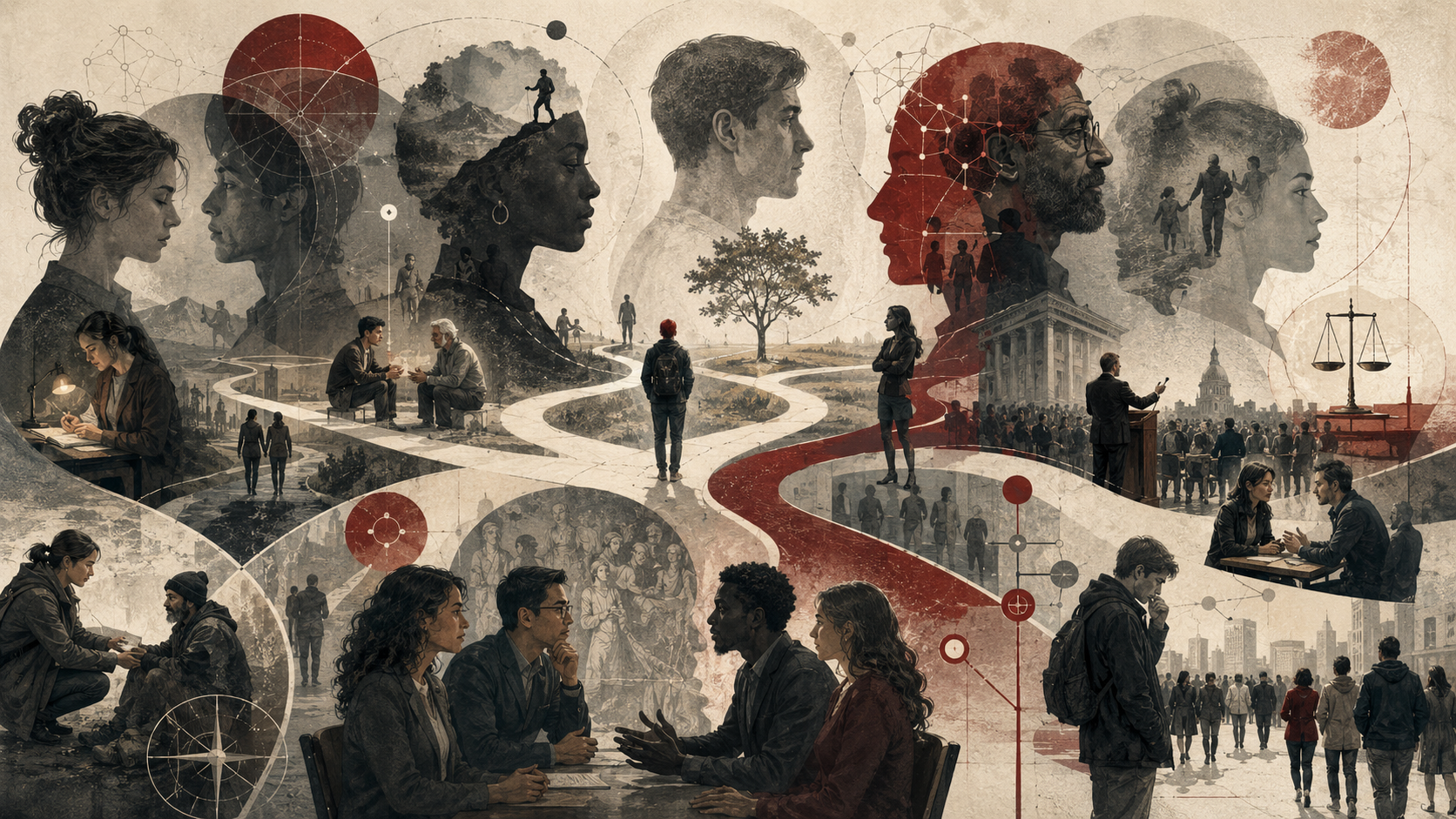
Personality and character matter because moral life is not enacted by abstract reasoners alone. It is enacted by persons with temperaments, histories, habits, desires, fears, attachments, loyalties, strengths, vulnerabilities, and social identities. Some people are more prone to compassion, some to discipline, some to fear, some to anger, some to conformity, some to curiosity, some to self-protection, and some to moral courage. These differences do not determine moral life mechanically, but they shape what people notice, how they interpret situations, what they feel, which excuses become tempting, and whether moral judgment becomes action.
At the same time, individual differences must be handled carefully. They can illuminate moral variation, but they can also become a way to blame persons for failures produced by institutions, incentives, authority structures, scarcity, inequality, fear, or coercion. A workplace that rewards silence will produce silence even among many decent people. A political culture that dehumanizes outsiders will reshape perception even among people who otherwise value fairness. A family or institution that punishes truth-telling can make courage costly. Moral individuality is real, but it is never lived outside social conditions.
What These Terms Mean
Personality is the broadest of the three core terms here. In contemporary psychology, it usually refers to comparatively enduring differences in tendencies such as sociability, emotional stability, conscientiousness, openness, agreeableness, motivation, and patterns of response across time. Personality does not by itself tell us whether a person is morally good or bad. It describes broad ways in which people tend to perceive, feel, react, regulate themselves, pursue goals, and relate to others.
Character is narrower and more normatively charged. It refers to morally relevant patterns of thought, emotion, desire, judgment, and conduct. To speak of character is to speak not merely of how a person behaves, but of whether their patterns support honesty, courage, compassion, fairness, humility, fidelity, responsibility, justice, temperance, generosity, or their opposites. Character is therefore not reducible to temperament. It is personality seen through the lens of moral meaning, shaped by habit, reflection, practice, community, and response to real demands.
Individual differences is the widest scientific umbrella. It includes personality and character, but also value priorities, ideological orientation, empathy, prosocial motivation, aggression, self-interest bias, moral identity, guilt-proneness, shame-proneness, disgust sensitivity, cognitive style, social dominance orientation, authoritarian tendencies, religiosity, cultural learning, and context-linked response patterns. This broader frame matters because moral life is shaped by multiple layers of difference rather than one master trait.
These distinctions prevent two opposite errors. The first error is to reduce morality to personality: to assume, for example, that moral life can be read directly from broad traits alone. The second error is to deny stable moral differences altogether and treat every moral outcome as only a product of situation. A more serious view recognizes that persons differ, but that those differences are expressed through environments, roles, relationships, institutions, and histories.
| Concept | Primary meaning | Moral relevance |
|---|---|---|
| Personality | Broad patterns of disposition, emotion, motivation, and behavior | Shapes moral perception, regulation, social response, and sensitivity to context. |
| Character | Morally valenced patterns of thought, feeling, habit, and conduct | Supports judgments about honesty, courage, justice, compassion, self-command, and responsibility. |
| Individual differences | Empirical variation across persons in traits, identities, values, biases, and response tendencies | Explains why people differ in moral judgment, motivation, action, and vulnerability to failure. |
| Moral identity | The degree to which morality is central to the self-concept | Helps explain why some people regulate action through moral self-understanding more strongly than others. |
| Contextual expression | The way dispositions appear differently across situations | Shows why stable tendencies do not produce identical conduct in every setting. |
Why Individual Differences Matter
Individual differences matter because people do not enter moral situations with the same dispositions, sensitivities, identities, habits, or motivational profiles. Some are more emotionally responsive to suffering. Some are more rule-bound. Some are more fairness-sensitive. Some are more susceptible to self-serving interpretation. Some are more inclined toward care. Some are more oriented toward authority, loyalty, purity, autonomy, or equality. Some integrate morality deeply into the self, while others treat morality more as external rule, social expectation, or situational constraint.
These differences shape what people notice. A person high in empathy may immediately perceive another person’s distress, while another person may notice rule violation, threat, inefficiency, or disrespect first. A highly conscientious person may notice duty and obligation; a highly open person may notice complexity and competing interpretations; a highly anxious person may notice danger; a highly status-oriented person may notice hierarchy and reputation. Moral life begins in attention, and attention is not evenly organized across persons.
Individual differences also shape how people act under pressure. Two people may make the same moral judgment in calm reflection but differ sharply when there is risk, cost, ambiguity, temptation, group pressure, institutional authority, or personal advantage at stake. Moral action often depends not only on knowing the good, but on whether one can remain oriented toward it when it becomes inconvenient. Character and self-regulation matter most when moral commitments are tested.
These differences also help explain why moral disagreement is not always reducible to ignorance or bad faith. People may vary in which moral features become salient, which authorities they trust, which groups they identify with, which harms feel urgent, which inequalities seem natural, and which obligations feel binding. Moral psychology must therefore explain both shared moral capacities and patterned moral variation.
| Individual difference | Possible moral effect | Important caution |
|---|---|---|
| Empathy | Can increase concern for suffering, aid, and restraint from harm. | Empathy can be selective, biased toward familiar or visible persons. |
| Conscientiousness | Can support duty, discipline, reliability, and self-control. | Can also become rigid, punitive, or overly deferential to rules. |
| Openness | Can support perspective-taking, complexity, and moral imagination. | Can also weaken commitment if complexity becomes avoidance. |
| Agreeableness | Can support cooperation, kindness, and conflict reduction. | Can also produce avoidance of necessary confrontation. |
| Moral identity | Can strengthen consistency between values and action. | Can become moral vanity if identity protects self-image more than conduct. |
| Self-interest bias | Can distort judgment toward personal advantage. | Often works subtly through narratives of fairness, merit, or necessity. |
Personality and the Moral Life
Personality is not identical with morality, but it shapes the moral life indirectly and sometimes strongly. Broad personality structure influences how people regulate emotion, tolerate ambiguity, respond to threat, seek approval, sustain discipline, interpret conflict, and interact socially. These are not themselves moral verdicts, but they affect how moral situations are experienced and navigated. A person’s moral life is partly built out of ordinary psychological tendencies that become morally significant under certain conditions.
The Big Five framework is useful here because it provides a broad map of dispositional variation. Agreeableness may be associated with warmth, cooperation, trust, and concern for others. Conscientiousness may be associated with duty, reliability, planning, and self-control. Openness may be associated with curiosity, imagination, and tolerance for complexity. Neuroticism may influence threat sensitivity, guilt, shame, anxiety, and defensive reactivity. Extraversion may shape social courage, assertiveness, and engagement. None of these traits is a moral virtue by itself, but each can shape moral perception and action.
This is why personality must be interpreted carefully. A person may be introverted without being morally deficient, emotionally intense without being unjust, or highly conscientious in a way that supports either humane responsibility or rigid moralism. A person may be agreeable in a way that supports kindness, or in a way that avoids necessary moral conflict. A person may be open-minded in a way that supports justice, or in a way that avoids judgment where judgment is required. Personality provides structure; character concerns the moral significance of how that structure is formed and expressed.
Personality also interacts with context. A highly conscientious person may act ethically in a just institution but become complicit in a harmful one if duty is fused with obedience. A highly agreeable person may protect relationships but fail to challenge abuse. A highly open person may recognize complexity but fail to defend clear moral boundaries. Moral psychology therefore needs both trait language and situational analysis. Personality matters, but it is not destiny.
| Big Five dimension | Possible moral affordance | Possible moral risk |
|---|---|---|
| Agreeableness | Compassion, cooperation, forgiveness, prosociality | Conflict avoidance, excessive compliance, reluctance to confront wrongdoing |
| Conscientiousness | Reliability, self-control, responsibility, follow-through | Rigid rule-following, punitive moralism, obedience to harmful systems |
| Openness | Perspective-taking, imagination, tolerance for complexity | Relativism, indecision, avoidance of firm moral judgment |
| Emotional stability | Calmness under pressure, reduced defensive reactivity | Possible underreaction to harm if emotional concern is muted |
| Extraversion | Social engagement, assertiveness, public courage | Status-seeking, dominance, impulsive group alignment |
Character as Morally Valenced Pattern
Character refers to patterns already interpreted through moral categories. It concerns whether a person’s habits of perception, desire, emotion, judgment, and action support virtues such as honesty, courage, compassion, fairness, justice, humility, temperance, generosity, responsibility, and practical wisdom. Character is therefore not just “what someone is like” in the broadest descriptive sense. It is how someone is in ways that bear on moral praise, blame, aspiration, and trust.
This distinction matters because moral psychology would otherwise collapse into ordinary personality science or purely normative ethics. Character is the bridge concept. It links empirical patterns in persons to the moral language through which lives are evaluated. To say someone has honest character is not merely to say they have a stable behavioral tendency. It is to say that their pattern of conduct expresses a morally valued relation to truth. To say someone is courageous is not merely to say they are bold. It is to say they can face fear for the sake of something worth protecting.
Character also has depth. A person may perform a good act without having the corresponding virtue. Someone may tell the truth because they fear punishment, seek approval, or lack opportunity to lie. Another person may tell the truth because they are genuinely committed to honesty and willing to bear cost for it. Character concerns the pattern, motive, stability, understanding, and integration of moral conduct, not only isolated behavior.
At the same time, character should not be romanticized as perfectly stable across all circumstances. Real character is tested, supported, weakened, and revealed by context. A person may be brave in public but evasive in family life. Honest in personal relationships but self-serving in institutional settings. Compassionate toward familiar people but indifferent to strangers. Character is morally real, but it may be uneven, domain-specific, and vulnerable to pressure.
| Character dimension | Moral question | Example expression |
|---|---|---|
| Honesty | How does the person relate to truth? | Truthfulness, transparency, refusal to deceive, willingness to correct falsehood. |
| Courage | How does the person act under fear or cost? | Speaking up, protecting others, resisting pressure, accepting risk for moral reasons. |
| Justice | How does the person respond to fairness, rights, and equal standing? | Impartiality, resistance to favoritism, concern for unequal burden and recognition. |
| Compassion | How does the person respond to suffering and vulnerability? | Aid, tenderness, attention, restraint, care, and refusal to treat need as weakness. |
| Temperance | How does the person regulate appetite, impulse, status desire, and self-interest? | Self-command, patience, moderation, resistance to temptation and excess. |
| Humility | How does the person relate to limits, error, dependence, and correction? | Listening, openness to critique, non-defensive learning, resistance to moral vanity. |
The Empirical Study of Moral Character
The modern empirical study of moral character is plural. It does not rest on one settled model of what character is or how it should be measured. Contemporary research approaches character through several frameworks, including situationism, trait psychology, cognitive-affective processing models, virtue and character-strength classifications, moral identity research, moral emotion research, and organizational ethics. This plurality is a strength when it prevents premature simplification.
One important debate concerns the stability of character. Traditional virtue language often suggests that virtues are relatively stable, integrated traits of persons. Situationist arguments challenge the assumption that behavior is globally consistent across contexts, emphasizing how strongly ordinary conduct can be shaped by situational cues, authority, incentives, framing, anonymity, time pressure, and social norms. The empirical question is not whether persons matter or situations matter, but how moral response is organized across person-situation patterns.
A more sophisticated account does not need to abandon character. It can reconceive character as structured but conditional. People may have stable moral tendencies that appear most clearly in recurring patterns: if criticized, this person becomes defensive; if someone is vulnerable, this person moves toward care; if authority pressures them, this person conforms; if the group dehumanizes outsiders, this person resists; if personal advantage is available, this person rationalizes. Such patterns are morally meaningful even if they are not uniform across all circumstances.
The empirical study of character therefore asks several questions at once. Which dispositions are stable? Which situations reveal or suppress them? Which virtues are domain-specific? Which traits predict moral action under cost? Which forms of self-understanding support consistency? Which institutions cultivate or corrode moral character? The answers require interdisciplinary work across personality psychology, social psychology, developmental psychology, organizational behavior, philosophy, and moral education.
| Empirical approach | Central insight | Moral significance |
|---|---|---|
| Trait approach | People show broad dispositional differences. | Personality and character can help explain patterned moral variation. |
| Situationism | Situational features strongly shape behavior. | Virtue claims must account for context, pressure, and social cues. |
| CAPS approach | Persons show stable if-then patterns across situation classes. | Character may be conditionally stable rather than globally uniform. |
| VIA approach | Character strengths can be classified and studied empirically. | Virtue language can be linked to positive psychology and strengths research. |
| Moral identity research | Morality varies in centrality to self-concept. | Identity can help explain when values become action-guiding. |
| Organizational ethics | Individual characteristics interact with systems, incentives, and culture. | Moral character is expressed inside institutions, not outside them. |
Big Five, CAPS, and VIA Frameworks
Three frameworks are especially useful for organizing the discussion: the Big Five, CAPS, and VIA. The Big Five model is useful because it provides a stable vocabulary for broad personality tendencies. It does not directly measure virtue, but it helps describe the general psychological structures through which virtue, vice, self-regulation, empathy, rigidity, cooperation, and moral reactivity may be expressed.
CAPS, the Cognitive-Affective Processing System, is useful because it reconceives stability in conditional terms. Instead of asking whether a person behaves the same way everywhere, it asks whether a person shows stable patterns across recurring kinds of situations. This is especially valuable for moral psychology because moral action is often situation-sensitive. A person may be generous under low threat but defensive under scarcity, honest with friends but evasive under institutional pressure, compassionate toward visible suffering but indifferent to distant suffering, courageous in public but not under authority.
The VIA framework, associated with positive psychology and character strengths research, foregrounds virtues and strengths in a way closer to moral language: wisdom, courage, humanity, justice, temperance, transcendence, and related character strengths. Its value lies in making character empirically discussable without abandoning the vocabulary of moral aspiration. Its risk, if used superficially, is that strengths can become self-branding labels rather than disciplined practices of moral formation.
Taken together, these frameworks suggest that moral individuality is structured but not simple. People may have meaningful tendencies, but those tendencies are expressed differently across contexts. Some moral patterns are broad traits. Some are conditional if-then signatures. Some are cultivated strengths. Some are identity-based commitments. Some are institutionally supported habits. A mature account of character uses multiple frameworks rather than forcing moral life into one scale.
| Framework | What it emphasizes | Use for moral psychology | Limitation |
|---|---|---|---|
| Big Five | Broad personality dimensions | Maps general dispositional tendencies relevant to moral perception and behavior. | Not inherently a virtue or character theory. |
| CAPS | Conditional if-then patterns | Explains how persons can be stable in situation-sensitive ways. | Requires careful situational classification and longitudinal observation. |
| VIA | Virtues and character strengths | Connects empirical study to moral aspiration and positive psychology. | Can become overly affirmative if detached from vice, failure, and social context. |
| Moral identity | Centrality of morality to self-concept | Explains why some values become self-regulating commitments. | Can become moral self-image rather than moral accountability. |
| Organizational models | Person-situation-system interaction | Shows how dispositions are expressed through incentives, authority, and culture. | Can understate deeper moral formation if treated only as decision mechanics. |
Moral Identity and Self-Regulation
Some of the most important moral differences among persons may lie not in general traits alone but in whether morality is central to selfhood. Moral identity concerns the degree to which being moral—honest, caring, fair, responsible, principled, compassionate, just, or trustworthy—is central to how a person understands who they are. When moral identity is strong and active, violations of moral standards threaten not merely external reputation but the self.
This matters because two people may endorse the same moral ideals in the abstract but differ sharply in whether those ideals guide conduct under pressure. A person may say honesty matters but abandon honesty when self-interest is high. Another may experience dishonesty as a threat to integrity and therefore resist it even at cost. Moral identity helps explain why moral judgment sometimes becomes action and sometimes remains only verbal endorsement.
Moral identity also connects to self-regulation. People regulate behavior partly through anticipated guilt, shame, pride, self-respect, and the desire to remain the kind of person they believe themselves to be. If moral values are deeply integrated into the self, then acting against them may produce stronger internal sanction. But identity is not always protective. If moral identity becomes self-flattering, it can produce defensiveness, hypocrisy, or moral licensing. A person who sees themselves as good may resist evidence that they have done harm.
The strongest account therefore treats moral identity as both a resource and a risk. It can support integrity when it binds the person to conduct, accountability, repair, and humility. It can become moral vanity when it protects self-image more than truth. The difference lies partly in whether moral identity remains open to correction by harmed others, evidence, and responsibility.
| Moral identity pattern | Possible strength | Possible danger |
|---|---|---|
| Internalized moral identity | Values become part of self-regulation and integrity. | May become defensive if the person cannot admit moral failure. |
| Symbolic moral identity | Public moral expression can motivate prosocial behavior. | May become reputation management or performance. |
| Identity-action integration | Judgment is more likely to become conduct under cost. | May produce rigidity if moral identity becomes closed to complexity. |
| Moral self-consistency | Supports coherence across situations. | May obscure domain-specific failures and blind spots. |
| Humility-linked identity | Allows correction, apology, and repair. | Requires accepting that moral identity is not proof against wrongdoing. |
Empathy, Conscience, and Moral Emotion
Individual differences in moral life are not only cognitive or trait-based. They are also emotional. People vary in empathy, guilt-proneness, shame-proneness, compassion, disgust sensitivity, anger, fear, resentment, pride, gratitude, contempt, and emotional regulation. These differences shape moral perception because emotions help mark what matters. A person who feels another’s distress vividly may interpret the moral situation differently from one who first feels threat, disgust, irritation, or contempt.
Empathy is morally important because it can make another person’s suffering visible and motivationally urgent. But empathy is not a perfect moral guide. It can be selective, biased toward those who are near, familiar, attractive, similar, or narratively vivid. It can be exhausted by scale or manipulated by framing. Moral life therefore requires empathy, but also justice, principle, perspective-taking, and institutions that protect those whose suffering is not emotionally salient to the powerful.
Conscience is similarly complex. It can restrain wrongdoing, produce guilt, and help the person remain answerable to moral standards. Yet conscience can be malformed, narrow, scrupulous, tribal, or socially conditioned. A person may feel guilty for violating a local norm while feeling no guilt about broader injustice. A person may feel shame at social exposure rather than remorse for harm. Moral emotion must therefore be interpreted, educated, and linked to reality.
Individual differences in moral emotion help explain why moral action varies under pressure. Some people experience guilt quickly and repair readily. Others externalize blame. Some feel compassion and move toward aid. Others feel disgust and move toward exclusion. Some feel shame and hide. Others feel anger and confront. These differences do not determine moral worth, but they shape pathways of moral growth and moral failure.
| Moral emotion | Potential contribution | Potential distortion |
|---|---|---|
| Empathy | Makes suffering visible and motivates care. | Can be selective, parochial, exhausting, or biased. |
| Guilt | Supports responsibility, apology, repair, and restraint. | Can become avoidance if the person seeks relief more than repair. |
| Shame | Can signal violation of self-image or social standing. | Can produce hiding, aggression, denial, or self-collapse. |
| Anger | Can protest injustice and defend moral boundaries. | Can become punitive, selective, or dehumanizing. |
| Disgust | Can mark violation or contamination concerns. | Can support stigma, exclusion, and moralized hierarchy. |
| Compassion | Motivates care for vulnerability and need. | Can become paternalistic if detached from agency and justice. |
Self-Interest Bias and Moral Variation
Another important source of individual difference is the extent to which moral judgment is bent by self-interest. People vary in how easily they reinterpret fairness, merit, loyalty, duty, and necessity when their own advantage is at stake. Some are more prone to rationalize self-benefit as justice. Some are more able to recognize when personal interest is distorting their interpretation. Some people respond to conflict of interest with transparency; others respond with justification.
Self-interest bias matters because moral failure is not distributed randomly. People differ not only in prosociality, but in how quickly self-protective narratives enter judgment. One person may ask, “What is fair?” Another may ask the same question while unconsciously selecting the fairness principle that benefits them. A person may sincerely believe they are defending merit while protecting privilege, defending efficiency while protecting convenience, or defending loyalty while avoiding accountability.
This bias often works through moral language rather than against it. People rarely say, “I want what benefits me, regardless of justice.” Instead, they say, “I earned this,” “They are asking for special treatment,” “This is how the system works,” “It would be unfair to change the rules,” “I had no choice,” or “The alternative would be worse.” Some of these claims may be true in particular cases. The problem is not that self-interest always invalidates moral judgment. The problem is that self-interest makes moral judgment suspect enough to require scrutiny.
Individual differences in self-interest bias also matter for institutions. Some people are more likely to exploit ambiguity, take advantage of weak oversight, or redefine conflicts of interest as acceptable. Others are more likely to disclose, recuse, invite review, or accept limits. Ethical design should assume that self-interest bias is real and build structures that make self-serving interpretation harder to hide.
| Self-interest pattern | How it appears | Corrective discipline |
|---|---|---|
| Merit rationalization | Advantage is interpreted as fully earned. | Examine starting points, opportunity, luck, and institutional support. |
| Rule protection | Existing rules are defended when they preserve advantage. | Ask whether rules would seem fair from a different position. |
| Conflict denial | Personal stake is treated as irrelevant to judgment. | Disclose interests and invite independent review. |
| Selective empathy | Costs to self feel larger than costs to others. | Restore symmetry of attention and affected-person testimony. |
| Moral licensing | Past goodness is used to excuse present self-benefit. | Evaluate the current act on its own terms. |
Culture, Politics, and Patterned Differences
Individual differences in moral life are not only intrapersonal. They are also culturally and politically patterned. People are formed by families, religions, schools, media systems, institutions, nations, professions, movements, and historical narratives. These social worlds teach which harms are visible, which authorities are trusted, which groups are feared, which obligations are sacred, which forms of suffering count, and which virtues are admired.
This means that moral individuality is never entirely detached from the worlds that form it. Differences in salience, group identity, authority, harm perception, fairness interpretation, and care obligations are often socially scaffolded. A person’s moral style may reflect temperament, but also class position, religious formation, political identity, national memory, racial history, gendered expectation, professional culture, and institutional experience.
Political difference is especially important because moral judgment is often organized through shared narratives about threat, responsibility, deservingness, authority, liberty, equality, purity, loyalty, harm, and order. People may disagree not only because they have different facts, but because they inhabit different moral vocabularies. One person sees regulation as protection; another sees domination. One sees redistribution as justice; another sees taking. One sees protest as moral courage; another sees disorder. Moral psychology must explain how these patterns emerge without reducing all disagreement to pathology.
Cultural and political patterning also creates moral blind spots. A society may teach compassion for some groups and suspicion toward others. A profession may teach responsibility in one domain and indifference in another. A political group may perceive hypocrisy in opponents and miss it in allies. A culture may praise self-reliance while hiding inherited support. Individual differences therefore cannot be studied apart from the collective meanings that shape individuals.
| Patterned source | What it shapes | Moral implication |
|---|---|---|
| Culture | Norms of duty, honor, care, authority, purity, autonomy, and community | Defines what seems obvious, shameful, admirable, or obligatory. |
| Politics | Threat perception, fairness models, group loyalty, institutional trust | Structures moral attention and moral disagreement. |
| Religion | Sacred obligation, virtue, conscience, authority, mercy, justice, discipline | Can deepen moral seriousness or intensify boundary policing. |
| Profession | Role duty, standards, expertise, hierarchy, and acceptable conduct | Can cultivate responsibility or normalize ethical distance. |
| Class and status | Deservingness narratives, merit beliefs, exposure to vulnerability | Shapes how people interpret need, effort, responsibility, and fairness. |
| Historical memory | Claims about injury, repair, belonging, legitimacy, and obligation | Influences whose suffering is remembered and whose is minimized. |
Organizations and Contextual Expression
Individual differences in moral life are often most visible inside organizations, where traits, identities, biases, and virtues are tested under real incentive structures. A person’s compassion, honesty, courage, self-command, and fairness are not tested only in private reflection. They are tested in meetings, budgets, hiring decisions, disciplinary processes, reporting systems, performance targets, leadership pressure, and moments when truth threatens status.
Organizational settings are morally powerful because they do not merely reveal character; they shape its expression. A person who values honesty may remain silent if the organization punishes dissent. A person high in conscientiousness may enforce harmful procedures if the institution equates duty with compliance. A person with strong empathy may become numb under overload. A person with moral courage may speak up if voice is protected, but may withdraw if retaliation is certain. Character is expressed through climate.
This is why organizational moral decision-making requires an interactionist model. Individual characteristics matter, but so do interpersonal norms, leadership behavior, incentives, accountability structures, role ambiguity, workload, psychological safety, and the broader environment. Ethical action is more likely where systems keep responsibility clear, make consequences visible, protect dissent, reward integrity, and align incentives with stated values.
Organizations can also create selective expression. They may reward certain virtues and punish others. A workplace may praise loyalty but punish honesty. Reward productivity but ignore care. Promote confidence but devalue humility. Celebrate inclusion while marginalizing dissent. Under such conditions, individual differences become filtered by institutional values. The organization teaches which parts of character are safe to express.
| Organizational factor | How it shapes individual moral expression | Ethical design question |
|---|---|---|
| Leadership | Signals which values are real and which are symbolic. | Do leaders accept accountability or only demand it from others? |
| Incentives | Reward some behaviors and quietly punish others. | Are people rewarded for integrity or only outcomes? |
| Psychological safety | Determines whether people can raise moral concerns. | Can people speak truth without retaliation? |
| Role clarity | Shapes whether people know what they are responsible for. | Is responsibility mapped clearly across decisions? |
| Consequence visibility | Determines whether actors see who is affected. | Are those harmed by decisions visible and heard? |
| Ethical climate | Defines what conduct becomes normal. | Does the culture make virtue easier or harder to practice? |
What Individual Differences Do Not Explain
Individual differences do not explain everything. They illuminate patterned variation in moral life, but they can also tempt researchers and institutions to psychologize structural problems. If a workplace rewards silence, diffuse responsibility, moral disengagement, and self-protective conformity, then many people will fail morally there, not only those with the “wrong” personality profile. If a society distributes vulnerability unequally, then moral outcomes cannot be explained by individual traits alone.
This is one reason moral psychology must resist trait essentialism. A person is not simply courageous or cowardly, honest or dishonest, compassionate or cold, independent of context. People may show courage in one domain and fear in another. Honesty under low cost may not predict honesty under severe threat. Compassion toward visible suffering may not predict compassion toward distant or stigmatized groups. Moral life is patterned, but the pattern is conditional.
Individual differences also do not settle normative questions. Knowing that people vary in fairness sensitivity does not tell us what justice requires. Knowing that some people are more empathetic does not tell us whose suffering should matter. Knowing that some people are more conscientious does not tell us whether a rule is just. Empirical variation helps explain moral behavior, but it cannot replace moral evaluation.
Finally, individual differences can be misused by institutions. Personality and character language can become tools of selection, discipline, surveillance, or blame-shifting. An organization may label dissenters as poor fits rather than examining injustice. A workplace may treat burnout as lack of resilience rather than evidence of exploitation. A political system may treat poverty as character failure rather than structural harm. Moral psychology must therefore use individual-difference research with ethical caution.
| Individual differences do not explain… | Why not? | Additional analysis needed |
|---|---|---|
| Structural injustice | Traits do not create unequal laws, histories, or institutions by themselves. | Historical, legal, economic, and institutional analysis. |
| Organizational misconduct | Bad systems can corrupt or silence many different personality types. | Incentives, leadership, accountability, and culture. |
| Normative justice | Empirical variation cannot determine what people are owed. | Ethics, political philosophy, law, and affected-community testimony. |
| Moral responsibility in isolation | Responsibility depends on control, knowledge, role, and context. | Agency analysis and accountability mapping. |
| Virtue as global uniformity | People often show domain-specific and conditional patterns. | Situation classes, longitudinal patterns, and if-then signatures. |
| Institutional harm | Character language can hide policy, hierarchy, and incentive failure. | Power-aware systems analysis. |
Mathematical Lens: Modeling Individual Differences in Moral Life
Individual differences in moral life can be modeled as the joint effect of general disposition, morally specific self-structure, and context. Let \(M_i\) represent the moral-response profile of person \(i\):
M_i = f(P_i, C_i, I_i, B_i)
\]
Interpretation: A person’s moral-response profile is modeled as a function of broad personality, character strength, moral-identity integration, and self-interest bias. This reflects the plural empirical picture in which broad traits, morally specific dispositions, identity, and bias each contribute distinct explanatory value.
where \(P_i\) is broader personality structure, \(C_i\) is character strength, \(I_i\) is moral-identity integration, and \(B_i\) is self-interest bias.
Moral action in a given situation \(j\) can then be written as:
A_{ij} = \sigma(\alpha P_i + \beta C_i + \gamma I_i – \delta B_i + \eta S_j + \kappa X_{ij})
\]
Interpretation: Moral action is modeled as a person-situation process. Broad personality, character, and moral identity support action; self-interest bias can suppress it; situational support or pressure shapes whether dispositions become conduct.
where \(\sigma\) is the logistic transformation, \(S_j\) is situational pressure or support, and \(X_{ij}\) is the interaction between the person and the situation. This captures a core theme in empirical moral-character work and organizational moral-decision research: persons differ, but those differences are expressed through context rather than outside it.
A CAPS-style formulation can also represent conditional stability:
R_i(k) = f_k(U_i)
\]
Interpretation: Person \(i\)’s response in situation class \(k\) depends on the person’s organized cognitive-affective system. This preserves stable moral individuality without requiring identical behavior across all situations.
We can also model organizational expression of character:
E_{ij} = \sigma(\theta_1 C_i + \theta_2 I_i + \theta_3 V_j – \theta_4 P_j – \theta_5 R_j)
\]
Interpretation: Ethical expression rises with character strength, moral identity, and institutional voice safety, but falls under pressure, retaliation risk, and fear. This model emphasizes that virtue requires supportive conditions for expression.
where \(E_{ij}\) is ethical expression, \(V_j\) is voice safety, \(P_j\) is institutional pressure, and \(R_j\) is retaliation risk. This model is important because it prevents individual-difference research from becoming a way of blaming persons while ignoring institutional design.
| Model term | Meaning | Moral interpretation |
|---|---|---|
| \(P_i\) | Broad personality | General dispositional structure shaping perception, emotion, and behavior. |
| \(C_i\) | Character strength | Morally valenced dispositions such as honesty, courage, care, and justice. |
| \(I_i\) | Moral identity integration | Degree to which morality is central to the self-concept and self-regulation. |
| \(B_i\) | Self-interest bias | Tendency for personal advantage to distort moral judgment. |
| \(S_j\) | Situational support or pressure | Contextual conditions that support or suppress moral action. |
| \(X_{ij}\) | Person-situation interaction | How a person’s dispositions are activated by a particular situation. |
| \(U_i\) | Cognitive-affective system | Organized if-then pattern of perception, affect, goals, and response. |
| \(V_j\) | Voice safety | Institutional protection for speaking, dissenting, warning, and reporting. |
R Workflow: Modeling Personality, Character, and Moral Variation
The following R workflow simulates broad personality, character strength, moral identity, self-interest bias, situational pressure, voice safety, and accountability strength, then estimates their separate and joint contributions to moral action. The dataset is synthetic and intended for reproducible article support, not empirical claims about real persons, organizations, workplaces, cultures, or institutions.
# Personality, Character, and Individual Differences in Moral Life
# Synthetic R workflow for modeling moral variation.
# Educational and reproducible research scaffold only.

suppressPackageStartupMessages({
  library(tidyverse)
  library(broom)
})

set.seed(42)

# ------------------------------------------------------------
# 1. Set up output folders
# ------------------------------------------------------------

dir.create("outputs", showWarnings = FALSE)
dir.create("outputs/tables", recursive = TRUE, showWarnings = FALSE)
dir.create("outputs/figures", recursive = TRUE, showWarnings = FALSE)

# ------------------------------------------------------------
# 2. Simulate individual-difference structure
# ------------------------------------------------------------

n <- 2400

df <- tibble(
  case_id = 1:n,
  broad_personality = rnorm(n, 0, 1),
  character_strength = rnorm(n, 0, 1),
  moral_identity = rnorm(n, 0, 1),
  empathy = rnorm(n, 0, 1),
  conscientious_self_regulation = rnorm(n, 0, 1),
  humility = rnorm(n, 0, 1),
  self_interest_bias = rnorm(n, 0, 1),
  situational_pressure = rnorm(n, 0, 1),
  voice_safety = rnorm(n, 0, 1),
  accountability_strength = rnorm(n, 0, 1)
) %>%
  mutate(
    moral_response_profile =
      0.20 * broad_personality +
      0.30 * character_strength +
      0.35 * moral_identity +
      0.25 * empathy +
      0.20 * conscientious_self_regulation +
      0.15 * humility -
      0.35 * self_interest_bias +
      rnorm(n, 0, 0.8),

    action_latent =
      0.45 * moral_response_profile -
      0.35 * situational_pressure +
      0.25 * voice_safety +
      0.25 * accountability_strength +
      rnorm(n, 0, 0.9),

    moral_action_probability = plogis(action_latent),
    moral_action = if_else(moral_action_probability >= 0.5, 1, 0)
  )

# ------------------------------------------------------------
# 3. Estimate moral response profile model
# ------------------------------------------------------------

model_profile <- lm(
  moral_response_profile ~ broad_personality + character_strength +
    moral_identity + empathy + conscientious_self_regulation +
    humility + self_interest_bias,
  data = df
)

profile_summary <- tidy(model_profile, conf.int = TRUE)
profile_fit <- glance(model_profile)

print(profile_summary)

# ------------------------------------------------------------
# 4. Estimate moral action model
# ------------------------------------------------------------

model_action <- glm(
  moral_action ~ moral_response_profile + situational_pressure +
    voice_safety + accountability_strength,
  data = df,
  family = binomial()
)

action_summary <- tidy(
  model_action,
  conf.int = TRUE,
  exponentiate = TRUE
)

action_fit <- glance(model_action)

print(action_summary)

# ------------------------------------------------------------
# 5. Summarize by character and bias profile
# ------------------------------------------------------------

profile_summary_table <- df %>%
  mutate(
    character_group = ntile(character_strength, 4),
    character_group = factor(
      character_group,
      labels = c("Low", "Lower-middle", "Upper-middle", "High")
    ),
    bias_group = if_else(
      self_interest_bias >= median(self_interest_bias),
      "Higher self-interest bias",
      "Lower self-interest bias"
    )
  ) %>%
  group_by(character_group, bias_group) %>%
  summarize(
    mean_action_prob = mean(moral_action_probability),
    action_rate = mean(moral_action),
    mean_identity = mean(moral_identity),
    mean_empathy = mean(empathy),
    mean_voice_safety = mean(voice_safety),
    .groups = "drop"
  )

print(profile_summary_table)

# ------------------------------------------------------------
# 6. Prediction grid across identity and self-interest bias
# ------------------------------------------------------------

pred_grid <- expand_grid(
  moral_identity = seq(-2, 2, length.out = 100),
  self_interest_bias = c(-1, 0, 1),
  broad_personality = 0,
  character_strength = 0,
  empathy = 0,
  conscientious_self_regulation = 0,
  humility = 0
)

pred_grid$predicted_profile <- predict(
  model_profile,
  newdata = pred_grid,
  type = "response"
)

pred_grid <- pred_grid %>%
  mutate(
    predicted_action_prob = plogis(
      coef(model_action)["(Intercept)"] +
      coef(model_action)["moral_response_profile"] * predicted_profile +
      coef(model_action)["situational_pressure"] * 0 +
      coef(model_action)["voice_safety"] * 0 +
      coef(model_action)["accountability_strength"] * 0
    ),
    bias_label = case_when(
      self_interest_bias == -1 ~ "Low self-interest bias",
      self_interest_bias == 0 ~ "Average self-interest bias",
      TRUE ~ "High self-interest bias"
    )
  )

# ------------------------------------------------------------
# 7. Plot predicted moral action
# ------------------------------------------------------------

plot_action <- ggplot(
  pred_grid,
  aes(x = moral_identity, y = predicted_action_prob)
) +
  geom_line(linewidth = 1) +
  facet_wrap(~ bias_label) +
  labs(
    title = "Predicted Moral Action from Identity and Self-Interest Bias",
    subtitle = "Moral identity supports action, but self-interest bias can suppress it",
    x = "Moral identity",
    y = "Probability of moral action"
  ) +
  theme_minimal(base_size = 12)

print(plot_action)

# ------------------------------------------------------------
# 8. Export outputs
# ------------------------------------------------------------

write_csv(df, "outputs/tables/personality_character_individual_differences_simulated_data.csv")
write_csv(profile_summary, "outputs/tables/moral_response_profile_model.csv")
write_csv(profile_fit, "outputs/tables/moral_response_profile_model_fit.csv")
write_csv(action_summary, "outputs/tables/personality_character_action_model.csv")
write_csv(action_fit, "outputs/tables/personality_character_action_model_fit.csv")
write_csv(profile_summary_table, "outputs/tables/personality_character_profile_summary.csv")
write_csv(pred_grid, "outputs/tables/personality_character_predictions.csv")

ggsave(
  filename = "outputs/figures/predicted_moral_action_by_identity_and_bias.png",
  plot = plot_action,
  width = 10,
  height = 6,
  dpi = 300
)
This workflow is useful because it separates broad personality from morally specific factors such as character, identity, empathy, humility, self-regulation, and self-interest bias instead of treating them as one undifferentiated disposition. It also includes situational pressure, voice safety, and accountability strength so that moral action is modeled as a person-situation process rather than a fixed trait expression.
Python Workflow: Simulating Individual Differences in Moral Action
The Python workflow below simulates how broad personality, character, moral identity, empathy, humility, self-interest bias, situational pressure, voice safety, and accountability strength interact to shape moral action. The example uses synthetic data for reproducible demonstration and should not be interpreted as an assessment of real people, organizations, institutions, workplaces, or communities.
# Personality, Character, and Individual Differences in Moral Life
# Python workflow for synthetic moral-individual-difference modeling.
# Educational and reproducible research scaffold only.

from pathlib import Path

import numpy as np
import pandas as pd

np.random.seed(42)

# ------------------------------------------------------------
# 1. Set up output folders
# ------------------------------------------------------------

output_tables = Path("outputs/tables")
output_tables.mkdir(parents=True, exist_ok=True)

# ------------------------------------------------------------
# 2. Simulate individual-difference profiles
# ------------------------------------------------------------

n = 2600

df = pd.DataFrame({
    "case_id": np.arange(1, n + 1),
    "broad_personality": np.random.normal(0, 1, n),
    "character_strength": np.random.normal(0, 1, n),
    "moral_identity": np.random.normal(0, 1, n),
    "empathy": np.random.normal(0, 1, n),
    "conscientious_self_regulation": np.random.normal(0, 1, n),
    "humility": np.random.normal(0, 1, n),
    "self_interest_bias": np.random.normal(0, 1, n),
    "situational_pressure": np.random.normal(0, 1, n),
    "voice_safety": np.random.normal(0, 1, n),
    "accountability_strength": np.random.normal(0, 1, n)
})

# ------------------------------------------------------------
# 3. Generate moral response profile and moral action
# ------------------------------------------------------------

df["moral_response_profile"] = (
    0.20 * df["broad_personality"] +
    0.30 * df["character_strength"] +
    0.35 * df["moral_identity"] +
    0.25 * df["empathy"] +
    0.20 * df["conscientious_self_regulation"] +
    0.15 * df["humility"] -
    0.35 * df["self_interest_bias"] +
    np.random.normal(0, 0.8, n)
)

latent = (
    0.45 * df["moral_response_profile"] -
    0.35 * df["situational_pressure"] +
    0.25 * df["voice_safety"] +
    0.25 * df["accountability_strength"] +
    np.random.normal(0, 0.9, n)
)

df["moral_action_probability"] = 1 / (1 + np.exp(-latent))
df["moral_action"] = (df["moral_action_probability"] >= 0.5).astype(int)

# ------------------------------------------------------------
# 4. Summarize by character and bias profile
# ------------------------------------------------------------

df["character_group"] = np.where(
    df["character_strength"] >= df["character_strength"].median(),
    "Higher character",
    "Lower character"
)

df["bias_group"] = np.where(
    df["self_interest_bias"] >= df["self_interest_bias"].median(),
    "Higher self-interest bias",
    "Lower self-interest bias"
)

summary = (
    df.groupby(["character_group", "bias_group"])
      .agg(
          mean_action_prob=("moral_action_probability", "mean"),
          action_rate=("moral_action", "mean"),
          mean_identity=("moral_identity", "mean"),
          mean_empathy=("empathy", "mean"),
          mean_voice_safety=("voice_safety", "mean"),
          mean_accountability=("accountability_strength", "mean")
      )
      .reset_index()
)

print(summary)

# ------------------------------------------------------------
# 5. Scenario grid across moral identity, self-interest, and pressure
# ------------------------------------------------------------

scenario_rows = []

for identity in np.linspace(-2, 2, 41):
    for bias in [-1, 0, 1]:
        for pressure in [-1, 0, 1]:
            profile = (
                0.20 * 0 +
                0.30 * 0 +
                0.35 * identity +
                0.25 * 0 +
                0.20 * 0 +
                0.15 * 0 -
                0.35 * bias
            )

            latent = (
                0.45 * profile -
                0.35 * pressure +
                0.25 * 0 +
                0.25 * 0
            )

            prob = 1 / (1 + np.exp(-latent))

            scenario_rows.append({
                "moral_identity": identity,
                "self_interest_bias": bias,
                "situational_pressure": pressure,
                "predicted_profile": profile,
                "predicted_action_probability": prob
            })

scenario_df = pd.DataFrame(scenario_rows)

print(scenario_df.head(12))

# ------------------------------------------------------------
# 6. Identify high-profile low-action synthetic cases
# ------------------------------------------------------------

high_profile_low_action = (
    df[
        (df["moral_response_profile"] > df["moral_response_profile"].quantile(0.75)) &
        (df["moral_action"] == 0)
    ]
    .sort_values("situational_pressure", ascending=False)
    .head(25)
    .reset_index(drop=True)
)

# ------------------------------------------------------------
# 7. Export outputs
# ------------------------------------------------------------

df.to_csv(output_tables / "personality_character_individual_differences_python.csv", index=False)
summary.to_csv(output_tables / "personality_character_summary.csv", index=False)
scenario_df.to_csv(output_tables / "personality_character_scenarios.csv", index=False)
high_profile_low_action.to_csv(
    output_tables / "personality_character_high_profile_low_action_cases.csv",
    index=False
)

print("Synthetic personality, character, and individual-difference outputs written to:", output_tables)
This workflow is useful because it models moral individuality as plural and layered rather than as the product of one single moral trait. It also makes a central moral-psychological point visible: even people with stronger moral-response profiles may fail to act when situational pressure is high and voice safety or accountability is weak.
In a full article repository, this Python workflow can be extended into notebooks, SQL schema, synthetic datasets, validation notes, person-situation scenario grids, moral identity models, self-interest-bias analyses, organizational climate simulations, and additional language examples. R can support statistical modeling and visualization; Python can support simulation and data pipelines; SQL can preserve structured scenario metadata; Julia can support person-situation simulations; and C, C++, Fortran, Go, and Rust can support reproducible command-line tools, validation utilities, and computational demonstrations.
GitHub Repository
The companion repository for this article provides a reproducible code scaffold for modeling broad personality, character strength, moral identity, empathy, conscientious self-regulation, humility, self-interest bias, situational pressure, voice safety, accountability strength, moral-response profiles, moral action probability, and person-situation interaction.
The repository structure should support a full research workflow rather than a single script. The article folder can include language-specific examples in python, r, julia, sql, c, cpp, fortran, go, and rust, along with data, docs, notebooks, and outputs. This structure makes the article reproducible, inspectable, and extensible for readers who want to move from conceptual argument to analytical demonstration.
Conclusion
Personality, character, and individual differences in moral life are best understood as overlapping but distinct layers of explanation. Personality captures broad dispositional structure. Character captures morally valenced patterns of perception, emotion, habit, and conduct. Individual-difference research captures the wider empirical field in which broad traits, self-interest bias, empathy, identity, ideology, context, and institutional life all shape moral response.
The strongest contemporary view is therefore neither reductive trait essentialism nor a refusal to study persons at all. Moral life varies systematically across individuals, but that variation is always expressed through situations, institutions, relationships, and social worlds. People differ in what they notice, what they feel, how they justify, how they regulate themselves, how they respond to pressure, and whether moral values become action under cost.
Character remains important, but it should be understood as lived and tested rather than merely possessed. Virtue is not a decorative label attached to the self. It is a pattern of attention, emotion, judgment, action, correction, and repair that must survive contact with temptation, fear, social pressure, institutional incentives, and the needs of others. A person’s moral individuality is not proven by self-description. It is revealed in patterned response.
At the same time, moral psychology must not use individual differences to hide structural failure. Persons are responsible, but they act inside worlds that make some actions easier and others more costly. A mature moral psychology treats persons as structured, context-sensitive, and morally differentiable without forgetting that moral individuality is always lived in relation to others and under conditions not wholly of one’s own making.
Related articles
- Character, Virtue, and the Psychology of Moral Selfhood
- Situationism, Moral Character, and the Stability of Virtue
- Moral Identity and the Formation of Moral Agency
- Moral Self-Regulation, Temptation, and Weakness of Will
- Moral Motivation and the Judgment–Action Gap
- Conscience, Guilt, Shame, and Moral Self-Evaluation
- Cross-Cultural Moral Psychology
- Moral Psychology in Organizations and Institutions
- Moral Disagreement and the Psychology of Pluralism
Further reading
- Miller, C.B. (2016) ‘Empirical Approaches to Moral Character’, in Zalta, E.N. and Nodelman, U. (eds.) The Stanford Encyclopedia of Philosophy. Available at: https://plato.stanford.edu/entries/moral-character-empirical/.
- Snow, N.E. (2003, archived 2025) ‘Moral Character’, in The Stanford Encyclopedia of Philosophy. Available at: https://plato.stanford.edu/archives/fall2025/entries/moral-character/.
- Doris, J. (2006, rev. 2022) ‘Moral Psychology: Empirical Approaches’, in The Stanford Encyclopedia of Philosophy. Available at: https://plato.stanford.edu/entries/moral-psych-emp/.
- Gray, K. and Pratt, S. (2025) ‘Morality in Our Mind and Across Cultures and Politics’, Annual Review of Psychology, 76, pp. 663–691. Available at: https://www.annualreviews.org/content/journals/10.1146/annurev-psych-020924-124236.
- Kouchaki, M. and Smith, I.H. (2025) ‘Moral Decision-Making in Organizations’, Annual Review of Organizational Psychology and Organizational Behavior, 12, pp. 45–72. Available at: https://www.annualreviews.org/content/journals/10.1146/annurev-orgpsych-110622-045715.
References
- Doris, J. (2006, rev. 2022) ‘Moral Psychology: Empirical Approaches’, in The Stanford Encyclopedia of Philosophy. Available at: https://plato.stanford.edu/entries/moral-psych-emp/.
- Gray, K. and Pratt, S. (2025) ‘Morality in Our Mind and Across Cultures and Politics’, Annual Review of Psychology, 76, pp. 663–691. Available at: https://www.annualreviews.org/content/journals/10.1146/annurev-psych-020924-124236.
- Kouchaki, M. and Smith, I.H. (2025) ‘Moral Decision-Making in Organizations’, Annual Review of Organizational Psychology and Organizational Behavior, 12, pp. 45–72. Available at: https://www.annualreviews.org/content/journals/10.1146/annurev-orgpsych-110622-045715.
- Miller, C.B. (2016) ‘Empirical Approaches to Moral Character’, in Zalta, E.N. and Nodelman, U. (eds.) The Stanford Encyclopedia of Philosophy. Available at: https://plato.stanford.edu/entries/moral-character-empirical/.
- Snow, N.E. (2003, archived 2025) ‘Moral Character’, in The Stanford Encyclopedia of Philosophy. Available at: https://plato.stanford.edu/archives/fall2025/entries/moral-character/.