
Last Updated May 28, 2026
Moral reasoning concerns the ways human beings justify, interpret, and organize judgments about right and wrong through concepts such as fairness, duty, harm, reciprocity, authority, justice, care, intention, responsibility, and obligation. Within moral psychology, the developmental tradition treated this capacity as one of the central pathways through which moral agency matures. Rather than asking only what adults judge in isolated situations, it asked how children and adolescents come to understand rules, intentions, punishment, fairness, cooperation, social order, moral conflict, and ethical principle over time.
This developmental question remains one of the most important in moral psychology. Moral life is not simply present or absent. It is formed. Children do not merely absorb adult commands. They interpret them, contest them, apply them unevenly, distinguish some rules from others, and gradually learn that obedience, fairness, reciprocity, care, justice, authority, and personal choice are not all the same kind of thing. A child who obeys a rule to avoid punishment is not reasoning in the same way as an adolescent who understands mutual obligation, nor in the same way as an adult who can evaluate a law against broader principles of justice or human dignity.
The developmental tradition is most strongly associated with Jean Piaget and Lawrence Kohlberg. Piaget framed children’s moral understanding as moving from a more heteronomous orientation, in which rules are experienced as fixed and externally imposed, toward a more autonomous orientation in which cooperation, reciprocity, and intention matter more. Kohlberg extended this into a stage theory of moral development organized into preconventional, conventional, and postconventional levels. Yet the tradition did not end there. It provoked major criticism, revision, and expansion from care ethics, social domain theory, cultural psychology, feminist theory, developmental science, early moral cognition research, and contemporary work on norms, prosociality, and social learning.
Main Library
Publications
Article Map
Moral Psychology
Related Topic
Cognitive Psychology
Related Topic
Social Psychology
Related Topic
Positive Psychology
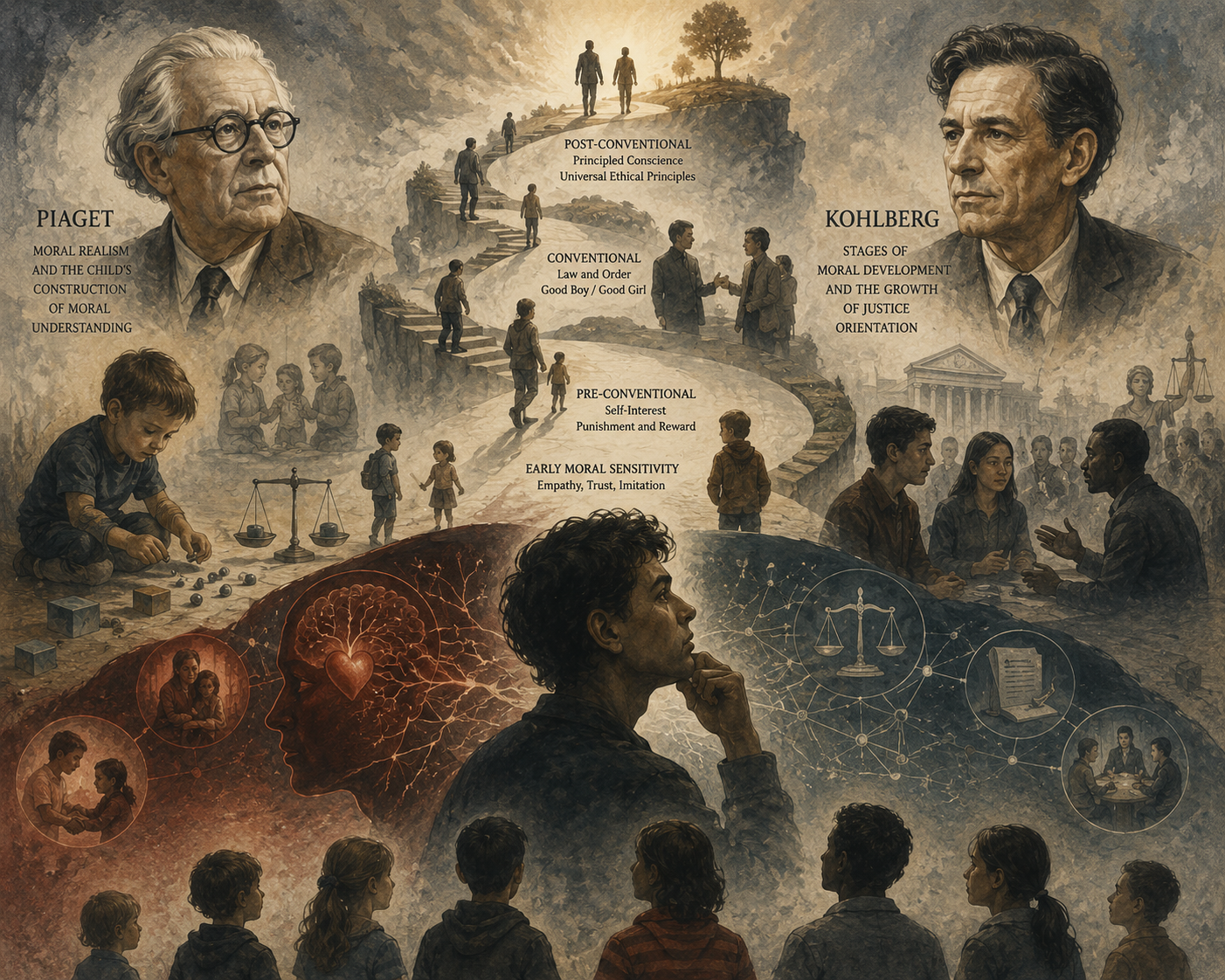
This article argues that the developmental tradition remains indispensable, but only when treated critically. Piaget and Kohlberg helped make moral development intellectually serious by showing that moral understanding has structure and changes over time. At the same time, their frameworks were limited by an overly justice-centered, verbally articulated, and stage-like picture of moral maturity. A contemporary account of moral reasoning must preserve what the tradition illuminated while expanding beyond it: children develop not only justice reasoning, but also care, empathy, convention sensitivity, domain differentiation, cultural understanding, group awareness, moral identity, and practical capacities for responsible action.
To study moral reasoning seriously, then, is not only to learn Piaget and Kohlberg. It is to understand why their work became so influential, what questions it made possible, why it was criticized, and how later research transformed the field. Moral reasoning is not the whole of moral life. It must be studied alongside emotion, perception, identity, social influence, culture, institutions, power, and action. But reasoning remains crucial because it reveals how people justify moral claims, interpret competing obligations, and decide whether existing rules deserve obedience, revision, or critique.
The developmental tradition also matters because it connects psychology to education, civic life, law, family formation, religious instruction, democratic participation, and institutional ethics. How children learn to reason about rules affects how they later interpret authority. How adolescents learn to think about fairness affects how they respond to exclusion and inequality. How adults understand justice affects how they evaluate institutions. Moral reasoning is therefore not an isolated intellectual skill. It is part of the formation of persons capable of inhabiting a shared world responsibly.
What Moral Reasoning Is
Moral reasoning is the reflective and justificatory dimension of moral judgment. It concerns how people explain why an action is right or wrong, how they interpret conflicts among values, how they distinguish rule compliance from justice, how they understand obligation in relation to persons and institutions, and how they decide whether a norm deserves obedience, revision, or rejection. Moral reasoning does not exhaust moral life. Much of morality also depends on perception, emotion, salience, habit, identity, social structure, empathy, conscience, and moral motivation. But reasoning remains important because it reveals the conceptual frameworks through which people organize ethical claims.
In developmental research, moral reasoning became especially significant because it offered a way to study the growth of moral understanding over time. Instead of treating children as simply possessing more or less morality, researchers asked how their concepts changed. Do children see rules as absolute or revisable? Do they judge by outcome or intention? Do they understand fairness as obedience, exchange, reciprocity, or justice? Can they evaluate social rules critically rather than merely accept them? Do they distinguish moral harm from social convention? Do they understand that persons can have obligations to others even when no authority is watching?
Moral reasoning also involves justification. A child, adolescent, or adult may say that an action is wrong, but the developmental psychologist asks why. Is it wrong because punishment will follow? Because an authority forbids it? Because it violates a shared rule? Because it hurts someone? Because it betrays trust? Because it is unfair? Because it violates a principle that should apply to everyone? The structure of the answer reveals how the person understands morality itself.
This does not mean that more complex verbal explanation always equals greater moral maturity. A person may produce sophisticated rationalizations for selfishness, cruelty, exclusion, or domination. Another person may have limited language but a deep practical sensitivity to care and fairness. For this reason, contemporary moral psychology treats moral reasoning as important but not sufficient. It must be studied in relation to perception, emotion, action, culture, and institutional context.
| Dimension of moral reasoning | Core question | Developmental significance |
|---|---|---|
| Rule understanding | Are rules fixed commands, mutual agreements, or revisable social arrangements? | Shows how children understand authority, cooperation, and social order. |
| Intention understanding | Does intention matter when evaluating wrongdoing? | Marks movement beyond outcome-only judgment. |
| Fairness reasoning | Is fairness obedience, equal exchange, reciprocity, desert, need, or justice? | Reveals increasing complexity in social comparison and obligation. |
| Authority reasoning | When should authority be obeyed, questioned, or resisted? | Connects development to autonomy and critical judgment. |
| Domain differentiation | Is this a moral rule, convention, personal choice, prudential matter, or mixed case? | Shows that children reason differently across normative domains. |
| Care reasoning | How do dependence, vulnerability, relationship, and responsibility matter? | Expands moral maturity beyond abstract justice alone. |
| Principled critique | Can existing social rules be evaluated against broader ethical standards? | Supports postconventional reasoning and institutional critique. |
Why the Developmental Tradition Mattered
The developmental tradition mattered because it made morality a question of psychological growth rather than mere conformity. It framed children as active interpreters of social life who construct and revise their understanding of rules, authority, fairness, intention, responsibility, and cooperation. This was a major shift away from views that treated moral development mainly as the internalization of adult commands, punishments, or social rewards.
Piaget and Kohlberg helped make moral development a structural question. They did not ask only whether a child had learned a rule. They asked what kind of reasoning made the rule meaningful. A child who obeys because punishment is expected is not reasoning in the same way as a child who sees the rule as necessary for mutual cooperation. An adolescent who values social approval is not reasoning in the same way as a person who can evaluate law against principles of justice. The developmental tradition therefore treated moral growth as a transformation in how the moral world is organized.
The tradition also mattered because it linked moral psychology to larger philosophical questions. If moral development unfolds through identifiable forms of reasoning, then morality may involve more than local custom, adult authority, or immediate affect. It may also involve increasingly differentiated ways of understanding persons, obligations, reciprocity, rights, and universalizability. Even critics of Piaget and Kohlberg inherited this ambition. They continued to ask whether moral life matures, what counts as maturity, and how social experience shapes that process.
The developmental tradition also gave moral education a theoretical foundation. If moral reasoning can develop, then education is not merely moral instruction or discipline. It can become the cultivation of perspective-taking, dialogue, reciprocity, fairness, care, and principled reflection. This is why Kohlberg’s work influenced debates over schooling, democratic education, civic formation, and the role of moral dilemmas in classroom discussion.
| Contribution | Why it mattered | Contemporary qualification |
|---|---|---|
| Morality develops | Children’s moral understanding changes over time. | Development is not a single universal staircase. |
| Children are active interpreters | Children reconstruct norms rather than merely absorb commands. | Interpretation is shaped by culture, power, family, institutions, and peers. |
| Reasoning has structure | Different justifications reveal different ways of understanding morality. | Reasoning must be studied alongside emotion, perception, and action. |
| Authority can be evaluated | Moral maturity involves more than obedience. | Critique must include care, dignity, history, and social context. |
| Justice matters | Fairness, reciprocity, and rights are central to moral development. | Justice is not the only moral dimension; care and relational responsibility also matter. |
| Education can cultivate moral growth | Dialogue and reasoning can support moral development. | Moral education must avoid imposing one narrow cultural model of maturity. |
Piaget and the Moral Judgment of the Child
Jean Piaget’s work on moral judgment helped establish the developmental tradition by arguing that children’s understanding of rules changes with cognitive and social development. In his account, younger children tend to treat rules as fixed, external, and backed by authority. Older children, especially through peer interaction and cooperation, become more able to see rules as products of mutual agreement and social coordination. This made moral development inseparable from broader changes in perspective-taking, reciprocity, and cognitive structure.
Piaget’s contribution was not only the claim that morality develops. It was the specific idea that children move from a morality centered on constraint toward one more oriented to cooperation and reciprocity. In this framework, moral growth involves learning to evaluate intention, fairness, and mutual respect rather than merely obeying externally imposed commands. That conceptual move profoundly shaped later developmental research because it treated moral understanding as an evolving structure rather than a list of learned behaviors.
Piaget’s method included close attention to children’s reasoning about rules, games, accidents, lies, punishment, and responsibility. He was interested in how children explain wrongness. Do they judge an accidental large damage as worse than an intentional small damage? Do they think rules are created by adults and cannot be changed? Do they see punishment as automatically following wrongdoing? These questions allowed Piaget to study children’s implicit theories of moral order.
Piaget’s model is no longer accepted in its original form without qualification. Later research has shown that children can distinguish moral from conventional rules earlier than Piaget suggested and that young children’s moral cognition is more complex than early stage-like accounts implied. Still, Piaget’s core insight remains powerful: children’s moral thinking is not static. It develops through interaction, cooperation, perspective-taking, and changing conceptions of rules and responsibility.
| Piagetian theme | Meaning | Developmental significance |
|---|---|---|
| Constraint | Rules are experienced as imposed by authority. | Captures early dependence on adult power and external rule structure. |
| Cooperation | Rules are understood through mutual agreement and peer interaction. | Supports more autonomous reasoning about fairness and reciprocity. |
| Outcome focus | Judgment is based heavily on consequences. | Shows limited integration of intention and context. |
| Intention focus | Judgment incorporates motive, purpose, and responsibility. | Marks increased sophistication in moral evaluation. |
| Immanent justice | Wrongdoing is believed to bring automatic punishment. | Reveals early beliefs about moral order and authority. |
| Rule revisability | Rules can be changed through mutual agreement. | Supports autonomy and understanding of social coordination. |
Heteronomous and Autonomous Morality
Piaget’s distinction between heteronomous and autonomous morality remains foundational. Heteronomous morality refers to a mode of understanding in which rules are experienced as fixed, sacred, and imposed by authorities. In this orientation, consequences often weigh more heavily than intentions, and wrongness is closely tied to obedience and punishment. Autonomous morality, by contrast, involves a more flexible understanding of rules as revisable through cooperation, a stronger appreciation of intentions, and a broader sense of fairness grounded in reciprocity rather than sheer authority.
The distinction still matters because it captures a real developmental insight even where its sharpness has been softened by later work. Children do not simply progress from ignorance to knowledge. They move through different ways of organizing social normativity. They learn that rules can be binding without being metaphysically fixed, that fairness can exceed obedience, that intentions alter how actions should be judged, and that mutual respect can become a basis for moral order.
Heteronomous morality is not merely “bad” and autonomous morality is not merely “good.” Young children depend on adult guidance and external structure for real developmental reasons. Rules, routines, and authority can provide protection, predictability, and safety. The developmental question is whether authority remains the only basis of moral understanding or whether the child gradually comes to understand the reasons, relationships, and mutual obligations behind rules.
Autonomous morality does not mean individualism without obligation. It means that moral agents become capable of understanding the logic of norms rather than merely submitting to them. They can ask whether a rule is fair, whether a punishment is proportional, whether intention matters, whether cooperation requires mutual respect, and whether authority itself is acting responsibly. This remains one of Piaget’s most important contributions to moral psychology: moral maturity involves the growth of critical participation in shared norms.
| Dimension | Heteronomous morality | Autonomous morality |
|---|---|---|
| Source of rules | Rules come from powerful authorities and are fixed. | Rules arise through cooperation, agreement, and shared purposes. |
| View of authority | Authority is external and difficult to question. | Authority can be respected but also evaluated. |
| Judgment basis | Consequences and punishment are central. | Intentions, fairness, reciprocity, and context matter. |
| Responsibility | Wrongness is tied to damage or rule violation. | Wrongness includes motive, obligation, and mutual respect. |
| Fairness | Fairness may mean obedience or equal punishment. | Fairness includes reciprocity, proportionality, and cooperation. |
| Developmental setting | Associated with adult constraint and unilateral respect. | Associated with peer cooperation and mutual respect. |
Kohlberg and the Stage Theory of Moral Development
Lawrence Kohlberg extended Piaget’s work into the most influential stage theory in moral psychology. Kohlberg argued that moral development proceeds through a sequence of increasingly complex forms of reasoning, grouped into three broad levels: preconventional, conventional, and postconventional. What mattered for Kohlberg was not whether a person reached the “correct” answer to a dilemma, but the structure of the reasoning used to justify that answer.
This was historically important because it shifted the study of morality toward justificatory form. Kohlberg treated moral development as a progression in how people understand rules, interpersonal expectations, social order, law, rights, and universal ethical principle. In doing so, he built a framework that shaped decades of developmental research, moral education, and philosophical reflection on justice and moral maturity.
Kohlberg’s most famous research used moral dilemmas, including the Heinz dilemma, to examine how individuals justified choices in situations of conflict. The content of the answer mattered less than the reasoning. A person who said Heinz should steal the medicine because he might be punished if he did not, a person who said he should steal because his wife’s life has value, and a person who said he should steal because human life takes precedence over property law were not simply giving different answers. They were reasoning from different moral structures.
The ambition of Kohlberg’s theory was both empirical and normative. Empirically, it claimed that moral reasoning tends to develop through ordered stages. Normatively, it suggested that later stages represent more adequate forms of moral reasoning because they are more universal, reciprocal, principled, and capable of evaluating existing social arrangements. This ambition made the theory powerful, but also controversial. It raised questions about cultural bias, gender bias, verbal reasoning, justice-centered abstraction, and whether moral development can be captured by a single hierarchy.
| Feature of Kohlberg’s theory | Meaning | Importance |
|---|---|---|
| Stage structure | Moral reasoning develops through qualitatively different levels. | Frames moral growth as structural reorganization, not accumulation. |
| Dilemma method | Participants justify choices in morally conflicted scenarios. | Focuses analysis on reasoning rather than answer alone. |
| Justice orientation | Fairness, rights, law, and universal principle are central. | Gives the theory philosophical ambition and civic relevance. |
| Developmental sequence | Stages are understood as ordered and increasingly complex. | Supports a theory of moral growth over time. |
| Postconventional reasoning | Existing law and convention can be judged by broader principles. | Connects moral maturity to critique of unjust social order. |
| Controversy | The theory was criticized for narrowness, bias, and overgeneralization. | Forced the field to broaden beyond classical stage theory. |
The Six Stages of Kohlberg’s Model
Kohlberg’s theory organizes moral reasoning into six stages across three levels. At the preconventional level, moral reasoning is oriented toward punishment avoidance and instrumental exchange. Right action is understood in terms of avoiding sanction or securing advantage. At the conventional level, reasoning centers on interpersonal approval and social order. Right action becomes what pleases others, fulfills expected roles, or sustains law and duty. At the postconventional level, morality is interpreted through principles that can evaluate existing conventions themselves, such as rights, justice, and broader human obligations.
The power of this model lay in its claim that moral development is not only accumulation of norms but reorganization of reasoning. A child who obeys because punishment is feared is not reasoning in the same way as an adolescent who values social order, nor in the same way as an adult who judges law itself against standards of justice. Whether or not one accepts the full hierarchy, the model captured a real intuition: moral thought changes qualitatively, not merely quantitatively.
Stage 1 reasoning is centered on punishment and obedience. Stage 2 reasoning introduces instrumental exchange and individual advantage. Stage 3 reasoning emphasizes interpersonal approval, being “good,” and maintaining relationships. Stage 4 reasoning emphasizes law, duty, and social order. Stage 5 reasoning introduces social contract, rights, and the possibility that laws can be revised. Stage 6 reasoning is organized around universal ethical principles, though Kohlberg later treated this stage cautiously because of measurement difficulties and its rarity in empirical coding.
Contemporary scholars often use Kohlberg’s stages less as a literal universal map and more as a historically influential model of increasing moral complexity. The model remains useful when treated as a conceptual tool rather than a complete theory of moral development. It clarifies a movement from externally imposed order toward socially coordinated obligation and then toward principled critique. But it must be supplemented by care, culture, domain differentiation, early moral cognition, identity, and practical action.
| Level | Stage | Core orientation | Typical reasoning | Developmental limitation |
|---|---|---|---|---|
| Preconventional | Stage 1 | Punishment and obedience | Wrong is what leads to punishment. | Moral authority is external and fear-based. |
| Preconventional | Stage 2 | Instrumental exchange | Right is what serves one’s interests or fair exchange. | Reciprocity is often transactional rather than mutual. |
| Conventional | Stage 3 | Good-person orientation | Right is what earns approval and maintains relationships. | Social approval can override justice or dissent. |
| Conventional | Stage 4 | Law and social order | Right is fulfilling duty and maintaining social systems. | Existing law may be treated as morally sufficient. |
| Postconventional | Stage 5 | Social contract and rights | Law is legitimate when it protects rights and public good. | Requires abstract reasoning and institutional imagination. |
| Postconventional | Stage 6 | Universal ethical principles | Right is guided by universalizable principles of justice and dignity. | Difficult to measure and rarely coded consistently. |
Reasoning, Justice, and Universality
Kohlberg’s project was closely tied to a justice-centered conception of moral maturity. Higher stages of moral reasoning were associated with greater abstraction, universality, reciprocity, and principled evaluation of social order. This gave the theory philosophical ambition. It did not merely describe what people happened to say. It suggested that some forms of moral reasoning are developmentally and normatively superior because they better respect persons, fairness, consistency, and rights.
This ambition partly explains the theory’s enduring influence and its controversy. Kohlberg offered a strong answer to the question of what moral development is for: not just conformity, but the capacity to assess norms themselves in light of broader principles. Even critics often continued to work within the shadow of this question, whether by revising what counts as maturity or by disputing the privileged place of justice-based abstraction.
The justice-centered framework is powerful because it protects against moral collapse into local custom. If morality is only what a society approves, then unjust societies cannot be criticized from within moral reasoning itself. Kohlberg’s postconventional framework made room for civil disobedience, rights claims, critique of unjust law, and the possibility that ethical obligation can exceed convention. This remains one of the most important strengths of the tradition.
Yet justice-centered universality can also become too abstract. It can treat moral maturity as detached impartiality while undervaluing care, dependence, vulnerability, history, embodiment, and relationship. It can understate how power shapes what counts as universal and whose experience is used as the model of the “rational moral subject.” A contemporary account should preserve the importance of universalizable principles while recognizing that justice must be informed by lived context, relational responsibility, and historically marginalized voices.
| Justice-centered strength | Why it matters | Needed supplement |
|---|---|---|
| Consistency | Prevents arbitrary moral double standards. | Attend to context so consistency does not erase relevant difference. |
| Universalizability | Tests whether a judgment can apply beyond one’s group. | Ask whose experience defines the universal. |
| Rights | Protects persons against majority preference and authority. | Include social conditions that make rights meaningful in practice. |
| Law critique | Allows unjust law to be evaluated morally. | Include affected communities and histories of unequal power. |
| Reciprocity | Frames moral life as mutual respect rather than domination. | Recognize asymmetries of dependency and vulnerability. |
| Principle | Gives moral reasoning stability across cases. | Connect principle to care, embodiment, and material consequence. |
Major Critiques of the Developmental Tradition
The developmental tradition generated major criticism on both empirical and conceptual grounds. Some critics argued that the stage model overstated sequence and universality. Others noted that many adults do not consistently reason at the highest levels or do so only in selected contexts. Still others argued that the theory was too narrow in treating verbalized justice reasoning as the privileged expression of moral maturity.
These critiques were productive because they forced the field to broaden. Researchers began to ask whether moral development includes care, empathy, convention, identity, role expectation, culture, peer relations, family structure, social class, religion, gender, history, and institutional experience in ways not well captured by a single justice-centered staircase. The question ceased to be whether Piaget and Kohlberg were simply right or wrong. It became what parts of moral development their framework captured, what parts it obscured, and how a more plural account might look.
One critique concerned cultural bias. Stage theories often implied that more abstract, individual-rights-based reasoning represented the highest form of moral development, but this may fit some liberal Western philosophical traditions better than others. Communities organized around relational obligation, religious duty, communal responsibility, filial respect, or social harmony may not treat abstract autonomy as the single marker of moral maturity. This does not mean all moral forms are equally defensible, but it does mean developmental theory must be careful about mistaking one cultural ideal for universal maturity.
Another critique concerned the gap between reasoning and action. People may reason well and act badly. They may articulate principles of justice while failing to intervene, repair harm, resist group pressure, or practice care. Moral reasoning is therefore not the whole of moral agency. It must be studied alongside moral motivation, self-regulation, courage, empathy, institutional incentives, and situational pressure.
| Critique | Target | Why it matters | Resulting expansion |
|---|---|---|---|
| Stage rigidity | Fixed universal sequence | People reason differently across domains and contexts. | More flexible developmental models. |
| Justice bias | Privileging abstract justice reasoning | Care, relationship, and dependency are morally central. | Care ethics and relational moral psychology. |
| Gender critique | Possible undervaluing of relational voices | Dominant measures may reflect biased assumptions about maturity. | Attention to voice, care, and relational responsibility. |
| Cultural bias | Western liberal individualism as universal endpoint | Moral maturity may be expressed through different social vocabularies. | Cross-cultural moral psychology. |
| Verbal reasoning bias | Scoring articulated justification | Language skill may be confused with moral maturity. | Broader methods including behavior, emotion, and interaction. |
| Reason-action gap | Assuming judgment leads to conduct | People may know the right and fail to do it. | Integration with motivation, identity, and situationism. |
| Domain overgeneralization | One scale for all moral thought | Children distinguish moral, conventional, and personal domains. | Social domain theory and domain-specific research. |
Gilligan, Care, and Relational Critique
Carol Gilligan’s intervention was especially important because it challenged the idea that mature moral reasoning is best measured by abstract justice reasoning alone. She argued that relational responsibility, care, and responsiveness to concrete others had been undervalued in dominant developmental models. This did not merely add another topic; it altered the field’s image of moral maturity by insisting that relationship and dependence are morally central rather than signs of developmental deficiency.
Gilligan’s critique remains significant even where later scholarship complicates its strongest formulations. It widened the moral vocabulary of developmental research and made it harder to assume that universal principle, detached from relational context, is the sole or final form of moral seriousness. The developmental tradition after Gilligan had to reckon with care, voice, dependency, and the possibility of multiple moral orientations.
The care critique did not simply oppose justice. It exposed the incompleteness of a moral psychology that treats persons primarily as abstract choosers rather than relational beings. Human life is marked by dependence: childhood, illness, disability, aging, grief, economic vulnerability, social exclusion, and the ordinary need for care. A moral developmental theory that cannot account for dependence risks making autonomy appear more fundamental than the relationships that make autonomy possible.
Care reasoning also shifts attention from isolated dilemmas to ongoing relationships. Many moral conflicts do not ask only “What principle applies?” They ask: Who is vulnerable? Who has been neglected? What does this relationship require? What response preserves dignity without abandoning responsibility? How can harm be repaired without severing the relational world in which persons live? These questions are not lesser forms of moral reasoning. They are essential to moral maturity.
| Justice-centered question | Care-centered question | Why both matter |
|---|---|---|
| What principle applies? | Who is vulnerable here? | Principle needs contact with lived need. |
| What is fair? | What does this relationship require? | Fairness and care often intersect but are not identical. |
| What rule should govern everyone? | How does this rule affect particular persons? | Universal rules can hide unequal burdens. |
| What rights are at stake? | What responsibilities arise from dependence? | Rights and care are mutually necessary. |
| What is the impartial answer? | What would attentive responsiveness require? | Impartiality must not become emotional absence. |
| What judgment is justified? | What repair, support, or accompaniment is needed? | Reasoning should lead toward responsible action. |
Social Domain Theory and the Moral-Conventional Distinction
Another major response to the classical developmental tradition came from social domain theory, especially the work associated with Elliot Turiel and later researchers. This approach argued that children differentiate among moral rules, social conventions, and personal choices earlier and more clearly than a single stage model suggests. Moral concerns involving harm, fairness, rights, and welfare are not simply the same as conventions about dress, etiquette, classroom order, or local custom.
This mattered because it introduced greater conceptual precision into developmental research. Instead of assuming that children move through one general ladder of moral reasoning, domain theorists showed that they may reason differently depending on whether a situation concerns harm, fairness, authority, convention, prudence, or personal choice. This work preserved developmental seriousness while moving away from overly unitary models of moral growth.
Social domain theory also challenged simple obedience models. Children can sometimes recognize that hitting is wrong even if an authority permits it, while also recognizing that classroom conventions may depend on local rules. This distinction is crucial. It suggests that children’s moral cognition is not simply adult-rule internalization. Children may grasp that some norms have moral force because they concern welfare and fairness, while other norms depend more on coordination, authority, or custom.
The moral-conventional distinction has practical importance. In schools, families, workplaces, and public life, not every rule violation has the same moral status. Some violations harm persons; others disrupt coordination; others concern personal expression. Ethical maturity requires distinguishing these domains rather than treating all rule-breaking as morally equivalent. A child who learns only obedience may not learn justice. A child who learns domain sensitivity can begin to ask which rules protect persons, which rules organize social life, and which rules unnecessarily control personal choice.
| Domain | Primary concern | Example | Developmental significance |
|---|---|---|---|
| Moral domain | Harm, fairness, rights, welfare, dignity | Hitting, stealing, exclusion, humiliation | Often treated as wrong independent of local authority. |
| Conventional domain | Coordination, etiquette, role expectations, local order | Dress codes, classroom routines, table manners | Often understood as changeable by agreement or authority. |
| Personal domain | Preference, identity, self-expression, private choice | Friendship, hobbies, hairstyle, personal taste | Supports autonomy and boundaries against overcontrol. |
| Prudential domain | Safety, health, practical welfare of the self | Wearing a helmet, avoiding danger | Connects reasoning to self-care and risk understanding. |
| Mixed domain | Cases involving overlapping concerns | Clothing rules tied to gender, religion, modesty, or discrimination | Requires more complex reasoning about power and interpretation. |
Early Moral Cognition, Norms, and Contemporary Developmental Research
Recent developmental research has further expanded the field by studying early moral cognition, norm understanding, helping behavior, fairness expectations, prosociality, punishment, cooperation, and the acquisition of social rules. Contemporary work often examines how children distinguish moral from conventional norms, how they understand obligation, how they evaluate fairness and transgression, and how early-emerging social capacities interact with later learning and cultural shaping.
This newer research does not simply restore stage theory under another name. It tends to be more plural, more methodologically varied, and more attentive to early competence, domain differentiation, experimental design, cross-cultural variation, and the interplay of cognition, emotion, socialization, and culture. Yet it still owes a debt to the developmental tradition because Piaget and Kohlberg helped make moral development a central psychological problem in the first place.
Contemporary developmental work often begins earlier than Piaget and Kohlberg did. It asks how infants and young children respond to helping and hindering, how toddlers engage in prosocial behavior, how children enforce norms, how they distinguish accidental from intentional harm, and how they learn which norms apply across contexts. This research complicates the idea that young children are simply pre-moral or purely obedience-oriented. Moral cognition appears earlier and in more differentiated forms than classical accounts sometimes suggested.
At the same time, early moral cognition does not eliminate development. Early sensitivities must be organized, interpreted, expanded, and corrected over time. Children may notice harm but still struggle with conflicting duties. They may value fairness but define fairness simplistically. They may enforce norms but not understand power. They may care for familiar persons while excluding out-groups. Moral development remains necessary because early capacities require social and reflective formation.
| Contemporary research focus | What it studies | How it extends the classical tradition |
|---|---|---|
| Early prosociality | Helping, sharing, comforting, and cooperation in young children | Shows moral-relevant capacities before advanced verbal reasoning. |
| Norm acquisition | How children learn and enforce social rules | Connects moral development to social learning and group life. |
| Domain differentiation | Distinguishing moral, conventional, personal, and prudential rules | Challenges one-dimensional stage models. |
| Intention understanding | How children evaluate accidental, negligent, and intentional harms | Refines Piaget’s early outcome/intention distinction. |
| Fairness and distribution | How children reason about equality, need, merit, and inequality | Shows that fairness itself becomes more complex over time. |
| Group and identity | How children reason about in-groups, out-groups, exclusion, and loyalty | Connects development to social identity and prejudice. |
| Culture and context | How different communities teach norms, authority, care, and obligation | Moves beyond universal stage assumptions. |
Culture, Power, and Moral Development
A contemporary treatment of moral reasoning must also address culture and power. Classical developmental models often aspired to universality, but children do not develop in abstract space. They develop inside families, schools, neighborhoods, religious communities, peer cultures, class structures, racial orders, legal systems, media environments, and national histories. These environments shape what counts as obedience, respect, fairness, care, harm, responsibility, and moral maturity.
Culture does not merely provide content that fills a universal reasoning structure. It can shape the structure itself by teaching which distinctions matter. Some communities emphasize autonomy and individual rights. Others emphasize obligation, kinship, filial respect, religious duty, communal harmony, honor, or collective survival. Some moral environments cultivate voice and questioning; others cultivate respect, restraint, or submission to authority. Moral development is therefore always situated, even where some moral concerns such as harm and fairness appear widely recognizable.
Power matters because not all children encounter rules from the same position. A rule can feel protective to one child and punitive to another. A school discipline policy can teach social order to some while teaching surveillance and distrust to others. A legal system can appear as neutral authority to those protected by it and as threat to those historically harmed by it. Developmental theories that treat authority, law, and convention as neutral categories risk missing how unequal power shapes moral learning.
This is especially important for marginalized communities. Children who experience racism, poverty, displacement, disability exclusion, religious minority status, gendered control, or state violence may develop moral reasoning under conditions where trust in authority cannot be assumed. Their moral development may involve early awareness of injustice, code-switching, survival reasoning, collective care, skepticism toward institutions, and complex judgments about when obedience is safe or morally compromised. A serious moral psychology must treat these experiences not as deviations from normal development but as crucial evidence about how moral reasoning forms under unequal conditions.
| Developmental context | What it shapes | Moral-psychological implication |
|---|---|---|
| Family | Authority, attachment, discipline, care, responsibility | Children learn early models of obligation, fairness, and voice. |
| School | Rules, discipline, peer cooperation, achievement, exclusion | Schools can cultivate reasoning or train compliance and silence. |
| Religion | Sacred obligation, moral law, mercy, authority, community | Religious formation can deepen duty, care, restraint, and moral identity. |
| Class position | Scarcity, security, opportunity, institutional trust | Material conditions shape how rules and fairness are experienced. |
| Race and ethnicity | Belonging, exclusion, dignity, historical memory, surveillance | Power affects whether institutions appear legitimate or threatening. |
| Disability and embodiment | Dependency, access, dignity, care, autonomy | Moral reasoning must include interdependence and accessibility. |
| Political culture | Authority, rights, loyalty, justice, freedom, punishment | Public moral vocabularies shape developmental reasoning. |
Moral Reasoning and Moral Action
One of the most important limitations of the developmental tradition is that moral reasoning is not identical to moral action. A person may articulate sophisticated principles and still fail in courage, honesty, restraint, or care. Judgment and justification do not automatically become conduct. This does not make reasoning irrelevant, but it places it within a larger architecture of moral agency that includes emotion, identity, salience, self-regulation, habit, environment, power, and institutional incentives.
This is why contemporary moral psychology often treats moral reasoning as one component among others rather than the entire center of morality. The developmental tradition remains crucial for understanding how concepts of justice, fairness, duty, and authority evolve. But moral life must also be studied as lived action under conditions of temptation, fatigue, fear, reward, conformity, hierarchy, and social conflict.
The reasoning-action gap is visible in many domains. A student may know cheating is wrong and still cheat under pressure. A professional may affirm fairness and still participate in discriminatory routines. A citizen may endorse rights while tolerating rights violations against an out-group. A leader may speak of integrity while protecting reputation over truth. The gap between reasoning and action is not an embarrassment to moral psychology; it is one of its central problems.
Developmental theory becomes stronger when it asks how reasoning becomes action. What forms of identity make principles personally binding? What emotional capacities support courage and repair? What environments make moral action costly or possible? What habits allow people to act under pressure? What institutions reward ethical consistency rather than public justification alone? These questions extend the developmental tradition beyond the interview room into real moral life.
| Reasoning-action factor | How it affects conduct | Example |
|---|---|---|
| Moral identity | Makes principles part of the self-concept. | A person acts honestly because integrity is central to who they are. |
| Emotion | Gives reasoning motivational force. | Guilt motivates repair; compassion motivates helping. |
| Courage | Allows action despite social or material cost. | A worker speaks up about harm despite fear of retaliation. |
| Self-regulation | Supports action under temptation or pressure. | A student resists cheating despite performance anxiety. |
| Institutional incentives | Make ethical action easier or harder. | A reporting system protects or punishes truth-telling. |
| Social norms | Shape what conduct feels expected or risky. | A group normalizes exclusion despite members’ stated values. |
| Repair pathways | Convert judgment into concrete response. | A person knows how to apologize, compensate, and change behavior. |
Moral Education and Civic Formation
The developmental tradition has always had educational implications. If moral reasoning develops, then schools, families, communities, and civic institutions are not merely sites of rule enforcement. They are environments in which children learn how to interpret authority, negotiate fairness, listen to others, resolve conflict, question unjust norms, and connect principle to action. Moral education is therefore not reducible to telling children what is right. It involves forming the capacities through which they can understand and practice responsibility.
Kohlberg’s influence on moral education was partly tied to the use of dilemmas and discussion. By engaging children and adolescents in reasoning about conflicts among values, educators could encourage movement toward more complex forms of justification. The aim was not simply to transmit rules, but to stimulate perspective-taking and principled thought. This remains valuable, but it is incomplete if discussion is detached from relational care, institutional fairness, and lived practice.
Moral education must also be attentive to power. A classroom that talks about justice while humiliating students teaches contradiction. A school that demands obedience while ignoring discrimination teaches moral double standards. A civic curriculum that celebrates rights while silencing marginalized history teaches selective universality. Developmental moral reasoning depends not only on what is discussed, but on how children experience authority, voice, belonging, care, fairness, and accountability in everyday institutions.
The strongest moral education integrates reasoning, care, dialogue, practice, and institutional integrity. It teaches children how to ask why a rule exists, who is affected by it, whether it is fair, how it can be changed, what responsibility requires, and how harm can be repaired. It treats children not merely as future adults but as present moral participants whose reasoning grows through meaningful social life.
| Educational practice | Developmental function | Risk if absent |
|---|---|---|
| Moral dialogue | Develops justification, perspective-taking, and principled reasoning. | Rules are obeyed without understanding. |
| Fair authority | Models legitimacy and proportional discipline. | Authority is experienced as arbitrary or coercive. |
| Peer cooperation | Builds reciprocity and mutual respect. | Children learn hierarchy more than cooperation. |
| Care practice | Connects reasoning to vulnerability and support. | Moral development becomes overly abstract. |
| Restorative response | Links wrongdoing to repair and responsibility. | Punishment replaces moral learning. |
| Historical truth-telling | Expands moral reasoning beyond local comfort. | Justice becomes selective and sanitized. |
| Student voice | Supports autonomy and critical participation. | Children learn compliance rather than ethical agency. |
What Remains Valuable in the Developmental Tradition
What remains valuable in the developmental tradition is not necessarily the strongest version of a universal stage ladder. Its enduring contribution is the insistence that moral life has structure, that children are not passive recipients of norms, and that changes in moral understanding matter for how people interpret rules, intentions, fairness, authority, convention, responsibility, and justice. Piaget and Kohlberg asked developmental questions that still define the field: how does morality become thinkable, how does it become criticizable, and how do persons grow beyond obedience into reflective ethical judgment?
Those questions remain indispensable. Even where the answers now include care, culture, domain differentiation, social identity, early-emerging norm understanding, and institutional context, the developmental tradition still provides one of the central frameworks for thinking about moral growth. It gave the field a temporal dimension and made moral psychology accountable to the fact that ethical agency is formed, not simply assumed.
The tradition also preserves the importance of critique. If moral development were only socialization, then morality would be whatever authorities successfully teach. Piaget and Kohlberg, despite their limitations, helped show that children and adults can come to evaluate rules rather than merely follow them. That insight remains vital for any moral psychology concerned with justice, democracy, institutional legitimacy, and human dignity.
The task now is not to abandon the developmental tradition but to deepen it. Moral reasoning develops, but not along a single narrow path. It develops through justice and care, authority and critique, convention and autonomy, relationship and principle, emotion and reflection, culture and agency. A contemporary developmental moral psychology should therefore be plural, historically aware, attentive to marginalized voices, and connected to real moral action.
| Enduring insight | Why it still matters | Contemporary renewal |
|---|---|---|
| Moral understanding changes over time | Ethical agency is formed developmentally. | Study multiple pathways of moral growth. |
| Children interpret norms | Children are active moral thinkers, not passive recipients. | Study early competence, social learning, and cultural context. |
| Rules require understanding | Obedience is not the same as moral maturity. | Distinguish moral, conventional, personal, and prudential domains. |
| Intention matters | Responsibility cannot be reduced to outcome alone. | Study intention, negligence, foreseeability, and harm together. |
| Justice matters | Moral reasoning can evaluate social order. | Integrate justice with care, dignity, history, and power. |
| Reasoning is not enough | Good judgment does not guarantee good action. | Connect reasoning to identity, emotion, courage, and institutions. |
Mathematical Lens: Modeling Developmental Moral Reasoning
Developmental moral reasoning can be modeled as a changing latent structure rather than as a simple age effect. Let \(R_i(t)\) represent the moral reasoning complexity of person \(i\) at time \(t\). A minimal formulation is:
R_i(t) = f(C_i(t), P_i(t), S_i(t), D_i(t))
\]
Interpretation: Moral reasoning complexity is modeled as a function of cognitive developmental capacity, perspective-taking, social interaction and norm exposure, and domain differentiation. This reflects the core developmental insight that moral reasoning is constructed through interacting cognitive and social processes rather than mere passive absorption.
where \(C_i(t)\) represents cognitive developmental capacity, \(P_i(t)\) perspective-taking, \(S_i(t)\) social interaction and norm exposure, and \(D_i(t)\) domain differentiation among moral, conventional, prudential, and personal judgments.
A simple growth model can be written as:
R_i(t) = \alpha_i + \beta_i t + \gamma_i t^2 + \varepsilon_i(t)
\]
Interpretation: Moral reasoning may increase with age and experience, but growth can accelerate, slow, or plateau. The curvature term prevents the model from treating development as a simple straight line.
If we want to represent stage-like movement across ordered developmental levels, we can define the probability of being at or above a reasoning threshold \(k\) as:
P(Y_i \geq k) = \sigma(\theta_k + \lambda_1 C_i + \lambda_2 P_i + \lambda_3 S_i + \lambda_4 D_i)
\]
Interpretation: This ordered-threshold model captures stage-like movement without requiring a rigid universal staircase. It allows cognitive capacity, perspective-taking, social exposure, and domain differentiation to shift the probability of more complex reasoning.
We can also distinguish justice-centered reasoning from care-centered or convention-sensitive reasoning through a multidimensional structure:
\mathbf{M}_i = (J_i, K_i, V_i)
\]
Interpretation: Moral reasoning can be represented as a profile rather than a single score. Justice reasoning, care reasoning, and convention sensitivity may develop together but not identically.
Finally, the reasoning-action gap can be represented by distinguishing moral reasoning from moral conduct:
A_i = \sigma(\rho_0 + \rho_1 R_i + \rho_2 E_i + \rho_3 I_i + \rho_4 B_i – \rho_5 Q_i)
\]
Interpretation: Ethical action depends partly on reasoning, but also on emotion, identity, behavioral capacity, and situational pressure. This makes explicit why moral reasoning is important but not sufficient.
| Model term | Meaning | Moral-psychological interpretation |
|---|---|---|
| \(R_i(t)\) | Moral reasoning complexity over time | Represents developmental change in justificatory structure. |
| \(C_i(t)\) | Cognitive developmental capacity | Supports abstraction, coordination, and perspective-taking. |
| \(P_i(t)\) | Perspective-taking | Allows the child to consider intentions, viewpoints, and reciprocity. |
| \(S_i(t)\) | Social interaction and norm exposure | Represents peer cooperation, adult guidance, cultural learning, and dialogue. |
| \(D_i(t)\) | Domain differentiation | Captures distinction among moral, conventional, personal, and prudential domains. |
| \(Y_i\) | Ordered reasoning category | Represents stage-like or level-like developmental classification. |
| \(J_i\) | Justice reasoning | Fairness, rights, reciprocity, and principled critique. |
| \(K_i\) | Care reasoning | Relationship, vulnerability, responsiveness, and responsibility. |
| \(V_i\) | Convention sensitivity | Ability to interpret social rules, local norms, and coordination practices. |
| \(A_i\) | Ethical action probability | Shows that reasoning contributes to action but does not determine it alone. |
R Workflow: Estimating Developmental Shifts in Moral Reasoning
The following R workflow simulates developmental data on age, perspective-taking, norm exposure, domain differentiation, relational orientation, authority orientation, and ordered moral reasoning levels. It estimates an ordinal model that reflects the classical developmental tradition while also incorporating later pluralist refinements. The dataset is synthetic and intended for reproducible article support, not empirical claims about real children, adolescents, schools, families, communities, or cultures.
# Moral Reasoning: Piaget, Kohlberg, and the Developmental Tradition
# Synthetic R workflow for modeling developmental shifts in moral reasoning.
# Educational and reproducible research scaffold only.

suppressPackageStartupMessages({
  library(tidyverse)
  library(MASS)
  library(broom)
})

set.seed(42)

# ------------------------------------------------------------
# 1. Set up output folders
# ------------------------------------------------------------

dir.create("outputs", showWarnings = FALSE)
dir.create("outputs/tables", recursive = TRUE, showWarnings = FALSE)
dir.create("outputs/figures", recursive = TRUE, showWarnings = FALSE)

# ------------------------------------------------------------
# 2. Simulate developmental moral reasoning data
# ------------------------------------------------------------

n <- 2200

df <- tibble( case_id = 1:n, age = runif(n, min = 6, max = 25), perspective_taking = rnorm(n, 0, 1), norm_exposure = rnorm(n, 0, 1), domain_differentiation = rnorm(n, 0, 1), relational_orientation = rnorm(n, 0, 1), authority_orientation = rnorm(n, 0, 1), peer_cooperation = rnorm(n, 0, 1), cultural_context_support = rnorm(n, 0, 1) ) %>%
  mutate(
    latent_reasoning =
      0.10 * age +
      0.55 * perspective_taking +
      0.35 * norm_exposure +
      0.45 * domain_differentiation +
      0.25 * peer_cooperation +
      0.20 * cultural_context_support -
      0.20 * authority_orientation +
      rnorm(n, 0, 1),

    justice_reasoning =
      0.60 * latent_reasoning +
      0.25 * perspective_taking +
      0.20 * domain_differentiation +
      rnorm(n, 0, 0.8),

    care_reasoning =
      0.35 * latent_reasoning +
      0.50 * relational_orientation +
      0.20 * perspective_taking +
      rnorm(n, 0, 0.8),

    conventional_sensitivity =
      0.25 * latent_reasoning +
      0.45 * norm_exposure +
      0.35 * authority_orientation -
      0.25 * domain_differentiation +
      rnorm(n, 0, 0.8),

    autonomy_orientation =
      0.40 * latent_reasoning +
      0.35 * domain_differentiation +
      0.25 * peer_cooperation -
      0.20 * authority_orientation +
      rnorm(n, 0, 0.8),

    reasoning_stage = case_when(
      latent_reasoning < -0.75 ~ "Stage_1_2",
      latent_reasoning < 0.25 ~ "Stage_3_4",
      TRUE ~ "Stage_5_6"
    ),

    reasoning_stage = factor(
      reasoning_stage,
      levels = c("Stage_1_2", "Stage_3_4", "Stage_5_6"),
      ordered = TRUE
    ),

    developmental_band = case_when(
      age < 10 ~ "Childhood",
      age < 14 ~ "Early adolescence",
      age < 18 ~ "Adolescence",
      TRUE ~ "Young adulthood"
    )
  )

# ------------------------------------------------------------
# 3. Estimate ordinal logistic model
# ------------------------------------------------------------

model_stage <- polr(
  reasoning_stage ~ age + perspective_taking +
    norm_exposure + domain_differentiation +
    relational_orientation + authority_orientation +
    peer_cooperation + cultural_context_support,
  data = df,
  Hess = TRUE
)

stage_results <- broom::tidy(model_stage)
print(stage_results)

# ------------------------------------------------------------
# 4. Estimate multidimensional reasoning models
# ------------------------------------------------------------

model_justice <- lm(
  justice_reasoning ~ age + perspective_taking +
    domain_differentiation + norm_exposure,
  data = df
)

model_care <- lm(
  care_reasoning ~ age + relational_orientation +
    perspective_taking + peer_cooperation,
  data = df
)

model_convention <- lm(
  conventional_sensitivity ~ age + norm_exposure +
    authority_orientation + domain_differentiation,
  data = df
)

justice_results <- tidy(model_justice, conf.int = TRUE)
care_results <- tidy(model_care, conf.int = TRUE)
convention_results <- tidy(model_convention, conf.int = TRUE)

# ------------------------------------------------------------
# 5. Build prediction grid across age and perspective-taking
# ------------------------------------------------------------

pred_grid <- expand_grid(
  age = seq(6, 25, length.out = 120),
  perspective_taking = c(-1, 0, 1),
  norm_exposure = 0,
  domain_differentiation = 0,
  relational_orientation = 0,
  authority_orientation = 0,
  peer_cooperation = 0,
  cultural_context_support = 0
)

pred_probs <- predict(model_stage, newdata = pred_grid, type = "probs")

pred_df <- bind_cols(pred_grid, as_tibble(pred_probs)) %>%
  pivot_longer(
    cols = c(Stage_1_2, Stage_3_4, Stage_5_6),
    names_to = "stage",
    values_to = "probability"
  ) %>%
  mutate(
    perspective_label = case_when(
      perspective_taking == -1 ~ "Low perspective-taking",
      perspective_taking == 0 ~ "Average perspective-taking",
      TRUE ~ "High perspective-taking"
    )
  )

# ------------------------------------------------------------
# 6. Summarize developmental profiles
# ------------------------------------------------------------

stage_summary <- df %>%
  group_by(reasoning_stage) %>%
  summarize(
    mean_age = mean(age),
    mean_perspective_taking = mean(perspective_taking),
    mean_domain_differentiation = mean(domain_differentiation),
    mean_justice = mean(justice_reasoning),
    mean_care = mean(care_reasoning),
    mean_conventional = mean(conventional_sensitivity),
    mean_autonomy = mean(autonomy_orientation),
    .groups = "drop"
  )

band_summary <- df %>%
  group_by(developmental_band) %>%
  summarize(
    mean_latent_reasoning = mean(latent_reasoning),
    mean_justice = mean(justice_reasoning),
    mean_care = mean(care_reasoning),
    mean_conventional = mean(conventional_sensitivity),
    mean_domain_differentiation = mean(domain_differentiation),
    .groups = "drop"
  )

print(stage_summary)
print(band_summary)

# ------------------------------------------------------------
# 7. Plot predicted developmental stage probabilities
# ------------------------------------------------------------

plot_stage <- ggplot(pred_df, aes(x = age, y = probability)) +
  geom_line(linewidth = 1) +
  facet_grid(stage ~ perspective_label) +
  labs(
    title = "Predicted Developmental Shifts in Moral Reasoning",
    subtitle = "Ordered probabilities across age and perspective-taking",
    x = "Age",
    y = "Predicted probability"
  ) +
  theme_minimal(base_size = 12)

print(plot_stage)

# ------------------------------------------------------------
# 8. Export outputs
# ------------------------------------------------------------

write_csv(df, "outputs/tables/moral_reasoning_development_simulated_data.csv")
write_csv(stage_results, "outputs/tables/moral_reasoning_ordinal_model_results.csv")
write_csv(justice_results, "outputs/tables/moral_reasoning_justice_model_results.csv")
write_csv(care_results, "outputs/tables/moral_reasoning_care_model_results.csv")
write_csv(convention_results, "outputs/tables/moral_reasoning_convention_model_results.csv")
write_csv(pred_df, "outputs/tables/moral_reasoning_predicted_stage_probabilities.csv")
write_csv(stage_summary, "outputs/tables/moral_reasoning_stage_summary.csv")
write_csv(band_summary, "outputs/tables/moral_reasoning_developmental_band_summary.csv")

ggsave(
  filename = "outputs/figures/moral_reasoning_stage_probabilities.png",
  plot = plot_stage,
  width = 11,
  height = 8,
  dpi = 300
)
This workflow is useful because it preserves the developmental intuition that moral reasoning changes structurally over time while allowing multiple predictors beyond age alone. It also models justice, care, convention sensitivity, and autonomy as parallel dimensions, which is closer to contemporary developmental moral psychology than a single rigid stage ladder.
Python Workflow: Simulating Stage-Like Change and Domain Differentiation
The Python workflow below simulates developmental moral reasoning with both stage-like ordering and multidimensional domain sensitivity. It is designed to reflect the transition from classical stage theory to more plural contemporary developmental models. The dataset is synthetic and intended for reproducible demonstration, not assessment of real children, adolescents, schools, families, communities, or moral worth.
# Moral Reasoning: Piaget, Kohlberg, and the Developmental Tradition
# Python workflow for stage-like change and domain differentiation.
# Educational and reproducible research scaffold only.

from pathlib import Path

import numpy as np
import pandas as pd

np.random.seed(42)

# ------------------------------------------------------------
# 1. Set up output folders
# ------------------------------------------------------------

output_tables = Path("outputs/tables")
output_tables.mkdir(parents=True, exist_ok=True)

# ------------------------------------------------------------
# 2. Simulate developmental observations
# ------------------------------------------------------------

n = 2400

df = pd.DataFrame({
    "case_id": np.arange(1, n + 1),
    "age": np.random.uniform(6, 25, n),
    "perspective_taking": np.random.normal(0, 1, n),
    "norm_exposure": np.random.normal(0, 1, n),
    "domain_differentiation": np.random.normal(0, 1, n),
    "relational_orientation": np.random.normal(0, 1, n),
    "authority_orientation": np.random.normal(0, 1, n),
    "peer_cooperation": np.random.normal(0, 1, n),
    "cultural_context_support": np.random.normal(0, 1, n)
})

# ------------------------------------------------------------
# 3. Generate latent moral reasoning complexity
# ------------------------------------------------------------

df["latent_reasoning"] = (
    0.10 * df["age"] +
    0.55 * df["perspective_taking"] +
    0.35 * df["norm_exposure"] +
    0.45 * df["domain_differentiation"] +
    0.25 * df["peer_cooperation"] +
    0.20 * df["cultural_context_support"] -
    0.20 * df["authority_orientation"] +
    np.random.normal(0, 1, n)
)

# Ordered stage-like categories
conditions = [
    df["latent_reasoning"] < -0.75, (df["latent_reasoning"] >= -0.75) & (df["latent_reasoning"] < 0.25), df["latent_reasoning"] >= 0.25
]

choices = ["Stage_1_2", "Stage_3_4", "Stage_5_6"]
df["reasoning_stage"] = np.select(conditions, choices, default="Stage_3_4")

# ------------------------------------------------------------
# 4. Create justice, care, convention, and autonomy dimensions
# ------------------------------------------------------------

df["justice_reasoning"] = (
    0.60 * df["latent_reasoning"] +
    0.25 * df["perspective_taking"] +
    0.20 * df["domain_differentiation"] +
    np.random.normal(0, 0.8, n)
)

df["care_reasoning"] = (
    0.35 * df["latent_reasoning"] +
    0.50 * df["relational_orientation"] +
    0.20 * df["perspective_taking"] +
    np.random.normal(0, 0.8, n)
)

df["conventional_sensitivity"] = (
    0.25 * df["latent_reasoning"] +
    0.45 * df["norm_exposure"] +
    0.35 * df["authority_orientation"] -
    0.25 * df["domain_differentiation"] +
    np.random.normal(0, 0.8, n)
)

df["autonomy_orientation"] = (
    0.40 * df["latent_reasoning"] +
    0.35 * df["domain_differentiation"] +
    0.25 * df["peer_cooperation"] -
    0.20 * df["authority_orientation"] +
    np.random.normal(0, 0.8, n)
)

# ------------------------------------------------------------
# 5. Summarize developmental profiles by stage
# ------------------------------------------------------------

stage_order = ["Stage_1_2", "Stage_3_4", "Stage_5_6"]

summary = (
    df.groupby("reasoning_stage")
      .agg(
          mean_age=("age", "mean"),
          mean_perspective=("perspective_taking", "mean"),
          mean_domain_diff=("domain_differentiation", "mean"),
          mean_justice=("justice_reasoning", "mean"),
          mean_care=("care_reasoning", "mean"),
          mean_conventional=("conventional_sensitivity", "mean"),
          mean_autonomy=("autonomy_orientation", "mean")
      )
      .reindex(stage_order)
      .reset_index()
)

print(summary)

# ------------------------------------------------------------
# 6. Build an age-based scenario grid
# ------------------------------------------------------------

scenario_rows = []

for age in np.linspace(6, 25, 40):
    for perspective in [-1, 0, 1]:
        for domain_diff in [-1, 0, 1]:
            latent_reasoning = (
                0.10 * age +
                0.55 * perspective +
                0.35 * 0 +
                0.45 * domain_diff +
                0.25 * 0 +
                0.20 * 0 -
                0.20 * 0
            )

            if latent_reasoning < -0.75:
                stage = "Stage_1_2"
            elif latent_reasoning < 0.25: stage = "Stage_3_4" else: stage = "Stage_5_6" scenario_rows.append({ "age": age, "perspective_taking": perspective, "domain_differentiation": domain_diff, "latent_reasoning": latent_reasoning, "predicted_stage": stage }) scenario_df = pd.DataFrame(scenario_rows) # ------------------------------------------------------------ # 7. Identify high-developmental-complexity cases # ------------------------------------------------------------ high_complexity_cases = ( df[ (df["justice_reasoning"] > df["justice_reasoning"].quantile(0.75)) &
        (df["care_reasoning"] > df["care_reasoning"].quantile(0.75)) &
        (df["domain_differentiation"] > df["domain_differentiation"].quantile(0.75))
    ]
    .sort_values(["latent_reasoning", "perspective_taking"], ascending=False)
    .head(25)
    .reset_index(drop=True)
)

# ------------------------------------------------------------
# 8. Identify stage-domain mismatch cases
# ------------------------------------------------------------

stage_domain_mismatch_cases = (
    df[
        (
            (df["reasoning_stage"] == "Stage_5_6") &
            (df["conventional_sensitivity"] > df["conventional_sensitivity"].quantile(0.75))
        ) |
        (
            (df["reasoning_stage"] == "Stage_1_2") &
            (df["domain_differentiation"] > df["domain_differentiation"].quantile(0.75))
        )
    ]
    .sort_values(["domain_differentiation", "conventional_sensitivity"], ascending=False)
    .head(25)
    .reset_index(drop=True)
)

# ------------------------------------------------------------
# 9. Export files for further modeling
# ------------------------------------------------------------

df.to_csv(output_tables / "moral_reasoning_python_simulation.csv", index=False)
summary.to_csv(output_tables / "moral_reasoning_stage_summary.csv", index=False)
scenario_df.to_csv(output_tables / "moral_reasoning_age_domain_scenarios.csv", index=False)
high_complexity_cases.to_csv(
    output_tables / "moral_reasoning_high_complexity_cases.csv",
    index=False
)
stage_domain_mismatch_cases.to_csv(
    output_tables / "moral_reasoning_stage_domain_mismatch_cases.csv",
    index=False
)

print("Synthetic moral reasoning outputs written to:", output_tables)
This workflow is useful because it shows how a developmental article can preserve the Piaget-Kohlberg tradition while also modeling care, convention, autonomy, and domain differentiation as coexisting dimensions rather than mere deviations. It also creates case sets that help readers inspect developmental profiles rather than only stage labels.
In a full article repository, this Python workflow can be extended into notebooks, SQL schema, synthetic datasets, validation notes, stage-domain mismatch analysis, justice-care profile modeling, moral-conventional distinction simulations, educational intervention scenarios, and additional language examples. R can support ordinal modeling and visualization; Python can support simulation and data pipelines; SQL can preserve structured scenario metadata; Julia can support growth models; and C, C++, Fortran, Go, and Rust can support reproducible command-line tools, validation utilities, and computational demonstrations.
GitHub Repository
The companion repository for this article provides a reproducible code scaffold for modeling developmental moral reasoning, Piagetian heteronomous and autonomous morality, Kohlbergian stage-like reasoning, perspective-taking, norm exposure, domain differentiation, relational orientation, authority orientation, peer cooperation, justice reasoning, care reasoning, conventional sensitivity, autonomy orientation, developmental stage probabilities, high-complexity reasoning profiles, and stage-domain mismatch cases.
Complete Code RepositoryThis article’s companion repository includes reproducible workflows, synthetic datasets, model documentation, computational examples, and outputs for exploring how moral reasoning develops through age, perspective-taking, rule understanding, peer cooperation, norm exposure, authority orientation, care, justice, convention sensitivity, autonomy, and domain differentiation.
The repository structure should support a full research workflow rather than a single script. The article folder can include language-specific examples in python, r, julia, sql, c, cpp, fortran, go, and rust, along with data, docs, notebooks, and outputs. This structure makes the article reproducible, inspectable, and extensible for readers who want to move from conceptual argument to analytical demonstration.
Conclusion
Moral reasoning became central to moral psychology because the developmental tradition showed that ethical understanding changes over time. Piaget revealed that children do not simply absorb rules but reconstruct them through cognitive and social development. Kohlberg gave this intuition its most ambitious form by proposing a sequence of increasingly complex kinds of moral justification. Later critiques and revisions did not make this tradition obsolete. They made it deeper by showing that care, convention, culture, early cognition, domain differentiation, identity, and action also matter.
The developmental tradition remains valuable because it forces moral psychology to ask temporal questions: how does a person move from obedience to reciprocity, from authority to reflection, from convention to critique, from rule-following to justice, and from local norms to broader ethical understanding? Those questions are still foundational. Even in a field now shaped by intuition research, cultural psychology, social domain theory, moral emotion research, and institutional analysis, moral development remains one of the most powerful ways to investigate how moral agency is formed.
At the same time, a contemporary account must reject narrow developmental triumphalism. Moral maturity is not simply abstract justice reasoning, not simply verbal justification, not simply movement through a universal stage ladder, and not simply conformity to authority. It includes care for vulnerable persons, sensitivity to context, recognition of convention and personal autonomy, capacity for critique, willingness to revise inherited norms, and the courage to act on what one has come to understand.
The best inheritance from Piaget and Kohlberg is therefore not a finished map but a set of enduring questions. How do children learn that rules have reasons? How do they come to understand intention, fairness, and reciprocity? How do they distinguish authority from justice? How do they learn to care for persons rather than merely obey systems? How do they become capable of criticizing the world they inherit? Moral reasoning is not the whole of morality, but without it, ethical agency cannot fully mature.
Related articles
- What Is Moral Psychology?
- The History of Moral Psychology: From Moral Sense Theory to Contemporary Research
- Moral Judgment and the Psychology of Right and Wrong
- Intuition, Reflection, and the Structure of Moral Evaluation
- Moral Development in Childhood and Adolescence
- Care, Empathy, and Relational Moral Life
- Cross-Cultural Moral Psychology
- Methods in Moral Psychology: Experiment, Development, and Measurement
Further reading
- Doris, J. (2006, rev. 2022) ‘Moral Psychology: Empirical Approaches’, in Zalta, E.N. and Nodelman, U. (eds.) The Stanford Encyclopedia of Philosophy. Available at: https://plato.stanford.edu/entries/moral-psych-emp/.
- Machery, E. (2022) ‘The Moral/Conventional Distinction’, in Zalta, E.N. and Nodelman, U. (eds.) The Stanford Encyclopedia of Philosophy. Available at: https://plato.stanford.edu/entries/moral-conventional/.
- Schmidt, M.F.H. and Rakoczy, H. (2023) ‘Children’s Acquisition and Application of Norms’, Annual Review of Developmental Psychology, 5, pp. 193–215. Available at: https://www.annualreviews.org/content/journals/10.1146/annurev-devpsych-120621-034731.
- Yoo, H.N. and Smetana, J.G. (2022) ‘A meta-analysis of social domain theory research’, Child Development. Available at: https://pubmed.ncbi.nlm.nih.gov/35311313/.
- Gray, K. and Pratt, S. (2025) ‘Morality in Our Mind and Across Cultures and Politics’, Annual Review of Psychology, 76, pp. 663–691. Available at: https://www.annualreviews.org/content/journals/10.1146/annurev-psych-020924-124236.
- Piaget, J. (1932) The Moral Judgment of the Child. London: Routledge & Kegan Paul.
- Kohlberg, L. (1981) Essays on Moral Development, Volume I: The Philosophy of Moral Development. San Francisco: Harper & Row.
- Kohlberg, L. (1984) Essays on Moral Development, Volume II: The Psychology of Moral Development. San Francisco: Harper & Row.
- Gilligan, C. (1982) In a Different Voice: Psychological Theory and Women’s Development. Cambridge, MA: Harvard University Press.
- Turiel, E. (1983) The Development of Social Knowledge: Morality and Convention. Cambridge: Cambridge University Press.
References
- Doris, J. (2006, rev. 2022) ‘Moral Psychology: Empirical Approaches’, in Zalta, E.N. and Nodelman, U. (eds.) The Stanford Encyclopedia of Philosophy. Available at: https://plato.stanford.edu/entries/moral-psych-emp/.
- Gilligan, C. (1982) In a Different Voice: Psychological Theory and Women’s Development. Cambridge, MA: Harvard University Press.
- Gray, K. and Pratt, S. (2025) ‘Morality in Our Mind and Across Cultures and Politics’, Annual Review of Psychology, 76, pp. 663–691. Available at: https://www.annualreviews.org/content/journals/10.1146/annurev-psych-020924-124236.
- Kohlberg, L. (1981) Essays on Moral Development, Volume I: The Philosophy of Moral Development. San Francisco: Harper & Row.
- Kohlberg, L. (1984) Essays on Moral Development, Volume II: The Psychology of Moral Development. San Francisco: Harper & Row.
- Machery, E. (2022) ‘The Moral/Conventional Distinction’, in Zalta, E.N. and Nodelman, U. (eds.) The Stanford Encyclopedia of Philosophy. Available at: https://plato.stanford.edu/entries/moral-conventional/.
- Piaget, J. (1932) The Moral Judgment of the Child. London: Routledge & Kegan Paul.
- Schmidt, M.F.H. and Rakoczy, H. (2023) ‘Children’s Acquisition and Application of Norms’, Annual Review of Developmental Psychology, 5, pp. 193–215. Available at: https://www.annualreviews.org/content/journals/10.1146/annurev-devpsych-120621-034731.
- Turiel, E. (1983) The Development of Social Knowledge: Morality and Convention. Cambridge: Cambridge University Press.
- Yoo, H.N. and Smetana, J.G. (2022) ‘A meta-analysis of social domain theory research’, Child Development. Available at: https://pubmed.ncbi.nlm.nih.gov/35311313/.