
Last Updated May 22, 2026
The person–situation debate became one of the defining controversies in modern personality psychology because it forced the field to confront a deceptively simple question: what does it mean to say that behavior is consistent? Earlier trait psychology often assumed that if personality traits were real, they should produce broad cross-situational regularity in overt behavior. Walter Mischel’s challenge destabilized that assumption by arguing that observed behavior often varied more across situations than trait theorists had acknowledged.
The importance of the debate, however, does not lie in the claim that traits were disproven. Its deeper significance is that it compelled personality psychology to revise what consistency means, how it should be measured, and where personality should be located. Personality is not found only in average behavioral regularity. It is also found in patterned responsiveness, conditional signatures, situation selection, stable distributions of states, and repeated person–environment loops across time.
This article argues that the mature resolution of the debate is interactionist and dynamic. Persons matter. Situations matter. But the most informative unit is often the organized relation between persons and situations: how a given person interprets, enters, modifies, responds to, and learns from particular classes of context. The person–situation debate therefore did not end personality psychology. It made the field more precise, more contextual, and more capable of explaining how stable individuality can coexist with behavioral variability.
Main Library
Publications
Article Map
Personality Psychology
Related Topic
Cognitive Psychology
Related Topic
Developmental Psychology
Related Topic
Social Psychology
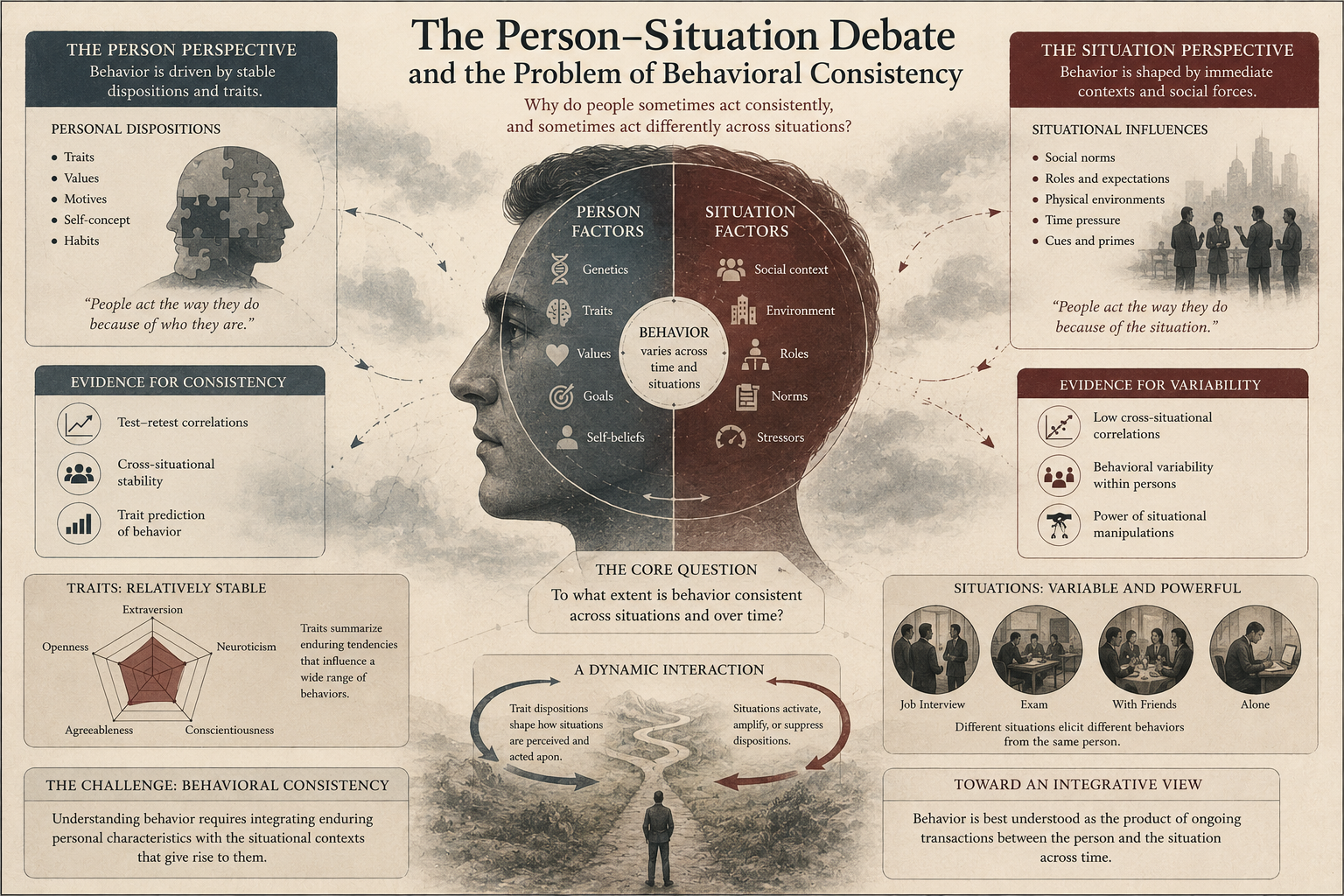
The central lesson of the debate is not that personality disappears in context. It is that personality is expressed through context. A person may not behave identically in every setting, yet still show a stable pattern in how they respond to criticism, intimacy, uncertainty, authority, autonomy, threat, trust, competition, or moral demand. Consistency is therefore often conditional rather than uniform.
What the debate was about
The person–situation debate was never really about whether persons matter or whether situations matter. Both obviously do. The real issue was whether stable traits could explain meaningful regularity in behavior across situations, or whether behavior was so context-dependent that broad trait language overstated the coherence of personality. In its strongest form, the debate questioned the older expectation that an honest person should behave honestly almost everywhere, or that an aggressive person should behave aggressively with broad cross-situational uniformity.
This was a serious challenge because personality psychology had often inferred enduring dispositions from relatively thin behavioral evidence. If behavioral consistency could not be demonstrated convincingly, then the field risked mistaking reputation, social impression, or selective observation for psychological structure. The debate therefore forced psychologists to become much more careful about what sort of evidence actually supports trait claims.
The debate also exposed a level-of-analysis problem. A broad trait such as conscientiousness, extraversion, honesty, aggression, or dependency may not be expected to predict one isolated behavior in one isolated situation with high precision. A person’s single act at a single moment is shaped by goals, incentives, constraints, mood, role expectations, social norms, opportunity, and the immediate meaning of the situation. A broad trait may become visible only when behavior is sampled across many occasions or when the relevant class of situations is specified.
That distinction changed the field. Personality psychology had to move from crude questions such as “does the person behave the same way everywhere?” toward more precise questions: what is the person’s average tendency? How much do they vary? Which situations activate which responses? How stable are their if–then patterns? How do traits shape situation selection and construal? What level of aggregation is needed to detect meaningful regularity?
The debate therefore became a turning point. It weakened simplistic trait claims, but it also weakened simplistic situationist claims. The mature conclusion is not that persons or situations win. It is that behavior emerges from their structured interaction.
The classic trait view
Traditional trait theories assumed that personality consists of relatively enduring dispositions that influence behavior across time and context. On this view, traits such as honesty, aggression, sociability, anxiety, dominance, warmth, or conscientiousness are not merely momentary states. They are stable characteristics of persons that help explain recurring patterns in conduct. The intuitive appeal of this picture is obvious. In ordinary life, people do seem recognizably themselves. They carry styles of feeling, judgment, and conduct that persist across different roles and relationships.
The classic trait view was important because it gave personality psychology a language of continuity. It suggested that persons are not simply the products of immediate circumstances. They bring tendencies, habits, motives, expectations, emotional styles, and self-regulatory patterns into situations. Two people can encounter the same event and respond differently because they differ in enduring dispositions.
The difficulty arises when one asks how that persistence should appear empirically. If a trait is real, must it generate highly similar behavior in all situations? Or is that expectation too crude? Much of the person–situation debate turned on this hidden assumption. Early critics of trait psychology often treated low cross-situational behavioral correlations as evidence against the reality of traits. Later work showed that this conclusion was too simple.
Traits should not be interpreted as mechanical guarantees of identical conduct. A person high in honesty may still face situations where truthfulness is risky, ambiguous, socially punished, or morally complicated. A person high in aggression may not behave aggressively in contexts with strong sanctions or trusted relationships. A person high in extraversion may still withdraw when exhausted, grieving, threatened, or absorbed in solitary work. The existence of situational modulation does not by itself disprove the trait.
The stronger version of trait theory does not require behavioral uniformity. It requires patterned regularity. Traits influence probabilities, thresholds, interpretations, and tendencies across classes of situations. They become most visible through repeated observation, well-designed measurement, and theoretically relevant contexts.
Mischel’s challenge
Walter Mischel’s Personality and Assessment challenged the field by arguing that broad trait inferences often lacked strong empirical support when tested against actual behavior in different situations. The critique was not that personality does not exist, but that psychologists had exaggerated the generality of behavioral consistency and often failed to specify the conditions under which traits should be expected to predict conduct.
The force of Mischel’s challenge came from its methodological discipline. If behavior varies substantially across situations, then a serious personality science must explain that variation rather than dismiss it as noise. A field cannot simply claim stable traits while ignoring evidence that the same person behaves differently in different contexts. The debate demanded better theories of when behavior should generalize and when it should not.
Mischel’s intervention exposed a mismatch between broad dispositional language and the finer-grained realities of behavior. If a child cheats in one situation but not another, if a person is assertive with peers but not with authority, or if someone is generous toward friends but not strangers, then the task is not to deny personality. The task is to ask what structure organizes the difference. What cues matter? What goals are activated? What meanings are attached to the situation? What expectations guide the response?
This is why Mischel’s critique ultimately pushed personality psychology toward more sophisticated models rather than away from personality altogether. It encouraged attention to cognitive-affective processes, situational meanings, conditional response patterns, and the organization of behavior across contexts. The result was not the death of traits, but the transformation of trait theory into a more dynamic and interactionist science.
The debate also made personality psychologists more careful about evidence. A trait claim cannot be supported by a label alone. It requires measurement across relevant situations, attention to aggregation, validation against meaningful outcomes, and theoretical clarity about what counts as expected consistency.
What behavioral consistency actually means
The major lesson of the debate is that consistency does not have to mean identical overt behavior everywhere. A person can be stable without being behaviorally uniform. Someone may be consistently assertive in competitive settings, consistently warm in trusted relationships, consistently anxious under uncertainty, consistently guarded under evaluation, or consistently restrained in highly structured institutions. The stability lies not in doing the same thing in every context, but in showing patterned relations between situations and responses.
This is a more sophisticated view of personality because it distinguishes surface consistency from structural consistency. Surface consistency means doing the same behavior across many settings. Structural consistency means showing a stable organization of response across meaningful classes of situations. A person may be behaviorally variable on the surface and deeply consistent in structure.
For example, a person may appear inconsistent if they are quiet at work, animated with close friends, defensive with authority, and gentle with children. But those variations may form a coherent pattern: guardedness under evaluation, warmth under trust, caution under hierarchy, and affection under caregiving. The person is not random. The pattern is conditional.
This shift also changes how traits should be measured. If consistency is conditional, then personality cannot be assessed well by sampling arbitrary behaviors in arbitrary contexts and expecting high uniformity. Researchers need to identify relevant situations, measure psychological meaning, collect repeated observations, and examine whether person-specific response patterns recur.
Behavioral consistency can therefore appear in several forms: average-level consistency, rank-order stability, situational signatures, state distributions, affective recovery patterns, situation selection, and repeated person–environment loops. Each form captures a different layer of personality. None alone exhausts the person.
The strongest conclusion is that consistency is not sameness. It is organized pattern. Personality science became more mature once it stopped demanding rigid uniformity and began studying structured variability.
The problem of aggregation
One response to Mischel’s critique emphasized aggregation. A single behavior observed in a single setting is often a poor indicator of a broad trait because behavior is noisy, role-dependent, mood-sensitive, opportunity-dependent, and situationally constrained. But when behavior is aggregated across many occasions and settings, more stable between-person differences often emerge. This insight helped rehabilitate trait psychology without denying situational influence.
Aggregation matters because broad traits are probabilistic tendencies, not moment-by-moment commands. A single act of sociability does not prove high extraversion. A single lapse in organization does not disprove conscientiousness. A single angry remark does not define a person’s aggressiveness. But repeated patterns across many relevant occasions can reveal stable tendencies that isolated acts obscure.
The aggregation response clarified that consistency can be difficult to detect at the level of isolated acts. Broad traits are usually not best inferred from one episode, one encounter, one moral test, or one observation by a single informant. They become more visible when sampled repeatedly across time, contexts, and behavioral opportunities.
Aggregation also explains why both critics and defenders of trait theory could appear partly right. Critics were right that individual behaviors often vary strongly across situations. Defenders were right that personality traits can predict aggregated patterns and consequential life outcomes. The difference lies in the level of measurement.
This principle has methodological implications. Researchers must design studies that match the level of the claim. A broad claim about trait standing requires broad sampling. A claim about behavior in a specific situation requires situation-specific measurement. A claim about conditional consistency requires repeated observation across classes of situations. The debate made it clear that personality measurement must be aligned with the phenomenon being studied.
Aggregation therefore did not make situations irrelevant. It showed that situations create variability at the level of single acts, while traits often emerge across repeated acts. A strong personality science models both.
If–then patterns and CAPS
One of the most important developments after the debate was the cognitive-affective personality system framework developed by Mischel and Shoda. This model argued that personality resides partly in stable if–then patterns: if a person encounters a particular class of situation, then certain thoughts, affects, expectations, goals, and behaviors become more likely to follow. On this view, personality is not refuted by variability. It is revealed through the organized way variability is structured.
This reformulation was decisive because it preserved individuality while honoring situational sensitivity. A person may not be uniformly hostile, timid, generous, anxious, assertive, or withdrawn in all contexts, but they may still show a stable and distinctive signature in how they respond to specific triggers, relationships, threats, permissions, or constraints. Personality becomes dynamic without becoming formless.
The CAPS model also made situation meaning central. Situations do not act on people in a raw physical form. They are encoded. A meeting can be experienced as opportunity, evaluation, threat, boredom, obligation, recognition, exclusion, or competition. The same objective situation can activate different cognitive-affective units in different people. A person’s stability may lie partly in how they repeatedly construe certain classes of events.
This helps explain why the person–situation debate could not be resolved by simply assigning a percentage of behavior to “person” and a percentage to “situation.” Situations are psychologically filtered through the person. Persons are activated by situations. Behavior emerges from the pattern linking the two.
The if–then model also has practical value. It encourages clinicians, educators, researchers, and organizational professionals to ask more precise questions. Not merely “is this person aggressive?” but “under what conditions does this person become aggressive?” Not merely “is this person anxious?” but “which cues activate threat appraisal?” Not merely “is this person conscientious?” but “where does responsibility emerge, and where does it collapse?”
The legacy of CAPS is therefore a conditional view of coherence. Personality is not always visible as cross-situational sameness. It is often visible as a stable map of situational response.
Density distributions and modern trait theory
William Fleeson’s density-distribution approach pushed the post-debate synthesis further by showing that people display substantial within-person variability in momentary trait-relevant states while still differing systematically in their average levels and distributions. A person can enact extraversion at some moments and introversion at others, yet still have a characteristic distribution of states that differs from someone else’s. Traits, in this view, are not rigid behavioral constants but summaries of the distribution of state expressions across time.
This idea is powerful because it makes variability part of the trait rather than an embarrassment to trait theory. A person’s extraversion can be represented not only by a single score, but by the distribution of extraverted states they enact across many occasions. One person’s distribution may be centered high, another low, another moderate but wide, another highly situation-sensitive. These distributional patterns can be stable and informative.
The density-distribution view also explains why people often experience themselves as more variable than trait labels suggest. A person who is generally introverted may still have moments of sociability, assertiveness, enthusiasm, and public ease. A person who is generally conscientious may still procrastinate, become disorganized, or lose focus under stress. A person who is generally agreeable may still become angry, firm, or confrontational under moral pressure. These moments do not necessarily contradict the trait. They belong to the state distribution.
This approach became one of the most productive syntheses to emerge from the debate. It allowed personality psychology to retain trait structure while integrating process, variability, and situational responsiveness. Broad trait standing and rich within-person variation could now be studied together rather than treated as mutually exclusive.
The density-distribution model also created a bridge to Whole Trait Theory, which treats traits as both descriptive summaries of state distributions and explanatory systems generated by social-cognitive mechanisms. This means traits can describe what a person tends to enact while process models explain why the person enacts those states in particular situations.
Modern trait theory therefore no longer needs to defend crude behavioral uniformity. It can define traits as stable patterns in distributions of states, generated through dynamic processes in context. That is one of the most important theoretical gains produced by the person–situation debate.
Why the debate did not end traits
The person–situation debate is often misremembered as a decisive victory of social psychology over trait psychology. That reading is historically misleading. Traits survived not because the critique failed, but because the critique forced better theory. Personality science became more precise about levels of analysis, aggregation, conditionality, measurement, and within-person variability. Later research consistently showed that traits predict important life outcomes and that personality structure remains empirically robust.
The field changed, however, in an important way. Few serious personality psychologists now defend the crude idea that traits should produce identical behavior across all situations. The stronger position is interactionist: traits matter, situations matter, and what matters most is often their patterned relation. Personality is neither an inner essence that acts independently of context nor a mere residue of the immediate environment.
Traits remain useful because they summarize broad regularities across time and because they predict meaningful outcomes when measured properly. Extraversion, conscientiousness, neuroticism, agreeableness, openness, honesty-humility, and related trait constructs can help explain patterns in health, work, relationships, wellbeing, learning, risk, leadership, and adaptation. But trait interpretation must be probabilistic and contextual, not deterministic.
The debate also improved the field by creating space for process. A trait score can tell us that one person is generally more anxious, more sociable, or more conscientious than another. It does not by itself explain the mechanisms that produce those patterns. Social-cognitive models, motivational systems, appraisal processes, and dynamic state models help fill that explanatory gap.
Thus, the debate did not destroy personality psychology. It pushed the field toward an integrated science in which broad traits, dynamic states, cognitive-affective processes, social situations, and developmental pathways are studied together.
The best conclusion is not that traits were wrong. It is that traits had to become more sophisticated. They had to be understood as patterns of probability, distribution, conditional expression, and development rather than as rigid behavioral scripts.
Situations, culture, and the social world
The person–situation debate helped make situations conceptually important. A situation is not just a backdrop. It carries norms, affordances, incentives, threats, power relations, role expectations, cultural meanings, histories, and institutional constraints. Moreover, situations are not culturally neutral. The same behavior can mean something different in a classroom, a court, a workplace, a family gathering, a hospital, a religious community, or a digital platform.
This point matters because behavioral consistency is always interpreted against a world of social expectations. People are not only traits in motion. They are actors moving through organized settings. To study consistency seriously therefore requires attention to the social and institutional structure of situations themselves.
Culture shapes which behaviors are expected, rewarded, tolerated, or punished. Assertiveness may be interpreted as confidence in one context, disrespect in another, courage in another, and self-protection in another. Emotional restraint may signal maturity, fear, professionalism, oppression, politeness, or alienation depending on the setting. A trait-relevant behavior does not carry one universal meaning apart from cultural interpretation.
Institutions also shape expression. Workplaces, schools, legal systems, families, clinics, bureaucracies, and public spaces create different opportunities and constraints for personality expression. A person may appear quiet in a punitive institution but expressive in a trusted community. They may appear compliant under surveillance but agentic under autonomy. They may appear inconsistent when they are actually adapting to very different power structures.
This is why the person–situation debate remains socially important. A purely individual interpretation can misread adaptive behavior under constraint as a personality deficit. A purely situational interpretation can erase stable individuality. The better approach asks how persons and structured worlds interact.
A mature personality science must therefore treat situations not as generic stimuli, but as meaning-laden social environments. Personality is expressed in worlds that already organize power, possibility, obligation, risk, and recognition.
Measurement, time scale, and research design
The person–situation debate was also a measurement debate. How often must behavior be observed? Which situations count as relevant? How should researchers separate trait signal from situational influence, measurement error, role constraint, and temporary state variation? These questions remain central to personality science.
A single observation is rarely enough. Broad trait claims require repeated measurement across occasions. Conditional-consistency claims require sampling multiple situation classes. Dynamic claims require time-structured data. Developmental claims require longitudinal designs. The time scale of the design must match the claim being made.
Experience sampling and ecological momentary assessment have become especially important because they allow researchers to observe state expression in real time or near real time. Such methods can show how people fluctuate across daily life, how situations activate states, how previous states carry forward, and how individual response patterns differ. They make it possible to study personality as lived process rather than only as retrospective summary.
However, repeated measurement also has limits. It can create participant burden, missing data, sampling bias, and reactivity. People may be least likely to respond when stressed, ashamed, socially engaged, overwhelmed, or avoiding reflection. Situations may be unevenly sampled. A short measurement window may capture a temporary phase rather than a stable pattern. Dynamic research therefore requires careful design and cautious interpretation.
Research also needs better situation measurement. Objective labels such as “work,” “home,” or “school” are useful but incomplete. The psychological meaning of the situation may be evaluation, autonomy, threat, trust, boredom, care, competition, injustice, or social belonging. A strong study should measure both setting and meaning.
The debate’s methodological legacy is clear: personality science must match measurement to theory. If the theory concerns stable averages, measure repeated averages. If it concerns if–then signatures, measure situations and responses. If it concerns development, measure change across time. If it concerns social context, measure the structure of context rather than treating it as background noise.
Professional use and applied boundaries
The person–situation debate has real professional value because it teaches caution against overinterpreting single behaviors, isolated assessments, or context-free personality labels. It is useful in research design, education, coaching, consulting, organizational learning, clinical formulation, leadership reflection, and methodological demonstration. It helps professionals ask when behavior reflects a stable tendency, when it reflects situational constraint, and when the most informative pattern is conditional.
A professional scaffold based on this debate can be used to demonstrate aggregation, repeated-measures design, within-person variability, mixed-effects modeling, if–then signatures, person–situation interactions, and the limits of single-observation inference. These are legitimate uses in professional education, research prototyping, workshop design, and analytic consulting.
But professional use does not mean unrestricted assessment use. A repeated-measures model is not a hiring tool. A situation-sensitivity index is not a diagnosis. A behavioral consistency score is not a moral rating. A synthetic dataset is not evidence about real people. A person–situation analysis should not be used as a standalone system for employment screening, promotion, termination, clinical assessment, educational placement, legal judgment, relationship matching, surveillance, or individual prediction.
Any consequential use involving real people would require validated instruments, qualified review, privacy protections, documented intended use, informed consent where appropriate, fairness and invariance analysis, missing-data planning, clear communication of uncertainty, and appropriate ethical and legal oversight. The higher the stakes, the stronger the evidence must be.
The intended professional use is analytic, educational, methodological, and reflective. The point is to improve reasoning about personality and context, not to create a new system of unsupported classification or gatekeeping.
This boundary matters because the person–situation debate itself warns against overreach. The same behavior can mean different things in different contexts. A responsible applied psychology must not detach behavior from the conditions that shape it.
Mathematical lens: conditional consistency and trait expression
The classical version of the trait problem can be expressed too simply as:
B_{it} = \mu_i + \varepsilon_{it}
\]
Interpretation: \(B_{it}\) is behavior for person \(i\) at occasion \(t\), \(\mu_i\) is the person’s stable average tendency, and \(\varepsilon_{it}\) is residual occasion-level variation. The person–situation debate showed that this model is often too thin, because what looks like noise may actually be structured responsiveness.
A more realistic formulation includes situations explicitly:
B_{it} = \alpha + \beta_1 P_i + \beta_2 S_{it} + \beta_3(P_i \times S_{it}) + u_i + \varepsilon_{it}
\]
Interpretation: \(P_i\) is a person variable, \(S_{it}\) is a situation variable, \(P_i \times S_{it}\) is their interaction, \(u_i\) is a person-specific random component, and \(\varepsilon_{it}\) is residual variation. If \(\beta_3 \ne 0\), then the effect of personality depends on the situation, or the effect of the situation depends on the person.
The if–then logic of the cognitive-affective personality system can be represented as a conditional mapping:
\text{If } S_{it} \in \mathcal{S}_k,\quad \Pr(B_{it}=b \mid S_{it}) = f_k(P_i)
\]
Interpretation: When a person encounters a certain class of situations \(\mathcal{S}_k\), the probability of a behavior depends on the person’s organized cognitive-affective system. Personality appears in conditional response patterns rather than rigid sameness.
Density-distribution thinking adds a distributional layer. If momentary state expressions are represented as \(s_{it}\), then each person may be characterized by:
s_{it} \sim D_i(\mu_i, \sigma_i^2)
\]
Interpretation: Each person has a characteristic distribution of state expressions, with mean \(\mu_i\) and variance \(\sigma_i^2\). Two people may differ in average state level, variability, or situational patterning.
Aggregation can be represented by averaging repeated observations:
\bar{B}_i = \frac{1}{T}\sum_{t=1}^{T} B_{it}
\]
Interpretation: \(\bar{B}_i\) is person \(i\)’s aggregated behavior across \(T\) occasions. Aggregation reduces occasion-specific noise and can reveal stable between-person differences that single observations obscure.
A stable behavioral signature can be represented as a vector of conditional means across situation classes:
\boldsymbol{\mu}_i = \left(E[B_i \mid \mathcal{S}_1], E[B_i \mid \mathcal{S}_2], \dots, E[B_i \mid \mathcal{S}_K]\right)
\]
Interpretation: The person’s consistency can be located in the pattern of expected behavior across situation classes. The signature is not one behavior everywhere, but an organized response profile.
These equations clarify the post-debate synthesis. Traits, situations, states, and conditional patterns can be modeled together. The result is not a weaker personality psychology, but a more precise one.
R: modeling between-person stability and within-person variation
The R example below analyzes repeated personality-state observations across situations. It estimates each person’s average state level, within-person variability, situation exposure, and a mixed model testing whether situation demand interacts with person-level trait standing.
# The Person-Situation Debate and Behavioral Consistency
# R workflow for repeated-measures personality-state data

# Install packages if needed:
# install.packages(c("readr", "dplyr", "lme4", "lmerTest", "broom.mixed", "ggplot2"))

library(readr)
library(dplyr)
library(lme4)
library(lmerTest)
library(broom.mixed)
library(ggplot2)

# -------------------------------------------------------------------
# Load repeated-measures data
# -------------------------------------------------------------------

# Expected columns:
# person_id
# occasion
# trait_score
# state_extraversion
# state_conscientiousness
# situation_demand
# situation_sociality
# situation_evaluation
# behavioral_consistency_marker

data <- read_csv("person_situation_data.csv")

glimpse(data)
summary(data)

# -------------------------------------------------------------------
# Person-level averages and within-person variability
# -------------------------------------------------------------------

person_summary <- data %>%
  group_by(person_id) %>%
  summarise(
    n_obs = n(),
    trait_score = mean(trait_score, na.rm = TRUE),
    mean_state_extraversion = mean(state_extraversion, na.rm = TRUE),
    sd_state_extraversion = sd(state_extraversion, na.rm = TRUE),
    mean_state_conscientiousness = mean(state_conscientiousness, na.rm = TRUE),
    sd_state_conscientiousness = sd(state_conscientiousness, na.rm = TRUE),
    mean_situation_demand = mean(situation_demand, na.rm = TRUE),
    mean_situation_sociality = mean(situation_sociality, na.rm = TRUE),
    mean_situation_evaluation = mean(situation_evaluation, na.rm = TRUE),
    mean_behavioral_consistency_marker = mean(
      behavioral_consistency_marker,
      na.rm = TRUE
    ),
    .groups = "drop"
  )

print(person_summary)

# -------------------------------------------------------------------
# Within-person centering for situation predictors
# -------------------------------------------------------------------

data_centered <- data %>%
  group_by(person_id) %>%
  mutate(
    situation_demand_person_mean = mean(situation_demand, na.rm = TRUE),
    situation_sociality_person_mean = mean(situation_sociality, na.rm = TRUE),
    situation_evaluation_person_mean = mean(situation_evaluation, na.rm = TRUE),
    situation_demand_within = situation_demand - situation_demand_person_mean,
    situation_sociality_within = situation_sociality - situation_sociality_person_mean,
    situation_evaluation_within = situation_evaluation - situation_evaluation_person_mean
  ) %>%
  ungroup()

# -------------------------------------------------------------------
# Intraclass correlation:
# how much state variance is between persons?
# -------------------------------------------------------------------

null_model <- lmer(
  state_extraversion ~ 1 + (1 | person_id),
  data = data_centered,
  REML = TRUE
)

var_components <- as.data.frame(VarCorr(null_model))

between_person_variance <- var_components$vcov[
  var_components$grp == "person_id"
]

within_person_variance <- attr(VarCorr(null_model), "sc")^2

icc <- between_person_variance /
  (between_person_variance + within_person_variance)

icc_summary <- data.frame(
  outcome = "state_extraversion",
  between_person_variance = between_person_variance,
  within_person_variance = within_person_variance,
  icc = icc
)

print(icc_summary)

# -------------------------------------------------------------------
# Mixed model:
# trait, situation, and person-by-situation interaction
# -------------------------------------------------------------------

model_extraversion <- lmer(
  state_extraversion ~
    trait_score * situation_sociality_within +
    situation_demand_within +
    situation_evaluation_within +
    (1 + situation_sociality_within | person_id),
  data = data_centered,
  REML = FALSE
)

summary(model_extraversion)

# -------------------------------------------------------------------
# Conscientious states under demand
# -------------------------------------------------------------------

model_conscientiousness <- lmer(
  state_conscientiousness ~
    trait_score * situation_demand_within +
    situation_sociality_within +
    situation_evaluation_within +
    (1 + situation_demand_within | person_id),
  data = data_centered,
  REML = FALSE
)

summary(model_conscientiousness)

# -------------------------------------------------------------------
# Person-specific situation sensitivity estimates
# -------------------------------------------------------------------

random_effects <- ranef(model_extraversion)$person_id

situation_sensitivity <- random_effects %>%
  tibble::rownames_to_column("person_id") %>%
  rename(
    random_intercept = `(Intercept)`,
    sociality_slope_deviation = situation_sociality_within
  )

print(head(situation_sensitivity))

# -------------------------------------------------------------------
# Plot one person's state distribution
# -------------------------------------------------------------------

example_person_id <- data_centered$person_id[1]

example_person <- data_centered %>%
  filter(person_id == example_person_id)

ggplot(example_person, aes(x = state_extraversion)) +
  geom_histogram(bins = 15) +
  labs(
    title = paste(
      "Distribution of State Extraversion for Person",
      example_person_id
    ),
    x = "State Extraversion",
    y = "Count"
  )

# -------------------------------------------------------------------
# Save outputs
# -------------------------------------------------------------------

write_csv(person_summary, "person_situation_person_summary_r.csv")
write_csv(icc_summary, "person_situation_icc_summary_r.csv")
write_csv(situation_sensitivity, "person_situation_sensitivity_r.csv")

write_csv(
  tidy(model_extraversion, effects = "fixed"),
  "person_situation_extraversion_model_r.csv"
)

write_csv(
  tidy(model_conscientiousness, effects = "fixed"),
  "person_situation_conscientiousness_model_r.csv"
)
This workflow reflects the actual legacy of the debate: stable person differences can coexist with substantial within-person variability, and the empirical task is to model both rather than choosing one and ignoring the other.
Python: estimating person-by-situation patterns
The Python example below performs a similar analysis using repeated observations. It calculates person-level means and variability, creates within-person centered situation variables, fits mixed-effects models, and estimates state inertia with lagged state expression.
# The Person-Situation Debate and Behavioral Consistency
# Python workflow for repeated-measures personality-state data

# Install packages if needed:
# pip install pandas numpy statsmodels

from pathlib import Path

import numpy as np
import pandas as pd
import statsmodels.formula.api as smf

# -------------------------------------------------------------------
# Load repeated-measures data
# -------------------------------------------------------------------

# Expected columns:
# person_id
# occasion
# trait_score
# state_extraversion
# state_conscientiousness
# situation_demand
# situation_sociality
# situation_evaluation
# behavioral_consistency_marker

data_path = Path("person_situation_data.csv")
df = pd.read_csv(data_path)

print(df.head())
print(df.info())
print(df.describe(include="all"))

# -------------------------------------------------------------------
# Person-level summaries
# -------------------------------------------------------------------

person_summary = (
    df.groupby("person_id")
    .agg(
        n_obs=("occasion", "count"),
        trait_score=("trait_score", "mean"),
        mean_state_extraversion=("state_extraversion", "mean"),
        sd_state_extraversion=("state_extraversion", "std"),
        mean_state_conscientiousness=("state_conscientiousness", "mean"),
        sd_state_conscientiousness=("state_conscientiousness", "std"),
        mean_situation_demand=("situation_demand", "mean"),
        mean_situation_sociality=("situation_sociality", "mean"),
        mean_situation_evaluation=("situation_evaluation", "mean"),
        mean_behavioral_consistency_marker=(
            "behavioral_consistency_marker",
            "mean",
        ),
    )
    .reset_index()
)

print(person_summary.head())

# -------------------------------------------------------------------
# Within-person centering
# -------------------------------------------------------------------

for variable in [
    "situation_demand",
    "situation_sociality",
    "situation_evaluation",
]:
    person_mean_name = f"{variable}_person_mean"
    within_name = f"{variable}_within"

    df[person_mean_name] = (
        df.groupby("person_id")[variable]
        .transform("mean")
    )

    df[within_name] = df[variable] - df[person_mean_name]

# -------------------------------------------------------------------
# Approximate ICC for state extraversion
# -------------------------------------------------------------------

person_means = df.groupby("person_id")["state_extraversion"].mean()

merged = df.merge(
    person_means.rename("person_mean_state_extraversion"),
    left_on="person_id",
    right_index=True,
)

between_person_variance = person_means.var(ddof=1)

within_person_variance = (
    merged["state_extraversion"]
    - merged["person_mean_state_extraversion"]
).var(ddof=1)

icc = between_person_variance / (
    between_person_variance + within_person_variance
)

icc_summary = pd.DataFrame(
    {
        "outcome": ["state_extraversion"],
        "between_person_variance": [between_person_variance],
        "within_person_variance": [within_person_variance],
        "icc": [icc],
    }
)

print(icc_summary)

# -------------------------------------------------------------------
# Mixed model:
# state extraversion as person-by-situation pattern
# -------------------------------------------------------------------

model_extraversion = smf.mixedlm(
    "state_extraversion ~ trait_score * situation_sociality_within + "
    "situation_demand_within + situation_evaluation_within",
    data=df,
    groups=df["person_id"],
)

result_extraversion = model_extraversion.fit(
    method="lbfgs",
    maxiter=500,
    reml=False,
)

print(result_extraversion.summary())

# -------------------------------------------------------------------
# Mixed model:
# conscientious state expression under demand
# -------------------------------------------------------------------

model_conscientiousness = smf.mixedlm(
    "state_conscientiousness ~ trait_score * situation_demand_within + "
    "situation_sociality_within + situation_evaluation_within",
    data=df,
    groups=df["person_id"],
)

result_conscientiousness = model_conscientiousness.fit(
    method="lbfgs",
    maxiter=500,
    reml=False,
)

print(result_conscientiousness.summary())

# -------------------------------------------------------------------
# State inertia:
# does prior state predict later state?
# -------------------------------------------------------------------

df = df.sort_values(["person_id", "occasion"]).copy()

df["lag_state_extraversion"] = (
    df.groupby("person_id")["state_extraversion"]
    .shift(1)
)

inertia_df = df.dropna(subset=["lag_state_extraversion"]).copy()

model_inertia = smf.mixedlm(
    "state_extraversion ~ lag_state_extraversion + "
    "situation_sociality_within + situation_evaluation_within",
    data=inertia_df,
    groups=inertia_df["person_id"],
)

result_inertia = model_inertia.fit(
    method="lbfgs",
    maxiter=500,
    reml=False,
)

print(result_inertia.summary())

# -------------------------------------------------------------------
# Export fixed-effect summaries
# -------------------------------------------------------------------

def fixed_effect_table(result, model_name):
    return pd.DataFrame(
        {
            "model": model_name,
            "term": result.fe_params.index,
            "estimate": result.fe_params.values,
            "standard_error": result.bse_fe.values,
            "z_value": result.fe_params.values / result.bse_fe.values,
        }
    )

fixed_effects = pd.concat(
    [
        fixed_effect_table(result_extraversion, "state_extraversion"),
        fixed_effect_table(
            result_conscientiousness,
            "state_conscientiousness",
        ),
        fixed_effect_table(result_inertia, "state_extraversion_inertia"),
    ],
    ignore_index=True,
)

# -------------------------------------------------------------------
# Save outputs
# -------------------------------------------------------------------

person_summary.to_csv(
    "person_situation_person_summary_python.csv",
    index=False,
)

icc_summary.to_csv(
    "person_situation_icc_summary_python.csv",
    index=False,
)

fixed_effects.to_csv(
    "person_situation_fixed_effects_python.csv",
    index=False,
)

df.to_csv(
    "person_situation_scored_python.csv",
    index=False,
)
This kind of modeling is especially appropriate for the person–situation problem because it does not force an artificial choice between traits and situations. It lets the analyst examine average dispositional differences, within-person variation, situation effects, and conditional trait expression in a single framework.
GitHub repository
The companion GitHub repository provides reproducible research scaffolding for this article, including synthetic repeated-measures person–situation data, documentation, validation materials, and multi-language workflows for examining behavioral consistency, aggregation, within-person variability, situation effects, person–situation interactions, conditional signatures, and state distributions.
Complete Code Repository
Access the full companion repository for this article, including reproducible analysis materials and multi-language code workflows for the person–situation debate, behavioral consistency, trait expression, situational variability, aggregation, if–then signatures, mixed-effects modeling, and density-distribution approaches.
Responsible interpretation
The person–situation debate requires responsible interpretation because it concerns how psychologists infer enduring personality from behavior. A single behavior should not be treated as a complete personality revelation. A trait score should not be treated as a context-free behavioral guarantee. A situation should not be treated as a neutral backdrop. All three—person, behavior, and situation—need to be interpreted together.
The first principle is non-reduction. A person cannot be reduced to one act, one situation, one trait label, one state average, one variability index, or one conditional signature. Behavioral evidence can reveal patterns, but it does not exhaust identity, culture, development, motive, trauma, role, moral character, social position, or institutional context.
The second principle is contextual humility. Behavior that looks inconsistent may be adaptively responsive to different situations. A person who is quiet in one setting and expressive in another may be showing incoherence, but they may also be showing discernment, self-protection, role adaptation, or sensitivity to power and trust. Apparent inconsistency requires interpretation, not automatic judgment.
The third principle is aggregation. Broad personality claims should not be based on isolated behavior. Repeated observations, multiple situations, and appropriate time scales are needed before strong trait claims are warranted. The broader the claim, the broader and more carefully sampled the evidence should be.
The fourth principle is structural awareness. Situations are shaped by culture, institutions, power, incentives, norms, and constraints. Personality interpretation should not individualize behavior that is partly produced by unsafe conditions, discrimination, coercion, surveillance, poor leadership, role pressure, or lack of opportunity.
The fifth principle is proportional use. Person–situation workflows are suitable for professional education, research prototyping, methodological demonstration, consulting support, organizational learning, and reproducible workflow development. They are not standalone assessment systems for hiring, promotion, termination, clinical assessment, diagnosis, educational placement, legal evaluation, relationship matching, surveillance, or individual prediction. Any consequential use involving real people would require validated instruments, qualified review, privacy safeguards, documented intended use, informed consent where appropriate, fairness analysis, and appropriate ethical and legal oversight.
The debate’s own lesson should guide applied use: behavior is meaningful, but it is meaningful in context. Any interpretation that strips behavior from situation or person from social world risks becoming both scientifically weak and ethically careless.
Conclusion
The person–situation debate changed personality psychology not by destroying trait theory, but by demanding a more sophisticated account of behavioral consistency. It showed that stable individuality cannot be reduced to uniform behavior across all settings. Traits had to be reconceived as dispositional tendencies expressed through situations, state distributions, and conditional patterns of response.
That is the debate’s enduring legacy. Personality is real, situations are powerful, and consistency is often found not in literal sameness but in patterned variation. Once that insight is accepted, the old opposition between person and situation begins to look less like a final dispute and more like a transitional stage in the development of a more mature personality science.
The mature view is interactionist and dynamic. People carry tendencies into situations, but situations activate, constrain, and organize those tendencies. Behavior varies, but variation can be structured. Traits endure, but they are enacted through states. Situations matter, but they matter partly through the meanings persons give them. Personality is therefore not located only inside the person or only outside in the situation. It is expressed in the patterned relation between persons and the worlds they inhabit.
Related articles
- What Is a Trait? Stability, Disposition, and the Logic of Individual Difference
- Personality Dynamics: Traits, States, and Situational Variability
- Social-Cognitive Approaches to Personality
- The Five-Factor Model and the Architecture of Personality
- Trait Hierarchies, Facets, and the Architecture of Personality
- Personality Stability and Change Across the Life Course
- Measurement in Personality Psychology: Self-Report, Observer Ratings, and Psychometrics
Further reading
- Ayduk, Ö. and Mischel, W. (2008) ‘Applying the cognitive-affective processing systems approach to conceptualizing and studying personality’, Journal of Research in Personality, 42(4), pp. 969–990.
- Fleeson, W. (2001) ‘Toward a structure- and process-integrated view of personality: Traits as density distributions of states’, Journal of Personality and Social Psychology, 80(6), pp. 1011–1027.
- Fleeson, W. (2004) ‘Moving personality beyond the person–situation debate’, Current Directions in Psychological Science, 13(2), pp. 83–87.
- Fleeson, W. and Jayawickreme, E. (2015) ‘Whole Trait Theory’, Journal of Research in Personality, 56, pp. 82–92.
- Funder, D.C. (2006) ‘Towards a resolution of the personality triad: Persons, situations, and behaviors’, Journal of Research in Personality, 40(1), pp. 21–34.
- Mischel, W. (1968) Personality and Assessment. New York: Wiley.
- Mischel, W. and Shoda, Y. (1995) ‘A cognitive-affective system theory of personality: Reconceptualizing situations, dispositions, dynamics, and invariance in personality structure’, Psychological Review, 102(2), pp. 246–268.
- Roberts, B.W. (2009) ‘Back to the future: Personality and Assessment and personality science’, Journal of Research in Personality, 43(2), pp. 137–145.
- Shoda, Y. and Mischel, W. (2000) ‘Personality as a stable cognitive-affective activation network’, in Cervone, D. and Shoda, Y. (eds.) The Coherence of Personality. New York: Guilford Press.
References
- Ayduk, Ö. and Mischel, W. (2008) ‘Applying the cognitive-affective processing systems approach to conceptualizing and studying personality’, Journal of Research in Personality, 42(4), pp. 969–990. Available at: https://pmc.ncbi.nlm.nih.gov/articles/PMC2772175/.
- Fleeson, W. (2001) ‘Toward a structure- and process-integrated view of personality: Traits as density distributions of states’, Journal of Personality and Social Psychology, 80(6), pp. 1011–1027. Available at: https://doi.org/10.1037/0022-3514.80.6.1011.
- Fleeson, W. (2004) ‘Moving personality beyond the person–situation debate’, Current Directions in Psychological Science, 13(2), pp. 83–87. Available at: https://doi.org/10.1111/j.0963-7214.2004.00280.x.
- Fleeson, W. and Gallagher, P. (2009) ‘The implications of Big Five standing for the distribution of trait manifestation in behavior: Fifteen experience-sampling studies and a meta-analysis’, Journal of Personality and Social Psychology, 97(6), pp. 1097–1114. Available at: https://pmc.ncbi.nlm.nih.gov/articles/PMC2791901/.
- Fleeson, W. and Jayawickreme, E. (2015) ‘Whole Trait Theory’, Journal of Research in Personality, 56, pp. 82–92. Available at: https://doi.org/10.1016/j.jrp.2014.10.009.
- Funder, D.C. (2003) ‘Toward an integrative science of personality’, Annual Review of Psychology, 55, pp. 1–22. Available at: https://www.annualreviews.org/doi/pdf/10.1146/annurev.psych.55.042902.130709.
- Funder, D.C. (2006) ‘Towards a resolution of the personality triad: Persons, situations, and behaviors’, Journal of Research in Personality, 40(1), pp. 21–34.
- Mischel, W. (1968) Personality and Assessment. New York: Wiley.
- Mischel, W. and Shoda, Y. (1995) ‘A cognitive-affective system theory of personality: Reconceptualizing situations, dispositions, dynamics, and invariance in personality structure’, Psychological Review, 102(2), pp. 246–268. Available at: https://doi.org/10.1037/0033-295X.102.2.246.
- Roberts, B.W. (2009) ‘Back to the future: Personality and Assessment and personality science’, Journal of Research in Personality, 43(2), pp. 137–145. Available at: https://pmc.ncbi.nlm.nih.gov/articles/PMC2711529/.
- Shoda, Y. and Mischel, W. (2000) ‘Personality as a stable cognitive-affective activation network’, in Cervone, D. and Shoda, Y. (eds.) The Coherence of Personality. New York: Guilford Press.
- Weisbuch, M., Slepian, M.L., Clarke, A.D.F. and Ambady, N. (2010) ‘Behavioral stability across time and situations: Nonverbal versus verbal consistency’, Journal of Nonverbal Behavior, 34(1), pp. 43–58. Available at: https://pmc.ncbi.nlm.nih.gov/articles/PMC2819213/.