
Last Updated May 22, 2026
Personality psychology is the branch of psychology that asks one of the discipline’s most enduring questions: what makes a person recognizably the same person across time, context, relationship, role, and crisis, while still leaving room for contradiction, development, adaptation, and change? At its best, the field is not merely an inventory of traits or a collection of personality tests. It is a disciplined inquiry into patterned individuality: the relatively enduring ways people think, feel, want, interpret, attach, regulate, narrate, and act.
The field matters because human lives are not random collections of behaviors. They display structure. They carry style. They reveal continuity. They are shaped by temperament, development, culture, biology, identity, institutions, trauma, relationships, values, and social worlds. Personality psychology tries to understand how these layers become organized into recognizable patterns without reducing the person to a score, a type, a diagnosis, a role, or a single story.
This article argues that personality psychology should be understood as the study of enduring psychological organization across traits, identity, development, motivation, measurement, and context. Traits matter because they provide a powerful descriptive architecture for individual differences. Identity matters because persons interpret themselves. Development matters because personality unfolds through time. Measurement matters because claims about personality require evidence. Culture and power matter because personality is always expressed, evaluated, and constrained in social worlds. A serious account of personality must therefore be both scientific and humanistic: rigorous enough to measure patterned individuality, and humble enough to recognize that the person always exceeds the model.
Main Library
Publications
Article Map
Personality Psychology
Related Topic
Cognitive Psychology
Related Topic
Social Psychology
Related Topic
Developmental Psychology
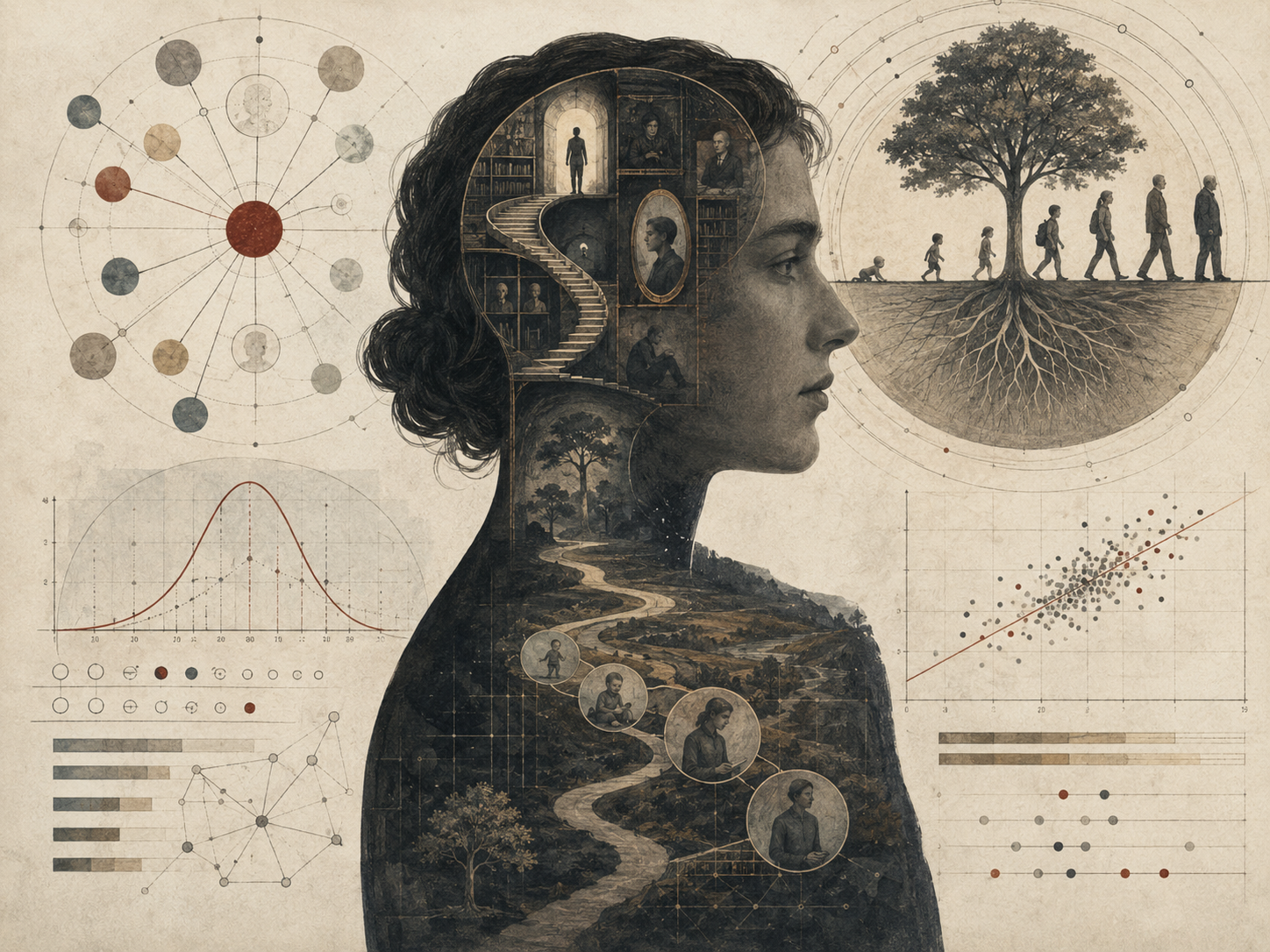
Personality psychology is one of psychology’s great integrative fields because it sits at the intersection of measurement and meaning. It asks how persons differ, how those differences become stable, how they change, how they are measured, how they matter, and how they are interpreted by institutions and relationships. The field becomes strongest when it refuses two errors at once: reducing the person to a trait score, and dissolving personality into purely situational flux.
What personality psychology studies
Personality psychology studies enduring individual differences in patterns of thought, emotion, motivation, self-regulation, interpretation, attachment, identity, and behavior. The crucial word is enduring. A person may behave differently at work than at home, with strangers than with family, under threat than under safety, at twenty than at fifty. But personality psychology asks whether there is intelligible structure across those variations. What persists? What changes? What predicts outcomes? What organizes a person’s style of being in the world?
In simple terms, the field is interested in whether observed behavior can be understood as more than isolated events. A person’s actions may reflect broad traits, current states, social roles, developmental history, cultural norms, motives, values, bodily conditions, institutional constraints, and situational pressures. Personality psychology does not deny that behavior changes across contexts. It asks whether change itself has patterned structure.
This makes personality psychology broader than popular discussion usually suggests. In public culture, personality is often reduced to a quiz result, type label, brand shorthand, dating profile, workplace category, or social stereotype. In serious scholarship, personality includes multiple layers of psychological organization: broad traits, characteristic adaptations, motivational systems, attachment patterns, self-regulatory tendencies, identity commitments, narrative meaning, and life-course development.
The field also overlaps with developmental psychology, clinical psychology, social psychology, cognitive psychology, organizational psychology, health psychology, cultural psychology, behavioral genetics, neuroscience, and moral psychology. Personality is not a narrow silo. It is one of psychology’s major attempts to understand the person as a coherent but unfinished whole.
That broad ambition gives the field its distinctive challenge. Personality psychology must describe patterned individuality without making people seem fixed, simple, or isolated from their worlds. It must measure differences without turning scores into destiny. It must study persons comparatively while preserving the fact that every person is more than a point in a distribution.
At its best, personality psychology is therefore both structural and interpretive. It studies the architecture of individuality, but also the meaning of that architecture in lived life.
Personality as patterned individuality
The concept of patterned individuality is central to personality psychology. A person is not simply a collection of disconnected behaviors. Over time, others come to recognize something like style: a way of responding to frustration, forming attachments, interpreting criticism, keeping promises, seeking novelty, managing fear, expressing warmth, avoiding shame, pursuing goals, telling stories, and making sense of responsibility. Personality psychology studies that patterned style.
Yet pattern does not mean sameness. A person can be stable without being rigid. Someone may be generally conscientious but disorganized under grief, generally introverted but animated among trusted friends, generally agreeable but uncompromising in moral conflict, generally open to ideas but cautious in dangerous environments. Personality is visible not in identical behavior everywhere, but in recurring distributions of attention, feeling, action, and interpretation.
This is why personality psychology cannot be reduced to surface behavior. The same act can have different personality meanings. Silence can reflect introversion, fear, respect, anger, grief, strategic restraint, cultural deference, institutional marginalization, or deep concentration. Assertiveness can reflect confidence, dominance, courage, insecurity, role demand, or desperation. A serious account of personality asks what pattern of meaning, motive, and context gives an act its psychological significance.
Patterned individuality also requires time. Personality is not only what someone does now. It is what recurs across development and what becomes organized through memory, role, body, culture, and story. A person’s personality includes early temperament, learned strategies, relational expectations, emotional habits, values, self-concepts, and life narratives. These layers do not always align neatly. A person may be temperamentally sensitive but narratively brave, socially reserved but morally forceful, achievement-oriented but internally conflicted, agreeable in public but resentful in private.
The richness of personality psychology comes from its refusal to choose only one layer. It studies broad regularities, but also contradictions. It studies distributions, but also stories. It studies traits, but also adaptations. It studies the person as a pattern that changes while remaining partly recognizable.
That is why personality psychology remains one of the most ambitious areas of psychology. It asks how a life has form.
Personality is not just traits
Traits are indispensable to personality psychology because they provide a powerful language for describing relatively stable tendencies. A person can be more or less conscientious, more or less emotionally stable, more or less agreeable, more or less open to experience, more or less extraverted. Trait models matter because they bring comparability, measurement, and predictive leverage to a field that would otherwise risk dissolving into impressionistic description.
But traits do not exhaust personality. A person is not only a location on a trait continuum. People also pursue projects, inhabit roles, develop defense patterns, interpret situations through learned schemas, internalize cultural expectations, form attachments, make commitments, and tell stories about who they have been and who they hope to become. Two individuals may be similarly high in conscientiousness but differ radically in moral outlook, attachment style, political identity, religious orientation, vocational purpose, or the narrative meaning they assign to hardship.
Trait language captures dispositional breadth. It does not fully capture existential content. A trait profile may describe a person’s tendency toward organization, sociability, emotional reactivity, cooperation, or imagination. It does not by itself explain what the person loves, fears, worships, regrets, defends, remembers, or seeks to repair.
A layered account of personality therefore needs more than traits. It needs characteristic adaptations: goals, values, coping strategies, attachments, beliefs, and role-specific commitments. It needs identity: the person’s sense of continuity, belonging, difference, and self-definition. It needs narrative: the story through which a person connects past, present, and future into meaning. It needs development: the processes through which a person becomes, changes, and stabilizes over time.
P = T + A + I + N
\]
Interpretation: This heuristic expression represents personality \(P\) as including broad traits \(T\), characteristic adaptations \(A\), identity commitments \(I\), and narrative organization \(N\). It is not a literal measurement equation. It is a reminder that personality is layered, and that trait scores describe only part of the person.
This layered view helps prevent two forms of reduction. The first is trait reduction: the belief that a few broad scores tell us everything important about a person. The second is narrative romanticism: the belief that a person’s story alone can replace measurement of stable tendencies. Serious personality psychology needs both structure and meaning.
Traits are necessary because they reveal broad patterns. They are insufficient because persons live those patterns inside histories, institutions, bodies, relationships, and moral worlds.
Major frameworks in personality psychology
Personality psychology is not one theory. It is a field organized around several major frameworks, each emphasizing a different layer of personhood. These frameworks sometimes compete, but the field is strongest when they are treated as complementary lenses rather than mutually exclusive territories.
Trait approaches
Trait theories aim to identify broad, relatively stable dimensions of personality. Contemporary trait psychology is often organized around the Five-Factor Model or Big Five: extraversion, agreeableness, conscientiousness, neuroticism, and openness to experience. These dimensions do not capture everything important about a person, but they have proven useful for organizing research on individual differences and for predicting many life outcomes, including aspects of health, work, relationship quality, civic behavior, and wellbeing.
Trait models are especially strong at large-scale description. They help identify where people tend to differ and how those differences relate to patterns across life. But they are less complete when the question is why a person behaves as they do in a particular morally, culturally, or historically charged context. A trait profile can say something about style and tendency; it cannot by itself explain biography.
Social-cognitive approaches
Social-cognitive approaches emphasize how people encode situations, form expectations, regulate goals, and develop recurring “if–then” patterns of response. On this view, personality is not simply an internal stock of traits. It is a dynamic processing system that interacts with environments. The same person may display considerable regularity, but that regularity may be conditional: warm in trusted settings, guarded in evaluative ones; assertive under threat, collaborative under security; disciplined under clear expectations, scattered under ambiguity.
This framework helped the field move beyond crude trait determinism. It shows that stable personality may appear not as identical behavior across situations, but as stable patterns of situational response. A person’s personality includes how they read the room, what cues they notice, what threats they anticipate, what goals they activate, and how they regulate themselves in context.
Psychodynamic and depth approaches
Psychodynamic traditions remain important because they insist that personality includes conflict, defense, fantasy, ambivalence, attachment, and motives that are only partly available to conscious inspection. Even where classic Freudian doctrine is no longer accepted in its original form, the deeper claim survives: persons are not transparent to themselves. Habits of avoidance, idealization, shame regulation, rivalry, repetition, dissociation, and attachment often structure conduct below the level of deliberate self-description.
These approaches remind the field that self-report is not the whole of personality. What a person says about themselves may differ from what they repeatedly enact. This does not invalidate self-report, but it places it in context. A mature science of personality must account for self-knowledge, self-deception, conflict, and the ways persons defend against what they cannot yet integrate.
Humanistic and existential approaches
Humanistic and existential traditions shift attention from taxonomy to personhood. They ask about authenticity, growth, meaning, agency, value orientation, dignity, and the conditions under which a person can become more integrated. These traditions are sometimes treated as softer than trait psychology, but that dismissal misses their intellectual contribution. They keep the field from collapsing into measurement alone.
A science of personality that cannot ask what a life is for, what a person is trying to become, or how dignity and meaning shape selfhood is descriptively competent but philosophically thin. Humanistic and existential approaches preserve the question of human flourishing inside a field often dominated by scores and predictors.
Narrative identity approaches
Narrative identity approaches argue that persons do not merely possess traits; they interpret themselves through evolving life stories. These stories organize memory, aspiration, failure, responsibility, turning points, belonging, rupture, exile, repair, and hope. Personality in this view is partly storied. People become intelligible not only through trait scores but through the narratives they build about suffering, loyalty, injustice, achievement, vocation, and transformation.
This layer of personality is especially important for understanding adulthood, moral development, migration, trauma, recovery, vocation, political identity, religious life, and the social construction of identity. Traits may summarize regularity across behavior. Narratives summarize coherence across time.
Biological and evolutionary approaches
Biological and evolutionary approaches examine temperament, heritability, neural systems, hormonal influences, regulatory systems, reward sensitivity, threat sensitivity, and adaptive tradeoffs. They remind the field that personality is embodied. It is not written onto a blank slate. People differ in reactivity, energy, inhibition, sensitivity, and regulation partly because biological systems differ.
At the same time, the strongest contemporary work avoids biological reductionism. Biological dispositions unfold in developmental, relational, cultural, and institutional environments. A temperamentally sensitive child may become anxious, observant, artistic, cautious, spiritually attentive, socially withdrawn, or emotionally wise depending on care, context, adversity, and opportunity. Biology matters, but it never acts alone.
Together, these frameworks show why personality psychology is necessarily plural. No single framework captures the whole person. Traits describe broad tendencies. Social-cognitive models explain conditional patterns. Depth approaches reveal conflict and defense. Humanistic approaches preserve meaning and agency. Narrative approaches organize life through time. Biological approaches ground personality in embodied systems. The field needs all of them because persons are layered.
Traits and individual differences
Trait psychology is one of the most influential areas of personality psychology because it gives the field a disciplined language for stable individual differences. A trait is a relatively enduring disposition: a tendency to think, feel, regulate, desire, and behave in characteristic ways. Traits are not fixed essences and not guarantees of behavior. They are probabilistic tendencies inferred from recurring patterns.
The logic of individual differences is comparative. To say that someone is high in extraversion, low in neuroticism, or moderate in conscientiousness is to place that person within a distribution. Personality psychology therefore depends on measurement, variance, and comparison. If everyone were the same in a given domain, there would be no individual difference to study. If variation were pure noise, there would be no trait to infer.
Traits matter because they often predict meaningful outcomes. Conscientiousness is associated with patterns of academic, occupational, and health-related behavior. Neuroticism is associated with distress and emotional vulnerability. Extraversion is associated with sociability and positive emotionality. Agreeableness is associated with cooperation and relationship functioning. Openness is associated with imagination, intellectual exploration, and aesthetic sensitivity. These associations are probabilistic, not deterministic. They shift likelihoods. They do not fix destinies.
Broad traits also have internal structure. Conscientiousness may include orderliness, industriousness, dutifulness, self-discipline, and deliberation. Extraversion may include sociability, assertiveness, activity, enthusiasm, and positive affect. Agreeableness may include compassion, politeness, trust, and forgiveness. Neuroticism may include anxiety, volatility, sadness, self-consciousness, and vulnerability. Openness may include imagination, aesthetics, intellect, emotional depth, and receptivity to ideas.
This internal structure is important because broad scores can hide important differences. Two people may have similar conscientiousness scores while one is orderly and the other is industrious. Two people may have similar extraversion scores while one is warm and another is dominant. Two people may have similar openness scores while one is artistically imaginative and another is intellectually abstract. Trait psychology therefore requires attention to level: broad domains, aspects, facets, and specific behaviors.
The value of trait psychology is that it gives the field a cumulative architecture. The danger is that architecture can be mistaken for the whole person. Traits are powerful descriptors, but they remain descriptors. They must be interpreted alongside development, identity, culture, situation, and meaning.
Identity, motivation, and narrative
Personality psychology is not only concerned with how people differ in traits. It is also concerned with what people want, what they value, how they make sense of themselves, and how they connect the events of their lives into meaning. Identity, motivation, and narrative are essential because they explain dimensions of personality that broad traits cannot capture by themselves.
Motivation concerns direction. Traits describe tendencies, but motives describe aims. Two people may both be high in conscientiousness, but one may use discipline to serve family duty, another to pursue status, another to honor religious commitments, another to avoid shame, and another to build creative mastery. The same trait can be organized around different motives.
Identity concerns self-definition. A person’s identity includes commitments, roles, affiliations, values, memories, and social locations through which they understand who they are. Identity is partly personal and partly social. It is shaped by culture, family, class, race, gender, religion, nation, disability, work, historical moment, and belonging. A person’s traits may influence how they enact identity, but identity cannot be reduced to trait standing.
Narrative concerns temporal meaning. People do not merely remember events. They organize events into stories of continuity, rupture, loss, injustice, redemption, endurance, calling, betrayal, exile, recovery, and responsibility. These stories shape how persons understand suffering and agency. A person may interpret hardship as proof of failure, as a call to service, as evidence of injustice, as a test of faith, or as a wound that still lacks meaning. These interpretations become part of personality because they organize future action and self-understanding.
Narrative identity is especially important because it reveals personality as lived through time. A trait profile can describe recurring tendencies, but a life story explains how the person understands those tendencies. Someone high in neuroticism may describe themselves as broken, sensitive, vigilant, spiritually tested, politically aware, traumatized, emotionally honest, or morally alert. The same broad disposition can be narratively framed in very different ways.
This is why a layered personality psychology needs both quantitative and qualitative imagination. Traits help compare people across dimensions. Narratives help explain how persons interpret their own lives. Motives explain direction. Identity explains commitment and belonging. Together, they show that personality is not only measurable structure, but interpreted existence.
Personality psychology loses depth when it treats persons as scores alone. It loses discipline when it treats stories as if they need no evidence. The mature field requires both measurement and meaning.
The person–situation question
One of the most important debates in personality psychology concerns whether behavior is driven more by persons or situations. The mature answer is not that one side won and the other lost. It is that the opposition itself was too crude. Traits matter. Situations matter. More importantly, persons enter, select, interpret, shape, and remember situations differently.
A highly conscientious person may seek structured settings, create routines, and avoid chaotic obligations. A highly extraverted person may generate more social opportunities and thus encounter a different social world than a more introverted one. A highly neurotic person may perceive ambiguity as threat and thereby amplify stress exposure. A highly open person may seek novelty, ideas, art, travel, intellectual debate, or spiritual exploration. Personality is not merely expressed in situations; it helps build the ecology of situations a person inhabits.
Situations also shape personality expression. A weak situation allows more room for dispositional variation. A strong situation constrains behavior through rules, sanctions, danger, role demands, surveillance, or ritual. A courtroom, military drill, emergency room, funeral, examination hall, or job interview may suppress some individual differences while amplifying others. The meaning of a trait depends partly on the situation in which it is expressed.
The person–situation debate forced personality psychology to become more careful. A trait should not be expected to predict a single behavior with perfect accuracy. The better question is whether traits predict patterns across time, distributions of states, characteristic interpretations, situation selection, and conditional response profiles. A person can be stable in how they vary.
B_{it} = \alpha_i + \beta_iS_t + \varepsilon_{it}
\]
Interpretation: Behavior \(B_{it}\) for person \(i\) in situation \(t\) reflects the person’s average tendency \(\alpha_i\), the effect of the situation \(S_t\), the person’s sensitivity to that situation \(\beta_i\), and residual fluctuation \(\varepsilon_{it}\). Personality can appear as a stable pattern of situational responsiveness, not identical behavior everywhere.
This transactional view is one of the major achievements of modern personality psychology. Persons shape situations. Situations shape persons. Both are embedded in culture, institutions, history, and power. A serious science of personality studies this reciprocity rather than isolating the person from the world.
In practice, this means that personality psychology must move beyond the question “What kind of person is this?” toward more specific questions: In what contexts does this pattern appear? What cues activate it? What roles suppress it? What institutions reward it? What relationships transform it? What histories made it adaptive? What future environments might change it?
The person–situation question therefore does not weaken personality psychology. It makes it more honest.
Development and the life course
Personality is relatively stable, but it is not fixed in the trivial sense of being frozen. Stability and change coexist. Temperament appears early. Traits show measurable continuity. Yet people also mature, revise goals, accumulate roles, endure losses, recover from crisis, form identities, enter institutions, become caregivers, migrate, age, and reinterpret earlier experience. Personality is carried through time, but it is also formed by time.
Development matters at several levels. Temperament provides early patterns of reactivity, inhibition, energy, attention, and regulation. Traits become more organized through childhood, adolescence, and adulthood. Characteristic adaptations—goals, habits, values, attachments, roles—may shift as life conditions change. Narrative identity can change dramatically after trauma, migration, illness, religious conversion, parenthood, political rupture, bereavement, or vocational calling.
Longitudinal research distinguishes several kinds of change. Rank-order stability asks whether people maintain relative standing compared with others. Mean-level change asks whether average trait levels shift across age or historical period. Individual change asks how particular persons develop in distinctive ways. These distinctions matter because a trait can show stability and change at the same time.
\bar{T}_{t+1} – \bar{T}_t \neq 0
\]
Interpretation: Mean-level change occurs when the average level of a trait changes across time in a group or population.
\mathrm{corr}(T_t, T_{t+1}) > 0
\]
Interpretation: Rank-order stability occurs when individuals tend to preserve relative standing over time, even if the group average changes. Personality development is therefore more subtle than either “people never change” or “everything is fluid.”
Developmental personality psychology also keeps the field ethically serious. People are not only measured; they are formed. Families, schools, workplaces, states, media systems, religious communities, peer networks, health systems, and economic conditions all participate in shaping personality. The field is therefore not only about difference. It is also about formation under unequal conditions.
This matters especially for marginalized groups and people living under chronic stress, discrimination, disability exclusion, poverty, surveillance, displacement, or institutional neglect. Personality cannot be responsibly interpreted without asking what conditions have shaped a person’s regulatory patterns, threat sensitivity, trust, self-presentation, anger, silence, persistence, or withdrawal. What looks like a trait may partly reflect adaptation to constraint.
A mature developmental view therefore holds two truths together. Persons have enduring tendencies. Persons are also formed and changed by lives that are not equally free.
Culture, power, and social worlds
No account of personality is complete if it ignores culture. The self that personality psychology studies is never culture-free. Languages offer different vocabularies of character. Social institutions reward different forms of self-control, assertiveness, obedience, emotional expression, and autonomy. Collective histories shape what kinds of stories can be told about suffering, honor, family duty, achievement, shame, faith, loyalty, and belonging.
This does not mean personality is merely a cultural illusion. It means psychological structure and cultural meaning must be studied together. Trait models travel across many settings, but not always cleanly or equivalently. Measures developed in one linguistic or institutional context may not map perfectly onto another. Questions of translation, measurement invariance, self-presentation, local moral vocabulary, and institutional power are not peripheral technicalities. They are central to whether the science is describing persons well.
Culture shapes trait expression. Assertiveness may be read as confidence, disrespect, leadership, arrogance, courage, or impropriety depending on social world. Emotional restraint may be read as maturity, suppression, dignity, fear, coldness, spiritual discipline, or survival. Conscientiousness may be expressed as individual ambition, family obligation, religious devotion, bureaucratic compliance, craft pride, or community responsibility. Openness may appear through art, science, spirituality, political dissent, local tradition, or intellectual exploration.
Power matters because personality judgments are socially distributed through institutions. Schools define who is “motivated.” Employers define who is “professional.” Courts define who is “credible.” Clinics define who is “disordered.” Bureaucracies define who is “fit.” These judgments may identify real patterns, but they can also encode class norms, racialized expectations, gendered scripts, disability exclusion, colonial categories, and institutional convenience.
Personality psychology can illuminate these judgments, but it must also remain alert to the danger of converting historically situated norms into supposedly neutral measures of character. A trait scale is not automatically fair because it is standardized. A workplace assessment is not automatically valid because it is quantified. A culturally dominant norm of emotional expression is not automatically a universal standard of adjustment.
X_g = \lambda_gT + \delta_g
\]
Interpretation: If an observed score \(X_g\) in group \(g\) reflects latent trait \(T\), researchers must ask whether the loading \(\lambda_g\) and error term \(\delta_g\) are comparable across groups. If they differ substantially, apparent differences may partly reflect measurement non-equivalence rather than genuine trait differences.
The field becomes stronger when it treats culture and power as central rather than supplementary. Personality is always personal, but it is never only private. Persons become recognizable within social worlds that name, reward, punish, misunderstand, and narrate them.
Measurement and method
Measurement in personality psychology ranges from self-report inventories and observer ratings to interviews, behavioral traces, experience sampling, informant reports, experimental tasks, biological measures, archival records, and narrative methods. Each method reveals something and hides something.
Self-report instruments are efficient and often highly informative, especially for broad trait assessment. They can capture self-perceived patterns, internal states, goals, and recurring tendencies. But they are vulnerable to response styles, limited self-insight, mood, social desirability, strategic self-presentation, identity commitments, and contextual framing.
Observer reports can capture reputation and visible behavioral style. Other people may know aspects of us that we do not see clearly. But observers also bring bias, partial access, relationship history, social expectations, and cultural assumptions. A parent, friend, colleague, partner, teacher, therapist, or supervisor may each see a different version of the same person.
Narrative interviews offer depth, temporality, and moral meaning. They reveal how people make sense of lives, turning points, suffering, obligation, and identity. But narrative methods require interpretation and are difficult to standardize. Stories can be revealing, but they can also be edited, defended, culturally scripted, or constrained by what a person is able to say.
Experience-sampling designs illuminate moment-to-moment variation. They help show how personality states fluctuate across days and situations. But they can fragment the person into episodes unless connected back to broader structure. Behavioral traces and digital data can reveal patterns at scale, but they raise serious questions about privacy, consent, context collapse, surveillance, and interpretation.
The strongest measurement strategy is therefore plural rather than doctrinaire. A field committed to understanding persons should not assume that one instrument, one scale, or one method can capture the whole of personality. Convergence across methods is often more informative than any single score.
Good measurement also requires conceptual discipline. Researchers must ask what construct is being measured, whether the instrument is reliable, whether it is valid for the intended use, whether the scale works equivalently across groups, whether the interpretation is proportionate to the evidence, and whether the stakes justify the method.
Measurement is not merely a technical step. It is an ethical act. To measure personality is to create a representation of a person. That representation can clarify, but it can also mislead. It can support care, research, and self-understanding, but it can also support sorting, exclusion, surveillance, and moral labeling.
The goal is not to abandon measurement. The goal is to make measurement answerable to the complexity of the person.
Professional use and applied boundaries
Personality psychology can be professionally useful in research, education, clinical formulation, coaching reflection, organizational learning, leadership development, health psychology, career counseling, psychometric training, and science communication. It provides a disciplined vocabulary for discussing enduring patterns of thought, emotion, motivation, identity, self-regulation, and behavior. It can help professionals distinguish traits from states, habits from roles, identity from test scores, and personality structure from moral judgment.
A professional scaffold based on personality psychology can support legitimate work: teaching trait theory, demonstrating reliability, exploring person–situation interaction, comparing self-report and observer ratings, examining identity development, studying narrative coherence, modeling life-course change, and building reproducible workflows for psychometric education. These are appropriate uses when the goal is conceptual clarification, research prototyping, methodological demonstration, reflective professional development, or low-stakes educational analysis.
But professional use does not mean unrestricted assessment use. A synthetic dataset is not evidence about real people. A trait score is not a diagnosis. A personality profile is not a hiring decision. A narrative theme is not a legal evaluation. A high conscientiousness score is not proof of competence. A low agreeableness score is not proof of moral defect. A high neuroticism score is not proof of clinical disorder. Personality language should not be converted into a shortcut for consequential judgment.
Personality workflows are appropriate for education, research prototyping, reproducible workflow development, psychometric demonstration, consulting support, organizational learning, coaching reflection, and careful professional discussion. They are not appropriate as standalone systems for hiring, promotion, termination, clinical diagnosis, educational placement, legal evaluation, insurance decisions, surveillance, relationship matching, moral labeling, or individual prediction.
Any consequential use involving real people would require validated instruments, qualified interpretation, documented intended use, informed consent where appropriate, privacy protections, measurement-invariance analysis, fairness review, cultural and linguistic evaluation, careful communication of uncertainty, and appropriate ethical and legal oversight. If workplace, student, patient, genetic, disability, clinical, legal, or vulnerable-population data are involved, the governance burden becomes even higher.
The intended professional use is analytic, educational, methodological, and reflective. The purpose is to reason more carefully about personality—not to convert personality science into unsupported classification, moral labeling, surveillance, or gatekeeping.
Mathematical lens: stability, variance, and latent structure
Personality psychology becomes sharper when its conceptual claims are translated into formal terms. Formalization does not capture the whole person, but it clarifies what the field is claiming about stability, variance, measurement, and structure.
1. Behavior as a person–situation function
A basic interactional statement can be written as:
B = f(P, S)
\]
Interpretation: Behavior \(B\) is a function of the person \(P\), the situation \(S\), and their interaction. Personality psychology does not claim that persons act independently of situations. It asks how persons and situations jointly produce patterned behavior.
2. Layered personality model
A layered conceptual model can represent personality as:
P_t = T_t + A_t + I_t + N_t
\]
Interpretation: Personality at time \(t\) includes traits \(T_t\), characteristic adaptations \(A_t\), identity commitments \(I_t\), and narrative organization \(N_t\). The time index matters because personality is developmental, not static.
3. True score and error
A measured personality score can be represented as:
X_{it} = T_{it} + E_{it}
\]
Interpretation: Observed score \(X_{it}\) for person \(i\) at time \(t\) includes trait-relevant signal \(T_{it}\) and measurement error or transient disturbance \(E_{it}\). This decomposition clarifies why reliability matters.
4. Reliability
\mathrm{Reliability} = \frac{\mathrm{Var}(T)}{\mathrm{Var}(X)}
\]
Interpretation: Reliability is the proportion of observed-score variance attributable to trait-relevant true-score variance. A personality measure becomes more trustworthy when it captures substantive structure rather than noise.
5. Latent trait model
If observed questionnaire items \(x_1, x_2, \dots, x_p\) are treated as indicators of an unobserved dimension, a factor model can be written as:
x_j = \lambda_jF + \delta_j
\]
Interpretation: \(F\) is a latent trait factor, \(\lambda_j\) is the loading of item \(j\), and \(\delta_j\) is item-specific variance or error. Factor analysis helps test whether multiple indicators move together as if they reflect an underlying dispositional structure.
6. Stability across time
Trait continuity can be represented by an autoregressive relation:
T_{i,t+1} = \alpha + \beta T_{it} + \gamma Z_{it} + \varepsilon_{it}
\]
Interpretation: Later trait standing depends partly on earlier trait standing, contextual or developmental influences \(Z_{it}\), and residual change. A high \(\beta\) implies patterned continuity, not immutability.
7. Person–situation interaction
B = \alpha + \beta_1P + \beta_2S + \beta_3(P \times S) + \varepsilon
\]
Interpretation: Behavior \(B\) depends on person variables \(P\), situation variables \(S\), and their interaction. If \(\beta_3 \neq 0\), then the effect of the person depends on the situation, or the effect of the situation depends on the person.
8. Culture and measurement invariance
X_g = \lambda_gT + \delta_g
\]
Interpretation: Observed score \(X_g\) in group \(g\) depends on how the measured indicator loads on the latent trait. If \(\lambda_g\) differs across groups, group comparisons may partly reflect measurement non-equivalence rather than genuine personality differences.
These models matter because they protect the field from loose language. Claims about “deep personality,” “stable traits,” or “character” become scientifically credible only when linked to observed patterns, replicable measurements, explicit models of error, and careful interpretation of context.
R: exploring trait structure, reliability, and identity-linked outcomes
The following R workflow shows how a researcher might inspect trait-item reliability, explore latent structure, compute broad trait scores, and examine how traits relate to identity-linked or developmental outcomes. It is designed as a transparent educational scaffold rather than a high-stakes assessment system.
# What Is Personality Psychology?
# R workflow for trait structure, reliability, and identity-linked outcomes

# Install packages if needed:
# install.packages(c("psych", "readr", "dplyr", "GPArotation", "broom"))

library(psych)
library(readr)
library(dplyr)
library(GPArotation)
library(broom)

# -------------------------------------------------------------------
# Part 1: Read personality item data
# -------------------------------------------------------------------

# Expected structure:
# Each row is a respondent.
# item1:item60 represent a broad personality item pool.
# c1:c6 represent conscientiousness items.
# e1:e6 represent extraversion items.
# n1:n6 represent neuroticism items.
# Optional outcomes:
# identity_coherence
# life_satisfaction
# social_functioning

personality_data <- read_csv("personality_items.csv")

str(personality_data)
summary(personality_data)

# -------------------------------------------------------------------
# Part 2: Define item sets
# -------------------------------------------------------------------

conscientiousness_items <- personality_data %>%
  select(c1, c2, c3, c4, c5, c6)

extraversion_items <- personality_data %>%
  select(e1, e2, e3, e4, e5, e6)

neuroticism_items <- personality_data %>%
  select(n1, n2, n3, n4, n5, n6)

# -------------------------------------------------------------------
# Part 3: Reliability analysis
# -------------------------------------------------------------------

alpha_conscientiousness <- psych::alpha(conscientiousness_items)
alpha_extraversion <- psych::alpha(extraversion_items)
alpha_neuroticism <- psych::alpha(neuroticism_items)

print(alpha_conscientiousness)
print(alpha_extraversion)
print(alpha_neuroticism)

# -------------------------------------------------------------------
# Part 4: Create mean trait scores
# -------------------------------------------------------------------

personality_data <- personality_data %>%
  mutate(
    conscientiousness_score = rowMeans(conscientiousness_items, na.rm = TRUE),
    extraversion_score = rowMeans(extraversion_items, na.rm = TRUE),
    neuroticism_score = rowMeans(neuroticism_items, na.rm = TRUE)
  )

trait_summary <- personality_data %>%
  summarize(
    n = n(),
    conscientiousness_mean = mean(conscientiousness_score, na.rm = TRUE),
    conscientiousness_sd = sd(conscientiousness_score, na.rm = TRUE),
    extraversion_mean = mean(extraversion_score, na.rm = TRUE),
    extraversion_sd = sd(extraversion_score, na.rm = TRUE),
    neuroticism_mean = mean(neuroticism_score, na.rm = TRUE),
    neuroticism_sd = sd(neuroticism_score, na.rm = TRUE)
  )

print(trait_summary)

# -------------------------------------------------------------------
# Part 5: Explore broader latent structure
# -------------------------------------------------------------------

item_pool <- personality_data %>%
  select(item1:item60)

# Remove items with no variance.
item_pool <- item_pool %>%
  select(where(~ sd(.x, na.rm = TRUE) > 0))

cor_matrix <- cor(item_pool, use = "pairwise.complete.obs")

write.csv(
  round(cor_matrix, 3),
  "personality_item_correlation_matrix_r.csv"
)

# Parallel analysis helps estimate plausible dimensionality.
fa.parallel(
  item_pool,
  fa = "fa",
  n.iter = 100,
  main = "Parallel Analysis for Personality Item Pool"
)

# Fit a five-factor exploratory factor analysis.
efa_result <- fa(
  item_pool,
  nfactors = 5,
  rotate = "oblimin",
  fm = "ml"
)

print(efa_result$loadings, cutoff = 0.30)

# -------------------------------------------------------------------
# Part 6: Add factor scores
# -------------------------------------------------------------------

factor_scores <- factor.scores(
  item_pool,
  efa_result,
  method = "tenBerge"
)$scores

factor_scores <- as.data.frame(factor_scores)
names(factor_scores) <- paste0("personality_factor_", seq_len(ncol(factor_scores)))

personality_data_scored <- bind_cols(
  personality_data,
  factor_scores
)

# -------------------------------------------------------------------
# Part 7: Example identity-linked outcome model
# -------------------------------------------------------------------

if (all(c("identity_coherence", "conscientiousness_score", "extraversion_score", "neuroticism_score") %in% names(personality_data_scored))) {
  identity_model <- lm(
    identity_coherence ~ conscientiousness_score +
      extraversion_score +
      neuroticism_score,
    data = personality_data_scored
  )

  print(summary(identity_model))

  write_csv(
    tidy(identity_model),
    "personality_identity_model_coefficients_r.csv"
  )

  write_csv(
    glance(identity_model),
    "personality_identity_model_fit_r.csv"
  )
}

# -------------------------------------------------------------------
# Part 8: Example wellbeing or functioning model
# -------------------------------------------------------------------

if (all(c("life_satisfaction", "conscientiousness_score", "extraversion_score", "neuroticism_score") %in% names(personality_data_scored))) {
  wellbeing_model <- lm(
    life_satisfaction ~ conscientiousness_score +
      extraversion_score +
      neuroticism_score,
    data = personality_data_scored
  )

  print(summary(wellbeing_model))

  write_csv(
    tidy(wellbeing_model),
    "personality_wellbeing_model_coefficients_r.csv"
  )

  write_csv(
    glance(wellbeing_model),
    "personality_wellbeing_model_fit_r.csv"
  )
}

# -------------------------------------------------------------------
# Part 9: Save outputs
# -------------------------------------------------------------------

write_csv(
  personality_data_scored,
  "personality_items_scored_r.csv"
)

write_csv(
  trait_summary,
  "personality_trait_summary_r.csv"
)
This workflow illustrates the core methodological logic of personality psychology: construct scores carefully, evaluate reliability, inspect dimensional structure, and relate personality measures to outcomes only in proportion to the evidence.
Python: estimating trait scores and modeling person–situation patterns
The Python example below performs a related workflow. It computes trait scores, estimates internal consistency, examines dimensional structure with principal components, and models person–situation patterns when repeated observation data are available.
# What Is Personality Psychology?
# Python workflow for trait scoring, dimensionality, and person-situation patterns

# Install packages if needed:
# pip install pandas numpy scikit-learn statsmodels

from pathlib import Path

import numpy as np
import pandas as pd
from sklearn.preprocessing import StandardScaler
from sklearn.decomposition import PCA
import statsmodels.api as sm
import statsmodels.formula.api as smf

# -------------------------------------------------------------------
# Part 1: Reliability helper
# -------------------------------------------------------------------

def cronbach_alpha(frame: pd.DataFrame) -> float:
    """Compute Cronbach's alpha for a set of item columns."""
    clean = frame.dropna()
    n_items = clean.shape[1]

    if n_items <= 1:
        return np.nan

    item_variances = clean.var(axis=0, ddof=1)
    total_score = clean.sum(axis=1)
    total_variance = total_score.var(ddof=1)

    if total_variance == 0:
        return np.nan

    return float(
        (n_items / (n_items - 1))
        * (1 - item_variances.sum() / total_variance)
    )

# -------------------------------------------------------------------
# Part 2: Load personality item data
# -------------------------------------------------------------------

data_path = Path("personality_items.csv")
df = pd.read_csv(data_path)

print(df.head())
print(df.info())

# -------------------------------------------------------------------
# Part 3: Define item groups
# -------------------------------------------------------------------

trait_item_groups = {
    "conscientiousness": ["c1", "c2", "c3", "c4", "c5", "c6"],
    "extraversion": ["e1", "e2", "e3", "e4", "e5", "e6"],
    "neuroticism": ["n1", "n2", "n3", "n4", "n5", "n6"],
}

for trait_name, columns in trait_item_groups.items():
    missing = [col for col in columns if col not in df.columns]
    if missing:
        raise ValueError(f"Missing {trait_name} item columns: {missing}")

# -------------------------------------------------------------------
# Part 4: Compute reliability and mean trait scores
# -------------------------------------------------------------------

reliability_rows = []

for trait_name, columns in trait_item_groups.items():
    alpha = cronbach_alpha(df[columns])
    score_name = f"{trait_name}_score"
    df[score_name] = df[columns].mean(axis=1)

    reliability_rows.append(
        {
            "scale": trait_name,
            "n_items": len(columns),
            "cronbach_alpha": alpha,
        }
    )

reliability_table = pd.DataFrame(reliability_rows)
print(reliability_table)

trait_summary = df[
    ["conscientiousness_score", "extraversion_score", "neuroticism_score"]
].describe()

print(trait_summary)

# -------------------------------------------------------------------
# Part 5: Inspect broad dimensionality with PCA
# -------------------------------------------------------------------

item_columns = [f"item{i}" for i in range(1, 61)]
missing_items = [col for col in item_columns if col not in df.columns]

if missing_items:
    raise ValueError(f"Missing broad item columns: {missing_items}")

item_data = df[item_columns].dropna().copy()
item_data = item_data.loc[:, item_data.std(axis=0, ddof=1) > 0]

scaler = StandardScaler()
item_scaled = scaler.fit_transform(item_data)

pca = PCA(n_components=10)
components = pca.fit_transform(item_scaled)

explained_variance = pd.DataFrame(
    {
        "component": range(1, 11),
        "explained_variance_ratio": pca.explained_variance_ratio_,
        "cumulative_explained_variance": np.cumsum(
            pca.explained_variance_ratio_
        ),
    }
)

print(explained_variance)

component_df = pd.DataFrame(
    components,
    columns=[f"personality_component_{i}" for i in range(1, 11)],
    index=item_data.index,
)

df = df.join(component_df, how="left")

# -------------------------------------------------------------------
# Part 6: Outcome model helper
# -------------------------------------------------------------------

def fit_ols(frame: pd.DataFrame, outcome: str, predictors: list[str], name: str):
    """Fit OLS and return summary tables."""
    model_df = frame[[outcome] + predictors].dropna()
    X = sm.add_constant(model_df[predictors])
    y = model_df[outcome]

    result = sm.OLS(y, X).fit()

    summary = {
        "model": name,
        "outcome": outcome,
        "n": int(result.nobs),
        "r_squared": result.rsquared,
        "adj_r_squared": result.rsquared_adj,
        "aic": result.aic,
        "bic": result.bic,
    }

    coefficients = pd.DataFrame(
        {
            "model": name,
            "term": result.params.index,
            "estimate": result.params.values,
            "standard_error": result.bse.values,
            "p_value": result.pvalues.values,
        }
    )

    return result, summary, coefficients

# -------------------------------------------------------------------
# Part 7: Example identity and wellbeing models
# -------------------------------------------------------------------

model_summaries = []
coefficient_tables = []

predictors = [
    "conscientiousness_score",
    "extraversion_score",
    "neuroticism_score",
]

if "identity_coherence" in df.columns:
    result, summary, coefficients = fit_ols(
        df,
        "identity_coherence",
        predictors,
        "identity_coherence_from_traits",
    )

    print(result.summary())
    model_summaries.append(summary)
    coefficient_tables.append(coefficients)

if "life_satisfaction" in df.columns:
    result, summary, coefficients = fit_ols(
        df,
        "life_satisfaction",
        predictors,
        "life_satisfaction_from_traits",
    )

    print(result.summary())
    model_summaries.append(summary)
    coefficient_tables.append(coefficients)

# -------------------------------------------------------------------
# Part 8: Optional person-situation model
# -------------------------------------------------------------------

# Expected repeated-observation file:
# person_id
# occasion
# behavior_score
# trait_score
# situation_strength

state_path = Path("person_situation_observations.csv")

if state_path.exists():
    state_df = pd.read_csv(state_path)

    required_state_columns = {
        "person_id",
        "occasion",
        "behavior_score",
        "trait_score",
        "situation_strength",
    }

    missing_state = required_state_columns - set(state_df.columns)

    if missing_state:
        raise ValueError(
            f"Missing person-situation columns: {sorted(missing_state)}"
        )

    state_df["trait_x_situation"] = (
        state_df["trait_score"] * state_df["situation_strength"]
    )

    interaction_model = smf.ols(
        "behavior_score ~ trait_score + situation_strength + trait_x_situation",
        data=state_df,
    ).fit()

    print(interaction_model.summary())

    interaction_coefficients = pd.DataFrame(
        {
            "term": interaction_model.params.index,
            "estimate": interaction_model.params.values,
            "standard_error": interaction_model.bse.values,
            "p_value": interaction_model.pvalues.values,
        }
    )

    interaction_coefficients.to_csv(
        "person_situation_interaction_coefficients_python.csv",
        index=False,
    )

# -------------------------------------------------------------------
# Part 9: Save outputs
# -------------------------------------------------------------------

df.to_csv("personality_items_scored_python.csv", index=False)
reliability_table.to_csv("personality_reliability_summary_python.csv", index=False)
trait_summary.to_csv("personality_trait_summary_python.csv")
explained_variance.to_csv("personality_pca_explained_variance_python.csv", index=False)

if model_summaries:
    pd.DataFrame(model_summaries).to_csv(
        "personality_model_fit_summary_python.csv",
        index=False,
    )

if coefficient_tables:
    pd.concat(coefficient_tables, ignore_index=True).to_csv(
        "personality_model_coefficients_python.csv",
        index=False,
    )

print("Personality psychology workflow complete.")
This workflow is useful because it links substantive claims to explicit evidence. Before declaring that an instrument measures a trait, one should ask whether the items cohere, whether the dimensional structure is plausible, whether scores relate meaningfully to outcomes, and whether the interpretation is proportionate to the data.
GitHub repository
The companion GitHub repository provides reproducible research scaffolding for this article, including synthetic personality item data, person–situation observations, documentation, validation materials, and multi-language workflows for examining trait structure, reliability, dimensionality, identity-linked outcomes, person–situation interaction, and responsible interpretation of personality measurement.
Complete Code Repository
Access the full companion repository for this article, including reproducible analysis materials and multi-language code workflows for personality psychology, trait structure, identity-linked outcomes, measurement reliability, dimensionality, and person–situation modeling.
Responsible interpretation
Personality psychology requires responsible interpretation because its concepts are powerful. They can help people understand patterns, develop self-awareness, improve research, clarify clinical formulation, support education, and illuminate human development. But they can also be misused to label, rank, pathologize, exclude, surveil, or make unsupported predictions about persons.
The first principle is non-reduction. A person cannot be reduced to a personality type, trait score, questionnaire profile, diagnosis, attachment label, narrative theme, temperament category, or behavioral prediction. These tools describe parts of personality under particular assumptions and measurement conditions. They do not exhaust identity, biography, culture, trauma, disability, spirituality, moral life, social position, relationships, or future possibility.
The second principle is probabilistic interpretation. Personality scores describe tendencies, distributions, and likelihoods. They do not determine destiny. A high score does not mean always. A low score does not mean never. A personality profile may shift probabilities, but it should not be treated as a script.
The third principle is level matching. Broad traits should not be used to make narrow claims without evidence. A conscientiousness score does not prove punctuality, responsibility, work quality, or moral reliability. A neuroticism score does not diagnose anxiety or depression. An extraversion score does not establish leadership ability. An openness score does not prove creativity. The claim must match the level and quality of measurement.
The fourth principle is contextual humility. Personality is expressed in social worlds. Culture, language, role, disability, chronic stress, discrimination, family responsibility, trauma, opportunity, and institutional power shape how personality appears and how it is judged. A responsible interpretation asks not only what the score says, but what conditions shaped the pattern and what context gives it meaning.
The fifth principle is proportional use. Personality workflows are suitable for professional education, research prototyping, psychometric demonstration, consulting support, organizational learning, coaching reflection, and reproducible workflow development. They are not standalone systems for hiring, promotion, termination, clinical diagnosis, educational placement, legal evaluation, insurance decisions, surveillance, relationship matching, moral labeling, or individual prediction. Any consequential use involving real people would require validated instruments, qualified interpretation, privacy safeguards, documented intended use, informed consent where appropriate, fairness and measurement-invariance analysis, cultural and linguistic review, and appropriate ethical and legal oversight.
Personality psychology should deepen understanding, not provide a more polished vocabulary for unsupported judgment. Its purpose is to make claims about persons more careful, more evidence-based, and more humane.
Why the field matters
Personality psychology matters because institutions constantly make judgments about persons, whether or not they admit it. Schools evaluate diligence, self-regulation, attention, motivation, and compliance. Employers infer dependability, leadership style, collaboration, resilience, and professionalism. Courts read credibility, impulse control, remorse, and responsibility. Clinics assess patterns of affect, attachment, identity, and functioning. Political systems sort citizens through narratives of responsibility, danger, trustworthiness, belonging, and threat.
To study personality is therefore to study a major interface between inner life and social order. Personality psychology can help explain why people differ in health behaviors, relationship patterns, work styles, emotional vulnerabilities, political tendencies, creative engagement, leadership styles, and developmental trajectories. But it also helps reveal how institutions name, reward, punish, and misread those differences.
The field matters because it offers one of the clearest ways to resist both sentimental individualism and crude determinism. People are not infinitely self-inventing, but neither are they reducible to biology, trauma, class position, culture, or test scores. Personality psychology, at its best, studies durable structure without denying history, and studies development without pretending that all constraints are equal.
It also matters because self-understanding matters. People want to know why certain patterns repeat, why some relationships feel familiar, why some situations activate fear or energy, why discipline comes easily in one domain and not another, why identity shifts after loss, why old defenses persist, and how a life can change without ceasing to be one’s own. Personality psychology cannot answer all of these questions, but it gives them structure.
Finally, the field matters because it can humanize measurement when practiced well. It can show that a person’s pattern has history, context, and meaning. It can turn quick judgment into careful inquiry. It can help professionals ask better questions before they label, classify, or intervene.
That is the field’s promise: not to reduce persons to personality, but to understand how personality helps make a person’s life intelligible.
Conclusion
Personality psychology is the disciplined study of patterned individuality. It asks how persons remain recognizable across time, why they differ from one another in enduring ways, how those differences develop, how they are measured, and how they matter in the worlds people inhabit. The field is at its most powerful when it refuses false simplifications: personality is not only trait structure, not only social performance, not only hidden motive, not only life story, and not only biology.
A serious account of personality must be layered. Traits describe broad dispositional tendencies. Characteristic adaptations describe goals, values, roles, attachments, and coping strategies. Identity describes self-definition and belonging. Narrative describes the meaning of life through time. Development explains continuity and change. Culture and institutions shape expression, evaluation, and opportunity. Measurement provides evidence, but also requires humility.
This layered view makes personality psychology indispensable. It gives psychology one of its strongest frameworks for linking measurement to meaning, individuality to structure, and biography to social life. It helps explain how a person becomes recognizable, how patterns recur, how change happens, and how inner life meets the social world.
The field’s deepest responsibility is therefore not simply to classify persons more efficiently. It is to understand persons more carefully. Personality psychology begins with patterns, but its best work returns to the whole human being those patterns only partially describe.
Related articles
- The History of Personality Psychology: From Characterology to Personality Science
- What Is a Trait? Stability, Disposition, and the Logic of Individual Difference
- The Lexical Hypothesis and the Emergence of Trait Structure
- The Five-Factor Model and the Architecture of Personality
- Trait Hierarchies, Facets, and the Architecture of Personality
- Beyond the Big Five: HEXACO, Hierarchies, and Alternative Structural Models
- Personality Stability and Change Across the Life Course
Further reading
- Funder, D.C. (2022) The Personality Puzzle, 9th edn. New York: W.W. Norton.
- John, O.P. and Robins, R.W. (eds.) (2021) Handbook of Personality: Theory and Research, 4th edn. New York: Guilford Press.
- McAdams, D.P. (2013) The Redemptive Self: Stories Americans Live By, revised and expanded edn. New York: Oxford University Press.
- Mischel, W. and Shoda, Y. (1995) ‘A cognitive-affective system theory of personality: Reconceptualizing situations, dispositions, dynamics, and invariance in personality structure’, Psychological Review, 102(2), pp. 246–268.
- Roberts, B.W. and Nickel, L.B. (2021) ‘Personality development across the lifespan’, in John, O.P. and Robins, R.W. (eds.) Handbook of Personality: Theory and Research, 4th edn. New York: Guilford Press.
- Syed, M. and McLean, K.C. (eds.) (2016) The Oxford Handbook of Identity Development. New York: Oxford University Press.
- McAdams, D.P. and Pals, J.L. (2006) ‘A new Big Five: Fundamental principles for an integrative science of personality’, American Psychologist, 61(3), pp. 204–217.
- Roberts, B.W., Yoon, H.J., Magee, C.A., Soto, C.J., Wright, A.G.C. and Briley, D.A. (2022) ‘Personality psychology’, Annual Review of Psychology, 73, pp. 489–516.
References
- American Psychological Association (n.d.) ‘Personality psychology’, APA Dictionary of Psychology. Available at: https://dictionary.apa.org/personality-psychology.
- American Psychological Association (n.d.) ‘Personality trait’, APA Dictionary of Psychology. Available at: https://dictionary.apa.org/personality-trait.
- Costa, P.T. and McCrae, R.R. (1992) ‘An introduction to the five-factor model and its applications’, Journal of Personality, 60(2), pp. 175–215. Available at: https://doi.org/10.1111/j.1467-6494.1992.tb00970.x.
- Fleeson, W. and Noftle, E.E. (2008) ‘The end of the person-situation debate: An emerging synthesis in the answer to the consistency question’, Social and Personality Psychology Compass, 2(4), pp. 1667–1684. Available at: https://doi.org/10.1111/j.1751-9004.2008.00122.x.
- Funder, D.C. (2001) ‘Personality’, Annual Review of Psychology, 52, pp. 197–221. Available at: https://www.annualreviews.org/content/journals/10.1146/annurev.psych.52.1.197.
- Goldberg, L.R. (1990) ‘An alternative “description of personality”: The big-five factor structure’, Journal of Personality and Social Psychology, 59(6), pp. 1216–1229. Available at: https://doi.org/10.1037/0022-3514.59.6.1216.
- Gurven, M., von Rueden, C., Massenkoff, M., Kaplan, H. and Lero Vie, M. (2013) ‘How universal is the Big Five? Testing the five-factor model of personality variation among forager-farmers in the Bolivian Amazon’, Journal of Personality and Social Psychology, 104(2), pp. 354–370. Available at: https://pmc.ncbi.nlm.nih.gov/articles/PMC4104167/.
- McAdams, D.P. (2010) ‘Personality development: Continuity and change over the life course’, Annual Review of Psychology, 62, pp. 517–542. Available at: https://pubmed.ncbi.nlm.nih.gov/19534589/.
- McAdams, D.P. and McLean, K.C. (2013) ‘Narrative identity’, Current Directions in Psychological Science, 22(3), pp. 233–238. Available at: https://doi.org/10.1177/0963721413475622.
- McAdams, D.P. and Pals, J.L. (2006) ‘A new Big Five: Fundamental principles for an integrative science of personality’, American Psychologist, 61(3), pp. 204–217. Available at: https://doi.org/10.1037/0003-066X.61.3.204.
- Mischel, W. and Shoda, Y. (1995) ‘A cognitive-affective system theory of personality: Reconceptualizing situations, dispositions, dynamics, and invariance in personality structure’, Psychological Review, 102(2), pp. 246–268. Available at: https://doi.org/10.1037/0033-295X.102.2.246.
- Roberts, B.W., Kuncel, N.R., Shiner, R., Caspi, A. and Goldberg, L.R. (2007) ‘The power of personality: The comparative validity of personality traits, socioeconomic status, and cognitive ability for predicting important life outcomes’, Perspectives on Psychological Science, 2(4), pp. 313–345. Available at: https://doi.org/10.1111/j.1745-6916.2007.00047.x.
- Roberts, B.W., Yoon, H.J., Magee, C.A., Soto, C.J., Wright, A.G.C. and Briley, D.A. (2022) ‘Personality psychology’, Annual Review of Psychology, 73, pp. 489–516. Available at: https://doi.org/10.1146/annurev-psych-020821-114927.
- Syed, M. and McLean, K.C. (2016) ‘Understanding identity integration: Theoretical, methodological, and applied issues’, in McLean, K.C. and Syed, M. (eds.) The Oxford Handbook of Identity Development. New York: Oxford University Press.
- Syed, M. and McLean, K.C. (2017) ‘Advancing the cultural study of personality and identity: Models, methods, and outcomes’, Current Issues in Personality Psychology, 5(1), pp. 65–78. Available at: https://doi.org/10.5114/cipp.2017.66604.
- Widiger, T.A. and Oltmanns, J.R. (2017) ‘The five-factor model of personality disorder: A proposal for DSM-5’, Annual Review of Clinical Psychology, 13, pp. 395–420. Available at: https://pmc.ncbi.nlm.nih.gov/articles/PMC6732674/.