
Last Updated May 21, 2026
Moral development is the growth of conscience: the developmental process through which children and adolescents learn to recognize harm, feel obligation, interpret fairness, respond to wrongdoing, and act in relation to values that exceed impulse, fear, approval, or immediate self-interest. It is not simply the acquisition of rules. Nor is it only the ability to reason about ethical dilemmas. Moral development is the gradual formation of a morally responsive self—one capable of empathy, guilt, repair, self-restraint, fairness, responsibility, care, judgment, and reflection within relationships and institutions.
Developmental psychology has often studied morality through stages, judgments, rules, and reasoning, but conscience is formed through a wider developmental ecology. Children learn morality through caregiving, imitation, discipline, attachment, emotional attunement, empathy, guilt, shame, peer conflict, storytelling, religious or secular moral worlds, school rules, social exclusion, repair, adult example, punishment, forgiveness, and institutional authority. A child’s moral life is therefore never only inside the child. It develops through the repeated experience of being cared for, corrected, witnessed, harmed, forgiven, excluded, included, and asked to answer for one’s actions.
Main Library
Publications
Article Map
Developmental Psychology
Related Topic
Social Psychology
Related Topic
Cognitive Psychology
Related Topic
Risk & Resilience
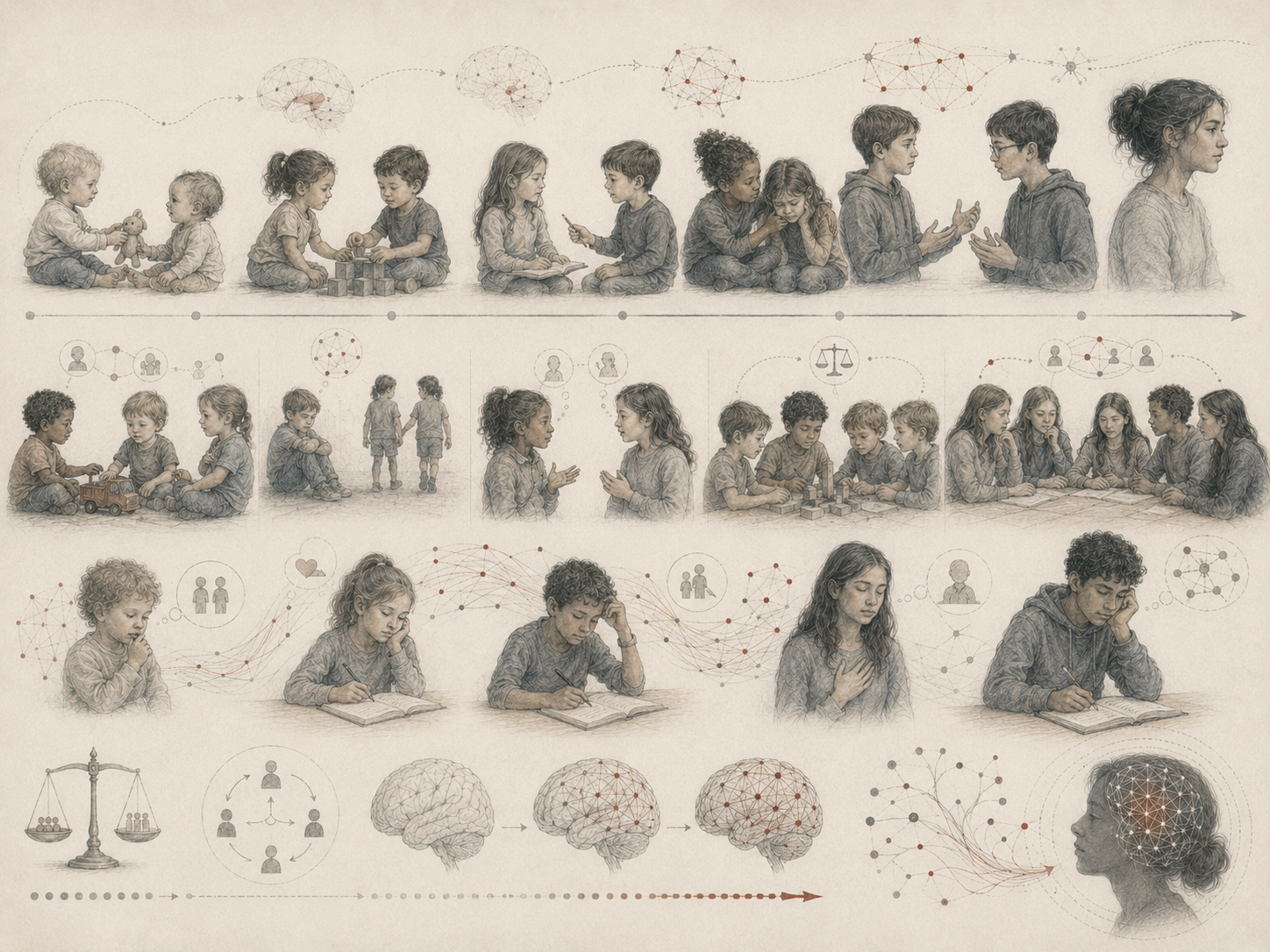
The strongest developmental psychology treats morality as a process of becoming rather than a finished code transmitted from adults to passive children. Children gradually learn what counts as harm, fairness, cruelty, loyalty, honesty, justice, responsibility, and repair within particular relational and cultural worlds. This growth is never purely cognitive. A child may repeat a rule without feeling its meaning. Another may feel another person’s pain before being able to explain a principle. Moral development requires both: emotional responsiveness and interpretive understanding, social practice and reflective judgment, care and accountability.
The growth of conscience is one of the clearest places where emotional development, social development, cognitive development, attachment, self-regulation, identity, and institutional experience converge. A child learns that something is wrong not only because an adult says so, but because wrongdoing damages trust, causes pain, creates conflict, requires repair, and changes how one understands oneself in relation to others. Conscience is therefore not merely a private inner voice. It is a developmental achievement formed through social life.
Why Moral Development Matters
Moral development matters because social life depends on more than intelligence, desire, obedience, or self-control. Human beings must gradually learn how to recognize others as morally significant, how to restrain harmful impulse, how to interpret duties and obligations, how to judge fairness, how to respond to wrongdoing, and how to repair damaged relationships. A society cannot function on rule compliance alone. It requires people who can care about harm, understand responsibility, and act under moral meanings that are partly internalized.
This is why conscience is such an important developmental concept. Conscience refers not simply to knowledge of rules, but to the inward organization of moral response: concern, guilt, conflict, empathy, self-evaluation, obligation, and the felt sense that certain actions should or should not be done. A child who avoids hitting only because punishment is feared has learned something important, but not the same thing as a child who begins to understand that hitting causes pain, violates trust, and requires repair. Developmental psychology is strongest when it distinguishes external control from moral internalization.
Moral development also matters because it shapes how children and adolescents interpret authority. A rule may be experienced as care, fairness, domination, hypocrisy, protection, humiliation, tradition, or arbitrary power depending on how it is enforced and by whom. Children learn about morality not only from what adults say, but from whether adults act justly. If a classroom preaches respect while tolerating bullying, if a family demands honesty while modeling deception, or if an institution speaks of fairness while punishing some groups more harshly than others, children learn moral contradiction as well as moral instruction.
The field also matters because morality develops unevenly. Children may show empathy in one context and cruelty in another. Adolescents may reason abstractly about justice while still acting under peer pressure, status fear, resentment, shame, or group loyalty. Adults may possess sophisticated moral language while participating in harmful institutions. Developmental psychology therefore asks not only what people know morally, but when and under what conditions moral concern becomes behavior.
Moral development is not a luxury topic within developmental psychology. It is central to the formation of social life. It connects early caregiving to conscience, self-regulation to responsibility, peer life to fairness, culture to obligation, institutions to justice, and adolescence to identity. It asks how human beings become capable of living with others without reducing them to objects, obstacles, or instruments.
What Moral Development Is
Moral development is the gradual formation of concepts, emotions, habits, judgments, and identities through which people come to understand right and wrong, harm and care, fairness and injustice, obligation and freedom, guilt and repair, authority and legitimacy. It includes how children and adolescents learn to interpret the difference between a moral violation and a personal preference, between a social convention and a serious harm, between obedience and responsibility, between shame and conscience, between punishment and repair.
The field includes moral judgment, but moral judgment is not the whole field. Children can show moral sensitivity before they can explain moral principles. They can comfort someone in distress, object to unfairness, protest harm, or feel guilt before they can produce adult-like ethical reasoning. Conversely, young people can repeat moral vocabulary without consistently acting on it. Moral development therefore includes language, but cannot be reduced to language.
It also includes moral emotion. Empathy helps another person’s distress become meaningful. Guilt helps wrongdoing become internally registered. Shame can either signal social exposure or become destructive humiliation. Pride can support moral identity when tied to responsible conduct. Anger can become moral outrage when directed toward injustice, but it can also become aggression when unregulated. Developmental morality is therefore emotional, not merely rational.
Moral development also includes social practice. Children learn fairness by sharing, waiting, losing, arguing, apologizing, being excluded, excluding others, negotiating rules, and repairing relationships. They learn responsibility by being trusted with tasks and by experiencing consequences. They learn obligation by caring for siblings, pets, elders, friends, classmates, or community members. They learn justice not only from moral lessons, but from how rules are applied to them and to others.
Finally, moral development includes identity. Over time, moral expectations can become part of the self: “I am the kind of person who tells the truth,” “I do not abandon friends,” “I stand up when someone is treated unfairly,” “I repair harm when I cause it.” This movement from external rule to self-organization is one of the central achievements of conscience. Moral development is not simply knowing what is right. It is becoming someone for whom right and wrong matter.
Conscience as a Developmental Achievement
Conscience is often imagined as an inner voice, but developmentally it is better understood as an organized pattern of moral response. It includes emotional sensitivity to harm, internal discomfort after wrongdoing, memory of rules and values, capacity for self-evaluation, concern for repair, and the ability to inhibit behavior because it violates a valued relationship or principle. Conscience is not present fully formed. It is built through interaction.
Early conscience begins before children can offer sophisticated explanations. A toddler may show distress when another child cries, attempt to comfort a caregiver, protest unfair treatment, or look guilty after breaking a rule. These early responses are not yet mature moral agency, but they show that moral life has roots in affective and relational experience. The child is beginning to feel that others matter and that the self can be accountable to others.
As children grow, conscience becomes more reflective. They begin to understand intention, accident, deception, promise, blame, apology, restitution, and fairness. They distinguish between hurting someone on purpose and by mistake. They learn that rules can be justified, challenged, negotiated, or misused. They begin to ask not only “Will I get in trouble?” but “Was that fair?” “Did I hurt someone?” “Should I apologize?” “Why is this rule here?”
Conscience also requires integration. A child may know that lying is wrong but still lie under fear. An adolescent may believe in fairness but stay silent when a friend humiliates someone. Moral development therefore depends on self-regulation, courage, social confidence, identity, and context. Conscience is not only a moral idea. It is a developmental capacity that must operate under emotional pressure.
Conscience can also be distorted. Harsh punishment may produce fear rather than responsibility. Chronic humiliation may produce shame rather than repair. Inconsistent authority may produce confusion or cynicism. Institutional hypocrisy may teach that morality is a language of power rather than a guide to shared life. This is why moral development cannot be studied apart from the moral quality of the environments in which children grow.
From Early Care to the Formation of Conscience
The roots of conscience are relational. Before children can reason abstractly about justice or rights, they experience comfort, distress, approval, disapproval, prohibition, affection, disappointment, repair, and trust in relationships with caregivers. Early caregiving does not mechanically install morality, but it shapes whether moral guidance is experienced as care, fear, humiliation, neglect, or arbitrary control.
Attachment and co-regulation matter because conscience grows in a world where others are emotionally significant. When children experience caregivers as responsive, they are more likely to experience correction within a relationship that can survive conflict. A child can be told “That hurt your brother” by an adult whose disappointment matters because the relationship matters. The moral lesson is carried not only by the words, but by the relational field in which the words are spoken.
Caregiving also teaches children how emotions are handled after wrongdoing. Some families move quickly from misbehavior to punishment, leaving little space for reflection or repair. Others frame wrongdoing through harm, responsibility, apology, restitution, and restored connection. These differences matter. A child who learns that wrongdoing leads only to fear may become skilled at avoiding detection. A child who learns that wrongdoing can be named, repaired, and reintegrated may develop a more stable conscience.
Early moral life also includes imitation. Children observe how adults treat strangers, service workers, siblings, elders, animals, disabled people, people of different social groups, and those who have less power. They learn whether adults apologize, whether rules apply equally, whether anger justifies cruelty, whether truth matters, whether vulnerability receives care, and whether power can be used without accountability. Much moral development happens through witness.
This does not mean early care determines moral life forever. Later relationships, peer worlds, schools, mentors, religious or secular communities, social movements, and personal reflection can redirect moral development. But early care often provides the emotional grammar through which correction, obligation, guilt, and repair are first understood.
Discipline, Repair, and Moral Internalization
Discipline is morally formative, but only if discipline is understood as guidance rather than mere punishment. Children need boundaries. They need adults to stop harm, name wrongdoing, protect others, and explain expectations. But discipline becomes developmentally shallow when it focuses only on control. The deeper moral question is whether discipline helps the child understand harm, responsibility, and repair.
Inductive discipline—explaining consequences, naming feelings, and connecting actions to others’ welfare—can support moral internalization when delivered within a relationship of care. A caregiver who says, “She is crying because that hurt her; what can we do to make it right?” invites the child to connect behavior with another person’s experience. The child is not simply being trained to avoid punishment. The child is being invited into moral perspective-taking.
Repair is central. Without repair, guilt can become shame, avoidance, or self-condemnation. Moral development requires pathways back into relationship after harm. Apology, restitution, changed behavior, truth-telling, and forgiveness all help children learn that wrongdoing is serious but not necessarily identity-ending. A child who breaks trust must learn that trust can be restored through action. This is one reason restorative approaches matter developmentally: they treat wrongdoing as a relational event requiring accountability, not only a rule violation requiring penalty.
At the same time, repair must not become forced performance. A coerced apology may teach compliance without remorse. Effective moral guidance helps children understand what happened, why it matters, who was affected, and what responsibility requires. The goal is not to produce scripted guilt, but to develop moral understanding that can eventually function without adult supervision.
Discipline also teaches children what authority is. Fair, consistent, proportionate discipline can support trust in rules. Arbitrary, humiliating, discriminatory, or violent discipline can teach that authority is domination. Developmental psychology must therefore ask not only whether children obey, but what kind of moral world obedience creates.
Classical Theories of Moral Development
Kohlberg and Moral Reasoning
Lawrence Kohlberg remains one of the most influential theorists of moral development because he framed morality as a developmental progression in reasoning. His model proposed that children and adolescents move from judgments oriented around punishment and reward toward more complex reasoning about rules, social order, rights, and principles. The enduring contribution of this framework lies in its insistence that moral judgment develops. Children do not reason about right and wrong in the same way at all ages.
Kohlberg’s theory also gave developmental psychology a way to study moral explanation rather than only moral behavior. It asked how children justify a moral choice, what they understand about authority, and how they coordinate personal interest with social rules. This was a major theoretical advance because it treated moral thought as structured and developmental rather than as simple obedience.
The limitations are equally important. Moral life cannot be reduced to formal reasoning alone. People do not always act according to the highest reasoning they can articulate. Moral behavior depends on emotion, identity, courage, group pressure, institutional context, and material conditions. Kohlberg’s model also historically privileged abstract, justice-centered reasoning in ways that did not fully capture care, relationship, dependency, culture, power, gendered experience, or the moral significance of concrete vulnerability.
Gilligan and the Ethics of Care
Carol Gilligan’s critique mattered because it challenged the assumption that abstract justice reasoning represented the highest or most mature moral voice. She argued that care, responsibility, relationship, and attentiveness to vulnerability were not morally inferior concerns. They were central dimensions of moral life that had often been minimized or misread.
The ethics of care expanded developmental psychology’s moral vocabulary. It made dependency, responsibility, listening, relational harm, and concrete others more visible. It also revealed that moral maturity may require balancing justice and care rather than ranking one over the other. A moral agent must sometimes ask, “What is fair?” and sometimes ask, “Who is vulnerable here?” or “What does this relationship require?”
Gilligan’s work remains important not because it resolves all questions about gender and moral development, but because it exposed the narrowness of moral models that treated detached abstraction as the dominant path to maturity. Moral development includes reasoning, but it also includes responsiveness to dependency and care.
Social Domain Theory
Social domain theory complicated both rigid stage models and simple relativism by distinguishing among moral concerns, social conventions, and personal choice. Children often understand harm and unfairness differently from conventional violations. A child may recognize that hitting someone is wrong even if a teacher says it is allowed, while also understanding that classroom seating rules or clothing norms may be socially agreed conventions.
This distinction is powerful because it shows that children’s moral understanding is structured in more than one domain. They are not simply moving up one ladder of reasoning. They are learning to differentiate harm, fairness, authority, custom, group identity, privacy, and personal preference. Moral development is therefore not a single-track process. It involves the ability to interpret what kind of issue is at stake.
Social Learning and Moral Modeling
Social learning perspectives emphasized that children learn morality by observing others. Adults, peers, siblings, media figures, teachers, religious leaders, coaches, and online communities all model moral behavior and moral failure. Children watch who gets rewarded, who gets punished, who apologizes, who escapes consequences, who is protected, and who is ignored.
This tradition is important because moral development is not only what children are told. It is what they see enacted. If adults preach fairness but mock the weak, children learn something. If a school promotes respect but tolerates humiliation, students learn something. If a family demands honesty but punishes truth-telling when it is inconvenient, children learn something. Moral models do not need to be perfect, but they need to be accountable.
Developmental Systems Perspectives
Developmental systems approaches treat moral growth as multilevel and relational. Conscience emerges through interactions among temperament, attachment, emotion regulation, caregiving, peer life, school climate, culture, religion, institutional justice, and historical context. There is no single cause of moral development. It is an organized process across levels.
This perspective is especially useful because it avoids two errors. It avoids reducing morality to inner traits alone, and it avoids reducing children to passive products of socialization. Children interpret, resist, imitate, negotiate, and internalize. They are shaped by moral worlds, but they also act back upon them. Moral development is therefore best understood as a dynamic process in which self and context continually shape one another.
Empathy, Guilt, and the Emotional Life of Morality
Moral development is emotional as well as cognitive. Empathy matters because another person’s distress can become emotionally meaningful. Guilt matters because wrongdoing can become internally registered. Shame matters because social exposure can alter self-understanding, though shame can either support responsibility or become destructive humiliation. Pride, gratitude, anger, disgust, compassion, and remorse can all become morally organized depending on context.
Empathy is not identical to morality, but it is one major foundation of moral concern. A child who notices another child crying, pauses, and tries to help is not necessarily making a formal ethical judgment, but the child is already participating in a moral world. Another person’s suffering has become significant. Over time, empathy can support concern, helping, fairness, and resistance to cruelty. Yet empathy can also be selective. Children and adults may feel more empathy for those who are familiar, similar, or socially valued. Moral development must therefore expand empathy beyond immediate preference.
Guilt is also developmental. Constructive guilt focuses attention on the harm caused and the need for repair. It can motivate apology, restitution, and changed behavior. Destructive guilt, however, can collapse into fear, self-condemnation, or avoidance if children are not given pathways to repair. The difference between “I did something wrong” and “I am bad and cannot return” is developmentally significant.
Shame is even more complicated. Some forms of shame signal that one has violated valued expectations and may need to repair social trust. But chronic humiliation, ridicule, or public degradation can damage moral development by producing defensiveness, secrecy, resentment, or despair. A child who is repeatedly shamed may learn to hide wrongdoing rather than understand it. Moral emotion becomes developmental only when it is connected to meaning, dignity, and repair.
Moral feeling also requires regulation. Empathy without regulation can become personal distress. Anger without reflection can become retaliation. Guilt without repair can become self-attack. Conscience therefore depends on emotional development and self-regulation. Children need help naming feelings, understanding causes, tolerating discomfort, and acting responsibly under moral emotion.
Moral development without emotion would be thin and mechanical. Emotion without interpretation would be unstable. The growth of conscience occurs where feeling, thought, relationship, and action become organized around responsibility.
Fairness, Rules, and Peer Worlds
Peer relations are central to moral development because peers confront children with fairness in living form. In families and classrooms, adults often define rules and settle disputes. In peer worlds, children must negotiate sharing, turn-taking, cheating, loyalty, retaliation, exclusion, forgiveness, and group belonging with others who have more comparable standing. This is one reason peer life is morally formative.
Games are moral laboratories. Children learn that rules make shared activity possible, that cheating damages trust, that unfair advantage provokes protest, that exclusion hurts, and that group belonging can require negotiation. A child may learn more about fairness from a disputed game than from a lecture about fairness because the conflict is immediate, embodied, and relational.
Friendship also teaches morality. Friends make claims on one another: loyalty, honesty, reciprocity, inclusion, secrecy, apology, and care. Betrayal feels different in friendship than in abstract moral reasoning because the relationship itself is at stake. Children learn that moral life is not only about universal rules. It is also about trust within particular relationships.
Peer worlds can also distort moral development. Bullying, exclusion, group cruelty, status hierarchies, conformity pressure, and ridicule can teach children that power overrides fairness. A child may know that cruelty is wrong but participate in it to avoid becoming a target. This is why moral behavior cannot be inferred only from moral knowledge. Peer ecology shapes the cost of conscience.
Peer conflict is not morally irrelevant noise. It is one of the workshops in which children learn justice, exclusion, forgiveness, loyalty, courage, and repair. Developmental psychology should therefore treat peer life as a core site of conscience formation, not merely as a background to family socialization.
School, Discipline, and Institutional Moral Life
Schools are moral institutions. They teach morality not only through explicit lessons about character, citizenship, or respect, but through discipline practices, classroom norms, grading, teacher authority, peer response, inclusion, exclusion, punishment, recognition, and the everyday distribution of dignity. A school’s moral curriculum includes what it tolerates, what it punishes, what it ignores, and whom it protects.
Children learn about fairness from whether rules are applied consistently. They learn about dignity from whether adults humiliate students. They learn about responsibility from whether harm is repaired or simply punished. They learn about justice from whether bullying is stopped, whether disabled students receive accommodations, whether racialized students are disciplined disproportionately, whether poor students are shamed, whether language differences are respected, and whether adults model accountability.
School discipline has major developmental consequences. Punitive systems may produce compliance, but compliance is not the same as conscience. Exclusionary discipline can teach children that institutions reject rather than restore. Restorative approaches, when implemented seriously, can support moral development by requiring harm recognition, accountability, listening, restitution, and reintegration. But restorative language becomes shallow if institutions use it without structural fairness or adequate support.
Classrooms also create moral communities. Children learn whether disagreement can be respectful, whether mistakes can be repaired, whether vulnerable students are protected, whether helping others is valued, and whether competition destroys or coexists with care. Teachers are therefore moral models as well as academic instructors. Their authority shapes how children interpret power, fairness, and responsibility.
A school’s moral power should make developmental psychology cautious. Institutions can strengthen conscience, but they can also produce cynicism, shame, resentment, or distrust. The central question is not whether schools teach morality. They always do. The question is what moral world they actually enact.
Culture, Religion, and Moral Worlds
Moral development is always culturally shaped. Children do not acquire morality in the abstract. They are socialized into particular understandings of duty, care, justice, authority, dignity, shame, purity, reciprocity, gender, family obligation, community responsibility, law, religion, and personhood. Some moral worlds emphasize individual rights; others emphasize family obligation, sacred order, elder respect, communal harmony, hospitality, honor, liberation, or social justice. Most combine multiple moral languages in historically specific ways.
This cultural grounding does not mean anything goes. Harm, cruelty, coercion, domination, neglect, and injustice still matter. But developmental psychology becomes impoverished when it assumes that one cultural model of moral reasoning represents the universal endpoint of conscience. A child raised in a highly interdependent family structure may develop moral responsibility through obligation to kin and community. A child raised in a more individualist setting may learn moral responsibility through rights, autonomy, and personal choice. Both may develop conscience, but through different moral grammars.
Religion can be a powerful context for moral development. It may provide stories, rituals, duties, prohibitions, virtues, communal identity, practices of confession or repentance, models of mercy, and narratives of justice. Religious communities can teach generosity, humility, care for the vulnerable, reverence, discipline, and moral accountability. They can also produce shame, fear, exclusion, or authoritarian control when moral instruction is detached from compassion and dignity.
Secular moral worlds also shape conscience through civic values, human rights, family ethics, school rules, community norms, political commitments, and philosophical ideals. Children may learn morality through religious teaching, but also through public institutions, social movements, literature, friendship, family memory, law, and lived experience of injustice.
A serious developmental account should therefore avoid treating moral development as a single ladder detached from culture. Children grow into moral worlds. They also eventually interpret those worlds, revise them, resist them, or carry them forward. Culture forms conscience, but conscience can also become a site of cultural critique.
Inequality, Power, and the Unequal Formation of Morality
Moral development is shaped by power and inequality. Children do not learn fairness under equally fair conditions. Some children are disciplined more harshly, surveilled more closely, disbelieved more often, protected less consistently, or adultified earlier because of race, class, disability, gender, language, immigration status, religion, neighborhood, or institutional bias. These experiences are not only social facts. They are developmental facts.
A child who repeatedly experiences unfair authority may learn to distrust moral language used by institutions. A child who sees some peers protected and others punished may learn that rules are selective. A child who is punished for emotional distress while another is comforted may learn that vulnerability is not equally recognized. Moral development therefore includes the interpretation of injustice.
This is one reason conscience can become conflicted. Children may be taught ideals of fairness while observing hypocrisy in the same systems that claim moral legitimacy. They may be told to respect authority while watching authority humiliate, exclude, or harm. They may be taught honesty while learning that truth-telling can be punished when it challenges power. Developmental psychology must therefore study how children and adolescents make sense of moral contradiction.
Inequality also shapes moral opportunity. Children in safer, better-resourced environments may have more chances to practice cooperation, repair, reflection, and civic participation. Children under chronic threat may prioritize survival, loyalty, self-protection, or mistrust. These responses should not be simplistically pathologized. Under some conditions, suspicion may be adaptive; silence may be protective; aggression may be learned in environments where vulnerability is dangerous. Moral development must be understood in relation to actual conditions of life.
Power also shapes whose morality is recognized. Dominant institutions may label marginalized children defiant, disrespectful, or immoral when they are responding to unfair treatment. Conversely, institutions may excuse harmful behavior by powerful groups as normal development, leadership, competitiveness, or tradition. Developmental psychology must therefore ask not only how children internalize morality, but whose moral experience is taken seriously.
A rigorous account of moral development cannot separate conscience from justice. Children learn morality within worlds that are themselves moral or immoral in how they distribute dignity, protection, punishment, and care.
Disability, Neurodivergence, and Moral Development
Disability and neurodivergence should be central to moral-development theory, not treated as exceptions to a standard path. Disabled and neurodivergent children develop conscience, empathy, fairness, responsibility, and moral identity, but they may express and learn these capacities in ways that differ from dominant expectations. A narrow view of moral development can misread communication difference, sensory overload, literal interpretation, executive-function difficulty, social anxiety, or disability-related frustration as moral failure.
For example, a child who does not make expected eye contact may still be deeply attentive. A child who struggles with impulse control may understand harm but need support to regulate action. A child with language delay may feel guilt or concern before being able to explain it verbally. A child with sensory overwhelm may appear noncompliant when the issue is environmental distress. Moral-development assessment must therefore avoid confusing conventional social performance with conscience.
Disabled children are also often subject to unequal moral expectations. Some are infantilized and denied responsibility; others are punished for disability-related needs. Some are overprotected from moral participation, while others are blamed for behavior shaped by inaccessible environments. Both extremes distort development. Children need meaningful responsibility and appropriate support. Moral growth requires access, accommodation, communication, and dignity.
Neurodivergent children may also have distinctive moral strengths: strong rule concern, deep distress at injustice, intense loyalty, careful truthfulness, or heightened sensitivity to inconsistency. These strengths can be overlooked when social norms define morality primarily through smooth interpersonal performance. A serious developmental psychology must recognize moral variation without romanticizing or pathologizing it.
Disability also raises moral questions for the environment. How do peers learn inclusion? How do schools teach fairness when accommodations are needed? How do adults distinguish equal treatment from equitable support? How do communities teach dignity rather than pity? Moral development is not only something disabled and neurodivergent children undergo. It is also something their communities must undergo in learning how to recognize them fully.
Adolescence, Identity, and Moral Reflection
Adolescence intensifies moral development because identity, autonomy, group belonging, social comparison, and reflective thought become more explicit. The adolescent does not merely follow or violate rules. The adolescent increasingly asks what kind of person to become, which authorities deserve legitimacy, what peers expect, which values are worth defending, and how loyalty, justice, care, freedom, and identity can be coordinated.
This period can bring more abstract reasoning, but it also brings more complicated social pressure. Adolescents may become capable of principled moral reflection while also being more exposed to peer status, group identity, ideological conflict, romantic relationships, sexuality, institutional hypocrisy, digital cruelty, and public injustice. Moral maturity does not automatically appear with age. Adolescence makes moral life more self-conscious and more contested.
Identity formation matters because moral commitments become part of the self. Adolescents may begin to define themselves as honest, loyal, religious, secular, activist, compassionate, ambitious, protective, rebellious, principled, or independent. These identities can support moral courage, but they can also harden into group superiority, moral performance, or ideological rigidity. The adolescent is learning not only what is right, but who they are in relation to right and wrong.
Adolescence is also a period when moral critique deepens. Young people may begin to see contradictions between family values and institutional behavior, between religious teaching and community practice, between democratic ideals and racial inequality, between school rules and actual fairness, between adult advice and adult conduct. This critique can be destabilizing, but it is also developmentally important. A conscience that never questions authority remains immature.
Moral development in adolescence therefore involves both internalization and re-evaluation. The adolescent inherits moral worlds, but also begins to decide which parts to affirm, revise, resist, or reject. Conscience becomes less purely transmitted and more actively interpreted.
Digital Life and Moral Development
Digital life has become a major site of moral development. Children and adolescents now learn fairness, harm, responsibility, cruelty, empathy, reputation, privacy, loyalty, and accountability in online environments as well as face-to-face ones. Group chats, comment sections, gaming communities, social platforms, image sharing, screenshots, algorithms, and viral attention create moral situations that earlier theories did not fully anticipate.
Digital environments can expand moral awareness. Young people may encounter suffering, injustice, activism, mutual aid, disability advocacy, religious communities, peer support, and perspectives far beyond their immediate local world. Online spaces can help adolescents develop concern for people they have never met and can expose them to moral questions about climate, war, racism, gender, poverty, disability, and human rights.
But digital life can also detach action from immediate emotional feedback. It is easier to mock someone when their face is not visible. It is easier to share harm when it is framed as entertainment. It is easier to join group cruelty when social reward is immediate and accountability is diffuse. Digital platforms can amplify humiliation, exclusion, rumor, sexual harassment, and dehumanization. They can also preserve harmful actions in ways that outlast the developmental moment in which they occurred.
This creates new developmental challenges for conscience. Young people must learn that online actions are real actions, that digital harm affects embodied persons, that privacy matters, that consent matters, and that group participation can carry moral responsibility even when one is not the original aggressor. They must learn how to resist pile-ons, how to repair harm, how to interpret misinformation, and how to maintain empathy under conditions of distance and speed.
Digital moral development therefore requires more than safety rules. It requires moral education about attention, dignity, privacy, truth, cruelty, spectatorship, and repair. The question is not only what young people do online, but what kind of conscience develops in spaces designed to intensify reaction, comparison, status, and visibility.
What Moral Development Can and Cannot Explain
Moral development can explain how children gradually form concepts of right and wrong, how conscience becomes internalized, how empathy and guilt become organized, how peer life teaches fairness, how culture shapes obligation, and how adolescents begin to reflect on identity and authority. It can help families, schools, clinicians, and communities understand why moral learning requires more than punishment or slogans.
It can also clarify why behavior is not always a direct measure of moral understanding. A child may know something is wrong but lack self-regulation. An adolescent may value fairness but fear peer exclusion. A student may violate rules because the rules themselves are experienced as illegitimate. A young person may appear unempathic because distress is masked, communication differs, or the environment is unsafe. Moral behavior must be interpreted developmentally and contextually.
But moral-development theory cannot explain all wrongdoing as immaturity. Children and adolescents can cause real harm. Developmental context helps explain behavior, but it does not erase accountability. The challenge is to hold explanation and responsibility together. A developmental approach asks what supports repair, learning, and prevention without denying the reality of harm.
The field also cannot provide one universal moral ladder for all cultures, families, religions, institutions, or histories. It can identify important developmental processes—empathy, fairness, guilt, perspective-taking, harm recognition, repair—but their meanings vary across moral worlds. Developmental psychology must avoid turning culturally narrow expectations into universal measures of moral maturity.
Finally, moral development cannot be studied responsibly without examining power. A child’s conscience develops inside institutions that may be just or unjust. If moral psychology studies only individual judgment while ignoring unequal discipline, exclusion, racism, ableism, poverty, adultification, and institutional hypocrisy, it mistakes symptoms for causes. Moral development includes the development of persons, but also reveals the moral condition of the worlds that form them.
An Analytical Framework for Moral Development
A stylized moral-development outcome \(M_{it}\) for individual \(i\) at time \(t\) can be modeled as:
M_{it} = \alpha_i + \beta_i t + \gamma C_{it} + \delta E_{it} + \phi P_{it} + \varepsilon_{it}
\]
Interpretation: \( \alpha_i \) represents initial moral responsiveness, \( \beta_i \) represents developmental change over time, \( C_{it} \) represents caregiving guidance and relational support, \( E_{it} \) represents empathic experience or emotional responsiveness, and \( P_{it} \) represents peer fairness or peer moral climate. The model expresses a central developmental claim: conscience grows over time, but it grows through care, emotion, and social life.
To represent continuity in moral functioning, we can add state dependence:
M_{it} = \rho M_{i,t-1} + \beta_i t + \gamma C_{it} + \delta E_{it} + \phi P_{it} – \lambda X_{it} + \varepsilon_{it}
\]
Interpretation: \(M_{i,t-1}\) captures prior moral organization, while \(X_{it}\) represents chronic exclusion, punitive inconsistency, humiliation, fear, or morally destabilizing stress. A large \( \rho \) indicates continuity; the negative term captures conditions that can disrupt conscience by making moral life feel unsafe, unjust, or incoherent.
To model conscience more explicitly, let internalized moral response \(K_{it}\) depend on harm recognition and repair:
K_{it} = \alpha_i + \theta_1 H_{it} + \theta_2 R_{it} + \theta_3 C_{it} + \varepsilon_{it}
\]
Interpretation: \(H_{it}\) represents recognition of harm, \(R_{it}\) represents experience of repair, and \(C_{it}\) represents relational guidance. This expresses a developmental insight often obscured by abstract stage models: conscience grows through emotionally and socially meaningful encounters with wrongdoing, responsibility, and restoration.
Because moral development unfolds within classrooms, families, communities, and institutions, a multilevel model is often more realistic:
M_{ijt} = \alpha + u_j + \beta t + \gamma C_{ijt} + \delta P_{ijt} – \lambda X_{ijt} + \varepsilon_{ijt}
\]
Interpretation: \(u_j\) captures classroom, school, family, community, or institutional moral climate. This matters because the growth of conscience depends not only on the child’s mind, but on whether the surrounding moral world is coherent, caring, fair, and accountable.
To represent moral action under pressure, moral behavior \(B_{it}\) can be modeled as the interaction of conscience, peer pressure, and self-regulation:
B_{it} = \eta_0 + \eta_1 M_{it} + \eta_2 S_{it} – \eta_3 Q_{it} – \eta_4 G_{it} + \varepsilon_{it}
\]
Interpretation: \(S_{it}\) represents self-regulation, \(Q_{it}\) represents peer pressure or status threat, and \(G_{it}\) represents group-based hostility or exclusionary norms. Moral knowledge does not automatically become moral behavior; action depends on regulation, courage, belonging, and social context.
The point of this framework is not to reduce morality to equations. It is to clarify that conscience, empathy, fairness, moral judgment, and moral action are developmental processes shaped through time, relation, emotion, power, and social structure.
R: Simulating Fairness, Empathy, and Developmental Moral Growth
The following R example simulates children observed across eight waves. It includes caregiving guidance, empathic sensitivity, peer fairness, restorative repair opportunities, school moral climate, punitive inconsistency, chronic exclusion, and a developmental outcome that can be interpreted as broad conscience functioning. The data are synthetic and designed for methodological demonstration.
# Simulating fairness, empathy, and developmental moral growth
# ------------------------------------------------------------
# This synthetic example models moral development as a longitudinal
# process shaped by caregiving guidance, empathy, peer fairness,
# repair opportunities, school moral climate, punitive inconsistency,
# exclusion, and prior moral organization.

suppressPackageStartupMessages({
  library(dplyr)
  library(tidyr)
  library(lme4)
  library(ggplot2)
})

set.seed(2026)

n_children <- 820
n_waves <- 8
n_schools <- 32

children <- data.frame(
  child_id = 1:n_children,
  school_id = sample(1:n_schools, n_children, replace = TRUE),
  baseline_morality = rnorm(n_children, mean = 50, sd = 8),
  caregiving_guidance = rnorm(n_children, mean = 0, sd = 1),
  empathic_sensitivity = rnorm(n_children, mean = 0, sd = 1),
  peer_fairness_base = rnorm(n_children, mean = 0, sd = 1),
  self_regulation = rnorm(n_children, mean = 0, sd = 1),
  chronic_exclusion = rbinom(n_children, size = 1, prob = 0.22)
)

schools <- data.frame(
  school_id = 1:n_schools,
  school_moral_climate = rnorm(n_schools, mean = 0, sd = 0.6),
  restorative_practice_access = rnorm(n_schools, mean = 0, sd = 0.6),
  punitive_inconsistency = rnorm(n_schools, mean = 0, sd = 0.6),
  anti_bullying_climate = rnorm(n_schools, mean = 0, sd = 0.6)
)

panel_data <- children |>
  slice(rep(1:n(), each = n_waves)) |>
  group_by(child_id) |>
  mutate(
    wave = 0:(n_waves - 1),
    current_guidance = rnorm(n_waves, mean = caregiving_guidance, sd = 0.6),
    current_empathy = rnorm(n_waves, mean = empathic_sensitivity, sd = 0.6),
    current_peer_fairness = rnorm(n_waves, mean = peer_fairness_base, sd = 0.6),
    current_self_regulation = rnorm(n_waves, mean = self_regulation, sd = 0.5),
    current_exclusion = rnorm(n_waves, mean = 0.4 * chronic_exclusion, sd = 0.7)
  ) |>
  ungroup() |>
  left_join(schools, by = "school_id") |>
  mutate(
    moral_support_context =
      current_guidance +
      current_empathy +
      current_peer_fairness +
      current_self_regulation +
      school_moral_climate +
      restorative_practice_access +
      anti_bullying_climate -
      punitive_inconsistency,
    conscience_score =
      baseline_morality +
      1.2 * wave +
      1.3 * current_guidance +
      1.1 * current_empathy +
      1.0 * current_peer_fairness +
      0.9 * current_self_regulation +
      0.8 * school_moral_climate +
      0.9 * restorative_practice_access +
      0.8 * anti_bullying_climate -
      1.0 * punitive_inconsistency -
      1.4 * current_exclusion -
      0.9 * chronic_exclusion +
      rnorm(n(), mean = 0, sd = 2.7)
  )

model <- lmer(
  conscience_score ~ wave + current_guidance + current_empathy +
    current_peer_fairness + current_self_regulation +
    school_moral_climate + restorative_practice_access +
    punitive_inconsistency + anti_bullying_climate +
    current_exclusion + chronic_exclusion +
    (1 + wave | school_id/child_id),
  data = panel_data
)

summary(model)

trajectory_summary <- panel_data |>
  group_by(wave, chronic_exclusion) |>
  summarize(
    mean_conscience = mean(conscience_score),
    standard_error = sd(conscience_score) / sqrt(n()),
    .groups = "drop"
  ) |>
  mutate(
    lower = mean_conscience - 1.96 * standard_error,
    upper = mean_conscience + 1.96 * standard_error,
    exclusion_group = ifelse(chronic_exclusion == 1, "Higher exclusion risk", "Lower exclusion risk")
  )

ggplot(trajectory_summary, aes(x = wave, y = mean_conscience, linetype = exclusion_group)) +
  geom_line(linewidth = 1) +
  geom_ribbon(aes(ymin = lower, ymax = upper, group = exclusion_group), alpha = 0.12) +
  labs(
    title = "Simulated Moral Development Across Time",
    x = "Wave",
    y = "Conscience score",
    linetype = "Group"
  ) +
  theme_minimal()

context_summary <- panel_data |>
  group_by(wave) |>
  summarize(
    average_guidance = mean(current_guidance),
    average_empathy = mean(current_empathy),
    average_peer_fairness = mean(current_peer_fairness),
    average_exclusion = mean(current_exclusion),
    average_moral_support_context = mean(moral_support_context),
    average_conscience = mean(conscience_score),
    .groups = "drop"
  )

ggplot(context_summary, aes(x = wave)) +
  geom_line(aes(y = average_guidance, linetype = "caregiving guidance"), linewidth = 1) +
  geom_line(aes(y = average_empathy, linetype = "empathy"), linewidth = 1) +
  geom_line(aes(y = average_peer_fairness, linetype = "peer fairness"), linewidth = 1) +
  geom_line(aes(y = average_exclusion, linetype = "exclusion"), linewidth = 1) +
  geom_line(aes(y = average_moral_support_context, linetype = "moral support context"), linewidth = 1) +
  labs(
    title = "Synthetic Moral Development Context Across Time",
    x = "Wave",
    y = "Average index",
    linetype = "Measure"
  ) +
  theme_minimal()

# Analysts can extend this model by:
# 1. separating harm sensitivity, fairness reasoning, and care orientation;
# 2. modeling classroom, school, family, or community random effects;
# 3. comparing restorative and punitive disciplinary climates;
# 4. distinguishing childhood and adolescent moral pathways;
# 5. linking conscience growth to prosocial behavior under peer pressure;
# 6. adding digital moral climate and bystander behavior.
This simulation highlights a core developmental insight: conscience grows not only through age, but through guidance, empathy, peer fairness, repair opportunities, school climate, self-regulation, and the social conditions that support or distort moral life.
Python: Modeling Conscience, Social Experience, and Moral Development
The following Python example simulates children’s moral-development pathways over ten periods using caregiving guidance, empathic sensitivity, peer fairness, restorative repair, school moral climate, self-regulation, punitive inconsistency, and exclusion. The outcome can be read as a broad conscience-functioning score. The data are synthetic and intended for conceptual demonstration.
# Modeling conscience, social experience, and moral development
# -------------------------------------------------------------
# This synthetic example models conscience as a dynamic developmental
# process shaped by caregiving guidance, empathy, peer fairness,
# restorative repair, school moral climate, self-regulation,
# punitive inconsistency, exclusion, and prior moral organization.

from __future__ import annotations

import numpy as np
import pandas as pd
import statsmodels.formula.api as smf
import matplotlib.pyplot as plt

np.random.seed(2026)

n_children = 900
n_periods = 10
n_schools = 36

children = pd.DataFrame({
    "child_id": np.arange(1, n_children + 1),
    "school_id": np.random.choice(np.arange(1, n_schools + 1), size=n_children),
    "baseline_morality": np.random.normal(50, 8, n_children),
    "caregiving_guidance": np.random.normal(0, 1, n_children),
    "empathic_sensitivity": np.random.normal(0, 1, n_children),
    "peer_fairness_base": np.random.normal(0, 1, n_children),
    "self_regulation": np.random.normal(0, 1, n_children),
    "chronic_exclusion": np.random.binomial(1, 0.22, n_children),
})

schools = pd.DataFrame({
    "school_id": np.arange(1, n_schools + 1),
    "school_moral_climate": np.random.normal(0, 0.6, n_schools),
    "restorative_practice_access": np.random.normal(0, 0.6, n_schools),
    "punitive_inconsistency": np.random.normal(0, 0.6, n_schools),
    "anti_bullying_climate": np.random.normal(0, 0.6, n_schools),
})

panel = children.loc[children.index.repeat(n_periods)].copy()
panel["time"] = np.tile(np.arange(n_periods), n_children)
panel = panel.merge(schools, on="school_id", how="left")

panel["current_guidance"] = np.random.normal(
    loc=panel["caregiving_guidance"],
    scale=0.7,
    size=len(panel)
)

panel["current_empathy"] = np.random.normal(
    loc=panel["empathic_sensitivity"],
    scale=0.7,
    size=len(panel)
)

panel["current_peer_fairness"] = np.random.normal(
    loc=panel["peer_fairness_base"],
    scale=0.7,
    size=len(panel)
)

panel["current_self_regulation"] = np.random.normal(
    loc=panel["self_regulation"],
    scale=0.5,
    size=len(panel)
)

panel["current_exclusion"] = np.random.normal(
    loc=0.4 * panel["chronic_exclusion"] - 0.20 * panel["anti_bullying_climate"],
    scale=0.7,
    size=len(panel)
)

panel["moral_support_context"] = (
    panel["current_guidance"]
    + panel["current_empathy"]
    + panel["current_peer_fairness"]
    + panel["current_self_regulation"]
    + panel["school_moral_climate"]
    + panel["restorative_practice_access"]
    + panel["anti_bullying_climate"]
    - panel["punitive_inconsistency"]
)

panel = panel.sort_values(["child_id", "time"]).reset_index(drop=True)
panel["conscience_score"] = np.nan

for child in panel["child_id"].unique():
    child_rows = panel["child_id"] == child
    child_data = panel.loc[child_rows].copy()

    previous_score = child_data["baseline_morality"].iloc[0]

    for idx in child_data.index:
        time = panel.at[idx, "time"]
        guidance = panel.at[idx, "current_guidance"]
        empathy = panel.at[idx, "current_empathy"]
        fairness = panel.at[idx, "current_peer_fairness"]
        self_regulation = panel.at[idx, "current_self_regulation"]
        school_climate = panel.at[idx, "school_moral_climate"]
        repair = panel.at[idx, "restorative_practice_access"]
        punitive = panel.at[idx, "punitive_inconsistency"]
        anti_bullying = panel.at[idx, "anti_bullying_climate"]
        exclusion = panel.at[idx, "current_exclusion"]
        chronic = panel.at[idx, "chronic_exclusion"]
        moral_context = panel.at[idx, "moral_support_context"]

        current_score = (
            0.70 * previous_score
            + 0.80 * time
            + 1.05 * guidance
            + 1.00 * empathy
            + 0.95 * fairness
            + 0.90 * self_regulation
            + 0.80 * school_climate
            + 0.90 * repair
            + 0.80 * anti_bullying
            - 1.00 * punitive
            - 1.20 * exclusion
            - 0.85 * chronic
            + 0.25 * moral_context
            + np.random.normal(0, 2.5)
        )

        panel.at[idx, "conscience_score"] = current_score
        previous_score = current_score

panel["lag_score"] = panel.groupby("child_id")["conscience_score"].shift(1)

regression_data = panel.dropna(subset=["lag_score"]).copy()

model = smf.ols(
    formula="""
    conscience_score ~ lag_score + time + current_guidance +
    current_empathy + current_peer_fairness + current_self_regulation +
    school_moral_climate + restorative_practice_access +
    punitive_inconsistency + anti_bullying_climate +
    current_exclusion + chronic_exclusion + moral_support_context
    """,
    data=regression_data
).fit(cov_type="HC3")

print(model.summary())

trajectory = panel.groupby(["time", "chronic_exclusion"], as_index=False).agg(
    average_conscience=("conscience_score", "mean"),
    average_moral_context=("moral_support_context", "mean"),
    average_exclusion=("current_exclusion", "mean"),
    average_peer_fairness=("current_peer_fairness", "mean"),
    standard_error=("conscience_score", lambda x: x.std() / np.sqrt(len(x))),
)

trajectory["exclusion_group"] = trajectory["chronic_exclusion"].map({
    0: "Lower exclusion risk",
    1: "Higher exclusion risk",
})

trajectory["lower"] = trajectory["average_conscience"] - 1.96 * trajectory["standard_error"]
trajectory["upper"] = trajectory["average_conscience"] + 1.96 * trajectory["standard_error"]

plt.figure(figsize=(8, 5))
for group_name, subset in trajectory.groupby("exclusion_group"):
    plt.plot(subset["time"], subset["average_conscience"], marker="o", label=group_name)

plt.xlabel("Time")
plt.ylabel("Average conscience score")
plt.title("Simulated Moral Development and Growth of Conscience")
plt.legend()
plt.tight_layout()
plt.show()

school_summary = panel.groupby("school_id", as_index=False).agg(
    school_moral_climate=("school_moral_climate", "mean"),
    restorative_practice_access=("restorative_practice_access", "mean"),
    punitive_inconsistency=("punitive_inconsistency", "mean"),
    anti_bullying_climate=("anti_bullying_climate", "mean"),
    average_conscience=("conscience_score", "mean"),
    average_moral_context=("moral_support_context", "mean"),
    average_exclusion=("current_exclusion", "mean"),
)

print(school_summary.sort_values("average_conscience", ascending=False).head())

# Analysts can extend this framework by:
# 1. separating harm sensitivity, fairness reasoning, and care orientation;
# 2. adding classroom, family, community, or peer-group clustering;
# 3. modeling restorative versus punitive moral climates;
# 4. comparing childhood and adolescent pathways;
# 5. linking conscience growth to prosocial behavior under pressure;
# 6. adding digital moral climate, bystander behavior, and group polarization.
The analytical value of a model like this is that it makes clear that conscience is formed not only by reasoning, but through guidance, empathy, peer life, exclusion, repair, school moral climate, self-regulation, and repeated moral experience.
GitHub Repository
Complete Code Repository
Access the full companion repository for this article, including reproducible analysis materials and multi-language code workflows for moral development, conscience formation, empathy, guilt, fairness, peer moral climate, school discipline, restorative practice, exclusion, self-regulation, and moral growth across development.
Conclusion
Moral development and the growth of conscience belong together because morality is not only a matter of rules, judgments, or obedience. It is the gradual formation of an inner and social capacity to recognize harm, feel responsibility, care about fairness, respond to obligation, and act within shared worlds in ways that sustain rather than damage them. Conscience grows through caregiving, emotion, discipline, peer conflict, empathy, culture, power, reflection, and repair.
The strongest developmental psychology therefore treats morality neither as mere compliance nor as abstract reasoning alone. It treats conscience as a developmental achievement formed through relation, experience, and interpretation across unequal moral worlds. Children become moral beings by living among others who respond, correct, care, forgive, punish, exclude, include, model, and repair. They learn not only what adults say morality is, but what moral life feels like in practice.
In that sense, moral development reveals one of the field’s deepest truths: children become ethical beings not outside social life, but through the relationships, conflicts, institutions, and cultures in which they learn what right and wrong actually mean. A developmental account of conscience must therefore ask not only how children reason, but what kinds of moral worlds are forming them.
Related Articles
- What Is Developmental Psychology?
- Attachment, Caregiving, and Early Emotional Development
- Social Development, Peer Relations, and the Formation of the Self
- Self-Regulation and Executive Function Across Development
- Play, Imagination, and Development
- Cognitive Development and the Growth of Mind
- Language Development and the Social Formation of Speech
- Developmental Psychopathology, Risk, Trauma, and Adaptation
- Lifespan Development and the Baltes Tradition
- Developmental Psychology knowledge series
Further Reading
- Developmental Psychology knowledge series
- Gilligan, C. (1982) In a Different Voice. Cambridge, MA: Harvard University Press.
- Hoffman, M.L. (2000) Empathy and Moral Development: Implications for Caring and Justice. Cambridge: Cambridge University Press.
- Kohlberg, L. (1981) The Philosophy of Moral Development. San Francisco: Harper & Row.
- Nucci, L.P. (2001) Education in the Moral Domain. Cambridge: Cambridge University Press.
- Turiel, E. (2006) ‘The development of morality’, in Damon, W. and Lerner, R.M. (eds.) Handbook of Child Psychology. 6th edn. Hoboken, NJ: Wiley.
References
- American Psychological Association (n.d.) Moral development. Available at: https://dictionary.apa.org/moral-development.
- American Psychological Association (n.d.) Developmental Psychology. Available at: https://www.apa.org/education-career/guide/subfields/developmental.
- Centers for Disease Control and Prevention (2026) CDC’s Developmental Milestones. Available at: https://www.cdc.gov/act-early/milestones/index.html.
- Centers for Disease Control and Prevention (2026) Milestones by 2 Years. Available at: https://www.cdc.gov/act-early/milestones/2-years.html.
- Eunice Kennedy Shriver National Institute of Child Health and Human Development (2026) Child Development and Behavior Branch. Available at: https://www.nichd.nih.gov/about/org/der/branches/cdbb.
- Eunice Kennedy Shriver National Institute of Child Health and Human Development (2025) CDBB Research Programs. Available at: https://www.nichd.nih.gov/about/org/der/branches/cdbb/programs.
- World Health Organization (n.d.) Early childhood development. Available at: https://www.who.int/southeastasia/activities/early-childhood-development.
- World Health Organization (2020) Improving early childhood development. Available at: https://www.who.int/publications/i/item/9789240002098.
- World Health Organization (n.d.) Healthy growth and development. Available at: https://www.who.int/teams/maternal-newborn-child-adolescent-health-and-ageing/child-health/healthy-growth-and-development.
- World Health Organization (n.d.) Child and adolescent mental and brain health. Available at: https://www.who.int/activities/improving-the-mental-and-brain-health-of-children-and-adolescents.