
Last Updated May 21, 2026
Self-regulation and executive function are among the most consequential developmental capacities because they shape how children and adolescents direct attention, inhibit impulses, hold information in mind, shift between tasks, manage frustration, and act in relation to goals rather than only immediate reaction. Developmental psychology treats these capacities as central because they connect cognition, emotion, behavior, schooling, mental health, social life, and long-term adaptation. A child who can pause before acting, remember what matters, recover from disappointment, and continue toward a goal is not merely displaying classroom compliance. They are showing an emerging capacity to organize thought, feeling, and action under pressure.
Self-regulation is not simply obedience, and executive function is not merely an academic skill bundle. Together, they describe how human beings gradually acquire the ability to coordinate attention, emotion, memory, inhibition, planning, and behavior across changing environments. These capacities do not appear fully formed from within the child. They develop through brain maturation, caregiving, co-regulation, sleep, nutrition, stress physiology, play, language, classroom structure, peer life, disability support, cultural expectations, and institutional conditions. To understand self-regulation development is therefore to understand one of the main ways children become capable of intentional life.
Main Library
Publications
Article Map
Developmental Psychology
Related Topic
Cognitive Psychology
Related Topic
Social Psychology
Related Topic
Risk & Resilience
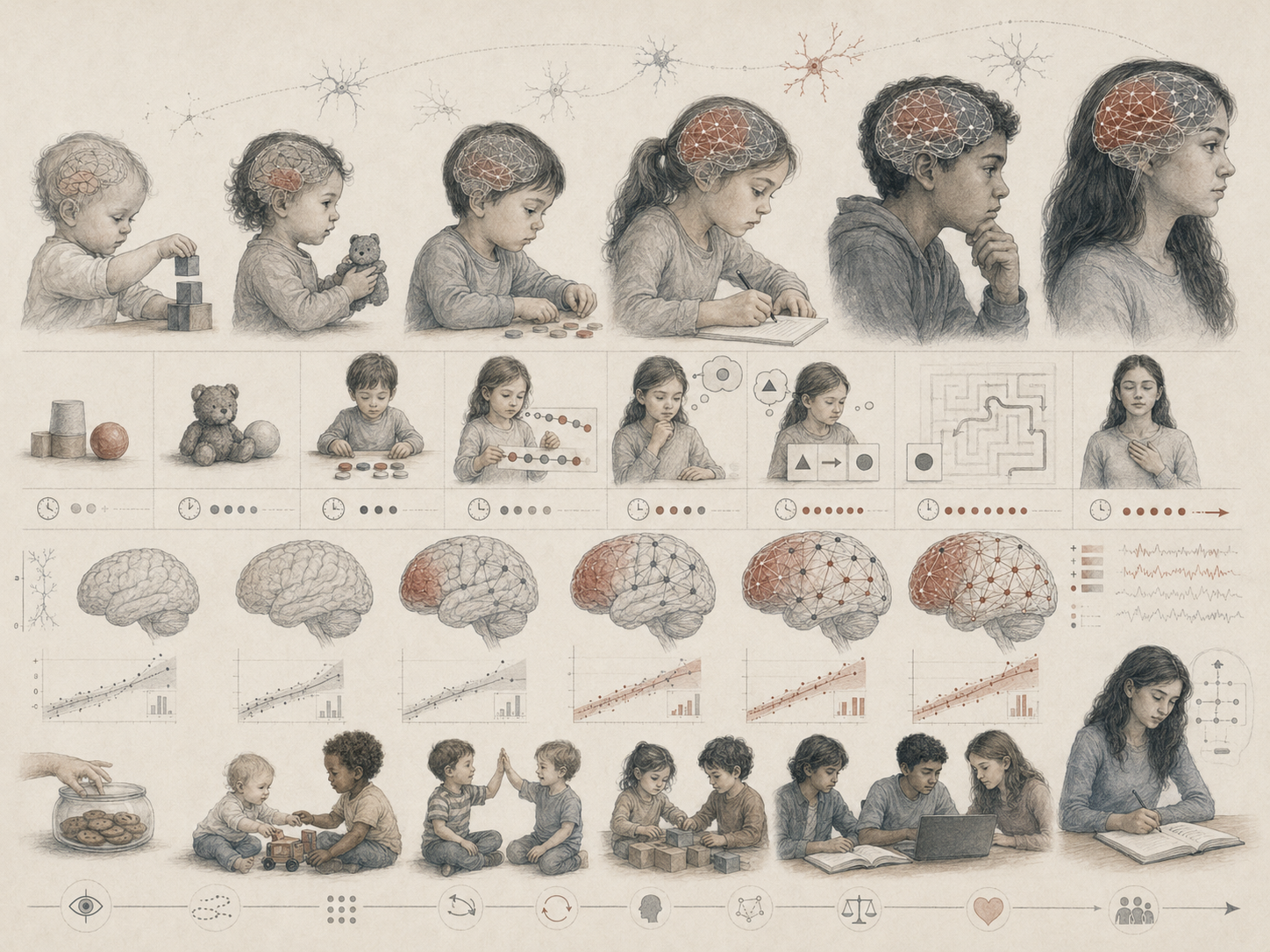
Current developmental and public-health sources increasingly treat self-regulation and executive function as foundational to learning, health, and well-being. Research programs in child development, early learning, school health, and early childhood policy repeatedly connect these capacities to children’s ability to learn, participate, adapt, recover, and act with increasing independence. A serious developmental psychology therefore approaches self-regulation and executive function not as isolated classroom competencies, but as developmental systems shaped by care, stress, schooling, brain development, inequality, and support.
This article examines self-regulation and executive function as developmental achievements rather than static traits. It asks how children move from external regulation toward internal control, why attention and inhibition are shaped by emotion and context, how stress and inequality affect regulatory capacity, why disability and neurodivergence require careful interpretation, and how regulation changes across childhood, adolescence, and the broader life course.
Why Self-Regulation and Executive Function Matter
Self-regulation and executive function matter because much of human development depends on the ability to organize action over time. To wait, plan, remember instructions, stop an automatic response, calm oneself enough to think, shift strategies after failure, and persist through difficulty are not narrow school behaviors. They affect friendship, play, language use, moral development, academic learning, conflict resolution, risk-taking, health behavior, and adaptation under stress.
These capacities also matter because they help explain one of developmental psychology’s deepest transitions: how children move from dependence on external structure toward increasing internal organization. Infants and toddlers rely heavily on caregivers for soothing, pacing, routines, transitions, and recovery from arousal. Preschool and school-age children begin to use language, rules, memory, and routines to regulate themselves more actively. Adolescents increasingly must regulate under more complex conditions of autonomy, peer pressure, emotional intensity, digital distraction, academic demand, sexuality, identity formation, and future planning.
Self-regulation also matters because it is often misinterpreted. Children who struggle to regulate are frequently described as lazy, defiant, immature, dramatic, impulsive, disrespectful, careless, or unwilling. Some may indeed need firmer boundaries or more practice, but many are struggling with developmental demands that exceed current capacity under current conditions. Sleep loss, chronic stress, sensory overload, trauma, hunger, disability, anxiety, executive-function differences, language demands, classroom mismatch, unstable routines, and punitive environments can all shape how regulation appears.
Executive function is equally important because it provides the cognitive architecture for goal-directed action. Working memory allows children to hold instructions and intentions in mind. Inhibitory control allows them to pause before acting. Cognitive flexibility allows them to shift when rules, expectations, or strategies change. Planning allows them to organize behavior toward future goals. These are not isolated laboratory capacities. They are used every time a child waits for a turn, solves a conflict, remembers a multi-step task, follows a game rule, writes an essay, resists distraction, or apologizes after losing control.
Finally, these capacities matter because they reveal the relationship between development and social justice. Regulation is often demanded most harshly from children with the fewest supports. Children facing poverty, racism, disability exclusion, trauma, unstable housing, environmental stress, or over-punitive schooling may be expected to display high levels of regulation under conditions that actively undermine regulatory capacity. A serious developmental account must therefore ask not only whether a child self-regulates, but what the child is being asked to regulate against.
What Self-Regulation and Executive Function Are
Self-regulation refers broadly to the capacity to manage attention, emotion, behavior, and goal pursuit under changing conditions. It includes the ability to direct attention, recover from frustration, delay gratification, follow rules, inhibit impulses, coordinate behavior with social expectations, persist through challenge, and adjust action in response to feedback. It is not one single skill. It is an organized developmental system involving cognition, emotion, motivation, physiology, language, and social context.
Executive function refers more specifically to higher-order control processes that support deliberate action. The most commonly discussed components are inhibitory control, working memory, and cognitive flexibility. Inhibitory control helps a child stop, delay, or modify a dominant response. Working memory helps the child hold information in mind and use it. Cognitive flexibility helps the child shift between rules, perspectives, tasks, or strategies. Planning, error monitoring, attentional control, and goal management are often included in broader executive-function frameworks.
The two concepts overlap heavily, but they are not identical. Executive function is often treated as a set of cognitive control processes, while self-regulation includes the emotional and behavioral use of those processes in everyday life. A child may have adequate working memory in a calm testing environment but struggle to use it during conflict, embarrassment, fear, or overstimulation. Conversely, a child may appear well-regulated in structured environments because adults and routines reduce demands, but struggle when asked to self-organize without scaffolding.
It is important not to flatten these ideas into moral language. A child with weaker self-regulation is not simply less virtuous, and a child with stronger executive function is not automatically more mature in every domain. Regulation is developmental, uneven, and context-sensitive. Children regulate differently across settings: home, school, playground, religious community, clinic, sports team, digital space, and peer group. They also regulate differently across demands: waiting, shifting attention, tolerating frustration, managing disappointment, resisting temptation, remembering instructions, controlling anger, or planning ahead.
Self-regulation should therefore be understood as a capacity that emerges through interaction between the child and the environment. It reflects internal development, but it also reflects external design. A quiet, predictable, supportive classroom asks something different of a child than a chaotic, punitive, overstimulating one. A caregiver who helps name emotions and scaffold transitions supports regulation differently than one who relies only on threat or shame. The child’s regulatory capacity is real, but it is always expressed in context.
From External Regulation to Internal Control
One of the strongest developmental insights in this area is that self-regulation begins as co-regulation. Infants do not regulate distress, arousal, attention, hunger, sleep, and sensory overload alone. Caregivers help regulate the infant through touch, voice, rhythm, feeding, rocking, gaze, routines, and emotional responsiveness. Before the child has strategies, the relationship provides organization. Before the child can calm themselves, someone else helps create calm.
Over time, some of this externally supported regulation becomes internalized. Toddlers begin to anticipate routines. Preschool children use language to guide behavior: “Wait,” “my turn,” “first this, then that.” School-age children begin to remember multi-step instructions, manage classroom transitions, and recover from disappointment with less direct adult support. Adolescents increasingly regulate through internal goals, identity, values, planning, and imagined futures. Development is therefore not the sudden emergence of willpower. It is the gradual transformation of relational structure into self-organization.
This transition should not be imagined as a clean handoff from adult to child. Even older children, adolescents, and adults still depend on environments that structure attention, reduce overload, and support regulation. Calendars, routines, reminders, social expectations, classrooms, work schedules, therapy, spiritual practice, exercise, medication, assistive technology, and community support all help organize behavior. Human self-regulation is never purely self-contained. Development increases autonomy, but autonomy remains scaffolded.
The concept of co-regulation also protects against harsh interpretation. A child who cannot regulate without support is not necessarily refusing to develop. They may still require relational, sensory, environmental, or instructional scaffolding. This is especially important for younger children, disabled children, neurodivergent children, traumatized children, and children under chronic stress. Developmental expectations should be ambitious but realistic: children need opportunities to practice regulation, but practice requires conditions that make success possible.
Internal control also develops unevenly. A child may control attention during preferred activities but not during boring tasks. They may manage frustration at home but not at school, or vice versa. They may regulate emotions when rested but collapse when hungry or overstimulated. This variability is not incidental. It reveals that regulation is a dynamic process shaped by arousal, motivation, relationship, context, and task demands.
The movement from external regulation to internal control is therefore a developmental arc, not a simple milestone. It begins in care, grows through practice, and remains dependent on environments that either support or overload the developing child.
Attention, Inhibition, Working Memory, and Flexibility
Executive function is often described through three central components: inhibitory control, working memory, and cognitive flexibility. These components are analytically distinct, but in everyday life they work together. A child following classroom instructions must attend to the teacher, inhibit distraction, hold the instruction in mind, shift from one activity to another, and monitor whether they are doing the right thing. A child resolving a peer conflict must inhibit anger, hold another person’s perspective in mind, shift from self-defense to repair, and choose an action that preserves relationship.
Attention is foundational because children cannot regulate what they cannot orient toward or sustain. Attention allows a child to select relevant information from a crowded field of stimuli. It helps the child listen, observe, track rules, notice emotional cues, and persist through tasks. Attention is not simply a private internal trait. It is shaped by sleep, stress, sensory environment, motivation, teaching quality, screen exposure, disability, and emotional safety.
Inhibitory control allows children to pause before acting. It supports waiting, turn-taking, resisting temptation, stopping aggression, not blurting out, and delaying immediate desire for a longer-term goal. But inhibition should not be understood only as suppression. Healthy inhibition makes room for choice. It creates a developmental space between impulse and action where language, memory, social meaning, and moral judgment can intervene.
Working memory allows children to hold information in mind while using it. A child needs working memory to follow multi-step instructions, solve math problems, remember a rule during play, track a story, write a sentence, or keep a goal active while distractions appear. Working memory is especially sensitive to cognitive load. Stress, anxiety, noise, unclear instructions, language mismatch, and fatigue can all make a child appear less capable than they are in calmer conditions.
Cognitive flexibility allows children to shift. It supports switching from one rule to another, seeing a problem differently, revising a strategy, taking another person’s perspective, and adapting when expectations change. Flexibility is central to learning because development constantly presents new demands. A child who can only persist rigidly may struggle when the task changes. A child who can flexibly adjust can adapt without total collapse.
These components matter because development rarely asks children to use them separately. Real life requires integration. Executive function is the control architecture through which attention, memory, emotion, and action become coordinated in meaningful contexts.
Hot and Cool Executive Function
Developmental researchers often distinguish between “cool” executive function and “hot” executive function. Cool executive function refers to control processes used in relatively abstract, emotionally neutral tasks: sorting cards, remembering sequences, switching rules, solving puzzles, or suppressing a response in a low-stakes setting. Hot executive function refers to regulation under emotional, motivational, or reward-laden conditions: resisting temptation, managing anger, making decisions under peer pressure, delaying gratification, coping with embarrassment, or choosing a long-term goal over immediate reward.
This distinction matters because children often look different across cool and hot tasks. A child may perform well on a structured cognitive task but struggle when frustrated or rejected. Another child may manage social emotion well but struggle with working-memory-heavy academic demands. Executive function is not a single uniform resource applied equally across all situations. Emotional salience changes the task.
Hot executive function is especially important in real developmental life. Many regulatory failures occur not because the child lacks knowledge, but because the child is tired, excited, ashamed, angry, afraid, overstimulated, or socially pressured. A child may know not to hit but still hit when humiliated. An adolescent may understand risk but still act under status pressure. A student may know how to solve a problem but freeze under evaluation anxiety. Self-regulation depends not only on knowledge but on regulation under arousal.
Cool executive function still matters because it supports academic learning, planning, task switching, organization, and problem solving. But if developmental psychology treats executive function only as cool cognitive control, it misses how regulation actually operates in life. The developmental challenge is not merely to complete a task under ideal conditions. It is to sustain goal-directed action under emotional and social conditions that pull the person away from the goal.
Hot and cool executive function also help explain why children may be misjudged. A child who performs well in testing may still need support during transitions, conflict, or unstructured time. A child who struggles in a testing environment may regulate better in relational, embodied, or meaningful contexts. Good developmental interpretation asks which regulatory system is being taxed, under what conditions, and with what support.
Emotion Regulation, Behavior, and Goal-Directed Action
Self-regulation is broader than cognition alone because emotional life is part of what must be regulated. The child who can pause, recover from frustration, tolerate delay, return to a task, apologize after conflict, or ask for help is coordinating emotion with behavior. Regulation is therefore not emotional numbness. It is the capacity to experience feeling without being wholly governed by it.
Emotion regulation develops through naming, modeling, containment, practice, and repair. Children learn what emotions are, what they mean, how intense they can become, how long they last, how others respond to them, and what can be done when they feel overwhelming. A child whose anger is met only with punishment may learn suppression or escalation. A child whose anger is named, bounded, and guided toward repair may learn that strong emotion can be survived and organized.
Goal-directed behavior depends on this integration. A child may know what to do but still struggle to do it under emotional strain. They may know they should wait, but desire is intense. They may know they should use words, but anger floods the system. They may know they should keep working, but shame after a mistake makes withdrawal feel safer. Developmental psychology is strongest when it refuses to separate “knowing” from “doing” too sharply. Self-regulation lives between knowledge and action.
Behavior is therefore often a visible outcome of invisible regulatory demands. A child who runs from a room may be escaping sensory overload. A child who refuses a task may be avoiding anticipated failure. A child who interrupts may be struggling with inhibition and working memory. A child who appears oppositional may be unable to transition quickly under stress. This does not mean all behavior should be excused. It means behavior should be interpreted developmentally before it is moralized.
Good regulation also requires motivation. Children regulate more effectively when goals matter, when expectations are clear, when adults are trustworthy, when tasks feel possible, and when effort is connected to meaning. Self-regulation cannot be reduced to control. It includes the developmental ability to organize oneself around valued goals in environments that make those goals intelligible and attainable.
Caregiving, Stress, Schooling, and Developmental Context
Caregiving matters because early regulation is socially scaffolded. Responsive caregivers help children develop rhythms, routines, emotional language, frustration tolerance, and recovery from distress. They create predictable structures that make regulation possible before children can create those structures for themselves. Over time, children internalize some of these patterns as strategies: taking a breath, asking for help, waiting, naming emotion, rehearsing steps, or returning to a task after frustration.
Schooling matters because executive function is heavily recruited in classrooms. Students must sit, listen, shift tasks, remember instructions, manage materials, inhibit distraction, work with peers, accept correction, tolerate mistakes, and persist through difficulty. Classrooms can strengthen regulation when they provide clear routines, supportive relationships, predictable transitions, meaningful tasks, movement opportunities, emotional safety, and scaffolded expectations. They can weaken regulation when they are chaotic, humiliating, overstimulating, punitive, or developmentally mismatched.
Stress is especially important. Chronic stress affects arousal, attention, sleep, vigilance, emotional reactivity, and working memory. A child under chronic stress may appear inattentive or impulsive when their system is organized around threat detection rather than classroom compliance. This does not mean stress explains everything, but it does mean regulation cannot be understood apart from physiology and environment.
Caregiving, stress, and schooling also interact. A supportive caregiver may buffer school stress. A trusted teacher may buffer family instability. A predictable classroom may help a child practice regulation that is difficult elsewhere. Conversely, stress across multiple systems can accumulate. A child facing unstable housing, caregiver strain, unsafe neighborhood conditions, poor sleep, and punitive school discipline may be asked to regulate far more than peers who appear more “self-controlled” under easier conditions.
Developmental context therefore matters not as background, but as part of the regulatory system itself. Self-regulation is not born in a vacuum and then merely measured at school. It is shaped in home routines, classroom structures, peer expectations, cultural practices, health conditions, and institutional responses across time.
Play, Language, and the Practice of Regulation
Play is one of the major developmental settings where self-regulation grows. In pretend play, children must hold roles in mind, follow shared scripts, inhibit out-of-role behavior, negotiate rules, manage frustration, and shift perspectives. A child pretending to be a doctor, patient, parent, teacher, animal, or hero is not only imagining. The child is practicing symbolic control, social coordination, and flexible self-organization.
Games also develop regulation. Turn-taking requires waiting. Rule-governed play requires memory and inhibition. Losing requires emotion regulation. Team play requires coordination with others. Physical play requires impulse control, risk calibration, and attention to boundaries. These ordinary childhood experiences are regulatory laboratories. They allow children to practice control in meaningful, motivated contexts rather than only under adult command.
Language is equally important. Children use private speech and inner speech to guide action: “first,” “wait,” “don’t touch,” “my turn,” “I can try again.” Over time, spoken regulation becomes internal regulation. Adults support this process by narrating strategies, naming emotions, breaking tasks into steps, modeling calm problem-solving, and helping children use language as a tool for action.
Regulation grows through repeated practice, not through demand alone. Telling a child to “focus,” “calm down,” or “make better choices” may be necessary in the moment, but it is not sufficient as developmental support. Children need practice in environments where regulation is possible: predictable routines, manageable demands, clear cues, supportive feedback, and opportunities to recover after mistakes.
Play and language also prevent self-regulation from being understood as mere compliance. A child who can organize a complex pretend game, negotiate rules with peers, or sustain focus on a personally meaningful project may show regulatory strength that is not visible in worksheet completion. Developmental psychology should look for regulation across the full ecology of childhood, not only in adult-controlled tasks.
Inequality, Disability, and Developmental Difference
Self-regulation is often treated as a purely individual trait, but inequality profoundly shapes its development and expression. Children do not regulate under equal conditions. Chronic poverty, housing instability, food insecurity, unsafe environments, over-surveillance, family stress, environmental toxins, sleep disruption, and inconsistent institutional support all affect the demands placed on regulation and the opportunities children have to practice it.
This matters because regulatory struggle is often moralized most harshly in children facing the greatest adversity. A child who is hungry, exhausted, anxious, grieving, traumatized, or unsafe may be expected to sit still, focus, remember, and comply as if the body were not carrying stress. A developmental approach does not excuse harmful behavior, but it refuses to interpret behavior without context. The child’s regulatory system is developing inside conditions that may either support or overload it.
Disability and neurodevelopmental difference also matter. Executive-function differences are common in ADHD, autism, learning disabilities, intellectual disabilities, trauma-related conditions, anxiety, depression, sleep disorders, and other developmental profiles. Some children need environmental supports, explicit instruction, sensory accommodations, movement breaks, visual schedules, assistive technology, medication, therapy, or reduced cognitive load. These supports are not shortcuts around development. They are often the conditions that allow development to proceed.
Neurodivergent regulation may also be uneven. A child may focus intensely on preferred interests but struggle with transitions. A child may understand rules but be overwhelmed by sensory input. A child may want to comply but lose track of instructions. A child may appear rigid because flexibility requires more cognitive and emotional effort than adults recognize. These patterns require interpretation, not quick moral judgment.
At the same time, developmental psychology should not romanticize regulatory struggle or deny support needs. Children deserve help when executive-function challenges interfere with learning, safety, relationships, or well-being. The ethical task is to provide support without stigma, structure without humiliation, and accountability without reducing the child to a deficit. Regulation should be understood as a developmental capacity that grows through fit between child and environment.
Adolescence, Risk, and Autonomy
Adolescence adds complexity because regulatory demands intensify while social, emotional, and biological systems are changing. Adolescents face stronger peer salience, expanded autonomy, academic pressure, romantic and sexual development, identity formation, digital visibility, sleep shifts, risk opportunities, and future-oriented decisions. Executive function continues to mature, but the environments requiring regulation become more complex and consequential.
Adolescent risk-taking is often misunderstood as irrationality. Some risk-taking reflects sensation-seeking, peer influence, emotional urgency, reward sensitivity, or incomplete long-term planning. But risk-taking can also reflect exploration, identity formation, courage, social belonging, resistance, or the search for autonomy. Developmental psychology must distinguish reckless danger from developmentally meaningful experimentation.
Self-regulation in adolescence depends heavily on context. An adolescent may make careful decisions alone but act differently under peer observation. They may regulate well in structured school tasks but struggle in emotionally charged digital interactions. They may plan long-term goals while still making short-term choices under stress, shame, desire, or belonging pressure. Hot executive function becomes especially important because adolescent life increasingly involves emotionally and socially loaded decisions.
Autonomy should therefore be scaffolded, not simply granted or denied. Adolescents need opportunities to practice decision-making with real but manageable consequences. They need adults who can provide structure without infantilization, guidance without domination, and trust without abandonment. Overcontrol can undermine autonomy, while total absence of structure can overload the developing regulatory system.
Adolescence shows that self-regulation is not simply the suppression of impulse. It is the developmental capacity to coordinate identity, emotion, social belonging, future goals, and moral responsibility under conditions of increasing freedom. A mature account of adolescent regulation must therefore connect executive function to dignity, agency, and the social worlds in which choices are made.
Self-Regulation Across Developmental Time
Self-regulation and executive function develop across time rather than arriving fully formed in early childhood. Preschool years are especially important because attention, inhibition, working memory, and rule use become more visible under language, play, and classroom demands. But the developmental story continues through middle childhood, adolescence, adulthood, and aging.
Middle childhood often brings stronger rule use, planning, working memory, and emotional control. Children become more capable of organizing school materials, following multi-step instructions, negotiating peer conflict, and monitoring their own behavior. Yet regulation remains uneven. Peer stress, academic pressure, family instability, sleep, disability, and school climate can all affect performance.
Adolescence reorganizes regulation under conditions of emotional intensity, identity formation, social comparison, autonomy, and future planning. Young people must increasingly regulate not only behavior, but self-presentation, relationships, digital communication, sexuality, moral commitments, and long-term goals. The regulatory task becomes more internal, but also more socially complex.
Adulthood does not simply mark the endpoint. Regulation can continue to deepen through practice, work roles, caregiving, therapy, spiritual discipline, social responsibility, and changed environments. Adults also experience regulatory strain under stress, trauma, addiction, illness, grief, unemployment, caregiving burden, and sleep disruption. Self-regulation is a lifespan capacity, not a childhood-only achievement.
Aging adds further complexity. Some executive functions may become more vulnerable with age, while emotional regulation and life experience may support adaptation in other domains. Older adults may use routines, selective attention, social wisdom, environmental structure, and compensatory strategies to regulate effectively. A lifespan view rejects the idea that regulation is simply acquired once. It is reorganized across changing bodies, roles, responsibilities, and environments.
What Self-Regulation Can and Cannot Explain
Self-regulation and executive function can explain a great deal about development. They help explain why children differ in attention, impulse control, persistence, classroom behavior, peer conflict, frustration tolerance, and goal pursuit. They help connect early caregiving, stress physiology, brain development, schooling, mental health, and social adaptation. They help educators and caregivers understand why structure, routines, emotion coaching, play, sleep, and supportive relationships matter.
They can also correct harmful simplifications. A child who struggles to sit still is not necessarily choosing disrespect. A child who forgets instructions is not necessarily careless. A child who melts down during transitions is not necessarily manipulative. A child who avoids a task may be protecting themselves from anticipated failure. A developmental account asks what regulatory demand is being made, what support is available, and what stressors are present.
But self-regulation cannot explain everything. It should not become a universal explanation for every difficulty. Academic failure may reflect poor instruction, language mismatch, disability, poverty, curriculum design, racism, trauma, or lack of access. Peer conflict may reflect social exclusion, bullying, or institutional failure rather than only poor impulse control. Emotional distress may reflect grief, anxiety, depression, abuse, sensory overload, or unsafe conditions. Regulation is important, but it is not the whole person.
The field also must avoid turning self-regulation into a tool of social control. When institutions emphasize regulation without examining whether environments are fair, safe, inclusive, and developmentally appropriate, self-regulation becomes a demand that children adapt to harmful conditions. Teaching children to calm down is not enough if the conditions making them unsafe remain unchanged.
Self-regulation is most useful when treated as developmental capacity, not moral verdict. It should guide support, not blame. It should help adults build better conditions for growth, not merely demand better performance from children under unequal conditions. The central question is not “Why can’t this child control themselves?” but “What developmental capacities, supports, stressors, and environmental designs are shaping this child’s ability to organize thought, feeling, and action?”
An Analytical Framework for Self-Regulation and Executive Function
A stylized executive-function outcome \(E_{it}\) for individual \(i\) at time \(t\) can be written as:
E_{it} = \alpha_i + \beta_i t + \gamma C_{it} – \delta S_{it} + \varepsilon_{it}
\]
Interpretation: \( \alpha_i \) is initial regulatory capacity, \( \beta_i \) is the growth rate, \( C_{it} \) represents contextual support such as caregiving, classroom scaffolding, sleep, routines, or instructional clarity, and \( S_{it} \) represents stress, overload, threat, fatigue, or instability.
To reflect continuity of prior functioning, we can add state dependence:
E_{it} = \rho E_{i,t-1} + \beta_i t + \gamma C_{it} – \delta S_{it} + \varepsilon_{it}
\]
Interpretation: A large value of \( \rho \) indicates that earlier self-regulation strongly conditions later self-regulation. This expresses the common developmental pattern that prior organization helps structure future adaptation.
Because regulation depends on interaction between child characteristics and context, we can include fit explicitly:
E_{it} = \alpha_i + \beta_T T_i + \gamma C_{it} + \eta (T_i \times C_{it}) – \delta S_{it} + \varepsilon_{it}
\]
Interpretation: \(T_i\) may represent temperament, baseline reactivity, sensory sensitivity, or neurodevelopmental profile. The interaction term \(T_i \times C_{it}\) allows some children to benefit disproportionately from supportive contexts while struggling more sharply under poorly matched conditions.
Because executive function unfolds within classrooms, families, and neighborhoods, a multilevel model is often more realistic:
E_{ijt} = \alpha + u_j + \beta t + \gamma C_{ijt} – \delta S_{ijt} + \varepsilon_{ijt}
\]
Interpretation: \(u_j\) captures contextual differences at the level of school, classroom, family system, clinic, neighborhood, or community. What looks like an individual difference in regulation is often co-authored by institutional design and environmental condition.
To represent intervention or scaffolding effects, the model can be extended:
E_{it} = \rho E_{i,t-1} + \beta t + \theta I_{it} + \gamma C_{it} – \delta S_{it} + \varepsilon_{it}
\]
Interpretation: \(I_{it}\) represents intervention, coaching, classroom support, therapy, assistive technology, emotion-regulation training, or structured routines. This captures the developmental claim that self-regulation can be strengthened through better conditions and repeated supported practice.
The point of this framework is not to reduce regulation to an equation. It is to clarify that executive function and self-regulation are developmental, interactive, context-sensitive processes shaped by support, stress, time, fit, and institutional environment.
R: Simulating Executive Function, Stress, and Developmental Growth
The following R example simulates children observed across eight waves. It includes baseline executive function, caregiving support, classroom structure, sleep quality, chronic stress, acute stress, temperament reactivity, disability support need, intervention exposure, and a developmental regulation outcome. The data are synthetic and intended for methodological demonstration.
# Simulating executive function, stress, and developmental growth
# ---------------------------------------------------------------
# This synthetic example models self-regulation as a longitudinal
# process shaped by caregiving support, classroom structure, sleep,
# stress, temperament reactivity, disability support need, and intervention.

suppressPackageStartupMessages({
  library(dplyr)
  library(tidyr)
  library(lme4)
  library(ggplot2)
})

set.seed(2026)

n_children <- 820
n_waves <- 8
n_schools <- 32

children <- data.frame(
  child_id = 1:n_children,
  school_id = sample(1:n_schools, n_children, replace = TRUE),
  baseline_ef = rnorm(n_children, mean = 50, sd = 8),
  caregiving_support = rnorm(n_children, mean = 0, sd = 1),
  classroom_structure = rnorm(n_children, mean = 0, sd = 1),
  sleep_quality = rnorm(n_children, mean = 0, sd = 1),
  chronic_stress = rbinom(n_children, size = 1, prob = 0.30),
  temperament_reactivity = rnorm(n_children, mean = 0, sd = 1),
  disability_support_need = rbinom(n_children, size = 1, prob = 0.18)
)

schools <- data.frame(
  school_id = 1:n_schools,
  school_climate = rnorm(n_schools, mean = 0, sd = 0.6),
  regulation_scaffolding = rnorm(n_schools, mean = 0, sd = 0.6),
  disability_accommodation = rnorm(n_schools, mean = 0, sd = 0.6),
  transition_predictability = rnorm(n_schools, mean = 0, sd = 0.5)
)

panel_data <- children |>
  slice(rep(1:n(), each = n_waves)) |>
  group_by(child_id) |>
  mutate(
    wave = 0:(n_waves - 1),
    current_support = rnorm(n_waves, mean = caregiving_support, sd = 0.6),
    current_structure = rnorm(n_waves, mean = classroom_structure, sd = 0.6),
    current_sleep = rnorm(n_waves, mean = sleep_quality, sd = 0.5),
    acute_stress = rnorm(n_waves, mean = 0.35 * chronic_stress, sd = 0.8),
    intervention_exposure = ifelse(wave >= 4 & runif(n_waves) < 0.35, 1, 0)
  ) |>
  ungroup() |>
  left_join(schools, by = "school_id") |>
  mutate(
    regulatory_support_context =
      current_support +
      current_structure +
      current_sleep +
      school_climate +
      regulation_scaffolding +
      transition_predictability +
      disability_accommodation * disability_support_need,
    regulation_score =
      baseline_ef +
      1.55 * wave +
      1.30 * current_support +
      1.20 * current_structure +
      0.95 * current_sleep +
      0.85 * school_climate +
      1.00 * regulation_scaffolding +
      0.85 * transition_predictability +
      0.95 * disability_accommodation * disability_support_need +
      1.10 * intervention_exposure -
      1.45 * acute_stress -
      1.00 * chronic_stress +
      0.70 * temperament_reactivity * current_support -
      0.75 * temperament_reactivity * acute_stress +
      0.25 * regulatory_support_context +
      rnorm(n(), mean = 0, sd = 2.7)
  )

model <- lmer(
  regulation_score ~ wave + current_support + current_structure +
    current_sleep + school_climate + regulation_scaffolding +
    transition_predictability + disability_support_need +
    disability_accommodation + intervention_exposure +
    acute_stress + chronic_stress + temperament_reactivity +
    temperament_reactivity:current_support +
    temperament_reactivity:acute_stress +
    regulatory_support_context +
    (1 + wave | school_id/child_id),
  data = panel_data
)

summary(model)

trajectory_summary <- panel_data |>
  group_by(wave, chronic_stress) |>
  summarize(
    mean_regulation = mean(regulation_score),
    standard_error = sd(regulation_score) / sqrt(n()),
    .groups = "drop"
  ) |>
  mutate(
    lower = mean_regulation - 1.96 * standard_error,
    upper = mean_regulation + 1.96 * standard_error,
    stress_group = ifelse(chronic_stress == 1, "Higher chronic stress", "Lower chronic stress")
  )

ggplot(trajectory_summary, aes(x = wave, y = mean_regulation, linetype = stress_group)) +
  geom_line(linewidth = 1) +
  geom_ribbon(aes(ymin = lower, ymax = upper, group = stress_group), alpha = 0.12) +
  labs(
    title = "Simulated Self-Regulation and Executive Function Across Time",
    x = "Wave",
    y = "Regulation score",
    linetype = "Group"
  ) +
  theme_minimal()

context_summary <- panel_data |>
  group_by(wave) |>
  summarize(
    average_support = mean(current_support),
    average_structure = mean(current_structure),
    average_sleep = mean(current_sleep),
    average_stress = mean(acute_stress),
    average_intervention = mean(intervention_exposure),
    average_regulatory_context = mean(regulatory_support_context),
    average_regulation = mean(regulation_score),
    .groups = "drop"
  )

ggplot(context_summary, aes(x = wave)) +
  geom_line(aes(y = average_support, linetype = "caregiving support"), linewidth = 1) +
  geom_line(aes(y = average_structure, linetype = "classroom structure"), linewidth = 1) +
  geom_line(aes(y = average_sleep, linetype = "sleep quality"), linewidth = 1) +
  geom_line(aes(y = average_stress, linetype = "acute stress"), linewidth = 1) +
  geom_line(aes(y = average_regulatory_context, linetype = "regulatory context"), linewidth = 1) +
  labs(
    title = "Synthetic Regulation Context Across Waves",
    x = "Wave",
    y = "Average index",
    linetype = "Measure"
  ) +
  theme_minimal()

# Analysts can extend this model by:
# 1. separating working memory, inhibition, and flexibility;
# 2. adding school, classroom, family, or neighborhood random effects;
# 3. introducing intervention timing and dosage;
# 4. modeling sleep and physiological stress explicitly;
# 5. comparing childhood and adolescent growth curves;
# 6. adding ADHD, autism, trauma, or disability-support variables;
# 7. estimating nonlinear growth or latent classes.
This simulation highlights a core developmental insight: executive function grows through time, but its developmental shape depends on support, stress, sleep, classroom structure, disability accommodation, intervention, and contextual fit rather than age alone.
Python: Modeling Self-Regulation Across Time and Context
The following Python example simulates children’s developmental pathways over ten periods using caregiving support, classroom structure, sleep quality, acute stress, chronic stress, temperament reactivity, school scaffolding, disability accommodation, intervention exposure, and state-dependent regulation. The outcome can be read as a broad self-regulation and executive-function score. The data are synthetic and intended for conceptual demonstration.
# Modeling self-regulation across time and context
# ------------------------------------------------
# This synthetic example models self-regulation as a dynamic,
# state-dependent process shaped by caregiving support, classroom structure,
# sleep, school climate, regulation scaffolding, disability accommodation,
# acute stress, chronic stress, temperament reactivity, and intervention.

from __future__ import annotations

import numpy as np
import pandas as pd
import statsmodels.formula.api as smf
import matplotlib.pyplot as plt

np.random.seed(2026)

n_children = 920
n_periods = 10
n_schools = 36

children = pd.DataFrame({
    "child_id": np.arange(1, n_children + 1),
    "school_id": np.random.choice(np.arange(1, n_schools + 1), size=n_children),
    "baseline_ef": np.random.normal(50, 8, n_children),
    "caregiving_support": np.random.normal(0, 1, n_children),
    "classroom_structure": np.random.normal(0, 1, n_children),
    "sleep_quality": np.random.normal(0, 1, n_children),
    "chronic_stress": np.random.binomial(1, 0.30, n_children),
    "temperament_reactivity": np.random.normal(0, 1, n_children),
    "disability_support_need": np.random.binomial(1, 0.18, n_children)
})

schools = pd.DataFrame({
    "school_id": np.arange(1, n_schools + 1),
    "school_climate": np.random.normal(0, 0.6, n_schools),
    "regulation_scaffolding": np.random.normal(0, 0.6, n_schools),
    "disability_accommodation": np.random.normal(0, 0.6, n_schools),
    "transition_predictability": np.random.normal(0, 0.5, n_schools)
})

panel = children.loc[children.index.repeat(n_periods)].copy()
panel["time"] = np.tile(np.arange(n_periods), n_children)
panel = panel.merge(schools, on="school_id", how="left")

panel["current_support"] = np.random.normal(
    loc=panel["caregiving_support"],
    scale=0.7,
    size=len(panel)
)

panel["current_structure"] = np.random.normal(
    loc=panel["classroom_structure"],
    scale=0.7,
    size=len(panel)
)

panel["current_sleep"] = np.random.normal(
    loc=panel["sleep_quality"],
    scale=0.5,
    size=len(panel)
)

panel["acute_stress"] = np.random.normal(
    loc=0.35 * panel["chronic_stress"],
    scale=0.8,
    size=len(panel)
)

panel["intervention_exposure"] = (
    (panel["time"] >= 5) &
    (np.random.uniform(size=len(panel)) < 0.35)
).astype(int)

panel["regulatory_support_context"] = (
    panel["current_support"]
    + panel["current_structure"]
    + panel["current_sleep"]
    + panel["school_climate"]
    + panel["regulation_scaffolding"]
    + panel["transition_predictability"]
    + panel["disability_accommodation"] * panel["disability_support_need"]
)

panel = panel.sort_values(["child_id", "time"]).reset_index(drop=True)
panel["regulation_score"] = np.nan

for child in panel["child_id"].unique():
    child_rows = panel["child_id"] == child
    child_data = panel.loc[child_rows].copy()

    previous_score = child_data["baseline_ef"].iloc[0]

    for idx in child_data.index:
        time = panel.at[idx, "time"]
        support = panel.at[idx, "current_support"]
        structure = panel.at[idx, "current_structure"]
        sleep = panel.at[idx, "current_sleep"]
        stress = panel.at[idx, "acute_stress"]
        chronic = panel.at[idx, "chronic_stress"]
        temperament = panel.at[idx, "temperament_reactivity"]
        school_climate = panel.at[idx, "school_climate"]
        scaffolding = panel.at[idx, "regulation_scaffolding"]
        transition = panel.at[idx, "transition_predictability"]
        support_need = panel.at[idx, "disability_support_need"]
        accommodation = panel.at[idx, "disability_accommodation"]
        intervention = panel.at[idx, "intervention_exposure"]
        context = panel.at[idx, "regulatory_support_context"]

        current_score = (
            0.70 * previous_score
            + 0.90 * time
            + 1.15 * support
            + 1.05 * structure
            + 0.90 * sleep
            + 0.80 * school_climate
            + 0.95 * scaffolding
            + 0.80 * transition
            + 0.90 * accommodation * support_need
            + 1.10 * intervention
            - 1.25 * stress
            - 0.90 * chronic
            + 0.75 * temperament * support
            - 0.80 * temperament * stress
            + 0.25 * context
            + np.random.normal(0, 2.5)
        )

        panel.at[idx, "regulation_score"] = current_score
        previous_score = current_score

panel["lag_score"] = panel.groupby("child_id")["regulation_score"].shift(1)

regression_data = panel.dropna(subset=["lag_score"]).copy()

model = smf.ols(
    formula="""
    regulation_score ~ lag_score + time + current_support + current_structure +
    current_sleep + school_climate + regulation_scaffolding +
    transition_predictability + disability_support_need +
    disability_accommodation + intervention_exposure +
    acute_stress + chronic_stress + temperament_reactivity +
    temperament_reactivity:current_support +
    temperament_reactivity:acute_stress +
    regulatory_support_context
    """,
    data=regression_data
).fit(cov_type="HC3")

print(model.summary())

trajectory = panel.groupby(["time", "chronic_stress"], as_index=False).agg(
    average_regulation=("regulation_score", "mean"),
    average_support=("current_support", "mean"),
    average_structure=("current_structure", "mean"),
    average_sleep=("current_sleep", "mean"),
    average_stress=("acute_stress", "mean"),
    average_context=("regulatory_support_context", "mean"),
    standard_error=("regulation_score", lambda x: x.std() / np.sqrt(len(x)))
)

trajectory["stress_group"] = trajectory["chronic_stress"].map({
    0: "Lower chronic stress",
    1: "Higher chronic stress"
})

plt.figure(figsize=(8, 5))
for group_name, subset in trajectory.groupby("stress_group"):
    plt.plot(
        subset["time"],
        subset["average_regulation"],
        marker="o",
        label=group_name
    )

plt.xlabel("Time")
plt.ylabel("Average regulation score")
plt.title("Simulated Self-Regulation Across Development")
plt.legend()
plt.tight_layout()
plt.show()

school_summary = panel.groupby("school_id", as_index=False).agg(
    school_climate=("school_climate", "mean"),
    regulation_scaffolding=("regulation_scaffolding", "mean"),
    disability_accommodation=("disability_accommodation", "mean"),
    transition_predictability=("transition_predictability", "mean"),
    average_regulation=("regulation_score", "mean"),
    average_stress=("acute_stress", "mean"),
    average_context=("regulatory_support_context", "mean")
)

print(school_summary.sort_values("average_regulation", ascending=False).head())

# Analysts can extend this framework by:
# 1. modeling working memory, inhibition, and cognitive flexibility separately;
# 2. adding school-, classroom-, family-, or neighborhood-level clustering;
# 3. introducing targeted support programs and intervention dosage;
# 4. comparing childhood and adolescent developmental periods;
# 5. testing differential sensitivity under high-stress contexts;
# 6. adding ADHD, autism, trauma, disability support, or sleep-disorder variables;
# 7. estimating nonlinear growth, latent classes, or hierarchical Bayesian models.
The analytical value of a model like this is that it makes regulation explicit as a developmental achievement emerging through growth, support, stress, sleep, environmental fit, and repeated practice rather than through willpower alone.
GitHub Repository
Complete Code Repository
Access the full companion repository for this article, including reproducible analysis materials and multi-language code workflows for self-regulation, executive function, attention, inhibition, working memory, cognitive flexibility, stress, classroom structure, caregiving support, disability accommodation, and developmental growth across time.
Conclusion
Self-regulation and executive function are central to development because they organize how children and adolescents learn to direct thought, manage feeling, inhibit impulse, remember goals, shift strategies, and act under real-world conditions of distraction, desire, stress, and social demand. They are not simply school skills, and they are not moral verdicts on the child. They are developmental capacities formed through brain development, caregiving, co-regulation, practice, schooling, physiology, disability support, cultural expectations, and environmental design.
The strongest developmental psychology treats self-regulation neither as innate destiny nor as purely individual choice. It is a growing system of cognitive, emotional, behavioral, and relational organization that begins through external support and becomes increasingly internal across time. Even then, it remains shaped by context. Children become more capable of governing themselves when relationships, routines, institutions, and environments help organize development rather than merely demand performance.
In that sense, self-regulation reveals one of the field’s deepest truths: autonomy is developmentally scaffolded. Children become capable of intentional life not because they are simply told to control themselves, but because they are gradually supported in building the capacities, strategies, meanings, and environments that make self-directed action possible.
Related Articles
- What Is Developmental Psychology?
- Brain Development, Plasticity, and the Developing Nervous System
- Cognitive Development and the Growth of Mind
- Attachment, Caregiving, and Early Emotional Development
- Temperament and Individual Differences in Development
- Play, Imagination, and Development
- Developmental Psychopathology, Risk, Trauma, and Adaptation
- Lifespan Development from Childhood to Aging
- Developmental Psychology knowledge series
Further Reading
- Developmental Psychology knowledge series
- Bernier, A., Carlson, S.M. and Whipple, N. (2010) ‘From external regulation to self-regulation: Early parenting precursors of young children’s executive functioning’, Child Development, 81(1), pp. 326–339.
- Blair, C. and Diamond, A. (2008) ‘Biological processes in prevention and intervention: The promotion of self-regulation as a means of preventing school failure’, Development and Psychopathology, 20(3), pp. 899–911.
- Diamond, A. (2013) ‘Executive functions’, Annual Review of Psychology, 64, pp. 135–168.
- Griffin, J.A., McCardle, P. and Freund, L.S. (eds.) (2016) Executive Function in Preschool-Age Children. Washington, DC: American Psychological Association.
- Zelazo, P.D. and Carlson, S.M. (2012) ‘Hot and cool executive function in childhood and adolescence’, Child Development Perspectives, 6(4), pp. 354–360.
- Center on the Developing Child at Harvard University (n.d.) Executive Function & Self-Regulation. Available at: https://developingchild.harvard.edu/science/key-concepts/executive-function/.
- National Scientific Council on the Developing Child (2011) Building the Brain’s “Air Traffic Control” System: How Early Experiences Shape the Development of Executive Function. Available at: https://developingchild.harvard.edu/resources/building-the-brains-air-traffic-control-system-how-early-experiences-shape-the-development-of-executive-function/.
References
- American Psychological Association (2018) ‘Lab Work: Unearthing the seeds of executive function’. Available at: https://www.apa.org/monitor/2018/04/executive-function.
- American Psychological Association (2025) ‘Momo Hayakawa helps kids build executive functioning and self-regulation skills’. Available at: https://www.apa.org/monitor/2025/07-08/momo-hayakawa-kids-future.
- Centers for Disease Control and Prevention (2026) Child Development. Available at: https://www.cdc.gov/child-development/index.html.
- Claussen, A.H. et al. (2021) ‘Factors Associated with Self-regulation in a Nationally Representative Sample of Children Ages 3–5 Years’, Maternal and Child Health Journal. Available at: https://stacks.cdc.gov/view/cdc/102157/cdc_102157_DS1.pdf.
- Eunice Kennedy Shriver National Institute of Child Health and Human Development (2017) ‘Science Update: Preschool program to boost executive function’. Available at: https://www.nichd.nih.gov/newsroom/releases/122017-REDI.
- Eunice Kennedy Shriver National Institute of Child Health and Human Development (2026) Child Development and Behavior Branch. Available at: https://www.nichd.nih.gov/about/org/der/branches/cdbb.
- Eunice Kennedy Shriver National Institute of Child Health and Human Development (2021) Early Learning Research Information. Available at: https://www.nichd.nih.gov/health/topics/early-learning/researchinfo.
- Eunice Kennedy Shriver National Institute of Child Health and Human Development (2012) ‘Stresses of Poverty may Impair Learning Ability in Young Children’. Available at: https://www.nichd.nih.gov/newsroom/releases/082812-stress_learning.
- World Health Organization (2021) WHO Guideline on School Health Services. Available at: https://www.who.int/publications/i/item/9789240029392.
- World Health Organization (2020) Improving Early Childhood Development. Available at: https://iris.who.int/bitstreams/af368e00-83fc-44e4-aa10-fd4b467c2904/download.