
Last Updated May 21, 2026
Few questions in developmental psychology are more important than whether change unfolds continuously or discontinuously. Does development proceed as gradual accumulation, with new capacities emerging through small increments of learning, growth, maturation, practice, and adaptation? Or does it reorganize itself in more abrupt ways, so that new stages, structures, roles, or developmental forms appear that cannot be reduced to mere addition? The continuity-discontinuity debate lies at the heart of how developmental psychology explains mind, language, attachment, identity, moral judgment, puberty, trauma, aging, and human change across the lifespan. It is not a narrow technical dispute. It is a question about the logic of development itself: whether change is best understood as smooth progression, qualitative reorganization, or some layered combination of both.
Developmental psychology has never fully resolved this question because human development itself does not conform neatly to one model. Some changes clearly look cumulative. Vocabulary grows word by word. Motor coordination improves through practice. Knowledge expands with repeated exposure and use. Other changes appear more discontinuous. Puberty reorganizes the body and social self. Symbolic thought opens capacities not present in infancy. Identity crises, role transitions, trauma, institutional disruption, illness, bereavement, migration, and developmental turning points can redirect lives in ways that feel qualitative rather than merely incremental. The real task, then, is not to defend one side dogmatically, but to understand how continuity and discontinuity operate together across biological maturation, cognitive reorganization, socialization, culture, inequality, and institutional life.
Main Library
Publications
Article Map
Developmental Psychology
Related Topic
Cognitive Psychology
Related Topic
Risk & Resilience
Related Topic
Social Psychology
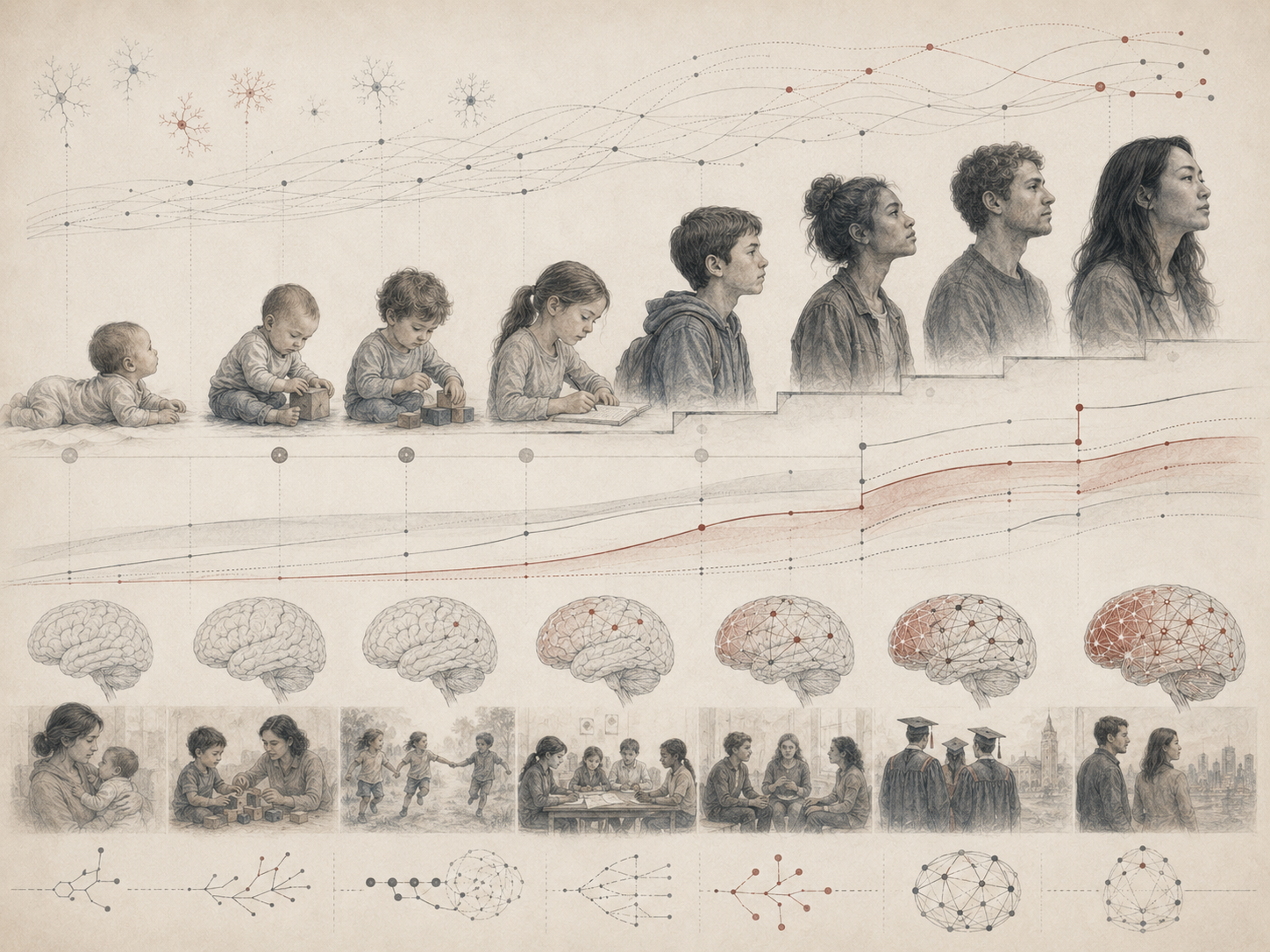
The continuity-discontinuity debate is often introduced as a choice between gradual growth and stage-like change, but the deeper issue is how developmental systems transform. A continuous process may eventually cross a threshold and appear discontinuous. A discontinuous transition may be prepared by years of gradual change. A developmental rupture may be caused not by an internal stage but by an external event: school exclusion, family instability, illness, displacement, violence, poverty, institutional failure, or social recognition. Development can therefore be smooth at one level of analysis and abrupt at another. What looks like a leap from a distance may be a buildup up close; what looks like a stable trajectory may conceal vulnerability to sudden reorganization.
This article treats continuity and discontinuity not as rival slogans but as complementary ways of asking sharper developmental questions. What kind of change is occurring? Is it quantitative, qualitative, nonlinear, threshold-like, cumulative, interrupted, or reorganizing? Is the change located in the child, the relationship, the body, the institution, the environment, or the historical moment? Does the observed shift reflect maturation, learning, trauma, opportunity, exclusion, intervention, or measurement design? The debate matters because developmental science must be able to see both gradients and ruptures, both slow accumulation and sudden transformation, both stability and the possibility of change.
The Core Question of Developmental Change
The continuity-discontinuity question asks whether development is best understood as a smooth, cumulative process or as a series of more abrupt reorganizations. In a continuous model, change is gradual. Small differences accumulate over time until they produce what appears, from a distance, to be substantial transformation. In a discontinuous model, development proceeds through more distinct shifts in structure, function, organization, role, or meaning. The person does not simply have more of the same ability; they may have acquired a different mode of functioning altogether.
This question matters because the answer shapes how developmental psychologists study, measure, interpret, and intervene in human change. If development is continuous, researchers tend to emphasize learning, practice, incremental skill acquisition, growth curves, and measurable change across time. If development is discontinuous, researchers tend to emphasize stages, transitions, thresholds, crises, reorganizations, or turning points in how the person perceives, reasons, relates, regulates, or participates in social life.
Yet the most serious developmental work now recognizes that these logics are not always mutually exclusive. Some domains change gradually within broader developmental reorganizations. Some stage-like transformations are prepared by long periods of incremental buildup. Some apparent discontinuities reflect changes in measurement, context, expectations, or institutional demands rather than an internal developmental leap. A child may seem suddenly different when school begins, but the discontinuity may belong partly to the institution: new rules, peer comparisons, classroom expectations, standardized assessment, and adult interpretations of behavior.
The core question is therefore not “Which theory wins?” It is “What shape does change take here?” A useful developmental explanation should be able to distinguish slow growth from threshold transition, internal reorganization from external disruption, biological maturation from social role change, and stable trajectory from apparent stability masking accumulated strain. Continuity and discontinuity are not merely theoretical camps. They are possible shapes of developmental time.
What Continuity Means
Continuity refers to development as cumulative progression. A child’s vocabulary may expand through repeated interaction, exposure, and practice. Working memory may improve over time with maturation and experience. Fine motor coordination develops through many small adjustments rather than one dramatic leap. Reading fluency builds through repeated decoding, recognition, instruction, and comprehension practice. Personality style may show relative consistency, even as it becomes more differentiated and context-sensitive. In these cases, development appears as ongoing modification rather than abrupt replacement.
Continuous models are attractive because much of development is indeed gradual. Skills can be plotted, tracked, and modeled through longitudinal designs. Growth-curve methods are built precisely to study change across time rather than simply compare age groups. Milestones themselves, while often presented categorically in clinical or educational settings, are usually underwritten by continuous processes of growth in play, movement, communication, attention, and social response. A child does not suddenly become a walker in an absolute sense. Walking emerges from balance, muscle strength, perception, motivation, opportunity, falls, practice, and bodily coordination.
Continuous thinking is especially strong in information-processing accounts of cognition, learning theory, many language-development models, quantitative lifespan research, public-health monitoring, and educational measurement. These frameworks are powerful because they help researchers identify rates of growth, individual differences in slope, periods of acceleration or deceleration, and the influence of supports or risks over time.
Continuity also helps guard against overly dramatic interpretation. Not every developmental change is a crisis, stage, or rupture. Many capacities emerge quietly through repeated participation in ordinary routines: being spoken to, held, fed, read with, corrected, encouraged, challenged, comforted, and included. Developmental science needs this language of accumulation because human growth is often built from everyday repetition.
Yet continuity can become conceptually thin when it fails to explain why some changes feel genuinely structural rather than merely additive. Growth is real, but not all development is just “more.” A child who begins using language symbolically, an adolescent who reorganizes identity, or an adult who becomes a caregiver after the birth of a child may not simply be adding skills. The meaning of the world may have changed.
What Discontinuity Means
Discontinuity refers to development as qualitative reorganization. In this view, later functioning is not just an enlarged version of earlier functioning. It may involve a different structure altogether. Infants do not simply know less than older children; in many domains, they organize experience differently. Adolescents do not merely have more social experience than children; puberty, identity work, peer comparison, social visibility, and institutional transition can reorganize the meaning of the self. Older adults do not simply possess less capacity than younger adults; many also shift motivational priorities, time orientation, relational goals, and forms of expertise.
Stage theories represent the clearest form of discontinuity thinking. In such accounts, developmental change passes through relatively distinct forms, each with its own logic. These models are attractive because they explain why certain tasks, conflicts, or capacities appear especially salient at particular periods and why new developmental forms sometimes seem to emerge suddenly. Piaget’s cognitive stages, Erikson’s psychosocial stages, Kohlberg’s moral stages, and many identity-development models all depend on the idea that development can reorganize rather than simply expand.
Discontinuity is especially plausible in domains involving puberty, school entry, language emergence, symbolic thought, role transition, moral reorientation, trauma, migration, illness, institutional passage, or identity crisis. A child entering school may face a new social world with new expectations. An adolescent entering puberty may encounter a changed body and a changed social gaze. A displaced family may experience an abrupt break in continuity that reorganizes language, schooling, belonging, and stress. A bereaved adult may continue living in ordinary time while experiencing a discontinuity in meaning.
But discontinuity also carries risks as an explanation. Apparent abruptness may hide gradual preparation. A visible shift may occur because a measurement threshold has been crossed, not because development itself changed in one sudden moment. A child’s linguistic “explosion” may rest on months of comprehension, social attention, sound mapping, and practice. A moral shift may follow years of relational learning. A developmental crisis may reveal cumulative pressure rather than appear from nowhere.
Discontinuity is therefore most useful when treated as a claim requiring explanation. What reorganized? At what level? Under what conditions? Was the shift biological, psychological, relational, institutional, or interpretive? Discontinuity is powerful precisely because it asks whether development sometimes changes form. It is dangerous when it converts every visible transition into a fixed stage.
Why Continuity and Discontinuity Often Operate Together
One reason the debate persists is that continuity and discontinuity often operate at different levels of the same process. A developmental change may be continuous in mechanism but discontinuous in appearance. It may be continuous in biological preparation but discontinuous in social meaning. It may be continuous in learning but discontinuous in institutional recognition. The opposition between the two becomes misleading when it assumes development has only one scale.
Language development illustrates this clearly. Infants gradually build auditory discrimination, turn-taking expectations, vocal practice, joint attention, and comprehension. These are continuous processes. Yet when expressive language expands rapidly, the child may appear to have entered a new developmental world. The same is true of reading: years of speech, print exposure, phonological awareness, visual recognition, instruction, and practice may culminate in what feels like a sudden transition from decoding to fluent reading.
Puberty also combines both logics. Hormonal and bodily changes unfold over time, but the social consequences of pubertal visibility can feel abrupt. A young person may be treated differently by adults, peers, and institutions once the body is read as more mature. The biological process is gradual; the social interpretation can be discontinuous. The same applies to role transitions such as starting school, leaving home, becoming a parent, entering prison, migrating, becoming disabled, retiring, or losing a partner. The event may occur on a date, but its developmental meaning unfolds before and after.
Continuity and discontinuity also interact in intervention. A supportive program may produce small changes in routine, confidence, safety, language, or caregiving for months before measurable outcomes improve. When the benefits become visible, the change may appear discontinuous even though it was built cumulatively. Conversely, a traumatic rupture may suddenly redirect development, but recovery may require long continuous processes of repair.
The strongest developmental thinking therefore treats continuity and discontinuity as complementary analytical lenses. Continuity asks how change accumulates. Discontinuity asks when the organization of development changes. Good developmental science needs both questions.
Classical Theories and the Debate
Piaget and Qualitative Cognitive Change
Piaget is perhaps the classic defender of discontinuity in developmental psychology. His stage theory proposed that children pass through qualitatively different structures of thought, from sensorimotor intelligence to preoperational symbolism, concrete operational logic, and formal operational reasoning. The significance of this framework lies in its claim that development involves reorganization in how the child thinks, not just the accumulation of more facts or better memory.
Piaget’s lasting value is that he made developmental structure visible. Children’s errors were not merely failures; they could reveal a developing logic. A child who struggles with conservation or perspective-taking is not simply ignorant. The child may be organizing the relation among appearance, transformation, quantity, and perspective differently. Piaget helped establish the child as an active thinker whose mind develops through structured engagement with the world.
Piaget’s limitation is that later research showed greater variability, domain specificity, cultural dependence, and task sensitivity than the classical stage model allowed. Children often show partial competences earlier than expected when tasks are simplified, familiar, socially scaffolded, or less linguistically demanding. Adults do not always reason formally across all domains. Cognitive development is less staircase-like and more uneven than Piaget’s strongest stage claims implied. Still, Piaget remains central because he insisted that the logic of development may include discontinuity.
Vygotsky and Mediated Development
Vygotsky complicates the debate. His account of development through language, cultural tools, and guided interaction suggests both continuity and transformation. Development can be gradual in the sense that abilities are scaffolded over time through participation with more capable others. But it can also be discontinuous because social mediation reorganizes what the learner can do and how the learner understands the world. A child internalizing language, number systems, writing, scientific concepts, or culturally organized tools is not simply adding content. The structure of mental life itself may change.
Vygotsky’s importance lies in showing that discontinuity need not be purely internal. A developmental reorganization may arise through cultural mediation. A child’s cognitive possibilities change when language, symbols, tools, school practices, and social interaction reorganize thought. Development is therefore neither only inside the individual nor only outside in the environment. It emerges through mediated activity.
Erikson and Psychosocial Reorganization
Erikson’s psychosocial theory is also largely discontinuous in spirit. Each life period is marked by a distinctive developmental tension, such as trust, autonomy, identity, intimacy, generativity, or integrity. These are not merely linear increases in competence. They are reorganizations in selfhood, recognition, and social task. Erikson helped developmental psychology see that adulthood and aging are not empty aftermaths of childhood but developmental periods with their own tensions and possibilities.
At the same time, Erikson also implies continuity because earlier relational patterns carry forward. Trust, autonomy, initiative, competence, identity, intimacy, and generativity are historically layered. Unresolved tensions may reappear later. New roles may reopen old questions. Development is therefore not a clean sequence of completed tasks. It is a layered history in which continuity and reorganization repeatedly interact.
Learning Theory and Information Processing
Behaviorist, social-learning, and many information-processing frameworks lean more strongly toward continuity. Learning accumulates through reinforcement, modeling, practice, attention, encoding, memory development, strategy change, feedback, and repeated engagement. Cognitive processing becomes faster, more efficient, and more strategic. These traditions are powerful because they explain measurable improvement well.
Their weakness is that they can understate qualitative reorganization, symbolic shift, embodied transition, identity rupture, or institutional turning points. A child may improve gradually in processing speed, but the emergence of literacy, formal schooling, or abstract reasoning may still reorganize the developmental system. Continuous mechanisms may produce discontinuous forms.
The classical debate, then, does not divide theories neatly into two camps. Most major traditions contain both elements. What varies is which logic they privilege and what kind of evidence they treat as decisive.
Lifespan, Ecological, and Developmental Systems Perspectives
Later developmental theory moved beyond the old either-or opposition. The APA’s lifespan framing emphasizes that development involves contextual variation, multiple forms of growth and decline, and change across the whole life course rather than in childhood alone. Lifespan perspectives associated with Paul Baltes argued that development is multidirectional, plastic, and shaped by gains and losses rather than a simple upward line toward mature completion. This already complicates the continuity-discontinuity split: development can be continuous in some respects, discontinuous in others, and nonlinear across different domains.
Ecological and developmental systems approaches go further by showing that continuity and discontinuity depend partly on context. A child may show gradual growth in a supportive environment and sharp disruption under institutional instability, displacement, bereavement, chronic stress, exclusion, or violence. Bronfenbrenner’s ecological logic implies that developmental pathways are shaped by nested social systems. What looks like internal developmental discontinuity may sometimes reflect external ecological rupture: family breakdown, school transition, migration, incarceration, disability onset, climate disaster, or policy failure.
Developmental systems theory also undermines simplistic stage thinking by emphasizing reciprocal causation across genes, bodies, environments, relationships, and institutions. Development is not a clean staircase. It is a dynamic system in which small continuous inputs can eventually produce threshold effects, and threshold effects can reorganize the meaning of later incremental change. Stability is not the absence of process. It is often the temporary organization of many interacting processes.
Dynamic systems approaches are especially useful because they show how new patterns can emerge without assuming a fixed universal stage sequence. A developmental system may reorganize when many interacting components—body, perception, action, motivation, task demands, caregiver response, social expectation, and environment—reach a new configuration. The result may look sudden, but the system has been preparing for change. Walking, language, self-regulation, identity articulation, and moral reasoning can all be studied in this way.
From this perspective, continuity and discontinuity are not properties of the child alone. They are properties of a person-context system unfolding over time. A developmental pathway may appear continuous when context remains stable and discontinuous when context reorganizes. Conversely, a person may undergo internal reorganization while the external setting appears unchanged. Developmental science must therefore ask where continuity or discontinuity is located.
Domains of Change: Cognition, Language, Attachment, Identity, and Moral Development
Cognitive Development
Some areas of cognition appear continuous, such as vocabulary expansion, working-memory improvement, processing speed, and practice-based gains in problem solving. Other aspects appear more discontinuous, especially when children begin to reason symbolically, understand conservation, coordinate perspectives, use formal abstraction, or reflect on their own thinking. In contemporary terms, cognitive development often combines gradual underlying accumulation with periodic reorganization in strategy, representation, or task structure.
Language Development
Language is a classic mixed case. On one hand, vocabulary and usage expand continuously through exposure, interaction, turn-taking, imitation, correction, and social participation. On the other hand, children sometimes appear to “take off” linguistically once enough structure, confidence, and communicative motivation are in place. The visible shift may look discontinuous even when it rests on a long continuous buildup of auditory, social, motor, and symbolic learning.
Attachment and Socioemotional Development
Attachment also resists simple classification. Early relationships build gradually through repeated experience, responsiveness, protection, and regulation. Yet the child’s relational organization may later appear as a more structured pattern of expectation or insecurity, giving development a discontinuous appearance. Similarly, socioemotional development includes both incremental gains in regulation and more abrupt changes associated with school entry, adolescence, trauma, grief, care disruption, or new relational contexts.
Identity Development
Identity development, especially in adolescence and early adulthood, often appears discontinuous because crises, commitments, exclusions, and new roles can reorganize the self rapidly. But these moments rarely emerge from nowhere. They are usually prepared by long histories of socialization, recognition, conflict, aspiration, family expectation, bodily development, and institutional sorting. Identity is therefore often continuous in formation and discontinuous in articulation.
Moral Development
Moral development likewise contains both logics. Children may gradually learn empathy, reciprocity, norms, rule coordination, responsibility, and perspective-taking. Yet moral orientation can also shift more structurally when a person moves from externally enforced obedience toward more complex reasoning about fairness, care, responsibility, loyalty, justice, or principle. The most realistic view is that moral development combines cumulative socialization with periodic reorganization in how judgment itself is framed.
Adulthood and Aging
Adulthood and aging also show mixed developmental patterns. Expertise, caregiving skill, emotional regulation, and practical judgment may develop gradually across decades. But adult lives can also be reorganized by marriage, divorce, parenthood, unemployment, migration, disability, illness, religious conversion, bereavement, retirement, or political upheaval. Aging itself contains both continuous processes of biological change and discontinuous shifts in role, time horizon, social status, health, and dependence. Lifespan development cannot be understood as either smooth growth or simple decline. It is multidirectional and historically situated.
Biology, Maturation, and Developmental Thresholds
Biological development often blurs the boundary between continuity and discontinuity. Growth in height, neural connectivity, hormonal regulation, motor coordination, and sensory integration may unfold continuously, but the consequences of biological change may become visible only after a threshold is crossed. A child gradually gains strength, balance, and coordination before walking appears. Puberty unfolds through gradual endocrine and bodily change, yet its social and psychological consequences can feel abrupt. Brain development proceeds across years, but new patterns of attention, planning, inhibition, and emotional regulation may appear more suddenly when systems become better coordinated.
Maturation is therefore not simply a biological clock that produces stages automatically. It is a developmental process interacting with environment. Nutrition, stress, sleep, illness, disability, exposure, care, safety, and activity can all shape biological development. Biological continuity can be disrupted by injury, malnutrition, chronic illness, toxic exposure, trauma, or deprivation. Biological discontinuity can be buffered by care, treatment, rehabilitation, accommodation, and social support.
Threshold thinking is useful here. A threshold is not necessarily a stage. It is a point at which accumulated change becomes organized differently or becomes visible in a new way. The threshold may be biological, cognitive, emotional, relational, institutional, or social. The threshold may be crossed gradually, suddenly, or unevenly across domains. It may also be context-dependent: a child may demonstrate a capacity in a familiar environment but not in a stressful testing situation.
Developmental psychology therefore needs an account of maturation that is neither purely continuous nor rigidly staged. Bodies grow through time, but bodily change becomes developmentally meaningful through coordination, interpretation, support, and social context. Biology provides conditions of possibility; it does not supply a complete developmental script.
Timing, Risk, Inequality, and Developmental Turning Points
The continuity-discontinuity debate becomes far more serious when inequality enters the frame. Developmental pathways are not shaped only by intrinsic logic; they are also shaped by differentiated conditions of safety, care, nutrition, schooling, violence, disability accommodation, and public support. For some children, development may appear relatively continuous because institutions are stable and supportive. For others, abrupt discontinuities are imposed by family stress, eviction, school exclusion, illness, bereavement, war, migration, discrimination, environmental exposure, or trauma.
Risk and resilience research shows that development can be redirected. Early healthy pathways do not guarantee later stability, and early difficulty does not eliminate the possibility of later recovery. Developmental discontinuity may appear when later demands exceed previously adequate coping systems. Conversely, supportive intervention can create new trajectories that seem stage-like only because the cumulative benefits suddenly become visible.
This is why the field must distinguish between endogenous developmental change and institutionally produced rupture. A decline in academic functioning, for example, may reflect not a child’s internal developmental “failure” but a discontinuity in housing, caregiving, mental health, language access, disability support, nutrition, sleep, transportation, school climate, or teacher interpretation. A sudden behavioral change may reflect not a developmental stage but an environmental shock. A child who appears “behind” may have been denied the conditions under which continuous development could be sustained.
Developmental turning points also reveal that time is not neutral. The same event may have different consequences depending on when it occurs. A supportive mentor in adolescence may redirect identity. A stable placement after early care disruption may alter attachment expectations. A school transition may create opportunity for one child and rupture for another. A diagnosis may open support or intensify stigma depending on institutional response. Developmental timing is therefore always tied to social timing: when help arrives, when harm occurs, when institutions respond, and when the person is recognized.
Developmental psychology is strongest when it refuses to isolate the person from the conditions through which continuity or discontinuity is lived. Unequal worlds produce unequal developmental time.
Trauma, Intervention, and the Redirection of Development
Trauma and intervention reveal why continuity and discontinuity are not simply abstract theoretical categories. Developmental pathways can be broken, redirected, repaired, or reorganized by events and supports that alter the person-context system. A traumatic event can introduce discontinuity by changing safety, trust, physiology, memory, attention, attachment expectations, school functioning, and emotional regulation. But trauma also has continuous effects: repeated stress can accumulate across time, shaping development gradually before a visible crisis appears.
Intervention works in the opposite direction. A therapeutic relationship, stable foster placement, disability accommodation, language support, health treatment, mentoring program, income support, or school-climate reform may not produce immediate transformation. But over time, small changes in safety, predictability, regulation, support, and opportunity can accumulate until a new developmental pathway becomes visible. From the outside, this may look like a sudden improvement. From within the system, it may be the result of sustained continuity.
This matters ethically. When a child or adolescent appears to change suddenly, adults often search for an internal explanation: personality, motivation, maturity, pathology, defiance, resilience. Sometimes these matter. But developmental change may also reflect changes in the environment: a safer classroom, a more responsive caregiver, a new peer group, reduced violence, better sleep, medication, therapy, stable housing, or the end of a harmful relationship. Conversely, sudden decline may reflect rupture rather than character.
Trauma and intervention therefore show that discontinuity can be imposed or supported. A rupture can harm. A turning point can heal. Developmental science must be able to distinguish destructive discontinuity from transformative transition and must recognize that many interventions operate by rebuilding the continuous conditions under which development can resume.
Why the Debate Is Also Methodological
The continuity-discontinuity question is partly theoretical, but it is also methodological. What researchers observe depends on how they measure change. Cross-sectional designs may exaggerate discontinuity by comparing age groups at one moment and inferring stage difference from cohort snapshots. Fine-grained longitudinal data may reveal that apparently sharp shifts were actually built from many smaller changes. At the same time, measures that sample too coarsely may miss real thresholds and reorganizations.
Measurement scale is crucial. If researchers observe development once a year, change may look sudden. If they observe it weekly, the same change may look gradual. If they measure only task success, a child may appear to cross a stage boundary suddenly. If they measure strategy, hesitation, error type, explanation, and context, the transition may appear mixed and unstable. Developmental discontinuity can be created or erased by the instrument.
Research design also shapes interpretation. Growth-curve models capture gradual change well. Event-history and hazard models can illuminate transitions, onset, and developmental turning points. Person-centered approaches can identify subgroups with differing pathways. Dynamic systems methods can reveal how nonlinear change emerges from repeated interaction over time. Mixture models can show whether a population contains multiple trajectory types. Qualitative and narrative methods can show whether a person experiences a transition as continuous, rupturing, or reorganizing in meaning.
Methodological humility is therefore essential. A claim that development is continuous or discontinuous should always specify the domain, measure, time scale, sample, context, and level of analysis. Development can be continuous in one domain and discontinuous in another. It can be continuous at the level of neural maturation and discontinuous at the level of social identity. It can be discontinuous in institutional role while continuous in underlying skill. The method must be capable of seeing both gradients and thresholds.
In a deep sense, the continuity-discontinuity debate persists because human development itself contains both measurable gradients and meaningful thresholds. Research design must be able to see both.
Ethical Implications of Continuity and Discontinuity
The way developmental psychology frames continuity and discontinuity has ethical consequences. A continuous model can support patience: development takes time, growth is cumulative, and small supports matter. But it can also naturalize inequality if it treats slow growth as an individual problem while ignoring unequal access to stable care, nutrition, schooling, safety, healthcare, disability support, and language-rich environments.
A discontinuous model can support recognition of transition: puberty, trauma, school entry, migration, grief, disability onset, and identity reorganization may genuinely change the developmental system. But discontinuity can also become a rigid stage script used to rank people by supposed maturity, readiness, or normality. If stage-like models are treated as universal, they can misread children, disabled people, neurodivergent people, culturally marginalized communities, older adults, and people whose life courses do not follow dominant institutional timelines.
Ethically, developmental science should avoid treating continuity as destiny and discontinuity as failure. A continuous pathway is not automatically healthy; some harmful conditions persist continuously. A discontinuity is not automatically pathological; some disruptions are liberating, protective, or transformative. Leaving an abusive home, receiving a diagnosis that opens support, changing schools, entering treatment, finding community, or gaining accommodation can produce discontinuity that improves life.
The ethical question is therefore not only how development changes, but who benefits from the interpretation. Does a model help adults provide better care, education, accommodation, and protection? Or does it become a tool for ranking, exclusion, surveillance, blame, or lowered expectations? Developmental explanation should expand responsibility, not narrow it. It should help identify what supports continuity when continuity is beneficial and what interventions can create constructive turning points when continuity is harmful.
A humane developmental psychology asks not only whether change is gradual or abrupt, but what kind of world makes healthy change possible.
An Analytical Framework for Continuity and Discontinuity
A continuous developmental trajectory for person \(i\) observed at time \(t\) can be represented as:
Y_{it} = \alpha_i + \beta_i t + \varepsilon_{it}
\]
Interpretation: \( \alpha_i \) is the initial status and \( \beta_i \) is the individual-specific growth rate. This is the simplest expression of continuity: development changes gradually over time, with no sharp break in structure.
To allow for nonlinear continuous growth, we can add curvature:
Y_{it} = \alpha_i + \beta_{1i} t + \beta_{2i} t^2 + \varepsilon_{it}
\]
Interpretation: The quadratic term captures acceleration or deceleration. Many developmental processes are not perfectly linear, but they may still be continuous.
A simple way to represent discontinuity is to model a threshold or stage shift:
Y_{it} = \alpha_i + \beta_i t + \gamma_i \mathbf{1}(t \geq \tau_i) + \varepsilon_{it}
\]
Interpretation: \( \mathbf{1}(t \geq \tau_i) \) is an indicator that turns on after threshold \( \tau_i \). Here, \( \gamma_i \) represents a jump or structural shift once the developmental transition occurs. This can approximate puberty, school entry, role transition, intervention onset, or a qualitative developmental reorganization.
A smoother threshold can be modeled with a logistic transition:
Y_{it} = \alpha_i + \beta_i t + \frac{\gamma_i}{1 + e^{-k(t-\tau_i)}} + \varepsilon_{it}
\]
Interpretation: This is useful when development appears gradual from close up but still includes a recognizable transition zone. The parameter \(k\) controls how abrupt the shift is; larger values imply more rapid transition.
To include ecological context, we can add institutional or environmental effects:
Y_{ijt} = \alpha + u_j + \beta t + \gamma \mathbf{1}(t \geq \tau) + \delta X_{ijt} + \varepsilon_{ijt}
\]
Interpretation: \(u_j\) represents family, school, clinic, neighborhood, or community context and \(X_{ijt}\) captures time-varying exposures such as stress, support, or intervention. This matters because what appears as internal developmental discontinuity may actually be produced by environmental rupture or contextual support.
To make threshold timing context-sensitive, we can model the threshold itself:
\tau_i = \theta_0 + \theta_1 S_i – \theta_2 P_i + \eta_i
\]
Interpretation: \(S_i\) represents stress or constraint, while \(P_i\) represents protective support. This allows transition timing to vary across persons and contexts rather than assuming that everyone changes at the same time.
The analytical lesson is straightforward: continuity and discontinuity are not merely philosophical positions. They are different possible shapes of developmental change. Serious developmental science must be able to model both gradients and thresholds, both incremental accumulation and reorganizing transition.
R: Simulating Continuous Growth and Stage-Like Shifts
The following R example simulates developmental trajectories for children observed across ten waves. Some children follow mostly continuous growth, while others experience a stage-like shift after a threshold point such as school transition, pubertal onset, intervention entry, or another developmental turning point. The data are synthetic and intended for conceptual demonstration only.
# Simulating continuous growth and stage-like developmental shifts
# ---------------------------------------------------------------
# This synthetic example compares mostly continuous development with
# threshold-sensitive development. It includes contextual support,
# chronic stress, school-level support, resource stability, and
# transition readiness.

suppressPackageStartupMessages({
  library(dplyr)
  library(tidyr)
  library(ggplot2)
  library(lme4)
})

set.seed(2026)

n_children <- 850
n_waves <- 10
n_contexts <- 32

children <- data.frame(
  child_id = 1:n_children,
  context_id = sample(1:n_contexts, n_children, replace = TRUE),
  baseline = rnorm(n_children, mean = 45, sd = 7),
  growth_rate = rnorm(n_children, mean = 1.8, sd = 0.5),
  threshold_wave = sample(4:7, n_children, replace = TRUE),
  stage_shift = rbinom(n_children, size = 1, prob = 0.45),
  contextual_support = rnorm(n_children, mean = 0, sd = 1),
  chronic_stress = rbinom(n_children, size = 1, prob = 0.30)
)

contexts <- data.frame(
  context_id = 1:n_contexts,
  school_support = rnorm(n_contexts, mean = 0, sd = 0.6),
  resource_stability = rnorm(n_contexts, mean = 0, sd = 0.5)
)

panel_data <- children |>
  slice(rep(1:n(), each = n_waves)) |>
  group_by(child_id) |>
  mutate(
    wave = 0:(n_waves - 1),
    current_support = rnorm(n_waves, mean = contextual_support, sd = 0.6),
    threshold_on = ifelse(wave >= threshold_wave, 1, 0),
    logistic_transition = 1 / (1 + exp(-1.35 * (wave - threshold_wave)))
  ) |>
  ungroup() |>
  left_join(contexts, by = "context_id") |>
  mutate(
    transition_readiness =
      current_support +
      school_support +
      resource_stability -
      0.75 * chronic_stress,
    outcome_score =
      baseline +
      growth_rate * wave +
      1.40 * current_support +
      0.90 * school_support +
      0.70 * resource_stability -
      2.00 * chronic_stress +
      4.20 * stage_shift * threshold_on +
      2.00 * stage_shift * logistic_transition +
      0.70 * stage_shift * threshold_on * transition_readiness +
      rnorm(n(), mean = 0, sd = 2.8)
  )

model <- lmer(
  outcome_score ~ wave + current_support + school_support +
    resource_stability + chronic_stress + stage_shift +
    threshold_on + logistic_transition +
    stage_shift:threshold_on +
    stage_shift:logistic_transition +
    stage_shift:threshold_on:transition_readiness +
    (1 + wave | context_id/child_id),
  data = panel_data
)

summary(model)

trajectory_summary <- panel_data |>
  group_by(wave, stage_shift) |>
  summarize(
    mean_score = mean(outcome_score),
    standard_error = sd(outcome_score) / sqrt(n()),
    .groups = "drop"
  ) |>
  mutate(
    lower = mean_score - 1.96 * standard_error,
    upper = mean_score + 1.96 * standard_error,
    group_label = ifelse(
      stage_shift == 1,
      "Threshold-sensitive development",
      "Mostly continuous growth"
    )
  )

ggplot(trajectory_summary, aes(x = wave, y = mean_score, linetype = group_label)) +
  geom_line(linewidth = 1) +
  geom_ribbon(aes(ymin = lower, ymax = upper, group = group_label), alpha = 0.12) +
  labs(
    title = "Simulated Continuous and Stage-Like Developmental Change",
    x = "Wave",
    y = "Outcome score",
    linetype = "Trajectory type"
  ) +
  theme_minimal()

threshold_summary <- panel_data |>
  group_by(threshold_wave, stage_shift) |>
  summarize(
    average_outcome = mean(outcome_score),
    average_readiness = mean(transition_readiness),
    average_support = mean(current_support),
    average_stress = mean(chronic_stress),
    .groups = "drop"
  ) |>
  mutate(
    group_label = ifelse(
      stage_shift == 1,
      "Threshold-sensitive development",
      "Mostly continuous growth"
    )
  )

ggplot(threshold_summary, aes(x = threshold_wave, y = average_outcome, linetype = group_label)) +
  geom_line(linewidth = 1) +
  geom_point(size = 2) +
  labs(
    title = "Synthetic Threshold Timing and Developmental Outcome",
    x = "Threshold wave",
    y = "Average outcome score",
    linetype = "Trajectory type"
  ) +
  theme_minimal()

# Analysts can extend this model by:
# 1. adding nonlinear time terms;
# 2. estimating separate cognitive and socioemotional outcomes;
# 3. including school-level, family-level, or neighborhood-level random effects;
# 4. modeling intervention-induced turning points;
# 5. testing whether stress delays or amplifies threshold shifts;
# 6. comparing continuous, threshold, and logistic-transition models.
This simulation shows why the debate is often misframed when treated as absolute. Development may be mostly continuous for some individuals or domains and more sharply reorganized for others. It may also appear discontinuous only when accumulated support, stress, or transition readiness crosses a threshold.
Python: Modeling Developmental Trajectories with Threshold Effects
The following Python example simulates a developmental process with both gradual accumulation and threshold-based reorganization. It includes lagged dependence, environmental support, school support, resource stability, chronic stress, logistic transition, and a transition effect that becomes active after a developmental threshold.
# Modeling developmental trajectories with threshold effects
# ---------------------------------------------------------
# This synthetic example models development as a combination of
# gradual accumulation, state dependence, ecological support,
# chronic stress, logistic transition, and threshold-sensitive
# reorganization.

from __future__ import annotations

import numpy as np
import pandas as pd
import statsmodels.formula.api as smf
import matplotlib.pyplot as plt

np.random.seed(2026)

n_children = 950
n_periods = 10
n_contexts = 36

children = pd.DataFrame({
    "child_id": np.arange(1, n_children + 1),
    "context_id": np.random.choice(np.arange(1, n_contexts + 1), size=n_children),
    "baseline_functioning": np.random.normal(45, 7, n_children),
    "growth_rate": np.random.normal(1.8, 0.5, n_children),
    "support_context": np.random.normal(0, 1, n_children),
    "chronic_stress": np.random.binomial(1, 0.30, n_children),
    "threshold_time": np.random.randint(4, 8, n_children),
    "transition_prone": np.random.binomial(1, 0.45, n_children),
})

contexts = pd.DataFrame({
    "context_id": np.arange(1, n_contexts + 1),
    "school_support": np.random.normal(0, 0.6, n_contexts),
    "resource_stability": np.random.normal(0, 0.5, n_contexts),
})

panel = children.loc[children.index.repeat(n_periods)].copy()
panel["time"] = np.tile(np.arange(n_periods), n_children)
panel = panel.merge(contexts, on="context_id", how="left")

panel["current_support"] = np.random.normal(
    loc=panel["support_context"],
    scale=0.7,
    size=len(panel),
)

panel["threshold_on"] = (panel["time"] >= panel["threshold_time"]).astype(int)
panel["logistic_transition"] = 1 / (
    1 + np.exp(-1.35 * (panel["time"] - panel["threshold_time"]))
)

panel["transition_readiness"] = (
    panel["current_support"]
    + panel["school_support"]
    + panel["resource_stability"]
    - 0.75 * panel["chronic_stress"]
)

panel = panel.sort_values(["child_id", "time"]).reset_index(drop=True)
panel["development_score"] = np.nan

for child in panel["child_id"].unique():
    child_data = panel.loc[panel["child_id"] == child].copy()
    previous_score = child_data["baseline_functioning"].iloc[0]

    for idx in child_data.index:
        time = panel.at[idx, "time"]
        growth_rate = panel.at[idx, "growth_rate"]
        support = panel.at[idx, "current_support"]
        stress = panel.at[idx, "chronic_stress"]
        school_support = panel.at[idx, "school_support"]
        stability = panel.at[idx, "resource_stability"]
        threshold_on = panel.at[idx, "threshold_on"]
        transition_prone = panel.at[idx, "transition_prone"]
        logistic_transition = panel.at[idx, "logistic_transition"]
        readiness = panel.at[idx, "transition_readiness"]
        baseline = panel.at[idx, "baseline_functioning"]

        current_score = (
            0.58 * previous_score
            + 0.42 * (baseline + growth_rate * time)
            + 1.25 * support
            + 0.90 * school_support
            + 0.70 * stability
            - 2.00 * stress
            + 3.10 * threshold_on * transition_prone
            + 2.10 * logistic_transition * transition_prone
            + 0.75 * threshold_on * transition_prone * readiness
            + np.random.normal(0, 2.6)
        )

        panel.at[idx, "development_score"] = current_score
        previous_score = current_score

panel["lag_score"] = panel.groupby("child_id")["development_score"].shift(1)
regression_data = panel.dropna(subset=["lag_score"]).copy()

model = smf.ols(
    formula="""
    development_score ~ lag_score + time + current_support +
    school_support + resource_stability + chronic_stress +
    threshold_on + logistic_transition + transition_prone +
    threshold_on:transition_prone +
    logistic_transition:transition_prone +
    threshold_on:transition_prone:transition_readiness
    """,
    data=regression_data
).fit(cov_type="HC3")

print(model.summary())

trajectory = panel.groupby(["time", "transition_prone"], as_index=False).agg(
    average_score=("development_score", "mean"),
    average_readiness=("transition_readiness", "mean"),
    average_support=("current_support", "mean"),
    average_stress=("chronic_stress", "mean"),
    standard_error=("development_score", lambda x: x.std() / np.sqrt(len(x))),
)

trajectory["group_label"] = trajectory["transition_prone"].map({
    0: "Mostly continuous growth",
    1: "Threshold-sensitive development",
})

trajectory["lower"] = trajectory["average_score"] - 1.96 * trajectory["standard_error"]
trajectory["upper"] = trajectory["average_score"] + 1.96 * trajectory["standard_error"]

plt.figure(figsize=(8, 5))
for group_name, subset in trajectory.groupby("group_label"):
    plt.plot(subset["time"], subset["average_score"], marker="o", label=group_name)

plt.xlabel("Time")
plt.ylabel("Average development score")
plt.title("Simulated Developmental Trajectories with Threshold Effects")
plt.legend()
plt.tight_layout()
plt.show()

threshold_summary = panel.groupby(["threshold_time", "transition_prone"], as_index=False).agg(
    average_score=("development_score", "mean"),
    average_readiness=("transition_readiness", "mean"),
    average_support=("current_support", "mean"),
    average_stress=("chronic_stress", "mean"),
)

print(threshold_summary.head())

# Analysts can extend this framework by:
# 1. modeling puberty, school transitions, or interventions explicitly;
# 2. adding random effects with mixed models;
# 3. allowing threshold timing to depend on adversity or support;
# 4. comparing cognitive, social, moral, and identity-related outcomes;
# 5. testing multiple thresholds across the life course;
# 6. comparing linear, quadratic, threshold, and logistic-transition models.
The advantage of a framework like this is that it lets developmental reasoning become concrete. Researchers can compare whether observed change is better explained by gradual accumulation, by threshold effects, by context-sensitive transition, or by a hybrid of the three.
GitHub Repository
Complete Code Repository
Access the full companion repository for this article, including reproducible analysis materials and multi-language code workflows for continuity, discontinuity, developmental thresholds, stage-like shifts, logistic transition, contextual support, chronic stress, transition readiness, and nonlinear developmental change.
Conclusion
The continuity-discontinuity debate endures because it names a real tension in the logic of developmental change. Human development is neither fully smooth nor purely staged. Some changes accumulate, some reorganize, and many of the most important developmental processes do both. A child’s capacities may build gradually until a threshold is crossed. A life may appear stable until institutional rupture, pubertal transition, illness, trauma, role change, or psychosocial crisis reorganizes its trajectory. Development is often continuous in mechanism and discontinuous in appearance, or discontinuous in consequence after long periods of continuity.
The best developmental psychology therefore refuses false simplicity. It does not ask whether all change is gradual or all change is stage-like. It asks what kind of change is occurring, in which domain, under what conditions, at what level of analysis, and for whom. That question is more demanding, but it is also truer to the complexity of human development across unequal and changing worlds.
The deepest lesson is that development is shaped both by accumulation and interruption. Repetition matters. Timing matters. Thresholds matter. Context matters. So do violence, care, opportunity, recognition, disability support, cultural meaning, public policy, and institutional stability. Continuity and discontinuity are not merely theoretical categories. They are ways of understanding how lives are formed, disrupted, repaired, and redirected over time.
Related Articles
- What Is Developmental Psychology?
- The History of Developmental Psychology: From Child Study to Lifespan Science
- Nature, Nurture, and the Developmental Question
- Stage Theories of Development: Promise, Power, and Critique
- Critical Periods, Sensitive Periods, and the Timing of Development
- Developmental Systems Theory and the Ecology of Human Growth
- Lifespan Development from Childhood to Aging
- Developmental Psychology knowledge series
Further Reading
- Baltes, P.B. (1987) ‘Theoretical propositions of life-span developmental psychology: On the dynamics between growth and decline’, Developmental Psychology, 23(5), pp. 611–626. Available at: https://www.imprs-life.mpg.de/25277/022_baltes_1987.pdf.
- Case, R. (1998) The Mind’s Staircase: Exploring the Conceptual Underpinnings of Children’s Thought and Knowledge. Mahwah, NJ: Lawrence Erlbaum.
- Fischer, K.W. and Bidell, T.R. (2006) ‘Dynamic development of action and thought’, in Damon, W. and Lerner, R.M. (eds.) Handbook of Child Psychology. 6th edn. Hoboken, NJ: Wiley.
- Piaget, J. (1952) The Origins of Intelligence in Children. New York: International Universities Press. Available at: https://archive.org/details/originsofintelli0000piag.
- Siegler, R.S. (2006) ‘Microgenetic analyses of learning’, in Kuhn, D. and Siegler, R. (eds.) Handbook of Child Psychology. 6th edn. Hoboken, NJ: Wiley.
- Thelen, E. and Smith, L.B. (1994) A Dynamic Systems Approach to the Development of Cognition and Action. Cambridge, MA: MIT Press. Available at: https://mitpress.mit.edu/9780262700597/a-dynamic-systems-approach-to-the-development-of-cognition-and-action/.
- World Health Organization (2018) Nurturing Care for Early Childhood Development: A Framework for Helping Children Survive and Thrive. Geneva: World Health Organization. Available at: https://www.who.int/publications/i/item/9789241514064.
References
- American Psychological Association (n.d.) Developmental Psychology. Available at: https://www.apa.org/education-career/guide/subfields/developmental.
- American Psychological Association (n.d.) Life Span Development. Available at: https://www.apa.org/ed/precollege/topss/lessons/life-development.pdf.
- American Psychological Association (n.d.) National Standards for High School Psychology Curricula. Available at: https://www.apa.org/about/policy/high-school-standards.pdf.
- Baltes, P.B. (1987) ‘Theoretical propositions of life-span developmental psychology: On the dynamics between growth and decline’, Developmental Psychology, 23(5), pp. 611–626. Available at: https://www.imprs-life.mpg.de/25277/022_baltes_1987.pdf.
- Centers for Disease Control and Prevention (2026) CDC’s Developmental Milestones. Available at: https://www.cdc.gov/act-early/milestones/index.html.
- Centers for Disease Control and Prevention (2025) Milestone Checklists by Age. Available at: https://www.cdc.gov/act-early/resources/milestones-checklist-by-age.html.
- Eunice Kennedy Shriver National Institute of Child Health and Human Development (2009) Child Development and Behavior Branch Historical Perspective. Available at: https://www.nichd.nih.gov/sites/default/files/publications/pubs/documents/cdbb_council_2009_historical.pdf.
- Eunice Kennedy Shriver National Institute of Child Health and Human Development (2026) Child Development and Behavior Branch. Available at: https://www.nichd.nih.gov/about/org/der/branches/cdbb.
- Piaget, J. (1952) The Origins of Intelligence in Children. New York: International Universities Press. Available at: https://archive.org/details/originsofintelli0000piag.
- Thelen, E. and Smith, L.B. (1994) A Dynamic Systems Approach to the Development of Cognition and Action. Cambridge, MA: MIT Press. Available at: https://mitpress.mit.edu/9780262700597/a-dynamic-systems-approach-to-the-development-of-cognition-and-action/.
- World Health Organization (2018) Nurturing Care for Early Childhood Development: A Framework for Helping Children Survive and Thrive. Geneva: World Health Organization. Available at: https://www.who.int/publications/i/item/9789241514064.