
Last Updated May 3, 2026
Classical literature preserves the remembered life of civilizations. It carries forward the stories through which societies explained origins, staged conflict, honored the dead, instructed elites, justified institutions, imagined justice, and confronted the limits of human greatness. In the ancient world, literature was never merely ornament. It was a medium of transmission through which political memory, sacred order, aristocratic ideals, civic education, heroic exemplarity, moral argument, and civilizational self-understanding were made durable across generations.
This content pillar approaches classical literature not simply as a canon of admired texts, but as a civilizational archive extending across the ancient Near East, Greece, Rome, late antiquity, Byzantium, medieval education, Renaissance humanism, and modern scholarship. Epic preserved founding struggle and the desire for lasting name. Tragedy exposed the fracture lines of kinship, law, and power. Lyric gave concentrated form to eros, grief, praise, and mortal intensity. Comedy mocked the pretensions of the city. Historiography and biography organized public memory. Rhetoric trained citizens and rulers in the arts of speech. Philosophical prose transformed literary form into an instrument of inquiry. To study classical literature is therefore to study one of the principal ways civilizations remembered themselves.
Current Space
Literature & Cultural Memory
Related Topic
Ancient Near Eastern Literature
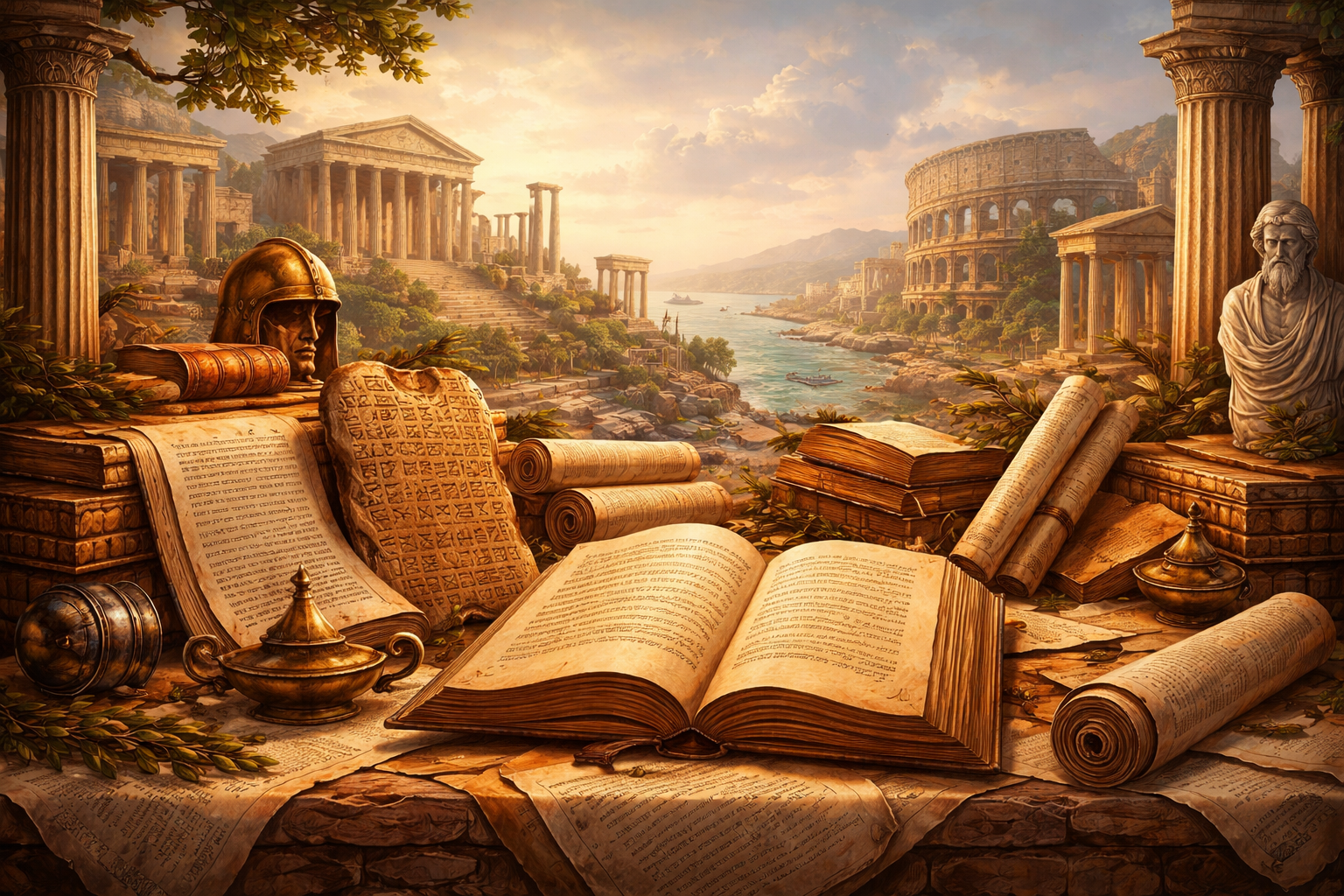
Read in this way, classical literature becomes more than literary history. It becomes a history of memory, authority, and recurrence. These works endured not only because later readers admired their form, but because later societies repeatedly found in them a repertoire of usable figures, conflicts, and symbolic patterns through which to think about republic and empire, law and revenge, war and mourning, exile and return, eros and discipline, civic virtue and corruption, mortality and fame. Classical texts survived because they carried structures of interpretation capable of outliving the worlds that first produced them. They became school texts, objects of commentary, models of style, repositories of exempla, sources of political reflection, and recurring points of return in moments of civilizational crisis, renewal, and reinterpretation.
Classical Literature and Civilizational Memory therefore stands at the intersection of literary history, political thought, intellectual history, religious history, educational history, and the history of cultural transmission. It concerns not only what the ancient world wrote, but how it remembered, curated, taught, translated, imitated, and argued with its own texts. It asks how literature becomes foundational, how canons are made, how memory is institutionalized, how narrative authority is inherited, and why certain works remain present long after the societies that first heard them have vanished.
Classical Literature as Civilizational Memory
Classical literature preserves the symbolic structures through which ancient societies narrated origins, authority, conflict, fate, law, kinship, exile, war, desire, public speech, political decline, and the hope for endurance beyond death. It is not a single tradition or a simple canon. It is a layered archive that begins with the deep literary inheritance of the ancient Near East and continues through Greek epic, lyric, tragedy, comedy, historiography, rhetoric, philosophy, Hellenistic scholarship, Roman republican and imperial literature, and the late antique transformations that carried classical forms into new religious and educational worlds.
The ancient literary archive is especially powerful because it binds beauty to memory. These works are not merely aesthetic objects. They are vehicles through which societies preserved exemplary actions, staged moral conflict, remembered catastrophe, instructed citizens, trained elites, disciplined grief, exposed corruption, and imagined the relationship between human beings and powers greater than themselves. Epic remembers war and return. Tragedy remembers the irreparable collision of duties. Comedy remembers the absurdity of civic life. Historiography remembers public time. Biography remembers character as political evidence. Rhetoric remembers speech as action. Philosophy remembers thought as dramatic inquiry and disciplined argument.
To study classical literature in this pillar is therefore to read ancient texts as literary works, historical artifacts, moral arguments, educational instruments, and civilizational memory systems. The goal is not to treat the classical world as timeless perfection. It is to understand how ancient literature preserved greatness and violence, beauty and hierarchy, wisdom and exclusion, freedom and slavery, civic order and imperial domination, grief and ambition, mortality and fame.
Why This Pillar Matters
Classical literature matters because it preserves some of the oldest and most influential narrative frameworks through which human beings interpreted power, suffering, heroism, law, public speech, political order, and the desire for lasting name. It records worlds in which speech could found cities, ruin households, redirect assemblies, win trials, justify war, or preserve the memory of the dead. It stages the tensions between personal honor and civic order, kinship and law, divine command and human agency, eros and discipline, conquest and grief.
This archive also matters because of its afterlife. Greek and Roman texts became foundational for later educational systems, political languages, religious debates, theories of eloquence, concepts of tragedy, standards of style, and models of historical narrative. Their authority persisted in libraries, schools, courts, monasteries, universities, translation projects, commentaries, anthologies, and humanist recoveries. Yet that persistence was never passive. Classical literature was repeatedly rearranged, excerpted, moralized, Christianized, contested, classicized, secularized, politicized, and retranslated.
For a Literature and Cultural Memory space, this pillar is foundational because it shows how texts become civilizational infrastructure. They are copied, taught, quoted, imitated, translated, criticized, and reactivated across centuries. Classical literature does not simply belong to the past. It shows how the past is preserved, transformed, and made available for later worlds.
Scope and Method
This pillar is intentionally broad. It includes the deeper ancient literary world that precedes and contextualizes Greece and Rome, especially Mesopotamian epic, royal memory, flood traditions, city laments, and wisdom literature. It includes the full range of Greek literary production from Homer and Hesiod through lyric, drama, historiography, rhetoric, philosophy, Hellenistic poetry, and prose fiction. It includes the major traditions of Roman literature from early adaptation and republican prose to Augustan poetry and imperial satire, historiography, biography, epigram, tragedy, and prose narrative. It also includes the institutional processes by which classical literature entered school curricula, commentary traditions, manuscript culture, humanist learning, philology, and civilizational canon.
The method throughout is to read literature as both art and memory structure. This means attending to genre, form, performance context, social function, political setting, and historical transmission. But it also means asking what these works were for. How did they preserve exemplary action? How did they narrate the founding or corruption of civic order? How did they teach speech, discipline grief, dignify ambition, expose vanity, or make mortality thinkable? How did they become texts to be quoted, memorized, copied, interpreted, and inherited?
By approaching classical literature as a memory system, this pillar connects epic to kingship, tragedy to law, lyric to social identity, satire to moral surveillance, biography to public exemplarity, rhetoric to civic education, and textual transmission to the making of civilizational continuity.
Foundational Questions
- How did ancient literature preserve civilizational origins, dynastic memory, civic ideals, and exemplary lives?
- What distinguishes epic, tragedy, lyric, comedy, historiography, rhetoric, biography, satire, and philosophical prose as different technologies of memory?
- How did the ancient Near Eastern archive shape early models of kingship, mortality, flood memory, lament, and heroic narrative?
- How do Greek and Roman texts negotiate war, exile, piety, eros, law, vengeance, empire, and decline?
- How did oral performance, scribal preservation, library culture, scholia, commentary, and school curricula shape what became “classical”?
- How did biography and historiography convert political action into durable moral judgment?
- Why did later societies repeatedly return to Homer, Sophocles, Plato, Virgil, Cicero, Ovid, Tacitus, and other classical authors in moments of crisis and renewal?
- How should classical literature be read alongside slavery, patriarchy, conquest, imperial violence, exclusion, and social hierarchy rather than above them?
- What does it mean for literature to outlive the institutions, cults, and polities that first produced it?
Reading Architecture for a Humanities Pillar
Unlike scientific, computational, or infrastructure-oriented pillars, this pillar does not require a GitHub repository. Its research infrastructure is textual, bibliographic, philological, and interpretive rather than code-based. The appropriate scholarly architecture consists of primary texts, reliable translations, critical editions, commentary traditions, reference works, university press scholarship, open classical libraries, and carefully organized reading pathways.
For this reason, the pillar is organized around humanities research practices: primary-text reading, genre analysis, historical contextualization, reception history, canon formation, transmission studies, comparative literary interpretation, and critical engagement with the politics of antiquity. The most important resources are not scripts or datasets, but editions, translations, ancient texts, commentaries, concordances, scholarly companions, and interpretive essays.
A strong Classical Literature and Civilizational Memory pillar should therefore foreground:
- primary texts in reliable translations or digital scholarly libraries;
- major genre pathways such as epic, tragedy, comedy, lyric, historiography, rhetoric, philosophy, satire, biography, and novelistic prose;
- historical sequence from ancient Near Eastern literature through Greek, Hellenistic, Roman, and late antique traditions;
- thematic memory structures such as war, exile, law, vengeance, mourning, glory, empire, desire, speech, mortality, and corruption;
- transmission history through oral culture, scribal culture, library culture, scholia, manuscripts, schools, Byzantine preservation, Renaissance humanism, and modern philology;
- critical attention to slavery, conquest, gender, hierarchy, violence, and exclusion within the classical archive.
I. Ancient Near Eastern Foundations and the Earliest Literary Memory
The Epic of Gilgamesh and the Origin of Story
A comprehensive pillar on classical literature should begin before the Greek and Roman canon. The Epic of Gilgamesh stands among the earliest surviving monuments of literary civilization and belongs at the threshold of any serious archive of civilizational memory. It gathers together themes that will remain central across later classical traditions: kingship and its excesses, friendship as the human answer to power, wilderness and the city, the confrontation with mortality, flood memory, divine-human tension, and the attempt to transform grief into narrative knowledge.
The importance of Gilgamesh lies not merely in chronological priority, but in formal and civilizational depth. The poem is already about inscription, transmission, and memory. It preserves a king not by praising conquest alone, but by turning his failures, friendship, fear, and insight into a durable literary object. In this sense, Gilgamesh is not only an ancient epic. It is an origin text for literature understood as the preservation of a civilization’s deepest anxieties and aspirations.
Broader Ancient Near Eastern Context
The Near Eastern literary world also includes royal inscriptions, flood traditions, lamentations, temple poetry, wisdom literature, and city laments that illuminate the prehistory of classical forms. These materials show that literature was bound early to kingship, divine legitimacy, scribal authority, ritual continuity, and the recording of catastrophe. Even when direct lines of influence remain complex or uncertain, the wider ancient archive demonstrates that heroic narrative, lament, dynastic memory, and sacred historiography existed long before the consolidation of Greek literary culture.
- The Epic of Gilgamesh and the Earliest Civilizational Imagination (planned) — A foundational article on kingship, mortality, friendship, inscription, and the transformation of grief into story.
- Mortality, Friendship, and the Search for Endurance in Gilgamesh (planned) — A close reading of human finitude, heroic failure, and the desire for lasting name.
- Flood Memory and Narrative Survival in the Ancient Near East (planned) — An article on flood traditions, catastrophe, divine judgment, and the preservation of memory across cultures.
- Kingship, City, and Sacred Order in Mesopotamian Literature (planned) — A study of royal authority, city-building, divine legitimacy, and literary preservation.
- The Origin of Story: Epic, Inscription, and the First Literary Civilizations (planned) — A broader introduction to writing, memory, and early literary consciousness.
- Lamentation, Catastrophe, and the Memory of Cities in the Ancient Near East (planned) — An article on city laments, loss, ritual memory, and the literary preservation of ruin.
II. Greek Archaic Literature: Epic, Genealogy, and Song
Homer and the Monument of Heroic Memory
The Greek literary archive begins in monumental form with Homer. The Iliad and the Odyssey are not simply founding texts of Greek literature; they are vast acts of memory in which war, rage, honor, suffering, cunning, return, and the fragile restoration of order are transformed into durable song. The Iliad centers on wrath and mortality. It asks what heroic glory means in a world where even the greatest warrior must die, and where the pursuit of honor produces grief that exceeds any victory. The Odyssey, by contrast, turns toward wandering, return, disguise, household order, testing, and the long difficulty of becoming oneself again after catastrophe.
Together the poems establish a fundamental duality in classical memory: the memory of war and the memory of return. Homer also establishes literature as a site of civilizational self-description. The poems preserve social codes of hospitality, sacrifice, lament, martial valor, supplication, gift exchange, kingship, and household rule. They became central to Greek education, ethics, political rhetoric, philosophical criticism, and artistic imitation.
Hesiod and the Literature of Order, Labor, and Descent
Hesiod complements Homer by turning literary attention toward genealogy, cosmic succession, agrarian life, justice, labor, and the burdens of ordinary existence. The Theogony maps the birth of divine order and the succession of powers that establish a cosmos. Works and Days shifts toward the discipline of labor, the instability of justice, the violence of social competition, and the temporality of the agricultural year. Hesiod’s world is harsher, more didactic, and more explicitly concerned with moral economy than Homer’s. It reminds us that classical literature is not only aristocratic heroism, but also instruction, complaint, and the ordering of life under necessity.
Archaic Lyric and the Memory of the Performed Voice
Greek lyric opens another domain of memory: the short, intense, situational preservation of voice. Sappho transforms eros, longing, absence, and recollection into some of antiquity’s most powerful fragmentary speech. Alcaeus binds lyric to political conflict, faction, aristocratic identity, and exile. Archilochus introduces a more abrasive and unstable poetic self, marked by invective, emotional fracture, and anti-heroic self-presentation. Pindar elevates praise poetry into a meditation on lineage, victory, mortal brilliance, and the dangerous nearness of excess. In lyric, the classical world preserves not monumental narrative alone, but also the vulnerable textures of desire, occasion, and social performance.
- The Iliad and the Tragedy of Heroic Honor (planned) — A reading of wrath, honor, grief, and the moral cost of heroic glory.
- The Odyssey and the Poetics of Return (planned) — A study of wandering, disguise, household restoration, and the difficult return to identity.
- Wrath, Mortality, and Fame in Homeric Epic (planned) — A thematic article on death, renown, lament, and heroic memory.
- Women, Captivity, and Grief in the Homeric World (planned) — A critical article on captive women, mourning, household vulnerability, and the hidden cost of war.
- Hospitality, Strangerhood, and Moral Testing in the Odyssey (planned) — A study of xenia, recognition, disguise, and social judgment.
- Hesiod’s Theogony and the Ordering of Divine Power (planned) — An article on cosmic succession, genealogy, and divine sovereignty.
- Works and Days: Justice, Labor, and the Harshness of Human Life (planned) — A reading of labor, moral economy, and ordinary necessity.
- The Epic Cycle and the Lost Worlds Around Troy (planned) — An article on lost epic, fragmentary memory, and the wider Trojan tradition.
- Sappho and the Literature of Desire, Fragment, and Remembrance (planned) — A reading of eros, lyric intensity, and fragmentary survival.
- Alcaeus, Aristocratic Politics, and Exilic Song (planned) — A study of faction, exile, song, and political identity.
- Archilochus and the Fractured Poetic Self (planned) — An article on invective, anti-heroic voice, and lyric instability.
- Pindar and the Poetics of Mortal Greatness (planned) — A study of victory, praise, lineage, mortality, and excess.
- Elegy, Symposium, and the Social Worlds of Archaic Poetry (planned) — An article on performance, sociability, instruction, and aristocratic memory.
III. Greek Drama and the Civic Imagination
Tragedy as the Public Memory of Conflict
Greek tragedy is one of the central literary inventions of the classical world because it converts inherited myth into civic thought. Performed before the polis, tragedy transforms legendary material into an arena for reflecting on law, kingship, piety, vengeance, family obligation, civic order, prophecy, and the limits of human agency. Aeschylus gives tragic form to deep structures of curse, succession, blood guilt, and the transition from private retaliation to institutional judgment. Sophocles refines tragedy into concentrated confrontations between conscience and rule, knowledge and blindness, loyalty and ruin. Euripides makes tragedy more unsettling still, amplifying the suffering of women, foreigners, captives, and the defeated, while exposing the cruelty embedded in heroic and civic ideals.
Tragedy matters to civilizational memory because it preserves conflict without dissolving it into simple moral instruction. It stages worlds in which right contends with right, law with duty, state with kinship, and survival with honor. It is one of antiquity’s most durable forms because it refuses easy reconciliation while still insisting on public reckoning.
Comedy and the Self-Critique of the City
Greek comedy, especially in Aristophanes, preserves another indispensable dimension of the classical archive: the right of the city to laugh at itself. Comedy exposes war-making, demagoguery, legal obsession, philosophical fashion, class pretension, and erotic disorder through fantasy, parody, inversion, obscene exuberance, and public play. In Aristophanes, the civic body is absurd as well as serious. Later New Comedy, above all in Menander, turns more toward domestic life, social negotiation, and recognizable character, widening the range of what classical literature remembers about everyday life.
- Aeschylus and the Invention of Tragic Justice (planned) — A study of curse, blood guilt, divine order, and civic judgment.
- The Oresteia: Blood, Law, and the Birth of Civic Judgment (planned) — A reading of vengeance, institutional justice, and the transition from household violence to public order.
- Prometheus Bound and the Drama of Cosmic Power (planned) — An article on defiance, suffering, sovereignty, and divine authority.
- Sophocles and the Tragedy of Human Limits (planned) — A study of knowledge, blindness, obedience, dignity, and ruin.
- Antigone, Burial, and the Conflict Between Kinship and State (planned) — A reading of law, burial, conscience, and political authority.
- Oedipus Tyrannus and the Ruinous Search for Truth (planned) — An article on knowledge, fate, identity, and tragic recognition.
- Philoctetes, Isolation, and the Ethics of Need (planned) — A study of abandonment, injury, persuasion, and moral obligation.
- Euripides and the Fracturing of Heroic Ideals (planned) — A study of critique, suffering, foreignness, gender, and civic violence.
- Medea, Foreignness, and the Violence of Speech (planned) — A reading of exile, marriage, gendered rage, and rhetorical power.
- The Trojan Women and the Memory of Defeat (planned) — An article on captivity, mourning, imperial violence, and defeated voices.
- Bacchae and the Return of the Unmastered Sacred (planned) — A study of Dionysian power, rational control, and sacred excess.
- Greek Tragedy as a Civic Memory Machine (planned) — A synthetic article on tragedy, performance, myth, and public memory.
- Aristophanes and the Comic Critique of Democratic Athens (planned) — A study of laughter, politics, war, gender, and civic self-mockery.
- War, Ridicule, and Fantasy in Old Comedy (planned) — An article on comic inversion, public speech, and political imagination.
- Menander and the Social Intelligence of New Comedy (planned) — A study of domestic order, recognition, character, and social negotiation.
IV. Greek Prose: History, Rhetoric, Philosophy, and Narrative
Historiography and the Writing of Public Time
Greek prose expands literature into inquiry, analysis, memory, and judgment. Herodotus joins ethnography, travel narrative, divine reflection, imperial conflict, and the Persian Wars into a capacious meditation on custom, power, and human reversal. Thucydides hardens historical prose into a severe analysis of fear, interest, rhetoric, plague, civil strife, and strategic calculation. Xenophon moves across history, memoir, leadership writing, and philosophical portrait. Together, these authors created enduring models for narrating public time, imperial encounter, political decay, and the relationship between speech and action.
Rhetoric and Democratic Speech
The Attic orators preserve speech as civic event and literary artifact. In the assembly, the courts, and the funeral oration, language becomes one of the primary media through which classical society remembers itself. Demosthenes, Lysias, Isocrates, and others show how prose style, persuasion, accusation, praise, and political urgency can themselves become part of the literary canon. Rhetoric is not peripheral to classical literature; it is one of the key ways the classical world transformed public argument into enduring text.
Philosophy as Literary Form
Greek philosophy also belongs within literary history. Plato’s dialogues are dramatic, dialogic, ironic, and myth-bearing works of prose in which character, setting, memory, and argument are inseparable. Aristotle’s treatises are less dramatic, but foundational for later theories of rhetoric, poetics, ethics, politics, and knowledge. Later philosophical schools likewise shaped prose style and intellectual memory. Classical literature includes not only song and drama, but sustained argumentative form.
Greek Prose Fiction and Narrative Expansion
The later Greek world also produced prose narratives, romances, satirical dialogues, and fictionalized travel or transformation that extended the possibilities of classical storytelling beyond epic and tragedy. Lucian’s satirical intelligence, along with the Greek romances of Chariton, Longus, Heliodorus, and Achilles Tatius, reveals a literary culture capable of irony, adventure, erotic plotting, narrative self-awareness, and transregional imagination.
- Herodotus and the Invention of Civilizational Inquiry (planned) — A study of custom, empire, travel, ethnography, and historical memory.
- Thucydides and the Tragic Logic of Power (planned) — An article on fear, interest, plague, rhetoric, civil strife, and political realism.
- The Peloponnesian War and the Collapse of Political Language (planned) — A reading of speech, faction, crisis, and civic dissolution.
- Xenophon: Leadership, Memory, and the Uses of History (planned) — A study of command, retreat, memoir, and practical ethics.
- Demosthenes and the Crisis of the Polis (planned) — An article on rhetoric, political urgency, and civic defense.
- Lysias, Isocrates, and the Literary Life of Civic Speech (planned) — A study of forensic rhetoric, education, persuasion, and prose style.
- Plato’s Dialogues as Philosophical Literature (planned) — A reading of drama, irony, setting, character, and argument.
- Myth, Irony, and Memory in Plato (planned) — An article on philosophical myth, recollection, and literary form.
- Aristotle’s Poetics and the Theory of Tragic Form (planned) — A study of tragedy, imitation, plot, recognition, and catharsis.
- Aristotle’s Rhetoric and the Ethics of Persuasion (planned) — An article on persuasion, civic speech, emotion, character, and judgment.
- Lucian and the Satirical Intelligence of Greek Prose (planned) — A study of parody, skepticism, dialogue, and imperial Greek literary play.
- Greek Romance and the Expansion of Classical Narrative (planned) — An article on adventure, eros, travel, recognition, and narrative expansion.
- Longus, Heliodorus, and the Afterlife of Classical Storytelling (planned) — A study of pastoral, romance, religious wonder, and late narrative form.
V. Hellenistic Literature and the Scholarly Ordering of the Past
Hellenistic literature is essential to this pillar because it marks a civilizational turn from primary composition alone toward literary self-consciousness, curation, scholarship, and allusive refinement. In Alexandria and related centers, poetry becomes acutely aware of library culture, textual criticism, editorial labor, and the burden of writing after Homer. Callimachus privileges learned precision, miniature form, and anti-monumental poetics. Apollonius of Rhodes reimagines epic in a more psychologically intricate and erudite mode. Theocritus invents pastoral as a literary space of stylized rurality and song. Epigram flourishes as a compact form of memory, wit, memorialization, and aesthetic compression.
The Hellenistic period matters because it actively organizes the literary past. It is one of the great eras of canon-making, editing, commentary, classification, and scholastic inheritance. Here, antiquity begins not only to create literature, but to manage and curate literature as tradition.
- Callimachus and the Poetics of Learned Refinement (planned) — A study of miniaturism, erudition, anti-monumentality, and literary self-consciousness.
- Apollonius of Rhodes and Epic After Homer (planned) — An article on the Argonautica, psychological epic, and Alexandrian inheritance.
- Theocritus and the Literary Invention of Pastoral (planned) — A study of stylized rurality, song, desire, and literary landscape.
- Hellenistic Epigram and the Art of Compression (planned) — An article on wit, memorialization, brevity, and aesthetic concentration.
- Alexandria, Libraries, and the Scholarly Ordering of the Classical Past (planned) — A study of libraries, editors, grammarians, and the institutional life of literature.
- Allusion, Erudition, and the Burden of Inheritance in Hellenistic Poetry (planned) — An article on writing after Homer and the learned management of tradition.
VI. Roman Republican Literature and the Formation of Latin Cultural Memory
Adaptation, Translation, and Roman Distinctiveness
Roman literature begins in profound dialogue with Greek precedent, but quickly develops a distinctive Latin voice shaped by law, civic competition, aristocratic memory, republican debate, and military expansion. Early Roman literary culture is a culture of adaptation and translation, but also of self-definition. Plautus and Terence rework Greek comedy into Roman theatrical language, social sharpness, and urban immediacy. Ennius contributes to the formation of a Roman historical voice. Lucilius lays the foundation for Roman satire, one of Latin literature’s most enduring innovations.
Late Republican Crisis and Literary Self-Understanding
The late Republic produces a literature of extraordinary intensity because political instability, elite rivalry, and constitutional breakdown sharpen questions of speech, virtue, ambition, and the public good. Cicero turns oratory, correspondence, philosophical prose, and political reflection into monuments of republican self-consciousness. Catullus compresses eros, wit, injury, grief, friendship, and urban performance into lyric intensity. Lucretius composes one of the ancient world’s most ambitious didactic poems, using poetic form to think through atomism, sensation, mortality, fear, and release from superstition. In republican Rome, literature becomes inseparable from the crisis of the polity.
- Plautus and the Comic Energy of Early Latin Literature (planned) — A study of performance, social inversion, urban comedy, and Roman adaptation.
- Terence and the Ethics of Social Recognition (planned) — An article on comedy, character, social perception, and moral ambiguity.
- Ennius and the Historical Voice of Rome (planned) — A study of Roman epic, national memory, and literary self-definition.
- Lucilius and the Origins of Roman Satire (planned) — An article on satire, moral aggression, social criticism, and Roman distinctiveness.
- Cicero: Eloquence, Republic, and the Literature of Political Crisis (planned) — A study of oratory, statesmanship, prose style, and republican collapse.
- Cicero’s Letters and the Texture of Republican Collapse (planned) — An article on correspondence, anxiety, ambition, friendship, and political breakdown.
- Cicero’s Philosophical Prose and the Roman Reception of Greek Thought (planned) — A study of translation, philosophical adaptation, and Latin intellectual culture.
- Catullus and the Poetics of Desire, Injury, and Urban Intimacy (planned) — A reading of erotic vulnerability, insult, friendship, and lyric self-fashioning.
- Lucretius and the Epic of Nature, Fear, and Freedom (planned) — A study of atomism, mortality, superstition, and philosophical poetry.
- Didactic Poetry and the Roman Reordering of Knowledge (planned) — An article on poetry as instruction, cosmology, agriculture, and intellectual form.
VII. Augustan Literature and the Poetics of Founding, Order, and Empire
Augustan literature is one of the most consequential literary constellations in world history because it joins aesthetic brilliance to civilizational refounding. Here literature becomes one of the principal media through which Rome narrates itself after republican collapse. Virgil’s Aeneid transforms epic into a meditation on exile, destiny, sacrifice, mourning, violence, and the terrible burden of political foundation. The Georgics turns agriculture, labor, order, and loss into a meditation on cultivation as civilizational repair. Horace combines lyric, satire, and epistolary reflection to articulate balance, measure, patronage, moral self-fashioning, and public voice. Propertius and Tibullus reshape elegy into a literature of desire, refusal, delicacy, and urban intimacy. Ovid simultaneously inherits and destabilizes Augustan order through erotic play, metamorphic narrative, mythic proliferation, and exile writing.
This cluster deserves comprehensive treatment because it is here that Roman literature most fully becomes an archive of political settlement and symbolic self-authorization, while also preserving critique, ambivalence, and fracture within imperial form.
- Virgil’s Aeneid and the Burden of Founding (planned) — A study of exile, destiny, violence, sacrifice, and Roman foundation.
- Aeneas, Pietas, and the Ethics of Roman Destiny (planned) — An article on duty, loss, divine command, and political identity.
- Dido, Desire, and the Human Cost of Empire (planned) — A reading of love, abandonment, gender, empire, and historical necessity.
- Turnus, Violence, and the Moral Ambiguity of Victory (planned) — A study of final combat, justice, rage, and imperial cost.
- The Georgics and the Poetics of Labor, Land, and Restoration (planned) — An article on cultivation, loss, agriculture, and civilizational repair.
- Horace: Lyric Measure, Public Voice, and Moral Form (planned) — A study of lyric balance, public identity, patronage, and ethical restraint.
- Horatian Satire and the Social Ethics of Urban Rome (planned) — An article on self-correction, moderation, ridicule, and urban social life.
- Propertius and the Elegiac Rewriting of Roman Masculinity (planned) — A study of love, refusal, politics, and poetic self-fashioning.
- Tibullus and the Imagined Simplicity of Elegiac Retreat (planned) — An article on desire, rural fantasy, peace, and poetic withdrawal.
- Ovid’s Metamorphoses and the Endless Life of Myth (planned) — A study of transformation, violence, desire, narrative abundance, and mythic memory.
- Ovid, Desire, Power, and the Narrative Politics of Transformation (planned) — A critical article on metamorphosis, gender, speech, and power.
- Ovid in Exile: Memory, Punishment, and Displacement (planned) — A reading of exile poetry, loss, imperial authority, and literary survival.
VIII. Imperial Rome: Power, Character, Satire, and Historical Judgment
Historiography and the Moral Record of Empire
Imperial Roman literature preserves not only triumph, but corrosion. Sallust, though rooted in the late Republic, establishes a style of compressed moral diagnosis that echoes into later historiography. Livy narrates Rome’s origins and early growth as a vast moral-historical archive. Tacitus produces perhaps the sharpest literature of power in antiquity, registering fear, spectacle, suspicion, silence, compromised virtue, and the psychological deformities of autocracy. These writers are not neutral chroniclers. They convert political history into enduring moral perception.
Suetonius and the Biographical Theater of Rule
Suetonius’ The Twelve Caesars requires central place in this pillar because it demonstrates how biography can become one of the strongest engines of civilizational memory. Suetonius does not narrate empire primarily through constitutional analysis or battlefield sequence. He narrates rulers through habits, gestures, scandals, sayings, appetites, cruelties, administrative practices, omens, bodily details, sexual rumor, ceremonial conduct, and death scenes. Julius Caesar, Augustus, Tiberius, Caligula, Claudius, Nero, Galba, Otho, Vitellius, Vespasian, Titus, and Domitian survive in cultural memory partly because Suetonius turned imperial power into narratable character. His work demonstrates that historical memory often endures less through institutional exposition than through vivid personhood, anecdote, and judgment.
Satire, Epigram, and the Imperial Everyday
Rome also developed unrivaled diagnostic forms for everyday imperial life. Juvenal’s satires record resentment, disgust, class anxiety, corruption, pretension, and urban overload in a literature of fierce moral compression. Persius condenses Stoic seriousness into difficult satirical form. Martial’s epigrams preserve the city as a field of sharp miniatures: patronage, insult, intimacy, gift exchange, self-display, and survival. Petronius and Apuleius widen Latin prose into grotesque realism, comic excess, wonder, transformation, and religious experimentation. Seneca joins tragedy, philosophical prose, and courtly proximity into a literature of interiority and danger. These authors make the empire visible not only through public history, but through style, vice, wit, and social texture.
- Sallust and the Moralization of Political Crisis (planned) — A study of corruption, ambition, compressed style, and republican decay.
- Livy and the Narrative Construction of Roman Greatness (planned) — An article on origins, exempla, virtue, expansion, and historical memory.
- Tacitus and the Literature of Fear Under Empire (planned) — A study of autocracy, silence, surveillance, suspicion, and moral judgment.
- The Annals and Histories: Silence, Suspicion, and Imperial Power (planned) — A reading of imperial narrative, fear, rumor, and compromised virtue.
- Suetonius’ The Twelve Caesars and the Biographical Memory of Rome (planned) — A study of imperial character, anecdote, scandal, and durable historical image.
- Julius Caesar, Augustus, and the Architecture of Imperial Character (planned) — An article on biography, foundation, authority, and memory.
- Tiberius, Caligula, Claudius, and Nero in the Theater of Suetonian Memory (planned) — A reading of rumor, spectacle, cruelty, eccentricity, and imperial personhood.
- Biography, Scandal, and the Politics of Detail in The Twelve Caesars (planned) — A study of detail, gossip, moral evidence, and political memory.
- Plutarch’s Parallel Lives and the Comparative Ethics of Greatness (planned) — An article on biography, moral comparison, Greek and Roman exemplarity.
- Seneca: Stoic Prose, Tragic Intensity, and the Court of Nero (planned) — A study of philosophy, power, danger, and self-command.
- Senecan Tragedy and the Theater of Excess (planned) — An article on violence, passion, rhetoric, and imperial imagination.
- Juvenal and the Moral Fury of Roman Satire (planned) — A study of indignation, urban disorder, class anxiety, and moral aggression.
- Persius and the Compression of Ethical Voice (planned) — An article on Stoic satire, difficulty, and compressed moral speech.
- Martial and the Epigrammatic City (planned) — A study of patronage, insult, wit, survival, and urban miniature.
- Petronius and the Grotesque Social World of the Satyricon (planned) — An article on parody, luxury, freedmen, vulgarity, and narrative disorder.
- Apuleius’ The Golden Ass and the Comic-Sacred Imagination (planned) — A study of transformation, curiosity, magic, religion, and narrative play.
IX. Late Antique Transition and the Transformation of Classical Memory
A strongest-sense pillar should not end abruptly with the high empire. Classical literature survived because late antiquity transformed it. Authors such as Augustine, Jerome, Macrobius, Boethius, Martianus Capella, and others re-situated the classical inheritance within Christian, encyclopedic, pedagogical, and philosophical frameworks. The boundaries of “classical literature” become more porous here, but the transition is essential. Late antique readers excerpted, moralized, allegorized, and reclassified the ancient archive, ensuring that parts of it would enter medieval education and survive the institutional collapse of the western empire.
This period matters because it shows that civilizational memory is not static preservation. It is active reinterpretation under new metaphysical, political, and educational conditions. The classical world survived not by remaining untouched, but by being repurposed.
- Late Antiquity and the Reordering of the Classical Inheritance (planned) — A study of transformation, Christianization, commentary, and educational survival.
- Augustine Between Classical Rhetoric and Christian Memory (planned) — An article on rhetoric, conversion, memory, and the reorientation of classical form.
- Boethius and the Philosophical Afterlife of Rome (planned) — A reading of consolation, philosophy, imprisonment, and late Roman memory.
- Macrobius, Commentary, and the Preservation of Literary Authority (planned) — A study of commentary, allegory, learned preservation, and late antique reading.
- How Classical Literature Entered the Medieval Schoolroom (planned) — An article on grammar, curriculum, manuscript transmission, and educational inheritance.
X. Major Genres Across the Classical Archive
The category also requires genre-level treatment, because genre is one of antiquity’s great organizational principles of memory. Epic monumentalizes origins, struggle, and civilizational destiny. Tragedy preserves irreparable conflict in public form. Comedy gives institutional self-ridicule to the city. Lyric captures intensity, ritual, praise, and longing. Elegy refines desire, loss, and refusal into a literature of inwardness. Satire surveils society morally through ridicule and compression. Historiography narrates public time and exemplary causation. Biography personalizes institutions through lives and character. Rhetoric teaches persuasion as a civic art. Philosophical prose makes inquiry durable through argument and form. The ancient novel expands narrative space into adventure, transformation, erotic testing, and religious wonder.
- Epic as Civilizational Archive (planned) — A genre article on origins, war, return, fate, and memory.
- Tragedy and the Memory of Irreparable Conflict (planned) — A study of law, kinship, obligation, suffering, and public reckoning.
- Comedy and the Political Imagination of Laughter (planned) — An article on ridicule, civic disorder, fantasy, and public self-critique.
- Lyric and the Preservation of Mortal Intensity (planned) — A study of voice, fragment, desire, praise, grief, and occasion.
- Elegy, Desire, and Refusal in the Classical World (planned) — An article on erotic subjectivity, resistance, vulnerability, and poetic retreat.
- Satire as Moral Surveillance (planned) — A study of ridicule, social diagnosis, vice, anger, and compressed judgment.
- Historiography and the Narrative of Public Time (planned) — An article on causation, empire, crisis, and historical prose.
- Biography and the Making of Exemplary Lives (planned) — A study of character, anecdote, moral comparison, and public memory.
- Rhetoric, Education, and the Formation of Civic Speech (planned) — An article on persuasion, public argument, oratory, and civic training.
- Philosophical Prose as Literary Form (planned) — A study of dialogue, treatise, myth, argument, and intellectual memory.
- The Ancient Novel and the Broadening of Classical Narrative (planned) — An article on romance, adventure, travel, transformation, and narrative expansion.
XI. Recurring Themes and Memory Structures
A comprehensive pillar should also organize the archive thematically. Across genres and centuries, certain civilizational structures recur: war and heroic renown; exile and homecoming; dynastic succession; law, vengeance, and the move toward civic adjudication; eros and household order; piety and sacrilege; city and wilderness; slavery and dependency; friendship and betrayal; imperial foundation and its victims; mortality and the desire for lasting name; mourning, burial, and the rights of the dead; rhetoric and the instability of public language; virtue and corruption; gendered constraint and voice.
These themes connect Gilgamesh to Homer, Homer to tragedy, tragedy to historiography, historiography to biography, and Roman empire-poetics to late antique memory work.
- War, Memory, and the Burden of Glory (planned) — A thematic article on battle, renown, grief, and heroic cost.
- Exile, Wandering, and the Long Desire for Return (planned) — A study of displacement, nostos, punishment, and memory.
- Law, Vengeance, and the Making of Civic Order (planned) — An article on retaliation, kinship, adjudication, and political institution.
- Eros, Marriage, and the Social Discipline of Desire (planned) — A study of erotic power, household order, gender, and social constraint.
- Mourning, Burial, and the Politics of the Dead (planned) — An article on grief, ritual, memory, and the rights of the dead.
- Empire, Foundation, and the Moral Cost of Rule (planned) — A study of conquest, sacrifice, destiny, and victims of greatness.
- Women, Constraint, and Speech in Classical Literature (planned) — A critical article on voice, gender, captivity, desire, and authority.
- Slavery, Servitude, and the Hidden Social Order of the Classical World (planned) — A necessary article on dependency, labor, household structure, and literary invisibility.
- Friendship, Loyalty, and the Fragility of Human Bonds (planned) — A study of attachment, betrayal, obligation, and memory.
- Fame, Mortality, and the Desire for Endurance (planned) — An article on death, name, inscription, song, and literary survival.
- Rhetoric, Deception, and the Vulnerability of Public Language (planned) — A study of persuasion, manipulation, civic speech, and political crisis.
- Virtue, Corruption, and the Memory of Political Decline (planned) — An article on moral diagnosis, republican loss, imperial fear, and historical judgment.
XII. Transmission, Canon Formation, and the Educational Life of Classical Literature
Classical literature became classical through institutions of transmission. Oral performance mattered in the earliest phases, but so did scribal stabilization, editorial labor, school curricula, commentaries, anthologies, quotations, epitomes, library catalogues, scholia, manuscript copying, and grammarian culture. The survival of Homer, tragedy, Cicero, Virgil, Horace, Ovid, Tacitus, and others was never inevitable. It depended on teachers, copyists, scholars, librarians, patrons, exegetes, and educational systems that selected some works for preservation while allowing others to fragment or disappear.
This institutional life is central to civilizational memory. The classical archive endured because it was taught. Children learned grammar from it. Orators imitated it. Philosophers critiqued it. Christian readers appropriated and censured it. Byzantine scholars copied and commented on it. Renaissance humanists recovered, edited, and elevated it anew. Modern philology stabilized texts, reconstructed fragments, and reframed classical studies under new scholarly conditions. Canon formation is therefore not secondary to classical literature. It is part of its very meaning.
- How the Classical Canon Was Made (planned) — A study of selection, survival, loss, education, and authority.
- Schools, Grammar, and the Educational Life of Ancient Texts (planned) — An article on pedagogy, memorization, imitation, and elite formation.
- Alexandrian Scholarship and the Editing of Classical Memory (planned) — A study of libraries, textual criticism, scholarship, and canon formation.
- Scholia, Commentary, and the Ancient Reading Tradition (planned) — An article on marginal commentary, interpretation, and scholarly transmission.
- Translation, Adaptation, and the Passage from Greek to Latin (planned) — A study of imitation, Romanization, translation, and cultural transfer.
- Byzantium and the Survival of Greek Literary Culture (planned) — An article on manuscript preservation, scholarship, and the eastern afterlife of Greek texts.
- Humanism, Printing, and the Reassembly of the Classical Archive (planned) — A study of Renaissance recovery, print culture, and classical authority.
- Why Civilizations Return to Foundational Texts (planned) — A synthetic article on recurrence, crisis, memory, and canon.
Expanded Article Architecture
The following structure gathers the pillar into a long-range architecture suitable for a major literature and cultural memory knowledge series. It is designed to support canonical authors, primary works, genre-level synthesis, thematic essays, and transmission history. All entries below should be treated as planned unless already completed elsewhere on the site.
Origins and Ancient Near Eastern Foundations
- The Epic of Gilgamesh and the Earliest Civilizational Imagination (planned)
- Mortality, Kingship, and Friendship in Gilgamesh (planned)
- Flood Memory and Narrative Survival in the Ancient Near East (planned)
- Lamentation and the Memory of Destroyed Cities (planned)
- The Origin of Story in the First Literary Civilizations (planned)
- Kingship, City, and Sacred Order in Mesopotamian Literature (planned)
- Wisdom Literature and the Moral Instruction of Ancient Civilizations (planned)
- Royal Inscription, Divine Legitimacy, and the Literary Memory of Power (planned)
Greek Epic and Archaic Literature
- The Iliad and the Tragedy of Heroic Honor (planned)
- The Odyssey and the Poetics of Return (planned)
- Wrath, Mortality, and Fame in Homeric Epic (planned)
- Homeric Lament and the Memory of War (planned)
- Women, Captivity, and Grief in the Homeric World (planned)
- Hospitality, Strangerhood, and Moral Testing in the Odyssey (planned)
- Hesiod’s Theogony and the Ordering of Divine Power (planned)
- Works and Days and the Moral Economy of Human Labor (planned)
- The Epic Cycle and the Lost Trojan Archive (planned)
- Sappho and the Literature of Desire (planned)
- Alcaeus, Exile, and Political Song (planned)
- Archilochus and the Anti-Heroic Voice (planned)
- Pindar and the Praise of Mortal Greatness (planned)
- Elegy, Symposium, and the Social Worlds of Archaic Poetry (planned)
Greek Drama
- Aeschylus and the Invention of Tragic Justice (planned)
- The Oresteia and the Passage from Blood to Law (planned)
- Prometheus Bound and the Drama of Cosmic Power (planned)
- Sophocles and the Tragedy of Human Limits (planned)
- Antigone and the Politics of Burial (planned)
- Oedipus Tyrannus and the Ruin of Knowledge (planned)
- Philoctetes, Isolation, and the Ethics of Need (planned)
- Euripides and the Fracturing of Heroic Ideals (planned)
- Medea and the Violence of Exclusion (planned)
- The Trojan Women and the Literature of Defeat (planned)
- Bacchae and the Return of Sacred Excess (planned)
- Greek Tragedy as a Civic Memory Machine (planned)
- Aristophanes and the Self-Mockery of Democratic Athens (planned)
- War, Ridicule, and Fantasy in Old Comedy (planned)
- Menander and the Social World of New Comedy (planned)
Greek Prose and Intellectual Literature
- Herodotus and the Invention of Civilizational Inquiry (planned)
- Thucydides and the Tragic Logic of Power (planned)
- The Peloponnesian War and the Collapse of Political Language (planned)
- Xenophon and the Literature of Leadership (planned)
- Demosthenes and the Crisis of Civic Speech (planned)
- Lysias, Isocrates, and the Literary Life of Civic Speech (planned)
- Plato’s Dialogues as Philosophical Literature (planned)
- Myth, Irony, and Memory in Plato (planned)
- Aristotle’s Poetics and the Theory of Tragedy (planned)
- Aristotle’s Rhetoric and the Ethics of Persuasion (planned)
- Lucian and the Satirical Intelligence of Greek Prose (planned)
- Greek Romance and the Expansion of Classical Narrative (planned)
Hellenistic Literature
- Callimachus and Learned Poetics (planned)
- Apollonius of Rhodes and Epic After Homer (planned)
- Theocritus and the Invention of Pastoral (planned)
- Hellenistic Epigram and the Art of Literary Compression (planned)
- Alexandria, Libraries, and the Scholarly Ordering of the Past (planned)
- Allusion, Erudition, and the Burden of Inheritance in Hellenistic Poetry (planned)
Roman Republican Literature
- Plautus and the Comic Energies of Rome (planned)
- Terence and the Ethics of Recognition (planned)
- Ennius and the Historical Voice of the Republic (planned)
- Lucilius and the Birth of Roman Satire (planned)
- Cicero and the Literature of the Republic (planned)
- Cicero’s Letters and the Texture of Collapse (planned)
- Cicero’s Philosophical Prose and the Roman Reception of Greek Thought (planned)
- Catullus and the Poetics of Urban Intimacy (planned)
- Lucretius and the Epic of Nature (planned)
- Didactic Poetry and the Roman Reordering of Knowledge (planned)
Augustan Literature
- Virgil’s Aeneid and the Burden of Founding (planned)
- Aeneas, Pietas, and Roman Destiny (planned)
- Dido and the Human Cost of Empire (planned)
- Turnus, Violence, and the Moral Ambiguity of Victory (planned)
- The Georgics and the Poetics of Labor and Land (planned)
- Horace and the Art of Measure (planned)
- Horatian Satire and Urban Moral Form (planned)
- Propertius and the Rewriting of Roman Desire (planned)
- Tibullus and the Elegiac Retreat (planned)
- Ovid’s Metamorphoses and the Endless Life of Myth (planned)
- Ovid, Desire, Power, and the Narrative Politics of Transformation (planned)
- Ovid in Exile (planned)
Imperial Rome
- Sallust and the Moralization of Politics (planned)
- Livy and the Narrative Making of Roman Greatness (planned)
- Tacitus and the Literature of Fear (planned)
- The Annals and Histories: Silence, Suspicion, and Imperial Power (planned)
- Suetonius’ The Twelve Caesars and the Biographical Memory of Empire (planned)
- Plutarch’s Parallel Lives and Comparative Greatness (planned)
- Seneca’s Prose and the Ethics of Power (planned)
- Senecan Tragedy and Imperial Excess (planned)
- Juvenal and the Satirical Anatomy of Rome (planned)
- Persius and the Compression of Moral Voice (planned)
- Martial and the Epigrammatic City (planned)
- Petronius and the Social Grotesque (planned)
- Apuleius and the Comic-Sacred Imagination (planned)
Late Antique Transformation
- Late Antiquity and the Reordering of Classical Memory (planned)
- Augustine Between Classical Rhetoric and Christian Thought (planned)
- Boethius and the Philosophical Afterlife of Rome (planned)
- Macrobius, Commentary, and Literary Survival (planned)
- How Classical Literature Entered Medieval Education (planned)
Genres and Structures
- Epic as Civilizational Archive (planned)
- Tragedy and the Memory of Irreparable Conflict (planned)
- Comedy and the Political Imagination of Laughter (planned)
- Lyric and the Preservation of Human Intensity (planned)
- Elegy, Desire, and Refusal (planned)
- Satire as Moral Surveillance (planned)
- Historiography and the Narrative of Public Time (planned)
- Biography and the Making of Exemplary Lives (planned)
- Rhetoric and the Education of Civic Speech (planned)
- Philosophical Prose as Literary Form (planned)
- The Ancient Novel and Narrative Expansion (planned)
Major Themes
- War, Memory, and the Burden of Glory (planned)
- Exile, Wandering, and Return (planned)
- Law, Vengeance, and Political Order (planned)
- Eros, Marriage, and Social Discipline (planned)
- Mourning, Burial, and the Rights of the Dead (planned)
- Empire, Foundation, and the Victims of Greatness (planned)
- Women, Constraint, and Voice in Classical Literature (planned)
- Slavery and the Hidden Foundations of the Classical World (planned)
- Friendship, Loyalty, and Betrayal (planned)
- Mortality, Fame, and the Desire for Endurance (planned)
- Rhetoric, Deception, and the Fragility of Public Language (planned)
- Virtue, Corruption, and the Memory of Political Decline (planned)
Closing Perspective
Classical Literature and Civilizational Memory should be understood as a major archive of foundations, forms, institutions, and afterlives rather than as a narrow shelf of “great books.” Its range runs from the ancient Near Eastern roots of heroic and royal narrative through Homeric epic, archaic lyric, tragic Athens, Hellenistic scholarship, republican Roman eloquence, Augustan empire-poetics, Tacitean judgment, Suetonian biography, and the late antique transformations that carried the classical world into new religious and educational orders.
Read comprehensively, the category shows how literature preserves not only beauty or prestige, but the symbolic structures by which societies narrate power, grief, justice, desire, law, ruin, and endurance. It is therefore central to any serious understanding of how civilizations remember themselves. It reveals how foundational texts are made, how canons are curated, how institutions preserve authority, how later ages inherit and contest earlier worlds, and why certain stories continue to govern the cultural imagination long after the states, cults, and empires that first produced them have passed away.
Related Reading
- Literature & Cultural Memory
- Ancient Near Eastern Literature
- Greek Literature
- Roman Literature
- Philosophy
- Religious Studies
- Political Philosophy and Justice
Further Reading
- Greensmith, E. (ed.) (2024). The Cambridge Companion to Ancient Greek Epic. Cambridge: Cambridge University Press. https://www.cambridge.org/core/books/cambridge-companion-to-ancient-greek-epic/02CE746CC7011C7EE023C42770561E87
- Whitmarsh, T. (ed.) (2008). The Cambridge Companion to the Greek and Roman Novel. Cambridge: Cambridge University Press. https://www.cambridge.org/us/universitypress/subjects/classical-studies/classical-literature/cambridge-companion-greek-and-roman-novel?format=HB
- Sedley, D. (ed.) (2003). The Cambridge Companion to Greek and Roman Philosophy. Cambridge: Cambridge University Press. https://www.cambridge.org/us/universitypress/subjects/philosophy/classical-philosophy/cambridge-companion-greek-and-roman-philosophy?format=HB
- Wright, J. (ed.) (2017). The Cambridge Companion to Greek and Roman Classics. Cambridge: Cambridge University Press. https://www.cambridge.org/core/books/cambridge-companion-to-greek-and-roman-classics/3BE4D31F9A6AAFE3B9C88AF8E4E94510
- West, M. L. (1997). The East Face of Helicon: West Asiatic Elements in Greek Poetry and Myth. Oxford: Clarendon Press.
- George, A. (2003). The Babylonian Gilgamesh Epic: Introduction, Critical Edition and Cuneiform Texts. Oxford: Oxford University Press.
- Nagy, G. (n.d.). Homer. Washington, DC: Center for Hellenic Studies. https://chs.harvard.edu/tag/homer/
- Nagy, G. (n.d.). Bibliography for A Homer Commentary in Progress. Washington, DC: Center for Hellenic Studies. https://classical-inquiries.chs.harvard.edu/bibliography-for-ahcip/
- Beardsley, D. A. (n.d.). The Journey Back to Where You Are: Homer’s Odyssey as Spiritual Quest. Washington, DC: Center for Hellenic Studies. https://chs.harvard.edu/wp-content/uploads/2020/07/The-Journey-Back-To-Where-You-Are.pdf
- Segal, C. (1995). “Classics, Ecumenicism, and Greek Tragedy.” Arion. https://www.jstor.org/stable/284343
- McDonald, M. (2006). “War Then and Now: The Legacy of Ancient Greek Tragedy.” Arion. https://www.jstor.org/stable/23041623
- Szemerényi, O. (1975). “The Origins of Roman Drama and Greek Tragedy.” Harvard Studies in Classical Philology. https://www.jstor.org/stable/4475915
- Goldberg, S. M. (1996). “The Fall and Rise of Roman Tragedy.” Transactions of the American Philological Association. https://www.jstor.org/stable/370179
References
- Aeschylus (1926). Aeschylus, Volume I. Translated by H. Weir Smyth. Cambridge, MA: Harvard University Press. https://scaife.perseus.org/library/urn:cts:greekLit:tlg0085/
- Apollonius Rhodius (1912). The Argonautica. Translated by R. C. Seaton. Cambridge, MA: Harvard University Press. https://scaife.perseus.org/library/urn:cts:greekLit:tlg0545.tlg001/
- Aristophanes (1907). The Acharnians, The Clouds, The Knights, The Wasps. Translated by B. B. Rogers. London: G. Bell and Sons. https://classics.mit.edu/Aristophanes/clouds.html
- Aristotle (n.d.). Poetics. Medford, MA: Perseus Digital Library / Scaife Viewer. https://scaife.perseus.org/library/urn:cts:greekLit:tlg0086.tlg034.perseus-eng1/
- Aristotle (n.d.). Rhetoric. Medford, MA: Perseus Digital Library / Scaife Viewer. https://scaife.perseus.org/library/urn:cts:greekLit:tlg0086.tlg038.perseus-eng1/
- Catullus (1913). The Poems of Catullus. Translated by F. W. Cornish. Cambridge, MA: Harvard University Press. https://scaife.perseus.org/library/urn:cts:latinLit:phi0472.phi001/
- Cicero (n.d.). De Oratore. Medford, MA: Perseus Digital Library / Scaife Viewer. https://scaife.perseus.org/library/urn:cts:latinLit:phi0474.phi036/
- Euripides (n.d.). Medea. Medford, MA: Perseus Digital Library / Scaife Viewer. https://scaife.perseus.org/library/urn:cts:greekLit:tlg0006.tlg001/
- George, A. (2003). The Babylonian Gilgamesh Epic: Introduction, Critical Edition and Cuneiform Texts. 2 vols. Oxford: Oxford University Press.
- Herodotus (1920). The Histories. Translated by A. D. Godley. Cambridge, MA: Harvard University Press. https://scaife.perseus.org/library/urn:cts:greekLit:tlg0016.tlg001/
- Hesiod (1914). Theogony and Works and Days. Translated by H. G. Evelyn-White. Cambridge, MA: Harvard University Press. https://www.theoi.com/Text/HesiodTheogony.html
- Homer (1924–1925). The Iliad of Homer. Translated by A. T. Murray. Cambridge, MA: Harvard University Press. https://scaife.perseus.org/library/urn:cts:greekLit:tlg0012.tlg001.perseus-eng3/
- Homer (1919). The Odyssey with an English Translation by A. T. Murray. Cambridge, MA: Harvard University Press. https://scaife.perseus.org/library/urn:cts:greekLit:tlg0012.tlg002.perseus-eng1/
- Longus (1916). Daphnis and Chloe. Translated by G. Thornley, revised by J. M. Edmonds. Cambridge, MA: Harvard University Press. https://scaife.perseus.org/library/urn:cts:greekLit:tlg0561.tlg001/
- Lucretius (1851). On the Nature of Things. Translated by J. S. Watson. London: Henry G. Bohn. https://classics.mit.edu/Carus/nature_things.html
- Ovid (n.d.). Metamorphoses. Medford, MA: Perseus Digital Library / Scaife Viewer. https://scaife.perseus.org/library/urn:cts:latinLit:phi0959.phi006/
- Petronius (1913). Satyricon. Translated by M. Heseltine. Cambridge, MA: Harvard University Press. https://scaife.perseus.org/library/urn:cts:latinLit:phi0972.phi001/
- Plato (n.d.). Dialogues. Medford, MA: Perseus Digital Library / Scaife Viewer. https://scaife.perseus.org/library/urn:cts:greekLit:tlg0059/
- Plutarch (1914–1926). Lives. Translated by B. Perrin. Cambridge, MA: Harvard University Press. https://scaife.perseus.org/library/urn:cts:greekLit:tlg0007/
- Sappho (n.d.). Poems and Fragments. Medford, MA: Perseus Digital Library / Scaife Viewer. https://scaife.perseus.org/library/urn:cts:greekLit:tlg0008/
- Sophocles (1903). Antigone. London: Macmillan. https://classics.mit.edu/Sophocles/antigone.html
- Suetonius (1883). The Lives of the Twelve Caesars. Translated by A. Thomson, revised by J. E. Reed. Philadelphia: Gebbie & Co. https://scaife.perseus.org/library/urn:cts:latinLit:phi1348/
- Tacitus (1876). The Annals. Translated by A. J. Church and W. J. Brodribb. London: Macmillan. https://classics.mit.edu/Tacitus/annals.html
- Thucydides (1910). History of the Peloponnesian War. Translated by R. Crawley. London: J. M. Dent. https://classics.mit.edu/Thucydides/pelopwar.html
- Virgil (1900). The Bucolics, Aeneid, and Georgics of Virgil. Translated by J. B. Greenough. Boston, MA: Ginn & Co. https://scaife.perseus.org/library/urn:cts:latinLit:phi0690.phi003.perseus-eng2/
- West, M. L. (1997). The East Face of Helicon: West Asiatic Elements in Greek Poetry and Myth. Oxford: Clarendon Press.
- Xenophon (n.d.). Anabasis. Medford, MA: Perseus Digital Library / Scaife Viewer. https://scaife.perseus.org/library/urn:cts:greekLit:tlg0032.tlg001/