
Last Updated May 4, 2026
Socialism and socialist thought form one of the central constellations of political philosophy, organized around critiques of capitalism, opposition to domination and exploitation, and the aspiration to build social orders grounded in equality, solidarity, democratic power, and the subordination of economic life to human need rather than private accumulation. Socialism is not a single doctrine. It is a broad, internally contested family of traditions asking how economic and social institutions should be organized if freedom, equality, dignity, and human flourishing are to be shared rather than reserved for owners of property, inherited privilege, or concentrated power.
At its core lies a distinctive political question: what would it mean to democratize economic life? Socialist thought asks whether political democracy can be meaningful when workplaces, land, housing, finance, healthcare, infrastructure, data, and productive assets remain governed primarily by private accumulation, unequal bargaining power, and market dependence. It asks whether freedom is real where persons lack material security, whether equality can survive concentrated ownership, and whether social institutions can be organized around cooperation rather than domination.
Socialist thought emerged historically from the upheavals of industrial capitalism, mass dispossession, wage labor, class stratification, imperial expansion, colonial extraction, and the brutal asymmetries of modern economic development. Yet socialism soon became far more than a protest against misery or inequality. It developed into a rich and varied philosophy of labor, class, property, planning, democracy, cooperation, solidarity, production, distribution, alienation, emancipation, and historical change.
Early socialists imagined cooperative communities and moral alternatives to capitalist competition. Marx and Engels radicalized the tradition by linking capitalism to class struggle, exploitation, commodity production, alienation, and historically specific forms of domination. Later socialist thinkers expanded and contested the tradition through democratic socialism, social democracy, revolutionary communism, council socialism, Western Marxism, Maoism, African socialism, Latin American socialism, Cuban socialism, chavismo, Arab socialism, Palestinian left traditions, feminist socialism, ecological socialism, libertarian socialism, and contemporary democratic and pluralist socialist theory.
Current Space
Political Philosophy & Justice
Related Topic
Liberalism & Its Traditions
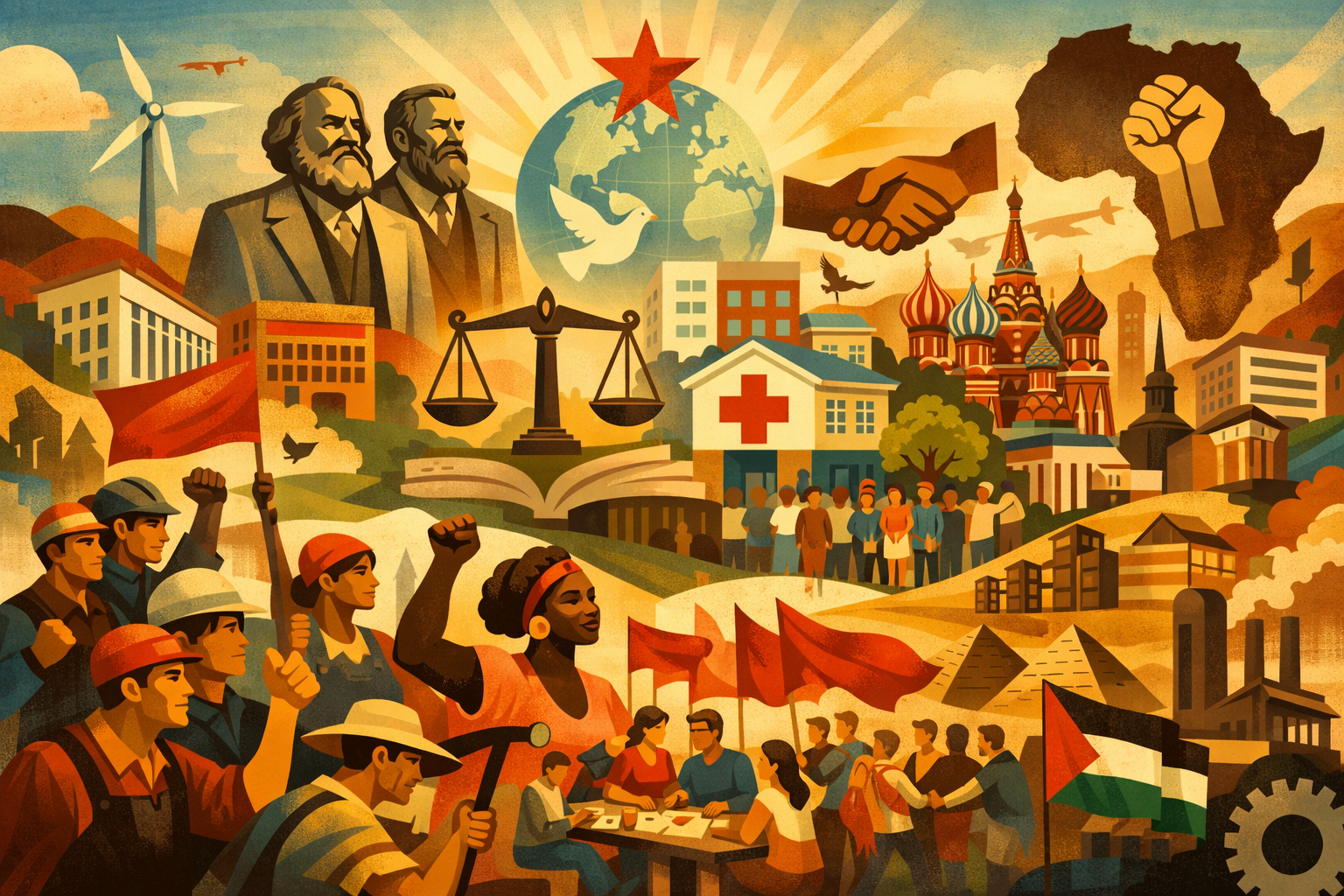
The significance of socialism extends far beyond the history of ideas. Socialist thought has shaped modern debates about class power, workplace democracy, labor rights, welfare states, public ownership, imperialism, racial capitalism, care, ecological crisis, democratic planning, land reform, housing, healthcare, and the limits of market society. It remains central not only to critiques of inequality but to broader disputes over whether capitalism is compatible with democracy, whether markets can be subordinated to justice, whether freedom is meaningful without material security, and whether collective control over economic life can be achieved without reproducing bureaucracy, authoritarianism, or new forms of domination.
The internal tensions of socialism appear almost immediately. Does socialism require the abolition of markets or only their deep subordination to democratic aims? Must productive property be held publicly, socially, cooperatively, municipally, or through mixed institutional forms? Is socialism best pursued through parliamentary reform, workplace organization, revolutionary rupture, national liberation struggle, democratic planning, mutualist association, or transnational transformation? Can collective ownership avoid bureaucratic hierarchy? Can equality be reconciled with pluralism, experimentation, and freedom of dissent? How should socialist politics confront patriarchy, racism, settler colonialism, caste hierarchy, ecological breakdown, and the failures of twentieth-century state socialism?
This article pillar is part of the broader Political Philosophy and Justice knowledge series. It moves from early socialist critique and Marxist foundations through democratic socialism, social democracy, revolutionary socialism, libertarian socialism, Maoism, Eastern European experiments, African socialism, Latin American and Cuban socialism, chavismo, Arab socialism, Palestinian left traditions, anti-colonial and feminist socialism, eco-socialism, and contemporary debates over planning, labor, technology, care, ecology, public health, and democratic ownership. It is designed to provide both conceptual orientation and a rigorous article architecture for future essays on socialist theory, its internal traditions, its global transformations, and its most powerful critics.
Why Socialism Matters
Socialism matters because it has been one of the most powerful and enduring traditions for analyzing how economic power shapes freedom, citizenship, social hierarchy, and the actual conditions of collective life. Where liberal thought often begins with rights, consent, and limits on political coercion, socialist thought insists that formally equal rights may coexist with profound material dependence, domination in the workplace, insecurity in housing and healthcare, and structural subordination rooted in property relations. Socialism therefore asks whether political democracy can be meaningful when economic life remains organized through concentrated ownership, profit imperatives, extraction, and unequal bargaining power.
It also matters because socialism is internally diverse in ways that remain politically and philosophically consequential. One socialist tradition emphasizes abolition or deep transformation of private ownership of the means of production. Another emphasizes robust welfare institutions, decommodification, labor power, and democratic regulation rather than wholesale abolition of markets. A further strand emphasizes revolutionary rupture, while others insist on democratic, pluralist, cooperative, municipal, federal, or anti-colonial paths. More recent socialist thought extends the tradition through critiques of patriarchy, racial capitalism, ecological destruction, debt, financialization, settler colonialism, caste, care labor, and the colonization of social life by market logics.
The stakes extend into labor law, public services, healthcare, housing, taxation, industrial policy, environmental planning, care work, migration, land reform, public ownership, digital infrastructure, and the design of democratic institutions. Socialist thought also faces major criticism: that it underestimates dispersed knowledge, risks bureaucratic domination, suppresses pluralism, overstates class at the expense of race and gender, or fails to explain how collective ownership can remain genuinely democratic at scale. A serious study of socialism therefore requires not only moral aspiration and historical sympathy but also sustained attention to failure, institutional design, and the problem of how equality can be organized without sacrificing freedom.
Socialism endures because the problems to which it responds have not disappeared. Concentrated wealth, precarious labor, housing insecurity, health inequality, financialized life, ecological crisis, exploitative supply chains, and the domination of public life by private economic power remain defining features of the contemporary world. Socialist thought keeps asking whether institutions should serve accumulation or life, whether democracy should stop at the workplace door, and whether freedom can be shared under conditions of extreme material inequality.
What This Article Pillar Covers
This article pillar is designed as a comprehensive foundation for the study of socialism within political philosophy and justice. It combines historical depth, conceptual analysis, and contemporary debate while connecting socialist theory to political economy, democratic theory, feminism, anti-colonial thought, race, caste, ecology, labor history, agrarian struggle, institutional design, public health, and social provision.
It begins with early socialist responses to industrial capitalism and then moves through Marxist critique, social democracy, democratic socialism, revolutionary socialism, libertarian socialism, council socialism, welfare-state socialism, anti-colonial socialism, global South socialist traditions, socialist feminism, Black Marxism, eco-socialism, and newer debates about digital planning, care infrastructure, public goods, and democratic ownership. The purpose is not to reduce socialism to one model, party, state, or historical experience, but to show socialism as a contested field of arguments about equality, labor, ownership, democracy, and human need.
A rigorous account of socialism must hold together several tensions. The first is the tension between equality and freedom. The second is the tension between planning and pluralism. The third is the tension between public ownership and democratic control. The fourth is the tension between state power and popular self-management. The fifth is the tension between class analysis and other forms of domination, including race, gender, caste, coloniality, ecology, and care. The sixth is the tension between socialism’s emancipatory aspirations and the authoritarian failures associated with some twentieth-century socialist states.
This article pillar therefore treats socialism neither as a simple moral ideal nor as a closed historical verdict. It treats socialist thought as one of the most important ongoing debates about how collective life should be organized when freedom, democracy, and equality are understood not only politically but also economically and socially.
Equality, Solidarity, and Human Need
Socialist traditions typically begin from the claim that a just society cannot be organized around private accumulation alone. Economic institutions should be answerable to human need, social cooperation, and democratic accountability rather than to profit as the governing end of collective life. This concern often appears in arguments for equality, social provision, mutual obligation, dignity in labor, universal access, and the moral importance of solidarity.
Equality in socialist thought is not merely legal equality before the state. It concerns the material and institutional conditions under which persons live. A worker may possess civil rights while remaining dependent on an employer for survival. A tenant may possess formal legal standing while remaining vulnerable to eviction and housing scarcity. A patient may possess political rights while lacking access to healthcare. A citizen may be equal in law while unequal in the economy, workplace, school, neighborhood, and public sphere.
Solidarity adds another dimension. It asks how persons understand their interests in relation to one another rather than as isolated competitors. Socialist solidarity does not necessarily require uniformity or the suppression of difference. At its best, it asks how social institutions can cultivate mutual responsibility across class, race, gender, nationality, disability, generation, and place. It treats social life as interdependent and argues that freedom becomes more secure when people are not abandoned to market vulnerability alone.
Human need is also central. Socialist thought repeatedly asks whether food, housing, healthcare, education, care, transportation, energy, and ecological security should be treated as commodities allocated by purchasing power or as social goods organized through public, cooperative, or democratic provision. This is one reason socialism remains central to debates over welfare states, public health, housing policy, education, and climate planning.
Property, Ownership, and Economic Power
Socialism has long been defined by its critique of concentrated private ownership of productive assets. Yet the tradition has never agreed on a single replacement. Socialist proposals range across public ownership, common ownership, cooperative ownership, municipal ownership, democratic planning, market socialism, guild socialism, commonwealth models, public banking, worker ownership, participatory budgeting, and mixed institutional forms. The key issue is not ownership in abstraction, but how control over production shapes domination, dependence, and the distribution of social power.
Property is never merely economic. It organizes authority. Those who control land, factories, housing, platforms, patents, energy systems, finance, and infrastructure shape the conditions under which others live. Socialist thought therefore asks whether property rights should be treated as absolute individual entitlements or as social institutions subject to democratic judgment. If ownership gives some people power over the labor, housing, health, mobility, and life chances of others, then ownership becomes a political question.
The socialist critique of property does not always require identical institutional forms. Some socialist traditions favor nationalization, others cooperative ownership, others municipal ownership, others democratic control of investment, and others decentralized commons. What they share is the view that productive assets should not be governed solely by private profit when they structure the common conditions of life.
This concern has become more complex in the twenty-first century. Productive power increasingly includes data, platforms, algorithms, logistics networks, pharmaceutical patents, energy grids, food systems, communication infrastructure, and financial instruments. Socialist thought must therefore ask how ownership and control operate in contemporary capitalism, where domination may be mediated not only by factories and wages, but also by debt, rent, surveillance, intellectual property, digital enclosure, and ecological extraction.
Labor, Class, and Exploitation
Many socialist theories focus on labor and class as central to the structure of modern society. Wage labor under capitalism is often treated not simply as contract but as a historically specific relation of dependence in which workers, lacking access to the means of production, must sell labor power under unequal conditions. Questions of exploitation, surplus, alienation, class formation, workplace hierarchy, and social reproduction therefore remain central to socialist critique.
Exploitation names the problem that those who labor may not control the value they produce or the conditions under which production occurs. In Marxist terms, capital accumulation depends on the extraction of surplus from labor. In broader socialist terms, the workplace becomes a site where formal freedom can coexist with real subordination. Workers may be legally free to leave an employer, but if survival depends on selling labor under unequal bargaining conditions, the meaning of freedom becomes unstable.
Alienation adds a deeper human dimension. Labor can become separated from creativity, purpose, community, and self-development when it is organized primarily for accumulation rather than human flourishing. Socialist thought therefore asks not only how income should be distributed but how work itself should be structured. Who decides what is produced? Under what conditions? For whose benefit? With what effects on the worker, the community, and the environment?
Class remains central because it identifies structured relations of power rather than merely differences in income. Class is about control over productive assets, dependence on wages, command over investment, and the ability to shape institutions. Yet contemporary socialist thought also insists that class must be analyzed alongside race, gender, caste, citizenship, migration status, disability, and colonial history. Labor is never abstract. It is embodied, located, racialized, gendered, and institutionally organized.
Democracy, Planning, and Coordination
Socialist thought does not concern distribution alone. It also asks how economic life should be governed. Can production and investment be democratically directed? What forms of planning are compatible with freedom, experimentation, local knowledge, and pluralism? Can markets be subordinated to democratic priorities without reproducing inequality and instability? These questions define longstanding disputes between central planning, decentralized coordination, market socialism, participatory planning, worker self-management, municipal provision, and newer visions of democratic economic governance.
Planning is one of socialism’s most contested concepts. Central planning promised coordination around social priorities rather than profit, but historical experiments often produced bureaucratic rigidity, information problems, coercion, shortages, and authoritarian concentration. Socialist critics of capitalism must therefore confront the question of how coordination can be democratic, responsive, innovative, and accountable rather than merely centralized.
Market socialism offers one answer by preserving some market mechanisms while changing ownership, governance, or distribution. Worker self-management offers another by democratizing the firm. Participatory planning seeks forms of coordination rooted in deliberation, local knowledge, and negotiated social priorities. Municipal socialism and public enterprise focus on local democratic provision of housing, utilities, transport, and services. Contemporary digital planning debates ask whether data systems, modeling, and computational coordination could support democratic public planning without reproducing technocratic domination.
The central problem is not simply whether markets or planning should exist. It is how economic coordination can serve human need, ecological limits, and democratic legitimacy. Socialist thought remains alive because this question has not been settled.
Freedom Beyond Market Dependence
Socialist traditions often reject the idea that freedom is exhausted by noninterference or formal contract. A person who must accept degrading work, lacks healthcare, fears eviction, is dispossessed from land, or cannot secure education and care may possess civil rights while remaining substantively unfree. Socialist arguments therefore frequently connect freedom to decommodification, social rights, democratic power, reduced dependency, and the material conditions necessary for meaningful agency.
Decommodification is central here. To decommodify a social good is to reduce dependence on market purchase for access to basic conditions of life. Public healthcare, social housing, free education, childcare, pensions, unemployment support, public transportation, and labor protections can all be understood as ways of expanding real freedom by reducing the coercive pressure of market dependence.
This account of freedom also changes the meaning of democracy. Political democracy becomes incomplete if people spend most of their waking lives under authoritarian workplace structures. Socialist thought therefore asks whether democracy should extend into production, investment, housing, care, energy, and public services. Workplace democracy, union power, cooperative ownership, participatory budgeting, and public planning all belong to this broader view of freedom.
The socialist account of freedom also matters for care. A society that treats care as private burden or low-wage labor often leaves caregivers and dependents unfree. Socialist feminism expands the meaning of freedom by showing that social reproduction—childcare, elder care, household labor, emotional labor, healthcare, and community support—is foundational to all economic life. Freedom requires institutions that recognize and support dependence rather than pretending everyone begins as an isolated market actor.
State Power, Revolution, and Reform
Socialists have long disagreed about strategy and institutional form. Some defend revolutionary transformation of state and property relations; others emphasize parliamentary paths, labor organization, municipalism, social insurance, land reform, cooperative ownership, and gradual democratization of the economy. The relation between socialism and the state is therefore one of the tradition’s central tensions: whether the state is an instrument to be captured, transformed, decentralized, transcended, or permanently constrained by popular power.
Revolutionary socialism has often argued that capitalist institutions cannot be gradually reformed because property power, class rule, and state violence ultimately defend the existing order. Reformist and democratic socialist traditions argue that socialist gains can be built through elections, unions, public policy, social movements, local institutions, and democratic struggle. Libertarian socialists and anarchists warn that state-centered socialism risks replacing capitalist domination with bureaucratic domination.
The twentieth century made these debates unavoidable. Some socialist revolutions achieved major transformations in literacy, health, land reform, industrialization, and national sovereignty, especially under conditions of imperial pressure and underdevelopment. At the same time, state socialist regimes often produced party monopoly, repression, censorship, bureaucratic privilege, and suppression of dissent. A serious account of socialism must therefore address both achievements and failures without reducing the tradition either to moral aspiration or to authoritarian collapse.
The central institutional question remains open: how can economic power be democratized without concentrating political power dangerously? Socialism’s future depends in part on whether it can answer this question through plural institutions, constitutional limits, worker power, public accountability, local democracy, social rights, and democratic planning.
Feminism, Race, Empire, Caste, and Ecology
Contemporary socialist thought increasingly insists that class cannot be treated in isolation from patriarchy, racial hierarchy, caste domination, colonial dispossession, migration regimes, ecological extraction, and care labor. Socialist feminism, Black Marxism, anti-colonial socialism, dependency theory, African socialism, Arab socialism, Palestinian left traditions, Dalit and anti-caste radicalism, eco-socialism, and health-centered accounts of welfare and public provision broaden the tradition by showing how capitalism organizes reproduction, racialization, imperial violence, settler power, and environmental degradation alongside wage labor and class domination.
Socialist feminism transformed the tradition by insisting that capitalism depends not only on wage labor but also on unpaid and underpaid reproductive labor. Care work, domestic labor, emotional labor, childbirth, elder care, and community reproduction are not peripheral to capitalism. They are the hidden conditions that make wage labor possible. This insight expands socialist critique beyond the factory and into the household, hospital, school, neighborhood, and care infrastructure.
Black Marxist and anti-colonial traditions challenge economistic versions of socialism by showing that capitalism has been historically racialized and imperial. Slavery, colonial extraction, land dispossession, plantation labor, segregation, debt, migration control, and global unequal exchange are not accidents outside capitalism’s history. They are central to the making of the modern world economy. Socialist thought must therefore ask how class exploitation interacts with racial domination, coloniality, nationality, and state violence.
Eco-socialism adds yet another dimension. It argues that capitalism’s drive toward accumulation is structurally linked to ecological crisis. Climate breakdown, biodiversity loss, pollution, extractivism, land degradation, and environmental racism cannot be solved only through green markets if the underlying growth imperative remains intact. Socialist ecological thought therefore asks how democratic planning, public ownership, global justice, and decommodified provision might support a just transition within planetary limits.
Origins and Development of Socialist Thought
A serious account of socialism begins before the mature language of Marxism. Early socialist currents emerged in response to industrialization, enclosure, wage dependence, urban misery, and the reorganization of social life around competitive accumulation. Utopian and associative socialists criticized the moral and social disfigurement of capitalism while imagining cooperative alternatives rooted in fellowship, shared labor, communal organization, and rational social design. Though later Marxists often dismissed these traditions as insufficiently scientific, they helped establish socialism as a critique of atomized competition and social misery rather than merely a technical alternative to private ownership.
Marx and Engels transformed socialist thought by locating capitalism within a broader theory of historical development, class struggle, exploitation, commodity production, and alienation. Their critique of political economy gave socialism a more systematic analysis of how capitalist society reproduces inequality and crisis through wage labor, surplus extraction, accumulation, and class rule. Yet Marxism itself soon diversified. Social democratic traditions emphasized labor organization, universal suffrage, public provision, and gradual transformation. Revolutionary traditions emphasized insurrection, party organization, and seizure of state power. Libertarian socialist traditions emphasized federation, self-management, and hostility to domination whether exercised by capital or by centralized party-state structures.
Later socialist thinkers confronted imperialism, fascism, bureaucracy, colonial struggle, welfare capitalism, consumer society, racial hierarchy, patriarchy, and the persistence of domination under nominally socialist regimes. Western Marxism, democratic socialism, council communism, anti-colonial socialism, Maoism, socialist feminism, Arab socialism, Palestinian left movements, African socialism, Cuban socialism, chavismo, and eco-socialism all emerged in part through attempts to preserve socialist critique while rejecting economism, authoritarianism, colonial subordination, or state-centered orthodoxy.
In the late twentieth and early twenty-first centuries, neoliberal restructuring, inequality, climate crisis, financialization, renewed labor precarity, housing insecurity, and crisis in public welfare systems gave socialist thought fresh urgency while forcing it to address globalization, technology, ecology, race, caste, debt, land, sovereignty, healthcare, and care in new ways.
Global Socialist Traditions
A research-grade treatment of socialism must be explicitly global. Socialist thought did not remain confined to European industrial society, nor can its history be captured adequately through a narrow focus on Western Marxism and welfare-state debates alone. Europe itself generated multiple socialist trajectories: revolutionary Marxism, parliamentary social democracy, welfare-state reformism, Eurocommunism, dissident socialism, guild socialism, municipal socialism, and experiments in workers’ self-management. Eastern Europe is especially important because it reveals socialism not only as an emancipatory project but as a field marked by contradiction, coercion, bureaucratic centralization, reform attempts, and struggles over whether collective ownership can be made genuinely democratic.
The Eastern European experience cannot be reduced to a single Soviet template. Yugoslavia, especially after its break with the Soviet Union, developed a distinctive socialist path centered on workers’ self-management, decentralization, and a partial turn toward market mechanisms, even while remaining under one-party rule. That history matters because it represents one of the most significant twentieth-century attempts to rethink socialism beyond rigid central planning while still claiming fidelity to collective ownership and socialist development. Eastern Europe more broadly also raises essential questions about party monopoly, democratic deficit, popular legitimacy, reform socialism, and the eventual crisis and collapse of state socialist regimes.
African socialism likewise requires explicit treatment as more than a footnote to decolonization. In the decades following formal independence, several African leaders and movements developed socialist doctrines rooted in anti-colonial struggle, national development, communal obligation, and the search for institutional models not simply borrowed from European capitalism or Soviet orthodoxy. African socialism became one of the major political vocabularies through which newly independent societies attempted to unite social justice, sovereignty, modernization, and postcolonial reconstruction. Figures such as Julius Nyerere, Kwame Nkrumah, and Léopold Sédar Senghor made these debates especially important by articulating socialist models grounded in African realities, Pan-African struggle, and postcolonial development.
In Asia, socialism developed along multiple distinct paths. In China, Mao Zedong and Maoism transformed Marxism by reworking revolutionary theory around peasant struggle, agrarian conditions, protracted people’s war, contradiction, mass mobilization, and the adaptation of socialism to Chinese historical realities. Maoism became one of the most influential revolutionary doctrines of the twentieth century, not only through the Chinese Revolution but through its global afterlives in anti-imperial and insurgent movements. South Asia, Southeast Asia, and East Asia beyond China also produced distinctive socialist histories shaped by colonial rule, agrarian hierarchy, peasant insurgency, anti-caste struggle, national liberation, and parliamentary as well as revolutionary experimentation.
Latin America and Cuba reshaped socialist thought in equally important ways. The Cuban Revolution gave socialism in the Americas a durable revolutionary reference point, while Fidel Castro and Che Guevara became central figures in debates about guerrilla strategy, anti-imperialism, socialist development, internationalism, and postcolonial sovereignty. Cuba also became especially significant for socialist debates about public health, literacy, and social provision. Its medical system, despite operating under severe material constraints and longstanding geopolitical pressure, became one of the most discussed examples of how a socialist state could prioritize preventive care, medical training, universal provision, and international medical solidarity as core public goods.
Across Latin America, socialist and Marxist traditions were transformed by dependency theory, liberation theology, labor militancy, agrarian struggle, anti-dictatorial resistance, Indigenous politics, and later debates over the Pink Tide and twenty-first-century socialism. Hugo Chávez and chavismo deserve explicit treatment within this history. Chavismo combined redistributive politics, anti-imperialist rhetoric, mass electoral mobilization, participatory and communal language, and state-led control over strategic resources, especially oil, while also generating intense controversy over democratic institutions, executive power, polarization, economic management, and the long-term viability of rent-dependent socialist projects.
Palestine and West Asia also require explicit treatment rather than passing mention. Arab socialism, especially in its Nasserist and Baʿthist forms, linked anti-imperial development, state-led modernization, social reform, and Arab unity, though often under authoritarian conditions that generated their own contradictions. Palestinian left traditions developed in the context of dispossession, settler colonialism, exile, class fragmentation, and national liberation. Marxist-Leninist currents within the Palestinian movement placed the Palestinian question within wider anti-imperial, socialist, and Third Worldist frameworks. A serious socialist account must therefore address not only class and labor in the abstract but land, occupation, liberation, state formation, and the uneven historical geography of capitalism and empire.
Socialism Within Political Philosophy and Justice
Within political philosophy, socialism occupies a foundational but contested position. It is foundational because many of the modern world’s central questions about labor, ownership, markets, class power, welfare, democracy, exploitation, and public provision have been sharpened by socialist critique. It is contested because socialism continually generates internal tensions between democracy and planning, equality and plurality, state coordination and decentralized control, revolutionary rupture and institutional reform, anti-imperial struggle and national state-building, economic transformation and civil liberty.
European socialism is especially important here because it reveals the full range of socialist strategy: revolutionary Marxism, parliamentary social democracy, welfare-state reformism, labor republicanism, Eurocommunism, municipal socialism, and later struggles over privatization, austerity, and the retreat from decommodification. The Nordic experience is especially significant because it raises one of the central questions of modern socialist politics: whether high levels of equality, public provision, labor power, and social citizenship can be sustained through democratic institutions within mixed economies, or whether those achievements remain structurally vulnerable to capital mobility, market discipline, and political retrenchment.
Socialism also serves as a site where multiple traditions meet and collide. Marxist, democratic socialist, social democratic, Maoist, libertarian socialist, anarchist, feminist, anti-colonial, African socialist, Cuban, chavista, Arab socialist, Palestinian, ecological, and critical-theoretical arguments often share parts of a vocabulary while disagreeing sharply about strategy, institutions, historical agency, and the role of the state. Some defend socialism as the only framework capable of confronting structural inequality, exploitation, occupation, caste domination, ecological breakdown, and failures of social provision. Others argue that socialist aspirations remain normatively compelling but must be disentangled from centralist or statist failures that marked parts of the twentieth century.
For that reason, this article pillar treats socialism and socialist thought not as a single doctrine with a settled essence but as a field of political argument about equality, labor, ownership, democracy, freedom, health, welfare, and the organization of collective life beyond domination by capital. To study socialism seriously is to study both one of the great emancipatory traditions of modern politics and one of its most demanding unresolved institutional questions: how to democratize economic power without reproducing new forms of hierarchy, rigidity, coercion, or exclusion.
Core Themes in Socialism and Socialist Thought
One major theme is equality. Socialist thought asks whether formal equality before the law can be meaningful without material security, social provision, labor power, and limits on concentrated ownership.
A second theme is solidarity. Socialism treats social life as interdependent and asks how institutions can cultivate mutual responsibility rather than isolating persons as market competitors.
A third theme is labor. Socialist traditions analyze work as a site of production, exploitation, alienation, creativity, discipline, and possible democratic transformation.
A fourth theme is property. Socialism asks whether productive property should remain privately controlled when it structures the conditions of life for whole communities.
A fifth theme is democracy. Socialist thought expands the question of democracy beyond elections and asks whether economic life itself can be democratized.
A sixth theme is planning and coordination. Socialism asks how production, investment, care, infrastructure, and ecological transition can be directed toward human need without reproducing bureaucracy or authoritarian control.
A seventh theme is freedom beyond market dependence. Socialist traditions argue that persons are not meaningfully free when survival depends on accepting exploitative work, unaffordable housing, inaccessible healthcare, or market insecurity.
An eighth theme is anti-imperialism. Global socialist traditions connect capitalism to colonial extraction, dependency, war, racial hierarchy, and uneven development.
A ninth theme is care and social reproduction. Socialist feminism shows that the economy depends on forms of labor often ignored by wage-centered theory.
A tenth theme is ecology. Eco-socialism asks whether capitalism’s growth imperative is compatible with planetary limits and intergenerational justice.
Finally, socialism remains defined by a central unresolved question: how can collective control over economic life be organized democratically, pluralistically, and humanely at scale?
Expanded Article Architecture
The following structure gathers the article pillar into a long-range architecture suitable for a major political philosophy knowledge series. It is designed to support early socialist critique, Marxist foundations, democratic socialism, social democracy, revolutionary socialism, libertarian socialism, Eastern European state socialism, African socialism, Maoism, South Asian and East Asian socialist traditions, Latin American socialism, Cuban socialism, chavismo, Arab socialism, Palestinian left traditions, socialist feminism, Black Marxism, anti-colonial socialism, eco-socialism, public goods, democratic planning, technology, care, housing, healthcare, and contemporary debates over whether socialism can be democratic, pluralist, ecological, and institutionally credible at scale. All entries below should be treated as planned unless already completed elsewhere on the site.
Foundations of Socialist Thought
- What Is Socialism? (planned)
Introduces socialism as a family of traditions organized around equality, solidarity, democratic control, critique of capitalism, and the subordination of economic life to human need. - The Historical Emergence of Socialist Thought (planned)
Studies the social, economic, and political conditions that produced socialist critique in the age of industrial capitalism. - Industrial Capitalism and the Socialist Response (planned)
Examines how industrialization, wage labor, urban poverty, and class formation shaped socialist opposition to capitalist order. - Utopian Socialism and Cooperative Visions of Society (planned)
Explores early socialist attempts to imagine cooperative communities, moral alternatives to competition, and planned social harmony. - Saint-Simon, Fourier, and Owen (planned)
Introduces three major early socialist figures and their visions of cooperation, association, planning, and social reform. - Association, Cooperation, and Early Socialist Experiments (planned)
Studies practical attempts to build cooperative institutions before the rise of mature Marxist theory.
Marx, Engels, and Classical Marxist Foundations
- Karl Marx and the Transformation of Socialist Theory (planned)
Examines how Marx transformed socialism through critique of political economy, class struggle, exploitation, and historical analysis. - Marx on Alienation, Labor, and Human Emancipation (planned)
Studies alienation as a condition in which labor, creativity, social relation, and human development are distorted by capitalist production. - Marx on Class Struggle and Historical Change (planned)
Explores class conflict as a driving force in Marx’s account of historical transformation. - Marx’s Critique of Capitalism (planned)
Introduces Marx’s critique of capital accumulation, exploitation, crisis, commodity production, and class domination. - Engels, Historical Materialism, and Socialist Strategy (planned)
Studies Engels’s role in developing historical materialism and shaping socialist political strategy. - Exploitation, Surplus, and the Critique of Wage Labor (planned)
Explains exploitation as a social relation structured by surplus extraction, unequal ownership, and labor dependence. - Commodity Fetishism and the Mystification of Social Power (planned)
Examines how capitalist exchange can obscure the social relations and labor that produce commodities. - Socialism, Property, and the Means of Production (planned)
Studies why ownership and control over productive assets are central to socialist critique. - Class, Labor, and the Structure of Capitalist Society (planned)
Explores class as a relation of power rooted in production, ownership, labor, and social reproduction. - Freedom, Equality, and the Socialist Critique of Liberalism (planned)
Examines socialist arguments that liberal rights and formal equality remain incomplete under economic domination.
Organization, Anarchism, and Libertarian Socialist Traditions
- The First International and the Problem of Socialist Organization (planned)
Studies early socialist organizing across national borders and the conflicts over party, union, and revolutionary strategy. - Anarchism and Socialism: Conflict and Overlap (planned)
Explores shared critiques of capitalism and major disagreements over the state, authority, revolution, and organization. - Libertarian Socialism and the Rejection of Domination (planned)
Studies socialist traditions that oppose both capitalist exploitation and centralized state domination. - Anarcho-Syndicalism and Worker Power (planned)
Examines trade unions, direct action, strikes, and worker-controlled institutions as instruments of socialist transformation. - Guild Socialism and Democratic Production (planned)
Explores guild socialist proposals for worker control, industrial democracy, and pluralist economic governance. - Council Socialism and Workers’ Self-Management (planned)
Studies workers’ councils as institutions of direct workplace democracy and anti-bureaucratic socialist control.
European Social Democracy and Reformist Socialism
- European Social Democracy and the Reformist Socialist Tradition (planned)
Introduces social democracy as a strategy of labor organization, electoral reform, public provision, and democratic transformation. - The German SPD and the Revisionist Debate (planned)
Studies the German Social Democratic Party and the debates over Marxism, reform, revolution, and parliamentary strategy. - Revisionism, Reform, and the Rise of Social Democracy (planned)
Explores how socialist parties shifted toward reformist strategies within democratic institutions. - Eduard Bernstein and Evolutionary Socialism (planned)
Examines Bernstein’s argument for democratic reform, gradual transformation, and revision of orthodox Marxism. - Rosa Luxemburg on Reform, Revolution, and Democracy (planned)
Studies Luxemburg’s critique of reformism and her defense of democratic mass struggle. - Democratic Socialism and Parliamentary Transformation (planned)
Explores whether socialism can be achieved through democratic institutions, electoral strategy, and popular organization. - Social Democracy, Welfare States, and Decommodification (planned)
Studies welfare-state institutions as attempts to reduce market dependence and expand social citizenship. - Austerity, Privatization, and the Pressures on European Social Democracy (planned)
Examines how neoliberal restructuring, fiscal constraint, and capital mobility pressured social democratic achievements. - Third Way Politics and the Retreat from Socialist Ambition (planned)
Studies the shift from social democratic redistribution toward market-compatible reform and managerial governance. - Can Social Democracy Still Deliver Equality? (planned)
Assesses whether social democracy can remain effective under globalization, financialization, inequality, and political fragmentation.
Nordic Social Democracy and Welfare-State Politics
- Nordic Social Democracy and the Welfare State (planned)
Introduces Nordic social democracy as a major model of universal welfare, labor power, equality, and social citizenship. - The Swedish Social Democratic Model (planned)
Studies Sweden’s social democratic institutions, labor movement, welfare state, and political economy. - Labor Movements, Collective Bargaining, and the Nordic Compromise (planned)
Explores how organized labor, employers, and the state structured class compromise and social provision. - Decommodification, Public Goods, and Social Citizenship (planned)
Examines how welfare institutions reduce market dependence and create more equal conditions of citizenship. - The Nordic Model: Equality, Trust, and Democratic Capitalism (planned)
Studies the strengths and limits of Nordic mixed economies, social trust, labor institutions, and welfare universalism. - Municipal Socialism and Local Democratic Provision in Europe (planned)
Explores local public ownership, housing, utilities, transport, and municipal provision as socialist-adjacent reforms. - Public Housing, Public Health, and Socialist Urban Reform (planned)
Studies the role of housing, sanitation, healthcare, and urban planning in socialist and social democratic reform. - European Welfare States and the Politics of Universalism (planned)
Examines universal social provision, redistribution, citizenship, and the tension between solidarity and exclusion.
Eastern Europe, State Socialism, and Democratic Critique
- Eastern Europe, State Socialism, and the Problem of Party Rule (planned)
Studies the achievements, contradictions, and failures of party-state socialism in Eastern Europe. - Yugoslavia and Workers’ Self-Management (planned)
Examines Yugoslavia’s distinctive attempt to build socialism through decentralization and worker self-management. - Tito, Decentralization, and the Yugoslav Road to Socialism (planned)
Studies Tito’s break with Soviet orthodoxy and the institutional experiment of Yugoslav socialism. - Hungary, Prague Spring, and Reform Socialism in Eastern Europe (planned)
Explores reform movements that sought democratization, decentralization, and socialism beyond rigid party control. - Dissident Socialism and Democratic Critique Behind the Iron Curtain (planned)
Studies socialist dissidents who criticized authoritarian state socialism from democratic and emancipatory perspectives. - Eurocommunism and the Search for Democratic Marxism (planned)
Examines efforts to reconcile Marxism, parliamentary democracy, pluralism, and civil liberties in Western Europe. - Post-Soviet Lessons and the Problem of Socialist Failure (planned)
Assesses the institutional, democratic, economic, and moral lessons drawn from the collapse of Soviet-style socialism. - Post-1989 Socialism and the Reconstruction of Democratic Left Thought (planned)
Studies how socialist theory was reworked after the Cold War, neoliberal triumphalism, and post-Soviet transformation.
Revolutionary Socialism, Planning, and Economic Coordination
- Lenin, Vanguardism, and Revolutionary Party Theory (planned)
Examines Lenin’s theory of party organization, revolutionary leadership, and the seizure of political power. - State Socialism and the Problem of Bureaucratic Power (planned)
Studies the danger that collective ownership may become bureaucratic domination without democratic control. - Planning, Coordination, and the Socialist Calculation Debate (planned)
Introduces debates over whether socialist planning can coordinate complex economies effectively and democratically. - Market Socialism and Democratic Economic Coordination (planned)
Examines proposals that combine social ownership with markets, worker control, or democratic regulation. - Public Ownership, Cooperative Ownership, and Social Wealth (planned)
Studies different institutional forms for holding productive wealth in common or under democratic authority. - Workplace Democracy and Economic Citizenship (planned)
Explores the argument that democracy should extend into workplaces, firms, and investment decisions. - Can Socialism Be Democratic at Scale? (planned)
Assesses whether socialist institutions can preserve pluralism, accountability, innovation, dissent, and freedom at large scale.
African Socialism and Postcolonial Development
- African Socialism and Postcolonial Development (planned)
Introduces African socialism as a response to colonialism, underdevelopment, communal traditions, and national reconstruction. - Julius Nyerere and Ujamaa (planned)
Studies Nyerere’s vision of African socialism, village cooperation, moral community, and postcolonial development. - Léopold Sédar Senghor and the Philosophical Language of African Socialism (planned)
Examines Senghor’s attempt to articulate socialism through culture, humanism, African communal thought, and postcolonial identity. - Kwame Nkrumah, Pan-Africanism, and Socialist Transformation (planned)
Studies Nkrumah’s connection between socialism, Pan-African unity, anti-imperialism, and national development. - African Socialism Between Communalism and State Development (planned)
Explores the tension between communal traditions and state-led modernization in African socialist thought. - Socialism, Decolonization, and Nation-Building in Africa (planned)
Examines socialism as a language of sovereignty, social justice, and development after colonial rule. - African Socialism and the Problem of Dependency (planned)
Studies how dependency, trade, debt, and global inequality shaped socialist projects in postcolonial Africa. - African Socialism, Liberation Movements, and Postcolonial Sovereignty (planned)
Explores liberation movements, socialist ideology, and the struggle for sovereignty under imperial pressure. - Why African Socialism Mattered (planned)
Assesses the enduring importance of African socialism for political theory, development, and anti-colonial thought.
Maoism and Asian Socialist Traditions
- Mao Zedong and the Sinification of Marxism (planned)
Studies how Mao adapted Marxism to Chinese conditions, peasant struggle, agrarian revolution, and anti-imperial war. - Maoism as Peasant Revolution and Revolutionary Method (planned)
Examines Maoism’s transformation of revolutionary agency from industrial workers to peasants and rural struggle. - On Contradiction, On Practice, and Maoist Dialectics (planned)
Studies Mao’s philosophical writings on knowledge, contradiction, practice, and revolutionary method. - The Mass Line, Revolutionary Leadership, and Party Strategy (planned)
Explores Maoist political organization through mass mobilization, party leadership, and popular participation. - People’s War and Protracted Revolutionary Struggle (planned)
Examines Maoist strategy, rural base areas, guerrilla warfare, and protracted revolutionary conflict. - The Chinese Revolution and the Recasting of Socialist Strategy (planned)
Studies the Chinese Revolution as a transformation of socialist theory, anti-imperial struggle, and state formation. - The Great Leap Forward and the Catastrophe of Forced Transformation (planned)
Examines the tragic consequences of coercive mobilization, planning failure, famine, and political pressure. - The Cultural Revolution and the Problem of Permanent Revolution (planned)
Studies the Cultural Revolution as a crisis of ideology, youth mobilization, party conflict, and social violence. - Maoism Beyond China: Global Revolutionary Afterlives (planned)
Explores Maoism’s influence on revolutionary movements across Asia, Latin America, Africa, and the global left. - Maoism, Third Worldism, and Anti-Imperial Struggle (planned)
Studies Maoism as a global language of anti-imperial resistance and revolutionary transformation. - The Maoist Legacy: Liberation, Violence, and Historical Judgment (planned)
Assesses Maoism’s emancipatory claims, catastrophic failures, and contested place in socialist history.
South Asian, Southeast Asian, and East Asian Socialist Traditions
- Socialism in South Asia: Colonialism, Class, and Caste (planned)
Introduces South Asian socialism through colonial rule, labor, agrarian struggle, class politics, and caste hierarchy. - Marxism, Anti-Colonialism, and Indian Political Thought (planned)
Studies the relation between Marxism, nationalism, labor, anti-colonial struggle, and Indian political theory. - Socialism and Anti-Caste Radicalism (planned)
Examines how socialist and anti-caste politics intersect and conflict in struggles against hierarchy and exploitation. - Peasant Struggle, Agrarian Reform, and Revolutionary Left Traditions in South Asia (planned)
Studies land, tenancy, peasant organization, agrarian reform, and revolutionary movements. - Nepal, Sri Lanka, and the Regional Diversity of South Asian Socialism (planned)
Explores varied socialist trajectories shaped by monarchy, civil war, ethnicity, labor, and democratic struggle. - Socialism in Southeast and East Asia Beyond China (planned)
Introduces socialist traditions across Vietnam, Korea, Southeast Asia, and regional anti-colonial movements. - Vietnamese Socialism, National Liberation, and Development (planned)
Studies Vietnamese socialism through anti-colonial war, national liberation, party-state development, and reform. - Korean Socialism, Division, and State Formation (planned)
Examines Korean socialism through war, partition, state formation, ideology, and geopolitical conflict. - Asian Revolutionary Thought Beyond the Soviet and Chinese Models (planned)
Explores regional socialist traditions that adapted Marxism and socialism to local histories and conditions.
Western Marxism and Critical Theory
- Western Marxism and the Critique of Domination (planned)
Introduces Western Marxism as a turn toward culture, ideology, domination, subjectivity, and advanced capitalism. - Gramsci, Hegemony, and Civil Society (planned)
Studies Gramsci’s theory of hegemony, culture, civil society, political leadership, and revolutionary strategy. - The Frankfurt School and Critical Theory (planned)
Examines critical theory’s analysis of domination, mass culture, reason, capitalism, fascism, and modern society. - Analytical Marxism and Socialist Design (planned)
Studies attempts to reconstruct Marxist theory using analytical philosophy, rational choice, and institutional design. - Ideology, Culture, and the Reproduction of Capitalist Order (planned)
Explores how ideology, media, education, and culture help reproduce class power and social consent. - Alienation, Reification, and the Critique of Everyday Life (planned)
Studies socialist and Marxist critiques of how capitalist relations shape perception, desire, and daily experience.
Latin American Socialism, Cuba, and Chavismo
- Socialism in Latin America: Reform, Revolution, and Dependency (planned)
Introduces Latin American socialist traditions shaped by dependency, imperialism, land struggle, labor, and revolution. - The Cuban Revolution and the Turn to Socialism (planned)
Studies Cuba’s revolutionary process, anti-imperial politics, and transition toward socialist state formation. - Fidel Castro, the Cuban State, and Socialist Development (planned)
Examines Castro’s leadership, state-building, social provision, political centralization, and socialist development strategy. - Che Guevara and Revolutionary Internationalism (planned)
Studies Guevara’s ideas of revolutionary ethics, guerrilla struggle, international solidarity, and socialist consciousness. - Cuba, Planning, and Survival After the Soviet Collapse (planned)
Explores Cuba’s economic crisis, adaptation, planning, austerity, and survival after the loss of Soviet support. - Cuba, Public Health, and Socialist Medicine (planned)
Studies Cuba’s healthcare system as a socialist model of preventive care, universal provision, and public health priority. - Cuban Medical Internationalism and the Politics of Solidarity (planned)
Examines Cuban medical missions as an example of public health, diplomacy, and socialist internationalism. - Dependency Theory and the Critique of Global Capitalism (planned)
Studies dependency theory’s argument that underdevelopment is produced through unequal global economic relations. - Allende, Chile, and the Democratic Road to Socialism (planned)
Examines Chile’s attempt to build socialism through democratic institutions, constitutional struggle, and popular mobilization. - Liberation Theology and Socialist Horizons in Latin America (planned)
Explores the intersection of Christian theology, social justice, poverty, and socialist politics in Latin America. - The Pink Tide and Twenty-First Century Socialism (planned)
Studies the resurgence of left governments in Latin America and their varied approaches to redistribution and sovereignty. - Hugo Chávez, Chavismo, and Twenty-First-Century Socialism (planned)
Examines chavismo as a project of redistribution, participatory rhetoric, anti-imperialism, oil politics, and state transformation. - Venezuela, Oil, Redistribution, and the Bolivarian Project (planned)
Studies the opportunities and vulnerabilities created by oil dependence within Venezuela’s socialist project. - Participatory Democracy, Executive Power, and the Contradictions of Chavismo (planned)
Explores the tension between popular participation, charismatic leadership, executive power, and institutional fragility. - Latin American Socialism Between Extraction, Redistribution, and Popular Power (planned)
Examines how extractive economies shaped left projects, social programs, state power, and ecological limits.
Arab Socialism, Palestine, and West Asian Socialist Traditions
- Socialism in West Asia: Arab Socialism, National Liberation, and State Formation (planned)
Introduces West Asian socialist traditions shaped by anti-imperialism, Arab unity, development, and state-building. - Nasserism, Arab Socialism, and the Politics of Development (planned)
Studies Nasserism as a project of anti-imperial sovereignty, state-led development, redistribution, and Arab nationalism. - Baʿthism Between Socialism, Authoritarianism, and Arab Unity (planned)
Examines Baʿthist socialism through its claims to unity, social reform, party rule, and authoritarian state power. - Islamic Socialism and the Search for Justice Beyond Capitalism (planned)
Explores attempts to connect Islamic ethical concepts with anti-capitalist, redistributive, and social justice politics. - Palestinian Left Traditions and the Politics of Liberation (planned)
Studies Palestinian socialist and Marxist currents within national liberation, exile, occupation, and anti-imperial struggle. - Marxism, National Liberation, and the Palestinian Question (planned)
Examines how Marxist traditions framed Palestine through imperialism, class, land, settler colonialism, and liberation. - Popular Front and Democratic Front Traditions in Palestinian Socialism (planned)
Studies major Palestinian left organizations and their approaches to liberation, socialism, armed struggle, and democracy. - Socialism, Oil, and State Power in the Arab World (planned)
Explores how oil, rent, public ownership, redistribution, and state authority shaped socialist currents in the region. - Anti-Imperialism, Secularism, and Socialist Currents in West Asia (planned)
Studies socialist politics in relation to anti-imperial struggle, secular nationalism, religion, and state formation. - The Limits of State Socialism in the Middle East (planned)
Examines how authoritarianism, militarization, party rule, and geopolitical pressure constrained socialist projects. - Palestine, Class, Dispossession, and Settler Colonialism (planned)
Studies the Palestinian question through land, labor, displacement, occupation, class fragmentation, and colonial structure. - West Asian Socialism After the Cold War (planned)
Explores the decline, transformation, and survival of socialist currents after Soviet collapse and neoliberal restructuring.
Feminist Socialism, Racial Capitalism, and Anti-Colonial Thought
- Socialist Feminism and the Politics of Social Reproduction (planned)
Studies how unpaid care, domestic labor, gendered work, and reproduction sustain capitalist society. - Care Work, Dependency, and the Hidden Foundations of Capitalism (planned)
Examines care as essential labor that is often invisibilized, underpaid, gendered, and institutionally unsupported. - Black Marxism and the Critique of Racial Capitalism (planned)
Explores Black radical traditions that analyze capitalism as historically racialized through slavery, empire, and labor hierarchy. - Race, Class, and the Limits of Economism (planned)
Studies why class analysis must be expanded through race, coloniality, migration, caste, gender, and state violence. - Anti-Colonial Socialism and National Liberation (planned)
Examines socialist thought in anti-colonial struggles for sovereignty, land, dignity, development, and self-determination. - Dependency, World-Systems, and Global Inequality (planned)
Studies theories that explain global inequality through imperialism, dependency, unequal exchange, and world-system hierarchy. - Socialism and the Problem of Empire (planned)
Explores socialism’s critique of imperial domination and the difficulty of building post-imperial justice.
Eco-Socialism, Technology, and Twenty-First-Century Coordination
- Eco-Socialism and the Ecological Critique of Capital (planned)
Studies the argument that ecological crisis is rooted in capitalism’s growth imperative and extractive structure. - Climate Crisis, Planning, and the Future of Democratic Coordination (planned)
Examines whether democratic planning is necessary for decarbonization, adaptation, and just transition. - Technology, Automation, and Post-Work Socialist Futures (planned)
Explores automation, reduced working time, universal provision, and the possibility of work beyond wage dependence. - Digital Planning, Data, and Twenty-First-Century Socialist Coordination (planned)
Studies how computational tools could support planning while raising risks of technocracy and surveillance. - Commons-Based Socialism and Shared Infrastructure (planned)
Examines commons, public platforms, shared knowledge, open infrastructure, and democratic stewardship. - Municipalism and Democratic Ownership in the Twenty-First Century (planned)
Studies local public ownership, participatory governance, community wealth-building, and democratic municipal provision.
Public Goods, Welfare, Housing, and Care Infrastructure
- Socialism, Housing, and the Politics of Decommodification (planned)
Examines housing as a social good and critiques speculative property, rent extraction, and housing insecurity. - Healthcare, Care Infrastructures, and Socialist Public Goods (planned)
Studies healthcare, elder care, childcare, disability support, and public health as socialist questions of provision and dignity. - Socialism and the Critique of Neoliberalism (planned)
Explores socialist responses to privatization, austerity, market governance, financialization, and public-sector retrenchment. - From Welfare Retrenchment to Democratic Renewal (planned)
Examines how welfare erosion can be answered through renewed labor power, public goods, and democratic social provision. - Socialism and Human Rights (planned)
Studies the relationship between socialist traditions and rights to housing, health, labor, education, democracy, and dissent. - Socialism, Freedom, and the Problem of Coercion (planned)
Examines whether socialist institutions can expand freedom while avoiding coercion, party domination, and bureaucratic control.
Comparative and Integrative Socialist Questions
- Comparative Perspectives on Socialism in Europe, Latin America, Africa, Asia, and the Arab World (planned)
Compares socialist traditions across regions to show how local histories reshape socialist theory and practice. - Socialism Between Reform, Revolution, and Democratic Experiment (planned)
Studies competing socialist strategies and the institutional dilemmas that follow from each path. - Socialism, Equality, and the Problem of Pluralism (planned)
Examines whether socialist institutions can sustain cultural, political, religious, and intellectual diversity. - Socialism After State Socialism (planned)
Explores how socialist thought can learn from twentieth-century failures without abandoning democratic economic transformation. - Socialism and the Future of Public Goods (planned)
Studies the future of universal provision, social rights, public infrastructure, and decommodified life. - Why Socialist Thought Still Matters (planned)
Concludes the series by explaining why socialist critique remains central to debates over capitalism, democracy, equality, and human need.
Closing Perspective
Socialism and socialist thought remain indispensable because the organization of economic life is never merely technical. Ownership, labor, housing, healthcare, care, land, finance, energy, infrastructure, and ecological transition all shape the real conditions of freedom. A society may proclaim equality while leaving persons dependent on employers, landlords, creditors, markets, and inherited inequalities for the basic conditions of life. Socialist thought keeps asking whether such a society can truly be called free.
This is what makes socialism so important within political philosophy. It joins moral inquiry to political economy. It asks whether democracy should stop at elections or extend into workplaces, investment, public goods, and social provision. It asks whether equality can be meaningful under concentrated ownership. It asks whether human need should be subordinated to accumulation. It also forces its own traditions to confront difficult questions about planning, coercion, bureaucracy, pluralism, dissent, and historical failure.
The strongest reason to study socialism is that it trains political judgment where economic power becomes moral power. It teaches that markets are institutions, property is political, labor is human, care is foundational, and democracy is incomplete when the basic architecture of social life remains outside democratic control. Socialist thought remains unfinished because the struggle to organize freedom, equality, solidarity, and human flourishing beyond domination remains unfinished.
Related Reading
- Political Philosophy and Justice — for authority, legitimacy, rights, democracy, law, justice, and the moral foundations of collective life.
- Liberalism and Its Traditions — for liberty, rights, constitutionalism, public reason, markets, and the liberal framework socialism critiques and revises.
- Liberation, Anti-Colonial, and Decolonial Thought — for anti-imperial critique, colonial history, liberation movements, and decolonial approaches to power.
- Pan-African and Black Political Thought — for Black radical traditions, racial capitalism, anti-colonial struggle, and global justice.
- Ethics and Moral Philosophy — for moral obligation, dignity, responsibility, justice, and the good life.
- Institutions and Governance — for public authority, institutional design, accountability, governance systems, and legitimacy.
- Global Governance — for global inequality, international institutions, sovereignty, development, public law, and planetary cooperation.
Further Reading
- Cohen, G.A. (2009) Why Not Socialism? Princeton, NJ: Princeton University Press. Available at: https://press.princeton.edu/books/hardcover/9780691143613/why-not-socialism.
- Gilabert, P. (2020) Socialism: A Very Short Introduction. Oxford: Oxford University Press. Available at: https://global.oup.com/academic/product/socialism-a-very-short-introduction-9780198827228.
- Luxemburg, R. (1900) Reform or Revolution. Available at: https://www.marxists.org/archive/luxemburg/1900/reform-revolution/.
- Mao Zedong (1937) On Practice. Available at: https://www.marxists.org/reference/archive/mao/selected-works/volume-1/mswv1_16.htm.
- Mao Zedong (1937) On Contradiction. Available at: https://www.marxists.org/reference/archive/mao/selected-works/volume-1/mswv1_17.htm.
- Marx, K. and Engels, F. (1848) Manifesto of the Communist Party. Available at: https://www.marxists.org/archive/marx/works/1848/communist-manifesto/.
- Marx, K. (1867) Capital, Volume I. Available at: https://www.marxists.org/archive/marx/works/1867-c1/.
- Nyerere, J.K. (1968) Ujamaa: Essays on Socialism. Oxford: Oxford University Press.
- Roemer, J.E. (1994) A Future for Socialism. Cambridge, MA: Harvard University Press. Available at: https://www.hup.harvard.edu/books/9780674339460.
- Schweickart, D. (2011) After Capitalism. 2nd edn. Lanham, MD: Rowman & Littlefield. Available at: https://rowman.com/ISBN/9780742564989/After-Capitalism-Second-Edition.
- Wright, E.O. (2010) Envisioning Real Utopias. London: Verso. Available at: https://www.versobooks.com/products/2126-envisioning-real-utopias.
References
- Celikates, R. (2023) ‘Critical Theory (Frankfurt School)’, in The Stanford Encyclopedia of Philosophy. Available at: https://plato.stanford.edu/entries/critical-theory/.
- Gilabert, P. (2019) ‘Socialism’, in The Stanford Encyclopedia of Philosophy. Available at: https://plato.stanford.edu/entries/socialism/.
- Leopold, D. (2022) ‘Analytical Marxism’, in The Stanford Encyclopedia of Philosophy. Available at: https://plato.stanford.edu/entries/marxism-analytical/.
- Leopold, D. (2023) ‘Karl Marx’, in The Stanford Encyclopedia of Philosophy. Available at: https://plato.stanford.edu/entries/marx/.
- McCarney, J. (n.d.) ‘Socialism’, Internet Encyclopedia of Philosophy. Available at: https://iep.utm.edu/socialis/.
- Sangiovanni, A. (2023) ‘Solidarity in Social and Political Philosophy’, in The Stanford Encyclopedia of Philosophy. Available at: https://plato.stanford.edu/entries/solidarity/.
- White, S. (2004) ‘Social Minimum’, in The Stanford Encyclopedia of Philosophy. Available at: https://plato.stanford.edu/entries/social-minimum/.
- Ypi, L. (2022) ‘Rosa Luxemburg’, in The Stanford Encyclopedia of Philosophy. Available at: https://plato.stanford.edu/entries/luxemburg/.