
Last Updated May 4, 2026
Time, change, and causation form one of the central constellations of metaphysics, joining questions of temporal order, becoming, persistence, explanation, and the structure of dynamic reality. Time concerns succession, duration, memory, anticipation, temporal passage, and the ordering of past, present, and future. Change concerns alteration, motion, growth, decay, development, transformation, and the problem of how something can become different while remaining intelligible as the same thing. Causation concerns the relations through which events, processes, states, systems, actions, and conditions bring about further events, processes, states, systems, actions, and conditions.
Taken together, these concepts shape some of the deepest philosophical questions about reality. Does the world genuinely unfold, or is temporal passage a feature of consciousness rather than reality itself? Is becoming fundamental, or can change be analyzed as difference across times within a static four-dimensional order? Does the present have special metaphysical status, or are past, present, and future equally real? Must causes precede their effects, or can causal priority be distinguished from temporal priority? Is causation a real productive relation in nature, a regular pattern, a counterfactual dependence relation, a probabilistic structure, a mechanism, a power, or a feature of explanation?
These questions have animated philosophy from its earliest beginnings. Greek thought wrestled with permanence and flux, with Parmenides pressing the problem of change and Heraclitus making becoming central to reality. Aristotle developed a rich account of change, motion, causation, actuality, potentiality, and explanatory structure. Later traditions deepened the analysis through debates over divine eternity, natural law, necessity, contingency, creation, temporal order, and the relation between time and being. Modern philosophy reframed these questions through mechanism, laws of nature, Humean skepticism about necessary connection, Kant’s analysis of causality and temporal order, and scientific revolutions in relativity, thermodynamics, quantum theory, and systems science.
This pillar studies time, change, and causation as an integrated field of metaphysical inquiry. It asks how reality unfolds, how things become otherwise, how entities persist, how sequences become intelligible as processes, how causes relate to effects, how explanation works in a changing world, and how temporal and causal structure shape science, agency, responsibility, history, technology, ecology, and human experience.
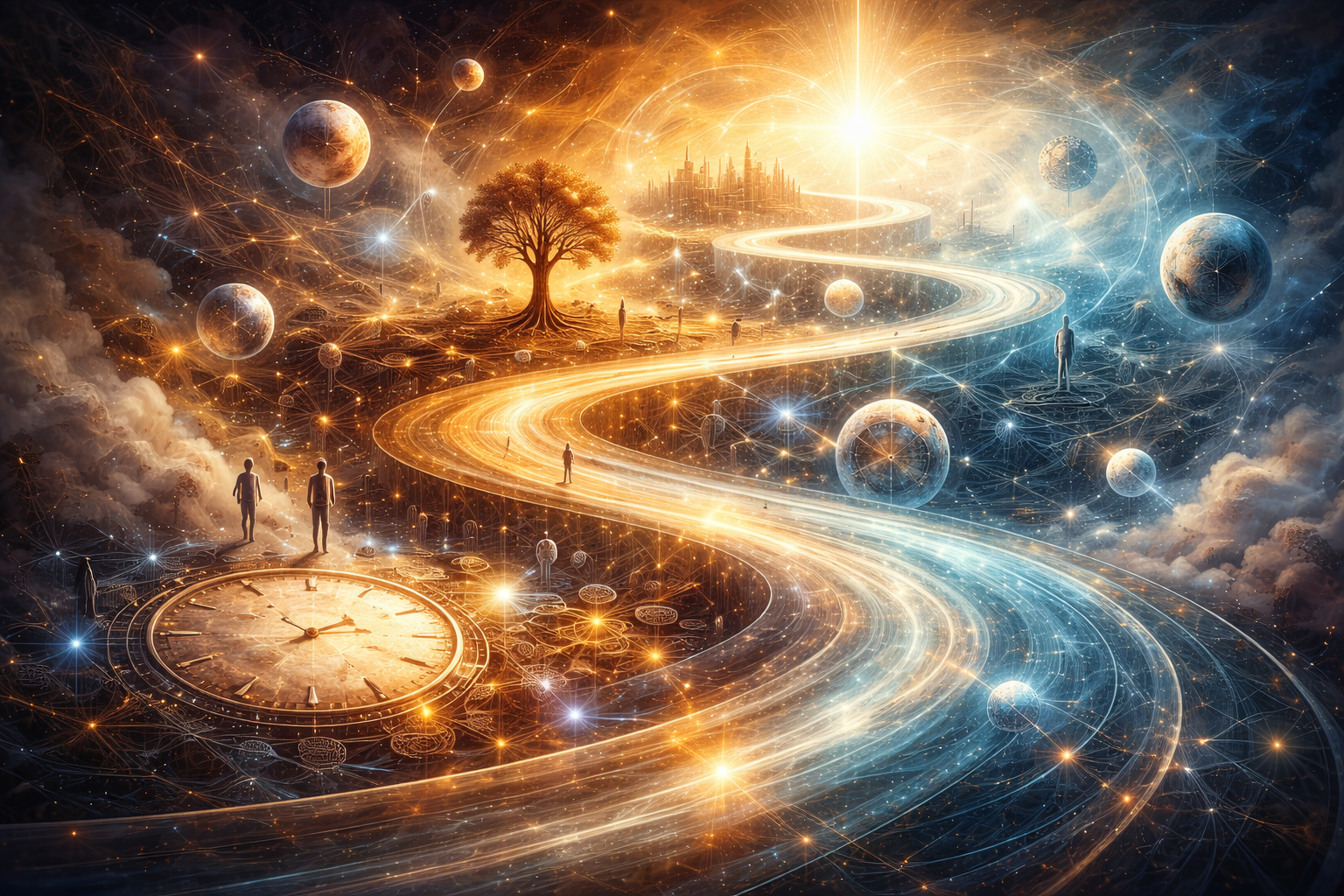
A couple of paragraphs into the problem, the philosophical stakes become clearer. Time is not merely a background container in which things happen. Change is not merely an obvious feature of everyday life. Causation is not merely a practical shorthand for prediction. Each raises questions about the deep structure of reality: whether the universe is static or dynamic, whether becoming is objective or perspectival, whether events are connected through necessary relations or only through patterns we impose, and whether explanation ultimately reveals metaphysical structure or simply theoretical convenience.
This pillar is part of the broader Metaphysics category and is designed as a long-horizon knowledge series. It moves from classical debates over motion and change to contemporary disputes over tense, passage, persistence, causation, laws, counterfactuals, temporal asymmetry, agency, physics, historical explanation, ecological time, complex systems, and the relation between metaphysics and science. It is intended to provide both conceptual orientation and a rigorous article architecture for future essays on temporality, becoming, persistence, explanation, and causal order.
Why Time, Change, and Causation Matter
Time, change, and causation matter because they structure how reality is experienced, described, and explained. Without some account of time, philosophy cannot adequately address persistence, succession, memory, anticipation, motion, history, aging, decay, or future possibility. Without some account of change, it cannot explain growth, transformation, development, identity through alteration, or the difference between static description and dynamic process. Without some account of causation, it cannot explain why events occur, how actions produce outcomes, how scientific explanations work, or why some sequences count as intelligible processes rather than accidental conjunctions.
These topics are also central because they lie at the intersection of everyday experience and theoretical abstraction. Human beings experience passage, novelty, loss, expectation, sequence, consequence, delay, memory, and responsibility. Yet philosophical analysis quickly raises doubts about whether these features belong to the world itself or to our ways of representing it. Is temporal passage objective, or does it arise from consciousness and perspective? Is change fundamental, or can it be analyzed as differences across times within a tenseless order? Does causation pick out a real connection in nature, or is it a conceptual tool constructed for explanation, intervention, and prediction?
These questions force metaphysics to clarify the relation between appearance and reality with unusual intensity. Time appears to pass, but physics may describe the world through equations that do not privilege a moving present. Change appears obvious, yet metaphysical puzzles about identity reveal how difficult it is to say what changes and what remains. Causation appears indispensable, yet Humean skepticism challenges the idea that we ever perceive necessary connection itself.
These issues extend far beyond abstract speculation. Scientific explanation depends on temporal ordering and causal structure. Moral and legal responsibility depend on judgments about action, consequence, agency, intention, and counterfactual dependence. Historical understanding depends on distinguishing sequence from causation, contingency from necessity, and structural conditions from triggering events. Technological systems, ecological systems, economic systems, political institutions, and social movements all unfold through temporally extended processes in which causal reasoning matters.
A serious treatment of time, change, and causation therefore belongs not only to metaphysics narrowly conceived, but to any broader intellectual effort to understand dynamic reality.
What Are Time, Change, and Causation?
Time is the dimension or order through which events are arranged as earlier and later, simultaneous or successive, past, present, or future, brief or extended, recurring or irreversible. Philosophically, time raises questions about whether temporal order exists independently of events, whether the present is metaphysically privileged, whether passage is objective, and whether time is fundamental or emergent. Time also shapes memory, expectation, mortality, history, agency, and human self-understanding.
Change is the becoming otherwise of things, states, systems, or processes. A thing changes when it gains or loses a property, moves from one place to another, develops, decays, grows, breaks down, transforms, or enters a new condition. The metaphysical problem of change is that change appears to require both difference and continuity. Something must become different, yet something must persist through that difference for change to be intelligible. If nothing remains, there is replacement rather than change. If nothing differs, there is no change at all.
Causation is the relation or structure through which one event, condition, process, action, mechanism, power, or system contributes to the occurrence of another. Philosophers debate whether causation is a necessary connection, a regular succession, a counterfactual dependence relation, a probabilistic relation, an intervention relation, a mechanism, a productive process, or a plural family of relations. Causation is central to explanation because it allows sequences to become intelligible as processes rather than mere orderings.
Time, change, and causation are distinct but deeply entangled. Change occurs across time. Causes often produce changes. Causal explanation frequently orders events temporally. Temporal experience is shaped by perceived change and consequence. Agency presupposes the ability to act in time and alter what follows. Historical understanding depends on causal interpretation of temporal sequences. Together, these concepts form a metaphysical architecture for dynamic reality.
What This Pillar Covers
This pillar is designed as a comprehensive foundation for the study of time, change, and causation within metaphysics. It brings together historical debates, conceptual analysis, contemporary theoretical disputes, and connections to logic, physics, law, agency, history, technology, ecology, and systems thinking.
Time and Temporal Order
Philosophical inquiry into time asks whether time is fundamental, whether it is independent of events, whether it is best understood relationally or substantivally, and whether the distinctions between past, present, and future belong to reality itself or to our standpoint within it. It also asks whether time has a privileged direction, whether temporal passage is real, and how time should be understood in relation to physics, cosmology, memory, and temporal experience.
Tense, Passage, and the A-Theory/B-Theory Debate
One of the central modern debates concerns whether temporal reality is fundamentally tensed or tenseless. A-theories privilege the distinctions between past, present, and future, while B-theories treat temporal order in terms of earlier-than and later-than relations without an objectively moving present. Closely related debates concern presentism, eternalism, the growing block theory, and the moving spotlight theory, each offering a different account of what exists across time and what makes time seem to pass.
Change, Motion, and Becoming
Change is one of the oldest metaphysical problems. What does it mean for a thing to become different while remaining the same thing? How should philosophy distinguish alteration, growth, locomotion, generation, corruption, development, and process? Is change reducible to differences across times, or is becoming an irreducible feature of reality? These questions run from ancient accounts of motion and actuality to contemporary debates over process metaphysics, systems theory, and temporal becoming.
Persistence and Identity Through Time
Metaphysics must explain how entities persist through change. Do objects endure by being wholly present at each moment of their existence, or perdure by having different temporal parts at different times? How should philosophers understand diachronic identity, constitution, and continuity? These questions matter not only for ordinary objects but for organisms, persons, artifacts, institutions, ecosystems, legal systems, and historical traditions.
Causation and Necessary Connection
Causation concerns what it means for one event, process, state, or action to bring about another. Is causation a necessary connection in nature, a regular succession, a counterfactual dependence relation, a probabilistic pattern, a manipulable mechanism, or a plural family of related structures? The metaphysics of causation investigates the nature of the causal relation itself, the kinds of entities that stand in causal relations, and whether causation is fundamental or derivative.
Causal Order and Temporal Order
Cause and time are closely linked but not obviously identical. Causes are often assumed to precede effects, yet philosophical and scientific discussion has long entertained the possibility of simultaneous causation, backward causation, causal loops, and complex causal networks in which temporal sequence alone is insufficient to ground explanation. This forces metaphysics to ask whether temporal priority is essential to causation or whether causal priority is conceptually distinct from temporal order.
Laws, Counterfactuals, and Explanation
Many accounts of causation rely on laws of nature, counterfactual conditionals, or explanatory structures. This opens broader questions about whether laws govern the world or merely summarize regularities, whether counterfactual dependence tracks causation or only part of it, and whether explanation reveals genuine metaphysical structure or useful patterns. The study of causation thus connects metaphysics to philosophy of science, logic, epistemology, and scientific modeling.
Probability, Indeterminacy, and Causal Complexity
Not every change appears deterministic, and not every cause guarantees its effect. Probability, chance, indeterminacy, and stochastic explanation complicate any simple picture of causal order. Radioactive decay, statistical mechanics, evolutionary processes, ecological feedback, epidemiology, technological risk, and social systems all raise questions about whether causal explanation requires deterministic necessity or can be compatible with irreducible indeterminacy and probabilistic structure.
Agency, Action, and Intervention
Causal reasoning is not limited to natural processes. Human action introduces questions about agency, intention, intervention, control, deliberation, and responsibility. Philosophers ask whether actions are events, whether reasons can be causes, how agency fits into causal order, and whether interventionist accounts of causation better illuminate the practical dimensions of explanation than purely observational accounts do.
Time, Change, and Physics
Modern metaphysics cannot ignore physics. Relativity complicates common assumptions about simultaneity, presentness, and temporal structure, while thermodynamics raises questions about temporal asymmetry and the arrow of time. Philosophers also examine whether physical theory leaves room for an objective present, whether causal notions belong in fundamental physics, and how ordinary temporal experience relates to scientific descriptions of the world.
Time, Change, and Causation Within Metaphysics
Within metaphysics, time, change, and causation are deeply interwoven. A theory of time influences how change is understood, since change involves temporal difference and persistence across succession. A theory of change influences how causation is understood, since causes are often thought to produce changes. A theory of causation influences how explanation and temporal order are understood, since causal narratives typically connect sequences into intelligible processes. These topics should therefore not be treated in isolation. They form an integrated field of inquiry into dynamic reality.
They also reveal major divides within metaphysical method. Some philosophers prioritize common sense and manifest experience, insisting that passage, becoming, and causal production are too basic to be eliminated from serious metaphysical description. Others privilege formal analysis, scientific theory, or parsimonious ontology, seeking tenseless accounts of time, reductive accounts of causation, or structural accounts of change. Still others resist reduction altogether and argue for process metaphysics, powers ontologies, interventionist pluralism, or layered accounts of causation.
This pillar approaches time, change, and causation as a domain in which metaphysics confronts some of its most enduring tensions: permanence and flux, appearance and reality, explanation and description, structure and event, freedom and necessity, order and contingency, law and chance, mechanism and agency, history and possibility. To study these topics is to study how the world unfolds, how things become otherwise, and how sequences become intelligible as histories, processes, actions, and consequences.
Time and Temporal Order
Time appears at once familiar and mysterious. Human beings inhabit a world of before and after, memory and anticipation, duration and delay, loss and expectation. Yet when philosophers ask what time is, ordinary familiarity quickly becomes unstable. Is time an independent dimension through which events occur? Is it nothing over and above relations among events? Is it a feature of consciousness, a structure of experience, a physical dimension, or a deep feature of reality itself?
One major question concerns whether time is relational or substantival. A relational theory treats time as dependent on events and their ordering. A substantival theory treats time as something that could exist independently of particular events, more like a container or dimension. This debate has deep roots in early modern philosophy and continues in modified form through contemporary metaphysics and physics.
Another question concerns the status of temporal direction. The world appears temporally asymmetrical. We remember the past, not the future. Causes usually seem to precede effects. Entropy increases. Human beings age in one direction. Yet many fundamental physical equations appear time-symmetric. The arrow of time therefore raises questions about whether temporal direction is fundamental, emergent, thermodynamic, psychological, cosmological, or perspectival.
Temporal order is thus not merely a background. It is a structure through which reality becomes intelligible. Without it, change, causation, memory, agency, history, and responsibility would lose their ordinary form.
Tense, Passage, and Temporal Reality
The debate over tense and passage is one of the defining debates in the metaphysics of time. A-theories hold that past, present, and future are metaphysically significant. The present may be privileged, and time may genuinely pass. B-theories hold that temporal reality is fundamentally tenseless, structured by relations such as earlier than, later than, and simultaneous with, without an objectively moving present.
Presentism holds that only the present exists. Eternalism holds that past, present, and future events all exist, though at different temporal locations. The growing block theory holds that the past and present exist, while the future does not yet exist. The moving spotlight theory treats all times as real but holds that presentness moves across the temporal order. Each view tries to explain ordinary temporal experience while preserving metaphysical coherence.
The problem is that temporal passage seems phenomenologically obvious but metaphysically difficult. What exactly moves when time passes? If the present moves, does it move in a second time? If all events exist in a four-dimensional structure, why does time seem to flow? If only the present exists, what grounds truths about the past? If the future does not exist, how should future-directed responsibility be understood?
These questions show why the metaphysics of time is not merely abstract. It shapes how one understands memory, loss, anticipation, hope, mortality, historical truth, future obligation, and the structure of reality itself.
Change, Motion, and Becoming
Change is one of philosophy’s oldest problems because it appears to require both being and non-being. For something to change, it must become what it was not while still remaining somehow connected to what it was. Parmenides challenged the intelligibility of becoming. Heraclitus made flux central to reality. Aristotle developed a more systematic account by distinguishing actuality and potentiality: change is the actualization of what is potential insofar as it is potential.
This framework allowed Aristotle to explain motion, growth, alteration, generation, and corruption without collapsing reality into either static being or chaotic flux. A thing changes because it has capacities that can be actualized under the right conditions. This account also linked change to explanation, since one must ask what material, formal, efficient, and final factors make change intelligible.
Contemporary metaphysics reframes the problem through persistence, properties, processes, temporal parts, and event ontology. Is change simply the possession of different properties at different times? Or is becoming something more fundamental than a static description of temporal variation? Process metaphysics argues that reality is better understood through events, relations, and becoming than through enduring substances alone.
Change is also central to systems thinking. Biological development, ecological succession, technological transformation, political change, and institutional evolution all involve organized processes across time. A strong metaphysics of change must therefore account not only for simple alteration but also for complex, layered, irreversible, and emergent transformation.
Persistence and Identity Through Time
Persistence is the metaphysical problem of how entities remain themselves through time. A person changes physically and psychologically. An organism replaces its cells. A legal institution changes personnel and rules. A river changes water. A technological system changes software versions, hardware, data, and users. Yet ordinary thought treats these as persisting entities.
Endurance theory holds that objects are wholly present at each moment at which they exist. Perdurance theory holds that objects persist by having temporal parts, much as extended objects have spatial parts. Stage theory treats ordinary objects as momentary stages linked by counterpart relations. These theories disagree over whether persistence involves enduring sameness, temporal extension, or structured succession.
The issue becomes especially difficult when applied to persons. Is personal identity grounded in bodily continuity, psychological continuity, memory, narrative, soul, social recognition, organismic life, or some combination of these? These questions matter for responsibility, survival, medical ethics, punishment, memory, dementia, digital identity, and death.
Persistence also matters for institutions and histories. A political state, religious tradition, legal system, university, corporation, or ecological system can persist despite deep internal change. Ontology must explain how continuity is maintained when the parts, rules, practices, and material basis of an entity are transformed over time.
Causation and Necessary Connection
Causation is central to explanation because it connects what happens with why it happens. Yet its metaphysical nature is deeply contested. Hume famously challenged the idea that we perceive necessary connection. We observe one event following another, but the necessity linking cause and effect seems to be supplied by habit, expectation, or mental association rather than direct perception.
Regularity theories treat causation as constant conjunction under laws or patterns. Counterfactual theories treat causation in terms of dependence: if the cause had not occurred, the effect would not have occurred. Probabilistic theories treat causes as factors that raise the probability of effects. Process theories look for physical connections or transfers. Powers theories hold that things have real capacities or dispositions that produce effects. Interventionist theories treat causal relations as those that support manipulation or control.
Each approach captures something important but faces difficulties. Regularity theories struggle with accidental regularities. Counterfactual theories face problems of overdetermination and preemption. Probabilistic theories must distinguish genuine causal influence from correlation. Process theories may struggle with absences and omissions. Powers theories must explain the metaphysics of capacities. Interventionist theories may be epistemically powerful but metaphysically modest.
Causation therefore remains one of metaphysics’ most difficult and important topics. It connects the structure of reality to explanation, science, action, responsibility, and practical reasoning.
Causal Order and Temporal Order
Causes are usually thought to precede their effects, but the relation between causal order and temporal order is not simple. Simultaneous causation appears possible in some cases: a heavy object depresses a cushion at the same time as the depression exists. Backward causation has been debated in relation to time travel, quantum theory, and causal loops. Complex systems may involve feedback loops in which effects alter the conditions that produced them.
This raises a deeper question: is causation essentially temporal, or is causal priority a distinct metaphysical relation? If causation requires temporal priority, backward causation may be incoherent. If causation is a form of dependence, production, or explanation, temporal priority may not be essential in every case. Philosophers therefore debate whether causes must be earlier, whether simultaneous causation is possible, and whether causal loops are metaphysically acceptable.
Causal order also matters in scientific and historical explanation. A sequence is not automatically a causal process. One event may precede another without causing it. Conversely, a structural condition may causally shape an outcome long before the visible triggering event occurs. Understanding causal order therefore requires more than chronology.
The distinction between temporal sequence and causal explanation is essential for history, law, medicine, ecology, engineering, and public policy. It helps separate coincidence from consequence, trigger from condition, and narrative sequence from explanatory structure.
Laws, Counterfactuals, and Explanation
Causation is often analyzed through laws and counterfactuals. Laws of nature may explain why certain events follow others. Counterfactuals ask what would have happened if something had been different. Together, laws and counterfactuals help distinguish genuine causal relations from mere temporal sequence or accidental correlation.
But laws themselves raise metaphysical questions. Are laws governing principles that direct the behavior of things? Are they descriptions of regularities? Are they grounded in powers and dispositions? Are they necessary, contingent, or structural? The metaphysics of laws shapes the metaphysics of causation because different accounts of laws produce different accounts of causal necessity.
Counterfactuals also raise questions. If a window shattered because a stone was thrown, then one might say: if the stone had not been thrown, the window would not have shattered. But cases of preemption, backup causes, overdetermination, omissions, and probabilistic causation complicate this simple model. Sometimes an effect would have occurred anyway; sometimes an absence seems causally relevant; sometimes a cause changes probability rather than guaranteeing an outcome.
Explanation therefore requires careful structure. A causal explanation identifies not merely what happened before an effect, but what made a difference, what mechanism operated, what conditions mattered, what alternatives were possible, and what dependencies shaped the outcome.
Probability, Indeterminacy, and Causal Complexity
Many causal processes are not deterministic in any simple sense. A cause may increase the probability of an effect without guaranteeing it. Smoking increases the risk of lung cancer, but not every smoker develops cancer. A policy may increase the likelihood of an outcome without producing it in every case. Ecological systems, weather systems, markets, disease spread, and technological failures often involve stochastic processes, thresholds, feedback, and nonlinear interactions.
Probabilistic causation asks how causes operate under uncertainty. Does causation require probability-raising? Can a cause lower the probability of an effect in unusual contexts? How should philosophers distinguish causal probability from mere statistical association? These questions matter for science, medicine, law, climate modeling, risk assessment, and social explanation.
Indeterminacy also raises deeper metaphysical issues. If some events are genuinely indeterministic, then causal order cannot be understood as strict necessity. This may be relevant in quantum theory, but also in broader debates about chance, emergence, and complex systems. A metaphysics of causation must account for processes where outcomes are constrained but not fully determined.
Causal complexity is especially important in systems. Many outcomes arise from interacting causes rather than single causes. Feedback loops, path dependence, tipping points, network effects, and emergent behavior require a richer causal vocabulary than linear cause-and-effect chains. This makes causal metaphysics central to contemporary systems thinking.
Agency, Action, and Intervention
Human action places causation in a practical and moral frame. Agents deliberate, choose, intervene, intend, act, and produce consequences. This raises questions about whether actions are events, whether reasons can be causes, whether intentions have causal power, and how agency fits within a broader causal order.
The relation between reasons and causes is especially important. When someone acts for a reason, is that reason a cause of the action? Or is reason-giving a different kind of explanation? Philosophy of action examines how intention, belief, desire, deliberation, habit, embodiment, and social context contribute to action. The metaphysics of causation must make room for both natural processes and intentional agency.
Interventionist accounts of causation have become influential because they connect causation to manipulation, control, and practical reasoning. To say that X causes Y is often to say that intervening on X would make a difference to Y. This approach is powerful in science, medicine, policy, and engineering, where causal knowledge supports action.
Agency also connects causation to responsibility. Moral and legal responsibility depend on whether actions caused harms, whether alternatives were available, whether outcomes were foreseeable, whether causal chains were broken, and whether agents possessed control. Time, change, and causation therefore converge in the analysis of responsibility.
Time, Change, Causation, and Physics
Modern physics deeply complicates common assumptions about time and causation. Relativity challenges the idea of absolute simultaneity and suggests that temporal ordering can depend on reference frames in certain contexts. This raises questions about whether there is an objective present and whether presentism can be reconciled with relativistic spacetime.
Thermodynamics raises the problem of the arrow of time. Entropy increase appears to give time a direction, helping explain why eggs break but do not unbreak, why we remember the past rather than the future, and why many processes are irreversible. Yet the connection between thermodynamic asymmetry, cosmology, statistical mechanics, and temporal experience remains philosophically complex.
Quantum theory raises further issues. Does indeterminacy imply causation without determinism? Do quantum correlations challenge ordinary causal assumptions? Does fundamental physics require causation at all, or are causal notions emergent features of higher-level descriptions? Philosophers of physics debate whether causation belongs in the basic furniture of the world or in the explanatory practices of agents.
Metaphysics and physics therefore must remain in dialogue. Physics disciplines metaphysical speculation, while metaphysics clarifies the conceptual commitments of physical theory. Time, change, and causation are among the clearest places where that dialogue becomes necessary.
Systems, History, and Long-Duration Causation
Not all causation is immediate, linear, or local. Many of the most important causal processes unfold across long durations and complex systems. Climate change, ecological collapse, institutional decline, economic transformation, technological disruption, public health crises, and historical injustice all involve layered causes operating across time.
Historical explanation requires distinguishing event, structure, condition, trigger, contingency, and path dependence. A revolution, war, migration, financial crisis, or institutional breakdown rarely has a single cause. It emerges from accumulated pressures, choices, constraints, accidents, and long-term developments. Causation in history therefore requires both narrative and structural explanation.
Ecological time also challenges short-term causal thinking. Soil formation, species extinction, climate feedback, watershed change, and ecosystem recovery unfold over durations far longer than ordinary policy cycles. The metaphysics of causation must therefore account for delayed effects, cumulative harm, thresholds, and intergenerational consequences.
Technological systems add another layer. Automation, algorithmic decision-making, infrastructure failures, and complex supply chains involve distributed causation across human decisions, code, hardware, institutions, incentives, and environments. Understanding responsibility in such systems requires causal analysis that can handle networks rather than isolated acts.
A strong contemporary metaphysics of time, change, and causation must therefore move beyond simple examples and address complex dynamic systems, historical depth, ecological temporality, and institutional responsibility.
Core Themes in Time, Change, and Causation
One major theme is temporal reality. The field asks whether time is fundamental, relational, emergent, subjective, or a feature of physical structure.
A second theme is passage. It asks whether the present is metaphysically privileged and whether time genuinely flows.
A third theme is becoming. It asks whether change is reducible to differences across times or whether becoming is an irreducible feature of reality.
A fourth theme is persistence. It asks how objects, persons, organisms, institutions, and systems remain identical through change.
A fifth theme is causation. It asks what makes causes cause, whether causation involves necessity, dependence, probability, mechanism, powers, or intervention.
A sixth theme is temporal and causal order. It asks whether causes must precede effects and how causal priority relates to temporal sequence.
A seventh theme is law and explanation. It studies the relation between causation, laws of nature, counterfactuals, mechanisms, and scientific explanation.
An eighth theme is indeterminacy. It asks how chance, probability, stochastic processes, and uncertainty fit into causal structure.
A ninth theme is agency. It examines reasons, actions, interventions, responsibility, and the causal structure of human conduct.
A tenth theme is dynamic systems. It asks how nonlinear causation, feedback, path dependence, ecological time, historical development, and technological complexity reshape metaphysical accounts of change and explanation.
Expanded Article Architecture
The following structure gathers the time, change, and causation pillar into a long-range article architecture. It expands the original article index into a fuller publication map while keeping the focus scholarly, historically grounded, conceptually serious, and connected to metaphysics, physics, history, agency, ecology, technology, and systems thinking.
Foundations of Time, Change, and Causation
- What Is Time in Metaphysics? (planned)
Introduces time as a metaphysical problem involving succession, duration, passage, temporal order, and the relation between experience and reality. - What Is Change in Metaphysics? (planned)
Explains change as the problem of becoming otherwise while preserving enough continuity for transformation to be intelligible. - What Is Causation? Causes, Effects, and Explanation (planned)
Introduces causation as the relation or structure through which events, processes, actions, or conditions make a difference to what happens. - Why Time, Change, and Causation Still Matter (planned)
Explains why these concepts remain central to metaphysics, science, agency, responsibility, history, technology, and systems thinking. - Dynamic Reality and the Metaphysics of Becoming (planned)
Studies reality as unfolding, transforming, and structured by temporal and causal processes. - Appearance, Reality, and the Experience of Temporal Flow (planned)
Examines whether temporal passage belongs to the world itself or to consciousness, memory, and perspective.
Ancient and Classical Foundations
- Being, Flux, and Permanence from Parmenides to Heraclitus (planned)
Studies the ancient conflict between permanence and becoming, including Parmenides’ challenge to change and Heraclitus’ emphasis on flux. - Plato on Time, Eternity, and Cosmic Order (planned)
Examines Plato’s account of time in relation to eternity, cosmic order, becoming, and intelligible reality. - Aristotle on Change, Motion, and the Actualization of Potential (planned)
Studies Aristotle’s account of change as the actualization of potential and its role in explaining motion, growth, and transformation. - Aristotle’s Four Causes and the Structure of Explanation (planned)
Examines material, formal, efficient, and final causes as a multidimensional account of why things are and become as they do. - Zeno’s Paradoxes and the Problem of Motion (planned)
Studies Zeno’s paradoxes as challenges to continuity, divisibility, motion, and the metaphysical structure of space and time. - Stoic Causation, Fate, and Cosmic Order (planned)
Examines Stoic accounts of causal determinism, providence, fate, and the rational ordering of the cosmos. - Plotinus, Eternity, and Temporal Derivation (planned)
Studies Neoplatonic accounts of eternity, time, emanation, and the relation between temporal reality and higher principles.
Medieval, Theological, and Early Modern Debates
- Augustine on Time, Memory, and the Distension of the Soul (planned)
Studies Augustine’s account of time through memory, attention, expectation, and the soul’s temporal distension. - Time and Eternity in Medieval Metaphysics (planned)
Examines medieval debates over time, divine eternity, creation, contingency, and temporal order. - Creation, Beginning, and the Metaphysics of Temporal Dependence (planned)
Studies the relation between creation, temporal beginning, ontological dependence, and divine causation. - Divine Foreknowledge, Future Contingents, and Temporal Freedom (planned)
Examines whether divine knowledge of the future can be reconciled with contingency and human freedom. - Early Modern Debates on Causation, Substance, and Mechanism (planned)
Explores how early modern philosophy reframed causation through mechanism, substance, laws, and natural philosophy. - Descartes, Mechanism, and the New Science of Motion (planned)
Studies Cartesian mechanism and its influence on the modern metaphysics of matter, motion, and causal explanation. - Spinoza, Necessity, and the Causal Order of Nature (planned)
Examines Spinoza’s account of causation, necessity, substance, and the intelligible order of nature. - Leibniz, Sufficient Reason, and the Structure of Explanation (planned)
Studies Leibniz’s principle of sufficient reason and its implications for causation, modality, and explanation.
Modern Philosophy of Time and Causation
- Hume and the Problem of Necessary Connection (planned)
Examines Hume’s critique of causal necessity and his account of causation through regularity, habit, and expectation. - Kant on Causality and Temporal Order (planned)
Studies Kant’s claim that causality is a condition of objective temporal experience and empirical knowledge. - Newton, Absolute Time, and the Metaphysics of Space and Motion (planned)
Examines Newtonian absolute time and its influence on modern metaphysics and physics. - Leibniz Against Absolute Time: Relation, Order, and Sufficient Reason (planned)
Studies Leibniz’s relational account of space and time and his critique of absolute temporal containers. - McTaggart and the Unreality of Time (planned)
Examines McTaggart’s famous argument that time is unreal through the distinction between A-series and B-series temporal ordering. - Time, Idealism, and the Limits of Temporal Appearance (planned)
Studies philosophical accounts that treat time as dependent on consciousness, conceptual structure, or appearance rather than mind-independent reality.
Tense, Passage, and Temporal Ontology
- The A-Theory and the Reality of Temporal Passage (planned)
Introduces A-theories of time, which treat past, present, and future as metaphysically significant. - The B-Theory and Tenseless Time (planned)
Studies B-theories of time, which analyze temporal reality through earlier-than and later-than relations without objective passage. - Presentism, Eternalism, and the Growing Block Theory (planned)
Compares major theories of temporal existence and asks whether only the present exists, all times exist, or reality grows over time. - Temporal Passage and the Moving Spotlight Theory (planned)
Studies the view that all times exist but that presentness moves across the temporal order. - Past, Present, and Future: What Exists Across Time? (planned)
Examines the ontological status of past events, present reality, future possibilities, and future-directed truth. - Truth About the Past and the Problem of Presentism (planned)
Studies how presentism can account for truths about past events if only the present exists. - Future Contingents and the Ontology of the Unsettled Future (planned)
Examines whether future-tense statements are already true or false when the future remains open. - Temporal Order, Direction, and the Arrow of Time (planned)
Studies why time appears directional and whether temporal asymmetry is metaphysically fundamental, thermodynamic, psychological, or cosmological.
Change, Motion, and Process
- Time Without Change? Classical and Contemporary Debates (planned)
Examines whether time could exist without change and what this reveals about temporal structure. - Change, Becoming, and the Metaphysics of Process (planned)
Studies process metaphysics and the view that becoming, events, and transformation are more fundamental than static substances. - Change and Contradiction: Ancient Problems of Becoming (planned)
Explores ancient puzzles about how a thing can both be and become otherwise without contradiction. - Motion, Continuity, and the Problem of Infinite Divisibility (planned)
Studies motion through continuity, divisibility, calculus-like reasoning, and metaphysical puzzles of space and time. - Generation, Corruption, Growth, and Decay (planned)
Examines different kinds of change and how metaphysics distinguishes development, destruction, transformation, and replacement. - Process Ontology and the Priority of Becoming (planned)
Studies ontologies that treat events, processes, and dynamic relations as more fundamental than enduring things. - Whitehead and the Metaphysics of Process (planned)
Examines Whitehead’s process philosophy as a major modern attempt to rethink reality through events, creativity, and becoming.
Persistence, Identity, and Temporal Parts
- Persistence Through Time: Endurance, Perdurance, and Stage Theory (planned)
Introduces major theories of persistence and asks how entities remain themselves through temporal change. - Identity, Constitution, and Continuity Across Change (planned)
Studies how identity persists through alteration, replacement, constitution, and transformation. - Personal Identity and Temporal Persistence (planned)
Examines the identity of persons through memory, body, psychology, narrative, organismic continuity, and social recognition. - Temporal Parts and Four-Dimensionalism (planned)
Studies the view that objects persist by having temporal parts extended across time. - The Ship of Theseus and the Problem of Replacement Over Time (planned)
Uses the Ship of Theseus puzzle to examine persistence, composition, replacement, and identity. - Organisms, Development, and Biological Persistence (planned)
Studies how living beings persist through metabolism, growth, repair, aging, and ecological dependence. - Institutional Persistence and Historical Continuity (planned)
Examines how institutions, nations, traditions, and legal orders persist through changes in members, practices, rules, and memory. - Digital Persistence: Copies, Versions, and Identity Across Platforms (planned)
Studies how digital objects, datasets, software systems, and model versions persist through copying, migration, updating, and transformation.
Theories of Causation
- Causation: What Makes Causes Cause? (planned)
Introduces the metaphysical problem of causation and the question of what links cause and effect. - Regularity Theories of Causation (planned)
Studies accounts that explain causation through constant conjunctions, patterns, and regular sequences. - Counterfactual Theories of Causation (planned)
Examines theories that analyze causation through what would have happened if the cause had not occurred. - Probabilistic Causation and Indeterminate Processes (planned)
Studies causes that raise or alter the probability of effects without guaranteeing them. - Process Theories of Causation (planned)
Examines causal processes, physical connections, transfer, and the continuity of causal influence. - Powers, Dispositions, and Causal Production (planned)
Studies causal powers and dispositions as real capacities through which things produce effects. - Mechanisms, Intervention, and Manipulability (planned)
Explores mechanism and interventionist theories that connect causation to control, manipulation, and explanatory practice. - Singular Causation and General Causal Laws (planned)
Examines whether individual causal relations can exist independently of general laws or regular patterns. - Causal Relata: Events, Facts, States, and Processes (planned)
Studies what kinds of entities can stand in causal relations, including events, facts, states, objects, omissions, and processes.
Causal Complexity, Networks, and Difficult Cases
- Causal Chains, Networks, and Overdetermination (planned)
Studies causation in extended chains and networks where multiple causes contribute to the same outcome. - Preemption, Overdetermination, and Problems for Causal Explanation (planned)
Examines cases where one cause preempts another or where multiple sufficient causes complicate simple counterfactual analysis. - Omissions, Absences, and Negative Causation (planned)
Studies whether failures to act, absences, missing conditions, and omissions can be genuine causes. - Simultaneous Causation and Temporal Coincidence (planned)
Examines whether cause and effect can occur at the same time and what such cases imply about causal priority. - Backward Causation and the Reversal Problem (planned)
Studies whether effects can precede causes and whether backward causation is coherent. - Causation and the Direction of Time (planned)
Examines whether causal asymmetry explains temporal direction or whether temporal direction explains causal asymmetry. - Time Travel, Causal Loops, and Temporal Paradox (planned)
Studies time travel, causal loops, grandfather-style paradoxes, and the metaphysical coherence of closed temporal structures. - Chance, Determinism, and Causal Order (planned)
Examines whether chance and determinism are compatible with causal explanation and how causal order works under uncertainty.
Laws, Explanation, and Scientific Reasoning
- Explanation, Laws of Nature, and Counterfactual Dependence (planned)
Studies the relation between causal explanation, laws, counterfactuals, and metaphysical structure. - What Are Laws of Nature? (planned)
Examines whether laws govern the world, describe regularities, express powers, or reflect structural constraints. - Humean Laws and the Best-System Account (planned)
Studies Humean theories that analyze laws as part of the best systematization of regularities. - Governing Laws, Necessitarianism, and Metaphysical Necessity (planned)
Examines stronger views according to which laws govern or necessitate the behavior of things. - Mechanistic Explanation in Science (planned)
Studies explanation through mechanisms, organized parts, activities, and causal pathways. - Causal Modeling, Intervention, and Counterfactual Structure (planned)
Explores causal models as tools for representing intervention, dependence, and explanatory structure. - Statistical Explanation and Causal Inference (planned)
Studies the relation between statistical association, causal inference, probability, and evidence.
Agency, Freedom, Action, and Responsibility
- Free Will, Agency, and the Causal Structure of Action (planned)
Examines how human action fits into causal order and what follows for freedom and responsibility. - Reasons, Causes, and Human Action (planned)
Studies whether reasons can be causes and how intentional explanation relates to causal explanation. - Action, Intention, and Intervention in the World (planned)
Explores agency as the capacity to intervene in causal processes through intention, deliberation, and action. - Determinism, Compatibilism, and Moral Responsibility (planned)
Examines whether responsibility can survive if human actions are causally determined. - Counterfactual Control and the Ethics of Responsibility (planned)
Studies how alternative possibilities, control, foresight, and causal contribution shape responsibility. - Legal Causation, Proximate Cause, and Responsibility (planned)
Examines how legal systems translate metaphysical and practical causation into responsibility, liability, and judgment. - Collective Agency and Distributed Causation (planned)
Studies how groups, institutions, organizations, and systems can act and cause outcomes across distributed structures.
Causation in Human, Historical, and Social Explanation
- Causation in the Human Sciences and Historical Explanation (planned)
Studies how causal explanation works in history, sociology, anthropology, economics, and political analysis. - Historical Time, Eventfulness, and Causal Narrative (planned)
Examines how historians distinguish chronology, causation, contingency, structure, and narrative meaning. - Structural Causes and Triggering Events (planned)
Studies the difference between long-term conditions and immediate triggers in historical and social explanation. - Path Dependence, Contingency, and Institutional Change (planned)
Examines how earlier events constrain later possibilities and shape institutional trajectories. - Social Movements, Political Change, and Causal Complexity (planned)
Studies how movements, institutions, crises, ideas, and material conditions interact in political transformation. - Causation, Blame, and Responsibility in Complex Institutions (planned)
Explores how responsibility is assigned when outcomes arise from distributed actions, norms, systems, and incentives.
Time, Change, and Physics
- Causation in Physics and the Limits of Mechanism (planned)
Examines whether causation belongs to fundamental physics or to higher-level explanatory practice. - Relativity and the Metaphysics of Time (planned)
Studies how relativity challenges absolute simultaneity, presentism, and common-sense temporal structure. - Thermodynamics, Entropy, and the Arrow of Time (planned)
Examines entropy increase, irreversibility, and the physical basis of temporal asymmetry. - Quantum Theory, Indeterminacy, and Causal Structure (planned)
Studies how quantum phenomena complicate deterministic causation, locality, and causal explanation. - Cosmology, Time’s Beginning, and Temporal Boundary Questions (planned)
Examines philosophical questions about whether time has a beginning, whether before-the-beginning questions are coherent, and how cosmology reshapes temporal metaphysics. - Time Symmetry, Irreversibility, and the Problem of Experience (planned)
Studies the tension between time-symmetric laws and irreversible temporal experience.
Logic, Formal Systems, and Representation
- Temporal Logic and the Formal Representation of Time (planned)
Introduces temporal logic as a formal tool for representing time, tense, succession, and temporal propositions. - Causal Logic and Formal Models of Dependence (planned)
Studies formal representations of causal structure, intervention, dependency, and counterfactual relations. - Event Ontology and the Structure of Temporal Representation (planned)
Examines whether events are basic entities and how event structures represent change and causation. - Computational Models of Time, Process, and Causation (planned)
Studies how computational systems represent temporal processes, causal dependencies, simulations, and dynamic systems. - Data, Time Stamps, and the Ontology of Recorded Events (planned)
Examines how digital systems record, order, timestamp, reconstruct, and interpret events over time.
Temporal Experience, Memory, and Human Life
- Temporal Experience and the Phenomenology of Succession (planned)
Studies the lived experience of succession, duration, flow, attention, and temporal awareness. - Memory, Anticipation, and the Human Experience of Time (planned)
Examines how memory and expectation structure human temporal consciousness. - Aging, Mortality, and the Existential Meaning of Time (planned)
Studies time through finitude, aging, death, grief, and the existential structure of human life. - Trauma, Repetition, and Broken Temporal Experience (planned)
Examines how trauma can disturb ordinary temporal experience through repetition, interruption, and unresolved pastness. - Hope, Futurity, and the Metaphysics of Possibility (planned)
Studies future-directed experience, hope, action, uncertainty, and the structure of possible futures.
Systems, Ecology, Technology, and Long-Duration Processes
- Systems, Feedback, and Nonlinear Causation (planned)
Studies feedback loops, nonlinear interactions, emergent behavior, and distributed causal structures in complex systems. - Ecological Time and Long-Term Causal Processes (planned)
Examines ecological processes, climate systems, delayed effects, thresholds, succession, and intergenerational causation. - Technology, Automation, and Causation in Complex Systems (planned)
Studies automated systems, infrastructure, software, algorithms, and distributed responsibility in technological causation. - Climate Change, Cumulative Harm, and Temporal Responsibility (planned)
Examines climate causation through delayed effects, historical emissions, intergenerational obligation, and collective responsibility. - Public Health, Epidemiology, and Probabilistic Causation (planned)
Studies causal reasoning in disease, risk, population-level explanation, and public health intervention. - Infrastructure Failure and Distributed Causal Responsibility (planned)
Examines how failures in infrastructure arise from maintenance, design, governance, technology, and temporal neglect.
Comparative and Cross-Cultural Perspectives
- Comparative Perspectives on Time and Change in Greek, Islamic, Indian, and East Asian Thought (planned)
Introduces comparative approaches to temporality, becoming, causation, cyclicality, creation, and transformation. - Islamic Philosophy, Creation, and Causal Order (planned)
Studies Islamic philosophical and theological debates over causation, occasionalism, necessity, divine agency, and created order. - Indian Philosophies of Time, Karma, and Causality (planned)
Examines Indian traditions on temporal cycles, causation, karma, liberation, and continuity. - Buddhist Impermanence, Dependent Arising, and Causal Interdependence (planned)
Studies Buddhist accounts of impermanence, no-self, dependent arising, and causal interrelation. - Chinese Thought, Transformation, and Processual Order (planned)
Examines Chinese accounts of change, pattern, harmony, transformation, and relational order. - Indigenous Temporalities, Land, Memory, and Generational Responsibility (planned)
Studies time through land, ancestry, ceremony, ecological continuity, and obligations across generations.
Future Directions
- Time, Change, and Causation in an Age of Artificial Intelligence (planned)
Examines temporal modeling, causal inference, prediction, automation, and responsibility in AI systems. - Causation, Explainability, and Algorithmic Decision Systems (planned)
Studies how causal explanation matters for transparency, accountability, and contestability in automated decisions. - Metaphysics of Risk, Forecasting, and Future Harm (planned)
Examines the metaphysical and ethical structure of prediction, uncertainty, risk, and future-directed responsibility. - Temporal Justice and Obligations to Future Generations (planned)
Studies how theories of time and causation shape intergenerational ethics, climate responsibility, and future rights. - Why Time, Change, and Causation Still Matter (planned)
Concludes the series by explaining why temporality, becoming, and causal explanation remain central to metaphysics, science, agency, and human self-understanding.
Closing Perspective
Time, change, and causation remain indispensable because human beings cannot understand reality without them. Every science presupposes temporal order and causal structure. Every history presupposes sequence, contingency, continuity, and explanation. Every ethics of responsibility presupposes action, consequence, agency, and counterfactual possibility. Every ecology presupposes long-duration processes, feedback, inheritance, and cumulative change. Every technology presupposes causally organized systems unfolding across time.
This does not mean that ordinary experience gives the final account of time, change, or causation. Time may not be exactly as it appears. Change may be more difficult to analyze than common sense assumes. Causation may not be one single relation shared by every domain. The world may be tenseless at one level and dynamic at another, deterministic in some respects and probabilistic in others, mechanistic in some domains and processual in others.
The strongest reason to study time, change, and causation is that they train thought to understand reality dynamically. They teach that the world is not only a collection of things, but an order of events, processes, transformations, dependencies, histories, and consequences. To study them is to ask how the world unfolds, how things become otherwise, and how reality becomes intelligible as more than a sequence of moments.
Related Reading
- Metaphysics — for the broader study of being, existence, causation, modality, mind, matter, and the structure of reality.
- Ontology — for being, entities, categories, dependence, grounding, identity, and the question of what exists.
- Freedom, Agency, and Determinism — for free will, responsibility, choice, causation, agency, and necessity.
- Mind, Matter, and Consciousness — for consciousness, embodiment, personhood, subjectivity, and the mind-body problem.
- Philosophy — for the broader category structure connecting metaphysics, ethics, political philosophy, epistemology, and major philosophical traditions.
- Physics — for scientific treatments of time, motion, thermodynamics, relativity, fields, and causal structure in physical theory.
- Systems Thinking — for feedback, emergence, dynamic systems, causal loops, and nonlinear explanation.
- Resilience Thinking — for long-duration processes, adaptive systems, thresholds, disturbance, and recovery.
Further Reading
- Aristotle (1984) Physics, in Barnes, J. (ed.) The Complete Works of Aristotle. Princeton, NJ: Princeton University Press. Available at: https://classics.mit.edu/Aristotle/physics.html.
- Aristotle (1984) Metaphysics, in Barnes, J. (ed.) The Complete Works of Aristotle. Princeton, NJ: Princeton University Press. Available at: https://classics.mit.edu/Aristotle/metaphysics.html.
- Dainton, B. (2010) Time and Space. 2nd edn. Montreal: McGill-Queen’s University Press. Available at: https://www.mqup.ca/time-and-space-products-9780773537475.php.
- Lewis, D. (1973) ‘Causation’, Journal of Philosophy, 70(17), pp. 556–567. Available at: https://www.jstor.org/stable/2025310.
- Maudlin, T. (2011) The Metaphysics Within Physics. Oxford: Oxford University Press. Available at: https://global.oup.com/academic/product/the-metaphysics-within-physics-9780199575372.
- Mellor, D.H. (1998) Real Time II. London: Routledge. Available at: https://www.routledge.com/Real-Time-II/Mellor/p/book/9780415094816.
- Ney, A. (2014) Metaphysics: An Introduction. New York: Routledge. Available at: https://www.routledge.com/Metaphysics-An-Introduction/Ney/p/book/9780415655987.
- Pearl, J. and Mackenzie, D. (2018) The Book of Why: The New Science of Cause and Effect. New York: Basic Books.
- Sider, T. (2001) Four-Dimensionalism: An Ontology of Persistence and Time. Oxford: Oxford University Press. Available at: https://global.oup.com/academic/product/four-dimensionalism-9780199263521.
- Tooley, M. (1997) Time, Tense, and Causation. Oxford: Oxford University Press. Available at: https://global.oup.com/academic/product/time-tense-and-causation-9780198235796.
- van Inwagen, P. (2018) Metaphysics. 5th edn. New York: Routledge. Available at: https://www.routledge.com/Metaphysics/van-Inwagen/p/book/9780815345532.
References
- Dainton, B. (2024) ‘Time’, in Zalta, E.N. and Nodelman, U. (eds.) The Stanford Encyclopedia of Philosophy. Available at: https://plato.stanford.edu/entries/time/.
- Faye, J. (2024) ‘Backward Causation’, in Zalta, E.N. and Nodelman, U. (eds.) The Stanford Encyclopedia of Philosophy. Available at: https://plato.stanford.edu/entries/causation-backwards/.
- Gallow, J.D. (2022) ‘The Metaphysics of Causation’, in Zalta, E.N. and Nodelman, U. (eds.) The Stanford Encyclopedia of Philosophy. Available at: https://plato.stanford.edu/entries/causation-metaphysics/.
- Goranko, V. and Rumberg, A. (2021) ‘Temporal Logic’, in Zalta, E.N. and Nodelman, U. (eds.) The Stanford Encyclopedia of Philosophy. Available at: https://plato.stanford.edu/entries/logic-temporal/.
- Hawley, K. (2020) ‘Temporal Parts’, in Zalta, E.N. and Nodelman, U. (eds.) The Stanford Encyclopedia of Philosophy. Available at: https://plato.stanford.edu/entries/temporal-parts/.
- Markosian, N. (2008) ‘Time’, Internet Encyclopedia of Philosophy. Available at: https://iep.utm.edu/time/.
- McDaniel, K. and Bigelow, J. (2002/2006 archive) ‘Change’, in The Stanford Encyclopedia of Philosophy. Available at: https://plato.stanford.edu/archives/fall2006/entries/change/.
- Mumford, S. and Anjum, R.L. (n.d.) ‘Causation’, Internet Encyclopedia of Philosophy. Available at: https://iep.utm.edu/causation/.
- Sider, T. (2023) ‘Time’, in Zalta, E.N. and Nodelman, U. (eds.) The Stanford Encyclopedia of Philosophy. Available at: https://plato.stanford.edu/entries/time/.
- Wüthrich, C. and Lam, V. (2020) ‘Causation in Physics’, in Stanford Encyclopedia of Philosophy Online. Available at: https://seop.illc.uva.nl/entries/causation-physics/.