
Last Updated May 4, 2026
Differential Equations for Systems Modeling examines how relationships of change can be formally represented when the behavior of a system depends on rates of change, feedback, interaction, forcing, delay, instability, and time-dependent adjustment across economics, infrastructure, ecology, climate, engineering, epidemiology, governance, and public policy. Many real-world systems cannot be described adequately through static equations alone. Their present state depends on motion, accumulation, response, coupling, memory, and continual adjustment through time. Differential equations provide the formal language for describing these processes, while computational practice in R and Python makes it possible to solve, simulate, visualize, compare, and investigate dynamic systems in applied settings.
This pillar treats differential equations not merely as a technical extension of calculus, but as a foundational modeling language for systems that evolve. Ordinary differential equations describe change through time. Systems of equations describe coupled variables that interact. Higher-order equations represent acceleration, oscillation, damping, resonance, and inertia. Nonlinear equations represent thresholds, saturation, feedback amplification, and regime change. Partial differential equations extend dynamic reasoning across space, supporting models of diffusion, transport, heat, flow, waves, spread, and redistribution. Numerical solvers make these models usable when analytic solutions are unavailable.
Because most real systems are nonlinear, partially observed, parameter-sensitive, externally forced, or computationally difficult, differential equations for systems modeling must also be computational. Closed-form solutions are valuable when available, but many important models require numerical methods, phase analysis, parameter sweeps, sensitivity analysis, solver diagnostics, scenario comparison, calibration, simulation notebooks, and careful interpretation. This series therefore joins formal mathematics, systems reasoning, and applied computation into a single framework for understanding dynamic change.
Series context: This article is part of the Mathematical Modeling knowledge series.
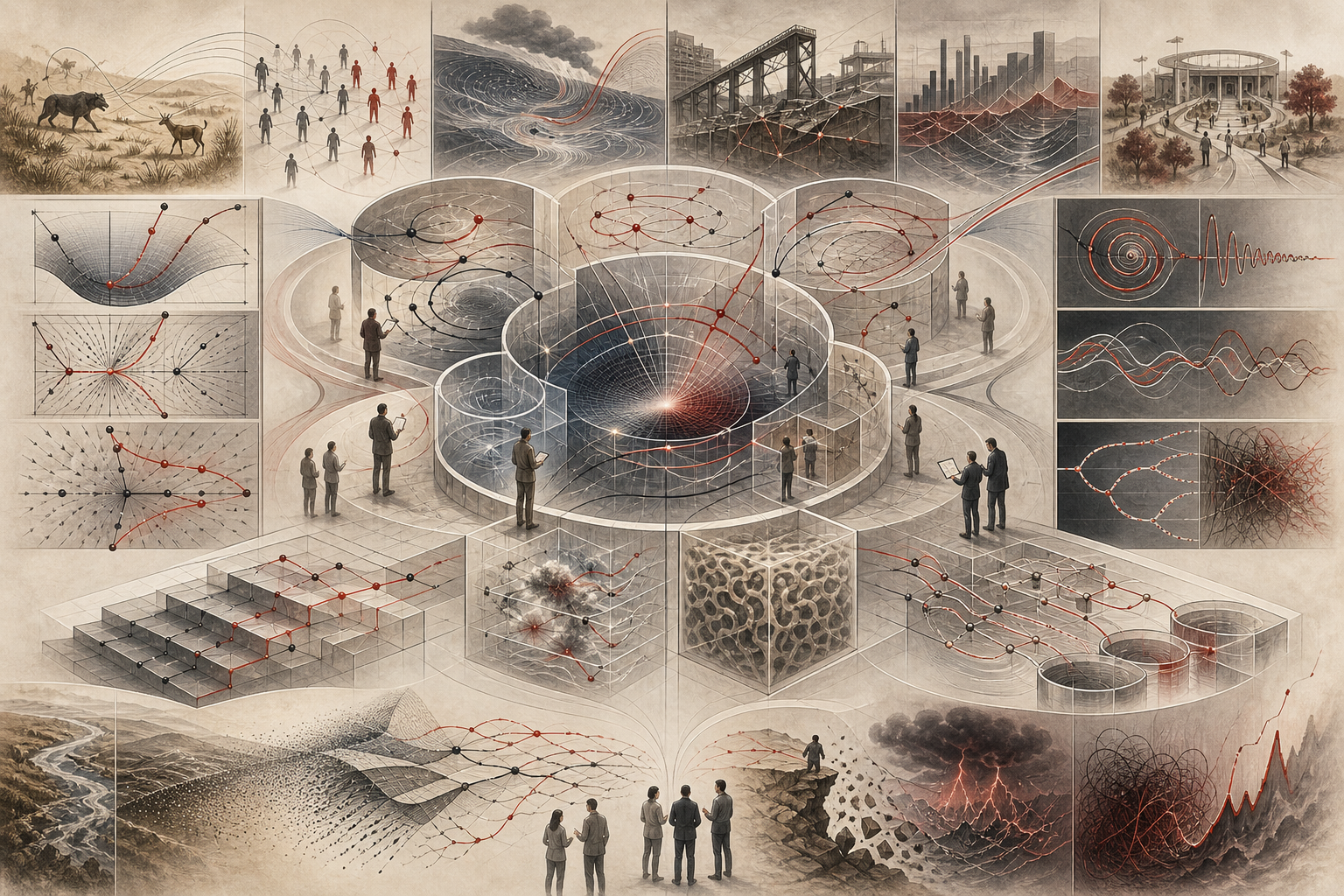
In mathematical modeling, differential equations provide one of the clearest formal languages for studying systems that move, accumulate, respond, oscillate, stabilize, destabilize, diffuse, spread, or reorganize through time. They clarify how populations grow and interact, how epidemics spread, how temperatures respond to energy imbalance, how infrastructure systems oscillate or degrade, how economic variables adjust, how ecological systems move toward or away from equilibrium, and how coupled systems generate behavior that cannot be understood by examining one variable in isolation.
Differential equations are especially important because they shift attention from static values to dynamic relationships. A system is not understood only by asking what its current state is. It is also understood by asking how that state is changing, what drives the change, what feeds back into the process, what forces it from outside, what stabilizes it, what destabilizes it, and what conditions may alter its trajectory. When combined with numerical methods, phase analysis, simulation, and reproducible workflows, differential equations become one of the central languages through which dynamic systems can be represented, interpreted, and explored.
Complete Code Repository
This article is supported by a companion code folder with reproducible examples, synthetic datasets, ordinary differential equation simulations, phase-plane workflows, parameter sweeps, sensitivity analysis, solver examples, SQL schemas, documentation, and scientific-computing examples across Python, R, Julia, SQL, C, C++, Fortran, Rust, Go, and notebooks.
Differential Equations as the Mathematics of Dynamic Systems
Differential equations begin from a central modeling question: what determines how a system changes? A static equation may describe a relationship among quantities at one moment, but a differential equation describes how a quantity evolves. It connects the present state of a system to its rate of change and, through that rate of change, to its future trajectory.
This makes differential equations indispensable for systems modeling. They allow modelers to represent growth, decay, adjustment, feedback, oscillation, diffusion, flow, response, and interaction as structured mathematical relationships. A population model can represent the rate at which population changes. An epidemiological model can represent how susceptible, infected, and recovered groups move between states. A climate model can represent how temperature responds to forcing and feedback. An infrastructure model can represent load, degradation, repair, and capacity through time.
The key point is that differential equations do not merely describe motion after it happens. They propose mechanisms of motion. They ask what drives change, what constrains it, what amplifies it, what delays it, and what stabilizes or destabilizes it. In this sense, they are not just mathematical objects. They are formal theories of dynamic behavior.
Why Differential Equations Matter for Systems Modeling
Many systems studied across economics, engineering, infrastructure analysis, ecology, climate science, epidemiology, governance, and public policy are fundamentally dynamic. Their present state depends not only on current inputs but on rates of change, past conditions, feedback mechanisms, external forcing, and interactions among multiple variables. Population growth depends on birth and death dynamics. Disease transmission depends on contact rates and susceptibility. Climate systems respond to radiative forcing, heat transfer, and delayed feedback. Mechanical and infrastructural systems oscillate, dampen, or destabilize under stress. Economic systems adjust through accumulation, lag, expectation, and coupled interaction.
Differential equations matter because they provide the formal language for representing these relationships. They make it possible to express how a quantity changes relative to time, space, or another variable, and how those changes influence future states. First-order equations represent simple rates of adjustment. Higher-order equations represent acceleration, oscillation, and more complex response. Systems of differential equations represent coupled processes whose behavior emerges from interaction rather than isolation. Qualitative tools such as phase lines, phase planes, nullclines, and stability analysis make it possible to interpret trajectories even when explicit analytic solutions are unavailable.
For mathematical modeling, the importance of differential equations is not only theoretical. Many real applications depend on numerical approximation, simulation, parameter exploration, and computational experimentation. Nonlinearity, stiffness, delay, dependence, and limited data often make closed-form solutions difficult or impossible. Real systems may need to be studied through solvers, phase analysis, scenario comparison, and repeated computational runs rather than hand-derived formulas alone. For that reason, differential equations must also be understood as a practical modeling discipline implemented through computational workflows, numerical methods, and reproducible analysis.
Used in this way, differential equations become more than a branch of applied mathematics. They become a language for understanding dynamic structure in complex systems. They clarify how feedback produces growth or collapse, how interaction generates oscillation or equilibrium, how forcing shifts trajectories, how thresholds can destabilize a system, how diffusion and transport redistribute states, and how change through time can be represented in forms that support explanation, analysis, simulation, and responsible decision-making.
Scope of This Content Pillar
This pillar is designed as a comprehensive treatment of differential equations while remaining organized enough to support cumulative learning over time. It does not treat differential equations merely as a classroom sequence of techniques, nor merely as a solver tutorial. Instead, it treats the subject as a major intellectual and methodological foundation for mathematical modeling.
The series moves across several levels at once. At the mathematical level, it examines the conceptual and formal foundations of first-order equations, higher-order equations, systems of equations, equilibrium, stability, phase analysis, forcing, nonlinearity, delay, and partial differential equations. At the interpretive level, it shows how these concepts clarify the behavior of complex systems, including growth, decay, coupling, oscillation, diffusion, thresholds, feedback, instability, and transformation through time and space. At the computational level, it explores how differential equations can be implemented in R and Python through numerical solvers, simulation, sensitivity analysis, visualization, and reproducible analysis.
The goal is not simply to teach isolated solution techniques. It is to build a durable framework for understanding how dynamic systems can be represented formally across domains such as climate systems, epidemiology, infrastructure analysis, economics, ecology, engineering, and data-driven scientific inquiry. The result is a series that is mathematical in rigor, systems-oriented in interpretation, and computational in practical orientation.
Because the subject is large, the pillar is intentionally structured as a long-term architecture rather than a short article set. The plan below is therefore extensive and marked (planned) throughout. It is meant to support gradual development into a deep and integrated body of work rather than an attempt at instant completion.
Mathematics, R, and Python
A full treatment of differential equations for modeling requires more than symbolic derivation alone. Mathematics establishes the formal structure of dynamic relationships, but computation makes it possible to investigate systems that are nonlinear, coupled, stiff, delayed, spatially distributed, or otherwise resistant to purely analytic treatment. For this reason, the series is deliberately designed around three mutually reinforcing components: formal mathematics, R, and Python.
The mathematical dimension addresses the logic of dynamic change itself. It asks how rates of change determine trajectories, how equilibrium emerges, how stability should be understood, how forcing alters solutions, how coupled systems behave, how qualitative analysis supplements exact solution, and how dynamic behavior can be interpreted even when no closed form is available. This is the level at which the concepts must be understood with precision.
The R dimension emphasizes analysis, visualization, reproducible research, parameter exploration, and applied workflows for studying dynamic systems. R is especially valuable for simulation output analysis, phase plotting, sensitivity analysis, statistical integration, literate programming, and clear communication of dynamic behavior. Within this pillar, R helps illuminate how solutions behave under varying assumptions and how results can be documented with methodological transparency.
The Python dimension emphasizes numerical solvers, scientific computing, simulation, algorithmic flexibility, and scalable modeling practice. Python makes it possible to implement ordinary and partial differential equation solvers, run scenario experiments, analyze dynamic systems, and connect differential equation modeling to broader ecosystems in scientific computing, machine learning, and computational science. Libraries such as SciPy, NumPy, SymPy, Matplotlib, and related tools make it a natural environment for applied differential equations in modeling contexts.
Together, these three dimensions allow the subject to be treated more richly than any one of them alone could provide. Mathematics gives rigor. R gives analytical clarity and reproducibility. Python gives numerical power and computational flexibility. A comprehensive treatment of differential equations for systems modeling therefore depends on all three.
Mathematical Lens
A first-order ordinary differential equation represents a rate of change:
\frac{dx}{dt}=f(x,t,\theta)
\]
Interpretation: The state \(x\) changes through time according to a rule \(f\), which may depend on the current state, time, and parameters \(\theta\). This is the basic language of dynamic systems modeling.
An initial value problem adds a starting condition:
\frac{dx}{dt}=f(x,t), \qquad x(t_0)=x_0
\]
Interpretation: The differential equation describes how the system changes, while the initial condition specifies where the trajectory begins.
A system of differential equations represents interacting state variables:
\frac{d\mathbf{x}}{dt}=\mathbf{f}(\mathbf{x},t,\theta)
\]
Interpretation: A vector of state variables changes according to a vector-valued rule. This structure supports models of ecosystems, epidemics, economies, infrastructure systems, climate feedback, and coupled human-natural systems.
An equilibrium occurs when the rate of change is zero:
f(x^*)=0
\]
Interpretation: At equilibrium \(x^*\), the system is not changing under the model. Stability analysis asks whether nearby trajectories move toward or away from that equilibrium.
Linearization approximates local behavior near an equilibrium:
\frac{d\mathbf{u}}{dt}=A\mathbf{u}
\]
Interpretation: Near an equilibrium, nonlinear dynamics can often be approximated by a linear system. The matrix \(A\) summarizes local interactions and helps assess stability.
Euler’s method approximates a trajectory numerically:
x_{n+1}=x_n+\Delta t\, f(x_n,t_n)
\]
Interpretation: Euler’s method steps forward by adding the current rate of change multiplied by a small time step. It is simple and intuitive, but accuracy and stability depend on step size and model structure.
A diffusion equation represents redistribution through space and time:
\frac{\partial u}{\partial t}=D\frac{\partial^2 u}{\partial x^2}
\]
Interpretation: Diffusion models how a quantity spreads from regions of higher concentration toward lower concentration. It appears in heat flow, pollution spread, ecology, epidemiology, and transport systems.
These formulas do not exhaust differential equations. They show why the field is central to systems modeling: it connects rates of change, initial conditions, interaction, equilibrium, stability, numerical approximation, spatial redistribution, and dynamic interpretation.
Major Themes in Differential Equations for Systems Modeling
1. Dynamic Representation
Differential equations begin by making it possible to represent systems in terms of rates of change rather than static states alone. This theme includes state variables, derivatives, initial conditions, boundary conditions, and the representation of dynamic systems in analyzable mathematical form.
2. Equilibrium, Stability, and Qualitative Behavior
Many modeling questions concern long-run tendencies, persistence, oscillation, or instability rather than exact formulas alone. This theme includes equilibrium points, local and global stability, linearization, phase lines, phase planes, bifurcation, and the qualitative interpretation of trajectories.
3. Interaction and Coupling
Real systems are rarely governed by a single isolated equation. This theme includes systems of differential equations, coupled variables, feedback structures, predator-prey relations, contagion dynamics, resource interaction, economic adjustment, and the ways interdependence shapes system motion.
4. Forcing, Delay, and Nonlinearity
Dynamic systems often respond to external inputs, delayed effects, and nonlinear structure. This theme includes forced systems, delayed adjustment, threshold behavior, feedback amplification, nonlinear response, and the conditions under which systems shift qualitatively rather than change smoothly.
5. Diffusion, Transport, and Spatial Dynamics
When change unfolds across space as well as time, differential equations become essential for modeling movement and distribution. This theme includes diffusion, transport, reaction-diffusion structure, wave-like propagation, boundary conditions, and the representation of spatially extended systems.
6. Numerical Solution and Simulation
Many differential equations cannot be solved analytically in closed form. This theme includes Euler methods, Runge–Kutta methods, stiffness, solver choice, discretization, numerical stability, computational diagnostics, and the use of R and Python to investigate dynamic systems computationally.
7. Calibration, Sensitivity, and Robustness
Differential equation models are only as useful as their assumptions and parameter choices allow. This theme includes calibration, parameter estimation, sensitivity analysis, uncertainty propagation, scenario comparison, identifiability, and the disciplined evaluation of how robust dynamic conclusions really are.
8. Interpretation and Model Judgment
Mathematical and computational outputs still require disciplined interpretation. This theme includes scaling, units, boundary conditions, identifiability, misspecification, oversimplification, solver error, and the distinction between elegant dynamics and credible systems explanation.
Differential Equations and Modeling Judgment
Differential equations give modelers powerful formal tools, but they do not remove the need for judgment. Every dynamic model depends on assumptions about state variables, parameters, rates, scale, time steps, boundary conditions, feedback structure, external forcing, and the appropriateness of continuous representation. A system of equations may be mathematically elegant while omitting key mechanisms. A stable equilibrium may appear reassuring while the real system remains vulnerable to shocks, thresholds, or structural change. A numerical solver may produce smooth trajectories that hide stiffness, parameter sensitivity, or invalid assumptions.
For this reason, differential equations for systems modeling must be joined to model assessment. Are the state variables meaningful? Are the units consistent? Are the parameters measurable? Does the model represent the right time scale? Is the system continuous enough for a differential-equation representation? Are delays, thresholds, and external shocks being handled appropriately? How sensitive are the results to initial conditions, step size, solver method, and parameter values?
A serious differential-equation modeling practice does not treat dynamic formalism as a guarantee of truth. It treats formalism as a disciplined way to reason, test, simulate, and revise. The strength of differential equations lies not only in the equations themselves, but in the interpretive discipline required to use them responsibly.
Differential Equations for Systems Modeling Article Series
The Differential Equations for Systems Modeling pillar is organized to move from foundations and first-order models toward higher-order dynamics, coupled systems, phase analysis, nonlinearity, forcing, delay, partial differential equations, numerical methods, calibration, sensitivity, applied systems, and case studies. Planned articles are shown in their intended final order but are left unlinked until publication.
Part I. Foundations of Differential Equations
- What Are Differential Equations for Systems Modeling? (planned) — An opening article defining differential equations as a formal language for systems whose behavior depends on rates of change.
- Rates of Change and Dynamic Representation (planned) — A foundation for understanding how derivatives become models of dynamic behavior.
- State Variables, Parameters, and Initial Conditions (planned) — An article on the core components of dynamic system representation.
- Separable Equations and Simple Dynamic Laws (planned) — A treatment of growth, decay, adjustment, and models that can be separated into solvable parts.
- Linear First-Order Differential Equations (planned) — A core article on linear adjustment, forcing, response, and first-order dynamic structure.
- Exact Equations and Integrating Factors (planned) — A technical article on recognizable solution structure and transformation.
- Existence, Uniqueness, and What a Solution Means (planned) — A conceptual article on when a dynamic model has a well-defined solution and why that matters.
Part II. Higher-Order Dynamics and Oscillation
- Second-Order Equations and Accelerating Systems (planned) — An article on systems where acceleration, inertia, or second-order response matters.
- Oscillation, Damping, and Resonance (planned) — A treatment of repeating motion, energy loss, amplification, and dynamic response.
- Mechanical Analogies and Dynamic Interpretation (planned) — A modeling article on how physical analogies clarify system behavior across domains.
- Forced Oscillators and External Inputs (planned) — A study of systems driven by external cycles, shocks, or signals.
- Homogeneous and Nonhomogeneous Systems (planned) — A technical article on intrinsic dynamics and externally forced response.
- Characteristic Equations and Dynamic Modes (planned) — A treatment of solution structure, modes, and the behavior of higher-order linear systems.
Part III. Systems of Differential Equations
- Systems of Differential Equations (planned) — A major article on multiple state variables evolving together through interaction.
- Coupled Dynamics and Interacting Variables (planned) — A systems article on how interdependence creates behavior that cannot be reduced to isolated equations.
- Predator-Prey Models and Ecological Interaction (planned) — A classic ecological case for studying coupled population dynamics.
- Compartment Models in Epidemiology (planned) — A treatment of susceptible, infected, recovered, and related compartmental systems.
- Economic Adjustment and Interacting State Variables (planned) — An article on dynamic economic models involving adjustment, accumulation, and interaction.
- Matrix Methods for Linear Dynamic Systems (planned) — A bridge to linear algebra, eigenvalues, matrix exponentials, and state-space models.
- Nullclines, Interaction, and Local Behavior (planned) — A visual and qualitative article on how nullclines clarify coupled system motion.
Part IV. Equilibrium, Stability, and Phase Analysis
- Equilibrium, Stability, and Local Dynamics (planned) — A foundation for interpreting where systems settle, diverge, or shift.
- Phase Lines and One-Dimensional Dynamics (planned) — A visualization-focused article on trajectories in one-dimensional systems.
- Phase Planes and Two-Dimensional Systems (planned) — A treatment of trajectories, vector fields, and qualitative motion in two dimensions.
- Linearization and Local Approximation (planned) — An article on approximating nonlinear dynamics near equilibrium.
- Eigenvalues and Dynamic Stability (planned) — A bridge between linear algebra and stability analysis.
- Bifurcation and Qualitative Change (planned) — A study of how parameter changes can alter system behavior qualitatively.
- Chaos and Sensitivity to Initial Conditions (planned) — An article on deterministic dynamics that become practically unpredictable.
Part V. Nonlinearity, Forcing, and Delay
- Nonlinear Differential Equations (planned) — A major article on nonlinear response, multiple equilibria, saturation, and complex dynamics.
- Thresholds, Saturation, and Logistic Structure (planned) — A treatment of carrying capacity, bounded growth, and threshold effects.
- Feedback, Amplification, and Dynamic Instability (planned) — A systems article on reinforcing dynamics, destabilization, and runaway behavior.
- Forced Systems and External Shock (planned) — An article on external forcing, disturbance, stress, and response.
- Delay, Memory, and Time-Lagged Dynamics (planned) — A treatment of systems where present change depends on past states.
- Path Dependence in Dynamic Models (planned) — A study of how early conditions, history, and irreversible choices shape later trajectories.
Part VI. Partial Differential Equations and Spatial Systems
- Introduction to Partial Differential Equations (planned) — A foundation for models involving both space and time.
- Diffusion, Transport, and Spatial Dynamics (planned) — A treatment of spread, movement, gradients, and redistribution.
- Heat, Flow, and Redistribution in Continuous Space (planned) — An article on spatial smoothing, thermal transfer, and continuous redistribution.
- Reaction-Diffusion Systems (planned) — A study of systems where local reaction and spatial spread interact.
- Wave-Like Propagation and Dynamic Spread (planned) — A treatment of wave equations, propagation, signaling, and dynamic transmission.
- Boundary Conditions and Spatial Interpretation (planned) — A modeling article on how boundaries shape spatial-temporal solutions.
Part VII. Numerical Methods in R and Python
- Why Numerical Solvers Matter (planned) — An article on why dynamic systems often require computational approximation.
- Euler’s Method (planned) — An accessible introduction to stepping through differential equations numerically.
- Runge–Kutta Methods (planned) — A treatment of higher-order methods for improving numerical accuracy.
- Ordinary Differential Equation Solvers in Python (planned) — A practical workflow using Python scientific-computing tools.
- Ordinary Differential Equation Workflows in R (planned) — A practical workflow for simulation and visualization in R.
- Stiff Systems and Computational Difficulty (planned) — A technical article on dynamic systems that create solver challenges.
- Error, Stability, and Convergence in Numerical Modeling (planned) — A treatment of numerical reliability and approximation discipline.
- Visualizing Dynamic Trajectories and Phase Structure (planned) — A workflow article on plotting trajectories, vector fields, phase planes, and solution families.
Part VIII. Calibration, Sensitivity, and Model Evaluation
- Parameter Estimation in Differential Equation Models (planned) — An article on fitting dynamic models to observed data.
- Model Calibration Techniques (planned) — A practical article on aligning model behavior with empirical evidence.
- Sensitivity Analysis in Dynamic Systems (planned) — A workflow article on parameter dependence and robustness.
- Scenario Comparison and Robustness (planned) — An article on comparing trajectories under alternative assumptions and futures.
- Validation, Verification, and Model Credibility (planned) — A critical article on whether a dynamic model is adequate for its intended purpose.
- Identifiability, Scale, and Dynamic Interpretation (planned) — A treatment of whether parameters and mechanisms can be inferred from available observations.
Part IX. Differential Equations in Applied Systems
- Population Dynamics and Growth Models (planned) — A case-oriented article on exponential, logistic, and constrained growth.
- Epidemiological Systems Under Transmission Dynamics (planned) — A treatment of disease spread, intervention, susceptibility, and recovery.
- Climate Feedback Models (planned) — An article on energy balance, forcing, delay, and feedback response.
- Carbon Accumulation and Emissions Pathways (planned) — A flow-to-stock article on cumulative emissions and atmospheric burden.
- Infrastructure Load, Flow, and Degradation Models (planned) — A systems article on capacity, decay, maintenance, and dynamic stress.
- Economic Growth and Adjustment Dynamics (planned) — A treatment of growth, adjustment, equilibrium, and delayed response in economic systems.
- Resource Depletion and Regeneration Systems (planned) — An article on extraction, renewal, thresholds, and sustainability constraints.
Part X. Applied Case Studies
- Case Study: A Predator-Prey System (planned) — A worked example of ecological interaction and coupled dynamics.
- Case Study: An SIR Epidemiological Model (planned) — A worked example of compartmental disease modeling.
- Case Study: A Climate Energy Balance Model (planned) — A worked example of forcing, heat balance, and climate response.
- Case Study: A Dynamic Infrastructure Capacity Model (planned) — A worked example of load, degradation, repair, and capacity.
- Case Study: A Reproducible Solver Workflow in Python (planned) — A practical Python workflow for dynamic simulation and interpretation.
- Case Study: A Reproducible Dynamic Modeling Workflow in R (planned) — A practical R workflow for simulation, visualization, and reporting.
R Section: Simulating a Dynamic System
The R workflow below simulates a logistic differential equation using Euler’s method. The example is intentionally simple, but the workflow illustrates a general modeling pattern: define the rate equation, choose initial conditions, step forward numerically, summarize the trajectory, and examine sensitivity to parameter choices.
# Differential Equations for Systems Modeling:
# Simulating a dynamic system in R.
# Educational example only.

library(tidyverse)

simulate_logistic_ode <- function(initial_state, growth_rate, capacity, dt, steps) {
  time <- numeric(steps)
  state <- numeric(steps)
  derivative <- numeric(steps)

  state[1] <- initial_state
  time[1] <- 0

  for (i in 2:steps) {
    derivative[i - 1] <- growth_rate * state[i - 1] * (1 - state[i - 1] / capacity)
    state[i] <- state[i - 1] + derivative[i - 1] * dt
    time[i] <- time[i - 1] + dt
  }

  derivative[steps] <- growth_rate * state[steps] * (1 - state[steps] / capacity)

  tibble(
    time = time,
    state = state,
    derivative = derivative,
    growth_rate = growth_rate,
    capacity = capacity
  )
}

parameter_grid <- crossing(
  growth_rate = c(0.10, 0.15, 0.20, 0.25),
  capacity = c(80, 100, 120)
)

simulation_results <- parameter_grid |>
  mutate(
    simulation = map2(
      growth_rate,
      capacity,
      ~ simulate_logistic_ode(
        initial_state = 10,
        growth_rate = .x,
        capacity = .y,
        dt = 0.1,
        steps = 300
      )
    )
  ) |>
  unnest(simulation)

summary_results <- simulation_results |>
  group_by(growth_rate, capacity) |>
  summarise(
    final_state = state[time == max(time)],
    maximum_state = max(state),
    maximum_derivative = max(derivative),
    .groups = "drop"
  ) |>
  arrange(desc(final_state))

print(summary_results)

ggplot(simulation_results, aes(x = time, y = state, group = interaction(growth_rate, capacity))) +
  geom_line(aes(linetype = factor(capacity))) +
  labs(
    title = "Logistic Differential Equation Simulation",
    x = "Time",
    y = "System state",
    linetype = "Capacity"
  ) +
  theme_minimal(base_size = 12)

dir.create("outputs", showWarnings = FALSE, recursive = TRUE)

write_csv(simulation_results, "outputs/r_differential_equation_simulation.csv")
write_csv(summary_results, "outputs/r_differential_equation_sensitivity_summary.csv")
This workflow demonstrates how a differential equation becomes a simulation. The equation defines the rate of change, the initial condition defines the starting point, and the numerical method approximates the trajectory through time. The sensitivity grid shows how dynamic outcomes change under different parameter assumptions.
Python Section: ODE Simulation, Phase Behavior, and Sensitivity
The Python workflow below simulates a logistic differential equation, computes rate values, and compares outcomes across a parameter sweep. It is designed as an accessible entry point into dynamic modeling with ordinary differential equations.
# Differential Equations for Systems Modeling:
# ODE simulation, phase behavior, and sensitivity in Python.
# Educational example only.

from __future__ import annotations

import numpy as np
import pandas as pd


def logistic_rate(state: float, growth_rate: float, capacity: float) -> float:
    """Return dS/dt for the logistic differential equation."""
    return growth_rate * state * (1.0 - state / capacity)


def simulate_logistic_ode(
    initial_state: float,
    growth_rate: float,
    capacity: float,
    dt: float,
    steps: int
) -> pd.DataFrame:
    """
    Simulate dS/dt = rS(1 - S/K) using Euler's method.

    This is a teaching example. Production modeling should evaluate
    solver accuracy, stiffness, step-size dependence, and uncertainty.
    """
    time = np.zeros(steps)
    state = np.zeros(steps)
    derivative = np.zeros(steps)

    state[0] = initial_state

    for i in range(1, steps):
        derivative[i - 1] = logistic_rate(
            state=state[i - 1],
            growth_rate=growth_rate,
            capacity=capacity
        )

        state[i] = state[i - 1] + derivative[i - 1] * dt
        time[i] = time[i - 1] + dt

    derivative[-1] = logistic_rate(
        state=state[-1],
        growth_rate=growth_rate,
        capacity=capacity
    )

    return pd.DataFrame({
        "time": time,
        "state": state,
        "derivative": derivative,
        "growth_rate": growth_rate,
        "capacity": capacity
    })


def run_parameter_sweep() -> pd.DataFrame:
    """Run a small sensitivity sweep over growth rate and capacity."""
    rows = []

    for growth_rate in [0.10, 0.15, 0.20, 0.25]:
        for capacity in [80.0, 100.0, 120.0]:
            simulation = simulate_logistic_ode(
                initial_state=10.0,
                growth_rate=growth_rate,
                capacity=capacity,
                dt=0.1,
                steps=300
            )

            rows.append({
                "growth_rate": growth_rate,
                "capacity": capacity,
                "final_state": float(simulation["state"].iloc[-1]),
                "maximum_state": float(simulation["state"].max()),
                "maximum_derivative": float(simulation["derivative"].max())
            })

    return pd.DataFrame(rows).sort_values("final_state", ascending=False)


def main() -> None:
    simulation = simulate_logistic_ode(
        initial_state=10.0,
        growth_rate=0.20,
        capacity=100.0,
        dt=0.1,
        steps=300
    )

    sensitivity = run_parameter_sweep()

    phase_values = pd.DataFrame({
        "state": np.linspace(0, 120, 241)
    })

    phase_values["derivative"] = phase_values["state"].apply(
        lambda value: logistic_rate(value, growth_rate=0.20, capacity=100.0)
    )

    print(simulation.head())
    print("\nSensitivity summary:")
    print(sensitivity)
    print("\nPhase behavior sample:")
    print(phase_values.head())

    simulation.to_csv("differential_equation_simulation.csv", index=False)
    sensitivity.to_csv("differential_equation_sensitivity_summary.csv", index=False)
    phase_values.to_csv("differential_equation_phase_values.csv", index=False)


if __name__ == "__main__":
    main()
This workflow reinforces a central lesson of differential-equation modeling: dynamic behavior is shaped by equations, parameters, initial conditions, and numerical choices. Even a simple model can reveal equilibrium behavior, growth dynamics, parameter sensitivity, and the need for careful interpretation.
Interpretive Limits and Responsible Use
Differential equations are powerful, but dynamic models can mislead when used without judgment. A smooth trajectory can hide discontinuity, shock, institutional disruption, or regime shift. A stable equilibrium can imply long-run order while ignoring rare events, external forcing, or structural change. A numerical solution can appear precise while depending strongly on step size, solver choice, parameter assumptions, or boundary conditions. A nonlinear model can produce rich behavior while remaining weakly connected to empirical evidence.
Dynamic models are especially vulnerable to inappropriate simplification. Real systems may contain discrete decisions, thresholds, stochastic shocks, spatial heterogeneity, network structure, behavioral adaptation, institutional constraints, or delayed feedback that a simple ordinary differential equation cannot capture. In those cases, differential equations may still be useful, but they should be combined with data analysis, systems thinking, stochastic modeling, agent-based modeling, scenario analysis, and careful domain interpretation.
Responsible use of differential equations for systems modeling therefore requires interpretive discipline. Analysts should ask whether the state variables are meaningful, whether the rate equations are plausible, whether parameters can be estimated, whether equilibrium analysis is relevant, whether numerical methods are reliable, whether sensitivity has been examined, and whether uncertainty has been communicated honestly. Differential equations support rigorous dynamic reasoning, but they do not replace modeling judgment.
Related Reading
- Mathematical Modeling
- Calculus for Systems Modeling
- Linear Algebra for Systems Modeling
- Probability for Systems Modeling
- Statistics for Systems Modeling
- Scientific Computing for Systems Modeling
- Systems Modeling
- Decision Science
Primary Texts and Foundational Works
- Poincaré, H., Lectures on Differential Equations
- Whittaker, E.T. and Watson, G.N., A Course of Modern Analysis
- Coddington, E.A. and Levinson, N., Theory of Ordinary Differential Equations
- Arnold, V.I., Ordinary Differential Equations
Further Reading
- OpenStax, Calculus Volume 2
- OpenStax, Calculus Volume 3
- MIT OpenCourseWare, Differential Equations
- Runestone ODE Project
- The Scientific Machine Learning Book
References
- Arnold, V.I. (1992) Ordinary Differential Equations. Berlin: Springer.
- Coddington, E.A. and Levinson, N. (1955) Theory of Ordinary Differential Equations. New York: McGraw-Hill.
- Massachusetts Institute of Technology (MIT) OpenCourseWare (2010) Differential Equations. Cambridge, MA: MIT OpenCourseWare.
- OpenStax (2016a) Calculus Volume 2. Houston, TX: OpenStax, Rice University.
- OpenStax (2016b) Calculus Volume 3. Houston, TX: OpenStax, Rice University.
- Poincaré, H. (1905) Lectures on Differential Equations. Boston: Ginn and Company.
- Rackauckas, C. and Nie, Q. (n.d.) The Scientific Machine Learning Book.
- Runestone Academy (n.d.) ODE Project.
- Whittaker, E.T. and Watson, G.N. (1927) A Course of Modern Analysis. Cambridge: Cambridge University Press.