
Last Updated May 28, 2026
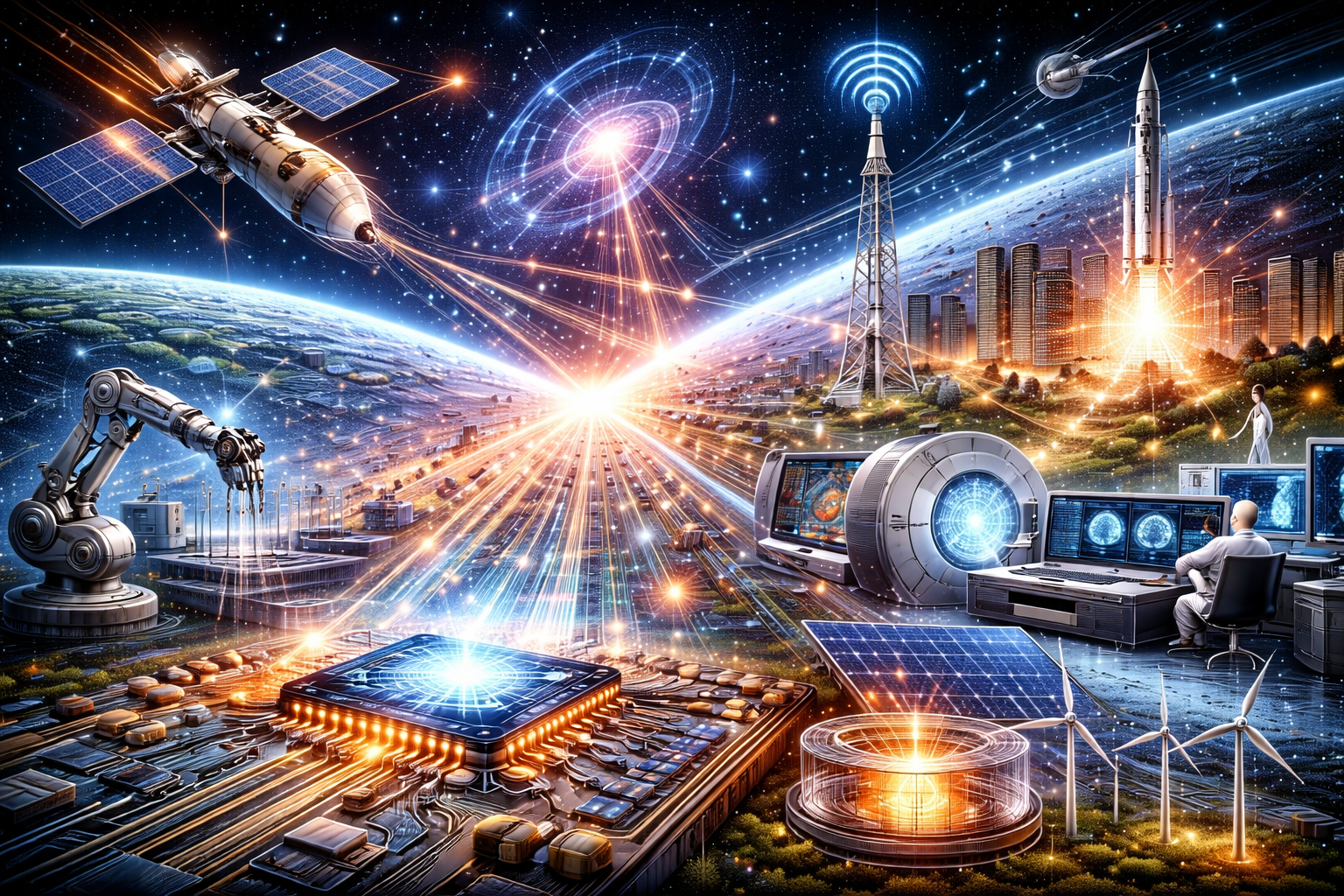
Physics, technology, and the modern world examine one of the most consequential facts about contemporary civilization: many of the systems that shape everyday life, industry, medicine, communication, mobility, energy, computation, and national infrastructure are direct outgrowths of physical science. Physics is not only a foundational science of matter, energy, motion, fields, radiation, materials, space, time, and measurement. It is also one of the deepest technological engines in modern history. Semiconductors, lasers, GPS timing, medical imaging, nuclear power, space systems, fiber optics, superconducting magnets, sensors, quantum devices, advanced materials, and modern communication networks all depend on physical principles translated into instruments, devices, platforms, and operational systems.
This relationship is not accidental or secondary. Modern technology is not simply “applied science” in a loose sense. It is often the result of sustained interaction among physical theory, metrology, instrumentation, computation, manufacturing constraints, materials development, systems engineering, institutional investment, and standards infrastructure. NIST’s CHIPS Metrology Program emphasizes measurement science for microelectronic materials, devices, circuits, and systems. NASA’s physical-sciences program organizes research across biophysics, combustion science, complex fluids, fluid physics, fundamental physics, and materials science in the space environment. DOE’s Office of Science identifies microelectronics, quantum information science, fusion, critical materials, and advanced manufacturing as strategic research domains. CERN’s knowledge-transfer work shows how technologies developed for particle physics can diffuse into medicine, space, imaging, data systems, and broader societal applications.
This article develops Physics, Technology, and the Modern World as a capstone topic within the Physics knowledge series. It explains how physical law becomes technology through measurement, materials, devices, platforms, and systems; how physics underlies computing, sensing, imaging, energy, transport, communication, and space infrastructure; why metrology and standards are central to technological civilization; and how modern physics continues to generate new technological possibilities through semiconductors, photonics, quantum systems, advanced materials, and large-scale instrumentation. It also follows the mathematics-first and computation-aware structure used throughout the series while keeping the article body readable. Selected Python and R workflows appear here, while the full GitHub repository contains expanded research-grade computational workflows for simulation, uncertainty analysis, structured metadata, performance-oriented code, and reproducible technology-modeling workflows.
Main Library
Publications
Article Map
Physics
Related Topic
Mathematical Thinking
Related Topic
Data Systems & Analytics
Related Topic
Astronomy
Why Physics Matters Technologically
Physics matters technologically because it provides the most general quantitative language for describing how the material world behaves under controlled conditions. That makes it uniquely powerful for building devices and systems that rely on predictability, repeatability, calibration, and physically constrained response. A bridge, a laser, an MRI scanner, a GPS receiver, a photovoltaic array, a fiber-optic network, a semiconductor fabrication line, a particle detector, a power transformer, and a spacecraft instrument all depend on the same broad principle: physical law can be transformed into engineered reliability when measurement, design, materials, and control systems are disciplined carefully enough.
This does not mean that every technology is a direct implementation of a textbook equation. Mature systems are layered achievements built from physical insight, materials optimization, manufacturing tolerances, signal processing, standards, maintenance regimes, safety practices, and institutional knowledge. But physics remains foundational because it supplies many of the governing structures: electromagnetism for communication and electronics, quantum mechanics for semiconductors and lasers, nuclear physics for imaging and fission, relativity for high-precision timing and navigation, thermodynamics for engines and energy systems, optics for photonics, and materials physics for advanced manufacturing.
The modern world is therefore deeply physical even when that fact is hidden behind interfaces. People often encounter software, devices, and networks as seemingly abstract services. Yet computation depends on semiconductor switching and heat dissipation. Communication depends on electromagnetic fields, fiber optics, antennas, modulation, and detectors. Navigation depends on clocks, signals, orbital mechanics, relativity, and statistical inference. Medicine depends on radiation, resonance, acoustics, imaging, detector physics, and calibrated dose. Technology is not an escape from materiality. It is refined material organization through physics.
From Physical Law to Technical System
The path from physics to technology is rarely linear. A discovery in basic science does not automatically become a useful device. Instead, physical law is translated through a long chain: experimental confirmation, metrology, materials characterization, component design, scaling, fabrication, control systems, reliability testing, safety analysis, standards development, economic feasibility, and integration into larger infrastructures. This is why technological civilization depends not only on theory but on institutions that stabilize knowledge into reproducible practice.
Semiconductors provide a clear example. Quantum physics explains band structure, carrier behavior, tunneling, and energy levels, but a functioning chip also requires crystalline control, doping precision, lithography, pattern transfer, etching, deposition, packaging, thermal management, metrology, yield analysis, and defect control. NIST’s CHIPS and semiconductor metrology work makes this explicit by placing measurement science near the center of microelectronics development. The device is not just a theory made visible. It is theory disciplined by manufacturing reality.
The same logic holds elsewhere. Space instruments require sensing principles, but also environmental testing, materials qualification, calibration, radiation tolerance, thermal design, data processing, and mission constraints. Medical imaging requires physical contrast mechanisms, but also detector electronics, reconstruction algorithms, safety standards, and clinical workflows. Energy systems require thermodynamic and electromagnetic principles, but also scale, grid integration, storage, regulation, land use, and materials supply. Physical law becomes technology only when it survives the realities of systems.
Measurement, Standards, and Modern Infrastructure
Modern technology depends on physical standards. A processor clock, a photonic package, an electrical reference, a chemical sensor, a radiometric instrument, a manufacturing tolerance, or a satellite timing system only becomes interoperable when it is tied to recognized measurement systems. Physics enters the modern world not only through invention but through metrology: the science and practice of measurement.
This standards layer is easy to underestimate because it is often invisible. The modern world depends on shared definitions of time, length, mass, temperature, electric current, luminous intensity, material properties, signal levels, tolerances, and uncertainties. Without traceable measurement, technologies become less comparable, less safe, less scalable, and less reliable. A medical device, semiconductor wafer, aerospace component, power-system sensor, or laboratory instrument must be measured in ways that others can reproduce and trust.
NIST’s work in time and frequency, semiconductor metrology, photonics, manufacturing, and standards illustrates how physical measurement underwrites technical civilization. NIST time and frequency activities include maintaining standards, providing official U.S. time, operating atomic clocks, and supporting research in time and frequency metrology. These activities are not peripheral to technology. They make synchronized infrastructure possible.
Electronics, Semiconductors, and Computation
One of the clearest examples of physics shaping the modern world is electronics. The transistor, integrated circuit, memory device, sensor array, and microprocessor all depend on solid-state physics, quantum mechanics, electromagnetism, materials science, and statistical control. The logic of modern computing rests on the control of charge, carrier mobility, band gaps, interfaces, switching behavior, interconnects, noise, heat, and signal integrity at scales where microscopic physical effects become technologically decisive.
This matters because digital civilization is often misread as purely informational rather than physical. In reality, every calculation in a conventional computer is an event in matter: charges move, fields change, gates switch, heat is generated, timing margins are maintained, and signals are propagated through imperfect conductors and materials. The apparent abstraction of software is supported by an immense physical stack.
Semiconductors also show how physics, economics, and geopolitics converge. Chips support consumer electronics, vehicles, data centers, communications, defense systems, AI hardware, biotechnology, and clean-energy technologies. They are scientific objects, manufactured products, strategic assets, and infrastructural dependencies at the same time. The physics of semiconductors is therefore inseparable from the modern political economy of computation.
Photonics, Communication, and Information
Modern communication depends deeply on physics, especially electromagnetism, optics, quantum transitions, and materials engineering. Fiber-optic communication, lasers, detectors, photonic chips, antennas, microwave systems, and optical clocks rely on the controlled production, transmission, modulation, and detection of electromagnetic radiation. The modern internet, satellite communication, precision sensing infrastructure, and many scientific instruments rest on this optical and electromagnetic foundation.
Photonics is especially important because it bridges information systems and materials systems. It is not enough to move information abstractly. Light must be generated, guided, modulated, coupled, amplified, filtered, detected, and packaged. Optical performance is inseparable from alignment, thermal stability, environmental robustness, fabrication quality, and signal integrity. This is why photonic packaging, chip-scale optics, and integrated photonics are central technology challenges rather than minor implementation details.
Communication technologies therefore are not just about data. They are about physical fields and devices operating under real-world constraints. Bits move because photons, electrons, fields, and materials behave in ways that can be predicted, engineered, and standardized.
Energy Systems, Power, and Physical Scale
Energy technology is another major domain where physics shapes the modern world. Thermodynamics governs engines, refrigeration, heat transfer, power cycles, and industrial process design. Electromagnetism governs power generation, transmission, motors, generators, transformers, and grid operation. Nuclear physics governs fission, fusion research, radiation, and reactor behavior. Materials physics governs batteries, photovoltaics, superconducting systems, insulation, turbines, corrosion, and thermal stability.
This matters because energy systems are not simply political or economic infrastructures. They are also physical infrastructures whose possibilities and limits are governed by conversion efficiency, heat rejection, storage density, materials constraints, transport losses, power quality, intermittency, and environmental coupling. Policy can shape incentives and deployment, but it cannot repeal thermodynamics, materials limits, or grid physics.
The technological future of energy therefore depends on physics at multiple levels: quantum and materials physics for batteries and photovoltaics; plasma physics for fusion; nuclear physics for fission; fluid dynamics for turbines and atmospheric resources; thermodynamics for efficiency and waste heat; and control theory for grid operation. Energy systems are among the clearest examples of physics becoming civilization-scale infrastructure.
Medical Imaging, Sensing, and Human Health
Some of the most humane and socially consequential uses of physics appear in medicine. X-ray imaging, CT, MRI, PET, ultrasound, radiotherapy, dosimetry, biosensing, optical imaging, and precision diagnostics all depend on physical principles. These technologies show how deeply physics can become embedded in care, diagnosis, and intervention.
Medical imaging is especially instructive because it brings many parts of physics together. X-ray and CT systems depend on radiation production, attenuation, detector response, and reconstruction algorithms. MRI depends on magnetic resonance, radiofrequency pulses, gradient fields, relaxation times, superconducting magnets, and signal processing. PET depends on nuclear decay, positron annihilation, gamma-ray detection, coincidence timing, and statistical reconstruction. Ultrasound depends on acoustic wave propagation, reflection, scattering, attenuation, and transducer physics.
The broader lesson is that physics shapes the modern world not only by powering large infrastructures but by altering how bodies are seen, measured, and treated. The physics of radiation, fields, waves, and detectors becomes a clinical interface between hidden biological structure and medical judgment.
Space, Satellites, and Observational Technology
Modern life depends heavily on space technology, much of which is physics-based in both design and purpose. Satellites support communication, navigation, weather monitoring, Earth observation, climate measurement, astrophysical observation, heliophysics, disaster response, and national security. These systems rely on orbital mechanics, radiometry, detector physics, plasma and radiation-environment tolerance, thermal control, remote sensing, precision timing, and signal processing.
The space layer of modern civilization is often invisible precisely because it works so well. Navigation apps, weather forecasts, financial timing, telecommunications, agricultural monitoring, disaster mapping, and climate observation all depend on space-based infrastructure. GPS and related global navigation satellite systems reveal this clearly: a user experiences a location fix, but the underlying system depends on atomic clocks, satellite orbits, signal propagation, relativistic correction, receiver algorithms, and error modeling.
Space technology also extends science itself. The same physics that builds instruments also uses instruments to deepen physics. Space telescopes, cosmic microwave background missions, heliophysics observatories, planetary probes, and gravitational-wave follow-up systems turn technological capability into new knowledge about the universe.
Advanced Materials, Quantum Systems, and the Next Wave
Physics continues to shape the future of technology through advanced materials, quantum systems, and new device architectures. Semiconductors are still evolving, but so are photonic systems, quantum information platforms, cryogenic devices, superconductors, spintronic systems, nanoscale materials, radiation-hard components, and sensors designed for extreme environments or unusual physical responses.
Quantum technologies are especially important because they show how concepts once associated with foundational physics can become engineering platforms. Quantum sensing, quantum communication, quantum computing, and quantum materials all depend on controlled coherence, measurement, noise, coupling, and environmental isolation. Their promise depends not only on theory but on device physics, materials purity, fabrication control, cryogenics, error correction, and metrology.
Advanced materials similarly demonstrate that technological futures are often materials futures. Batteries, catalysts, magnets, superconductors, photovoltaics, membranes, detectors, and structural materials all depend on physical properties that must be understood and controlled across scales. The next wave of technology will not be built from computation alone. It will be built from matter, fields, information, and measurement together.
Large Instruments and Spillover Innovation
Large scientific infrastructures often generate technologies that spill beyond their original research purpose. Particle accelerators, cryogenic systems, detector platforms, vacuum systems, superconducting magnets, high-speed electronics, radiation-hard sensors, data pipelines, and materials advances developed for fundamental research can migrate into medicine, industry, security, imaging, manufacturing, and computing.
CERN is one of the clearest examples of this pattern. Particle physics requires instruments of unusual scale and precision, and those instruments generate technical capabilities that can later be adapted elsewhere. Detector technologies, accelerator expertise, semiconductor readout systems, computing frameworks, and data-analysis tools can become useful beyond the laboratory. The same is true across large observatories, national laboratories, synchrotron facilities, fusion experiments, and space missions.
This matters because the social value of basic physics is not exhausted by direct explanation of nature. It also appears in capabilities, methods, instruments, standards, and trained expertise that diffuse outward into the wider world. The line between “fundamental” and “applied” physics is therefore often more porous than it first appears.
The Politics, Economics, and Ethics of Physics-Based Technology
Physics-based technologies do not enter the world neutrally. They emerge within political economies, strategic competition, industrial systems, labor structures, environmental constraints, and ethical conflicts. Semiconductor supply chains, nuclear technologies, surveillance systems, AI hardware, space infrastructure, medical imaging systems, energy grids, and sensor networks all involve power as well as knowledge.
A serious account of physics in the modern world cannot stop at invention and capability. It must also ask who benefits, who is exposed to risk, how technological systems are governed, whose labor and materials make them possible, and how physical power is distributed socially. The same physics that enables diagnosis can enable surveillance; the same nuclear knowledge that enables low-carbon electricity can enable weapons; the same satellites that support disaster response can support targeting; the same chips that support medicine can support extractive or coercive systems.
Modern physics has enabled extraordinary gains in health, communication, mobility, safety, and understanding. It has also enabled destructive capacities of unusual scale. The modern world shaped by physics is therefore neither purely emancipatory nor purely dangerous. It is historically mixed, politically structured, and ethically consequential.
Mathematical Lens
A mathematics-first treatment of physics and technology begins by recognizing that technologies usually operate through measurable transfer functions, scaling relations, conservation constraints, uncertainty budgets, and signal models. A semiconductor device turns material parameters and bias conditions into current-voltage response. A radiometric instrument turns photon flux into calibrated digital counts. A navigation system turns timing information into positional inference. A power system turns energy flow into capacity, loss, and reliability constraints.
One of the most basic relations in physics-based technology connects distance, speed, and time:
d = vt
\]
Interpretation: Distance equals speed multiplied by travel time, a basic relation behind ranging, motion, and signal propagation.
This relation appears elementary, but its technological implications are enormous. In high-precision navigation and timing systems, tiny errors in time translate into meaningful errors in inferred position. If a signal travels at approximately the speed of light \(c\), then the inferred distance is:
d = ct
\]
Interpretation: For electromagnetic signals, timing can be converted into distance using the speed of light.
and the corresponding distance uncertainty from timing uncertainty is:
\Delta d = c\Delta t
\]
Interpretation: Timing uncertainty becomes spatial uncertainty when multiplied by signal speed.
Power and energy relations are equally fundamental:
P = \frac{E}{t}
\]
Interpretation: Power is the rate at which energy is transferred, delivered, or consumed.
For electrical systems, power can also be written as:
P = IV
\]
Interpretation: Electrical power equals current multiplied by voltage in a simple circuit relation.
where \(I\) is current and \(V\) is voltage. Many engineered systems combine these relations with loss, efficiency, thermal, and noise constraints:
\eta = \frac{E_{\mathrm{useful}}}{E_{\mathrm{input}}}
\]
Interpretation: Efficiency measures the fraction of input energy converted into useful output.
The modern technological world is therefore mathematical, but not in an abstractly detached way. It is mathematical because devices must perform predictably under quantified constraints, uncertainty limits, safety margins, and physical scaling laws.
Variables, Units, and Technology Interpretation
Technology converts physical quantities into operational decisions. The table below summarizes several variables that appear across timing, power, sensing, and infrastructure systems.
| Symbol | Meaning | Typical Unit | Technology Interpretation |
|---|---|---|---|
| \(d\) | Distance | meter, \(m\) | Navigation, ranging, mapping, sensing, and positioning |
| \(v\) | Speed or signal velocity | \(m/s\) | Propagation through space, fiber, circuits, or media |
| \(c\) | Speed of light in vacuum | \(m/s\) | Reference for timing, relativity, and electromagnetic propagation |
| \(t\) | Time | second, \(s\) | Synchronization, control, sampling, navigation, and computing |
| \(\Delta t\) | Timing uncertainty | second, \(s\) | Clock error, synchronization uncertainty, or measurement uncertainty |
| \(\Delta d\) | Distance uncertainty | meter, \(m\) | Position error induced by timing uncertainty |
| \(E\) | Energy | joule, \(J\) | Stored, transferred, consumed, or converted capacity |
| \(P\) | Power | watt, \(W\) | Rate of energy transfer or use |
| \(I\) | Electric current | ampere, \(A\) | Charge flow in electrical systems |
| \(V\) | Voltage | volt, \(V\) | Electrical potential difference driving current |
| \(\eta\) | Efficiency | dimensionless or percent | Fraction of input energy converted into useful output |
Note: Physics-based technology depends on units, uncertainty, tolerances, calibration, and interpretation. The same equation can serve different technological roles depending on whether it is used for navigation, power design, sensing, imaging, or manufacturing.
Worked Example: Timing, Position, and Modern Navigation
A compact way to show how physics enters everyday technology is through timing-based navigation. If an electromagnetic signal travels at approximately the speed of light \(c\), then the inferred distance from a timing measurement is:
d = ct
\]
Interpretation: Navigation and ranging systems can infer distance from signal travel time.
If the timing uncertainty is \(\Delta t\), the corresponding distance uncertainty is:
\Delta d = c\Delta t
\]
Interpretation: Position error scales directly with timing uncertainty for light-speed signals.
Using \(c \approx 299{,}792{,}458 \, \mathrm{m/s}\), a timing uncertainty of one nanosecond produces a distance uncertainty of approximately:
\Delta d = (299{,}792{,}458)(1 \times 10^{-9}) \approx 0.30 \, \mathrm{m}
\]
Interpretation: A one-nanosecond timing uncertainty corresponds to roughly 30 centimeters of distance uncertainty.
This example reveals why precise clocks, signal standards, synchronization, orbital knowledge, and relativistic correction are indispensable to global navigation systems. A smartphone map interface hides the physical stack beneath it, but the system depends on timing precision, satellite motion, signal propagation, atmospheric correction, receiver computation, and uncertainty control.
The deeper lesson is that technologies people experience as seamless often depend on extremely stringent physical measurement conditions in the background. A nanosecond is not a human-scale interval, but it can become a human-scale location error when multiplied by the speed of light.
Computational Modeling
Computational modeling helps connect physical relations to technology performance. Timing uncertainty can be converted into position uncertainty. Energy use can be converted into power demand. Efficiency can be modeled as useful output divided by input. Signal-to-noise ratios can be estimated. Thermal loads can be projected. Device parameters can be swept across plausible ranges. These computational exercises do not replace experiment or engineering, but they clarify physical constraints before systems are built or deployed.
The selected article examples below focus on timing and energy because they are broadly understandable and technologically central. The GitHub repository extends the same logic into richer workflows, including Python parameter sweeps, R uncertainty analysis, Julia numerical models, C++ performance-oriented loops, Fortran scientific-computing examples, SQL metadata, Rust command-line utilities, and C instrumentation-style examples.
Python Workflow: Timing Error and Power Scaling
The following Python workflow computes how timing uncertainty maps into position uncertainty for a signal traveling at the speed of light, then computes a simple power relation from energy and time. It is intentionally compact, fully commented, and suitable for extending into infrastructure-scale modeling.
"""
Timing Error and Power Scaling

This workflow demonstrates two foundational technology relations:

1. Timing-derived position uncertainty:
       delta_d = c * delta_t

2. Power as energy per unit time:
       P = E / t

Variables:
    c = speed of light in vacuum, meters per second
    delta_t = timing uncertainty, seconds
    delta_d = position uncertainty, meters
    E = energy, joules
    t = time, seconds
    P = power, watts
"""

import numpy as np
import pandas as pd


SPEED_OF_LIGHT_M_PER_S = 299_792_458.0


def timing_error_to_position_error(timing_error_ns: np.ndarray) -> np.ndarray:
    """
    Convert timing uncertainty in nanoseconds to position uncertainty in meters.

    Parameters
    ----------
    timing_error_ns:
        Timing uncertainty in nanoseconds.

    Returns
    -------
    np.ndarray
        Position uncertainty in meters.
    """
    timing_error_s = timing_error_ns * 1e-9
    return SPEED_OF_LIGHT_M_PER_S * timing_error_s


def power_from_energy(energy_j: np.ndarray, time_s: float) -> np.ndarray:
    """
    Compute power from energy and time.

    Parameters
    ----------
    energy_j:
        Energy in joules.
    time_s:
        Time interval in seconds.

    Returns
    -------
    np.ndarray
        Power in watts.
    """
    if time_s <= 0:
        raise ValueError("time_s must be positive.")

    return energy_j / time_s


def main() -> None:
    """
    Generate two simple technology-performance tables.
    """
    timing_error_ns = np.array([1, 5, 10, 25, 50, 100], dtype=float)
    position_error_m = timing_error_to_position_error(timing_error_ns)

    timing_table = pd.DataFrame(
        {
            "timing_error_ns": timing_error_ns,
            "position_error_m": position_error_m,
        }
    )

    energy_j = np.array([1, 10, 25, 50, 100, 250], dtype=float)
    discharge_time_s = 5.0
    power_w = power_from_energy(energy_j, discharge_time_s)

    power_table = pd.DataFrame(
        {
            "energy_j": energy_j,
            "time_s": discharge_time_s,
            "power_w": power_w,
        }
    )

    print("Timing uncertainty mapped to position uncertainty:")
    print(timing_table.round(4).to_string(index=False))

    print("\nEnergy-to-power scaling:")
    print(power_table.round(4).to_string(index=False))


if __name__ == "__main__":
    main()
This workflow shows how a basic physical equation becomes an infrastructure insight. A timing error that looks negligible in ordinary experience can become a significant spatial error in navigation. Similarly, the rate at which energy is delivered or consumed becomes a power requirement that matters for batteries, chips, motors, instruments, and thermal design.
R Workflow: Measurement Uncertainty and Infrastructure Error
R is useful when technology performance is treated as a measurement and uncertainty problem. The following workflow builds a small timing-error table and summarizes the corresponding position-error range. It is a simple example of how infrastructure analysis can begin from physical conversion and uncertainty interpretation.
# Measurement Uncertainty and Infrastructure Error
#
# This workflow converts timing uncertainty into position uncertainty
# for an electromagnetic signal traveling at the speed of light.
#
# Relation:
#   delta_d = c * delta_t
#
# Variables:
#   c = speed of light in meters per second
#   delta_t = timing uncertainty in seconds
#   delta_d = position uncertainty in meters

library(tibble)
library(dplyr)

speed_of_light_m_per_s <- 299792458

timing_errors <- tibble(
  timing_error_ns = c(1, 5, 10, 25, 50, 100)
) %>%
  mutate(
    timing_error_s = timing_error_ns * 1e-9,
    position_error_m = speed_of_light_m_per_s * timing_error_s
  )

summary_table <- timing_errors %>%
  summarise(
    minimum_position_error_m = min(position_error_m),
    maximum_position_error_m = max(position_error_m),
    mean_position_error_m = mean(position_error_m)
  )

print(timing_errors)
print(summary_table)
This workflow makes visible one of the most important practical facts about timing-based infrastructure: temporal uncertainty becomes spatial uncertainty. The same principle applies across navigation, synchronization, telecommunications, financial timing, scientific instrumentation, and distributed computing systems.
GitHub Repository
The article body includes only selected computational examples so the conceptual and historical argument remains readable. The full repository contains the expanded computational infrastructure: Python timing and power models, R uncertainty workflows, Julia signal and heat-transfer models, C++ performance-oriented parameter sweeps, Fortran diffusion examples, SQL technology metadata, Rust command-line utilities, C instrumentation examples, documentation, and reproducible sample data.
Complete Code Repository
The full code distribution for this article, including selected article examples and expanded research-grade computational workflows for timing uncertainty, power scaling, semiconductor-style parameter sweeps, instrument metadata, reproducibility documentation, uncertainty analysis, and performance-oriented scientific computing, is available on GitHub.
From Physics to Technological Civilization
Physics, technology, and the modern world belong together because the modern world is, in a deep sense, physically organized. Its infrastructures rely on semiconductors, clocks, detectors, fields, materials, radiation, energy conversion, satellites, signals, and measurement systems that would not exist without centuries of physical inquiry. At the same time, current institutional work at NIST, NASA, DOE, CERN, and other scientific organizations shows that this relationship remains active rather than historical. Physics is still producing new devices, new metrology, new platforms, and new technological possibilities.
This is why the topic belongs centrally within the Physics knowledge series. It shows that physics is not only about explaining the world. It is also about helping build the technical conditions under which the modern world operates. To understand modern technology seriously, one must understand its physical substrate: the material, energetic, electromagnetic, quantum, thermal, optical, and measurement-based conditions that make it possible.
The final lesson is therefore both intellectual and civic. Physics-based technology expands human capability, but it also concentrates power, introduces risk, and creates new forms of dependence. A mature understanding of physics in the modern world must therefore combine wonder with responsibility: respect for the extraordinary systems physical science has made possible, and clear judgment about how those systems are designed, governed, maintained, and used.
Related Articles
- Physics
- What Is Physics?
- Experiment, Instruments, and the Material Practice of Physics
- Measurement, Mathematics, and the Structure of Physical Inquiry
- Condensed Matter and the Physics of Materials
- Quantum Fields, Particles, and the Standard Model
- Symmetry, Law, and the Search for Physical Order
- Astrophysics and the Life of Stars
- Data Systems & Analytics
- Systems Modeling
Further Reading
- Ashby, N. (2003) ‘Relativity in the Global Positioning System’, Living Reviews in Relativity, 6, article 1. Available at: https://pmc.ncbi.nlm.nih.gov/articles/PMC5253894/ (Accessed: 24 April 2026).
- CERN (n.d.) Contribute to Society. Available at: https://home.cern/about/what-we-do/our-impact (Accessed: 24 April 2026).
- CERN (2025) The CERN Chips Transforming Science and Society. Available at: https://home.cern/news/news/knowledge-sharing/cern-chips-transforming-science-and-society (Accessed: 24 April 2026).
- DOE Office of Science (n.d.) Microelectronics. Available at: https://science.osti.gov/Initiatives/Microelectronics (Accessed: 24 April 2026).
- GPS.gov (n.d.) GPS Accuracy. Available at: https://www.gps.gov/gps-accuracy-0 (Accessed: 24 April 2026).
- NASA (2025) Physical Sciences Program. Available at: https://science.nasa.gov/biological-physical/programs/physical-sciences/ (Accessed: 24 April 2026).
- NIST (n.d.) CHIPS for America. Available at: https://www.nist.gov/chips (Accessed: 24 April 2026).
- NIST (n.d.) CHIPS Metrology Program. Available at: https://www.nist.gov/chips/research-development-programs/metrology-program (Accessed: 24 April 2026).
- NIST (n.d.) Time and Frequency. Available at: https://www.nist.gov/time-frequency (Accessed: 24 April 2026).
References
- Ashby, N. (2003) ‘Relativity in the Global Positioning System’, Living Reviews in Relativity, 6, article 1. Available at: https://pmc.ncbi.nlm.nih.gov/articles/PMC5253894/ (Accessed: 24 April 2026).
- CERN (n.d.) Contribute to Society. Available at: https://home.cern/about/what-we-do/our-impact (Accessed: 24 April 2026).
- CERN (n.d.) Knowledge Transfer. Available at: https://home.cern/tags/knowledge-transfer-0 (Accessed: 24 April 2026).
- CERN (2025) The CERN Chips Transforming Science and Society. Available at: https://home.cern/news/news/knowledge-sharing/cern-chips-transforming-science-and-society (Accessed: 24 April 2026).
- DOE Office of Science (n.d.) Microelectronics. Available at: https://science.osti.gov/Initiatives/Microelectronics (Accessed: 24 April 2026).
- DOE Office of Science (2026) FY2026 Research Opportunities. Available at: https://science.osti.gov/-/media/grants/pdf/foas/2026/DE-FOA-0003612-000003.pdf (Accessed: 24 April 2026).
- GPS.gov (n.d.) GPS Accuracy. Available at: https://www.gps.gov/gps-accuracy-0 (Accessed: 24 April 2026).
- NASA (2025) Physical Sciences Program. Available at: https://science.nasa.gov/biological-physical/programs/physical-sciences/ (Accessed: 24 April 2026).
- NASA (2026) Biological & Physical Sciences — Scientific Goals. Available at: https://science.nasa.gov/biological-physical/goals/ (Accessed: 24 April 2026).
- NIST (n.d.) CHIPS for America. Available at: https://www.nist.gov/chips (Accessed: 24 April 2026).
- NIST (n.d.) CHIPS Metrology Program. Available at: https://www.nist.gov/chips/research-development-programs/metrology-program (Accessed: 24 April 2026).
- NIST (n.d.) GPS Data Archive. Available at: https://www.nist.gov/pml/time-and-frequency-division/services/gps-data-archive (Accessed: 24 April 2026).
- NIST (n.d.) Time and Frequency. Available at: https://www.nist.gov/time-frequency (Accessed: 24 April 2026).