
Last Updated May 28, 2026
Nuclear physics becomes one of the deepest chapters in modern science when matter is examined not only at the level of atoms and electrons, but at the level of the atomic nucleus itself. The nucleus is extraordinarily small relative to the atom, yet it contains almost all of the atom’s mass and stores energies far greater than those associated with ordinary chemical change. It is therefore the site where questions of binding, stability, transmutation, radiation, and large-scale energy release become physically meaningful in a new way. Nuclear physics is not smaller-scale chemistry. It is a distinct domain in which the strong interaction, nuclear structure, radioactive decay, binding energy, fission, fusion, and nuclear data become central.
This shift mattered historically because the nuclear picture transformed both the ontology of matter and the scale of physical energy. Rutherford’s scattering interpretation revealed that the atom contains a compact nucleus. Later work on radioactivity, isotopes, nuclear reactions, fission, fusion, nuclear models, and particle interactions showed that the nucleus is not merely a passive core but a dynamically structured many-body system with its own laws, instabilities, transformation pathways, and measurement demands. The energy associated with nuclear binding also forced a major reconceptualization of matter itself, especially once Einstein’s mass–energy relation became physically consequential rather than merely formal.
This article develops Nuclear Physics and the Energetics of the Atomic Nucleus as a foundational topic within the Physics knowledge series. It explains nuclear composition, protons, neutrons, isotopes, nuclear forces, binding energy, mass defect, radioactive decay, half-life, alpha, beta, and gamma processes, fission, fusion, nuclear models, evaluated nuclear data, and nuclear measurement. It also follows the mathematics-first and computation-aware structure used throughout the series while keeping the article body readable. Selected R and Python workflows appear here, while the full GitHub repository contains advanced research-style computational workflows for binding-energy calculations, half-life fitting, exponential decay simulation, isotope metadata, semi-empirical mass-formula examples, nuclear-data schemas, C/C++/Fortran/Rust examples, and reproducible nuclear-physics workflows.
Main Library
Publications
Article Map
Physics
Related Topic
Chemistry
Related Topic
Biology
Related Topic
Astronomy
Why Nuclear Physics Matters
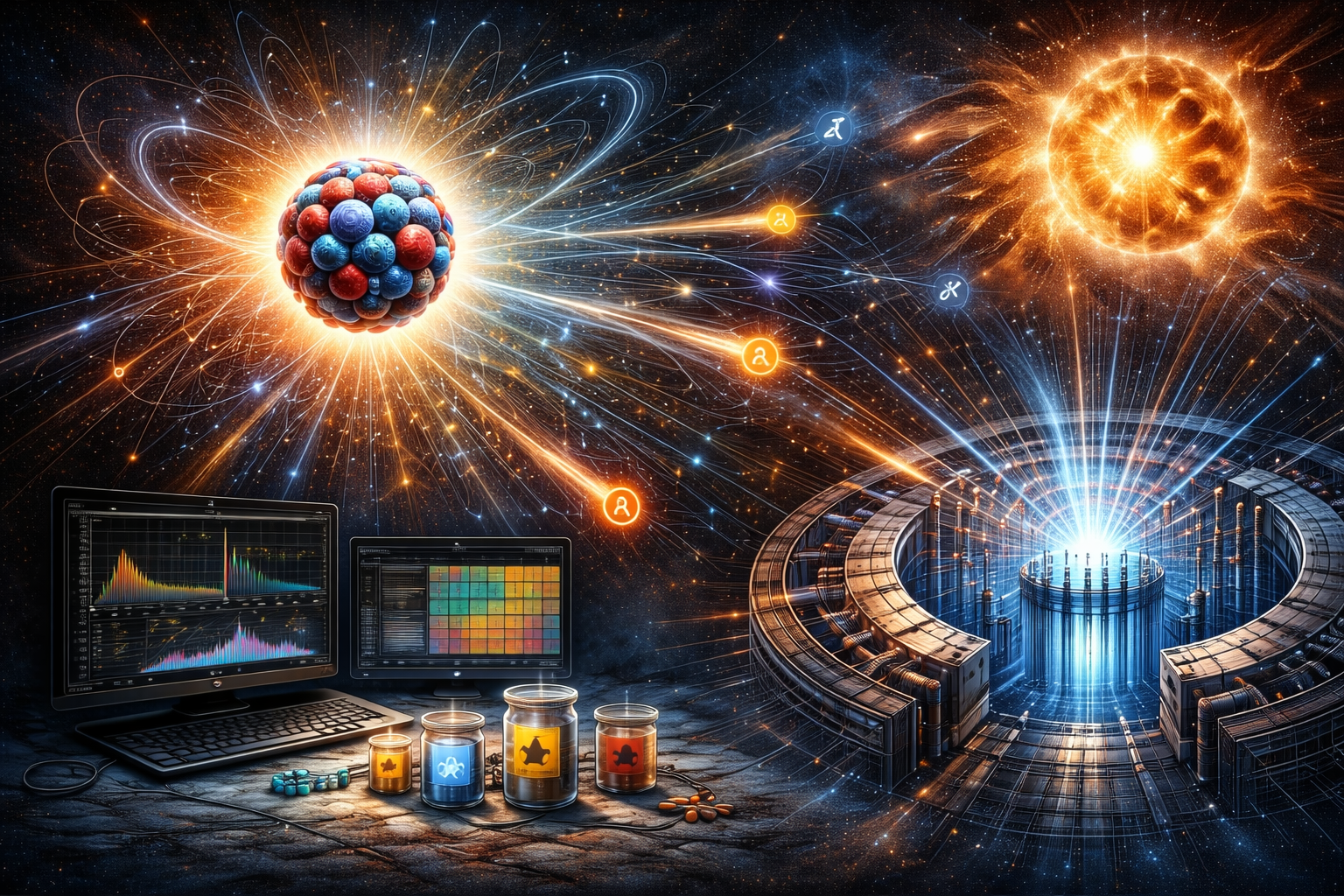
Nuclear physics matters because it explains how the atomic nucleus is built, why some nuclei are stable while others decay, and how enormous quantities of energy can be released when nuclear structure changes. At ordinary scale, matter often appears chemically and mechanically diverse; at nuclear scale, much of that diversity is reorganized in terms of proton number, neutron number, binding energy, quantum state, decay pathway, and nuclear transformation. The subject therefore links the structure of matter to radioactivity, isotopes, astrophysical element formation, medical imaging and therapy, energy production, geochronology, nuclear data, radiation measurement, and the behavior of strongly interacting many-body systems.
This is one of the places where modern physics most clearly shows that small scale does not imply small significance. A nucleus is tiny compared with an atom, but nuclear processes can dominate the age of rocks, the power of stars, the detectability of isotopes, the operation of reactors, the generation of medical isotopes, the calibration of radiation instruments, and the origin of many chemical elements. The nucleus is small in size and enormous in consequence.
For scientists and engineers, the field is important not only theoretically but operationally. Nuclear data—half-lives, branching ratios, emission probabilities, reaction cross sections, level schemes, decay radiation, and structure information—are essential for reactor analysis, medical isotope work, shielding, geochronology, radiation metrology, astrophysical modeling, and fundamental nuclear science. That is why the IAEA Nuclear Data Section, NIST Radioactivity Group, NNDC NuDat tools, and the Particle Data Group remain important parts of the field’s public infrastructure.
From the Nuclear Atom to Nuclear Science
Nuclear physics in its modern form begins with the recognition that the atom contains a compact nucleus. Rutherford’s scattering interpretation transformed the atom from a diffuse positive medium into a structured object with a small central core. That conceptual shift made it possible to ask a new class of physical questions: what is the nucleus made of, how is it held together, why does it emit radiation, how can it change, and what energies are associated with those transformations?
The early study of radioactivity had already shown that some atoms spontaneously transform and emit penetrating radiation. But the nuclear picture made it possible to understand such transformations as changes in the nucleus rather than in the atom as a whole. Once the nucleus became the seat of radioactivity, the field opened rapidly into isotope structure, transmutation, scattering, nuclear reactions, decay schemes, fission, fusion, and the construction of evaluated nuclear-data libraries.
This history matters because nuclear physics did not arise as an arbitrary subdivision of atomic physics. It emerged because the atom itself turned out to contain a new dynamical domain with its own scales, forces, quantum structure, and energetic accounting. The nucleus is not simply the center of an atom. It is a physical system in its own right.
Protons, Neutrons, and Isotopes
The nucleus is composed of protons and neutrons, collectively called nucleons. The proton number \(Z\) determines the chemical element. The neutron number \(N\) helps determine the isotope. The total nucleon number \(A\), called the mass number, is:
A = Z + N
\]
Interpretation: Mass number is the total number of protons and neutrons in the nucleus.
This simple relation is one of the most important pieces of nuclear notation because it separates chemical identity from nuclear variation. Atoms of the same element can differ in neutron number and therefore exist as different isotopes, some stable and some radioactive.
Isotopes matter because they reveal that nuclear structure cannot be reduced to element names alone. Carbon-12 and carbon-14 are chemically similar in broad terms because they have the same proton number, yet they differ profoundly in nuclear stability and decay behavior. That difference is the basis of radiocarbon dating and many other nuclear applications. Uranium isotopes, medical radionuclides, environmental tracers, and stellar nucleosynthesis pathways all depend on isotope-specific nuclear properties.
This is also where nuclear physics becomes a science of systematic charting. The chart of nuclides is more informative than the periodic table for many nuclear questions because it organizes nuclei by proton and neutron number and reveals bands of stability, decay routes, half-lives, and structure trends. The IAEA LiveChart of Nuclides and NNDC NuDat are modern examples of this nuclear-data perspective.
Nuclear Forces and Nuclear Stability
One of the deepest questions in nuclear physics is why positively charged protons can remain bound together in such a small region despite their electric repulsion. The answer is that the nucleus is not held together by electromagnetism but by the residual strong interaction operating among nucleons. This interaction is short-ranged, attractive over relevant nuclear distances, and strong enough to overcome Coulomb repulsion at nuclear scale.
This does not mean all nuclei are stable. Nuclear stability depends on a balance among several factors: the attractive binding associated with the strong interaction, the repulsive Coulomb interaction among protons, the neutron–proton ratio, shell effects, pairing effects, angular momentum, deformation, and the total size of the nucleus. Small and medium nuclei often need roughly comparable numbers of protons and neutrons, while heavier nuclei require neutron excess to help maintain stability.
The result is that the nucleus is neither a simple cluster nor an arbitrary heap of nucleons. It is a many-body quantum system whose stability is structured and selective. Some nuclei are tightly bound; others are metastable; still others decay rapidly. Nuclear physics therefore studies not only what nuclei are, but how close they are to instability and by what routes they transform.
Mass Defect and Binding Energy
One of the most important insights in nuclear physics is that the mass of a bound nucleus is less than the sum of the free masses of its separate constituent nucleons. This difference is the mass defect, and it corresponds to binding energy through Einstein’s mass–energy relation.
E = mc^2
\]
Interpretation: Mass and energy are related by the speed of light squared.
For a nucleus, the binding energy can be written schematically as:
B = \Delta m\, c^2
\]
Interpretation: Nuclear binding energy is the energy equivalent of the mass defect.
where \(\Delta m\) is the mass defect. This is one of the most important bridge equations in modern physics because it makes clear that mass is not merely an inert tally of matter. In bound systems, mass reflects energy structure.
Binding energy matters because it quantifies how much energy would be required to separate a nucleus completely into free nucleons, or equivalently how much energy is released when the bound nucleus forms. The binding energy per nucleon also reveals why both fusion of light nuclei and fission of very heavy nuclei can release energy: both processes can move nuclei toward configurations with higher average binding per nucleon.
Radioactive Decay and Half-Life
Not all nuclei are stable. Some transform spontaneously into other nuclei or nuclear states while emitting radiation. This spontaneous transformation is radioactive decay. It is one of the clearest signs that the nucleus is a dynamical system rather than a fixed inert core.
The most widely used quantitative descriptor of radioactive decay is the half-life, the time required for half of a population of unstable nuclei to decay. Accurate half-life values are essential for isotope identification, nuclear medicine, radiometric dating, production planning, calibration, environmental monitoring, and radiation metrology. NIST’s radionuclide half-life work and broader radioactivity programs illustrate why decay constants are not merely textbook parameters but measurement objects that require sustained evaluation.
The basic decay law is exponential. If \(N(t)\) is the number of undecayed nuclei at time \(t\), then:
N(t) = N_0 e^{-\lambda t}
\]
Interpretation: The number of undecayed nuclei decreases exponentially with time.
where \(\lambda\) is the decay constant. The half-life \(t_{1/2}\) is related to \(\lambda\) by:
t_{1/2} = \frac{\ln 2}{\lambda}
\]
Interpretation: Half-life is the time required for an exponential decay population to fall by one half.
This relation connects statistical population behavior to a single measurable parameter that can be tabulated, compared, fitted, and applied across nuclear science.
Alpha, Beta, and Gamma Processes
Radioactive decay is not a single process but a family of nuclear transformations. In alpha decay, a nucleus emits an alpha particle, which is a helium-4 nucleus. This reduces both mass number and atomic number and is common among heavy nuclei. In beta decay, the nucleus changes one nucleon type into another through the weak interaction, emitting an electron or positron together with the corresponding neutrino or antineutrino. In gamma decay, an excited nucleus emits a photon while changing nuclear state without changing proton or neutron number.
These distinctions are important because they reveal that nuclear transformation can involve different interactions and different kinds of structural change. Alpha decay alters gross nuclear composition. Beta decay changes the proton–neutron balance. Gamma decay relaxes excitation without changing the nuclear species. Electron capture, internal conversion, spontaneous fission, and other processes add still more complexity to nuclear decay schemes.
This is also where nuclear structure meets radiation measurement. Gamma energies and emission probabilities are essential for radionuclide identification and dosimetry. Beta branches matter for decay schemes and applications. Alpha energies can identify heavy radionuclides. Nuclear physics is therefore not only a theory of transformations but also a measurement discipline organized around emitted particles, photons, branching fractions, and detection systems.
Fission, Fusion, and Nuclear Energy Release
Nuclear energy release becomes especially dramatic in fission and fusion. In nuclear fission, a heavy nucleus splits into smaller nuclei, often after neutron absorption, releasing energy and additional neutrons. In nuclear fusion, light nuclei combine to form a heavier nucleus, also releasing energy when the resulting configuration has greater binding per nucleon.
The physical reason both processes can release energy is the structure of the binding-energy curve. Very light nuclei can release energy by moving upward in binding per nucleon through fusion, while very heavy nuclei can release energy by moving upward in binding per nucleon through fission. Mid-range nuclei near the iron region are among the most tightly bound on average.
This is one of the deepest energetic lessons in nuclear physics. The nucleus is not a uniform energetic domain. Its binding structure determines whether combining or splitting is energetically favored. That is why stars can shine by fusion and reactors can produce power by fission. The same binding-energy principle connects stellar evolution, nuclear energy, isotope production, and the origin of elements.
Nuclear Models: Liquid Drop, Shell, and Beyond
No single simple picture captures all nuclear behavior. That is why nuclear physics developed multiple models, each illuminating different aspects of the nucleus. The liquid-drop model emphasizes collective properties such as volume, surface, Coulomb, asymmetry, and pairing effects. It helps explain broad binding-energy trends and fission behavior. The shell model emphasizes quantized single-particle structure and helps explain magic numbers, nuclear spectra, spin-parity patterns, and especially stable configurations.
This plurality matters because nuclei are many-body systems that display both collective and shell-like behavior. The liquid-drop picture helps explain broad energetics. The shell model helps explain fine structure. Pairing, deformation, collective rotation, vibration, and clustering add still more richness. Light nuclei, heavy nuclei, near-stable nuclei, neutron-rich nuclei, and exotic nuclei may require different emphases.
The need for multiple models is not a weakness. It is a sign that the nucleus is a genuinely complex physical system whose behavior is not exhausted by a single oversimplified image. Nuclear physics sits between fundamental interaction and emergent many-body structure.
Nuclear Data, Measurement, and Applications
Nuclear physics depends heavily on evaluated data. Structure information, decay schemes, half-lives, reaction cross sections, emission probabilities, level information, branching ratios, and standards are essential not only for basic science but for applications. The IAEA Nuclear Data Section serves as a major international hub for nuclear structure, decay, and reaction data, including evaluated libraries and the LiveChart of Nuclides. NNDC’s NuDat similarly allows users to search and plot nuclear structure and decay data interactively.
NIST’s nuclear-data and radioactivity efforts show how central measurement and evaluation are to the field. Accurate half-lives, absolute gamma-ray emission probabilities, activity standards, and radionuclide measurements are needed for primary standards, isotope identification, dose calculations, production workflows, and the improvement of evaluated nuclear data. Nuclear data are not merely background tables. They are part of the infrastructure that makes nuclear science usable.
This is important conceptually because nuclear physics is one of the clearest examples of how theory and measurement infrastructure intertwine. A decay law or binding-energy argument is only as useful as the data environment that supports calibration, comparison, uncertainty evaluation, and application.
Mathematical Lens
A mathematics-first treatment of nuclear physics begins with composition, mass, energy, and exponential transformation. A nucleus is identified by \(Z\), \(N\), and \(A\), with:
A = Z + N
\]
Interpretation: Nuclear mass number equals proton number plus neutron number.
Binding enters through mass difference. If the separate nucleons have greater total mass than the bound nucleus, the difference \(\Delta m\) corresponds to binding energy:
B = \Delta m\, c^2
\]
Interpretation: The binding energy is the mass defect converted into energy.
Binding energy per nucleon is:
\frac{B}{A}
\]
Interpretation: Binding energy per nucleon compares average nuclear binding across different nuclei.
which helps compare stability across nuclei of different size. Decay enters through exponential law:
N(t) = N_0 e^{-\lambda t}
\]
Interpretation: Radioactive populations decay exponentially in time.
and the half-life relation:
t_{1/2} = \frac{\ln 2}{\lambda}
\]
Interpretation: The half-life is determined by the decay constant.
Activity, the number of decays per unit time, is:
A_{\text{act}} = \lambda N
\]
Interpretation: Activity is the decay rate of a radioactive population.
These equations show why nuclear physics is both structural and statistical. Nuclear composition is discrete, binding is energetic, and decay is probabilistic at the single-nucleus level while lawlike at the population level.
More advanced mathematical treatments introduce potential barriers, tunneling, decay widths, reaction cross sections, Q-values, nuclear level schemes, matrix elements, scattering amplitudes, and shell-model Hamiltonians. But even at the introductory level, nuclear physics already displays the characteristic grammar of modern physical theory: quantized structure, energetic accounting, and probabilistic evolution.
Variables, Units, and Nuclear Interpretation
Nuclear physics depends on variables that connect nuclear composition, energy, decay, and measurement. The table below summarizes several central quantities.
| Symbol or Term | Meaning | Typical Unit or Type | Nuclear Interpretation |
|---|---|---|---|
| \(Z\) | Proton number | integer | Determines the chemical element |
| \(N\) | Neutron number | integer | Distinguishes isotopes of the same element |
| \(A\) | Mass number | integer | Total number of protons and neutrons |
| \(\Delta m\) | Mass defect | u or kg | Mass difference between separated nucleons and bound nucleus |
| \(B\) | Binding energy | MeV or J | Energy associated with nuclear binding |
| \(B/A\) | Binding energy per nucleon | MeV/nucleon | Useful measure of average nuclear stability |
| \(\lambda\) | Decay constant | inverse time | Probability rate parameter for radioactive decay |
| \(t_{1/2}\) | Half-life | time | Time for half a population of unstable nuclei to decay |
| \(A_{\text{act}}\) | Activity | Bq or decays/s | Number of decays per unit time |
| \(Q\) | Reaction or decay energy | MeV | Energy released or absorbed by a nuclear process |
Note: A few compact variables define nuclear identity and transformation, but their measured values support large systems of nuclear science, medicine, metrology, energy, and astrophysics.
Worked Example: Binding Energy of Helium-4
A compact way to illustrate nuclear energetics is to examine helium-4. This nucleus contains two protons and two neutrons and is one of the most tightly bound light nuclei. The key idea is that the mass of the bound nucleus is less than the sum of the masses of two free protons and two free neutrons.
If the constituent mass sum is written schematically as:
m_{\text{free}} = 2m_p + 2m_n
\]
Interpretation: The free-nucleon mass is the sum of the separate proton and neutron masses.
and the measured nuclear mass is \(m_{\mathrm{He}\text{-}4}\), then the mass defect is:
\Delta m = (2m_p + 2m_n) – m_{\mathrm{He}\text{-}4}
\]
Interpretation: The mass defect is the difference between separated nucleon mass and bound nuclear mass.
The binding energy is then:
B = \Delta m\, c^2
\]
Interpretation: Mass defect becomes binding energy through mass–energy equivalence.
and the binding energy per nucleon is:
\frac{B}{A}
\]
Interpretation: Dividing by mass number gives the average binding energy per nucleon.
This example is valuable because it makes nuclear stability quantitative. Helium-4 is not merely stable in a loose sense. Its stability is expressed through a relatively large binding energy per nucleon among light nuclei. That helps explain why alpha particles play such an important role in nuclear decay and nuclear structure arguments.
Computational Modeling
Computational modeling helps make nuclear physics concrete. A decay curve can be fitted to estimate a decay constant and half-life. A nuclear mass defect can be converted into binding energy. Binding energy per nucleon can be compared across isotopes. Activity can be calculated from the number of nuclei and decay constant. A semi-empirical mass-formula model can show how volume, surface, Coulomb, asymmetry, and pairing terms contribute to broad binding-energy trends. Nuclear-data metadata can store isotope identity, decay mode, half-life, emissions, and source provenance.
The selected article examples below focus on decay fitting and binding energy because they are foundational and readable. The GitHub repository extends the same logic into richer computational workflows: R decay fitting, Python binding-energy and decay simulations, Julia isotope calculations, C++ binding-energy parameter sweeps, Fortran decay tables, SQL nuclear metadata, Rust command-line utilities, C examples, documentation, and reproducible sample data.
R Workflow: Half-Life Estimation from Decay Counts
R is especially useful for measurement-rich nuclear physics: decay curves, half-life fitting, tabulated isotopic comparison, and uncertainty-aware visualization. The following workflow fits a simple exponential decay curve by using a log-linear model.
# Half-Life Estimation from Decay Counts
#
# This workflow estimates a decay constant and half-life from observed
# radioactive decay counts.
#
# Model:
#   N(t) = N0 * exp(-lambda * t)
#
# Taking logs:
#   log(N) = log(N0) - lambda * t
#
# The values below are illustrative and should be replaced by calibrated
# activity or count data in a real nuclear-measurement workflow.

library(tibble)
library(dplyr)

decay_data <- tibble(
  time = c(0, 1, 2, 3, 4, 5, 6, 7, 8),
  counts = c(1000, 801, 640, 515, 410, 330, 262, 212, 170)
) %>%
  mutate(
    log_counts = log(counts)
  )

fit <- lm(log_counts ~ time, data = decay_data)

lambda_estimate <- -coef(fit)[["time"]]
half_life_estimate <- log(2) / lambda_estimate

summary_table <- tibble(
  estimated_initial_log_count = coef(fit)[["(Intercept)"]],
  estimated_decay_constant = lambda_estimate,
  estimated_half_life = half_life_estimate,
  r_squared = summary(fit)$r.squared
)

print(decay_data)
print(summary_table)
This workflow shows what R does well in the nuclear-physics context: connecting observed decay behavior to parameter estimation, keeping the statistical structure visible, and making empirical variation easy to inspect.
Python Workflow: Decay Simulation and Binding Energy
Python is especially useful for numerical binding-energy and decay modeling. The following workflow simulates exponential radioactive decay and computes a schematic binding-energy calculation for helium-4 from a mass defect.
"""
Decay Simulation and Binding Energy

This workflow demonstrates two foundational nuclear-physics calculations:

1. Exponential radioactive decay:
       N(t) = N0 * exp(-lambda * t)

2. Binding energy from mass defect:
       B = delta_m * c^2

For nuclear mass calculations in atomic mass units:
       1 u = 931.494 MeV/c^2

The helium-4 values are approximate educational values.
Use evaluated nuclear-mass data for precision work.
"""

import numpy as np
import pandas as pd


U_TO_MEV = 931.49410242


def simulate_decay(
    initial_nuclei: float,
    decay_constant: float,
    time: np.ndarray,
) -> np.ndarray:
    """
    Simulate exponential radioactive decay.

    Parameters
    ----------
    initial_nuclei:
        Initial number of undecayed nuclei or normalized count value.
    decay_constant:
        Decay constant in inverse time units.
    time:
        Time values.

    Returns
    -------
    np.ndarray
        Number of undecayed nuclei at each time.
    """
    return initial_nuclei * np.exp(-decay_constant * time)


def half_life(decay_constant: float) -> float:
    """
    Convert decay constant to half-life.

    Parameters
    ----------
    decay_constant:
        Decay constant in inverse time units.

    Returns
    -------
    float
        Half-life in the same time unit used for the decay constant.
    """
    return np.log(2.0) / decay_constant


def helium4_binding_energy() -> dict:
    """
    Compute a schematic helium-4 binding-energy estimate.

    Returns
    -------
    dict
        Mass defect, total binding energy, and binding energy per nucleon.
    """
    proton_mass_u = 1.007276466621
    neutron_mass_u = 1.00866491595
    helium4_nuclear_mass_u = 4.001506179127

    free_nucleon_mass_u = 2.0 * proton_mass_u + 2.0 * neutron_mass_u
    mass_defect_u = free_nucleon_mass_u - helium4_nuclear_mass_u

    binding_energy_mev = mass_defect_u * U_TO_MEV

    return {
        "free_nucleon_mass_u": free_nucleon_mass_u,
        "helium4_nuclear_mass_u": helium4_nuclear_mass_u,
        "mass_defect_u": mass_defect_u,
        "binding_energy_mev": binding_energy_mev,
        "binding_energy_per_nucleon_mev": binding_energy_mev / 4.0,
    }


def main() -> None:
    """
    Run decay and helium-4 binding-energy examples.
    """
    time = np.linspace(0.0, 12.0, 25)
    decay_constant = 0.22
    initial_nuclei = 1000.0

    decay_table = pd.DataFrame(
        {
            "time": time,
            "undecayed_nuclei": simulate_decay(
                initial_nuclei,
                decay_constant,
                time,
            ),
        }
    )

    binding = helium4_binding_energy()

    print("Radioactive decay simulation:")
    print(decay_table.head(10).round(6).to_string(index=False))

    print("\nDecay half-life:")
    print(f"{half_life(decay_constant):.6f}")

    print("\nHelium-4 binding-energy estimate:")
    for key, value in binding.items():
        print(f"{key}: {value:.8f}")


if __name__ == "__main__":
    main()
This workflow makes two nuclear ideas computationally visible: the lawlike population behavior of radioactive decay and the energetic meaning of mass defect in a bound nucleus. In a research-grade workflow, the same structure would be connected to evaluated nuclear masses, uncertainties, decay libraries, detector calibration, and provenance-tracked source data.
GitHub Repository
The article body includes only selected computational examples so the conceptual and nuclear-physics argument remains readable. The full repository contains the expanded computational infrastructure: R half-life fitting workflows, Python binding-energy and decay simulations, Julia isotope calculations, C++ binding-energy parameter sweeps, Fortran decay tables, SQL nuclear metadata, Rust command-line utilities, C examples, documentation, and reproducible sample data.
Complete Code Repository
The full code distribution for this article, including selected article examples and advanced research-style computational workflows for binding-energy calculations, half-life fitting, exponential decay simulation, isotope metadata, semi-empirical mass-formula examples, nuclear-data schemas, reproducibility documentation, and performance-oriented scientific computing, is available on GitHub.
From Nuclear Structure to Modern Physics
Nuclear physics does not remain confined to the nucleus as a static object. It opens directly into particle physics, astrophysics, reactor science, isotope applications, radiation metrology, medical physics, and questions about the origin of elements in the universe. Nuclear structure and nuclear energetics are therefore both foundational and expansive.
This is why the subject belongs centrally within the Physics knowledge series. It reveals that matter is not only atomic and molecular, but nuclear; that stability is conditional rather than universal; and that mass, energy, radiation, and transformation become inseparable at the scale of the nucleus.
The later development of particle physics deepens the story further by asking what nucleons themselves are made of and how the strong interaction is understood at a more fundamental level. But nuclear physics remains indispensable in its own right because the nucleus is a physical domain with emergent structure, measurable data, evaluated standards, and extraordinary energetic importance.
Related articles
- What Is Physics?
- Atoms, Molecules, and the Structure of Matter
- Quantum Fields, Particles, and the Standard Model
- Energy, Work, and Conservation in Physical Systems
- Thermodynamics and the Physics of Heat
- Statistical Physics and the Emergence of Macroscopic Order
- Symmetry, Law, and the Search for Physical Order
- Experiment, Instruments, and the Material Practice of Physics
- Measurement, Mathematics, and the Structure of Physical Inquiry
- Astrophysics and the Life of Stars
- Cosmology and the History of the Universe
Further reading
- IAEA Nuclear Data Section (n.d.) IAEA Nuclear Data Services. Available at: https://www-nds.iaea.org/ (Accessed: 24 April 2026).
- IAEA Nuclear Data Section (n.d.) LiveChart of Nuclides — Advanced Version. Available at: https://www.iaea.org/resources/databases/livechart-of-nuclides-advanced-version (Accessed: 24 April 2026).
- IAEA Nuclear Data Section (n.d.) LiveChart Table of Nuclides. Available at: https://nds.iaea.org/relnsd/vcharthtml/VChartHTML.html (Accessed: 24 April 2026).
- National Nuclear Data Center (n.d.) NuDat 3.0. Available at: https://www.nndc.bnl.gov/nudat3/ (Accessed: 24 April 2026).
- NIST (n.d.) Radioactivity Group. Available at: https://www.nist.gov/pml/radiation-physics/radioactivity (Accessed: 24 April 2026).
- NIST (n.d.) Radionuclide Half-Life Measurements. Available at: https://www.nist.gov/pml/radiation-physics/radioactivity/radionuclide-half-life-measurements (Accessed: 24 April 2026).
- NIST (2025) Measurement and Evaluation of Nuclear Data. Available at: https://www.nist.gov/programs-projects/basic-metrology-measurement-and-evaluation-nuclear-data (Accessed: 24 April 2026).
- NIST (2012) Radioactivity Standard Reference Material Program. Available at: https://www.nist.gov/programs-projects/calibrations-radioactivity-standard-reference-material-program (Accessed: 24 April 2026).
- Particle Data Group (2025) Review of Particle Physics. Available at: https://pdg.lbl.gov/ (Accessed: 24 April 2026).
- Rutherford, E. (1911) ‘The Scattering of α and β Particles by Matter and the Structure of the Atom’, Philosophical Magazine, 21(125), pp. 669–688.
References
- IAEA Nuclear Data Section (n.d.) IAEA Nuclear Data Services. Available at: https://www-nds.iaea.org/ (Accessed: 24 April 2026).
- IAEA Nuclear Data Section (n.d.) LiveChart of Nuclides — Advanced Version. Available at: https://www.iaea.org/resources/databases/livechart-of-nuclides-advanced-version (Accessed: 24 April 2026).
- IAEA Nuclear Data Section (n.d.) LiveChart Table of Nuclides. Available at: https://nds.iaea.org/relnsd/vcharthtml/VChartHTML.html (Accessed: 24 April 2026).
- National Nuclear Data Center (n.d.) NuDat 3.0. Available at: https://www.nndc.bnl.gov/nudat3/ (Accessed: 24 April 2026).
- NIST (n.d.) Radioactivity Group. Available at: https://www.nist.gov/pml/radiation-physics/radioactivity (Accessed: 24 April 2026).
- NIST (n.d.) Radionuclide Half-Life Measurements. Available at: https://www.nist.gov/pml/radiation-physics/radioactivity/radionuclide-half-life-measurements (Accessed: 24 April 2026).
- NIST (2025) Measurement and Evaluation of Nuclear Data. Available at: https://www.nist.gov/programs-projects/basic-metrology-measurement-and-evaluation-nuclear-data (Accessed: 24 April 2026).
- NIST (2012) Radioactivity Standard Reference Material Program. Available at: https://www.nist.gov/programs-projects/calibrations-radioactivity-standard-reference-material-program (Accessed: 24 April 2026).
- Particle Data Group (2025) Review of Particle Physics. Available at: https://pdg.lbl.gov/ (Accessed: 24 April 2026).
- Rutherford, E. (1911) ‘The Scattering of α and β Particles by Matter and the Structure of the Atom’, Philosophical Magazine, 21(125), pp. 669–688.