
Last Updated August 5, 2026
Circular economy and regenerative production belong together because they address a central weakness of modern industrial systems: the tendency to organize production around linear throughput. In linear systems, materials are extracted, transformed, consumed, and discarded at scales that degrade ecological systems, generate waste, weaken resilience, and normalize dependence on continuous new extraction. The circular economy refers to approaches that aim to reduce waste, extend material lifecycles, support reuse, repair, remanufacturing, and recycling, and redesign production so that materials circulate more productively through the economy. Regenerative production goes further by asking not only how to reduce damage, but how to organize economic activity so that ecological and social systems are actively renewed rather than merely used more efficiently.
These themes matter because industrial economies have often treated waste as an afterthought and natural systems as passive recipients of extraction and disposal. Linear production can generate short-run efficiency while accumulating pollution, material depletion, ecological degradation, and infrastructure burdens that are pushed into the future or onto weaker communities. Circular approaches respond by trying to close loops, reduce virgin extraction, and preserve value already embodied in materials, products, buildings, components, and systems. Regenerative approaches respond by asking whether production can improve soil health, restore ecosystems, strengthen local resilience, deepen repair cultures, and build capacities that support long-term ecological and social renewal.
The distinction is important. A circular system may be less wasteful than a linear one while still operating at ecologically excessive scale. A regenerative system asks a harder question: whether the forms of production themselves contribute positively to the systems on which future life depends. Circularity emphasizes recirculation and material efficiency. Regeneration emphasizes renewal, stewardship, resilience, and the rebuilding of living and social systems rather than their progressive exhaustion. The strongest sustainable production systems must therefore combine both: they must preserve material value longer while also restoring the ecological and social foundations that production requires.
Main Library
Publications
Article Map
Economic Systems
Related Topic
Sustainable Development
Related Topic
Environmental Systems
Related Topic
Risk & Resilience
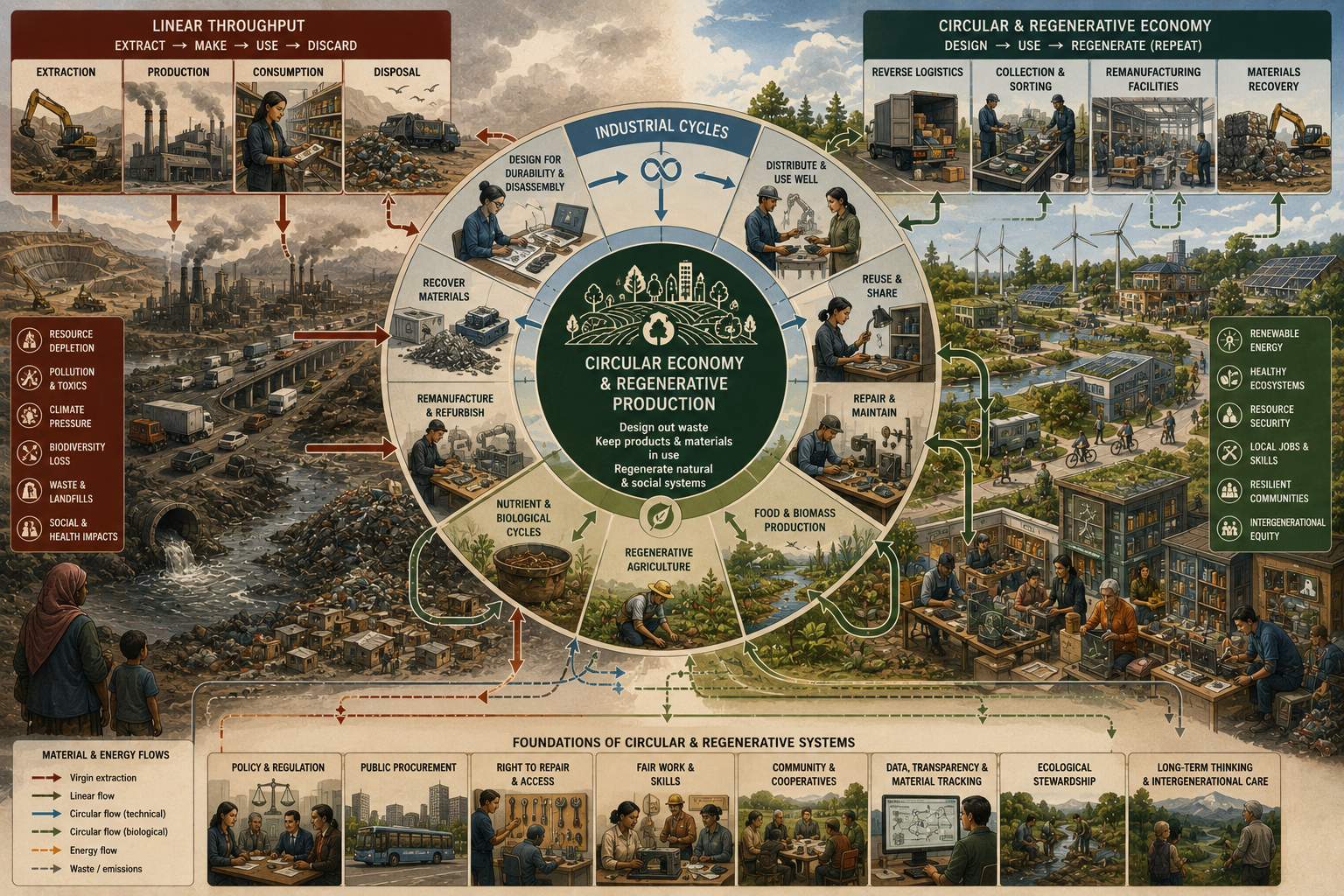
Within a sustainable systems framework, circular economy and regenerative production should be examined not only in terms of waste reduction or innovation, but in terms of scale, ecological integrity, labor, governance, justice, and long-run capability. A society may improve recycling rates while continuing to over-extract, over-consume, and externalize burdens. The deeper question is whether economies can reorganize production around durability, maintenance, repair, restoration, and ecological renewal rather than treating material throughput and disposal as the default logic of prosperity.
Why This Topic Matters
Modern economies still operate largely through linear material logic. Resources are extracted, processed, packaged, shipped, sold, used briefly, and discarded. This pattern may generate convenience and output, but it also produces mounting waste, supply vulnerability, ecological degradation, public-health burdens, and dependence on continuous extraction. The result is a system that often appears productive precisely because it moves materials quickly, even when much of that motion represents loss.
The circular economy matters because it asks whether value can be preserved for longer. Can products be designed to last? Can materials be reused rather than discarded? Can maintenance and repair become central rather than marginal? Can industrial systems be organized to reduce virgin extraction and waste generation rather than merely managing their consequences after the fact?
Regenerative production matters because efficiency alone is not enough. A production system may become less wasteful while still eroding soils, water systems, biodiversity, labor conditions, or local resilience. Regeneration asks whether production can restore rather than merely slow damage. It shifts the question from minimizing harm to rebuilding the conditions of future life.
For that reason, circularity and regeneration belong near the center of sustainable economic thought. They challenge the assumption that disposable throughput is the natural destiny of industrial societies.
They also make clear that the real issue is not simply how to manage waste more intelligently, but how to redesign production so that durability, stewardship, and renewal become ordinary features of economic life.
This is a systems problem rather than a consumer-behavior problem alone. Households can recycle, repair, and reuse only within the design, infrastructure, price, policy, and business systems available to them. If products are sealed, spare parts unavailable, repair unaffordable, reverse logistics weak, and disposal cheap, linear behavior will remain the path of least resistance.
Circular and regenerative production therefore require more than moral exhortation. They require institutional redesign: standards, infrastructure, public procurement, labor systems, ownership models, local capability, and governance that make material retention easier than waste.
What the Circular Economy Is
The circular economy refers to strategies, institutions, and design principles aimed at reducing waste and keeping materials, components, and products in use for longer periods. It emphasizes reuse, repair, refurbishment, remanufacturing, recycling, and redesign in order to slow, narrow, or close material loops within the economy.
This matters because conventional economic systems often destroy value unnecessarily. Products that could be repaired are replaced. Materials that could be recirculated are discarded. Goods are designed for short life cycles, proprietary lock-in, or difficult disassembly. Circularity responds by treating materials as assets to be stewarded rather than as disposable flows.
The circular economy also involves systems thinking. It is not simply about consumer recycling bins. It concerns product design, industrial symbiosis, logistics, standards, procurement, reverse supply chains, maintenance systems, material tracking, repair rights, and governance frameworks that allow recirculation to happen at scale.
A serious account therefore treats circularity as a redesign project rather than a narrow waste-management program.
Its central aim is to reduce the need for continuous new extraction by preserving material usefulness across longer time horizons.
Circularity also has a hierarchy. Keeping a product in use through maintenance and repair usually preserves more value than breaking it down for raw materials. Reuse often retains more embodied energy, labor, and function than recycling. Prevention and durability often matter more than end-of-pipe recovery.
The circular economy is strongest when it asks how to reduce total material pressure, not merely how to redirect waste after a disposable system has already produced it.
What Regenerative Production Is
Regenerative production refers to forms of economic activity organized not merely to reduce damage, but to restore and renew the ecological and social systems on which production depends. In ecological terms, this can include rebuilding soil fertility, restoring biodiversity, improving water retention, strengthening ecosystem resilience, and supporting cyclical processes that maintain life. In social terms, it can include rebuilding local capability, supporting care, deepening craft and repair knowledge, strengthening institutions of stewardship, and creating durable forms of work rooted in maintenance rather than disposal.
This matters because less harmful production is not necessarily regenerative. A factory may lower emissions per unit while still contributing to extractive land use and fragile global supply chains. A farm may reduce chemical intensity while continuing to deplete soil structure or groundwater. A product may contain recycled material while still being designed for rapid replacement.
Regeneration asks whether systems are becoming healthier over time, not merely less damaging at the margin. It requires attention to the condition of soils, watersheds, biodiversity, local skills, public infrastructure, communities, and institutions.
A serious framework therefore treats regeneration as qualitatively different from incremental mitigation alone.
Its standard is not simply reduced harm, but the rebuilding of the living and institutional systems that make long-term prosperity possible.
Regenerative production also shifts the time horizon. A linear system asks how quickly materials can be converted into saleable goods. A circular system asks how long value can be retained. A regenerative system asks what condition the land, community, and infrastructure will be in after production has taken place.
That question changes the meaning of productivity. Productivity cannot be measured only by output per unit of labor or capital if production quietly degrades the ecological and social conditions of future output.
From Linear Throughput to Circular and Regenerative Systems
Linear systems are organized around take, make, use, and dispose. Circular systems attempt to recirculate materials and extend product life. Regenerative systems go further by asking whether the wider ecological and social context is being renewed through the way production is organized.
This matters because each model implies a different understanding of value. Linear systems often prioritize sales volume, turnover speed, and low upfront costs. Circular systems prioritize longevity, recovery, and value retention. Regenerative systems prioritize ecological health, social continuity, and long-run system viability alongside economic function.
The shift from linear to circular and regenerative production is therefore not just technical. It affects product design, business models, land use, labor, logistics, standards, ownership, public policy, and investment horizons.
A serious account therefore sees these models as competing institutional logics rather than simple operational tweaks.
The question is what kind of economy is being built when wasteful throughput ceases to be treated as the baseline condition of growth.
Linear systems often appear efficient because they optimize a narrow segment of the chain: production cost, retail price, delivery speed, or convenience. Circular and regenerative systems evaluate the whole chain: extraction, design, use, repair, circulation, waste, ecological condition, and social capability.
The transition therefore requires changing what counts as success. A product sold quickly and discarded quickly may be profitable, but it is not necessarily efficient in a systems sense if it generates avoidable extraction, waste, and repair of damage elsewhere.
Waste, Material Flows, and the Problem of Disposal
Waste is not merely what remains after production. It is a sign of how systems are organized. When valuable materials are discarded after short use cycles, the economy reveals that it has been designed around throughput rather than retention. Landfills, incineration, leakage, and pollution are not separate from production. They are part of its material logic.
This matters because waste shifts costs across time and space. Disposal sites burden particular communities. Pollution accumulates in air, water, soils, and bodies. Lost materials require new extraction elsewhere. A society may appear efficient at the point of sale while becoming highly inefficient at the scale of the full system.
Circular thinking therefore begins by tracing material flows. It asks where value is lost, where products fail prematurely, where packaging becomes excessive, where byproducts go unused, where repair is blocked, and where infrastructure encourages disposal rather than recovery.
A serious framework therefore treats waste as a design outcome rather than an unfortunate leftover.
To reduce waste seriously, one has to redesign the systems that produce it, not merely manage the residue more politely.
Waste also has social geography. Incinerators, landfills, e-waste processing, scrap yards, and polluted industrial corridors are often concentrated in communities with less political power. Circularity that ignores this geography can improve aggregate metrics while leaving sacrifice zones intact.
A mature circular economy therefore measures not only how much waste is reduced, but where residual waste goes, who handles it, under what labor conditions, and who benefits from material recovery.
Design for Durability, Repair, and Disassembly
One of the most powerful circular strategies begins upstream: design. Products that are durable, modular, repairable, and easy to disassemble can remain useful for much longer and make higher-value recirculation possible. By contrast, products designed for rapid obsolescence or sealed replacement push systems toward waste.
This matters because end-of-life outcomes are often determined at the moment of design. A device that cannot be opened without damage, a machine built around proprietary parts, or a composite material that cannot be separated efficiently is already halfway to disposal even before it reaches the consumer.
Design also shapes labor and access. Repairable goods support technicians, local service economies, and user autonomy. Disposable goods support repeated sales and centralized control. The right to repair is therefore not only an environmental issue; it is also a question of ownership, power, skill, and economic democracy.
A serious account therefore treats design as one of the main political-economic sites of circularity.
How products are made determines whether societies live with objects as maintainable tools or as short-lived material events.
Design choices also influence public infrastructure. Standardized components, material labels, modular architecture, and digital product passports can make recovery easier. Sealed, complex, opaque, and proprietary designs make circularity costly or impossible.
Circularity is therefore not something added after production. It must be built into production from the beginning.
Reuse, Remanufacturing, and Life Extension
Reuse and remanufacturing preserve value more effectively than many downstream recovery systems because they keep products or components functioning at higher levels of integrity. Reuse extends product life with minimal reprocessing. Remanufacturing restores used components or products to working condition, often preserving much of the material and energy already embodied in them.
This matters because not all circular strategies are equal. Melting, shredding, or downcycling materials may recover some value, but it usually loses structure, labor, and embedded energy that reuse or remanufacturing can retain. Life extension therefore often yields better ecological returns than mere material recovery.
These strategies also require institutions: take-back systems, repair networks, product standards, secondary markets, certification, warranty frameworks, public procurement rules, and consumer trust.
A serious framework therefore treats reuse and remanufacturing as core pillars of circular production rather than niche aftermarkets.
They show that an economy can create value by preserving what already exists instead of relying primarily on new extraction and new sales.
Life extension also changes the relationship between quality and affordability. Durable goods may cost more upfront but less over time if repair, parts, and service are accessible. Without supportive institutions, however, lower-income households may still be pushed toward cheap disposable goods.
Circular transition therefore requires attention to financing, access, warranties, public procurement, and repair infrastructure so that durability does not become a premium good available only to affluent consumers.
Recycling and the Limits of End-of-Pipe Solutions
Recycling remains important, but it is often overestimated because it occurs late in the chain, after products have already been designed, consumed, and often degraded. Many materials lose quality in recycling, require large energy inputs, or become contaminated in ways that make full recovery difficult.
This matters because recycling can create an illusion of circularity while leaving the deeper linear system unchanged. High-volume packaging, short-lived electronics, mixed materials, and disposable business models can persist so long as some fraction of the residue is recycled. Yet the underlying extraction and throughput logic remains intact.
Recycling therefore works best when combined with better design, longer product life, lower material intensity, stronger sorting systems, and systems that prevent degradation in the first place.
A serious account therefore avoids treating recycling as the whole of circularity.
It is one tool within a broader hierarchy in which prevention, durability, reuse, repair, and remanufacturing often matter more.
This does not diminish recycling’s importance. High-quality recycling can reduce virgin extraction, especially for metals and some industrial materials. But recycling becomes much stronger when products are designed for material separation and when collection systems preserve quality.
The goal is not to dismiss recycling, but to put it in its proper place: a necessary backstop, not a substitute for redesigning production itself.
Biological Cycles, Industrial Cycles, and Material Metabolism
Circular economy thinking often distinguishes between biological cycles and industrial cycles. Biological materials can, under the right conditions, return to living systems through composting, regeneration, and ecological metabolism. Industrial materials such as metals, technical polymers, and manufactured components circulate through maintenance, reuse, remanufacturing, and high-quality recycling.
This matters because mixing these cycles badly creates waste. Biological materials embedded in toxic compounds, or industrial materials designed as inseparable composites, disrupt recovery and increase disposal burdens. Good circular design respects the different logics of living and technical systems.
The distinction also clarifies that circularity is about metabolism. Economies process materials the way organisms process nutrients, except often far less intelligently and with much greater waste.
A serious framework therefore treats material cycles as differentiated rather than uniform.
The question is whether economic metabolism is being redesigned to work with the properties of materials and living systems rather than against them.
Biological cycles require attention to soil, nutrients, toxicity, water, and ecological timing. Industrial cycles require attention to purity, modularity, component tracking, reverse logistics, and embodied energy. Confusing the two can undermine both.
Circular production therefore requires material literacy: a serious understanding of what each material is, how it degrades, how it can be safely recovered, and whether it belongs in a biological or technical cycle.
Regenerative Agriculture, Land Use, and Living Systems
Regenerative production is especially visible in agriculture and land use. Here the difference between extraction and renewal becomes concrete. Production systems can degrade soils, reduce biodiversity, intensify erosion, and weaken water retention, or they can rebuild organic matter, improve ecological function, support habitat, and strengthen resilience to drought and flood.
This matters because food production depends on living systems, not merely on land as a passive surface. Regenerative agriculture places emphasis on soil health, cover, diversity, reduced disturbance, water retention, ecological integration, and the long-term capacity of land to remain fertile, resilient, and biologically alive.
Land-use systems also link circularity with regeneration. Nutrient cycling, composting, local biomass use, watershed stewardship, and reduced food waste all connect industrial and biological metabolism.
A serious account therefore treats regenerative land use as more than a niche farming philosophy.
It is one of the clearest examples of production organized around renewal rather than depletion.
Regenerative land systems also raise questions of ownership, labor, and knowledge. Soil restoration and watershed stewardship require time, skill, place-based observation, and institutions that reward long-term care rather than only short-term yield.
For this reason, regenerative production cannot be reduced to a checklist of practices. It is a governance and livelihood question: who stewards land, under what incentives, with what knowledge, and for whose benefit?
Infrastructure, Logistics, and the Institutions of Circulation
Circular systems require infrastructure. Materials do not recirculate by intention alone. They require collection systems, sorting facilities, repair hubs, remanufacturing capacity, reverse logistics, information tracking, warehousing, local service networks, and standards that make recovered materials and components usable again.
This matters because many products are discarded not because reuse is impossible in principle, but because the institutional and logistical systems needed to support it are weak or absent. Disposal is often easier because linear systems are better built than circular ones.
Circularity therefore has a public-systems dimension. Municipal policy, procurement, transport systems, labeling rules, digital passports, regional industrial strategy, and investment in repair and remanufacturing capacity can all affect whether circulation remains marginal or becomes normal.
A serious framework therefore treats circularity as infrastructural as well as entrepreneurial.
Materials stay in use when institutions make retention easier than disposal.
Infrastructure also determines the geography of circularity. If repair hubs, reuse centers, and remanufacturing clusters exist only in affluent regions, circular benefits will remain uneven. If waste-processing burdens remain concentrated in already burdened communities, circular branding may conceal unequal harm.
Circular infrastructure should therefore be designed as public capacity: accessible, accountable, regionally distributed, and capable of supporting local skill as well as material recovery.
Labor, Skills, and the Political Economy of Repair
Circular and regenerative systems depend on labor that linear systems often undervalue. Repair technicians, remanufacturing workers, maintenance crews, local trades, ecological stewards, reuse coordinators, regenerative farmers, and materials specialists all perform work that preserves value rather than merely accelerating throughput.
This matters because the circular economy is sometimes framed too narrowly as a technical efficiency project. In reality, it also involves a labor model. Durable systems require skilled work, local knowledge, craft capacity, and time for maintenance. Repair cultures depend on institutions that recognize and reward such labor.
Linear systems often weaken these capabilities by making replacement cheaper than repair and deskilling users and communities through proprietary design and centralized disposal systems.
A serious account therefore treats repair as part of political economy, not just household thrift.
It concerns whether societies organize work around preservation and stewardship or around rapid obsolescence and continuous replacement.
This also means circular transition must include labor standards. Repair and recycling work can be skilled, dignified, and locally valuable, but it can also be precarious, hazardous, or poorly paid if governed badly.
A just circular economy must therefore value maintenance labor as essential infrastructure, not as informal or disposable work at the margins of industrial society.
Business Models, Ownership, and Product-Service Systems
Circularity often collides with existing business models. Firms built around high sales volume and rapid replacement may have weak incentives to support long product life. By contrast, service-based models, leasing arrangements, extended producer responsibility, and take-back systems can make durability and maintenance more attractive economically.
This matters because ownership shapes incentives. A company that retains responsibility for performance over time may design goods differently from one that profits mainly from repeated replacement. Business models can therefore either reinforce circularity or quietly undermine it even when circular language is adopted publicly.
Product-service systems also reveal that circularity is not only about materials. It is about rethinking the relation between users, producers, and objects over time.
A serious framework therefore treats ownership and business design as central to circular transition.
Without changing incentives, many firms will continue to speak the language of circularity while remaining structurally tied to throughput.
However, product-service systems also require governance. If leasing or service models concentrate control, restrict user autonomy, or create surveillance-heavy systems, circularity may come at the cost of economic freedom and fairness.
The goal is not simply for producers to retain ownership. The goal is to align ownership, responsibility, durability, repair access, affordability, and public accountability.
Scale, Rebound Effects, and the Limits of Circular Optimism
One of the main risks in circular-economy discourse is optimism without scale awareness. A system can become more circular in relative terms while still increasing total material throughput if consumption expands fast enough. Efficiency savings can lower costs, which may in turn stimulate more use elsewhere. This is the problem of rebound.
This matters because circularity is not automatically sufficient for sustainability. A society can recycle more, reuse more, or design products better while still operating at ecologically excessive scale. Regeneration, too, can be weakened if it becomes a local improvement inside a wider system committed to continuous expansion.
For this reason, scale remains central. Circular production must be judged not only by loop closure, but by whether total extraction, waste, land pressure, energy use, and ecological burden are falling enough to matter.
A serious account therefore pairs circularity with scale discipline.
Without that, improved circulation can coexist with overall overshoot.
Rebound effects do not mean efficiency or circularity are useless. They mean that efficiency must be embedded in systems that also manage demand, product lifetimes, sufficiency, public planning, and absolute material-reduction targets.
The deeper question is not whether materials are moving in loops, but whether the whole economy is reducing destructive pressure while preserving wellbeing and equity.
Governance, Standards, and Public Policy for Circularity
Circular and regenerative production require governance. Product standards, right-to-repair laws, procurement rules, waste regulation, deposit systems, material passports, design requirements, land-use policy, agricultural support, and industrial strategy all shape whether circularity remains aspirational or becomes institutionalized.
This matters because private initiative alone is unlikely to redesign whole systems at the necessary speed. Firms often face coordination problems, first-mover risks, and short-term financial pressures. Public policy can change the background conditions under which durability, recovery, and regeneration become more rational.
Governance also matters because standards protect quality. Reused components, repaired systems, compostable materials, recovered inputs, and regenerated land systems all require rules and verification that build trust.
A serious framework therefore treats circularity as a governance project rather than as a purely voluntary market trend.
Production becomes more circular and regenerative when institutions reward long horizons instead of throughput alone.
Public procurement is especially powerful because states, cities, universities, hospitals, transit agencies, and infrastructure authorities purchase large volumes of goods. If they require durability, repairability, low residual waste, and regenerative sourcing, they can create markets for circular production.
The circular economy therefore requires public capacity: not only innovation, but rules, enforcement, data, procurement, infrastructure, and accountability.
Justice, Localism, and the Distribution of Circular Benefits
Circular and regenerative systems can produce benefits unevenly. Local repair economies, cleaner environments, lower waste burdens, and regenerative land systems may strengthen some communities while others remain sites of extraction, disposal, or industrial transition costs. Justice therefore matters at every stage.
This matters because circularity can be captured rhetorically by affluent regions while pollution, disassembly hazards, extractive mining, or waste processing remain concentrated elsewhere. Likewise, regenerative branding can obscure labor exploitation, land concentration, or exclusion of Indigenous and local knowledge if governance is weak.
Localism is relevant here because some of the strongest circular gains come from shortening loops: local repair, regional remanufacturing, nutrient cycling, territorial food systems, and community stewardship can reduce dependence on distant throughput chains. But localism alone is not enough if inequality and exclusion remain embedded within it.
A serious account therefore treats justice as internal to circular transition rather than as an optional add-on.
The question is not only whether loops are closing, but for whom, at whose expense, and with what distribution of capability and control.
Circular justice also requires access. If repairable goods, reuse systems, and durable products are expensive or inconvenient, circularity can become a privilege. If waste work is hazardous and underpaid, circular systems may reproduce the same inequalities as linear ones.
The just circular economy must therefore distribute repair access, decent work, decision-making voice, cleaner environments, and local value capture alongside material recovery.
Historical Lessons from Maintenance, Stewardship, and Industrial Waste
Historically, many societies relied more heavily on repair, maintenance, reuse, and stewardship than contemporary disposable economies do. Objects were repaired because materials were costly, supply chains shorter, and craft capacity stronger. Industrial modernity increased abundance, but it also normalized throwaway design and rapid replacement in ways that made waste systemic.
This matters because circularity is not entirely new. Some of its principles draw on older practices of maintenance and reuse, though they must now be adapted to far more complex industrial systems. Regeneration likewise draws on long traditions of land stewardship that were often displaced by extractive production models.
History also shows that waste is institutional. It rises when infrastructures, incentives, and design norms make disposal easier than care.
A serious historical perspective therefore avoids treating circularity as either a futuristic novelty or a nostalgic return.
It is better understood as a necessary redesign of industrial systems that lost sight of maintenance, renewal, and material intelligence.
Historical memory is also important because some communities maintained circular and regenerative practices under conditions of scarcity, marginalization, or stewardship rather than as branded innovation. Repair cultures, commons governance, Indigenous land practices, and local reuse economies should not be erased when circularity becomes a policy language.
The challenge is to build modern circular systems with technical sophistication while honoring older forms of care, stewardship, and material respect.
Circular Economy, Regenerative Production, and Sustainable Systems
Within sustainable systems, circular economy and regenerative production matter because they challenge the assumption that prosperity requires ever-faster throughput. They suggest instead that long-run wellbeing may depend more on how intelligently societies preserve, repair, restore, and regenerate the systems they already rely on.
This changes the policy frame. The task is not only to manage waste better, but to reorganize production around durability, maintenance, recovery, restoration, and scale awareness. A sustainable economy would not treat disposal as normal, nor restoration as a niche moral preference. It would build these principles into design, infrastructure, labor, governance, and investment.
Sustainable systems therefore require both circular and regenerative intelligence. Circularity helps preserve material value and reduce extraction. Regeneration helps rebuild the ecological and social systems that underwrite production itself.
In this sense, circular production becomes a systems question. It asks whether societies can convert industrial metabolism from a pattern of exhaustion into one of stewardship and renewal.
This also means that sustainability cannot be reduced to cleaner consumption alone. It depends on whether the deeper structures of production are being redesigned to preserve the conditions of future life.
A mature sustainable production system would use fewer virgin inputs, retain products longer, reward repair, support remanufacturing, minimize residual waste, restore ecological systems, protect workers, and ensure that the benefits of circularity are not captured only by those already advantaged.
The central challenge is to build economies where preservation is not treated as stagnation, maintenance is not treated as failure, and renewal is not treated as charity. These are core functions of durable prosperity.
How Circular and Regenerative Systems Should Be Judged
Circular and regenerative systems should not be judged only by recycling rates or innovation claims. A broader economic systems framework asks whether production reduces absolute throughput, extends product life, preserves embodied value, supports repair labor, restores ecological systems, distributes benefits fairly, and builds long-term resilience.
| Dimension | Narrow Question | Systems Question |
|---|---|---|
| Material Input | How much recycled material is used? | Does recovered material actually displace virgin extraction and reduce total throughput? |
| Product Life | How long does the product last? | Do design, repair, warranties, and business models support meaningful life extension? |
| Repair | Can the product be fixed? | Are parts, manuals, tools, skills, rights, and local repair systems accessible? |
| Reuse | Can products be reused? | Are logistics, standards, trust, affordability, and secondary markets strong enough to preserve value? |
| Remanufacturing | Can components be restored? | Does the system preserve embedded labor, energy, function, and material quality? |
| Recycling | Is waste recycled? | Is recycling high-quality, non-toxic, energy-conscious, and secondary to prevention and reuse? |
| Regeneration | Is harm reduced? | Does production actively restore soil, water, biodiversity, local capability, and system resilience? |
| Scale | Are loops closing? | Is absolute extraction, waste, land pressure, and energy burden falling enough to matter? |
| Labor | Are jobs created? | Are repair, maintenance, remanufacturing, and stewardship jobs skilled, safe, dignified, and fairly paid? |
| Justice | Who benefits? | Are circular benefits, waste burdens, repair access, and decision-making power distributed fairly? |
This framework prevents a common mistake: treating circularity as a branding category rather than a systems transformation. A product can be marketed as circular while still depending on high throughput, short lifecycles, weak labor standards, or unequal waste burdens.
The central issue is therefore not whether a loop exists somewhere in the system. The deeper question is whether the whole production system is moving from extraction and disposal toward preservation, repair, regeneration, justice, and resilience.
Material-Flow Accounting and Stock–Flow Dynamics
Circularity begins with a physical account of what enters, accumulates within, circulates through, and leaves an economy. Material-flow accounting distinguishes extraction, imports, exports, processed materials, additions to stock, emissions, dissipative losses, and waste. Without this accounting, an organization can report a high recovery rate while total material demand and ecological pressure continue rising.
Stocks matter because buildings, roads, vehicles, machinery, appliances, and infrastructure retain materials for years or decades. These stocks provide services, but they also create future maintenance, demolition, recovery, and replacement obligations. A rapidly expanding stock can delay waste while increasing long-run resource demand.
Stock_{t+1}=Stock_t+Inflow_t-Outflow_t
\]
Interpretation: Material stocks grow when additions exceed retirements and shrink when outflows exceed new additions.
A credible circular strategy therefore tracks both flows and stocks. It asks how much service existing assets provide, whether maintenance can defer replacement, when components will become available for reuse, and whether future outflows can be recovered at useful quality.
Stock-flow analysis also changes infrastructure planning. The objective is not merely to replace old assets with nominally greener ones. It is to compare repair, retrofit, adaptive reuse, shared use, modular expansion, and new construction across service, cost, emissions, material demand, and resilience.
The Circularity Hierarchy and Value-Retention Options
Not every loop preserves the same amount of value. Refusing unnecessary production, reducing material intensity, maintaining a product, repairing it, reusing it, refurbishing it, remanufacturing components, repurposing materials, recycling them, and recovering energy each retain different amounts of function, labor, information, and embodied energy.
Higher-value pathways generally keep a product or component closer to its original function. Repair preserves more than shredding. Remanufacturing can preserve precision components that commodity recycling destroys. Adaptive reuse of a building often retains more value than demolition and material recovery.
| Pathway | Value retained | Primary constraint |
|---|---|---|
| Maintenance and repair | Product function, embedded labor, energy, and identity. | Parts, diagnostics, access, skills, and warranties. |
| Reuse and redistribution | Whole-product function with limited reprocessing. | Trust, logistics, standards, and affordability. |
| Refurbishment and remanufacturing | Components and product architecture. | Core collection, testing, certification, and design. |
| High-quality recycling | Material value. | Purity, contamination, separation, and energy. |
| Energy recovery | Limited calorific value. | Destroys material function and can create pollution. |
Hierarchy is not an absolute rule. A damaged or hazardous product may require material recovery rather than continued use. The analytical task is to choose the highest safe and feasible retention pathway rather than treating any diversion from landfill as equally circular.
Absolute Decoupling, Material Footprints, and Sufficiency
Circular claims should be tested against absolute resource use. Relative decoupling occurs when material use grows more slowly than economic output. Absolute decoupling occurs when total material pressure declines while desired social outcomes are maintained or improved.
Domestic material consumption can fall because material-intensive production moves abroad. Consumption-based material footprints therefore help reveal extraction embodied in imports. A wealthy economy can appear more circular while relying on mining, processing, waste, and ecological damage elsewhere.
Absolute\ Decoupling = \Delta Wellbeing > 0 \quad \text{and} \quad \Delta Material\ Footprint < 0
\]
Interpretation: Strong decoupling improves outcomes while reducing total consumption-based material pressure.
Sufficiency complements efficiency. It asks how much floor space, mobility, clothing, packaging, equipment, and energy service are needed for a good life. Shared infrastructure, compact settlement, public transit, repairable appliances, and service access can reduce the number of physical products required.
This does not mean universal austerity. Material needs differ across income levels and regions. High-consuming populations often need absolute reductions, while under-served communities require additional infrastructure and access. Circular justice requires differentiated pathways rather than one global consumption target.
Thermodynamics, Quality Loss, and Dissipative Use
Circular systems cannot recycle every material indefinitely without loss. Collection is incomplete, products wear, alloys mix, fibers shorten, polymers degrade, contaminants accumulate, and recovery requires energy. Some materials are deliberately dispersed through fertilizers, paints, lubricants, medicines, abrasives, and combustion.
Entropy does not make circularity futile. It explains why prevention, durability, modularity, separation, and quality preservation matter. A system that repeatedly downgrades materials can report high recycling tonnage while depending on continuous virgin input.
Material quality should therefore be tracked alongside mass. Recycled aluminum that substitutes directly for primary aluminum is different from mixed residue used as low-grade fill. Closed-loop language should be reserved for systems that maintain useful quality and verified substitution.
Energy inputs also matter. A recovery pathway can be materially circular but climate-intensive if it relies on high-temperature processing or long-distance transport. Circular assessment should compare total lifecycle energy and the opportunity cost of alternative pathways.
The realistic goal is not perfect closure. It is to minimize unnecessary throughput, preserve quality, slow degradation, recover strategic materials, and manage unavoidable losses safely.
Secondary-Material Displacement and Additionality
Recovered material creates environmental benefit only when it changes what the wider system does. A recycled input that is added to growing total production without reducing virgin extraction may improve a product’s composition while leaving aggregate pressure largely unchanged.
Displacement asks how much primary production is actually avoided. The answer depends on material quality, market demand, price, regulation, technical compatibility, and whether recovered material is used in the same or a lower-value application.
Virgin\ Displacement = Recovered\ Input \times Quality\ Factor \times Substitution\ Factor
\]
Interpretation: Recovered mass should be adjusted for quality and the degree to which it genuinely substitutes for primary material.
Additionality asks whether a circular intervention caused an improvement beyond what would have happened anyway. A take-back program that collects products already captured by municipal systems may shift ownership of the material without increasing recovery.
Claims should identify the baseline, geographic market, time period, quality, substitution pathway, and leakage. Otherwise, organizations risk double counting recycled content, avoided waste, and avoided extraction across several actors in the same value chain.
Design for Repairability, Upgrade, and Modularity
Repairability is an engineered property. It depends on access to fasteners, modular architecture, replaceable wear components, diagnostic information, software support, standard tools, spare-part availability, safe disassembly, and reasonable labor time.
A product can be technically repairable but economically inaccessible. Proprietary pairing, unavailable firmware, serialized parts, restricted manuals, high diagnostic fees, and short software support can make replacement the rational option.
Repairability scores should therefore include physical, digital, commercial, and institutional conditions. They should also avoid rewarding designs that are easy to open but unreliable, hazardous, or impossible to restore to verified performance.
Upgradeability can extend life when processors, storage, batteries, sensors, and software can be improved without replacing the entire system. Modularity also has trade-offs: connectors and housings can add material, and excessive modularity can reduce efficiency or durability.
The design objective is service-life optimization rather than modularity for its own sake. Products should remain safe, supported, maintainable, and useful for a period appropriate to their material and ecological cost.
Digital Product Passports, Traceability, and Data Governance
Circular systems need information about material composition, repair instructions, hazardous substances, component identity, recycled content, ownership, maintenance, and end-of-life pathways. Digital product passports and product circularity data sheets can make this information available across a product’s lifecycle.
Information alone does not create circulation. Data must be accurate, interoperable, persistent, accessible to the right actors, and connected to physical collection and repair systems. A QR code that links to incomplete marketing material is not a circular infrastructure.
Data governance should define who creates, verifies, updates, and retains each field. Suppliers may have different levels of access, while repairers and recyclers need practical information. Proprietary secrecy should be balanced against safety, repair, competition, and environmental requirements.
Digital systems also create privacy and power concerns. Product-service models can generate usage, location, maintenance, and ownership data. Circularity should not become a justification for continuous consumer surveillance or technological lock-in.
ISO 59040:2025 provides a methodology for exchanging product circularity information through a product circularity data sheet. Regulatory product passports and voluntary standards should be mapped carefully because their scopes and legal effects differ.
Industrial Symbiosis and Regional Material Networks
Industrial symbiosis connects one organization’s residual heat, water, byproducts, equipment, or materials with another organization’s inputs. It can reduce disposal and primary-resource demand while creating regional resilience.
Successful symbiosis requires more than geographic proximity. Material quality, volume, timing, liability, contracts, infrastructure, confidentiality, and continuity matter. A facility should not become dependent on a waste stream that disappears when the upstream producer improves efficiency or closes.
Public institutions can support mapping, shared utilities, standards, permitting, brokerage, and infrastructure. Industrial parks can coordinate energy, steam, water, logistics, storage, laboratories, and emergency planning.
Symbiosis should not legitimize hazardous production by creating a downstream use for its waste. Prevention and substitution remain higher priorities where toxic materials can be eliminated.
Regional networks are especially valuable when they preserve local skills and reduce transport. But boundaries should be chosen by system function rather than political preference alone. Some specialized recovery systems require national or international scale to achieve quality and safety.
Urban Mining, Buildings, and Infrastructure
Cities contain large stocks of steel, copper, aluminum, timber, glass, plastics, aggregates, equipment, and critical materials. Urban mining treats buildings, infrastructure, vehicles, and products as future material reservoirs rather than undifferentiated waste.
Recovery begins before demolition. Building inventories, material passports, reversible connections, adaptable floor plans, selective deconstruction, and storage markets can preserve components and high-quality materials.
Adaptive reuse often avoids substantial material and carbon impacts, but it should be evaluated against safety, accessibility, energy performance, location, and service needs. Preserving a poorly located or unhealthy asset is not automatically regenerative.
Infrastructure circularity also includes maintenance. Water leaks, road deterioration, bridge corrosion, and deferred transit maintenance destroy value and increase future material demand. Maintenance data should be treated as strategic public information.
Urban mining raises timing challenges. Materials become available when assets retire, not when industry necessarily needs them. Forecasting, storage, standardization, and demand planning are required to align future outflows with new uses.
Critical Raw Materials, Resilience, and Strategic Circularity
Energy, digital, health, and defense systems depend on minerals and components with concentrated supply chains. Circularity can reduce vulnerability through repair, life extension, component harvesting, high-quality recycling, substitution, and stock management.
Strategic circularity should not be confused with complete self-sufficiency. Rapid deployment of clean infrastructure may require substantial primary extraction before large secondary stocks are available. The responsible strategy combines demand reduction, long asset life, responsible primary supply, and future recovery.
Recovery targets should account for technical feasibility, collection, material concentration, and quality. Small quantities dispersed across millions of products may be more difficult to recover than concentrated industrial scrap.
Resilience also depends on diversity. A circular system with one dominant recycler, one software platform, or one return route can be fragile. Redundant capacity, open standards, regional networks, and public inventories can reduce single points of failure.
Strategic policy should prioritize materials by consequence, substitutability, supply concentration, ecological burden, and recovery opportunity rather than by market price alone.
Bioeconomy, Nutrient Cycles, and Safe Biological Return
Biological circularity depends on returning materials safely to living systems. Compost, manure, crop residues, food waste, timber, fibers, and bio-based chemicals can support nutrient cycles, but only when contamination, land use, biodiversity, and competing uses are addressed.
Bio-based does not automatically mean regenerative. Large monocultures, deforestation, water stress, soil depletion, and displacement of food production can make renewable feedstocks ecologically damaging.
Nutrient recovery should focus on soil need and system balance. Excess nitrogen or phosphorus can pollute water even when derived from recovered sources. Plastics, heavy metals, persistent chemicals, and pathogens can make organic waste unsuitable for land application.
Cascading use can preserve value: timber may serve first as a structural material, then as a component or board, and only later as energy. Food should be prevented from becoming waste before being redirected to feed, industrial use, compost, or digestion where safe.
Regenerative biological cycles require place-based ecological knowledge. Material return should improve soil structure, biodiversity, water retention, and long-term productive capacity rather than merely divert organic mass from landfill.
Regenerative Outcomes, Baselines, and Ecological Additionality
Regeneration should be defined through measurable ecological and social change. Claims such as soil restoration, watershed renewal, biodiversity gain, or community resilience require a baseline, time horizon, spatial boundary, and evidence of causation.
Ecological systems vary naturally. A single season’s increase in biomass may reflect rainfall rather than management. Monitoring should combine indicators such as soil organic matter, infiltration, erosion, habitat condition, species composition, water quality, and landscape connectivity.
Regenerative\ Additionality = Observed\ Condition – Credible\ Counterfactual
\]
Interpretation: Regeneration is the improvement attributable to an intervention beyond the expected baseline.
Social regeneration also needs evidence. Local ownership, worker capability, public health, repair access, cultural continuity, and institutional trust can improve or deteriorate independently of material metrics.
Regenerative claims should not permit harm in one location to be offset by restoration elsewhere without a clear ethical and ecological basis. Avoidance of local damage remains a priority. Regeneration is strongest when it improves the system directly affected by production.
Life-Cycle Assessment and Burden Shifting
Life-cycle assessment helps compare extraction, manufacturing, transport, use, maintenance, and end-of-life impacts. Circular strategies can shift burdens between stages. A heavier durable product may use more material upfront but avoid several replacements. A reusable package may require washing and reverse transport. A recycled process may reduce extraction but increase energy use.
Functional units are essential. Comparing one kilogram of packaging is different from comparing the delivery of one thousand safe product uses. Service-based comparison reveals whether durability or reuse changes the amount of function delivered.
System boundaries should include upstream suppliers, maintenance, losses, collection, sorting, rejected material, and displaced production. Allocation choices can materially change results when processes generate several products.
Lifecycle models should report uncertainty and scenario dependence. Collection rates, electricity mix, transport distance, product lifetime, user behavior, and substitution may dominate conclusions.
LCA is not a complete sustainability test. It can underrepresent labor, power, biodiversity, local pollution, Indigenous rights, resilience, and distribution. It should be combined with material-flow, social, ecological, and institutional analysis.
Extended Producer Responsibility and Take-Back Governance
Extended producer responsibility assigns producers financial or operational responsibility for products after use. It can fund collection, recycling, repair, or safe treatment and can create incentives for better design.
Design incentives depend on fee structure. Flat fees may fund waste management without rewarding durability or repairability. Modulated fees can reflect material choice, product life, recycled content, repair access, and recovery cost.
Producer systems need governance. Targets should distinguish collection, preparation for reuse, remanufacturing, high-quality recycling, and disposal. Audits should prevent false reporting, export leakage, double counting, and treatment in unsafe facilities.
Take-back can strengthen producer learning by returning failed products and components. It can also concentrate control over repair and secondary markets. Independent repairers, social enterprises, municipalities, and consumers should retain fair access.
EPR should not make producers the sole architects of public waste policy. Public authorities remain responsible for standards, enforcement, environmental justice, emergency continuity, and transparent data.
Public Procurement, Finance, and Accounting for Durability
Public procurement can create demand for durable, repairable, remanufactured, and low-impact products. Evaluation should move beyond purchase price toward total cost of ownership, service life, maintenance, energy, downtime, residual value, and end-of-use recovery.
Budget rules can undermine circularity when capital and maintenance funds are separated. Agencies may buy cheap equipment because replacement costs fall in a future budget, while maintenance teams lack resources to preserve assets.
Accounting systems also influence business behavior. Revenue recognition, depreciation, inventory treatment, warranties, leases, and residual-value assumptions can support or discourage product-service models and remanufacturing.
Finance should evaluate circular assets realistically. A long-lived product may reduce sales volume but generate stable service revenue. A recovered-material facility may depend on policy, feedstock contracts, and quality standards rather than commodity prices alone.
Public lenders and development institutions can support shared repair infrastructure, deconstruction facilities, industrial symbiosis, local remanufacturing, and regenerative land systems where private finance underinvests.
Standards, Assurance, and Circularity Claims
Circular-economy claims need consistent terminology and evidence. “Recyclable,” “made with recycled content,” “repairable,” “closed loop,” “zero waste,” and “regenerative” describe different properties and should not be used interchangeably.
The ISO 59000 family now provides international guidance on vocabulary and implementation, business-model and value-network transition, circularity measurement, and product circularity information. Standards can improve comparability, but certification to a management or information standard does not prove absolute ecological improvement.
Assurance should trace data to invoices, material tests, product records, collection systems, and verified destinations. Mass-balance systems should disclose whether recovered material is physically present in a product or allocated through a chain-of-custody method.
Claims should state the boundary. A product can contain recycled material while the company’s total material footprint rises. A factory can achieve zero waste to landfill while sending large volumes to incineration.
The strongest claim is specific, measurable, time-bound, independently verifiable, and connected to absolute system outcomes.
Circular-Economy Greenwashing and Failure Modes
Circularity can become a branding strategy that protects high-throughput business models. Common failure modes include emphasizing recyclable packaging that is rarely collected, highlighting one recycled component, counting internal scrap as post-consumer recovery, or promoting leasing without improving durability.
Recycling can also legitimize disposable production. Chemical-recycling claims may depend on uncertain yields, high energy use, or accounting allocation. Plastic collection projects may remove visible waste without reducing production or addressing toxic additives.
Regenerative claims can be equally weak when they rely on isolated practices, short monitoring periods, or outcomes outside the affected ecosystem. A farm or product should not be called regenerative merely because it uses a preferred technique.
Governance failure occurs when responsibility is shifted to consumers. Labeling and sorting are useful, but individuals cannot repair sealed products, create reverse logistics, or regulate hazardous chemistry alone.
A credible circular strategy identifies its own failure conditions: low return rates, rebound, contamination, secondary-market collapse, repair exclusion, unsafe labor, export leakage, or continued growth in virgin input.
The 2024–2026 Standards and Policy Context
The International Resource Panel’s Global Resources Outlook 2024 reports that global extraction has tripled over the past five decades and warns that material extraction could rise substantially by 2060 without transformation. This makes absolute resource use, distribution, and provisioning systems central to circular policy.
ISO published ISO 59004, ISO 59010, and ISO 59020 in 2024, covering circular-economy principles and implementation, business-model and value-network transition, and circularity measurement. ISO 59040:2025 adds a product circularity data sheet for interoperable product information, while further standards and revisions remain under development.
The European Union’s Ecodesign for Sustainable Products Regulation establishes a framework for durability, repairability, resource efficiency, recycled content, remanufacturing, recycling, environmental information, and digital product passports. The first ESPR working plan was adopted in April 2025, prioritizing several product groups and horizontal measures.
The EU’s 2024 right-to-repair directive strengthens repair rules for covered consumer goods. As of August 2026, the planned Circular Economy Act remained under preparation following consultation and 2026 stakeholder work; it should not be described as an adopted law until the legislative process is complete.
These developments show movement from voluntary circularity language toward product requirements, interoperable information, repair institutions, secondary-material markets, and measured performance. Implementation and enforcement will determine whether they reduce absolute material pressure.
Worked Diagnostic: A “Circular” Electronics Subscription That Increases Throughput
Consider a fictional electronics company that leases devices, advertises recycled aluminum, collects seventy per cent of returned units, and reports a high circularity score. Customers receive a new model every two years, batteries are difficult to replace, and most returned devices are shredded for material recovery.
Step 1: Define the service and system boundary
Measure the communication, computing, or device service delivered rather than the number of units sold or leased.
Step 2: Reconstruct material stocks and flows
Trace virgin inputs, recovered inputs, inventories, products in use, returns, spare parts, rejected units, exports, recycling, and residual waste.
Step 3: Test product-life and repair conditions
Examine physical durability, battery replacement, software support, parts, diagnostics, repair cost, warranty, and upgrade policy.
Step 4: Apply the value-retention hierarchy
Compare continued use, redistribution, refurbishment, component harvesting, remanufacturing, and recycling.
Step 5: Verify virgin-material displacement
Adjust recovered material for quality, substitution, market effects, double counting, and total production growth.
Step 6: Test rebound and distribution
Assess whether lower monthly cost and frequent upgrades increase device demand, logistics, energy, and e-waste, and who bears processing burdens.
Step 7: Evaluate governance and data
Review product-passport accuracy, ownership rights, privacy, independent repair access, return incentives, and downstream verification.
Step 8: Redesign the model and define release gates
Extend upgrade intervals, make batteries replaceable, support software longer, prioritize refurbishment, guarantee parts, and set absolute virgin-input and waste targets.
| Claim | Observed evidence | Systems conclusion |
|---|---|---|
| High collection rate | Seventy per cent of leased units return. | Useful, but collection does not prove reuse or displacement. |
| Recycled content | Housing contains secondary aluminum. | Benefit depends on quality, allocation, and total virgin input. |
| Product as a service | Company retains ownership. | Can improve stewardship or accelerate replacement and control. |
| Governed circular redesign | Longer life, repair, refurbishment, verified recovery, and absolute targets. | Better aligned with material reduction and value retention. |
The diagnostic shows why a circular business model must be evaluated through physical throughput, product life, verified retention, and ecological and social outcomes rather than ownership structure or marketing language alone.
A Practical Method for Circular and Regenerative Production
1. Define the service and desired outcomes
State what need is being met, for whom, at what quality, and over what time horizon.
2. Map physical stocks and flows
Quantify extraction, imports, production, stocks, maintenance, reuse, exports, emissions, and waste.
3. Establish absolute and consumption-based baselines
Track total material footprint, not only intensity or domestic waste.
4. Apply the value-retention hierarchy
Prioritize refusal, reduction, maintenance, repair, reuse, refurbishment, and remanufacturing before recycling.
5. Redesign products and infrastructure
Build durability, modularity, safe disassembly, support, and reverse logistics into the system.
6. Verify quality and virgin displacement
Measure whether recovered inputs substitute for primary material at useful quality.
7. Test lifecycle and burden shifting
Compare energy, water, toxicity, biodiversity, transport, use, maintenance, and end-of-life impacts.
8. Define regenerative outcomes
Use ecological and social baselines, counterfactuals, monitoring, and place-based indicators.
9. Build labor and institutional capability
Fund repair skills, safe recovery, public infrastructure, local networks, and decent work.
10. Establish data and assurance controls
Govern product information, chain of custody, claims, privacy, audits, and interoperability.
11. Stress-test scale, rebound, and justice
Evaluate total demand, induced use, unequal burdens, affordability, and geographic leakage.
12. Monitor, correct, and retire weak claims
Use absolute material, waste, ecological, labor, and service outcomes to revise the strategy.
Common Pitfalls in Circular-Economy Analysis
- Equating recycling with circularity: Higher-value retention and prevention usually matter more.
- Reporting percentages without absolute totals: Circular shares can rise while extraction and waste also increase.
- Ignoring consumption-based footprints: Imports can hide material pressure abroad.
- Counting collected products as recovered value: Collection, reuse, recycling, and disposal are different outcomes.
- Assuming recovered material displaces virgin input: Quality and market substitution must be demonstrated.
- Treating product-service models as automatically circular: They can encourage care or accelerate replacement and surveillance.
- Using digital passports without physical infrastructure: Information cannot substitute for repair, return, and recovery capacity.
- Calling bio-based materials regenerative: Land use, water, biodiversity, toxicity, and nutrient balance remain relevant.
- Ignoring rebound: Lower unit impacts can be offset by higher total demand.
- Neglecting labor and environmental justice: Circular work can remain hazardous, precarious, or geographically unequal.
- Using one indicator as proof: Material, lifecycle, ecological, social, and resilience outcomes must be connected.
- Claiming regeneration without a baseline: Practices do not prove attributable ecological or social improvement.
The central failure is to treat circulation as the objective. The objective is durable wellbeing with lower absolute material pressure, preserved value, restored living systems, and fair distribution of capability and burden.
Mathematical Lens
Mathematics can clarify circular economy and regenerative production by making material recovery, product life, residual waste, regenerative balance, rebound effects, and system resilience explicit. These equations do not determine what level of production is appropriate, but they help show what must be examined.
1. Circularity Ratio
CR = \frac{Recovered\ Material}{Total\ Material\ Input}
\]
Interpretation: The circularity ratio \(CR\) indicates how much of total material input comes from recovered rather than virgin material sources. It is useful, but it should be interpreted alongside total throughput and waste.
2. Product Life Extension
PLE = \frac{Actual\ Product\ Life}{Baseline\ Product\ Life}
\]
Interpretation: Product life extension \(PLE\) shows whether design, repair, and maintenance are extending useful life meaningfully. Longer useful life can reduce replacement pressure and embodied material loss.
3. Waste Reduction Ratio
WR = 1 – \frac{Residual\ Waste}{Total\ Material\ Throughput}
\]
Interpretation: Waste reduction \(WR\) highlights the share of throughput avoided, reused, repaired, remanufactured, or recovered before disposal.
4. Regenerative Balance
RB = Ecological\ Restoration – Ecological\ Degradation
\]
Interpretation: Regenerative balance \(RB\) asks whether production contributes more to ecological renewal than to damage. Regeneration requires restoration to exceed degradation over time.
5. Rebound Effect
RE = Efficiency\ Gain – Induced\ Additional\ Use
\]
Interpretation: Rebound \(RE\) shows why technical gains may not reduce total pressure if lower cost, convenience, or higher demand drives additional use.
6. Value Retention
VR = f(Material\ Retention, Energy\ Retention, Labor\ Value, Functional\ Retention)
\]
Interpretation: Value retention \(VR\) compares circular pathways by how much embodied material, energy, labor, and function they preserve. Reuse and repair often retain more value than low-quality recycling.
7. System Resilience
SR = f(Durability, Diversity, Maintenance, Local\ Capacity, Ecological\ Health)
\]
Interpretation: System resilience \(SR\) reflects the idea that circular and regenerative systems depend on more than efficiency alone. Durability, diversity, maintenance, local capacity, and ecological health all matter.
8. Practical Interpretation
The mathematical lens clarifies several structural points. Circularity depends on how much virgin extraction is displaced by recovered inputs. Longer product life can reduce replacement pressure significantly. Waste reduction depends on upstream design as well as downstream recovery. Regeneration requires that restoration exceed degradation, not merely that harm slows. Efficiency gains can be offset if total scale keeps expanding.
Formalization helps clarify mechanism, but it does not determine what scale of production is appropriate, what level of degradation is acceptable, or how societies should balance convenience, employment, equity, and ecological renewal. Those remain institutional, ecological, ethical, and political questions.
Python Workflow: Circular Economy and Regenerative Production
Python is useful for turning circular and regenerative production concepts into reproducible calculations. The following compact workflow models circularity, product-life extension, residual waste, regenerative balance, rebound effects, value retention, and system resilience.
from dataclasses import dataclass

@dataclass
class CircularSystem:
    virgin_input: float
    recovered_input: float
    total_throughput: float
    residual_waste: float
    baseline_life: float
    actual_life: float
    restoration: float
    degradation: float
    induced_use: float
    gross_efficiency_gain: float
    quality_factor: float
    substitution_factor: float

    def metrics(self) -> dict[str, float]:
        circularity = self.recovered_input / max(
            self.virgin_input + self.recovered_input, 1e-9
        )
        waste_reduction = 1 - self.residual_waste / max(
            self.total_throughput, 1e-9
        )
        life_extension = self.actual_life / max(self.baseline_life, 1e-9)
        regenerative_balance = self.restoration - self.degradation
        net_efficiency = self.gross_efficiency_gain - self.induced_use
        virgin_displacement = (
            self.recovered_input
            * self.quality_factor
            * self.substitution_factor
        )
        return {
            "circularity_ratio": circularity,
            "waste_reduction": waste_reduction,
            "product_life_extension": life_extension,
            "regenerative_balance": regenerative_balance,
            "net_efficiency_after_rebound": net_efficiency,
            "verified_virgin_displacement": virgin_displacement,
        }

system = CircularSystem(
    virgin_input=78,
    recovered_input=42,
    total_throughput=120,
    residual_waste=38,
    baseline_life=5,
    actual_life=9,
    restoration=14,
    degradation=11,
    induced_use=0.09,
    gross_efficiency_gain=0.22,
    quality_factor=0.86,
    substitution_factor=0.72,
)

for name, value in system.metrics().items():
    print(name, round(value, 3))
This workflow is useful because it links material retention, product longevity, waste reduction, ecological renewal, rebound, value retention, and resilience within one simplified production frame. It helps show why circularity cannot be evaluated only by recycling rates. A serious circular system must also consider product life, upstream design, repair access, total throughput, regenerative effects, and rebound risk.
The full GitHub repository expands this example into material-flow scenarios, design-for-circularity scoring, repair and reuse models, value-retention hierarchy, regenerative production metrics, circular infrastructure and policy scoring, labor and business-model analysis, rebound and scale-discipline scenarios, circular justice indicators, SQL queries, R and Stata replication workflows, Julia simulations, and article-ready figures.
R Workflow: Circular Economy and Regenerative Production
R is useful for circular economy summaries, material-retention tables, regenerative-production comparisons, and publication-ready graphics. The following compact workflow performs the same circularity, product-life extension, waste-reduction, regenerative-balance, rebound, value-retention, and resilience calculations in R.
virgin_input <- 78
recovered_input <- 42
total_throughput <- 120
residual_waste <- 38
baseline_life <- 5
actual_life <- 9
restoration <- 14
degradation <- 11
gross_efficiency_gain <- 0.22
induced_use <- 0.09
quality_factor <- 0.86
substitution_factor <- 0.72

circularity_ratio <- recovered_input / (virgin_input + recovered_input)
waste_reduction <- 1 - residual_waste / total_throughput
product_life_extension <- actual_life / baseline_life
regenerative_balance <- restoration - degradation
net_efficiency_after_rebound <- gross_efficiency_gain - induced_use
verified_virgin_displacement <- (
  recovered_input * quality_factor * substitution_factor
)

summary_df <- data.frame(
  Metric = c(
    "Circularity Ratio",
    "Waste Reduction",
    "Product Life Extension",
    "Regenerative Balance",
    "Net Efficiency After Rebound",
    "Verified Virgin Displacement"
  ),
  Value = c(
    circularity_ratio,
    waste_reduction,
    product_life_extension,
    regenerative_balance,
    net_efficiency_after_rebound,
    verified_virgin_displacement
  )
)

print(summary_df)
This R workflow is deliberately compact for article readability. In the full repository, R reads structured material-flow, product-life, value-retention, regenerative-production, circular-infrastructure, labor-model, rebound, and justice scenarios; calculates circularity ratios, virgin-input shares, waste-reduction ratios, product-life extension, design-for-circularity scores, value-retention scores, regenerative balances, and article-ready graphics.
Future Economic Systems articles can extend this foundation with product-level material-flow data, life-cycle assessment data, waste-management statistics, repair-market data, remanufacturing data, embodied-energy estimates, product-lifetime data, industrial-symbiosis datasets, soil and land-restoration metrics, household access data, and circular-policy indicators.
Go Workflow: Circularity and Regeneration Gate
The Go companion provides a lightweight, dependency-free gate for product life, repair, recovered-material quality, verified virgin displacement, residual waste, rebound, regenerative balance, labor safeguards, and claim assurance.
package main

import (
	"encoding/csv"
	"fmt"
	"math"
	"os"
	"path/filepath"
	"strconv"
)

func parse(record map[string]string, key string) float64 {
	value, err := strconv.ParseFloat(record[key], 64)
	if err != nil {
		panic(fmt.Errorf("%s: %w", key, err))
	}
	return value
}

func clamp(value float64) float64 {
	return math.Max(0, math.Min(1, value))
}

func main() {
	input := filepath.Join("..", "data", "circular_system_profiles.csv")
	output := filepath.Join("..", "outputs", "tables", "circular_scores_go.csv")

	file, err := os.Open(input)
	if err != nil {
		panic(err)
	}
	defer file.Close()

	reader := csv.NewReader(file)
	rows, err := reader.ReadAll()
	if err != nil {
		panic(err)
	}
	headers := rows[0]

	out, err := os.Create(output)
	if err != nil {
		panic(err)
	}
	defer out.Close()

	writer := csv.NewWriter(out)
	defer writer.Flush()
	writer.Write([]string{
		"system_id", "value_retention", "verified_virgin_displacement",
		"absolute_material_pressure", "regenerative_balance",
		"circular_regenerative_risk", "release_allowed",
	})

	for _, row := range rows[1:] {
		record := map[string]string{}
		for index, header := range headers {
			record[header] = row[index]
		}

		valueRetention := clamp(
			0.20*parse(record, "repairability") +
				0.18*parse(record, "product_life_extension") +
				0.18*parse(record, "reuse_share") +
				0.18*parse(record, "remanufacturing_share") +
				0.14*parse(record, "recycling_quality") +
				0.12*parse(record, "collection_rate"),
		)
		verifiedDisplacement := clamp(
			parse(record, "recovered_input_share") *
				parse(record, "recycling_quality") *
				parse(record, "substitution_factor"),
		)
		absolutePressure := clamp(
			0.48*parse(record, "virgin_input_index") +
				0.18*parse(record, "residual_waste_share") +
				0.16*parse(record, "rebound_pressure") +
				0.10*(1-valueRetention) +
				0.08*(1-verifiedDisplacement),
		)
		regenerativeBalance := clamp(
			0.5 +
				0.52*parse(record, "regenerative_restoration") -
				0.52*parse(record, "ecological_degradation"),
		)
		socialCapability := clamp(
			0.42*parse(record, "labor_safeguards") +
				0.34*parse(record, "justice_score") +
				0.24*parse(record, "system_resilience"),
		)
		evidenceStrength := clamp(
			0.54*parse(record, "traceability") +
				0.46*parse(record, "claim_assurance"),
		)
		baseRisk := 0.31*absolutePressure +
			0.17*(1-valueRetention) +
			0.14*(1-verifiedDisplacement) +
			0.15*(1-regenerativeBalance) +
			0.12*(1-socialCapability) +
			0.11*(1-evidenceStrength)
		risk := clamp(
			baseRisk * (0.78 + 0.30*parse(record, "consequence")),
		)
		releaseAllowed := risk < 0.46 &&
			absolutePressure <= 0.52 &&
			valueRetention >= 0.58 &&
			evidenceStrength >= 0.68 &&
			socialCapability >= 0.60 &&
			parse(record, "residual_waste_share") <= 0.30

		writer.Write([]string{
			record["system_id"],
			fmt.Sprintf("%.4f", valueRetention),
			fmt.Sprintf("%.4f", verifiedDisplacement),
			fmt.Sprintf("%.4f", absolutePressure),
			fmt.Sprintf("%.4f", regenerativeBalance),
			fmt.Sprintf("%.4f", risk),
			strconv.FormatBool(releaseAllowed),
		})
	}

	fmt.Println("Go circular-system scoring complete.")
	fmt.Println(output)
}
GitHub Repository
The article body includes selected computational examples so the conceptual, ecological, institutional, and mathematical argument remains readable. The full repository contains the expanded research infrastructure: Python circular-economy analysis, R material-retention summaries, Stata applied circular-production replication workflows, SQL circular-production scenario tables, Julia product-stock and rebound simulations, circularity ratios, product-life extension, design-for-circularity scoring, repair and reuse pathways, remanufacturing value retention, residual waste, regenerative balance, circular infrastructure, labor models, rebound effects, circular justice, documentation, reproducible sample data, and article-ready figures and tables.
The full code distribution for this article, including selected article examples and advanced research-style computational scaffolding for circularity ratios, material-flow analysis, product-life extension, repair, reuse, remanufacturing, recycling, residual waste, regenerative production, circular infrastructure, reverse logistics, right-to-repair policy, labor and skill systems, product-service models, rebound effects, circular justice, reproducibility documentation, and cross-language economic analysis, is available on GitHub.
Conclusion
Circular economy and regenerative production are central to economic analysis because they show that sustainability depends not only on cleaner technologies, but on the deeper organization of material life. The question is not simply how to dispose of waste more responsibly, but whether economies can preserve value longer, reduce virgin extraction, support repair and maintenance, and rebuild the ecological systems on which production itself depends.
To understand a production system seriously, one must therefore ask not only how much it produces, but how long products last, how much material is retained, how much waste remains, whether repair and stewardship are institutionally supported, and whether ecological restoration is occurring alongside economic activity rather than after its damage accumulates. These questions reveal whether an economy is still organized around throughput and exhaustion or is beginning to shift toward renewal, maintenance, and long-term resilience.
The serious study of circularity also requires caution. Recycling rates and circular branding can conceal high total throughput, weak labor standards, unequal waste burdens, and rebound effects. A product or sector may become more circular in relative terms while the overall economy remains materially excessive.
In a sustainable economic system, circular economy and regenerative production must therefore be joined to scale discipline, justice, public infrastructure, labor dignity, and ecological restoration. The goal is not simply to keep materials moving in loops. It is to build production systems that preserve value, reduce harm, restore living systems, and strengthen the conditions of future life.
Related Reading
- Economic Systems
- Natural Capital, Resource Use, and Environmental Constraint
- Ecological Economics and the Embedded Economy
- Externalities, Public Goods, and Collective Provision
- Industrial Policy and the Developmental State
- Public Finance, State Capacity, and Collective Goods
- Planetary Boundaries
- Sustainable Development
- Environmental Systems
- Risk & Resilience
Further Reading
- United Nations Environment Programme (2024) Global Waste Management Outlook 2024. Available at: https://www.unep.org/resources/global-waste-management-outlook-2024
- European Commission (2026) Circular Economy Act consultation and stakeholder process. Available at: https://environment.ec.europa.eu/news/commission-holds-high-level-talks-circular-economy-act-2026-04-30_en
- European Commission (2025) Ecodesign for Sustainable Products and Energy Labelling Working Plan 2025–2030. Available at: https://environment.ec.europa.eu/news/commission-rolls-out-plan-boost-circular-and-efficient-products-eu-2025-04-16_en
- European Union (2024) Directive (EU) 2024/1799 on common rules promoting the repair of goods. Available at: https://eur-lex.europa.eu/eli/dir/2024/1799/oj
- European Union (2024) Regulation (EU) 2024/1781 establishing a framework for ecodesign requirements for sustainable products. Available at: https://eur-lex.europa.eu/eli/reg/2024/1781/oj
- International Organization for Standardization (2025) ISO 59040:2025 — Product circularity data sheet. Available at: https://www.iso.org/standard/82339.html
- International Organization for Standardization (2024) ISO 59020:2024 — Measuring and assessing circularity performance. Available at: https://www.iso.org/standard/80650.html
- International Organization for Standardization (2024) ISO 59010:2024 — Guidance on the transition of business models and value networks. Available at: https://www.iso.org/standard/80649.html
- International Organization for Standardization (2024) ISO 59004:2024 — Circular economy: Vocabulary, principles and guidance for implementation. Available at: https://www.iso.org/standard/80648.html
- Ellen MacArthur Foundation (n.d.). What is a circular economy? Available at: https://www.ellenmacarthurfoundation.org/topics/circular-economy-introduction/overview
- International Resource Panel (IRP) (2024). Global Resources Outlook 2024. Available at: https://www.resourcepanel.org/reports/global-resources-outlook-2024
- ISO (n.d.). Circular economy standards. Available at: https://www.iso.org/circular-economy.html
- OECD (n.d.). Circular economy and resource efficiency. Available at: https://www.oecd.org/environment/waste/circular-economy.htm
- United Nations Environment Programme (UNEP) (n.d.). Resource efficiency and sustainable consumption and production. Available at: https://www.unep.org/explore-topics/resource-efficiency
- United Nations Industrial Development Organization (UNIDO) (n.d.). Circular economy and resource efficient cleaner production. Available at: https://www.unido.org/our-focus-safeguarding-environment-resource-efficient-and-low-carbon-industrial-production/circular-economy
- Food and Agriculture Organization of the United Nations (FAO) (n.d.). Soils, land, and sustainable food systems. Available at: https://www.fao.org/soils-portal/en/
- Stahel, W.R. (2016). The circular economy. Nature, 531, pp. 435–438. Available at: https://www.nature.com/articles/531435a
References
- Ellen MacArthur Foundation (n.d.). What is a circular economy? Available at: https://www.ellenmacarthurfoundation.org/topics/circular-economy-introduction/overview
- Food and Agriculture Organization of the United Nations (FAO) (n.d.). Soils, land, and sustainable food systems. Available at: https://www.fao.org/soils-portal/en/
- International Resource Panel (IRP) (2024). Global Resources Outlook 2024. Available at: https://www.resourcepanel.org/reports/global-resources-outlook-2024
- ISO (n.d.). Circular economy standards. Available at: https://www.iso.org/circular-economy.html
- OECD (n.d.). Circular economy and resource efficiency. Available at: https://www.oecd.org/environment/waste/circular-economy.htm
- Stahel, W.R. (2016). The circular economy. Nature, 531, pp. 435–438. Available at: https://www.nature.com/articles/531435a
- United Nations Environment Programme (UNEP) (n.d.). Resource efficiency and sustainable consumption and production. Available at: https://www.unep.org/explore-topics/resource-efficiency
- United Nations Industrial Development Organization (UNIDO) (n.d.). Circular economy and resource efficient cleaner production. Available at: https://www.unido.org/our-focus-safeguarding-environment-resource-efficient-and-low-carbon-industrial-production/circular-economy