
Last Updated May 9, 2026
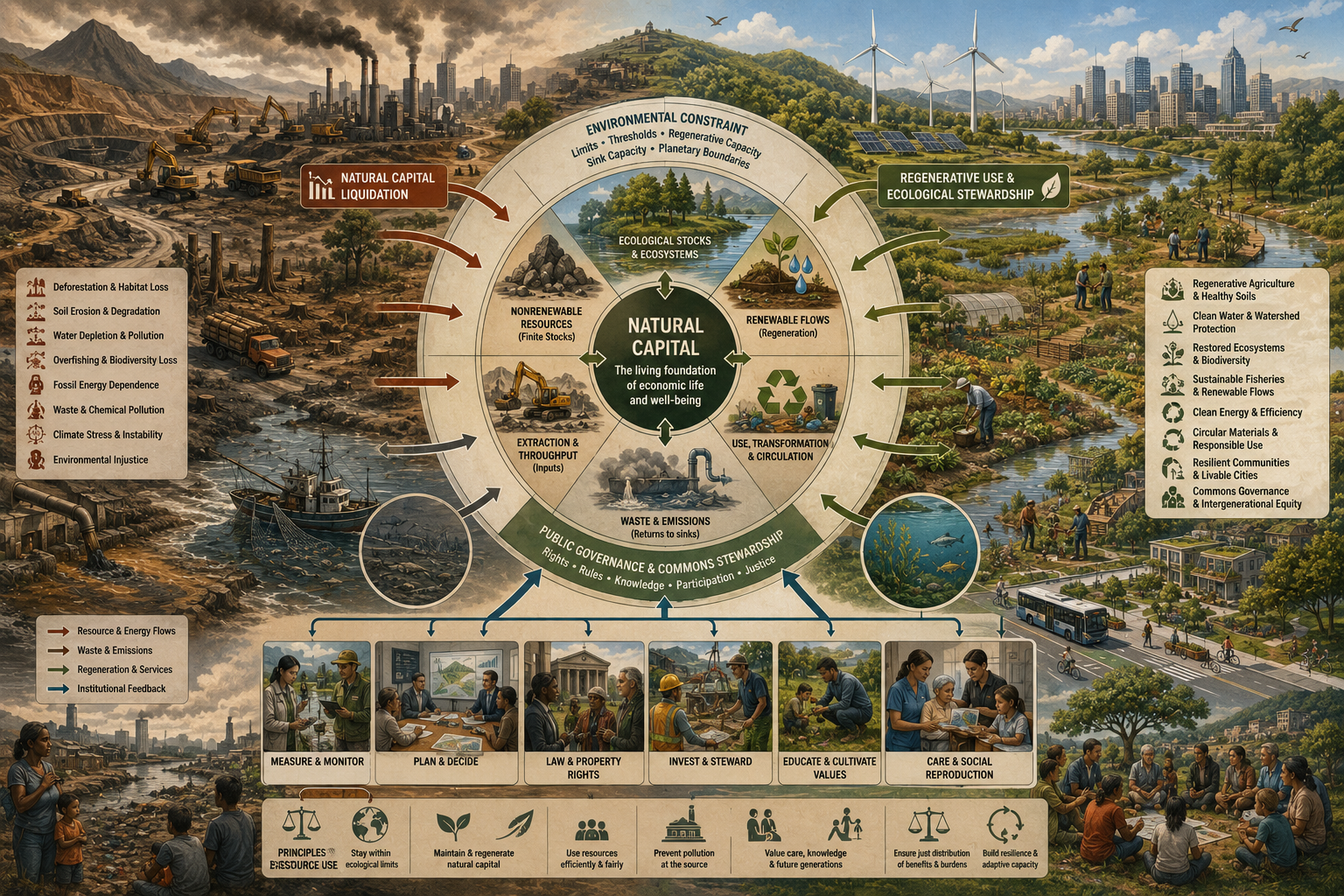
Natural capital, resource use, and environmental constraint belong together because economies do not create the material basis of life from nothing. They depend on land, water, forests, minerals, biodiversity, fertile soils, stable climate systems, and the ecological processes that support production, health, and social continuity across time. Natural capital refers to the stock of natural assets that generate flows of goods, ecological functions, and life-supporting services. Resource use concerns the extraction, transformation, consumption, and disposal of materials and energy within economic systems. Environmental constraint concerns the limits, thresholds, regenerative rates, and absorptive capacities that shape what ecological systems can sustain without degradation or breakdown.
These themes matter because modern economies often treat nature as a storehouse of inputs and a sink for wastes while measuring success in ways that understate depletion, contamination, fragmentation, and overshoot. Extraction may support income and industrial activity in the short run while weakening the ecological foundations on which future production depends. Water tables can fall, fisheries can collapse, soils can erode, forests can be fragmented, and the atmosphere can be overloaded with emissions long before conventional economic indicators register the seriousness of the loss.
Natural capital is especially important because it forces a distinction between income and inheritance. A society may consume flows generated by natural systems, or it may liquidate the underlying stocks themselves. Resource use is important because not all use is equivalent. Some extraction occurs within regenerative cycles; some exceeds them. Some material use can be circulated, repaired, or substituted; some destroys complex systems that cannot easily be rebuilt. Environmental constraint is important because it clarifies that economic activity always operates within ecological boundaries even when institutions behave as though those boundaries were optional.
This article is part of the Economic Systems knowledge series, which examines how societies organize production, distribution, exchange, institutions, and material life across time.
Within a sustainable systems framework, natural capital, resource use, and environmental constraint should be examined not only in terms of efficiency or conservation, but in terms of scale, resilience, justice, and long-run viability. A society may convert natural wealth into short-horizon growth while undermining the systems that support water security, food production, climate stability, public health, and social continuity. The deeper question is whether economies can use natural systems in ways that preserve their regenerative integrity, distribute burdens fairly, and maintain the ecological conditions on which collective life depends.
Why This Topic Matters
Economic systems depend on ecological assets that are often treated as background until they begin to fail. Agriculture depends on fertile soil, water, pollination, biodiversity, and stable weather. Industry depends on energy, metals, land, logistics, and waste-absorbing environments. Cities depend on watersheds, clean air, drainage systems, and ecological buffering against heat, flood, and contamination. None of these conditions are optional.
Natural capital matters because it clarifies that wealth is not only financial or industrial. Ecological assets generate flows of value that may be invisible in market prices while remaining essential for long-run production and social stability. Resource use matters because every economy transforms matter and energy. The issue is not whether resource use occurs, but at what scale, with what intensity, under what governance, and with what ecological consequences.
Environmental constraint matters because extraction and waste do not operate in an empty world. Forests regrow at certain rates. Aquifers recharge under certain conditions. Fisheries recover only if pressure remains within limits. Atmospheres and watersheds absorb pollution only up to a point. Once thresholds are crossed, recovery becomes slower, more uncertain, or in some cases impossible on human timescales.
For that reason, natural capital, resource use, and environmental constraint belong near the center of serious economic thought. They show that production always has biophysical foundations and that ecological decline is not an external side issue, but a problem that reaches into food systems, health, infrastructure, security, and future capability.
They also make clear that societies can consume natural wealth while mistaking that liquidation for durable prosperity.
What Natural Capital Is
Natural capital refers to the stock of natural assets that support life and generate ongoing flows of goods and ecological functions. These assets include forests, soils, freshwater systems, wetlands, oceans, fisheries, minerals, biodiversity, atmosphere-regulating systems, and the ecological relationships that sustain regeneration and resilience.
This matters because the term capital highlights continuity and stock dependence. A forest is not only timber standing in reserve; it is also habitat, hydrological regulation, carbon storage, climatic influence, soil protection, and a living system with long-term reproductive capacities. A river is not only a water source; it is also a transport system, ecological corridor, nutrient carrier, and public health condition. Natural capital therefore includes more than saleable commodities.
The concept is useful so long as it does not flatten living systems into mere economic instruments. It helps show that nature supports production partly through stocks that can be maintained, degraded, or liquidated. But it also has limits, because many ecological systems cannot be understood adequately through the language of capital alone.
A serious account therefore uses the idea of natural capital to highlight dependence while remaining attentive to the irreducible complexity of living systems.
Natural wealth is not simply another portfolio category. It is part of the material basis of collective life itself.
What Resource Use Means
Resource use refers to the extraction, harvest, transformation, circulation, and consumption of matter and energy in economic life. It includes the use of land, water, biomass, minerals, fuels, fish stocks, forests, and the ecosystems that support these flows indirectly.
This matters because use is not automatically depletion. A society can draw on renewable flows within regenerative limits or exceed those limits and erode the stock itself. It can use materials efficiently or wastefully. It can organize production around repair, maintenance, and sufficiency or around rapid throughput and disposable consumption.
Resource use also includes indirect dependence. A digital service still depends on server infrastructure, electricity, transport systems, mining, and water. An imported product still carries land, energy, labor, and pollution burdens somewhere along the supply chain. Resource use is therefore often displaced geographically while remaining very real materially.
A serious account therefore treats resource use as a systemic pattern rather than a narrow extraction statistic.
The key question is not whether economies use resources, but how intensively, how unevenly, and how intelligently they do so.
What Environmental Constraint Means
Environmental constraint refers to the ecological limits, thresholds, regenerative rates, and absorptive capacities that shape what resource use and waste emissions can be sustained without undermining the systems on which life and production depend. These constraints include finite stocks, recharge rates, carrying capacities, pollution thresholds, and the structural vulnerability of ecosystems to disturbance.
This matters because economic reasoning often assumes adaptation can always outpace depletion or damage. In reality, systems can be slow to recover, highly interdependent, and sensitive to cumulative pressure. A fishery cannot be harvested indefinitely above reproductive rate. A watershed cannot remain reliable if land use, extraction, and contamination exceed its resilience. Climate systems do not respond linearly to every increment of stress.
Environmental constraint also matters because it is not merely a technical restriction. It becomes political when societies must decide who gets access, who bears limits, who is asked to reduce throughput, and what forms of development remain viable under ecological pressure.
A serious framework therefore treats environmental constraint as constitutive of economic possibility rather than as a secondary adjustment cost.
The economy operates inside these limits whether institutions acknowledge them clearly or not.
Stocks, Flows, and the Difference Between Use and Depletion
A basic distinction in ecological thinking is the distinction between stocks and flows. Stocks are accumulated reserves or living systems that persist across time. Flows are the annual or periodic yields that those stocks generate. Sustainable use depends in large part on whether societies are living from flows or drawing down stocks irreversibly.
This matters because a society can appear prosperous while converting stocks into temporary income. Old-growth forests can be logged more quickly than they regenerate. Groundwater can be pumped faster than recharge. Soil fertility can be mined by intensive production practices that maintain yields for a period before decline becomes visible. In such cases, reported output may rise even as underlying wealth falls.
This distinction also applies to pollution sinks. The atmosphere’s absorptive capacity and ecosystems’ buffering functions are stocks of resilience, not infinite flows of disposal.
A serious account therefore distinguishes carefully between ongoing yield and capital liquidation.
Many environmental problems begin when societies confuse one for the other and build economic expectations on that confusion.
Renewable and Nonrenewable Resources
Resources are often divided into renewable and nonrenewable categories, but the distinction needs care. Renewable resources such as forests, fisheries, soils, and freshwater can regenerate, but only under ecological conditions that allow recovery. Nonrenewable resources such as many minerals and fossil fuels do not regenerate on human timescales, though they may be recycled, substituted, or used more sparingly.
This matters because renewable does not mean inexhaustible. Overharvest, pollution, habitat fragmentation, and climatic stress can turn renewable systems into declining systems. Likewise, nonrenewable does not always mean immediate scarcity if institutions manage use, substitution, reuse, and demand intelligently.
The deeper issue is not only resource type but governance, scale, and time horizon. Some societies exhaust renewable systems through weak regulation and short-horizon extraction. Others waste nonrenewable wealth through low-value throughput rather than using it strategically to build long-term capability.
A serious framework therefore avoids simplistic labels.
What matters is whether resource regimes are aligned with the ecological and temporal character of the asset in question.
Resource Extraction, Throughput, and Economic Scale
Resource extraction is one moment within a wider metabolic pattern of throughput. Economies take in energy and materials, transform them through production and consumption, and emit wastes back into ecosystems. Extraction cannot be understood separately from scale because total pressure depends not only on efficiency per unit, but on the size of the whole system.
This matters because growth in output can offset gains in efficiency. A society may reduce material intensity per unit of GDP while still expanding absolute extraction if total scale rises fast enough. Ecological stress is shaped by total throughput, not only by relative efficiency.
Scale also matters geopolitically. Resource-intensive consumption in one region may drive extraction, deforestation, mining, or water stress elsewhere. Apparent domestic cleanliness can coexist with outsourced ecological burden.
A serious account therefore treats extraction as part of a larger throughput problem.
The relevant question is whether the size and structure of economic activity remain compatible with the regenerative and absorptive capacities of the systems it draws upon.
Ecosystem Functions and the Hidden Value of Living Systems
Natural systems generate functions that underpin economic and social life: water filtration, pollination, temperature moderation, nutrient cycling, soil formation, flood buffering, carbon storage, habitat provision, and disease regulation are all examples. These functions are often indispensable while remaining weakly represented in market price.
This matters because living systems support value without necessarily being valued well by exchange systems. A wetland may appear economically idle until its drainage increases flood risk and water-treatment costs. A forest may appear underused until its loss destabilizes water cycles, soils, and regional climate patterns. Market visibility and actual importance are often badly misaligned.
This misalignment encourages ecological underprotection. Systems that seem cheap to degrade can be extremely expensive to replace, if replacement is possible at all.
A serious framework therefore treats ecosystem function as part of real wealth even when accounting systems do not capture it adequately.
What economies overlook in price may still be central to their survival.
Soil, Water, Forests, and the Foundations of Production
Some forms of natural capital are so basic that their degradation eventually affects nearly every other sector. Soil supports food systems, biodiversity, and water retention. Freshwater supports drinking supplies, irrigation, sanitation, energy systems, and industrial use. Forests support climate regulation, biodiversity, carbon cycling, and hydrological stability. These are not niche environmental goods. They are productive foundations.
This matters because degradation in these systems can accumulate gradually and then become socially disruptive quickly. Soil loss weakens agricultural resilience. Water scarcity intensifies conflict and infrastructure strain. Forest degradation alters heat, rainfall, and ecological connectivity across regions.
These systems also reveal how closely ecological and institutional questions are linked. Land tenure, watershed governance, public planning, agricultural practice, infrastructure design, and environmental regulation all influence whether natural capital is renewed or exhausted.
A serious account therefore treats soil, water, and forests as foundational forms of capital rather than scenic background.
They are part of the productive architecture of any society that expects continuity across generations.
Minerals, Energy, and Industrial Dependence
Modern industrial systems depend heavily on minerals and energy. Metals, aggregates, rare earth elements, lithium, copper, sand, and fossil or renewable energy infrastructures all support manufacturing, construction, transport, communications, and defense. This dependence is often hidden behind finished goods and service sectors.
This matters because transition itself is materially intensive. Electrification, grid expansion, storage systems, public transit, and digital infrastructure require substantial mineral inputs and new land-use decisions. Moving beyond fossil fuels does not eliminate material dependence; it changes its composition and geography.
Industrial dependence also raises strategic questions. Supply concentration, import dependence, unstable producer regions, and extractive injustice can make resource systems fragile even when absolute scarcity is not immediate.
A serious framework therefore treats minerals and energy as governance questions as well as engineering questions.
The issue is not only how much is available, but under what political, ecological, and institutional conditions it can be used responsibly.
Pollution, Waste, and Assimilative Limits
Environmental constraint concerns not only extraction, but also waste. Economies emit pollutants into air, water, soils, and living bodies. They generate greenhouse gases, chemical residues, sewage loads, nutrient runoff, plastics, tailings, particulate matter, and toxic byproducts. Ecological systems can absorb some waste, but not without limit.
This matters because disposal is often treated as though it were costless or spatially externalized. Yet waste accumulates. Rivers become contaminated, fisheries decline, lungs are damaged, soils lose fertility, and atmospheric systems warm. Assimilation is not disappearance.
Waste also reveals inequality. Polluting activities and disposal sites are often concentrated near weaker communities, poorer regions, or ecosystems with less political protection.
A serious account therefore treats pollution as a central part of resource economics rather than a secondary cleanup issue.
Every production system is also a waste system, and its sustainability depends on whether its residuals remain within the capacities of the environments receiving them.
Substitution, Efficiency, and the Limits of Technological Optimism
One common response to environmental constraint is technological optimism: the belief that scarcity, pollution, or ecological loss can be solved primarily through substitution, efficiency gains, innovation, and market adaptation. These responses matter and should not be dismissed lightly. Societies do adapt. Materials can be used more efficiently, processes can be redesigned, and some resources can be replaced by others.
This matters because optimism becomes misleading when it assumes all ecological functions are substitutable or that efficiency automatically reduces total pressure. Rebound effects can increase total demand. Substitutes may shift burden rather than remove it. Some ecological systems, once degraded, cannot be meaningfully replicated by technology at comparable scale and complexity.
A serious framework therefore welcomes innovation while refusing magical thinking.
Technology can change the terms of constraint, but it does not abolish dependence on living systems or the need for restraint, governance, and scale awareness.
Natural Capital Accounting and the Problem of Measurement
One response to ecological invisibility is natural capital accounting: efforts to measure environmental stocks, ecosystem functions, depletion, restoration, and related changes in ways that can inform policy and public decision-making. Such accounting can make ecological change more visible and help distinguish income from depletion more clearly.
This matters because what is not measured well is often governed poorly. If national accounts register logging income but not forest degradation, or water extraction but not aquifer depletion, public decisions may appear more rational than they actually are. Measurement can improve institutional visibility.
At the same time, accounting has limits. Not everything important can be translated cleanly into monetary units. Complex ecosystems, cultural relationships to land, species existence, and irreversible thresholds resist easy valuation.
A serious account therefore treats natural capital accounting as useful but incomplete.
Better measurement can improve governance, but it does not eliminate the need for judgment, precaution, and non-monetary forms of protection.
Commons, Property Regimes, and Resource Governance
Resource use is shaped not only by physical availability, but by property regimes and governance institutions. Resources may be privately owned, publicly owned, communally governed, or effectively open access. Each regime creates different incentives, protections, and risks.
This matters because ecological decline is often governance failure as much as resource scarcity. Weakly governed fisheries collapse not because fish are valueless, but because extraction outruns collective restraint. Forest loss may reflect insecure tenure, extractive finance, or state weakness more than simple population pressure. Water stress may reflect allocation rules and infrastructure failures as much as hydrology alone.
The commons tradition is especially important here because it shows that neither pure privatization nor unmanaged access exhausts the field of possibilities. Shared governance can work under the right institutional conditions.
A serious framework therefore treats property and governance as central to resource outcomes.
Natural capital is used through institutions, and those institutions often determine whether use remains regenerative or becomes destructive.
Resource Use, Justice, and the Distribution of Ecological Burden
Resource use is never distributed evenly. Wealthier households, richer countries, and resource-intensive sectors often command larger shares of energy, land, minerals, and material throughput, while ecological burdens are frequently concentrated on poorer communities, Indigenous territories, extractive frontiers, and future generations.
This matters because environmental constraint is not experienced neutrally. Some groups gain from extraction while others live with polluted water, degraded land, heat exposure, flood risk, or displacement. Justice questions therefore run through all serious resource governance.
Distribution also shapes capacity to adapt. Wealthier actors can relocate, insure, diversify supply, or purchase alternatives more easily. Poorer households and regions are more exposed to shocks and often more dependent on degraded common systems.
A serious account therefore treats natural capital as a justice issue as well as a conservation issue.
Who gets to use resources, who absorbs damage, and who retains future ecological possibility are inseparable political questions.
Scarcity, Resilience, and Strategic Dependence
Environmental constraint does not always appear first as absolute shortage. It often appears as volatility, fragility, dependency, and strategic exposure. Water stress, concentrated mineral supply chains, degraded soils, disrupted harvests, wildfire risk, and energy dependency can all reduce resilience before full scarcity is reached.
This matters because resilient systems require buffers. They need maintenance, diversity of supply, regenerative land and water systems, strategic reserves, and institutions capable of coordinating adaptation. Systems built around narrow optimization often prove brittle under ecological stress.
Scarcity is therefore not only a matter of quantity. It is also a matter of system design, infrastructure depth, and governance quality.
A serious framework treats resilience as part of resource economics rather than as a separate emergency concern.
The question is not merely whether a resource exists somewhere, but whether societies can depend on it under changing ecological and geopolitical conditions.
Historical Lessons from Resource Frontiers and Environmental Overshoot
Historical development has often proceeded through resource frontiers: forests cleared, soils mined, fisheries expanded, rivers dammed, fuels extracted, mineral belts opened, and territories incorporated into wider systems of production and trade. These frontiers generated wealth, but often by treating ecological systems as expendable or endlessly replaceable.
This matters because overshoot is often normalized while extraction is rising. Institutions adapt to cheap resource access and build infrastructures, expectations, and political coalitions around it. By the time degradation becomes undeniable, whole sectors and regions may already be dependent on unsustainable patterns.
History also shows that apparent abundance can conceal structural vulnerability. Societies may seem resource-rich while exhausting water, simplifying ecosystems, eroding soils, or locking themselves into energy systems that later become destabilizing liabilities.
A serious historical perspective therefore treats natural capital loss as a developmental issue rather than a conservation afterthought.
Many crises of the future begin as successes of expansion that failed to respect environmental constraint.
Natural Capital, Resource Use, and Sustainable Systems
Within sustainable systems, natural capital should be understood as part of the foundational wealth of a society, not merely as raw material available for immediate conversion into revenue. Resource use should be judged not only by productivity, but by whether it preserves ecological stocks, respects regenerative limits, and supports long-run resilience rather than liquidation.
This changes the policy frame. The issue is not simply how to extract more cleanly. It is how to organize production, consumption, land use, infrastructure, and trade so that ecological systems remain capable of supporting future life. That means distinguishing renewable flows from stock depletion, recognizing thresholds, and governing waste as seriously as extraction.
Sustainable systems therefore require more than efficiency. They require institutional forms capable of keeping use within ecological constraint, distributing benefits and burdens fairly, and preserving the shared natural inheritance on which future capability depends.
In this sense, natural capital becomes a systems question. It asks whether societies can convert ecological dependence into stewardship rather than liquidation.
This also means that sustainability cannot be treated as a narrow environmental add-on. It is about whether the material foundations of economic life remain intact enough to support collective continuity across generations.
Mathematical Lens
1. Stock-Flow Relation
A simple natural-capital relation can be written as:
NC(t+1) = NC(t) + R – D
Where:
- NC is natural capital stock
- R is regeneration or replenishment
- D is depletion or degradation
This shows that stocks are sustained only when regeneration matches or exceeds degradation over time.
2. Resource Use Ratio
A stylized pressure relation can be written as:
RU = Use / Regenerative Capacity
When this ratio remains above one for long periods, ecological overshoot becomes more likely.
3. Waste Constraint Relation
A simplified sink relation is:
WC = Emissions / Absorptive Capacity
This helps show when pollution burdens exceed what receiving systems can safely absorb.
4. Extraction Dependency Relation
A stylized material dependency expression is:
ED = f(Material Intensity, Energy Intensity, Import Dependence)
This reflects the idea that environmental and strategic vulnerability often rise together.
5. Resilience Relation
A simplified ecological resilience relation can be expressed as:
ER = f(Diversity, Regeneration, Redundancy, Governance)
This shows why resilient natural systems are shaped not only by stocks, but by system qualities and institutions.
6. Justice Burden Relation
A stylized burden function can be written as:
JB = f(Exposure, Income, Public Infrastructure, Adaptive Capacity)
This reflects the idea that ecological constraint is socially distributed rather than universally experienced in the same way.
7. Practical Interpretation
The mathematical lens clarifies several structural points:
- Natural capital changes through the balance between regeneration and degradation.
- Resource use must be judged relative to regenerative capacity, not only output.
- Pollution depends on sink limits as well as on production volume.
- Material dependence can create both ecological and geopolitical vulnerability.
- Justice and resilience are built into resource systems, not added afterward.
Formalization helps clarify mechanism, but it does not determine what level of use is fair, what losses are unacceptable, or how much precaution is warranted in the face of uncertainty and irreversibility. Those remain institutional and political questions.
R Workflow
The following R example models natural-capital change, a resource-use ratio, a waste constraint, and a stylized resilience score.
# Natural Capital, Resource Use, and Environmental Constraint
# R workflow

# Natural capital stock change
natural_capital_t <- 100
regeneration <- 8
degradation <- 12
natural_capital_next <- natural_capital_t + regeneration - degradation
cat("Natural capital next period:", natural_capital_next, "\n")

# Resource use ratio
resource_use <- 18
regenerative_capacity <- 14
resource_use_ratio <- resource_use / regenerative_capacity
cat("Resource use ratio:", round(resource_use_ratio, 3), "\n")

# Waste constraint
emissions <- 22
absorptive_capacity <- 17
waste_constraint <- emissions / absorptive_capacity
cat("Waste constraint ratio:", round(waste_constraint, 3), "\n")

# Stylized ecological resilience
diversity <- 0.64
regeneration_score <- 0.58
redundancy <- 0.60
governance <- 0.66

ecological_resilience <- mean(c(
  diversity,
  regeneration_score,
  redundancy,
  governance
))

cat("Ecological resilience score:", round(ecological_resilience, 3), "\n")

summary_df <- data.frame(
  Metric = c("Natural Capital Next Period", "Resource Use Ratio", "Waste Constraint Ratio", "Ecological Resilience Score"),
  Value = c(natural_capital_next, resource_use_ratio, waste_constraint, ecological_resilience)
)

print(summary_df)
This workflow is useful because it links stock change, resource pressure, pollution limits, and resilience within one simplified ecological-economic frame.
Python Workflow
The following Python example performs the same analysis and can be extended into richer natural-capital scenarios.
# Natural Capital, Resource Use, and Environmental Constraint
# Python workflow

import pandas as pd

# Natural capital stock change
natural_capital_t = 100
regeneration = 8
degradation = 12
natural_capital_next = natural_capital_t + regeneration - degradation
print("Natural capital next period:", natural_capital_next)

# Resource use ratio
resource_use = 18
regenerative_capacity = 14
resource_use_ratio = resource_use / regenerative_capacity
print("Resource use ratio:", round(resource_use_ratio, 3))

# Waste constraint
emissions = 22
absorptive_capacity = 17
waste_constraint = emissions / absorptive_capacity
print("Waste constraint ratio:", round(waste_constraint, 3))

# Stylized ecological resilience
diversity = 0.64
regeneration_score = 0.58
redundancy = 0.60
governance = 0.66

ecological_resilience = sum([
    diversity,
    regeneration_score,
    redundancy,
    governance
]) / 4

print("Ecological resilience score:", round(ecological_resilience, 3))

df = pd.DataFrame({
    "Metric": [
        "Natural Capital Next Period",
        "Resource Use Ratio",
        "Waste Constraint Ratio",
        "Ecological Resilience Score"
    ],
    "Value": [
        natural_capital_next,
        resource_use_ratio,
        waste_constraint,
        ecological_resilience
    ]
})

print(df)
You could extend this Python workflow by adding:
- renewable versus nonrenewable resource scenarios
- water-stress and land-use pressure comparisons
- mineral-dependence and supply-risk analysis
- forest, soil, or fishery regeneration simulations
- pollution-load scenarios under different production structures
- justice comparisons across regions or income groups under ecological stress
Conclusion
Natural capital, resource use, and environmental constraint are central to economic analysis because they show that wealth depends on ecological stocks, regenerative processes, and finite sink capacities that no society can safely ignore. The economy does not simply use nature; it depends on living systems whose decline can quietly undermine the very conditions of production, health, and security.
To understand an economic system seriously, one must therefore ask not only how much output it generates, but whether it is living from regenerative flows or liquidating foundational stocks, whether it is pushing wastes beyond ecological capacity, how resource burdens are distributed, and whether institutions are strong enough to preserve the natural inheritance on which future capability depends. These questions reveal whether a society is converting natural wealth into durable wellbeing or mistaking ecological drawdown for prosperity.
Related Reading
- Economic Systems knowledge series
- Ecological Economics and the Embedded Economy
- Planetary Boundaries
- Sustainable Development
- Risk & Resilience
- Public Finance, State Capacity, and Collective Goods
- Sustainable Systems
Further Reading
- United Nations Environment Programme (UNEP) (n.d.) Natural resources, environmental sustainability, and economic transition. Available at: https://www.unep.org/
- International Resource Panel (IRP) (n.d.) Material use, resource efficiency, and global resource outlook. Available at: https://www.resourcepanel.org/
- Food and Agriculture Organization of the United Nations (FAO) (n.d.) Land, soil, forests, and water systems. Available at: https://www.fao.org/
- Stockholm Resilience Centre (n.d.) Earth system limits and resilience. Available at: https://www.stockholmresilience.org/
- United Nations University Institute for Natural Resources in Africa (UNU-INRA) (n.d.) Natural capital and resource governance. Available at: https://inra.unu.edu/
References
- Food and Agriculture Organization of the United Nations (FAO) (n.d.) Land, soil, forests, and water systems. Available at: https://www.fao.org/
- International Resource Panel (IRP) (n.d.) Material use, resource efficiency, and global resource outlook. Available at: https://www.resourcepanel.org/
- Stockholm Resilience Centre (n.d.) Earth system limits and resilience. Available at: https://www.stockholmresilience.org/
- United Nations Environment Programme (UNEP) (n.d.) Natural resources, environmental sustainability, and economic transition. Available at: https://www.unep.org/
- United Nations University Institute for Natural Resources in Africa (UNU-INRA) (n.d.) Natural capital and resource governance. Available at: https://inra.unu.edu/