
Last Updated May 9, 2026
Consumer choice is often treated as one of the basic units of economic analysis, but everyday household life reveals that choice is never simply the expression of private preference. Households face prices, incomes, wages, debt, rents, care responsibilities, transport needs, health costs, time limits, public-service quality, and unequal access to assets. They decide how to allocate limited resources across food, shelter, utilities, transport, health care, communication, education, leisure, savings, debt service, caregiving, and emergency reserves. At a formal level, consumer choice concerns how people choose among available bundles of goods and services under scarcity. At a social level, it concerns something deeper: how everyday life is provisioned, how welfare is experienced, and how economic systems shape the practical horizons within which households live.
Household welfare cannot be reduced to the abstract satisfaction of preferences. It depends on whether households can secure essentials, maintain housing stability, absorb shocks, care for dependents, preserve time, sustain dignity, and plan beyond immediate emergency. What economists call consumer choice is therefore never simply a matter of individual desire meeting market opportunity. It is mediated by wages, debt, wealth, public goods, household composition, infrastructure, social norms, geographic access, and the distribution of power across the wider economy.
This is why everyday economic life matters so much. It is the level at which inflation becomes anxiety, rent becomes overcrowding, transport failure becomes lost time, medical bills become debt, and inadequate public provision becomes a private burden carried by households. Consumer choice appears in theory as a matter of optimization, substitution, and budget constraints. In practice, it is often a matter of coping, trade-offs, prioritization, and the unequal management of vulnerability.
Main Library
Publications
Article Map
Economic Systems
Related Topic
Sustainable Development
Related Topic
Institutions & Governance
Related Topic
Risk & Resilience
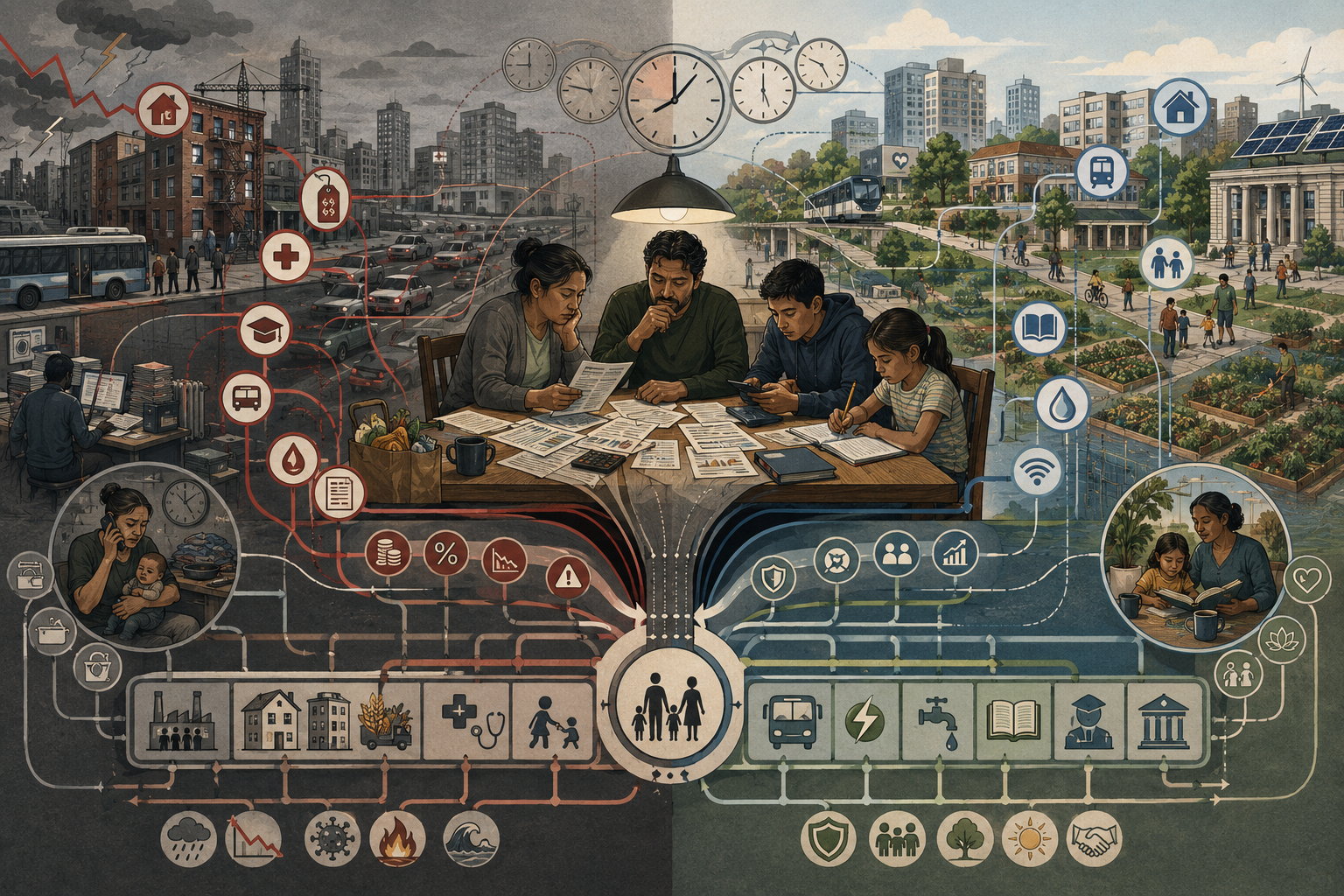
Within a sustainable systems framework, consumer choice and household welfare must be understood not only in terms of purchasing decisions, but also in relation to provisioning systems, institutional supports, public goods, time use, care structures, ecological limits, and long-term resilience. The deeper question is not merely what consumers choose, but under what conditions they choose, what choices are materially available, what constraints shape their behavior, and whether the surrounding economic order supports a livable and durable form of everyday life.
Why This Topic Matters
Consumer choice matters because economic systems are ultimately lived at the household level. Whatever happens in labor markets, housing systems, energy networks, food systems, financial institutions, health systems, or public budgets eventually becomes ordinary life: what to buy, what to postpone, what to cut, what to borrow, how to save, how to care, how to travel, and how to cope. The household is where macroeconomic pressures become practical reality.
This is also why household welfare matters as more than a microeconomic topic. It reveals whether wages are sufficient, whether prices are manageable, whether infrastructure works, whether public goods reduce burdens or intensify them through absence, and whether the economy supports security or reproduces instability. An economy may look strong in aggregate while household welfare deteriorates through debt, rent burden, time scarcity, energy insecurity, food stress, care exhaustion, or exposure to volatile prices.
For that reason, consumer choice should not be treated as a narrow theory of preference revelation. It is better understood as one of the practical interfaces between institutional order and lived existence. It shows what households can actually command, what they must sacrifice, and how much room they have to exercise agency under prevailing conditions.
Everyday economic life is also politically revealing. It shows whether public institutions are reducing avoidable burdens or transferring them downward into households. It shows whether market systems are provisioning essentials or rationing them by purchasing power. It shows whether economic growth is translating into household security or simply raising measured output while leaving families financially, temporally, and emotionally strained.
A serious account of consumer choice therefore asks not only what households choose, but what kind of economy has made those choices necessary.
Consumer Choice Beyond Preference
In formal economics, consumer choice is often modeled as the selection of the most preferred bundle of goods and services subject to a budget constraint. That model is analytically useful because it clarifies how prices, income, substitution, and opportunity cost shape decisions. But it is incomplete if treated as a full account of household life. It assumes that choices are given meaning primarily by preferences, when real household choices are shaped by income, obligations, health, disability, household structure, geography, public provision, debt, care burdens, social expectations, and institutional environment.
Choice in this broader sense is not just about desire. It is about feasible action under constraint. A household may “choose” cheaper food because wages are stagnant. It may “choose” a long commute because housing near work is unaffordable. It may “choose” private tutoring, private transport, private security, private health care, or private backup systems because public systems are inadequate. Such choices are real, but they are structured choices. They emerge within an economic order that expands some possibilities and narrows others.
This distinction matters because observed choice can easily be misread. What appears as preference may in fact be adaptation to scarcity. What appears as consumer sovereignty may conceal compulsion. What appears as consumer freedom may depend on unequal infrastructures, unequal time endowments, unequal exposure to shocks, unequal access to public provision, and unequal command over assets. A serious account of consumer choice must therefore distinguish between formal choice and substantive capability.
Substantive choice requires more than the presence of options in a market. It requires income, time, information, mobility, safety, institutional access, and enough security to choose without being driven entirely by fear or immediate necessity. A household deciding between rent, food, medicine, debt service, and transport is making choices, but those choices cannot be understood as simple expressions of preference. They are decisions within a constrained field of survival.
Household Welfare
Household welfare refers to the capacity of a household to sustain material security, basic functioning, and a tolerable quality of life across time. It includes consumption, but also much more: health, housing security, nutrition, time, stress, care capacity, access to public goods, resilience to shocks, and freedom from chronic precarity.
This makes welfare broader than utility in the narrow sense. A household can consume many market goods and still experience poor welfare if it is overleveraged, time-poor, insecure in housing, dependent on unstable wages, or forced to compensate continually for failing infrastructure and inadequate public systems. Welfare is therefore a question of living conditions, not merely purchasing events.
Household welfare is also relational. The same income can imply very different welfare outcomes depending on household size, dependency ratios, age structure, disability, geography, rent levels, health costs, commute burdens, school quality, transport availability, energy efficiency, and the reliability of public services. A household with children, elders, disability needs, long commutes, or high medical costs does not occupy the same welfare position as a household with the same income but fewer burdens.
Welfare is also temporal. Households need not only enough resources today, but enough stability to plan. A household with no savings, rising debts, unstable employment, and high fixed costs may appear solvent in a single month while being structurally fragile over time. Conversely, a household with moderate income but strong public services, low debt, stable housing, and some buffer may experience higher welfare than income alone would suggest.
For this reason, household welfare cannot be inferred from income alone. It must be understood through the wider organization of everyday life: money, time, care, public provision, debt, assets, risk, infrastructure, and resilience.
Budget Constraints and Trade-Offs
Everyday economic life is structured by budgets. Households face finite incomes and must allocate them across necessities, contingencies, aspirations, and obligations. Rent, utilities, food, transport, child care, health care, debt service, insurance, communication, taxes, savings, and emergency reserves compete for limited command over resources. Budgeting is therefore not just arithmetic. It is a recurring form of prioritization under uncertainty.
Trade-offs become especially sharp under stress. Inflation can force households to reduce food quality, delay medical care, cut mobility, draw down savings, miss payments, or take on additional debt. Rent increases can crowd out education, nutrition, preventive health, and social participation. Rising interest rates can turn debt service into a permanent drain on household flexibility. Under such conditions, consumer choice is best understood not as maximizing freedom, but as managing sacrifice.
Budget constraints are also shaped by rigidity. Some expenditures are flexible, but many are not. Housing, utilities, transport to work, medications, insurance, child care, and debt payments often behave as fixed claims on income over the short run. The existence of these rigidities means that even small income losses or price increases can trigger disproportionate effects on household welfare. A household with very little slack does not merely consume less when conditions worsen; it becomes structurally fragile.
Budget analysis also reveals the difference between average affordability and lived affordability. A cost may appear manageable as a percentage of income in aggregate, but once fixed obligations, care needs, commuting costs, medical expenses, and debt service are included, the household’s real margin of choice may be very narrow. The visible budget is only part of the story. The hidden structure of obligation often determines what choices remain.
Needs, Wants, and Social Priorities
One of the most important distinctions in household economics is the difference between wants and needs. Wants may be broad, shifting, culturally shaped, and influenced by identity, aspiration, status, advertising, habit, and social comparison. Needs are more foundational. They include food, shelter, warmth, safety, health, sanitation, mobility, communication, education, and forms of care without which ordinary life becomes unstable or degrading.
This distinction matters because markets register purchasing power, not moral urgency. Luxury demand may command strong market signals while essential needs remain underprovided where households lack income or entitlement. For that reason, the study of consumer choice must remain connected to social priorities. A serious account of household welfare asks not only what is purchased, but whether basic capabilities are secured and whether essential goods are organized as private burdens or shared guarantees.
It also matters because what counts as a need changes historically and institutionally. Connectivity, transport access, refrigeration, secure heating, reliable electricity, and basic digital access may once have been treated as optional or secondary, but in many societies they are now prerequisites of social participation. A household without internet access may struggle to apply for jobs, complete schoolwork, access benefits, communicate with health providers, or participate in public life. The boundary between need and want is partly shaped by social structure.
This makes household welfare inseparable from broader questions of economic citizenship. A society defines its minimum standard of membership partly by deciding which goods are treated as basic conditions of dignity and which are left entirely to market purchasing power.
Time, Care, and Household Reproduction
Household welfare depends not only on money, but on time. Time is needed for paid labor, care, commuting, rest, learning, household maintenance, bureaucratic navigation, meal preparation, cleaning, shopping, medical appointments, school support, and social reproduction more broadly. A household may appear solvent in monetary terms while being exhausted in temporal terms.
This is especially important because much of everyday economic life depends on unpaid or undercounted labor: caring for children, supporting elders, maintaining households, coordinating schedules, filling out forms, managing appointments, cooking, cleaning, and absorbing administrative burdens. These activities reproduce the conditions of labor and social life, yet they often remain invisible in narrow accounts of welfare. An economy that pushes too many care burdens onto households may generate output while quietly degrading the foundations of ordinary life.
Time pressure also interacts with inequality. Higher-income households may purchase services that save time, live closer to work, benefit from more reliable infrastructure, or have access to flexible work arrangements. Lower-income households often face the reverse: longer commutes, more administrative hurdles, less reliable services, less schedule control, and greater care burdens. Everyday economic life is therefore structured not only by command over money, but by command over time.
Care work makes this especially clear. Households with children, elders, disabled family members, or health needs face constraints that are not captured by a simple income measure. A society that fails to provide adequate care infrastructure converts social need into household burden. That burden is then carried through time scarcity, labor-market penalties, stress, reduced savings, and diminished household resilience.
Consumer choice cannot be understood apart from this time structure. A household’s “choice” to buy convenience food, rely on expensive transport, delay care, or outsource household work may reflect time poverty as much as preference.
Prices, Income, and Lived Insecurity
Household welfare is shaped by the relation between prices and income. A wage is not meaningful in isolation. Its significance depends on rents, food costs, transport burdens, utility prices, medical expenses, taxes, debt obligations, insurance costs, and the services that public systems provide or fail to provide. The same nominal income can support very different levels of welfare depending on local price structures and the costs households must privately bear.
This is why inflation, housing costs, and essentials pricing are so consequential. They alter not only consumption patterns, but also psychological and institutional security. When households are repeatedly forced to recalculate necessities, delay spending, reduce buffering savings, or take on debt to cover basics, everyday life becomes more precarious even if employment and output remain statistically strong.
The lived experience of insecurity often appears before conventional macroeconomic indicators fully register it. Households know they are strained when meals are adjusted, repairs are deferred, appointments are postponed, children’s activities are cut, credit-card balances rise, or savings cease to accumulate. These forms of stress matter analytically because they show how welfare deteriorates in advance of more visible breakdown. Everyday economic life is therefore an important early warning system for the health of the wider economy.
Price increases also differ by category. Rising prices for discretionary goods may change consumption with limited welfare loss. Rising prices for essentials—rent, food, energy, medicine, transport, insurance, or child care—can reduce household security directly. Essentials inflation is not merely a price phenomenon. It is a redistribution of stress, especially when wages, transfers, and liquid buffers fail to keep pace.
Public Goods and Everyday Life
Consumer choice is often described as if it takes place in a purely private market setting, but much of household welfare depends on public goods and collective provisioning. Education, transit, sanitation, water systems, public safety, parks, libraries, health systems, legal protections, digital infrastructure, and energy systems all shape what households must purchase privately and what they can access as part of a shared social baseline.
This means that public goods alter the real content of choice. A household with good transit may not need a second car. A household with secure public schooling may not need extensive private supplementation. A household with reliable public health provision may face lower financial and emotional risk. A household with safe public space, resilient infrastructure, and accessible services has more real freedom than a household forced to buy private substitutes for every missing collective good.
The absence of public goods, by contrast, privatizes burden. Households must then compensate through money, time, or unpaid labor. They drive farther, pay more, organize more, insure more, search more, wait more, and absorb more uncertainty privately. This is one reason why public provision should be understood not as external to household welfare, but as one of its constitutive conditions.
Public goods also change the meaning of income. Two households with the same income may experience different welfare if one lives in a place with reliable schools, safe transit, good public health systems, clean water, and affordable utilities, while the other must purchase substitutes or endure degraded provision. Private income is only one component of effective household command over life conditions.
Debt, Assets, and Household Fragility
Household welfare also depends on balance sheets. Assets can buffer shocks, widen options, and support long-term planning. Debt can smooth consumption in some contexts, but it can also become a source of chronic fragility. The difference matters greatly. Two households with similar incomes may inhabit very different realities if one has savings, stable housing, and pension assets while the other carries high-interest debt and no meaningful reserve.
Debt is especially important because it changes the structure of everyday choice. It turns future income into present obligation. It narrows flexibility, alters risk tolerance, and can magnify shocks when prices rise or wages fall. Debt service often comes before ordinary household discretion. A household may appear to choose a lower level of consumption, but the choice may already have been made by past borrowing, medical bills, student debt, credit-card balances, or emergency expenses.
Asset ownership, by contrast, often widens time horizons and reduces exposure. Liquid savings can prevent a temporary shock from becoming a crisis. Home equity can support stability or credit access. Retirement assets can reduce future vulnerability. Durable goods, reliable vehicles, efficient housing, and social networks can all function as buffers. Household welfare is therefore inseparable from the distribution of assets and liabilities across the population.
This has larger systemic implications. A society in which many households depend on borrowing to sustain ordinary life is one in which welfare is increasingly financialized. Access to basic stability then depends less on secure provisioning and more on the capacity to service debt. That may stabilize consumption temporarily while intensifying vulnerability over time.
Household fragility is therefore not simply an individual financial condition. It is a feature of the economic system when wages, prices, public goods, debt markets, and asset distribution leave large shares of the population with little slack.
Consumer Choice and Power
Consumer choice is often framed as an expression of sovereignty, but in real economies it is conditioned by power. Firms influence preferences through design, advertising, platform control, default settings, pricing architecture, product availability, subscription models, data collection, search rankings, and planned obsolescence. States shape choice through regulation, subsidy, taxation, public provision, and legal rules. Employers shape choice indirectly through wages, schedules, benefits, and stability. Landlords and creditors shape it through rent and debt burdens. Infrastructure shapes it through what is geographically possible.
For that reason, household choice is never simply individual. It is institutionally produced. Some households have wide margins of discretion. Others are forced into repeated defensive decisions under constraint. The language of choice can therefore conceal inequality if it ignores the different material positions from which households act.
It can also obscure asymmetries of influence. Households choose within menus that others design. Product ecosystems, platform lock-in, neighborhood access, school quality, employer schedules, insurance networks, credit scores, and transport systems all pre-structure what appears as individual decision. A research-grade treatment of consumer choice must therefore analyze not only the chooser, but the architecture within which choice takes place.
Power also shapes which household burdens become visible. A market may treat a household’s inability to purchase as absence of demand, even where need is urgent. A platform may treat repeated engagement as preference, even where design induces dependence. A labor market may treat long work hours as choice, even where wages require them. Observed behavior often reflects constraint as much as preference.
Measurement, Welfare, and the Limits of Observed Choice
One difficulty in studying household welfare is that observed choices do not straightforwardly reveal well-being. Consumption patterns can reflect deprivation, adaptation, constraint, aspiration, signaling, or necessity. A household may reduce energy consumption because of ecological concern, but also because it cannot afford heating. It may cut food expenditure because of changed diet, but also because prices have outrun income. It may borrow because of optimism, but also because essentials exceed current income. Observed behavior therefore requires interpretation.
This is why broader welfare measurement matters. Income, expenditure, asset position, time use, housing burden, debt service ratios, health access, energy security, food security, commute time, care burdens, and exposure to volatility all help reveal dimensions of welfare that market transactions alone conceal. The more household welfare is studied seriously, the less adequate it becomes to treat consumption expenditure as a sufficient summary of lived economic life.
The same applies to policy. If governments or institutions evaluate welfare through narrow consumption indicators alone, they may overlook time poverty, care depletion, administrative burden, financial stress, climate exposure, and fragility masked by temporary borrowing. The measurement of household welfare is therefore itself a political and institutional question.
Better measurement does not mean abandoning economic indicators. It means placing them inside a richer framework. Household income matters, but so do fixed obligations. Consumption matters, but so do forced substitutions. Prices matter, but so do public goods. Employment matters, but so do schedules, care responsibilities, and commute times. Assets matter, because they shape resilience. Debt matters, because it converts income into obligation. Time matters, because life is lived through hours as well as dollars.
Consumer Choice and Household Welfare Within Sustainable Systems
Within sustainable systems, consumer choice must be interpreted in relation to provisioning, resilience, and ecological viability. The question is not merely whether households can choose among market goods, but whether they can live securely without relying on forms of consumption that are ecologically destructive, financially destabilizing, socially exhausting, or dependent on the privatization of public failure.
This shifts the analytical emphasis from isolated choice to system design. Are households forced into car dependence because of urban form? Are they exposed to energy insecurity because public infrastructure is weak? Are they priced into unhealthy diets because essential foods are expensive? Are they burdened with private substitutes for public goods? Are they forced to consume inefficiently because housing, transport, and energy systems are badly designed? Sustainable household welfare depends on whether institutions reduce these structural burdens rather than simply asking households to optimize within them.
A durable economic order therefore supports welfare not only through income, but through public goods, resilient infrastructures, low-friction access to essentials, ecological stability, and time-saving institutional design. Where these are absent, consumer choice becomes a narrow and often misleading description of what households are actually doing.
In this sense, sustainable household welfare is a systems achievement. It depends on wages, but also on transport systems, energy systems, health provision, housing design, ecological conditions, care institutions, public services, debt structures, and the capacity of public authority to reduce avoidable household burden. The household is where these wider systems are finally tested.
A sustainable economy is not one that merely gives households more products to choose from. It is one that organizes everyday life so that households can secure essentials, preserve time, avoid destructive debt, participate in society, withstand shocks, and live within ecological limits without heroic private effort.
How Household Welfare Should Be Judged
Household welfare should not be judged only by consumption expenditure or observed market choice. A broader economic systems framework asks whether households have enough income, time, public support, asset buffers, and institutional access to sustain life with dignity and resilience.
| Dimension | Narrow Question | Systems Question |
|---|---|---|
| Consumer Choice | What bundle does the household choose? | What constraints, public goods, prices, debt burdens, and time limits shape the feasible set? |
| Income | How much money does the household receive? | Is income sufficient after rent, food, transport, utilities, health costs, debt service, and care needs? |
| Prices | What do goods cost? | Are essentials affordable, stable, and accessible across household types and regions? |
| Public Goods | What does the household purchase privately? | Which burdens are reduced through public provision, and which are privatized onto households? |
| Time | How many hours are worked? | Does the household retain enough time for care, rest, learning, recovery, and social participation? |
| Debt and Assets | Can the household make payments? | Does the household have enough buffer to absorb shocks without crisis or asset depletion? |
| Resilience | Is the household currently solvent? | Can it withstand illness, job loss, inflation, care shocks, climate disruption, or unexpected expenses? |
This wider framework helps avoid a common mistake: treating market behavior as a complete measure of welfare. Households may continue purchasing essentials even while welfare declines. They may borrow to maintain consumption. They may cut rest, care, health, nutrition, or future savings before visible crisis appears. They may adapt to deprivation in ways that look like ordinary choice from a distance.
Household welfare should therefore be evaluated through the real conditions of everyday life: not just what households buy, but what they must endure to keep buying it.
Mathematical Lens
Mathematics can clarify consumer choice and household welfare by making constraints visible. But formalization should not reduce welfare to preference satisfaction alone. The equations below are useful because they show how prices, income, debt, time, public provision, and fragility shape the real field of household choice.
1. Household Budget Constraint
\sum_{i=1}^{n} p_i x_i + S = Y + TR + A_l – D – B
\]
Interpretation: Household spending across goods \(p_i x_i\) plus saving \(S\) must fit within income \(Y\), transfers \(TR\), and available liquid assets \(A_l\), after debt service \(D\) and other fixed burdens \(B\). Consumer choice takes place after existing claims on household resources have already narrowed the feasible set.
2. Utility Under Constraint
\max U(x_1,x_2,\ldots,x_n)
\]
Interpretation: A standard model represents the household as choosing the bundle of goods and services that maximizes utility.
\sum_{i=1}^{n} p_i x_i \leq Y – D
\]
Interpretation: The household’s choices are constrained by prices, income, and debt obligations. This formal structure is useful, but incomplete when welfare also depends on time, care, assets, health, infrastructure, and public goods.
3. Welfare as a Broader Function
W = f(C,T,H,A,P,R)
\]
Interpretation: Household welfare \(W\) depends on consumption \(C\), discretionary time \(T\), housing and health security \(H\), asset position \(A\), public provision \(P\), and resilience to shocks \(R\). Welfare is broader than market purchases alone.
4. Effective Access to Essentials
E = \frac{Y + TR + A_l – D}{P_e}
\]
Interpretation: Effective command over essentials \(E\) depends on income, transfers, liquid assets, and debt service relative to the price level of essentials \(P_e\). When essentials prices rise faster than household command over resources, welfare becomes more fragile even if aggregate output remains high.
5. Time Constraint
24 = L + C_r + T_h + R
\]
Interpretation: The household day is divided among paid labor \(L\), care and reproductive labor \(C_r\), household maintenance and logistical time \(T_h\), and rest or discretionary time \(R\). Households can be constrained by time scarcity even when monetary income appears adequate.
6. Household Fragility Ratio
F = \frac{P_e + D + B}{Y + TR + A_l}
\]
Interpretation: The fragility ratio \(F\) compares essentials expenditure \(P_e\), debt service \(D\), and other fixed burdens \(B\) with total command over resources. As this ratio rises, households have less slack, less resilience, and less room to adapt without welfare loss.
7. Practical Interpretation
The mathematical lens clarifies several things. Choice is limited not only by prices, but by fixed obligations and debt. Welfare is broader than utility from consumption. Access to essentials depends on prices, transfers, liquid buffers, and public supports. Time is a real household constraint, not a background assumption. Fragility rises when fixed burdens consume too much household command over resources.
Formalization helps reveal structure, but it does not by itself capture dignity, stress, legitimacy, or lived insecurity. Those remain central to any serious account of household welfare.
Python Workflow: Household Welfare and Fragility
Python is useful for turning household welfare concepts into reproducible budget and fragility analysis. The following compact workflow models a household budget, essentials burden, time constraint, and fragility indicator.
# Consumer Choice, Household Welfare, and Everyday Economic Life
# Simple Python workflow

import pandas as pd

# Income and obligations
income = 4200
transfers = 300
debt_service = 450
liquid_assets_use = 100
other_fixed_burdens = 180

# Spending
rent = 1600
food = 650
transport = 300
utilities = 250
health = 220
other = 500

total_consumption = rent + food + transport + utilities + health + other

saving = (
    income
    + transfers
    + liquid_assets_use
    - debt_service
    - total_consumption
    - other_fixed_burdens
)

# Essentials burden
essentials = rent + food + transport + utilities + health
essentials_ratio = essentials / (income + transfers)

# Time constraint
paid_labor = 9
care_work = 3
household_time = 2.5
rest_discretionary = 24 - paid_labor - care_work - household_time

# Fragility indicator
fragility_ratio = (
    essentials + debt_service + other_fixed_burdens
) / (income + transfers + liquid_assets_use)

df = pd.DataFrame({
    "Variable": [
        "Total Consumption",
        "Saving",
        "Essentials Ratio",
        "Rest/Discretionary Hours",
        "Fragility Ratio"
    ],
    "Value": [
        total_consumption,
        saving,
        essentials_ratio,
        rest_discretionary,
        fragility_ratio
    ]
})

print(df.round(3))
This workflow is useful because it shows how household welfare depends not only on income and spending, but also on essentials burden, fixed obligations, debt service, time pressure, and liquid buffers. A household can appear to be making ordinary consumption choices while its real freedom is narrowed by rent, debt, care, commuting, and the rising cost of essentials.
The full GitHub repository expands this example into household profiles, inflation scenarios, public-goods scenarios, time-poverty metrics, asset-depletion paths, SQL queries, R and Stata replication workflows, Julia dynamic resilience simulations, and article-ready figures.
R Workflow: Consumer Choice and Household Budgets
R is useful for household welfare summaries, essentials-burden analysis, and publication-ready graphics. The following compact workflow performs the same budget, time, and fragility calculation in R.
# Consumer Choice, Household Welfare, and Everyday Economic Life
# Simple R workflow

# Income and obligations
income <- 4200
transfers <- 300
debt_service <- 450
liquid_assets_use <- 100
other_fixed_burdens <- 180

# Spending categories
rent <- 1600
food <- 650
transport <- 300
utilities <- 250
health <- 220
other <- 500

total_consumption <- rent + food + transport + utilities + health + other

saving <- income + transfers + liquid_assets_use -
  debt_service - total_consumption - other_fixed_burdens

# Essentials burden
essentials <- rent + food + transport + utilities + health
essentials_ratio <- essentials / (income + transfers)

# Time constraint
paid_labor <- 9
care_work <- 3
household_time <- 2.5
rest_discretionary <- 24 - paid_labor - care_work - household_time

# Fragility indicator
fragility_ratio <- (essentials + debt_service + other_fixed_burdens) /
  (income + transfers + liquid_assets_use)

summary_df <- data.frame(
  Variable = c(
    "Total Consumption",
    "Saving",
    "Essentials Ratio",
    "Rest/Discretionary Hours",
    "Fragility Ratio"
  ),
  Value = c(
    total_consumption,
    saving,
    essentials_ratio,
    rest_discretionary,
    fragility_ratio
  )
)

print(summary_df)
This R workflow is deliberately compact for article readability. In the full repository, R reads multiple household profiles, calculates essentials burdens and fragility ratios, summarizes time poverty, compares public-goods scenarios, and visualizes how household welfare changes under different cost pressures.
Future Economic Systems articles can extend this foundation with household expenditure surveys, time-use data, regional cost-of-living data, debt-service ratios, public-benefit microsimulation, inflation pass-through, and welfare dashboards focused on household resilience.
GitHub Repository
The article body includes selected computational examples so the conceptual, institutional, and mathematical argument remains readable. The full repository contains the expanded research infrastructure: Python household budget modeling, R welfare summaries, Stata applied-economics replication workflows, SQL household and scenario tables, Julia household resilience simulations, essentials-burden metrics, time-poverty indicators, public-goods scenarios, asset-depletion paths, documentation, reproducible sample data, and article-ready figures and tables.
Complete Code Repository
The full code distribution for this article, including selected article examples and advanced research-style computational scaffolding for consumer choice, household budgets, essentials burden, debt service, liquid assets, time poverty, care work, public goods, household fragility, effective access, welfare measurement, reproducibility documentation, and cross-language economic analysis, is available on GitHub.
Conclusion
Consumer choice, household welfare, and everyday economic life are central to economic analysis because they show how systems are actually lived. Households do not encounter the economy as a set of abstract curves. They encounter it through prices, wages, rent, debt, care burdens, infrastructure quality, time scarcity, health costs, energy bills, transport systems, and access to public goods. Choice is real, but it is always shaped by constraint.
To understand household welfare seriously is therefore to move beyond preference satisfaction and toward the broader question of whether everyday life is materially secure, temporally bearable, institutionally supported, and resilient across time. A society’s approach to consumer life reveals whether its economy serves ordinary existence or merely asks households to absorb the costs of systemic failure.
In a sustainable economic system, the goal is not simply to expand private consumption. It is to organize material life so that households can secure essentials, care for one another, preserve time, avoid destructive debt, withstand shocks, and participate in society with dignity. Consumer choice is meaningful only when the surrounding system makes real choice possible.
Related Reading
- Economic Systems
- What Is an Economic System?
- Scarcity, Allocation, and the Organization of Material Life
- Households, Firms, Markets, and States
- Supply, Demand, Prices, and Economic Coordination
- Labor, Wages, Productivity, and the Social Organization of Work
- Ecological Economics and the Embedded Economy
- Risk & Resilience
Further Reading
- International Labour Organization (ILO) (n.d.). Statistics on Wages. Available at: https://ilostat.ilo.org/topics/wages/
- Organisation for Economic Co-operation and Development (OECD) (2018). Beyond GDP: Measuring What Counts for Economic and Social Performance. Available at: https://www.oecd.org/en/publications/beyond-gdp_9789264307292-en.html
- Organisation for Economic Co-operation and Development (OECD) (n.d.). Measuring Well-being and Progress. Available at: https://www.oecd.org/en/topics/measuring-well-being-and-progress.html
- United Nations Development Programme (UNDP) (n.d.). Human Development Reports. Available at: https://hdr.undp.org/
- World Bank (2022). Poverty and Shared Prosperity 2022. Available at: https://www.worldbank.org/en/publication/poverty-and-shared-prosperity
- World Bank (n.d.). Household Consumption Expenditure. Available at: https://databank.worldbank.org/metadataglossary/world-development-indicators/series/NE.CON.PRVT.CD
- United States Bureau of Labor Statistics (n.d.). Consumer Expenditure Surveys. Available at: https://www.bls.gov/cex/
- United States Bureau of Labor Statistics (n.d.). American Time Use Survey. Available at: https://www.bls.gov/tus/
References
- International Labour Organization (ILO) (n.d.). Statistics on Wages. Available at: https://ilostat.ilo.org/topics/wages/
- Organisation for Economic Co-operation and Development (OECD) (2018). Beyond GDP: Measuring What Counts for Economic and Social Performance. Paris: OECD. Available at: https://www.oecd.org/en/publications/beyond-gdp_9789264307292-en.html
- Organisation for Economic Co-operation and Development (OECD) (n.d.). Measuring Well-being and Progress. Available at: https://www.oecd.org/en/topics/measuring-well-being-and-progress.html
- United Nations Development Programme (UNDP) (n.d.). Human Development Reports. Available at: https://hdr.undp.org/
- World Bank (2022). Poverty and Shared Prosperity 2022: Correcting Course. Washington, DC: World Bank. Available at: https://www.worldbank.org/en/publication/poverty-and-shared-prosperity
- World Bank (n.d.). Household Consumption Expenditure. World Development Indicators metadata. Available at: https://databank.worldbank.org/metadataglossary/world-development-indicators/series/NE.CON.PRVT.CD
- United States Bureau of Labor Statistics (n.d.). Consumer Expenditure Surveys. Available at: https://www.bls.gov/cex/
- United States Bureau of Labor Statistics (n.d.). American Time Use Survey. Available at: https://www.bls.gov/tus/