
Last Updated May 26, 2026
Modern economic life is organized through the interaction of four fundamental institutional actors: households, firms, markets, and states. Households sustain everyday life through consumption, care, labor supply, saving, borrowing, and intergenerational support. Firms organize production, investment, innovation, hiring, and the transformation of inputs into goods and services. Markets coordinate exchange through prices, competition, contracts, credit, and information. States define legal order, protect property, regulate markets, collect taxes, provide public goods, stabilize the macroeconomy, and redistribute income and risk.
Together, these institutions form the practical architecture through which societies organize material life. They are often introduced as separate building blocks, but real economies are structured by their interdependence. Households depend on firms for wages and employment, on markets for access to goods, and on states for infrastructure, public services, and social protection. Firms depend on households as workers, consumers, and savers; on markets as arenas of exchange and competition; and on states for legal order, education, transport systems, finance, and macroeconomic stability.
Markets do not exist outside institutions. They depend on enforceable rules, trusted money, public authority, standards, infrastructure, and social trust. States, meanwhile, depend on the productive capacities of households and firms to generate tax bases, innovation, labor income, and economic dynamism. An economy is therefore not a collection of isolated units. It is a structured order of mutual dependence.
Main Library
Publications
Article Map
Economic Systems
Related Topic
Sustainable Development
Related Topic
Institutions & Governance
Related Topic
Risk & Resilience
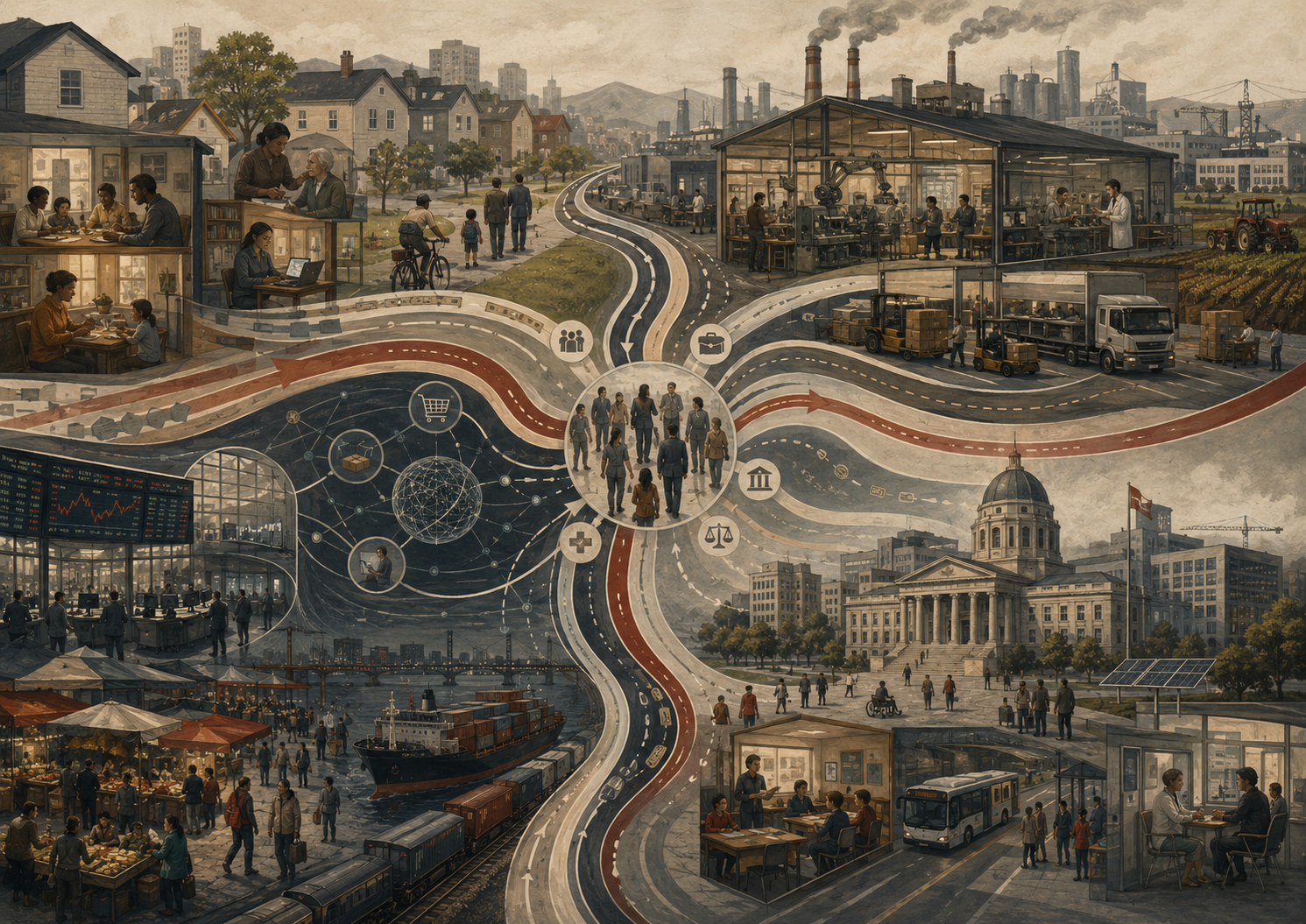
Within a sustainable systems framework, the relationship among households, firms, markets, and states must be understood not only in terms of efficiency, but also in terms of resilience, legitimacy, public goods, distribution, and ecological viability. A society that treats markets as self-sufficient, firms as ends in themselves, households merely as consumers, or states only as external constraints misses the deeper reality: these institutions are co-constitutive. They shape who bears risk, who receives protection, how innovation is directed, how scarcity is managed, and whether economic life supports durable human flourishing or merely short-term accumulation.
Why These Four Matter
Every complex economy must solve recurring problems of production, coordination, provisioning, risk management, and legitimacy. Households, firms, markets, and states are the principal institutional forms through which those problems are addressed. They are not the only actors in economic life, but they are among the most important because they organize the most durable patterns of everyday dependence: work, income, prices, investment, law, public provision, and collective security.
This is why they recur so consistently across economic theory and policy. Debates about capitalism, welfare, industrial strategy, development, public finance, stabilization, and sustainable growth all turn, in one way or another, on how these four institutions are related. The central question is never simply whether markets should be freer or states should be stronger. It is how households, firms, markets, and states can be arranged so that material life is productive, stable, legitimate, and resilient across time.
What makes these four especially important is that they organize not only exchange, but social time. Households must budget across pay cycles, illness, childrearing, old age, debt obligations, and care responsibilities. Firms plan across investment horizons, product cycles, supply chains, financing conditions, and competitive pressures. States operate across fiscal years, electoral cycles, infrastructure lifetimes, emergency obligations, and long-term public commitments. Markets coordinate continuously in real time, often with shorter horizons than households, firms, or states can safely inhabit.
One of the deepest problems of political economy is how these competing temporalities are reconciled. If markets pressure firms toward short-term profit, firms may underinvest in workers, maintenance, resilience, and ecological responsibility. If households are forced to absorb too much insecurity, social reproduction weakens. If states lose fiscal and administrative capacity, long-term public goods become harder to sustain. If markets are treated as self-correcting without regard to public goods, social protection, and ecological limits, the system may remain active while becoming brittle.
To analyze households, firms, markets, and states seriously is therefore to analyze the institutional composition of an economic system itself. These are not just textbook categories. They are recurrent sites through which need, work, law, finance, power, expectation, and collective risk are organized.
Households
Households are the foundational units of everyday economic life. They consume goods and services, supply labor, manage budgets, save, borrow, care for children and dependents, and absorb a great deal of social risk. They are not simply sites of preference satisfaction. They are also sites of social reproduction: the places where health, education, nutrition, care, time allocation, intergenerational transfer, and daily stability are organized.
Without households, labor could not be reproduced, and without reproduced labor the wider economy could not continue. The worker who appears in the labor market has already been fed, housed, educated, cared for, transported, and supported through countless forms of household and public labor. Much of that work is unpaid, underpaid, gendered, racialized, or treated as private responsibility even though it sustains the formal economy.
Households experience the economy not in abstract aggregates but in concrete terms: wages, rents, mortgages, food prices, energy bills, commuting costs, debt obligations, health costs, childcare needs, eldercare burdens, insurance gaps, and access to public goods. Their security depends on employment conditions, social insurance, infrastructure quality, affordable essentials, asset ownership, and protection from shocks.
This is why household wellbeing cannot be understood through market exchange alone. A household may participate fully in markets and still be insecure if wages are low, rents are high, debt service is heavy, care needs are unsupported, or public goods are weak. Access to education, health care, transport, clean water, public safety, unemployment insurance, disability support, and retirement security can matter as much as private income.
Households also differ profoundly from one another. They are stratified by class, wealth, debt, geography, gender, caregiving burden, race, disability, citizenship, and access to assets. Some enter the economy buffered by savings, homeownership, education, stable employment, and family support. Others encounter it through precarity, informal work, insecure housing, medical debt, environmental exposure, and continual vulnerability to shocks. For that reason, households must be understood not only as economic units, but as unequal sites through which the wider structure of security and vulnerability is lived.
They are also sites of adaptation. When wages stagnate, prices rise, or public goods deteriorate, households compensate by working longer hours, reducing consumption, drawing down savings, increasing debt, reallocating care, delaying family formation, moving, relying on kinship networks, or accepting lower standards of security. These adjustments often remain invisible in formal accounts of the economy even though they are central to how the system copes with stress.
Firms
Firms are the primary organizations through which much production is coordinated in modern economies. They hire labor, combine inputs, invest in machinery and technology, develop business models, manage supply chains, organize logistics, raise finance, and bring goods and services to market. Firms range from small family enterprises to multinational corporations, and their scale, ownership structure, financing model, strategic position, and governance shape the wider organization of production.
Yet firms are not merely technical production units. They are also institutional centers of power. They shape wage structures, innovation trajectories, employment quality, lobbying capacity, supply-chain dependence, market concentration, technology adoption, investment priorities, and the distribution of gains between labor and capital. Decisions made within firms affect not only profitability, but also regional development, household stability, labor conditions, ecological impact, and the direction of technological change.
The behavior of firms is inseparable from the rules governing finance, competition, labor, taxation, trade, public procurement, environmental protection, and public investment. A firm does not act in a vacuum. Its choices are conditioned by credit systems, infrastructure, educational capacity, regulatory frameworks, shareholder expectations, consumer demand, public subsidies, union power, and the strategies of competitors.
This makes firms central to any serious analysis of economic systems. They are not only participants in the economy. They are institutions through which economic order is actively shaped. They decide whether profits are directed toward wages, dividends, buybacks, research, training, resilience, decarbonization, automation, regional investment, or speculative positioning. In that sense, firms are not merely recipients of market signals. They are agents that shape the developmental direction of the system.
Firms also mediate between short-term calculation and long-term capacity. When competitive pressure, financial markets, or managerial incentives reward short-term returns, firms may underinvest in worker training, maintenance, safety, redundancy, climate adaptation, or durable innovation. When institutional design rewards long-term productive capacity, firms can become engines of social development, technological progress, and broad-based prosperity.
The key question is therefore not only whether firms are profitable. It is what kind of productive, distributive, ecological, and social role they play within the wider system.
Markets
Markets are institutional arenas in which exchange is coordinated through prices, competition, contracts, and information. They allow households, firms, and other actors to buy, sell, hire, borrow, invest, insure, and specialize. Markets can be highly effective at coordinating decentralized information and facilitating exchange, but they do not operate outside institutions. They depend on trusted money, enforceable rules, public infrastructure, contract law, standards, courts, regulation, and public authority.
Markets are therefore not natural states of affairs. They are built, governed, maintained, and contested. The legal system determines what can be owned, what can be contracted, what counts as fraud, how competition is regulated, how bankruptcy works, and how property claims are enforced. Public infrastructure makes exchange physically possible. Monetary institutions make exchange financially possible. Social trust makes exchange credible.
Markets also have limits. They may underprovide public goods, mishandle externalities, amplify inequality, deepen exclusion, reward market power, and ignore harms that are delayed, diffuse, intergenerational, or ecological. They can coordinate efficiently within a given distribution of income and assets while reproducing that distribution’s inequalities. They can generate innovation and flexibility while also intensifying fragility, concentration, speculation, or environmental harm.
For that reason, markets should be understood as one coordinating mechanism among several, not as a self-sufficient social order. Their performance depends on the surrounding institutional environment and on how their outcomes are corrected, supplemented, or constrained by public authority, social norms, public goods, and long-term collective priorities.
Markets also differ internally. Labor markets, housing markets, energy markets, financial markets, agricultural markets, health-care markets, data markets, and platform markets each behave differently because the goods exchanged, the actors involved, the degree of competition, the urgency of need, and the role of infrastructure vary. To speak of “the market” in the singular often obscures this institutional diversity.
A housing market, for example, cannot be judged in the same way as a market for optional consumer goods. Housing is shelter, asset, collateral, neighborhood access, and social stability at once. A labor market is not just a place where hours are exchanged for wages; it is a system through which households secure income, dignity, bargaining power, and future prospects. A financial market can mobilize capital, but it can also amplify leverage and systemic risk. Each market must be analyzed according to what is being exchanged and what social consequences follow from that exchange.
States
States are central economic actors because they define and enforce the rules under which economic life takes place. They establish property and contract law, regulate competition, create tax systems, spend on infrastructure and services, manage public debt, stabilize the macroeconomy, regulate finance, enforce labor standards, and coordinate public priorities. In doing so, states do not merely intervene in the economy from outside. They help constitute the economy as an organized system in the first place.
States are also the primary institutions through which societies provide public goods and social insurance. Basic education, health systems, transport infrastructure, environmental regulation, unemployment insurance, old-age support, disability protection, disaster response, public safety, legal order, and many forms of risk management cannot reliably be supplied through private markets alone. Public authority is therefore not simply a constraint on private action. It is one of the conditions that makes durable economic life possible.
At the same time, states vary widely in capacity, legitimacy, and orientation. Some are capable of long-range coordination, effective redistribution, credible regulation, public investment, and infrastructural provision. Others are weak, captured, fragmented, authoritarian, corrupt, fiscally constrained, or unable to deliver services reliably. The question is thus not whether states matter, but what kind of states exist, whose interests they serve, and how effectively they can balance growth, stability, welfare, democracy, ecological responsibility, and long-term resilience.
States also structure time differently from markets. They are among the few institutions capable of acting on a horizon long enough to maintain infrastructure, coordinate energy transitions, fund basic science, insure against systemic risk, prepare for disasters, preserve public health, and protect future generations. Where states lose that capacity, the whole system becomes more short-term, brittle, and less legitimate.
State capacity should therefore be treated as an economic variable in its own right. Fiscal capacity, administrative competence, regulatory independence, democratic legitimacy, data systems, public procurement capacity, and legal credibility all shape economic performance. A society can possess private wealth and active markets while still failing to provide public goods if the state lacks capacity or is politically captured.
The state is not automatically benevolent. It can oppress, exclude, misallocate, surveil, subsidize destructive interests, or protect entrenched power. But the absence of effective public capacity does not produce freedom by default. It often leaves households exposed, firms short-term, markets concentrated, and long-term public goods neglected.
Mutual Dependence and Economic Order
Households, firms, markets, and states do not simply coexist. They reproduce one another. Households provide labor to firms and demand to markets. Firms generate wages, profits, goods, services, and investment. Markets coordinate circulation and price formation. States stabilize the wider framework, provide nonmarket goods, enforce rules, and redistribute income and risk. None can function for long without the others.
This interdependence means that weakness in one domain often cascades into others. A labor-market shock weakens households, which can reduce demand for firms. Financial fragility can constrain credit to households and businesses. Inadequate public infrastructure can suppress productivity and raise household costs. Weak household purchasing power can undermine market demand and discourage productive investment. Fiscal stress can weaken public goods, which then raises private costs and lowers long-term capacity.
What appears as a problem in one institutional sphere often turns out to be systemic. A household debt crisis is also a financial-market problem, a labor-market problem, a housing problem, and a public-policy problem. A firm investment slowdown may reflect weak demand, uncertain regulation, poor infrastructure, financial pressure, or inadequate skills formation. A market failure may reveal missing public goods or excessive concentration. A state fiscal crisis may reflect weak tax capacity, low growth, political capture, or inherited obligations.
For that reason, economic order should be understood relationally. The central task is not to isolate the proper domain of each institution once and for all, but to understand how they interact, where they compensate for one another, where they generate tensions, and how their balance changes across history and political context.
This relational view also makes visible something often missed in narrower economics: institutions do not merely coexist side by side. They actively transform one another. Welfare design affects labor bargaining. Financial deregulation alters firm behavior. Household debt reshapes market demand. Infrastructure quality changes production possibilities. Public trust alters the governability of reform. Economic systems are dynamic because their core institutions are mutually formative.
Labor, Consumption, and Saving
One of the most important ways these institutions interact is through labor, consumption, and saving. Households supply labor and receive wages or self-employment income. Firms demand labor and organize production. Markets translate wages into purchasing power for goods and services. States shape this entire circuit through labor law, public employment, taxes, transfers, minimum wages, collective-bargaining rules, social insurance, and macroeconomic policy.
Saving and borrowing deepen these links further. Households save through deposits, pensions, housing, retirement accounts, and other assets. Firms depend on retained earnings, loans, equity, bonds, supplier credit, and market-based finance. States borrow and spend across time to fund public priorities, stabilize downturns, build infrastructure, and manage collective risk. These flows connect household security, business investment, public capacity, and financial stability within a single economic structure.
What matters is not merely that these circuits exist, but how they are organized. A system in which labor income is weak, household debt is high, business investment is speculative, and public capacity is constrained will distribute risk very differently from one in which wages, social insurance, public goods, and productive investment are stronger.
Labor, consumption, and saving are therefore not just economic variables. They are institutional linkages through which the broader character of the system is expressed. A rise in household consumption financed by debt is different from a rise in consumption financed by broad wage growth. Firm profits generated through productive innovation differ from profits generated by monopoly pricing, wage suppression, or financial engineering. Public borrowing used to stabilize a downturn or build infrastructure differs from borrowing used to compensate for a weakened tax base or political refusal to fund public goods.
These distinctions matter because flow identities can look similar while institutional realities differ. The same aggregate level of consumption, investment, or public expenditure can rest on very different distributions of security, risk, and future capacity.
Public Goods, Regulation, and Redistribution
The relationship between markets and states becomes clearest in the provision of public goods and the correction of market failures. Public goods, social insurance, externalities, natural monopolies, systemic risk, and unequal bargaining power all create allocative and stabilizing roles for government. In practice, this means that states do not merely tax and spend after markets have operated. They shape the conditions under which markets function, the terms on which risks are borne, and the extent to which essential goods remain accessible.
Redistribution matters as well. Through taxes, transfers, services, and infrastructure, states alter the distributive outcomes generated by markets and firms. These policies affect not only fairness, but also demand, stability, opportunity, and the capacity of households to withstand shocks. Redistribution can stabilize a society by preventing economic vulnerability from becoming chronic exclusion.
Regulation plays a similarly constitutive role. Competition policy, environmental rules, labor protections, financial supervision, housing law, data regulation, consumer protection, public standards, and safety rules all influence how firms behave, how markets allocate, and how households experience the economy. Regulation is not simply an after-the-fact correction. It is one of the main ways an economic system defines acceptable forms of power, risk, and obligation.
Public goods and redistribution also shape legitimacy. Where basic capabilities are protected, markets can operate within a more stable social order. Where they are not, economic life becomes more fragile because households are asked to absorb risks they cannot realistically bear.
Public goods should also be understood as productive. Education supports labor capacity. Health systems preserve human capability. Transport connects workers and firms. Courts and legal systems support contracts and rights. Public research expands technological possibility. Environmental regulation protects the natural foundations of production. Social insurance stabilizes demand. These are not merely costs deducted from private productivity. They are conditions of durable economic performance.
Power, Inequality, and Institutional Asymmetry
Households, firms, markets, and states do not stand in symmetrical relation to one another. Firms may possess concentrated resources, market power, lobbying influence, data control, legal capacity, and global mobility. Households are internally unequal by class, wealth, debt, gender, race, citizenship, geography, and access to assets. Markets can magnify existing inequalities because purchasing power is unevenly distributed. States can either mitigate or reinforce such asymmetries depending on their design, capacity, and political capture.
Power shapes whose needs are visible, which risks are socialized, and which burdens are privatized. It affects whether housing is treated primarily as shelter or as an asset class, whether finance serves productive investment or speculative concentration, whether labor is protected or disciplined, whether firms internalize ecological harms or externalize them, and whether public systems are robust or hollowed out.
Once power is foregrounded, the economy no longer appears as a neutral field of exchange. It appears as a structured order in which some actors command far more capacity than others to shape outcomes. A household facing eviction and a landlord holding multiple properties do not enter the housing market symmetrically. A worker needing income and a firm with monopsony power do not bargain symmetrically. A small business seeking credit and a large corporation with market access do not face the same financial system.
A serious account of households, firms, markets, and states must therefore treat them not just as analytical categories but as unequal centers of agency and constraint within a broader political economy. Their relations are always shaped by bargaining, law, ideology, institutional design, public policy, and historical struggle.
Institutional asymmetry also affects crisis response. In downturns, households may be expected to absorb unemployment, debt, and insecurity, while firms may receive liquidity support and markets may receive stabilization. In other cases, states may use public capacity to protect workers, renters, small businesses, and essential services directly. How risk is assigned during crisis reveals the moral structure of the economic system.
Time, Risk, and Social Reproduction
One way to deepen the analysis of these four institutions is to ask how each handles time and risk. Households absorb the immediate effects of illness, unemployment, inflation, rent increases, debt burdens, care obligations, school closures, climate hazards, and public-service failures. Firms absorb or shift risk through pricing, investment, employment decisions, insurance, supplier contracts, automation, outsourcing, financial strategy, and lobbying. Markets distribute risk through price movements, credit conditions, liquidity, volatility, and asset valuations. States absorb systemic risk by guaranteeing deposits, insuring unemployment, funding emergency response, stabilizing demand, regulating finance, and maintaining public order.
This makes social reproduction central to institutional analysis. If households are chronically overburdened, labor cannot be reproduced securely. If firms externalize too much risk, productive capacity may remain formally intact while social stability deteriorates. If markets price volatility without buffering its effects, insecurity spreads. If states lose fiscal or administrative capacity, the system becomes less able to manage shocks collectively.
The relation among the four is therefore inseparable from the question of who ultimately bears uncertainty. A system can appear efficient because it minimizes visible costs for firms or states while quietly transferring risk to households, workers, caregivers, local communities, or future generations. That is not true efficiency. It is displaced fragility.
A sustainable and legitimate economic order must do more than coordinate exchange. It must distribute time and risk in ways that do not quietly consume households, erode trust, undermine public capacity, or deplete the institutional foundations of future stability.
Social reproduction also has an ecological dimension. Households, firms, markets, and states all depend on energy systems, water systems, food systems, climate stability, and infrastructure resilience. If ecological risks are treated as external to the economy, those risks eventually return as household costs, firm disruptions, market volatility, and state emergency burdens. The institutional distribution of risk must therefore include the Earth systems on which economic life depends.
Households, Firms, Markets, and States Within Sustainable Systems
Within sustainable systems, the interaction among these four institutions must be judged by broader standards than output or efficiency alone. The key questions become whether households are secure enough to reproduce social life, whether firms are organized toward productive and ecologically compatible goals, whether markets coordinate exchange without undermining public goods, and whether states can provide infrastructure, resilience, and fair burden-sharing across time.
This framing matters because sustainability is not achieved by one institution acting alone. Households cannot absorb endless insecurity. Firms cannot be expected to self-govern every public good. Markets do not spontaneously protect future generations. States cannot function without productive capacity, social trust, a tax base, and institutional legitimacy. Sustainable systems require a workable balance among the four: households protected enough to sustain life, firms productive enough to innovate and employ, markets governed enough to coordinate without domination, and states capable enough to provide public goods, regulation, stabilization, and long-range direction.
That balance is also a question of legitimacy. Economic systems endure not only when they produce, but when they are experienced as fair enough, stable enough, and intelligible enough to command trust. Where households experience constant insecurity, firms escape public responsibility, markets distribute essentials only by purchasing power, and states lose credibility or capacity, legitimacy erodes.
A sustainable system must therefore be institutionally balanced in a way that preserves public trust as well as material capacity. It must ask whether market outcomes support or undermine household stability; whether firms invest in real productive capacity or extract rents; whether states can protect public goods without becoming captured; and whether risk is distributed in ways that allow the system to reproduce itself without sacrificing the vulnerable, the future, or the ecological foundation of life.
The institutional balance is not fixed forever. Different historical moments require different arrangements. A depression may require stronger public stabilization. A climate transition may require coordinated industrial policy, household protection, and firm-level transformation. A housing crisis may require market reform, public investment, household support, and regulation of speculative finance. The point is not to assign permanent supremacy to any one actor. The point is to understand the system as a changing structure of interdependence.
How the Four Institutions Should Be Judged
Households, firms, markets, and states should not be judged only by narrow measures of efficiency, profit, consumption, or fiscal balance. Each must be evaluated according to its role in sustaining material life, distributing risk, preserving legitimacy, and supporting future capacity.
| Institution | Narrow Question | Systems Question |
|---|---|---|
| Households | How much do they consume and save? | Are households secure enough to reproduce labor, care, health, learning, and intergenerational stability? |
| Firms | Are they profitable? | Do firms build productive capacity, dignified work, innovation, resilience, and ecological compatibility? |
| Markets | Do prices clear supply and demand? | Do markets coordinate exchange without excluding essential needs, concentrating power, or ignoring public goods and externalities? |
| States | How much do they tax, spend, and borrow? | Do states provide legal order, public goods, social insurance, regulation, stabilization, and long-term capacity with legitimacy? |
| Institutional Balance | Is each actor operating within its formal role? | Are risks, responsibilities, protections, and powers distributed in ways that sustain the whole system? |
| System Reproduction | Does the economy continue growing? | Does the system preserve household stability, productive capacity, institutional trust, and ecological foundations across time? |
This broader framework prevents two common mistakes. The first is market reductionism: treating markets as if they alone organize economic life. The second is state reductionism: treating public authority as if it can command durable prosperity without households, firms, productive capacity, and trusted exchange. A serious economic systems framework must analyze how all four institutions interact.
Good institutional design does not ask households to absorb every shock, firms to pursue profit without public obligation, markets to decide every social priority, or states to solve every problem after damage has occurred. It distributes roles intelligently and corrects imbalances before they become crises.
Mathematical Lens
Mathematics can clarify how households, firms, markets, and states are connected through flows, constraints, and reproduction conditions. It cannot settle questions of justice, legitimacy, or institutional purpose on its own. But it can make visible the relationships that connect wages, consumption, saving, profit, taxation, public spending, debt, market access, and system continuity.
1. A Four-Sector Income-Flow Identity
Y = C + I + G + NX
\]
Interpretation: Aggregate output or income \(Y\) is connected to household consumption \(C\), firm investment \(I\), state expenditure \(G\), and net external demand \(NX\). Households, firms, markets, and states are linked through a common macroeconomic structure rather than existing as separate spheres.
2. Household Budget Constraint
C_h + S_h + T + D = W + TR + rA
\]
Interpretation: Household consumption \(C_h\), saving \(S_h\), taxes \(T\), and debt service \(D\) must be financed by wages \(W\), transfers \(TR\), and asset income \(rA\). Household life is shaped not only by wages, but also by transfers, assets, taxes, and debt burdens.
3. Firm Profit Condition
\Pi = PQ – WL – rK – M
\]
Interpretation: Firm profit \(\Pi\) is revenue \(PQ\) minus labor cost \(WL\), capital cost \(rK\), and material or intermediate input cost \(M\). Firm decisions about wages, investment, pricing, and production are embedded in a broader struggle over costs, returns, and social priorities.
4. State Budget Identity
G + TR + iB = T + \Delta B
\]
Interpretation: Public spending \(G\), transfers \(TR\), and interest on public debt \(iB\) must be financed through tax revenue \(T\) and new borrowing \(\Delta B\). State capacity depends on fiscal choices, taxation, borrowing, legitimacy, and the ability to sustain public commitments.
5. Market Clearing as a Partial Condition
Q_d = Q_s
\]
Interpretation: A market clears when quantity demanded \(Q_d\) equals quantity supplied \(Q_s\). But market clearing is only a partial condition. Households may still be excluded by low income, firms may still wield market power, and states may still need to provide public goods or regulate harms.
6. Effective Access
A_e = f(Y_h, P, I_a, N)
\]
Interpretation: Effective access \(A_e\) depends on household income \(Y_h\), prices \(P\), institutional access \(I_a\), and need \(N\). A good may exist in the market and still be inaccessible to households without sufficient income, entitlement, public provision, or geographic access.
7. A Simple Reproduction Condition
R_s = f(H, P_c, I_c, E)
\]
Interpretation: System reproduction capacity \(R_s\) depends on household stability \(H\), productive capacity \(P_c\), institutional capacity \(I_c\), and ecological foundations \(E\). If any deteriorates persistently, the wider system becomes harder to reproduce.
The mathematical lens clarifies several structural features. Households face constraints shaped by wages, transfers, assets, taxes, and debt. Firms operate through revenue, labor cost, capital cost, and input cost. States shape outcomes through taxation, transfers, borrowing, and public provision. Markets coordinate exchange, but market balance alone does not settle questions of justice or legitimacy. System continuity depends on household, productive, institutional, and ecological reproduction together.
Formalization helps reveal structure, but it should not be mistaken for a complete account. A balanced equation is not the same as a fair system. The mathematics is most useful when it clarifies institutional relations rather than replacing them.
Python Workflow: Institutional Flow Analysis
Python is useful for turning the institutional relationships among households, firms, markets, and states into reproducible scenarios. The following compact workflow models household saving, firm profit, public borrowing, and a simple reproduction score.
# Households, Firms, Markets, and States
# Simple institutional-flow workflow in Python

import pandas as pd

scenarios = [
    {
        "scenario": "baseline",
        "W": 500,      # wages
        "TR": 120,     # transfers
        "A_income": 80,
        "Taxes": 140,
        "Debt_service": 60,
        "C_h": 380,    # household consumption
        "Revenue": 900,
        "Labor_cost": 500,
        "Capital_cost": 120,
        "Material_cost": 180,
        "G": 260,      # public spending
        "Interest_public_debt": 40
    },
    {
        "scenario": "household_stress",
        "W": 455,
        "TR": 130,
        "A_income": 55,
        "Taxes": 118,
        "Debt_service": 85,
        "C_h": 380,
        "Revenue": 850,
        "Labor_cost": 455,
        "Capital_cost": 125,
        "Material_cost": 185,
        "G": 280,
        "Interest_public_debt": 45
    }
]

records = []

for item in scenarios:
    household_saving = (
        item["W"] + item["TR"] + item["A_income"]
        - item["Taxes"] - item["Debt_service"] - item["C_h"]
    )

    firm_profit = (
        item["Revenue"] - item["Labor_cost"]
        - item["Capital_cost"] - item["Material_cost"]
    )

    public_borrowing = (
        item["G"] + item["TR"] + item["Interest_public_debt"] - item["Taxes"]
    )

    household_stability = 1 if household_saving >= 0 else 0
    productive_capacity = 1 if firm_profit > 0 else 0
    institutional_capacity = 1 if public_borrowing <= 350 else 0

    reproduction_score = (
        household_stability + productive_capacity + institutional_capacity
    )

    records.append({
        "scenario": item["scenario"],
        "household_saving": household_saving,
        "firm_profit": firm_profit,
        "public_borrowing": public_borrowing,
        "reproduction_score": reproduction_score
    })

df = pd.DataFrame(records)

print(df)
This workflow shows why the four institutional actors cannot be analyzed in isolation. A household stress scenario can reduce saving, weaken demand, alter firm revenue, increase public transfers, and change public borrowing needs. The simple reproduction score is not a complete model, but it makes a systems point: an economy is harder to reproduce when households are unstable, firms are weak, or public capacity is strained.
The full GitHub repository expands this example into institutional-flow scenario tables, market-access metrics, risk-distribution scenarios, SQL queries, R and Stata replication workflows, Julia dynamic reproduction simulations, and article-ready figures.
R Workflow: Institutional Balances
R is useful for summarizing institutional balances and producing scenario graphics. The following compact workflow calculates household saving, firm profit, public borrowing, and system reproduction indicators.
# Households, Firms, Markets, and States
# Simple institutional-flow workflow in R

library(dplyr)

scenarios <- data.frame(
  scenario = c("baseline", "household_stress"),
  W = c(500, 455),
  TR = c(120, 130),
  A_income = c(80, 55),
  Taxes = c(140, 118),
  Debt_service = c(60, 85),
  C_h = c(380, 380),
  Revenue = c(900, 850),
  Labor_cost = c(500, 455),
  Capital_cost = c(120, 125),
  Material_cost = c(180, 185),
  G = c(260, 280),
  Interest_public_debt = c(40, 45)
)

results <- scenarios |>
  mutate(
    household_saving = W + TR + A_income - Taxes - Debt_service - C_h,
    firm_profit = Revenue - Labor_cost - Capital_cost - Material_cost,
    public_borrowing = G + TR + Interest_public_debt - Taxes,
    household_stability = household_saving >= 0,
    productive_capacity = firm_profit > 0,
    institutional_capacity = public_borrowing <= 350,
    reproduction_score =
      as.integer(household_stability) +
      as.integer(productive_capacity) +
      as.integer(institutional_capacity)
  ) |>
  select(
    scenario,
    household_saving,
    firm_profit,
    public_borrowing,
    reproduction_score
  )

print(results)
This R workflow is deliberately compact for article readability. In the full repository, R reads the institutional-flow scenario tables, summarizes household, firm, and state balances across multiple scenarios, and produces visual comparisons of institutional stress and reproduction capacity.
Future Economic Systems articles can extend this foundation with stock-flow consistent accounting, household microdata, firm-level balance sheets, tax-and-transfer microsimulation, market power indicators, financial-account data, and ecological risk constraints.
GitHub Repository
The article body includes selected computational examples so the conceptual, institutional, and mathematical argument remains readable. The full repository contains the expanded research infrastructure: Python institutional-flow modeling, R scenario summaries, Stata applied-economics replication workflows, SQL actor and flow tables, Julia reproduction dynamics, market-access metrics, risk-distribution scenarios, documentation, reproducible sample data, and article-ready figures and tables.
Complete Code Repository
The full code distribution for this article, including selected article examples and advanced research-style computational scaffolding for household budgets, firm profit conditions, state fiscal capacity, market access, public goods, risk distribution, social reproduction, institutional resilience, reproducibility documentation, and cross-language economic analysis, is available on GitHub.
Conclusion
Households, firms, markets, and states are the central institutional actors through which modern economies organize work, exchange, provisioning, public authority, and social reproduction. Households sustain life and labor. Firms organize production and investment. Markets coordinate exchange. States provide rules, public goods, stabilization, and redistribution. None is self-sufficient. Each depends on the others, and the quality of their interaction helps determine whether an economy is productive, legitimate, resilient, and socially sustainable.
To understand an economic system, one must therefore ask how these institutions are related, what powers they hold, what risks they bear, and what purposes they serve. A society’s answers reveal far more than its formal economic model. They reveal how it organizes material life, how it distributes protection and exposure, and what kind of future it is prepared to sustain.
A sustainable institutional order cannot treat households as shock absorbers, firms as detached profit engines, markets as self-sufficient arbiters, or states as mere external regulators. It must understand all four as mutually dependent parts of a living economic system. The central question is how to organize their relationship so that production, exchange, public authority, household security, ecological responsibility, and long-term resilience reinforce one another rather than pull the system apart.
Related Reading
- Economic Systems
- What Is an Economic System?
- Production, Distribution, and Exchange in Human Societies
- Scarcity, Allocation, and the Organization of Material Life
- Labor, Wages, Productivity, and the Social Organization of Work
- Public Finance, State Capacity, and Collective Goods
- Ecological Economics and the Embedded Economy
- Risk & Resilience
Further Reading
- International Labour Organization (ILO) (n.d.). Statistics on Employment. Available at: https://ilostat.ilo.org/topics/employment/
- International Monetary Fund (IMF) (n.d.). Fiscal Policy: Taking and Giving Away. Available at: https://www.imf.org/en/publications/fandd/issues/series/back-to-basics/fiscal-policy
- International Monetary Fund (IMF) (2014). Government Finance Statistics Manual 2014. Available at: https://www.imf.org/external/Pubs/FT/GFS/Manual/2014/gfsfinal.pdf
- Organisation for Economic Co-operation and Development (OECD) (n.d.). Household Financial Assets. Available at: https://www.oecd.org/en/data/indicators/household-financial-assets.html
- Organisation for Economic Co-operation and Development (OECD) (n.d.). Household Net Worth. Available at: https://www.oecd.org/en/data/indicators/household-net-worth.html
- Organisation for Economic Co-operation and Development (OECD) (n.d.). Capital Markets. Available at: https://www.oecd.org/en/topics/capital-markets.html
- Polanyi, K. (2001 [1944]). The Great Transformation: The Political and Economic Origins of Our Time. Boston: Beacon Press.
- World Bank (n.d.). WDI Theme: States and Markets. Available at: https://datatopics.worldbank.org/world-development-indicators/themes/states-and-markets.html
- World Bank (2022). World Development Report 2022: Finance for an Equitable Recovery. Available at: https://www.worldbank.org/en/publication/wdr2022
References
- International Labour Organization (ILO) (n.d.). Statistics on Employment. Available at: https://ilostat.ilo.org/topics/employment/
- International Labour Organization (ILO) (n.d.). Labour Force Statistics. Available at: https://ilostat.ilo.org/methods/concepts-and-definitions/description-labour-force-statistics/
- International Monetary Fund (IMF) (n.d.). Fiscal Policy: Taking and Giving Away. Available at: https://www.imf.org/en/publications/fandd/issues/series/back-to-basics/fiscal-policy
- International Monetary Fund (IMF) (2014). Government Finance Statistics Manual 2014. Washington, DC: IMF. Available at: https://www.imf.org/external/Pubs/FT/GFS/Manual/2014/gfsfinal.pdf
- Organisation for Economic Co-operation and Development (OECD) (n.d.). Household Financial Assets. Available at: https://www.oecd.org/en/data/indicators/household-financial-assets.html
- Organisation for Economic Co-operation and Development (OECD) (n.d.). Household Net Worth. Available at: https://www.oecd.org/en/data/indicators/household-net-worth.html
- Organisation for Economic Co-operation and Development (OECD) (n.d.). Capital Markets. Available at: https://www.oecd.org/en/topics/capital-markets.html
- World Bank (n.d.). WDI Theme: States and Markets. Available at: https://datatopics.worldbank.org/world-development-indicators/themes/states-and-markets.html
- World Bank (2022). World Development Report 2022: Finance for an Equitable Recovery. Washington, DC: World Bank. Available at: https://www.worldbank.org/en/publication/wdr2022