
Last Updated May 9, 2026
Biodiversity loss matters ethically because extinction is not merely a biological event. It is a moral event. When species disappear, habitats collapse, populations decline, and ecological communities are simplified or degraded, the issue is not only whether nature becomes less productive, less beautiful, or less resilient. It is also whether human beings and human institutions have acted in ways that destroy forms of life, evolutionary inheritance, ecological relation, and future possibility that they did not create and cannot restore once lost.
The deeper reason this issue belongs in Stewardship & Ethics is that biodiversity loss reveals the moral consequences of treating life as disposable where it is not immediately profitable, visible, politically protected, or institutionally convenient. Extinction is often presented as an unfortunate side effect of development, land conversion, extraction, infrastructure expansion, pollution, invasive species, overconsumption, or climate disruption. But the ethical question is whether those losses are morally tolerable simply because they are systemically produced.
Once extinction is understood as irreversible, cumulative, and bound up with human choices, it becomes impossible to treat biodiversity decline as a neutral background process. Species loss is not only something that happens in nature. Under contemporary conditions, it is increasingly something produced through economies, laws, land systems, energy systems, food systems, trade systems, consumption patterns, financial incentives, and failures of governance.
Biodiversity ethics therefore cannot be reduced to a narrow conservation argument about protecting useful resources. Utility matters, because human life depends on pollination, soil fertility, clean water, climate regulation, disease buffering, genetic diversity, and ecosystem resilience. But the moral stakes go further. Species and ecosystems matter not only because they support human life, but because extinction destroys unique living forms, weakens ecological communities, narrows the future, and raises profound questions about the legitimacy of human power over the more-than-human world.
A society that knowingly drives irreversible biological loss cannot evaluate itself only by what it gained. It must also answer for what it eliminated.
Main Library
Publications
Article Map
Stewardship & Ethics
Related Topic
Sustainable Development
Related Topic
Planetary Boundaries
Related Topic
Biology
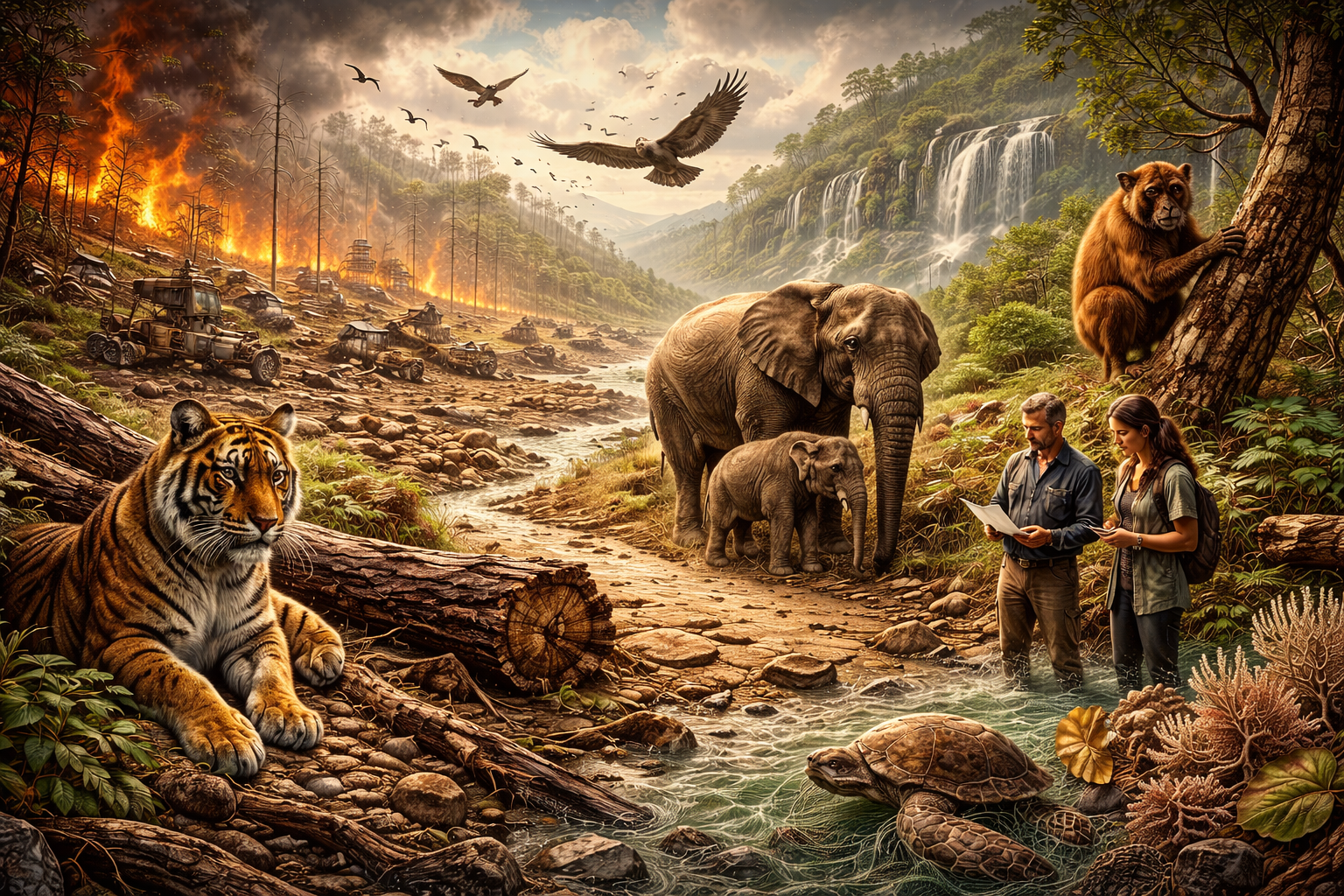 Biodiversity loss is not only ecological decline. It is a moral crisis of irreversible disappearance, human responsibility, damaged relationships, and diminished future possibility.</caption]
This article argues that biodiversity loss, extinction, and moral responsibility should be understood as central problems in stewardship and environmental ethics. It examines what biodiversity means, why extinction raises distinctive moral questions, how instrumental, intrinsic, ecological, cultural, and intergenerational values shape the debate, why human-caused biodiversity loss intensifies responsibility, how climate change and land-use change amplify extinction risk, why conservation and restoration cannot fully substitute for prevention, and why sustainable systems require institutions capable of treating species loss as a matter of justice, restraint, and public accountability rather than as an acceptable externality.
Why This Belongs in Stewardship & Ethics
Biodiversity loss belongs in Stewardship & Ethics because it asks what kind of responsibility human beings bear toward forms of life that are not reducible to human use. Stewardship is not only the management of resources for human continuity. It is also the moral discipline of caring for living systems whose value exceeds their market price, immediate utility, or political visibility.
Extinction exposes the ethical failure of a purely instrumental view of nature. If species matter only when they are economically useful, culturally beloved, scientifically interesting, or ecologically convenient, then many forms of life become morally invisible until they are nearly gone. A stewardship ethic resists that narrowing. It asks whether human power over land, water, climate, oceans, forests, animals, plants, microbes, and ecological communities can be governed with humility, restraint, and accountability.
This issue also belongs in Stewardship & Ethics because biodiversity loss is not evenly caused or evenly experienced. Industrial agriculture, deforestation, mining, fossil-fuel systems, infrastructure expansion, overfishing, pollution, invasive species, and climate change are organized through institutions and economies. Some actors benefit more from the systems that drive ecological loss. Some communities bear greater consequences. Some peoples are dispossessed from lands and waters they have stewarded for generations, while others profit from simplified landscapes and extractive development.
Moral responsibility must therefore be more precise than a generic claim that “humanity” is causing biodiversity loss. Humanity is implicated, but not equally. Responsibility scales with contribution, benefit, capacity, decision-making power, and control over the systems that produce harm.
Biodiversity loss also raises intergenerational questions. Extinction is a permanent transfer of loss into the future. Future generations inherit not merely fewer resources, but a diminished living world: fewer species, fewer ecological relationships, fewer evolutionary possibilities, fewer forms of wonder, knowledge, kinship, and resilience.
Stewardship & Ethics therefore treats extinction not as a background environmental cost, but as a test of whether human systems can recognize limits before loss becomes irreversible.
What Biodiversity Loss, Extinction, and Moral Responsibility Mean
Biodiversity refers to the variety of life across multiple levels, including genes, traits, populations, species, ecological communities, habitats, and ecosystems. It is not simply a list of species. It includes the relationships through which living systems function: predator and prey, pollinator and flower, seed disperser and forest, soil microbe and plant root, coral and algae, river and floodplain, climate and migration, culture and landscape.
Biodiversity loss refers to decline in that living variety. It can occur through shrinking populations, reduced genetic diversity, habitat fragmentation, degraded ecosystems, disappearing ecological interactions, altered food webs, invasive species pressure, pollution, climate stress, or the extinction of species altogether. Extinction is the most final expression of such loss because it eliminates a lineage irreversibly.
Moral responsibility concerns whether and how human beings, institutions, states, firms, consumers, investors, land managers, and governance systems can be held answerable for causing, accelerating, tolerating, or failing to prevent those losses.
This matters because biodiversity is not reducible to scenery, recreation, or resource stock. It includes ecological relationships, evolutionary histories, adaptive capacities, and forms of life that together shape resilience, regeneration, and the conditions under which both human and nonhuman beings can flourish. To speak of biodiversity loss ethically is therefore to speak about damage to living plurality itself.
A serious biodiversity ethic must also recognize scale. Biodiversity loss happens locally, regionally, and globally. A wetland drained for development, a forest fragmented by roads, a coral reef bleached by warming waters, a river dammed without ecological passage, a grassland converted to monoculture, and a species pushed into extinction all belong to the same wider moral problem: the simplification of life under systems that often value land and organisms only when they can be converted into immediate human benefit.
This is why biodiversity ethics is not a sentimental add-on to science. It is the ethical interpretation of what biological loss means when it is caused, accelerated, or normalized by human systems.
Why Extinction Is a Moral Question
Extinction is a moral question because it involves the destruction of something that cannot be recreated once lost. Species extinction does not resemble ordinary replacement in human economic life. A lost building can be rebuilt. A damaged machine can be repaired or replaced. A depleted inventory can be restocked. An extinct species cannot be restored as the same historical form of life, with the same evolutionary path, ecological relationships, genetic inheritance, behavioral repertoire, and future possibility.
This irreversibility changes the ethical stakes.
Extinction is also morally distinctive because it represents the end of a lineage. A species is not only a population count. It is an evolutionary history moving through time. It carries adaptations shaped by deep time, relationships with other species, and possibilities that no human institution designed. To drive such a lineage out of existence for avoidable reasons is not merely to reduce biological inventory. It is to terminate a living history.
This matters because extinction is often mediated by choice rather than necessity. Human systems clear habitat, fragment landscapes, intensify extraction, spread pollution, introduce invasive species, overexploit populations, and destabilize climate systems in ways that predictably increase extinction risk. Once those pathways are known, moral responsibility cannot be evaded by treating extinction as though it were simply part of nature’s ordinary turnover.
There have always been extinctions. But the ethical question today concerns avoidable, human-driven, rapidly accelerating disappearance under conditions of knowledge. When societies know that certain land-use, energy, industrial, agricultural, and consumption systems are pushing species toward extinction, continued inaction becomes morally significant.
Extinction therefore asks whether avoidable human-caused disappearance is being normalized under the language of progress, efficiency, necessity, or inevitability. It asks whether development can remain legitimate when its ordinary operation destroys irreplaceable life. It asks whether law, finance, policy, and public institutions are capable of treating irreversible biological loss as a serious moral limit rather than as an acceptable externality.
Instrumental Value, Intrinsic Value, and the Worth of Living Diversity
One major argument for protecting biodiversity is instrumental. Species and ecosystems support pollination, soil fertility, water regulation, climate stability, food security, medicine, fisheries, forests, disaster risk reduction, disease regulation, and broader ecological resilience. On this view, biodiversity matters because human wellbeing depends on it.
This argument is important. It makes clear that biodiversity loss is not a luxury concern for people who already have enough. It affects food systems, public health, livelihoods, water security, climate adaptation, infrastructure resilience, and economic stability. The loss of pollinators affects agriculture. The degradation of wetlands affects flood protection. The decline of forests affects water cycles and climate regulation. The collapse of fisheries affects food and labor. The simplification of ecosystems can increase vulnerability to disease, pests, drought, fire, and shock.
Instrumental value therefore provides a powerful public reason for biodiversity protection: human societies cannot remain healthy, secure, or resilient if the living systems that support them are degraded beyond recovery.
But instrumental value is not the whole issue. Biodiversity also raises questions of intrinsic value. If living beings, species, and ecological communities possess worth beyond their immediate utility to humans, then biodiversity loss is not wrong only when it reduces ecosystem services or material advantage. It may also be wrong because it destroys forms of life that matter in themselves.
This distinction is central to environmental ethics. Once life is seen as having value beyond utility, extinction becomes more than a miscalculation. It becomes a moral injury.
A robust biodiversity ethic therefore draws on multiple forms of value:
- instrumental value: biodiversity supports human survival, health, resilience, and development;
- intrinsic value: living beings and ecological communities may matter beyond their usefulness;
- relational value: people live in meaningful relationships with species, places, waters, forests, and landscapes;
- cultural and spiritual value: biodiversity is woven into memory, identity, ritual, language, and sacred responsibility;
- intergenerational value: future generations inherit or lose the living world shaped by present action.
Instrumental value explains why biodiversity loss can destabilize life-support systems. Intrinsic and relational value explain why usefulness does not exhaust the worth of the living world.
Species, Ecosystems, and the Problem of Moral Standing
One of the central philosophical difficulties in biodiversity ethics is deciding what, exactly, has moral standing. Is moral concern owed primarily to individual sentient animals, to living organisms as such, to species, to ecosystems, to habitats, to evolutionary processes, or to the integrity of ecological wholes?
These levels do not always align. Measures that protect ecosystems may harm individual animals. Measures that preserve native species may require intervention against invasive populations. Measures that prioritize sentient suffering may conflict with ecosystem restoration or ecological integrity. Measures that protect charismatic species may leave less visible organisms, fungi, insects, plants, amphibians, microorganisms, and ecological interactions underprotected.
This matters because biodiversity loss cannot be evaluated adequately by a single moral unit. The disappearance of a species is not identical to the suffering of an individual animal, yet neither is it morally trivial. Ecosystem degradation can be wrong even when no single harmed individual seems to capture the full scale of the loss. The collapse of a coral reef, the draining of a wetland, or the fragmentation of a forest is not merely a collection of individual injuries. It is a loss of living relation, structure, function, and future.
Biodiversity ethics is demanding because the living world is layered. Moral responsibility may attach to multiple levels of life at once.
This requires humility in ethical judgment. Human beings often prefer simple moral categories: protect the individual, preserve the species, restore the ecosystem, maximize human benefit, minimize suffering, conserve function, or protect wilderness. Each approach captures something important. None captures everything.
A stewardship ethic should therefore avoid reducing biodiversity to one moral lens alone. It should hold together concern for sentient animals, living organisms, species, ecological integrity, human communities, Indigenous relationships to land, and future generations. It should recognize that ethical conflict within conservation is real, but that difficulty is not a reason for indifference.
The moral complexity of biodiversity is not an excuse to avoid responsibility. It is a reason to exercise responsibility more carefully.
Human-Caused Biodiversity Loss and Differentiated Responsibility
Human beings have always altered environments, but contemporary biodiversity decline is deeply shaped by industrial agriculture, land-use conversion, extractive development, pollution, overexploitation, invasive species introductions, and climate change. These are not abstract forces. They are organized through institutions, capital flows, regulations, trade systems, infrastructure, legal regimes, property systems, and consumption patterns.
That means moral responsibility is not evenly distributed.
Appeals to “humanity” can blur the asymmetry of benefit and burden. Some actors profit more from the activities driving biodiversity loss. Some states and firms exercise greater control over land, finance, extraction, commodity chains, infrastructure, and regulatory choices. Some communities are forced into environmentally destructive arrangements by poverty, debt, dispossession, or lack of alternatives, while others accumulate wealth through systems that externalize ecological damage.
A serious ethics of biodiversity loss therefore requires differentiated responsibility, not species-level abstraction.
Responsibility should be evaluated through several questions:
- Who caused or accelerated the damage?
- Who benefited from the systems that produced it?
- Who had the capacity to prevent or reduce harm?
- Who controlled the land, finance, policy, technology, or supply chain?
- Who was displaced, excluded, or made vulnerable by the same systems?
- Who is asked to bear the cost of conservation or transition?
This matters because conservation can become unjust if it protects biodiversity by imposing burdens on communities with little responsibility for biodiversity decline. Protected areas, restoration programs, carbon offsets, biodiversity credits, and conservation finance can all reproduce injustice if they ignore land rights, Indigenous sovereignty, local livelihoods, and historical dispossession.
Biodiversity ethics must therefore hold two responsibilities together: responsibility to the more-than-human world and responsibility to the human communities whose lives are entangled with land, water, species, and ecological governance.
Once biodiversity loss is understood as a patterned outcome of power rather than a generic human tendency, the ethical task becomes sharper: to identify how obligation scales with contribution, benefit, capacity, and control.
Climate Change, Land Use, and the Acceleration of Extinction Risk
Biodiversity loss is intensified by the interaction of multiple drivers, but two of the most important are land-use change and climate change. Land conversion simplifies or destroys habitat, fragments migration and breeding systems, isolates populations, alters fire regimes, reduces food sources, and erodes ecological complexity. Climate change then compounds these pressures by shifting temperature, moisture, ocean chemistry, seasonal timing, species ranges, extreme weather, drought, fire, and disease dynamics.
The result is not one isolated pressure but layered risk across already stressed systems.
A species may survive habitat loss in a stable climate. It may survive some warming if habitat corridors remain intact. It may survive pollution if populations remain large enough to adapt. But when habitat fragmentation, climate stress, invasive species, pollution, overharvest, and disease interact, resilience can collapse. Extinction often emerges not from a single cause, but from cumulative pressure.
This cumulative structure matters ethically because it reveals how human systems drive disappearance not only through direct killing or harvest, but through the slow erosion of viability. Species can be pushed toward extinction by making their worlds unlivable piece by piece: removing nesting sites, altering water flows, changing food webs, degrading soils, warming oceans, acidifying waters, fragmenting migration routes, or increasing exposure to fire and drought.
Such losses are harder to see than direct destruction, but they are no less morally serious.
This strengthens the argument for precaution, restraint, and systems-level governance rather than narrow species-by-species rescue after damage is already severe. If biodiversity loss is produced through interacting systems, then the response must also be systemic. It must address land use, agriculture, forestry, fisheries, energy systems, mining, infrastructure, urban planning, trade, climate policy, and financial incentives together.
Biodiversity ethics is therefore closely tied to climate ethics. Climate disruption is not only a human development risk. It is also a driver of extinction and ecological reorganization. A climate policy that ignores biodiversity can become too narrow. A biodiversity policy that ignores climate becomes too fragile.
Extinction, Irreversibility, and Future Generations
Extinction has a distinctive relationship to future generations because it forecloses possibilities they cannot recover. A future generation may inherit climate instability, degraded ecosystems, diminished biodiversity, and the permanent absence of forms of life that once existed but were lost through present action. Extinction is therefore not only an environmental issue. It is an intergenerational issue.
This matters because a generation cannot claim to be acting responsibly if it enjoys short-term gains while transferring irreparable biological loss into the future. Future people do not merely inherit fewer resources. They inherit a narrower living world. The loss is ecological, scientific, aesthetic, ethical, cultural, spiritual, and civilizational at once.
A species lost today is unavailable to future knowledge. Its behaviors cannot be studied. Its ecological relationships cannot unfold. Its genetic inheritance cannot contribute to future adaptation. Its presence cannot shape culture, wonder, identity, or moral imagination. The future is deprived not only of utility, but of encounter.
This is one reason extinction differs from many other forms of environmental damage. Some harms can be partially repaired. Some landscapes can regenerate. Some rivers can recover. Some habitats can be restored. But extinction marks a boundary beyond which restoration becomes impossible in any full sense.
Intergenerational justice therefore requires more than passing forward economic assets or technological capacity. It requires preserving the living conditions of future flourishing. A world with fewer species, simplified ecosystems, degraded habitats, and diminished ecological resilience is not merely less biologically rich. It is a less generous inheritance.
A stewardship ethic asks present institutions to act as though the future has moral weight, even when future beings cannot vote, litigate, lobby, or bargain. Extinction is one of the clearest examples of a present choice imposing a permanent deficit on the future.
Indigenous Knowledge, Relational Ethics, and Biocultural Diversity
Biodiversity ethics must also take seriously Indigenous knowledge, local stewardship, and relational understandings of land and life. Many Indigenous peoples have long understood land, water, animals, plants, seasons, fire, harvest, migration, and ecological care through relationships of reciprocity, obligation, memory, and law. These traditions often resist the modern separation between nature as object and society as manager.
This matters because biodiversity loss is also biocultural loss. When species decline, habitats disappear, and landscapes are transformed, the damage can include language, ceremony, foodways, medicine, seasonal knowledge, place-based memory, law, kinship, and identity. Biodiversity is not only out there in ecosystems. It is also woven into human cultures that have learned to live with particular places across generations.
A relational ethic changes the question. Instead of asking only what benefits nature provides to humans, it asks what relationships humans are obligated to maintain. Instead of treating land as an external resource base, it sees land as a living field of responsibility. Instead of treating conservation as expert management alone, it asks how stewardship has already been practiced by peoples whose knowledge has often been marginalized or appropriated.
This does not mean all local or Indigenous practices are identical, static, or immune from ethical scrutiny. It means biodiversity governance is incomplete when it ignores the knowledge, rights, sovereignty, and stewardship traditions of those most deeply connected to particular ecosystems.
Relational ethics also helps correct a weakness in purely instrumental approaches. A river is not only a water service. A forest is not only carbon storage. A species is not only genetic material. These may be true descriptions within certain policy frameworks, but they are not morally complete descriptions. Living systems are also relations, histories, presences, and responsibilities.
Biodiversity protection becomes stronger when science, law, Indigenous knowledge, local stewardship, and ecological ethics are brought into accountable relationship rather than arranged in a hierarchy where only market value or technocratic expertise counts.
Conservation, Restoration, and the Limits of Repair
Conservation and restoration are ethically important because they represent attempts to protect what remains and repair what can still be repaired. Conservation can preserve habitats, protect species, reduce exploitation, maintain ecological corridors, regulate harmful activity, and defend living systems from further damage. Restoration can revive wetlands, reconnect rivers, reforest degraded land, rebuild soil, reduce erosion, strengthen habitat, and support ecological resilience.
These practices matter. They are not symbolic gestures. They can preserve life, reduce harm, and open futures that would otherwise close.
Yet biodiversity ethics must also recognize the limits of repair. Restoration can improve ecosystems, revive habitats, reconnect landscapes, and strengthen resilience. It cannot reverse all losses. Some species, once gone, are gone. Some ecological relations, once broken, cannot be reconstructed in their historical form. Some old-growth forests cannot be replaced on human time scales. Some cultural and ecological relationships cannot be restored by technical intervention alone.
This matters because the language of restoration can sometimes obscure the asymmetry between prevention and repair. It may create the illusion that future technical capacity can compensate for present destruction. But repair is often partial, uncertain, costly, and morally inadequate relative to the value of what was lost.
This is why biodiversity ethics remains closely tied to prevention. Once extinction occurs, the relevant moral opportunity has already been missed.
Conservation is therefore not merely a technical practice. It is a form of moral restraint in the face of irreversible possibility. It asks societies to protect life before it becomes a crisis case, to preserve ecological complexity before collapse, and to resist the temptation to justify destruction by promising later repair.
A restoration ethic is strongest when it does not become an excuse for continued harm. Repair matters. But prevention carries a deeper responsibility where loss cannot be undone.
Biodiversity Loss and Sustainable Systems
Biodiversity loss belongs at the center of sustainable systems because sustainability is not credible if it rests on the simplification and depletion of life itself. A system cannot plausibly call itself sustainable when its productivity depends on habitat destruction, species decline, ecological fragmentation, toxic exposure, overextraction, and the normalization of extinction risk.
Durable human systems still fail ethically if their durability is purchased through biological impoverishment.
This matters because biodiversity reveals whether sustainability is being treated as a genuinely ecological concept or merely as a refined way of sustaining human throughput. If sustainability means only that human economies continue operating, then biodiversity becomes relevant only when it affects production. But if sustainability means the long-term flourishing of life-supporting systems, then biodiversity is not peripheral. It is foundational.
Biodiversity also connects ecological health with justice. The harms of extinction and ecological decline do not remain in nature alone. They return through food systems, water insecurity, cultural loss, climate vulnerability, disaster exposure, disease risk, and unequal burdens across human communities. The loss of mangroves affects coastal protection. The decline of fisheries affects livelihoods. The loss of forests affects rainfall, temperature, and soil. The erosion of pollinator populations affects food systems. The degradation of ecosystems affects the poor most sharply where public protections are weak.
A sustainable system must therefore protect both human dignity and ecological plurality. It must ask how agriculture, cities, energy systems, transportation, industry, finance, and infrastructure can operate without steadily converting living diversity into simplified production landscapes.
This requires governance at multiple scales:
- protecting habitat and ecological corridors;
- reducing land-use conversion and destructive extraction;
- aligning agriculture and food systems with ecological resilience;
- integrating biodiversity into climate policy;
- recognizing Indigenous land rights and local stewardship;
- reforming harmful subsidies and financial incentives;
- building legal accountability for ecological damage;
- treating biodiversity as a condition of long-term development rather than as a constraint upon it.
Sustainability without biodiversity is a contradiction. It may sustain some human systems for a time, but it does so by degrading the living world that makes durable flourishing possible.
Why Biodiversity Ethics Remains Contested
Biodiversity ethics remains contested because it forces difficult questions about value, intervention, trade-offs, development, sovereignty, and obligation. Disagreement persists over whether species have value independently of human interest, whether ecosystem integrity can outweigh individual animal welfare, whether conservation priorities should focus on rarity, function, suffering, genetic diversity, cultural value, or resilience, and how to judge conflicts between development and biodiversity protection.
These questions are real. They should not be dismissed.
Development needs can be urgent. Communities need housing, food, energy, livelihoods, transport, health systems, and infrastructure. Conservation can become unjust if it ignores poverty, land rights, Indigenous sovereignty, or local communities. Restoration can become technocratic if it displaces people or treats landscapes as empty laboratories. Biodiversity policy can be captured by elites if it protects scenic landscapes while ignoring ordinary environments where people live and work.
At the same time, the reality of difficult trade-offs cannot justify treating biodiversity loss as morally negligible. Complexity should deepen responsibility, not dissolve it.
The contest is not a sign of weakness. It is a sign of depth. Biodiversity loss sits at the intersection of biology, philosophy, law, justice, economics, Indigenous knowledge, political ecology, and public governance. It is difficult precisely because the living world matters in more than one way at once.
The real question is not whether biodiversity ethics is simple. It is whether human institutions are willing to take the difficulty seriously enough to act before extinction becomes one more normalized cost of business as usual.
A mature biodiversity ethic does not pretend there are no conflicts. It asks that conflicts be governed with humility, precaution, justice, and a clear recognition that irreversible loss changes the moral burden of decision-making.
Biodiversity Ethics Diagnostic Table
| Ethical question | Thin environmental frame | Stewardship & Ethics frame |
|---|---|---|
| What is biodiversity? | A count of species or natural resources. | Living plurality across genes, species, ecosystems, relationships, evolutionary histories, and cultural worlds. |
| What is extinction? | A biological loss or conservation failure. | An irreversible moral event that terminates a lineage and narrows future possibility. |
| Why does biodiversity matter? | Because it provides useful ecosystem services. | Because it supports human life, carries intrinsic and relational value, and sustains ecological and cultural possibility. |
| What is moral standing? | A question mainly about useful species or charismatic animals. | A layered problem involving individuals, species, ecosystems, ecological relationships, and the integrity of living systems. |
| Who is responsible? | Humanity in general. | Responsibility varies by contribution, benefit, capacity, control, historical role, and power over land, finance, policy, and extraction. |
| What role does climate change play? | An added stressor on species and habitats. | A systemic extinction driver interacting with land use, pollution, fragmentation, invasive species, and ecological vulnerability. |
| What is conservation? | Protection of selected species or protected areas. | A practice of restraint, care, justice, habitat protection, ecological relationship, and accountability before irreversible loss occurs. |
| What is restoration? | Repairing damaged ecosystems after harm. | Important but limited; repair cannot fully replace prevention where extinction or deep ecological loss has occurred. |
| What is sustainability? | Maintaining human systems over time. | Maintaining human dignity within the living systems, ecological plurality, and more-than-human relationships that make flourishing possible. |
| What is the ethical test? | Whether biodiversity protection can be balanced against development. | Whether human systems can pursue development without normalizing irreversible biological loss, ecological simplification, and unjust burden shifting. |
Conclusion: Biodiversity Loss, Extinction, and Moral Responsibility
Biodiversity loss, extinction, and moral responsibility matter because they ask whether human beings and human institutions are justified in driving the disappearance of forms of life they did not create and cannot replace. The issue is not only whether biodiversity is useful. It is whether human power can remain morally legitimate while treating irreversible biological loss as an acceptable side effect of extraction, growth, convenience, or institutional neglect.
This is why biodiversity ethics belongs near the center of stewardship. It asks whether restraint, protection, justice, and responsibility will govern the use of power over life, or whether extinction will continue to be rationalized after the fact as unfortunate but necessary.
Once species loss is seen for what it is — irreversible, cumulative, relational, and bound up with systems of human decision — it becomes impossible to say that biodiversity decline is someone else’s problem, or nature’s alone. It is a judgment on land systems, economic systems, political systems, legal systems, food systems, energy systems, infrastructure systems, and moral systems that permit disappearance while calling the process normal.
A serious ethic of biodiversity does not deny human need. It does not romanticize untouched nature or ignore development, poverty, food security, and infrastructure. But it refuses to treat living diversity as expendable simply because human systems have learned to profit from its destruction.
To take biodiversity loss seriously is therefore to accept that extinction is not only a conservation issue. It is a test of whether human civilization can govern its own power with humility before what it cannot recreate.
The moral question is not only what humanity can take from the living world.
It is whether humanity can become worthy of living within it.
Related Reading
- Environmental Ethics and the Moral Status of Nature
- The Land Ethic and the Expansion of Moral Community
- Responsibility in the Anthropocene
- Precaution, Prudence, and Irreversible Harm
- Intergenerational Justice and Long-Term Obligation
- Justice, Equity, and the Distribution of Environmental Burdens
Further Reading
- Brennan, A. and Lo, Y.-S. (2021) ‘Environmental Ethics’, Stanford Encyclopedia of Philosophy. Available at: https://plato.stanford.edu/entries/ethics-environmental/
- Intergovernmental Science-Policy Platform on Biodiversity and Ecosystem Services (IPBES) (2019) Global Assessment Report on Biodiversity and Ecosystem Services: Summary for Policymakers. Bonn: IPBES. Available at: https://files.ipbes.net/ipbes-web-prod-public-files/inline/files/ipbes_global_assessment_report_summary_for_policymakers.pdf
- Intergovernmental Science-Policy Platform on Biodiversity and Ecosystem Services (IPBES) (2024) Transformative Change Assessment. Bonn: IPBES. Available at: https://www.ipbes.net/transformative-change-assessment
- International Union for Conservation of Nature (IUCN) (n.d.) Biodiversity. Available at: https://iucn.org/our-work/biodiversity
- Justus, J. and Sarkar, S. (2016) ‘Conservation Biology’, Stanford Encyclopedia of Philosophy. Available at: https://plato.stanford.edu/entries/conservation-biology/
- Leopold, A. (1949) A Sand County Almanac and Sketches Here and There. Oxford: Oxford University Press.
- Rolston III, H. (1988) Environmental Ethics: Duties to and Values in the Natural World. Philadelphia: Temple University Press.
- Shiva, V. (1993) Monocultures of the Mind: Perspectives on Biodiversity and Biotechnology. London: Zed Books.
- Whyte, K. (2018) ‘Settler colonialism, ecology, and environmental injustice’, Environment and Society, 9(1), pp. 125–144.
- Wilson, E.O. (1984) Biophilia. Cambridge, MA: Harvard University Press.
References
- Brennan, A. and Lo, Y.-S. (2021) ‘Environmental Ethics’, Stanford Encyclopedia of Philosophy. Available at: https://plato.stanford.edu/entries/ethics-environmental/
- Intergovernmental Panel on Climate Change (IPCC) (2022) Climate Change 2022: Impacts, Adaptation and Vulnerability. Summary for Policymakers. Available at: https://www.ipcc.ch/report/ar6/wg2/chapter/summary-for-policymakers/
- Intergovernmental Science-Policy Platform on Biodiversity and Ecosystem Services (IPBES) (2019) Global Assessment Report on Biodiversity and Ecosystem Services: Summary for Policymakers. Bonn: IPBES. Available at: https://files.ipbes.net/ipbes-web-prod-public-files/inline/files/ipbes_global_assessment_report_summary_for_policymakers.pdf
- Intergovernmental Science-Policy Platform on Biodiversity and Ecosystem Services (IPBES) (2024) Transformative Change Assessment. Bonn: IPBES. Available at: https://www.ipbes.net/transformative-change-assessment
- International Union for Conservation of Nature (IUCN) (n.d.) Biodiversity. Available at: https://iucn.org/our-work/biodiversity
- Justus, J. and Sarkar, S. (2016) ‘Conservation Biology’, Stanford Encyclopedia of Philosophy. Available at: https://plato.stanford.edu/entries/conservation-biology/
- Leopold, A. (1949) A Sand County Almanac and Sketches Here and There. Oxford: Oxford University Press.
- Rolston III, H. (1988) Environmental Ethics: Duties to and Values in the Natural World. Philadelphia: Temple University Press.
- Shiva, V. (1993) Monocultures of the Mind: Perspectives on Biodiversity and Biotechnology. London: Zed Books.
- Whyte, K. (2018) ‘Settler colonialism, ecology, and environmental injustice’, Environment and Society, 9(1), pp. 125–144.
- Wilson, E.O. (1984) Biophilia. Cambridge, MA: Harvard University Press.