
Last Updated May 3, 2026
Native American myth, folklore, and legend constitute a vast and internally diverse field of cultural, historical, ecological, literary, religious, and ethical inquiry in which creation narratives, emergence traditions, trickster cycles, sacred geography, animal powers, ceremonial knowledge, oral memory, historical record, and living Indigenous sovereignty converge. Any serious treatment of the field must begin by rejecting the idea of a single unified “Native American mythology.” The Indigenous peoples of North America comprise many distinct nations, languages, ceremonial systems, homelands, political histories, sacred protocols, and narrative traditions. What unites the field is not a shared canon, but a broad constellation of oral, performative, material, ceremonial, and place-based traditions through which communities have preserved cosmology, moral instruction, ecological knowledge, kinship memory, historical consciousness, and relationships among human, animal, spiritual, ancestral, territorial, and more-than-human worlds.
Native American stories have historically been transmitted through oral tradition, performance, song, dance, pictographic record, seasonal ceremony, place-names, material culture, kinship instruction, and community-specific forms of education. In many nations, some stories are public, some are restricted to particular seasons, some are held within families or ceremonial societies, and some are considered sacred or community-bound. A research-grade treatment must therefore recognize oral sovereignty, community specificity, cultural protocol, and the ethical limits of extractive or homogenizing approaches. Native stories are not merely “tales” detached from living communities. They are often shared histories, teaching systems, records of place, moral inheritances, ecological instructions, ceremonial knowledge, and forms of nation-specific memory.
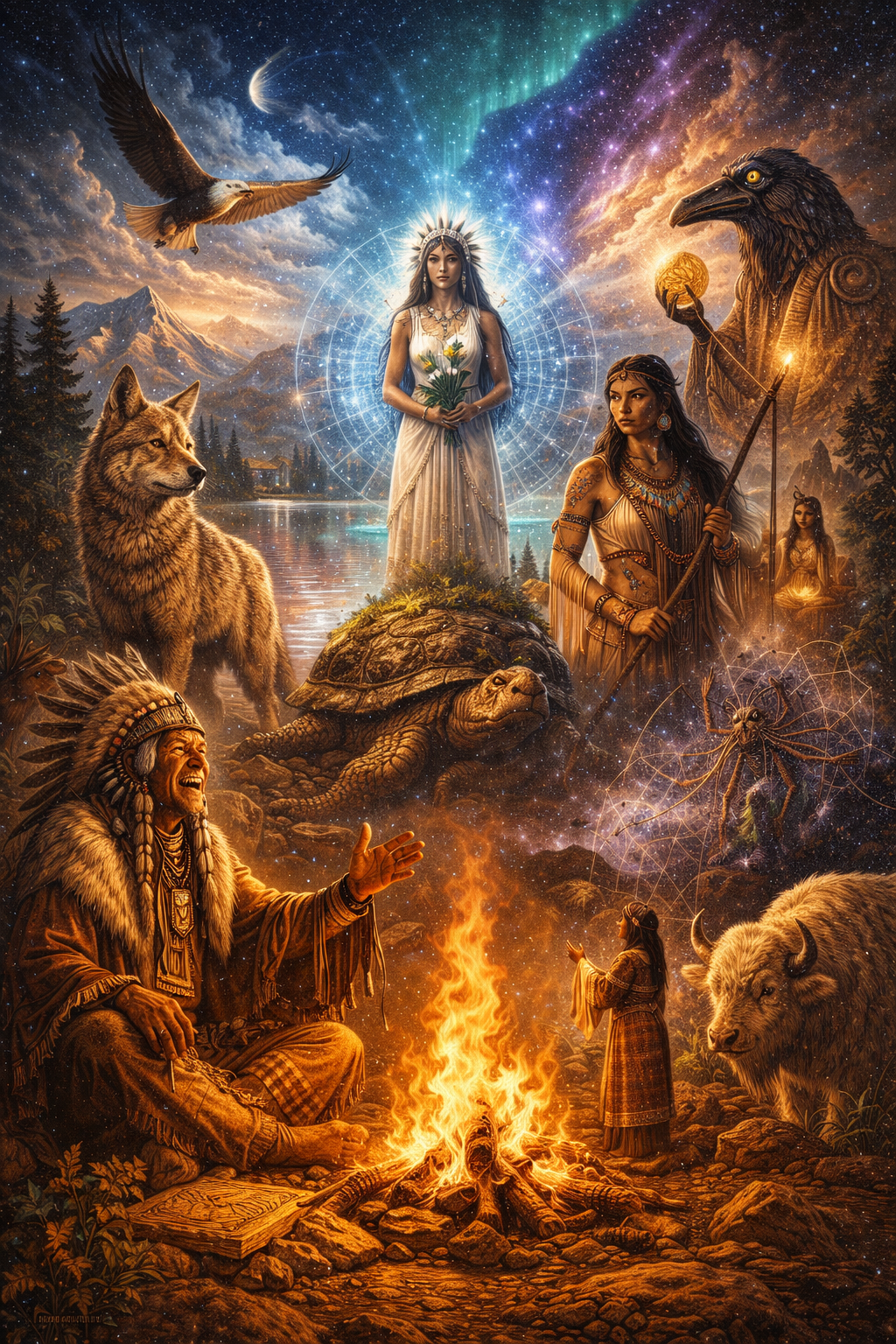
The field also requires historical awareness. Many written versions through which non-Native audiences first encountered Native stories were collected, translated, edited, or reframed by missionaries, anthropologists, linguists, government agents, museum workers, folklorists, and literary anthologists. Such records can be valuable, but they are never neutral. They preserve materials while also reflecting asymmetries of power, colonial mediation, imposed categories, translation loss, and the intellectual assumptions of collectors. Contemporary scholarship and museum practice increasingly emphasize Native perspectives, tribal context, language revitalization, community authority, repatriation, cultural sensitivity, and the distinction between community-based transmission and outsider compilation.
Native American myth, folklore, and legend therefore belong not only to literary history, but also to the study of religion, ecology, memory, performance, ethics, language, sovereignty, education, land, and the lived continuity of Indigenous nations. Raven, Coyote, Nanabozho, Sky Woman, Corn Mother, Spider Woman, Thunder Beings, Star People, water beings, animal nations, transformer figures, culture heroes, and countless other figures are not simply “characters” in a detached mythic system. They belong to relational worlds shaped by land, season, kinship, ceremony, responsibility, law, and community memory.
This pillar approaches Native American myth, folklore, and legend as a living, nation-specific, regionally differentiated, and ethically bounded field. It asks how creation and emergence stories order worlds; how tricksters and transformers teach moral intelligence; how animal stories express relational responsibility; how land and place carry sacred memory; how winter counts and pictographic traditions preserve history; how language and ceremony shape narrative meaning; how colonial archives must be read critically; and how contemporary Native writers, artists, educators, language workers, and communities continue to protect, reinterpret, and renew storytelling traditions today.
Why This Field Matters
Native American myth, folklore, and legend matter because they preserve living intellectual traditions that cannot be separated from land, language, kinship, ceremony, law, sovereignty, ecological knowledge, and historical memory. These traditions are not merely entertainment or symbolic decoration. They are ways of teaching how the world came to be ordered, how people should live, how relations with animals and other beings should be maintained, how places remember, how history is carried, and how community obligations continue across generations.
The field also matters because it corrects a long history of homogenization. Popular culture often speaks as though there were one “Native American mythology,” one “trickster,” one “creation story,” or one “spiritual worldview.” That framing erases the specificity of Native nations and the distinctiveness of languages, homelands, ceremonial protocols, and histories. A Haudenosaunee story-world is not interchangeable with a Diné ceremonial cosmology, a Tlingit or Haida Raven cycle, a Lakota winter-count tradition, a Cherokee animal story, an Anishinaabe Nanabozho cycle, a Hopi emergence tradition, or a Zuni narrative form.
The field matters because it challenges narrow definitions of history. Oral traditions, winter counts, place-based narratives, songs, ceremonies, and memory practices can preserve historical knowledge, political identity, ecological information, migration memory, and moral instruction. Written documents are not the only archives of truth. Indigenous story traditions often hold history in forms that are relational, performative, seasonal, and community-governed.
Finally, the field matters because Native storytelling remains active. It shapes contemporary Native literature, visual art, language revitalization, education, environmental defense, tribal history, community healing, and cultural resurgence. These traditions are not relics of a vanished past. They belong to living nations that continue to interpret, protect, adapt, and transmit their own knowledge.
The Problem of the Archive
A research-grade account must begin with the archive itself. Native American myth, folklore, and legend do not survive in a single canon, scripture, or universal mythology. They are carried through oral tradition, ceremonial practice, seasonal storytelling, songs, dances, place-names, material culture, winter counts, pictographic records, family teaching, public narratives, restricted narratives, archival recordings, museum collections, tribal publications, language programs, and contemporary Native-authored literature.
The archive is therefore not only textual. It is spoken, sung, danced, painted, carved, woven, mapped, remembered, performed, and practiced. A story may belong to a particular season, clan, family, ceremonial society, language context, or homeland. It may be a public teaching story, a historical account, a sacred narrative, a place-based memory, or a restricted form of knowledge not intended for general circulation.
Much of what appears in public books and archives was recorded under colonial conditions. Missionaries, anthropologists, linguists, government agents, folklorists, and collectors often translated stories into English, summarized them, removed them from ritual context, altered names, ignored protocols, or treated living knowledge as raw material. These sources may preserve valuable evidence, but they require careful source criticism.
The archive is therefore both rich and ethically complex. Responsible study must distinguish community-authorized materials from outsider-collected records; public narratives from restricted knowledge; nation-specific teachings from generalized anthologies; and living oral traditions from archival fragments. The question is not only “What does this story mean?” but also “Who has the authority to tell it, when, where, in what language, and for whom?”
Myth Without a Single Canon
Native American myth, folklore, and legend are best approached as a plural and nation-specific field rather than as a single mythology. There is no one Native American creation account, one sacred geography, one trickster system, one animal symbolism, one theology, or one ceremonial framework. Indigenous North America contains many distinct nations, each with particular histories, homelands, languages, laws, kinship systems, and protocols of transmission.
This absence of a single canon is not a weakness. It is the structure of the field. The archive is a constellation of story-worlds, each grounded in community and place. A Northwest Coast Raven narrative, a Plains winter count, a Haudenosaunee Sky Woman tradition, a Diné emergence account, an Anishinaabe Nanabozho story, a Pueblo ceremonial narrative, and a Cherokee animal story may all be studied under a broad comparative frame, but none should be treated as interchangeable examples of one generic mythology.
Comparison can still be valuable. Many traditions explore creation, emergence, trickster intelligence, animal relations, sacred landscapes, stars, water beings, transformation, migration, law, ceremony, and reciprocal responsibility. But comparison must move carefully from local context outward, not from an imposed continental generalization downward.
This pillar therefore uses “myth” in a scholarly rather than dismissive sense: a field of powerful stories, beings, places, ceremonies, and symbolic forms through which communities articulate origin, moral order, identity, responsibility, and relations with visible and invisible worlds. The term must never be used to deny the truth claims, sacred value, or community authority of Native traditions.
Oral Sovereignty and the Ethics of Retelling
Oral sovereignty is central to this field. Native communities have the right to determine how their stories are told, protected, translated, taught, withheld, revitalized, or shared. Some stories are meant for public teaching. Some are meant only for certain seasons. Some are ceremonial. Some belong to particular families, clans, societies, or nations. Some should not be summarized by outsiders at all.
This matters because many older collections treated Native stories as public folklore available for unrestricted extraction. They often ignored protocols around seasonality, initiation, language, kinship, and place. A responsible contemporary approach must do better. It should not treat all publicly available stories as ethically unrestricted simply because they appear in a printed book, archive, or website.
Retelling also involves power. When stories are translated into English, removed from Native languages, separated from land, detached from ceremonial context, or turned into generalized “Native wisdom,” their meanings can be distorted. The ethics of retelling require attention to source, community, context, permissions, and limits.
This pillar therefore emphasizes careful description over extraction. It can map themes, source problems, historical contexts, and public-facing traditions, but it should not presume the authority to reveal restricted sacred knowledge. Respectful scholarship begins with restraint.
Nation-Specific Traditions and Regional Difference
Regional and nation-specific differentiation is essential. The Northeast, Southeast, Plains, Great Basin, Plateau, Southwest, California, Northwest Coast, Subarctic, Arctic, and other regions contain distinct story-worlds shaped by ecology, language, kinship, migration, ceremony, colonial encounter, and contemporary sovereignty. Within each region, nations are not interchangeable.
Haudenosaunee traditions, for example, are shaped by specific confederacy histories, Sky Woman narratives, political philosophy, agricultural worlds, and ceremonial life. Diné traditions are shaped by emergence, hózhó, ceremonial knowledge, place, language, and complex relations among Holy People, land, and responsibility. Northwest Coast traditions involving Raven must be read through the particular worlds of Tlingit, Haida, Tsimshian, Kwakwaka’wakw, and other nations rather than through a generic Raven motif.
Plains traditions include winter counts, buffalo relations, sacred bundles, star knowledge, vision traditions, and ceremonial histories, but Plains nations themselves are diverse. Lakota, Dakota, Nakota, Blackfoot, Cheyenne, Crow, Kiowa, Comanche, Arapaho, and others preserve distinct histories and narrative forms. Pueblo traditions are equally diverse, with Hopi, Zuni, Acoma, Laguna, Taos, and other communities preserving distinct ceremonial, linguistic, and place-based worlds.
A serious pillar must therefore resist both romantic generalization and encyclopedic flattening. The correct method is layered: begin with nation-specific authority, move through regional context, and only then consider broader comparison.
Oral Tradition, Performance, and Historical Knowledge
Oral tradition is not an inferior substitute for written history. In many Native communities, oral traditions preserve historical knowledge, migration memory, law, ethics, ecological instruction, ceremonial meaning, and relationships to place. The form of transmission may be spoken, sung, danced, painted, or enacted, but that does not make it less disciplined or less meaningful.
Performance matters because stories are not simply information. They are events. A story may be told by a particular person, in a particular place, during a particular season, for a particular audience, in a particular language, under particular protocols. The meaning emerges through the relationship among teller, listener, community, place, and time.
Oral tradition can also preserve history through narrative density. A migration story may encode geography, social memory, and political identity. A winter count may condense a year into one memorable image. A place-name may preserve an event, warning, origin, or relationship. A song may carry a history that cannot be reduced to prose summary.
Native oral traditions therefore require interpretive respect. They should not be treated as vague legends unless written evidence confirms them. They are knowledge systems, and in many cases they have preserved histories long ignored by colonial archives.
Creation, Emergence, and the Ordering of Worlds
Creation and emergence traditions are central across many Native nations, but they differ profoundly. Some traditions describe emergence from earlier worlds; some describe descent from sky worlds; some involve earth-diving; some involve transformers who shape land, animals, and human life; some involve first beings, twin figures, animal helpers, or sacred instructions that establish order. These accounts should be understood within their specific nation and language contexts.
Creation stories often do more than explain beginnings. They teach how relations should be maintained. They may establish obligations to land, animals, waters, plants, stars, ancestors, ceremonies, clans, foodways, and future generations. Origin is therefore not merely chronological. It is ethical.
Emergence traditions are especially important in the Southwest and other regions where stories of movement through worlds shape understandings of ceremony, place, humility, and social responsibility. These stories often link geography and cosmology: sacred mountains, mesas, caves, lakes, springs, and routes become parts of a living world-order.
Creation and emergence narratives therefore belong at the foundation of the field, but they must be treated with cultural care. Some versions are public; others are not. Some details require community authority. A pillar can describe the importance of creation and emergence without extracting restricted knowledge.
Sky Worlds, Earth-Divers, and First Beings
Sky-world and earth-diver traditions are among the most widely discussed Native narrative forms, especially in parts of the Northeast and other regions. These stories often involve a descent from above, the formation of earth from a watery world, animals who assist creation, or first beings whose actions establish human life. But each tradition belongs to its own community and should not be collapsed into a single pan-Native pattern.
Sky Woman narratives are central in several Haudenosaunee and related Northeastern traditions, but they must be read within Haudenosaunee cosmology, agricultural worlds, gendered knowledge, and political philosophy rather than as an abstract motif. Earth-diver stories likewise vary by community and carry different teachings depending on the teller, language, and context.
First beings and culture-forming figures often establish more than physical earth. They may establish food, kinship, death, law, ceremony, language, or relations between humans and animal persons. These narratives show that creation is social and moral as well as cosmological.
The importance of these stories lies in their relational vision. Earth is not inert matter; animals are not mere tools; the first actions of beings create obligations that continue into the present.
Tricksters, Transformers, and Culture Heroes
Trickster and transformer figures are central to many Native traditions, but they should not be generalized into one universal archetype. Coyote, Raven, Nanabozho, Iktomi, Gluskap, Wakdjunkaga, Bluejay, and other figures differ by nation, region, language, and narrative setting. They may create, steal, deceive, fail, teach, disrupt, transform, expose, or renew.
Trickster stories often teach through contradiction. The trickster may be foolish and wise, selfish and generative, obscene and sacred, destructive and necessary. This ambiguity is not a flaw. It is part of the teaching. Trickster narratives reveal the instability of social order, the consequences of greed, the danger of pride, the power of hunger, the importance of laughter, and the need for humility.
Transformer figures may shape land, release light, create animals, defeat monsters, set boundaries, establish foodways, or make the world habitable. Their actions often explain why the world is as it is, but they also teach how humans should live within it.
These figures belong at the center of Native American myth and folklore because they show that story is not always moral instruction through ideal behavior. Sometimes it teaches through failure, absurdity, appetite, reversal, and the comic exposure of human weakness.
Coyote, Raven, Nanabozho, and Regional Trickster Worlds
Coyote appears across many western and Plains traditions, but Coyote is not the same in every nation. In some stories, Coyote is creator or transformer; in others, a fool, wanderer, imitator, rule-breaker, or excessive appetite made visible. Coyote stories often belong to seasonal protocols and may be told under specific conditions.
Raven is especially central in many Northwest Coast traditions, including Tlingit, Haida, Tsimshian, and other story-worlds. Raven may steal light, transform the world, satisfy appetite, disrupt order, or reveal the complicated relation between cunning and creation. Raven stories should be read through Northwest Coast art, clan histories, oral performance, crest systems, and local protocols rather than through a generic trickster label.
Nanabozho occupies a central place in Anishinaabe narrative worlds. He is often associated with creation, teaching, trickster behavior, kinship with animals, and moral instruction. His stories belong within Anishinaabe language, land, seasonal practice, and relational ethics. They are not simply comic episodes but teachings about survival, humility, and responsibility.
Regional trickster traditions therefore reveal the value and danger of comparison. Similar patterns can illuminate shared narrative questions, but only nation-specific context protects the stories from being flattened into abstraction.
Animals, Persons, and More-Than-Human Relations
Animal stories are central to many Native traditions, but they are not simply fables in which animals stand for human traits. In many Indigenous worldviews, animals, birds, fish, plants, weather powers, and landforms participate in relational worlds of personhood, reciprocity, obligation, and respect. Stories involving animals often teach how humans should live among other beings rather than above them.
Bear, buffalo, eagle, salmon, wolf, turtle, deer, beaver, spider, coyote, raven, serpent, and many other beings carry different meanings in different traditions. The buffalo in Plains worlds cannot be understood apart from subsistence, ceremony, kinship, colonial violence, and the ethical relation between humans and buffalo nations. Salmon stories on the Northwest Coast belong to ecological, ceremonial, and reciprocal worlds. Turtle may be central to earth formation in some Northeastern traditions while carrying different meanings elsewhere.
More-than-human relations also shape ecological knowledge. Stories can teach hunting ethics, seasonal awareness, migration, food responsibility, plant knowledge, weather patterns, and the consequences of disrespect. This is not “symbolism” in a shallow sense. It is a relational philosophy embedded in narrative.
Native animal stories therefore challenge modern assumptions that only humans possess agency. They often imagine a world in which humans must learn from, negotiate with, and remain accountable to other beings.
Land, Migration, and Sacred Geography
Land is central to Native American storytelling. Mountains, rivers, lakes, plains, deserts, coastlines, canyons, forests, caves, springs, mesas, islands, and migration routes are not passive settings. They are relatives, witnesses, archives, teachers, and legal-historical presences. Stories make place intelligible, and place gives story authority.
Many origin and migration narratives are inseparable from specific landscapes. They may explain how a people came to a homeland, how sacred places were established, why certain routes matter, where ceremonies belong, or how responsibilities to land continue. These stories are not merely symbolic. They can be part of land tenure, political identity, and the moral geography of sovereignty.
Sacred geography also resists colonial mapping. Settler maps often divide land into property, jurisdiction, resource, and boundary. Native place-based narratives often preserve older relations: trails, seasonal rounds, sacred mountains, burial sites, water relations, plant territories, hunting grounds, ceremonial places, and storied landmarks.
To study Native myth and legend responsibly is therefore to study land as an archive. The stories cannot be severed from the places that hold them.
Stars, Sky Knowledge, and Celestial Story
Sky stories and star knowledge are important across many Native traditions. Constellations, celestial beings, seasonal skies, aurora, moon cycles, sun paths, meteor events, and star stories can carry knowledge of time, navigation, ceremony, migration, planting, hunting, and moral order. These traditions are deeply local and should be interpreted through specific communities rather than generalized as “Native astronomy.”
Star stories may encode seasonal knowledge. A constellation’s appearance may mark a time for ceremony, movement, planting, hunting, or communal preparation. The sky becomes calendar, memory, and teaching. Celestial knowledge is therefore both scientific and sacred in the broad sense: it links observation to responsibility.
Sky beings and Star People also appear in many narrative worlds, though their meanings vary widely. Some stories speak of origins, marriage between sky and earth beings, visitors from above, or moral relations between human communities and celestial powers. Others preserve cosmological teachings that are restricted or ceremonial.
A responsible pillar should include sky knowledge while maintaining restraint. Not all celestial traditions are public, and not all should be summarized outside community contexts. The point is to recognize the sky as part of Indigenous knowledge systems, not to extract sacred astronomy into generalized content.
Ceremony, Seasonality, and Restricted Knowledge
Many Native stories are bound to ceremonial time and seasonal practice. In some communities, certain stories are told only in winter. Others belong to ceremony, initiation, healing, clan instruction, or particular knowledge holders. Seasonality is not a decorative rule. It is part of the story’s meaning and proper relation to the world.
Restricted knowledge must be respected. The fact that a story appears in an old book or archive does not mean it is appropriate for unrestricted republication or summary. Some materials were recorded without full consent or outside proper protocol. Others may have been shared for a specific purpose and then circulated beyond that purpose.
Ceremony also changes how story functions. A narrative told in ceremony is not only an account of events. It may be part of healing, renewal, protection, naming, thanksgiving, mourning, or social restoration. Its force depends on context, language, and participation.
This pillar therefore treats restricted knowledge as an ethical boundary. A research-grade approach can discuss the existence and importance of ceremonial protocols without disclosing what communities have not authorized for public interpretation.
Winter Counts, Pictographic Record, and Visual Memory
Native storytelling is not only oral in the narrow sense. It can also be visual and material. Winter counts, pictographic records, ledger art, petroglyphs, birchbark records, wampum belts, painted hides, masks, carvings, textiles, baskets, pottery, regalia, and other forms carry memory in visual and embodied ways.
Winter counts are especially important in Plains historical memory. A winter count may mark each year with an image representing a major event. The image is not the whole story; it is a mnemonic anchor that requires oral explanation. Visual record and spoken narrative work together.
Wampum belts in Haudenosaunee and other Northeastern contexts likewise challenge narrow definitions of writing and archive. They can record agreements, relations, histories, and political commitments. They belong to diplomatic, ceremonial, and historical memory, not merely ornament.
Visual memory shows that Indigenous archives cannot be reduced to books. Narrative can be kept in images, objects, materials, and practices that require community knowledge to interpret properly.
Women, Grandmothers, Mothers, and Knowledge Transmission
Women, grandmothers, mothers, aunties, clan mothers, knowledge keepers, midwives, artists, singers, and language teachers play central roles in many Native storytelling traditions. Their work has often been underrepresented in outsider accounts focused on male leaders, warriors, shamans, or ceremonial specialists. A serious pillar must restore women’s transmission to the center of the field.
Stories are often carried in domestic, kinship, and community settings: by grandmothers teaching children, by mothers transmitting language, by women preserving food knowledge, by artists encoding story in baskets, pottery, beadwork, weaving, or clothing, by singers and dancers sustaining ceremonial memory, and by clan mothers holding political and social authority.
Women also appear within story-worlds as origin figures, earth figures, corn mothers, water beings, star women, creators, teachers, tricksters, grandmothers, protectors, and moral authorities. Their narrative roles are diverse and nation-specific. They cannot be reduced to generic fertility symbolism or romanticized “earth mother” stereotypes.
Women’s storywork is therefore foundational to cultural continuity. It carries language, kinship, foodways, ceremony, ecological knowledge, humor, grief, and survival across generations.
Language Revitalization and Story Continuity
Language is central to Native storytelling. Translation can make stories accessible, but it can also lose wordplay, place references, kinship terms, spiritual concepts, humor, grammatical relations, ecological knowledge, and ceremonial force. Some stories can only be fully understood in the language that carries them.
Language revitalization is therefore also story revitalization. When communities teach Native languages to children, create immersion programs, record elders, publish language materials, or restore place-names, they also protect narrative worlds. Story is not only content; it is carried by grammar, sound, rhythm, names, and relationships embedded in language.
Many older collections translated Native concepts into English categories such as “god,” “spirit,” “demon,” “fairy,” “myth,” or “legend,” often distorting the original meaning. Contemporary work should preserve Indigenous terms where appropriate and explain them carefully rather than forcing them into inherited European categories.
A research-grade pillar should therefore treat language as an archive of thought. Without language, the deepest structure of many stories becomes difficult to recover.
Colonial Recording, Translation, and Archival Mediation
Much of the public written archive of Native American myth and folklore was shaped by colonial recording. Missionaries, anthropologists, folklorists, linguists, government officials, and museum collectors often worked within systems that displaced Native people, suppressed ceremonies, punished language use, removed children to boarding schools, and treated Indigenous knowledge as data.
This does not mean that all older records are useless. Some preserve valuable materials, including stories told by named Native narrators and language consultants. But they must be read critically. Who recorded the story? Who translated it? Was the narrator named? Was the language preserved? Was the proper season or context respected? Did the collector impose Christian, evolutionary, racial, or literary categories? Was the story edited for a non-Native audience?
Archival mediation also involves institutions. Museums and libraries may hold recordings, objects, photographs, manuscripts, and ceremonial materials that communities are now working to access, reinterpret, restrict, or repatriate. Responsible scholarship should support community authority over materials connected to their own heritage.
The colonial archive is therefore both a resource and a problem. It must be used with humility, transparency, and awareness of the power relations that shaped it.
Contemporary Native Literature, Art, and Storywork
Native storytelling continues in contemporary literature, poetry, film, visual art, theater, music, digital media, education, language revitalization, and community storywork. Contemporary Native authors and artists do not simply preserve old stories unchanged. They reinterpret narrative inheritance in relation to sovereignty, land defense, boarding school memory, environmental justice, gender, humor, urban Native life, futurity, and cultural resurgence.
Storywork is also political. It can resist erasure, correct colonial archives, restore language, teach children, honor elders, document community history, and defend relationships to land. Contemporary Native storytelling often carries the same responsibilities as older traditions while adapting to new media and historical conditions.
Visual art and material culture remain crucial. Beadwork, carving, basketry, textiles, pottery, painting, ledger art, sculpture, and digital design can all carry story. These works may draw on nation-specific forms while also speaking to contemporary experience. They are not merely illustrations of myth; they are part of continuing narrative practice.
This pillar therefore treats Native myth, folklore, and legend as living storywork. The archive does not end in old collections. It continues wherever Native communities tell, protect, translate, teach, and renew their own stories.
Major Questions of Interpretation
This pillar is organized around several major questions. How should Native American myth, folklore, and legend be studied without reducing many nations to one generic mythology? How should public-facing scholarship honor oral sovereignty, seasonal protocol, restricted knowledge, and community authority? How can archival records be used responsibly when many were collected under colonial conditions?
The pillar also asks how stories organize relationships among land, animals, ancestors, spirits, ceremonies, language, law, and history. How do creation and emergence traditions order worlds? How do Coyote, Raven, Nanabozho, Spider Woman, Sky Woman, Corn Mother, Thunder Beings, and other figures function within specific community contexts? How do winter counts, wampum, pictographic records, songs, and place-names expand the meaning of archive? How do contemporary Native writers and communities renew story traditions without surrendering control over them?
These questions keep the category from becoming a romanticized inventory of stories. They open Native American myth, folklore, and legend as a field of oral, ecological, political, ceremonial, visual, linguistic, ethical, and nation-specific inquiry. The tradition is not one collection of tales. It is a living constellation of Indigenous knowledge systems through which communities remember, teach, govern, protect, and continue.
Expanded Article Architecture
The following structure gathers the pillar into a long-range architecture suitable for a major mythology knowledge series. It is designed to support oral sovereignty, nation-specific traditions, regional differentiation, creation and emergence narratives, trickster and transformer cycles, land-based story, animal relations, ceremonial protocols, visual memory, language revitalization, colonial archive criticism, and contemporary Native storywork. All entries below should be treated as planned unless already completed elsewhere on the site.
Foundations, Ethics, and Source Problems
- What Is Native American Myth, Folklore & Legend? (planned)
- The Problem of Sources in Native American Mythology (planned)
- Native American Myth Without a Single Canon (planned)
- Oral Sovereignty, Story Protocols, and the Ethics of Retelling (planned)
- Sacred Stories, Seasonal Protocols, and Restricted Knowledge (planned)
- Colonial Collectors, Translation, and the Archive of Native Story (planned)
- How to Read Native Story Traditions Without Homogenizing Them (planned)
Oral Tradition, Performance, and Historical Knowledge
- Oral Tradition, Storytelling, and Historical Knowledge in Native North America (planned)
- Storytelling as Education, Law, Memory, and Community Continuity (planned)
- Performance, Teller, Audience, Season, and Place in Native Story Worlds (planned)
- Song, Dance, Ceremony, and the Embodied Life of Story (planned)
- Place-Names, Oral Maps, and the Narrative Keeping of Land (planned)
- Storywork, Elders, and Intergenerational Teaching (planned)
Creation, Emergence, and World-Ordering
- Creation, Emergence, and Earth-Diver Traditions (planned)
- Sky Woman and the Cosmological Imagination of the Northeast (planned)
- Emergence Worlds and Sacred Instruction in Southwestern Traditions (planned)
- First Beings, First Foods, and the Ordering of Human Responsibility (planned)
- Flood, Renewal, and the Reordering of the World (planned)
- Corn Mother, Origin, and the Sacred Life of Food (planned)
- Creation Stories as Ethics of Relation (planned)
Tricksters, Transformers, and Culture Heroes
- Coyote Across the West: Trickster, Creator, and Disruptor (planned)
- Raven and the Mythic Worlds of the Northwest Coast (planned)
- Nanabozho and the Anishinaabe Trickster Tradition (planned)
- Iktomi, Spider, and the Logic of Trickster Intelligence (planned)
- Transformers, World-Makers, and the Making of Habitable Land (planned)
- Trickster Humor, Hunger, Failure, and Moral Instruction (planned)
- Culture Heroes and the Gift of Social Order (planned)
Animals, Persons, and More-Than-Human Worlds
- Animals, Persons, and More-Than-Human Worlds in Native Tradition (planned)
- Bear, Buffalo, Eagle, and the Symbolic Life of Powerful Beings (planned)
- Salmon, Deer, Turtle, Wolf, and the Ethics of Reciprocity (planned)
- Serpents, Water Beings, and Underworld Presences (planned)
- Thunder Beings, Storm Power, and Sacred Authority (planned)
- Transformation, Shape-Shifting, and the Unstable Boundary of the Human (planned)
- Animal Stories Beyond Fable: Relation, Obligation, and Respect (planned)
Land, Migration, and Sacred Geography
- Land, Migration, and Sacred Geography in Native Narrative (planned)
- Homeland, Origin, and the Memory of Place (planned)
- Mountains, Rivers, Deserts, Lakes, and Storied Landscapes (planned)
- Migration Stories and the Narrative Geography of Nationhood (planned)
- Sacred Sites, Colonial Mapping, and Indigenous Place-Memory (planned)
- Land as Archive, Relative, Witness, and Teacher (planned)
Stars, Sky Knowledge, and Celestial Story
- Stars, Sky Stories, and Indigenous Astronomical Imagination (planned)
- Constellations, Seasonal Time, and Ceremonial Calendars (planned)
- Star People, Sky Worlds, and Celestial Relations (planned)
- Aurora, Moon, Sun, and the Narrative Life of the Sky (planned)
- Navigation, Planting, Hunting, and Sky-Based Knowledge (planned)
- Ethics of Public and Restricted Star Knowledge (planned)
Visual Memory, Winter Counts, and Material Archives
- Winter Counts, Pictographic Memory, and the Narrative Keeping of History (planned)
- Wampum, Treaty Memory, and the Material Archive of Relation (planned)
- Ledger Art, Pictographs, Petroglyphs, and Visual Storytelling (planned)
- Regalia, Carving, Weaving, Pottery, and Story in Material Form (planned)
- Objects, Museums, Repatriation, and Community Authority (planned)
- Visual Archives Beyond Writing (planned)
Women, Grandmothers, and Knowledge Transmission
- Women, Grandmothers, Mothers, and the Transmission of Story (planned)
- Sky Woman, Corn Mother, Spider Woman, and Female Origin Figures (planned)
- Clan Mothers, Kinship, and the Political Life of Story (planned)
- Food Knowledge, Child Teaching, and Domestic Storywork (planned)
- Women’s Art, Song, Ceremony, and Narrative Continuity (planned)
- Gender, Authority, and Restricted Knowledge in Native Traditions (planned)
Northeast and Great Lakes Traditions
- Haudenosaunee Narrative Worlds (planned)
- Sky Woman, Twins, Agriculture, and Haudenosaunee World-Ordering (planned)
- Anishinaabe Myth and the Moral Work of Story (planned)
- Nanabozho, Animals, and Anishinaabe Relational Ethics (planned)
- Wampum, Confederacy Memory, and Story as Political Record (planned)
- Great Lakes Water Worlds, Manitou Relations, and Sacred Place (planned)
Southeast Traditions
- Cherokee Myth, Animal Stories, and Sacred Balance (planned)
- Choctaw, Chickasaw, Creek, Seminole, and Southeastern Story Worlds (planned)
- Origin, Fire, Medicine, and Animal Teachings in Southeastern Traditions (planned)
- Mounds, Towns, Ceremonial Grounds, and Sacred Geography (planned)
- Corn, Agriculture, and the Narrative Life of Food (planned)
- Removal, Memory, and Story After Displacement (planned)
Plains Traditions
- Lakota and Nakota Sacred Histories (planned)
- Blackfoot and Plains Cosmologies of Relation and Responsibility (planned)
- Buffalo, Vision, Ceremony, and the Moral World of the Plains (planned)
- Winter Counts and Plains Historical Memory (planned)
- Thunder Beings, Star Knowledge, and Sacred Power on the Plains (planned)
- Horse, Bison, Colonial Violence, and Narrative Transformation (planned)
Southwest and Pueblo Traditions
- Diné Emergence and Ceremonial Cosmology (planned)
- Hózhó, Holy People, and the Narrative Ethics of Balance (planned)
- Hopi Emergence Traditions and the Sacred Order of the Mesa (planned)
- Pueblo Story Worlds, Ceremony, and Community Memory (planned)
- Zuni Narrative Traditions and the Work of Storytelling (planned)
- Spider Woman, Weaving, and Sacred Instruction in the Southwest (planned)
- Sacred Mountains, Springs, and Desert Place-Memory (planned)
West, Plateau, Great Basin, and California Traditions
- Coyote, Transformer, and Culture-Hero Traditions of the West (planned)
- Plateau Story Worlds, Rivers, Salmon, and Seasonal Knowledge (planned)
- Great Basin Narratives of Desert, Mobility, and Survival (planned)
- California Native Story Worlds, Fire, Animals, and Sacred Place (planned)
- Basketry, Rock Art, Song, and Material Story in Western Traditions (planned)
- Language Loss, Revitalization, and Story Renewal in the West (planned)
Northwest Coast Traditions
- Tlingit, Haida, and the Narrative Power of the Northwest Coast (planned)
- Raven, Light, Hunger, and Transformation (planned)
- Salmon, Sea, Clan, and the Ethics of Reciprocity (planned)
- Totem Poles, Crest Beings, and Visual Story Authority (planned)
- Masks, Potlatch, Ceremony, and the Public Life of Story (planned)
- Northwest Coast Art as Narrative, Law, and Memory (planned)
Subarctic and Arctic Traditions
- Subarctic Story Worlds, Animal Relations, and Northern Ecologies (planned)
- Inuit Narrative Traditions, Sea Beings, and Arctic Cosmology (planned)
- Raven, Caribou, Seal, and the Moral Life of Northern Hunting Worlds (planned)
- Cold, Survival, Weather, and the Narrative Ethics of the North (planned)
- Oral History, Place, and Climate Memory in Northern Traditions (planned)
- Restricted Knowledge and Respectful Interpretation in Arctic Story Worlds (planned)
Language, Revitalization, and Contemporary Storywork
- Story, Language Revitalization, and Cultural Continuity (planned)
- Native Literature and the Renewal of Mythic Memory (planned)
- Contemporary Native Art, Film, and Visual Storytelling (planned)
- Storytelling, Environmental Justice, and Land Defense (planned)
- Boarding School Memory, Healing, and Narrative Repair (planned)
- Native American Myth in Comparative Perspective (planned)
- Why Native American Myth, Folklore & Legend Still Matter (planned)
Closing Perspective
Native American myth, folklore, and legend reveal one of the world’s great constellations of living story traditions. They preserve creation and emergence, trickster intelligence and transformer power, land and migration memory, animals and more-than-human relations, stars and ceremonial time, winter counts and visual archives, women’s knowledge and intergenerational teaching, language and place, sacred protocols and community authority. Their power lies not in a single canon, but in the diversity and sovereignty of Native nations.
This is what makes the category so important within Mythology. Native story traditions show how mythology can be oral and visual, ceremonial and historical, ecological and political, public and restricted, ancient and contemporary, local and cosmological. They also show why mythology must be studied through land, language, protocol, kinship, performance, sovereignty, and living community, not only through story summary.
The strongest reason to study this field is that it clarifies how communities remember responsibly. Stories teach how to live with animals, plants, waters, stars, ancestors, children, homelands, ceremonies, and future generations. They preserve history without depending only on written archives. They defend land against erasure. They renew language. They carry grief and humor, survival and law, memory and imagination. These traditions do not belong only to the past. They continue wherever Native nations protect, tell, teach, and transform their own stories.
Related Reading
- Mythology
- Indigenous and Oral Traditions
- Environment, Place, and Ecological Knowledge
- Culture, Meaning, and Symbolism
- Religion and Ecology
- Comparative Sacred Themes
- Cultural Anthropology
- Power, Norms, and Institutions
- Technology, Infrastructure, and Everyday Systems
- African Myth, Folklore, and Sacred Narrative
Primary Sources
Oral Traditions and Community-Specific Storytelling
- Smithsonian National Museum of the American Indian, “Celebrating Native Cultures Through Words: Storytelling and Oral Traditions.” Useful as an institutional guide to oral tradition as shared history, including creation stories, cultural beliefs, and tribal histories, while emphasizing community specificity and protocol: https://americanindian.si.edu/nk360/informational/storytelling-and-oral-traditions
- Library of Congress, “Indigenous Storytelling in the US and Canada.” Useful as a guide to recorded and published Indigenous stories, while also noting that some materials are subject to cultural restrictions: https://guides.loc.gov/folktales-oral-storytelling/Indigenous-storytelling
- Nation-specific oral traditions and community-published story materials, used with attention to tribal authority, cultural protocol, source context, and permissions.
Historical Memory and Pictographic Traditions
- Smithsonian National Museum of the American Indian, “Lone Dog’s Winter Count.” Useful for understanding winter counts as a form of historical record-keeping and storytelling among the Nakota: https://americanindian.si.edu/nk360/resources/Lone-Dogs-Winter-Count
- Winter counts, wampum belts, pictographic records, ledger art, petroglyphs, birchbark records, painted hides, and other visual archives, interpreted through community-specific authority and historical context.
- Place-name traditions, tribal histories, migration narratives, and oral maps that preserve relations among land, history, identity, and responsibility.
Folklife and Recorded Narrative Collections
- Library of Congress, American Folklife Center, “Storytelling.” Useful for access to recorded Indigenous storytelling collections, including Zuni narrative materials and other region-specific traditions: https://guides.loc.gov/indigenous-peoples-of-the-Americas-folklife/storytelling
- Library of Congress digital collections relating to Native Americans. Useful for oral histories, recordings, and other primary materials connected to Indigenous communities and local traditions: https://guides.loc.gov/native-americans/digital-collections
- American Folklife Center recordings, tribal histories, songs, interviews, and performance records, used with caution regarding access conditions, cultural restrictions, and community preference.
Collections, Archives, and Community Research Gateways
- National Museum of the American Indian Collections. Useful for object, media, photo, and paper archives documenting Indigenous lives, religious materials, artistic practice, and community histories across many nations of the Americas: https://americanindian.si.edu/explore/collections
- Smithsonian Native Knowledge 360° Essential Understandings Guide. Useful for framing Native nations as dynamic, diverse, sovereign, and historically continuous rather than as a single culture or vanished past: https://americanindian.si.edu/nk360/pdf/NMAI-Essential-Understandings-Guide.pdf
- Tribal cultural centers, language departments, education programs, and community archives, which should be prioritized where they provide public-facing materials and guidance.
Older Printed Collections to Use Critically
- Public-domain collections of Indigenous stories preserved by earlier collectors can be useful as archival witnesses, but they should be read with caution because of translation choices, editorial framing, colonial-era assumptions, and the possibility that stories were recorded outside appropriate protocol.
- Older collections available through Project Gutenberg, Sacred Texts, Internet Archive, and similar repositories may preserve otherwise hard-to-access materials, but they should not be treated as community-authorized interpretation unless supported by Native sources or tribal context.
- Ethnographic, missionary, and government records should be evaluated by asking who recorded the story, who told it, whether the language was preserved, what was omitted, and what power relationship shaped the recording.
Further Reading
- Smithsonian National Museum of the American Indian, “Celebrating Native Cultures Through Words: Storytelling and Oral Traditions.” A strong introduction to oral tradition as history, education, and cultural continuity. https://americanindian.si.edu/nk360/informational/storytelling-and-oral-traditions
- Smithsonian Native Knowledge 360° Essential Understandings Guide. Important for correcting homogenizing assumptions and foregrounding Native diversity, continuity, and sovereignty. https://americanindian.si.edu/nk360/pdf/NMAI-Essential-Understandings-Guide.pdf
- Library of Congress, “Indigenous Storytelling in the US and Canada.” Useful for thinking about access, restrictions, and archival responsibility. https://guides.loc.gov/folktales-oral-storytelling/Indigenous-storytelling
- Library of Congress, American Folklife Center storytelling collections. Valuable for recorded narrative traditions and performance contexts. https://guides.loc.gov/indigenous-peoples-of-the-Americas-folklife/storytelling
- National Museum of the American Indian collections and archive resources. Useful for connecting narrative traditions to objects, media, archives, and community documentation. https://americanindian.si.edu/explore/collections
- Archibald, J.-A. (2008) Indigenous Storywork: Educating the Heart, Mind, Body, and Spirit. Vancouver: UBC Press.
- Basso, K.H. (1996) Wisdom Sits in Places: Landscape and Language Among the Western Apache. Albuquerque: University of New Mexico Press.
- Bruchac, J. (1991) Native American Stories. Golden, CO: Fulcrum Publishing.
- Deloria, V. Jr. (1995) Red Earth, White Lies: Native Americans and the Myth of Scientific Fact. New York: Scribner.
- Erdoes, R. and Ortiz, A. (eds.) (1984) American Indian Myths and Legends. New York: Pantheon.
- Fixico, D.L. (2003) The American Indian Mind in a Linear World: American Indian Studies and Traditional Knowledge. New York: Routledge.
- Hymes, D. (1981) “In Vain I Tried to Tell You”: Essays in Native American Ethnopoetics. Philadelphia: University of Pennsylvania Press.
- Kimmerer, R.W. (2013) Braiding Sweetgrass: Indigenous Wisdom, Scientific Knowledge, and the Teachings of Plants. Minneapolis: Milkweed Editions.
- Ortiz, S.J. (ed.) (1998) Speaking for the Generations: Native Writers on Writing. Tucson: University of Arizona Press.
- Silko, L.M. (1981) Storyteller. New York: Arcade Publishing.
- Vizenor, G. (1993) Narrative Chance: Postmodern Discourse on Native American Indian Literatures. Norman: University of Oklahoma Press.
- Weaver, J., Womack, C.S. and Warrior, R. (2006) American Indian Literary Nationalism. Albuquerque: University of New Mexico Press.
References
- Archibald, J.-A. (2008) Indigenous Storywork: Educating the Heart, Mind, Body, and Spirit. Vancouver: UBC Press.
- Basso, K.H. (1996) Wisdom Sits in Places: Landscape and Language Among the Western Apache. Albuquerque: University of New Mexico Press.
- Bruchac, J. (1991) Native American Stories. Golden, CO: Fulcrum Publishing.
- Deloria, V. Jr. (1995) Red Earth, White Lies: Native Americans and the Myth of Scientific Fact. New York: Scribner.
- Erdoes, R. and Ortiz, A. (eds.) (1984) American Indian Myths and Legends. New York: Pantheon.
- Fixico, D.L. (2003) The American Indian Mind in a Linear World: American Indian Studies and Traditional Knowledge. New York: Routledge.
- Hymes, D. (1981) “In Vain I Tried to Tell You”: Essays in Native American Ethnopoetics. Philadelphia: University of Pennsylvania Press.
- Kimmerer, R.W. (2013) Braiding Sweetgrass: Indigenous Wisdom, Scientific Knowledge, and the Teachings of Plants. Minneapolis: Milkweed Editions.
- Library of Congress (n.d.) ‘Indigenous storytelling in the US and Canada’. Available at: https://guides.loc.gov/folktales-oral-storytelling/Indigenous-storytelling
- Library of Congress (n.d.) ‘Storytelling – American Folklife Center Collections: Indigenous Peoples of the Americas’. Available at: https://guides.loc.gov/indigenous-peoples-of-the-Americas-folklife/storytelling
- Library of Congress (2026) ‘Digital Collections – Native Americans: Resources in Local History and Genealogy’. Available at: https://guides.loc.gov/native-americans/digital-collections
- National Museum of the American Indian (2021) ‘Celebrating Native Cultures Through Words: Storytelling and Oral Traditions’. Available at: https://americanindian.si.edu/nk360/informational/storytelling-and-oral-traditions
- National Museum of the American Indian (2018) Native Knowledge 360° Essential Understandings Guide. Available at: https://americanindian.si.edu/nk360/pdf/NMAI-Essential-Understandings-Guide.pdf
- National Museum of the American Indian (n.d.) ‘Collections’. Available at: https://americanindian.si.edu/explore/collections
- National Museum of the American Indian (n.d.) ‘Lone Dog’s Winter Count’. Available at: https://americanindian.si.edu/nk360/resources/Lone-Dogs-Winter-Count
- Ortiz, S.J. (ed.) (1998) Speaking for the Generations: Native Writers on Writing. Tucson: University of Arizona Press.
- Silko, L.M. (1981) Storyteller. New York: Arcade Publishing.
- Vizenor, G. (1993) Narrative Chance: Postmodern Discourse on Native American Indian Literatures. Norman: University of Oklahoma Press.
- Weaver, J., Womack, C.S. and Warrior, R. (2006) American Indian Literary Nationalism. Albuquerque: University of New Mexico Press.