
Last Updated May 3, 2026
Egyptian mythology constitutes one of the foundational mythic archives of the ancient world, preserving a vast symbolic and religious field in which cosmogony, divine kingship, sacred speech, funerary transformation, temple ritual, solar order, underworld passage, ecological imagination, and cosmic renewal converge. The archive is not contained in a single canonical scripture. Instead, it survives across mortuary corpora, hymns, ritual liturgies, temple inscriptions, mythic narratives, wisdom traditions, royal ideology, funerary iconography, sacred architecture, and the monumental religious landscapes of ancient Egypt. Egyptian mythology is therefore best understood not as a closed anthology of tales about gods, but as an evolving religious and textual tradition in which myth, ritual, kingship, cosmology, death, speech, and material culture are deeply entangled.
The principal textual witnesses include the Pyramid Texts, the Coffin Texts, and the corpus conventionally known as the Book of the Dead, together with temple inscriptions, hymns, ritual texts, royal inscriptions, underworld books, magical spells, and later funerary compositions. These materials preserve myths of creation, solar travel, divine succession, death and rebirth, judgment, protection, magical speech, and the hoped-for transformation of the deceased into an effective being among the gods. Modern scholarship increasingly emphasizes continuity across these corpora rather than treating them as wholly separate systems: many spells, images, divine roles, ritual logics, and theological concepts pass from pyramid walls to coffins, papyri, tombs, temple walls, and other supports over long periods of Egyptian history.
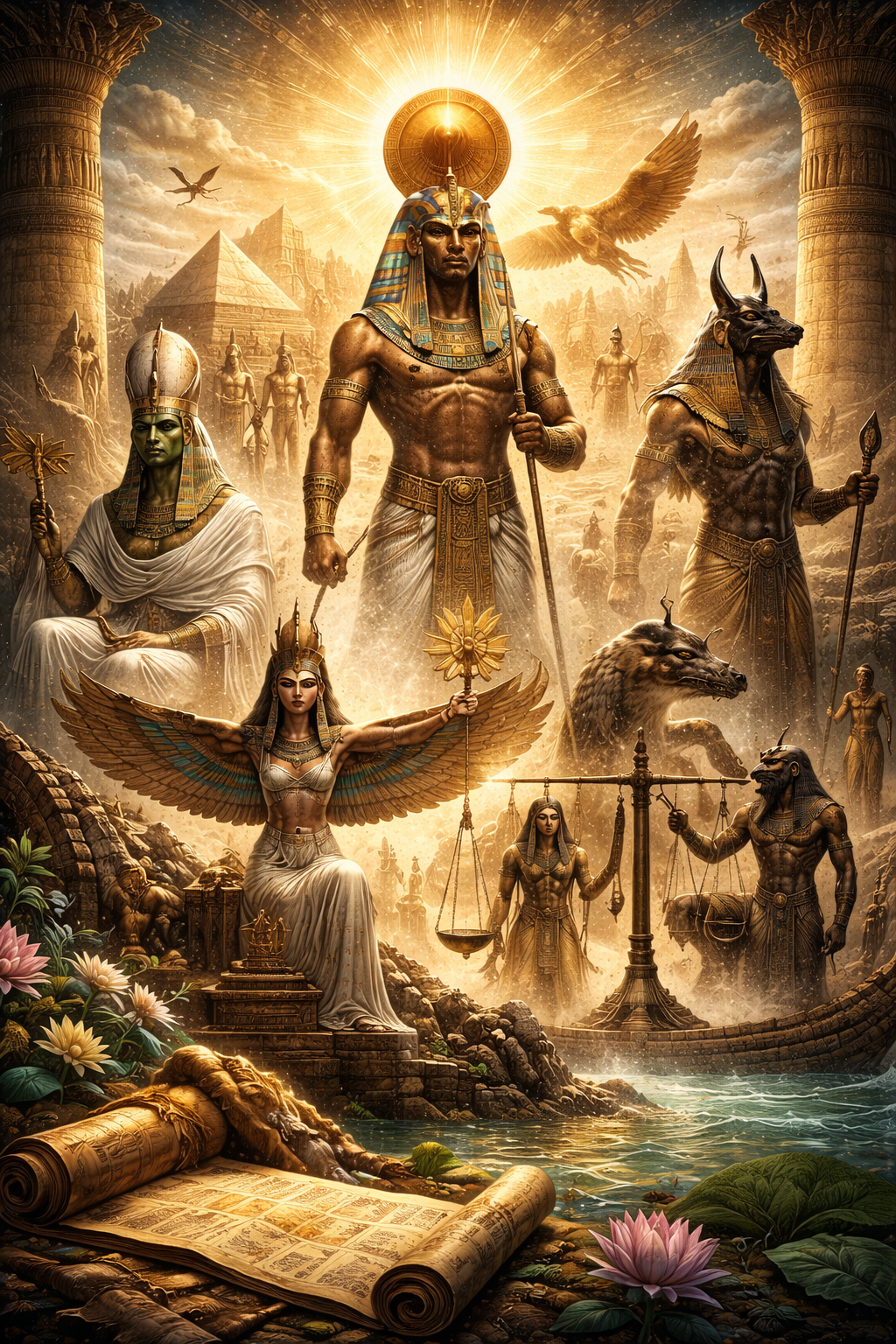
Any serious treatment of Egyptian mythology must therefore attend to transmission. Egyptian myths do not survive primarily in the form of a single mythographic handbook comparable to later classical compilations. They are distributed across ritual and mortuary texts, images, temple reliefs, local cult traditions, funerary equipment, hymns, offering scenes, royal ideology, magical formulae, and later compilatory or interpretive settings. What modern readers call “mythology” was, in ancient Egypt, often embedded in acts of worship, royal legitimation, funerary preparation, temple performance, sacred architecture, household protection, and the maintenance of cosmic order.
Egyptian mythology also matters because it preserves one of the most sophisticated religious imaginations of the ancient world. It is a world in which the sun must be renewed, the dead must be justified, the body must be reassembled, names must be preserved, sacred speech must be effective, kingship must be cosmically anchored, and divine plurality coexists with deep theological abstraction. Myths of Ra, Atum, Ptah, Amun, Osiris, Isis, Horus, Seth, Hathor, Sekhmet, Thoth, Anubis, Nut, Geb, Nephthys, and other deities illuminate not only Egyptian religion, but also broader questions of order, justice, transformation, memory, ecology, kingship, mortality, and the afterlife.
This pillar approaches Egyptian mythology as a layered religious and cultural system. It asks how cosmogony becomes a theology of emergence, how solar myth dramatizes daily renewal, how Osirian myth binds death to kingship and regeneration, how mortuary texts function as technologies of transformation, how temples maintain divine presence, how magical speech becomes effective action, how animal forms carry theological meaning, how the Nile landscape informs mythic imagination, and how Egyptian religious symbols entered later Mediterranean and global afterlives.
Why This Field Matters
Egyptian mythology matters because it preserves one of the ancient world’s most enduring symbolic systems for thinking creation, order, death, rebirth, sacred power, kingship, ritual action, and the afterlife. Its myths are not merely stories told about gods. They are embedded in the architecture of temples, the walls of tombs, the ritual life of cult statues, the language of spells, the ideology of kingship, the symbolism of amulets, the visual grammar of funerary papyri, and the sacred geography of the Nile valley.
The field also matters because Egyptian mythology challenges modern assumptions about what mythology is. Much of the material does not survive as continuous narrative. Instead, it appears in liturgical fragments, ritual scenes, theological declarations, funerary spells, protective formulae, temple inscriptions, hymnic praise, and visual sequences. Egyptian myth often functions less as a story recited for entertainment than as sacred knowledge applied in ritual, death, kingship, and cosmic maintenance.
Egyptian mythology is therefore indispensable for studying the relation between myth and practice. A mythic statement may help animate a ritual; a spell may identify the deceased with a god; a temple relief may renew a cosmic relationship; a name may preserve being; a divine image may make presence visible; an amulet may condense mythic power into portable form. In this tradition, myth is not separate from action. Myth becomes effective through speech, image, ritual, and material support.
The field also matters for comparative mythology because Egyptian religion preserves a complex relation between multiplicity and unity. Deities can merge, separate, localize, universalize, or become aspects of one another without collapsing the whole system into simple contradiction. Ra, Amun-Ra, Atum, Ptah, Osiris, Horus, Hathor, Isis, and other deities operate in overlapping theological registers. Egyptian mythology therefore teaches readers to think in layered symbolic systems rather than rigid doctrinal categories.
The Problem of the Archive
A research-grade account must begin with the archive itself. Egyptian mythology is not preserved in one canonical mythological handbook. It survives across many media, periods, places, and ritual settings. The same deity, image, or mythic pattern may appear on a pyramid wall, a coffin, a papyrus, a temple wall, an amulet, a statue, a tomb painting, a royal inscription, or a later Greek or Roman account. Each setting changes how the myth functions.
The Pyramid Texts appear first in royal pyramids of the late Old Kingdom and align the deceased king with divine ascent, solar movement, and eternal cult. The Coffin Texts, transmitted on Middle Kingdom coffins and related supports, broaden access to mortuary knowledge and preserve a richer range of spells, routes, dangers, divine identifications, and afterlife possibilities. The Book of the Dead, attested on papyri by the New Kingdom and later, continues and reshapes these traditions in more portable and visually elaborate form.
Temple texts and images add another dimension. They preserve ritual performances, offering scenes, divine genealogies, festival processions, theological elaborations, and local cult identities. Myth appears there not as detached narrative but as a living structure of worship. Sacred images, architecture, inscriptions, and daily cult participate in the maintenance of divine presence.
This archive therefore requires methodological caution. Egyptian myths may appear fragmentary because their full force was distributed across words, images, spaces, actions, and ritual occasions. Interpretation must ask not only what a myth “means,” but where it appears, what it does, who uses it, which deity or deceased person it empowers, what ritual situation activates it, and how it participates in cosmic order.
Myth Without a Single Canon
Egyptian mythology is best approached as a plural and adaptive religious field rather than as a single fixed canon. The same mythic structure may be expressed differently in Heliopolitan, Memphite, Hermopolitan, Theban, Abydene, solar, Osirian, funerary, royal, or local contexts. This plurality is not a sign of incoherence. It is one of the defining features of Egyptian religious thought.
Creation, for example, may be articulated through Atum’s self-generation, Ptah’s creative heart and tongue, the Ogdoad’s primordial conditions, Amun’s hiddenness, or solar emergence. These are not simply competing stories to be ranked into one correct version. They are theological languages that emphasize different dimensions of emergence, speech, hiddenness, differentiation, and order.
Likewise, the afterlife may be imagined through solar ascent, Osirian regeneration, underworld passage, field of reeds imagery, judgment before divine assessors, or union with divine powers. These models can overlap. The dead may be associated with Osiris, travel with Ra, become an akh, speak effective spells, enter blessed fields, and overcome hostile forces. Egyptian religious imagination often works by accumulation and layering rather than exclusion.
This makes Egyptian mythology especially important for understanding myth as a flexible system of symbolic equivalence. Deities can be combined; myths can be localized; theological language can adapt to ritual need; older texts can be reused in new media. The archive survives because it can be repeated and transformed without losing continuity.
Mortuary Corpora and the Continuity of Transmission
The mortuary corpora are central to Egyptian mythology because they preserve some of the richest evidence for how ancient Egyptians imagined death, transformation, protection, divine identity, and continued existence. The Pyramid Texts, Coffin Texts, and Book of the Dead should not be treated as isolated textual systems. They form a long continuum of ritual language, mythic knowledge, and funerary technology.
The Pyramid Texts are deeply royal in their earliest monumental setting. They present the deceased king as ascending, joining the gods, moving among celestial powers, and participating in eternal order. They place kingship within a mythic cosmos where death is not simple ending but transition, elevation, and divine integration.
The Coffin Texts preserve and expand mortuary knowledge beyond royal pyramids. They include spells for protection, movement, transformation, food, air, identity, and access to divine spaces. They also preserve important underworld and afterlife conceptions, including materials that lead toward later cartographies of the netherworld.
The Book of the Dead makes funerary knowledge portable, visual, and widely adaptable. Its spells and vignettes guide the deceased through dangers, judgment, naming, transformation, and divine encounter. The famous weighing of the heart is only one part of a much larger system in which speech, image, memory, morality, and ritual preparation help the deceased become effective in the afterlife.
Cosmogony and the Emergence of Order
Egyptian creation traditions often begin with undifferentiated waters, darkness, hiddenness, inertness, or potentiality. Creation is imagined as emergence: the first mound rising from the waters, the self-generated deity appearing, light separating from darkness, names and forms coming into being, speech differentiating reality, and ordered space becoming possible. Creation is less a single past event than an enduring pattern of renewal.
The Heliopolitan tradition emphasizes Atum, self-generation, and the emergence of a divine genealogy that leads through Shu, Tefnut, Geb, Nut, Osiris, Isis, Seth, and Nephthys. The Memphite tradition associated with Ptah gives special force to thought and speech: creation by heart and tongue, by conceptual formation and utterance. The Hermopolitan tradition emphasizes primordial conditions through the Ogdoad. Theban theology elevates Amun as hidden creative power whose presence exceeds ordinary visibility.
These cosmogonies reveal different ways of imagining order. Atum emphasizes emergence and generation; Ptah emphasizes intellectual and verbal creation; Amun emphasizes hiddenness and theological expansion; solar traditions emphasize light, visibility, and cyclical renewal. Egyptian theology does not always require one creation account to eliminate the others. Its strength lies in symbolic plurality.
Creation also remains ritually present. Temples often evoke the first moment of emergence; sacred architecture can function as a renewed cosmos; daily ritual can repeat the maintenance of order; the sunrise reenacts creation each morning. Cosmogony is therefore not only origin. It is the recurring possibility that the world may be renewed against disorder.
Maat, Cosmic Order, and the Problem of Disorder
Maat is one of the central concepts for understanding Egyptian mythology. It signifies order, truth, justice, balance, rightness, and the proper alignment of cosmic, social, ritual, and moral life. The maintenance of maat is not abstract ethics alone. It is the condition of a livable cosmos. Gods, kings, priests, scribes, the dead, and living communities all participate in relation to it.
Disorder is not merely moral error. It can appear as chaos, falsehood, violence, cosmic threat, foreign invasion, social breakdown, ritual neglect, illness, death, or the serpent Apophis attacking the solar bark. Egyptian myth repeatedly dramatizes the fact that order must be maintained. The world is not secure once and for all.
Royal ideology places the king in a crucial role as maintainer of maat. The king offers maat to the gods, defeats enemies, performs ritual, upholds temples, and represents the human center through which cosmic and political order are linked. Yet maat is broader than kingship. It structures judgment of the dead, truth-speaking, ritual correctness, and the moral order of life.
Egyptian mythology therefore preserves a powerful vision of order under pressure. The sun rises because danger is overcome; the dead are justified because judgment is passed; temples function because ritual is repeated; kingship is legitimate only when it aligns with cosmic order. Myth is the language through which the fragility and necessity of maat become visible.
Solar Theology and Cyclical Renewal
Solar theology is one of the core symbolic structures of Egyptian religion. The daily movement of the sun and its nightly passage through danger bind together cosmic order, kingship, death, rebirth, and the maintenance of life. Ra’s journey is not merely an astronomical observation rendered mythic. It is a drama of renewal on which the cosmos depends.
By day, the sun gives light, visibility, warmth, time, and order. By night, it passes through the underworld, confronts hostile forces, joins with regenerative powers, and emerges again. The defeat of Apophis is not incidental. It is a recurring mythic image of order overcoming chaos. Each sunrise is a renewed victory.
The solar bark, scarab imagery, horizon symbolism, and underworld books all develop this theology. Khepri represents becoming and morning emergence; Ra embodies solar power and visible kingship; Atum may represent evening completion; the sun’s passage through the night dramatizes danger, transformation, and rebirth. Solar myth therefore links time to theology.
Solar renewal also intersects with funerary hope. The deceased may join the solar cycle, travel with Ra, emerge renewed, or be identified with divine powers of rebirth. Death is imagined not simply as departure from life, but as participation in a cosmic rhythm of danger and renewal.
Osiris, Isis, Horus, and Divine Kingship
The Osirian cycle is central to Egyptian mythic thought. Osiris is murdered by Seth, mourned and restored through Isis and Nephthys, associated with embalming and regeneration, and succeeded by Horus. This cycle binds together death, mourning, restoration, inheritance, maternal protection, kingship, legitimacy, and the hope of renewed existence after death.
Osiris is not simply a dying god in a general comparative sense. He is the dead king, the ruler of the afterlife, the one who becomes powerful through death, and the divine figure with whom the deceased may be identified. His myth transforms death from obliteration into a condition capable of ritual restoration and continuing power.
Isis is equally central. She is mourner, magician, mother, protector, healer, and restorer. Her power lies not only in grief but in effective action: searching, lamenting, speaking, protecting, conceiving, nursing, and defending Horus. Her mythic role reveals the power of maternal protection, sacred speech, and magical knowledge in the restoration of life and legitimacy.
Horus completes the political and theological structure. As heir of Osiris and opponent of Seth, he embodies legitimate kingship, succession, and the living ruler. The conflict between Horus and Seth dramatizes the struggle over inheritance and order. Egyptian kingship is therefore mythically anchored in the relation between dead king, living king, maternal protection, and the defeat or containment of disruptive force.
Death, Judgment, and Becoming Effective
Egyptian mortuary texts are not only funerary literature. They are mythic technologies of transformation. They concern protection, navigation, justification, naming, reassembly, breath, food, movement, memory, divine identification, and access to effective existence after death. The goal is not merely survival in a vague afterlife, but transformation into an effective being capable of existing among divine powers.
The judgment of the dead is one of the most famous Egyptian afterlife scenes. The heart is weighed against maat; the deceased is assessed before divine judges; moral declarations and ritual knowledge matter; the possibility of annihilation remains present. This scene expresses a religious imagination in which truth, moral order, memory, and cosmic justice converge.
But judgment is only one part of a larger afterlife system. The deceased must know names, pass gates, avoid dangers, transform into desired forms, receive offerings, maintain bodily integrity, and participate in divine order. Spells and images are not mere decoration. They are tools for passage and empowerment.
This is why the body, name, tomb, image, offerings, and written word matter so deeply. Egyptian funerary religion seeks to preserve personhood through a network of material, verbal, ritual, and divine supports. Myth becomes a framework for making death navigable.
Temple Ritual and Divine Presence
Ancient Egyptian temples were understood as residences of deities and cosmic centers where divine presence was maintained through daily ritual. The temple was not merely a gathering place for human worshippers. It was a sacred environment in which priests awakened, purified, clothed, fed, praised, and served the deity’s cult image. These actions helped maintain the relation between divine and human realms.
Temple mythology appears in architecture, relief, inscriptions, offering scenes, festival calendars, processional routes, and sacred drama. A wall scene may depict the king offering to a god, receiving life, defeating enemies, or maintaining maat. Such scenes are not simply illustrations. They participate in the symbolic and ritual life of order.
The temple also reenacts cosmogony. Its architecture can evoke the first mound, ordered space, sacred enclosure, and the meeting point between heaven, earth, and underworld. The sanctuary is a place of concentrated presence; the outer walls and gates mark boundaries between ordered sacred space and the dangers beyond.
Temple ritual therefore belongs at the center of Egyptian mythology. Myth survives not only in narrative accounts but in repeated action. The gods remain present because ritual sustains relation.
Magic, Speech, and Protective Power
Egyptian mythology is inseparable from effective speech. Names, spells, hymns, invocations, ritual commands, protective formulae, and divine identifications reveal a religious world in which properly performed language can generate power. Speech does not only describe reality. Under the right conditions, it acts within reality.
Magic, often discussed through the concept of heka, is not marginal superstition in Egyptian religion. It is a divine and cosmic force. Gods use it; humans may access it through ritual knowledge; the dead rely on it for protection and transformation. Myths of Isis frequently foreground magical knowledge, especially her ability to speak, protect, heal, and restore.
Protective power also appears in amulets, divine images, written spells, gestures, and ritual objects. The Eye of Horus, scarabs, djed pillars, tyet knots, heart amulets, and other symbols condense mythic meaning into portable or material form. Such objects do not merely represent myth; they are meant to participate in its protective power.
Speech, writing, and image are therefore closely linked. Egyptian hieroglyphic culture gives visible form to sacred language. A written sign, divine name, or funerary spell may preserve presence, activate protection, or help the deceased pass through danger. Myth becomes a technology of words and images.
Local Cults and Theological Plurality
Egyptian religion preserved powerful local traditions and theological schools. Heliopolis, Memphis, Thebes, Abydos, Hermopolis, Dendera, Edfu, Elephantine, and many other centers shaped different divine emphases and mythic patterns. Local cults did not simply add regional color to a single national religion. They were central engines of theological development.
Heliopolis is associated with solar and genealogical creation centered on Atum and the Ennead. Memphis developed theological language around Ptah, heart, tongue, and creative speech. Thebes elevated Amun and later Amun-Ra as hidden and expansive divine power. Abydos became deeply associated with Osiris, pilgrimage, death, and regeneration. Dendera preserved powerful Hathoric and celestial traditions. Edfu developed rich temple mythologies around Horus.
This plurality requires careful interpretation. Egyptian religion can present many gods without reducing them to isolated personalities. Deities may merge, overlap, take on local forms, or be interpreted as manifestations of broader powers. Syncretic names such as Amun-Ra are not casual combinations but theological statements.
Local cults also show how myth becomes place-based. A deity’s meaning is shaped by temple, landscape, ritual calendar, priestly theology, local economy, political history, and pilgrimage. Egyptian mythology is therefore both universalizing and intensely local.
Animal Forms, Iconography, and Symbolic Beings
Egyptian divine iconography is one of the most recognizable symbolic systems in world art, but it is often misunderstood. Animal forms do not mean that Egyptians simply worshipped animals in a naive or literal sense. Falcon, ibis, jackal, cow, lioness, crocodile, scarab, cobra, ram, cat, hippopotamus, and other forms belong to a complex symbolic field in which divine manifestation, behavior, ecology, power, and theological meaning intersect.
The falcon may express sky, kingship, vision, and Horus. The ibis and baboon are associated with Thoth, writing, calculation, and wisdom. The jackal form of Anubis links desert edges, cemeteries, embalming, and the care of the dead. Hathor’s bovine imagery connects motherhood, nourishment, joy, heaven, and divine femininity. Sekhmet’s lioness form expresses heat, violence, plague, protection, and dangerous power. The scarab evokes becoming, sunrise, and self-renewal.
Such imagery condenses environment and theology. Animals observed in the Nile valley and desert were not merely natural creatures; they became signs through which divine force could be imagined. The crocodile, hippopotamus, serpent, and lioness all carry danger as well as sacred potency. Egyptian mythic imagination is deeply ecological because its symbols are drawn from the living landscape.
Iconography therefore belongs to mythology. A divine form is not only artistic convention. It is a theological language through which power becomes visible.
Sacred Geography, Nile Landscape, and Ecological Imagination
Egyptian mythology is inseparable from geography. The Nile, desert, marsh, sky, horizon, inundation, cultivated fields, necropoleis, temple sites, pilgrimage routes, and sacred cities all shape the mythic imagination. The landscape is not passive background. It is part of the structure through which order, danger, fertility, death, and renewal are understood.
The Nile’s annual cycle helped shape Egyptian ideas of fertility, recurrence, and cosmic renewal. The contrast between fertile black land and surrounding desert gave powerful symbolic form to life and danger, order and disorder, cultivation and wilderness. The western horizon became associated with the dead, while the eastern horizon evoked sunrise and renewal. Marsh imagery plays a crucial role in stories of Isis protecting the young Horus, in papyrus symbolism, and in the imagined geography of rebirth.
Sacred geography also includes temple cities and cult centers. Heliopolis, Memphis, Thebes, Abydos, Dendera, Edfu, Philae, and other sites served as nodes of theological memory. Pilgrimage and festival routes linked places to divine narratives and ritual reenactment.
Egyptian mythology therefore offers a powerful model of ecological sacred memory. Water, sun, soil, desert, animal life, plant life, and horizon are not merely environmental conditions. They become symbols through which human life is situated within cosmic order.
Kingship, Politics, and Sacred Legitimacy
Egyptian kingship was closely linked to divine order. The king was associated with Horus in life and Osiris in death, connected to solar theology, charged with maintaining maat, and represented as mediator between gods and human society. Myth and rulership are therefore inseparable in the articulation of legitimacy, succession, victory, temple maintenance, and cosmic order.
This does not mean that Egyptian kingship was merely political power decorated with religion. In Egyptian ideology, rulership was a cosmic office. The king’s rituals, offerings, building projects, military victories, festival appearances, and mortuary preparations were placed within the mythic structure of order overcoming disorder.
Sed festivals, coronation rituals, royal titulary, temple reliefs, and funerary monuments all participate in this sacred political imagination. The living king renews strength, serves the gods, receives divine life, defeats enemies, offers maat, and preserves continuity. The dead king enters Osirian and solar frameworks of transformation.
At the same time, mythic kingship must be interpreted critically as ideology. It presents an idealized relation between power and order. Studying Egyptian mythology therefore helps explain how ancient political authority was sacralized, represented, and ritually maintained.
Reception, Adaptation, and Afterlives
Egyptian mythology did not end with pharaonic religion. Its gods, symbols, rituals, and images entered later Mediterranean, Hellenistic, Roman, Coptic, Islamic, European, colonial, occult, museum, artistic, cinematic, and popular contexts. The cults of Isis, Osiris, Harpocrates, Serapis, and other figures moved through Greek and Roman worlds, often transformed by new languages, religious settings, and imperial networks.
Isis became one of the most widely venerated Egyptian deities beyond Egypt. Her Mediterranean afterlives show how Egyptian divine figures could be translated into broader religious and symbolic systems while retaining distinctive associations with motherhood, magic, protection, mourning, and salvation. Osiris and Horus likewise entered interpretive worlds far beyond their earliest Egyptian contexts.
Modern reception is more complicated. Egyptian symbols have been admired, collected, appropriated, exoticized, commercialized, and misunderstood. Egyptomania, museum display, occult reinterpretation, nationalist uses, film imagery, fantasy, and popular design have all reshaped public perception of Egyptian mythology, often separating symbols from their original ritual and theological contexts.
Reception therefore belongs to the field but must be handled carefully. The afterlife of Egyptian mythology reveals extraordinary durability, but also the risks of distortion. A responsible account distinguishes ancient religious meaning from later reinterpretation while studying both as part of cultural memory.
Major Questions of Interpretation
This pillar is organized around several major questions. How should Egyptian mythology be studied when its archive is distributed across mortuary corpora, temple ritual, hymns, inscriptions, images, royal ideology, sacred architecture, and material culture? What does it mean to study mythology without a single narrative canon? How do the Pyramid Texts, Coffin Texts, and Book of the Dead preserve continuity and transformation across changing funerary contexts?
The pillar also asks how Egyptian creation traditions imagine emergence, order, speech, hiddenness, and renewal. How does solar theology connect daily time to cosmic struggle? How does the Osirian cycle bind death, kingship, mourning, magic, and inheritance? How do judgment scenes, names, spells, amulets, and images function as technologies of afterlife transformation? How do temples, local cults, animal forms, and sacred geography shape the mythic archive?
These questions keep the category from becoming a simple catalogue of gods and symbols. They open Egyptian mythology as a field of textual, ritual, theological, artistic, ecological, political, funerary, and comparative inquiry. The tradition is not only a collection of ancient stories. It is one of the great symbolic systems through which human beings imagined order, death, renewal, sacred speech, and the enduring struggle against disorder.
Expanded Article Architecture
The following structure gathers the pillar into a long-range architecture suitable for a major mythology knowledge series. It is designed to support foundational source studies, mortuary corpora, cosmogony, solar theology, Osirian myth, temple ritual, sacred speech, divine iconography, Nile ecology, kingship, local cults, Mediterranean reception, and modern afterlives. All entries below should be treated as planned unless already completed elsewhere on the site.
Foundations and Source Problems
- What Is Egyptian Mythology? (planned)
- The Problem of Sources in Egyptian Mythology (planned)
- Egyptian Mythology Without a Single Canon (planned)
- Text, Ritual, Image, and Monument in Egyptian Mythic Memory (planned)
- How to Read Egyptian Myth Across Genres and Periods (planned)
- Myth, Religion, Kingship, and Cultural Memory in Ancient Egypt (planned)
Mortuary Corpora and Funerary Texts
- The Pyramid Texts and the Earliest Mortuary Archive (planned)
- The Coffin Texts and the Expansion of the Afterlife Imagination (planned)
- The Book of the Dead and the Portable Archive of Transformation (planned)
- Funerary Books, Netherworlds, and the Cartography of the Afterlife (planned)
- Mortuary Spells as Technologies of Divine Passage (planned)
- Continuity from Pyramid Walls to Coffins and Papyri (planned)
- The Deceased as Osiris, Solar Traveler, and Effective Spirit (planned)
Creation, Emergence, and First Order
- Creation in Ancient Egypt: Waters, Emergence, and the First Mound (planned)
- Atum, Self-Creation, and the Theology of Emergence (planned)
- Ptah, Thought, and Creation by Heart and Tongue (planned)
- Amun, Hiddenness, and Theological Expansion (planned)
- The Ogdoad, Primordial Conditions, and the Birth of Differentiation (planned)
- Cosmogony as Ritual Renewal in Egyptian Temples (planned)
- Creation, Speech, and the Making of Ordered Space (planned)
Maat, Order, and Disorder
- Maat, Cosmic Order, and the Problem of Disorder (planned)
- Falsehood, Chaos, and the Threat to the Egyptian Cosmos (planned)
- Apophis and the Mythic Imagination of Chaos (planned)
- Offering Maat: Ritual, Kingship, and Cosmic Maintenance (planned)
- Truth, Justice, and Balance in Egyptian Religious Thought (planned)
- Order Against Disorder from Temple Ritual to Afterlife Judgment (planned)
Solar Theology and Renewal
- Ra and the Daily Renewal of the Sun (planned)
- The Solar Bark and the Perils of the Night Journey (planned)
- Scarabs, Sunrise, and the Symbolism of Becoming (planned)
- Khepri, Ra, and Atum: Morning, Noon, and Evening Sun (planned)
- The Horizon as Mythic Threshold in Egyptian Thought (planned)
- Solar Theology, Kingship, and the Renewal of Life (planned)
- Underworld Passage and the Regeneration of the Sun (planned)
The Osirian Cycle and Divine Succession
- Osiris: Death, Kingship, and Regeneration (planned)
- Isis: Magic, Mourning, and Divine Protection (planned)
- Horus, Inheritance, and the Logic of Rule (planned)
- Seth, Violence, Ambiguity, and the Problem of Opposition (planned)
- The Contendings of Horus and Seth (planned)
- Nephthys, Lamentation, and the Sacred Work of Mourning (planned)
- Osiris and the Theology of the Dead King (planned)
- Abydos, Pilgrimage, and the Mythic Memory of Osiris (planned)
Death, Judgment, and Afterlife Transformation
- The Weighing of the Heart and the Judgment of the Dead (planned)
- Naming, Spells, and the Technologies of Afterlife Transformation (planned)
- The Field of Reeds and the Geography of the Blessed Dead (planned)
- Anubis, Embalming, and the Care of the Dead (planned)
- Ammit, Annihilation, and the Fear of Failed Judgment (planned)
- Heart Scarabs, Memory, and Moral Identity (planned)
- Becoming an Akh: Effectiveness After Death in Egyptian Religion (planned)
- Tombs, Images, Offerings, and the Preservation of Personhood (planned)
Temple Ritual and Divine Presence
- Temple Inscriptions, Ritual Performance, and the Mythic Archive (planned)
- Temples as Residences of the Gods (planned)
- Offering, Purification, and Daily Cult in Ancient Egypt (planned)
- Festivals, Processions, and the Public Life of the Gods (planned)
- Cult Statues and the Ritual Maintenance of Divine Presence (planned)
- Temple Architecture as Recreated Cosmos (planned)
- The Temple of Dendur and the Mythic Life of Isis, Osiris, and Horus (planned)
- Sacred Performance and the Renewal of Order in Egyptian Ritual (planned)
Magic, Speech, Writing, and Protection
- Magic, Speech, and Protective Power in Egyptian Mythology (planned)
- Thoth, Writing, and the Sacred Force of Knowledge (planned)
- The Eye of Horus, Amulets, and Protective Symbolism (planned)
- Divine Names and the Power of Effective Utterance (planned)
- Heka and the Mythic Force of Ritual Action (planned)
- Healing, Protection, and the Magical Authority of Isis (planned)
- Hieroglyphs, Sacred Signs, and the Visible Power of Words (planned)
Major Deities and Theological Powers
- Hathor, Joy, Fury, and Divine Femininity (planned)
- Sekhmet, Destruction, and Divine Power (planned)
- Bastet, Protection, Domesticity, and Dangerous Grace (planned)
- Nut, Geb, and the Mythic Architecture of Sky and Earth (planned)
- Neith, Primordial Power, and the Weaving of Order (planned)
- Khnum, Formation, and the Potter’s Wheel of Life (planned)
- Min, Fertility, and Generative Power (planned)
- Bes, Taweret, and Protective Domestic Divinities (planned)
Animal Forms, Divine Manifestation, and Ecology
- Animal Forms and Divine Manifestation in Egyptian Religion (planned)
- Falcons, Ibis, Jackals, and the Iconography of Divine Function (planned)
- Hippopotami, Crocodiles, and the Ecology of Mythic Danger (planned)
- Cows, Lionesses, Cobras, and the Ambivalence of Divine Protection (planned)
- Scarabs, Serpents, and the Symbolism of Renewal and Threat (planned)
- Sacred Animals, Cult Practice, and the Material Life of Divine Presence (planned)
- The Nile Environment and the Symbolic Imagination of Egyptian Myth (planned)
Sacred Geography and Nile Landscapes
- Sacred Geography Along the Nile (planned)
- Papyrus, Marshes, and the Landscape of Isis and Horus (planned)
- The Western Horizon and the Geography of the Dead (planned)
- Desert, Necropolis, and the Edge of Ordered Life (planned)
- Abydos, Thebes, Memphis, Heliopolis, and Local Theological Memory (planned)
- Inundation, Fertility, and the Mythic Time of the Nile (planned)
- Temples, Processional Routes, and the Sacred Mapping of Egypt (planned)
Kingship, Royal Ritual, and Political Order
- Kingship, Sed Festivals, and Divine Legitimacy (planned)
- Horus and the Living King (planned)
- Osiris and the Dead King in Egyptian Political Theology (planned)
- Royal Titulary, Divine Names, and Sacred Authority (planned)
- Enemies, Boundaries, and the Ritual Defeat of Disorder (planned)
- Monument, Temple, and the Political Use of Cosmic Order (planned)
- Pharaoh as Mediator Between Gods and Human Society (planned)
Local Cults and Theological Schools
- Heliopolis and the Solar-Genealogical Imagination (planned)
- Memphis, Ptah, and the Theology of Creative Speech (planned)
- Thebes, Amun-Ra, and the Expansion of Hidden Power (planned)
- Abydos and the Osirian Geography of Death and Renewal (planned)
- Dendera, Hathor, and Celestial Femininity (planned)
- Edfu, Horus, and Temple Mythology in the Ptolemaic Period (planned)
- Local Cults and the Plural Structure of Egyptian Theology (planned)
Mediterranean Reception and Later Afterlives
- Egyptian Mythology in the Ptolemaic and Roman Worlds (planned)
- Isis Beyond Egypt: Mediterranean Afterlives of an Egyptian Goddess (planned)
- Osiris, Serapis, and the Translation of Egyptian Divine Power (planned)
- Harpocrates, Horus, and the Child-God in Mediterranean Religion (planned)
- Egyptian Symbols in Greek and Roman Visual Culture (planned)
- Egyptian Mythology in Comparative Perspective (planned)
- Why Egyptian Mythology Still Matters (planned)
- Egyptomania, Museums, and the Modern Reinvention of Egyptian Myth (planned)
Closing Perspective
Egyptian mythology reveals one of the great long-duration symbolic archives of world culture. It preserves creation from primordial waters, solar renewal against chaos, the death and restoration of Osiris, the protective power of Isis, the inheritance of Horus, the ambiguity of Seth, the judgment of the dead, the divine presence of temples, the force of sacred speech, the political theology of kingship, and the ecological symbolism of the Nile. Its power lies not in a single fixed canon, but in a layered continuity of ritual, text, image, monument, and sacred practice.
This is what makes the category so important within Mythology. Egyptian mythic culture shows how mythology can be mortuary and cosmic, royal and popular, textual and visual, local and universalizing, theological and material, ancient and continually reinterpreted. It also shows why mythology must be studied through ritual, image, architecture, landscape, and embodied practice, not only through story summary.
The strongest reason to study this field is that Egyptian mythology clarifies how deeply human beings have imagined order against disorder, memory against annihilation, speech against silence, renewal against death, and sacred presence against the instability of time. These traditions do not belong only to the ancient past. They continue to shape how later cultures imagine afterlife, kingship, magic, divine plurality, sacred landscape, and the enduring desire for transformation beyond death.
Related Reading
- Mythology
- Greek and Roman Mythology
- Mesopotamian Mythology
- Ancient Near Eastern and Mediterranean Healing Traditions
- Greek-Roman Medicine
- Foundations of Religion
- Religion and Ecology
- Comparative Sacred Themes
Primary Sources
Mortuary Corpora and Funerary Texts
- Pyramid Texts. The earliest large mortuary corpus, inscribed in royal pyramids of the late Old Kingdom and central to understanding divine ascent, kingship, solar theology, and afterlife transformation. Discussed and contextualized in ISAC and related Egyptological resources: https://oi-idb-static.uchicago.edu/multimedia/239131/oimp39.pdf
- Coffin Texts. A major Middle Kingdom corpus that expands mortuary knowledge beyond the royal sphere and forms a crucial bridge between the Pyramid Texts and later funerary books. University of Chicago publication: https://isac.uchicago.edu/sites/default/files/uploads/shared/docs/oip34.pdf
- Book of the Dead. New Kingdom and later corpus of spells, incantations, and images designed to aid the deceased in achieving effective afterlife existence. British Museum object from the Papyrus of Ani: https://www.britishmuseum.org/collection/object/Y_EA10470-3
- Papyrus of Hunefer, Book of the Dead. British Museum entry illustrating the judgment scene and afterlife imagery: https://www.britishmuseum.org/collection/object/Y_EA9901-3
Temple and Cultic Contexts
- Temple of Dendur cult and decoration. Useful for understanding temples as residences of gods, daily cult, and the ritual presence of Isis, Osiris, and Horus in sacred architecture: https://www.metmuseum.org/essays/temple-of-dendur-cult-and-decoration
- The Metropolitan Museum of Art, Egyptian temple and ritual resources. Useful for connecting divine presence, cult image, architecture, and offering scenes in Egyptian religious practice: https://www.metmuseum.org/art/collection/search#!?department=10
Research Platforms and Scholarly Gateways
- UCLA Encyclopedia of Egyptology. A peer-reviewed research platform for ancient Egypt, useful for theology, gods, ritual, texts, kingship, funerary religion, and material culture: https://uee.ucla.edu/
- ISAC, Book of the Dead: Becoming God in Ancient Egypt. Important for understanding the continuity among Pyramid Texts, Coffin Texts, and Book of the Dead traditions: https://oi-idb-static.uchicago.edu/multimedia/239131/oimp39.pdf
- Institute for the Study of Ancient Cultures publications. A major gateway for Egyptological publications, including primary-source editions, archaeological reports, and interpretive scholarship: https://isac.uchicago.edu/research/publications
Further Reading
- UCLA Encyclopedia of Egyptology (n.d.) UCLA Encyclopedia of Egyptology. Essential for peer-reviewed overviews of Egyptian religion, deities, mortuary texts, theology, kingship, and material culture. https://uee.ucla.edu/
- The Metropolitan Museum of Art (2018) ‘The Temple’s Cult and Decoration’. Useful for understanding temple ritual and divine presence. https://www.metmuseum.org/essays/temple-of-dendur-cult-and-decoration
- The Metropolitan Museum of Art (2004) ‘Kings and Queens of Egypt’. Helpful for the connection between kingship, Horus, Osiris, royal iconography, and sacred legitimacy. https://www.metmuseum.org/essays/kings-and-queens-of-egypt
- The Metropolitan Museum of Art (2015) ‘Papyrus in Ancient Egypt’. Useful for the Isis-Horus marsh tradition, writing materials, and the material culture of texts. https://www.metmuseum.org/essays/papyrus-in-ancient-egypt
- The Metropolitan Museum of Art (2019) ‘Ancient Egyptian Amulets’. Valuable for protective symbolism, including the Eye of Horus and other mythically charged objects. https://www.metmuseum.org/essays/egyptian-amulets
- The Metropolitan Museum of Art (2016) ‘The Weighing of the Heart’. Helpful for understanding one of the most famous afterlife scenes from the Book of the Dead. https://www.metmuseum.org/perspectives/the-weighing-of-the-heart
- British Museum (n.d.) collection entries for the Papyrus of Ani. Useful for object-level access to Book of the Dead spells and vignettes. https://www.britishmuseum.org/collection/object/Y_EA10470-3
- Institute for the Study of Ancient Cultures (2017) Book of the Dead: Becoming God in Ancient Egypt. Strong interpretive overview of funerary textual continuity. https://oi-idb-static.uchicago.edu/multimedia/239131/oimp39.pdf
- Assmann, J. (2001) The Search for God in Ancient Egypt. Ithaca, NY: Cornell University Press.
- Assmann, J. (2005) Death and Salvation in Ancient Egypt. Ithaca, NY: Cornell University Press.
- Hornung, E. (1982) Conceptions of God in Ancient Egypt: The One and the Many. Ithaca, NY: Cornell University Press.
- Hornung, E. (1999) The Ancient Egyptian Books of the Afterlife. Ithaca, NY: Cornell University Press.
- Pinch, G. (2002) Handbook of Egyptian Mythology. Santa Barbara, CA: ABC-CLIO.
- Wilkinson, R.H. (2003) The Complete Gods and Goddesses of Ancient Egypt. London: Thames & Hudson.
- Lesko, L.H. (1991) Ancient Egyptian Cosmogonies and Cosmology. Providence, RI: Brown University.
References
- Assmann, J. (2001) The Search for God in Ancient Egypt. Ithaca, NY: Cornell University Press.
- Assmann, J. (2005) Death and Salvation in Ancient Egypt. Ithaca, NY: Cornell University Press.
- British Museum (n.d.) ‘Book of the Dead’, Papyrus of Ani, frame 3. Available at: https://www.britishmuseum.org/collection/object/Y_EA10470-3
- British Museum (n.d.) ‘Book of the Dead of Hunefer’. Available at: https://www.britishmuseum.org/collection/object/Y_EA9901-3
- Hornung, E. (1982) Conceptions of God in Ancient Egypt: The One and the Many. Ithaca, NY: Cornell University Press.
- Hornung, E. (1999) The Ancient Egyptian Books of the Afterlife. Ithaca, NY: Cornell University Press.
- Institute for the Study of Ancient Cultures (2017) Book of the Dead: Becoming God in Ancient Egypt. Available at: https://oi-idb-static.uchicago.edu/multimedia/239131/oimp39.pdf
- Institute for the Study of Ancient Cultures (n.d.) The Egyptian Coffin Texts. Available at: https://isac.uchicago.edu/sites/default/files/uploads/shared/docs/oip34.pdf
- Lesko, L.H. (1991) Ancient Egyptian Cosmogonies and Cosmology. Providence, RI: Brown University.
- Metropolitan Museum of Art (2004) ‘Kings and Queens of Egypt’. Available at: https://www.metmuseum.org/essays/kings-and-queens-of-egypt
- Metropolitan Museum of Art (2015) ‘Papyrus in Ancient Egypt’. Available at: https://www.metmuseum.org/essays/papyrus-in-ancient-egypt
- Metropolitan Museum of Art (2016) ‘The Weighing of the Heart’. Available at: https://www.metmuseum.org/perspectives/the-weighing-of-the-heart
- Metropolitan Museum of Art (2018) ‘The Temple’s Cult and Decoration’. Available at: https://www.metmuseum.org/essays/temple-of-dendur-cult-and-decoration
- Metropolitan Museum of Art (2019) ‘Ancient Egyptian Amulets’. Available at: https://www.metmuseum.org/essays/egyptian-amulets
- Pinch, G. (2002) Handbook of Egyptian Mythology. Santa Barbara, CA: ABC-CLIO.
- UCLA Encyclopedia of Egyptology (n.d.) ‘UCLA Encyclopedia of Egyptology’. Available at: https://uee.ucla.edu/
- Wilkinson, R.H. (2003) The Complete Gods and Goddesses of Ancient Egypt. London: Thames & Hudson.