
Last Updated May 8, 2026
Early warning systems and preparedness belong together because warnings do not reduce harm by existing, or even by being accurate, alone. They reduce harm only when hazard detection is connected to risk knowledge, trusted communication, institutional protocols, household readiness, community capacity, and timely action under uncertainty. A warning is not simply a signal. It is part of a preparedness system that must help people, agencies, infrastructure operators, health systems, schools, emergency managers, and communities decide what to do before the window for action closes.
Preparedness is what turns warning into protection. A technically sophisticated forecast may still fail if it arrives too late, is poorly understood, lacks legitimacy, conflicts with other messages, or reaches people who do not have transport, shelter, savings, care support, language access, or trust in public institutions. Conversely, even imperfect warnings may save lives when communities have practiced response, institutions have clear protocols, and households understand what action is expected. The real question is therefore not only whether societies can detect danger, but whether they are prepared to act on warnings under stress.
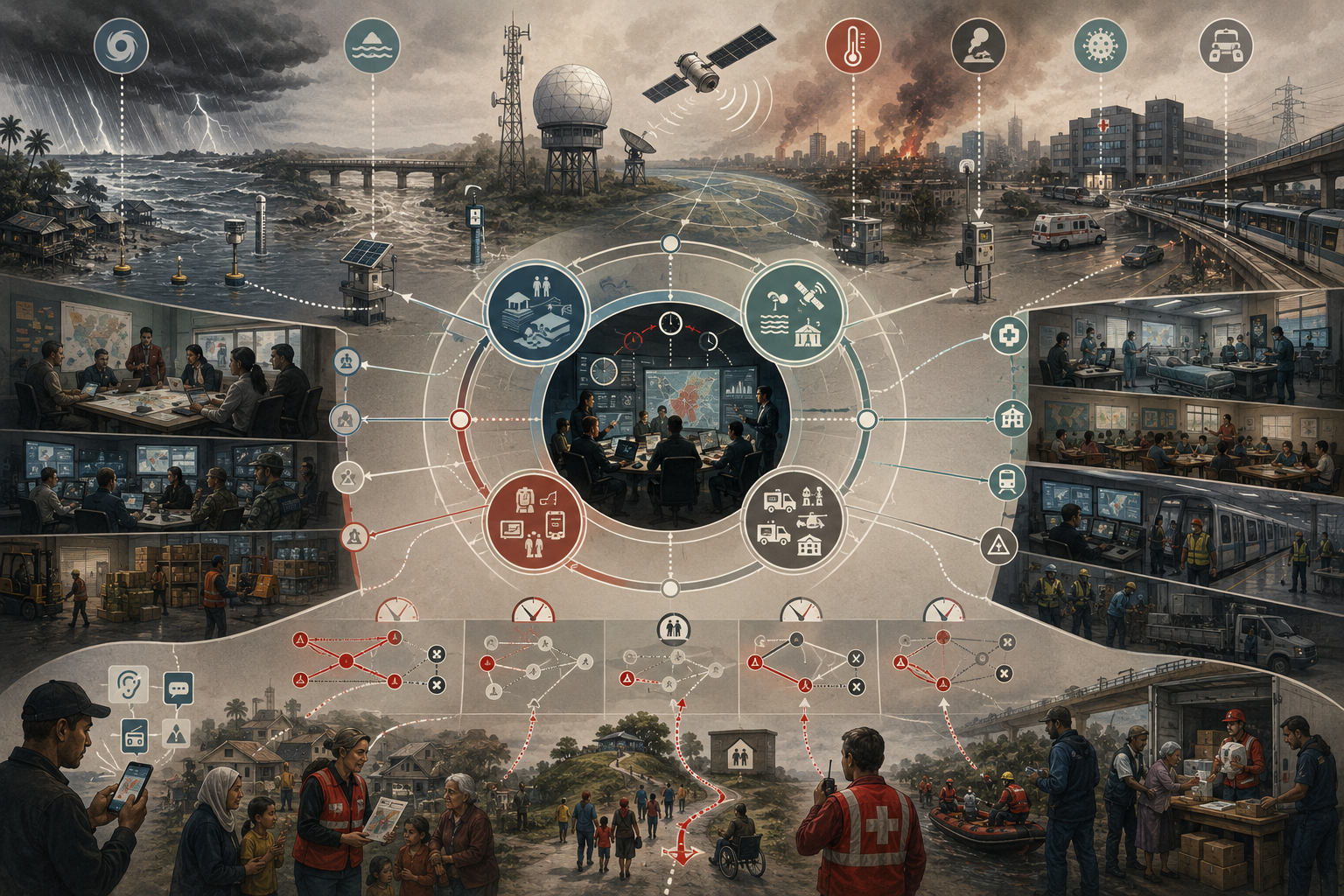
Early warning systems are therefore decision infrastructures and preparedness infrastructures at the same time. They preserve time. They create space for evacuation, sheltering, resource mobilization, protective behavior, early financing, infrastructure protection, public communication, and mutual aid. But warning systems are only as strong as the preparedness systems into which they are embedded. A warning that cannot be acted on is not yet resilience. It is information stranded before action.
Why This Topic Matters
This topic matters because early warning systems are among the clearest examples of the difference between information and resilience. Societies often assume that better sensing, better models, and better forecasts naturally produce better outcomes. But real disasters show something more difficult. Hazards are detected within social systems shaped by poverty, disability, language access, public trust, transportation, housing quality, emergency authority, shelter availability, care obligations, institutional coordination, and unequal exposure. The problem is not only whether a threat is known. It is whether knowledge becomes protective action in time.
Early warning systems are now treated as core public goods in disaster risk reduction, climate adaptation, humanitarian action, public health, infrastructure resilience, and community preparedness. They matter because they preserve decision time. A flood warning issued early enough can allow drainage systems to be cleared, transport routes to be changed, shelters to open, hospitals to prepare, and households to move. A heat warning can trigger cooling centers, worker protections, public-health outreach, energy planning, and checks on elderly or isolated residents. A cyclone warning can support evacuation, maritime safety, school closure, supply staging, and emergency communication.
But warning is never enough by itself. A household may receive an alert and still be unable to leave. A local official may understand the forecast but lack authority to order closure. A community may distrust the messenger because previous warnings were inaccurate, inaccessible, or politically manipulated. A hospital may receive warning but lack staff, backup power, or supplies. A transport system may know flooding is likely but lack alternate routes. Preparedness is what determines whether warning becomes action.
This distinction is central for resilience. Early warning systems convert surprise into anticipation, but preparedness converts anticipation into protection. Without preparedness, warning can become a cruel form of knowledge: people are told that danger is coming but are not given the means to reduce harm. A just and effective early warning system must therefore include risk knowledge, monitoring, communication, response capacity, social trust, and material ability to act.
Preparedness also matters because hazards are intensifying and compounding. Climate change, urbanization, infrastructure aging, public-health stress, digital dependency, and ecological degradation make many risks more complex. Warning systems must therefore support action across multiple hazards and multiple institutions. They must work not only for idealized decision-makers, but for real communities under pressure.
What Early Warning Systems Mean
An early warning system is an end-to-end, people-centered system for anticipating hazard and enabling early action. It does not begin with an alert and does not end with a message. It includes risk knowledge, monitoring and forecasting, warning communication, preparedness, response capacity, and learning. The system is only as strong as its weakest link. If monitoring is strong but communication fails, the warning fails. If communication succeeds but people cannot act, the warning still fails. If institutions act but vulnerable groups are excluded, the system remains only partially protective.
This broader definition matters because early warning is often misunderstood as a technical forecasting problem. Forecasting is essential, but it is only one part of the system. A warning must be connected to the places, people, institutions, and decisions affected by the hazard. A rainfall forecast becomes a flood warning only when it is interpreted through watershed conditions, drainage capacity, settlement patterns, transport routes, housing quality, and population vulnerability. A heat forecast becomes public-health warning only when it is linked to cooling access, energy reliability, worker protection, care systems, age structure, and social isolation.
Early warning systems are therefore socio-technical systems. They combine science, sensors, models, communication channels, public institutions, emergency protocols, local knowledge, community organizations, and material preparedness. Their purpose is not merely to know earlier, but to act earlier.
Multi-hazard early warning systems expand this logic further. They recognize that communities face overlapping hazards: floods, storms, heat waves, droughts, landslides, wildfire smoke, epidemics, infrastructure failure, and cascading disruptions. A multi-hazard system should not create separate warning silos for every threat. It should support integrated risk knowledge, coordinated communication, and prepared action across hazards that may occur together.
A good early warning system answers several questions. What hazard is possible? Where is exposure highest? Who is vulnerable? How much time is available? What actions are recommended? Who has authority? What resources are needed? How will warnings reach people? How will uncertainty be communicated? How will the system learn afterward?
When these questions are answered before crisis, warning becomes a preparedness system rather than a last-minute message.
Preparedness as the Missing Link Between Warning and Action
Preparedness is the missing link between warning and action. It includes the plans, capacities, relationships, resources, training, protocols, and social conditions that allow people and institutions to act before a hazard becomes disaster. Preparedness is what determines whether warning produces evacuation, sheltering, cooling, stockpiling, staffing, early financing, route changes, public-health outreach, infrastructure protection, or community mobilization.
Preparedness has several layers. Household preparedness includes knowledge of local risks, emergency supplies, evacuation options, medication planning, communication plans, care arrangements, and awareness of official warning channels. Community preparedness includes mutual aid networks, local leadership, accessible communication, transportation support, neighborhood mapping, and trusted organizations. Institutional preparedness includes protocols, authority, staffing, logistics, exercises, resource prepositioning, emergency funds, public communication, and cross-agency coordination.
Preparedness also includes social trust. People are more likely to act on warnings when they trust the institutions issuing them, understand the recommended action, believe the warning is relevant to their situation, and have confidence that response systems will not abandon them. Trust is not created by a siren or text alert. It is built over time through fairness, competence, transparency, accessibility, and repeated institutional reliability.
Material capacity matters just as much. A household cannot evacuate without transportation or a place to go. A person dependent on medical equipment cannot simply leave without power, care coordination, and accessible shelter. Outdoor workers cannot avoid heat exposure without labor protections. Low-income households may not be able to miss work, buy supplies, or relocate temporarily. Preparedness must therefore address the social conditions that make action possible.
Early warning without preparedness can deepen inequality because it assumes that everyone can act on information in the same way. In reality, people have different resources, constraints, obligations, risks, and histories with public institutions. Preparedness must be designed around those differences.
The strongest early warning systems are not merely alert systems. They are preparedness ecosystems that link information to capacity, authority, community trust, and practical means of protection.
Warning Systems as Decision Infrastructure
One of the most useful ways to understand early warning systems is to treat them as decision infrastructure. Roads move people. Pipes move water. Grids move electricity. Warning systems move judgment forward in time. Their purpose is to enlarge the interval in which human beings and institutions can still choose among alternatives rather than merely absorb consequences after the fact.
Decision infrastructure includes the information, thresholds, protocols, responsibilities, communication channels, and preparedness capacities that allow action under uncertainty. A forecast is part of this infrastructure, but so is the decision rule that determines when schools close, when shelters open, when evacuation begins, when hospitals activate surge plans, when emergency funds are released, and when public health outreach is intensified.
This framing matters because it shifts attention from warning as message to warning as governance. A society with weak warning infrastructure is often forced into late, reactive, high-cost decision-making. Officials wait for certainty that arrives too late. Households receive alerts without knowing what to do. Agencies negotiate roles during crisis. Communities improvise under pressure. The result is not only slower action, but avoidable harm.
A society with strong warning infrastructure can act earlier because some decisions have been structured in advance. Forecast thresholds are linked to protocols. Protocols are rehearsed. Responsibilities are clear. Communication is trusted. Vulnerable groups are identified. Resources are pre-positioned. Local organizations know their roles. This does not eliminate uncertainty, but it reduces paralysis.
Decision infrastructure also helps manage accountability. Without pre-agreed thresholds and protocols, decision-makers may hesitate because every action carries political risk. Acting early may create disruption if the hazard is less severe than expected. Acting late may create tragedy. Clear protocols can reduce hesitation by making early action legitimate before crisis arrives.
Early warning systems should therefore be evaluated by their ability to preserve decision time, reduce cognitive burden, clarify responsibility, and support protective action. Their purpose is not simply to detect danger. It is to keep decision-making possible when conditions deteriorate.
Why Warning Is Not the Same as Action
A warning is not the same as action because information does not carry its own implementation. A warning must pass through interpretation, trust, incentives, institutions, resources, and physical constraints. At every point, it can fail.
A national meteorological agency may issue an accurate warning, but local officials may not translate it into local action. A mayor may understand the forecast but lack clear authority to close roads or order evacuation. A household may receive the alert but lack transportation. A migrant worker may not understand the language of the message. A disabled resident may not have accessible shelter. A rural community may not receive cellular alerts. A coastal resident may distrust warnings because previous evacuation orders did not match observed impacts. A hospital may know a storm is coming but lack backup power or supply reserves.
This is why early warning systems cannot be evaluated by forecast accuracy alone. Accuracy matters, but the chain from signal to action matters as much. A technically correct warning that does not produce protective behavior is operationally incomplete. A less precise warning that triggers timely preparedness may reduce harm more effectively.
Warning also competes with daily life. People may need to work, care for relatives, protect property, manage livestock, find transportation, secure documents, obtain medication, or coordinate children. If warnings do not account for these realities, they may be ignored not because people are irrational, but because the recommended action is materially difficult.
Institutional action is also constrained. Agencies face limited budgets, legal mandates, political pressure, staffing shortages, and competing priorities. Emergency managers may need to decide before certainty is available. Public officials may fear false alarms. Businesses may resist closure. Schools may worry about parents’ work schedules. These pressures shape whether warnings become action.
The practical lesson is that warning systems must be built around response feasibility. A warning should tell people not only what may happen, but what action is recommended, when to act, where to go, how to get support, and what institutions are doing. Preparedness makes those actions possible before the warning is issued.
The Four Core Elements of Early Warning
A widely used way to structure early warning systems is through four core elements: risk knowledge, monitoring and forecasting, warning communication, and preparedness to respond. This framework is powerful because it makes visible the full chain through which anticipation becomes protection.
Risk knowledge identifies hazards, exposure, vulnerability, capacities, and likely consequences. It asks who and what is at risk, where, why, and under what conditions. Risk knowledge includes physical hazard data, social vulnerability mapping, infrastructure dependencies, local knowledge, historical experience, and changing conditions such as climate risk or urban growth.
Monitoring and forecasting provide the evolving signal. They detect changes in weather, water, land, air quality, disease, infrastructure condition, seismic activity, fire risk, or other hazards. Forecasting extends the signal forward in time, creating lead time for action. The value of monitoring and forecasting depends on reliability, timeliness, uncertainty communication, and relevance to decisions.
Warning communication disseminates information to the people and institutions who need to act. Communication must be timely, accessible, credible, understandable, multilingual where necessary, disability-accessible, and tailored to the decision context. Communication is not only transmission. It is meaning-making under pressure.
Preparedness to respond determines whether warning becomes action. This includes emergency plans, evacuation routes, shelters, supplies, trained personnel, local organizations, public trust, transportation, accessible services, early financing, institutional protocols, and household readiness. Without response capacity, the warning chain breaks.
These four elements are coupled. Risk knowledge informs monitoring priorities. Monitoring supports communication. Communication activates preparedness. Preparedness reveals what information is needed. After action, learning should revise all four elements. A warning system is therefore not a linear pipeline but an adaptive system of anticipation, communication, response, and learning.
The weakest link determines the system’s protective value. Strong technology cannot compensate for absent trust. Good communication cannot compensate for inaccessible shelter. Preparedness cannot compensate for warnings that arrive too late. The whole system must work together.
Risk Knowledge, Exposure, and Vulnerability
Risk knowledge is the first condition of useful warning because decision-makers need to know not only that a hazard may occur, but what it means in a specific place. A rainfall forecast is not yet a flood decision. It becomes one only when joined to drainage capacity, soil saturation, river levels, land cover, topography, housing quality, transport routes, and population vulnerability. A heat forecast is not yet a public-health warning until interpreted through power reliability, cooling access, age structure, chronic illness, labor conditions, urban heat islands, and social isolation.
Risk knowledge should include exposure and vulnerability. Exposure identifies people, assets, infrastructure, ecosystems, and services located in harm’s way. Vulnerability identifies the conditions that make harm more likely or more severe: poverty, disability, poor housing, weak infrastructure, lack of insurance, social isolation, insecure work, language barriers, limited mobility, discrimination, and histories of institutional neglect. Without vulnerability knowledge, warnings may protect the easiest-to-reach populations while missing those most at risk.
Local knowledge is also essential. Communities often know where water collects, which roads become impassable, which households need assistance, which shelters are inaccessible, which official maps are outdated, and which messages people trust. Indigenous and place-based knowledge can reveal environmental signals and long-term patterns not captured in technical datasets. Workers often understand operational hazards before managers do. Risk knowledge should therefore be plural rather than narrowly technocratic.
Risk knowledge must also be updated. Climate change alters hazard patterns. Urban development changes runoff, heat exposure, and evacuation routes. Infrastructure ages. Social vulnerability shifts. New informal settlements appear. Health burdens change. A warning system based on outdated risk maps may issue technically correct alerts that fail to identify where harm will occur.
Preparedness depends on risk knowledge because plans must be built around real conditions. Knowing where vulnerability is concentrated allows institutions to pre-position resources, target outreach, design accessible shelters, plan transport, and prioritize early action. Risk knowledge is therefore not a background dataset. It is the foundation of preparedness.
Monitoring, Forecasting, and Lead Time
Monitoring and forecasting provide the informational core of early warning. Monitoring detects current conditions: rainfall, river levels, wind speed, heat, air quality, disease incidence, wildfire risk, soil moisture, seismic activity, infrastructure stress, or other signals. Forecasting projects possible future conditions and creates lead time. Lead time is one of the most valuable resources in resilience because it allows institutions and communities to act before harm peaks.
Forecast skill matters. Forecasts should be reliable, calibrated, timely, and appropriate to the hazard. But forecast skill is not the same as decision usefulness. A forecast may be scientifically strong but difficult to use if it is expressed in technical language, disconnected from local thresholds, issued too late for response, or not translated into recommended action. Preparedness requires forecasts that are not only accurate, but usable.
Lead time varies by hazard. Cyclones may provide days of warning. Flash floods may provide minutes or hours. Heat waves may be forecast in advance, but public-health consequences depend on exposure and duration. Drought develops slowly but can be politically difficult to act on early. Epidemics may begin with weak signals and uncertainty. Cyber and infrastructure risks may require anomaly detection rather than traditional forecasting. Each hazard requires different monitoring architectures and preparedness protocols.
Forecast uncertainty must be communicated clearly. Waiting for certainty can be dangerous, but acting on uncertainty can be politically difficult. Good warning systems help decision-makers understand probability, confidence, possible impact, and action thresholds. They avoid false precision while still supporting action.
Impact-based forecasting is especially important. Instead of only communicating physical hazard levels, impact-based systems ask what the hazard is likely to do to people, infrastructure, services, and livelihoods. This makes forecasts more decision-relevant. A storm warning becomes more useful when it indicates likely flooding, power disruption, road closures, health risks, and shelter needs.
Monitoring and forecasting are therefore not isolated technical functions. They are part of preparedness when they are connected to risk knowledge, thresholds, communication, and response capacity.
Communication, Trust, and Last-Mile Preparedness
Communication is central because warnings move through social systems, not empty space. Messages must be timely, intelligible, credible, accessible, and actionable. They must reach people through channels they actually use and trust. They must be available in relevant languages and accessible formats. They must identify expected timing, likely consequences, recommended actions, and available support.
Last-mile communication is often the most fragile part of early warning. A warning issued nationally may not reach remote communities, informal settlements, elderly residents, people without smartphones, people with disabilities, unhoused people, migrants, prisoners, outdoor workers, or people without reliable internet. Communication systems must therefore use multiple channels: sirens, radio, television, SMS, mobile alerts, community leaders, schools, clinics, religious institutions, local organizations, social media, door-to-door outreach, and trusted intermediaries.
Trust is equally important. People respond to warnings based not only on message content, but on their relationship with the messenger. Trust is shaped by past performance, fairness, political credibility, cultural relevance, and whether institutions have protected people before. Repeated false alarms can erode trust, but so can missed alarms, inaccessible communication, discriminatory enforcement, or warnings that tell people to act without providing means.
Communication should also be specific. “Dangerous conditions are possible” may not be enough. People need to know what to do: evacuate now, avoid travel, move to higher ground, check on neighbors, seek cooling, boil water, shelter indoors, protect livestock, charge devices, prepare medication, or follow local instructions. Ambiguity can delay action.
Preparedness strengthens communication because people who have heard warnings before, practiced response, learned routes, identified shelters, and received clear instructions are more likely to act when alerts arrive. Communication is not only an emergency activity. It is a long-term relationship between institutions and communities.
The strongest warning systems build communication before crisis. They cultivate trusted messengers, accessible language, repeated education, community drills, and feedback channels. Last-mile preparedness begins long before the last mile.
Response Capacity, Protocols, and Early Action
Response capacity determines whether warnings become protective action. It includes the personnel, authority, plans, equipment, financing, logistics, shelters, transport, healthcare capacity, communications, community networks, and institutional protocols needed to act before impact. A warning without response capacity is a signal without protection.
Protocols matter because they reduce hesitation under pressure. A well-designed system links alerts to operational consequences before crisis occurs. Schools know when to close. Emergency managers know when to activate shelters. Public health agencies know when to begin heat outreach. Utilities know when to protect assets. Hospitals know when to prepare surge capacity. Local governments know when to issue evacuation orders. Community organizations know when to check on vulnerable residents.
Early action often requires pre-commitment. If institutions wait until hazard certainty is high, they may lose the time needed for action. Forecast-based financing, anticipatory action, pre-positioned supplies, early evacuation triggers, and pre-agreed closure thresholds all move decisions upstream. They allow systems to act on risk rather than waiting for disaster.
Response capacity must also be realistic. Evacuation plans are not credible without transportation, accessible shelters, fuel, care support, animal sheltering, public communication, and protection for those who cannot leave easily. Heat plans are not credible without cooling access, worker protections, energy reliability, and outreach to isolated residents. Flood plans are not credible without drainage maintenance, road closure protocols, rescue capacity, and housing support.
Preparedness also requires exercises. Plans that have never been tested may fail under pressure. Drills, simulations, tabletop exercises, community rehearsals, and after-action reviews help reveal gaps before disaster does. They build relationships among agencies and communities, clarify roles, and reduce cognitive burden during crisis.
Response capacity is therefore the practical test of early warning. If the system cannot act, it has not fully warned. The purpose of warning is not awareness alone. It is early protective action.
Decision Making Under Stress
Decision-making under stress differs sharply from idealized decision-making. Time pressure compresses deliberation. Information is partial and changing. Stakes are high. Decision-makers may fear acting too late, but they may also fear overreacting, causing disruption, wasting resources, or losing credibility. Under these conditions, action is rarely a simple function of evidence. It is shaped by uncertainty, accountability, institutional culture, trust, and perceived consequences.
Stress affects cognition. People under pressure may rely on familiar routines, social cues, authority signals, recent experience, or emotionally salient information. They may narrow attention, delay action, cling to precedent, or seek certainty that emergency conditions cannot provide. Institutions can behave similarly. Agencies may wait for more data, avoid responsibility, defer to hierarchy, or hesitate because the political cost of acting early is visible while the benefit of avoided harm is invisible.
Warning systems should therefore be designed around real decision environments rather than ideal ones. They should reduce cognitive burden. They should provide clear thresholds, action menus, role assignments, and escalation pathways. They should distinguish between watch, warning, emergency, and action stages. They should communicate uncertainty without paralyzing action. They should support decisions that must be made before full information is available.
Preparedness helps because it moves some decisions out of the crisis moment. When institutions establish thresholds, protocols, and responsibilities in advance, decision-makers do not need to invent governance under stress. When households have plans, they do not need to solve every logistical problem after an alert arrives. When communities practice response, action becomes more familiar.
This is one of the deepest reasons early warning systems belong inside resilience. They are not simply tools for producing information. They are tools for supporting judgment when judgment is hardest.
Thresholds, False Alarms, Missed Alarms, and Public Credibility
Threshold-setting is one of the hardest governance problems in early warning. Warnings are often issued probabilistically, before the full impact is known. This creates tension between false alarms and missed alarms. Warn too early or too often, and credibility may erode, resources may be wasted, and people may become less responsive. Warn too late or too cautiously, and the system may preserve credibility at the cost of avoidable harm.
There is no perfectly neutral threshold. Every threshold reflects implicit judgments about acceptable risk, institutional tolerance, uncertainty, cost, and who bears the consequences of error. A false alarm may impose costs: missed work, evacuation expense, school disruption, business closure, transportation strain, and emotional stress. A missed alarm may impose injury, death, displacement, infrastructure damage, and loss of trust. These costs are not distributed equally.
This makes threshold-setting a justice issue. Wealthier households may absorb precautionary evacuation more easily than low-income households. Salaried workers may stay home more easily than hourly workers. People with cars can evacuate more easily than those dependent on public transport. A warning threshold that appears technically reasonable may still impose unequal burdens.
Preparedness can reduce the cost of false alarms and missed alarms. If shelters are accessible, transport is organized, employers have hazard policies, public communication is clear, and communities understand protocols, early action becomes less disruptive. If institutions explain uncertainty honestly, publics may better understand why precautionary warnings are issued.
Credibility depends on learning. Warning systems should analyze false alarms, missed alarms, near misses, and successful actions. They should ask whether thresholds were appropriate, whether communication was clear, whether vulnerable groups were reached, and whether people had the means to act. Credibility grows when institutions show that they learn from warning performance.
The goal is not to eliminate false alarms entirely. A system that avoids all false alarms may warn too late. The goal is to manage warning thresholds transparently, proportionately, and justly, while building preparedness that makes early action easier to take.
Equity, Access, and Vulnerable Communities
Early warning systems must be judged by whether they protect those most at risk, not only by whether they reach those easiest to reach. Disasters often reveal pre-existing inequality. People are not equally exposed, equally informed, equally mobile, equally trusted, or equally able to act. Warning systems that ignore this reality can reproduce vulnerability.
Access barriers are practical and social. People may lack smartphones, internet, electricity, transportation, safe shelter, legal status, language access, hearing or visual accessibility, disability support, savings, paid leave, or trusted institutional relationships. A warning that assumes a fully resourced household may fail people who live with precarity.
Vulnerability also includes care responsibilities. Parents may need to collect children. People may care for elderly relatives, disabled family members, patients, livestock, or neighbors. Evacuation, sheltering, cooling, or medical preparation must account for these relationships. Preparedness plans that treat people as isolated individuals often fail because real people live in networks of care.
Equity requires targeted preparedness. Institutions should identify communities at high risk, co-design communication with trusted local actors, provide accessible shelters, support transportation, protect workers, ensure language access, maintain registries where appropriate and consent-based, and build partnerships with community organizations. Warning systems should also be tested with the people most likely to face barriers.
Equity also means avoiding punitive approaches. People who do not evacuate or follow guidance are often blamed as irrational. But non-action may reflect poverty, distrust, disability, fear of losing property, immigration concerns, lack of transport, or previous institutional failure. Good governance asks why action was difficult and how preparedness can reduce those barriers.
A just early warning system does not simply broadcast danger. It helps create the conditions under which vulnerable people can act. Preparedness is therefore inseparable from justice.
Climate Risk, Multi-Hazard Warning, and Compound Events
Climate change makes early warning and preparedness more important because hazard patterns are shifting. Heat waves, extreme rainfall, drought, wildfire conditions, coastal flooding, storm surge, and compound hazards are becoming more consequential in many regions. Historical patterns are less reliable. Infrastructure designed for past conditions may be underprepared for future extremes. Warning systems must therefore adapt to changing baselines.
Multi-hazard warning systems are essential because hazards interact. A storm may produce flooding, landslides, power outages, water contamination, transport disruption, and healthcare access problems. A heat wave may coincide with wildfire smoke, energy demand spikes, drought, and public-health strain. A drought may affect food systems, water supply, hydropower, migration, and conflict risk. Preparedness must account for cascading and compound effects rather than treating hazards as isolated events.
Climate risk also changes lead time. Some hazards provide short warning windows, while others develop slowly. Drought and food insecurity require seasonal monitoring and anticipatory action. Heat waves may be forecast in advance, but preparedness must begin long before summer through housing, cooling access, labor protections, urban trees, and health outreach. Flood risk may require both real-time warning and long-term land-use planning.
Climate adaptation and early warning should therefore be connected. Warning systems help manage immediate risk, but preparedness must also reduce structural vulnerability. A flood warning helps only so much if people remain trapped in unsafe housing. A heat warning helps only so much if workers lack protection and homes lack cooling. A drought warning helps only so much if water governance and social protection are weak.
Climate-related early warning should also be impact-based and locally grounded. It should translate hazards into likely consequences for people, infrastructure, ecosystems, and services. It should combine scientific forecasting with local knowledge, vulnerability mapping, and preparedness planning.
The climate lesson is clear: early warning systems are not only emergency tools. They are part of long-term adaptation and resilience governance.
Preparedness Culture, Exercises, and Learning
Preparedness is not a document. It is a practiced capacity. A plan that no one knows, a protocol that has never been tested, a shelter that is inaccessible, or a warning channel that communities distrust will not perform well under stress. Preparedness culture means that institutions and communities repeatedly build, test, revise, and remember their capacity to act.
Exercises are central. Tabletop exercises help agencies test decision roles. Full-scale drills test logistics. Community rehearsals help households understand routes and actions. Communication tests reveal whether warnings reach the last mile. Simulations expose coordination gaps. After-action reviews turn experience into learning. These practices reduce confusion before real crisis.
Preparedness culture also depends on education. People should understand local hazards, warning levels, evacuation routes, shelter options, heat protections, flood behavior, emergency supplies, and how to verify official information. This education should be repeated and accessible, not delivered once and forgotten.
Learning should occur after every warning cycle, not only after catastrophe. False alarms, near misses, delayed actions, communication failures, successful evacuations, and community feedback all provide evidence. Institutions should ask: Did warnings reach people? Did people understand them? Did they trust them? Could they act? Were shelters accessible? Were protocols clear? Did vulnerable groups receive support? Did thresholds work? What should change?
Preparedness also requires institutional memory. Staff turnover, political cycles, budget cuts, and fading public attention can erode preparedness over time. Adaptive warning systems preserve lessons through training, documentation, funding, law, protocols, and community relationships.
A preparedness culture recognizes that warning systems decay if they are not maintained. Sensors fail. Contact lists become outdated. Shelters change. Communities shift. Risks evolve. Trust must be renewed. Preparedness is a living system, not a one-time plan.
Toward Better Early Warning Systems and Preparedness
Better early warning systems require more than stronger sensors and better models. They require stronger risk knowledge, clearer communication, trusted institutions, inclusive design, realistic action protocols, and rehearsal under conditions that resemble actual stress. They also require explicit attention to uncertainty, thresholds, trade-offs, equity, and learning.
First, warning systems should be people-centered. The measure of success is not only whether a forecast was issued, but whether people at risk received, understood, trusted, and could act on it. Second, they should be impact-based. Warnings should translate hazards into likely consequences for specific places, systems, and communities. Third, they should be multi-hazard and systemic, recognizing that hazards compound and cascade. Fourth, they should be connected to preparedness protocols that specify who does what, when, and with what resources.
Fifth, warning systems should include communities as partners. Local organizations, Indigenous knowledge holders, workers, health providers, schools, faith institutions, disability advocates, and neighborhood groups can help identify vulnerability, communicate warnings, and support action. Sixth, warning systems should include financing. Early action requires resources before disaster, not only recovery funds after harm occurs.
Seventh, warning systems should be evaluated continuously. Forecast accuracy matters, but so do lead time, communication reach, actionability, equity, response capacity, trust, and outcomes. Systems should learn from false alarms, missed alarms, near misses, and successful early action.
The goal is not perfect prediction. It is better anticipation linked to better preparedness. Early warning systems should preserve time, reduce confusion, widen options, and support coordinated protective action. In resilience terms, they are successful when they help people and institutions act before danger becomes irreversible harm.
Mathematical Lens
Early warning effectiveness can be represented as a function of risk knowledge, forecast skill, lead time, communication reach, trust, preparedness, and response capacity, reduced by uncertainty, access barriers, and institutional fragmentation. Let \(E_w\) represent warning effectiveness:
E_w = \alpha R_k + \beta F_s + \gamma L_t + \delta C_r + \epsilon T_s + \zeta P_c + \eta A_r – \lambda U_n – \mu B_a – \nu F_i
\]
Interpretation: Early warning effectiveness rises when risk knowledge, forecast skill, lead time, communication reach, trust, preparedness, and response capacity are strong. It falls when uncertainty, access barriers, and institutional fragmentation weaken action.
This captures the article’s central claim: warning effectiveness is not a property of forecasting alone. It is a property of the full preparedness chain.
Preparedness capacity can be represented as:
P_c = \theta H_p + \kappa C_p + \rho I_p + \omega S_a + \psi M_a
\]
Interpretation: Preparedness capacity increases when households, communities, institutions, shelters, and mutual-aid systems are ready before warning is issued.
Here, \(H_p\) is household preparedness, \(C_p\) is community preparedness, \(I_p\) is institutional preparedness, \(S_a\) is shelter and support accessibility, and \(M_a\) is mutual-aid capacity.
Finally, early action potential can be expressed as:
A_e = \eta L_t + \iota D_u + \chi P_r + \tau F_a – \phi C_b
\]
Interpretation: Early action potential increases with lead time, decision usability, protocol readiness, and available financing, but falls when cognitive and material barriers are high.
| Term | Meaning | Interpretive role |
|---|---|---|
| \(E_w\) | Warning effectiveness | Represents the ability of the warning system to reduce harm through timely action. |
| \(R_k\) | Risk knowledge | Represents knowledge of hazards, exposure, vulnerability, and likely impacts. |
| \(F_s\) | Forecast skill | Represents reliability, calibration, accuracy, and relevance of monitoring and forecasting. |
| \(L_t\) | Lead time | Represents the amount of usable time available before impact. |
| \(C_r\) | Communication reach | Represents whether warnings reach affected people through accessible channels. |
| \(T_s\) | Trust strength | Represents confidence in messengers, institutions, and warning credibility. |
| \(P_c\) | Preparedness capacity | Represents household, community, institutional, and logistical readiness to act. |
| \(A_r\) | Action readiness | Represents clear protocols, authority, financing, and operational ability to act early. |
| \(U_n\) | Uncertainty burden | Represents uncertainty, ambiguity, and incomplete information. |
| \(B_a\) | Access barriers | Represents material, linguistic, disability, transport, economic, or trust barriers to action. |
| \(F_i\) | Institutional fragmentation | Represents disconnected responsibilities and weak coordination. |
The equations are conceptual rather than predictive. Their value is to make visible the structure of early warning and preparedness: detection, communication, trust, preparedness, action capacity, uncertainty, access, and coordination must be interpreted together.
Advanced Python Workflow: Early Warning and Preparedness Scoring
This Python workflow models early warning effectiveness by combining risk knowledge, forecast skill, lead time, communication reach, trust, preparedness capacity, response capacity, protocol clarity, equity access, uncertainty burden, false-alarm strain, missed-alarm risk, institutional fragmentation, and vulnerable exposure.
from __future__ import annotations

import pandas as pd
import numpy as np

INPUT_FILE = "early_warning_preparedness_panel.csv"
OUTPUT_FILE = "early_warning_preparedness_scores.csv"


def load_data(path: str) -> pd.DataFrame:
    """
    Load an early warning and preparedness dataset.

    All *_index columns should be normalized to [0, 1].
    Higher values should mean more of the named property.

    Examples:
      - risk_knowledge_index: higher = stronger risk knowledge
      - forecast_skill_index: higher = stronger monitoring and forecasting
      - preparedness_capacity_index: higher = stronger preparedness
      - access_barrier_index: higher = greater access barriers
    """
    df = pd.read_csv(path)

    required_columns = [
        "system_name",
        "jurisdiction",
        "hazard_type",
        "risk_knowledge_index",
        "forecast_skill_index",
        "lead_time_index",
        "communication_reach_index",
        "trust_strength_index",
        "preparedness_capacity_index",
        "response_capacity_index",
        "protocol_clarity_index",
        "equity_access_index",
        "household_preparedness_index",
        "community_preparedness_index",
        "institutional_preparedness_index",
        "uncertainty_burden_index",
        "access_barrier_index",
        "false_alarm_strain_index",
        "missed_alarm_risk_index",
        "institutional_fragmentation_index",
        "vulnerability_exposure_index",
    ]

    missing = [col for col in required_columns if col not in df.columns]

    if missing:
        raise ValueError(f"Missing required columns: {missing}")

    return df


def validate_indices(df: pd.DataFrame) -> pd.DataFrame:
    """Validate that all *_index fields are complete and normalized to [0, 1]."""
    index_columns = [col for col in df.columns if col.endswith("_index")]

    for col in index_columns:
        if df[col].isna().any():
            raise ValueError(f"Column '{col}' contains missing values.")

        if ((df[col] < 0) | (df[col] > 1)).any():
            raise ValueError(f"Column '{col}' contains values outside [0, 1].")

    return df


def compute_scores(df: pd.DataFrame) -> pd.DataFrame:
    """
    Compute warning effectiveness, preparedness capacity,
    and early action readiness.
    """
    df = df.copy()

    df["warning_effectiveness_score"] = (
        0.11 * df["risk_knowledge_index"] +
        0.11 * df["forecast_skill_index"] +
        0.10 * df["lead_time_index"] +
        0.10 * df["communication_reach_index"] +
        0.09 * df["trust_strength_index"] +
        0.10 * df["preparedness_capacity_index"] +
        0.10 * df["response_capacity_index"] +
        0.08 * df["protocol_clarity_index"] +
        0.08 * df["equity_access_index"] +
        0.05 * (1 - df["uncertainty_burden_index"]) +
        0.04 * (1 - df["access_barrier_index"]) +
        0.04 * (1 - df["institutional_fragmentation_index"])
    ).clip(lower=0, upper=1)

    df["preparedness_system_score"] = (
        0.17 * df["household_preparedness_index"] +
        0.18 * df["community_preparedness_index"] +
        0.18 * df["institutional_preparedness_index"] +
        0.15 * df["preparedness_capacity_index"] +
        0.13 * df["response_capacity_index"] +
        0.11 * df["protocol_clarity_index"] +
        0.08 * df["equity_access_index"]
    ).clip(lower=0, upper=1)

    df["warning_vulnerability_score"] = (
        0.15 * df["vulnerability_exposure_index"] +
        0.14 * df["access_barrier_index"] +
        0.13 * df["institutional_fragmentation_index"] +
        0.12 * df["uncertainty_burden_index"] +
        0.11 * df["missed_alarm_risk_index"] +
        0.09 * df["false_alarm_strain_index"] +
        0.09 * (1 - df["trust_strength_index"]) +
        0.08 * (1 - df["communication_reach_index"]) +
        0.05 * (1 - df["preparedness_capacity_index"]) +
        0.04 * (1 - df["response_capacity_index"])
    ).clip(lower=0, upper=1)

    df["early_action_readiness_score"] = (
        0.38 * df["warning_effectiveness_score"] +
        0.32 * df["preparedness_system_score"] +
        0.18 * (1 - df["warning_vulnerability_score"]) +
        0.12 * df["equity_access_index"]
    ).clip(lower=0, upper=1)

    df["preparedness_gap"] = (
        df["preparedness_system_score"] -
        df["warning_vulnerability_score"]
    )

    df["readiness_band"] = np.select(
        [
            df["early_action_readiness_score"] >= 0.80,
            df["early_action_readiness_score"] >= 0.60,
            df["early_action_readiness_score"] >= 0.40,
        ],
        [
            "Strong early warning and preparedness readiness",
            "Moderate early warning and preparedness readiness",
            "Limited early warning and preparedness readiness",
        ],
        default="Weak early warning and preparedness readiness",
    )

    df["preparedness_warning"] = np.select(
        [
            df["warning_vulnerability_score"] - df["preparedness_system_score"] >= 0.35,
            df["warning_vulnerability_score"] - df["preparedness_system_score"] >= 0.20,
            df["warning_vulnerability_score"] - df["preparedness_system_score"] >= 0.05,
        ],
        [
            "Severe warning-preparedness gap",
            "High warning-preparedness gap",
            "Moderate warning-preparedness gap",
        ],
        default="Lower warning-preparedness gap or stronger readiness",
    )

    return df


def build_summary(df: pd.DataFrame) -> pd.DataFrame:
    """Return a ranked summary table for early warning preparedness review."""
    columns = [
        "system_name",
        "jurisdiction",
        "hazard_type",
        "warning_effectiveness_score",
        "preparedness_system_score",
        "warning_vulnerability_score",
        "early_action_readiness_score",
        "preparedness_gap",
        "readiness_band",
        "preparedness_warning",
    ]

    summary = df[columns].copy()

    summary = summary.sort_values(
        by=[
            "early_action_readiness_score",
            "warning_effectiveness_score",
            "warning_vulnerability_score",
        ],
        ascending=[False, False, True],
    ).reset_index(drop=True)

    return summary


def main() -> None:
    df = load_data(INPUT_FILE)
    df = validate_indices(df)
    scored = compute_scores(df)
    summary = build_summary(scored)

    summary.to_csv(OUTPUT_FILE, index=False)

    print("Early warning and preparedness scoring complete.")
    print(summary.to_string(index=False))


if __name__ == "__main__":
    main()
This workflow is intentionally transparent. It does not claim that early warning effectiveness can be reduced to a single objective score. Instead, it makes assumptions visible: risk knowledge, forecast skill, lead time, communication, trust, preparedness, response capacity, protocols, equity access, uncertainty, access barriers, false alarms, missed alarms, fragmentation, and vulnerability are treated as distinct components. The value of the model is diagnostic. It helps identify where warning systems are strong, where preparedness gaps remain, and where vulnerable communities may still be unable to act on warnings.
Advanced R Workflow: Warning Coverage, Preparedness, and Response Capacity
This R workflow compares early warning and preparedness readiness across jurisdictions and hazard types. It is useful for identifying where forecast systems are strong but preparedness is weak, where communication reaches people but response capacity is limited, and where access barriers or vulnerable exposure undermine early action.
library(readr)
library(dplyr)

input_file <- "early_warning_preparedness_panel.csv"
jurisdiction_output_file <- "early_warning_jurisdiction_summary.csv"
hazard_output_file <- "early_warning_hazard_summary.csv"

warning_df <- read_csv(input_file, show_col_types = FALSE)

required_cols <- c(
  "system_name",
  "jurisdiction",
  "hazard_type",
  "risk_knowledge_index",
  "forecast_skill_index",
  "lead_time_index",
  "communication_reach_index",
  "trust_strength_index",
  "preparedness_capacity_index",
  "response_capacity_index",
  "protocol_clarity_index",
  "equity_access_index",
  "household_preparedness_index",
  "community_preparedness_index",
  "institutional_preparedness_index",
  "uncertainty_burden_index",
  "access_barrier_index",
  "false_alarm_strain_index",
  "missed_alarm_risk_index",
  "institutional_fragmentation_index",
  "vulnerability_exposure_index"
)

missing_cols <- setdiff(required_cols, names(warning_df))

if (length(missing_cols) > 0) {
  stop(paste("Missing required columns:", paste(missing_cols, collapse = ", ")))
}

index_cols <- names(warning_df)[grepl("_index$", names(warning_df))]

invalid_index_cols <- index_cols[
  vapply(
    warning_df[index_cols],
    function(x) any(is.na(x) | x < 0 | x > 1),
    logical(1)
  )
]

if (length(invalid_index_cols) > 0) {
  stop(
    paste(
      "Index columns must be complete and normalized to [0, 1]:",
      paste(invalid_index_cols, collapse = ", ")
    )
  )
}

warning_df <- warning_df %>%
  mutate(
    warning_effectiveness_proxy = (
      risk_knowledge_index +
        forecast_skill_index +
        lead_time_index +
        communication_reach_index +
        trust_strength_index +
        preparedness_capacity_index +
        response_capacity_index +
        protocol_clarity_index +
        equity_access_index +
        (1 - uncertainty_burden_index) +
        (1 - access_barrier_index) +
        (1 - institutional_fragmentation_index)
    ) / 12,
    preparedness_system_proxy = (
      household_preparedness_index +
        community_preparedness_index +
        institutional_preparedness_index +
        preparedness_capacity_index +
        response_capacity_index +
        protocol_clarity_index +
        equity_access_index
    ) / 7,
    warning_vulnerability_proxy = (
      vulnerability_exposure_index +
        access_barrier_index +
        institutional_fragmentation_index +
        uncertainty_burden_index +
        missed_alarm_risk_index +
        false_alarm_strain_index +
        (1 - trust_strength_index) +
        (1 - communication_reach_index) +
        (1 - preparedness_capacity_index) +
        (1 - response_capacity_index)
    ) / 10,
    early_action_readiness_proxy = (
      warning_effectiveness_proxy +
        preparedness_system_proxy +
        (1 - warning_vulnerability_proxy) +
        equity_access_index
    ) / 4,
    preparedness_gap = preparedness_system_proxy - warning_vulnerability_proxy,
    readiness_band = case_when(
      early_action_readiness_proxy >= 0.75 ~ "Strong early warning and preparedness readiness",
      early_action_readiness_proxy >= 0.55 ~ "Moderate early warning and preparedness readiness",
      early_action_readiness_proxy >= 0.35 ~ "Limited early warning and preparedness readiness",
      TRUE ~ "Weak early warning and preparedness readiness"
    )
  )

jurisdiction_summary <- warning_df %>%
  group_by(jurisdiction) %>%
  summarise(
    avg_early_action_readiness = mean(early_action_readiness_proxy, na.rm = TRUE),
    avg_warning_effectiveness = mean(warning_effectiveness_proxy, na.rm = TRUE),
    avg_preparedness_system = mean(preparedness_system_proxy, na.rm = TRUE),
    avg_warning_vulnerability = mean(warning_vulnerability_proxy, na.rm = TRUE),
    avg_risk_knowledge = mean(risk_knowledge_index, na.rm = TRUE),
    avg_forecast_skill = mean(forecast_skill_index, na.rm = TRUE),
    avg_lead_time = mean(lead_time_index, na.rm = TRUE),
    avg_communication_reach = mean(communication_reach_index, na.rm = TRUE),
    avg_trust_strength = mean(trust_strength_index, na.rm = TRUE),
    avg_preparedness_capacity = mean(preparedness_capacity_index, na.rm = TRUE),
    avg_response_capacity = mean(response_capacity_index, na.rm = TRUE),
    avg_equity_access = mean(equity_access_index, na.rm = TRUE),
    avg_access_barrier = mean(access_barrier_index, na.rm = TRUE),
    avg_vulnerability_exposure = mean(vulnerability_exposure_index, na.rm = TRUE),
    avg_preparedness_gap = mean(preparedness_gap, na.rm = TRUE),
    observations = n(),
    .groups = "drop"
  ) %>%
  mutate(
    jurisdiction_readiness_band = case_when(
      avg_early_action_readiness >= 0.75 ~ "Strong early warning and preparedness readiness",
      avg_early_action_readiness >= 0.55 ~ "Moderate early warning and preparedness readiness",
      avg_early_action_readiness >= 0.35 ~ "Limited early warning and preparedness readiness",
      TRUE ~ "Weak early warning and preparedness readiness"
    )
  ) %>%
  arrange(desc(avg_early_action_readiness))

hazard_summary <- warning_df %>%
  group_by(hazard_type) %>%
  summarise(
    avg_early_action_readiness = mean(early_action_readiness_proxy, na.rm = TRUE),
    avg_warning_effectiveness = mean(warning_effectiveness_proxy, na.rm = TRUE),
    avg_preparedness_system = mean(preparedness_system_proxy, na.rm = TRUE),
    avg_warning_vulnerability = mean(warning_vulnerability_proxy, na.rm = TRUE),
    avg_risk_knowledge = mean(risk_knowledge_index, na.rm = TRUE),
    avg_forecast_skill = mean(forecast_skill_index, na.rm = TRUE),
    avg_lead_time = mean(lead_time_index, na.rm = TRUE),
    avg_communication_reach = mean(communication_reach_index, na.rm = TRUE),
    avg_trust_strength = mean(trust_strength_index, na.rm = TRUE),
    avg_preparedness_capacity = mean(preparedness_capacity_index, na.rm = TRUE),
    avg_response_capacity = mean(response_capacity_index, na.rm = TRUE),
    avg_equity_access = mean(equity_access_index, na.rm = TRUE),
    avg_access_barrier = mean(access_barrier_index, na.rm = TRUE),
    avg_vulnerability_exposure = mean(vulnerability_exposure_index, na.rm = TRUE),
    avg_preparedness_gap = mean(preparedness_gap, na.rm = TRUE),
    observations = n(),
    .groups = "drop"
  ) %>%
  arrange(desc(avg_early_action_readiness))

write_csv(jurisdiction_summary, jurisdiction_output_file)
write_csv(hazard_summary, hazard_output_file)

cat("Early warning jurisdiction summary exported to:", jurisdiction_output_file, "\n")
print(jurisdiction_summary)

cat("\nEarly warning hazard summary exported to:", hazard_output_file, "\n")
print(hazard_summary)
This workflow helps distinguish warning capacity from preparedness capacity. A system may have strong monitoring and forecast skill but weak trust, inaccessible communication, limited shelters, unclear protocols, high access barriers, or insufficient response capacity. Conversely, a system with imperfect forecasts may still reduce harm if communities are prepared, institutions are trusted, protocols are clear, and early action is feasible. The workflow therefore treats early warning as a socio-institutional preparedness system rather than a forecasting tool alone.
GitHub Repository
Complete Code Repository
The full code distribution for this article, including early warning effectiveness scoring workflows, preparedness-capacity diagnostics, cross-jurisdiction summaries, SQL materials, optional monitoring support tools, and supporting documentation, is available on GitHub.
Related Articles
- Environmental Monitoring as a Foundation of Resilience
- Risk Governance and Adaptive Institutions
- Adaptive Governance and Institutional Learning
- Public Health Systems and Social Resilience
- Climate Risk and Systemic Vulnerability
- Community Resilience, Trust, and Local Capacity
- Digital Twins, Sensing, and Infrastructure Resilience
Further Reading
- Intergovernmental Panel on Climate Change (IPCC) (2022) Chapter 17: Decision-Making Options for Managing Risk. In: Climate Change 2022: Impacts, Adaptation and Vulnerability. Available at: https://www.ipcc.ch/report/ar6/wg2/chapter/chapter-17/
- Intergovernmental Panel on Climate Change (IPCC) (2023) AR6 Synthesis Report: Summary for Policymakers. Available at: https://www.ipcc.ch/report/ar6/syr/downloads/report/IPCC_AR6_SYR_SPM.pdf
- United Nations Environment Programme (UNEP) (n.d.) Climate Information and Early Warning Systems. Available at: https://www.unep.org/topics/climate-action/climate-transparency/climate-information-and-early-warning-systems
- United Nations Office for Disaster Risk Reduction (UNDRR) (2018) Handbook on the Use of Risk Knowledge for Multi-Hazard Early Warning Systems. Available at: https://www.undrr.org/media/101628/download
- United Nations Office for Disaster Risk Reduction (UNDRR) (2023) Global Status of Multi-Hazard Early Warning Systems 2023. Available at: https://www.undrr.org/media/91954/download
- World Meteorological Organization (WMO) (2024) Toolkit for Monitoring and Evaluation of Early Warnings for All. Available at: https://wmo.int/sites/default/files/2024-09/EW4ALL%20ME%20Toolkit_Final%20Version%201_August2024.pdf
- World Meteorological Organization (WMO) (n.d.) Early Warnings for All. Available at: https://wmo.int/activities/early-warnings-all
- Kelman, I. and Glantz, M.H. (2014) ‘Early warning systems defined’, in Zommers, Z. and Singh, A. (eds.) Reducing Disaster: Early Warning Systems for Climate Change. Dordrecht: Springer. Available at: https://doi.org/10.1007/978-94-017-8598-3_5
- Basher, R. (2006) ‘Global early warning systems for natural hazards: Systematic and people-centred’, Philosophical Transactions of the Royal Society A, 364(1845), pp. 2167–2182. Available at: https://doi.org/10.1098/rsta.2006.1819
References
- Basher, R. (2006) ‘Global early warning systems for natural hazards: Systematic and people-centred’, Philosophical Transactions of the Royal Society A, 364(1845), pp. 2167–2182. Available at: https://doi.org/10.1098/rsta.2006.1819
- Intergovernmental Panel on Climate Change (IPCC) (2022) Chapter 17: Decision-Making Options for Managing Risk. In: Climate Change 2022: Impacts, Adaptation and Vulnerability. Available at: https://www.ipcc.ch/report/ar6/wg2/chapter/chapter-17/
- Intergovernmental Panel on Climate Change (IPCC) (2023) AR6 Synthesis Report: Summary for Policymakers. Available at: https://www.ipcc.ch/report/ar6/syr/downloads/report/IPCC_AR6_SYR_SPM.pdf
- Kelman, I. and Glantz, M.H. (2014) ‘Early warning systems defined’, in Zommers, Z. and Singh, A. (eds.) Reducing Disaster: Early Warning Systems for Climate Change. Dordrecht: Springer. Available at: https://doi.org/10.1007/978-94-017-8598-3_5
- United Nations Environment Programme (UNEP) (n.d.) Climate Information and Early Warning Systems. Available at: https://www.unep.org/topics/climate-action/climate-transparency/climate-information-and-early-warning-systems
- United Nations Environment Programme (UNEP) (2025) Early Warning and Data Analytics. Available at: https://www.unep.org/topics/environment-under-review/early-warning-and-data-analytics
- United Nations Office for Disaster Risk Reduction (UNDRR) (2018) Handbook on the Use of Risk Knowledge for Multi-Hazard Early Warning Systems. Available at: https://www.undrr.org/media/101628/download
- United Nations Office for Disaster Risk Reduction (UNDRR) (2023) Global Status of Multi-Hazard Early Warning Systems 2023. Available at: https://www.undrr.org/media/91954/download
- United Nations Office for Disaster Risk Reduction (UNDRR) (n.d.) Definition: Multi-Hazard Early Warning System. Available at: https://www.undrr.org/terminology/multi-hazard-early-warning-system
- World Meteorological Organization (WMO) (2023) Early Warnings for All Officially Becomes WMO’s Top Priority. Available at: https://wmo.int/news/media-centre/early-warnings-all-officially-becomes-wmos-top-priority
- World Meteorological Organization (WMO) (2024) Toolkit for Monitoring and Evaluation of Early Warnings for All. Available at: https://wmo.int/sites/default/files/2024-09/EW4ALL%20ME%20Toolkit_Final%20Version%201_August2024.pdf
- World Meteorological Organization (WMO) (n.d.) Early Warnings for All. Available at: https://wmo.int/activities/early-warnings-all