
Last Updated May 8, 2026
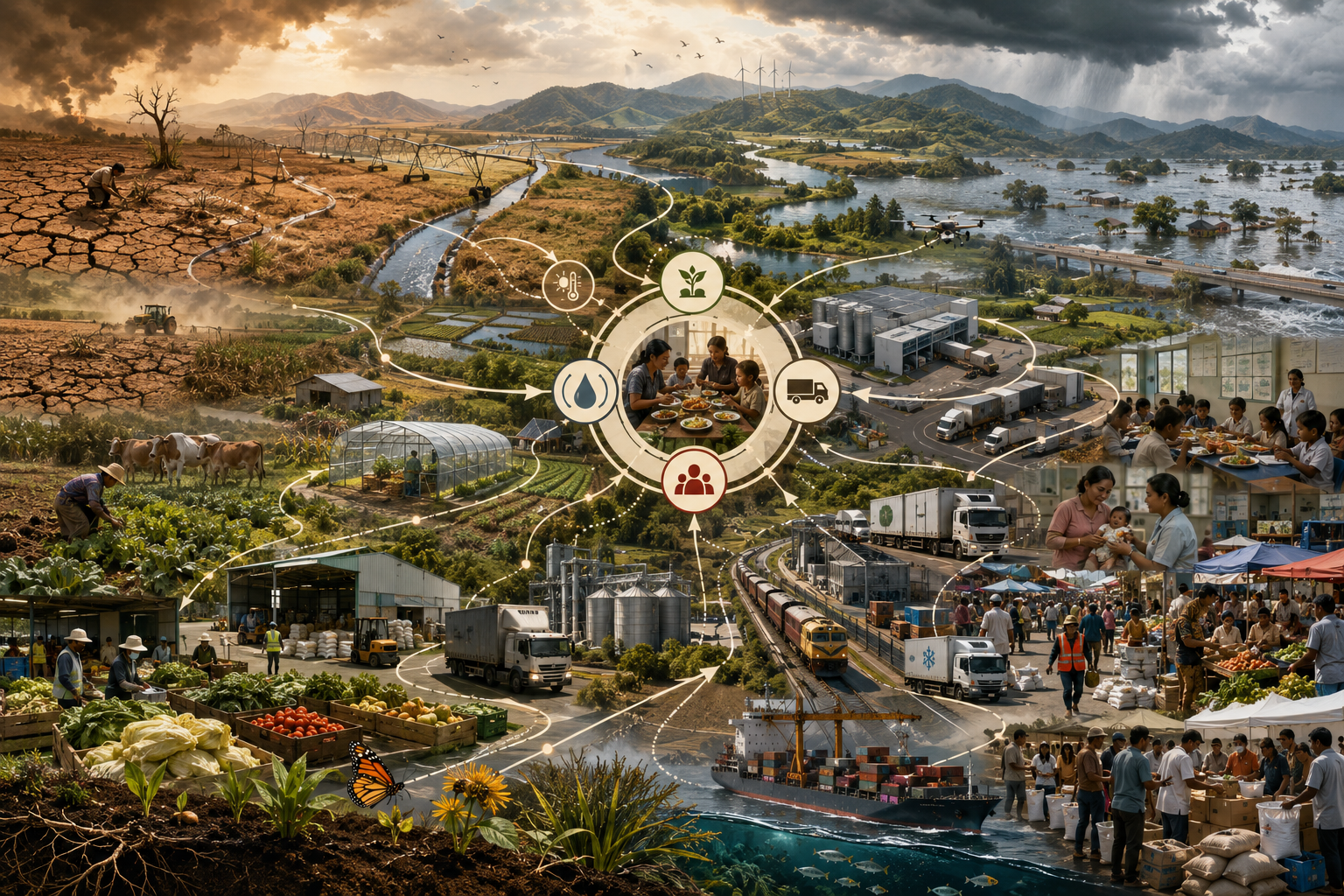
Food system fragility and resilience belong together because food security depends on far more than production alone. Food systems include the ecological, agricultural, logistical, economic, labor, financial, infrastructural, technological, institutional, cultural, and household systems that allow food to be grown, harvested, processed, stored, transported, sold, prepared, eaten, and sustained over time. When any part of that chain becomes brittle, food insecurity can emerge even where aggregate production appears sufficient.
Climate shocks, drought, flooding, water stress, soil degradation, biodiversity loss, fertilizer dependency, energy prices, conflict, trade disruption, transport failure, labor precarity, market concentration, household poverty, and weak public protection can all expose fragility in food systems. A crop failure may begin in the field, but its consequences can move through storage, transport, prices, nutrition, debt, employment, migration, public health, and political stability. Food system risk is therefore systemic: it travels through connections.
Main Library
Publications
Article Map
Risk & Resilience
Related Topic
Sustainable Development
Related Topic
Planetary Boundaries
Related Topic
Systems Thinking
This article builds on What Is Risk and Resilience in Sustainable Systems? by examining food systems as interconnected, climate-exposed, socially unequal, and highly sensitive systems under stress. It also connects closely with Climate Risk and Systemic Vulnerability, Compound Climate Events and Cascading Social Risk, and Water Security, Drought, Flood, and Resilience, because food fragility often emerges where climate, water, infrastructure, ecosystems, prices, livelihoods, and public protection interact.
The central argument is that food system resilience is not simply the ability to produce more food. It is the capacity of food systems to prevent, absorb, adapt to, recover from, and transform under disruption while preserving access to sufficient, safe, nutritious, culturally appropriate, and affordable food. A resilient food system must protect production, but also storage, transport, labor, markets, ecosystems, livelihoods, public health, household purchasing power, and the dignity of those most exposed to hunger.
Why Food System Fragility Matters
Food system fragility matters because food systems sit at the intersection of ecology, livelihoods, health, trade, infrastructure, finance, labor, and governance. They determine whether populations can access sufficient, nutritious, safe, and affordable food, and they shape the environmental conditions under which future food security remains possible. A fragile food system may appear functional under normal conditions while lacking the buffers needed to withstand climate shocks, logistics disruption, price volatility, crop disease, water stress, conflict, or household income loss.
This makes food systems especially important within sustainable systems thinking. A shock to food systems does not remain confined to farms or markets. It can affect household welfare, nutrition, employment, school attendance, migration, public health, fiscal pressure, social trust, and political stability at once. A food system is therefore not only a production system. It is a life-support system.
Fragility often hides in the ordinary operation of the system. A supply chain may be efficient but highly concentrated. A crop system may be productive but ecologically narrow. A household may be fed but one price shock away from hunger. A region may produce food but depend on imported fertilizer, diesel, feed, seed, packaging, or transport infrastructure. A country may have enough calories in aggregate while children, workers, migrants, rural communities, and low-income households remain food-insecure.
Food system resilience therefore requires asking where fragility accumulates before crisis. Are soils degrading? Are farms overdependent on groundwater? Are logistics corridors too concentrated? Are markets too exposed to energy prices? Are households protected from food-price spikes? Are local food systems diverse enough? Are public agencies able to monitor and respond? Are ecosystems still supporting pollination, soil health, water regulation, and pest control? These questions reveal whether food security is durable or merely temporarily functional.
What Food Systems Are
Food systems include the full set of actors, activities, infrastructures, ecosystems, institutions, and social relationships involved in feeding people. They include farms, fisheries, forests, livestock systems, seed systems, irrigation, soil, labor, storage, roads, ports, refrigeration, processing plants, packaging, wholesale markets, retail systems, restaurants, schools, households, waste systems, public agencies, trade networks, and financial systems. They also include cultural practices, land relations, gendered labor, informal markets, and the political economy of who controls food.
This broad framing is essential because food insecurity is rarely caused by production alone. A region may produce enough food but fail to distribute it equitably. A harvest may be adequate but prices may rise beyond household purchasing power. Food may be physically available but nutritionally poor, unsafe, culturally inappropriate, or inaccessible. A port closure, trucker shortage, fuel spike, electricity outage, flood-damaged road, cold-chain failure, conflict, or market panic can interrupt access without a simple production collapse.
Food systems are therefore social-ecological-technical systems. Ecological conditions shape what can be grown. Technology shapes how food is produced, stored, processed, transported, and sold. Institutions shape land rights, subsidies, safety standards, trade rules, emergency support, social protection, and market oversight. Social structures shape who labors, who profits, who eats, and who bears risk.
A systems view also helps distinguish food availability, food access, food utilization, and food stability. Availability concerns whether food exists in sufficient quantity. Access concerns whether people can obtain it physically and economically. Utilization concerns nutrition, health, safety, preparation, and dietary quality. Stability concerns whether these conditions can be sustained over time under shock and stress. Resilience must support all four dimensions.
Food system fragility emerges when one part of this system becomes too narrow, too dependent, too unequal, too degraded, too concentrated, or too poorly governed to absorb stress without transmitting harm elsewhere.
What Food System Fragility Means
Food system fragility refers to the susceptibility of food systems to disruption, cascading stress, and unequal harm. Fragility can appear in production, but it can also appear in logistics, storage, input supply, food prices, nutrition, household income, labor, governance, trade, ecosystems, finance, and recovery capacity. A fragile food system has too little adaptive room.
Some fragility is ecological. Soil degradation, water depletion, deforestation, biodiversity loss, pollinator decline, pest pressure, salinization, erosion, and climate extremes reduce the capacity of agricultural systems to sustain production. Some fragility is infrastructural. Weak roads, unreliable electricity, poor storage, damaged irrigation, limited cold chains, port bottlenecks, and fragile digital systems can disrupt food movement. Some fragility is economic. Debt, price volatility, market concentration, input dependence, low farm margins, and household poverty make food systems more exposed to shock.
Fragility can also be institutional. Weak public agencies, poor early warning, insufficient reserves, fragmented governance, inadequate safety nets, corruption, conflict, and lack of trust all reduce the capacity to respond. Food systems require coordination across agriculture, water, transport, energy, health, trade, finance, labor, environment, and social protection. When these systems operate in silos, food stress can move faster than response.
Food system fragility is often cumulative. A drought may not cause crisis by itself. But drought combined with degraded soils, weak storage, fertilizer dependence, high debt, poor social protection, and transport disruption can produce widespread insecurity. A price shock may be manageable for some households but devastating for others already facing unemployment, rent pressure, health costs, or displacement.
Resilience begins by making fragility visible. It asks where the system lacks diversity, redundancy, storage, ecological health, public capacity, social protection, and adaptive governance. It also asks who is exposed to the consequences when fragility becomes crisis.
Production Is Only One Part of Food Security
Production remains fundamental. Without adequate production, food systems cannot sustain reliable availability. But production is only one part of the food-security equation. A food system can produce enough in aggregate while many people remain hungry because food is unaffordable, poorly distributed, nutritionally inadequate, unsafe, or inaccessible. Food insecurity often emerges where production stress intersects with access stress.
This distinction matters because policy often defaults to yield. Higher yields can reduce pressure, but they do not automatically produce resilience. A high-yield system may depend on fragile inputs, water-intensive crops, fossil energy, narrow genetic diversity, vulnerable trade routes, underpaid labor, degraded soils, or unstable credit. It may produce calories while weakening ecological foundations. It may generate exports while local households remain food-insecure.
Access matters because hunger is strongly shaped by income, prices, markets, and public protection. When food prices rise faster than wages, households reduce meal quality, skip meals, take on debt, withdraw children from school, sell assets, migrate, or adopt other harmful coping strategies. Food insecurity can therefore grow even when shelves are not empty.
Stability also matters. A system that works only in normal conditions is not resilient. A food system must preserve access during drought, flood, heat, conflict, pandemic, port disruption, input shortage, fuel-price shock, currency stress, or public-health crisis. This requires buffers: storage, diverse supply chains, local capacity, social protection, ecological restoration, emergency planning, public reserves, and trusted institutions.
Food system resilience therefore shifts the central question. Instead of asking only whether production can increase, it asks whether the whole system can continue to nourish people under stress without destroying the ecological, social, and institutional foundations on which future food security depends.
Climate, Water, and Ecological Pressure
Climate, water, and ecological pressures are among the most important sources of food system fragility. Heat stress affects crops, livestock, workers, storage, transport, and food safety. Drought reduces soil moisture, irrigation availability, pasture, hydropower, and yields. Flooding can destroy crops, contaminate fields, damage roads, interrupt markets, and delay planting. Wildfire smoke can affect labor, crops, and livestock. Ocean warming and acidification affect fisheries. Pest and disease patterns shift as climates change.
Water insecurity is especially central. Agriculture is highly water-dependent, and water stress can affect production, processing, livestock, fisheries, household food preparation, sanitation, and food safety. Groundwater depletion may allow production to continue temporarily while undermining future resilience. Floods and droughts can affect the same region across different seasons, forcing systems to manage scarcity and excess together.
Ecological degradation compounds climate risk. Healthy soils store water, cycle nutrients, support microbial life, and buffer drought. Biodiversity supports pollination, pest regulation, and ecosystem stability. Forests and wetlands regulate water flows. Coastal ecosystems protect fisheries and settlements. When these ecological supports are degraded, food systems lose natural resilience and become more dependent on costly technical substitutes.
These pressures interact. Drought can increase irrigation demand, groundwater depletion, crop failure, food prices, and farmer debt. Flooding can damage stored food and transport routes, turning a production shock into an access shock. Heat can reduce labor productivity and increase food spoilage. Ecological degradation can turn climate variability into chronic instability.
A resilient food system must therefore be climate-aware, water-secure, and ecologically grounded. It must protect soils, watersheds, biodiversity, seed diversity, local knowledge, and adaptive farming systems. Food resilience is not only a logistics problem. It is also a living-systems problem.
Infrastructure, Logistics, Energy, and Labor
Food systems depend heavily on infrastructure: roads, ports, railways, storage, refrigeration, electricity, water systems, digital coordination, markets, warehouses, processing plants, and transport services. Stress in any of these domains can interrupt the movement of food even when production remains viable. This is why food system failures often resemble broader infrastructure and governance failures rather than purely agricultural ones.
Logistics systems are especially important because food is perishable, spatially distributed, and time-sensitive. Cold chains preserve nutrition and safety. Roads and ports connect rural producers to urban consumers. Electricity supports refrigeration, milling, processing, irrigation, packaging, retail, and food service. Fuel prices affect transport, fertilizer, machinery, and food prices. Digital systems coordinate inventory, payments, orders, routing, and trade documentation.
Labor is also central. Food systems depend on farmers, farmworkers, fishers, truck drivers, warehouse workers, food processors, market vendors, cooks, sanitation workers, retail workers, and care workers who prepare food in households and institutions. Heat, illness, migration restrictions, low wages, unsafe working conditions, conflict, and labor shortages can all disrupt the system. Labor precarity is food system fragility.
Infrastructure and labor risk often cascade. A flood closes roads, preventing workers from reaching processing facilities and food from reaching markets. A power outage damages refrigerated food and disables digital payment systems. A fuel shock raises transport and fertilizer costs. A pandemic disrupts labor, processing, schools, food assistance, and household income at once.
Resilient food systems require infrastructure reliability, but also redundancy, decentralization where useful, storage, local and regional capacity, worker protection, fair wages, health safeguards, emergency logistics, and continuity planning. A food system cannot be resilient if the people who make it function are treated as disposable.
Prices, Access, Nutrition, and Vulnerability
Food insecurity is shaped as much by access and affordability as by supply. Households may lose food security not because food disappears entirely, but because prices rise, incomes fall, transport becomes unreliable, public assistance is inadequate, or nutritious food becomes less accessible. This is why food system resilience must include household purchasing power and social protection.
Price shocks can spread quickly through food systems. Drought, conflict, fuel prices, trade restrictions, fertilizer costs, currency instability, speculation, and logistics disruption can all affect food prices. Even modest price increases can be severe for households that spend a large share of income on food. Low-income households often respond by reducing dietary diversity, buying cheaper and less nutritious food, skipping meals, taking children out of school, delaying healthcare, or taking on debt.
Nutrition matters because food security is not only about calories. A system that provides enough calories but fails to provide diverse, safe, nutritious food is not fully resilient. Malnutrition includes undernutrition, micronutrient deficiency, and diet-related disease. Food system stress often reduces dietary quality before it produces outright hunger.
Social vulnerability shapes how stress is experienced. Children, pregnant people, older adults, people with disabilities, displaced people, migrants, small farmers, pastoralists, informal workers, and low-income households are often more exposed to food insecurity and less able to buffer shocks. Women and girls may carry additional burdens through food preparation, care work, water collection, and household coping strategies.
A resilient food system must therefore protect access, not only supply. This includes school meals, cash transfers, food assistance, nutrition programs, emergency reserves, price monitoring, worker protections, local procurement, public distribution, and social safety nets that can expand quickly during crisis. Food resilience is partly about markets, but it cannot be left to markets alone.
Market Concentration, Trade, and Systemic Risk
Food systems are deeply shaped by trade and market structure. Trade can improve food security by allowing regions to access food they cannot produce locally, smooth local production shocks, and diversify supply. But trade can also create dependency when countries rely heavily on a narrow set of exporters, ports, shipping routes, commodities, inputs, or corporations. Resilience depends on the structure of dependency.
Market concentration can create hidden fragility. If seed, fertilizer, grain trading, meat processing, shipping, retail, or digital platforms are highly concentrated, disruptions or strategic decisions by a small number of actors can have wide effects. Efficiency may increase under normal conditions, but redundancy may decline. Local producers and consumers may have little control over price, access, or production choices.
Trade restrictions can amplify food stress. During crises, governments may restrict exports to protect domestic supply, but such measures can raise prices elsewhere and intensify global volatility. Import-dependent countries may face severe exposure when global prices rise, currencies weaken, or shipping routes are disrupted. Food system resilience therefore requires balancing local capacity, regional cooperation, and global trade rather than treating any one scale as sufficient.
Systemic risk also emerges through input dependence. Food production may rely on imported fertilizer, fuel, pesticides, machinery, seed, feed, packaging, and credit. A disruption in energy markets, finance, geopolitics, or transport can therefore affect food production indirectly. A systems view asks where food systems depend on things that are not obviously “food” but are essential to food production and access.
Resilient food systems need diversity across crops, suppliers, markets, logistics routes, production systems, knowledge systems, and governance arrangements. Diversity is not inefficiency. In risk terms, diversity is a buffer against common-mode failure.
Toward Food System Resilience
Food system resilience requires more than higher yields. It requires diversity, ecological stewardship, storage, logistics reliability, social protection, fair labor, price monitoring, water security, climate adaptation, public reserves, early warning, local capacity, and adaptive institutions. It also requires the ability to transform food systems when existing arrangements are brittle, unequal, or ecologically damaging.
First, resilient food systems need ecological foundations. Soil health, water stewardship, biodiversity, pollination, agroecology, crop diversity, seed systems, fisheries management, and ecosystem restoration all support long-term food security. Production that undermines these foundations can increase short-term output while weakening future resilience.
Second, they need infrastructural and logistical capacity. Storage, cold chains, roads, markets, ports, energy systems, digital coordination, emergency transport, and decentralized distribution can reduce food loss and maintain access during disruption. But infrastructure should not be designed only for efficiency. It should be designed for continuity under stress.
Third, they need social protection and nutrition safeguards. Food assistance, cash transfers, school meals, public procurement, emergency reserves, nutrition programs, and worker protections help prevent production or price shocks from becoming hunger and malnutrition. Protecting access is as important as protecting output.
Fourth, they need governance capable of learning. Food system resilience requires monitoring, early warning, scenario planning, transparent reserves, fair allocation, anti-corruption safeguards, local participation, and coordination across agriculture, water, energy, transport, health, trade, labor, environment, and social protection.
Finally, resilient food systems need justice. A system that feeds some by exploiting others, degrading ecosystems, or leaving vulnerable households exposed is not resilient in a meaningful sense. Food resilience must protect livelihoods, dignity, ecological function, and the right to food across generations.
Mathematical Lens: Food System Fragility and Resilience
Food system fragility can be represented as a relationship among production stress, water stress, ecological degradation, logistics fragility, input dependency, price volatility, household vulnerability, governance capacity, social protection, and nutritional adequacy. Let \(P_r\) represent production stress, \(W_r\) represent water stress, \(E_r\) represent ecological degradation, \(L_r\) represent logistics fragility, \(I_r\) represent input dependency, \(V_r\) represent price volatility, \(H_r\) represent household vulnerability, \(G_r\) represent governance capacity, \(S_r\) represent social protection, and \(N_r\) represent nutritional adequacy for food system \(r\).
A food-system fragility index can be written as:
F_r = f_1P_r + f_2W_r + f_3E_r + f_4L_r + f_5I_r + f_6V_r
\]
Interpretation: Food system fragility rises when production stress, water stress, ecological degradation, logistics fragility, input dependency, and price volatility accumulate.
A food-access vulnerability score can be represented as:
A_r = a_1H_r + a_2V_r + a_3U_r + a_4(1 – S_r) + a_5(1 – N_r)
\]
Interpretation: Food access vulnerability rises when household vulnerability, price volatility, inequality, weak social protection, and poor nutritional adequacy combine.
A resilience capacity score can be written as:
R_r = r_1D_r + r_2B_r + r_3S_r + r_4G_r + r_5M_r + r_6K_r
\]
Interpretation: Food system resilience increases when diversity, ecological buffers, social protection, governance, market access, and storage capacity reinforce one another.
A cascading food-risk score can be represented as:
C_r = (F_r + A_r)(1 + \alpha T_r)(1 + \beta Q_r)
\]
Interpretation: Cascading food risk rises when fragility and access vulnerability move through trade dependency and cross-sector linkages.
A justice-weighted food insecurity risk can be written as:
J_r = C_r(1 + \theta U_r)
\]
Interpretation: Food insecurity risk becomes more urgent when cascading food-system stress is amplified by inequality.
The food-resilience gap can then be written as:
\Delta_r = \max(0, J_r – R_r)
\]
Interpretation: A food-resilience gap appears when justice-weighted food-system risk exceeds the system’s capacity to preserve production, access, nutrition, livelihoods, and ecological function under stress.
| Term | Meaning | Interpretive role |
|---|---|---|
| \(F_r\) | Food-system fragility | Represents production stress, water stress, ecological degradation, logistics fragility, input dependency, and price volatility. |
| \(A_r\) | Food-access vulnerability | Represents household vulnerability, price volatility, inequality, weak social protection, and nutritional inadequacy. |
| \(R_r\) | Resilience capacity | Represents diversity, ecological buffers, social protection, governance, market access, and storage capacity. |
| \(C_r\) | Cascading food risk | Represents the spread of food stress through trade, infrastructure, markets, and cross-sector dependencies. |
| \(J_r\) | Justice-weighted food insecurity risk | Represents cascading food risk adjusted for unequal exposure and unequal access. |
| \(\Delta_r\) | Food-resilience gap | Identifies where food-system risk exceeds the system’s capacity to protect food security and nutrition. |
This mathematical lens is not meant to reduce hunger, agriculture, or food systems to a single number. It clarifies what responsible analysis must examine: production, water, ecosystems, logistics, inputs, prices, households, nutrition, labor, governance, social protection, trade dependency, and inequality.
Advanced Python Workflow: Food System Fragility Diagnostics
The following Python workflow models food system fragility and resilience as relationships among production stress, water stress, ecological degradation, logistics fragility, input dependency, price volatility, household vulnerability, inequality, social protection, nutritional adequacy, diversity, ecological buffers, governance capacity, market access, storage capacity, trade dependency, and cross-sector linkage.
from pathlib import Path
import numpy as np
import pandas as pd

BASE_DIR = Path("articles/food-system-fragility-and-resilience")
DATA_FILE = BASE_DIR / "data" / "food_system_fragility_panel.csv"
OUTPUT_DIR = BASE_DIR / "outputs"


def load_data():
    df = pd.read_csv(DATA_FILE)

    numeric_cols = [
        col for col in df.columns
        if col not in {"system_id", "system_name", "region", "food_system_type"}
    ]

    for col in numeric_cols:
        if ((df[col] < 0) | (df[col] > 1)).any():
            raise ValueError(f"{col} must be scaled between 0 and 1.")

    return df


def score_systems(df):
    scored = df.copy()

    scored["food_system_fragility"] = (
        0.20 * scored["production_stress"]
        + 0.18 * scored["water_stress"]
        + 0.18 * scored["ecological_degradation"]
        + 0.16 * scored["logistics_fragility"]
        + 0.14 * scored["input_dependency"]
        + 0.14 * scored["price_volatility"]
    )

    scored["food_access_vulnerability"] = (
        0.24 * scored["household_vulnerability"]
        + 0.22 * scored["price_volatility"]
        + 0.20 * scored["inequality_pressure"]
        + 0.18 * (1 - scored["social_protection_capacity"])
        + 0.16 * (1 - scored["nutritional_adequacy"])
    )

    scored["resilience_capacity"] = (
        0.20 * scored["food_system_diversity"]
        + 0.18 * scored["ecological_buffer_condition"]
        + 0.18 * scored["social_protection_capacity"]
        + 0.16 * scored["governance_capacity"]
        + 0.14 * scored["market_access_reliability"]
        + 0.14 * scored["storage_capacity"]
    )

    scored["cascading_food_risk"] = (
        (scored["food_system_fragility"] + scored["food_access_vulnerability"])
        * (1 + 0.30 * scored["trade_dependency"])
        * (1 + 0.30 * scored["cross_sector_linkage"])
    )

    scored["justice_weighted_food_risk"] = (
        scored["cascading_food_risk"]
        * (1 + 0.35 * scored["inequality_pressure"])
    )

    scored["food_resilience_gap"] = np.maximum(
        0,
        scored["justice_weighted_food_risk"] - scored["resilience_capacity"],
    )

    scored["diagnostic_priority"] = np.select(
        [
            scored["production_stress"] > 0.72,
            scored["water_stress"] > 0.72,
            scored["ecological_degradation"] > 0.70,
            scored["logistics_fragility"] > 0.70,
            scored["household_vulnerability"] > 0.70,
            scored["food_resilience_gap"] > 1.0,
        ],
        [
            "production_and_climate_resilience",
            "water_secure_food_systems",
            "ecological_restoration_and_soil_health",
            "logistics_storage_and_market_continuity",
            "social_protection_and_food_access",
            "close_food_resilience_gap",
        ],
        default="monitor_and_preserve_food_system_resilience",
    )

    return scored.sort_values(
        ["food_resilience_gap", "justice_weighted_food_risk"],
        ascending=False,
    ).reset_index(drop=True)


def main():
    OUTPUT_DIR.mkdir(parents=True, exist_ok=True)

    raw = load_data()
    scored = score_systems(raw)

    region_summary = (
        scored.groupby("region")
        .agg(
            systems=("system_id", "count"),
            mean_fragility=("food_system_fragility", "mean"),
            mean_access_vulnerability=("food_access_vulnerability", "mean"),
            mean_cascading_risk=("cascading_food_risk", "mean"),
            mean_resilience_capacity=("resilience_capacity", "mean"),
            mean_resilience_gap=("food_resilience_gap", "mean"),
        )
        .reset_index()
        .sort_values("mean_resilience_gap", ascending=False)
    )

    scored.to_csv(OUTPUT_DIR / "food_system_fragility_scores.csv", index=False)
    region_summary.to_csv(OUTPUT_DIR / "food_system_region_summary.csv", index=False)

    print(scored.round(3).to_string(index=False))
    print(region_summary.round(3).to_string(index=False))


if __name__ == "__main__":
    main()
This workflow operationalizes the article’s central claim: food system risk becomes systemic when production stress, water stress, ecological degradation, logistics fragility, input dependency, price volatility, household vulnerability, inequality, trade dependency, and weak social protection interact. It separates production fragility from food-access vulnerability so that resilience can be analyzed across the full food system rather than reduced to yields alone.
Advanced R Workflow: Food System Resilience Dashboarding
The following R workflow creates dashboard-ready outputs for comparing food system fragility, food access vulnerability, resilience capacity, cascading food risk, justice-weighted food risk, food-resilience gaps, regional summaries, food-system-type summaries, and long-format visualization data.
library(readr)
library(dplyr)
library(tidyr)

base_dir <- "articles/food-system-fragility-and-resilience"
data_file <- file.path(base_dir, "data", "food_system_fragility_panel.csv")
output_dir <- file.path(base_dir, "outputs")

dir.create(output_dir, recursive = TRUE, showWarnings = FALSE)

systems <- read_csv(data_file, show_col_types = FALSE)

score_systems <- function(df) {
  df %>%
    mutate(
      food_system_fragility =
        0.20 * production_stress +
        0.18 * water_stress +
        0.18 * ecological_degradation +
        0.16 * logistics_fragility +
        0.14 * input_dependency +
        0.14 * price_volatility,

      food_access_vulnerability =
        0.24 * household_vulnerability +
        0.22 * price_volatility +
        0.20 * inequality_pressure +
        0.18 * (1 - social_protection_capacity) +
        0.16 * (1 - nutritional_adequacy),

      resilience_capacity =
        0.20 * food_system_diversity +
        0.18 * ecological_buffer_condition +
        0.18 * social_protection_capacity +
        0.16 * governance_capacity +
        0.14 * market_access_reliability +
        0.14 * storage_capacity,

      cascading_food_risk =
        (food_system_fragility + food_access_vulnerability) *
        (1 + 0.30 * trade_dependency) *
        (1 + 0.30 * cross_sector_linkage),

      justice_weighted_food_risk =
        cascading_food_risk *
        (1 + 0.35 * inequality_pressure),

      food_resilience_gap =
        pmax(0, justice_weighted_food_risk - resilience_capacity),

      diagnostic_priority = case_when(
        production_stress > 0.72 ~
          "production_and_climate_resilience",
        water_stress > 0.72 ~
          "water_secure_food_systems",
        ecological_degradation > 0.70 ~
          "ecological_restoration_and_soil_health",
        logistics_fragility > 0.70 ~
          "logistics_storage_and_market_continuity",
        household_vulnerability > 0.70 ~
          "social_protection_and_food_access",
        food_resilience_gap > 1.0 ~
          "close_food_resilience_gap",
        TRUE ~
          "monitor_and_preserve_food_system_resilience"
      )
    ) %>%
    arrange(desc(food_resilience_gap), desc(justice_weighted_food_risk))
}

scored <- score_systems(systems)

region_summary <- scored %>%
  group_by(region) %>%
  summarise(
    systems = n(),
    mean_fragility = mean(food_system_fragility),
    mean_access_vulnerability = mean(food_access_vulnerability),
    mean_cascading_risk = mean(cascading_food_risk),
    mean_resilience_capacity = mean(resilience_capacity),
    mean_resilience_gap = mean(food_resilience_gap),
    .groups = "drop"
  ) %>%
  arrange(desc(mean_resilience_gap))

type_summary <- scored %>%
  group_by(food_system_type) %>%
  summarise(
    systems = n(),
    mean_production_stress = mean(production_stress),
    mean_water_stress = mean(water_stress),
    mean_fragility = mean(food_system_fragility),
    mean_access_vulnerability = mean(food_access_vulnerability),
    mean_resilience_gap = mean(food_resilience_gap),
    .groups = "drop"
  ) %>%
  arrange(desc(mean_resilience_gap))

dashboard_long <- scored %>%
  select(
    system_id,
    system_name,
    region,
    food_system_type,
    food_system_fragility,
    food_access_vulnerability,
    resilience_capacity,
    cascading_food_risk,
    justice_weighted_food_risk,
    food_resilience_gap
  ) %>%
  pivot_longer(
    cols = c(
      food_system_fragility,
      food_access_vulnerability,
      resilience_capacity,
      cascading_food_risk,
      justice_weighted_food_risk,
      food_resilience_gap
    ),
    names_to = "metric",
    values_to = "value"
  )

write_csv(scored, file.path(output_dir, "r_food_system_fragility_scores.csv"))
write_csv(region_summary, file.path(output_dir, "r_region_summary.csv"))
write_csv(type_summary, file.path(output_dir, "r_type_summary.csv"))
write_csv(dashboard_long, file.path(output_dir, "r_dashboard_long.csv"))

print(scored)
print(region_summary)
print(type_summary)
The R workflow complements the Python workflow by producing dashboard-oriented outputs. It is especially useful for comparing climate-stressed production systems, water-dependent agricultural regions, trade-dependent food systems, logistics-exposed markets, household access vulnerability, and social-protection needs. A production version could connect to crop yields, food prices, rainfall anomalies, drought indices, flood records, market access data, fertilizer prices, transport disruptions, food assistance records, household surveys, and nutrition indicators.
Engineering Extensions in the GitHub Repository
The accompanying repository can extend the article beyond conceptual explanation into reproducible food-system resilience analysis. The article folder is designed around a synthetic food-system indicator panel, advanced Python diagnostics, advanced R dashboarding, SQL schema scaffolding, scenario outputs, uncertainty analysis, documentation, and extensible scoring logic.
The article body foregrounds Python and R because they are accessible languages for data analysis, scenario modeling, uncertainty analysis, and dashboard preparation. Additional languages can strengthen the repository where they serve a real analytical purpose. SQL can support structured records for food systems, supply chains, market prices, hazards, food access, nutrition, source provenance, and auditability. Go can support lightweight scoring services. Rust can support reliable command-line validation tools. C and C++ can support compact numerical kernels for food fragility or access-risk scoring. Fortran can support numerical resilience-gap calculations and legacy scientific-computing workflows where useful.
The deeper purpose of the repository is not to turn food system resilience into false precision. It is to make assumptions visible. By separating production stress, water stress, ecological degradation, logistics fragility, input dependency, price volatility, household vulnerability, social protection, nutrition, diversity, governance, market access, storage capacity, trade dependency, and cross-sector linkage, the workflow allows users to inspect how final interpretations are produced.
GitHub Repository
Complete Code Repository
The full code directory for this article, including advanced Python diagnostics, advanced R dashboard workflow, synthetic food-system fragility data, SQL schema, scenario outputs, uncertainty analysis, documentation, and systems-level extensions, is available on GitHub.
Common Misunderstandings
A common misunderstanding is that food security is mainly about producing more food. Production matters, but food security also depends on affordability, access, storage, logistics, nutrition, safety, public protection, and household purchasing power.
Another misunderstanding is that food systems are linear supply chains. Food systems are networks shaped by ecology, labor, energy, water, trade, finance, infrastructure, governance, markets, households, culture, and waste.
A third misunderstanding is that efficiency always improves resilience. Highly efficient food systems may become brittle if they reduce diversity, storage, redundancy, local capacity, labor protections, or ecological buffers.
A fourth misunderstanding is that food insecurity means food has physically disappeared. In many crises, food exists but is unaffordable, inaccessible, unsafe, nutritionally inadequate, or unevenly distributed.
A fifth misunderstanding is that food system resilience is only a technical problem. It is also an ecological, social, labor, governance, public-health, and justice problem.
A final misunderstanding is that global trade or local production alone can solve food insecurity. Resilience usually requires a balanced architecture of local capacity, regional cooperation, diversified trade, social protection, ecological stewardship, and accountable governance.
Conclusion
Food system fragility and resilience must be understood across the full chain from ecological foundations to household access. Food systems are not merely agricultural systems facing occasional shocks. They are interconnected ecological, logistical, economic, labor, infrastructural, institutional, and social systems whose stability depends on much more than production alone. Climate pressure, water stress, ecological degradation, infrastructure disruption, price volatility, inequality, market concentration, and governance weakness can all turn localized strain into wider food insecurity.
To think seriously about food resilience is to think across production, storage, transport, affordability, nutrition, labor, ecosystems, public protection, and governance. It is to ask not only how food is produced, but how it is moved, priced, accessed, prepared, governed, and sustained ecologically over time. Sustainable systems are not food-secure because they maximize output under ideal conditions. They are food-secure when they preserve enough diversity, buffering capacity, social protection, and adaptive room to keep stress from becoming hunger, malnutrition, and systemic instability.
The computational workflows attached to this article extend that argument into practice. They separate food system fragility, food access vulnerability, resilience capacity, cascading food risk, justice-weighted food insecurity risk, and food-resilience gaps. They show why some systems require climate-resilient production, some require water-secure agriculture, some require ecological restoration, some require logistics and storage continuity, and some require social protection and food access safeguards.
Food system resilience is therefore not only about feeding people today. It is about preserving the ecological, infrastructural, institutional, and social conditions that make nourishment possible under stress.
Return to the Risk & Resilience knowledge series.
Related Reading
- Risk & Resilience
- What Is Risk and Resilience in Sustainable Systems?
- Climate Risk and Systemic Vulnerability
- Compound Climate Events and Cascading Social Risk
- Water Security, Drought, Flood, and Resilience
- Food System Fragility and Resilience
- Ecosystem Resilience and Natural Buffers
- Nature-Based Solutions, Ecosystem Buffers, and Resilience
- Planetary Boundaries and Earth System Resilience
- Sustainable Development
- Planetary Boundaries
- Systems Thinking
Further Reading
- Food and Agriculture Organization of the United Nations (n.d.) Agrifood Systems. Available at: https://www.fao.org/food-systems/en.
- Food and Agriculture Organization of the United Nations (2018) Sustainable Food Systems: Concept and Framework. Available at: https://openknowledge.fao.org/server/api/core/bitstreams/b620989c-407b-4caf-a152-f790f55fec71/content.
- Intergovernmental Panel on Climate Change (2022) Climate Change 2022: Impacts, Adaptation and Vulnerability, Chapter 5: Food, Fibre and Other Ecosystem Products. Available at: https://www.ipcc.ch/report/ar6/wg2/chapter/chapter-5/.
- Intergovernmental Panel on Climate Change (2022) AR6 WGII Fact Sheet: Food and Water. Available at: https://www.ipcc.ch/report/ar6/wg2/downloads/outreach/IPCC_AR6_WGII_FactSheet_FoodAndWater.pdf.
- World Food Programme (n.d.) What Are Food Systems? Available at: https://www.wfp.org/food-systems.
- World Food Programme (2024) Resilient Food Systems for Climate Action. Available at: https://www.wfp.org/publications/resilient-food-systems-climate-action.
- World Bank (n.d.) Food Systems 2030. Available at: https://www.worldbank.org/en/programs/food-systems-2030.
- World Bank (2026) Food Security Update. Available at: https://www.worldbank.org/en/topic/agriculture/brief/food-security-update.
References
- Food and Agriculture Organization of the United Nations (n.d.) Agrifood Systems. Available at: https://www.fao.org/food-systems/en.
- Food and Agriculture Organization of the United Nations (2018) Sustainable Food Systems: Concept and Framework. Available at: https://openknowledge.fao.org/server/api/core/bitstreams/b620989c-407b-4caf-a152-f790f55fec71/content.
- Intergovernmental Panel on Climate Change (2022) Climate Change 2022: Impacts, Adaptation and Vulnerability, Chapter 5: Food, Fibre and Other Ecosystem Products. Available at: https://www.ipcc.ch/report/ar6/wg2/chapter/chapter-5/.
- Intergovernmental Panel on Climate Change (2022) AR6 WGII Fact Sheet: Food and Water. Available at: https://www.ipcc.ch/report/ar6/wg2/downloads/outreach/IPCC_AR6_WGII_FactSheet_FoodAndWater.pdf.
- World Food Programme (n.d.) What Are Food Systems? Available at: https://www.wfp.org/food-systems.
- World Food Programme (2024) Resilient Food Systems for Climate Action. Available at: https://www.wfp.org/publications/resilient-food-systems-climate-action.
- World Bank (n.d.) Food Systems 2030. Available at: https://www.worldbank.org/en/programs/food-systems-2030.
- World Bank (2026) Food Security Update. Available at: https://www.worldbank.org/en/topic/agriculture/brief/food-security-update.