
Last Updated May 8, 2026
Climate risk and systemic vulnerability belong together because climate change does not act on empty space. Climate hazards move through infrastructures, institutions, ecosystems, economies, supply chains, public-health systems, housing systems, water systems, food systems, and unequal social conditions. A heatwave is not only a temperature event. A flood is not only excess water. A drought is not only missing rainfall. Each becomes dangerous through the systems it encounters: who is exposed, who is protected, which infrastructures are brittle, which institutions are prepared, which ecosystems still buffer disturbance, and which communities have enough adaptive capacity to endure stress without being pushed into deeper harm.
The IPCC’s risk framing is especially important because it defines climate-related risk as an interaction among climate-related hazards, exposure, and vulnerability. That means climate risk is not simply a matter of more extreme weather. It is also a matter of where people and systems are located, how susceptible they are to damage, how much capacity they have to cope and adapt, and how development choices change those conditions over time. Climate risk is therefore a systems problem as much as an environmental one.
Main Library
Publications
Article Map
Risk & Resilience
Related Topic
Sustainable Development
Related Topic
Planetary Boundaries
Related Topic
Systems Thinking
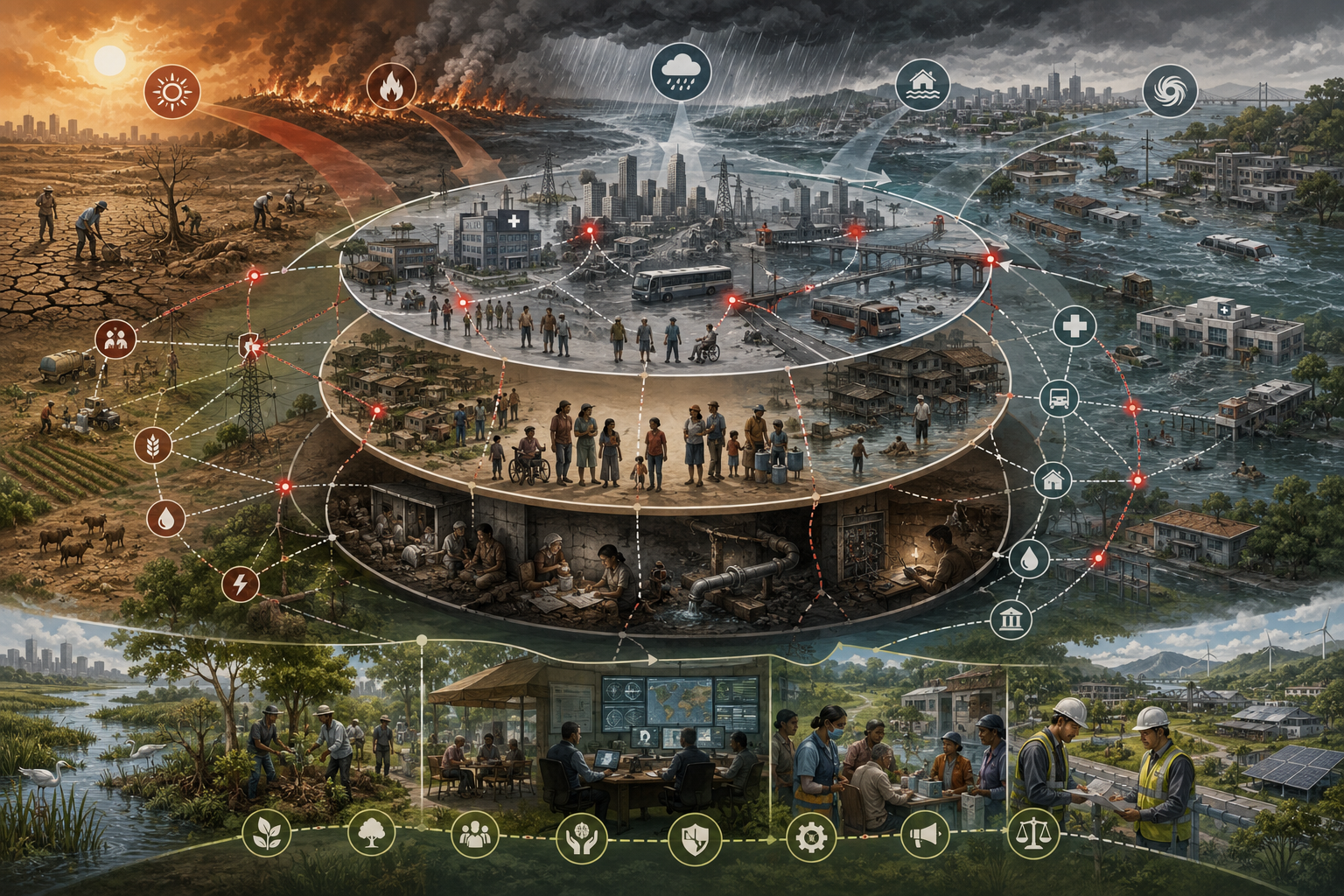
This article builds on What Is Risk and Resilience in Sustainable Systems? by examining climate change as a driver of systemic vulnerability. It also connects closely with Vulnerability, Exposure, and Sensitivity and Cascading Failures in Interdependent Systems, because climate hazards become most dangerous when they move through exposed, unequal, and interdependent systems.
The central argument is that climate risk is not only a hazard problem. It is a development, governance, infrastructure, ecological, and justice problem. Climate hazards become systemic when they interact with weak public capacity, exposed settlement patterns, degraded ecosystems, fragile infrastructure, concentrated supply chains, health-system strain, energy dependence, social inequality, and institutional delay. Climate resilience therefore requires more than adapting to weather extremes. It requires reducing the structural vulnerabilities that allow climate stress to cascade across systems and concentrate harm among those with the least margin.
Why This Distinction Matters
Climate change is often described through hazards: heatwaves, droughts, floods, wildfires, storms, sea-level rise, coastal erosion, crop stress, ecosystem disruption, and extreme precipitation. That description is necessary, but incomplete. Hazards do not produce uniform consequences on their own. Their effects depend on where people and assets are located, how systems are built, which populations have resources to cope, and whether institutions can anticipate, communicate, coordinate, and respond.
This distinction matters because many climate debates still focus too narrowly on physical hazard while neglecting the deeper structures that make hazards dangerous. A flood becomes a disaster not only because water rises, but because housing is exposed, drainage systems are weak, wetlands have been degraded, insurance is inaccessible, public agencies are underfunded, and households lack the savings or legal protection needed for recovery. A heatwave becomes deadly not only because temperatures rise, but because cooling access is unequal, housing is poorly insulated, workers are exposed outdoors, health systems are strained, tree canopy is uneven, and public communication fails to reach vulnerable residents.
Climate risk is therefore not simply “natural” risk intensified by global warming. It is socially, institutionally, infrastructurally, and ecologically organized risk under changing climatic conditions. Climate hazards reveal the systems societies have built. They expose where development has increased exposure, where public investment has been neglected, where ecological buffers have been removed, where inequalities have been normalized, and where governance systems are unable to act before crisis becomes visible.
The distinction also matters because it changes what climate adaptation means. If climate risk were only a hazard problem, adaptation could be treated as a matter of physical protection: walls, pumps, cooling systems, drought-resistant crops, emergency alerts, and stronger buildings. Those tools can be important, but they are insufficient. If risk is produced through hazard, exposure, and vulnerability, then adaptation must also address land use, housing, poverty, public health, labor conditions, ecosystem restoration, infrastructure maintenance, institutional trust, finance, and governance capacity.
Climate risk becomes a systems problem because climate stress rarely remains inside one sector. A heatwave affects health, electricity demand, water use, labor productivity, transport reliability, food spoilage, school safety, and public services. A drought affects agriculture, hydropower, household water access, food prices, debt burdens, migration pressure, ecosystem health, and political stability. A flood affects housing, transport, sanitation, healthcare, logistics, public finance, and recovery institutions. Climate change makes visible the interdependence that ordinary planning often hides.
What Climate Risk Means
Climate risk refers to the potential for adverse consequences arising from climate-related hazards interacting with exposure and vulnerability. The IPCC’s framing is valuable because it treats risk as dynamic. Hazards change over time. Exposure changes through settlement, infrastructure, land use, investment, migration, and economic development. Vulnerability changes through poverty, inequality, health, public services, social protection, ecological degradation, institutional capacity, and adaptive action.
This dynamic view is crucial. Climate risk is not a fixed property of a place. It is produced and reproduced through development decisions. A coastal city can increase future risk by building in flood-prone areas, hardening shorelines in ways that degrade wetlands, concentrating transport and energy systems in exposed zones, or failing to protect low-income communities. A rural region can increase risk through groundwater depletion, soil degradation, crop monoculture, debt exposure, loss of local storage, and weakened extension services. A national economy can increase risk through reliance on vulnerable supply chains, water-stressed energy systems, fragile food imports, or underfunded public-health capacity.
Climate risk therefore cannot be understood only by asking what the climate will do. It also requires asking what societies are doing: where they build, who they protect, what they maintain, what they neglect, whose knowledge counts, what ecosystems remain intact, what public systems have capacity, and what inequalities are allowed to persist.
Risk also includes uncertainty. Climate models can estimate many hazards, but decision-makers often face deep uncertainty about timing, local impacts, compound events, social response, infrastructure interactions, and adaptation limits. A serious climate-risk framework must therefore combine evidence with humility. It must support action even when precise prediction is impossible, because waiting for certainty can allow exposure and vulnerability to deepen.
Climate risk is best understood as an evolving relationship among atmosphere, land, water, infrastructure, ecosystems, institutions, and people. The same hazard can produce very different outcomes depending on preparedness, exposure, social protection, ecological buffering, and governance. That is why climate resilience must address the conditions that turn hazard into harm, not only the hazard itself.
What Systemic Vulnerability Means
Systemic vulnerability refers to susceptibility to harm that is embedded across interconnected systems rather than confined to one exposed asset, household, sector, or institution. It arises when infrastructures, ecosystems, livelihoods, social protections, public agencies, financial systems, and governance arrangements are linked in ways that allow stress in one domain to weaken others.
In climate terms, vulnerability is not only about whether a single building floods, a single crop fails, or a single household lacks cooling. It is also about whether a community depends on one transport corridor, one water source, one electricity supply, one employer, one fragile supply chain, one hospital, or one under-resourced public agency. It is about whether multiple systems fail together.
Systemic vulnerability often develops quietly. It can accumulate through deferred maintenance, underfunded drainage, fragmented governance, housing segregation, ecological degradation, weak health systems, degraded labor protections, food insecurity, insurance retreat, debt pressure, and erosion of public trust. These conditions may not appear as crisis during ordinary periods. They become visible when climate stress arrives.
This is why systemic vulnerability differs from simple exposure. Exposure tells us who or what is in harm’s way. Systemic vulnerability asks what happens next. Can people evacuate? Can hospitals function? Can water systems operate? Can public agencies communicate? Can supply chains reroute? Can households recover? Can ecosystems buffer disturbance? Can institutions learn? Can communities rebuild without displacement? Can risk be reduced rather than simply redistributed?
A system may appear stable under normal conditions while remaining deeply vulnerable under climate stress. That is especially true where efficiency has been prioritized over redundancy, where land-use decisions have increased exposure, where social inequality has been normalized, where ecological buffers have been removed, or where governments respond only after visible disaster occurs. Systemic vulnerability is the condition that allows climate hazards to become cascading crises.
Hazards, Exposure, and Vulnerability
The hazard-exposure-vulnerability triad remains one of the clearest ways to understand climate risk. Hazards include physical events and trends such as heat, drought, wildfire, flooding, storm surge, sea-level rise, heavy precipitation, glacier loss, permafrost thaw, ocean warming, and ecosystem disruption. Exposure refers to the people, assets, ecosystems, institutions, livelihoods, and infrastructure situated where those hazards can affect them. Vulnerability refers to the propensity or predisposition to be adversely affected, including sensitivity to harm and lack of capacity to cope or adapt.
Each element matters. A powerful hazard with little exposure may produce limited harm. High exposure with strong protective systems may still be manageable. Moderate hazards can become devastating where vulnerability is high. The most severe risks often emerge when all three intensify at once: stronger hazards, growing exposure, and deepening vulnerability.
Climate change increases hazard pressure, but development choices shape exposure and vulnerability. Urban growth in floodplains increases exposure. Loss of wetlands increases flood sensitivity. Informal settlement on unstable slopes increases landslide risk. Outdoor labor without heat protection increases health vulnerability. Poor housing increases thermal stress. Weak public-health systems increase mortality. Underfunded transit increases evacuation difficulty. Lack of social protection increases recovery failure. Ecological degradation removes buffers that once absorbed disturbance.
The triad also clarifies why climate risk is not evenly distributed. People may face the same hazard but have different levels of exposure and vulnerability. A heatwave affects people differently depending on housing, income, age, health, job type, tree cover, cooling access, electricity reliability, social isolation, and public-health outreach. A flood affects people differently depending on location, drainage, mobility, legal status, insurance, savings, and recovery assistance.
Climate resilience must therefore act on all three dimensions. It must reduce hazards through mitigation where possible, reduce exposure through planning and protection, and reduce vulnerability through public investment, social protection, ecological restoration, infrastructure maintenance, health systems, and inclusive governance.
How Climate Risk Becomes Systemic
Climate risk becomes systemic when climate hazards interact with networked dependencies and institutional fragilities so that impacts spread beyond their point of origin. The hazard may begin as heat, flood, drought, fire, or storm, but the consequences move through systems that depend on one another.
Heat can destabilize electricity demand, which affects power reliability, which affects cooling access, medical devices, food storage, communications, water pumping, and workplace safety. Drought can reduce agricultural yield, which affects farmer income, food prices, debt burdens, migration pressure, public finance, nutrition, and social stability. Flooding can damage transport and logistics, interrupting healthcare delivery, school access, supply chains, emergency response, sanitation, and local economies. Wildfire can damage housing, air quality, insurance markets, grid reliability, ecosystems, public health, and local government budgets.
These are not secondary effects. They are the mechanism through which climate risk becomes systemic. The most dangerous climate impacts often emerge through interaction rather than isolated damage.
Systemic climate risk is also shaped by timing. A single hazard may be manageable when institutions have capacity. But hazards that arrive during economic stress, public-health strain, political instability, infrastructure maintenance backlogs, or previous disaster recovery can overwhelm systems that might otherwise absorb them. Compound events are especially dangerous because they reduce the time and space available for recovery. A drought followed by heat, then fire, then flood, can push ecosystems, households, and governments beyond adaptive capacity.
Systemic risk also crosses boundaries. A climate event in one region can affect food prices, migration, supply chains, insurance markets, energy security, debt, and political stability elsewhere. Climate risk travels through trade, finance, logistics, data, labor, and governance systems. In an interconnected world, the location of the hazard is not the same as the geography of consequence.
This is why climate risk governance cannot remain siloed. Sector-by-sector adaptation may reduce direct losses in one domain while missing how failure propagates through others. Climate-resilient planning must map dependencies, protect essential functions, strengthen ecological buffers, preserve redundancy, and anticipate cascading impacts before they become visible.
Inequality and the Distribution of Climate Risk
Climate risk is distributed unequally because vulnerability is distributed unequally. Climate change is often described as a global problem, but its harms are filtered through local and historical conditions: poverty, racism, colonial legacies, caste, gender inequality, disability, age, legal status, labor precarity, land tenure, public disinvestment, housing segregation, and unequal political voice.
Low-income communities are often located in more exposed areas, served by weaker infrastructure, less able to insure losses, more dependent on climate-sensitive livelihoods, and less likely to receive rapid recovery support. Informal workers may lose income during heat, flood, or storm events without compensation. People with disabilities, older adults, children, migrants, incarcerated people, unhoused people, and people with chronic illnesses may face much higher risk from the same event. Communities historically excluded from infrastructure investment may experience climate hazards as an intensification of existing neglect.
Inequality also shapes adaptation itself. Wealthier households may buy cooling, move away from exposed areas, insure assets, elevate homes, or access legal and financial support. Poorer households may be forced to remain in place, accept unsafe work, rebuild without assistance, borrow at high cost, or relocate without protection. A city may adapt through projects that protect high-value assets while displacing lower-income residents. A coastal defense project may protect property while damaging fisheries or excluding local communities. A resilience strategy can reproduce inequality if it protects systems without asking who benefits and who is burdened.
This is why aggregate resilience indicators can be misleading. A region may recover economically while vulnerable households remain displaced. Infrastructure may be restored while debt and trauma persist. A city may claim climate resilience while heat mortality remains concentrated in under-shaded neighborhoods. System averages can hide unequal harm.
Climate resilience must therefore be justice-centered. It must ask who is exposed, who is made vulnerable, who has adaptive capacity, who decides adaptation priorities, who pays, who benefits, who is displaced, and who remains at risk after official recovery is declared. Without that lens, climate adaptation can become a tool for protecting assets while abandoning people.
Infrastructure, Governance, and Development
Infrastructure and governance are two of the main mediators of climate risk. Climate hazards become more damaging where drainage, energy, transport, communications, housing, healthcare, food systems, water systems, sanitation, and public administration are brittle or poorly coordinated. They also become more damaging where institutions cannot anticipate, prioritize, communicate, and adapt across sectors.
Infrastructure determines whether hazard becomes disruption. Drainage determines whether heavy rainfall becomes manageable runoff or urban flood. Power systems determine whether heat becomes an energy crisis. Transit systems determine whether people can evacuate or access work, school, healthcare, and food. Water systems determine whether drought becomes scarcity, contamination, or conflict. Hospitals determine whether climate stress becomes excess mortality. Digital systems determine whether agencies can coordinate response.
Governance determines whether systems learn before disaster. It shapes land-use regulation, infrastructure maintenance, public-health preparedness, social protection, emergency planning, risk communication, ecological restoration, climate finance, building standards, and accountability. Weak governance can turn moderate hazards into major crises. Strong governance can reduce exposure, lower vulnerability, and preserve essential functions under stress.
Development pathways matter because they can either reduce systemic vulnerability or deepen it. A development model that extends exposed settlement, centralizes fragile infrastructure, removes ecological buffers, privatizes risk, underfunds public systems, and treats maintenance as optional can lock in future climate vulnerability. A development model that strengthens social protection, climate-informed planning, distributed infrastructure, ecological restoration, public-health systems, inclusive governance, and adaptive finance can reduce climate risk.
Climate risk is therefore not only about what happens to development after climate impact. It is about whether development itself is producing or reducing future risk. Climate-resilient development must integrate mitigation, adaptation, poverty reduction, infrastructure planning, ecosystem protection, public capacity, and justice rather than treating them as separate agendas.
Climate Risk and Cascading Impacts
One of the most important contemporary insights is that climate risk often manifests through cascades rather than isolated events. A climate hazard may begin in one domain but move rapidly through others because modern systems are interconnected. This is why climate risk must be understood alongside systemic risk.
Heat can trigger grid strain, which affects cooling, healthcare, water pumping, communications, and food storage. Flooding can disable roads, which delays emergency response, interrupts supply chains, prevents workers from reaching jobs, and isolates hospitals. Drought can reduce hydropower, which increases energy costs, which affects households, businesses, public budgets, and food production. Wildfire smoke can affect respiratory health across regions far from the fire itself. Sea-level rise can affect property markets, insurance, municipal finance, infrastructure investment, and local tax bases.
Cascading climate impacts often reveal hidden dependencies. A city may not realize how much its healthcare system depends on road access until floodwaters block staff and supplies. A region may not realize how much its food system depends on one rail corridor until heat buckles tracks or flooding damages bridges. A public agency may not realize how much its emergency response depends on telecommunications until power failure disables communication networks.
Compound events make cascades more likely. Heat and drought can intensify wildfire. Flooding after wildfire can create landslide and water-quality risks. Storm damage can occur during pandemic stress. Drought can coincide with conflict, debt, or food-price volatility. In such cases, systems do not face one stressor at a time. They face interacting pressures that reduce recovery capacity while increasing demand for response.
Climate-resilient systems must therefore be designed for cascading impacts. That means mapping dependencies, preserving redundancy, strengthening modularity, protecting critical nodes, maintaining ecological buffers, stress testing public institutions, and ensuring that vulnerable communities are not left to absorb systemic failure privately.
Toward Climate-Resilient Development
The strongest positive alternative to systemic vulnerability is climate-resilient development: development that reduces poverty, strengthens public capacity, restores ecological buffers, lowers exposure, reduces vulnerability, and prepares systems to adapt under changing climate conditions. Climate-resilient development rejects the idea that climate adaptation is a technical add-on after development has already been planned. It asks how development itself must change so that climate hazards do not repeatedly translate into widening harm.
This means integrating climate risk into housing, transport, water, energy, food systems, health, education, public finance, land use, labor policy, ecological restoration, and industrial strategy. It means building adaptive capacity before crisis, not only responding afterward. It means protecting vulnerable communities, not merely protecting high-value assets. It means treating ecosystems as infrastructure, public trust as capacity, maintenance as prevention, and social protection as resilience.
Climate-resilient development also requires attention to limits. Not all risks can be adapted away. Some places may face adaptation limits where hazards exceed technical, ecological, financial, or social capacity. Some impacts may involve loss and damage that cannot be fully prevented by local adaptation. Some development pathways may become untenable if they depend on conditions that no longer hold. A serious resilience framework must therefore distinguish between manageable risk, residual risk, unavoidable loss, and risk that must be prevented through mitigation and transformative planning.
The goal is not merely to recover after each climate shock. The goal is to reduce the conditions that allow climate shocks to become systemic vulnerability. That requires governance capable of learning, infrastructure capable of failing safely, ecosystems capable of buffering stress, communities with real adaptive capacity, and public institutions accountable to those most exposed.
Climate-resilient development is therefore not a single project. It is a long-term transformation in how societies understand prosperity, security, planning, infrastructure, ecological stewardship, and justice under climatic change.
Mathematical Lens: Climate Risk and Systemic Vulnerability
Climate risk can be represented as a dynamic relationship among hazard intensity, exposure, vulnerability, adaptive capacity, systemic dependency, ecological buffering, institutional readiness, and social inequality. Let \(H_r\) represent climate hazard intensity for region or system \(r\), \(E_r\) represent exposure, \(V_r\) represent vulnerability, \(A_r\) represent adaptive capacity, \(D_r\) represent systemic dependency, \(B_r\) represent ecological buffer condition, \(G_r\) represent governance readiness, and \(I_r\) represent inequality pressure.
A basic climate-risk expression can be written as:
R_r = H_r \times E_r \times V_r
\]
Interpretation: Climate risk increases when climate hazards intersect with exposed people, assets, ecosystems, or institutions that are vulnerable to harm.
A more systems-oriented vulnerability expression can be written as:
V^{sys}_r = v_1S_r + v_2P_r + v_3F_r + v_4M_r + v_5(1 – A_r)
\]
Interpretation: Systemic vulnerability rises when social sensitivity, infrastructure fragility, financial precarity, maintenance deficits, and weak adaptive capacity combine.
Systemic climate risk can then be represented as:
R^{sys}_r = H_rE_rV^{sys}_r(1 + \alpha D_r)(1 – \beta B_r)(1 – \gamma G_r)
\]
Interpretation: Climate risk becomes more systemic when dependency networks are dense, ecological buffers are degraded, and governance readiness is weak.
A cascading climate-impact score can be represented as:
C_r = R^{sys}_r(1 + \delta K_r)(1 + \eta L_r)
\]
Interpretation: Cascading impact grows when climate risk affects critical systems and when cross-sector links transmit disruption across infrastructure, health, food, water, energy, finance, and governance systems.
A justice-weighted climate-risk score can be written as:
J_r = C_r(1 + \theta I_r)
\]
Interpretation: Climate risk becomes more ethically urgent when cascading impacts interact with inequality, leaving vulnerable communities with less capacity to avoid harm or recover from loss.
Climate-resilience capacity can be represented as:
Z_r = z_1A_r + z_2B_r + z_3G_r + z_4N_r + z_5T_r
\]
Interpretation: Resilience capacity grows when adaptive capacity, ecological buffers, governance readiness, social protection, and institutional trust reinforce one another.
A climate-resilience gap can then be written as:
\Delta_r = \max(0, J_r – Z_r)
\]
Interpretation: A resilience gap appears when justice-weighted climate risk exceeds the system’s capacity to absorb, adapt, recover, and transform.
| Term | Meaning | Interpretive role |
|---|---|---|
| \(H_r\) | Climate hazard intensity | Represents heat, flood, drought, wildfire, storm, sea-level, or compound climate pressure. |
| \(E_r\) | Exposure | Represents people, infrastructure, ecosystems, assets, and institutions located in harm’s way. |
| \(V^{sys}_r\) | Systemic vulnerability | Represents social sensitivity, infrastructure fragility, financial precarity, maintenance deficits, and weak adaptive capacity. |
| \(D_r\) | Systemic dependency | Represents the degree to which impacts can spread across connected systems. |
| \(B_r\) | Ecological buffer condition | Represents wetlands, forests, soils, watersheds, tree canopy, coastal buffers, and biodiversity that reduce climate harm. |
| \(G_r\) | Governance readiness | Represents institutional capacity to anticipate, coordinate, communicate, and respond. |
| \(\Delta_r\) | Climate-resilience gap | Identifies where justice-weighted climate risk exceeds adaptive and institutional capacity. |
This mathematical lens is not meant to imply that climate risk can be reduced to one equation. It clarifies the structure of analysis: climate risk grows through hazard, exposure, vulnerability, dependency, degraded buffers, weak governance, and inequality; climate resilience grows through adaptive capacity, ecological restoration, social protection, institutional readiness, and public trust.
Advanced Python Workflow: Climate Risk and Vulnerability Diagnostics
The following Python workflow models climate risk as an interaction among hazard intensity, exposure, vulnerability, adaptive capacity, systemic dependency, ecological buffering, governance readiness, social inequality, and critical-service dependence.
from pathlib import Path
import numpy as np
import pandas as pd

BASE_DIR = Path("articles/climate-risk-systemic-vulnerability")
DATA_FILE = BASE_DIR / "data" / "climate_risk_vulnerability_panel.csv"
OUTPUT_DIR = BASE_DIR / "outputs"

SCENARIOS = {
    "baseline": {
        "hazard_reduction": 0.00,
        "exposure_reduction": 0.00,
        "vulnerability_reduction": 0.00,
        "adaptive_capacity_gain": 0.00,
        "dependency_reduction": 0.00,
        "buffer_gain": 0.00,
        "governance_gain": 0.00,
        "inequality_reduction": 0.00,
        "social_protection_gain": 0.00,
        "trust_gain": 0.00,
    },
    "ecological_buffer_restoration": {
        "hazard_reduction": 0.02,
        "exposure_reduction": 0.06,
        "vulnerability_reduction": 0.08,
        "adaptive_capacity_gain": 0.10,
        "dependency_reduction": 0.06,
        "buffer_gain": 0.28,
        "governance_gain": 0.10,
        "inequality_reduction": 0.06,
        "social_protection_gain": 0.10,
        "trust_gain": 0.08,
    },
    "justice_centered_adaptation": {
        "hazard_reduction": 0.02,
        "exposure_reduction": 0.10,
        "vulnerability_reduction": 0.24,
        "adaptive_capacity_gain": 0.24,
        "dependency_reduction": 0.10,
        "buffer_gain": 0.14,
        "governance_gain": 0.22,
        "inequality_reduction": 0.28,
        "social_protection_gain": 0.28,
        "trust_gain": 0.22,
    },
    "infrastructure_and_governance_resilience": {
        "hazard_reduction": 0.04,
        "exposure_reduction": 0.16,
        "vulnerability_reduction": 0.14,
        "adaptive_capacity_gain": 0.20,
        "dependency_reduction": 0.22,
        "buffer_gain": 0.18,
        "governance_gain": 0.28,
        "inequality_reduction": 0.12,
        "social_protection_gain": 0.18,
        "trust_gain": 0.20,
    },
    "climate_resilient_development": {
        "hazard_reduction": 0.08,
        "exposure_reduction": 0.24,
        "vulnerability_reduction": 0.26,
        "adaptive_capacity_gain": 0.30,
        "dependency_reduction": 0.24,
        "buffer_gain": 0.30,
        "governance_gain": 0.30,
        "inequality_reduction": 0.26,
        "social_protection_gain": 0.30,
        "trust_gain": 0.28,
    },
}


def load_data() -> pd.DataFrame:
    """Load and validate climate-risk indicator data."""
    df = pd.read_csv(DATA_FILE)

    required = {
        "system_id",
        "system_name",
        "region",
        "hazard_type",
        "climate_hazard_intensity",
        "exposure",
        "social_sensitivity",
        "infrastructure_fragility",
        "financial_precarity",
        "maintenance_deficit",
        "adaptive_capacity",
        "systemic_dependency",
        "ecological_buffer_condition",
        "governance_readiness",
        "critical_service_dependence",
        "cross_sector_linkage",
        "inequality_pressure",
        "social_protection_capacity",
        "institutional_trust",
    }

    missing = required.difference(df.columns)
    if missing:
        raise ValueError(f"Missing required columns: {sorted(missing)}")

    numeric_cols = [
        col for col in df.columns
        if col not in {"system_id", "system_name", "region", "hazard_type"}
    ]

    for col in numeric_cols:
        if ((df[col] < 0) | (df[col] > 1)).any():
            raise ValueError(f"{col} must be scaled between 0 and 1.")

    return df


def score_systems(df: pd.DataFrame) -> pd.DataFrame:
    """Compute climate-risk, systemic-vulnerability, cascade, and resilience-gap scores."""
    scored = df.copy()

    scored["systemic_vulnerability"] = (
        0.24 * scored["social_sensitivity"]
        + 0.22 * scored["infrastructure_fragility"]
        + 0.18 * scored["financial_precarity"]
        + 0.16 * scored["maintenance_deficit"]
        + 0.20 * (1 - scored["adaptive_capacity"])
    )

    scored["systemic_climate_risk"] = (
        scored["climate_hazard_intensity"]
        * scored["exposure"]
        * scored["systemic_vulnerability"]
        * (1 + 0.45 * scored["systemic_dependency"])
        * (1 - 0.35 * scored["ecological_buffer_condition"])
        * (1 - 0.30 * scored["governance_readiness"])
    )

    scored["cascading_impact_potential"] = (
        scored["systemic_climate_risk"]
        * (1 + 0.40 * scored["critical_service_dependence"])
        * (1 + 0.35 * scored["cross_sector_linkage"])
    )

    scored["justice_weighted_climate_risk"] = (
        scored["cascading_impact_potential"]
        * (1 + 0.35 * scored["inequality_pressure"])
    )

    scored["resilience_capacity"] = (
        0.24 * scored["adaptive_capacity"]
        + 0.22 * scored["ecological_buffer_condition"]
        + 0.20 * scored["governance_readiness"]
        + 0.18 * scored["social_protection_capacity"]
        + 0.16 * scored["institutional_trust"]
    )

    scored["climate_resilience_gap"] = np.maximum(
        0,
        scored["justice_weighted_climate_risk"] - scored["resilience_capacity"],
    )

    scored["diagnostic_priority"] = np.select(
        [
            scored["systemic_vulnerability"] > 0.72,
            scored["systemic_dependency"] > 0.72,
            scored["ecological_buffer_condition"] < 0.40,
            scored["governance_readiness"] < 0.42,
            scored["inequality_pressure"] > 0.70,
            scored["climate_resilience_gap"] > 0.20,
        ],
        [
            "reduce_systemic_vulnerability",
            "map_and_reduce_dependencies",
            "restore_ecological_buffers",
            "strengthen_governance_readiness",
            "justice_centered_adaptation",
            "close_climate_resilience_gap",
        ],
        default="monitor_and_preserve_adaptive_capacity",
    )

    return scored.sort_values(
        ["climate_resilience_gap", "justice_weighted_climate_risk"],
        ascending=False,
    ).reset_index(drop=True)


def apply_scenario(df: pd.DataFrame, name: str, params: dict) -> pd.DataFrame:
    """Apply climate-resilience scenario assumptions and rescore systems."""
    scenario = df.copy()

    scenario["climate_hazard_intensity"] *= 1 - params["hazard_reduction"]
    scenario["exposure"] *= 1 - params["exposure_reduction"]

    for col in [
        "social_sensitivity",
        "infrastructure_fragility",
        "financial_precarity",
        "maintenance_deficit",
    ]:
        scenario[col] *= 1 - params["vulnerability_reduction"]

    scenario["adaptive_capacity"] += params["adaptive_capacity_gain"]
    scenario["systemic_dependency"] *= 1 - params["dependency_reduction"]
    scenario["ecological_buffer_condition"] += params["buffer_gain"]
    scenario["governance_readiness"] += params["governance_gain"]
    scenario["inequality_pressure"] *= 1 - params["inequality_reduction"]
    scenario["social_protection_capacity"] += params["social_protection_gain"]
    scenario["institutional_trust"] += params["trust_gain"]

    numeric_cols = [
        col for col in scenario.columns
        if col not in {"system_id", "system_name", "region", "hazard_type"}
    ]
    scenario[numeric_cols] = scenario[numeric_cols].clip(0, 1)

    scored = score_systems(scenario)
    scored["scenario"] = name
    return scored


def monte_carlo_uncertainty(
    df: pd.DataFrame,
    draws: int = 2000,
    seed: int = 42,
) -> pd.DataFrame:
    """Estimate uncertainty around climate-risk and resilience-gap scores."""
    rng = np.random.default_rng(seed)
    numeric_cols = [
        col for col in df.columns
        if col not in {"system_id", "system_name", "region", "hazard_type"}
    ]

    frames = []

    for draw in range(draws):
        sample = df.copy()
        sample[numeric_cols] = np.clip(
            sample[numeric_cols].to_numpy()
            + rng.normal(0, 0.04, size=(len(df), len(numeric_cols))),
            0,
            1,
        )

        scored = score_systems(sample)
        scored["draw"] = draw
        frames.append(
            scored[
                [
                    "system_id",
                    "system_name",
                    "draw",
                    "systemic_vulnerability",
                    "systemic_climate_risk",
                    "cascading_impact_potential",
                    "justice_weighted_climate_risk",
                    "resilience_capacity",
                    "climate_resilience_gap",
                ]
            ]
        )

    mc = pd.concat(frames, ignore_index=True)

    return (
        mc.groupby(["system_id", "system_name"])
        .agg(
            vulnerability_p50=("systemic_vulnerability", "median"),
            climate_risk_p50=("systemic_climate_risk", "median"),
            cascade_p50=("cascading_impact_potential", "median"),
            justice_risk_p50=("justice_weighted_climate_risk", "median"),
            justice_risk_p95=("justice_weighted_climate_risk", lambda x: np.quantile(x, 0.95)),
            resilience_capacity_p50=("resilience_capacity", "median"),
            resilience_gap_p50=("climate_resilience_gap", "median"),
            resilience_gap_p95=("climate_resilience_gap", lambda x: np.quantile(x, 0.95)),
        )
        .reset_index()
        .sort_values("resilience_gap_p50", ascending=False)
    )


def main() -> None:
    """Run the full climate-risk and systemic-vulnerability diagnostic workflow."""
    OUTPUT_DIR.mkdir(parents=True, exist_ok=True)

    raw = load_data()
    scored = score_systems(raw)

    scenarios = pd.concat(
        [apply_scenario(raw, name, params) for name, params in SCENARIOS.items()],
        ignore_index=True,
    )

    uncertainty = monte_carlo_uncertainty(raw)

    region_summary = (
        scored.groupby("region")
        .agg(
            systems=("system_id", "count"),
            mean_systemic_vulnerability=("systemic_vulnerability", "mean"),
            mean_systemic_climate_risk=("systemic_climate_risk", "mean"),
            mean_cascading_impact=("cascading_impact_potential", "mean"),
            mean_justice_weighted_risk=("justice_weighted_climate_risk", "mean"),
            mean_resilience_capacity=("resilience_capacity", "mean"),
            mean_resilience_gap=("climate_resilience_gap", "mean"),
        )
        .reset_index()
        .sort_values("mean_resilience_gap", ascending=False)
    )

    scored.to_csv(OUTPUT_DIR / "climate_risk_vulnerability_scores.csv", index=False)
    scenarios.to_csv(OUTPUT_DIR / "climate_risk_vulnerability_scenarios.csv", index=False)
    uncertainty.to_csv(OUTPUT_DIR / "climate_risk_vulnerability_uncertainty.csv", index=False)
    region_summary.to_csv(OUTPUT_DIR / "climate_risk_vulnerability_region_summary.csv", index=False)

    print(scored.round(3).to_string(index=False))
    print(region_summary.round(3).to_string(index=False))


if __name__ == "__main__":
    main()
This workflow operationalizes the article’s central claim: climate risk becomes systemic when climate hazards interact with exposure, vulnerability, dependency, degraded ecological buffers, weak governance, inequality, and insufficient adaptive capacity. The scenario structure allows users to compare ecological restoration, justice-centered adaptation, infrastructure and governance resilience, and broader climate-resilient development strategies.
Advanced R Workflow: Climate Vulnerability Dashboarding
The following R workflow creates dashboard-ready outputs for comparing systemic vulnerability, systemic climate risk, cascading impact potential, justice-weighted risk, resilience capacity, climate-resilience gaps, regional summaries, and long-format visualization data.
library(readr)
library(dplyr)
library(tidyr)

base_dir <- "articles/climate-risk-systemic-vulnerability"
data_file <- file.path(base_dir, "data", "climate_risk_vulnerability_panel.csv")
output_dir <- file.path(base_dir, "outputs")

dir.create(output_dir, recursive = TRUE, showWarnings = FALSE)

systems <- read_csv(data_file, show_col_types = FALSE)

score_systems <- function(df) {
  df %>%
    mutate(
      systemic_vulnerability =
        0.24 * social_sensitivity +
        0.22 * infrastructure_fragility +
        0.18 * financial_precarity +
        0.16 * maintenance_deficit +
        0.20 * (1 - adaptive_capacity),

      systemic_climate_risk =
        climate_hazard_intensity *
        exposure *
        systemic_vulnerability *
        (1 + 0.45 * systemic_dependency) *
        (1 - 0.35 * ecological_buffer_condition) *
        (1 - 0.30 * governance_readiness),

      cascading_impact_potential =
        systemic_climate_risk *
        (1 + 0.40 * critical_service_dependence) *
        (1 + 0.35 * cross_sector_linkage),

      justice_weighted_climate_risk =
        cascading_impact_potential *
        (1 + 0.35 * inequality_pressure),

      resilience_capacity =
        0.24 * adaptive_capacity +
        0.22 * ecological_buffer_condition +
        0.20 * governance_readiness +
        0.18 * social_protection_capacity +
        0.16 * institutional_trust,

      climate_resilience_gap =
        pmax(0, justice_weighted_climate_risk - resilience_capacity),

      diagnostic_priority = case_when(
        systemic_vulnerability > 0.72 ~
          "reduce_systemic_vulnerability",
        systemic_dependency > 0.72 ~
          "map_and_reduce_dependencies",
        ecological_buffer_condition < 0.40 ~
          "restore_ecological_buffers",
        governance_readiness < 0.42 ~
          "strengthen_governance_readiness",
        inequality_pressure > 0.70 ~
          "justice_centered_adaptation",
        climate_resilience_gap > 0.20 ~
          "close_climate_resilience_gap",
        TRUE ~
          "monitor_and_preserve_adaptive_capacity"
      )
    ) %>%
    arrange(desc(climate_resilience_gap), desc(justice_weighted_climate_risk))
}

scored <- score_systems(systems)

region_summary <- scored %>%
  group_by(region) %>%
  summarise(
    systems = n(),
    mean_systemic_vulnerability = mean(systemic_vulnerability),
    mean_systemic_climate_risk = mean(systemic_climate_risk),
    mean_cascading_impact = mean(cascading_impact_potential),
    mean_justice_weighted_risk = mean(justice_weighted_climate_risk),
    mean_resilience_capacity = mean(resilience_capacity),
    mean_resilience_gap = mean(climate_resilience_gap),
    .groups = "drop"
  ) %>%
  arrange(desc(mean_resilience_gap))

hazard_summary <- scored %>%
  group_by(hazard_type) %>%
  summarise(
    systems = n(),
    mean_hazard_intensity = mean(climate_hazard_intensity),
    mean_exposure = mean(exposure),
    mean_systemic_vulnerability = mean(systemic_vulnerability),
    mean_cascade_potential = mean(cascading_impact_potential),
    mean_resilience_gap = mean(climate_resilience_gap),
    .groups = "drop"
  ) %>%
  arrange(desc(mean_resilience_gap))

dashboard_long <- scored %>%
  select(
    system_id,
    system_name,
    region,
    hazard_type,
    systemic_vulnerability,
    systemic_climate_risk,
    cascading_impact_potential,
    justice_weighted_climate_risk,
    resilience_capacity,
    climate_resilience_gap
  ) %>%
  pivot_longer(
    cols = c(
      systemic_vulnerability,
      systemic_climate_risk,
      cascading_impact_potential,
      justice_weighted_climate_risk,
      resilience_capacity,
      climate_resilience_gap
    ),
    names_to = "metric",
    values_to = "value"
  )

write_csv(scored, file.path(output_dir, "r_climate_risk_vulnerability_scores.csv"))
write_csv(region_summary, file.path(output_dir, "r_region_summary.csv"))
write_csv(hazard_summary, file.path(output_dir, "r_hazard_summary.csv"))
write_csv(dashboard_long, file.path(output_dir, "r_dashboard_long.csv"))

print(scored)
print(region_summary)
print(hazard_summary)
The R workflow complements the Python workflow by producing dashboard-oriented outputs. It is especially useful for comparing climate-risk conditions across regions, hazard types, exposure profiles, vulnerability structures, and resilience-capacity indicators. A production version could connect to climate hazard layers, census indicators, infrastructure-condition data, public-health records, watershed data, tree-canopy coverage, floodplain maps, outage records, social-protection data, and disaster-recovery records.
Engineering Extensions in the GitHub Repository
The accompanying repository can extend the article beyond conceptual explanation into reproducible climate-risk analysis. The article folder is designed around a synthetic indicator panel, advanced Python diagnostics, advanced R dashboarding, SQL schema scaffolding, scenario outputs, uncertainty analysis, documentation, and extensible scoring logic.
The article body foregrounds Python and R because they are accessible languages for data analysis, scenario modeling, uncertainty analysis, and dashboard preparation. Additional languages can strengthen the repository where they serve a real analytical purpose. SQL can support structured climate-risk records, hazard metadata, exposure indicators, vulnerability attributes, source provenance, and auditability. Go can support lightweight scoring services. Rust can support reliable command-line validation tools. C and C++ can support compact numerical kernels for risk scoring or simulation. Fortran can support legacy scientific-computing routines where climate or hydrological models require it.
The deeper purpose of the repository is not to turn climate vulnerability into false precision. It is to make assumptions visible. By separating hazard intensity, exposure, vulnerability, adaptive capacity, systemic dependency, ecological buffering, governance readiness, social protection, inequality, and trust, the workflow allows users to see how final interpretations are produced. That transparency is essential in climate-risk analysis, where indicators can easily hide unequal vulnerability or normalize unacceptable harm.
GitHub Repository
Complete Code Repository
The full code directory for this article, including advanced Python diagnostics, advanced R dashboard workflow, synthetic climate-risk indicator data, SQL schema, scenario outputs, uncertainty analysis, documentation, and systems-level extensions, is available on GitHub.
Common Misunderstandings
A common misunderstanding is that climate risk is simply the same thing as climate hazard. Hazards matter, but risk emerges when hazards interact with exposure and vulnerability.
Another misunderstanding is that vulnerability is only a household characteristic. Vulnerability can be systemic when infrastructure, institutions, ecosystems, finance, supply chains, public health, and governance are linked in fragile ways.
A third misunderstanding is that adaptation is mainly a technical infrastructure problem. Infrastructure matters, but adaptation also depends on social protection, public trust, ecological restoration, inclusive governance, and justice.
A fourth misunderstanding is that climate resilience means recovery after impact. Recovery is only one part of resilience. Resilience also includes prevention, preparation, absorption, adaptation, transformation, and reduction of structural vulnerability.
A fifth misunderstanding is that aggregate recovery proves resilience. A system may recover in economic terms while vulnerable communities remain displaced, indebted, unhealthy, or exposed to the next shock.
A final misunderstanding is that climate risk is future risk. Many climate risks are already present because exposure, vulnerability, degraded ecosystems, infrastructure fragility, and institutional undercapacity already exist.
Conclusion
Climate risk and systemic vulnerability are inseparable because climate change acts through systems already structured by inequality, infrastructure dependency, ecological degradation, and institutional capacity. Climate-related hazards do not produce uniform harm. They become dangerous through exposure and vulnerability, and they become systemic when impacts propagate across interdependent sectors and scales.
To think seriously about climate resilience is therefore to think beyond isolated adaptation projects. It is to ask how risks are distributed, how interdependencies turn hazard into system-wide stress, how degraded ecological buffers intensify harm, and how development can be reorganized so that climate shocks do not repeatedly reproduce vulnerability. Sustainable systems are not climate-resilient simply because they recover after impact. They are climate-resilient when they reduce the structural conditions that allow those impacts to cascade in the first place.
The computational workflows attached to this article extend that argument into practice. They separate hazard intensity, exposure, systemic vulnerability, adaptive capacity, dependency, ecological buffers, governance readiness, inequality, social protection, institutional trust, cascading impact potential, justice-weighted climate risk, and resilience gaps. They show why some systems require ecological restoration, some require social protection, some require dependency reduction, some require governance reform, and some require full climate-resilient development strategies.
Climate resilience is not only about surviving a changing climate. It is about building societies capable of reducing vulnerability, protecting the exposed, preserving life-supporting systems, and transforming development pathways before climate stress becomes systemic harm.
Return to the Risk & Resilience knowledge series.
Related Reading
- Risk & Resilience
- What Is Risk and Resilience in Sustainable Systems?
- Vulnerability, Exposure, and Sensitivity
- Thresholds, Tipping Points, and System Breakdown
- Cascading Failures in Interdependent Systems
- Climate Risk and Systemic Vulnerability
- Compound Climate Events and Cascading Social Risk
- Water Security, Drought, Flood, and Resilience
- Food System Fragility and Resilience
- Ecosystem Resilience and Natural Buffers
- Nature-Based Solutions, Ecosystem Buffers, and Resilience
- Planetary Boundaries and Earth System Resilience
- Sustainable Development
- Planetary Boundaries
- Systems Thinking
Further Reading
- Intergovernmental Panel on Climate Change (2022) Climate Change 2022: Impacts, Adaptation and Vulnerability. Available at: https://www.ipcc.ch/report/ar6/wg2/.
- Intergovernmental Panel on Climate Change (2022) Annex II: Glossary. Available at: https://www.ipcc.ch/report/ar6/wg2/downloads/report/IPCC_AR6_WGII_Annex-II.pdf.
- Intergovernmental Panel on Climate Change (2019) The Concept of Risk in the IPCC Sixth Assessment Report. Available at: https://www.ipcc.ch/site/assets/uploads/2021/01/The-concept-of-risk-in-the-IPCC-Sixth-Assessment-Report.pdf.
- United Nations Office for Disaster Risk Reduction (2022) Briefing Note on Systemic Risk. Available at: https://www.undrr.org/publication/briefing-note-systemic-risk.
- United Nations Office for Disaster Risk Reduction (2019) Systemic Risks, the Sendai Framework and the 2030 Agenda. Available at: https://gar.undrr.org/chapters/chapter-2-systemic-risks-sendai-framework-and-2030-agenda.html.
- World Bank (2013) Building Resilience: Integrating Climate and Disaster Risk into Development. Available at: https://openknowledge.worldbank.org/entities/publication/591acb45-575d-5452-ad93-8d82a6829172.
- World Bank (2018) The World Bank Group’s Action Plan on Climate Change Adaptation and Resilience. Available at: https://documents1.worldbank.org/curated/en/519821547481031999/The-World-Bank-Groups-Action-Plan-on-Climate-Change-Adaptation-and-Resilience-Managing-Risks-for-a-More-Resilient-Future.pdf.
- World Bank (n.d.) Country Climate and Development Reports. Available at: https://www.worldbank.org/en/publication/country-climate-development-reports.
References
- Intergovernmental Panel on Climate Change (2022) Climate Change 2022: Impacts, Adaptation and Vulnerability. Available at: https://www.ipcc.ch/report/ar6/wg2/.
- Intergovernmental Panel on Climate Change (2022) Annex II: Glossary. Available at: https://www.ipcc.ch/report/ar6/wg2/downloads/report/IPCC_AR6_WGII_Annex-II.pdf.
- Intergovernmental Panel on Climate Change (2019) The Concept of Risk in the IPCC Sixth Assessment Report. Available at: https://www.ipcc.ch/site/assets/uploads/2021/01/The-concept-of-risk-in-the-IPCC-Sixth-Assessment-Report.pdf.
- United Nations Office for Disaster Risk Reduction (2022) Briefing Note on Systemic Risk. Available at: https://www.undrr.org/publication/briefing-note-systemic-risk.
- United Nations Office for Disaster Risk Reduction (2019) Systemic Risks, the Sendai Framework and the 2030 Agenda. Available at: https://gar.undrr.org/chapters/chapter-2-systemic-risks-sendai-framework-and-2030-agenda.html.
- World Bank (2013) Building Resilience: Integrating Climate and Disaster Risk into Development. Available at: https://openknowledge.worldbank.org/entities/publication/591acb45-575d-5452-ad93-8d82a6829172.
- World Bank (2018) The World Bank Group’s Action Plan on Climate Change Adaptation and Resilience. Available at: https://documents1.worldbank.org/curated/en/519821547481031999/The-World-Bank-Groups-Action-Plan-on-Climate-Change-Adaptation-and-Resilience-Managing-Risks-for-a-More-Resilient-Future.pdf.
- World Bank (n.d.) Country Climate and Development Reports. Available at: https://www.worldbank.org/en/publication/country-climate-development-reports.