
Last Updated May 8, 2026
Risk and resilience are among the most important concepts in the study of sustainable systems because they explain how societies, infrastructures, institutions, technologies, economies, and ecosystems confront disturbance, uncertainty, fragility, and long-term change. Sustainability is often described in terms of endurance, balance, stewardship, regeneration, or continuity. But no serious account of sustainability can stop at the question of what ought to be sustained. It must also ask how systems behave under stress, how vulnerabilities accumulate, how shocks propagate, why some arrangements fail, and what kinds of capacities enable systems to absorb disruption without descending into breakdown.
Risk and resilience provide the conceptual language for answering those questions. Risk is not merely an external threat waiting to strike. It is produced through the interaction of hazard, exposure, vulnerability, institutional capacity, ecological condition, infrastructure design, social inequality, dependency, and governance. Resilience is not merely recovery after crisis. It refers to the capacity of systems to resist, absorb, adapt, reorganize, recover, and sometimes transform while preserving essential functions and long-term viability.
Main Library
Publications
Article Map
Risk & Resilience
Related Topic
Sustainable Development
Related Topic
Planetary Boundaries
Related Topic
Systems Thinking
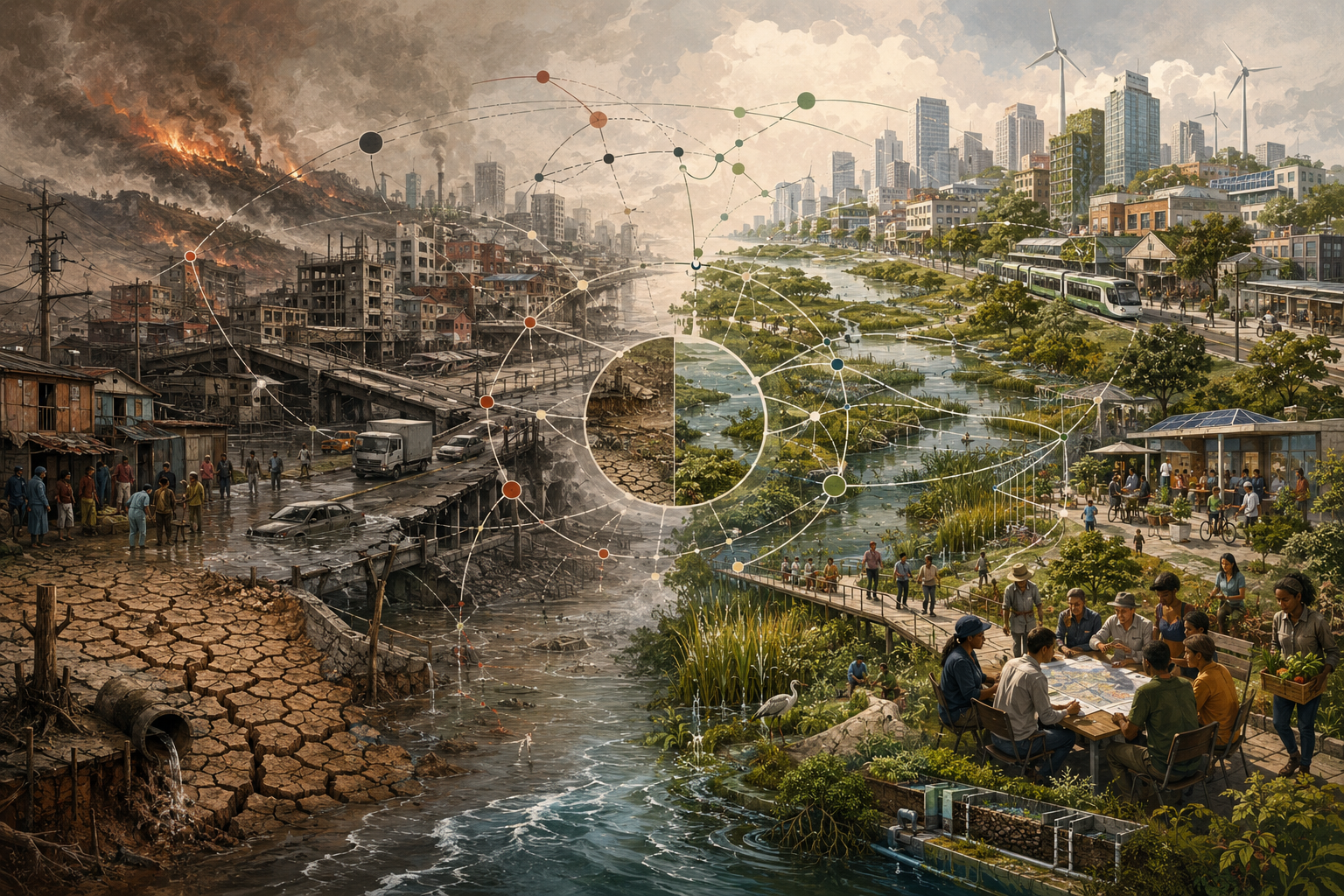
This article introduces risk and resilience as foundational ideas within sustainable systems thinking. It clarifies what each term means, explains how they relate to sustainability, shows why the distinction between hazard and vulnerability matters, and outlines the larger intellectual terrain in which these concepts have developed. It also extends the article into a computational framework by adding a mathematical lens, advanced Python diagnostics, advanced R dashboarding, scenario modeling, uncertainty analysis, and an embedded link to the article-level GitHub folder.
Risk and resilience matter because sustainable systems do not exist in a frictionless world. They operate under climate pressure, infrastructure aging, ecological degradation, social inequality, fiscal limits, digital dependency, geopolitical instability, public-health stress, and deep uncertainty. A system that performs well under normal conditions may fail under compound stress. A system that recovers quickly in aggregate may still abandon vulnerable communities. A system that appears efficient may have eliminated the redundancy, diversity, repair capacity, ecological buffering, and institutional trust it needs to survive disruption.
The central question is therefore not simply whether a system functions. It is whether it can continue to function under stress without sacrificing justice, ecological integrity, public legitimacy, or future viability.
Why Risk and Resilience Matter
Modern systems are increasingly exposed to overlapping and interacting pressures. Climate change intensifies drought, flood, wildfire, heat, storm surge, and ecosystem stress. Urban concentration places more people and assets in exposed environments. Global supply chains transmit disruption rapidly across borders. Digital dependence makes communication, logistics, governance, health care, finance, and public administration vulnerable to technical failure and cyber disruption. Ecological degradation undermines the buffering capacity of landscapes, watersheds, soils, wetlands, forests, reefs, and biodiversity. Social inequality determines who bears the greatest exposure and who has the fewest resources for adaptation and recovery.
Under these conditions, sustainability cannot be understood simply as continuity under normal circumstances. A system that performs well in stable times may prove deeply fragile when confronted with cumulative stress or sudden shock. A city may appear prosperous while relying on brittle infrastructure, inequitable housing, overdrawn water systems, weak heat response, or ecologically unsound growth. A food system may appear efficient while lacking diversity, storage, redundancy, soil health, labor protection, or regional backup capacity. A governance system may appear orderly while suffering from weak coordination, low public trust, fiscal austerity, and limited adaptive capacity.
Risk and resilience matter because they force analysis beyond superficial stability. They direct attention to structure, exposure, interdependence, and capacity. They ask what makes a system vulnerable before a crisis occurs, what enables it to respond once disruption begins, and whether its post-crisis trajectory preserves essential functions or merely restores the conditions that produced fragility in the first place. In this sense, risk and resilience are not peripheral themes within sustainability. They are among its deepest organizing concepts.
They also matter because crisis often reveals what ordinary performance hides. A road network may function every day while lacking evacuation capacity. A hospital may operate efficiently while depending on fragile supply chains. A city may report growth while neglecting floodplain exposure, heat vulnerability, drainage, public housing, and emergency communication. A digital platform may appear reliable until one shared dependency fails. A watershed may seem productive until drought reveals groundwater depletion and ecological degradation.
Risk-and-resilience thinking therefore asks societies to examine not only visible performance, but hidden fragility. It asks where stress is accumulating, where buffers are being lost, where capacity is uneven, where dependencies are concentrated, where early warning is weak, and where recovery would reproduce existing injustice. That makes the field indispensable for sustainable development, planetary boundaries, infrastructure planning, disaster-risk reduction, climate adaptation, public health, ecological restoration, and institutional design.
What Risk Means in Sustainable Systems
Risk is often misinterpreted as a synonym for danger. In more serious analysis, however, risk is relational. It emerges through the interaction of potentially harmful processes with the conditions that make harm possible. A floodplain does not become a disaster simply because water rises. Disaster emerges when hazard intersects with exposed populations, vulnerable settlements, fragile infrastructure, limited warning systems, weak institutions, ecological degradation, and unequal access to protection and recovery.
Risk therefore cannot be reduced to external threat alone. It is co-produced by environmental processes, social arrangements, technical systems, historical choices, and governance structures. A heat wave is more dangerous where housing lacks cooling, tree cover is low, workers lack protection, public-health systems are underfunded, elderly residents are isolated, and emergency communication is weak. A cyberattack is more dangerous where hospitals, utilities, logistics, and payment systems share dependencies and lack graceful failure modes. A drought is more dangerous where groundwater has been depleted, crop diversity is low, social safety nets are weak, and local governance lacks capacity.
This broader understanding is central to disaster-risk reduction, climate adaptation, infrastructure resilience, social-ecological systems research, public health, and sustainable development. Risk depends on at least four interrelated dimensions: hazards, exposure, vulnerability, and capacity. Hazards are potentially damaging events, trends, or pressures. Exposure refers to the presence of people, assets, ecosystems, institutions, or infrastructures in places or systems where they can be harmed. Vulnerability refers to susceptibility to damage, disruption, or loss. Capacity refers to the resources, institutions, knowledge, ecological buffers, technologies, relationships, and organizational capabilities that shape whether systems can prepare for, cope with, adapt to, and recover from disturbance.
This means that risk is never evenly distributed. Two communities exposed to the same storm may experience radically different outcomes because one has stronger housing, better drainage, greater wealth, trusted institutions, resilient health systems, and reliable communications. Likewise, two infrastructures subject to similar stresses may respond differently because one has redundancy, maintenance, distributed capacity, and adaptive oversight while the other has been optimized for efficiency at the expense of resilience.
In sustainable systems, risk must also be understood temporally. Some risks are acute and event-based, such as disasters, outages, fires, disease outbreaks, or supply disruptions. Others accumulate slowly through erosion of ecological buffers, underinvestment in infrastructure, institutional fragmentation, social distrust, groundwater depletion, biodiversity loss, debt burdens, and climate exposure locked into land-use decisions. Slow variables often matter as much as visible emergencies because they shape the background conditions under which crisis becomes more likely.
Risk is therefore not merely what might happen. It is what systems have made possible.
What Resilience Means in Sustainable Systems
Resilience is the companion concept to risk because it asks how systems respond once disturbance occurs or becomes unavoidable. In its most basic sense, resilience refers to the ability of a system to continue functioning in the face of disruption. Yet this general formulation quickly becomes more complex. What counts as essential function? Over what timescale? For which population? Under what normative criteria? A resilient electrical grid is not the same thing as a resilient community, and a resilient community is not the same thing as a resilient ecosystem.
In the context of sustainable systems, resilience generally includes several capacities. One is the capacity to resist or withstand disturbance without severe loss of function. Another is the capacity to absorb shock while preserving basic structures and services. A third is the capacity to adapt by learning, reorganizing, and adjusting practices under changing conditions. A fourth is the capacity to recover essential functions after disruption. A fifth is the capacity to transform when the prior system has become untenable, unjust, brittle, or ecologically unsustainable.
This distinction matters because resilience is often misunderstood as mere recovery. Recovery can mean restoration of the status quo, but the status quo may itself be the problem. A community repeatedly devastated by flood may “recover” only to be exposed again because land-use, housing, infrastructure, insurance, and governance arrangements remain unchanged. A food system may recover production while intensifying soil degradation and labor precarity. A political order may preserve continuity while reproducing inequality and suppressing adaptive learning. For these reasons, resilience should not be idealized automatically. It must be evaluated in terms of what is being preserved, for whom, and at what ecological or social cost.
Serious resilience thinking therefore moves beyond the image of bouncing back. It includes bouncing forward, adapting, and transforming. It recognizes that durable systems often depend on diversity, redundancy, flexibility, modularity, monitoring, institutional memory, ecological buffers, social trust, maintenance, and the ability to revise assumptions when environments change.
It also recognizes that some systems are resilient in undesirable ways. Corrupt institutions, exclusionary social orders, extractive economies, brittle but profitable supply chains, and environmentally destructive production models may display persistence and adaptability. Sustainability requires not resilience in the abstract, but forms of resilience compatible with justice, ecological integrity, democratic legitimacy, public health, and long-term collective flourishing.
A resilient system is therefore not simply a system that survives. It is a system that preserves or rebuilds life-supporting function under stress without deepening the vulnerabilities that made crisis harmful in the first place.
Why Risk and Resilience Belong Together
Risk and resilience belong together because one identifies the conditions under which systems can be harmed, while the other examines the capacities through which systems cope with, adapt to, or transform under that harm. Risk without resilience analysis remains incomplete because it tells us where problems may emerge but not how systems can endure, reorganize, or fail under pressure. Resilience without risk analysis is equally incomplete because it celebrates adaptive capacity without asking what threats, exposures, inequalities, and dependencies make resilience necessary in the first place.
Taken together, the concepts encourage a systems view. They reveal that crises do not arise solely from external events and that adaptation cannot be confined to emergency response. Risk builds over time through decisions about land use, infrastructure, housing, energy, public health, environmental management, finance, technology, labor, and governance. Resilience likewise develops over time through planning, institutional learning, public investment, monitoring systems, social trust, ecological stewardship, maintenance, and the preservation of capacities that may appear inefficient in normal periods but become indispensable in crisis.
This pairing is especially important in sustainable systems because sustainability is not a steady state insulated from disturbance. It is a condition of ongoing adjustment under environmental limits, social pressure, technological change, political contestation, and uncertainty. Risk names the instability built into these conditions. Resilience names the capacities through which systems navigate them without catastrophic loss of function, legitimacy, or life-supporting integrity.
Risk and resilience also belong together because each corrects the other’s weaknesses. Risk analysis can become pessimistic or technocratic if it focuses only on exposure and loss. Resilience analysis can become vague or celebratory if it focuses only on strength and recovery. Together, they create a more complete framework: where are systems exposed, why are they vulnerable, what capacities exist, what dependencies could cascade, what recovery pathways are available, and when is transformation necessary?
The most useful risk-and-resilience analysis therefore does not ask, “Is this system safe?” It asks a more demanding question: under which hazards, across which dependencies, for which communities, with what capacity, over what time horizon, and with what consequences for justice and ecological integrity?
Risk, Resilience, and Sustainability
The relationship between risk, resilience, and sustainability can be understood through a simple proposition: a system is not sustainable if it cannot cope with disturbance, and resilience is not sustainable if it depends on injustice, ecological overshoot, hidden extraction, or the transfer of harm elsewhere. This two-sided insight is crucial. Sustainability requires resilience because all real systems face uncertainty, volatility, and change. But resilience must itself be evaluated within a sustainability framework that asks whether preserved functions are ecologically sound, socially legitimate, and capable of enduring over time.
This is why sustainable systems analysis must move beyond narrow engineering conceptions of resilience. Engineering perspectives often focus on recovery speed and restoration of service. Those concerns are important, especially for infrastructure. But sustainable systems also require ecological resilience, social resilience, institutional resilience, developmental resilience, public-health resilience, digital resilience, and governance resilience. Ecosystems must retain regenerative capacity. Communities must retain social cohesion, health, voice, and adaptive capability. Institutions must remain capable of decision, coordination, learning, and accountability. Development pathways must not deepen fragility in the name of growth.
At the same time, sustainability cannot be romanticized as harmony. The systems that support human life are dynamic, contested, and often unequal. Risk and resilience bring realism into the sustainability conversation by emphasizing uncertainty, shock, adaptation, and nonlinearity. They show why sustainable development cannot mean only expansion of wealth or infrastructure, but must include vulnerability reduction, public capacity, ecological stewardship, social protection, and the ability to manage both anticipated and unexpected change.
This perspective also changes how trade-offs are evaluated. A system may become more efficient but less resilient. It may become more connected but more exposed to cascading failure. It may reduce short-term cost by eliminating redundancy, maintenance, and spare capacity. It may centralize control in ways that improve coordination but increase common-mode failure. It may rebuild quickly after a disaster but reproduce unequal exposure. A sustainability lens asks whether resilience strengthens the conditions of long-term flourishing rather than merely preserving output.
Risk, resilience, and sustainability therefore form a triangle. Risk reveals fragility. Resilience reveals capacity. Sustainability evaluates whether the system’s long-term trajectory is compatible with ecological integrity, justice, and durable human wellbeing.
Major Intellectual Traditions Behind the Field
The contemporary study of risk and resilience draws from several overlapping intellectual traditions. One is disaster-risk reduction, which has emphasized the relationship among hazard, exposure, vulnerability, preparedness, response, and recovery. This tradition highlights the social production of disaster and rejects the idea that catastrophe is simply a natural event. Floods, storms, earthquakes, epidemics, and heat waves become disasters through human settlement patterns, infrastructure quality, governance, inequality, warning systems, and public capacity.
A second tradition is climate adaptation research, which examines how human and ecological systems respond to climatic stress, adaptation limits, compound hazards, residual risk, and long-term environmental change. Climate adaptation expands risk-and-resilience thinking because it requires societies to plan under changing baselines. The climate of the past is no longer a reliable guide to the hazards of the future. This creates profound challenges for infrastructure design, insurance, public health, agriculture, housing, and fiscal planning.
A third tradition comes from ecology and social-ecological systems research, where resilience is tied to persistence, adaptive cycles, transformation, regime shifts, and the capacity of human-nature systems to navigate disturbance without crossing into degraded states. This tradition is especially important because it shows that resilience is not only a property of human institutions. It is also a property of living systems: wetlands that buffer floods, soils that hold water, forests that regulate climate, reefs that protect coasts, and biodiversity that supports redundancy and recovery.
A fourth tradition comes from infrastructure and engineering resilience, which examines the ability of buildings, networks, utilities, logistics systems, and communities to withstand and recover from disruption. This tradition contributes tools for reliability, redundancy, stress testing, graceful degradation, criticality analysis, failure modes, and service continuity. It is especially important for power grids, water systems, hospitals, transport corridors, telecommunications, and digital infrastructure.
A fifth tradition comes from organizational and governance research, which focuses on learning, coordination, crisis management, institutional trust, adaptive capacity, legitimacy, and decision-making under uncertainty. Systems do not become resilient only because they contain stronger materials or better sensors. They become resilient when institutions can detect risk, coordinate response, communicate clearly, learn from failure, and remain accountable to the people affected by their decisions.
These traditions differ in emphasis, but together they enrich sustainable systems thinking. Disaster studies sharpen attention to vulnerability and risk reduction. Ecology highlights thresholds, feedbacks, and regime shifts. Engineering clarifies robustness, performance, and recovery. Governance research emphasizes coordination, legitimacy, and institutional capacity. Sustainable systems analysis benefits from drawing these together rather than treating them as isolated domains.
Key Questions for the Series
This article serves as the conceptual gateway to a larger set of questions. How do hazards become crises? Why do some systems absorb disturbance while others experience cascading failure? What is the difference between robustness, resilience, redundancy, adaptation, and transformation? How do inequality and governance shape vulnerability? Why are redundancy and diversity often more valuable than narrow optimization? Under what conditions does adaptation become transformation? How should resilience be measured, and what are the limits of measurement? What kinds of resilience are consistent with ecological integrity and social justice?
The series also asks how risk travels through interdependent systems. How can a climate shock become a food-price shock, a public-health shock, a fiscal shock, or a migration shock? How can a cyberattack become a hospital crisis, a transport crisis, or a water-system crisis? How can ecological degradation increase disaster exposure? How can debt, austerity, and institutional underinvestment erode public resilience before an obvious hazard appears?
Another set of questions concerns design. How should systems be designed when optimization creates fragility? When should redundancy be treated as waste, and when is it essential insurance? How can infrastructure fail gracefully? How should public institutions maintain capacity for rare but severe events? How can communities build local capacity without being forced to absorb risks created by larger systems? How can digital tools improve early warning without creating new dependencies or surveillance harms?
These questions matter because risk and resilience are not merely academic abstractions. They shape the future of cities, infrastructures, food systems, water systems, energy transitions, climate adaptation, disaster governance, public health, digital systems, and sustainable development. As environmental and social pressures intensify, the ability to think clearly about fragility, exposure, capacity, and systemic adaptation becomes more important, not less.
The purpose of this series is to develop that clarity in a rigorous and interdisciplinary way.
Mathematical Lens: Hazard, Exposure, Vulnerability, Capacity, and Resilience
Risk and resilience can be represented through a systems relationship among hazard intensity, exposure, vulnerability, capacity, dependency, resilience, and justice. Let \(H_r\) represent hazard intensity for system \(r\), \(E_r\) represent exposure, \(V_r\) represent composite vulnerability, and \(C_r\) represent composite capacity. A basic relational risk score can be written as:
R_r = H_r \times E_r \times (1 + V_r) \times (1 – C_r)
\]
Interpretation: Risk rises when hazard intensity, exposure, and vulnerability are high, and falls when adaptive, governance, ecological, warning, and redundancy capacities are strong.
This expression clarifies why risk is not simply the existence of a hazard. A heat wave, flood, wildfire, drought, cyberattack, supply-chain disruption, or disease outbreak becomes more dangerous when exposed systems are vulnerable and lack the capacity to prepare, respond, adapt, or recover.
Composite vulnerability can be represented as a weighted combination of social, infrastructural, and ecological vulnerability:
V_r = w_s S_r + w_i I_r + w_e E^{eco}_r
\]
Interpretation: Vulnerability is multidimensional. Social, infrastructure, and ecological vulnerability each shape how hazard pressure becomes harm.
Composite capacity can be represented through adaptive capacity, governance capacity, ecological buffers, redundancy, early-warning capacity, and transformation capacity:
C_r = aA_r + gG_r + bB_r + dD_r + eW_r + tT_r
\]
Interpretation: Capacity is plural. A system may have strong early warning but weak ecological buffers, or strong governance but limited redundancy.
Because modern systems are interdependent, risk can cascade through supply chains, critical infrastructure, inequality, ecological fragility, and technical dependency. A systemic-risk score can therefore include a cascade multiplier:
R^{sys}_r = R_r \times \left(1 + m_1D^{supply}_r + m_2D^{infra}_r + m_3Ineq_r + m_4E^{eco}_r\right)
\]
Interpretation: Systemic risk increases when shocks can propagate through supply chains, critical infrastructure dependencies, inequality, and ecological vulnerability.
Resilience capacity can be represented as a combination of adaptive capacity, governance capacity, ecological buffering, redundancy, early warning, and transformation capacity:
S_r = \alpha A_r + \beta G_r + \gamma B_r + \delta D_r + \eta W_r + \theta T_r
\]
Interpretation: Resilience capacity increases when systems can adapt, coordinate, buffer, substitute, warn, recover, and transform.
The resilience gap can then be written as:
\Delta_r = \max(0, R^{sys}_r – S_r)
\]
Interpretation: A resilience gap appears when systemic risk exceeds resilience capacity. This gap identifies where urgent risk reduction, adaptation, or transformation may be needed.
Finally, justice-adjusted vulnerability can be represented as:
V^{J}_r = V_r \times (1 + \lambda Ineq_r)
\]
Interpretation: Vulnerability intensifies when social inequality increases exposure, reduces protection, delays recovery, or weakens political voice.
| Term | Meaning | Interpretive role |
|---|---|---|
| \(H_r\) | Hazard intensity | Represents the strength or severity of the hazard affecting system \(r\). |
| \(E_r\) | Exposure | Represents people, assets, ecosystems, institutions, or infrastructure in harm’s way. |
| \(V_r\) | Composite vulnerability | Combines social, infrastructural, and ecological vulnerability. |
| \(C_r\) | Composite capacity | Represents adaptive, governance, ecological, redundancy, warning, and transformation capacity. |
| \(R_r\) | Base risk | Shows relational risk before cascading dependencies are included. |
| \(R^{sys}_r\) | Systemic risk | Shows risk after accounting for interdependence and cascade potential. |
| \(S_r\) | Resilience capacity | Represents the system’s ability to absorb, adapt, recover, and transform. |
| \(\Delta_r\) | Resilience gap | Identifies where systemic risk exceeds resilience capacity. |
| \(V^{J}_r\) | Justice-adjusted vulnerability | Shows how inequality can intensify vulnerability and recovery burden. |
This mathematical lens is not meant to reduce risk and resilience to a single number. Its purpose is to clarify structure. Risk is produced through relationships among hazard, exposure, vulnerability, capacity, and dependency. Resilience depends on plural capacities. Justice determines whether resilience protects the whole community or merely preserves the strongest parts of an unequal system.
Advanced Python Workflow: Risk and Resilience Diagnostics for Sustainable Systems
The following Python workflow models risk and resilience as a relationship among hazard intensity, exposure, social vulnerability, infrastructure vulnerability, ecological vulnerability, adaptive capacity, governance capacity, ecological buffer capacity, redundancy, early-warning capacity, transformation capacity, supply-chain dependency, critical infrastructure dependency, and social inequality. It also adds intervention scenarios and Monte Carlo uncertainty analysis.
"""
Advanced risk and resilience diagnostics for sustainable systems.

This workflow models:
- hazard, exposure, vulnerability, and capacity
- cascading systemic risk
- resilience capacity and resilience gaps
- justice-sensitive vulnerability
- transformation readiness
- scenario-based resilience improvement
- Monte Carlo uncertainty around system risk

The sample data are illustrative. Replace them with documented hazard,
infrastructure, social, ecological, and governance indicators before applied use.
"""

from __future__ import annotations

from dataclasses import dataclass
from pathlib import Path
from typing import Dict

import numpy as np
import pandas as pd


BASE_DIR = Path("articles/what-is-risk-resilience")
DATA_FILE = BASE_DIR / "data" / "risk_resilience_system_panel.csv"
OUTPUT_DIR = BASE_DIR / "outputs"


@dataclass(frozen=True)
class Scenario:
    """Scenario assumptions for resilience intervention modeling."""

    name: str
    hazard_reduction: float
    vulnerability_reduction: float
    adaptive_capacity_gain: float
    governance_capacity_gain: float
    ecological_buffer_gain: float
    redundancy_gain: float
    early_warning_gain: float
    transformation_gain: float


SCENARIOS: Dict[str, Scenario] = {
    "baseline": Scenario("baseline", 0.00, 0.00, 0.00, 0.00, 0.00, 0.00, 0.00, 0.00),
    "preparedness_upgrade": Scenario("preparedness_upgrade", 0.02, 0.05, 0.10, 0.08, 0.04, 0.08, 0.18, 0.05),
    "ecological_buffer_restoration": Scenario("ecological_buffer_restoration", 0.08, 0.08, 0.07, 0.06, 0.24, 0.06, 0.06, 0.08),
    "justice_centered_adaptation": Scenario("justice_centered_adaptation", 0.04, 0.18, 0.14, 0.14, 0.10, 0.10, 0.12, 0.16),
    "deep_resilience_transformation": Scenario("deep_resilience_transformation", 0.10, 0.22, 0.22, 0.20, 0.22, 0.18, 0.18, 0.26),
}


def load_data(path: Path) -> pd.DataFrame:
    """Load the system panel and validate expected columns."""
    df = pd.read_csv(path)

    required = {
        "system_id",
        "system_name",
        "domain",
        "region",
        "hazard_type",
        "hazard_intensity",
        "exposure_index",
        "social_vulnerability",
        "infrastructure_vulnerability",
        "ecological_vulnerability",
        "adaptive_capacity",
        "governance_capacity",
        "ecological_buffer_capacity",
        "redundancy_index",
        "early_warning_capacity",
        "transformation_capacity",
        "supply_chain_dependency",
        "critical_infrastructure_dependency",
        "social_inequality_index",
    }

    missing = required.difference(df.columns)
    if missing:
        raise ValueError(f"Missing required columns: {sorted(missing)}")

    numeric_cols = [
        col for col in df.columns
        if col not in {"system_id", "system_name", "domain", "region", "hazard_type"}
    ]

    for col in numeric_cols:
        if ((df[col] < 0) | (df[col] > 1)).any():
            raise ValueError(f"{col} must be scaled between 0 and 1.")

    return df


def classify_band(value: float, low: float, high: float) -> str:
    """Classify a normalized value into lower, moderate, or elevated bands."""
    if value < low:
        return "lower"
    if value < high:
        return "moderate"
    return "elevated"


def score_systems(df: pd.DataFrame) -> pd.DataFrame:
    """Compute advanced risk and resilience diagnostics."""
    scored = df.copy()

    scored["hazard_exposure_load"] = (
        scored["hazard_intensity"] * scored["exposure_index"]
    )

    scored["composite_vulnerability"] = (
        0.42 * scored["social_vulnerability"]
        + 0.32 * scored["infrastructure_vulnerability"]
        + 0.26 * scored["ecological_vulnerability"]
    )

    scored["composite_capacity"] = (
        0.24 * scored["adaptive_capacity"]
        + 0.22 * scored["governance_capacity"]
        + 0.22 * scored["ecological_buffer_capacity"]
        + 0.14 * scored["redundancy_index"]
        + 0.10 * scored["early_warning_capacity"]
        + 0.08 * scored["transformation_capacity"]
    )

    scored["base_risk"] = (
        scored["hazard_exposure_load"]
        * (1 + scored["composite_vulnerability"])
        * (1 - scored["composite_capacity"])
    )

    scored["cascade_multiplier"] = (
        1
        + 0.24 * scored["supply_chain_dependency"]
        + 0.24 * scored["critical_infrastructure_dependency"]
        + 0.22 * scored["social_inequality_index"]
        + 0.16 * scored["ecological_vulnerability"]
        + 0.14 * scored["infrastructure_vulnerability"]
    )

    scored["systemic_risk_score"] = (
        scored["base_risk"] * scored["cascade_multiplier"]
    )

    scored["resilience_capacity_score"] = (
        0.20 * scored["adaptive_capacity"]
        + 0.18 * scored["governance_capacity"]
        + 0.18 * scored["ecological_buffer_capacity"]
        + 0.14 * scored["redundancy_index"]
        + 0.12 * scored["early_warning_capacity"]
        + 0.18 * scored["transformation_capacity"]
    )

    scored["justice_adjusted_vulnerability"] = (
        scored["composite_vulnerability"]
        * (1 + 0.35 * scored["social_inequality_index"])
    )

    scored["resilience_gap"] = np.maximum(
        0,
        scored["systemic_risk_score"] - scored["resilience_capacity_score"],
    )

    scored["transformation_readiness"] = (
        0.35 * scored["transformation_capacity"]
        + 0.25 * scored["governance_capacity"]
        + 0.20 * scored["adaptive_capacity"]
        + 0.20 * scored["redundancy_index"]
    )

    scored["risk_band"] = scored["systemic_risk_score"].apply(
        lambda x: classify_band(x, low=0.25, high=0.55)
    )

    scored["resilience_band"] = scored["resilience_capacity_score"].apply(
        lambda x: classify_band(x, low=0.40, high=0.65)
    )

    scored["priority_class"] = np.select(
        [
            (scored["risk_band"] == "elevated") & (scored["resilience_band"] != "elevated"),
            (scored["justice_adjusted_vulnerability"] > 0.75),
            (scored["resilience_gap"] > 0.20),
            (scored["transformation_readiness"] > 0.65),
        ],
        [
            "urgent_risk_reduction",
            "justice_centered_adaptation",
            "capacity_building_priority",
            "transformation_leverage",
        ],
        default="monitor_and_maintain",
    )

    return scored.sort_values("systemic_risk_score", ascending=False).reset_index(drop=True)


def apply_scenario(df: pd.DataFrame, scenario: Scenario) -> pd.DataFrame:
    """Apply intervention scenario assumptions and rescore."""
    scenario_df = df.copy()

    scenario_df["hazard_intensity"] = (
        scenario_df["hazard_intensity"] * (1 - scenario.hazard_reduction)
    ).clip(0, 1)

    for col in [
        "social_vulnerability",
        "infrastructure_vulnerability",
        "ecological_vulnerability",
    ]:
        scenario_df[col] = (
            scenario_df[col] * (1 - scenario.vulnerability_reduction)
        ).clip(0, 1)

    scenario_df["adaptive_capacity"] = (
        scenario_df["adaptive_capacity"] + scenario.adaptive_capacity_gain
    ).clip(0, 1)

    scenario_df["governance_capacity"] = (
        scenario_df["governance_capacity"] + scenario.governance_capacity_gain
    ).clip(0, 1)

    scenario_df["ecological_buffer_capacity"] = (
        scenario_df["ecological_buffer_capacity"] + scenario.ecological_buffer_gain
    ).clip(0, 1)

    scenario_df["redundancy_index"] = (
        scenario_df["redundancy_index"] + scenario.redundancy_gain
    ).clip(0, 1)

    scenario_df["early_warning_capacity"] = (
        scenario_df["early_warning_capacity"] + scenario.early_warning_gain
    ).clip(0, 1)

    scenario_df["transformation_capacity"] = (
        scenario_df["transformation_capacity"] + scenario.transformation_gain
    ).clip(0, 1)

    rescored = score_systems(scenario_df)
    rescored["scenario"] = scenario.name

    return rescored


def run_scenarios(df: pd.DataFrame) -> pd.DataFrame:
    """Run all resilience scenarios."""
    frames = [apply_scenario(df, scenario) for scenario in SCENARIOS.values()]
    return pd.concat(frames, ignore_index=True)


def monte_carlo_uncertainty(
    df: pd.DataFrame,
    draws: int = 5000,
    seed: int = 42,
) -> pd.DataFrame:
    """
    Run Monte Carlo uncertainty around key indicators.

    This helps avoid false precision. Each numeric indicator is perturbed
    within a bounded uncertainty envelope, then the system is rescored.
    """
    rng = np.random.default_rng(seed)
    records = []

    numeric_cols = [
        "hazard_intensity",
        "exposure_index",
        "social_vulnerability",
        "infrastructure_vulnerability",
        "ecological_vulnerability",
        "adaptive_capacity",
        "governance_capacity",
        "ecological_buffer_capacity",
        "redundancy_index",
        "early_warning_capacity",
        "transformation_capacity",
        "supply_chain_dependency",
        "critical_infrastructure_dependency",
        "social_inequality_index",
    ]

    for draw in range(draws):
        sampled = df.copy()

        noise = rng.normal(loc=0.0, scale=0.045, size=(len(df), len(numeric_cols)))
        sampled[numeric_cols] = np.clip(sampled[numeric_cols].to_numpy() + noise, 0, 1)

        scored = score_systems(sampled)
        scored["draw"] = draw

        records.append(
            scored[
                [
                    "system_id",
                    "system_name",
                    "draw",
                    "systemic_risk_score",
                    "resilience_capacity_score",
                    "resilience_gap",
                    "justice_adjusted_vulnerability",
                ]
            ]
        )

    mc = pd.concat(records, ignore_index=True)

    summary = (
        mc.groupby(["system_id", "system_name"])
        .agg(
            risk_p05=("systemic_risk_score", lambda x: np.quantile(x, 0.05)),
            risk_p50=("systemic_risk_score", "median"),
            risk_p95=("systemic_risk_score", lambda x: np.quantile(x, 0.95)),
            resilience_p50=("resilience_capacity_score", "median"),
            gap_p50=("resilience_gap", "median"),
            justice_vulnerability_p50=("justice_adjusted_vulnerability", "median"),
        )
        .reset_index()
        .sort_values("risk_p50", ascending=False)
    )

    return summary


def build_domain_summary(scored: pd.DataFrame) -> pd.DataFrame:
    """Summarize risk and resilience by sustainable-system domain."""
    return (
        scored.groupby("domain")
        .agg(
            systems=("system_id", "count"),
            mean_systemic_risk=("systemic_risk_score", "mean"),
            mean_resilience_capacity=("resilience_capacity_score", "mean"),
            mean_resilience_gap=("resilience_gap", "mean"),
            mean_justice_adjusted_vulnerability=("justice_adjusted_vulnerability", "mean"),
            mean_transformation_readiness=("transformation_readiness", "mean"),
        )
        .reset_index()
        .sort_values("mean_systemic_risk", ascending=False)
    )


def main() -> None:
    """Run the full advanced diagnostics workflow."""
    OUTPUT_DIR.mkdir(parents=True, exist_ok=True)

    raw = load_data(DATA_FILE)
    scored = score_systems(raw)
    scenarios = run_scenarios(raw)
    uncertainty = monte_carlo_uncertainty(raw, draws=2000)
    domain_summary = build_domain_summary(scored)

    scored.to_csv(OUTPUT_DIR / "advanced_risk_resilience_scores.csv", index=False)
    scenarios.to_csv(OUTPUT_DIR / "advanced_risk_resilience_scenarios.csv", index=False)
    uncertainty.to_csv(OUTPUT_DIR / "advanced_risk_resilience_uncertainty.csv", index=False)
    domain_summary.to_csv(OUTPUT_DIR / "advanced_risk_resilience_domain_summary.csv", index=False)

    print("\nAdvanced risk-resilience scores:")
    print(
        scored[
            [
                "system_name",
                "domain",
                "hazard_type",
                "systemic_risk_score",
                "resilience_capacity_score",
                "resilience_gap",
                "justice_adjusted_vulnerability",
                "priority_class",
            ]
        ].round(3).to_string(index=False)
    )

    print("\nDomain summary:")
    print(domain_summary.round(3).to_string(index=False))


if __name__ == "__main__":
    main()
This workflow advances the article in three ways. First, it separates hazard intensity, exposure, social vulnerability, infrastructure vulnerability, ecological vulnerability, and multiple capacity dimensions instead of collapsing risk into a single vague score. Second, it introduces cascading systemic risk by including supply-chain dependency, critical infrastructure dependency, inequality, ecological vulnerability, and infrastructure vulnerability. Third, it adds scenario testing and Monte Carlo uncertainty so the analysis does not pretend that point estimates are final truth.
The scenario structure is especially useful for resilience planning. A preparedness upgrade improves early warning, governance, redundancy, and adaptive capacity. Ecological-buffer restoration reduces hazard pressure and strengthens natural protection. Justice-centered adaptation reduces vulnerability and improves legitimacy. Deep resilience transformation changes several system properties at once. The model can therefore compare whether incremental preparedness, ecological restoration, justice-centered adaptation, or deeper transformation produces the strongest reduction in systemic risk.
Advanced R Workflow: Risk, Vulnerability, and Resilience Dashboarding
The following R workflow prepares dashboard-ready outputs for risk-and-resilience analysis. It is designed for analysts, planners, researchers, sustainability teams, public agencies, and governance teams that need to compare hazard-exposure load, composite vulnerability, composite capacity, systemic risk, resilience capacity, justice-adjusted vulnerability, resilience gaps, intervention scenarios, domain summaries, regional summaries, and long-format dashboard data.
# Advanced risk and resilience dashboard workflow
#
# This workflow creates dashboard-ready outputs for:
# - hazard-exposure load
# - composite vulnerability
# - composite capacity
# - systemic risk
# - resilience capacity
# - justice-adjusted vulnerability
# - resilience gaps
# - intervention scenarios
# - regional and domain summaries

library(readr)
library(dplyr)
library(tidyr)

base_dir <- "articles/what-is-risk-resilience"
data_file <- file.path(base_dir, "data", "risk_resilience_system_panel.csv")
output_dir <- file.path(base_dir, "outputs")

dir.create(output_dir, recursive = TRUE, showWarnings = FALSE)

systems <- read_csv(data_file, show_col_types = FALSE)

required_cols <- c(
  "system_id",
  "system_name",
  "domain",
  "region",
  "hazard_type",
  "hazard_intensity",
  "exposure_index",
  "social_vulnerability",
  "infrastructure_vulnerability",
  "ecological_vulnerability",
  "adaptive_capacity",
  "governance_capacity",
  "ecological_buffer_capacity",
  "redundancy_index",
  "early_warning_capacity",
  "transformation_capacity",
  "supply_chain_dependency",
  "critical_infrastructure_dependency",
  "social_inequality_index"
)

missing_cols <- setdiff(required_cols, names(systems))
if (length(missing_cols) > 0) {
  stop(paste("Missing required columns:", paste(missing_cols, collapse = ", ")))
}

classify_band <- function(value, low, high) {
  case_when(
    value < low ~ "lower",
    value < high ~ "moderate",
    TRUE ~ "elevated"
  )
}

score_systems <- function(df) {
  df %>%
    mutate(
      hazard_exposure_load = hazard_intensity * exposure_index,

      composite_vulnerability =
        0.42 * social_vulnerability +
        0.32 * infrastructure_vulnerability +
        0.26 * ecological_vulnerability,

      composite_capacity =
        0.24 * adaptive_capacity +
        0.22 * governance_capacity +
        0.22 * ecological_buffer_capacity +
        0.14 * redundancy_index +
        0.10 * early_warning_capacity +
        0.08 * transformation_capacity,

      base_risk =
        hazard_exposure_load *
        (1 + composite_vulnerability) *
        (1 - composite_capacity),

      cascade_multiplier =
        1 +
        0.24 * supply_chain_dependency +
        0.24 * critical_infrastructure_dependency +
        0.22 * social_inequality_index +
        0.16 * ecological_vulnerability +
        0.14 * infrastructure_vulnerability,

      systemic_risk_score = base_risk * cascade_multiplier,

      resilience_capacity_score =
        0.20 * adaptive_capacity +
        0.18 * governance_capacity +
        0.18 * ecological_buffer_capacity +
        0.14 * redundancy_index +
        0.12 * early_warning_capacity +
        0.18 * transformation_capacity,

      justice_adjusted_vulnerability =
        composite_vulnerability * (1 + 0.35 * social_inequality_index),

      resilience_gap = pmax(0, systemic_risk_score - resilience_capacity_score),

      transformation_readiness =
        0.35 * transformation_capacity +
        0.25 * governance_capacity +
        0.20 * adaptive_capacity +
        0.20 * redundancy_index,

      risk_band = classify_band(systemic_risk_score, 0.25, 0.55),
      resilience_band = classify_band(resilience_capacity_score, 0.40, 0.65),

      priority_class = case_when(
        risk_band == "elevated" & resilience_band != "elevated" ~
          "urgent_risk_reduction",
        justice_adjusted_vulnerability > 0.75 ~
          "justice_centered_adaptation",
        resilience_gap > 0.20 ~
          "capacity_building_priority",
        transformation_readiness > 0.65 ~
          "transformation_leverage",
        TRUE ~
          "monitor_and_maintain"
      )
    ) %>%
    arrange(desc(systemic_risk_score))
}

scored <- score_systems(systems)

scenario_parameters <- tibble::tibble(
  scenario = c(
    "baseline",
    "preparedness_upgrade",
    "ecological_buffer_restoration",
    "justice_centered_adaptation",
    "deep_resilience_transformation"
  ),
  hazard_reduction = c(0.00, 0.02, 0.08, 0.04, 0.10),
  vulnerability_reduction = c(0.00, 0.05, 0.08, 0.18, 0.22),
  adaptive_capacity_gain = c(0.00, 0.10, 0.07, 0.14, 0.22),
  governance_capacity_gain = c(0.00, 0.08, 0.06, 0.14, 0.20),
  ecological_buffer_gain = c(0.00, 0.04, 0.24, 0.10, 0.22),
  redundancy_gain = c(0.00, 0.08, 0.06, 0.10, 0.18),
  early_warning_gain = c(0.00, 0.18, 0.06, 0.12, 0.18),
  transformation_gain = c(0.00, 0.05, 0.08, 0.16, 0.26)
)

scenario_scores <- systems %>%
  tidyr::crossing(scenario_parameters) %>%
  mutate(
    hazard_intensity = pmax(0, hazard_intensity * (1 - hazard_reduction)),

    social_vulnerability = pmax(0, social_vulnerability * (1 - vulnerability_reduction)),
    infrastructure_vulnerability = pmax(0, infrastructure_vulnerability * (1 - vulnerability_reduction)),
    ecological_vulnerability = pmax(0, ecological_vulnerability * (1 - vulnerability_reduction)),

    adaptive_capacity = pmin(1, adaptive_capacity + adaptive_capacity_gain),
    governance_capacity = pmin(1, governance_capacity + governance_capacity_gain),
    ecological_buffer_capacity = pmin(1, ecological_buffer_capacity + ecological_buffer_gain),
    redundancy_index = pmin(1, redundancy_index + redundancy_gain),
    early_warning_capacity = pmin(1, early_warning_capacity + early_warning_gain),
    transformation_capacity = pmin(1, transformation_capacity + transformation_gain)
  ) %>%
  group_by(scenario) %>%
  group_modify(~ score_systems(.x)) %>%
  ungroup()

scenario_summary <- scenario_scores %>%
  group_by(scenario) %>%
  summarise(
    mean_systemic_risk = mean(systemic_risk_score),
    mean_resilience_capacity = mean(resilience_capacity_score),
    mean_resilience_gap = mean(resilience_gap),
    elevated_risk_systems = sum(risk_band == "elevated"),
    urgent_systems = sum(priority_class == "urgent_risk_reduction"),
    justice_priority_systems = sum(priority_class == "justice_centered_adaptation"),
    .groups = "drop"
  ) %>%
  arrange(mean_systemic_risk)

domain_summary <- scored %>%
  group_by(domain) %>%
  summarise(
    systems = n(),
    mean_systemic_risk = mean(systemic_risk_score),
    mean_resilience_capacity = mean(resilience_capacity_score),
    mean_resilience_gap = mean(resilience_gap),
    mean_justice_adjusted_vulnerability = mean(justice_adjusted_vulnerability),
    mean_transformation_readiness = mean(transformation_readiness),
    .groups = "drop"
  ) %>%
  arrange(desc(mean_systemic_risk))

regional_summary <- scored %>%
  group_by(region) %>%
  summarise(
    systems = n(),
    mean_hazard_exposure_load = mean(hazard_exposure_load),
    mean_composite_vulnerability = mean(composite_vulnerability),
    mean_composite_capacity = mean(composite_capacity),
    mean_systemic_risk = mean(systemic_risk_score),
    mean_resilience_capacity = mean(resilience_capacity_score),
    .groups = "drop"
  ) %>%
  arrange(desc(mean_systemic_risk))

dashboard_long <- scored %>%
  select(
    system_id,
    system_name,
    domain,
    region,
    hazard_type,
    hazard_exposure_load,
    composite_vulnerability,
    composite_capacity,
    systemic_risk_score,
    resilience_capacity_score,
    justice_adjusted_vulnerability,
    resilience_gap,
    transformation_readiness
  ) %>%
  pivot_longer(
    cols = c(
      hazard_exposure_load,
      composite_vulnerability,
      composite_capacity,
      systemic_risk_score,
      resilience_capacity_score,
      justice_adjusted_vulnerability,
      resilience_gap,
      transformation_readiness
    ),
    names_to = "metric",
    values_to = "value"
  )

write_csv(scored, file.path(output_dir, "r_advanced_risk_resilience_scores.csv"))
write_csv(scenario_scores, file.path(output_dir, "r_advanced_risk_resilience_scenarios.csv"))
write_csv(scenario_summary, file.path(output_dir, "r_advanced_scenario_summary.csv"))
write_csv(domain_summary, file.path(output_dir, "r_advanced_domain_summary.csv"))
write_csv(regional_summary, file.path(output_dir, "r_advanced_regional_summary.csv"))
write_csv(dashboard_long, file.path(output_dir, "r_advanced_dashboard_long.csv"))

print(scored)
print(scenario_summary)
print(domain_summary)
The R workflow complements the Python workflow by producing dashboard-oriented tables. It is especially useful for comparing systems across domains and regions, tracking scenario effects, and preparing long-format data for visualization. It also reinforces an important methodological point: resilience analysis should not treat risk, vulnerability, capacity, and justice as interchangeable. They are related but distinct dimensions of system behavior.
A production version could connect this workflow to climate-hazard layers, census data, public-health data, infrastructure inventories, supply-chain maps, ecological-buffer datasets, community vulnerability indexes, governance-capacity indicators, and documented source metadata. The goal is not to create a decorative dashboard. The goal is to make fragility, capacity, and intervention priorities visible enough to support accountable decision-making.
Engineering Extensions in the GitHub Repository
The GitHub repository extends the article beyond conceptual explanation into reproducible systems analysis. The current article folder includes a synthetic system panel, advanced Python diagnostics, advanced R dashboarding, scenario outputs, documentation, and notes on how to interpret the workflows. The structure is designed so the article can grow into a deeper research and teaching resource rather than remaining only a prose introduction.
The most important technical contribution is the separation of risk components. The workflows distinguish hazard intensity, exposure, social vulnerability, infrastructure vulnerability, ecological vulnerability, adaptive capacity, governance capacity, ecological buffer capacity, redundancy, early-warning capacity, transformation capacity, supply-chain dependency, critical infrastructure dependency, and social inequality. This makes the model more transparent than a single composite score.
Additional languages can strengthen the repository where they serve a real analytical purpose. Go is useful for lightweight scoring services and APIs. Rust is useful for reliable command-line tools and reproducible scoring utilities. C and C++ are useful for compact numerical kernels, systems simulation, and high-performance dependency analysis. Fortran is useful for numerical modeling and recovery-curve calculations, especially where scientific-computing conventions matter. SQL is useful as the backbone for structured indicators, scenario matrices, source provenance, scoring runs, and auditability.
The article body foregrounds Python and R because they are the most accessible languages for data analysis, scenario modeling, and dashboard preparation. The repository can carry additional systems-level implementations so technical readers can translate the conceptual framework into services, command-line tools, simulations, and reproducible research pipelines.
GitHub Repository
Complete Code Repository
The full code directory for this article, including the advanced Python diagnostics, advanced R dashboard workflow, synthetic risk-resilience system panel, scenario outputs, uncertainty analysis, documentation, and additional systems-level extensions, is available on GitHub.
Common Misunderstandings
A common misunderstanding is that risk means the same thing as hazard. A hazard is a potentially damaging event or process. Risk emerges when that hazard intersects with exposure, vulnerability, dependency, and limited capacity. A flood in an uninhabited wetland is not the same as a flood in an exposed settlement with weak housing, poor drainage, and limited warning systems.
Another misunderstanding is that resilience means bouncing back. Recovery matters, but bouncing back to an unjust, brittle, or ecologically destructive system may reproduce the same risk. Resilience can require adaptation or transformation, not merely restoration of prior conditions.
A third misunderstanding is that resilience is always good. Some systems are resilient because they preserve extraction, inequality, exclusion, or environmental harm. Sustainable resilience must be judged by what it preserves, whom it protects, and whether it supports long-term ecological and social viability.
A fourth misunderstanding is that resilience can be measured with a single score. Composite indicators can be useful, but they can also hide assumptions, flatten context, and obscure justice. Serious resilience measurement should preserve the distinction between hazard, exposure, vulnerability, capacity, dependency, recovery, and transformation.
A fifth misunderstanding is that resilience is mainly a local responsibility. Communities matter, but many risks are produced by larger systems: land-use policy, infrastructure investment, financial structures, climate change, supply chains, public-health systems, and governance. Local resilience cannot substitute for structural responsibility.
A final misunderstanding is that technology alone can solve resilience problems. Sensors, models, dashboards, digital twins, and AI tools can help, but they cannot replace public trust, maintenance, social protection, ecological repair, accountable governance, or community participation.
Conclusion
Risk and resilience are foundational concepts in sustainable systems because they illuminate the relationship between disturbance and viability. Risk explains how hazards, exposure, vulnerability, dependency, and capacity combine to produce the possibility of loss. Resilience explains how systems resist, absorb, adapt, reorganize, recover, and sometimes transform under pressure. Together, they move sustainability beyond idealized stability and toward a more serious understanding of fragility, uncertainty, governance, adaptation, and long-term systemic endurance.
To think in terms of risk and resilience is to ask not only whether a system functions, but under what conditions it can continue to function without sacrificing justice, ecological integrity, public legitimacy, or future viability. It is to recognize that sustainable systems are not those that avoid change, but those that can confront change intelligently, ethically, and adaptively.
The computational workflows attached to this article extend that argument into practice. They show how risk and resilience can be modeled as relationships among hazards, exposure, vulnerability, capacities, dependencies, inequality, scenario pathways, and uncertainty. The numbers are illustrative, but the structure matters. A transparent model can help reveal hidden fragility, compare intervention strategies, identify justice-centered adaptation priorities, and prevent resilience language from becoming vague or performative.
Risk and resilience deserve to stand near the center of any serious inquiry into sustainability because they ask the hardest practical question: when the system is stressed, who is protected, what fails, what recovers, what changes, and what kind of future becomes possible afterward?
Return to the Risk & Resilience knowledge series.
Related Reading
- Risk & Resilience
- Sustainable Development
- Planetary Boundaries
- Systems Thinking
- Environmental Monitoring Systems
- Data Systems & Analytics
- Institutions & Governance
Further Reading
- Adger, W.N. (2000) ‘Social and ecological resilience: are they related?’, Progress in Human Geography, 24(3), pp. 347–364. Available at: https://doi.org/10.1191/030913200701540465.
- Biggs, R., Schlüter, M. and Schoon, M.L. (eds.) (2015) Principles for Building Resilience: Sustaining Ecosystem Services in Social-Ecological Systems. Cambridge: Cambridge University Press. Available at: https://doi.org/10.1017/CBO9781316014240.
- Folke, C. (2006) ‘Resilience: The emergence of a perspective for social-ecological systems analyses’, Global Environmental Change, 16(3), pp. 253–267. Available at: https://doi.org/10.1016/j.gloenvcha.2006.04.002.
- Folke, C. (2016) ‘Resilience’, Oxford Research Encyclopedia of Environmental Science. Available at: https://doi.org/10.1093/acrefore/9780199389414.013.8.
- Holling, C.S. (1973) ‘Resilience and stability of ecological systems’, Annual Review of Ecology and Systematics, 4, pp. 1–23. Available at: https://doi.org/10.1146/annurev.es.04.110173.000245.
- Intergovernmental Panel on Climate Change (2022) Climate Change 2022: Impacts, Adaptation and Vulnerability. Available at: https://www.ipcc.ch/report/ar6/wg2/.
- National Academies of Sciences, Engineering, and Medicine (2012) Disaster Resilience: A National Imperative. Washington, DC: The National Academies Press. Available at: https://www.nationalacademies.org/publications/13457/disaster-resilience-a-national-imperative.
- National Institute of Standards and Technology (2024) Community Resilience Planning Guide for Buildings and Infrastructure Systems. Available at: https://www.nist.gov/community-resilience/planning-guide.
- Organisation for Economic Co-operation and Development (2025) Guidelines for Resilience Systems Analysis: How to Analyse Risk and Build a Roadmap to Resilience. Available at: https://www.oecd.org/en/publications/guidelines-for-resilience-systems-analysis-how-to-analyse-risk-and-build-a-roadmap-to-resilience_3b1d3efe-en.html.
- United Nations Office for Disaster Risk Reduction (2015) Sendai Framework for Disaster Risk Reduction 2015–2030. Available at: https://www.undrr.org/publication/sendai-framework-disaster-risk-reduction-2015-2030.
- Walker, B. and Salt, D. (2006) Resilience Thinking: Sustaining Ecosystems and People in a Changing World. Washington, DC: Island Press. Available at: https://islandpress.org/books/resilience-thinking.
- World Bank (2019) Lifelines: The Resilient Infrastructure Opportunity. Washington, DC: World Bank. Available at: https://www.worldbank.org/en/news/infographic/2019/06/17/lifelines-the-resilient-infrastructure-opportunity.
References
- Adger, W.N. (2000) ‘Social and ecological resilience: are they related?’, Progress in Human Geography, 24(3), pp. 347–364. Available at: https://doi.org/10.1191/030913200701540465.
- Biggs, R., Schlüter, M. and Schoon, M.L. (eds.) (2015) Principles for Building Resilience: Sustaining Ecosystem Services in Social-Ecological Systems. Cambridge: Cambridge University Press. Available at: https://doi.org/10.1017/CBO9781316014240.
- Folke, C. (2006) ‘Resilience: The emergence of a perspective for social-ecological systems analyses’, Global Environmental Change, 16(3), pp. 253–267. Available at: https://doi.org/10.1016/j.gloenvcha.2006.04.002.
- Folke, C. (2016) ‘Resilience’, Oxford Research Encyclopedia of Environmental Science. Available at: https://doi.org/10.1093/acrefore/9780199389414.013.8.
- Holling, C.S. (1973) ‘Resilience and stability of ecological systems’, Annual Review of Ecology and Systematics, 4, pp. 1–23. Available at: https://doi.org/10.1146/annurev.es.04.110173.000245.
- Intergovernmental Panel on Climate Change (2022) Climate Change 2022: Impacts, Adaptation and Vulnerability. Available at: https://www.ipcc.ch/report/ar6/wg2/.
- Intergovernmental Panel on Climate Change (2022) Annex II: Glossary. Available at: https://www.ipcc.ch/report/ar6/wg2/downloads/report/IPCC_AR6_WGII_Annex-II.pdf.
- National Academies of Sciences, Engineering, and Medicine (2012) Disaster Resilience: A National Imperative. Washington, DC: The National Academies Press. Available at: https://www.nationalacademies.org/publications/13457/disaster-resilience-a-national-imperative.
- National Institute of Standards and Technology (2024) Community Resilience Planning Guide for Buildings and Infrastructure Systems. Available at: https://www.nist.gov/community-resilience/planning-guide.
- Organisation for Economic Co-operation and Development (2025) Guidelines for Resilience Systems Analysis: How to Analyse Risk and Build a Roadmap to Resilience. Available at: https://www.oecd.org/en/publications/guidelines-for-resilience-systems-analysis-how-to-analyse-risk-and-build-a-roadmap-to-resilience_3b1d3efe-en.html.
- United Nations Office for Disaster Risk Reduction (2015) Sendai Framework for Disaster Risk Reduction 2015–2030. Available at: https://www.undrr.org/publication/sendai-framework-disaster-risk-reduction-2015-2030.
- United Nations Office for Disaster Risk Reduction (n.d.) Terminology: Disaster Risk. Available at: https://www.undrr.org/terminology/disaster-risk.
- United Nations Office for Disaster Risk Reduction (n.d.) Terminology: Resilience. Available at: https://www.undrr.org/terminology/resilience.
- Walker, B. and Salt, D. (2006) Resilience Thinking: Sustaining Ecosystems and People in a Changing World. Washington, DC: Island Press. Available at: https://islandpress.org/books/resilience-thinking.
- World Bank (2019) Lifelines: The Resilient Infrastructure Opportunity. Washington, DC: World Bank. Available at: https://www.worldbank.org/en/news/infographic/2019/06/17/lifelines-the-resilient-infrastructure-opportunity.