
Last Updated May 6, 2026
Poverty is not only a shortage of income. It is a condition of deprivation that constrains health, education, nutrition, shelter, dignity, security, public voice, resilience, and the real freedom to live a meaningful life. To understand poverty seriously, development analysis must move beyond monetary thresholds alone and examine the overlapping disadvantages that shape how people actually live. Multidimensional development begins from this recognition. It asks not simply whether incomes are rising, but whether human beings are escaping deprivation in the broader sense that matters for capability, wellbeing, dignity, and long-run inclusion.
This distinction matters because poverty rarely appears as one isolated deficit. A household may lack safe housing, sanitation, electricity, clean cooking fuel, adequate nutrition, regular schooling, healthcare access, legal protection, secure work, and protection from climate or environmental hazards at the same time. These deprivations interact. They reinforce one another. They shape whether people can convert resources into real opportunity.
Main Library
Publications
Article Map
Sustainable Development
Related Topic
Economic Systems
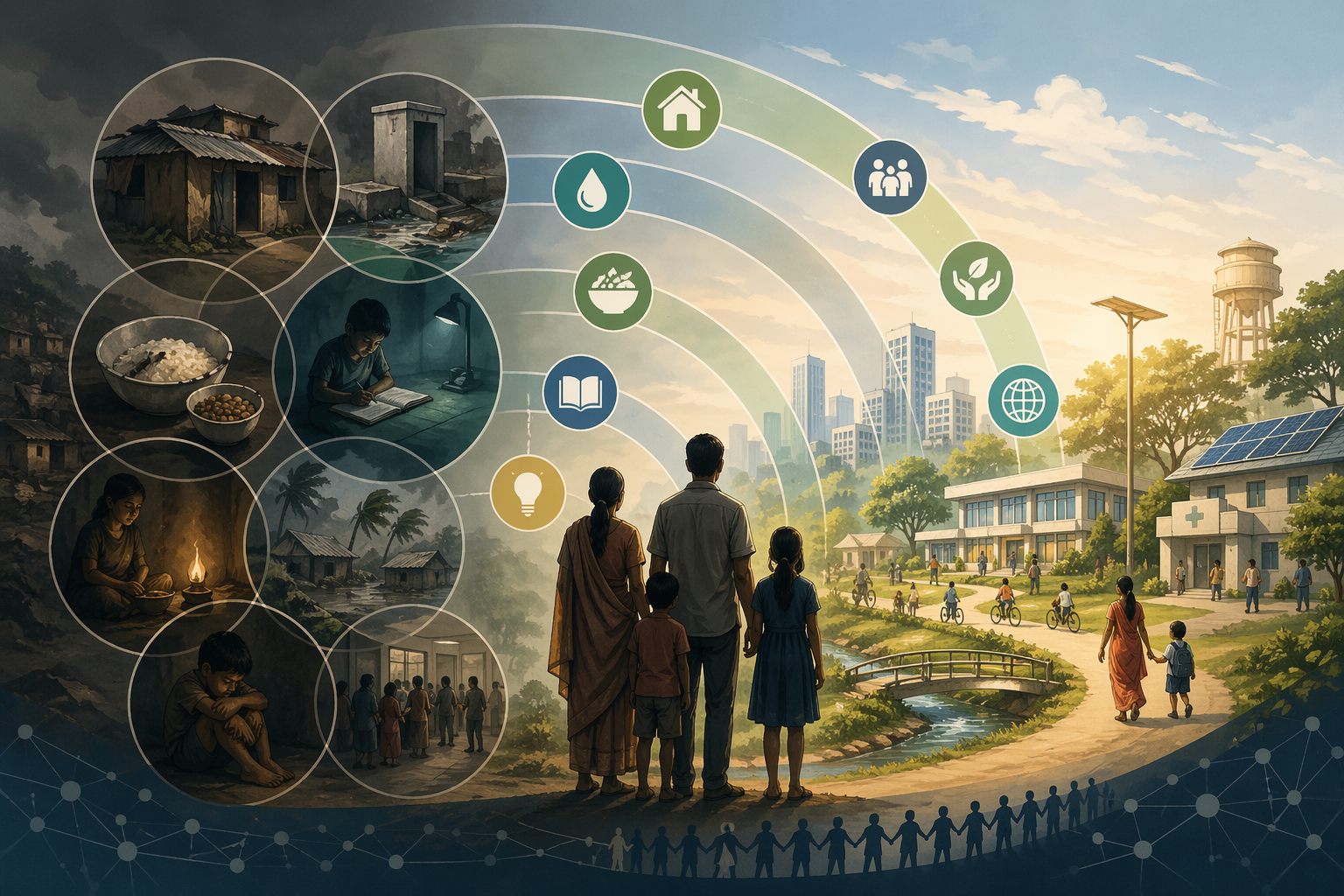
The 2030 Agenda treats poverty eradication as the greatest global challenge and an indispensable requirement for sustainable development. That phrasing matters because it rejects the idea that poverty is a secondary social concern that can be solved after growth, infrastructure, or environmental policy are addressed. Poverty stands at the center of the development question because deprivation shapes every other dimension of life: health, education, labor, exposure to environmental risk, political voice, household security, and resilience to shock.
Over time, development thought has moved from treating poverty primarily as low income toward understanding it as multidimensional deprivation. The human development approach widened the evaluative frame from income and output toward the expansion of capabilities and freedoms, while the Global Multidimensional Poverty Index made it possible to observe overlapping deficits in health, education, and living standards at the household level. The 2025 Global MPI reports that 1.1 billion people in the covered countries live in acute multidimensional poverty and highlights widespread deprivations in housing, sanitation, electricity, cooking fuel, and nutrition. This is a more demanding picture of poverty than income alone provides.
What Is Poverty?
Poverty is often defined narrowly as insufficient income to meet basic needs. That definition captures something real and important, because income affects access to food, housing, energy, healthcare, mobility, and security. Yet poverty in lived experience is usually broader than income alone. It involves deprivation across multiple domains that shape whether a person can live safely, participate in society, maintain health, pursue education, care for others, withstand shocks, and exercise meaningful choice. Poverty is therefore best understood not simply as low purchasing power, but as a condition of constrained human possibility.
This broader understanding matters because deprivation is rarely isolated. A household without adequate sanitation may also face poor housing, limited electricity, insecure nutrition, weak health access, and educational disadvantage. A worker with very low income may also face environmental exposure, lack of legal protection, inadequate transport, unsafe working conditions, or exclusion from public services. Once these overlaps are recognized, poverty becomes less a single deficit than a patterned condition of disadvantage affecting the whole texture of life.
Poverty also changes the meaning of time. It is not only a present hardship. It can shape childhood development, learning, health, social participation, and future earning capacity. It can limit the ability to plan, save, move, take risks, resist exploitation, recover from shock, or participate in public life. A household living in multidimensional deprivation may be forced to make short-term survival decisions that reduce long-term opportunity. Poverty therefore narrows both present wellbeing and future possibility.
For sustainable development, this is crucial. A development strategy that raises aggregate output without reducing interconnected forms of deprivation may improve macroeconomic indicators while leaving large populations trapped in structurally diminished life chances. Poverty must therefore be treated not only as a shortage of money, but as a complex social condition that distorts capability, resilience, dignity, and long-run wellbeing.
This places the article in clear continuity with From Economic Growth to Human Development, where development is judged by human possibility rather than output alone.
Income Poverty and Its Limits
Income poverty remains an indispensable part of development analysis. Monetary poverty lines are useful because they offer comparability, policy visibility, and a way of tracking severe material deprivation. Income affects what households can purchase, the risks they can absorb, and the opportunities they can secure. No serious poverty analysis should dismiss these realities. Food, rent, medicine, transport, school materials, energy, and communication all require resources. A household without sufficient income faces immediate and often harsh constraints.
But income alone is too narrow to capture the full structure of deprivation. Two households with similar incomes may experience very different real conditions depending on their access to water, sanitation, healthcare, energy, safe housing, schooling, transport, public safety, and supportive institutions. Income also tells us little about the quality of public goods or the social environments within which households must convert income into actual wellbeing. Where public infrastructure is weak, even modest monetary gains may fail to translate into secure improvements in health or capability.
Income metrics can also miss forms of deprivation that are not easily priced. A household may technically cross a monetary poverty line while still living in overcrowded housing, lacking safe water, breathing polluted air, depending on unsafe cooking fuel, or sending children to low-quality schools. A person may earn above a threshold but remain exposed to violence, discrimination, informal labor insecurity, debt traps, disability exclusion, or environmental hazards. Income matters, but it does not exhaust the reality of poverty.
This is why development theory increasingly treats monetary poverty as necessary but insufficient. Income matters, but it is not the same thing as development, and it is not even the whole of poverty. A more adequate account must ask not only how much people earn, but what forms of deprivation remain in place even when income measures alone suggest improvement.
The issue is not whether income should be measured. It should. The issue is whether income is allowed to dominate the field of interpretation so completely that other deprivations disappear from policy attention. Sustainable development requires a broader measurement architecture.
Why Development Must Be Multidimensional
The movement toward multidimensional development reflects a deeper shift in how progress is understood. Development cannot be reduced to the growth of national income or even to the reduction of income poverty alone. It must be judged by whether people are healthier, better educated, better nourished, safer, more secure, more resilient, and better able to participate in social, economic, and political life. This is one reason the human development tradition became so influential: it widened the evaluative frame from output to capability and freedom.
Multidimensional development matters because poverty itself is multidimensional. A person deprived of education faces long-term constraints that income transfers alone may not solve. A household without clean cooking fuel or electricity may remain exposed to health risks, time burdens, gendered labor burdens, and constrained opportunity even if its income temporarily rises. A child in poor housing with poor nutrition and irregular school attendance faces a cluster of disadvantages that interact and compound over time. Development therefore has to address these conditions as a web rather than as isolated variables.
This multidimensional framing also helps explain why public goods are central to poverty reduction. Health, education, sanitation, water systems, energy access, transport, legal protection, environmental safety, and social protection are not merely household purchases. They are collective systems that shape whether people can transform resources into lives of dignity and opportunity. When those systems are weak, poverty persists even where markets expand.
The 2030 Agenda frames poverty eradication in “all its forms and dimensions” as indispensable. The language is exact. Poverty is not treated as a single monetary metric, but as a broader developmental condition. That makes multidimensional analysis central rather than peripheral to sustainable development.
A multidimensional approach also prevents poverty policy from becoming too narrow. It encourages policymakers to ask whether programs are reducing actual deprivation bundles, improving human capability, strengthening resilience, and expanding freedom in practice. A household that gains income but remains exposed to unsafe water, climate hazards, weak schooling, and insecure housing has not fully escaped poverty in the developmental sense.
Poverty as Capability Constraint
One of the most important conceptual advances in development thought is the recognition that poverty is not only a low command over resources, but a restriction on what people are actually able to do and to be. A person may have some income, yet still be unable to secure basic health, gain an education, travel safely, participate politically, care for family members, access justice, or protect a household from recurring shocks. Poverty in this sense is a restriction on agency and possibility rather than merely a shortfall in consumption.
This capability-centered understanding matters because it connects poverty to freedom in a substantive sense. The issue is not whether people possess abstract rights in principle, but whether they possess the actual means and supporting conditions required to convert those rights into lived opportunity. Malnutrition, poor schooling, unsafe housing, social exclusion, weak public services, and environmental hazards all narrow the horizon of what people can realistically become. Poverty therefore shrinks both present wellbeing and future possibility.
Seeing poverty as capability constraint also changes policy reasoning. It suggests that the aim is not merely to lift incomes above a threshold, but to expand the substantive conditions of human development: health, knowledge, security, mobility, voice, resilience, and institutional protection. If development is about capability, then poverty policy must be evaluated by whether it expands real life chances, not only whether it raises household income temporarily.
The capability lens also helps explain why poverty is so closely connected to dignity. People experiencing poverty often face not only material deprivation, but humiliation, exclusion, dependence, social stigma, and loss of control over their own lives. A development approach that treats poverty only as low income may miss the moral and political dimensions of deprivation. Poverty is also about having one’s choices narrowed by structures that are often outside individual control.
That is why multidimensional development provides a more serious framework for poverty than income alone ever could. It allows poverty to be understood as a constraint on human flourishing, a weakening of freedom, and a structural failure of institutions, public goods, and social arrangements.
Overlapping Deprivations and Poverty Bundles
One of the most important insights of multidimensional poverty analysis is that deprivations cluster. Poor households are not usually deprived in only one area. They often face what might be called poverty bundles: combinations of inadequate housing, unsafe sanitation, poor nutrition, lack of electricity, absence of clean cooking fuel, school non-attendance, limited years of schooling, weak healthcare access, or exposure to environmental hazards. These overlaps matter because they intensify one another. The burden of deprivation is cumulative.
UNDP and OPHI’s MPI work emphasizes the importance of examining these interlinked deprivations rather than looking at each one in isolation. The 2025 Global MPI highlights common patterns including deprivation in housing, sanitation, cooking fuel, nutrition, and electricity, reinforcing that poverty is often best understood as layered disadvantage rather than single-issue scarcity.
This changes the logic of policy. If deprivation is bundled, intervention must be more integrated. A sanitation program may improve health and school attendance. Electrification may alter education, safety, household labor burdens, communication access, and local economic activity. Nutrition support may improve health and cognitive development in ways that affect long-run educational outcomes. Public transport may improve access to schools, clinics, jobs, and markets. A multidimensional understanding of poverty therefore pushes policy toward systems thinking rather than isolated sectoral fixes.
Poverty bundles also help explain why escaping poverty can be difficult even when one indicator improves. If income rises but sanitation remains unsafe, illness may continue to undermine work and school. If schooling expands but children lack nutrition, learning outcomes may remain weak. If electricity arrives but housing is insecure, households may still face instability. If a cash transfer helps consumption but climate shocks destroy assets repeatedly, poverty may return. Multidimensional poverty is not only a set of problems; it is a system of mutually reinforcing constraints.
This section connects naturally with Sustainable Development as a Systems Problem, because poverty reduction requires attention to interactions, feedbacks, public goods, and institutional capacity.
The Multidimensional Poverty Index and What It Measures
The Global Multidimensional Poverty Index is one of the most influential tools for operationalizing this broader understanding of poverty. UNDP explains that the global MPI identifies overlapping deprivations at the household level across three broad dimensions—health, education, and living standards—using indicators drawn from the same household surveys. This matters because it creates a structured way to observe poverty’s internal composition rather than reducing it to a single monetary threshold.
The value of the MPI lies not only in its composite measure, but in the picture it offers of poverty’s structure. It allows analysts to see not simply how many people are poor, but how they are poor: through which deprivations, in which combinations, and in which regions. This makes poverty policy more precise and more developmentally meaningful. It shifts attention away from a single poverty line toward the actual conditions households face.
The 2025 Global MPI adds current urgency to this framework. It reports that 1.1 billion of 6.3 billion people across 109 countries live in acute multidimensional poverty, that over half of them are children, and that common deprivations include clean cooking fuel, housing, sanitation, nutrition, and electricity. These findings reinforce the idea that poverty is not reducible to low consumption. It is a condition of layered disadvantage affecting the fundamentals of human life.
The MPI also has a policy advantage: it can identify which deprivations contribute most to poverty in different contexts. This helps avoid one-size-fits-all poverty reduction. In one setting, sanitation and housing may dominate. In another, nutrition and schooling may matter most. In another, electricity, cooking fuel, and child vulnerability may be central. A multidimensional tool helps policymakers see the pattern of deprivation rather than assuming that all poverty has the same structure.
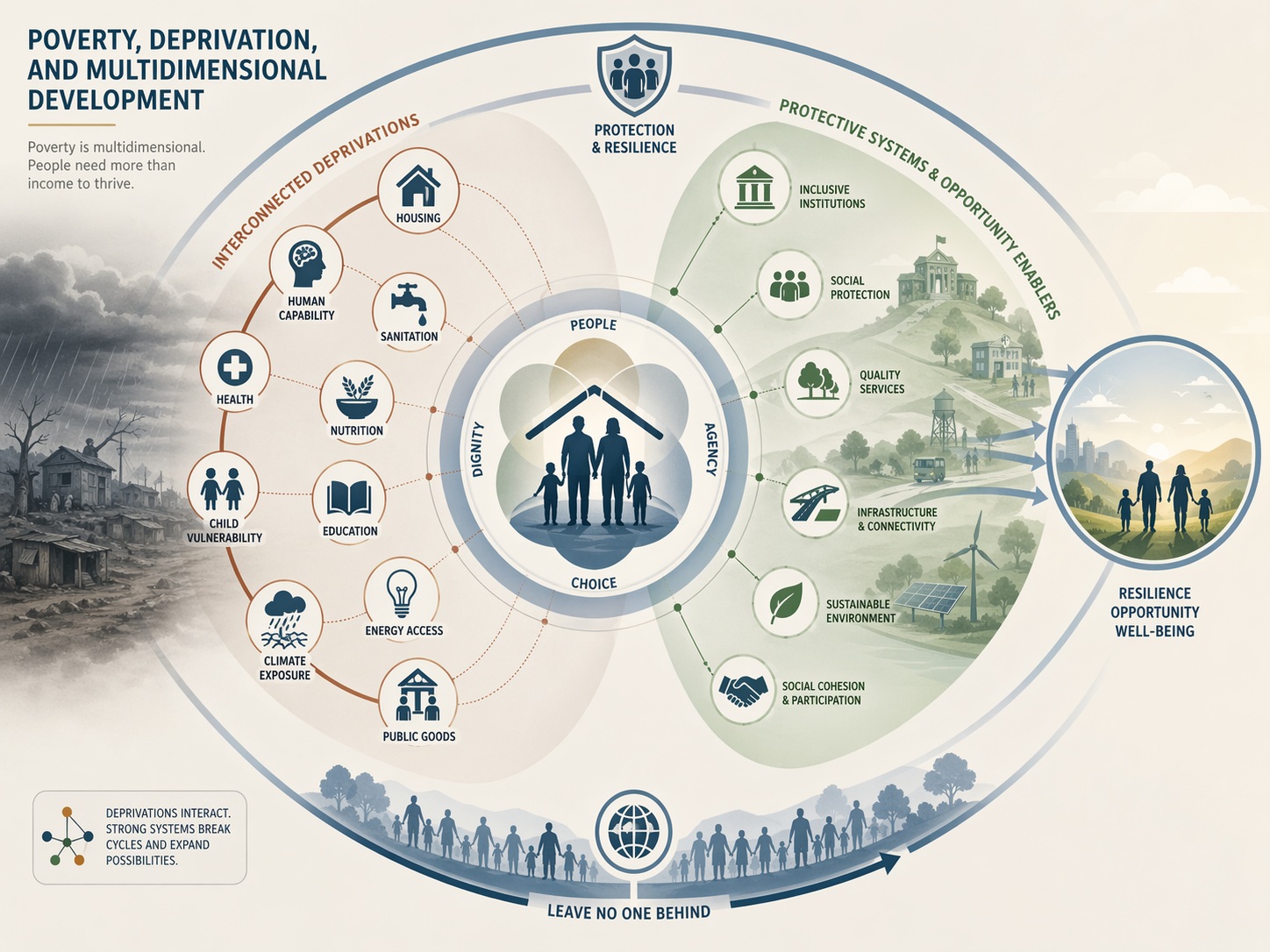
Like all indices, the MPI has limits. It cannot capture every aspect of dignity, power, political exclusion, care burdens, discrimination, violence, institutional distrust, or environmental insecurity. But its contribution remains substantial: it makes visible forms of deprivation that income measures alone often obscure. It gives development analysis a way to see poverty as a structured field of overlapping disadvantage.
Children, Households, and Structural Vulnerability
Multidimensional poverty is especially important for understanding childhood vulnerability. The 2025 Global MPI reports that children under 18 make up 33.6 percent of the covered population but 51 percent of those living in multidimensional poverty. This is a striking finding because it shows that poverty is not evenly distributed across age groups and because childhood deprivation often has lifelong consequences. Poor nutrition, interrupted schooling, inadequate shelter, unsafe sanitation, household energy deprivation, and exposure to shocks shape not only present hardship but future capability.
This reveals another strength of multidimensional poverty analysis: it highlights structural vulnerability within households and across generations. Poverty is not only about current consumption. It is about the long-run formation of human possibility. When children grow up in overlapping deprivation, the effects can persist through health, learning, labor-market access, social participation, and intergenerational transmission of disadvantage.
Childhood poverty also illustrates why deprivation cannot be treated as a matter of individual choice. Children do not choose household income, sanitation, school access, nutrition, neighborhood safety, household energy systems, or climate exposure. Their life chances are shaped by public systems, social structures, household conditions, and institutional protection. A society that allows large numbers of children to grow up in multidimensional poverty is not merely failing current households. It is transmitting diminished capability into the future.
That is why poverty policy must be more than compensatory. It must also be preventative and developmental. Reducing multidimensional poverty means interrupting the mechanisms through which deprivation reproduces itself over time. Early childhood health, nutrition, schooling, housing, sanitation, family support, social protection, and climate resilience become long-run development investments rather than narrow welfare expenditures.
Sustainable development cannot claim success if it improves aggregate indicators while leaving the next generation structurally compromised. This aligns closely with Intergenerational Justice and Long-Term Stewardship, because childhood poverty is one of the clearest ways present systems shape future possibility.
Space, Public Goods, and the Geography of Deprivation
Poverty is also spatial. Deprivation is often structured by where people live and by the public goods to which they do or do not have access. Rural isolation, informal urban settlement, weak transport links, inadequate sanitation systems, poor drainage, unreliable electricity, insecure land tenure, and environmental exposure all shape whether households can convert resources into secure forms of life. Two households with similar incomes may experience radically different real conditions because one is embedded in functioning public systems while the other is not.
This spatial dimension matters because it shows why poverty cannot be treated as an individual or household problem alone. Deprivation is often reproduced through place-based absences: absent clinics, absent schools, absent energy infrastructure, absent safe water, absent legal protection, absent flood control, absent mobility, absent waste management, absent digital connectivity, and absent public accountability. Where these deficits cluster, poverty becomes environmentally, infrastructurally, and institutionally embedded.
The geography of deprivation also shapes exposure to risk. Informal settlements may face flood risk, heat stress, weak drainage, unstable tenure, and inadequate services. Remote rural communities may face long distances to healthcare, weak transport, climate-sensitive livelihoods, and limited educational access. Marginalized urban neighborhoods may face pollution, unsafe housing, underinvestment, and limited political voice. Poverty is therefore not only a condition inside households; it is produced through the organization of space.
A multidimensional account of development must therefore include geography and public systems. Poverty reduction is not only about raising private resources. It is about transforming the spaces and infrastructures through which opportunity is made possible or impossible. This governance dimension also complements Trade-Offs, Synergies, and Policy Coherence, since public systems are one of the main sites where deprivation is either reproduced or interrupted.
Spatial poverty also requires disaggregated measurement. National averages can obscure regional deprivation, rural-urban gaps, informal settlement vulnerability, Indigenous land dispossession, and the unequal distribution of public investment. A serious multidimensional development framework must therefore ask where deprivation is concentrated and why.
Poverty, Capability, and Sustainable Development
The relationship between poverty and sustainable development is deeper than the simple claim that poverty should be reduced. Poverty is one of the most direct ways in which human capabilities are constrained. It limits access to health, education, mobility, voice, and resilience, and it increases vulnerability to environmental shocks, economic instability, conflict, institutional failure, and household crisis. This is one reason the 2030 Agenda gives poverty such centrality: poverty eradication is not one goal among many but a cross-cutting requirement of meaningful development.
At the same time, sustainable development complicates the poverty discussion by asking whether poverty reduction pathways are durable. Income growth or service expansion that depends on ecologically destabilizing models may relieve deprivation in the short run while reproducing larger vulnerabilities in the long run. This does not weaken the case for poverty reduction. It sharpens the need for development pathways that address deprivation without intensifying future instability.
Multidimensional development therefore provides a stronger bridge between human development and sustainability than income alone can. It keeps attention on the real conditions of life while opening space to ask how those conditions can be improved durably and justly over time. A poverty reduction strategy that strengthens public goods, social protection, clean energy, climate resilience, health, education, and inclusive institutions is more likely to produce development that lasts.
This also means poverty policy must be integrated with environmental and institutional policy. Climate adaptation, disaster risk reduction, clean energy, water security, sanitation, food systems, housing, and public health are not separate from poverty reduction. They are part of how poverty is either deepened or reduced. A household can escape income poverty and remain vulnerable if environmental risk repeatedly destroys assets or weak public systems fail to protect basic wellbeing.
This connects the article directly to Safe Operating Space and the Conditions of Long-Run Development. Poverty reduction must expand present capability without undermining the ecological conditions on which future capability depends.
Institutions, Public Goods, and the Reproduction of Deprivation
Poverty is never only a household problem. It is also a problem of institutions and public goods. Where schools are weak, clinics inaccessible, sanitation absent, energy unreliable, transport poor, housing insecure, legal protections thin, and public administration weak, deprivation is reproduced even when households struggle to improve their own conditions. Poverty therefore reflects not only low personal resources but failures in the larger systems that should support dignified life.
This is why multidimensional poverty analysis has strong institutional implications. If poverty is concentrated in deficits of housing, sanitation, electricity, nutrition, and schooling, then the problem is not simply that individuals lack money. It is that public and collective systems are failing to deliver basic conditions of development. Poverty policy must therefore include public goods, infrastructure, service delivery, and state capacity, not just transfers or growth promotion.
Institutional weakness can also make poverty more persistent by reducing trust and limiting access to rights. A household may be poor not only because income is low, but because land tenure is insecure, labor protections are absent, corruption raises costs, public offices are inaccessible, legal systems are unaffordable, or social protection is unreliable. Institutions shape whether poor people can make claims, receive services, build assets, defend rights, and recover from crisis.
In this sense, poverty is a systems problem. It is reproduced through interacting deficits in institutions, infrastructures, and opportunities. Sustainable development requires understanding and changing those structures rather than assuming that broad growth alone will eventually repair them. Growth can help, but without public goods and institutional capacity, growth may bypass the very people whose deprivation is most severe.
Good poverty policy therefore requires both household support and structural repair. Cash transfers, food support, and income security can reduce immediate hardship. But long-run multidimensional poverty reduction also requires public investment in schools, clinics, water systems, sanitation, housing, energy, transport, environmental protection, and accountable governance. The goal is not only to relieve poverty but to dismantle the systems that reproduce it.
Environmental Risk, Climate Exposure, and Poverty
One of the most important recent developments in multidimensional poverty analysis is the growing attention to overlap between poverty and environmental or climate risk. The 2025 MPI report explicitly focuses on poverty and climate hazards, overlaying poverty data with climate exposure to assess how exposed poor people are to environmental shocks. It reports that 887 million poor people live in subnational regions experiencing at least one of four climate hazards and that 309 million poor people face three or four concurrent hazards. This is highly relevant for sustainable development because it shows that deprivation and environmental vulnerability are often mutually reinforcing rather than separate policy domains.
Poor households are often more exposed to climate and environmental stress because they live in riskier locations, rely more directly on climate-sensitive livelihoods, and have fewer buffers against shocks. At the same time, environmental degradation can deepen deprivation by undermining food systems, water access, health, housing security, local livelihoods, and public capacity. Poverty and ecological instability therefore interact in ways that narrow both present wellbeing and future options.
This interaction is not accidental. Environmental risk is often distributed through inequality. Low-income households may live in areas more exposed to flood, heat, pollution, unsafe water, or unstable land because safer locations are more expensive or politically protected. Informal workers may lose income during climate shocks without insurance or social protection. Small farmers may face drought, crop failure, or water stress without savings or alternative livelihoods. Children may suffer learning losses after disasters or due to health burdens linked to heat, pollution, and malnutrition.
This further strengthens the case for multidimensional development. Poverty cannot be adequately understood if ecological exposure is treated as external to the poverty problem. Sustainable development requires approaches that integrate poverty reduction with climate resilience, environmental protection, and the strengthening of basic public systems.
This section links especially well with Freshwater Change and Development Risk and Risk, Shock, and Fragility in Development Systems, because poverty becomes more severe when household deprivation meets repeated environmental stress.
Power, Voice, and Dignity
Poverty is also a condition of unequal power. People experiencing poverty often have less voice in public decision-making, less access to legal remedies, less bargaining power in labor markets, and less ability to shape the systems that govern their lives. This political dimension is easy to miss when poverty is measured only as income or even as household deprivation. But deprivation is often reproduced because poor people are excluded from the institutions that decide where schools, clinics, water systems, transport routes, housing protections, and environmental safeguards will be placed.
Voice matters because poverty policy is not only about delivering services to passive recipients. It is about enabling people to participate in decisions that affect their lives. Communities experiencing poverty often know where public systems fail: which roads flood, which clinics lack medicine, which schools are inaccessible, which water points are unsafe, which housing arrangements are insecure, and which officials are unresponsive. Their experience is a form of knowledge. A serious multidimensional development approach should treat that knowledge as evidence, not as noise.
Dignity also matters. Poverty is not only material hardship; it can involve humiliation, dependency, exclusion, and the feeling of being treated as disposable. Development policy that reduces poverty numerically while ignoring dignity may fail to address the social meaning of deprivation. A household may receive assistance but still experience stigma, surveillance, disrespect, or exclusion from public life. Poverty reduction should therefore be judged not only by what is delivered, but by whether people are treated as rights-bearing participants in development.
This is especially important for marginalized communities whose poverty is shaped by histories of exclusion, discrimination, displacement, caste, race, ethnicity, gender, disability, migration status, colonial legacies, or land dispossession. Multidimensional development must be able to name these structures. Otherwise, it risks treating poverty as a technical deficit while ignoring the unequal power relations that produce and sustain it.
In this sense, poverty reduction is not only a service-delivery agenda. It is also a democratic and human-rights agenda. It asks whether people have the power, recognition, and institutional standing to claim the conditions of a dignified life.
Measurement, Indicators, and the Politics of Visibility
Measurement shapes what poverty policy can see. Income poverty lines make monetary deprivation visible. The MPI makes overlapping household deprivations visible. Human development indicators make health, education, and living standards more visible. Climate-poverty overlays make environmental vulnerability more visible. Each measurement frame brings certain realities into focus and leaves others less visible. This is why poverty measurement is not merely technical. It is also political.
When poverty is measured narrowly, policy may be narrow. If only income is visible, then sanitation, housing, energy, health, schooling, dignity, exposure, and public goods may be underweighted. If only national averages are visible, then regional, gendered, racialized, Indigenous, child-specific, disability-related, or informal-settlement deprivations may be hidden. If environmental exposure is not connected to poverty data, then the interaction between deprivation and climate risk may remain under-governed.
Good poverty measurement therefore requires disaggregation, multidimensionality, and interpretation. It should show who is poor, how they are poor, where they are poor, which deprivations overlap, which groups face the greatest exposure, and which public systems are failing. It should also be transparent enough to support public debate. Poverty indicators should not become technocratic screens that replace lived experience. They should help make lived experience more visible to institutions.
The politics of visibility also matters because people in poverty are often seen through deficits rather than through agency. Measurement should identify deprivation without reducing people to deprivation. It should support action without erasing dignity. It should show where systems fail rather than implying that households are individually responsible for conditions shaped by institutions, public goods, history, and power.
In sustainable development, measurement is strongest when it supports public responsibility. It helps societies ask whether poverty is being reduced in name only or whether real capability, resilience, security, and dignity are expanding. That is the difference between poverty reduction as a statistical achievement and poverty reduction as a transformation in human possibility.
Why This Matters for Sustainable Development
Poverty, deprivation, and multidimensional development matter for sustainable development because they clarify what development is for. The purpose of development is not merely to increase output, expand infrastructure, or improve aggregate indicators. It is to expand the conditions under which people can live healthy, educated, secure, dignified, and meaningful lives. Poverty is the direct denial of those conditions.
A multidimensional approach also helps protect sustainable development from two common errors. The first error is to assume that economic growth alone will solve deprivation. Growth may be necessary in many contexts, but it does not automatically provide sanitation, schooling, healthcare, housing security, clean energy, legal protection, environmental safety, or social dignity. The second error is to treat poverty reduction and ecological sustainability as separate projects. In reality, poverty and environmental risk often interact, especially where poor households face climate hazards, water stress, food insecurity, pollution, or weak public protection.
Multidimensional development brings these concerns together. It asks whether poverty reduction is improving real lives across the domains that matter, whether public goods are reaching those most excluded, whether children are protected from deprivation that will shape their futures, whether environmental shocks are being addressed, and whether institutions are strong enough to prevent deprivation from reproducing itself.
The central claim is therefore simple but demanding: poverty is not only a lack of money. It is a lack of sufficient conditions for human flourishing. Sustainable development becomes credible only when it treats those conditions as central. To eradicate poverty “in all its forms and dimensions” is to build systems in which human capability, public goods, ecological security, institutional protection, and dignity are no longer reserved for the fortunate.
This is why poverty belongs at the center of the sustainable-development series. It is not a separate humanitarian issue beside development. It is one of the clearest tests of whether development is actually working.
Mathematical Lens
Multidimensional poverty can be clarified by thinking in terms of overlapping deprivation, public-goods access, resilience, and capability conversion rather than income alone. Let \(P\) represent multidimensional poverty burden, \(D\) overlapping deprivation, \(G\) access to public goods and services, \(R\) resilience against shocks, and \(C\) capability conversion:
P = \alpha D – \beta G – \gamma R – \delta C
\]
Interpretation: Poverty deepens when deprivations cluster and when public systems, resilience, and capability conversion remain weak.
Higher \(P\) indicates a more severe poverty burden. This captures the article’s core point: poverty is not only income shortage, but a multidimensional condition shaped by deprivation, weak public systems, low resilience, and constrained capability.
We can also express poverty bundles as a weighted function of core household deprivations:
B = w_1 H + w_2 S + w_3 E + w_4 N + w_5 L
\]
Interpretation: Poverty bundles become more severe when housing, sanitation, energy, nutrition, and learning deprivations overlap.
Here, \(H\) is housing deprivation, \(S\) is sanitation deprivation, \(E\) is electricity and energy deprivation, \(N\) is nutrition deprivation, and \(L\) is learning deprivation. Higher \(B\) means a household faces more layered disadvantage.
Finally, long-run poverty exit capability can be represented as a function of income support, public systems, and environmental security:
X = \lambda I + \mu G + \nu Q
\]
Interpretation: Poverty exit capability increases when income security, public-goods reach, and protection from recurring environmental and institutional shocks improve together.
Here, \(I\) is income security, \(G\) is public-goods reach, and \(Q\) is protection from recurring environmental and institutional shocks. This helps show why similar incomes can produce very different development trajectories across places.
| Term | Meaning | Interpretive role |
|---|---|---|
| \(P\) | Multidimensional poverty burden | Represents poverty as overlapping deprivation rather than income shortage alone. |
| \(D\) | Overlapping deprivation | Represents clustered deficits across health, education, housing, energy, nutrition, sanitation, and living standards. |
| \(G\) | Public-goods access | Represents access to schools, clinics, water, sanitation, transport, energy, protection, and basic services. |
| \(R\) | Resilience against shocks | Represents the ability of households and communities to absorb economic, health, environmental, and institutional shocks. |
| \(C\) | Capability conversion | Represents the ability to turn resources and rights into real freedoms and life opportunities. |
| \(B\) | Poverty bundle | Represents the cumulative severity of multiple simultaneous household deprivations. |
| \(X\) | Poverty exit capability | Represents the likelihood that poverty reduction becomes durable rather than temporary. |
The equations are conceptual rather than predictive. Their value is to make visible the structure of multidimensional poverty: deprivation clusters, public goods matter, resilience matters, and poverty exit depends on more than income alone.
Advanced Python Workflow: Poverty, Deprivation, and Multidimensional Development Risk Scoring
This Python workflow translates the article’s core argument into a structured multidimensional poverty model. Rather than treating poverty as a single income shortfall, it scores territories across deprivation overlap, public-goods access, climate exposure, child vulnerability, governance readiness, and capability conversion. That makes it possible to compare not only where poverty is high, but where deprivation is most developmentally cumulative and structurally entrenched.
from __future__ import annotations

import pandas as pd
import numpy as np

INPUT_FILE = "poverty_multidimensional_development_panel.csv"
OUTPUT_FILE = "poverty_multidimensional_development_scores.csv"


def load_data(path: str) -> pd.DataFrame:
    """
    Load a territory-level multidimensional poverty dataset.

    All *_index columns should be normalized to [0, 1].
    Higher values should mean more of the named property.

    Examples:
      - income_poverty_index: higher = more income poverty
      - housing_deprivation_index: higher = more housing deprivation
      - public_goods_access_index: higher = stronger public-goods access
      - poverty_transition_readiness_index: higher = stronger poverty exit readiness
    """
    df = pd.read_csv(path)

    required_columns = [
        "territory_name",
        "country_or_region",
        "territory_type",
        "income_poverty_index",
        "housing_deprivation_index",
        "sanitation_deprivation_index",
        "electricity_cooking_fuel_deprivation_index",
        "nutrition_deprivation_index",
        "learning_deprivation_index",
        "health_access_deprivation_index",
        "climate_exposure_index",
        "child_vulnerability_index",
        "public_goods_access_index",
        "governance_capacity_index",
        "capability_conversion_index",
        "poverty_transition_readiness_index",
        "social_protection_reach_index",
    ]

    missing = [col for col in required_columns if col not in df.columns]

    if missing:
        raise ValueError(f"Missing required columns: {missing}")

    return df


def validate_indices(df: pd.DataFrame) -> pd.DataFrame:
    """Validate that all *_index fields are complete and normalized to [0, 1]."""
    index_columns = [col for col in df.columns if col.endswith("_index")]

    for col in index_columns:
        if df[col].isna().any():
            raise ValueError(f"Column '{col}' contains missing values.")

        if ((df[col] < 0) | (df[col] > 1)).any():
            raise ValueError(f"Column '{col}' contains values outside [0, 1].")

    return df


def compute_scores(df: pd.DataFrame) -> pd.DataFrame:
    """
    Compute multidimensional deprivation, capability support,
    and poverty reproduction risk.

    Multidimensional deprivation rises with income poverty,
    housing, sanitation, energy, nutrition, learning, health-access
    deprivation, climate exposure, and child vulnerability.

    Capability support rises with public-goods access, governance capacity,
    capability conversion, transition readiness, and social protection.
    """
    df = df.copy()

    df["multidimensional_deprivation_score"] = (
        0.10 * df["income_poverty_index"] +
        0.12 * df["housing_deprivation_index"] +
        0.12 * df["sanitation_deprivation_index"] +
        0.12 * df["electricity_cooking_fuel_deprivation_index"] +
        0.12 * df["nutrition_deprivation_index"] +
        0.12 * df["learning_deprivation_index"] +
        0.10 * df["health_access_deprivation_index"] +
        0.10 * df["climate_exposure_index"] +
        0.10 * df["child_vulnerability_index"]
    ).clip(lower=0, upper=1)

    df["capability_support_score"] = (
        0.24 * df["public_goods_access_index"] +
        0.22 * df["governance_capacity_index"] +
        0.22 * df["capability_conversion_index"] +
        0.18 * df["poverty_transition_readiness_index"] +
        0.14 * df["social_protection_reach_index"]
    ).clip(lower=0, upper=1)

    df["poverty_reproduction_risk_score"] = (
        0.44 * df["multidimensional_deprivation_score"] +
        0.16 * df["climate_exposure_index"] +
        0.14 * df["child_vulnerability_index"] +
        0.10 * (1 - df["social_protection_reach_index"]) +
        0.16 * (1 - df["capability_support_score"])
    ).clip(lower=0, upper=1)

    df["risk_band"] = np.select(
        [
            df["poverty_reproduction_risk_score"] >= 0.80,
            df["poverty_reproduction_risk_score"] >= 0.60,
            df["poverty_reproduction_risk_score"] >= 0.40,
        ],
        [
            "Extreme multidimensional poverty risk",
            "High multidimensional poverty risk",
            "Moderate multidimensional poverty risk",
        ],
        default="Lower multidimensional poverty risk",
    )

    df["capability_gap"] = (
        df["multidimensional_deprivation_score"] - df["capability_support_score"]
    )

    df["deprivation_warning"] = np.select(
        [
            df["capability_gap"] >= 0.35,
            df["capability_gap"] >= 0.20,
            df["capability_gap"] >= 0.05,
        ],
        [
            "Severe deprivation-capability gap",
            "High deprivation-capability gap",
            "Moderate deprivation-capability gap",
        ],
        default="Lower deprivation-capability gap or stronger support",
    )

    return df


def build_summary(df: pd.DataFrame) -> pd.DataFrame:
    """Return a ranked summary table for review or reporting."""
    columns = [
        "territory_name",
        "country_or_region",
        "territory_type",
        "multidimensional_deprivation_score",
        "capability_support_score",
        "poverty_reproduction_risk_score",
        "risk_band",
        "capability_gap",
        "deprivation_warning",
    ]

    summary = df[columns].copy()

    summary = summary.sort_values(
        by=[
            "poverty_reproduction_risk_score",
            "multidimensional_deprivation_score",
            "capability_support_score",
        ],
        ascending=[False, False, True],
    ).reset_index(drop=True)

    return summary


def main() -> None:
    df = load_data(INPUT_FILE)
    df = validate_indices(df)
    scored = compute_scores(df)
    summary = build_summary(scored)

    summary.to_csv(OUTPUT_FILE, index=False)

    print("Poverty, deprivation, and multidimensional development scoring complete.")
    print(summary.to_string(index=False))


if __name__ == "__main__":
    main()
This workflow is intentionally transparent. It does not claim that poverty can be reduced to a single objective score. Instead, it makes assumptions visible: income poverty, housing, sanitation, energy, nutrition, learning, health access, climate exposure, child vulnerability, public goods, governance, capability conversion, social protection, and transition readiness are treated as distinct components. The value of the model is diagnostic. It helps identify where deprivation is most cumulative and where public systems are least able to support durable poverty exit.
Advanced R Workflow: Multidimensional Poverty Bundles, Public Goods, and Governance Risk
This R workflow is designed for the part of the article that emphasizes clustered deprivation, child vulnerability, public goods, climate exposure, and institutional support. It compares settings across household deprivations, public-goods reach, social protection, climate exposure, governance capacity, and capability conversion, then builds grouped summaries that help show where poverty is becoming most cumulative and hardest to escape.
library(readr)
library(dplyr)

input_file <- "poverty_multidimensional_development_country_panel.csv"
region_output_file <- "cross_region_poverty_summary.csv"
territory_output_file <- "cross_territory_poverty_summary.csv"

poverty_df <- read_csv(input_file, show_col_types = FALSE)

required_cols <- c(
  "territory_name",
  "country_or_region",
  "territory_type",
  "income_poverty_index",
  "housing_deprivation_index",
  "sanitation_deprivation_index",
  "electricity_cooking_fuel_deprivation_index",
  "nutrition_deprivation_index",
  "learning_deprivation_index",
  "health_access_deprivation_index",
  "climate_exposure_index",
  "child_vulnerability_index",
  "public_goods_access_index",
  "governance_capacity_index",
  "capability_conversion_index",
  "poverty_transition_readiness_index",
  "social_protection_reach_index"
)

missing_cols <- setdiff(required_cols, names(poverty_df))

if (length(missing_cols) > 0) {
  stop(paste("Missing required columns:", paste(missing_cols, collapse = ", ")))
}

index_cols <- names(poverty_df)[grepl("_index$", names(poverty_df))]

invalid_index_cols <- index_cols[
  vapply(
    poverty_df[index_cols],
    function(x) any(is.na(x) | x < 0 | x > 1),
    logical(1)
  )
]

if (length(invalid_index_cols) > 0) {
  stop(
    paste(
      "Index columns must be complete and normalized to [0, 1]:",
      paste(invalid_index_cols, collapse = ", ")
    )
  )
}

poverty_df <- poverty_df %>%
  mutate(
    deprivation_bundle_proxy = (
      income_poverty_index +
      housing_deprivation_index +
      sanitation_deprivation_index +
      electricity_cooking_fuel_deprivation_index +
      nutrition_deprivation_index +
      learning_deprivation_index +
      health_access_deprivation_index +
      climate_exposure_index +
      child_vulnerability_index
    ) / 9,
    capability_support_proxy = (
      public_goods_access_index +
      governance_capacity_index +
      capability_conversion_index +
      poverty_transition_readiness_index +
      social_protection_reach_index
    ) / 5,
    multidimensional_poverty_proxy = (
      deprivation_bundle_proxy +
      (1 - public_goods_access_index) +
      (1 - governance_capacity_index) +
      (1 - capability_conversion_index) +
      (1 - poverty_transition_readiness_index) +
      (1 - social_protection_reach_index)
    ) / 6,
    capability_gap = deprivation_bundle_proxy - capability_support_proxy,
    risk_band = case_when(
      multidimensional_poverty_proxy >= 0.75 ~ "Extreme multidimensional poverty risk",
      multidimensional_poverty_proxy >= 0.55 ~ "High multidimensional poverty risk",
      multidimensional_poverty_proxy >= 0.35 ~ "Moderate multidimensional poverty risk",
      TRUE ~ "Lower multidimensional poverty risk"
    )
  )

region_summary <- poverty_df %>%
  group_by(country_or_region) %>%
  summarise(
    avg_multidimensional_poverty_proxy = mean(multidimensional_poverty_proxy, na.rm = TRUE),
    avg_deprivation_bundle_proxy = mean(deprivation_bundle_proxy, na.rm = TRUE),
    avg_capability_support_proxy = mean(capability_support_proxy, na.rm = TRUE),
    avg_income_poverty = mean(income_poverty_index, na.rm = TRUE),
    avg_housing_deprivation = mean(housing_deprivation_index, na.rm = TRUE),
    avg_sanitation_deprivation = mean(sanitation_deprivation_index, na.rm = TRUE),
    avg_energy_deprivation = mean(electricity_cooking_fuel_deprivation_index, na.rm = TRUE),
    avg_nutrition_deprivation = mean(nutrition_deprivation_index, na.rm = TRUE),
    avg_learning_deprivation = mean(learning_deprivation_index, na.rm = TRUE),
    avg_climate_exposure = mean(climate_exposure_index, na.rm = TRUE),
    avg_child_vulnerability = mean(child_vulnerability_index, na.rm = TRUE),
    avg_public_goods_access = mean(public_goods_access_index, na.rm = TRUE),
    avg_governance_capacity = mean(governance_capacity_index, na.rm = TRUE),
    avg_capability_gap = mean(capability_gap, na.rm = TRUE),
    observations = n(),
    .groups = "drop"
  ) %>%
  mutate(
    regional_risk_band = case_when(
      avg_multidimensional_poverty_proxy >= 0.75 ~ "Extreme multidimensional poverty risk",
      avg_multidimensional_poverty_proxy >= 0.55 ~ "High multidimensional poverty risk",
      avg_multidimensional_poverty_proxy >= 0.35 ~ "Moderate multidimensional poverty risk",
      TRUE ~ "Lower multidimensional poverty risk"
    )
  ) %>%
  arrange(desc(avg_multidimensional_poverty_proxy))

territory_summary <- poverty_df %>%
  group_by(territory_type) %>%
  summarise(
    avg_multidimensional_poverty_proxy = mean(multidimensional_poverty_proxy, na.rm = TRUE),
    avg_deprivation_bundle_proxy = mean(deprivation_bundle_proxy, na.rm = TRUE),
    avg_capability_support_proxy = mean(capability_support_proxy, na.rm = TRUE),
    avg_income_poverty = mean(income_poverty_index, na.rm = TRUE),
    avg_housing_deprivation = mean(housing_deprivation_index, na.rm = TRUE),
    avg_sanitation_deprivation = mean(sanitation_deprivation_index, na.rm = TRUE),
    avg_energy_deprivation = mean(electricity_cooking_fuel_deprivation_index, na.rm = TRUE),
    avg_nutrition_deprivation = mean(nutrition_deprivation_index, na.rm = TRUE),
    avg_learning_deprivation = mean(learning_deprivation_index, na.rm = TRUE),
    avg_climate_exposure = mean(climate_exposure_index, na.rm = TRUE),
    avg_child_vulnerability = mean(child_vulnerability_index, na.rm = TRUE),
    avg_public_goods_access = mean(public_goods_access_index, na.rm = TRUE),
    avg_governance_capacity = mean(governance_capacity_index, na.rm = TRUE),
    avg_capability_gap = mean(capability_gap, na.rm = TRUE),
    observations = n(),
    .groups = "drop"
  ) %>%
  arrange(desc(avg_multidimensional_poverty_proxy))

write_csv(region_summary, region_output_file)
write_csv(territory_summary, territory_output_file)

cat("Cross-region poverty summary exported to:", region_output_file, "\n")
print(region_summary)

cat("\nCross-territory poverty summary exported to:", territory_output_file, "\n")
print(territory_summary)
This workflow helps distinguish income poverty from broader deprivation systems. A territory may show modest income gains while still facing severe housing, sanitation, energy, nutrition, learning, health-access, climate, and child-vulnerability burdens. Conversely, strong public goods, governance capacity, social protection, and capability conversion can reduce the risk that deprivation reproduces itself across households and generations. The workflow therefore treats poverty as a systems-governance issue rather than a single monetary threshold.
GitHub Repository
Complete Code Repository
The full code distribution for this article, including multidimensional-poverty scoring workflows, deprivation-bundle diagnostics, SQL materials, optional monitoring support tooling, supporting documentation, and repository structure, is available on GitHub.
Related Articles
- From Economic Growth to Human Development
- Sustainable Development as a Systems Problem
- Intergenerational Justice and Long-Term Stewardship
- Trade-Offs, Synergies, and Policy Coherence
- Safe Operating Space and the Conditions of Long-Run Development
- Freshwater Change and Development Risk
- Risk, Shock, and Fragility in Development Systems
- Inequality and Inclusive Development
- Beyond GDP Development: Measuring Prosperity as a Systems Outcome
- Human Development Indicators and Their Limits
Further Reading
- United Nations Development Programme and Oxford Poverty and Human Development Initiative (2025) Global Multidimensional Poverty Index 2025: Overlapping Hardships: Poverty and Climate Hazards. New York: UNDP. Available at: https://hdr.undp.org/content/2025-global-multidimensional-poverty-index-mpi
- United Nations Development Programme and Oxford Poverty and Human Development Initiative (2025) Global Multidimensional Poverty Index 2025: Overlapping Hardships: Poverty and Climate Hazards. New York: UNDP. Available at: https://hdr.undp.org/system/files/documents/global-report-document/mpireport2025en.pdf
- United Nations Development Programme (2025) Human Development Report 2025: A Matter of Choice: People and Possibilities in the Age of AI. New York: UNDP. Available at: https://hdr.undp.org/content/human-development-report-2025
- United Nations Development Programme (1990) Human Development Report 1990: Concept and Measurement of Human Development. New York: UNDP. Available at: https://hdr.undp.org/content/human-development-report-1990
- United Nations Development Programme (n.d.) About human development. New York: UNDP. Available at: https://hdr.undp.org/about/human-development
- United Nations Development Programme (n.d.) Human Development Index. New York: UNDP. Available at: https://hdr.undp.org/data-center/human-development-index
- Oxford Poverty and Human Development Initiative (2025) Global MPI 2025. Oxford: University of Oxford. Available at: https://ophi.org.uk/global-mpi/2025
- Sen, A. (1999) Development as Freedom. Oxford: Oxford University Press. Available at: https://global.oup.com/academic/product/development-as-freedom-9780192893307
- Haq, M. ul (1995) Reflections on Human Development. Oxford: Oxford University Press. Available at: https://global.oup.com/academic/product/reflections-on-human-development-9780195101935
- Nussbaum, M.C. (2011) Creating Capabilities: The Human Development Approach. Cambridge, MA: Harvard University Press. Available at: https://www.hup.harvard.edu/books/9780674072350
References
- United Nations (2015) Transforming our world: the 2030 Agenda for Sustainable Development. New York: United Nations. Available at: https://sdgs.un.org/2030agenda
- United Nations (n.d.) Goal 1: End poverty in all its forms everywhere. New York: United Nations. Available at: https://sdgs.un.org/goals/goal1
- United Nations Department of Economic and Social Affairs (n.d.) Poverty eradication. New York: United Nations. Available at: https://sdgs.un.org/topics/poverty-eradication
- United Nations Development Programme and Oxford Poverty and Human Development Initiative (2025) 2025 Global Multidimensional Poverty Index (MPI): Overlapping Hardships: Poverty and Climate Hazards. New York: UNDP. Available at: https://hdr.undp.org/content/2025-global-multidimensional-poverty-index-mpi
- United Nations Development Programme and Oxford Poverty and Human Development Initiative (2025) Global Multidimensional Poverty Index 2025: Overlapping Hardships: Poverty and Climate Hazards. New York: UNDP. Available at: https://hdr.undp.org/system/files/documents/global-report-document/mpireport2025en.pdf
- United Nations Development Programme (2025) Human Development Report 2025: A Matter of Choice: People and Possibilities in the Age of AI. New York: UNDP. Available at: https://hdr.undp.org/content/human-development-report-2025
- United Nations Development Programme (1990) Human Development Report 1990: Concept and Measurement of Human Development. New York: UNDP. Available at: https://hdr.undp.org/content/human-development-report-1990
- United Nations Development Programme (n.d.) About human development. New York: UNDP. Available at: https://hdr.undp.org/about/human-development
- United Nations Development Programme (n.d.) Human Development Index. New York: UNDP. Available at: https://hdr.undp.org/data-center/human-development-index
- United Nations Development Programme (n.d.) MPI 2025 FAQs. New York: UNDP. Available at: https://hdr.undp.org/mpi-2025-faqs
- Oxford Poverty and Human Development Initiative (2025) Global MPI 2025. Oxford: University of Oxford. Available at: https://ophi.org.uk/global-mpi/2025
- Oxford Poverty and Human Development Initiative (n.d.) Global Multidimensional Poverty Index. Oxford: University of Oxford. Available at: https://ophi.org.uk/global-mpi
- Oxford Poverty and Human Development Initiative (n.d.) Amartya Sen and OPHI. Oxford: University of Oxford. Available at: https://ophi.org.uk/research/amartya-sen-and-ophi
- Sen, A. (1999) Development as Freedom. Oxford: Oxford University Press. Available at: https://global.oup.com/academic/product/development-as-freedom-9780192893307
- Haq, M. ul (1995) Reflections on Human Development. Oxford: Oxford University Press. Available at: https://global.oup.com/academic/product/reflections-on-human-development-9780195101935
- Nussbaum, M.C. (2011) Creating Capabilities: The Human Development Approach. Cambridge, MA: Harvard University Press. Available at: https://www.hup.harvard.edu/books/9780674072350