
Last Updated May 10, 2026
Systemic risk, feedback loops, and cascading failures in AI systems concern the conditions under which local errors, concentrated dependencies, tightly coupled workflows, automated interactions, or shared infrastructure dependencies propagate across larger sociotechnical systems. In an isolated application, an AI failure may appear as a misclassification, a poor recommendation, a hallucinated answer, a flawed forecast, or a weak ranking. In an interconnected environment, the same failure can travel through infrastructure, institutions, markets, platforms, public services, automated agents, supply chains, or information systems until it produces effects far beyond the original point of breakdown.
The central argument of this article is that systemic AI risk cannot be understood by examining models in isolation. Once AI becomes embedded in operational workflows, cloud platforms, enterprise software, public administration, logistics, market systems, content infrastructures, decision-support environments, or autonomous agents, the relevant unit of analysis changes. The question is no longer only whether a model is accurate. The stronger question is whether the surrounding system can absorb, contain, detect, contest, and recover from failure.
Systemic AI risk is especially important because artificial intelligence increasingly operates across several layers at once: foundation models, APIs, cloud infrastructure, data pipelines, retrieval systems, dashboards, human review processes, automated workflows, procurement contracts, and institutional incentives. These layers may appear separate, but they can become tightly coupled. A fault in one layer may alter behavior in another. A shared dependency may create correlated vulnerability. A feedback loop may amplify what began as a local error. A decision-support tool may quietly reshape future data. A platform outage may affect thousands of downstream systems at once.
Main Library
Publications
Article Map
Artificial Intelligence Systems
Related Topic
Data Systems & Analytics
Related Topic
Risk & Resilience
Related Topic
Institutions & Governance
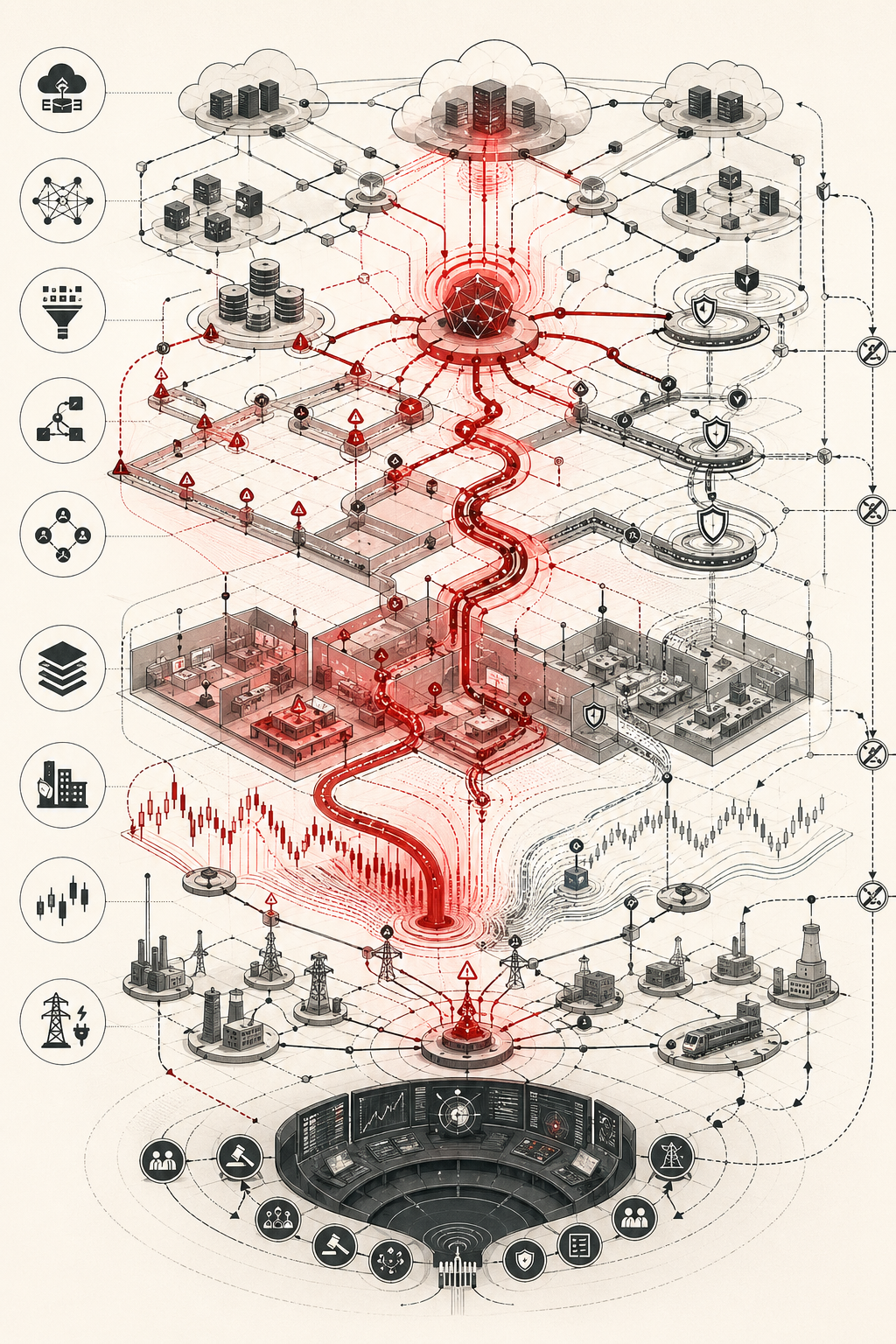
This article develops Systemic Risk, Feedback Loops, and Cascading Failures in AI Systems as an advanced article within the Artificial Intelligence Systems knowledge series. It explains systemic risk, complex adaptive systems, nonlinear response, tight coupling, feedback loops, cascading failures, dependency concentration, platform fragility, organizational propagation, critical infrastructure exposure, market-system instability, agentic coupling, runtime monitoring, early-warning indicators, resilience engineering, adaptive governance, incident reporting, and system-level risk management. Selected Python and R examples appear here, while the full GitHub repository contains expanded computational scaffolding for cascade simulation, dependency-network diagnostics, feedback-loop modeling, fragility scoring, SQL metadata, governance documentation, and advanced Jupyter notebooks.
Why Systemic Risk Matters in AI Systems
Systemic risk matters because AI systems increasingly shape other systems. They rank information, allocate attention, summarize evidence, route cases, prioritize alerts, trigger workflows, coordinate logistics, recommend financial actions, assist infrastructure planning, support public administration, and automate operational decisions. When these systems are loosely connected, failures may remain local. When they become tightly coupled, dependent on common providers, or embedded in high-speed workflows, small errors can travel across networks.
This is why systemic AI risk is different from ordinary model failure. A model-level error may be manageable if it is isolated, visible, reversible, and slow-moving. The same error may become dangerous if it is automatically copied into downstream systems, trusted by overloaded reviewers, used to update future training data, amplified by recommendation loops, synchronized across many organizations, or embedded in a workflow that lacks meaningful human interruption.
Systemic AI risk therefore asks a larger question: what happens when many AI systems interact with each other, with people, with organizations, with infrastructure, and with incentives? That question cannot be answered by benchmark accuracy alone. It requires complex systems thinking, network analysis, dependency mapping, incident monitoring, scenario testing, and governance capable of responding to propagation rather than only isolated defects.
Model\ Risk \neq Systemic\ Risk
\]
Interpretation: Model risk concerns the behavior of an AI model or application; systemic risk concerns how failures propagate through connected systems, organizations, infrastructures, and feedback loops.
Systemic AI risk also matters because modern AI systems are frequently optimized for speed, scale, efficiency, and automation. These are valuable qualities, but they can reduce slack. A system that eliminates delay may also eliminate time for human correction. A platform that standardizes tools may also concentrate dependency. A model that improves local efficiency may also synchronize behavior across many users. A decision-support system that increases throughput may also create institutional overreliance.
| System Feature | Local Benefit | Systemic Risk | Governance Question |
|---|---|---|---|
| Automation | Increases speed and reduces manual workload. | Errors may propagate before people can intervene. | Where are circuit breakers, escalation points, and rollback paths? |
| Shared providers | Improves scalability and lowers technical barriers. | Common dependency can create correlated failure. | How many critical workflows depend on the same upstream system? |
| Feedback optimization | Improves personalization, ranking, and adaptation. | Can reinforce bias, instability, attention concentration, or drift. | Which feedback loops are stabilizing and which are amplifying? |
| Tight coupling | Reduces latency and improves coordination. | Reduces time for review, correction, and containment. | How much response time exists before downstream consequences occur? |
| Institutional adoption | Standardizes processes and increases productivity. | Can spread weak assumptions across many decisions. | Who owns the risk after AI outputs enter formal workflows? |
Note: Systemic AI risk often emerges from the interaction between technical design, organizational process, infrastructure dependency, and institutional incentives.
Foundations of Systemic Risk in AI Systems
Systemic risk refers to the possibility that failures originating in one part of a system spread across connected components, producing broader disruption than the initial event would suggest. In AI systems, this may begin with a faulty model output, a broken data pipeline, a biased ranking function, a misconfigured automation, a cloud outage, a poisoned dataset, a fragile API dependency, a shared foundation model failure, or an interaction among autonomous agents. The systemic risk emerges when that local disturbance propagates.
This is a different problem from ordinary model evaluation. A benchmark may show whether a model performs well on a task, but it does not reveal what happens when many models interact, when users adapt to model outputs, when institutions reorganize around AI recommendations, or when shared dependencies fail. Systemic risk therefore belongs to the same family of problems as financial contagion, grid instability, supply-chain cascades, epidemiological spread, platform governance, and infrastructure interdependence. The risk lies not only in the defect, but in the pathway of propagation.
A useful distinction is:
Risk_{\mathrm{systemic}} \neq Risk_{\mathrm{local}}
\]
Interpretation: Systemic risk is not merely the sum of local model errors. It depends on interaction, interdependence, amplification, and propagation.
Systemic AI risk analysis therefore asks where the system is coupled, where it is dependent, where feedback loops amplify behavior, where common-mode failures can occur, and where governance lacks visibility into the full network of effects.
| Concept | Meaning | AI-System Example | Risk Implication |
|---|---|---|---|
| Local failure | A breakdown in one component, model, dataset, workflow, or decision point. | A model hallucinates an incorrect policy summary. | May remain contained if reviewed and corrected. |
| Propagation pathway | The route by which a local failure affects other components. | The false summary is copied into a workflow dashboard. | Risk increases when outputs move automatically downstream. |
| Amplification | A process that increases the scale or intensity of an error. | A recommendation loop promotes misleading content because it generates engagement. | Small signals can become dominant system behavior. |
| Common-mode failure | Many systems fail together because they share a dependency. | Multiple organizations rely on the same model API, cloud region, or vector database. | Failures become correlated rather than independent. |
| Resilience buffer | Slack, redundancy, diversity, fallback, or decoupling that absorbs stress. | Manual review, alternative provider, rollback procedure, or rate limiter. | Buffers prevent local faults from becoming cascades. |
Note: Systemic risk analysis begins by distinguishing failure origin from failure propagation. The initiating defect matters, but the architecture of spread often matters more.
Complex Systems, Nonlinearity, and Tight Coupling
AI systems increasingly display properties associated with complex adaptive systems: nonlinear response, emergent behavior, feedback loops, adaptation, dependence on initial conditions, and interaction across scales. A small change in one model’s output may have little effect in one context and large effects in another, depending on timing, dependency, user trust, automation level, organizational incentives, and institutional response.
Nonlinearity means that cause and effect are not proportional. A small ranking change may alter user behavior enough to change future training data. A small forecast error may trigger inventory changes that amplify supply-chain stress. A small moderation error may be magnified by platform dynamics. A small infrastructure outage may spread if many services depend on the same API, identity provider, or cloud region. In systemic risk, the size of the initial error is often less important than the structure through which it travels.
Tight coupling is especially important because it reduces the time available for correction. When AI systems are integrated into real-time workflows, autonomous decision systems, recommendation engines, trading systems, logistics platforms, infrastructure control loops, or agentic tool-use environments, local errors can propagate faster than humans or institutions can intervene. Tight coupling turns delay, ambiguity, and dependency into risk multipliers.
A tight-coupling indicator can be represented as:
C_t = \frac{1}{\tau_{\mathrm{response}}}
\]
Interpretation: Tight coupling increases as the available response time \(\tau_{\mathrm{response}}\) decreases.
The more tightly coupled the system, the more important buffers, circuit breakers, human review thresholds, rollback pathways, and decoupling mechanisms become.
| System Property | Description | AI Example | Resilience Response |
|---|---|---|---|
| Nonlinearity | Small changes can produce disproportionate effects. | A slight ranking change reshapes user attention and future data. | Scenario testing and sensitivity analysis. |
| Emergence | System-level behavior arises from many interacting parts. | Multiple agents produce unexpected coordination patterns. | Sandboxing, monitoring, and staged rollout. |
| Tight coupling | Components interact quickly with little slack. | An AI workflow updates downstream systems automatically. | Circuit breakers, delays, approval thresholds, rollback. |
| Opacity | No single actor fully sees the system. | Provider sees API load; user sees output; regulator sees only incidents. | Shared reporting, audit trails, and dependency maps. |
| Adaptation | Users, organizations, and adversaries change behavior in response to AI. | Workers learn to optimize for algorithmic scores. | Behavioral monitoring and governance review. |
Note: Systemic AI risk often grows when systems become efficient, fast, opaque, and interconnected without corresponding resilience capacity.
Efficiency – Slack = Fragility
\]
Interpretation: Optimization can improve normal performance while reducing the buffers needed to absorb unexpected shocks.
Feedback Loops and Self-Reinforcing Dynamics
Feedback loops are central to systemic AI risk. A system may generate outputs that shape user behavior, and that behavior may change the data the system later observes. In content systems, recommendation logic can amplify engagement patterns that become future training signals. In decision systems, allocations or rankings can alter the population being measured, producing self-confirming or self-reinforcing effects. In labor systems, algorithmic scoring may change worker behavior, which then becomes new scoring data.
A simple feedback loop can be written as:
x_{t+1}=F(x_t,a_t)
\]
Interpretation: The next system state \(x_{t+1}\) depends on the current state \(x_t\) and action or AI-mediated intervention \(a_t\).
When the AI system uses the resulting state as future input, the loop becomes:
a_{t+1}=M(x_{t+1})
\]
Interpretation: Future AI action \(a_{t+1}\) is generated from the state that earlier AI action helped create.
Feedback can be stabilizing or destabilizing. Stabilizing feedback dampens deviation and helps preserve control. Destabilizing feedback amplifies error, synchronizes behavior, accelerates drift, or concentrates visibility and resources. Systemic risk emerges when many local loops align in the same direction, producing runaway effects.
This is why feedback analysis belongs at the center of AI risk architecture. A system that looks accurate at one point in time may reshape its environment in ways that make future accuracy, fairness, reliability, or institutional accountability worse.
| Feedback Type | How It Works | Example | Risk |
|---|---|---|---|
| Recommendation feedback | AI ranks content; user behavior becomes future signal. | Engagement-based ranking amplifies emotionally charged content. | Visibility becomes self-reinforcing. |
| Decision feedback | AI decisions reshape the population later measured. | Predictive enforcement changes where incidents are recorded. | Future data may confirm earlier allocation patterns. |
| Labor feedback | Workers adapt to algorithmic metrics. | Drivers, couriers, or creators optimize for platform scores. | Measured performance may reflect metric gaming. |
| Market feedback | AI-generated signals influence other AI-mediated decisions. | Automated systems respond to similar forecasts or rankings. | Herding, volatility, and synchronized behavior. |
| Training feedback | Model outputs enter future data pipelines. | Generated text becomes part of future training or retrieval corpora. | Quality degradation, model collapse, or epistemic drift. |
Note: Feedback loops can improve adaptation, but they can also turn model outputs into future evidence in ways that are difficult to detect or reverse.
AI\ Output \rightarrow Behavior \rightarrow Data \rightarrow AI\ Output
\]
Interpretation: Feedback risk emerges when AI-mediated outputs influence the future data used to train, tune, rank, or govern the same system.
Cascading Failures and Interdependence
Cascading failure occurs when disruption in one component degrades other components, which then trigger further failures. In AI systems, this can happen through shared models, shared data pipelines, shared cloud dependencies, synchronized decision rules, tightly connected workflows, automated agents, or coupled human-machine processes.
A simple dependency network can be represented as:
G=(V,E)
\]
Interpretation: A system can be modeled as a network \(G\) of components \(V\) and dependencies \(E\).
A cascade begins when one or more nodes fail:
F_0 \subset V
\]
Interpretation: The initial failure set \(F_0\) contains the components where disruption begins.
Propagation can be represented as:
F_{t+1}=F_t \cup \{v \in V : \phi_v(F_t) > \theta_v\}
\]
Interpretation: A component \(v\) fails when the pressure or dependency load \(\phi_v\) from failed components exceeds its threshold \(\theta_v\).
The key idea is that interdependence transforms local faults into network events. A degraded model may misallocate resources, which alters demand, which overloads another system, which reduces monitoring capacity, which further increases failure probability. The danger is not merely that one component fails, but that the surrounding system lacks buffers, redundancy, diversity, or decoupling sufficient to absorb that failure.
| Initial Failure | Propagation Pathway | Possible Cascade | Containment Strategy |
|---|---|---|---|
| Bad model output | Copied into downstream workflow. | Repeated decisions based on false premise. | Human review, provenance labels, correction workflow. |
| Cloud or API outage | Multiple applications lose shared service. | Cross-organization service disruption. | Fallback providers, local degradation modes, offline procedures. |
| Data-pipeline corruption | Incorrect data feeds multiple models. | Many systems make coordinated errors. | Data validation, lineage checks, anomaly monitoring. |
| Recommendation amplification | Engagement signals reinforce exposure. | Distorted information environment or market attention. | Diversity constraints, throttling, counterfactual evaluation. |
| Agent tool misuse | Automated tool calls trigger downstream actions. | Workflow changes, messages, or transactions propagate quickly. | Tool permissions, approval gates, sandboxing, rate limits. |
Note: Cascades are not inevitable. They depend on thresholds, coupling, visibility, buffers, and response capacity.
Concentration, Common Dependencies, and Platform Fragility
Systemic risk is intensified when many organizations depend on the same upstream providers, model families, cloud regions, datasets, API layers, chips, identity systems, security vendors, or platform infrastructure. Common dependency creates correlated vulnerability. Even if each downstream organization manages its internal systems well, all of them may still be fragile if they depend on the same upstream bottleneck.
Dependency concentration can be represented as:
H=\sum_{i=1}^{n}s_i^2
\]
Interpretation: A concentration score \(H\) rises when dependency shares \(s_i\) are concentrated among a few providers or components.
This matters because resilience cannot be understood purely at the level of one organization. It becomes an ecosystem property shaped by concentration, substitutability, interoperability, exit options, and fallback capacity. A technically sophisticated downstream stack may still be systemically fragile if it is vertically dependent on a narrow set of upstream providers.
AI concentration risk is not only economic. It is operational and epistemic. When many organizations use similar models, similar safety filters, similar benchmark assumptions, similar governance documents, or similar cloud infrastructure, their failures may become correlated. Diversity of models, providers, evaluation methods, and governance practices can therefore become a resilience asset.
| Dependency Type | Concentration Pattern | Systemic Risk | Resilience Option |
|---|---|---|---|
| Model provider | Many systems rely on the same foundation model or API. | Model outage, policy change, or behavior shift affects many workflows. | Provider diversity, graceful degradation, local fallback models. |
| Cloud infrastructure | Shared region, identity system, storage service, or compute layer. | Infrastructure outage becomes application outage. | Multi-region resilience, backup identity paths, failover planning. |
| Dataset or benchmark | Many systems use the same training source or evaluation standard. | Shared blind spots and correlated failure modes. | Dataset diversity, independent evaluation, adversarial testing. |
| Governance template | Organizations copy similar model cards, policies, or risk assessments. | Documentation becomes standardized but shallow. | Context-specific review and independent assurance. |
| Vendor ecosystem | Few vendors provide critical AI infrastructure. | Market concentration becomes operational fragility. | Procurement scrutiny, portability, interoperability, exit planning. |
Note: Concentration can create efficiency, but it can also make failures correlated across organizations that appear independent.
Shared\ Dependency \rightarrow Correlated\ Failure
\]
Interpretation: When many systems depend on the same upstream component, their failures may become synchronized rather than independent.
Organizational and Institutional Propagation
Within organizations and institutions, AI can create new propagation channels by embedding automated outputs into workflows, dashboards, escalation pathways, reporting systems, procurement systems, customer-service channels, risk reviews, and decision routines. A local model error can be multiplied when it is copied into executive dashboards, approved by overloaded reviewers, translated into operational rules, or used to update future data.
Institutional propagation also matters because AI can alter attention, trust, and responsibility allocation. If staff assume a system is reliable, local warning signs may be discounted. If escalation pathways are unclear, small failures may go uncorrected until they are much larger. If dashboards present model outputs without uncertainty, executives may treat estimates as facts. If human review becomes a rubber stamp, accountability may exist formally but not operationally.
An institutional propagation chain can be represented as:
Model\ Output \rightarrow Workflow \rightarrow Decision \rightarrow Policy \rightarrow Future\ Data
\]
Interpretation: AI outputs can move from local prediction into organizational action and then reshape the data used for future decisions.
Static governance structures are poorly suited to risks that emerge from interaction and evolution. Adaptive governance is needed because the risk profile changes as users learn the system, workflows adapt around it, and organizational incentives shift.
| Channel | How Propagation Happens | Risk | Governance Response |
|---|---|---|---|
| Dashboards | Model outputs become management signals. | Uncertainty is hidden behind visual authority. | Confidence intervals, source notes, and review metadata. |
| Workflows | AI outputs trigger actions or case routing. | Errors enter formal operations. | Approval thresholds and exception handling. |
| Human review | Reviewers defer to AI recommendations. | Oversight becomes ceremonial. | Reviewer training, contestability, and audit of overrides. |
| Policy updates | AI-generated analysis informs organizational rules. | Temporary errors become durable policy. | Evidence review and legal or domain expert validation. |
| Data feedback | Decisions create records that become future training data. | Past model bias shapes future model evidence. | Counterfactual review and data-lineage controls. |
Note: Institutional propagation is often quiet. It occurs through normal workflow adoption, not only through visible technical failure.
AI in Critical Infrastructure and Cross-Sector Risk
As AI becomes more deeply embedded in energy, logistics, communications, healthcare, finance, transportation, water systems, public administration, emergency response, and cybersecurity, the possibility of cross-sector cascade becomes more important. An AI-enabled fault in one domain may alter demand, visibility, timing, or control conditions in another.
Critical infrastructures are already interdependent. Energy systems depend on communications. Communications depend on power. Healthcare depends on logistics, identity, payments, and data systems. Financial services depend on cloud infrastructure, telecommunications, and cybersecurity. AI can improve forecasting and fault response, but it can also increase coupling if many sectors rely on the same analytics layer, provider, or automated decision logic.
A cross-sector dependency can be represented as:
S_i \rightarrow S_j
\]
Interpretation: Sector \(S_j\) depends on sector \(S_i\), so disruption in one sector can affect another.
When AI reduces slack, automates coordination, and accelerates response, it may improve efficiency while reducing resilience. The hidden tradeoff is that optimization can remove buffers. Systemic AI governance therefore needs to ask not only whether AI improves performance in normal conditions, but whether it preserves resilience under stress.
| Sector | AI Use | Systemic Exposure | Resilience Requirement |
|---|---|---|---|
| Energy | Forecasting, grid optimization, maintenance prioritization. | Errors can affect power availability for other sectors. | Manual fallback, grid-security review, stress testing. |
| Healthcare | Triage, imaging support, scheduling, resource allocation. | Errors can affect patient access, staffing, and emergency response. | Clinical review, audit trails, escalation pathways. |
| Finance | Fraud detection, risk scoring, trading, compliance monitoring. | Synchronized model behavior can amplify market or access risk. | Stress testing, model-risk governance, circuit breakers. |
| Logistics | Routing, inventory, demand forecasting, warehouse automation. | Forecast errors may propagate through supply chains. | Redundancy, safety stock, scenario planning. |
| Public administration | Eligibility, prioritization, inspection, enforcement support. | Errors can affect rights, benefits, and public trust. | Appeal rights, transparency, human authority, impact review. |
Note: Critical infrastructure AI should be evaluated not only for local performance, but for cross-sector dependency and recovery under stress.
Economic, Informational, and Market-System Failures
Systemic AI risk is not confined to physical infrastructure. It also appears in market systems, information environments, labor platforms, advertising systems, ranking systems, and platform-mediated economies. Feedback-driven optimization can amplify volatility, synchronize behavior, reinforce distortive incentives, or increase dependence on shared signals.
In informational systems, repeated optimization for engagement, ranking, or relevance can reshape what becomes visible, credible, or rewarded. If content systems repeatedly amplify the same kinds of signals, public attention may become more concentrated, polarized, or vulnerable to manipulation. In market systems, autonomous optimization can amplify coordination failures if many actors respond to similar signals at similar speeds.
A synchronization risk can be represented as:
\rho(a_i,a_j) \rightarrow 1
\]
Interpretation: When actions \(a_i\) and \(a_j\) become highly correlated, independent systems may begin behaving as a synchronized system.
These cases illustrate a broader principle: AI can increase local efficiency while simultaneously increasing system-wide fragility if diversity, redundancy, and decoupling are reduced. In systemic-risk analysis, efficiency and resilience must be evaluated together.
| Domain | AI Mechanism | Systemic Risk | Resilience Strategy |
|---|---|---|---|
| Content platforms | Ranking, recommendation, personalization. | Attention concentration, misinformation amplification, polarization. | Diversity metrics, friction, audit access, amplification limits. |
| Advertising markets | Automated bidding, targeting, optimization. | Feedback loops between attention, price, and visibility. | Transparency, campaign-level risk review, anomaly detection. |
| Financial markets | Algorithmic trading, sentiment analysis, risk signals. | Synchronized behavior and volatility amplification. | Circuit breakers, stress testing, model diversity. |
| Labor platforms | Scoring, matching, scheduling, performance ranking. | Worker behavior adapts to opaque metrics. | Contestability, fairness review, metric governance. |
| Knowledge ecosystems | AI-generated summaries, search, retrieval, synthesis. | Low-quality information can be recirculated as evidence. | Provenance, citation validation, source-quality scoring. |
Note: AI-mediated markets and information systems can become fragile when many actors optimize against similar signals at similar speeds.
AI Agents, Automated Coordination, and Emergent Coupling
AI agents introduce additional systemic-risk concerns because they can act repeatedly, use tools, call APIs, transact, retrieve information, update plans, create documents, send messages, and interact with other agents or systems. A single agent error may be contained. Many agents interacting through shared infrastructure may create emergent coupling.
Agentic systems can create feedback loops through tool use. An agent may query a database, update a ticket, trigger a workflow, send a message, modify a document, or call another service. If many agents share prompts, tools, policies, or upstream models, their behavior may become correlated. If they operate at machine speed, errors may propagate before human operators notice.
An agentic interaction network can be represented as:
A_i \leftrightarrow T_j \leftrightarrow S_k
\]
Interpretation: Agent \(A_i\), tool \(T_j\), and service \(S_k\) form an interaction chain through which failures can propagate.
This does not mean that agentic systems should be avoided. It means they require stronger boundaries: permissions, rate limits, tool scopes, approval thresholds, logging, sandboxing, escalation triggers, rollback mechanisms, and incident response. In agentic AI, systemic risk is often a function of capability, connectivity, autonomy, and speed.
| Agent Feature | Systemic Risk | Failure Example | Control |
|---|---|---|---|
| Tool use | AI output becomes real-world action. | Agent updates records or sends messages based on wrong context. | Tool permissions, approval gates, and audit logs. |
| Memory | Errors persist across future actions. | Incorrect assumption is reused in later plans. | Memory review, expiration, source labels, correction workflows. |
| Autonomy | Many steps occur without intervention. | Agent executes a long workflow before error detection. | Step limits, checkpoints, and escalation thresholds. |
| Multi-agent interaction | Agents influence one another’s behavior. | Several agents reinforce a mistaken plan. | Coordination protocols, sandbox testing, independent verification. |
| Shared model dependency | Many agents inherit the same blind spots. | Common prompt failure affects many workflows. | Model diversity, red-teaming, fallback behaviors. |
Note: Agentic systems make systemic risk more dynamic because they can connect model outputs to tools, workflows, and other systems at speed.
Autonomy + Connectivity + Speed \rightarrow Propagation\ Risk
\]
Interpretation: Agentic AI becomes systemically risky when autonomous actions are highly connected and propagate faster than oversight can respond.
Monitoring, Early Warning, and Runtime Resilience
Because systemic risk often emerges through propagation rather than isolated defects, resilience requires runtime monitoring and early-warning capability. For systemic-risk contexts, this means watching not only model accuracy, but interaction patterns, dependency health, drift signals, incident propagation, feedback intensity, provider outages, synchronized behavior, queue backlogs, escalation rates, and downstream anomalies.
An early-warning signal can be represented as:
E_t = h(D_t,C_t,F_t,L_t)
\]
Interpretation: Early-warning signal \(E_t\) may depend on dependency stress \(D_t\), coupling \(C_t\), feedback intensity \(F_t\), and system load \(L_t\).
Early warning is valuable because cascades often accelerate once thresholds are crossed. Monitoring must therefore be paired with decoupling mechanisms, fallback modes, redundancy, throttling, rollback, human escalation, and incident response. The goal is not merely to detect failure, but to prevent local perturbations from becoming system-wide breakdowns.
Systemic monitoring should include:
- dependency health and provider status;
- data drift and distribution shift;
- feedback intensity and amplification metrics;
- correlation of AI-mediated actions across units or organizations;
- escalation and override rates;
- latency, queue, and load stress;
- incident propagation across workflows;
- fallback activation and recovery performance.
Runtime resilience is not an afterthought. It is the operating layer of systemic AI safety.
| Signal | What It Indicates | Possible Warning | Response |
|---|---|---|---|
| Dependency stress | Upstream services are degraded or overloaded. | Provider outage may affect many workflows. | Failover, throttling, fallback modes. |
| Feedback intensity | Outputs strongly affect future inputs. | Self-reinforcing dynamics may be emerging. | Reduce amplification, add diversity, review feedback loop. |
| Synchronization | Many systems or users behave similarly. | Independent actors may be responding to the same signal. | Monitor correlation, add friction, diversify signals. |
| Escalation rate | More cases require human review or override. | Model or workflow quality may be degrading. | Pause automation, inspect failure cases, revise thresholds. |
| Incident propagation | One failure appears across multiple systems. | A cascade may already be underway. | Contain, isolate, communicate, and document. |
Note: Monitoring must be linked to authority. Signals do not create resilience unless someone can act on them quickly.
Governance, Adaptation, and System-Level Risk Management
Systemic risk requires governance at the system level, not only at the product level. That means governance should include not just model testing, but dependency mapping, incident reporting, concentration analysis, feedback-loop review, resilience planning, procurement scrutiny, fallback design, and plans for containment when failures propagate.
NIST’s AI Risk Management Framework emphasizes risk management across the design, development, deployment, use, monitoring, and evaluation of AI systems. OECD work on AI incidents similarly emphasizes evidence, incident monitoring, and interoperable reporting. These perspectives are directly relevant to systemic AI risk because cascades often become visible only when incidents are recorded across contexts and compared over time.
A governance loop can be represented as:
Map \rightarrow Monitor \rightarrow Stress\ Test \rightarrow Mitigate \rightarrow Learn
\]
Interpretation: System-level governance maps dependencies, monitors behavior, stress-tests propagation, mitigates fragility, and learns from incidents.
In practical terms, system-level risk management must connect technical assurance to organizational due diligence, procurement choices, infrastructure planning, legal accountability, public-sector oversight, and cross-institutional coordination. Competition policy, cloud dependence, incident reporting frameworks, and resilience standards can all become relevant to AI safety when concentration and common-mode dependence amplify fragility.
| Governance Function | Purpose | Evidence Artifact | Review Question |
|---|---|---|---|
| Dependency mapping | Identify upstream and downstream dependencies. | System map, vendor inventory, workflow dependency graph. | Where can failure propagate? |
| Concentration review | Assess common-mode dependency risk. | Provider exposure score, substitutability assessment. | Are too many critical processes dependent on one provider? |
| Feedback-loop audit | Identify self-reinforcing dynamics. | Feedback diagram, data-lineage review, behavioral analysis. | Does the system shape the data it later uses? |
| Stress testing | Simulate failures, outages, drift, and cascades. | Scenario report, cascade simulation, resilience test. | Can the system absorb plausible shocks? |
| Incident reporting | Capture failures and near misses. | Incident log, root-cause analysis, corrective-action record. | Are systemic patterns visible across incidents? |
| Adaptive governance | Update controls as the system changes. | Review cadence, control updates, owner matrix. | Does governance evolve with deployment reality? |
Note: Systemic AI governance requires evidence about relationships among systems, not only documentation about individual models.
Governance = Visibility + Authority + Adaptation
\]
Interpretation: Systemic risk cannot be governed without visibility into dependencies, authority to intervene, and the ability to adapt controls as systems evolve.
Limits and Open Problems
Systemic-risk analysis in AI remains underdeveloped relative to model-level evaluation. Many open problems remain: how to quantify feedback intensity, how to map hidden interdependencies, how to detect approaching cascade thresholds, how to govern interacting AI agents, how to identify common-mode dependency risk, how to measure system resilience, and how to balance efficiency with redundancy when common platforms dominate.
There is also a visibility problem. Many systemic risks are distributed across organizations. A single firm may not see the full network. A regulator may not see enough operational detail. A provider may see infrastructure load but not downstream consequences. A user may see a local failure but not the upstream cause. This fragmented visibility makes systemic AI risk difficult to detect until incidents accumulate.
The broader conclusion is that the most important AI failures of the future may not be single dramatic errors by one model. They may be quieter, cumulative, and structural: dependency concentration, synchronized behavior, self-reinforcing feedback, hidden interdependence, and institutional overreliance that turns ordinary defects into cascading breakdowns. A mature theory of AI systems therefore has to treat systemic risk as a core design and governance problem, not a peripheral scenario.
| Open Problem | Why It Is Difficult | Why It Matters |
|---|---|---|
| Hidden dependencies | Organizations often lack full visibility into vendors, APIs, data flows, and downstream use. | Unseen dependencies can become surprise cascade pathways. |
| Feedback measurement | Behavioral feedback loops are dynamic and context-specific. | Systems can reshape the data they use for future decisions. |
| Agentic interaction | Autonomous agents can use tools, update plans, and interact with other systems. | Failures may emerge from interaction rather than from one model. |
| Cross-organization incidents | Evidence is fragmented across providers, users, regulators, and affected communities. | Systemic patterns may remain invisible. |
| Efficiency-resilience tradeoff | Optimization often removes slack, redundancy, and delay. | High-performing systems may become brittle under stress. |
| Common governance templates | Organizations may copy documentation without context-specific analysis. | Standardized compliance can obscure real systemic fragility. |
Note: Systemic AI risk remains difficult because it lives between technical systems, organizational processes, institutional incentives, and infrastructure dependencies.
Mathematical Lens
A system can be represented as a network:
G=(V,E)
\]
Interpretation: \(V\) represents system components and \(E\) represents dependencies or interactions among them.
Node state can be represented as:
s_i(t) \in \{0,1\}
\]
Interpretation: Component \(i\) is functioning when \(s_i(t)=1\) and failed when \(s_i(t)=0\).
Dependency pressure can be represented as:
\phi_i(t)=\sum_{j=1}^{n} A_{ij}\left(1-s_j(t)\right)
\]
Interpretation: Component \(i\) experiences pressure from failed neighboring components \(j\), weighted by dependency matrix \(A\).
A cascade threshold rule can be written as:
s_i(t+1)=0 \quad \mathrm{if} \quad \phi_i(t)>\theta_i
\]
Interpretation: Component \(i\) fails if dependency pressure exceeds threshold \(\theta_i\).
Feedback intensity can be represented as:
F_t=\left| \frac{\partial x_{t+1}}{\partial a_t} \right|
\]
Interpretation: Feedback intensity measures how strongly an AI-mediated action \(a_t\) changes the next system state \(x_{t+1}\).
Concentration risk can be represented as:
H=\sum_{i=1}^{n}s_i^2
\]
Interpretation: Concentration rises when dependency shares \(s_i\) are dominated by a small number of providers, models, or platforms.
A systemic-risk score can be represented as:
R_{\mathrm{sys}}=\alpha C_t+\beta F_t+\gamma H+\delta P_c-\eta B
\]
Interpretation: Systemic risk may increase with tight coupling \(C_t\), feedback intensity \(F_t\), concentration \(H\), and cascade probability \(P_c\), while decreasing with buffers \(B\).
This mathematical lens shows that systemic AI risk is a function of dependency structure, coupling, feedback, concentration, thresholds, and resilience buffers.
Variables and System Interpretation
| Symbol or Term | Meaning | Typical Type | System Interpretation |
|---|---|---|---|
| \(G=(V,E)\) | System network | Graph | Components and dependencies across AI systems, workflows, providers, and institutions. |
| \(V\) | Nodes | Models, services, teams, providers, workflows, sectors. | Units that can fail, amplify, or transmit risk. |
| \(E\) | Edges | Dependencies or interactions. | Pathways through which disruption can propagate. |
| \(s_i(t)\) | Node state | Binary or continuous status. | Whether component \(i\) is functioning, degraded, or failed. |
| \(A_{ij}\) | Dependency weight | Matrix entry. | Strength of dependence between components \(i\) and \(j\). |
| \(\phi_i(t)\) | Dependency pressure | Load or stress measure. | Stress imposed on a component by failures elsewhere. |
| \(\theta_i\) | Failure threshold | Capacity or tolerance. | Amount of stress component \(i\) can absorb before failure. |
| \(C_t\) | Tight coupling | Speed or response-time metric. | How quickly failure can propagate relative to human or institutional response. |
| \(F_t\) | Feedback intensity | Amplification metric. | How strongly AI-mediated actions reshape future system states. |
| \(H\) | Concentration score | Provider or dependency concentration. | Common-mode risk from dependence on a few upstream systems. |
| \(P_c\) | Cascade probability | Risk estimate. | Likelihood that local failure becomes broader propagation. |
| \(B\) | Buffers | Slack, redundancy, fallback, decoupling. | Resilience capacity that absorbs stress and slows propagation. |
Note: Systemic AI risk is meaningful only when dependency structure, feedback pathways, failure thresholds, coupling speed, concentration, and resilience buffers are examined together.
Worked Example: Local Failure Becoming a Cascade
Suppose an AI system supports triage across several organizational workflows. A local model error begins in one component:
F_0=\{v_1\}
\]
Interpretation: The initial failure affects only component \(v_1\).
If component \(v_2\) depends strongly on \(v_1\), it experiences pressure:
\phi_2=A_{21}(1-s_1)
\]
Interpretation: Component \(v_2\)’s stress depends on the failure of \(v_1\) and the strength of its dependency \(A_{21}\).
If the pressure exceeds the threshold, \(v_2\) fails:
\phi_2>\theta_2 \rightarrow s_2=0
\]
Interpretation: The failure propagates when dependency pressure exceeds the component’s tolerance.
The cascade size can be measured as:
K=\sum_{i=1}^{n}\left(1-s_i(T)\right)
\]
Interpretation: Cascade size \(K\) counts how many components have failed by final time \(T\).
This example shows why system design matters. A local model error does not necessarily produce a cascade. Cascades depend on dependency strength, failure thresholds, buffers, fallback pathways, and response time. The same local defect can remain contained in one architecture and become systemic in another.
| Step | System Condition | Risk Meaning | Possible Control |
|---|---|---|---|
| Initial failure | One model, workflow, or service fails. | Risk may remain local. | Detection, human review, isolation. |
| Dependency pressure | Connected components depend on the failed component. | Failure begins to stress the system. | Fallback data, alternative provider, queue management. |
| Threshold crossing | Stress exceeds tolerance. | Secondary component fails. | Circuit breaker, decoupling, manual override. |
| Cascade growth | Failure spreads through the network. | Local defect becomes systemic event. | Containment protocol, incident command, rollback. |
| Recovery | System stabilizes or is restored. | Incident becomes institutional learning. | Post-mortem, control update, dependency redesign. |
Note: The same initiating error can produce different outcomes depending on system architecture, dependency strength, buffers, and institutional response time.
Computational Modeling
Computational modeling can make systemic AI risk more concrete. A simple dependency-network workflow can simulate whether local failures propagate. A feedback-loop workflow can track amplification over time. A concentration-risk workflow can measure common dependency on upstream providers. A runtime-resilience workflow can compare cascade size before and after adding buffers, redundancy, or decoupling.
The selected examples below use lightweight synthetic workflows so the article remains readable and WordPress-friendly. The GitHub repository extends the same logic into advanced Jupyter notebooks, cascade simulation, dependency-network diagnostics, feedback-loop analysis, concentration scoring, SQL metadata, resilience checklists, governance documentation, and reproducible outputs.
A mature systemic-risk workflow should include:
- a dependency map of models, services, providers, workflows, and human review points;
- failure-threshold assumptions for critical nodes;
- cascade simulations under multiple initial-failure scenarios;
- feedback-loop analysis for systems that learn from their own outputs;
- concentration metrics for shared providers and infrastructure;
- stress tests for outage, drift, poisoning, synchronization, and overload;
- governance artifacts that connect risk signals to responsible owners.
Simulation \neq Prediction
\]
Interpretation: Systemic-risk models should be treated as scenario tools that reveal vulnerability, not as exact forecasts of future cascades.
Python Workflow: Dependency Cascades and Fragility Diagnostics
Python is useful for simulating dependency networks, failure thresholds, cascade propagation, and resilience effects. The following workflow creates a synthetic AI-system dependency network and simulates cascading failure under different buffer assumptions.
"""
Systemic Risk, Feedback Loops, and Cascading Failures in AI Systems

Python workflow: dependency cascades and fragility diagnostics.

This educational example demonstrates:
1. a synthetic AI-system dependency network
2. initial component failure
3. threshold-based cascade propagation
4. cascade-size measurement
5. resilience improvement through buffers
6. governance-ready output files

It uses synthetic data for illustration.
"""

from __future__ import annotations

from pathlib import Path
import numpy as np
import pandas as pd


RANDOM_SEED = 42
rng = np.random.default_rng(RANDOM_SEED)

OUTPUT_DIR = Path("outputs")
OUTPUT_DIR.mkdir(parents=True, exist_ok=True)

N_COMPONENTS = 18
components = [f"component_{i:02d}" for i in range(1, N_COMPONENTS + 1)]

# Create a weighted dependency matrix.
# A[i, j] means component i depends on component j.
A = rng.uniform(0, 0.35, size=(N_COMPONENTS, N_COMPONENTS))
np.fill_diagonal(A, 0)

# Sparsify the matrix so the network is not fully connected.
mask = rng.binomial(1, 0.25, size=(N_COMPONENTS, N_COMPONENTS))
A = A * mask

thresholds = rng.uniform(0.25, 0.75, size=N_COMPONENTS)


def simulate_cascade(
    dependency_matrix: np.ndarray,
    thresholds: np.ndarray,
    initial_failures: list[int],
    buffer_strength: float = 0.0,
    max_steps: int = 10,
) -> pd.DataFrame:
    """
    Simulate threshold-based failure propagation.

    A component fails when pressure from failed dependencies exceeds
    its threshold plus any buffer strength.
    """
    n = dependency_matrix.shape[0]

    state = np.ones(n, dtype=int)
    state[initial_failures] = 0

    rows = []

    for step in range(max_steps + 1):
        failed = 1 - state
        pressure = dependency_matrix @ failed

        rows.append(
            {
                "step": step,
                "failed_count": int(np.sum(failed)),
                "failed_fraction": float(np.mean(failed)),
                "max_dependency_pressure": float(np.max(pressure)),
                "mean_dependency_pressure": float(np.mean(pressure)),
                "buffer_strength": buffer_strength,
            }
        )

        new_failures = (pressure > (thresholds + buffer_strength)) & (state == 1)

        if not np.any(new_failures):
            break

        state[new_failures] = 0

    return pd.DataFrame(rows)


def summarize_final_state(results: pd.DataFrame, scenario: str) -> dict:
    """Create a compact summary of a cascade simulation."""
    final_row = results.iloc[-1]

    return {
        "scenario": scenario,
        "final_step": int(final_row["step"]),
        "final_failed_count": int(final_row["failed_count"]),
        "final_failed_fraction": float(final_row["failed_fraction"]),
        "max_dependency_pressure_observed": float(results["max_dependency_pressure"].max()),
        "mean_dependency_pressure_observed": float(results["mean_dependency_pressure"].mean()),
        "buffer_strength": float(final_row["buffer_strength"]),
    }


def write_governance_memo(summary: pd.DataFrame) -> None:
    """Write a plain-language memo for systemic-risk review."""
    baseline = summary.loc[summary["scenario"] == "baseline"].iloc[0]
    buffered = summary.loc[summary["scenario"] == "buffered"].iloc[0]

    avoided_failures = baseline["final_failed_count"] - buffered["final_failed_count"]

    memo = f"""# Systemic AI Risk Cascade Memo

This synthetic simulation compares a baseline AI-system dependency network
with a buffered network that has additional resilience capacity.

Baseline final failed components: {int(baseline["final_failed_count"])}
Buffered final failed components: {int(buffered["final_failed_count"])}
Avoided failures under buffered design: {int(avoided_failures)}

Interpretation:
- The same initial failure can produce different outcomes depending on buffers.
- Dependency pressure should be monitored for critical system components.
- Resilience can be improved through decoupling, fallback services, review gates, and redundancy.
- Simulation results should be treated as scenario evidence, not precise forecasts.

Governance questions:
1. Which components have the highest dependency pressure?
2. Which workflows lack fallback paths?
3. Which providers create common-mode dependency?
4. Which failures would propagate faster than human response?
5. Who owns intervention when cascade indicators rise?
"""

    (OUTPUT_DIR / "python_systemic_ai_risk_governance_memo.md").write_text(memo)


def main() -> None:
    baseline = simulate_cascade(
        dependency_matrix=A,
        thresholds=thresholds,
        initial_failures=[0, 3],
        buffer_strength=0.0,
    )

    buffered = simulate_cascade(
        dependency_matrix=A,
        thresholds=thresholds,
        initial_failures=[0, 3],
        buffer_strength=0.20,
    )

    baseline["scenario"] = "baseline"
    buffered["scenario"] = "buffered"

    results = pd.concat([baseline, buffered], ignore_index=True)

    dependency_table = pd.DataFrame(A, index=components, columns=components)
    threshold_table = pd.DataFrame(
        {
            "component_id": components,
            "failure_threshold": thresholds,
        }
    )

    summary = pd.DataFrame(
        [
            summarize_final_state(baseline, "baseline"),
            summarize_final_state(buffered, "buffered"),
        ]
    )

    dependency_table.to_csv(OUTPUT_DIR / "python_dependency_matrix.csv")
    threshold_table.to_csv(OUTPUT_DIR / "python_component_thresholds.csv", index=False)
    results.to_csv(OUTPUT_DIR / "python_cascade_simulation_results.csv", index=False)
    summary.to_csv(OUTPUT_DIR / "python_cascade_summary.csv", index=False)

    write_governance_memo(summary)

    print("Cascade simulation results")
    print(results)

    print("\nScenario summary")
    print(summary)


if __name__ == "__main__":
    main()
This workflow is simple, but it captures a core systemic-risk idea: the same initial failure can produce very different outcomes depending on thresholds, dependencies, and buffers.
R Workflow: Feedback Intensity and Cascade-Risk Summary
R is useful for reporting systemic-risk indicators, including dependency concentration, feedback intensity, coupling level, and cascade-risk bands. The following workflow creates a synthetic governance summary for AI-system components.
# Systemic Risk, Feedback Loops, and Cascading Failures in AI Systems
#
# R workflow: feedback intensity and cascade-risk summary.
#
# This educational workflow simulates:
# - component dependency intensity
# - feedback intensity
# - coupling level
# - concentration exposure
# - buffer capacity
# - systemic-risk scoring
# - governance-ready outputs

set.seed(42)

n <- 24

risk_data <- data.frame(
  component_id = paste0("component_", sprintf("%02d", 1:n)),
  dependency_intensity = runif(n, 0.05, 1.00),
  feedback_intensity = runif(n, 0.00, 1.00),
  coupling_level = runif(n, 0.00, 1.00),
  provider_concentration = runif(n, 0.10, 1.00),
  buffer_capacity = runif(n, 0.00, 0.80)
)

risk_data$systemic_risk_score <-
  0.25 * risk_data$dependency_intensity +
  0.25 * risk_data$feedback_intensity +
  0.20 * risk_data$coupling_level +
  0.20 * risk_data$provider_concentration -
  0.20 * risk_data$buffer_capacity

risk_data$risk_band <- ifelse(
  risk_data$systemic_risk_score < 0.25,
  "low",
  ifelse(
    risk_data$systemic_risk_score < 0.50,
    "moderate",
    "high"
  )
)

summary_table <- aggregate(
  cbind(
    dependency_intensity,
    feedback_intensity,
    coupling_level,
    provider_concentration,
    buffer_capacity,
    systemic_risk_score
  ) ~ risk_band,
  data = risk_data,
  FUN = mean
)

summary_table <- summary_table[order(summary_table$systemic_risk_score), ]

dir.create("outputs", recursive = TRUE, showWarnings = FALSE)

write.csv(
  risk_data,
  "outputs/r_systemic_ai_risk_component_scores.csv",
  row.names = FALSE
)

write.csv(
  summary_table,
  "outputs/r_systemic_ai_risk_summary.csv",
  row.names = FALSE
)

memo <- paste0(
  "# Systemic AI Risk Summary Memo\n\n",
  "Components evaluated: ", nrow(risk_data), "\n",
  "Mean systemic-risk score: ", round(mean(risk_data$systemic_risk_score), 3), "\n",
  "Maximum systemic-risk score: ", round(max(risk_data$systemic_risk_score), 3), "\n",
  "High-risk components: ", sum(risk_data$risk_band == "high"), "\n\n",
  "Interpretation:\n",
  "- High systemic-risk scores indicate components where dependency, feedback, coupling, and concentration may exceed buffer capacity.\n",
  "- Scores should be reviewed alongside dependency maps and operational context.\n",
  "- Components with high concentration and low buffer capacity should be prioritized for resilience review.\n",
  "- This workflow is a screening tool, not a substitute for full system-risk assessment.\n"
)

writeLines(memo, "outputs/r_systemic_ai_risk_governance_memo.md")

print("Component-level systemic risk scores")
print(risk_data)

print("Summary by risk band")
print(summary_table)

cat(memo)
This workflow treats systemic AI risk as a composite property: dependency intensity, feedback intensity, coupling, concentration, and buffer capacity must be examined together.
GitHub Repository
The article body includes selected computational examples so the conceptual and mathematical argument remains readable. The full repository contains expanded computational infrastructure: advanced Jupyter notebooks, cascade simulation, dependency-network diagnostics, feedback-loop modeling, concentration scoring, systemic-risk metadata schemas, governance checklists, model-card notes, and reproducible outputs.
Complete Code Repository
The full code distribution for this article includes Python, R, SQL, Julia, Go, Rust, documentation templates, dependency-network diagnostics, cascade simulations, feedback-loop models, concentration-risk scoring, governance checklists, reproducible outputs, and audit scaffolding for studying systemic risk in AI systems.
From Model Risk to Systemic AI Risk
Systemic risk, feedback loops, and cascading failures show that AI risk cannot be reduced to model behavior in isolation. A technically strong model can still contribute to systemic fragility if it is embedded in tightly coupled workflows, dependent on concentrated providers, amplified by feedback loops, trusted without review, or connected to infrastructure with weak fallback capacity.
The central lesson is that systemic AI risk is a propagation problem. Local defects matter, but their consequences depend on network structure, dependency concentration, coupling speed, feedback intensity, human oversight, monitoring, and governance. AI systems must therefore be evaluated not only as predictive tools, but as components inside larger adaptive systems.
The future of responsible AI governance will require more attention to dependency mapping, incident reporting, concentration risk, runtime monitoring, resilience engineering, agentic interaction, and cross-sector coordination. Efficiency gains should be balanced against redundancy, diversity, decoupling, and recovery capacity. A mature AI governance framework must ask not only whether a model is accurate, but whether the system can absorb, contain, and recover from failure.
Within the Artificial Intelligence Systems knowledge series, this article belongs near AI Safety and System Reliability, Robustness and Adversarial Resilience in Machine Learning, Real-Time AI Systems and Autonomous Decision-Making, AI Agents, Tool Use, and Workflow Automation, Economics of AI Systems and Platform Power, AI Governance and Regulatory Systems, and The Future of Artificial Intelligence Systems. It provides the systems-level layer for understanding how AI failures propagate through organizations, platforms, markets, and infrastructure.
The final point is institutional. Systemic risk is rarely owned by a single model team. It lives in relationships: between vendors and users, models and workflows, platforms and markets, automation and oversight, infrastructure and institutions. That means governance must become relational as well. It must map dependencies, follow outputs into consequences, preserve evidence across systems, and build enough resilience that local failures do not become structural breakdowns.
Related Articles
- Artificial Intelligence Systems
- AI Safety and System Reliability
- Robustness and Adversarial Resilience in Machine Learning
- Real-Time AI Systems and Autonomous Decision-Making
- AI Agents, Tool Use, and Workflow Automation
- Economics of AI Systems and Platform Power
- AI Governance and Regulatory Systems
- The Future of Artificial Intelligence Systems
Further Reading
- Kolt, N. (2025) ‘Lessons from complex systems science for AI governance’. Available at: https://pmc.ncbi.nlm.nih.gov/articles/PMC12365527/
- Kondor, D. et al. (2024) ‘Complex systems perspective in assessing risks in artificial intelligence’, Philosophical Transactions of the Royal Society A. Available at: https://royalsocietypublishing.org/doi/10.1098/rsta.2024.0109
- NIST (2024) Artificial Intelligence Risk Management Framework: Generative Artificial Intelligence Profile. Available at: https://nvlpubs.nist.gov/nistpubs/ai/NIST.AI.600-1.pdf
- NIST (2026) AI Risk Management Framework. Available at: https://www.nist.gov/itl/ai-risk-management-framework
- OECD (2025) How are AI developers managing risks? Available at: https://www.oecd.org/en/publications/how-are-ai-developers-managing-risks_658c2ad6-en.html
- OECD (ongoing) AI risks and incidents. Available at: https://www.oecd.org/en/topics/sub-issues/ai-risks-and-incidents.html
- Perrow, C. (1999) Normal Accidents: Living with High-Risk Technologies. Princeton: Princeton University Press. Available at: https://press.princeton.edu/books/paperback/9780691004129/normal-accidents
- Buldyrev, S.V. et al. (2010) ‘Catastrophic cascade of failures in interdependent networks’, Nature, 464, pp. 1025–1028. Available at: https://www.nature.com/articles/nature08932
- Sterman, J.D. (2000) Business Dynamics: Systems Thinking and Modeling for a Complex World. Boston: Irwin/McGraw-Hill. Available at: https://web.mit.edu/jsterman/www/BusDyn2.html
References
- Buldyrev, S.V. et al. (2010) ‘Catastrophic cascade of failures in interdependent networks’, Nature, 464, pp. 1025–1028. Available at: https://www.nature.com/articles/nature08932
- Kolt, N. (2025) ‘Lessons from complex systems science for AI governance’. Available at: https://pmc.ncbi.nlm.nih.gov/articles/PMC12365527/
- Kondor, D. et al. (2024) ‘Complex systems perspective in assessing risks in artificial intelligence’, Philosophical Transactions of the Royal Society A. Available at: https://royalsocietypublishing.org/doi/10.1098/rsta.2024.0109
- NIST (2024) Artificial Intelligence Risk Management Framework: Generative Artificial Intelligence Profile. Available at: https://nvlpubs.nist.gov/nistpubs/ai/NIST.AI.600-1.pdf
- NIST (2026) AI Risk Management Framework. Available at: https://www.nist.gov/itl/ai-risk-management-framework
- OECD (2025) How are AI developers managing risks? Available at: https://www.oecd.org/en/publications/how-are-ai-developers-managing-risks_658c2ad6-en.html
- OECD (ongoing) AI risks and incidents. Available at: https://www.oecd.org/en/topics/sub-issues/ai-risks-and-incidents.html
- Perrow, C. (1999) Normal Accidents: Living with High-Risk Technologies. Princeton: Princeton University Press. Available at: https://press.princeton.edu/books/paperback/9780691004129/normal-accidents
- Sterman, J.D. (2000) Business Dynamics: Systems Thinking and Modeling for a Complex World. Boston: Irwin/McGraw-Hill. Available at: https://web.mit.edu/jsterman/www/BusDyn2.html