
Last Updated August 5, 2026
Data governance, provenance, and lineage in AI systems constitute the epistemic and operational foundation of trustworthy artificial intelligence, enabling traceability, auditability, reproducibility, accountability, and responsible control across the machine-learning lifecycle. While models are often treated as the visible core of AI systems, their behavior is fundamentally shaped by the data, transformations, features, labels, metadata, software environments, and deployment workflows from which they are derived. Without robust governance of data origins, transformations, permissions, quality, and downstream use, AI systems become opaque, difficult to evaluate, hard to reproduce, and weakly accountable.
The central argument of this article is that AI governance begins with data governance. A model cannot be responsibly evaluated if its training data cannot be traced. A prediction cannot be meaningfully audited if its features, transformations, versions, permissions, and source systems are invisible. A deployment cannot be trusted if no one can reconstruct what data produced the model, what assumptions shaped the pipeline, which teams approved the artifact, which rights or consent conditions apply, and which downstream decisions may be affected by a defect.
Main Library
Publications
Article Map
Artificial Intelligence Systems
Related Topic
Data Systems & Analytics
Related Topic
Institutions & Governance
Related Topic
Intelligent Infrastructure Systems
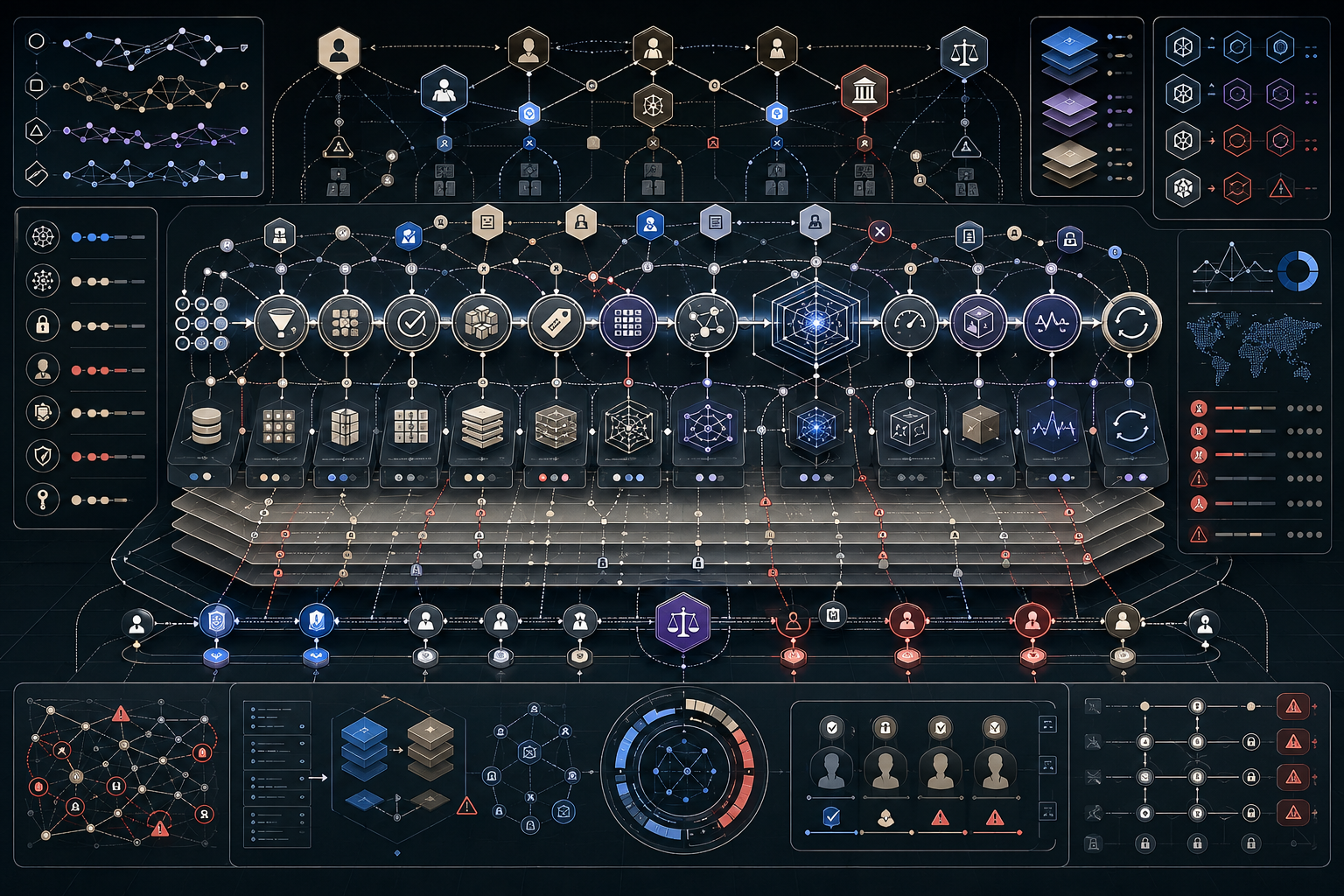
Modern AI systems operate through complex pipelines involving data ingestion, extraction, transformation, feature engineering, labeling, dataset versioning, model training, evaluation, deployment, monitoring, retraining, and governance review. Each stage produces artifacts, introduces assumptions, and creates dependencies. Data governance defines the policies, responsibilities, standards, controls, and technical mechanisms used to manage those artifacts. Provenance records where data and artifacts came from, who or what generated them, and under what conditions. Lineage traces how data moves through systems, transformations, models, and decisions over time.
This article develops Data Governance, Provenance, and Lineage in AI Systems as an advanced article within the Artificial Intelligence Systems knowledge series. It explains data governance foundations, W3C PROV, entities, activities, agents, attribution, derivation, data provenance, lineage graphs, transformation workflows, machine-learning lifecycle provenance, dataset documentation, datasheets, data cards, model cards, data quality, FAIR principles, reproducibility, MLOps metadata, regulatory accountability, privacy, security, and institutional governance. Selected Python and R examples appear here, while the full GitHub repository contains expanded computational scaffolding for provenance graphs, lineage tables, metadata catalogs, dataset versioning, transformation audits, SQL schemas, governance checklists, and advanced Jupyter notebooks.
Why Data Governance Matters in AI Systems
Data governance matters because AI systems are built from chains of dependency. A model depends on a training dataset. A training dataset depends on source systems, collection practices, consent or licensing conditions, labeling rules, transformation code, feature pipelines, filtering choices, and dataset versions. Evaluation depends on validation data, benchmark definitions, metrics, and environmental assumptions. Deployment depends on monitoring, logging, access control, and retraining procedures. If these dependencies are undocumented or unmanaged, the system cannot be fully understood.
This is not merely an engineering issue. It is an epistemic issue. Without provenance and lineage, an organization may know that a model produced an output but not know which data produced the model, which transformation introduced a feature, which pipeline version changed the distribution, which dataset contained a defect, or which governance decision authorized reuse. A system without traceability is difficult to reproduce, debug, audit, contest, or regulate.
AI governance therefore begins before model training. It begins with the governance of data sources, measurement practices, data rights, metadata, transformations, quality controls, lineage graphs, and documentation. The stronger the data governance layer, the more credible the model evaluation, the more accountable the deployment, and the more resilient the system becomes when errors, drift, or disputes arise.
Trustworthy\ AI = Governed\ Data + Traceable\ Pipelines + Accountable\ Models
\]
Interpretation: Trustworthy AI depends on governed data, traceable transformations, and accountable model artifacts rather than model performance alone.
| Governance Problem | Question It Raises | Failure Mode | System Consequence |
|---|---|---|---|
| Unknown source | Where did the data come from? | Teams cannot assess legality, reliability, context, or fitness for use. | Model evidence becomes weak and difficult to defend. |
| Untracked transformation | How did the data change? | Errors enter through joins, filters, feature engineering, or preprocessing. | Defects become hard to reproduce or repair. |
| Missing permissions | Was the data authorized for this use? | Data is reused outside its consent, license, or policy conditions. | Privacy, legal, and institutional risk increase. |
| Poor lineage | Which models and decisions depend on this artifact? | Impact analysis becomes impossible when a defect is discovered. | Unsafe models may remain in operation after data failure. |
| Weak documentation | What are the limits of the dataset or model? | Users overtrust outputs or reuse artifacts in inappropriate contexts. | Accountability and contestability are weakened. |
| Unclear responsibility | Who owns data quality, access, review, and incident response? | Responsibility fragments across teams, vendors, and systems. | Failures are treated as technical accidents rather than governance breakdowns. |
Note: Data governance makes AI systems inspectable. Without it, model behavior is disconnected from the evidence chain that produced it.
Foundations of Data Governance in AI Systems
Data governance refers to the policies, standards, roles, controls, and technical mechanisms used to manage data across its lifecycle. In AI systems, governance ensures that data is reliable, documented, auditable, secure, lawful, ethically appropriate, and fit for intended use. Governance is not simply about restricting data. It is about creating trustworthy conditions for data use.
A data governance system can be represented as:
G_D=(P,R,S,C,M,A)
\]
Interpretation: Data governance \(G_D\) includes policies \(P\), roles \(R\), standards \(S\), controls \(C\), metadata \(M\), and audit mechanisms \(A\).
AI introduces additional complexity because data and models evolve together. Data is not static. It is ingested, cleaned, transformed, labeled, joined, sampled, versioned, embedded, evaluated, deployed, monitored, and sometimes fed back into future training. Models are retrained, fine-tuned, benchmarked, monitored, updated, and integrated into downstream systems.
This makes governance dynamic. It must operate across distributed infrastructure, changing datasets, evolving model versions, iterative experimentation, and real-world feedback loops. A static data inventory is not enough. AI governance requires lifecycle governance: tracking what data exists, where it came from, how it changed, who used it, which models depended on it, and what downstream decisions it influenced.
| Component | Function | AI-System Example | Governance Value |
|---|---|---|---|
| Policies | Define rules for data collection, use, sharing, retention, and deletion. | Rules for using customer data in model training. | Clarifies authorized and prohibited use. |
| Roles | Assign responsibility for stewardship, access, quality, and review. | Data owner, model owner, governance reviewer, security owner. | Prevents responsibility from disappearing into the pipeline. |
| Standards | Set common definitions, schemas, documentation, and metadata practices. | Dataset cards, model cards, feature definitions, lineage schema. | Improves consistency and interoperability. |
| Controls | Enforce access, quality thresholds, approvals, and workflow gates. | Blocking training when a dataset lacks rights review. | Makes governance operational rather than advisory. |
| Metadata | Describe artifacts, versions, provenance, quality, permissions, and relationships. | Dataset version, source, owner, transformation, model dependency. | Makes data and models searchable, traceable, and auditable. |
| Audit mechanisms | Preserve evidence for review, incident response, and accountability. | Lineage logs, access logs, model registry, approval history. | Supports reproducibility, contestability, and regulatory review. |
Note: AI data governance should be embedded into pipelines, registries, metadata systems, access controls, and review workflows.
Formal Provenance Models and the W3C PROV Standard
The most widely used formal model for provenance is the W3C PROV family of standards. PROV provides a structured way to describe the entities, activities, and agents involved in producing data, artifacts, or other things. This matters because provenance must be represented in a form that can be exchanged, queried, validated, and interpreted across systems.
The PROV model centers on three core concepts: entities, activities, and agents. An entity is a data artifact or thing, such as a dataset, feature table, model, metric report, or prediction log. An activity is a process that uses or generates entities, such as extraction, labeling, cleaning, transformation, training, evaluation, or deployment. An agent is a person, organization, software system, service, or workflow responsible for an activity or entity.
A basic provenance relation can be represented as:
Entity_{\mathrm{out}} \leftarrow Activity
\]
Interpretation: An output entity was generated by a specific activity.
A usage relation can be represented as:
Activity \leftarrow Entity_{\mathrm{in}}
\]
Interpretation: An activity used an input entity to produce an output.
An attribution relation can be represented as:
Entity \leftarrow Agent
\]
Interpretation: An entity is attributed to a responsible agent.
Together, these relations form a directed graph of derivation, use, generation, and responsibility. In AI systems, this graph can connect source data, transformations, feature sets, training runs, model artifacts, evaluation reports, deployment versions, and monitoring outputs. Extensions such as PROV-ML adapt provenance concepts to machine-learning lifecycles by capturing not only datasets, but also workflows, experiments, model artifacts, hyperparameters, software environments, and computational context.
| PROV Concept | Meaning | AI-System Example | Governance Use |
|---|---|---|---|
| Entity | An artifact or thing whose provenance can be tracked. | Raw dataset, cleaned dataset, feature table, model, evaluation report. | Defines what is being governed, versioned, and audited. |
| Activity | A process that uses or generates entities. | Ingestion, labeling, transformation, training, evaluation, deployment. | Shows where assumptions, code, and operations changed artifacts. |
| Agent | A responsible person, team, system, or organization. | Data engineering team, labeling vendor, ML workflow, governance board. | Connects artifacts and activities to responsibility. |
| Used | An activity used an input entity. | Training run used feature table v2. | Supports dependency tracing and reproducibility. |
| Was generated by | An entity was generated by an activity. | Model artifact generated by training run. | Links outputs to the processes that produced them. |
| Was derived from | An entity depends on another entity. | Cleaned dataset derived from raw data. | Supports lineage, impact analysis, and defect tracing. |
| Was attributed to | An entity is associated with an agent. | Evaluation report attributed to responsible AI review team. | Clarifies ownership, approval, and accountability. |
Note: Provenance standards make AI artifacts queryable as evidence chains rather than isolated files.
Data Provenance: Origins, Context, and Attribution
Data provenance refers to the origin, history, and context of data. It answers questions such as: Where did this dataset come from? Who collected it? Under what conditions? What transformations were applied? What assumptions shaped measurement? What licenses or consent conditions apply? Which model used it? Which decision depended on it?
A provenance record can be represented as:
Prov(D)=\{Source,Collection,Transformations,Agents,Time,License,Context\}
\]
Interpretation: Provenance for dataset \(D\) includes source, collection method, transformations, responsible agents, timestamps, legal conditions, and contextual information.
In AI systems, provenance supports trust assessment, debugging, attribution, reproducibility, compliance, and contestability. It helps evaluate whether data is appropriate for a model or decision. It allows teams to trace errors back to defective sources, transformations, or labels. It identifies responsible agents and systems. It makes it possible to reconstruct a training or evaluation pipeline. It helps demonstrate lawful, authorized, and documented data use. It allows affected parties or reviewers to question data sources and assumptions.
Provenance is especially important when data is reused. A dataset created for one purpose may later be repurposed for another. Without provenance, downstream teams may treat reused data as neutral, current, representative, or permitted even when its original conditions do not support that use.
| Provenance Field | Question It Answers | AI-System Risk If Missing | Example Artifact |
|---|---|---|---|
| Source | Where did the data originate? | Reliability and context cannot be assessed. | Source-system identifier, external dataset citation, API source. |
| Collection method | How was the data collected? | Measurement bias and sampling limits remain hidden. | Survey protocol, sensor method, administrative process. |
| Time period | When was the data collected or transformed? | Stale data may be treated as current. | Collection window, processing timestamp, version date. |
| Transformations | What changed between source and artifact? | Errors or assumptions introduced by pipelines are invisible. | Transformation script, feature pipeline, join logic. |
| Agents | Who or what produced, reviewed, or approved the artifact? | Responsibility is unclear after failure. | Team owner, workflow owner, reviewer, vendor. |
| Rights and permissions | What use is authorized? | Data may be reused in unlawful or inappropriate ways. | License, consent metadata, purpose limitations. |
| Context and limitations | What assumptions and known limits apply? | Data is overgeneralized beyond its valid scope. | Datasheet, data card, limitation statement. |
Note: Provenance is the memory of a dataset. Without it, downstream AI systems lose the context needed for responsible interpretation.
Data Lineage: Transformation Graphs and Workflow Traceability
Data lineage describes the end-to-end flow of data through a system, including transformations, joins, filters, aggregations, feature engineering, model training, evaluation, deployment, and monitoring. If provenance answers where data came from and who or what produced it, lineage emphasizes how data moved and changed across technical workflows.
Lineage is often represented as a directed graph:
D_0 \rightarrow T_1 \rightarrow D_1 \rightarrow T_2 \rightarrow F \rightarrow M
\]
Interpretation: Source dataset \(D_0\) passes through transformations \(T_1\) and \(T_2\), producing features \(F\) and model \(M\).
Lineage enables impact analysis, debugging, auditability, reproducibility, and governance. It helps identify which models, dashboards, reports, or decisions are affected when a dataset changes. It helps locate where an error entered a pipeline. It demonstrates how a prediction, feature, or model was produced. It supports reconstruction of prior model versions and evaluation results. It allows policy controls to be enforced across transformations and downstream uses.
Lineage is not only a diagram. It is operational metadata. A usable lineage system should allow teams to query dependencies, trace artifacts backward, trace effects forward, compare versions, and identify where governance controls were applied or bypassed.
| Lineage Function | Question It Answers | Example Use | Governance Benefit |
|---|---|---|---|
| Backward tracing | What produced this model, feature, or prediction? | Trace a deployed model back to its training data and transformations. | Supports audit, debugging, and explanation. |
| Forward tracing | What depends on this dataset or artifact? | Find all models affected by a defective source dataset. | Supports impact analysis and incident response. |
| Version comparison | What changed between artifact versions? | Compare feature table v2 and v3 after performance shift. | Supports reproducibility and change control. |
| Transformation review | Which operations altered the data? | Review joins, filters, missingness handling, and aggregation logic. | Finds assumptions embedded in pipelines. |
| Policy propagation | Do rights or restrictions follow derived data? | Ensure sensitive data restrictions remain visible after feature extraction. | Prevents unauthorized downstream use. |
| Decision traceability | Which artifacts influenced a downstream decision? | Connect a prediction log to model, feature, and data versions. | Supports contestability and accountability. |
Note: Lineage turns AI infrastructure into a dependency graph that can be inspected, queried, and governed.
Provenance Across the Machine-Learning Lifecycle
Machine-learning systems generate many artifacts. A typical lifecycle includes source data, raw datasets, cleaned datasets, labels, feature sets, embeddings, training configurations, experiment runs, model artifacts, evaluation metrics, deployment containers, prediction logs, monitoring reports, and incident records. Each artifact depends on prior artifacts.
A machine-learning provenance chain can be represented as:
Raw\ Data \rightarrow Cleaned\ Data \rightarrow Features \rightarrow Model \rightarrow Evaluation \rightarrow Deployment \rightarrow Monitoring
\]
Interpretation: Machine-learning provenance must track data, features, models, evaluation, deployment, and monitoring as connected artifacts.
Capturing end-to-end provenance requires tracking data ingestion and source systems; preprocessing and transformation code; feature engineering and feature-store versions; labeling procedures and annotation sources; training datasets and sampling logic; model architecture, parameters, hyperparameters, and random seeds; software packages, runtime environments, and hardware context; evaluation datasets, metrics, and benchmark versions; deployment versions, containers, endpoints, and rollback history; monitoring signals, drift reports, incidents, and retraining triggers.
This lifecycle view is crucial because a model is not a standalone object. It is a derived artifact embedded in a chain of data, code, infrastructure, and governance decisions.
| Lifecycle Stage | Artifact | Key Metadata | Why It Matters |
|---|---|---|---|
| Ingestion | Raw source data. | Source, collection time, license, schema, owner. | Defines origin, rights, and initial measurement context. |
| Preparation | Cleaned dataset. | Cleaning code, filters, missingness handling, validation checks. | Shows how raw records were altered before modeling. |
| Labeling | Labels or annotations. | Annotator source, guidelines, quality checks, adjudication notes. | Determines what the model is being trained to reproduce. |
| Feature engineering | Feature table or embeddings. | Feature definitions, transformation code, feature version. | Connects model inputs to data and assumptions. |
| Training | Model artifact. | Training data version, hyperparameters, seed, code, environment. | Enables reproducibility and model comparison. |
| Evaluation | Metrics and validation report. | Test set, benchmark version, metric definitions, subgroup results. | Supports credible performance claims. |
| Deployment | Endpoint, container, or service version. | Model version, runtime environment, approvals, rollback path. | Links operational behavior to governed artifacts. |
| Monitoring | Prediction logs and drift reports. | Timestamp, inputs, outputs, data drift, incidents, alerts. | Tracks whether the system remains valid after deployment. |
Note: Provenance should follow the full machine-learning lifecycle, not stop at the training dataset.
Dataset Documentation: Datasheets, Data Cards, and Model Cards
Formal provenance graphs are powerful, but human-readable documentation is also necessary. Practical governance requires structured documentation that makes dataset and model assumptions understandable to researchers, engineers, reviewers, auditors, and affected stakeholders.
Several documentation frameworks are especially important. Datasheets for datasets provide standardized documentation covering dataset motivation, composition, collection process, preprocessing, recommended uses, distribution, maintenance, and limitations. Data Cards provide purposeful, human-centered dataset documentation designed to support transparent and responsible dataset use across teams and contexts. Model Cards provide structured reporting for models, including intended use, performance, limitations, ethical considerations, evaluation data, and caveats.
Documentation can be represented as:
Artifact = Data + Metadata + Context + Limitations + Governance
\]
Interpretation: A dataset or model artifact becomes governable when data is paired with metadata, context, limitations, and governance information.
Documentation should not be treated as paperwork added after the model is complete. It should be part of the artifact lifecycle. A dataset without documentation may be technically usable but institutionally unsafe. A model without documentation may produce outputs but remain unsuitable for accountable deployment.
| Documentation Framework | Primary Object | Key Questions | Governance Role |
|---|---|---|---|
| Datasheets for Datasets | Dataset. | Why was it created? Who is represented? How was it collected? What are its limits? | Supports responsible dataset reuse and review. |
| Data Cards | Dataset and use context. | What is the dataset intended to support? What should users know before using it? | Makes dataset assumptions more accessible across teams. |
| Model Cards | Model artifact. | What is the model for? How was it evaluated? Where should it not be used? | Connects model performance, limitations, and intended use. |
| Data dictionaries | Fields, variables, and schemas. | What do columns mean? What units, formats, and categories are used? | Prevents ambiguity in interpretation and transformation. |
| Lineage records | Dependencies and transformations. | What produced this artifact? What does it depend on? | Supports reproducibility, impact analysis, and audit. |
| Governance memos | Review decisions and risk context. | Who approved use? What risks were considered? What limits apply? | Preserves institutional reasoning and accountability. |
Note: Human-readable documentation and machine-readable provenance should reinforce each other. One supports interpretation; the other supports traceability.
Data Quality, Integrity, and Measurement
Data governance must incorporate quality controls. Provenance tells where data came from and how it changed. Lineage tells how it moved through systems. Quality assessment asks whether the data is accurate, complete, consistent, timely, representative, valid, and fit for purpose.
A data-quality score can be represented as:
Q_D=f(Accuracy,Completeness,Consistency,Timeliness,Representativeness,Validity)
\]
Interpretation: Data quality is multidimensional and depends on measurement, coverage, consistency, timeliness, representativeness, and construct validity.
Governance systems should record missingness rates, schema violations, duplicate records, label-quality checks, distributional drift, subgroup coverage, source reliability, known measurement limitations, quality thresholds, and review outcomes.
This connects directly to Data Quality, Bias, and Measurement in Machine Learning. Provenance and lineage make quality failures traceable. Quality diagnostics make provenance and lineage meaningful.
| Quality Control | What It Checks | Possible Failure | Governance Action |
|---|---|---|---|
| Schema validation | Fields, types, formats, and allowed values. | Pipeline receives incompatible or corrupted records. | Block pipeline or require review before use. |
| Completeness check | Missing fields, records, or populations. | Model learns from incomplete evidence. | Flag missingness, impute carefully, or improve collection. |
| Duplicate detection | Repeated records or leaked examples. | Training and evaluation become inflated or biased. | Deduplicate and audit split design. |
| Label-quality review | Consistency and reliability of labels. | Model learns noisy or biased labels. | Adjudicate labels and document uncertainty. |
| Distribution monitoring | Input, label, and feature distribution changes. | Deployment data no longer resembles training data. | Trigger recalibration, review, or retraining. |
| Subgroup coverage | Representation across relevant populations. | Hidden error disparities and weak external validity. | Require subgroup validation and coverage documentation. |
| Construct-validity review | Whether variables represent the intended concept. | Proxy variable is mistaken for ground truth. | Review measurement assumptions with domain expertise. |
Note: Quality controls should be attached to datasets and lineage records so defects can be traced to affected models and decisions.
Reproducibility, FAIR Data, and Scientific Validity
Reproducibility is central to scientific and engineering credibility. In AI systems, reproducibility requires more than preserving code. It requires data versions, transformation logic, labels, feature definitions, hyperparameters, software environments, model artifacts, evaluation sets, metrics, random seeds, and deployment configuration.
The FAIR principles—Findable, Accessible, Interoperable, and Reusable—provide a widely used framework for improving data management and reuse. In AI systems, FAIR principles should apply not only to final datasets but also to metadata, workflows, models, and evaluation artifacts.
A reproducibility condition can be represented as:
Reproduce(M_t)=f(D_t,C_t,E_t,H_t)
\]
Interpretation: Reproducing model \(M_t\) at time \(t\) requires dataset \(D_t\), code \(C_t\), environment \(E_t\), and hyperparameters \(H_t\).
Without provenance and lineage, reproduction becomes guesswork. With strong provenance, a team can reconstruct the model pipeline, identify which data and code produced a result, compare versions, and explain why a model changed.
| Requirement | What Must Be Preserved | Failure If Missing | Governance Mechanism |
|---|---|---|---|
| Dataset version | Exact data used for training, validation, and testing. | Model cannot be reconstructed or fairly compared. | Dataset registry and content hashing. |
| Transformation code | Cleaning, joining, filtering, feature engineering, and preprocessing logic. | Features cannot be explained or reproduced. | Pipeline version control and transformation logs. |
| Training configuration | Architecture, hyperparameters, seed, sampling logic. | Training results cannot be repeated. | Experiment tracking and model registry. |
| Software environment | Packages, runtime, hardware, dependencies, container versions. | Execution differences alter results. | Containers, lockfiles, environment metadata. |
| Evaluation protocol | Metrics, thresholds, datasets, benchmark versions, subgroup definitions. | Performance claims cannot be verified. | Evaluation registry and validation report. |
| Governance record | Approvals, risk reviews, rights checks, limitations, intended use. | Technical reproducibility lacks institutional accountability. | Approval workflow and review archive. |
Note: Reproducibility is not only a scientific value. In AI systems, it is also an accountability requirement.
Data Governance in MLOps Systems
MLOps integrates machine-learning development, deployment, monitoring, and governance into operational workflows. Data governance in MLOps ensures that data and model artifacts are versioned, monitored, documented, reproducible, and controlled across repeated deployment cycles.
Key practices include dataset versioning, feature-store governance, pipeline automation, experiment tracking, metadata management, model-registry controls, deployment approvals, monitoring and drift detection, incident logging, rollback, and retraining governance.
A governed MLOps loop can be represented as:
Build \rightarrow Validate \rightarrow Deploy \rightarrow Monitor \rightarrow Govern \rightarrow Retrain
\]
Interpretation: MLOps governance connects model building, validation, deployment, monitoring, governance review, and retraining.
MLOps without governance can accelerate unmanaged risk. Governance without operational integration can become static documentation that does not shape behavior. The goal is a system where governance controls are embedded directly into pipelines, metadata, approvals, monitoring, and audit workflows.
| MLOps Layer | Governance Control | Evidence Produced | Why It Matters |
|---|---|---|---|
| Data pipeline | Schema checks, quality gates, lineage capture. | Pipeline logs, validation reports, lineage edges. | Prevents defective data from silently entering training. |
| Feature store | Feature definitions, owners, versions, freshness rules. | Feature metadata and dependency records. | Ensures model inputs are traceable and consistent. |
| Experiment tracking | Record runs, parameters, metrics, artifacts, and environments. | Experiment registry and reproducibility bundle. | Supports comparison and audit of model development. |
| Model registry | Version models with lineage, approvals, risk classification. | Registered model cards and approval history. | Controls which models are eligible for deployment. |
| Deployment workflow | Approval gates, rollback paths, access controls. | Deployment records and release notes. | Prevents unreviewed models from entering production. |
| Monitoring | Track drift, data quality, performance, incidents, and feedback. | Monitoring reports, alerts, incident records. | Detects degradation and triggers governance review. |
| Retraining | Control when and why models are updated. | Retraining trigger, new lineage chain, validation report. | Prevents uncontrolled model evolution. |
Note: Governed MLOps makes traceability continuous rather than retrospective.
Privacy, Security, Access Control, and Data Rights
Data governance must also address privacy, security, access control, licensing, consent, and data rights. Provenance and lineage can reveal how data moved, but governance must define whether that movement was authorized, secure, lawful, and appropriate.
Important controls include role-based access control, data minimization, purpose limitation, retention and deletion policies, consent and licensing metadata, sensitive attribute controls, encryption and secure storage, audit logging, privacy risk assessment, controlled sharing, and downstream-use restrictions.
Access can be represented as:
Access(u,D)=Allowed \iff Role(u)\in Permissions(D)
\]
Interpretation: User \(u\) may access dataset \(D\) only when the user’s role satisfies the dataset’s permission policy.
For AI systems, these controls matter because data may be copied, transformed, embedded, vectorized, fine-tuned, cached, and reused in ways that obscure the original source. Lineage and provenance help ensure that data rights remain visible even after transformation.
| Control | Purpose | AI-Specific Concern | Governance Evidence |
|---|---|---|---|
| Role-based access control | Restrict access by role and authorization. | Training data may contain sensitive or regulated attributes. | Permission logs and access policy. |
| Purpose limitation | Ensure data is used only for authorized purposes. | Data collected for one reason may be reused for model training. | Use-case approval and purpose metadata. |
| Data minimization | Use only data necessary for the task. | Predictive convenience can encourage excessive collection. | Feature review and minimization rationale. |
| Retention and deletion | Control how long data and derived artifacts persist. | Derived features, embeddings, or caches may preserve sensitive information. | Retention schedule and deletion record. |
| Consent and license metadata | Track authorized use conditions. | Rights may not follow data after transformation unless recorded. | Consent fields, license terms, rights registry. |
| Audit logging | Record access, modification, export, and use. | Unauthorized reuse may occur across pipelines and teams. | Access logs and anomaly review. |
| Security controls | Protect data against exposure or tampering. | Training data poisoning or leakage can compromise models. | Encryption, integrity checks, and incident records. |
Note: Data rights should remain attached to derived artifacts through provenance and lineage, not disappear after transformation.
Institutional, Regulatory, and Ethical Dimensions
Data governance is shaped by institutional responsibilities, ethical commitments, legal requirements, and regulatory frameworks. Provenance and lineage support accountability because they make it possible to answer: What data was used? Was it authorized? Was it appropriate? Was it documented? Who approved it? Which models depended on it? What decisions did it influence?
In high-impact AI settings, inadequate data governance can become a governance failure. A model may be technically strong but institutionally illegitimate if its data provenance is unclear, its lineage is incomplete, its documentation is missing, or its use violates the conditions under which data was collected.
A governance review can be represented as:
Review = f(Provenance,Lineage,Quality,Rights,Risk,Use)
\]
Interpretation: Responsible review evaluates provenance, lineage, data quality, rights, risk, and intended use together.
Current governance context reinforces the operational importance of evidence lineage. W3C PROV remains a stable Recommendation for interoperable provenance. OpenLineage 1.47.0 defines an extensible runtime model for datasets, jobs, runs, and facets. NIST reports that AI RMF 1.0 is being revised. The European Union AI Act requires data governance, technical documentation, automatic logging, and record retention for high-risk systems under its applicable provisions.
Ethically, provenance and lineage also support contestability. Affected people and institutions should be able to ask what data contributed to a decision, what assumptions shaped it, and whether the system’s evidence is valid. Traceability is therefore not only an internal engineering convenience. It is part of accountable AI.
| Governance Question | Why It Matters | Weak Pattern | Stronger Pattern |
|---|---|---|---|
| Who authorized the data use? | AI data reuse can exceed original permissions or expectations. | Teams assume availability implies permission. | Documented rights review and approval workflow. |
| Who owns data quality? | Data defects can harm model reliability and downstream decisions. | No team is responsible once data enters the pipeline. | Named data steward and quality thresholds. |
| Who can contest a data source? | Affected people or reviewers may need to challenge records or assumptions. | Data is treated as unquestionable evidence. | Correction, appeal, and review pathways. |
| Who decides appropriate use? | A dataset may be technically usable but ethically or legally inappropriate. | Data reuse happens by convenience. | Use-case review and prohibited-use documentation. |
| Who investigates defects? | Data failures can affect many models and decisions. | Incidents are handled ad hoc. | Impact analysis, incident response, and corrective-action logs. |
| Who updates governance? | AI systems, data, laws, and risks change over time. | Governance documentation becomes stale. | Review cadence, monitoring triggers, and lifecycle stewardship. |
Note: Data governance is institutional design. It determines how evidence, responsibility, and authority move through AI systems.
Integration with AI Infrastructure and Decision Systems
Data governance connects directly to AI Infrastructure: Data Pipelines, Compute, and Deployment Systems, Data Quality, Bias, and Measurement in Machine Learning, Model Training, Optimization, and Evaluation, Model Validation, Benchmarking, and Generalization Theory, and AI Governance and Regulatory Systems.
A complete AI system can be represented as:
Data \rightarrow Model \rightarrow Decision \rightarrow Monitoring \rightarrow Governance
\]
Interpretation: Data governance links data, model behavior, downstream decisions, monitoring, and institutional review.
This integration matters because data lineage does not end at the model. Model outputs influence decisions. Decisions influence outcomes. Outcomes generate new data. New data influences future models. Governance must therefore operate across the entire feedback loop.
In decision systems, lineage must connect predictions to model versions, model versions to training data, training data to source systems, and source systems to documentation and rights metadata. In infrastructure systems, lineage must connect sensors, maintenance logs, operational records, forecasts, control decisions, monitoring, and incident response. In organizational systems, lineage must connect datasets, workflows, policy rules, human review, and institutional outcomes.
| System Layer | Governance Integration | Evidence Needed | Risk If Missing |
|---|---|---|---|
| Data infrastructure | Source systems, pipelines, schemas, storage, transformation logs. | Lineage records and data-quality checks. | Models depend on invisible or unstable data flows. |
| Model development | Training data, labels, features, experiments, model registry. | Experiment metadata and reproducibility bundle. | Performance claims cannot be reconstructed. |
| Evaluation | Validation data, metrics, benchmarks, subgroup tests. | Evaluation report and benchmark provenance. | Validation evidence lacks context or credibility. |
| Deployment | Release approvals, runtime environment, prediction logs, rollback history. | Deployment metadata and approval records. | Production behavior cannot be connected to reviewed artifacts. |
| Decision workflow | Human review, thresholds, escalation, contestability, overrides. | Decision logs and policy rules. | Data lineage stops before accountability begins. |
| Monitoring and incident response | Drift, defects, adverse outcomes, retraining triggers, corrective actions. | Monitoring reports and incident lineage. | Failures recur because root causes are not traced. |
Note: The strongest AI governance systems connect technical lineage to decision accountability.
Limits and Challenges
Data governance, provenance, and lineage remain difficult in practice. Major challenges include distributed systems where data moves across many platforms; inconsistent metadata standards across tools and teams; high overhead of manual documentation; incomplete lineage capture in legacy systems; privacy constraints that limit traceability; security risks from exposing sensitive metadata; rapid model iteration that outpaces governance review; difficulty linking technical lineage to institutional responsibility; large-scale AI pipelines where artifacts proliferate quickly; and semantic ambiguity about what counts as the “same” dataset or model version.
These challenges do not weaken the need for governance. They clarify why governance must be designed as infrastructure rather than as a retrospective compliance exercise. The stronger the provenance and lineage layer, the more resilient the AI system becomes when errors, audits, disputes, or failures occur.
A practical governance program should therefore balance ambition with implementation discipline. Not every artifact needs the same level of governance. High-impact systems require stricter provenance, stronger approvals, richer documentation, more complete lineage, and deeper audit trails than low-risk exploratory systems. Governance should be proportional to consequence.
| Challenge | Why It Is Difficult | System Risk | Responsible Response |
|---|---|---|---|
| Distributed infrastructure | Data moves across warehouses, lakes, APIs, notebooks, feature stores, and services. | Lineage becomes fragmented. | Adopt shared metadata standards and automated lineage capture. |
| Manual documentation burden | Teams may not maintain documentation during rapid iteration. | Documentation becomes incomplete or stale. | Automate metadata capture and pair it with review checkpoints. |
| Legacy systems | Older platforms may not expose lineage or metadata. | Critical dependencies remain invisible. | Prioritize high-risk pipelines and use wrapper-level logging. |
| Privacy and security tension | Traceability may expose sensitive metadata. | Governance records themselves become risky. | Use role-based access and metadata minimization. |
| Fast model iteration | Experiments and artifacts proliferate quickly. | Unreviewed models or datasets enter production. | Embed governance gates in MLOps workflows. |
| Semantic ambiguity | Teams may disagree on what counts as a dataset, version, or derived artifact. | Lineage records become inconsistent. | Define artifact taxonomy and versioning rules. |
| Institutional responsibility | Technical lineage does not automatically assign accountability. | Failures are traceable but no one is responsible for repair. | Map lineage to owners, review bodies, and incident roles. |
Note: Provenance and lineage are not solved by tooling alone. They require standards, ownership, workflow design, and institutional accountability.
The Governance Evidence Graph
A mature AI governance system should be represented as an evidence graph rather than a folder of disconnected documents. The graph connects data, code, transformations, labels, features, embeddings, models, prompts, evaluations, deployments, predictions, human reviews, decisions, incidents, permissions, retention rules, and responsible agents. Each edge states how one artifact used, generated, derived from, approved, restricted, or superseded another.
This structure turns governance from retrospective investigation into operational control. A quality defect can be traced forward to affected models and decisions. A prediction can be traced backward to the model, feature snapshot, transformation code, source records, and rights conditions that shaped it. An approval can be evaluated against the exact artifact version reviewed rather than a later replacement with the same display name.
G=(V,E,\Phi,\Pi)
\]
Interpretation: A governance evidence graph \(G\) contains versioned artifacts and agents \(V\), typed relations \(E\), evidentiary attributes \(\Phi\), and enforceable policies \(\Pi\).
The graph should preserve both machine-readable and human-readable evidence. Machine-readable lineage supports queries, controls, and incident response. Human-readable documentation explains purpose, assumptions, limitations, and institutional reasoning. Neither is sufficient alone.
Semantic Interoperability: W3C PROV and OpenLineage
W3C PROV provides a stable conceptual and machine-processable foundation for describing entities, activities, agents, generation, use, derivation, attribution, association, and delegation. It is especially useful when provenance must cross organizational or technical boundaries because it defines common semantics rather than a vendor-specific event format.
OpenLineage complements this approach with an operational standard for recording dataset, job, and run metadata as processing systems execute. Its extensible facets can attach schema, data quality, ownership, source code, lifecycle, and other context to lineage events. W3C PROV and OpenLineage solve related but different problems: one provides a general provenance model, while the other emphasizes runtime lineage collection across data platforms.
Interoperability requires explicit mappings. A dataset version may be represented as a PROV entity and an OpenLineage dataset. A pipeline execution may be a PROV activity and an OpenLineage run. A service account may be represented as an agent even when the runtime standard does not carry the full institutional responsibility chain.
A standards-based architecture should preserve extensions, local terminology, and governance controls without losing the shared core needed for exchange and query.
Artifact Identity, Versioning, and Cryptographic Integrity
Lineage fails when artifacts are identified only by mutable names such as training.csv, latest_features, or production_model. Governed systems need stable identifiers, explicit versions, timestamps, namespaces, and content integrity evidence.
A version can represent a material change in records, schema, transformation logic, labeling policy, model parameters, prompt template, runtime environment, or rights conditions. Versioning rules should distinguish semantic change from repackaging. A checksum can demonstrate that bytes are unchanged, but it does not prove that data is accurate, lawful, representative, or fit for purpose.
ArtifactID = Namespace + LogicalID + Version + Digest
\]
Interpretation: A governable artifact identity combines organizational namespace, stable logical identity, explicit version, and content digest.
Cryptographic hashes support integrity checks, reproducibility, and chain-of-custody review. Signed attestations can associate a review or release with a specific digest. Hashes must be paired with canonicalization rules because equivalent tabular or graph content can serialize differently.
Aliases such as current or approved should resolve to immutable versions and retain the history of each pointer change.
Data Contracts, Schema Evolution, and Breaking Change
A data contract defines the technical and governance expectations attached to an interface or dataset. It can include schema, units, definitions, freshness, nullability, allowed values, owner, quality thresholds, privacy classification, rights, retention, service levels, and change procedures.
Schema compatibility alone is insufficient. A field can retain the same name and type while its meaning changes. A risk score can move from a thirty-day to a ninety-day horizon. A category can be redefined. A sensor can be replaced. A population can be sampled differently. These semantic changes should create reviewable lineage events.
Breaking-change analysis should identify downstream features, models, dashboards, policies, and decisions that depend on the contract. Consumers need notice, migration guidance, validation windows, and rollback paths. Silent coercion or default values can preserve pipeline execution while corrupting meaning.
Contracts become governance controls when pipelines can block or quarantine data that violates required structure, quality, rights, or freshness. They should also record justified exceptions rather than allowing manual bypass to disappear from the evidence chain.
Rights, Consent, Purpose, and Policy Propagation
Data rights do not disappear when data is cleaned, joined, embedded, aggregated, or used to train a model. Purpose limitations, licenses, consent conditions, geographic restrictions, retention periods, confidentiality, and deletion obligations should propagate through derived artifacts.
Policy(D’) = Inherit\big(Policy(D_1),\ldots,Policy(D_n),T\big)
\]
Interpretation: The policy attached to a derived artifact \(D’\) depends on the restrictions inherited from its inputs and the transformation \(T\).
Propagation is not always a simple union. Aggregation may reduce some privacy risks while preserving licensing restrictions. Differential privacy can alter disclosure risk without automatically authorizing a new purpose. A model trained on restricted data may still encode information or remain contractually constrained.
Policy engines should identify incompatible combinations, expired permissions, missing legal basis, and unauthorized destinations before execution. Human review remains necessary for ambiguous terms and consequential use changes.
Governance records should preserve the original authorization, interpretation, reviewer, date, and downstream obligations so later teams do not infer permission merely from technical availability.
Feature, Embedding, Vector, and Retrieval Lineage
Modern AI systems derive high-dimensional artifacts that are difficult to inspect directly. Feature tables, embeddings, vector indexes, retrieved passages, caches, and context windows can preserve information from multiple sources while obscuring their origin.
Feature lineage should record definition, code, source fields, window, aggregation, imputation, leakage controls, freshness, and training-serving consistency. Embedding lineage should include source artifact, chunking, preprocessing, embedding model, model version, dimensions, normalization, indexing configuration, and deletion state.
Retrieval lineage should connect each generated answer or decision-support output to the query, index version, retrieved items, ranking configuration, filters, prompt, model, tools, and citations used. Without this chain, a system may display a source while relying on a different or stale context internally.
Derived representations need access and retention controls. Removing a source record may require rebuilding feature snapshots, embeddings, caches, fine-tunes, and evaluation corpora. A deletion marker without downstream impact analysis is not complete governance.
Labels, Annotations, and Human-Judgment Provenance
Labels are not neutral facts. They can reflect observation protocols, policy definitions, annotator interpretation, adjudication, historical treatment, incentives, and organizational objectives. A label such as fraud, toxicity, readiness, neglect, or risk can embed substantial judgment.
Annotation provenance should record task instructions, examples, annotator qualifications, compensation, working conditions, source context, tools, disagreement, uncertainty, escalation, adjudication, and versioned policy changes. Consensus can conceal systematic ambiguity when reviewers share the same assumptions.
Gold-standard labels should identify who established the standard and how disputed cases were resolved. Automatically generated or weak labels should remain distinguishable from direct expert review. Model-generated labels require their own model, prompt, and validation lineage.
When historical decisions become training labels, the governance graph should connect those decisions to the policy and institutional conditions under which they were made. Otherwise, a model can reproduce earlier inequity while presenting it as empirical truth.
Third-Party, Vendor, and Supply-Chain Provenance
Organizations frequently depend on purchased datasets, data brokers, cloud services, labeling vendors, pretrained models, APIs, foundation models, open-source packages, and external evaluation tools. Internal lineage may begin after critical provenance has already been lost.
Third-party governance should require source and collection descriptions, rights, permitted uses, geographic and retention restrictions, quality evidence, known limitations, update practices, security controls, incident notification, deletion procedures, and subprocessor visibility. Contract language should support technical verification and audit rather than relying on generic warranties.
Model and software supply chains also require provenance. A model artifact should identify base model, weights, fine-tuning data, adapters, quantization, safety layers, runtime libraries, hardware assumptions, and licensing. A software bill of materials does not replace data or model provenance, but the records should connect.
Where vendors cannot provide adequate evidence, the organization should narrow use, add independent validation, isolate the component, or reject the dependency. Procurement is a governance gate.
Synthetic, Generated, and Augmented Data Governance
Synthetic data can support testing, simulation, privacy engineering, rare-event analysis, and class balancing. It can also reproduce bias, leak training examples, create unrealistic correlations, or make an evaluation circular when generated and assessed by related models.
Generated-data provenance should record the source data or simulator, generator model, version, prompt or parameters, random seed, privacy method, constraints, filtering, validation, intended use, and relation to real observations. Synthetic records should remain distinguishable from measured records throughout the pipeline.
Data augmentation requires similar evidence. Cropping, translation, perturbation, oversampling, adversarial generation, and label-preserving transformations each assume that meaning remains stable. That assumption can fail for protected characteristics, medical signals, cultural content, or physical systems.
Privacy claims should be tested rather than inferred from the word synthetic. Membership inference, nearest-neighbor analysis, attribute disclosure, and memorization testing may be necessary. Synthetic data can reduce exposure while remaining subject to source rights and purpose restrictions.
Prompt, Model, Tool, and Agent Lineage
Generative and agentic systems produce outputs through more than one model invocation. System instructions, user prompts, retrieved context, policies, memory, tools, code execution, external APIs, intermediate plans, verifier models, and human approvals may all influence the final action.
Agent lineage should record each step with timestamp, component version, inputs, outputs, tool arguments, tool results, exceptions, policy decisions, and responsible service identity. Sensitive chain-of-thought need not be stored to preserve an operational trace; concise action rationales and observable transitions can support audit without exposing private reasoning.
Tool results need provenance and integrity. A result from a financial, medical, legal, or infrastructure system should identify the authoritative source, request parameters, timestamp, response version, and validation status. Cached or summarized results should remain linked to the original response.
Agentic loops can generate large evidence volumes. Retention should be risk-based, with stronger records for consequential actions, exceptions, overrides, and incidents. Logging everything without access control can create a new privacy and security risk.
Decision, Outcome, and Contestability Lineage
Technical lineage should continue past the prediction. A decision record should identify the model output, policy threshold, evidence shown to the reviewer, human action, override, rationale, affected party, notification, appeal status, and observed outcome.
This chain enables outcome evaluation and contestability. An affected person can challenge an incorrect source record, an inappropriate feature, a stale model, or a policy rule rather than receiving a generic explanation that “the algorithm decided.” Reviewers can determine whether the model was followed, ignored, or applied outside its intended use.
DecisionTrace = Data \rightarrow Model \rightarrow Output \rightarrow Rule \rightarrow HumanAction \rightarrow Outcome
\]
Interpretation: Accountability requires tracing the complete path from evidence to action and observed consequence.
Outcome lineage must account for feedback. A denied service may produce no later outcome, creating selective labels. A fraud intervention changes future behavior. A maintenance decision changes sensor readings. Governance should distinguish observed outcomes from outcomes made observable by the decision itself.
Reproducibility, Environments, and Executable Evidence
Reproducibility requires data and code, but also runtime images, dependencies, configuration, hardware assumptions, randomness, external services, and unavailable secrets. A notebook that once executed successfully may not reproduce a production model months later.
Executable evidence bundles can contain manifests, checksums, lockfiles, containers, schemas, configuration, test results, evaluation reports, and commands needed to rebuild an artifact. Deterministic reproduction may be impossible for distributed training or nondeterministic hardware, so the evidence should state the expected tolerance and which outputs must match.
External APIs and managed models complicate reconstruction because providers can change behavior without exposing underlying versions. Organizations should capture request and response samples, declared model identifiers, dates, parameters, and contract terms, then test for material drift.
Reproducibility is not a universal release requirement for all exploratory work. Governance should apply proportionally, with stronger preservation for deployed, regulated, safety-relevant, or contested systems.
Retention, Deletion, and Derived-Artifact Erasure
Retention schedules should apply to raw data, derived tables, features, embeddings, backups, logs, training snapshots, model artifacts, caches, and decision records. Keeping everything indefinitely increases privacy, security, legal, and governance risk. Deleting evidence too early can weaken accountability and incident investigation.
Deletion requests require impact analysis. The organization must determine which copies and derived artifacts contain or depend on the record, whether retraining is required, whether a model can reasonably be considered affected, and which legal or evidentiary holds apply.
A lineage graph supports this process by identifying descendants, replicas, exports, and downstream products. It should record deletion completion, exceptions, verification, and whether residual statistical influence remains. “Deleted from the primary table” is not a complete erasure claim.
Retention conflicts should be resolved transparently. Privacy minimization, safety investigation, financial recordkeeping, research integrity, and appeal rights can require different periods. Policy should define the lawful basis, accountable owner, and review process for each category.
Incident Response, Blast Radius, and Corrective Action
When a defective dataset, compromised credential, poisoned source, expired license, incorrect label policy, or faulty transformation is discovered, the first operational question is blast radius: which artifacts, deployments, decisions, and people may be affected?
Forward lineage traversal identifies downstream dependencies. Backward traversal reconstructs the inputs and activities that produced a suspicious artifact. Time and version filters distinguish current exposure from historical exposure. Decision lineage identifies cases that may require review, correction, notification, or remedy.
BlastRadius(x)=Descendants(x)\cap ActiveOrDecisionRelevant
\]
Interpretation: Incident blast radius is the set of downstream artifacts and decisions that remain active or consequential.
An incident record should preserve detection, source, scope, containment, owner, evidence, decisions, communications, corrective actions, validation, and closure criteria. Fixing the pipeline is not enough when earlier decisions remain harmful.
Exercises should test whether lineage is complete enough to answer these questions within the required response time. An untested graph can create false confidence.
Lineage Quality, Completeness, and Control Effectiveness
Lineage itself is a governed dataset. It can be incomplete, stale, duplicated, semantically inconsistent, or disconnected from responsibility. Organizations should measure whether required artifacts and relations are actually captured.
Useful metrics include artifact coverage, edge completeness, owner coverage, rights coverage, version coverage, decision-trace coverage, timeliness, orphan rate, unresolved-policy rate, and tested-reconstruction rate. A high edge count is not necessarily useful if important semantic relationships remain absent.
Completeness=\frac{\text{required evidence fields present and valid}}{\text{required evidence fields}}
\]
Interpretation: Lineage completeness should be evaluated against a risk-based evidence contract rather than raw metadata volume.
Control effectiveness asks whether lineage changes behavior. Do quality gates block defective data? Do expired rights stop training? Can incident teams find affected decisions? Are deleted records removed from derived stores? Are owners notified when upstream contracts change?
Governance metrics should therefore combine coverage with tested operational outcomes.
Privacy, Security, and the Risk of Governance Metadata
Provenance and lineage can reveal sensitive information about individuals, sources, systems, vulnerabilities, internal decisions, and organizational structure. A comprehensive graph can become an attractive target for attackers or an unintended directory of restricted assets.
Metadata minimization should preserve what is necessary for accountability without duplicating sensitive content. Access controls can separate structural lineage from detailed values. Tokenization, aggregation, confidential fields, segmented graphs, and query auditing can reduce exposure.
Integrity matters as much as confidentiality. An attacker who alters lineage can hide poisoned data, misattribute responsibility, or make an unsafe model appear approved. Append-only logs, signatures, checksums, independent attestations, and separation of duties can strengthen evidentiary reliability.
Security classifications and threat models should apply to governance platforms themselves. A lineage tool is not automatically trustworthy because it is used for governance.
Regulatory Evidence and Accountability by Design
Regulation increasingly requires organizations to demonstrate how high-impact AI systems are built and operated. The European Union AI Act includes data-governance requirements for high-risk systems, technical documentation, automatic logging, quality management, and retention of certain records. These obligations reinforce the need for traceable training, validation, testing, deployment, and monitoring evidence.
NIST’s AI Risk Management Framework remains a voluntary lifecycle framework for governing, mapping, measuring, and managing AI risk. NIST states that AI RMF 1.0 is being revised, making versioned governance crosswalks important. An organization should record which framework version, profile, control interpretation, and evidence artifact support each claim.
Compliance mapping should not become a substitute for risk control. One artifact can support several requirements, but the organization must show that the evidence is current, complete, and tied to actual system behavior. A policy document without execution records demonstrates intent rather than effectiveness.
Accountability by design embeds these evidence requirements into systems before deployment so audit and contestability do not depend on reconstructing missing history after harm occurs.
Worked Diagnostic: A Defective Source in an Eligibility AI System
Consider an eligibility system that joins administrative records, third-party income data, identity verification, and prior decisions to generate a recommendation reviewed by caseworkers. A vendor later reports that one source misclassified irregular income for several months.
Step 1: Identify the defective entity and validity window
The incident team records the exact vendor dataset versions, affected fields, collection dates, digest values, jurisdictions, and rights conditions.
Step 2: Traverse downstream lineage
Forward queries identify cleaned datasets, feature snapshots, training runs, model versions, evaluation reports, deployments, and decision logs derived from the defective source.
Step 3: Verify transformation semantics
The team inspects joins, missingness handling, aggregation windows, normalization, and fallback logic to determine how the source error changed features.
Step 4: Determine model and deployment exposure
Only model versions trained on or served with affected feature snapshots are included. Active endpoints and historical deployment intervals are separated.
Step 5: Trace decisions and affected people
Prediction and caseworker records identify decisions where the affected feature contributed, including overrides, appeals, and unavailable outcomes.
Step 6: Apply rights, notification, and remedy rules
Legal and policy owners determine correction, reprocessing, notice, benefit restoration, appeal support, vendor obligations, and preservation of evidence.
Step 7: Contain and correct the system
The source is quarantined, affected features are rebuilt, models are reevaluated or retrained, deployment is restricted, and replacement evidence is validated.
Step 8: Validate closure and strengthen controls
The organization tests that all affected descendants were addressed, compares repaired outcomes, updates contracts and gates, and records unresolved uncertainty.
| Response pattern | Visible action | Governance limitation |
|---|---|---|
| Repair the vendor file only | Future data is corrected. | Existing models and past decisions remain unexamined. |
| Retrain the active model | Current predictions use corrected data. | Historical decisions, derived stores, and other dependent models may remain affected. |
| Evidence-graph incident response | Source, transformations, models, deployments, decisions, rights, and remedies are traced together. | Requires complete lineage, institutional ownership, and authority to correct downstream harm. |
The diagnostic demonstrates that incident response is not complete when the pipeline resumes. Governance must identify and address the full technical and human consequence chain.
Mathematical Lens
A provenance graph can be represented as:
P=(E,A,G,R)
\]
Interpretation: Provenance graph \(P\) includes entities \(E\), activities \(A\), agents \(G\), and relations \(R\).
A basic lineage path is:
D_0 \rightarrow T_1 \rightarrow D_1 \rightarrow T_2 \rightarrow D_2
\]
Interpretation: Source dataset \(D_0\) is transformed through activities \(T_1\) and \(T_2\), producing derived datasets.
A model dependency chain is:
M = Train(F(D),\theta,E)
\]
Interpretation: Model \(M\) is produced by training on features \(F(D)\), with parameters or hyperparameters \(\theta\), within environment \(E\).
A data-quality score is:
Q_D=f(Accuracy,Completeness,Consistency,Timeliness,Representativeness,Validity)
\]
Interpretation: Data quality depends on multiple dimensions and must be evaluated as a composite governance concern.
A reproducibility condition is:
Reproduce(M_t)=f(D_t,C_t,E_t,H_t)
\]
Interpretation: Reproducing a model requires the relevant data, code, environment, and hyperparameters from the original run.
An impact-analysis query can be written as:
Impact(D_i)=\{M_j: D_i \to^{*} M_j\}
\]
Interpretation: The impact of dataset \(D_i\) includes all models \(M_j\) that depend on it through one or more lineage paths.
An access-control condition is:
Access(u,D)=Allowed \iff Role(u)\in Permissions(D)
\]
Interpretation: Access to dataset \(D\) is allowed only when user \(u\)’s role satisfies the dataset’s permission policy.
A governance review can be written as:
Review = f(Provenance,Lineage,Quality,Rights,Risk,Use)
\]
Interpretation: Responsible AI data review evaluates provenance, lineage, quality, rights, risks, and intended use together.
This mathematical lens shows that governance, provenance, and lineage can be represented as graph, dependency, quality, reproducibility, access, and review structures.
Variables and System Interpretation
| Symbol or Term | Meaning | Typical Type | System Interpretation |
|---|---|---|---|
| \(D\) | Dataset | Data artifact. | Structured data used for training, validation, evaluation, or monitoring. |
| \(E\) | Entity | PROV artifact. | Dataset, model, report, feature table, or other generated object. |
| \(A\) | Activity | Process. | Transformation, labeling, training, evaluation, or deployment process. |
| \(G\) | Agent | Actor. | Person, team, organization, workflow, or software system responsible for an activity or artifact. |
| \(R\) | Relation | Graph edge. | Provenance relationship such as used, generated, derived, or attributed. |
| \(T\) | Transformation | Pipeline operation. | Code or process that changes a dataset or feature representation. |
| \(F(D)\) | Feature representation | Derived data. | Features created from dataset \(D\). |
| \(M\) | Model artifact | Trained model. | Model produced by training on governed data and features. |
| \(Q_D\) | Data quality score | Diagnostic construct. | Composite measure of data fitness for purpose. |
| \(H_t\) | Hyperparameters at time \(t\) | Training configuration. | Training settings needed to reproduce a model run. |
| Provenance | Origin and derivation record | Metadata graph. | Who or what produced an artifact, using which inputs and activities. |
| Lineage | End-to-end data flow | Dependency graph. | How data moves and transforms across systems, models, and decisions. |
Note: Provenance and lineage should be interpreted together. Provenance emphasizes origin, derivation, and responsibility; lineage emphasizes flow, transformation, dependency, and impact.
Supporting Example: Tracing a Prediction Back to Data
A prediction produced by model \(M_3\) should resolve to the deployment version, training run, feature snapshot, transformation code, source datasets, quality checks, permissions, approval record, and decision workflow that used it.
Prediction \leftarrow Deployment \leftarrow Model \leftarrow Features \leftarrow Sources
\]
Interpretation: Backward traceability connects an operational output to every material artifact and activity that produced it.
| Trace object | Required evidence | Failure if missing |
|---|---|---|
| Prediction | Timestamp, request, model and policy version. | The output cannot be reconstructed. |
| Model | Training data, code, environment, evaluation and approval. | Performance and authorization claims cannot be verified. |
| Feature snapshot | Definitions, source fields, windows and transformations. | Input meaning and leakage controls remain invisible. |
| Source data | Origin, collection, quality, rights and validity period. | Reliability and lawful use cannot be assessed. |
| Decision | Threshold, human review, override, rationale and outcome. | Technical lineage stops before accountability begins. |
Computational Modeling
Computational modeling can make provenance and lineage concrete. A provenance graph can represent entities, activities, agents, and relations. A lineage workflow can trace source datasets through transformations into features, models, reports, and deployment artifacts. A governance workflow can record permissions, quality checks, documentation status, and review outcomes. A SQL metadata schema can make these relationships queryable.
The selected examples below use lightweight synthetic workflows so the article remains readable and WordPress-friendly. The GitHub repository extends the same logic into advanced notebooks, provenance graph construction, lineage queries, impact analysis, data-quality tables, governance review schemas, dataset documentation templates, and reproducible outputs.
A useful computational workflow should treat governance metadata as first-class evidence. It should not only store the final model. It should record the data, transformations, activities, agents, versions, permissions, quality checks, review status, and downstream dependencies that make the model accountable.
Governance\ Metadata = Provenance + Lineage + Quality + Rights + Review
\]
Interpretation: Governance metadata should connect artifact history, dependency flow, data quality, rights, and institutional review.
Python Workflow: Provenance Graph and Lineage Audit
Python is useful for representing provenance and lineage as graph structures. The following workflow creates a small provenance graph using entities, activities, agents, relations, quality checks, and impact analysis, then writes governance-ready output artifacts.
from __future__ import annotations

import csv
import hashlib
import json
import random
from collections import defaultdict, deque
from pathlib import Path
from statistics import mean

ROOT = Path(__file__).resolve().parents[1]
DATA_DIR = ROOT / "data"
TABLES = ROOT / "outputs" / "tables"

ARTIFACT_FILE = DATA_DIR / "governance_artifacts.csv"
EDGE_FILE = DATA_DIR / "lineage_edges.csv"

SCORE_COLUMNS = [
    "provenance_completeness",
    "quality_score",
    "rights_validity",
    "retention_compliance",
    "owner_coverage",
    "documentation_score",
    "security_integrity",
    "decision_trace_coverage",
]

def clamp(value: float, low: float = 0.0, high: float = 1.0) -> float:
    return max(low, min(high, value))

def load_artifacts(path: Path = ARTIFACT_FILE) -> list[dict[str, object]]:
    with path.open(newline="", encoding="utf-8") as handle:
        rows = list(csv.DictReader(handle))
    for row in rows:
        for column in SCORE_COLUMNS:
            row[column] = float(row[column])
        row["active"] = int(row["active"])
        row["consequence"] = float(row["consequence"])
        row["retention_days_remaining"] = int(row["retention_days_remaining"])
    return rows

def load_edges(path: Path = EDGE_FILE) -> list[dict[str, str]]:
    with path.open(newline="", encoding="utf-8") as handle:
        return list(csv.DictReader(handle))

def graph_maps(edges: list[dict[str, str]]) -> tuple[dict[str, list[str]], dict[str, list[str]]]:
    forward: dict[str, list[str]] = defaultdict(list)
    backward: dict[str, list[str]] = defaultdict(list)
    for edge in edges:
        forward[edge["source_id"]].append(edge["target_id"])
        backward[edge["target_id"]].append(edge["source_id"])
    return forward, backward

def descendants(start: str, forward: dict[str, list[str]]) -> set[str]:
    seen: set[str] = set()
    queue = deque([start])
    while queue:
        current = queue.popleft()
        for target in forward.get(current, []):
            if target not in seen:
                seen.add(target)
                queue.append(target)
    return seen

def ancestors(start: str, backward: dict[str, list[str]]) -> set[str]:
    seen: set[str] = set()
    queue = deque([start])
    while queue:
        current = queue.popleft()
        for source in backward.get(current, []):
            if source not in seen:
                seen.add(source)
                queue.append(source)
    return seen

def artifact_digest(row: dict[str, object]) -> str:
    payload = {
        key: row[key]
        for key in sorted(row)
        if key not in {"content_digest", "governance_risk"}
    }
    canonical = json.dumps(payload, sort_keys=True, separators=(",", ":"))
    return hashlib.sha256(canonical.encode("utf-8")).hexdigest()

def score_artifact(
    row: dict[str, object],
    forward: dict[str, list[str]],
    artifact_by_id: dict[str, dict[str, object]],
) -> dict[str, object]:
    descendants_set = descendants(str(row["artifact_id"]), forward)
    active_descendants = [
        node for node in descendants_set
        if node in artifact_by_id and int(artifact_by_id[node]["active"]) == 1
    ]
    decision_descendants = [
        node for node in descendants_set
        if node in artifact_by_id
        and str(artifact_by_id[node]["artifact_type"]) == "decision_log"
    ]

    evidence_strength = mean(float(row[column]) for column in SCORE_COLUMNS)
    rights_risk = 1.0 - float(row["rights_validity"])
    quality_risk = 1.0 - float(row["quality_score"])
    retention_risk = (
        1.0
        if int(row["retention_days_remaining"]) < 0
        else 0.35 if int(row["retention_days_remaining"]) < 30 else 0.0
    )
    orphan_risk = 1.0 - float(row["owner_coverage"])
    integrity_risk = 1.0 - float(row["security_integrity"])
    downstream_pressure = clamp(len(active_descendants) / 7.0)

    governance_risk = clamp(
        (
            0.20 * (1.0 - evidence_strength)
            + 0.18 * rights_risk
            + 0.17 * quality_risk
            + 0.13 * retention_risk
            + 0.10 * orphan_risk
            + 0.10 * integrity_risk
            + 0.12 * downstream_pressure
        )
        * (0.72 + 0.38 * float(row["consequence"]))
    )

    if governance_risk >= 0.66:
        risk_band = "severe"
    elif governance_risk >= 0.48:
        risk_band = "high"
    elif governance_risk >= 0.28:
        risk_band = "moderate"
    else:
        risk_band = "lower"

    release_allowed = (
        governance_risk < 0.48
        and rights_risk < 0.25
        and retention_risk < 1.0
        and float(row["owner_coverage"]) >= 0.70
        and float(row["provenance_completeness"]) >= 0.70
    )

    priorities = {
        "rights and purpose review": rights_risk,
        "quality remediation": quality_risk,
        "retention or deletion action": retention_risk,
        "owner assignment": orphan_risk,
        "integrity verification": integrity_risk,
        "lineage completion": 1.0 - float(row["provenance_completeness"]),
        "downstream impact review": downstream_pressure,
    }
    priority = max(priorities, key=priorities.get)

    return {
        **row,
        "content_digest": artifact_digest(row),
        "evidence_strength": round(evidence_strength, 4),
        "downstream_artifact_count": len(descendants_set),
        "active_downstream_count": len(active_descendants),
        "downstream_decision_count": len(decision_descendants),
        "rights_risk": round(rights_risk, 4),
        "quality_risk": round(quality_risk, 4),
        "retention_risk": round(retention_risk, 4),
        "downstream_pressure": round(downstream_pressure, 4),
        "governance_risk": round(governance_risk, 4),
        "risk_band": risk_band,
        "release_allowed": int(release_allowed),
        "priority": priority,
    }

def blast_radius_records(
    scored: list[dict[str, object]],
    forward: dict[str, list[str]],
    artifact_by_id: dict[str, dict[str, object]],
) -> list[dict[str, object]]:
    records = []
    incident_seeds = ["SRC-INCOME-V2", "FEATURE-ELIG-V4"]
    for seed in incident_seeds:
        for target in sorted(descendants(seed, forward)):
            if target not in artifact_by_id:
                continue
            artifact = artifact_by_id[target]
            records.append({
                "incident_source": seed,
                "affected_artifact": target,
                "artifact_type": artifact["artifact_type"],
                "active": artifact["active"],
                "consequence": artifact["consequence"],
                "requires_decision_review": int(
                    artifact["artifact_type"] in {"deployment", "prediction_log", "decision_log"}
                ),
            })
    return records

def policy_violation_records(scored: list[dict[str, object]]) -> list[dict[str, object]]:
    records = []
    for row in scored:
        violations = []
        if float(row["rights_validity"]) < 0.75:
            violations.append("rights_or_purpose")
        if int(row["retention_days_remaining"]) < 0:
            violations.append("expired_retention")
        if float(row["quality_score"]) < 0.70:
            violations.append("quality_gate")
        if float(row["owner_coverage"]) < 0.70:
            violations.append("missing_owner")
        if float(row["provenance_completeness"]) < 0.70:
            violations.append("lineage_contract")
        if not violations:
            violations.append("none")
        for violation in violations:
            records.append({
                "artifact_id": row["artifact_id"],
                "violation": violation,
                "risk_band": row["risk_band"],
                "release_allowed": row["release_allowed"],
                "priority": row["priority"],
            })
    return records

def decision_trace_records(
    artifacts: list[dict[str, object]],
    backward: dict[str, list[str]],
    artifact_by_id: dict[str, dict[str, object]],
) -> list[dict[str, object]]:
    decisions = [
        row for row in artifacts if row["artifact_type"] == "decision_log"
    ]
    records = []
    for decision in decisions:
        upstream = ancestors(str(decision["artifact_id"]), backward)
        by_type: dict[str, int] = defaultdict(int)
        for node in upstream:
            if node in artifact_by_id:
                by_type[str(artifact_by_id[node]["artifact_type"])] += 1
        records.append({
            "decision_id": decision["artifact_id"],
            "upstream_artifact_count": len(upstream),
            "source_datasets": by_type["source_dataset"],
            "derived_datasets": by_type["derived_dataset"],
            "feature_tables": by_type["feature_table"],
            "models": by_type["model"],
            "deployments": by_type["deployment"],
            "prediction_logs": by_type["prediction_log"],
            "trace_complete": int(
                by_type["source_dataset"] >= 1
                and by_type["feature_table"] >= 1
                and by_type["model"] >= 1
                and by_type["deployment"] >= 1
            ),
        })
    return records

def scenario_records(
    artifacts: list[dict[str, object]],
    edges: list[dict[str, str]],
) -> list[dict[str, object]]:
    scenarios = {
        "Baseline": {
            "completeness_gain": 0.00,
            "quality_gain": 0.00,
            "rights_gain": 0.00,
            "owner_gain": 0.00,
            "integrity_gain": 0.00,
            "retention_extension": 0,
        },
        "Automated lineage capture": {
            "completeness_gain": 0.18,
            "quality_gain": 0.03,
            "rights_gain": 0.03,
            "owner_gain": 0.08,
            "integrity_gain": 0.08,
            "retention_extension": 0,
        },
        "Rights and retention remediation": {
            "completeness_gain": 0.05,
            "quality_gain": 0.03,
            "rights_gain": 0.24,
            "owner_gain": 0.06,
            "integrity_gain": 0.04,
            "retention_extension": 120,
        },
        "Quality and contract gates": {
            "completeness_gain": 0.10,
            "quality_gain": 0.20,
            "rights_gain": 0.05,
            "owner_gain": 0.08,
            "integrity_gain": 0.10,
            "retention_extension": 15,
        },
        "Integrated evidence control plane": {
            "completeness_gain": 0.22,
            "quality_gain": 0.18,
            "rights_gain": 0.22,
            "owner_gain": 0.18,
            "integrity_gain": 0.16,
            "retention_extension": 120,
        },
    }
    forward, _ = graph_maps(edges)
    records = []
    for scenario_name, settings in scenarios.items():
        scenario_artifacts = []
        for base in artifacts:
            row = dict(base)
            row["provenance_completeness"] = clamp(
                float(row["provenance_completeness"])
                + settings["completeness_gain"]
            )
            row["quality_score"] = clamp(
                float(row["quality_score"]) + settings["quality_gain"]
            )
            row["rights_validity"] = clamp(
                float(row["rights_validity"]) + settings["rights_gain"]
            )
            row["owner_coverage"] = clamp(
                float(row["owner_coverage"]) + settings["owner_gain"]
            )
            row["security_integrity"] = clamp(
                float(row["security_integrity"]) + settings["integrity_gain"]
            )
            row["retention_days_remaining"] = (
                int(row["retention_days_remaining"])
                + settings["retention_extension"]
            )
            scenario_artifacts.append(row)
        scenario_by_id = {
            str(row["artifact_id"]): row for row in scenario_artifacts
        }
        for row in scenario_artifacts:
            scored = score_artifact(row, forward, scenario_by_id)
            records.append({
                "scenario": scenario_name,
                "artifact_id": scored["artifact_id"],
                "governance_risk": scored["governance_risk"],
                "risk_band": scored["risk_band"],
                "release_allowed": scored["release_allowed"],
                "evidence_strength": scored["evidence_strength"],
                "priority": scored["priority"],
            })
    return records

def write_csv(path: Path, rows: list[dict[str, object]]) -> None:
    path.parent.mkdir(parents=True, exist_ok=True)
    if not rows:
        raise ValueError(f"No rows for {path}")
    with path.open("w", newline="", encoding="utf-8") as handle:
        writer = csv.DictWriter(handle, fieldnames=list(rows[0].keys()))
        writer.writeheader()
        writer.writerows(rows)

def main() -> None:
    artifacts = load_artifacts()
    edges = load_edges()
    forward, backward = graph_maps(edges)
    artifact_by_id = {str(row["artifact_id"]): row for row in artifacts}
    scored = [
        score_artifact(row, forward, artifact_by_id)
        for row in artifacts
    ]
    scored.sort(key=lambda row: float(row["governance_risk"]), reverse=True)

    write_csv(TABLES / "governance_artifact_diagnostics.csv", scored)
    write_csv(TABLES / "governance_lineage_edges.csv", edges)
    write_csv(
        TABLES / "governance_blast_radius.csv",
        blast_radius_records(scored, forward, artifact_by_id),
    )
    write_csv(
        TABLES / "governance_policy_violations.csv",
        policy_violation_records(scored),
    )
    write_csv(
        TABLES / "governance_decision_trace.csv",
        decision_trace_records(artifacts, backward, artifact_by_id),
    )
    write_csv(
        TABLES / "governance_scenarios.csv",
        scenario_records(artifacts, edges),
    )

    print("Governance evidence-graph workflow complete.")
    print(TABLES / "governance_artifact_diagnostics.csv")

if __name__ == "__main__":
    main()
This workflow shows how provenance and lineage convert an AI pipeline into a queryable dependency graph. If a source dataset is defective, the organization can identify which transformations, features, models, reports, and decisions may be affected.
R Workflow: Data Lineage, Quality Checks, and Governance Summary
R is useful for summarizing lineage metadata, governance checks, and quality review status. The following workflow creates synthetic data governance tables and summarizes review status by artifact type.
# Base R governance evidence-graph cross-check.
args <- commandArgs(trailingOnly = FALSE)
file_arg <- grep("^--file=", args, value = TRUE)

if (length(file_arg) > 0) {
  script_path <- normalizePath(sub("^--file=", "", file_arg[1]), mustWork = TRUE)
  article_root <- normalizePath(file.path(dirname(script_path), ".."), mustWork = TRUE)
} else {
  article_root <- getwd()
}

input_file <- file.path(article_root, "data", "governance_artifacts.csv")
output_file <- file.path(article_root, "outputs", "tables", "governance_diagnostics_r.csv")

artifacts <- read.csv(input_file, stringsAsFactors = FALSE)

score_columns <- c(
  "provenance_completeness",
  "quality_score",
  "rights_validity",
  "retention_compliance",
  "owner_coverage",
  "documentation_score",
  "security_integrity",
  "decision_trace_coverage"
)

artifacts$evidence_strength <- rowMeans(artifacts[, score_columns])
artifacts$rights_risk <- 1 - artifacts$rights_validity
artifacts$quality_risk <- 1 - artifacts$quality_score
artifacts$retention_risk <- ifelse(
  artifacts$retention_days_remaining < 0,
  1,
  ifelse(artifacts$retention_days_remaining < 30, 0.35, 0)
)
artifacts$governance_risk <- pmin(
  1,
  pmax(
    0,
    (
      0.28 * (1 - artifacts$evidence_strength) +
      0.22 * artifacts$rights_risk +
      0.20 * artifacts$quality_risk +
      0.15 * artifacts$retention_risk +
      0.15 * (1 - artifacts$owner_coverage)
    ) *
    (0.72 + 0.38 * artifacts$consequence)
  )
)
artifacts$release_allowed <- as.integer(
  artifacts$governance_risk < 0.48 &
  artifacts$rights_validity >= 0.75 &
  artifacts$retention_days_remaining >= 0 &
  artifacts$owner_coverage >= 0.70
)

dir.create(dirname(output_file), recursive = TRUE, showWarnings = FALSE)
write.csv(artifacts, output_file, row.names = FALSE)

cat("Base R governance diagnostics complete.\n")
cat(output_file, "\n")
This workflow treats governance as measurable metadata. The organization can summarize documentation completeness, quality-review status, lineage coverage, rights review, and warning artifacts across the AI lifecycle.
Go Workflow: Lightweight Lineage Risk and Policy Service
The Go workflow provides a dependency-free service pattern for artifact governance scores, rights and retention checks, owner coverage, and release restrictions. It is intended as transparent operational scaffolding rather than a complete enterprise governance platform.
package main

import (
	"encoding/csv"
	"fmt"
	"math"
	"os"
	"path/filepath"
	"strconv"
)

func parse(record map[string]string, key string) float64 {
	value, err := strconv.ParseFloat(record[key], 64)
	if err != nil {
		panic(fmt.Errorf("%s: %w", key, err))
	}
	return value
}

func clamp(value float64) float64 {
	return math.Max(0, math.Min(1, value))
}

func average(values ...float64) float64 {
	total := 0.0
	for _, value := range values {
		total += value
	}
	return total / float64(len(values))
}

func main() {
	input := filepath.Join("..", "data", "governance_artifacts.csv")
	output := filepath.Join("..", "outputs", "tables", "governance_scores_go.csv")

	file, err := os.Open(input)
	if err != nil {
		panic(err)
	}
	defer file.Close()

	reader := csv.NewReader(file)
	rows, err := reader.ReadAll()
	if err != nil {
		panic(err)
	}
	headers := rows[0]

	out, err := os.Create(output)
	if err != nil {
		panic(err)
	}
	defer out.Close()

	writer := csv.NewWriter(out)
	defer writer.Flush()
	writer.Write([]string{
		"artifact_id",
		"evidence_strength",
		"rights_risk",
		"quality_risk",
		"retention_risk",
		"governance_risk",
		"release_allowed",
	})

	for _, row := range rows[1:] {
		record := map[string]string{}
		for index, header := range headers {
			record[header] = row[index]
		}

		evidenceStrength := average(
			parse(record, "provenance_completeness"),
			parse(record, "quality_score"),
			parse(record, "rights_validity"),
			parse(record, "retention_compliance"),
			parse(record, "owner_coverage"),
			parse(record, "documentation_score"),
			parse(record, "security_integrity"),
			parse(record, "decision_trace_coverage"),
		)
		rightsRisk := 1 - parse(record, "rights_validity")
		qualityRisk := 1 - parse(record, "quality_score")
		retentionRemaining := parse(record, "retention_days_remaining")
		retentionRisk := 0.0
		if retentionRemaining < 0 {
			retentionRisk = 1.0
		} else if retentionRemaining < 30 {
			retentionRisk = 0.35
		}
		baseRisk := 0.28*(1-evidenceStrength) +
			0.22*rightsRisk +
			0.20*qualityRisk +
			0.15*retentionRisk +
			0.15*(1-parse(record, "owner_coverage"))
		governanceRisk := clamp(
			baseRisk * (0.72 + 0.38*parse(record, "consequence")),
		)
		releaseAllowed := governanceRisk < 0.48 &&
			parse(record, "rights_validity") >= 0.75 &&
			retentionRemaining >= 0 &&
			parse(record, "owner_coverage") >= 0.70

		writer.Write([]string{
			record["artifact_id"],
			fmt.Sprintf("%.4f", evidenceStrength),
			fmt.Sprintf("%.4f", rightsRisk),
			fmt.Sprintf("%.4f", qualityRisk),
			fmt.Sprintf("%.4f", retentionRisk),
			fmt.Sprintf("%.4f", governanceRisk),
			strconv.FormatBool(releaseAllowed),
		})
	}

	fmt.Println("Go governance scoring complete.")
	fmt.Println(output)
}
GitHub Repository
The article body includes selected computational examples so the conceptual and mathematical argument remains readable. The full repository contains expanded computational infrastructure: advanced Jupyter notebooks, provenance graph construction, lineage traversal, impact analysis, SQL metadata schemas, dataset documentation templates, governance checklists, quality-control tables, audit records, and reproducible outputs.
From Data Pipelines to Accountable AI
Data governance, provenance, and lineage in AI systems show that trustworthy AI begins with traceable data. A model is not only an algorithmic object. It is the result of data sources, transformations, feature definitions, labels, software environments, training configurations, evaluation practices, deployment processes, and governance decisions. If those dependencies are invisible, the model cannot be fully understood or responsibly governed.
The central lesson is that provenance and lineage transform AI systems from opaque pipelines into auditable systems of evidence. They allow organizations to ask where data came from, how it changed, who was responsible, what models depended on it, which decisions were affected, and whether the system can be reproduced. This traceability is essential for debugging, quality control, regulatory accountability, scientific validity, and institutional trust.
The future of trustworthy AI will require stronger metadata infrastructure, automated provenance capture, human-readable documentation, lifecycle governance, access controls, rights metadata, data-quality monitoring, and impact analysis. In artificial intelligence systems, data governance is not separate from model governance. It is the foundation that makes model governance possible.
Within the Artificial Intelligence Systems knowledge series, this article belongs near AI Infrastructure: Data Pipelines, Compute, and Deployment Systems, Data Quality, Bias, and Measurement in Machine Learning, Model Training, Optimization, and Evaluation, Model Validation, Benchmarking, and Generalization Theory, AI Governance and Regulatory Systems, and Trust, Interpretability, and User-Centered AI Systems. It provides the traceability layer for understanding how AI systems can be inspected, reproduced, audited, and governed.
The final point is institutional. Provenance and lineage determine whether AI evidence can be trusted after it leaves the laboratory and enters decisions. Without traceability, data pipelines become invisible authority. With traceability, they become accountable infrastructure: reviewable, reproducible, contestable, and repairable when something goes wrong.
A Practical Method for Building Governed AI Lineage
1. Define the decisions and evidence obligations
Identify consequential outputs, affected parties, legal duties, audit needs, response times, and evidence that must remain reconstructable.
2. Establish the artifact and relation taxonomy
Define datasets, schemas, transformations, labels, features, models, prompts, runs, deployments, decisions, agents, policies, and typed edges.
3. Create immutable identity and versioning rules
Use stable namespaces, explicit versions, digests, timestamps, supersession, and controlled aliases.
4. Define governance data contracts
Specify required metadata, quality thresholds, rights, retention, ownership, freshness, semantic definitions, and breaking-change procedures.
5. Capture provenance and lineage automatically
Instrument ingestion, transformation, training, evaluation, deployment, retrieval, tool use, decision, and monitoring workflows.
6. Attach human-readable documentation
Connect datasheets, data cards, model cards, risk reviews, approvals, limitations, and intended-use statements to exact versions.
7. Propagate rights and restrictions
Carry consent, license, purpose, geography, confidentiality, retention, and deletion obligations into derived artifacts.
8. Validate lineage quality
Measure artifact, edge, owner, rights, decision, and reconstruction coverage; identify orphans, stale metadata, and unresolved policies.
9. Connect technical lineage to decisions and outcomes
Record policy thresholds, human review, overrides, notices, appeals, outcomes, and feedback effects.
10. Operationalize impact and deletion analysis
Support forward and backward traversal for defects, security incidents, expired permissions, schema changes, and erasure requests.
11. Test controls and incident response
Exercise quarantine, release blocking, blast-radius queries, rollback, notification, correction, and evidence preservation.
12. Review proportionality and lifecycle change
Increase evidence depth with consequence, update standards and crosswalks, restrict unsafe dependencies, and decommission obsolete artifacts.
Common Pitfalls in Data Governance and Lineage
- Building a catalog without a dependency graph: Searchable assets do not provide impact analysis or decision traceability.
- Using mutable names as identity: “Latest” and reused filenames prevent reliable reconstruction.
- Capturing technical edges without semantics: A connection is not useful when use, generation, derivation, approval, and responsibility are indistinguishable.
- Stopping lineage at the model: Predictions, policies, human actions, appeals, and outcomes remain outside accountability.
- Letting rights disappear after transformation: Features, embeddings, models, caches, and exports can retain restrictions.
- Equating a checksum with trust: Integrity does not establish accuracy, legality, representativeness, or fitness.
- Documenting only successful runs: Failed, bypassed, overridden, and exceptional paths often contain the most important evidence.
- Assuming vendor availability proves provenance: Third-party data and models require source, rights, quality, and incident evidence.
- Calling generated data synthetic without validation: Memorization, bias, circular evaluation, and source restrictions may remain.
- Logging everything without protecting metadata: Governance systems can create new privacy and security exposure.
- Measuring metadata volume rather than control effectiveness: The question is whether defects are blocked and consequences can be repaired.
- Reconstructing evidence only after an incident: Missing history cannot reliably be recreated once systems and staff have changed.
The central mistake is to treat provenance and lineage as documentation about a pipeline rather than the operational evidence infrastructure through which data, models, decisions, rights, and accountability remain connected.
Related Articles
- Artificial Intelligence Systems
- AI Infrastructure: Data Pipelines, Compute, and Deployment Systems
- Data Quality, Bias, and Measurement in Machine Learning
- Model Training, Optimization, and Evaluation
- Model Validation, Benchmarking, and Generalization Theory
- AI Governance and Regulatory Systems
- Trust, Interpretability, and User-Centered AI Systems
Further Reading
- European Union (2024) Regulation (EU) 2024/1689 — Artificial Intelligence Act. Available at: https://eur-lex.europa.eu/legal-content/EN/TXT/?uri=CELEX:32024R1689
- National Institute of Standards and Technology (2026) AI Risk Management Framework. Available at: https://www.nist.gov/itl/ai-risk-management-framework
- OpenLineage Project (2026) OpenLineage 1.47.0 Documentation. Available at: https://openlineage.io/docs/1.47.0/
- World Wide Web Consortium (2013) PROV-AQ: Provenance Access and Query. Available at: https://www.w3.org/TR/prov-aq/
- W3C (2013) PROV-DM: The PROV Data Model. Available at: https://www.w3.org/TR/prov-dm/
- W3C (2013) PROV-O: The PROV Ontology. Available at: https://www.w3.org/TR/prov-o/
- Moreau, L. and Groth, P. (2013) PROV-Overview: An Overview of the PROV Family of Documents. Available at: https://www.w3.org/TR/prov-overview/
- Wilkinson, M.D. et al. (2016) ‘The FAIR Guiding Principles for scientific data management and stewardship’, Scientific Data, 3, 160018. Available at: https://www.nature.com/articles/sdata201618
- Gebru, T. et al. (2021) ‘Datasheets for Datasets’, Communications of the ACM, 64(12), pp. 86–92. Available at: https://dl.acm.org/doi/10.1145/3458723
- Pushkarna, M., Zaldivar, A. and Kjartansson, O. (2022) ‘Data Cards: Purposeful and Transparent Dataset Documentation for Responsible AI’, Proceedings of the ACM Conference on Fairness, Accountability, and Transparency. Available at: https://dl.acm.org/doi/10.1145/3531146.3533231
- Mitchell, M. et al. (2019) ‘Model Cards for Model Reporting’, Proceedings of the Conference on Fairness, Accountability, and Transparency. Available at: https://dl.acm.org/doi/10.1145/3287560.3287596
- Souza, R. et al. (2019) ‘Provenance Data in the Machine Learning Lifecycle in Computational Science and Engineering’. Available at: https://arxiv.org/abs/1910.04223
- Schlegel, M. et al. (2025) ‘Capturing end-to-end provenance for machine learning pipelines’, Information Systems, 132, 102495. Available at: https://www.sciencedirect.com/science/article/pii/S0306437924001534
References
- European Union (2024) Regulation (EU) 2024/1689 — Artificial Intelligence Act. Available at: https://eur-lex.europa.eu/legal-content/EN/TXT/?uri=CELEX:32024R1689
- National Institute of Standards and Technology (2026) AI Risk Management Framework. Available at: https://www.nist.gov/itl/ai-risk-management-framework
- OpenLineage Project (2026) OpenLineage 1.47.0 Documentation. Available at: https://openlineage.io/docs/1.47.0/
- World Wide Web Consortium (2013) PROV-AQ: Provenance Access and Query. Available at: https://www.w3.org/TR/prov-aq/
- Gebru, T. et al. (2021) ‘Datasheets for Datasets’, Communications of the ACM, 64(12), pp. 86–92. Available at: https://dl.acm.org/doi/10.1145/3458723
- Mitchell, M. et al. (2019) ‘Model Cards for Model Reporting’, Proceedings of the Conference on Fairness, Accountability, and Transparency. Available at: https://dl.acm.org/doi/10.1145/3287560.3287596
- Moreau, L. and Groth, P. (2013) PROV-Overview: An Overview of the PROV Family of Documents. Available at: https://www.w3.org/TR/prov-overview/
- Pushkarna, M., Zaldivar, A. and Kjartansson, O. (2022) ‘Data Cards: Purposeful and Transparent Dataset Documentation for Responsible AI’, Proceedings of the ACM Conference on Fairness, Accountability, and Transparency. Available at: https://dl.acm.org/doi/10.1145/3531146.3533231
- Schlegel, M. et al. (2025) ‘Capturing end-to-end provenance for machine learning pipelines’, Information Systems, 132, 102495. Available at: https://www.sciencedirect.com/science/article/pii/S0306437924001534
- Souza, R. et al. (2019) ‘Provenance Data in the Machine Learning Lifecycle in Computational Science and Engineering’. Available at: https://arxiv.org/abs/1910.04223
- W3C (2013) PROV-DM: The PROV Data Model. Available at: https://www.w3.org/TR/prov-dm/
- W3C (2013) PROV-O: The PROV Ontology. Available at: https://www.w3.org/TR/prov-o/
- Wilkinson, M.D. et al. (2016) ‘The FAIR Guiding Principles for scientific data management and stewardship’, Scientific Data, 3, 160018. Available at: https://www.nature.com/articles/sdata201618