
Last Updated May 25, 2026
Overconfidence bias refers to the tendency of investors to overestimate the accuracy of their knowledge, the quality of their judgment, and the degree of control they possess over uncertain financial outcomes. In behavioral finance, overconfidence is one of the most important mechanisms through which psychology affects trading behavior, portfolio choice, risk management, leverage, speculative enthusiasm, and market dynamics. Investors may believe they can identify mispriced assets more reliably than they actually can, interpret noise as information, and trade as though their forecasts are more precise than the evidence warrants.
Overconfidence matters because financial markets are environments of uncertainty, incomplete information, noisy signals, probabilistic outcomes, and feedback that can be misleading. A profitable trade may reflect skill, but it may also reflect luck, broad market movement, temporary momentum, or exposure to hidden risk. An investor who interprets success too confidently may trade more aggressively, concentrate positions, under-diversify, dismiss contrary evidence, and underestimate downside exposure. At scale, these tendencies can contribute to excess turnover, volatility, mispricing, bubbles, crowded trades, and sharp reversals when confidence collapses.
Main Library
Publications
Article Map
Behavioral Economics
Related Topic
Economic Systems
Related Topic
Risk & Resilience
Related Topic
Data Systems & Analytics
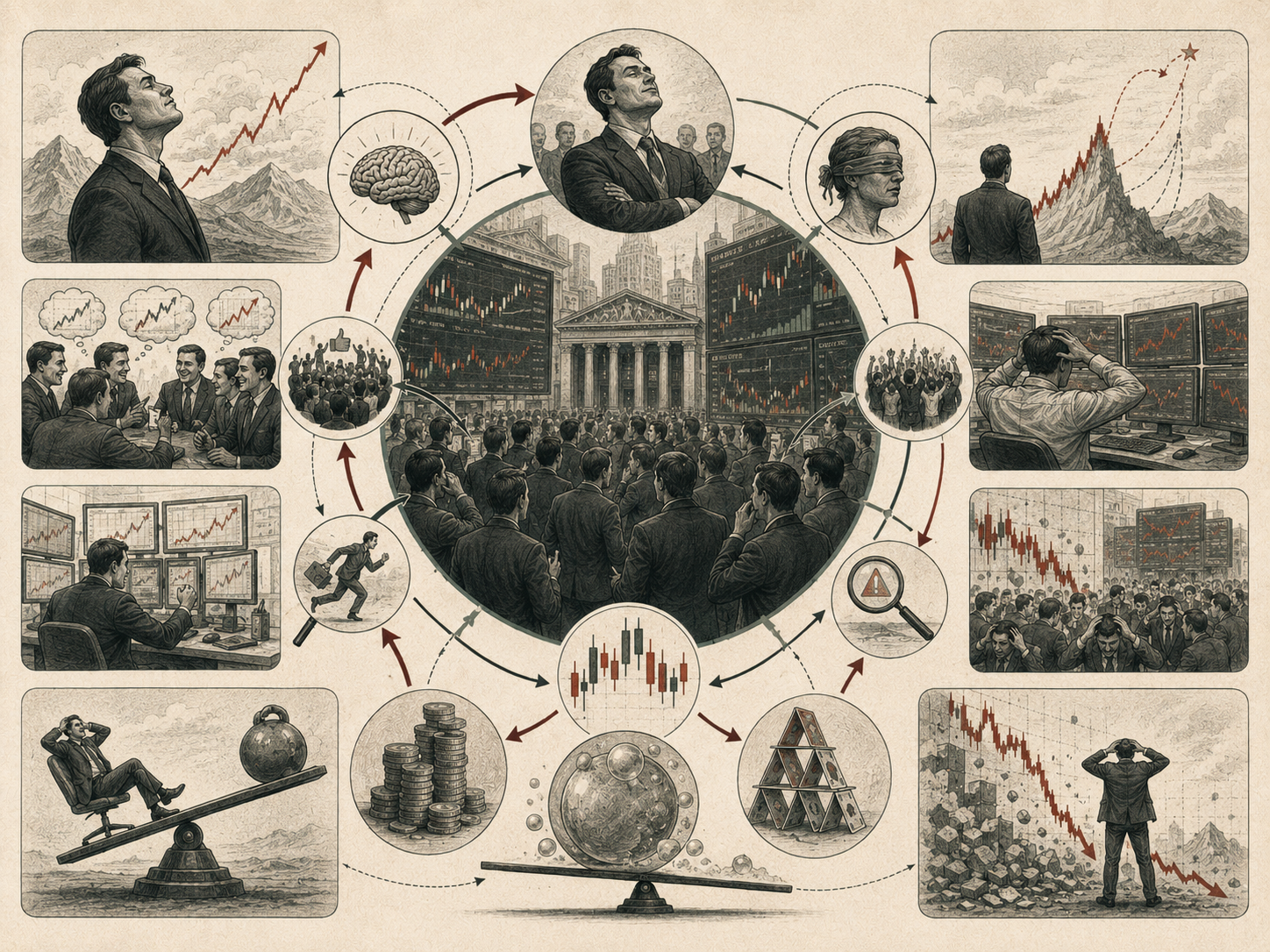
Classical financial theory assumes that investors process information rationally, update beliefs appropriately, diversify efficiently, and evaluate risk without systematic distortion. Behavioral finance shows that those assumptions are often too strong as descriptions of actual behavior. Investors frequently display unwarranted confidence in their forecasts, overweight their own information, interpret success as evidence of skill, and underestimate the role of randomness. Overconfidence bias therefore represents a central channel through which individual psychology can affect both personal investment outcomes and broader market conditions.
Overconfidence is not a single phenomenon. Psychological research commonly distinguishes among overestimation, overprecision, and illusion of control. Investors may overestimate their ability to forecast prices, express too much precision around uncertain beliefs, or act as though they can control outcomes shaped by macroeconomic shocks, liquidity conditions, policy changes, earnings surprises, and collective market behavior. These forms of unwarranted confidence can reinforce one another, especially in markets where feedback is fast, success is highly visible, and losses can be rationalized as temporary setbacks.
What Overconfidence Bias Means in Financial Markets
Overconfidence bias in financial markets occurs when investors act as though their information, judgment, timing ability, or control over outcomes is stronger than it actually is. The bias can appear in individual portfolios, professional fund management, trading platforms, analyst forecasts, institutional risk models, speculative bubbles, and broader market narratives. Its core feature is not merely optimism. It is excess confidence relative to evidence.
This distinction matters. Investors may have legitimate reasons to take risk, form forecasts, or disagree with market consensus. Financial markets require heterogeneous beliefs. But overconfidence appears when investors underestimate uncertainty, overstate the reliability of their signals, fail to distinguish skill from luck, or believe they can repeatedly time entry and exit despite weak evidence. The problem is not confidence itself. The problem is confidence that outruns calibration.
Overconfidence can distort behavior in several ways. Investors may trade too frequently because they believe they possess superior information. They may hold concentrated portfolios because they believe their selected assets are unusually promising. They may use leverage because they underestimate downside risk. They may delay selling losing positions because they remain too confident in their original thesis. They may interpret short-term success as proof of skill and increase risk exposure just as vulnerability grows.
The bias is especially consequential because financial feedback is noisy. A correct decision can lose money in the short run, and a poor decision can make money for reasons unrelated to skill. Markets therefore create many opportunities for mislearning. Overconfident investors may learn the wrong lesson from gains, losses, volatility, and momentum. They may become more certain precisely when humility would be more appropriate.
Overconfidence is closely connected to Behavioral Finance and Investor Psychology, Herd Behavior in Financial Markets, Loss Aversion and Risk Perception, Availability Bias and Economic Perception, and Anchoring Bias in Economic Judgment. Its distinctive contribution is to explain why investors often act with too much conviction in environments where uncertainty remains high.
The Psychology of Overconfidence
Overconfidence arises when people place excessive trust in their own analysis, forecasting precision, memory, interpretation, or perceived control. In financial markets, this can mean believing that one has superior insight into future returns, that one’s model captures the relevant risks, that one can exit before a reversal, or that one’s recent success reveals enduring skill. The psychological danger is that confidence often feels like evidence even when it is not.
Financial decision-making is saturated with ambiguity. Investors must interpret earnings, interest rates, inflation, geopolitical risk, regulation, consumer behavior, technology shifts, commodity markets, monetary policy, sentiment, liquidity, and the behavior of other investors. Because the environment is complex, people rely on simplified models and narratives. Overconfidence occurs when those models are treated as more reliable than they are.
Several psychological mechanisms support this bias. The first is self-attribution. Investors often attribute successful trades to skill and unsuccessful trades to bad luck, manipulation, macro shocks, or temporary irrationality by the market. This asymmetric learning process allows confidence to grow faster than accuracy. The second is confirmation bias. Overconfident investors may seek information that supports their thesis and discount information that undermines it. The third is hindsight bias. After outcomes occur, investors may believe they were more predictable than they actually were, reinforcing the illusion that future events can be forecast with similar confidence.
Overconfidence also interacts with identity. Investors may come to see themselves as disciplined contrarians, gifted traders, superior analysts, early adopters, or people who “understand” a market better than others. Once financial judgment becomes tied to identity, revising beliefs becomes emotionally harder. Admitting uncertainty can feel like admitting personal failure rather than simply updating a probabilistic view.
The psychology of overconfidence is therefore not a minor imperfection in reasoning. It affects how investors interpret evidence, remember outcomes, size positions, accept risk, and respond to disagreement. It also helps explain why technical knowledge alone does not eliminate poor financial behavior. A person can understand valuation theory and still be too confident in their own valuation.
Overestimation, Overprecision, and Illusion of Control
Overconfidence is best understood as a family of related biases rather than a single mental error. The first form is overestimation: believing that one’s ability, knowledge, or performance is better than it is. In finance, this may appear as the belief that one can select winning stocks, identify tops and bottoms, trade news events, or interpret macroeconomic signals better than most participants.
The second form is overprecision: expressing too much certainty around beliefs. Investors may assign narrow probability ranges to uncertain outcomes, state price targets with excessive confidence, or treat forecasts as if they were near-certainties. Overprecision is especially dangerous because it can make risk models appear more reliable than the underlying uncertainty allows. A forecast with decimal precision may look scientific while resting on fragile assumptions.
The third form is illusion of control: believing that one has influence over outcomes that remain largely uncertain or externally determined. In markets, this can appear when investors believe that frequent monitoring, active trading, technical dashboards, complex models, or rapid execution gives them more control over outcomes than they truly possess. Technology can intensify this illusion by making action feel immediate and powerful.
These three forms often reinforce one another. An investor who overestimates skill may become overprecise in forecasts. An investor who is overprecise may use larger position sizes. An investor who trades actively may develop an illusion of control because action itself creates a feeling of mastery. Together, these tendencies can produce excessive turnover, concentrated exposure, leverage, poor diversification, and reluctance to learn from error.
The distinction is analytically useful because different interventions address different forms of overconfidence. Overestimation may require performance attribution and benchmarking. Overprecision may require probabilistic forecasting and confidence-interval discipline. Illusion of control may require friction, position limits, precommitment rules, and awareness of randomness. Treating overconfidence as one generic bias misses these practical differences.
Overconfidence and Trading Behavior
One of the best-documented consequences of overconfidence bias is excessive trading. Investors who believe their information is unusually valuable are more likely to act on small signals, reinterpret noise as opportunity, and trade more frequently than warranted by expected gains after costs. This is one of the central empirical findings in behavioral finance: higher turnover often reduces net performance once transaction costs, spreads, taxes, and timing errors are considered.
The logic is straightforward. Trading requires the belief that action improves expected outcomes relative to inaction. An overconfident investor is more likely to believe that their forecast identifies a temporary mispricing, that their timing is better than average, or that the market has failed to incorporate information they understand. Each trade may seem reasonable in isolation. The problem is cumulative: many trades based on noisy signals can erode performance.
Excessive trading also creates hidden risks. Frequent trading exposes investors to bid-ask spreads, slippage, taxable events, short-term price noise, emotional feedback, and strategy drift. It can also weaken long-term discipline by making portfolio management reactive. A trader who constantly acts on perceived signals may fail to ask whether the signal has genuine predictive value after costs.
Overconfidence is particularly dangerous after success. A profitable trade can be interpreted as proof that the investor’s process is superior. This can increase risk appetite, position size, leverage, and frequency of trading. But if the profit resulted from luck or broad market beta, the investor may be scaling up a fragile strategy. The market rewards the behavior temporarily and then punishes it when conditions change.
The issue is not that active trading is always irrational. Skilled active management can exist, and markets need active participants for price discovery. The behavioral point is that many investors overestimate the likelihood that they are among the skilled minority. Overconfidence makes it difficult to distinguish genuine edge from the desire to believe one has edge.
Portfolio Choice, Diversification, and Risk Taking
Overconfidence also affects portfolio choice. A well-diversified portfolio acknowledges uncertainty. A concentrated portfolio often reflects stronger belief in specific assets, sectors, factors, or theses. Concentration can be justified when an investor has genuine information advantage, long horizon, and risk capacity. But overconfidence can produce concentration without sufficient evidence.
Investors may overweight familiar firms, employers, domestic markets, favorite sectors, recent winners, or assets tied to their personal narratives. They may believe they understand a company better than they do because they use its products, follow its media coverage, work in the industry, or identify with its story. Familiarity can feel like knowledge. Overconfidence turns that feeling into exposure.
Under-diversification becomes especially dangerous when investors underestimate correlation. A portfolio may appear diversified across many assets while still depending on the same macro factor, interest-rate condition, technology narrative, liquidity regime, or market sentiment. Overconfident investors may focus on asset-specific stories while underweighting systemic risk.
Overconfidence can also increase leverage. If investors believe downside scenarios are unlikely or manageable, they may borrow, use options, increase margin exposure, or concentrate in volatile assets. Leverage converts forecast error into fragility. A small mistake in confidence calibration can become a large loss when magnified by borrowed capital.
Risk taking also changes when investors believe they can time exits. An investor may accept a risky position because they believe they will sell before the crowd reverses. This belief can be especially seductive in speculative environments. But if many investors believe they can exit first, the exit becomes crowded. Overconfidence therefore interacts with herd behavior and liquidity risk.
Good portfolio discipline is partly a defense against the investor’s own confidence. Diversification, rebalancing, position sizing, stress testing, and explicit risk budgets are not signs of weak conviction. They are institutionalized humility.
Market-Level Effects
When overconfidence affects many investors, its consequences extend beyond individual portfolios. Excessive conviction can increase trading volume, raise short-term volatility, amplify price movements, and contribute to mispricing. If many investors are too certain of their signals, models, or narratives, they may collectively push prices away from fundamentals, especially in environments already characterized by uncertainty, liquidity, and speculative excitement.
Overconfidence can produce disagreement-driven trading. If investors hold overly precise but conflicting beliefs, they may trade heavily because each side believes the other is wrong. Higher trading volume may therefore indicate not only information arrival, but excessive certainty among market participants. Markets can become active because investors know more, but also because investors think they know more than they do.
The bias can also amplify bubbles. Rising prices can be interpreted as confirmation of investor skill. Participants who entered early may believe they correctly identified a durable opportunity. Their confidence may attract more risk taking, more leverage, and stronger narratives. As prices continue rising, the line between skill and market momentum becomes harder to see. Overconfidence converts temporary validation into durable conviction.
When confidence unwinds, reversals can be sharp. Investors who were slow to acknowledge uncertainty may all revise beliefs around the same time. If leverage, crowded positioning, and liquidity constraints are present, the market-level effect can be abrupt. Overconfidence therefore contributes not only to excess entry, but to delayed exit and disorderly correction.
Overconfidence is also relevant to market efficiency. If investors overweight private signals and underweight public information, prices may incorporate noise. If professional investors are overconfident in models, factor exposures, or risk estimates, systematic errors can become institutionalized. If retail investors are overconfident in platform-mediated signals, social narratives can become price-relevant. Behavioral finance must therefore analyze overconfidence at multiple levels: individual, institutional, technological, and systemic.
Institutional and Technological Influences
Institutional and technological environments can intensify or moderate overconfidence. Online brokerages, real-time dashboards, rapid execution, financial media, social trading environments, automated alerts, options access, and performance screens can create a sense of immediacy and control. Tools that increase access and speed are not inherently harmful, but they make it easier for overconfident decision-makers to translate fragile conviction into frequent trading.
Fast feedback can be misleading. A trading app may show gains and losses instantly, but immediate performance does not reveal whether a decision was sound. Short-term success can reinforce overconfidence before enough evidence has accumulated. Short-term losses can provoke reactive trading rather than reflection. The interface creates feedback, but not necessarily learning.
Professional institutions attempt to constrain overconfidence through diversification requirements, position limits, risk committees, model validation, stress testing, scenario analysis, independent review, and investment governance. These mechanisms reflect an institutional recognition that individual judgment can become too confident, too concentrated, or too brittle. Risk governance is partly the organizational management of overconfidence.
However, institutions can also produce overconfidence. Complex models can create false precision. Historical backtests can create confidence in strategies that may fail out of sample. Risk metrics can make uncertainty appear contained. Committee consensus can create the illusion that a view is robust because many people approved it. Sophistication does not eliminate overconfidence; it can make overconfidence harder to detect.
Technology and institutions therefore have a double role. They can create discipline, friction, and review. They can also create speed, precision theater, and amplified conviction. The question is not whether investors use tools, but whether tools improve calibration or merely make action easier.
Digital Platforms, Social Trading, and Confidence Amplification
Digital platforms have changed how overconfidence develops and spreads. Retail investors can now access real-time prices, options chains, analyst commentary, social sentiment, influencer content, discussion boards, and trading tools from a single device. This can expand participation and financial access, but it can also create an environment in which confidence is continuously stimulated.
Platform design matters. Watchlists, trending tickers, push notifications, simplified charts, color-coded gains, fast execution, fractional trading, and gamified engagement can make markets feel more controllable than they are. The user is invited to act. The easier it becomes to trade, the more important it becomes to ask whether action is justified.
Social trading can amplify confidence by making others’ conviction visible. A widely shared thesis, viral trade, community narrative, or influencer claim can make an investor feel that their belief is socially validated. The investor may experience confirmation not because independent evidence improved, but because more people appear to agree. This links overconfidence directly to herding.
Digital platforms can also blur the distinction between investing, entertainment, identity, and social participation. A trade may feel like a statement, a community affiliation, or a way to participate in a broader narrative. Once financial action becomes socially meaningful, confidence may be reinforced by belonging as much as by evidence.
This does not mean retail investors are uniquely irrational. Institutional investors also overestimate skill, rely on models, chase performance, and follow consensus. But digital platforms change the speed and visibility of confidence formation. They compress the distance between belief and action.
Responsible platform design should therefore consider behavioral risk. Investor education, friction around complex products, risk disclosure, position-size warnings, cooling-off features, clearer cost information, and better presentation of uncertainty can help reduce the translation of overconfidence into harmful action. Access and protection should be treated as complementary, not opposing, goals.
Professional Investors, Models, and Institutional Overconfidence
Overconfidence is often discussed in relation to individual retail investors, but professional investors can also be overconfident. In fact, professional overconfidence can be more systemically important because it may involve larger capital pools, leverage, complex instruments, and institutional endorsement. Expertise reduces some errors, but it can also increase confidence in one’s ability to interpret ambiguous evidence.
Professional overconfidence often appears through models. Quantitative strategies, valuation frameworks, macro forecasts, risk models, and factor analyses can improve discipline, but they can also create false precision. Backtests may fit the past better than the future. Correlations may break down in stress. Liquidity assumptions may fail when many actors use similar strategies. A model can be mathematically rigorous and still overstate what is knowable.
Institutional environments can reward confidence. Analysts are often expected to provide recommendations, price targets, scenarios, and decisive views. Fund managers must explain positions to clients. Committees may prefer clear narratives. Uncertainty can be perceived as weakness. These pressures may encourage overprecision: saying more than the evidence supports because the professional role demands conviction.
Career incentives also matter. A manager who expresses uncertainty may appear less competent than one who expresses confidence. A strategy that performed well recently may attract assets, reinforcing belief in the manager’s skill. Consultants and clients may reward compelling narratives. Overconfidence can therefore be socially produced by institutional expectations, not only psychologically generated inside individuals.
Risk governance should not assume that professional status solves overconfidence. It should ask whether forecasts are calibrated, whether uncertainty is represented honestly, whether position sizes reflect model risk, whether dissent is encouraged, and whether success is attributed carefully. The professional version of humility is not indecision. It is disciplined uncertainty management.
Risk Governance and Decision Discipline
Understanding overconfidence has practical implications for risk governance. The most important lesson is that conviction should be separated from calibration. An investor or institution may hold a strong thesis, but the position size, risk budget, and review process should reflect uncertainty. Confidence without calibration becomes exposure to error.
Decision discipline begins before the trade. Investors should write down the thesis, expected time horizon, key assumptions, disconfirming evidence, risk limits, and conditions for exit. Precommitment matters because overconfidence often becomes stronger after entry. Once capital is committed, investors may defend the position rather than evaluate it objectively.
Performance attribution is also crucial. Gains should be decomposed into market beta, factor exposure, sector movement, timing, security selection, leverage, currency effects, and luck where possible. Without attribution, investors may confuse broad market participation with skill. This is one reason overconfidence often rises during bull markets: many strategies appear intelligent when the tide is rising.
Risk governance should include base rates. Before acting on a confident forecast, investors should ask how often similar forecasts have been right, what the historical distribution of outcomes looks like, and whether the current situation truly differs. Base-rate discipline helps counter the tendency to treat one’s current thesis as uniquely compelling.
Diversification is another form of governance. It does not eliminate risk, but it acknowledges that individual judgment is fallible. Position limits, stop-loss policies, rebalancing, independent review, scenario analysis, and stress testing all serve the same function: they reduce the damage caused by excess confidence.
At the institutional level, risk governance should protect dissent. Overconfidence thrives in environments where confidence is rewarded and doubt is punished. Good governance makes it possible to say, “We may be wrong,” before the market forces that recognition.
Empirical and Policy-Evaluation Lens
A professional economist-facing treatment of overconfidence should ask what can be measured, identified, estimated, and evaluated. Overconfidence can be studied through trading frequency, portfolio concentration, turnover, realized returns, forecast calibration, confidence intervals, survey measures, brokerage records, analyst forecasts, fund manager behavior, options trading, leverage use, and responses to prior success or failure.
The empirical challenge is that overconfidence is not observed directly. Researchers infer it from behavior: excessive trading, overprecision in forecasts, poor diversification, excessive leverage, aggressive response to noisy signals, or failure to update after negative evidence. But these behaviors can have multiple explanations. High turnover may reflect liquidity needs, tax strategy, information advantage, rebalancing, or institutional mandate. Concentration may reflect genuine expertise or constrained choice. Careful design is necessary.
One major empirical strategy is to examine whether high trading frequency is associated with lower net returns after costs. Another is to compare forecast confidence with realized accuracy. A third is to study how investors change behavior after success: if gains lead to disproportionate increases in risk taking, that may indicate self-attribution and overconfidence. Researchers can also examine whether investors under-diversify in familiar assets or overreact to private signals relative to public information.
Policy evaluation should distinguish access from harm. Greater retail participation in financial markets can be valuable, but platform environments may increase the behavioral translation of overconfidence into frequent trading, complex product use, or leverage. Investor-protection analysis should therefore examine not only disclosure, but also interface design, product complexity, friction, defaults, salience, and the presentation of uncertainty.
Heterogeneity matters. Overconfidence varies by experience, recent performance, financial literacy, gender, age, profession, market environment, product complexity, and platform design. Professional investors may show overconfidence through models and forecasts; retail investors may show it through turnover and concentrated trades; executives may show it through corporate investment and merger decisions. A rigorous workflow should identify which form of overconfidence is being measured.
A serious empirical framework should ask: What is the investor’s true information quality? What is perceived information quality? How is confidence measured? Are outcomes evaluated before or after costs? Are returns risk-adjusted? Is trading voluntary or mechanically required? Does success lead to increased risk taking? Does confidence decline after error? These questions turn overconfidence from a loose diagnosis into a disciplined behavioral-finance object.
An Analytical Framework for Overconfidence Bias
A simple way to formalize overconfidence is to distinguish the true precision of a signal from the investor’s perceived precision. Let an investor observe a signal \(s_i\) about an asset’s return \(r\). Under calibrated updating, the investor weights the signal according to its true precision \(\tau_i\). Under overconfidence, the investor behaves as though the signal precision were \(\hat{\tau}_i\), where:
\hat{\tau}_i > \tau_i
\]
Interpretation: The investor believes their signal is more precise than it actually is, causing private information to receive too much weight.
This means the investor places excessive confidence in their own information relative to what the evidence warrants. Portfolio positions can then become too aggressive because conviction is inflated relative to informational quality. This is one of the basic mechanisms through which overconfidence generates excessive trading and under-diversified exposure.
A reduced-form expression for latent demand for a risky asset can be written as:
D_i = \alpha \hat{\mu}_i – \beta \hat{\sigma}_i^2
\]
Interpretation: Demand rises with perceived expected return and falls with perceived risk.
Here, \(\hat{\mu}_i\) is the investor’s expected excess return and \(\hat{\sigma}_i^2\) is perceived variance. Overconfidence can distort either term. The investor may overestimate expected return, underestimate uncertainty, or both. If confidence is excessive, demand becomes more extreme than a calibrated benchmark would justify.
Trading intensity can be modeled as increasing in the perceived divergence between one’s own belief and the market’s implied view:
T_i = \gamma \left| \hat{\mu}_i – \mu_m \right|
\]
Interpretation: Trading rises when an investor believes their expected return estimate differs from the market’s implied estimate.
If investors are too confident in their own signals, they perceive more opportunities to trade against the market. This helps explain why overconfidence is associated with high turnover and weaker net performance after costs.
Net return after trading costs can be represented as:
R_i^{net} = R_i^{gross} – cT_i
\]
Interpretation: Net return falls as trading intensity increases, holding gross performance and transaction cost per unit of turnover constant.
Overconfidence becomes costly when increased trading does not generate enough gross return to compensate for transaction costs, tax drag, bid-ask spreads, slippage, and timing error.
A simple performance-attribution discipline can be expressed as:
R_i = \beta_m R_m + \beta_f F + \alpha_i + \varepsilon_i
\]
Interpretation: Observed return should be decomposed into market exposure, factor exposure, estimated skill, and residual noise before attributing success to investor ability.
This equation captures a practical behavioral lesson. Without attribution, investors may mistake market beta or factor exposure for personal skill. Overconfidence often grows when people attribute returns to themselves that were actually produced by broader market conditions.
A risk-governance version of the model can define an overconfidence-adjusted position limit:
w_i^{max} = \frac{k}{1 + OC_i}
\]
Interpretation: Maximum position size declines as measured or suspected overconfidence rises.
Here, \(OC_i\) is an overconfidence-risk score and \(k\) is a baseline risk budget. This is not a universal prescription, but it illustrates the institutional idea that overconfidence should be managed through position sizing, not merely awareness.
R Workflow: Simulating Overconfidence, Trading Frequency, and Portfolio Drag
The following R workflow simulates a population of investors who differ in true signal quality but systematically overestimate the precision of their own information. It is designed as a professional scaffold for behavioral finance, investor education, risk governance, and applied portfolio-behavior analysis. The workflow produces investor-level trading intensity, trading costs, realized returns, overconfidence quartile summaries, and performance drag diagnostics.
# Overconfidence Bias in Financial Markets
# R workflow: trading frequency, portfolio drag, and net performance
# Synthetic data only. Economist-facing research scaffold.

set.seed(1212)

n_investors <- 2500
n_periods <- 120

investors <- data.frame(
  investor_id = 1:n_investors,
  true_signal_sd = runif(n_investors, 0.15, 0.35),
  overconfidence_multiplier = runif(n_investors, 1.0, 2.2),
  risk_tolerance = runif(n_investors, 0.5, 1.5),
  diversification_discipline = runif(n_investors, 0.25, 1.0),
  prior_success_sensitivity = runif(n_investors, 0.0, 0.8)
)

history <- vector("list", n_periods)

rolling_success <- rep(0, n_investors)

for (t in seq_len(n_periods)) {
  true_market_return <- rnorm(1, mean = 0.008, sd = 0.075)

  signals <- rnorm(
    n_investors,
    mean = true_market_return,
    sd = investors$true_signal_sd
  )

  confidence_boost <- 1 + investors$prior_success_sensitivity * pmax(rolling_success, 0)

  perceived_signal <- signals *
    investors$overconfidence_multiplier *
    confidence_boost

  trade_intensity <- abs(perceived_signal) *
    investors$risk_tolerance *
    (1.25 - 0.50 * investors$diversification_discipline)

  trade_intensity <- pmin(trade_intensity, 3.0)

  trading_cost <- 0.0025 * trade_intensity

  position_direction <- sign(perceived_signal)

  realized_return <- true_market_return *
    position_direction *
    trade_intensity -
    trading_cost

  rolling_success <- 0.80 * rolling_success + 0.20 * realized_return

  history[[t]] <- data.frame(
    period = t,
    investor_id = investors$investor_id,
    true_market_return = true_market_return,
    signal = signals,
    perceived_signal = perceived_signal,
    trade_intensity = trade_intensity,
    trading_cost = trading_cost,
    realized_return = realized_return,
    rolling_success = rolling_success,
    overconfidence_multiplier = investors$overconfidence_multiplier,
    diversification_discipline = investors$diversification_discipline
  )
}

panel <- do.call(rbind, history)

investor_summary <- aggregate(
  cbind(trade_intensity, trading_cost, realized_return) ~ investor_id,
  data = panel,
  FUN = mean
)

investor_summary <- merge(
  investor_summary,
  investors,
  by = "investor_id"
)

investor_summary$overconfidence_quartile <- cut(
  investor_summary$overconfidence_multiplier,
  breaks = quantile(investor_summary$overconfidence_multiplier, probs = seq(0, 1, 0.25)),
  include.lowest = TRUE,
  labels = paste0("Q", 1:4)
)

performance_by_group <- aggregate(
  cbind(trade_intensity, trading_cost, realized_return) ~ overconfidence_quartile,
  data = investor_summary,
  FUN = mean
)

performance_by_group$portfolio_drag <- performance_by_group$trading_cost

print(performance_by_group)

dir.create("outputs/tables", recursive = TRUE, showWarnings = FALSE)
write.csv(panel, "outputs/tables/r_overconfidence_trading_panel.csv", row.names = FALSE)
write.csv(investor_summary, "outputs/tables/r_overconfidence_investor_summary.csv", row.names = FALSE)
write.csv(performance_by_group, "outputs/tables/r_overconfidence_quartile_summary.csv", row.names = FALSE)
This workflow highlights a core behavioral-finance result: when investors overrate the precision of their own signals, they tend to trade more, incur more costs, and often earn lower net returns after accounting for turnover drag. The code can be extended with leverage, taxes, portfolio concentration, correlated signals, learning rules, or platform-level interventions.
Python Workflow: Comparing Investor Regimes Under Overconfidence Assumptions
The following Python workflow compares stylized investor regimes with calibrated confidence, moderate overconfidence, and high overconfidence. It includes synthetic investor-level data, regime-level summaries, turnover and cost diagnostics, and treatment-effect estimation. It is designed to support behavioral-finance teaching, applied investor-behavior analysis, and risk-governance prototyping.
# Overconfidence Bias in Financial Markets
# Python workflow: investor regimes, trading intensity, costs, and net performance
# Synthetic data only. Economist-facing research scaffold.

from __future__ import annotations

from pathlib import Path

import numpy as np
import pandas as pd

rng = np.random.default_rng(1212)

n_investors = 3000
n_periods = 140

investors = pd.DataFrame({
    "investor_id": np.arange(1, n_investors + 1),
    "true_signal_sd": rng.uniform(0.15, 0.35, n_investors),
    "risk_tolerance": rng.uniform(0.5, 1.5, n_investors),
    "diversification_discipline": rng.uniform(0.25, 1.0, n_investors),
    "prior_success_sensitivity": rng.uniform(0.0, 0.8, n_investors)
})

def simulate_regime(
    regime_name: str,
    overconfidence_multiplier: float,
    trading_friction: float,
    leverage_access: float
) -> pd.DataFrame:
    """Simulate investor behavior under a fixed overconfidence regime."""
    rows = []
    rolling_success = np.zeros(n_investors)

    for period in range(1, n_periods + 1):
        true_market_return = rng.normal(0.008, 0.075)

        signals = rng.normal(
            loc=true_market_return,
            scale=investors["true_signal_sd"].to_numpy()
        )

        confidence_boost = (
            1
            + investors["prior_success_sensitivity"].to_numpy()
            * np.maximum(rolling_success, 0)
        )

        perceived_signal = signals * overconfidence_multiplier * confidence_boost

        trade_intensity = (
            np.abs(perceived_signal)
            * investors["risk_tolerance"].to_numpy()
            * (1.25 - 0.50 * investors["diversification_discipline"].to_numpy())
            * leverage_access
        )

        trade_intensity = np.minimum(trade_intensity, 3.5)

        trading_cost = trading_friction * trade_intensity

        realized_return = (
            true_market_return
            * np.sign(perceived_signal)
            * trade_intensity
            - trading_cost
        )

        rolling_success = 0.80 * rolling_success + 0.20 * realized_return

        rows.append(pd.DataFrame({
            "regime": regime_name,
            "period": period,
            "investor_id": investors["investor_id"],
            "true_market_return": true_market_return,
            "signal": signals,
            "perceived_signal": perceived_signal,
            "trade_intensity": trade_intensity,
            "trading_cost": trading_cost,
            "realized_return": realized_return,
            "rolling_success": rolling_success,
            "overconfidence_multiplier": overconfidence_multiplier,
            "trading_friction": trading_friction,
            "leverage_access": leverage_access,
        }))

    return pd.concat(rows, ignore_index=True)

regimes = {
    "calibrated_confidence": {
        "overconfidence_multiplier": 1.00,
        "trading_friction": 0.0025,
        "leverage_access": 1.00,
    },
    "moderate_overconfidence": {
        "overconfidence_multiplier": 1.45,
        "trading_friction": 0.0025,
        "leverage_access": 1.15,
    },
    "high_overconfidence_low_friction": {
        "overconfidence_multiplier": 2.05,
        "trading_friction": 0.0018,
        "leverage_access": 1.35,
    },
}

frames = []

for name, params in regimes.items():
    frames.append(simulate_regime(name, **params))

panel = pd.concat(frames, ignore_index=True)

summary = panel.groupby("regime").agg(
    mean_trade_intensity=("trade_intensity", "mean"),
    mean_trading_cost=("trading_cost", "mean"),
    mean_realized_return=("realized_return", "mean"),
    volatility_realized_return=("realized_return", "std"),
    mean_abs_perceived_signal=("perceived_signal", lambda x: np.mean(np.abs(x))),
).reset_index()

summary["return_to_turnover_ratio"] = (
    summary["mean_realized_return"]
    / summary["mean_trade_intensity"]
)

print(summary.sort_values("mean_realized_return", ascending=False))

experiment = panel.groupby(["regime", "period"], as_index=False).agg(
    mean_trade_intensity=("trade_intensity", "mean"),
    mean_trading_cost=("trading_cost", "mean"),
    mean_realized_return=("realized_return", "mean"),
    volatility_proxy=("realized_return", "std"),
    mean_abs_perceived_signal=("perceived_signal", lambda x: np.mean(np.abs(x))),
    overconfidence_multiplier=("overconfidence_multiplier", "mean"),
    trading_friction=("trading_friction", "mean"),
    leverage_access=("leverage_access", "mean"),
)

experiment["moderate_overconfidence_treat"] = (
    experiment["regime"] == "moderate_overconfidence"
).astype(int)

experiment["high_overconfidence_treat"] = (
    experiment["regime"] == "high_overconfidence_low_friction"
).astype(int)

try:
    import statsmodels.api as sm

    outcomes = [
        "mean_trade_intensity",
        "mean_trading_cost",
        "mean_realized_return",
        "volatility_proxy"
    ]

    for outcome in outcomes:
        X = experiment[[
            "moderate_overconfidence_treat",
            "high_overconfidence_treat",
            "trading_friction",
            "leverage_access"
        ]]
        X = sm.add_constant(X)

        model = sm.OLS(experiment[outcome], X).fit(cov_type="HC1")

        print(f"\nOutcome: {outcome}")
        print(model.summary().tables[1])

except ImportError:
    print("statsmodels is not installed; skipping regression table.")

output_dir = Path("outputs/tables")
output_dir.mkdir(parents=True, exist_ok=True)

panel.to_csv(output_dir / "synthetic_overconfidence_investor_panel.csv", index=False)
experiment.to_csv(output_dir / "synthetic_overconfidence_experiment.csv", index=False)
summary.to_csv(output_dir / "overconfidence_regime_summary.csv", index=False)
For analysts, the value of this comparison is that it makes the core pattern visible: as overconfidence rises, trading intensity and trading costs tend to rise, while net performance may deteriorate unless the investor has genuine predictive skill strong enough to overcome turnover drag. The workflow also shows how low-friction trading environments can change the behavioral consequences of overconfidence by making action easier.
Stata Replication Note: Overconfidence, Turnover, and Net Returns
For an economist-facing repository, the companion code should support Stata as well as R and Python. The article-level GitHub folder should include a Stata workflow that imports the synthetic investor-regime dataset, estimates treatment effects, reports robust standard errors, and exports regression tables. A compact Stata pattern for this article would look like this:
clear all
set more off

* Overconfidence Bias in Financial Markets
* Stata investor-regime evaluation workflow using synthetic data.

global ROOT "`c(pwd)'"
global TABLES "$ROOT/outputs/tables"
global REG "$ROOT/outputs/regression_tables"

capture mkdir "$REG"

import delimited "$TABLES/synthetic_overconfidence_experiment.csv", clear varnames(1)

label variable moderate_overconfidence_treat "Moderate overconfidence treatment"
label variable high_overconfidence_treat "High overconfidence low-friction treatment"
label variable mean_trade_intensity "Mean trading intensity"
label variable mean_trading_cost "Mean trading cost"
label variable mean_realized_return "Mean realized return"
label variable volatility_proxy "Return volatility proxy"

local controls trading_friction leverage_access
local outcomes mean_trade_intensity mean_trading_cost mean_realized_return volatility_proxy mean_abs_perceived_signal

tempname handle
postfile `handle' str50 outcome str50 term double estimate double std_error double p_value double n using "$REG/stata_overconfidence_estimates.dta", replace

foreach y of local outcomes {
    regress `y' moderate_overconfidence_treat high_overconfidence_treat `controls', vce(robust)

    foreach x in moderate_overconfidence_treat high_overconfidence_treat {
        local b = _b[`x']
        local se = _se[`x']
        local p = 2 * ttail(e(df_r), abs(_b[`x'] / _se[`x']))
        local n = e(N)
        post `handle' ("`y'") ("`x'") (`b') (`se') (`p') (`n')
    }
}

postclose `handle'

use "$REG/stata_overconfidence_estimates.dta", clear
export delimited using "$REG/stata_overconfidence_estimates.csv", replace

display "Stata overconfidence investor-regime evaluation workflow complete."
The purpose of including Stata is to make the repository useful to economists, policy analysts, behavioral-finance researchers, investor-protection researchers, and graduate-level applied researchers who commonly work across Stata, R, and Python. The full repository scaffold should also include identification notes, robustness plans, replication instructions, synthetic investor-panel data, turnover diagnostics, cost-drag analysis, treatment-effect estimation, and sensitivity tests for confidence, trading friction, leverage access, signal quality, and diversification discipline.
GitHub Repository
The companion repository provides reproducible scaffolding for the computational side of this article, including synthetic investor-panel datasets, overconfidence-regime simulations, turnover diagnostics, trading-cost analysis, treatment-effect estimation, risk and performance summaries, robustness checks, Stata/R/Python workflows, SQL metadata structures, and scientific-computing examples for behavioral finance research.
Complete Code Repository
This article is supported by an article-level folder in the Behavioral Economics computational repository, with synthetic investor-panel and experiment-style datasets, causal-inference workflows, turnover and trading-cost diagnostics, econometric identification notes, policy-evaluation scripts, robustness and sensitivity checks, Stata/R/Python workflows, SQL metadata structures, and scientific-computing examples for studying overconfidence bias, trading frequency, portfolio concentration, perceived signal precision, leverage, performance attribution, platform friction, investor protection, and behavioral finance.
Interpretive Limits and Cautions
Overconfidence is a powerful concept, but it should not be used carelessly. Not every investor who trades actively is overconfident. Some investors may have liquidity needs, tax reasons, hedging requirements, institutional mandates, or genuine information advantages. High conviction is not automatically irrational. The analytical question is whether confidence is calibrated to evidence, uncertainty, and risk.
There is also a danger of blaming individual psychology while ignoring market design. If trading platforms make complex products easy to access, emphasize short-term movement, reduce friction, and present action as entertainment, investor overconfidence may be amplified by the environment. A serious analysis should examine both the investor and the decision architecture.
Professional investors should not be assumed immune. Expertise can reduce some errors, but it can also support more elaborate forms of overconfidence. Models, backtests, forecasts, and institutional consensus can create the appearance of precision while masking uncertainty. Overconfidence among professionals may be less visible than retail overconfidence, but it can be more systemically consequential.
Overconfidence also interacts with broader market conditions. A bull market can make many investors appear skilled. A liquidity-rich environment can hide fragility. Momentum can validate poor reasoning. A low-volatility period can encourage leverage. Analysts should therefore distinguish individual ability from market regime.
Finally, behavioral finance should not be used to discourage broad participation in financial markets. The goal is not to portray ordinary investors as incapable. The goal is to design better education, better disclosures, better tools, and better governance so that participation is paired with humility, diversification, risk awareness, and protection from avoidable behavioral harm.
Conclusion
Overconfidence bias is one of the clearest ways behavioral economics enters financial-market analysis. Investors often become too certain of their own knowledge, too confident in their predictive accuracy, and too willing to act as though uncertain outcomes were controllable. These distortions help explain excessive trading, weak diversification, speculative risk taking, leverage, mispricing, and poor net performance after costs.
The broader significance of the bias lies in showing that market inefficiency can arise not only from bad information, but from too much confidence in fragile information. Financial systems do not need to be irrational in a chaotic sense to become unstable. They need only contain enough actors who are too sure of themselves, too willing to trade on noisy signals, and too slow to recognize the limits of their own judgment.
The mature lesson is not that investors should lack confidence. Financial decisions require judgment under uncertainty. The lesson is that confidence must be disciplined by calibration, attribution, diversification, position sizing, humility, and review. Conviction is useful only when it remains answerable to evidence.
In that sense, overconfidence bias offers one of the strongest bridges between behavioral finance, investor protection, platform design, portfolio discipline, risk governance, and market stability. It reminds us that financial markets are not only systems of information and prices. They are also systems of belief, self-attribution, uncertainty, narrative, and human judgment under pressure.
Related Articles
- Behavioral Economics
- Behavioral Finance and Investor Psychology
- Herd Behavior in Financial Markets
- Loss Aversion and Risk Perception
- Availability Bias and Economic Perception
- Anchoring Bias in Economic Judgment
- Framing Effects and Consumer Choice
- Behavioral Economics and Digital Platforms
- Behavioral Design in Technology Systems
- Choice Architecture and Decision Environments
Further Reading
- Barber, B.M. and Odean, T. (2000) ‘Trading is hazardous to your wealth: The common stock investment performance of individual investors’, Journal of Finance, 55(2), pp. 773–806. Available at: https://onlinelibrary.wiley.com/doi/10.1111/0022-1082.00226.
- Barber, B.M. and Odean, T. (2001) ‘Boys will be boys: Gender, overconfidence, and common stock investment’, Quarterly Journal of Economics, 116(1), pp. 261–292. Available at: https://academic.oup.com/qje/article-abstract/116/1/261/1939000.
- Daniel, K., Hirshleifer, D. and Subrahmanyam, A. (1998) ‘Investor psychology and security market under- and overreactions’, Journal of Finance, 53(6), pp. 1839–1885. Available at: https://onlinelibrary.wiley.com/doi/10.1111/0022-1082.00077.
- Kahneman, D. and Tversky, A. (1979) ‘Prospect theory: An analysis of decision under risk’, Econometrica, 47(2), pp. 263–291. Available at: https://www.jstor.org/stable/1914185.
- Moore, D.A. and Healy, P.J. (2008) ‘The trouble with overconfidence’, Psychological Review, 115(2), pp. 502–517. Available at: https://psycnet.apa.org/record/2008-04614-012.
- Odean, T. (1998) ‘Volume, volatility, price, and profit when all traders are above average’, Journal of Finance, 53(6), pp. 1887–1934. Available at: https://onlinelibrary.wiley.com/doi/10.1111/0022-1082.00078.
- Odean, T. (1999) ‘Do investors trade too much?’, American Economic Review, 89(5), pp. 1279–1298. Available at: https://faculty.haas.berkeley.edu/odean/papers%20current%20versions/doinvestors.pdf.
- Statman, M., Thorley, S. and Vorkink, K. (2006) ‘Investor overconfidence and trading volume’, Review of Financial Studies, 19(4), pp. 1531–1565. Available at: https://academic.oup.com/rfs/article-abstract/19/4/1531/1590527.
- Thaler, R.H. (2015) Misbehaving: The Making of Behavioral Economics. New York: W.W. Norton. Available at: https://wwnorton.com/books/misbehaving/.
References
- Barber, B.M. and Odean, T. (2000) ‘Trading is hazardous to your wealth: The common stock investment performance of individual investors’, Journal of Finance, 55(2), pp. 773–806. Available at: https://onlinelibrary.wiley.com/doi/10.1111/0022-1082.00226.
- Barber, B.M. and Odean, T. (2001) ‘Boys will be boys: Gender, overconfidence, and common stock investment’, Quarterly Journal of Economics, 116(1), pp. 261–292. Available at: https://academic.oup.com/qje/article-abstract/116/1/261/1939000.
- Daniel, K., Hirshleifer, D. and Subrahmanyam, A. (1998) ‘Investor psychology and security market under- and overreactions’, Journal of Finance, 53(6), pp. 1839–1885. Available at: https://onlinelibrary.wiley.com/doi/10.1111/0022-1082.00077.
- Kahneman, D. and Tversky, A. (1979) ‘Prospect theory: An analysis of decision under risk’, Econometrica, 47(2), pp. 263–291. Available at: https://www.jstor.org/stable/1914185.
- Moore, D.A. and Healy, P.J. (2008) ‘The trouble with overconfidence’, Psychological Review, 115(2), pp. 502–517. Available at: https://psycnet.apa.org/record/2008-04614-012.
- Odean, T. (1998) ‘Volume, volatility, price, and profit when all traders are above average’, Journal of Finance, 53(6), pp. 1887–1934. Available at: https://onlinelibrary.wiley.com/doi/10.1111/0022-1082.00078.
- Odean, T. (1999) ‘Do investors trade too much?’, American Economic Review, 89(5), pp. 1279–1298. Available at: https://faculty.haas.berkeley.edu/odean/papers%20current%20versions/doinvestors.pdf.
- Statman, M., Thorley, S. and Vorkink, K. (2006) ‘Investor overconfidence and trading volume’, Review of Financial Studies, 19(4), pp. 1531–1565. Available at: https://academic.oup.com/rfs/article-abstract/19/4/1531/1590527.
- Thaler, R.H. (2015) Misbehaving: The Making of Behavioral Economics. New York: W.W. Norton. Available at: https://wwnorton.com/books/misbehaving/.