
Last Updated May 25, 2026
Behavioral finance examines why investors, institutions, and markets often depart from the predictions of fully rational financial models. It studies how psychological biases, emotional responses, social influence, cognitive shortcuts, technological environments, and institutional incentives shape investment decisions, asset prices, trading behavior, risk-taking, market bubbles, crashes, and long-term household financial outcomes.
Classical financial theory offers powerful benchmarks. Expected utility theory, modern portfolio theory, rational expectations, and versions of the efficient market hypothesis clarify how investors would behave if they processed information consistently, updated beliefs accurately, diversified efficiently, and priced risk without systematic distortion. Behavioral finance does not make those models useless. It asks where they are incomplete as descriptions of actual human and institutional behavior under uncertainty.
Main Library
Publications
Article Map
Behavioral Economics
Related Topic
Economic Systems
Related Topic
Risk & Resilience
Related Topic
Data Systems & Analytics
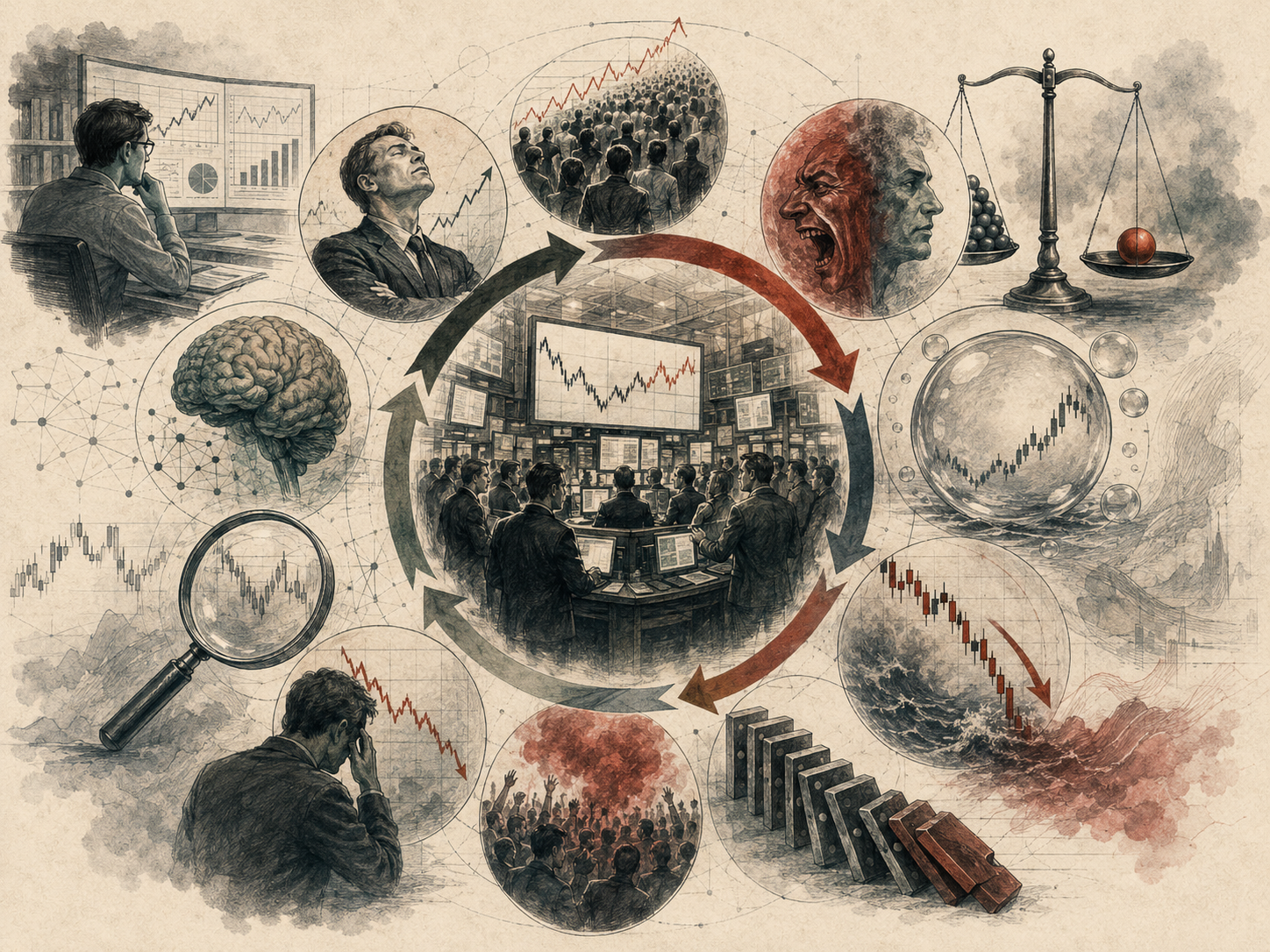
Financial markets are not only information-processing systems. They are also human, institutional, technological, and narrative systems. Investors interpret uncertainty through recent experience, reference points, social proof, fear, regret, confidence, loss sensitivity, platform cues, professional incentives, and public narratives. Prices may reflect fundamentals, but they can also reflect attention, sentiment, liquidity pressure, institutional crowding, and feedback loops between price movement and belief.
The importance of behavioral finance lies in its realism. It explains why investors trade too much, under-diversify, chase performance, resist realizing losses, follow crowds, overweight vivid stories, overreact to recent events, and sometimes mistake luck for skill. It also explains why market-level phenomena such as momentum, reversals, bubbles, crashes, excess volatility, and sentiment-driven mispricing can persist when arbitrage is limited, risky, costly, or institutionally constrained.
What Behavioral Finance Means
Behavioral finance is the study of how real investors make financial decisions when rationality is bounded, information is incomplete, feedback is noisy, and emotions are unavoidable. It connects psychology, financial economics, decision theory, market microstructure, institutional analysis, and public policy. Its central claim is not that investors are irrational in a chaotic or random sense. Its claim is that investors display systematic patterns of judgment and behavior that can be studied, modeled, and anticipated.
These patterns matter because financial decisions are made under uncertainty. Investors rarely know the true value of an asset, the future path of interest rates, the timing of recessions, the durability of earnings growth, the probability of a crash, or the future behavior of other investors. Under those conditions, people rely on heuristics, narratives, reference points, social signals, and emotional responses. Those shortcuts can be useful, but they can also produce predictable errors.
Behavioral finance operates at several levels. At the individual level, it studies how investors save, trade, diversify, react to losses, and evaluate risk. At the household level, it examines retirement enrollment, asset allocation, debt behavior, insurance choice, and financial planning. At the institutional level, it studies fund managers, analysts, committees, benchmarks, incentives, and risk models. At the market level, it examines sentiment, mispricing, bubbles, crashes, and limits to arbitrage.
The field therefore does not replace traditional finance. It modifies and extends it. Modern portfolio theory, asset-pricing theory, and efficient-market thinking remain valuable benchmarks. Behavioral finance asks what happens when the humans and institutions inside those models are less than fully rational, more socially embedded, more emotionally responsive, and more constrained than idealized theory assumes.
The result is a more realistic understanding of financial markets. Prices may still contain information. Risk and return still matter. Diversification still matters. But the path of prices, the behavior of investors, and the stability of markets are also shaped by psychology, attention, narratives, social influence, and institutional design.
The Limits of Rational Market Models
Classical financial economics often assumes that investors process information efficiently, update beliefs consistently, and allocate portfolios according to expected return, variance, covariance, and risk preferences. These assumptions support elegant theories of asset pricing and portfolio construction. They also provide useful normative guidance: diversify, evaluate risk, avoid unnecessary costs, and recognize that beating the market is difficult.
But these assumptions are often too strong as descriptions of real behavior. Investors do not always update beliefs in Bayesian fashion. They may cling to prior views, overweight recent experience, misread randomness, or interpret market noise as meaningful signal. They may sell winners too early, hold losers too long, overtrade, chase trends, panic during downturns, or concentrate wealth in familiar assets. These behaviors are not rare exceptions. They are recurring features of financial life.
The efficient market hypothesis also faces behavioral complications. If markets were always perfectly efficient, predictable mispricing should disappear quickly as rational arbitrageurs correct errors. But arbitrage is limited. It can be risky, costly, slow, institutionally constrained, and vulnerable to investor flows. A mispriced asset can become more mispriced before it corrects. A rational investor may know that a bubble exists and still be unable or unwilling to bet against it aggressively.
Behavioral finance therefore explains why psychological distortions can persist. If many investors share similar biases, their behavior can move prices. If arbitrageurs face short horizons, leverage constraints, career risk, or redemption pressure, they may be unable to eliminate mispricing. If narratives become self-reinforcing, prices may deviate from fundamentals long enough to influence real investment, household wealth, credit conditions, and financial stability.
The strongest version of behavioral finance does not say that markets are always irrational. It says that market efficiency is conditional. It depends on information quality, arbitrage capacity, investor heterogeneity, liquidity, institutional incentives, and the structure of decision environments. Rational models remain useful, but they become more powerful when paired with a serious account of how investors actually behave.
Core Psychological Biases in Investing
Behavioral finance identifies a set of cognitive and emotional patterns that repeatedly influence investment decisions. Overconfidence leads investors to overestimate the quality of their information, trade too frequently, and attribute success too readily to skill. Loss aversion leads investors to weigh losses more heavily than comparable gains, distorting selling behavior and risk tolerance. Anchoring causes investors to rely too heavily on reference prices, past highs, purchase prices, or arbitrary valuation points.
Availability bias makes vivid, recent, or widely discussed events feel more probable or representative than they are. A recent crash can make risk feel permanently elevated; a recent rally can make gains feel normal. Representativeness can lead investors to infer durable patterns from short sequences of returns. Confirmation bias encourages selective attention to evidence that supports an existing thesis. Mental accounting can cause investors to separate money into arbitrary categories that distort portfolio-level risk assessment.
These biases rarely operate in isolation. An investor may become overconfident after recent gains, anchor on a prior peak, follow a crowd narrative, and become loss averse after the position turns negative. A retirement saver may display inertia, present bias, and framing sensitivity at the same time. A professional manager may show overprecision, career-risk-driven herding, and confirmation bias inside a formal investment process.
The interaction among biases is one reason behavioral finance is more than a list of mistakes. Biases form systems. They reinforce one another through memory, emotion, incentives, and feedback. A bull market can make overconfidence feel justified. A social trading community can make herding feel like shared wisdom. A trading platform can make action feel like control. A loss can become psychologically difficult to realize because it would force the investor to admit that the original thesis was wrong.
Behavioral finance is therefore most useful when it analyzes decision environments, not only isolated mental errors. The question is not simply “What bias does this investor have?” The stronger question is: “What features of the market, institution, interface, incentive system, and social environment are making this bias more likely to matter?”
Prospect Theory, Loss Aversion, and Reference Points
Prospect theory is one of the intellectual foundations of behavioral finance. It shows that people often evaluate gains and losses relative to a reference point rather than evaluating final wealth in a purely absolute manner. Losses generally receive greater psychological weight than equivalent gains. This asymmetry helps explain why investors may behave differently when they are above or below a purchase price, benchmark, prior high, or expected outcome.
Loss aversion affects portfolio behavior in several ways. Investors may resist selling losing positions because realizing the loss makes the negative outcome psychologically concrete. This can contribute to the disposition effect: selling winners too early while holding losers too long. Investors may also take excessive risk to avoid locking in losses, becoming risk-seeking in the domain of losses even when they are risk-averse in the domain of gains.
Reference points are crucial. A stock purchased at $100 may feel cheap at $80 if the investor anchors on the purchase price, even if fundamentals have deteriorated. A portfolio that rises from $100,000 to $150,000 and then falls to $130,000 may be experienced as a loss from the peak, even though wealth remains above the starting point. Financial satisfaction and risk perception depend heavily on the reference point being used.
Loss aversion also influences market dynamics. During downturns, investors may initially resist selling because they do not want to realize losses. But if losses deepen, margin calls, liquidity needs, fear, or capitulation can trigger synchronized selling. This helps explain why selloffs can appear slow at first and then suddenly accelerate. Psychology and market structure interact.
Prospect theory does not imply that every refusal to sell is irrational. Investors may have valid long-term reasons to hold through volatility. The behavioral point is that reference-dependent evaluation can distort judgment when the purchase price or recent high becomes more psychologically salient than current expected value. A disciplined investment process must distinguish patience from loss-driven denial.
Overconfidence, Trading, and Skill Attribution
Overconfidence is one of the most documented behavioral forces in financial markets. Investors often overestimate the precision of their information, the reliability of their forecasts, and their ability to identify mispriced assets. This can lead to excessive trading, under-diversification, leverage, concentrated positions, and overreaction to noisy signals.
A central empirical concern is turnover. Trading requires a belief that action improves expected outcomes after costs. Overconfident investors are more likely to believe they have an edge. They may interpret small pieces of information as actionable, trade on short-term price movement, and underestimate transaction costs, taxes, bid-ask spreads, slippage, and timing error. Over many trades, small frictions can become significant portfolio drag.
Overconfidence is especially dangerous after success. A profitable trade can be interpreted as proof of skill even when it reflects luck, beta exposure, sector momentum, broad liquidity, or a favorable market regime. If investors increase position size or leverage after such success, they may scale up risk based on a mistaken attribution. The market temporarily rewards confidence and then punishes it when conditions change.
Professional investors are not immune. Analysts may issue overly precise forecasts. Fund managers may believe their models capture more risk than they do. Investment committees may mistake consensus for robustness. Backtests may create confidence in strategies that fail out of sample. Sophistication can reduce some errors, but it can also make overconfidence more elaborate and harder to detect.
The practical defense against overconfidence is calibration. Investors and institutions should compare forecasts with outcomes, separate skill from luck, attribute returns to beta and factors where possible, use position limits, diversify, write down investment theses, identify disconfirming evidence, and treat uncertainty as a central part of risk governance. Confidence is useful only when it remains answerable to evidence.
Herding, Social Influence, and Market Narratives
Herd behavior occurs when investors follow the actions, expectations, or narratives of others rather than relying primarily on independent assessment. Herding can arise from informational uncertainty, reputation pressure, social proof, fear of missing out, benchmark incentives, institutional career risk, or platform-mediated visibility. It is not limited to inexperienced investors. Institutions can herd as powerfully as individuals.
In uncertain environments, observing others can be rational. If many investors are buying an asset, later investors may infer that the crowd has information. If analysts converge around a view, dissent may seem risky. If a fund manager diverges from peers and performs poorly, the reputational cost may be greater than failing conventionally. Herding can therefore be individually understandable while collectively destabilizing.
Market narratives are central to herding. Bubbles rarely form around numbers alone. They form around stories: a new technology, a scarce asset, a permanent shift, a revolutionary platform, an economic regime change, or a claim that old valuation rules no longer apply. As more investors repeat the story, it becomes socially validated. Price increases then appear to confirm the narrative, drawing in more participation.
Herding also contributes to crashes. Once the crowd begins to exit, selling by others becomes a signal. Investors may infer that others know something, risk limits may force liquidation, and liquidity may disappear. Crowded trades are especially vulnerable because the exit is crowded too. The same social mechanism that amplifies confidence during the boom can amplify fear during the reversal.
Behavioral finance treats herding as both psychological and structural. It is psychological because people are influenced by others. It is structural because markets, platforms, benchmarks, media systems, and institutions make some signals highly visible and some deviations costly. The strongest analysis of herding therefore connects investor psychology to market design.
From Investor Psychology to Market Dynamics
Behavioral finance becomes especially important when individual biases scale into market-level effects. A single overconfident investor may trade too much. A market filled with overconfident investors may generate excessive volume, volatility, and disagreement-driven trading. A single loss-averse investor may hold a losing position too long. A market filled with loss-averse investors may produce delayed selling followed by sudden capitulation. A single investor may follow a crowd. A market in which many investors follow the crowd can produce bubbles and crashes.
Several market anomalies are commonly discussed through a behavioral lens. Momentum may arise when investors underreact to information at first and then overreact as trends become socially visible. Reversal may occur when overextended prices eventually correct. Excess volatility may reflect sentiment, attention, liquidity pressure, and changing risk perception rather than fundamentals alone. Mispricing may persist when arbitrage is constrained.
Behavioral finance also helps explain why market prices can become inputs into belief. A rising price may be interpreted as evidence that others know something. This attracts buyers, raising prices further. The process can become self-reinforcing even when the initial information was weak. Conversely, falling prices can become evidence of hidden risk, attracting sellers and intensifying the decline.
Market-level behavioral dynamics are not purely psychological. They interact with leverage, margin requirements, risk limits, investor flows, passive indexing, volatility targeting, stop-loss rules, and liquidity provision. A behavioral story without market structure is incomplete. A market-structure story without psychology is also incomplete. Real financial dynamics often emerge from their interaction.
The key insight is that financial markets are feedback systems. Beliefs affect trades, trades affect prices, prices affect beliefs, and institutional constraints affect which beliefs can survive losses. Behavioral finance studies those loops.
Institutional and Structural Influences
Behavioral finance should not be reduced to isolated individual psychology. Financial behavior is shaped by institutions. Brokerage platforms, mutual funds, pension systems, retirement plans, investment committees, analyst incentives, rating agencies, market makers, regulators, exchanges, and media organizations all structure how investors see information and how easily they act on it.
Institutional incentives can amplify bias. Fund managers may avoid contrarian positions because career risk makes deviation costly. Analysts may issue forecasts with more precision than the evidence supports because professional roles reward decisive judgment. Committees may converge around consensus because dissent is uncomfortable. Benchmarks may encourage crowded exposure. Performance evaluation may reward short-term results even when long-term discipline would be wiser.
Institutions can also reduce bias. Diversification rules, fiduciary standards, suitability requirements, risk committees, default retirement allocations, investment-policy statements, independent review, stress testing, and disclosure regulations can all provide guardrails. These mechanisms matter because they acknowledge that human judgment is fallible. Good institutions do not assume perfect rationality; they design for predictable error.
Technology plays a similar double role. It can expand access, reduce costs, and improve information availability. It can also increase speed, salience, impulsive trading, short-term feedback, and illusion of control. A real-time dashboard may help an investor monitor risk, but it may also encourage overreaction to noise. A trading app may democratize access, but it may also make high-risk products too easy to use without reflection.
The structural lesson is clear: behavioral finance is not just about correcting individual investors. It is about designing financial environments that make better decisions easier and avoidable harms less likely.
Digital Platforms and Retail Market Behavior
Digital platforms have transformed investor behavior by changing the speed, visibility, and emotional texture of market participation. Retail investors now encounter real-time prices, trending tickers, social feeds, influencer commentary, options chains, alerts, gamified cues, and simplified execution tools through interfaces designed for engagement. These features can empower investors, but they can also intensify behavioral risk.
Platform design affects attention. A platform that highlights short-term price movement encourages users to think in short horizons. A platform that displays social popularity may convert crowd behavior into perceived validation. A platform that reduces friction can make impulsive trading easier. A platform that makes complex products appear simple may obscure risk. Behavioral finance therefore treats interface design as part of financial decision architecture.
Retail herding and speculative surges are often discussed through social media, but the phenomenon is broader. Digital environments can turn investing into social participation. A trade may become a community identity, a narrative commitment, or a symbolic action against perceived institutions. This does not mean retail investors are irrational by default. It means that financial behavior is increasingly shaped by networked attention and platform-mediated social proof.
Digital platforms also create new responsibilities for investor protection. Disclosure alone may not be enough when behavioral design encourages action. Effective policy may require clearer risk presentation, friction around complex products, stronger default protections, cooling-off periods for high-risk trades, improved cost visibility, and better distinction between education, entertainment, and advice.
The goal should not be to restrict legitimate participation or preserve old gatekeeping. It should be to ensure that broader market access is paired with better decision architecture, transparency, and protection from predictable behavioral harm.
Household Finance, Retirement, and Investor Protection
Behavioral finance is not only about trading and asset prices. It is also central to household financial security. Decisions about saving, retirement enrollment, contribution rates, asset allocation, debt repayment, insurance, emergency funds, and long-term planning are all affected by behavioral tendencies such as inertia, present bias, framing, loss aversion, complexity avoidance, and default effects.
Retirement behavior offers one of the clearest examples. Many workers intend to save but delay action because the benefits are distant and the immediate sacrifice is salient. Automatic enrollment, default contribution rates, target-date funds, and escalation mechanisms can improve outcomes by designing around inertia and present bias. These interventions do not assume people lack intelligence. They recognize that timing, complexity, and defaults shape behavior.
Portfolio allocation is also behaviorally sensitive. Investors may hold too much cash after market declines, chase recent winners after rallies, avoid equities because losses are salient, or concentrate in familiar assets. Household portfolios often reflect emotion, familiarity, and framing as much as formal optimization. Financial education matters, but education alone may not overcome poor defaults, complexity, or emotionally charged decision environments.
Investor protection therefore benefits from behavioral finance. Traditional disclosure often assumes that if information is provided, investors will process it rationally. Behavioral research shows that format, timing, salience, complexity, and framing affect comprehension and action. A long disclosure document may satisfy legal requirements while failing behaviorally. Better policy asks whether investors can actually understand, compare, and use the information provided.
Household finance also reveals why behavioral finance has moral and social importance. Poor financial decisions can affect retirement security, housing stability, debt burden, health, family resilience, and intergenerational opportunity. Financial systems should therefore be evaluated not only by market efficiency, but by whether they support informed, durable, and dignified participation.
Behavioral Finance and Economic Governance
Behavioral finance has major implications for economic governance, market regulation, retirement policy, investor protection, fiduciary standards, disclosure design, financial education, and platform accountability. If investors predictably depart from rational models, then policy should not pretend those departures are rare or irrelevant. Financial systems should be designed for real people.
Market governance must balance access, innovation, and protection. Too much paternalism can limit participation and preserve exclusion. Too little protection can expose investors to avoidable harm, manipulation, complexity, and exploitative design. Behavioral finance helps clarify the middle ground: protect autonomy while improving decision environments, reducing deception, and ensuring that risk is visible before harm occurs.
Disclosure policy is one example. Effective disclosure should be timely, understandable, comparable, and salient. It should not bury key risks in legal language. Investor warnings should be designed around actual comprehension rather than formal availability. Cost information should make cumulative impact clear. Risk disclosures should avoid false precision and communicate uncertainty honestly.
Retirement governance is another example. Default rules, employer plans, contribution escalation, simplified menus, and low-cost diversified options can materially affect long-term outcomes. Behavioral design can improve welfare when it helps people do what they would endorse under reflection: save adequately, diversify, avoid unnecessary fees, and maintain discipline through volatility.
Financial stability governance also benefits from behavioral insight. Regulators should monitor sentiment, leverage, crowded trades, retail speculation, platform amplification, and liquidity fragility. Behavioral finance does not replace macroprudential analysis; it enriches it by showing how beliefs, narratives, and attention can become sources of systemic risk.
The policy goal is not to eliminate human emotion from markets. That is impossible. The goal is to design financial systems that are more honest about uncertainty, less exploitative of bias, more resilient to collective error, and more supportive of long-term welfare.
Empirical and Policy-Evaluation Lens
A professional economist-facing treatment of behavioral finance should ask what can be measured, identified, estimated, and evaluated. Behavioral finance can be studied through brokerage records, portfolio holdings, retirement-plan data, fund-flow data, analyst forecasts, market returns, volatility, survey experiments, laboratory markets, administrative data, platform usage data, and field experiments.
The empirical challenge is that behavioral mechanisms are often inferred indirectly. Excessive trading may reflect overconfidence, but it may also reflect liquidity needs, tax strategy, rebalancing, hedging, or genuine information. Herding may reflect imitation, but it may also reflect common response to public information. Loss aversion may explain delayed selling, but tax considerations or long-term strategy may also matter. A rigorous analysis must separate behavioral interpretation from observational correlation.
Useful empirical strategies include comparing gross and net returns after costs, measuring forecast calibration, estimating the disposition effect, analyzing trading behavior after prior gains, testing default effects in retirement plans, studying response to disclosure redesign, and examining market outcomes around sentiment shocks. Event studies, randomized trials, natural experiments, panel regressions, and structural models can all contribute when matched to the right question.
Policy evaluation should distinguish activity from welfare. More trading is not automatically better. More platform engagement is not necessarily improved investor welfare. More access to complex products can be beneficial for some investors and harmful for others. A behavioral policy lens asks whether interventions improve comprehension, reduce avoidable error, support long-term goals, and protect against manipulation while preserving meaningful choice.
Heterogeneity is central. Investors differ by income, experience, age, financial literacy, risk capacity, debt burden, trust, time horizon, platform exposure, and access to advice. An intervention that helps one group may be ineffective or harmful for another. Behavioral finance should therefore avoid one-size-fits-all assumptions and should evaluate distributional effects as well as average effects.
The strongest empirical work asks: What behavior changed? Was the change welfare-improving? Did it reduce costs, improve diversification, increase saving, improve calibration, or reduce harmful risk? Did it preserve autonomy? Did it affect vulnerable investors differently? These questions turn behavioral finance from a catalog of biases into a serious policy and research framework.
An Analytical Framework for Behavioral Finance
A simple way to formalize behavioral finance is to allow investor demand for an asset to depend not only on expected return and risk, but also on behavioral distortions that alter perceived value. Let investor \(i\)’s latent demand for asset \(j\) be:
D_{i,j} = \alpha \hat{\mu}_{i,j} – \beta \hat{\sigma}_{i,j}^2 + \gamma B_{i,j}
\]
Interpretation: Demand depends on subjective expected return, perceived risk, and a behavioral term representing bias, sentiment, or social influence.
Here, \(\hat{\mu}_{i,j}\) is the investor’s subjective expected excess return, \(\hat{\sigma}_{i,j}^2\) is perceived variance, and \(B_{i,j}\) is a behavioral term. The parameters \(\alpha, \beta,\) and \(\gamma\) measure sensitivity to expected return, risk, and behavioral forces. This framework allows investor behavior to differ from a rational benchmark without abandoning formal modeling.
The behavioral term may itself be decomposed:
B_{i,j} = \delta_1 O_i + \delta_2 L_i + \delta_3 A_i + \delta_4 H_i + \delta_5 S_i
\]
Interpretation: Behavioral demand can reflect overconfidence, loss aversion, anchoring, herding, and sentiment.
Here, \(O_i\) represents overconfidence, \(L_i\) loss aversion, \(A_i\) anchoring, \(H_i\) herd influence, and \(S_i\) sentiment or attention. Each term shifts demand away from what a purely rational expected-return-and-risk model would predict.
Prospect-theoretic reasoning is especially important because investors do not evaluate gains and losses symmetrically. A stylized value function may be written as:
v(x) =
\begin{cases}
x^{\eta}, & x \geq 0 \\
-\lambda (-x)^{\eta}, & x < 0
\end{cases}
\]
Interpretation: Losses carry greater psychological weight than equivalent gains when \(\lambda > 1\).
This structure helps explain why investors may react strongly to losses, resist realizing them, or take excessive risk to escape them. It also shows why reference points matter: the same final wealth level can be experienced differently depending on whether the investor evaluates it as a gain or a loss.
Overconfidence can be modeled by distinguishing true signal precision from perceived signal precision:
\hat{\tau}_i > \tau_i
\]
Interpretation: An overconfident investor acts as though their information is more precise than it actually is.
When perceived precision exceeds true precision, investors may trade too aggressively and underweight uncertainty. Trading intensity can be represented as:
T_i = \rho \left| \hat{\mu}_i – \mu_m \right|
\]
Interpretation: Trading rises when investors believe their expected-return estimate differs from the market’s implied estimate.
Net return after trading costs can then be represented as:
R_i^{net} = R_i^{gross} – cT_i
\]
Interpretation: Excessive trading can reduce net performance when gross gains do not exceed transaction costs, tax drag, spreads, slippage, and timing error.
A market-level expression can aggregate investor demand:
P_{t+1} = P_t + \kappa \left(\sum_i D_{i,t} – \bar{D}\right) + \varepsilon_t
\]
Interpretation: Prices move when aggregate demand differs from normal baseline demand, with behavioral distortions contributing to price pressure.
This framework makes behavioral finance analytically usable. It shows how psychological bias can affect individual demand, trading intensity, net returns, and aggregate price dynamics without treating markets as purely irrational.
R Workflow: Simulating Investor Bias, Trading, and Mispricing
The following R workflow simulates a market in which investors differ in overconfidence, loss aversion, anchoring strength, and herd influence. It generates price paths, fundamental values, buy rates, mispricing, investor-level traits, and regime summaries. The workflow is designed as a professional scaffold for behavioral-finance teaching, policy evaluation, and market-stability research.
# Behavioral Finance: Investor Bias, Trading, and Mispricing
# Synthetic data only. Economist-facing research scaffold.

set.seed(1313)

n_investors <- 1500
n_periods <- 100

investors <- data.frame(
  id = 1:n_investors,
  overconfidence = runif(n_investors, 0.2, 1.2),
  loss_aversion = runif(n_investors, 1.0, 2.5),
  anchoring_strength = runif(n_investors, 0.1, 0.9),
  herd_weight = runif(n_investors, 0.1, 1.0),
  diversification_discipline = runif(n_investors, 0.25, 1.0),
  risk_tolerance = runif(n_investors, 0.50, 1.50)
)

simulate_behavioral_market <- function(behavior_scale = 1.0, trading_friction = 0.0025) {
  price <- 100
  fundamental_value <- 100
  previous_price <- price

  history <- list()

  for (t in 1:n_periods) {
    fundamental_value <- fundamental_value + rnorm(1, mean = 0.20, sd = 1.50)

    private_signal <- rnorm(
      n_investors,
      mean = fundamental_value - price,
      sd = 5
    )

    anchored_view <- investors$anchoring_strength * behavior_scale * (previous_price - price)
    herd_signal <- investors$herd_weight * behavior_scale * (price - previous_price)

    expected_return <- private_signal *
      (1 + behavior_scale * investors$overconfidence) +
      anchored_view +
      herd_signal

    perceived_loss_penalty <- ifelse(
      expected_return < 0,
      behavior_scale * investors$loss_aversion * abs(expected_return),
      0
    )

    demand_signal <- expected_return - perceived_loss_penalty

    trade_intensity <- abs(demand_signal / 10) *
      investors$risk_tolerance *
      (1.25 - 0.50 * investors$diversification_discipline)

    trade_intensity <- pmin(trade_intensity, 3.0)

    buy_prob <- plogis(demand_signal / 10)
    buys <- rbinom(n_investors, 1, buy_prob)
    mean_buy_rate <- mean(buys)

    trading_cost_drag <- mean(trade_intensity) * trading_friction

    previous_price <- price
    price <- price +
      3 * (mean_buy_rate - 0.5) -
      trading_cost_drag +
      rnorm(1, mean = 0, sd = 0.8)

    history[[t]] <- data.frame(
      period = t,
      price = price,
      fundamental_value = fundamental_value,
      mean_buy_rate = mean_buy_rate,
      mean_trade_intensity = mean(trade_intensity),
      trading_cost_drag = trading_cost_drag,
      mispricing = price - fundamental_value,
      absolute_mispricing = abs(price - fundamental_value)
    )
  }

  do.call(rbind, history)
}

low_distortion <- simulate_behavioral_market(behavior_scale = 0.60)
medium_distortion <- simulate_behavioral_market(behavior_scale = 1.00)
high_distortion <- simulate_behavioral_market(behavior_scale = 1.50)

low_distortion$regime <- "low_behavioral_distortion"
medium_distortion$regime <- "medium_behavioral_distortion"
high_distortion$regime <- "high_behavioral_distortion"

market_history <- rbind(low_distortion, medium_distortion, high_distortion)

regime_summary <- aggregate(
  cbind(price, fundamental_value, mean_buy_rate, mean_trade_intensity,
        trading_cost_drag, mispricing, absolute_mispricing) ~ regime,
  data = market_history,
  FUN = mean
)

max_mispricing <- aggregate(
  absolute_mispricing ~ regime,
  data = market_history,
  FUN = max
)

names(max_mispricing)[2] <- "max_absolute_mispricing"

regime_summary <- merge(regime_summary, max_mispricing, by = "regime")

print(regime_summary)

dir.create("outputs/tables", recursive = TRUE, showWarnings = FALSE)
write.csv(market_history, "outputs/tables/r_behavioral_finance_market_history.csv", row.names = FALSE)
write.csv(regime_summary, "outputs/tables/r_behavioral_finance_regime_summary.csv", row.names = FALSE)
This simulation shows how behavioral distortions can push prices away from fundamentals even when underlying shocks are relatively modest. It also separates multiple behavioral channels so analysts can test whether mispricing arises primarily from overconfidence, loss aversion, anchoring, herding, or their interaction.
Python Workflow: Comparing Behavioral Market Regimes
The following Python workflow compares low-, medium-, and high-behavioral-distortion regimes. It creates a synthetic market-history dataset, computes regime-level mispricing and trading metrics, and prepares an experiment-style panel for treatment-effect estimation. The workflow can be extended with leverage, liquidity depth, sentiment indicators, platform design variables, or regulatory interventions.
# Behavioral Finance: Comparing Market Regimes Under Behavioral Assumptions
# Synthetic data only. Economist-facing research scaffold.

from __future__ import annotations

from pathlib import Path

import numpy as np
import pandas as pd

rng = np.random.default_rng(1313)

n_investors = 1800
n_periods = 120

investors = pd.DataFrame({
    "investor_id": np.arange(1, n_investors + 1),
    "overconfidence": rng.uniform(0.2, 1.2, n_investors),
    "loss_aversion": rng.uniform(1.0, 2.5, n_investors),
    "anchoring_strength": rng.uniform(0.1, 0.9, n_investors),
    "herd_weight": rng.uniform(0.1, 1.0, n_investors),
    "risk_tolerance": rng.uniform(0.50, 1.50, n_investors),
    "diversification_discipline": rng.uniform(0.25, 1.0, n_investors),
})

def simulate_market(
    regime_name: str,
    behavior_scale: float,
    trading_friction: float,
    platform_salience: float
) -> pd.DataFrame:
    """Simulate a stylized market shaped by investor bias."""
    price = 100.0
    fundamental_value = 100.0
    previous_price = price

    rows = []

    for period in range(1, n_periods + 1):
        fundamental_value += rng.normal(0.20, 1.50)

        private_signal = rng.normal(
            loc=fundamental_value - price,
            scale=5.0,
            size=n_investors
        )

        anchored_view = (
            investors["anchoring_strength"].to_numpy()
            * behavior_scale
            * (previous_price - price)
        )

        herd_signal = (
            investors["herd_weight"].to_numpy()
            * behavior_scale
            * platform_salience
            * (price - previous_price)
        )

        expected_return = (
            private_signal
            * (1 + behavior_scale * investors["overconfidence"].to_numpy())
            + anchored_view
            + herd_signal
        )

        perceived_loss_penalty = np.where(
            expected_return < 0,
            behavior_scale
            * investors["loss_aversion"].to_numpy()
            * np.abs(expected_return),
            0
        )

        demand_signal = expected_return - perceived_loss_penalty

        trade_intensity = (
            np.abs(demand_signal / 10)
            * investors["risk_tolerance"].to_numpy()
            * (1.25 - 0.50 * investors["diversification_discipline"].to_numpy())
        )

        trade_intensity = np.minimum(trade_intensity, 3.0)

        buy_prob = 1 / (1 + np.exp(-demand_signal / 10))
        buys = rng.binomial(1, buy_prob)
        mean_buy_rate = buys.mean()

        trading_cost_drag = trade_intensity.mean() * trading_friction

        previous_price = price
        price = (
            price
            + 3 * (mean_buy_rate - 0.5)
            - trading_cost_drag
            + rng.normal(0, 0.8)
        )

        rows.append({
            "regime": regime_name,
            "period": period,
            "price": price,
            "fundamental_value": fundamental_value,
            "mean_buy_rate": mean_buy_rate,
            "mean_trade_intensity": trade_intensity.mean(),
            "trading_cost_drag": trading_cost_drag,
            "mispricing": price - fundamental_value,
            "absolute_mispricing": abs(price - fundamental_value),
            "behavior_scale": behavior_scale,
            "trading_friction": trading_friction,
            "platform_salience": platform_salience,
        })

    return pd.DataFrame(rows)

regimes = {
    "low_behavioral_distortion": {
        "behavior_scale": 0.60,
        "trading_friction": 0.0030,
        "platform_salience": 0.70,
    },
    "medium_behavioral_distortion": {
        "behavior_scale": 1.00,
        "trading_friction": 0.0025,
        "platform_salience": 1.00,
    },
    "high_behavioral_distortion_low_friction": {
        "behavior_scale": 1.50,
        "trading_friction": 0.0018,
        "platform_salience": 1.35,
    },
}

frames = []

for name, params in regimes.items():
    frames.append(simulate_market(name, **params))

market_history = pd.concat(frames, ignore_index=True)

summary = market_history.groupby("regime").agg(
    mean_price=("price", "mean"),
    mean_fundamental_value=("fundamental_value", "mean"),
    mean_buy_rate=("mean_buy_rate", "mean"),
    mean_trade_intensity=("mean_trade_intensity", "mean"),
    mean_trading_cost_drag=("trading_cost_drag", "mean"),
    mean_mispricing=("mispricing", "mean"),
    mean_absolute_mispricing=("absolute_mispricing", "mean"),
    max_absolute_mispricing=("absolute_mispricing", "max"),
).reset_index()

print(summary.sort_values("max_absolute_mispricing", ascending=False))

experiment = market_history.copy()
experiment["medium_behavioral_treat"] = (
    experiment["regime"] == "medium_behavioral_distortion"
).astype(int)

experiment["high_behavioral_treat"] = (
    experiment["regime"] == "high_behavioral_distortion_low_friction"
).astype(int)

try:
    import statsmodels.api as sm

    outcomes = [
        "absolute_mispricing",
        "mean_trade_intensity",
        "mean_buy_rate",
        "trading_cost_drag"
    ]

    for outcome in outcomes:
        X = experiment[[
            "medium_behavioral_treat",
            "high_behavioral_treat",
            "trading_friction",
            "platform_salience"
        ]]
        X = sm.add_constant(X)

        model = sm.OLS(experiment[outcome], X).fit(cov_type="HC1")

        print(f"\nOutcome: {outcome}")
        print(model.summary().tables[1])

except ImportError:
    print("statsmodels is not installed; skipping regression table.")

output_dir = Path("outputs/tables")
output_dir.mkdir(parents=True, exist_ok=True)

market_history.to_csv(output_dir / "synthetic_behavioral_finance_market_history.csv", index=False)
experiment.to_csv(output_dir / "synthetic_behavioral_finance_experiment.csv", index=False)
summary.to_csv(output_dir / "behavioral_finance_regime_summary.csv", index=False)
For analysts, the point of this comparison is that the same broad market environment can generate different levels of mispricing depending on how strongly behavioral forces shape investor demand. The workflow also makes it possible to test the role of lower trading friction and platform salience in amplifying behavioral market dynamics.
Stata Replication Note: Behavioral Distortion and Mispricing
For an economist-facing repository, the companion code should support Stata as well as R and Python. The article-level GitHub folder should include a Stata workflow that imports the synthetic behavioral-finance market dataset, estimates treatment effects, reports robust standard errors, and exports regression tables. A compact Stata pattern for this article would look like this:
clear all
set more off

* Behavioral Finance: Why Investors Deviate from Rational Models
* Stata market-regime evaluation workflow using synthetic data.

global ROOT "`c(pwd)'"
global TABLES "$ROOT/outputs/tables"
global REG "$ROOT/outputs/regression_tables"

capture mkdir "$REG"

import delimited "$TABLES/synthetic_behavioral_finance_experiment.csv", clear varnames(1)

label variable medium_behavioral_treat "Medium behavioral distortion treatment"
label variable high_behavioral_treat "High behavioral distortion low-friction treatment"
label variable absolute_mispricing "Absolute mispricing"
label variable mean_trade_intensity "Mean trade intensity"
label variable mean_buy_rate "Mean buy rate"
label variable trading_cost_drag "Trading-cost drag"

local controls trading_friction platform_salience
local outcomes absolute_mispricing mean_trade_intensity mean_buy_rate trading_cost_drag mispricing

tempname handle
postfile `handle' str50 outcome str55 term double estimate double std_error double p_value double n using "$REG/stata_behavioral_finance_estimates.dta", replace

foreach y of local outcomes {
    regress `y' medium_behavioral_treat high_behavioral_treat `controls', vce(robust)

    foreach x in medium_behavioral_treat high_behavioral_treat {
        local b = _b[`x']
        local se = _se[`x']
        local p = 2 * ttail(e(df_r), abs(_b[`x'] / _se[`x']))
        local n = e(N)
        post `handle' ("`y'") ("`x'") (`b') (`se') (`p') (`n')
    }
}

postclose `handle'

use "$REG/stata_behavioral_finance_estimates.dta", clear
export delimited using "$REG/stata_behavioral_finance_estimates.csv", replace

display "Stata behavioral-finance market-regime evaluation workflow complete."
The purpose of including Stata is to make the repository useful to economists, behavioral-finance researchers, investor-protection analysts, financial-stability researchers, and graduate-level applied researchers who commonly work across Stata, R, and Python. The full repository scaffold should also include identification notes, robustness plans, replication instructions, synthetic market-history data, treatment-effect estimation, mispricing diagnostics, investor-bias simulation, platform-friction sensitivity, and welfare/stability notes.
GitHub Repository
The companion repository provides reproducible scaffolding for the computational side of this article, including synthetic investor and market-history datasets, behavioral-distortion simulations, mispricing diagnostics, treatment-effect estimation, turnover and trading-cost workflows, robustness checks, Stata/R/Python workflows, SQL metadata structures, and scientific-computing examples for behavioral finance research.
Complete Code Repository
This article is supported by an article-level folder in the Behavioral Economics computational repository, with synthetic market-history and experiment-style datasets, causal-inference workflows, mispricing diagnostics, econometric identification notes, policy-evaluation scripts, robustness and sensitivity checks, Stata/R/Python workflows, SQL metadata structures, and scientific-computing examples for studying behavioral finance, investor bias, overconfidence, loss aversion, anchoring, herding, sentiment, market bubbles, crashes, trading costs, platform salience, financial stability, and investor protection.
Interpretive Limits and Cautions
Behavioral finance is powerful, but it can be misused if every market movement is labeled irrational. Investors may trade because they have information, liquidity needs, tax reasons, hedging motives, rebalancing requirements, or institutional mandates. Price movement may reflect fundamentals, not sentiment. Correlated behavior may reflect common information, not herding. A serious behavioral-finance analysis must distinguish behavioral distortion from rational response to changing conditions.
There is also a risk of using behavioral finance to blame individuals while ignoring market design. If platforms encourage excessive trading, if disclosure is incomprehensible, if retirement choices are too complex, if financial products are opaque, or if incentives reward short-term performance, then poor outcomes are not simply individual bias. They are institutional design failures as well.
Behavioral finance should also avoid portraying ordinary investors as uniquely irrational. Professional investors, analysts, executives, fund managers, consultants, rating agencies, and regulators are also vulnerable to overconfidence, herd behavior, overprecision, anchoring, and narrative dependence. Expertise can reduce some errors, but it can also create more sophisticated forms of misplaced confidence.
Another caution concerns policy. Behavioral interventions can improve welfare when they help people act in line with reflective long-term interests. But nudges and choice architecture can also be used manipulatively. A trading platform, lender, insurer, employer, or fund provider can exploit behavioral tendencies for profit. The ethics of behavioral finance therefore require attention to power, transparency, accountability, and user welfare.
The strongest use of behavioral finance is not to dismiss rational models or pathologize investors. It is to build a more complete account of financial decision-making, one that includes incentives, information, institutions, uncertainty, emotion, social influence, and technological design.
Conclusion
Behavioral finance explains why investors often deviate from rational models and why those deviations matter for markets, households, institutions, and policy. Investors do not simply process information mechanically. They interpret signals through confidence, fear, regret, social proof, reference points, stories, interfaces, and incentives. These forces shape trading, saving, portfolio construction, asset prices, volatility, bubbles, crashes, and financial stability.
The importance of behavioral finance lies in its disciplined realism. It does not reduce markets to psychology, and it does not discard the insights of traditional finance. Instead, it shows how rational benchmarks must be modified when human judgment, bounded rationality, emotional response, and institutional context are taken seriously. It asks what financial systems look like when they are designed for real behavior rather than idealized behavior.
The mature lesson is not that investors are foolish or that markets are irrational by default. The lesson is that uncertainty makes human judgment difficult, feedback is noisy, and financial environments can amplify predictable error. Better financial systems therefore require better decision architecture, clearer disclosure, stronger governance, disciplined risk management, investor protection, and humility about what models and market participants can know.
In that sense, behavioral finance provides one of the clearest bridges between individual psychology and the operation of modern economic systems. It reminds us that finance is not only a domain of prices, portfolios, and equations. It is also a domain of belief, memory, emotion, social influence, institutional design, and human decision-making under uncertainty.
Related Articles
- Behavioral Economics
- Overconfidence Bias in Financial Markets
- Herd Behavior in Financial Markets
- Loss Aversion and Risk Perception
- Anchoring Bias in Economic Judgment
- Availability Bias and Economic Perception
- Framing Effects and Consumer Choice
- Mental Accounting in Personal Finance
- Self-Control and Commitment Devices
- Behavioral Economics and Digital Platforms
Further Reading
- Barber, B.M. and Odean, T. (2000) ‘Trading is hazardous to your wealth: The common stock investment performance of individual investors’, Journal of Finance, 55(2), pp. 773–806. Available at: https://onlinelibrary.wiley.com/doi/10.1111/0022-1082.00226.
- Barber, B.M. and Odean, T. (2001) ‘Boys will be boys: Gender, overconfidence, and common stock investment’, Quarterly Journal of Economics, 116(1), pp. 261–292. Available at: https://academic.oup.com/qje/article-abstract/116/1/261/1939000.
- De Bondt, W.F.M. and Thaler, R. (1985) ‘Does the stock market overreact?’, Journal of Finance, 40(3), pp. 793–805. Available at: https://onlinelibrary.wiley.com/doi/10.1111/j.1540-6261.1985.tb05004.x.
- Daniel, K., Hirshleifer, D. and Subrahmanyam, A. (1998) ‘Investor psychology and security market under- and overreactions’, Journal of Finance, 53(6), pp. 1839–1885. Available at: https://onlinelibrary.wiley.com/doi/10.1111/0022-1082.00077.
- Fama, E.F. (1970) ‘Efficient capital markets: A review of theory and empirical work’, Journal of Finance, 25(2), pp. 383–417. Available at: https://www.jstor.org/stable/2325486.
- Kahneman, D. and Tversky, A. (1979) ‘Prospect theory: An analysis of decision under risk’, Econometrica, 47(2), pp. 263–291. Available at: https://www.jstor.org/stable/1914185.
- Shiller, R.J. (2015) Irrational Exuberance. 3rd edn. Princeton, NJ: Princeton University Press. Available at: https://press.princeton.edu/books/paperback/9780691173122/irrational-exuberance.
- Shleifer, A. (2000) Inefficient Markets: An Introduction to Behavioral Finance. Oxford: Oxford University Press. Available at: https://global.oup.com/academic/product/inefficient-markets-9780198292289.
- Thaler, R.H. (2015) Misbehaving: The Making of Behavioral Economics. New York: W.W. Norton. Available at: https://wwnorton.com/books/misbehaving/.
References
- Barber, B.M. and Odean, T. (2000) ‘Trading is hazardous to your wealth: The common stock investment performance of individual investors’, Journal of Finance, 55(2), pp. 773–806. Available at: https://onlinelibrary.wiley.com/doi/10.1111/0022-1082.00226.
- Barber, B.M. and Odean, T. (2001) ‘Boys will be boys: Gender, overconfidence, and common stock investment’, Quarterly Journal of Economics, 116(1), pp. 261–292. Available at: https://academic.oup.com/qje/article-abstract/116/1/261/1939000.
- De Bondt, W.F.M. and Thaler, R. (1985) ‘Does the stock market overreact?’, Journal of Finance, 40(3), pp. 793–805. Available at: https://onlinelibrary.wiley.com/doi/10.1111/j.1540-6261.1985.tb05004.x.
- Daniel, K., Hirshleifer, D. and Subrahmanyam, A. (1998) ‘Investor psychology and security market under- and overreactions’, Journal of Finance, 53(6), pp. 1839–1885. Available at: https://onlinelibrary.wiley.com/doi/10.1111/0022-1082.00077.
- Fama, E.F. (1970) ‘Efficient capital markets: A review of theory and empirical work’, Journal of Finance, 25(2), pp. 383–417. Available at: https://www.jstor.org/stable/2325486.
- Kahneman, D. and Tversky, A. (1979) ‘Prospect theory: An analysis of decision under risk’, Econometrica, 47(2), pp. 263–291. Available at: https://www.jstor.org/stable/1914185.
- Lo, A.W. (2004) ‘The adaptive markets hypothesis: Market efficiency from an evolutionary perspective’, Journal of Portfolio Management, 30(5), pp. 15–29. Available at: https://jpm.pm-research.com/content/30/5/15.
- Odean, T. (1999) ‘Do investors trade too much?’, American Economic Review, 89(5), pp. 1279–1298. Available at: https://faculty.haas.berkeley.edu/odean/papers%20current%20versions/doinvestors.pdf.
- Shiller, R.J. (2015) Irrational Exuberance. 3rd edn. Princeton, NJ: Princeton University Press. Available at: https://press.princeton.edu/books/paperback/9780691173122/irrational-exuberance.
- Shleifer, A. (2000) Inefficient Markets: An Introduction to Behavioral Finance. Oxford: Oxford University Press. Available at: https://global.oup.com/academic/product/inefficient-markets-9780198292289.
- Thaler, R.H. (2015) Misbehaving: The Making of Behavioral Economics. New York: W.W. Norton. Available at: https://wwnorton.com/books/misbehaving/.