
Last Updated June 23, 2026
Warren McCulloch, Walter Pitts, and Neural Logic examines one of the most important bridges between nervous systems, logic, computation, cybernetics, and artificial intelligence. In 1943, McCulloch and Pitts proposed a formal model of neural activity in which simplified neurons could be treated as logical units. Their work did not produce modern deep learning directly. It did something more foundational: it suggested that nervous activity, logical calculation, and computational procedure could be brought into a shared formal language.
This article treats “neural logic” as a pivotal historical idea. It was not simply neuroscience, not simply mathematical logic, and not simply engineering. It joined questions about brains, symbols, thresholds, networks, automata, feedback, and inference. That made it central to early cybernetics, cognitive science, artificial intelligence, automata theory, and later neural-network thinking.
The significance of McCulloch and Pitts is not that biological neurons literally behave like clean Boolean gates. They do not. Their model was deliberately simplified. The historical importance lies in the abstraction: if neural events can be represented as formal units in a network, then mind, logic, computation, and machinery can be studied through common procedural structures. That abstraction shaped the history of AI, even as later neuroscience and machine learning moved beyond it.
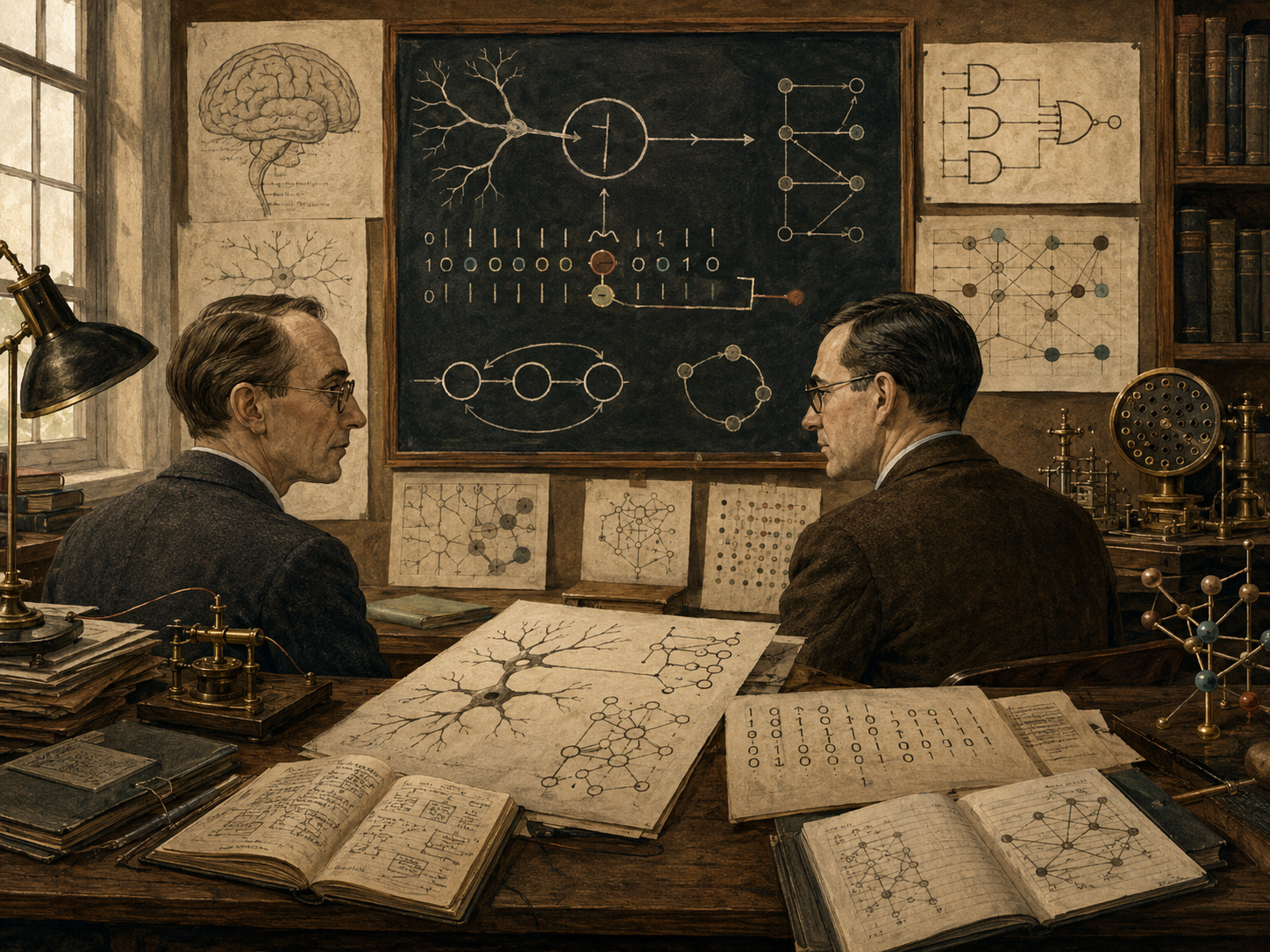
This article introduces Warren McCulloch, Walter Pitts, neural logic, the McCulloch-Pitts neuron, threshold logic, Boolean networks, nervous activity, mathematical biophysics, cybernetics, automata theory, symbolic logic, propositional calculus, artificial neural networks, cognitive science, neuroscience, feedback, finite-state machines, artificial intelligence, machine learning history, neural computation, representation, abstraction, biological plausibility, logic gates, threshold units, connectionism, embodied intelligence, and responsible computational reasoning. It argues that McCulloch and Pitts belong in the history of algorithms because they helped make networks of simplified processing units intelligible as formal procedures.
Why Neural Logic Matters
Neural logic matters because it shows one of the earliest moments when brains, logic, networks, and machines were brought into a single computational imagination. McCulloch and Pitts asked whether nervous activity could be modeled through formal relations among simplified neural units. That question helped open a path from neurophysiology to computation. Their model made networks analyzable, thresholds significant, and logical operations visible inside neural architecture.
| Question | Neural-logic answer | Historical significance |
|---|---|---|
| Can nervous activity be formalized? | Represent simplified neurons as logical units. | Bridges biology and computation. |
| Can networks compute? | Connect threshold units into circuits. | Prefigures neural-network thinking. |
| Can logic be embodied? | Map logical relations onto neural structures. | Links symbolic logic and nervous systems. |
| Can cognition be procedural? | Treat activity as rule-governed transformation. | Supports computational models of mind. |
| Can simple units create complex behavior? | Compose many threshold units. | Shapes connectionist imagination. |
| Can AI have neural roots? | Model artificial neural structures formally. | Influences AI and cognitive science. |
McCulloch and Pitts in Context
Warren McCulloch was a neurophysiologist and cybernetic thinker interested in the relation between nervous systems, logic, and knowledge. Walter Pitts was a brilliant young logician and mathematician whose work helped give the project its formal structure. Their collaboration belonged to a wider mid-century context: mathematical biophysics, formal logic, cybernetics, automata theory, wartime computation, and early cognitive science.
| Context | Relevant idea | Connection to McCulloch and Pitts |
|---|---|---|
| Neurophysiology | Nervous activity and signaling. | Provides biological inspiration. |
| Mathematical logic | Formal truth functions and propositions. | Provides symbolic structure. |
| Mathematical biophysics | Quantitative models of living systems. | Provides modeling environment. |
| Cybernetics | Feedback, control, communication. | Frames mind and machine together. |
| Automata theory | Formal machines and state transitions. | Supports network computation. |
| Artificial intelligence | Machine reasoning and learning. | Receives neural-logic legacy. |
The 1943 Logical Calculus Paper
The 1943 paper, A Logical Calculus of the Ideas Immanent in Nervous Activity, proposed a model in which simplified neurons could be interpreted as logical units. Neurons were treated as threshold devices: they fired or did not fire depending on inputs. Networks of such units could represent logical relations. The paper’s title matters because it asks whether formal structure can be found within nervous activity itself.
| Paper element | Meaning | Historical effect |
|---|---|---|
| Logical calculus | Formal relations among propositions. | Connects neural activity to logic. |
| Nervous activity | Biological signaling. | Connects logic to brain function. |
| Threshold units | All-or-none simplified neurons. | Defines computational units. |
| Networks | Connected units. | Makes distributed computation thinkable. |
| Temporal order | Activity unfolds in steps. | Connects networks to procedure. |
| Formal abstraction | Deliberate simplification. | Enables computation but limits biology. |
The McCulloch-Pitts Neuron
The McCulloch-Pitts neuron is a simplified mathematical model of a neuron. It receives inputs, applies a threshold rule, and produces an output. In the simplest form, the output is binary: the unit fires or it does not. This made neural behavior compatible with logic-gate thinking. The model’s power lies in its simplicity: a simplified neuron could be treated as a computational element.
| Model component | Function | Interpretive note |
|---|---|---|
| Input | Signals from other units. | Represents incoming neural activity. |
| Connection | Influences activation. | In early models, often simplified. |
| Threshold | Activation boundary. | Determines firing condition. |
| Output | Binary firing state. | Supports logical interpretation. |
| Network | Connected units. | Supports compound computation. |
| Time step | Ordered update. | Supports procedural dynamics. |
Thresholds, Logic, and Networks
Threshold logic is central to McCulloch and Pitts. A unit fires when its inputs satisfy a threshold condition. By arranging units in networks, one can represent logical functions such as AND, OR, and inhibition. This made neural networks understandable as circuits of logical relations and showed how simple units could support formal computation.
| Logical idea | Threshold-network form | Computational meaning |
|---|---|---|
| AND | Fire only when multiple inputs are active. | Conjunction. |
| OR | Fire when at least one input is active. | Disjunction. |
| NOT / inhibition | Suppress firing under certain input. | Negation-like control. |
| Sequence | Activity over time steps. | Procedure and temporal structure. |
| Composition | Connect units into larger circuits. | Complex functions from simple units. |
| Network state | Pattern of active units. | Distributed representation. |
From Neural Events to Formal Procedure
The deeper importance of neural logic is procedural. McCulloch and Pitts helped turn nervous activity into something that could be described as formal transformation. Inputs become states. States update according to rules. Outputs become consequences of network structure. This connects their work directly to the history of algorithms, because an algorithm is a rule-governed procedure.
| Neural concept | Procedural interpretation | Algorithmic significance |
|---|---|---|
| Stimulus | Input. | Begins computation. |
| Activation | State change. | Transforms representation. |
| Threshold | Rule condition. | Defines update logic. |
| Network path | Dependency structure. | Defines flow of influence. |
| Output firing | Result. | Produces signal or decision. |
| Repeated steps | Procedure over time. | Connects neural activity to computation. |
Cybernetics, Feedback, and Control
McCulloch and Pitts belong naturally beside Norbert Wiener because their work helped shape the cybernetic imagination: organisms and machines could be studied through communication, control, feedback, and formal systems. A neural network can receive signals, transform them, inhibit or activate pathways, and generate outputs. Feedback can then change future behavior.
| Cybernetic concept | Neural-logic relation | Historical bridge |
|---|---|---|
| Signal | Neural input or output. | Communication in systems. |
| Control | Activation and inhibition. | Behavioral regulation. |
| Feedback | Output affects future state. | Adaptive dynamics. |
| Network | Connected units. | Distributed organization. |
| Machine analogy | Formalizable behavior. | Organism-machine comparison. |
| Goal-directed behavior | System response to conditions. | Early cognitive modeling. |
Automata, Computation, and the Brain
The McCulloch-Pitts model connects to automata theory. Networks of units that change state according to rules resemble formal machines. They help link the brain to state transitions, circuits, finite procedures, and computation. This influenced later thinking about machines that reason, learn, classify, or recognize patterns.
| Automata concept | Neural-logic analogue | Significance |
|---|---|---|
| State | Pattern of neural activation. | Represents system condition. |
| Transition | Update from inputs and thresholds. | Defines computation over time. |
| Input alphabet | Possible input signals. | Defines readable conditions. |
| Output | Firing pattern or response. | Defines observable result. |
| Network topology | Connection structure. | Defines computational capacity. |
| Formal machine | Rule-governed neural model. | Links cognition and computation. |
Connectionism and AI Lineage
Connectionism is the broad idea that intelligent behavior can emerge from networks of simple interconnected units. McCulloch and Pitts were not the whole origin of connectionism, but their neural logic became one of its foundational formal sources. Later perceptrons, associative memory, parallel distributed processing, deep learning, and representation learning belong to a longer lineage that includes this early work.
| Later field | Connection to neural logic | Important distinction |
|---|---|---|
| Perceptrons | Threshold units and classification. | Introduces learning from data. |
| Neural networks | Networks of processing units. | Use weights and training algorithms. |
| Deep learning | Layered representations. | Far more complex and data-driven. |
| Symbolic AI | Logic and formal representation. | Often uses explicit symbolic rules. |
| Hybrid AI | Combines neural and symbolic methods. | Returns to old bridge questions. |
| Cognitive science | Models mind computationally. | Includes many theories of cognition. |
Biological Plausibility and Limits
The McCulloch-Pitts neuron is not a biologically complete neuron. Real neurons involve complex electrochemical processes, temporal dynamics, synaptic plasticity, dendritic computation, neurotransmitters, stochasticity, embodiment, development, and environmental interaction. Treating neurons as simple logical units is an abstraction. The model is powerful when used within scope and misleading when overclaimed.
| Model strength | Model limit | Interpretive lesson |
|---|---|---|
| Simple threshold behavior. | Real neurons are more complex. | Abstraction enables formal reasoning. |
| Logical interpretation. | Brains are not mere Boolean circuits. | Logic is a model, not full biology. |
| Network composition. | Biological networks are dynamic. | Topology matters but is not everything. |
| Binary firing. | Neural activity varies in time and strength. | Discretization loses detail. |
| Formal tractability. | Biological realism is reduced. | Use model within scope. |
| Computational bridge. | Can invite overclaiming. | Historical nuance matters. |
Why This Is Not Modern Deep Learning
It is tempting to draw a straight line from McCulloch and Pitts to contemporary deep learning. The connection is real, but the line is not straight. Modern neural networks involve differentiable computation, gradient descent, backpropagation, large datasets, numerical optimization, vectorized hardware, learned representations, probabilistic evaluation, and massive software infrastructures. McCulloch and Pitts contributed a conceptual and formal foundation, not a direct version of today’s systems.
| McCulloch-Pitts model | Modern deep learning | Continuity and difference |
|---|---|---|
| Binary threshold units. | Continuous activations and learned weights. | Both use units; learning differs. |
| Logical calculus. | Statistical optimization. | Both compute; methods differ. |
| Small formal networks. | Large trained architectures. | Scale and training transform the field. |
| Manual structure. | Data-driven representation learning. | Representation becomes learned. |
| Biophysical abstraction. | Engineering and AI infrastructure. | Biological analogy becomes looser. |
| Foundational model. | Industrial-scale systems. | Historical origin, not full explanation. |
Logic, Symbols, and Neural Representation
The McCulloch-Pitts model complicates the later opposition between symbolic AI and neural networks. Their neurons were neural abstractions, but the model was logical. It suggests that early neural computation was not anti-symbolic. It was an attempt to locate logical relations inside networks. That makes it highly relevant to today’s renewed interest in hybrid AI.
| Tradition | Common emphasis | McCulloch-Pitts relevance |
|---|---|---|
| Symbolic AI | Rules, logic, representation. | Neurons modeled through logical calculus. |
| Neural AI | Networks and learned patterns. | Networks of formal units. |
| Causal AI | Intervention and structure. | Raises questions of network causality. |
| Hybrid systems | Neural plus symbolic methods. | Returns to neural-logic bridge. |
| Explainable AI | Interpretable reasoning. | Logical structure provides one explanation model. |
| Responsible AI | Limits and accountability. | Requires careful abstraction claims. |
Institutional and Intellectual Lineage
The McCulloch-Pitts collaboration belongs to an intellectual environment that included mathematical biology, cybernetics, psychiatry, logic, wartime computation, and early information science. It influenced later thinking in cybernetics, cognitive science, neural-network research, and theories of artificial intelligence. It also helps connect several already-established articles in this series.
| Series thread | Connection | Why it matters |
|---|---|---|
| Alan Turing | Formal models of computation. | Procedure and machine reasoning. |
| Alonzo Church | Logic and formal computation. | Mathematical foundations. |
| John von Neumann | Machine architecture. | Executable computation. |
| Claude Shannon | Information and switching logic. | Signals and formal circuits. |
| Norbert Wiener | Cybernetics and feedback. | Organism-machine systems. |
| Neural networks | Networks of computational units. | Later AI and representation learning. |
Neural Logic and Responsible AI
Neural logic also matters for responsible AI because it teaches that every model begins with an abstraction. A simplified neuron is not a biological neuron. A neural network is not a mind. A model output is not understanding. A pattern is not a reason. Yet abstractions can still be useful if their limits are known and their use is governed.
| Responsible AI question | Neural-logic lesson | Practical implication |
|---|---|---|
| What is the model abstracting? | Simplification creates tractability. | State model scope. |
| What is the model not capturing? | Biology and cognition exceed formal units. | Avoid anthropomorphic overclaiming. |
| What does the output mean? | Firing or prediction is not understanding. | Interpret outputs carefully. |
| What kind of explanation is available? | Logical models can be interpretable. | Match explanation to system type. |
| Who is responsible? | Models do not own consequences. | Assign institutional accountability. |
| When should AI not be used? | Abstraction may be too lossy. | Use refusal criteria. |
Examples of Neural-Logic Ideas
Threshold unit
A simplified neuron fires when input conditions meet a threshold.
Logical network
Connected threshold units can implement logical relations.
Activation pattern
A network state can represent a distributed pattern of activity.
Inhibition
Certain inputs can prevent activation, giving the model a negation-like structure.
Temporal sequence
Network activity unfolds across steps, making neural logic procedural.
Automata connection
Rule-governed state transitions connect neural networks to formal machines.
Cybernetic bridge
Signals, feedback, and control connect neural logic to organism-machine systems.
AI lineage
Neural logic becomes one foundational source for later neural-network and hybrid AI thinking.
These examples show why McCulloch and Pitts belong in an algorithms series: their work made networks of simple units into formal computational objects.
Mathematics, Computation, and Modeling
A simple threshold unit can be written as:
y =
\begin{cases}
1, & \sum_i w_i x_i \geq \theta \\
0, & \sum_i w_i x_i < \theta
\end{cases}
\]
Interpretation: The unit fires when the weighted input reaches or exceeds a threshold.
A logical AND-style threshold unit can be represented as:
AND(x_1, x_2) = 1 \quad \text{when} \quad x_1 + x_2 \geq 2
\]
Interpretation: Both inputs must be active for the unit to fire.
A simple network update can be written as:
\mathbf{x}_{t+1} = H(W\mathbf{x}_t – \boldsymbol{\theta})
\]
Interpretation: The next network state depends on the current state, connection weights, thresholds, and a step function.
A responsible abstraction model can be written as:
UsefulModel = FormalClarity + StatedLimits + HistoricalCare
\]
Interpretation: A historically responsible model is useful when it is formal, bounded, and not overclaimed.
These formulas are simplified teaching models. They clarify neural logic without pretending that real neurons, brains, cognition, or contemporary AI systems can be reduced to these equations.
Python Workflow: Neural Logic Map
The Python workflow below creates a dependency-light interpretive map of McCulloch-Pitts neural logic. It scores concepts by logical clarity, neural abstraction, computational relevance, cybernetic connection, AI lineage, biological caution, historical influence, interpretability, formal tractability, and responsible-use relevance, then writes reproducible CSV and JSON outputs.
# mcculloch_pitts_neural_logic_map.py
from __future__ import annotations

from dataclasses import asdict, dataclass
from pathlib import Path
from statistics import mean
import csv
import json
from datetime import datetime, timezone

ARTICLE_ROOT = Path(__file__).resolve().parents[1]
TABLES = ARTICLE_ROOT / "outputs" / "tables"
JSON_DIR = ARTICLE_ROOT / "outputs" / "json"


@dataclass(frozen=True)
class NeuralLogicConfig:
    article: str = "warren_mcculloch_walter_pitts_and_neural_logic"
    core_threshold: float = 0.78
    high_influence_threshold: float = 0.86


def threshold_unit(inputs: list[int], weights: list[int], threshold: int) -> int:
    if len(inputs) != len(weights):
        raise ValueError("inputs and weights must have the same length")
    total = sum(x * w for x, w in zip(inputs, weights))
    return 1 if total >= threshold else 0


def write_csv(path: Path, rows: list[dict[str, object]]) -> None:
    path.parent.mkdir(parents=True, exist_ok=True)
    fieldnames = sorted({key for row in rows for key in row.keys()})
    with path.open("w", newline="", encoding="utf-8") as handle:
        writer = csv.DictWriter(handle, fieldnames=fieldnames)
        writer.writeheader()
        writer.writerows(rows)


def write_json(path: Path, payload: object) -> None:
    path.parent.mkdir(parents=True, exist_ok=True)
    path.write_text(json.dumps(payload, indent=2, sort_keys=True), encoding="utf-8")


def concept_rows() -> list[dict[str, object]]:
    return [
        {"concept_id": "threshold_unit", "logical_clarity": 0.96, "neural_abstraction": 0.94, "computational_relevance": 0.96, "cybernetic_connection": 0.86, "ai_lineage": 0.96, "biological_caution": 0.94, "historical_influence": 0.98, "interpretability": 0.94, "formal_tractability": 0.98, "responsible_use_relevance": 0.90},
        {"concept_id": "logical_network", "logical_clarity": 0.94, "neural_abstraction": 0.92, "computational_relevance": 0.98, "cybernetic_connection": 0.88, "ai_lineage": 0.98, "biological_caution": 0.92, "historical_influence": 0.98, "interpretability": 0.90, "formal_tractability": 0.94, "responsible_use_relevance": 0.88},
        {"concept_id": "activation_pattern", "logical_clarity": 0.86, "neural_abstraction": 0.90, "computational_relevance": 0.92, "cybernetic_connection": 0.90, "ai_lineage": 0.94, "biological_caution": 0.90, "historical_influence": 0.92, "interpretability": 0.82, "formal_tractability": 0.86, "responsible_use_relevance": 0.86},
        {"concept_id": "automata_connection", "logical_clarity": 0.92, "neural_abstraction": 0.84, "computational_relevance": 0.96, "cybernetic_connection": 0.88, "ai_lineage": 0.92, "biological_caution": 0.86, "historical_influence": 0.92, "interpretability": 0.88, "formal_tractability": 0.94, "responsible_use_relevance": 0.86},
        {"concept_id": "modern_ai_boundary", "logical_clarity": 0.78, "neural_abstraction": 0.82, "computational_relevance": 0.90, "cybernetic_connection": 0.80, "ai_lineage": 0.94, "biological_caution": 0.98, "historical_influence": 0.86, "interpretability": 0.78, "formal_tractability": 0.76, "responsible_use_relevance": 0.98},
    ]


def score_concept(row: dict[str, object], config: NeuralLogicConfig) -> dict[str, object]:
    keys = ["logical_clarity", "neural_abstraction", "computational_relevance", "cybernetic_connection", "ai_lineage", "biological_caution", "historical_influence", "interpretability", "formal_tractability", "responsible_use_relevance"]
    score = mean(float(row[key]) for key in keys)
    status = "core_neural_logic_thread" if score >= config.core_threshold and float(row["historical_influence"]) >= config.high_influence_threshold else "major_neural_logic_thread"
    out = {"concept_id": row["concept_id"], "neural_logic_score": round(score, 6), "interpretive_status": status}
    out.update({key: round(float(row[key]), 6) for key in keys})
    return out


def main() -> None:
    config = NeuralLogicConfig()
    scored = [score_concept(row, config) for row in concept_rows()]
    logic_examples = [
        {"gate": "AND", "x1": 0, "x2": 0, "threshold": 2, "output": threshold_unit([0, 0], [1, 1], 2)},
        {"gate": "AND", "x1": 1, "x2": 1, "threshold": 2, "output": threshold_unit([1, 1], [1, 1], 2)},
        {"gate": "OR", "x1": 1, "x2": 0, "threshold": 1, "output": threshold_unit([1, 0], [1, 1], 1)},
        {"gate": "OR", "x1": 0, "x2": 0, "threshold": 1, "output": threshold_unit([0, 0], [1, 1], 1)},
    ]
    summary = {
        "article": config.article,
        "timestamp_utc": datetime.now(timezone.utc).isoformat(),
        "concepts_reviewed": len(scored),
        "mean_neural_logic_score": round(mean(row["neural_logic_score"] for row in scored), 6),
        "interpretation": "McCulloch-Pitts neural logic bridges threshold units, symbolic logic, neural abstraction, cybernetics, automata, AI history, and responsible model interpretation.",
    }
    write_csv(TABLES / "mcculloch_pitts_neural_logic_map.csv", scored)
    write_csv(TABLES / "threshold_logic_examples.csv", logic_examples)
    write_csv(TABLES / "neural_logic_summary.csv", [summary])
    write_json(JSON_DIR / "neural_logic_config.json", asdict(config))
    write_json(JSON_DIR / "mcculloch_pitts_neural_logic_map.json", scored)
    write_json(JSON_DIR / "threshold_logic_examples.json", logic_examples)
    write_json(JSON_DIR / "neural_logic_summary.json", summary)
    print("McCulloch-Pitts neural logic map complete.")


if __name__ == "__main__":
    main()
This workflow turns the history of neural logic into a reproducible interpretive artifact.
R Workflow: Neural Logic Diagnostics
The R workflow reads the generated CSV outputs, summarizes neural-logic concepts, visualizes dimensions, and writes an additional diagnostic table.
# mcculloch_pitts_neural_logic_summary.R
args <- commandArgs(trailingOnly = FALSE)
file_arg <- grep("^--file=", args, value = TRUE)

if (length(file_arg) > 0) {
  script_path <- normalizePath(sub("^--file=", "", file_arg[1]), mustWork = TRUE)
  article_root <- normalizePath(file.path(dirname(script_path), ".."), mustWork = TRUE)
} else {
  article_root <- getwd()
}

setwd(article_root)
tables_dir <- file.path(article_root, "outputs", "tables")
figures_dir <- file.path(article_root, "outputs", "figures")
dir.create(tables_dir, recursive = TRUE, showWarnings = FALSE)
dir.create(figures_dir, recursive = TRUE, showWarnings = FALSE)

map_path <- file.path(tables_dir, "mcculloch_pitts_neural_logic_map.csv")
summary_path <- file.path(tables_dir, "neural_logic_summary.csv")

if (!file.exists(map_path)) {
  stop(paste("Missing", map_path, "Run the Python workflow first."))
}

logic_map <- read.csv(map_path, stringsAsFactors = FALSE)
summary <- read.csv(summary_path, stringsAsFactors = FALSE)

png(file.path(figures_dir, "neural_logic_score_by_concept.png"), width = 1000, height = 750)
barplot(logic_map$neural_logic_score,
        names.arg = logic_map$concept_id,
        las = 2,
        ylab = "Neural Logic Score",
        main = "Warren McCulloch, Walter Pitts, and Neural Logic")
grid()
dev.off()

r_summary <- data.frame(
  concepts_reviewed = summary$concepts_reviewed[1],
  mean_neural_logic_score = summary$mean_neural_logic_score[1],
  diagnostic_note = "McCulloch-Pitts neural logic should be studied as a bridge among threshold units, symbolic logic, neural abstraction, cybernetics, automata, AI history, and responsible model interpretation."
)

write.csv(r_summary, file.path(tables_dir, "r_neural_logic_diagnostic_summary.csv"), row.names = FALSE)
print(r_summary)
The R layer makes the interpretive structure visible across neural-logic concepts.
GitHub Repository
The companion repository contains reproducible workflows, synthetic interpretive data, outputs, calculators, documentation, and multilingual examples for this article.
Complete Code Repository
Companion article folder with Python, R, Julia, SQL, Haskell, C, C++, Fortran, Rust, Go, Java, TypeScript, Prolog, Racket, notebooks, documentation, synthetic teaching data, generated outputs, schemas, calculators, and Canvas-ready workflow artifacts for Warren McCulloch, Walter Pitts, neural logic, the McCulloch-Pitts neuron, threshold logic, Boolean networks, nervous activity, mathematical biophysics, cybernetics, automata theory, symbolic logic, neural networks, artificial intelligence history, biological plausibility, model abstraction, and responsible computational reasoning.
A Practical Method for Studying Neural Logic
A careful study of McCulloch and Pitts should preserve both the power and the limits of their abstraction.
| Step | Study action | Output |
|---|---|---|
| 1 | Identify the biological inspiration. | Nervous-system context. |
| 2 | Define the formal abstraction. | Threshold-unit model. |
| 3 | Map logical operations. | AND, OR, inhibition, composition. |
| 4 | Trace network behavior. | State and transition map. |
| 5 | Connect to cybernetics and automata. | Systems lineage. |
| 6 | Distinguish from modern deep learning. | Historical boundary statement. |
| 7 | Assess biological limits. | Model-scope caution. |
| 8 | Connect to responsible AI. | Abstraction and overclaiming review. |
Common Pitfalls
The first pitfall is treating the McCulloch-Pitts neuron as a full biological neuron. The second is calling the model modern deep learning. The third is separating neural and symbolic traditions too cleanly. The fourth is treating network output as understanding. The fifth is ignoring the responsible-use lessons of abstraction.
| Pitfall | Why it matters | Better practice |
|---|---|---|
| Simplified neuron equals real neuron. | Biology is richer than the model. | State abstraction limits. |
| McCulloch-Pitts equals deep learning. | Modern systems involve training, gradients, data, scale, and infrastructure. | Frame it as foundational lineage. |
| Neural versus symbolic is absolute. | The model is both neural and logical. | Use it to explain hybrid history. |
| Output equals understanding. | Formal activation is not cognition by itself. | Interpret outputs within model scope. |
| Brain analogy proves AI claims. | Analogies can overstate capability. | Require evidence and explanation. |
| History is just origin myth. | Simplified origin stories distort fields. | Use careful, bounded lineage. |
Why McCulloch and Pitts Still Matter
Warren McCulloch and Walter Pitts still matter because they helped make neural networks formally thinkable. Their model connected nervous activity to logical calculus, threshold units, networks, automata, cybernetics, and artificial intelligence. It belongs in the history of algorithms because it transformed neural activity into a procedural and formal object.
Their work also teaches caution. A useful abstraction can become misleading if treated as literal reality. The McCulloch-Pitts neuron is not the brain. Neural logic is not modern deep learning. A network output is not understanding. But the abstraction remains historically powerful because it opened a way to reason about brains and machines through shared formal structures.
For the Algorithms & Computational Reasoning series, McCulloch and Pitts provide the missing bridge from logic and cybernetics to neural networks and AI. They show that the history of algorithms is not only a history of written procedures or digital machines. It is also a history of attempts to formalize thought, nervous activity, representation, and intelligence. AI belongs in the toolkit, not in control.
Related Articles
- Norbert Wiener, Cybernetics, and Feedback in Computation
- Grace Hopper, Compilers, and the Humanization of Programming
- Neural Networks and Representation Learning
- Automated Reasoning, Symbolic AI, and Hybrid Systems
- The Philosophy of Algorithms
Further Reading
- McCulloch, W.S. and Pitts, W. (1943) ‘A Logical Calculus of the Ideas Immanent in Nervous Activity’. The Bulletin of Mathematical Biophysics, 5, pp. 115–133.
- Abraham, T.H. (2002) ‘The intellectual origins of the McCulloch-Pitts neural networks’. Journal of the History of the Behavioral Sciences, 38(1), pp. 3–25.
- Wiener, N. (1948) Cybernetics: Or Control and Communication in the Animal and the Machine. Cambridge, MA: MIT Press.
- Rosenblatt, F. (1958) ‘The Perceptron: A Probabilistic Model for Information Storage and Organization in the Brain’. Psychological Review, 65(6), pp. 386–408.
- Hebb, D.O. (1949) The Organization of Behavior: A Neuropsychological Theory. New York: Wiley.
- Minsky, M. and Papert, S. (1969) Perceptrons: An Introduction to Computational Geometry. Cambridge, MA: MIT Press.
- Rumelhart, D.E., McClelland, J.L. and the PDP Research Group (1986) Parallel Distributed Processing: Explorations in the Microstructure of Cognition. Cambridge, MA: MIT Press.
- Piccinini, G. (2015) Physical Computation: A Mechanistic Account. Oxford: Oxford University Press.
References
- Abraham, T.H. (2002) ‘The intellectual origins of the McCulloch-Pitts neural networks’. Journal of the History of the Behavioral Sciences, 38(1), pp. 3–25.
- Hebb, D.O. (1949) The Organization of Behavior: A Neuropsychological Theory. New York: Wiley.
- McCulloch, W.S. and Pitts, W. (1943) ‘A Logical Calculus of the Ideas Immanent in Nervous Activity’. The Bulletin of Mathematical Biophysics, 5, pp. 115–133.
- Minsky, M. and Papert, S. (1969) Perceptrons: An Introduction to Computational Geometry. Cambridge, MA: MIT Press.
- Piccinini, G. (2015) Physical Computation: A Mechanistic Account. Oxford: Oxford University Press.
- Rosenblatt, F. (1958) ‘The Perceptron: A Probabilistic Model for Information Storage and Organization in the Brain’. Psychological Review, 65(6), pp. 386–408.
- Rumelhart, D.E., McClelland, J.L. and the PDP Research Group (1986) Parallel Distributed Processing: Explorations in the Microstructure of Cognition. Cambridge, MA: MIT Press.
- Von Neumann, J. (1958) The Computer and the Brain. New Haven: Yale University Press.
- Wiener, N. (1948) Cybernetics: Or Control and Communication in the Animal and the Machine. Cambridge, MA: MIT Press.