
Last Updated June 23, 2026
The History of Algorithms: From Procedure to Computation traces the long development of rule-governed problem solving from ancient calculation practices to modern computing systems. Algorithms did not begin with electronic computers. They emerged through many traditions of procedure: arithmetic, geometry, astronomy, commerce, administration, music, cryptanalysis, mechanics, logic, proof, and machine execution. What changed over time was not the human need for procedure, but the forms in which procedures were written, justified, transmitted, mechanized, formalized, programmed, optimized, audited, and governed.
This history begins with practical methods: how to calculate, divide, measure, predict, tabulate, sort, transform, and verify. It moves through ancient and medieval mathematical cultures, including Babylonian worked procedures, Greek geometrical demonstrations, Indian numeration and combinatorial methods, Islamic-world algebra and algorism, Chinese numerical traditions, Latin reception, merchant arithmetic, astronomical tables, and mechanical devices. It then continues through early modern symbolism, calculation manuals, logarithms, mechanical calculators, formal logic, computability theory, electronic computing, software engineering, algorithm analysis, artificial intelligence, and algorithmic governance.
The key point is that algorithms are not only code. They are disciplined procedures for transforming inputs into outputs under constraints. Sometimes they are written as prose. Sometimes they are expressed as diagrams, tables, formulas, rules, machines, proofs, or programs. The history of algorithms is therefore a history of procedure becoming more explicit, portable, formal, mechanical, programmable, and institutional.
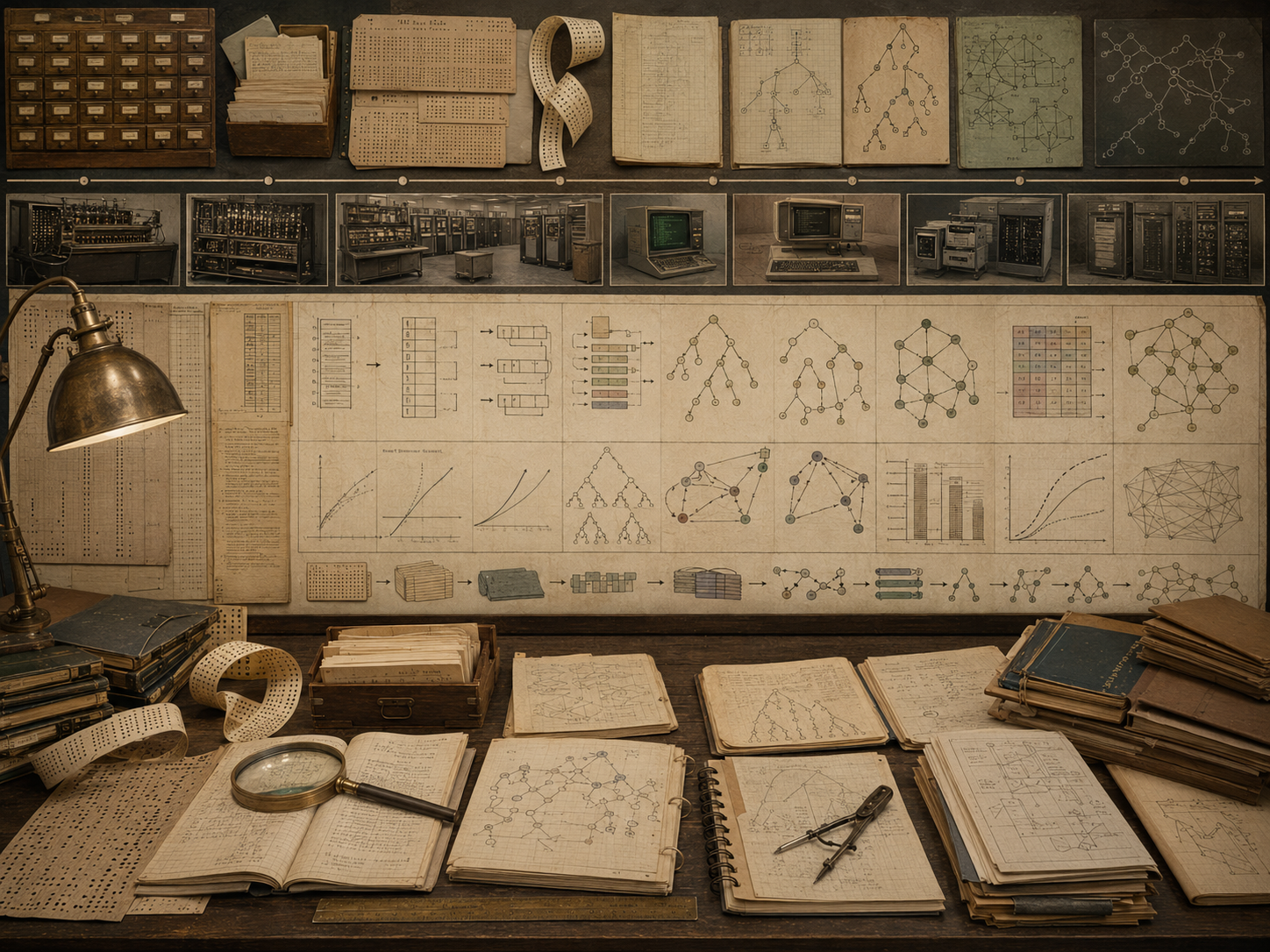
This article introduces ancient algorithms, Babylonian procedures, Euclidean algorithm, Indian numerals, Pingala, Islamic-world algebra, al-Khwārizmī, algorism, algebra, Latin reception, mechanical calculation, symbolic notation, Leibniz, Babbage, Lovelace, Boolean logic, Hilbert, Church, Turing, computability, electronic computers, programming languages, algorithm analysis, data structures, artificial intelligence, machine learning, algorithmic accountability, and responsible computation. It argues that the history of algorithms is not a straight line from one inventor to modern code, but a layered history of representation, method, proof, machine, and institution.
What Counts as an Algorithm in History?
In modern computer science, an algorithm is often defined as a finite, effective procedure for solving a problem or producing an output. Historical study requires more care. Many older procedures are algorithm-like without being modern algorithms in the formal sense. They may be expressed in prose, examples, diagrams, recipes, tables, instruments, or mechanical sequences rather than programming languages.
The historian’s task is not to force every procedure into modern terminology. It is to identify which features of algorithmic reasoning are present: ordered steps, inputs, operations, conditions, repetition, termination, correctness, verification, representation, and reuse.
| Algorithmic feature | Historical form | Modern analogy |
|---|---|---|
| Input | Given number, measurement, table value, problem statement. | Data. |
| Procedure | Rule, recipe, demonstration, mechanical sequence. | Algorithm. |
| State | Intermediate number, board position, table row, machine setting. | Memory. |
| Condition | Case, test, comparison, threshold. | Branch. |
| Iteration | Repeated subtraction, tabular lookup, recurring rule. | Loop. |
| Output | Answer, prediction, classification, movement, decision. | Result. |
A broad history of algorithms must distinguish modern formal definitions from earlier procedural ancestors.
Ancient Procedures Before the Word Algorithm
Procedures existed long before the word algorithm. Ancient mathematical and administrative cultures needed repeatable ways to measure land, compute taxes, divide goods, predict celestial events, solve equations, construct figures, and manage records. These procedures were often taught through examples rather than abstract symbolic formulas.
The key historical point is not that every ancient procedure should be called an algorithm without qualification. The key point is that algorithmic reasoning has deep procedural ancestry. Long before digital computation, people created reliable methods for transforming known information into useful results.
| Ancient need | Procedure type | Algorithmic ancestor |
|---|---|---|
| Land measurement | Area and boundary calculation. | Geometric procedure. |
| Trade | Weights, measures, exchange, accounts. | Commercial arithmetic. |
| Taxation | Assessment and allocation. | Administrative computation. |
| Astronomy | Tables and prediction. | Tabular algorithm. |
| Construction | Proportion and layout. | Geometric construction. |
| Education | Worked examples and exercises. | Procedural pedagogy. |
The history of algorithms begins as the history of making procedures stable enough to repeat.
Babylonian Procedure and Worked Examples
Babylonian mathematical tablets preserve worked procedures for numerical problems. These texts often explain a method through a specific example. The reader learns what to do by following a structured sequence of operations. Donald Knuth famously drew attention to ancient Babylonian procedures as algorithmically meaningful for computer-science history.
Babylonian procedure shows that an algorithm does not always begin as an abstract formula. It may begin as an example that encodes a method. The example teaches a pattern that can be reused. This is a powerful form of procedural knowledge: not symbolic generality, but operational generality through repetition.
| Babylonian feature | Procedural meaning | Modern comparison |
|---|---|---|
| Clay tablet problem | Specific numerical case. | Worked example. |
| Sequence of operations | Steps to transform values. | Algorithm trace. |
| Standard problem forms | Recognizable pattern. | Problem class. |
| Tabular values | Precomputed support. | Lookup table. |
| Instruction by example | Method learned through execution. | Procedural pedagogy. |
| Reusability | Example can guide similar cases. | Generalization through practice. |
Babylonian mathematics reminds us that procedure can be embodied in examples, not only in formulas.
Greek Geometry and Demonstrated Procedure
Greek geometry contributed another major strand: demonstrated procedure. In Euclidean geometry, constructions and proofs unfold step by step. The Euclidean algorithm for finding the greatest common divisor is one of the most famous examples of an ancient procedure later recognized as algorithmic.
Greek geometry is important because it links procedure with proof. A construction is not only something to do; it is something that can be justified. A proof establishes why the procedure works. This connection between method and correctness became central to later algorithmic thinking.
| Greek contribution | Procedural role | Algorithmic significance |
|---|---|---|
| Construction | Stepwise geometric action. | Procedure in space. |
| Proof | Justifies the result. | Correctness argument. |
| Euclidean algorithm | Repeated reduction. | Iteration and termination. |
| Axiomatic structure | Reasoning from assumptions. | Formal system ancestor. |
| Diagram | Supports reasoning. | Visual representation. |
| General theorem | Applies beyond one case. | Abstraction. |
Greek geometry helped make procedure accountable to demonstration.
Indian Numeration, Combinatorics, and Calculation
Indian mathematical traditions contributed deeply to the history of algorithmic reasoning through numeration, place value, zero, combinatorics, prosody, astronomy, arithmetic, and algebraic methods. The Hindu-Arabic numeral system eventually became one of the most important infrastructures for written calculation across the world.
Place-value numeration is algorithmically powerful because position becomes part of meaning. Carrying, borrowing, multiplication, division, and extraction procedures become compact and teachable. Combinatorial and prosodic traditions also show rule-governed generation, enumeration, and pattern analysis.
| Indian contribution | Procedural importance | Computational meaning |
|---|---|---|
| Place value | Digit position encodes magnitude. | Structured representation. |
| Zero | Marks absence in position. | Placeholder and value system. |
| Arithmetic methods | Efficient written calculation. | Operational procedure. |
| Combinatorics | Counting arrangements and patterns. | Enumeration. |
| Prosody | Rule-governed pattern generation. | Sequence structure. |
| Astronomy | Repeated calculation and prediction. | Computational modeling. |
The history of algorithms cannot be told responsibly without the history of numeration and representation.
Chinese Procedural Mathematics and Tabular Reasoning
Chinese mathematical traditions also developed procedural methods for arithmetic, algebra-like problem solving, linear systems, remainder problems, astronomical calculation, and administrative computation. Texts such as The Nine Chapters on the Mathematical Art present mathematical knowledge through problem types and solution procedures.
This tradition is important because it shows another major procedural style: algorithms as rules attached to practical problems. Methods are often organized by task: fields, grains, distribution, excess and deficiency, measurement, right triangles, equations, and extraction. Computation is tied to administration, measurement, and applied problem solving.
| Chinese procedural feature | Role | Algorithmic meaning |
|---|---|---|
| Problem collections | Organize methods by task. | Algorithm library. |
| Counting rods | Represent numbers spatially. | External memory. |
| Linear equation procedures | Transform tabular arrangements. | Matrix-like computation. |
| Remainder problems | Handle modular constraints. | Constraint solving. |
| Administrative calculation | Distribute goods and obligations. | Institutional computation. |
| Astronomy and calendars | Predict cycles. | Temporal modeling. |
Algorithm history is stronger when it treats procedural mathematics as a global and plural development.
Islamic-World Algebra, Algorism, and Systematic Method
Islamic-world mathematics brought together, transformed, and extended many strands of earlier knowledge: Indian numeration, Greek geometry, Persian and Babylonian astronomy, administrative calculation, commercial arithmetic, algebraic problem solving, astronomical tables, geography, optics, cryptanalysis, and mechanical procedure. This was not mere preservation. It was translation, synthesis, correction, commentary, systematization, and creation.
For algorithm history, two developments are especially important: algorism and algebra. Algorism made written arithmetic with Hindu-Arabic numerals portable and teachable. Algebra organized unknowns, roots, squares, numbers, cases, transformations, and verification into a procedural discipline. Together, they expanded the reach of rule-governed problem solving.
| Islamic-world strand | Procedural contribution | Algorithmic significance |
|---|---|---|
| Algorism | Written arithmetic with place-value numerals. | Portable computation. |
| Algebra | Rule-governed problem solving with unknowns. | Symbolic/procedural transformation. |
| Astronomical tables | Prediction and lookup procedures. | Tabular computation. |
| Cryptanalysis | Frequency analysis and inference. | Statistical procedure. |
| Mechanical devices | Sequenced material action. | Embodied procedure. |
| Translation movements | Knowledge transfer across languages. | Procedural portability. |
Islamic-world mathematical cultures are central to the history of algorithms because they made procedure explicit, portable, and teachable across languages and institutions.
Al-Khwārizmī and the Name Algorithm
Al-Khwārizmī’s name is central to the word history of algorithm. Latinized forms of his name became associated with algorism: arithmetic using Hindu-Arabic numerals. Over time, the word algorithm broadened to refer to methods of computation more generally. This history matters, but it must be handled carefully.
Al-Khwārizmī did not invent every algorithm. He did not create modern computer science. His importance is more precise: he helped systematize and transmit methods of calculation and algebraic problem solving that became historically durable. His name became attached to a tradition of written arithmetic, and that linguistic memory survived into modern technical language.
| Layer | Careful claim | Overclaim to avoid |
|---|---|---|
| Name | Algorithm traces linguistically to Latinized forms of al-Khwārizmī. | He invented all algorithms. |
| Arithmetic | His works helped transmit Hindu-Arabic numeral calculation. | He alone created positional numeration. |
| Algebra | His algebraic work systematized equation solving. | He invented all algebra from nothing. |
| Reception | Latin traditions adapted and taught his methods. | Influence was automatic or direct in every case. |
| Modern computing | His legacy is one deep strand in computational history. | He was a modern programmer. |
| Public memory | His story helps explain the word and tradition. | The word alone explains the full concept. |
Al-Khwārizmī’s real role is powerful enough without mythic simplification.
Latin Reception and the Spread of Algorism
Algorithms did not enter Latin Europe as modern code. They entered through translated texts, arithmetic manuals, teaching traditions, merchant practice, universities, and practical calculation. Algorism competed with counting boards, abacus methods, Roman numerals, finger reckoning, and local accounting habits.
Reception was active. Latin scholars and practitioners translated, adapted, explained, taught, resisted, and normalized new methods. Fibonacci’s Liber Abaci helped promote Hindu-Arabic numerals and commercial arithmetic, but it belongs to a broader network of transmission. The spread of algorism shows that an algorithm becomes historically powerful only when people learn, trust, and use it.
| Reception layer | Function | Algorithmic meaning |
|---|---|---|
| Translation | Moves procedure across language. | Porting method. |
| Teaching | Makes method repeatable. | Instructional algorithm. |
| Merchant practice | Tests utility in trade. | Applied computation. |
| Institutional use | Legitimizes method. | Adoption environment. |
| Resistance | Challenges trust and unfamiliarity. | Verification problem. |
| Normalization | Makes method ordinary. | Infrastructure. |
Reception history shows that algorithms need social infrastructure, not only technical elegance.
Tables, Instruments, and Mechanical Procedure
Algorithms also developed through tables and instruments. Astronomical tables, calendar procedures, navigational tables, trigonometric tables, logarithm tables, and calculating instruments made computation reusable. Tables precompute relationships. Instruments embody operations. Mechanical devices sequence action through material design.
This history complicates the idea that algorithms are only written instructions. A table can encode a procedure. An instrument can make a procedure easier to execute. A mechanical device can embody a sequence. The boundary between algorithm, data, tool, and machine has always been historically layered.
| Form | How it stores procedure | Computational significance |
|---|---|---|
| Astronomical table | Rows and columns of precomputed values. | Prediction by lookup and interpolation. |
| Calendar rule | Repeated temporal pattern. | Cyclic computation. |
| Astrolabe | Geometric relations embodied in instrument. | Analog computation. |
| Mechanical automaton | Sequenced physical states. | Embodied algorithmic action. |
| Logarithm table | Transforms multiplication into addition. | Computational compression. |
| Slide rule | Mechanical alignment of scales. | Instrumental calculation. |
Before electronic computers, much computation lived in tables, instruments, and disciplined material practices.
Early Modern Symbolism and Calculation
Early modern mathematics transformed algorithmic reasoning by making notation more compact and general. Symbols for unknowns, operations, equality, exponents, functions, and coordinates made it easier to manipulate relationships abstractly. Algebra became more symbolic. Calculus introduced systematic methods for change and accumulation. Logarithms, tables, and analytical geometry reorganized computation.
Symbolism did not replace procedure. It made procedures easier to generalize, compress, and communicate. A symbolic formula can express many cases at once. A notation system can become an interface for calculation. This shift helped prepare the way for formal methods, mechanical calculation, and eventually programmable computation.
| Early modern development | Procedural effect | Algorithmic consequence |
|---|---|---|
| Symbolic algebra | Compacts unknowns and operations. | General manipulation. |
| Analytic geometry | Connects algebra and space. | Coordinate computation. |
| Logarithms | Transform complex operations. | Computational efficiency. |
| Calculus | Systematizes change and accumulation. | Continuous modeling. |
| Probability | Formalizes uncertainty. | Statistical inference. |
| Printed manuals | Spread standardized methods. | Procedural dissemination. |
Symbolism made algorithms easier to write, teach, transform, and generalize.
Mechanical Calculators and Programmable Machines
The history of algorithms changed when procedures could be embodied in machines. Mechanical calculators, Jacquard looms, difference engines, analytical engines, punched cards, tabulating machines, and later electronic computers all changed the relationship between instruction and execution. A procedure could become not only written but mechanically performed.
Babbage’s engines and Lovelace’s notes are important because they helped imagine computation beyond arithmetic calculation. Lovelace recognized that a sufficiently general machine could operate on symbols according to rules, not only numbers in a narrow sense. This step matters for the history of algorithms because it links procedure, representation, and programmable execution.
| Machine tradition | Procedural contribution | Algorithmic meaning |
|---|---|---|
| Mechanical calculator | Performs arithmetic operations. | Mechanized calculation. |
| Jacquard loom | Controls pattern through punched cards. | Encoded instruction. |
| Difference engine | Computes tables mechanically. | Automated tabulation. |
| Analytical engine | Imagines general programmable calculation. | Machine-executable procedure. |
| Punched-card tabulator | Processes records systematically. | Data processing. |
| Electronic computer | Executes stored or loaded instructions. | Programmable computation. |
Machines changed algorithms from instructions people follow into instructions machines can execute.
Logic, Formal Systems, and Computability
The modern concept of an algorithm required more than machines. It required formal ideas about logic, proof, symbol manipulation, and effective procedure. Nineteenth- and twentieth-century developments in mathematical logic asked whether reasoning itself could be formalized. Could proof be mechanized? Could mathematics be reduced to rules? Could every true mathematical statement be decided by a procedure?
These questions led to some of the most important results in the history of computation. Formal systems, recursive functions, lambda calculus, Turing machines, undecidability, and computability theory clarified what effective procedure means and what its limits are.
| Logical development | Question | Algorithmic significance |
|---|---|---|
| Symbolic logic | Can reasoning be represented formally? | Formal language. |
| Hilbert’s program | Can mathematics be made complete and decidable? | Decision procedure problem. |
| Gödel | What are the limits of formal systems? | Incompleteness. |
| Church | Can effective calculability be formalized? | Lambda calculus and undecidability. |
| Turing | Can machine procedure model computation? | Turing machine. |
| Computability theory | What can and cannot be computed? | Limits of algorithmic method. |
Modern algorithm history is partly the history of discovering the power and limits of effective procedure.
Turing, Church, and Effective Procedure
The 1930s were decisive for the modern theory of algorithms. Alonzo Church and Alan Turing gave formal accounts of effective calculability. Turing’s model of an abstract machine showed how a finite set of rules could manipulate symbols on a tape. Church’s lambda calculus offered another formal model of computation. Their work helped clarify the modern idea of an algorithm as an effective method.
The Church-Turing thesis is not merely a technical landmark. It also marks a historical shift. Earlier procedures were practical, pedagogical, mechanical, or mathematical. After Church and Turing, effective procedure became a formal object of study. Algorithms could be analyzed not only by what they did, but by whether a class of problems was computable at all.
| Concept | Meaning | Historical effect |
|---|---|---|
| Effective procedure | Systematic method executable by rule. | Clarifies algorithmic method. |
| Turing machine | Abstract model of computation. | Defines machine procedure. |
| Lambda calculus | Formal system of function abstraction and application. | Defines computation through functions. |
| Undecidability | Some problems cannot be solved by general procedure. | Shows limits. |
| Universality | One machine can simulate many procedures. | General computation. |
| Computability | Boundary of effective method. | Modern algorithm theory. |
Turing and Church made algorithmic procedure mathematically precise.
Electronic Computers and Programming
Electronic computers changed the scale, speed, and social role of algorithms. Procedures that once belonged to mathematicians, clerks, navigators, astronomers, or engineers became executable at machine speed. Programming languages gave humans new ways to express procedures. Operating systems, compilers, databases, networks, and software engineering turned algorithmic reasoning into infrastructure.
The shift from procedure to program was not automatic. Programs require representation, memory, control flow, data structures, input/output, debugging, documentation, and maintenance. An algorithm may describe a method, but a program must operate in a real machine environment.
| Computing layer | Algorithmic role | Institutional consequence |
|---|---|---|
| Machine code | Low-level instructions. | Direct execution. |
| Programming language | Human-readable procedure. | Software development. |
| Compiler | Translates code into executable form. | Procedural transformation. |
| Operating system | Manages resources and processes. | Execution environment. |
| Database | Stores and retrieves structured information. | Algorithmic data management. |
| Network | Moves computation and data across systems. | Distributed procedure. |
Programming turned algorithms into repeatable machine operations embedded in institutions.
Algorithm Analysis, Data Structures, and Complexity
Modern computer science studies not only whether a procedure works, but how efficiently it works. Algorithm analysis examines time, space, correctness, termination, scalability, and worst-case behavior. Data structures organize information so algorithms can operate effectively. Complexity theory asks which problems are tractable, intractable, or unsolvable under defined models.
This changed algorithmic reasoning again. Algorithms became objects of comparison. Sorting methods, graph algorithms, search procedures, optimization methods, cryptographic protocols, numerical methods, and machine learning algorithms could be analyzed systematically.
| Modern algorithmic concern | Question | Why it matters |
|---|---|---|
| Correctness | Does the method produce the right result? | Reliability. |
| Termination | Does it stop? | Computability and safety. |
| Time complexity | How long does it take as input grows? | Scalability. |
| Space complexity | How much memory does it require? | Resource management. |
| Data structure | How is information organized? | Performance and clarity. |
| Complexity class | How hard is the problem? | Theoretical boundary. |
The modern algorithm is not just a method; it is a method under analysis.
Algorithms in AI, Machine Learning, and Platforms
Artificial intelligence and machine learning changed public understanding of algorithms. In many modern systems, algorithms do not simply follow explicit hand-written rules. They may learn patterns from data, optimize objectives, update models, rank content, recommend actions, generate text, classify images, detect anomalies, or guide decisions.
This does not erase the older history of algorithms. It extends it. Machine learning still depends on procedures: training loops, optimization algorithms, loss functions, gradient descent, data pipelines, evaluation metrics, inference procedures, deployment workflows, monitoring, feedback, and governance. But it also introduces new questions about opacity, bias, uncertainty, accountability, and human judgment.
| AI-era layer | Algorithmic role | Governance issue |
|---|---|---|
| Training algorithm | Fits model to data. | Data quality and bias. |
| Optimization objective | Defines what is improved. | Metric distortion. |
| Model inference | Produces prediction or output. | Reliability and explanation. |
| Recommendation system | Ranks and filters attention. | Feedback loops and manipulation. |
| Generative model | Produces new content from learned patterns. | Truth, provenance, and misuse. |
| Monitoring system | Tracks drift and failure. | Accountability over time. |
The AI era makes algorithms more powerful and more institutionally consequential.
Algorithmic Governance and Responsible Computation
The history of algorithms now includes governance. Algorithms make decisions, shape access, filter information, allocate resources, manage risk, detect fraud, recommend content, support diagnosis, influence labor, and mediate public systems. This means algorithmic reasoning can no longer be treated as merely technical.
Responsible computation asks who defines the objective, who supplies the data, who audits the output, who can appeal, who is harmed by errors, who benefits from automation, and when algorithms should not be used. These questions are part of the mature history of algorithms because they concern what procedures do in institutions.
| Governance question | Historical connection | Modern importance |
|---|---|---|
| What is the procedure for? | Purpose shapes method. | Objective alignment. |
| Who can understand it? | Procedures need explanation. | Transparency. |
| How is it checked? | Correctness requires verification. | Auditability. |
| Who is affected? | Procedures allocate consequences. | Justice and harm. |
| Can people contest it? | Institutional decisions need due process. | Appeals. |
| When should it not be used? | Some problems resist formalization. | Human judgment. |
The history of algorithms ends, for now, in questions of responsibility, not only efficiency.
Examples Across the History of Algorithms
The examples below show how algorithmic reasoning changes form across history.
Babylonian worked example
A numerical problem teaches a reusable sequence of operations through a specific case.
Euclidean algorithm
Repeated reduction finds a greatest common divisor and demonstrates termination.
Place-value arithmetic
Digits, zero, carrying, and borrowing create compact written computation.
Arabic algebra
Unknowns, roots, squares, numbers, cases, and transformations become systematic method.
Astronomical tables
Precomputed values allow prediction by lookup, interpolation, and correction.
Mechanical calculation
Procedure becomes embodied in gears, levers, punched cards, or engines.
Turing machine
Effective procedure becomes an abstract formal model of computation.
Machine learning pipeline
Data, objective, training, evaluation, deployment, and monitoring become algorithmic infrastructure.
These examples show that algorithms have never been only one thing. They are methods, representations, proofs, devices, programs, and institutions.
Mathematics, Computation, and Modeling
A broad historical model of algorithms can be expressed as:
Algorithm = Procedure + Representation + Correctness + Execution + Context
\]
Interpretation: Algorithms require steps, a way to express those steps, standards for correctness, a mode of execution, and a setting in which they are used.
The historical movement from procedure to computation can be summarized as:
Example \rightarrow Rule \rightarrow Method \rightarrow Notation \rightarrow Machine \rightarrow Program \rightarrow System
\]
Interpretation: Algorithmic reasoning becomes more portable and institutional as it moves from examples to systems.
The modern computer-science layer adds analysis:
AlgorithmAnalysis = Correctness + Termination + Time + Space + Complexity
\]
Interpretation: A modern algorithm is evaluated not only by result, but by proof, stopping behavior, resource use, and scalability.
The governance layer adds responsibility:
ResponsibleAlgorithm = Method + Evidence + Audit + Contestability + HumanJudgment
\]
Interpretation: In institutions, algorithmic quality includes accountability, review, appeal, and limits.
These formulas are interpretive models. They make historical structure visible without claiming that all traditions used modern notation or categories.
Python Workflow: Algorithm History Timeline Map
The Python workflow below creates a dependency-light interpretive map of algorithm history. It scores historical periods and traditions by procedural explicitness, representation, proof and correctness, portability, mechanization, formalization, programmability, institutional adoption, governance relevance, and modern resonance, then writes reproducible CSV and JSON outputs.
# history_of_algorithms_timeline_map.py
# Dependency-light workflow for mapping algorithm history from procedure to computation.

from __future__ import annotations

from dataclasses import asdict, dataclass
from pathlib import Path
from statistics import mean
import csv
import json
from datetime import datetime, timezone

ARTICLE_ROOT = Path(__file__).resolve().parents[1]
TABLES = ARTICLE_ROOT / "outputs" / "tables"
JSON_DIR = ARTICLE_ROOT / "outputs" / "json"


@dataclass(frozen=True)
class AlgorithmHistoryConfig:
    article: str = "history_of_algorithms"
    core_threshold: float = 0.80
    high_procedure_threshold: float = 0.86


def timestamp_utc() -> str:
    return datetime.now(timezone.utc).isoformat()


def write_csv(path: Path, rows: list[dict[str, object]]) -> None:
    path.parent.mkdir(parents=True, exist_ok=True)
    if not rows:
        path.write_text("", encoding="utf-8")
        return
    fieldnames = sorted({key for row in rows for key in row.keys()})
    with path.open("w", newline="", encoding="utf-8") as handle:
        writer = csv.DictWriter(handle, fieldnames=fieldnames, extrasaction="ignore")
        writer.writeheader()
        writer.writerows(rows)


def write_json(path: Path, payload: object) -> None:
    path.parent.mkdir(parents=True, exist_ok=True)
    path.write_text(json.dumps(payload, indent=2, sort_keys=True), encoding="utf-8")


def history_layers() -> list[dict[str, object]]:
    return [
        {"layer_id": "ancient_worked_procedures", "procedural_explicitness": 0.92, "representation": 0.84, "proof_correctness": 0.80, "portability": 0.82, "mechanization": 0.30, "formalization": 0.54, "programmability": 0.20, "institutional_adoption": 0.78, "governance_relevance": 0.62, "modern_resonance": 0.90},
        {"layer_id": "greek_demonstrated_procedure", "procedural_explicitness": 0.90, "representation": 0.88, "proof_correctness": 0.98, "portability": 0.86, "mechanization": 0.28, "formalization": 0.76, "programmability": 0.22, "institutional_adoption": 0.82, "governance_relevance": 0.60, "modern_resonance": 0.92},
        {"layer_id": "indian_numeration_and_calculation", "procedural_explicitness": 0.94, "representation": 0.98, "proof_correctness": 0.84, "portability": 0.96, "mechanization": 0.34, "formalization": 0.76, "programmability": 0.32, "institutional_adoption": 0.88, "governance_relevance": 0.66, "modern_resonance": 0.98},
        {"layer_id": "islamic_world_algorism_and_algebra", "procedural_explicitness": 0.98, "representation": 0.94, "proof_correctness": 0.92, "portability": 0.98, "mechanization": 0.54, "formalization": 0.84, "programmability": 0.42, "institutional_adoption": 0.94, "governance_relevance": 0.72, "modern_resonance": 0.98},
        {"layer_id": "latin_reception_and_commercial_arithmetic", "procedural_explicitness": 0.94, "representation": 0.94, "proof_correctness": 0.84, "portability": 0.96, "mechanization": 0.44, "formalization": 0.78, "programmability": 0.36, "institutional_adoption": 0.96, "governance_relevance": 0.76, "modern_resonance": 0.94},
        {"layer_id": "early_modern_symbolism_and_tables", "procedural_explicitness": 0.92, "representation": 0.98, "proof_correctness": 0.92, "portability": 0.96, "mechanization": 0.62, "formalization": 0.92, "programmability": 0.54, "institutional_adoption": 0.96, "governance_relevance": 0.74, "modern_resonance": 0.96},
        {"layer_id": "mechanical_and_programmable_machines", "procedural_explicitness": 0.96, "representation": 0.94, "proof_correctness": 0.86, "portability": 0.90, "mechanization": 0.98, "formalization": 0.88, "programmability": 0.90, "institutional_adoption": 0.92, "governance_relevance": 0.76, "modern_resonance": 0.98},
        {"layer_id": "logic_computability_and_turing_machines", "procedural_explicitness": 0.98, "representation": 0.96, "proof_correctness": 0.98, "portability": 0.96, "mechanization": 0.86, "formalization": 0.98, "programmability": 0.92, "institutional_adoption": 0.92, "governance_relevance": 0.80, "modern_resonance": 0.98},
        {"layer_id": "electronic_computing_and_software", "procedural_explicitness": 0.98, "representation": 0.98, "proof_correctness": 0.92, "portability": 0.94, "mechanization": 0.98, "formalization": 0.94, "programmability": 0.98, "institutional_adoption": 0.98, "governance_relevance": 0.88, "modern_resonance": 0.98},
        {"layer_id": "ai_platforms_and_governance", "procedural_explicitness": 0.90, "representation": 0.94, "proof_correctness": 0.78, "portability": 0.92, "mechanization": 0.98, "formalization": 0.88, "programmability": 0.96, "institutional_adoption": 0.98, "governance_relevance": 0.98, "modern_resonance": 0.98},
    ]


def score_layer(row: dict[str, object], config: AlgorithmHistoryConfig) -> dict[str, object]:
    history_score = mean([
        float(row["procedural_explicitness"]),
        float(row["representation"]),
        float(row["proof_correctness"]),
        float(row["portability"]),
        float(row["mechanization"]),
        float(row["formalization"]),
        float(row["programmability"]),
        float(row["institutional_adoption"]),
        float(row["governance_relevance"]),
        float(row["modern_resonance"]),
    ])

    if history_score >= config.core_threshold and float(row["procedural_explicitness"]) >= config.high_procedure_threshold:
        interpretive_status = "core_algorithm_history_layer"
    elif history_score >= config.core_threshold:
        interpretive_status = "major_algorithm_history_layer"
    else:
        interpretive_status = "supporting_algorithm_history_layer"

    return {
        "layer_id": row["layer_id"],
        "procedural_explicitness": round(float(row["procedural_explicitness"]), 6),
        "representation": round(float(row["representation"]), 6),
        "proof_correctness": round(float(row["proof_correctness"]), 6),
        "portability": round(float(row["portability"]), 6),
        "mechanization": round(float(row["mechanization"]), 6),
        "formalization": round(float(row["formalization"]), 6),
        "programmability": round(float(row["programmability"]), 6),
        "institutional_adoption": round(float(row["institutional_adoption"]), 6),
        "governance_relevance": round(float(row["governance_relevance"]), 6),
        "modern_resonance": round(float(row["modern_resonance"]), 6),
        "history_score": round(history_score, 6),
        "interpretive_status": interpretive_status,
    }


def interpretation_cautions() -> list[dict[str, str]]:
    return [
        {"caution": "do_not_treat_algorithm_history_as_computer_history_only", "meaning": "Algorithms have procedural ancestors long before electronic computers."},
        {"caution": "do_not_confuse_word_origin_with_total_origin", "meaning": "The word algorithm matters, but procedure history is broader."},
        {"caution": "do_not_project_modern_code_backward", "meaning": "Historical procedures can be algorithm-like without being programs."},
        {"caution": "do_not_ignore_institutions", "meaning": "Teaching, translation, copying, commerce, machines, and governance make algorithms durable."},
        {"caution": "do_not_reduce_history_to_efficiency", "meaning": "Correctness, proof, trust, responsibility, and public consequence also matter."},
    ]


def main() -> None:
    config = AlgorithmHistoryConfig()
    layers = history_layers()
    scored = [score_layer(row, config) for row in layers]
    cautions = interpretation_cautions()

    summary = {
        "article": config.article,
        "timestamp_utc": timestamp_utc(),
        "layers_reviewed": len(scored),
        "core_layers": sum(1 for row in scored if row["interpretive_status"] == "core_algorithm_history_layer"),
        "major_layers": sum(1 for row in scored if row["interpretive_status"] == "major_algorithm_history_layer"),
        "supporting_layers": sum(1 for row in scored if row["interpretive_status"] == "supporting_algorithm_history_layer"),
        "mean_history_score": round(mean(float(row["history_score"]) for row in scored), 6),
        "cautions": len(cautions),
        "interpretation": "Algorithm history is a layered movement from procedure to computation: examples, rules, notation, proof, tables, machines, programs, analysis, platforms, and governance.",
    }

    write_csv(TABLES / "algorithm_history_layers.csv", layers)
    write_csv(TABLES / "algorithm_history_map.csv", scored)
    write_csv(TABLES / "interpretation_cautions.csv", cautions)
    write_csv(TABLES / "algorithm_history_summary.csv", [summary])

    write_json(JSON_DIR / "algorithm_history_config.json", asdict(config))
    write_json(JSON_DIR / "algorithm_history_map.json", scored)
    write_json(JSON_DIR / "interpretation_cautions.json", cautions)
    write_json(JSON_DIR / "algorithm_history_summary.json", summary)

    print("Algorithm history timeline map complete.")
    print(TABLES / "algorithm_history_summary.csv")


if __name__ == "__main__":
    main()
This workflow turns the article’s historical argument into reproducible scaffolding: periods, traditions, mechanisms, and cautions can be compared without reducing history to one person, culture, or machine.
R Workflow: Algorithm History Diagnostics
The R workflow reads the generated CSV outputs, summarizes algorithm-history layers, visualizes dimensions across periods, and writes an additional diagnostic table.
# history_of_algorithms_summary.R
args <- commandArgs(trailingOnly = FALSE)
file_arg <- grep("^--file=", args, value = TRUE)

if (length(file_arg) > 0) {
  script_path <- normalizePath(sub("^--file=", "", file_arg[1]), mustWork = TRUE)
  article_root <- normalizePath(file.path(dirname(script_path), ".."), mustWork = TRUE)
} else {
  article_root <- getwd()
}

setwd(article_root)

tables_dir <- file.path(article_root, "outputs", "tables")
figures_dir <- file.path(article_root, "outputs", "figures")
dir.create(tables_dir, recursive = TRUE, showWarnings = FALSE)
dir.create(figures_dir, recursive = TRUE, showWarnings = FALSE)

map_path <- file.path(tables_dir, "algorithm_history_map.csv")
summary_path <- file.path(tables_dir, "algorithm_history_summary.csv")

if (!file.exists(map_path)) {
  stop(paste("Missing", map_path, "Run the Python workflow first."))
}

history_map <- read.csv(map_path, stringsAsFactors = FALSE)
summary <- read.csv(summary_path, stringsAsFactors = FALSE)

png(file.path(figures_dir, "algorithm_history_dimensions.png"), width = 1200, height = 850)
score_matrix <- t(as.matrix(history_map[, c("procedural_explicitness", "representation", "proof_correctness", "portability", "mechanization", "formalization", "programmability", "institutional_adoption", "governance_relevance", "modern_resonance")]))
barplot(score_matrix,
        beside = TRUE,
        names.arg = history_map$layer_id,
        las = 2,
        ylim = c(0, 1),
        ylab = "Interpretive Score",
        main = "The History of Algorithms: From Procedure to Computation")
legend("bottomright",
       legend = rownames(score_matrix),
       cex = 0.68,
       bty = "n")
grid()
dev.off()

png(file.path(figures_dir, "algorithm_history_score_by_layer.png"), width = 1000, height = 750)
barplot(history_map$history_score,
        names.arg = history_map$layer_id,
        las = 2,
        ylab = "History Score",
        main = "Algorithm History Score by Layer")
grid()
dev.off()

r_summary <- data.frame(
  layers_reviewed = summary$layers_reviewed[1],
  core_layers = summary$core_layers[1],
  major_layers = summary$major_layers[1],
  supporting_layers = summary$supporting_layers[1],
  mean_history_score = summary$mean_history_score[1],
  cautions = summary$cautions[1],
  diagnostic_note = "Algorithm history is a layered movement from procedure to computation: examples, rules, notation, proof, tables, machines, programs, analysis, platforms, and governance."
)

write.csv(r_summary, file.path(tables_dir, "r_algorithm_history_diagnostic_summary.csv"), row.names = FALSE)
print(r_summary)
The R layer makes the broad arc visible: procedure, representation, proof, portability, mechanization, formalization, programmability, institutional adoption, governance relevance, and modern resonance can be compared across historical layers.
GitHub Repository
The companion repository contains reproducible workflows, synthetic interpretive data, outputs, calculators, documentation, and multilingual examples for this article.
Complete Code Repository
Companion article folder with Python, R, Julia, SQL, Haskell, C, C++, Fortran, Rust, Go, Java, TypeScript, Prolog, Racket, notebooks, documentation, synthetic teaching data, generated outputs, schemas, calculators, and Canvas-ready workflow artifacts for the history of algorithms from ancient procedures to modern computation: Babylonian worked examples, Euclidean procedure, Indian numeration, Islamic-world algebra and algorism, Latin reception, tables, instruments, mechanical calculators, symbolic logic, computability, electronic computing, algorithm analysis, AI systems, and algorithmic governance.
A Practical Method for Studying Algorithm History
A careful study of algorithm history asks how a procedure is represented, justified, transmitted, executed, and institutionalized.
| Step | Historical action | Output |
|---|---|---|
| 1 | Identify the procedure and its problem context. | Procedure description. |
| 2 | Determine its representation: prose, example, diagram, table, notation, machine, or program. | Representation map. |
| 3 | Ask what counts as correctness: proof, check, example, test, or institutional trust. | Correctness layer. |
| 4 | Trace transmission: teaching, copying, translation, commentary, printing, programming, or deployment. | Transmission path. |
| 5 | Identify execution environment: human, instrument, machine, software, platform, or institution. | Execution model. |
| 6 | Analyze constraints: time, memory, materials, notation, data, governance, or cost. | Constraint profile. |
| 7 | Mark analogies carefully when using modern terms for older procedures. | Anachronism control. |
| 8 | Ask who benefits, who is affected, and who can contest the procedure. | Responsible history. |
This method lets algorithm history include both ancient procedure and modern computation without collapsing one into the other.
Common Pitfalls
The first pitfall is treating algorithm history as only computer history. The second is treating word origin as total origin. The third is projecting modern code backward. The fourth is ignoring institutions, users, and governance.
| Pitfall | Why it matters | Better practice |
|---|---|---|
| Computer-only history | Erases older procedural traditions. | Include ancient, medieval, and early modern procedures. |
| Etymology-only history | Confuses word origin with concept history. | Separate word, practice, concept, and formalization. |
| Modern-code projection | Misrepresents historical forms. | Use “algorithm-like” and explain differences. |
| Great-man simplification | Hides transmission networks. | Include translators, teachers, scribes, users, machines, and institutions. |
| Efficiency-only framing | Ignores proof, trust, harm, and responsibility. | Study correctness and governance too. |
| Flat chronology | Turns history into a list of names. | Trace changes in representation, execution, and institution. |
A better history explains how procedure changes form across time.
Why Algorithm History Matters Now
The history of algorithms matters because algorithms now shape daily life. They rank information, allocate attention, recommend content, detect fraud, route traffic, price risk, support diagnosis, manage logistics, optimize systems, and help automate institutional decisions. To understand their power, we need more than a technical definition. We need a historical account of how procedures become trusted, mechanized, formalized, and governed.
That history is long. It begins with practical methods and worked examples. It passes through proof, numeration, algebra, tables, translation, machines, logic, computability, programming, complexity analysis, machine learning, and governance. It includes al-Khwārizmī, but it does not begin or end with him. It includes computers, but it is older than computers. It includes AI, but it should not be reduced to AI.
The central lesson is simple: algorithms are human-made procedures embedded in representation, institutions, and judgment. Their history reminds us that computation is powerful, but never outside culture, evidence, responsibility, or interpretation. AI belongs in the toolkit, not in control.
Related Articles
- Why Origin Stories of Algorithms Need Care
- The Philosophy of Algorithms and Computational Reasoning
- Al-Khwārizmī, Algorism, and the Procedural Imagination
- The Unknown, the Variable, and Islamic Mathematical Philosophy
- Logic and Computation
Further Reading
- Chabert, J.-L. (ed.) (1999) A History of Algorithms: From the Pebble to the Microchip. Berlin: Springer.
- Knuth, D.E. (1972) ‘Ancient Babylonian Algorithms’. Communications of the ACM, 15(7), pp. 671–677.
- Copeland, B.J. (1997) ‘The Church-Turing Thesis’. Stanford Encyclopedia of Philosophy.
- MacTutor History of Mathematics (n.d.) ‘Al-Khwarizmi’. University of St Andrews.
- Online Etymology Dictionary (n.d.) ‘Algorithm’.
- Rashed, R. (1994) The Development of Arabic Mathematics: Between Arithmetic and Algebra. Dordrecht: Kluwer.
- Davis, M. (2000) The Universal Computer: The Road from Leibniz to Turing. New York: Norton.
- Cormen, T.H., Leiserson, C.E., Rivest, R.L. and Stein, C. (2022) Introduction to Algorithms. 4th edn. Cambridge, MA: MIT Press.
References
- Chabert, J.-L. (ed.) (1999) A History of Algorithms: From the Pebble to the Microchip. Berlin: Springer.
- Copeland, B.J. (1997) ‘The Church-Turing Thesis’. Stanford Encyclopedia of Philosophy. Available at: https://plato.stanford.edu/entries/church-turing/.
- Cormen, T.H., Leiserson, C.E., Rivest, R.L. and Stein, C. (2022) Introduction to Algorithms. 4th edn. Cambridge, MA: MIT Press.
- Davis, M. (2000) The Universal Computer: The Road from Leibniz to Turing. New York: Norton.
- Knuth, D.E. (1972) ‘Ancient Babylonian Algorithms’. Communications of the ACM, 15(7), pp. 671–677. Available at: https://cacm.acm.org/research/ancient-babylonian-algorithms/.
- MacTutor History of Mathematics (n.d.) ‘Al-Khwarizmi’. University of St Andrews. Available at: https://mathshistory.st-andrews.ac.uk/Biographies/Al-Khwarizmi/.
- Online Etymology Dictionary (n.d.) ‘Algorithm’. Available at: https://www.etymonline.com/word/algorithm.
- Rashed, R. (1994) The Development of Arabic Mathematics: Between Arithmetic and Algebra. Dordrecht: Kluwer.