
Last Updated June 22, 2026
Al-Khwārizmī, algorism, and the procedural imagination examine how one ninth-century scholarly name became attached to a much larger history of rule-governed calculation. Muḥammad ibn Mūsā al-Khwārizmī did not invent all algorithms. No single person did. But his name entered Latin mathematical culture through traditions of calculation, and those traditions helped shape the later word algorithm. His algebraic writing also helped give later mathematics one of its central names: algebra.
This article treats al-Khwārizmī as a historical bridge between older numerical traditions, Abbasid-era scholarship, practical calculation, algebraic procedure, astronomical tables, and later Latin algorism. The focus is not celebrity history. It is procedural history: how calculation becomes teachable; how a method can be written as a sequence of operations; how representations such as numerals and equations change what can be done; how a name can travel through translation; and how the imagination of procedure becomes part of the long prehistory of computational reasoning.
Al-Khwārizmī matters because he shows that algorithmic reasoning is not only about computers. It is about making thought executable by rule. A calculation can be taught. A problem can be classified. A quantity can be transformed. An unknown can be found. A table can encode prediction. A numerical notation can change the reach of arithmetic. A method can travel across languages and institutions.
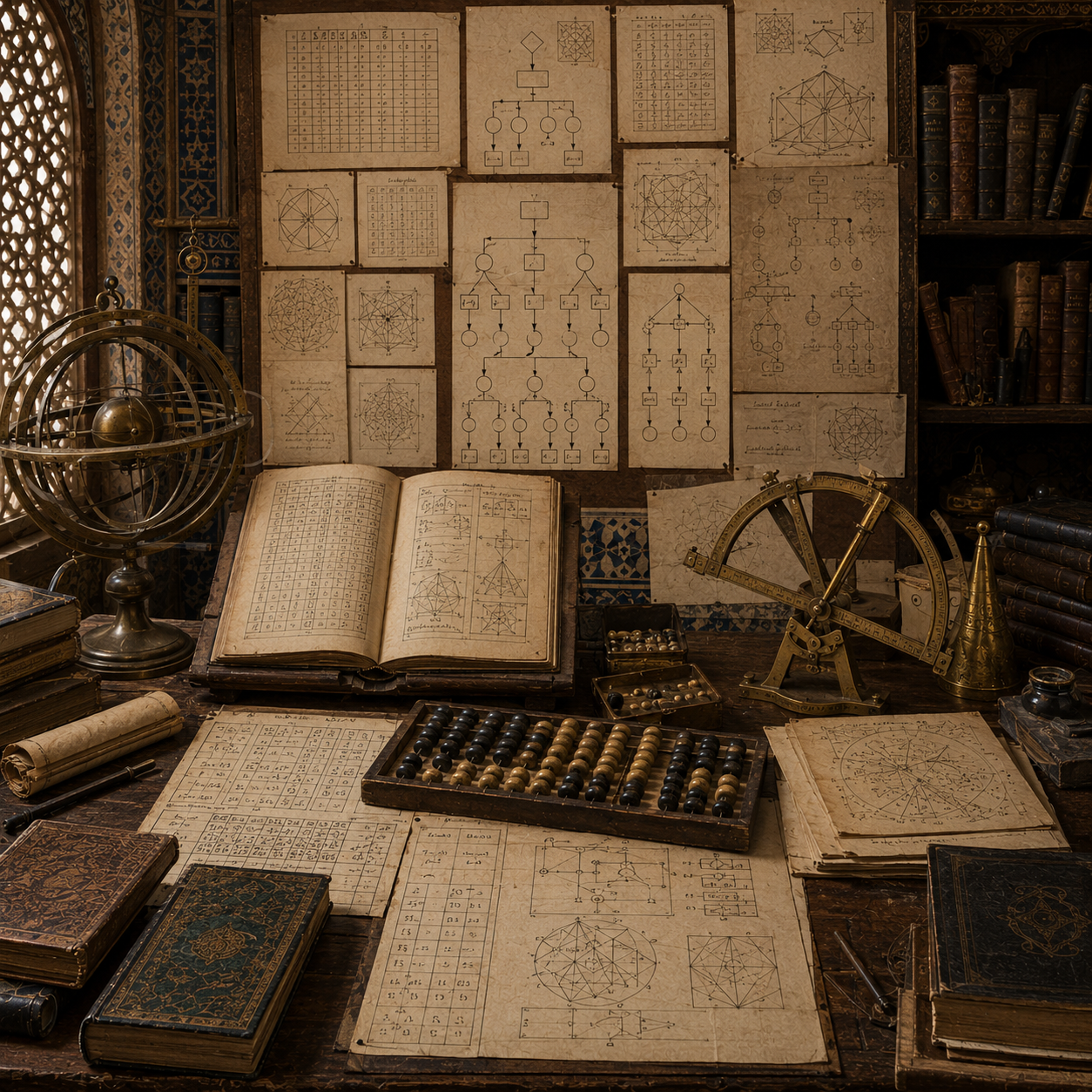
This article introduces al-Khwārizmī as a central figure in the history of algorithmic reasoning, not because he represents a single origin, but because his name, works, and reception reveal how mathematical procedures travel. It examines algorism, Hindu-Arabic numerals, positional calculation, algebraic method, verbal procedure, arithmetic instruction, astronomical tables, translation into Latin, the emergence of procedural imagination, and the need to distinguish historical etymology from simplified origin myth.
Why Al-Khwārizmī Matters
Al-Khwārizmī matters because his name became attached to a durable history of mathematical procedure. He is not important only because the modern word algorithm traces through Latin forms of his name. He is important because his works stand at the intersection of arithmetic, algebra, astronomy, geography, teaching, translation, and practical calculation.
The history of algorithms is often told as if computation began with machines. Al-Khwārizmī helps correct that view. He shows how a procedure can exist before programming languages, before symbolic algebra in its modern form, and before electronic computation. A procedure can be verbal, tabular, numerical, geometric, or instructional. It can be taught to human calculators and transmitted through manuscripts.
| Why he matters | Historical meaning | Computational meaning |
|---|---|---|
| Etymology | Latinized forms of his name became linked to algorism and algorithm. | The word algorithm preserves a history of written procedure. |
| Arithmetic | Calculation with Hindu-Arabic numerals became teachable and transmissible. | Representation changes the power of calculation. |
| Algebra | Equation solving was organized through rule-governed methods. | Problems can be classified, transformed, and solved. |
| Tables | Astronomical and numerical methods used reusable computed values. | Computation can be stored, reused, and corrected. |
| Transmission | Arabic, Latin, and later mathematical cultures adapted his legacy. | Algorithms travel through language, pedagogy, and institutions. |
| Imagination | Mathematics becomes a set of executable methods. | Reasoning becomes procedural. |
Al-Khwārizmī’s importance is not that he replaces every other origin. It is that he makes the procedural lineage of algorithmic reasoning visible.
Al-Khwārizmī in Historical Context
Al-Khwārizmī lived and worked in the Abbasid intellectual world, a setting shaped by translation, administration, astronomy, mathematics, geography, and scholarly patronage. He is usually associated with Baghdad and the ninth century, and his works are connected to the broader scholarly environment sometimes described through the House of Wisdom and related translation and research activity.
This context matters because al-Khwārizmī was not an isolated genius outside history. He worked within a multilingual world where Greek, Sanskrit, Persian, Syriac, and Arabic traditions interacted. Mathematical procedures were not simply discovered once and then preserved. They were translated, organized, revised, taught, commented on, and applied.
| Contextual layer | Why it matters | Algorithmic relevance |
|---|---|---|
| Abbasid Baghdad | Scholarly and administrative institutions supported mathematical work. | Procedures were tied to governance, astronomy, and education. |
| Translation culture | Knowledge moved across Greek, Sanskrit, Persian, Syriac, and Arabic traditions. | Algorithms travel through adaptation, not just invention. |
| Practical mathematics | Commerce, inheritance, surveying, and administration needed calculation. | Procedures solved institutional problems. |
| Astronomy | Tables and models supported prediction and calendar calculation. | Computation connected observation and forecasting. |
| Pedagogy | Methods had to be taught and copied. | Algorithmic reasoning depends on communicable steps. |
| Latin reception | Later translations reshaped European calculation traditions. | Procedure persisted through transmission. |
Al-Khwārizmī belongs to a networked history of scholarship, not a myth of solitary origin.
Algorism and the History of the Word Algorithm
Algorism refers to traditions of calculation with Hindu-Arabic numerals that circulated in medieval Latin Europe. The term is historically connected to Latinized forms of al-Khwārizmī’s name. Over time, words related to algorism and algorithm shifted from association with numerical reckoning to a broader sense of stepwise procedure.
The modern word algorithm therefore carries a layered memory. It is not simply a technical term from computer science. It is a linguistic trace of transmission: Arabic mathematical writing, Latin adaptation, arithmetic instruction, written calculation, and eventually generalized procedure.
| Term | Historical role | Procedural meaning |
|---|---|---|
| Al-Khwārizmī | Name of the mathematician whose Latinized name became attached to calculation traditions. | Personal name becomes procedural term. |
| Algorism | Medieval tradition of arithmetic using Hindu-Arabic numerals. | Written numerical procedure. |
| Algorithm | Modern term for a finite rule-governed procedure. | Generalized stepwise computation. |
| Al-jabr | Algebraic restoration in the title of al-Khwārizmī’s treatise. | Transformation and balancing. |
| Latin translation | Medium through which terms and methods entered new contexts. | Transmission changes vocabulary and pedagogy. |
| Arithmetic instruction | Teaching calculation through written rules. | Procedure becomes curriculum. |
The path from al-Khwārizmī to algorithm is not a straight line from one person to modern software. It is a history of names, translations, methods, and changing meanings.
Procedural Arithmetic and Hindu-Arabic Numerals
Hindu-Arabic numerals and positional notation transformed arithmetic because they made calculation more compact, systematic, and teachable. The value of a digit depends on its place. Zero can mark an empty position. Carrying and borrowing become procedures over columns. Large numbers can be manipulated with relatively few symbols.
Al-Khwārizmī’s association with calculation using Hindu-Arabic numerals matters because representation is part of algorithmic reasoning. A notation is not just a way to write answers. It shapes what procedures are easy, difficult, teachable, scalable, and transferable.
| Numeral feature | Procedural effect | Computational lesson |
|---|---|---|
| Place value | Digits change meaning by position. | Representation encodes magnitude. |
| Zero placeholder | Empty places can be represented. | Absence becomes operationally meaningful. |
| Carrying | Overflow moves between positions. | Rules coordinate local operations. |
| Borrowing | Subtraction reorganizes value across places. | Procedure manages representation. |
| Written arithmetic | Operations can be performed on paper. | Calculation becomes reproducible. |
| Instructional rules | Methods can be taught through examples. | Algorithms become social knowledge. |
Numerals matter because algorithms require representations that operations can act upon.
Algebra and Al-Jabr
Al-Khwārizmī’s algebraic treatise is central to the history of algebra because it organized equation solving through named operations, classes of problems, and examples. The treatise did not use modern symbolic notation, but it offered procedural methods for solving linear and quadratic problems.
The title phrase al-jabr wa’l-muqābalah is often associated with restoration and balancing. In algorithmic terms, this means transforming a problem while preserving the relation that makes the solution valid. Algebra becomes a discipline of controlled transformation.
| Algebraic element | Historical form | Algorithmic meaning |
|---|---|---|
| Unknown quantity | Discussed through words rather than modern symbols. | Missing value becomes representable. |
| Equation type | Problems classified into solvable forms. | Case analysis and pattern recognition. |
| Restoration | Terms are completed or moved to a usable form. | Normalization. |
| Balancing | Terms are compared, reduced, or made equivalent. | Invariant-preserving transformation. |
| Worked example | Method demonstrated through sample problems. | Executable test case. |
| General procedure | A rule applies across a class of problems. | Reusable algorithm. |
Algebra is algorithmic when it teaches how to move from problem form to solution through valid transformations.
Classification of Problems
One of the most important procedural moves in al-Khwārizmī’s algebra is classification. Problems are not treated as isolated puzzles. They are grouped into types. Once a problem is recognized as belonging to a type, a method can be applied.
This is deeply algorithmic. Classification makes procedure possible. A computer program later does something similar when it branches by condition, matches a pattern, applies a rule, or selects a solver. Al-Khwārizmī’s algebra shows an earlier form of this logic: understand the shape of the problem, then choose the appropriate transformation.
| Problem feature | Procedural response | Modern analogy |
|---|---|---|
| Known and unknown quantities | Represent the unknown and relations among quantities. | Variable definition. |
| Linear relation | Use proportional or balancing procedure. | Linear equation solver. |
| Quadratic relation | Use completion or geometric reasoning. | Quadratic case handling. |
| Excess or deficiency | Restore or balance the expression. | Normalization step. |
| Word problem | Translate practical language into mathematical relation. | Problem formalization. |
| Solution check | Verify result against original problem. | Correctness test. |
Classification is the bridge between understanding a problem and applying a procedure.
Verbal Algorithms Before Symbolic Algebra
Al-Khwārizmī’s algebra shows that procedures can be precise even when expressed in ordinary language. Modern readers often expect algebra to be symbolic, but early algebraic methods were frequently rhetorical or verbal. They described operations step by step, naming quantities and transformations in prose.
This matters for computational reasoning because algorithms are not identical with notation. A modern program uses syntax. A medieval mathematical procedure may use words. Both can organize steps, conditions, transformations, and outputs. The form differs, but the procedural structure is recognizable.
| Modern expectation | Verbal-procedure reality | Computational lesson |
|---|---|---|
| Symbols | Problems expressed in prose. | Formal structure can precede symbolic notation. |
| Variables | Unknowns described as things, roots, or quantities. | Abstraction can be linguistic. |
| Equations | Relations stated verbally. | Representation can be textual. |
| Code | Instructions written as mathematical recipes. | Algorithms can be pre-programmatic. |
| Execution | Human readers perform the steps. | Human calculation is part of algorithmic history. |
| Documentation | Examples teach method. | Worked examples are procedural infrastructure. |
A verbal algorithm is still an algorithmic form when it defines a repeatable path from problem to result.
The Procedural Imagination
The procedural imagination is the ability to see a problem as something that can be transformed through steps. It does not merely ask, “What is the answer?” It asks, “What operations will reliably produce the answer?” That shift is central to algorithmic reasoning.
Al-Khwārizmī’s importance lies partly in this shift. Arithmetic becomes a method. Algebra becomes a sequence of transformations. Tables become reusable computational structures. Practical problems become formalizable. Unknowns become manageable. Procedures become teachable across readers who may never meet the original author.
| Procedural imagination asks | Historical example | Computational meaning |
|---|---|---|
| What is the input? | Numbers, word problems, astronomical values, or practical quantities. | Problem data must be represented. |
| What type of problem is it? | Arithmetic, algebraic, tabular, geometric, or practical. | Classification selects method. |
| What operations are valid? | Restore, balance, multiply, divide, interpolate, compare. | Rules constrain transformation. |
| What must remain invariant? | Equality, proportion, share, direction, or relation. | Correctness depends on preserved structure. |
| When is the process finished? | The unknown is found, value calculated, table used, or answer checked. | Stopping condition. |
| Can the method be reused? | Examples teach a class of cases. | Generalizable procedure. |
The procedural imagination is what turns mathematics into method and method into computation.
Astronomical Tables and Computational Prediction
Al-Khwārizmī is also associated with astronomical work, and the broader Islamic-world astronomical tradition used tables to support prediction and calculation. Tables are important to algorithmic history because they store results of prior computation in a form that can be reused.
A table is not passive data. It is a computational artifact. The user must know which entry to choose, how to interpolate, how to correct, and how to interpret the result. In this sense, tabular computation is a human-table algorithm: lookup, adjust, combine, and apply.
| Tabular feature | Procedural role | Modern analogy |
|---|---|---|
| Precomputed values | Reduce repeated calculation. | Lookup table. |
| Indexing | Select row or column by argument. | Data access. |
| Interpolation | Estimate between entries. | Numerical approximation. |
| Correction | Adjust value for context or model. | Calibration. |
| Prediction | Use computed structure to anticipate phenomena. | Model output. |
| Instruction | Teach table use through procedure. | Human-executable algorithm. |
Astronomical tables show that computation can be distributed across text, table, instrument, and trained user.
Translation, Reception, and Latin Algorism
Al-Khwārizmī’s legacy depended on translation and reception. Arabic mathematical works moved into Latin contexts through translators, teachers, manuscripts, and practical arithmetic traditions. These translations did not simply copy words. They reorganized methods for new readers and institutions.
Latin algorism helped teach calculation with Hindu-Arabic numerals. The movement of these methods into European arithmetic was gradual and contested. Older abacus and numeral traditions did not vanish instantly. But over time, written positional calculation became increasingly central to commerce, education, astronomy, and science.
| Reception layer | What changed | Algorithmic implication |
|---|---|---|
| Translation | Arabic methods entered Latin language and pedagogy. | Procedures cross linguistic boundaries. |
| Terminology | Names and concepts shifted through adaptation. | Vocabulary carries procedural memory. |
| Arithmetic teaching | Algorism texts taught written calculation. | Algorithms become curricula. |
| Commercial practice | Merchants used arithmetic for trade and accounting. | Computation enters daily institutions. |
| Scholarly mathematics | Algebra and astronomy entered broader mathematical traditions. | Procedures become research infrastructure. |
| Long-term meaning | Algorithm becomes generalized beyond arithmetic. | Procedure becomes a central concept of computation. |
Reception is part of invention because methods are changed by the worlds that adopt them.
Al-Khwārizmī Without Single-Origin Myth
It is tempting to call al-Khwārizmī “the inventor of algorithms,” but that phrase is too simple. Algorithmic procedures existed in many ancient and medieval cultures. Babylonian mathematics, Egyptian procedures, Greek geometry, Indian arithmetic, Chinese mathematical texts, Islamic-world scholarship, and Latin European traditions all contributed to the long history of rule-governed calculation.
A better claim is stronger and more accurate: al-Khwārizmī is central to the naming, transmission, systematization, and teaching of major procedural traditions that became foundational for later arithmetic, algebra, and algorithmic thought. His importance does not require exaggeration.
| Simplified claim | Problem | Better claim |
|---|---|---|
| Al-Khwārizmī invented algorithms. | It ignores older and parallel procedures. | His name became central to the word algorithm through traditions of calculation. |
| Algebra began from nothing in one book. | It ignores prior mathematical traditions. | His treatise systematized and transmitted algebraic methods in a major way. |
| Islamic-world mathematics merely preserved earlier work. | It ignores transformation and innovation. | Scholars translated, extended, organized, taught, and transmitted procedures. |
| Medieval algorithms were computer programs. | It projects modern technology backward. | They were pre-computer procedures executed by people, tables, and instruments. |
| Etymology explains everything. | Words and practices have different histories. | Etymology is a key clue within a larger procedural history. |
| Great-person history is enough. | It erases institutions and transmission networks. | Study authors, translators, teachers, scribes, practitioners, and readers. |
A careful account of al-Khwārizmī is more impressive because it shows how deeply his legacy is woven into procedural culture.
What Modern Computational Reasoning Inherits
Modern computational reasoning inherits more than a word. It inherits a way of thinking: represent the problem, classify the case, apply a sequence of valid operations, preserve what matters, stop when the result is reached, and verify the answer.
This structure appears in arithmetic, algebra, table use, modeling, programming, data analysis, and institutional decision systems. The modern computer changes speed, scale, formalization, and automation, but it does not erase the earlier human history of procedure.
| Modern concept | Historical echo | Continuity |
|---|---|---|
| Input | Known quantities in a problem. | Problem data must be represented. |
| Algorithm | Rule-governed calculation procedure. | Operations are ordered and repeatable. |
| Case analysis | Classification of equation types. | Problem form selects method. |
| State transformation | Restoration, balancing, carrying, borrowing. | Valid operations change representation. |
| Lookup table | Astronomical and numerical tables. | Precomputed values support repeated use. |
| Verification | Checking solution against original problem. | Correctness matters after computation. |
The procedural imagination connects medieval mathematical practice to modern computational reasoning without pretending they are the same thing.
Examples of Al-Khwārizmī’s Procedural Legacy
The examples below show how al-Khwārizmī’s legacy connects name, notation, method, teaching, translation, and computational imagination.
Algorism
Calculation with Hindu-Arabic numerals became associated with procedural arithmetic and later with the word algorithm.
Algebraic classification
Problems were grouped into solvable forms, making method depend on recognizing structure.
Restoration and balancing
Algebraic transformations moved problems toward solvable form while preserving relation.
Verbal procedure
Mathematical instructions were expressed in prose, showing that algorithmic structure can precede modern symbols.
Positional calculation
Hindu-Arabic numerals made written arithmetic more compact, teachable, and scalable.
Astronomical tables
Tabular computation stored reusable values for prediction, lookup, correction, and calculation.
Latin reception
Translations and adaptations moved Arabic mathematical procedures into European mathematical culture.
Procedural imagination
Problems became things that could be transformed by rule rather than solved only by insight.
Across these examples, al-Khwārizmī’s legacy is best understood as a procedural tradition rather than a single isolated invention.
Mathematics, Computation, and Modeling
A simple procedural model of algorism can be written as:
Number\ Representation + Arithmetic\ Rule \rightarrow Result
\]
Interpretation: Written calculation depends on both notation and rule.
An algebraic balancing operation preserves equality:
A = B \quad \Rightarrow \quad A + C = B + C
\]
Interpretation: The same operation applied to both sides preserves the relation while transforming the problem.
A place-value representation can be expressed as:
N = \sum_{i=0}^{k} d_i 10^i
\]
Interpretation: A number is built from digits \(d_i\), each weighted by its position.
A procedural legacy score can be modeled as:
Legacy = \frac{Procedure + Representation + Transmission + Application + Resonance}{5}
\]
Interpretation: Historical significance can be interpreted across multiple dimensions rather than reduced to a single origin claim.
These formulas translate historical patterns into modern notation. They are interpretive models, not claims that al-Khwārizmī wrote in this notation.
Python Workflow: Algorism and Procedural Legacy Map
The Python workflow below creates a dependency-light interpretive map of al-Khwārizmī’s procedural legacy. It scores themes by procedure, representation, transmission, practical application, and modern resonance, then writes reproducible CSV and JSON outputs.
# al_khwarizmi_algorism_procedural_legacy_map.py
# Dependency-light workflow for mapping al-Khwarizmi, algorism, and procedural imagination.

from __future__ import annotations

from dataclasses import asdict, dataclass
from pathlib import Path
from statistics import mean
import csv
import json
from datetime import datetime, timezone

ARTICLE_ROOT = Path(__file__).resolve().parents[1]
TABLES = ARTICLE_ROOT / "outputs" / "tables"
JSON_DIR = ARTICLE_ROOT / "outputs" / "json"


@dataclass(frozen=True)
class ProceduralLegacyConfig:
    article: str = "al_khwarizmi_algorism_and_the_procedural_imagination"
    core_legacy_threshold: float = 0.82
    high_transmission_threshold: float = 0.80


def timestamp_utc() -> str:
    return datetime.now(timezone.utc).isoformat()


def write_csv(path: Path, rows: list[dict[str, object]]) -> None:
    path.parent.mkdir(parents=True, exist_ok=True)
    if not rows:
        path.write_text("", encoding="utf-8")
        return
    fieldnames = sorted({key for row in rows for key in row.keys()})
    with path.open("w", newline="", encoding="utf-8") as handle:
        writer = csv.DictWriter(handle, fieldnames=fieldnames, extrasaction="ignore")
        writer.writeheader()
        writer.writerows(rows)


def write_json(path: Path, payload: object) -> None:
    path.parent.mkdir(parents=True, exist_ok=True)
    path.write_text(json.dumps(payload, indent=2, sort_keys=True), encoding="utf-8")


def legacy_themes() -> list[dict[str, object]]:
    return [
        {"theme_id": "name_to_algorithm", "procedure": 0.88, "representation": 0.82, "transmission": 0.96, "application": 0.84, "modern_resonance": 0.98},
        {"theme_id": "algorism_written_arithmetic", "procedure": 0.94, "representation": 0.96, "transmission": 0.92, "application": 0.90, "modern_resonance": 0.94},
        {"theme_id": "algebraic_restoration_balancing", "procedure": 0.92, "representation": 0.86, "transmission": 0.90, "application": 0.84, "modern_resonance": 0.92},
        {"theme_id": "problem_classification", "procedure": 0.90, "representation": 0.78, "transmission": 0.82, "application": 0.82, "modern_resonance": 0.88},
        {"theme_id": "verbal_procedure_before_symbols", "procedure": 0.86, "representation": 0.80, "transmission": 0.82, "application": 0.78, "modern_resonance": 0.86},
        {"theme_id": "astronomical_table_computation", "procedure": 0.84, "representation": 0.88, "transmission": 0.78, "application": 0.88, "modern_resonance": 0.82},
    ]


def score_theme(row: dict[str, object], config: ProceduralLegacyConfig) -> dict[str, object]:
    legacy_score = mean([
        float(row["procedure"]),
        float(row["representation"]),
        float(row["transmission"]),
        float(row["application"]),
        float(row["modern_resonance"]),
    ])

    if legacy_score >= config.core_legacy_threshold and float(row["transmission"]) >= config.high_transmission_threshold:
        interpretive_status = "core_procedural_legacy"
    elif legacy_score >= config.core_legacy_threshold:
        interpretive_status = "major_procedural_legacy"
    else:
        interpretive_status = "supporting_procedural_legacy"

    return {
        "theme_id": row["theme_id"],
        "procedure": round(float(row["procedure"]), 6),
        "representation": round(float(row["representation"]), 6),
        "transmission": round(float(row["transmission"]), 6),
        "application": round(float(row["application"]), 6),
        "modern_resonance": round(float(row["modern_resonance"]), 6),
        "legacy_score": round(legacy_score, 6),
        "interpretive_status": interpretive_status,
    }


def interpretation_cautions() -> list[dict[str, str]]:
    return [
        {"caution": "do_not_claim_single_invention", "meaning": "Al-Khwārizmī is central to algorithmic naming and transmission, not the sole origin of algorithms."},
        {"caution": "do_not_confuse_algorism_with_all_algorithms", "meaning": "Algorism is historically tied to written arithmetic with Hindu-Arabic numerals; algorithm later generalizes."},
        {"caution": "do_not_project_modern_code_backwards", "meaning": "Verbal and tabular procedures are algorithmic without being computer programs."},
        {"caution": "do_not_ignore_representation", "meaning": "Numerals, tables, prose, and classifications shape what procedures can do."},
        {"caution": "do_not_separate_method_from_transmission", "meaning": "Translation, teaching, and reception are part of procedural history."},
    ]


def main() -> None:
    config = ProceduralLegacyConfig()
    themes = legacy_themes()
    scored = [score_theme(row, config) for row in themes]
    cautions = interpretation_cautions()

    summary = {
        "article": config.article,
        "timestamp_utc": timestamp_utc(),
        "themes_reviewed": len(scored),
        "core_legacy_threads": sum(1 for row in scored if row["interpretive_status"] == "core_procedural_legacy"),
        "major_legacy_threads": sum(1 for row in scored if row["interpretive_status"] == "major_procedural_legacy"),
        "supporting_legacy_threads": sum(1 for row in scored if row["interpretive_status"] == "supporting_procedural_legacy"),
        "mean_legacy_score": round(mean(float(row["legacy_score"]) for row in scored), 6),
        "cautions": len(cautions),
        "interpretation": "Al-Khwārizmī's legacy should be studied as a procedural, representational, and translational history: central to algorism and algorithmic naming, but not reducible to a single-origin myth.",
    }

    write_csv(TABLES / "procedural_legacy_themes.csv", themes)
    write_csv(TABLES / "al_khwarizmi_procedural_legacy_map.csv", scored)
    write_csv(TABLES / "interpretation_cautions.csv", cautions)
    write_csv(TABLES / "procedural_legacy_summary.csv", [summary])

    write_json(JSON_DIR / "procedural_legacy_config.json", asdict(config))
    write_json(JSON_DIR / "al_khwarizmi_procedural_legacy_map.json", scored)
    write_json(JSON_DIR / "interpretation_cautions.json", cautions)
    write_json(JSON_DIR / "procedural_legacy_summary.json", summary)

    print("Al-Khwārizmī procedural legacy map complete.")
    print(TABLES / "procedural_legacy_summary.csv")


if __name__ == "__main__":
    main()
This workflow turns al-Khwārizmī’s procedural legacy into a reproducible interpretive artifact: themes, procedure, representation, transmission, application, modern resonance, legacy score, and historical caution are documented together.
R Workflow: Procedural Legacy Diagnostics
The R workflow reads the generated CSV outputs, summarizes procedural legacy themes, visualizes theme dimensions, and writes an additional diagnostic table.
# al_khwarizmi_algorism_procedural_legacy_summary.R
args <- commandArgs(trailingOnly = FALSE)
file_arg <- grep("^--file=", args, value = TRUE)

if (length(file_arg) > 0) {
  script_path <- normalizePath(sub("^--file=", "", file_arg[1]), mustWork = TRUE)
  article_root <- normalizePath(file.path(dirname(script_path), ".."), mustWork = TRUE)
} else {
  article_root <- getwd()
}

setwd(article_root)

tables_dir <- file.path(article_root, "outputs", "tables")
figures_dir <- file.path(article_root, "outputs", "figures")
dir.create(tables_dir, recursive = TRUE, showWarnings = FALSE)
dir.create(figures_dir, recursive = TRUE, showWarnings = FALSE)

map_path <- file.path(tables_dir, "al_khwarizmi_procedural_legacy_map.csv")
summary_path <- file.path(tables_dir, "procedural_legacy_summary.csv")

if (!file.exists(map_path)) {
  stop(paste("Missing", map_path, "Run the Python workflow first."))
}

legacy_map <- read.csv(map_path, stringsAsFactors = FALSE)
summary <- read.csv(summary_path, stringsAsFactors = FALSE)

png(file.path(figures_dir, "procedural_legacy_dimensions.png"), width = 1200, height = 850)
score_matrix <- t(as.matrix(legacy_map[, c("procedure", "representation", "transmission", "application", "modern_resonance")]))
barplot(score_matrix,
        beside = TRUE,
        names.arg = legacy_map$theme_id,
        las = 2,
        ylim = c(0, 1),
        ylab = "Interpretive Score",
        main = "Al-Khwārizmī, Algorism, and the Procedural Imagination: Legacy Dimensions")
legend("bottomright",
       legend = rownames(score_matrix),
       cex = 0.72,
       bty = "n")
grid()
dev.off()

png(file.path(figures_dir, "procedural_legacy_score_by_theme.png"), width = 1000, height = 750)
barplot(legacy_map$legacy_score,
        names.arg = legacy_map$theme_id,
        las = 2,
        ylab = "Legacy Score",
        main = "Procedural Legacy Score by Theme")
grid()
dev.off()

r_summary <- data.frame(
  themes_reviewed = summary$themes_reviewed[1],
  core_legacy_threads = summary$core_legacy_threads[1],
  major_legacy_threads = summary$major_legacy_threads[1],
  supporting_legacy_threads = summary$supporting_legacy_threads[1],
  mean_legacy_score = summary$mean_legacy_score[1],
  cautions = summary$cautions[1],
  diagnostic_note = "Al-Khwārizmī's legacy should be studied as a procedural, representational, and translational history: central to algorism and algorithmic naming, but not reducible to a single-origin myth."
)

write.csv(r_summary, file.path(tables_dir, "r_procedural_legacy_diagnostic_summary.csv"), row.names = FALSE)
print(r_summary)
The R layer makes the interpretive structure visible: name, algorism, written arithmetic, algebraic transformation, classification, verbal procedure, tables, translation, and caution can be examined as related but distinct dimensions of al-Khwārizmī’s procedural legacy.
GitHub Repository
The companion repository contains reproducible workflows, synthetic interpretive data, outputs, calculators, documentation, and multilingual examples for this article.
Complete Code Repository
Companion article folder with Python, R, Julia, SQL, Haskell, C, C++, Fortran, Rust, Go, Java, TypeScript, Prolog, Racket, notebooks, documentation, synthetic teaching data, generated outputs, schemas, calculators, and Canvas-ready workflow artifacts for al-Khwārizmī, algorism, procedural arithmetic, Hindu-Arabic numerals, place value, algebraic restoration and balancing, problem classification, verbal procedures, astronomical tables, Latin reception, origin-story cautions, and the procedural imagination in algorithmic reasoning.
A Practical Method for Studying Al-Khwārizmī Procedurally
A procedural study of al-Khwārizmī should ask how methods are represented, taught, transmitted, and reused. It should not begin with the question, “Did he invent algorithms?” That question is too blunt. A better approach asks how his name and works illuminate a wider history of procedural calculation.
| Step | Historical action | Output |
|---|---|---|
| 1 | Identify the procedural domain: arithmetic, algebra, astronomy, geography, or practical calculation. | Domain scope. |
| 2 | Describe the representation: numerals, words, tables, diagrams, or quantities. | Representation record. |
| 3 | Recover the operations: restore, balance, multiply, divide, carry, borrow, interpolate, classify. | Procedure map. |
| 4 | Determine the problem class and stopping condition. | Algorithmic structure. |
| 5 | Trace transmission through Arabic, Latin, educational, and practical contexts. | Reception map. |
| 6 | Separate etymological importance from total origin claims. | Careful historical statement. |
| 7 | Connect the procedure to modern computational concepts without projecting modern code backward. | Interpretive bridge. |
| 8 | Place al-Khwārizmī in a multi-civilizational history of mathematical procedure. | Balanced account. |
This method keeps al-Khwārizmī central without making the history simplistic.
Common Pitfalls
Al-Khwārizmī’s legacy is often flattened into slogans. Some accounts say he invented algorithms. Others mention only the word algorithm. Others present him as the sole father of algebra, or treat Islamic-world mathematics as merely a bridge between ancient and European traditions. Each version loses something important.
| Pitfall | Why it matters | Better practice |
|---|---|---|
| Calling him the inventor of algorithms | It erases older and parallel procedural traditions. | Say his name is central to algorithmic naming and algorism transmission. |
| Reducing him to etymology | It ignores algebra, arithmetic, astronomy, and pedagogy. | Explain the procedural content of his legacy. |
| Projecting modern programming backward | It distorts pre-computer procedure. | Use “procedural reasoning” rather than “software” language. |
| Ignoring representation | It treats numerals as superficial symbols. | Show how notation changes calculation. |
| Ignoring translation | It treats reception as automatic. | Study translators, manuscripts, teachers, and Latin algorism. |
| Hero-only history | It removes institutions and networks. | Place al-Khwārizmī in Abbasid, Arabic, and Latin transmission contexts. |
The more careful account is not less powerful. It shows why al-Khwārizmī’s legacy lasted.
Why Al-Khwārizmī Belongs in Algorithmic Reasoning
Al-Khwārizmī belongs in algorithmic reasoning because he helps us see algorithms before computers: as teachable procedures, written methods, arithmetic rules, algebraic transformations, tabular computations, and transmitted intellectual practices. His name survives in the word algorithm, but his significance is broader than etymology.
His legacy shows that computation depends on representation. Hindu-Arabic numerals changed arithmetic. Algebraic classification changed problem solving. Verbal procedures made methods teachable. Tables made prediction reusable. Translation made procedure mobile. Reception made methods part of new educational and practical worlds.
The procedural imagination is the deeper inheritance. It is the habit of seeing a problem as something that can be represented, classified, transformed, checked, and taught. That habit remains at the center of computational reasoning today. AI belongs in the toolkit, not in control.
Related Articles
- Islamic-World Roots of Algorithmic Reasoning
- Al-Jabr wa’l-Muqābalah: Algebra as Rule-Governed Problem Solving
- Hindu-Arabic Numerals and the Transmission of Positional Calculation
- Algorithms Before Code: Verbal Procedures and Written Reckoning
- Why Origin Stories of Algorithms Need Care
Further Reading
- Berggren, J.L. (1986) Episodes in the Mathematics of Medieval Islam. New York: Springer.
- Rashed, R. (2009) Al-Khwārizmī: The Beginnings of Algebra. London: Saqi Books.
- O’Connor, J.J. and Robertson, E.F. (1999) ‘Abu Ja’far Muhammad ibn Musa Al-Khwarizmi’. MacTutor History of Mathematics Archive, University of St Andrews.
- Katz, V.J. (1998) A History of Mathematics: An Introduction. 2nd edn. Reading, MA: Addison-Wesley.
- Saliba, G. (2007) Islamic Science and the Making of the European Renaissance. Cambridge, MA: MIT Press.
- Oaks, J.A. (2009) ‘Polynomials and equations in Arabic algebra’, Archive for History of Exact Sciences, 63(2), pp. 169–203.
- Smith, D.E. and Karpinski, L.C. (1911) The Hindu-Arabic Numerals. Boston: Ginn and Company.
References
- Berggren, J.L. (1986) Episodes in the Mathematics of Medieval Islam. New York: Springer.
- Britannica (2026) ‘Al-Khwārizmī’. Encyclopaedia Britannica. Available at: https://www.britannica.com/biography/al-Khwarizmi.
- Katz, V.J. (1998) A History of Mathematics: An Introduction. 2nd edn. Reading, MA: Addison-Wesley.
- Oaks, J.A. (2009) ‘Polynomials and equations in Arabic algebra’, Archive for History of Exact Sciences, 63(2), pp. 169–203.
- O’Connor, J.J. and Robertson, E.F. (1999) ‘Abu Ja’far Muhammad ibn Musa Al-Khwarizmi’. MacTutor History of Mathematics Archive, University of St Andrews. Available at: https://mathshistory.st-andrews.ac.uk/Biographies/Al-Khwarizmi/.
- Rashed, R. (2009) Al-Khwārizmī: The Beginnings of Algebra. London: Saqi Books.
- Saliba, G. (2007) Islamic Science and the Making of the European Renaissance. Cambridge, MA: MIT Press.
- Saqi Books (n.d.) ‘Al-Khwārizmī: The Beginnings of Algebra’. Available at: https://saqibooks.com/books/saqi/al-khw%C4%81rizm%C4%AB/.
- Smith, D.E. and Karpinski, L.C. (1911) The Hindu-Arabic Numerals. Boston: Ginn and Company.