
Last Updated June 22, 2026
Islamic-world roots of algorithmic reasoning examine how procedural mathematics, algebra, astronomical tables, positional calculation, cryptanalysis, mechanical devices, translation movements, and practical calculation developed across Arabic, Persian, Central Asian, North African, Andalusian, and broader Islamicate scholarly worlds. This history matters because the modern word algorithm is tied to the Latinized name of Muḥammad ibn Mūsā al-Khwārizmī, while the modern word algebra is tied to the title of his treatise on al-jabr wa’l-muqābalah.
This article does not argue that algorithms began in only one civilization. Algorithmic reasoning has multiple ancient and medieval roots, including Babylonian, Egyptian, Greek, Indian, Chinese, Islamic-world, and later Latin European traditions. The point is more precise: the Islamic world became a major center for preserving, translating, extending, systematizing, teaching, and transmitting rule-governed mathematical procedures. It connected earlier numerical and geometric traditions with practical problem solving, astronomy, commerce, inheritance, surveying, geography, cryptanalysis, mechanical design, and later European algorism.
The history is especially important for computational reasoning because it reminds us that algorithms are not only modern computer programs. They are disciplined procedures: sequences of operations, transformations, reductions, classifications, tables, recipes, approximations, and rule-governed methods for solving problems. Long before electronic computers, scholars and practitioners developed procedural ways of calculating, predicting, encrypting, measuring, allocating, constructing, and reasoning.
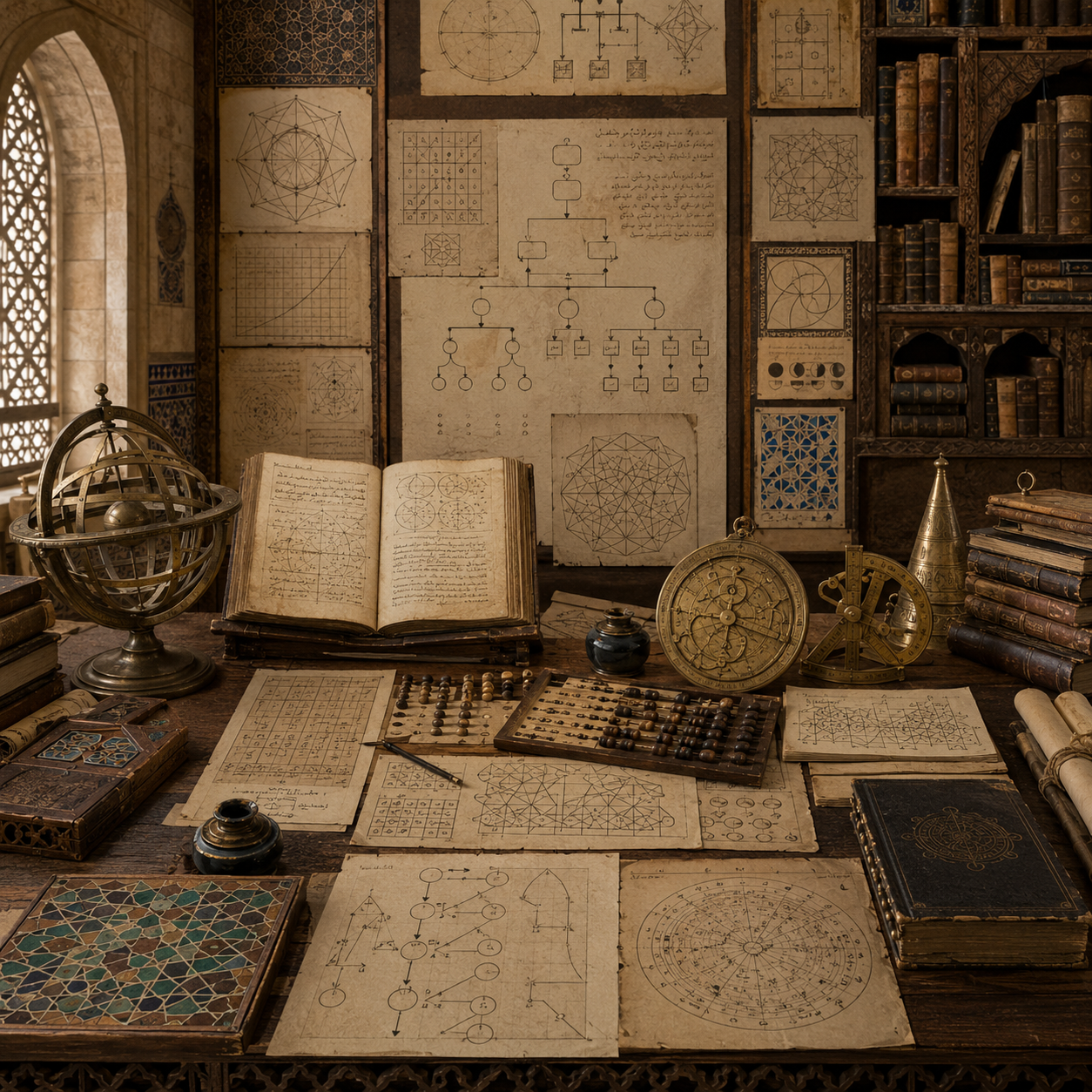
This article introduces the Islamic-world roots of algorithmic reasoning, al-Khwārizmī, algorism, algebra, Hindu-Arabic numerals, positional calculation, verbal procedures, practical mathematics, inheritance calculation, astronomy, geography, coordinates, cryptanalysis, automata, translation movements, Latin reception, and the need for careful origin stories. It frames the Islamic world not as an isolated source, but as a major intellectual crossroads where inherited techniques were translated, reorganized, extended, taught, and transmitted through procedural methods.
Why Islamic-World Roots Matter
Islamic-world roots matter because algorithmic reasoning did not emerge suddenly with modern computers. It developed through long traditions of numerical procedure, algebraic reduction, tabular prediction, astronomical calculation, practical mathematics, and mechanical sequencing. The Islamic world was one of the most important historical environments in which these traditions were translated, refined, systematized, and transmitted.
The relevance is not only etymological, though the etymology is powerful. The word algorithm traces through Latin forms of al-Khwārizmī’s name, while algebra traces through al-jabr in the title of his algebraic treatise. But the deeper significance is methodological. Islamic-world scholarship made procedures teachable: recipes for calculation, rules for solving equations, tables for prediction, methods for inheritance, commercial reckoning, astronomical computation, geographic coordinates, and cryptanalytic inference.
| Historical thread | Algorithmic significance | Modern connection |
|---|---|---|
| Al-Khwārizmī and algorism | Procedures for calculation using Hindu-Arabic numerals. | Algorithm as finite rule-governed procedure. |
| Al-jabr wa’l-muqābalah | Systematic solution of linear and quadratic problems. | Algebraic transformation and symbolic reasoning. |
| Astronomical tables | Tabular methods for prediction and calculation. | Lookup tables, computational models, and simulation outputs. |
| Practical mathematics | Procedures for trade, inheritance, surveying, and allocation. | Applied algorithms in institutions and public life. |
| Cryptanalysis | Pattern-based reasoning over letter frequencies. | Statistical inference, information analysis, and security. |
| Mechanical devices | Sequenced motion and automated action. | Control systems, robotics, and procedural automation. |
This history helps restore algorithmic reasoning to its broader intellectual setting: mathematics, language, craft, astronomy, law, administration, design, and transmission.
What Counts as Algorithmic Reasoning Before Computers?
Before computers, algorithmic reasoning appeared as rule-governed procedure. A procedure could be written verbally, memorized, tabulated, diagrammed, taught, copied, or embodied in an instrument. It did not need modern code. It needed a defined problem, a sequence of operations, transformations that could be repeated, and a criterion for completion.
Pre-modern algorithmic reasoning often took the form of calculation manuals, astronomical tables, legal or inheritance procedures, commercial reckoning methods, geometric constructions, cryptanalytic recipes, instrument instructions, and mechanical sequences. These procedures were not “algorithms” in the modern computer-science sense, but they were algorithmic in the broader sense: disciplined methods for getting from input to result.
| Pre-computer form | Algorithmic feature | Example use |
|---|---|---|
| Verbal rule | A sequence of instructions expressed in ordinary language. | Solving equations or distributing inheritance. |
| Numerical table | Precomputed values used for repeated calculation. | Astronomy, calendars, trigonometry, navigation. |
| Geometric construction | Stepwise transformation of shapes or magnitudes. | Surveying, algebraic demonstration, architecture. |
| Commercial recipe | Standardized method for exchange, profit, or partnership. | Trade, accounting, taxation. |
| Cryptanalytic method | Pattern inference over symbol frequencies. | Deciphering substitution ciphers. |
| Mechanical sequence | Ordered motions that produce repeatable action. | Automata, water clocks, programmable-like mechanisms. |
To study early algorithmic reasoning, we look for procedure, repeatability, transformation, representation, and institutional use.
Al-Khwārizmī and the Name Algorithm
Muḥammad ibn Mūsā al-Khwārizmī was a ninth-century mathematician and astronomer associated with Abbasid Baghdad. His name entered Latin mathematical culture through translations and adaptations of works on calculation. Over time, Latinized forms of his name became associated with methods of arithmetic using Hindu-Arabic numerals, and eventually with the term algorithm.
Al-Khwārizmī matters for algorithmic reasoning in at least three ways. First, his name became attached to procedural calculation. Second, his work helped transmit positional numerals and arithmetic methods into wider medieval circulation. Third, his algebraic treatise presented systematic methods for solving classes of problems.
| Al-Khwārizmī thread | Historical significance | Computational meaning |
|---|---|---|
| Name | Latinized forms contributed to the word algorithm. | Procedure becomes tied to a named mathematical tradition. |
| Numerals | Calculation with Hindu-Arabic positional notation circulated through algorism. | Representation transforms what calculation can become. |
| Algebra | Al-jabr wa’l-muqābalah organized equation solving by rule. | Problems can be classified and transformed systematically. |
| Astronomy | Tables and calculations connected mathematics to prediction. | Computation supports models of time, sky, and calendar. |
| Geography | Coordinate and measurement traditions linked mathematics to space. | Computation supports mapping and spatial representation. |
| Pedagogy | Procedural exposition made methods teachable. | Algorithms depend on communicable rules. |
The name algorithm therefore preserves a historical memory: computation is not only machinery, but also a tradition of written, taught, and transmitted procedure.
Algebra as Rule-Governed Problem Solving
Algebra in al-Khwārizmī’s tradition was not initially symbolic algebra in the modern notation-heavy sense. It was often expressed in words, organized around types of equations, transformations, and examples. The power of this tradition was procedural: identify the form of a problem, reduce it, balance it, complete it, and solve it.
The title phrase al-jabr wa’l-muqābalah refers to operations of restoration and balancing. In algorithmic terms, this is a transformation system. A problem is not solved by intuition alone. It is processed through a sequence of valid operations that preserve equivalence while making the solution accessible.
| Algebraic idea | Procedural meaning | Algorithmic analogy |
|---|---|---|
| Classifying problem types | Equations are grouped into solvable forms. | Pattern matching and case analysis. |
| Restoration | Negative or deficient terms are moved or completed. | Normalization of expression. |
| Balancing | Terms are compared, reduced, or equalized. | Invariant-preserving transformation. |
| Completion | Geometric or arithmetic procedures finish a square or form. | Structured transformation to solvable state. |
| Worked examples | Problems are taught by demonstration. | Executable examples and test cases. |
| General method | A rule applies to a class of problems. | Reusable algorithm. |
Algebra becomes algorithmic when it provides a disciplined path from problem form to solution.
Hindu-Arabic Numerals and Positional Calculation
The spread of Hindu-Arabic numerals and positional decimal calculation was one of the most important developments in the history of computation. Positional notation changes calculation because the value of a digit depends on its place. This makes arithmetic more systematic, compact, scalable, and teachable.
Islamic-world scholars and scribes played a major role in transmitting, adapting, and teaching these numerals and calculation methods. Latin European algorism later developed through translations and teaching traditions that contrasted written positional calculation with abacus-based reckoning.
| Representational shift | Why it mattered | Algorithmic effect |
|---|---|---|
| Place value | Digit value depends on position. | Arithmetic becomes rule-based over columns. |
| Zero as placeholder | Empty positions can be represented. | Large numbers become compact and manipulable. |
| Written calculation | Operations can be performed on paper. | Procedures become teachable and reproducible. |
| Decimal structure | Powers of ten organize magnitude. | Scaling and carrying become systematic. |
| Commercial use | Calculation supports exchange and accounting. | Algorithms enter daily institutional practice. |
| Transmission | Numerical methods circulate across languages. | Procedure crosses cultural and scholarly boundaries. |
Representations are not passive containers. They shape the procedures that become possible.
Algorithms Before Symbols
Modern readers often associate mathematics with symbolic notation, but many pre-modern algorithmic procedures were written verbally. A procedure could say, in effect: take the thing, multiply, divide, restore, balance, compare, subtract, or complete. This does not make the reasoning less algorithmic. It shows that algorithms can exist before modern notation.
Verbal procedures matter because they reveal computation as instruction. The step is not merely a calculation; it is a command in a structured process. Manuscripts taught readers how to act mathematically. They classified problems, gave examples, and described operations in ordinary language.
| Modern expectation | Pre-modern reality | Computational lesson |
|---|---|---|
| Symbolic formulas | Procedures often written in prose. | Algorithms can be linguistic before formal notation. |
| General variables | Unknowns named as things, roots, squares, or quantities. | Abstraction can be procedural before symbolic. |
| Code syntax | Instructions written as mathematical recipes. | Algorithmic structure is deeper than programming language. |
| Proof separated from computation | Demonstration and procedure often intertwined. | Reasoning and calculation develop together. |
| Universal notation | Methods circulated across languages and scripts. | Translation is part of computational history. |
| Machine execution | Human calculators executed procedures. | Algorithmic labor predates automation. |
An algorithm can begin as a disciplined instruction long before it becomes a symbolic expression or executable program.
Practical Calculation: Commerce, Inheritance, and Surveying
Algorithmic reasoning in the Islamic world was not confined to abstract mathematics. It appeared in practical calculation: trade, weights, measures, currency exchange, partnership, profit, inheritance, taxation, land surveying, architecture, and administration.
Inheritance calculation is especially important because legal shares can require precise allocation among multiple heirs under defined rules. Commercial calculation required proportional reasoning, exchange rates, debt, partnership, and profit distribution. Surveying required measurement, geometry, and area calculation. These domains made procedure socially consequential.
| Practical domain | Procedural need | Algorithmic significance |
|---|---|---|
| Commerce | Calculate exchange, profit, partnership, and debt. | Algorithms support market coordination. |
| Inheritance | Allocate shares under rule-governed constraints. | Algorithms support legal distribution. |
| Surveying | Measure land, area, distance, and boundaries. | Algorithms support spatial administration. |
| Taxation | Assess quantities, obligations, and rates. | Algorithms support state administration. |
| Architecture | Use geometric and proportional procedures. | Algorithms support design and construction. |
| Education | Teach repeatable methods to students and practitioners. | Algorithms become institutional knowledge. |
This practical layer reminds us that algorithmic reasoning has always been entangled with institutions, authority, and everyday life.
Astronomical Tables, Calendars, and Prediction
Astronomical calculation was one of the great procedural sciences of the medieval Islamic world. Astronomers used tables, instruments, geometry, observation, trigonometry, and models to calculate planetary positions, calendars, prayer times, qibla direction, eclipses, and other phenomena.
Tables are algorithmic because they encode computation in reusable form. A table can replace repeated calculation with lookup, interpolation, adjustment, and transformation. Astronomical tables also show how computation supports prediction: not simply calculating numbers, but organizing time, orientation, and celestial motion.
| Astronomical practice | Procedural feature | Computational analogy |
|---|---|---|
| Zīj tables | Precomputed values for repeated astronomical use. | Lookup tables and model outputs. |
| Interpolation | Estimate values between tabulated entries. | Numerical approximation. |
| Calendar calculation | Convert cycles into dates and observances. | Time computation and scheduling algorithms. |
| Qibla calculation | Determine direction from geographic position. | Spatial computation and spherical geometry. |
| Instrument use | Execute procedures with astrolabes and related devices. | Human-instrument computation. |
| Model correction | Adjust predictions against observation. | Calibration and model refinement. |
Astronomical computation shows algorithmic reasoning at the intersection of model, table, instrument, and observation.
Geography, Coordinates, and Computational Mapping
Geographic and cartographic traditions in the Islamic world developed methods for representing location, distance, direction, climate zones, routes, coordinates, and regions. These practices linked mathematics to spatial reasoning and administrative knowledge.
Coordinates are computational because they turn place into manipulable representation. Once locations can be represented numerically, they can be compared, transformed, tabulated, corrected, and mapped. This does not reduce geography to numbers; it creates a procedural layer for calculating with space.
| Geographic practice | Algorithmic feature | Modern connection |
|---|---|---|
| Coordinate lists | Represent places by numerical position. | Geospatial databases. |
| Route calculation | Estimate distance, direction, and travel relation. | Routing algorithms. |
| Map correction | Revise inherited geographic data. | Data cleaning and model updating. |
| Climate zones | Classify regions by environmental patterns. | Spatial classification. |
| Qibla direction | Compute orientation from location. | Spherical/geodesic calculation. |
| Administrative geography | Organize territory for governance and knowledge. | Spatial information systems. |
Computational mapping begins when space becomes representable through procedures that can be checked, corrected, and reused.
Al-Kindī and Cryptanalytic Reasoning
Al-Kindī is often associated with early systematic cryptanalysis, especially methods that use letter frequencies to attack substitution ciphers. This matters for algorithmic reasoning because cryptanalysis combines symbolic representation, statistical pattern, inference, and procedural testing.
Frequency analysis is a powerful conceptual leap. It treats text as data. It assumes that symbol patterns can reveal hidden structure. It compares observed frequencies with expected frequencies. It uses probabilistic clues to guide search. This is recognizably close to later forms of statistical reasoning, information analysis, and security practice.
| Cryptanalytic step | Procedural meaning | Computational analogy |
|---|---|---|
| Collect ciphertext | Gather encoded symbols. | Input data acquisition. |
| Count letters | Measure frequency distribution. | Feature extraction. |
| Compare patterns | Match observed counts to language patterns. | Statistical inference. |
| Hypothesize substitutions | Test candidate mappings. | Search over possible keys. |
| Check coherence | Validate whether decoded text makes sense. | Model evaluation. |
| Iterate | Revise guesses based on evidence. | Inference loop. |
Cryptanalysis shows algorithmic reasoning as pattern recognition under uncertainty.
Mechanical Procedure and Automata
Islamic-world mechanical traditions, including devices associated with the Banū Mūsā and al-Jazarī, show another dimension of procedural reasoning: sequenced physical action. Water clocks, automata, pumps, fountains, valves, gears, floats, cams, and feedback-like mechanisms translate design into repeated motion.
These devices are not digital computers, and they should not be described as if they were. Their relevance is different: they show how procedures can be embodied in material systems. A machine can store sequence in shape, constraint, flow, balance, timing, and mechanical relation.
| Mechanical feature | Procedural significance | Computational analogy |
|---|---|---|
| Sequenced motion | Actions occur in ordered steps. | Control flow. |
| Valves and flows | Water or air regulates behavior. | State-dependent control. |
| Feedback-like regulation | System behavior responds to internal conditions. | Control systems. |
| Programmable-like settings | Some mechanisms allow adjustable behavior. | Parameterization. |
| Mechanical memory | Device form encodes sequence or constraint. | Embodied instruction. |
| Demonstration and craft | Knowledge is transmitted through design and construction. | Procedural engineering. |
Mechanical automata show that algorithmic reasoning can be embodied in matter as well as written in manuscripts.
Translation Movements and Knowledge Transfer
The Islamic world was a major zone of translation and knowledge transfer. Greek, Syriac, Persian, Sanskrit, and other traditions entered Arabic scholarly culture, where they were translated, interpreted, debated, corrected, extended, and taught. Later, Arabic works were translated into Latin and other languages, influencing medieval European mathematics, astronomy, medicine, philosophy, and natural science.
Translation is not passive copying. It is intellectual work. Translators and scholars select terms, create vocabulary, reconcile systems, adapt examples, standardize methods, and make knowledge teachable in new contexts. Algorithmic reasoning often survives through this kind of transmission because procedures must be made intelligible to new readers.
| Transfer process | Algorithmic significance | Example effect |
|---|---|---|
| Translation | Procedures cross linguistic boundaries. | Greek, Indian, Persian, and Arabic mathematical exchange. |
| Terminology creation | New concepts require teachable language. | Algebraic vocabulary and computational terms. |
| Commentary | Methods are explained, corrected, or extended. | Procedures become pedagogical systems. |
| Compilation | Tables, examples, and rules are organized. | Computational knowledge becomes reference material. |
| Transmission | Methods move into new institutions. | Latin algorism, arithmetic texts, astronomical tables. |
| Adaptation | Procedures are changed for local uses. | Commerce, law, astronomy, education, administration. |
Algorithmic history is a history of transmission as much as invention.
From Baghdad to Latin Europe
The movement of mathematical knowledge from Arabic into Latin Europe was not a single event. It unfolded through translations, teaching traditions, manuscripts, commercial practice, universities, abacus schools, astronomical tables, and practical arithmetic. Works associated with al-Khwārizmī and later Arabic mathematical traditions became part of the broader medieval transmission of algorism and algebra.
Latin algorism taught calculation with Hindu-Arabic numerals. This was not immediately accepted everywhere; abacus traditions and Roman numerals remained important. But written positional calculation gradually reshaped European arithmetic, commerce, science, and education.
| Transmission layer | What moved | Computational significance |
|---|---|---|
| Arabic mathematical texts | Arithmetic, algebra, geometry, astronomy, and tables. | Procedures entered new scholarly settings. |
| Latin translations | Methods were recast for Latin readers. | Terminology and pedagogy changed. |
| Algorism texts | Rules for Hindu-Arabic numeral calculation. | Written arithmetic became more procedural. |
| Commercial arithmetic | Calculation for trade, currency, and accounting. | Algorithms entered everyday economic practice. |
| Astronomical tables | Tabular prediction and calendar calculation. | Computation supported science and timekeeping. |
| Educational institutions | Methods became teachable curricula. | Algorithmic reasoning became reproducible culture. |
The path from Baghdad to Latin Europe was not a simple handoff. It was a long process of translation, adaptation, resistance, and incorporation.
The Unknown, the Variable, and Mathematical Abstraction
The history of algebra is partly the history of how the unknown became manageable. Before modern symbolic notation, unknown quantities could be discussed through words such as thing, root, square, or amount. This linguistic abstraction allowed problems to be classified and transformed before symbolic variables became standard.
The move from concrete problem to unknown quantity is algorithmically important. It allows a problem to be represented, manipulated, reduced, and solved without knowing the answer in advance. That is one of the deepest ideas in computational reasoning: represent the unknown in a form that can be acted upon.
| Abstraction step | Meaning | Computational significance |
|---|---|---|
| Problem statement | A practical or mathematical question is posed. | Input is defined. |
| Unknown quantity | The missing value is represented. | State variable is introduced. |
| Equation form | Relations among quantities are structured. | Problem representation is formalized. |
| Transformation | Operations preserve equivalence. | Search space is reduced. |
| Solution | The unknown is determined. | Output is produced. |
| Verification | The result is checked against the problem. | Correctness is tested. |
The unknown becomes computational when it can be represented and transformed by rule.
Why Origin Stories Need Care
Origin stories can distort history if they search for a single heroic beginning. Algorithms do not have one origin. They have multiple lineages: numerical tables, administrative procedures, geometric constructions, legal calculations, astronomical models, commercial arithmetic, mechanical devices, symbolic transformations, logical systems, and eventually machine computation.
The Islamic world is central to the history of algorithmic reasoning, but not because it stands alone. Its importance lies in its role as a major scholarly, mathematical, linguistic, and practical crossroads. It translated earlier traditions, created new methods, organized procedures, developed algebra, transmitted numerals, advanced astronomical computation, produced cryptanalytic methods, and influenced later Latin European mathematics.
| Bad origin story | Why it misleads | Better framing |
|---|---|---|
| Algorithms began with one person. | It ignores older and parallel procedural traditions. | Al-Khwārizmī is central to the term and major traditions of algorism and algebra. |
| Islamic-world mathematics merely preserved Greek knowledge. | It ignores translation, critique, extension, invention, and pedagogy. | Scholars preserved, transformed, systematized, and transmitted knowledge. |
| Modern computing directly descends from medieval algebra. | It skips many intervening developments. | Medieval procedures are part of a long genealogy of computational reasoning. |
| Algorithm means only computer program. | It erases pre-computer procedural reasoning. | Algorithmic thinking includes finite procedures before code. |
| Etymology proves complete origin. | Words and practices have different histories. | Etymology is evidence of transmission, not total causality. |
| History is only celebratory. | It avoids complexity and context. | Good history is appreciative, precise, and critical. |
Careful origin stories honor the Islamic-world contribution more fully because they explain what actually happened: preservation, invention, synthesis, teaching, transmission, and transformation.
Examples of Islamic-World Algorithmic Reasoning
The examples below show how Islamic-world scholarship and practice contributed to procedural reasoning across mathematics, astronomy, cryptanalysis, geography, and mechanical design.
Al-Khwārizmī and algorism
Procedural arithmetic with Hindu-Arabic numerals helped shape later traditions of written calculation.
Al-jabr wa’l-muqābalah
Algebraic problem solving organized equations into types and solved them through rule-governed transformations.
Astronomical tables
Zīj traditions encoded computational astronomy into reusable tables for prediction, calendars, and observation.
Inheritance calculation
Legal distribution problems required precise, rule-governed allocation among heirs and shares.
Cryptanalysis
Frequency analysis treated text as data and used statistical patterns to infer hidden substitutions.
Geographic computation
Coordinate lists, direction calculation, and mapping practices transformed place into structured representation.
Mechanical automata
Water clocks, valves, gears, and automata embodied procedural sequences in material devices.
Translation movements
Arabic scholarly culture translated, transformed, taught, and transmitted mathematical procedures across regions.
Across these examples, algorithmic reasoning appears as structured procedure across text, table, number, instrument, and institution.
Mathematics, Computation, and Modeling
A simple procedural view of algorithmic reasoning can be written as:
Input \rightarrow Procedure \rightarrow Output
\]
Interpretation: A problem is transformed through a finite method into a result.
An algebraic transformation preserves equivalence while moving toward solution:
A = B \quad \Rightarrow \quad T(A) = T(B)
\]
Interpretation: Valid operations transform both sides while preserving the relation.
A tabular method can be represented as lookup plus adjustment:
Result \approx Table(x) + Correction(x)
\]
Interpretation: Astronomical and numerical tables allow repeated calculation by lookup, interpolation, and correction.
A cryptanalytic frequency method compares observed and expected symbol distributions:
\Delta = \sum_i |Observed_i – Expected_i|
\]
Interpretation: The smaller the difference between observed and expected distributions, the more plausible a candidate decoding may be.
These formulas do not claim that medieval scholars used modern notation. They translate procedural patterns into modern mathematical language so the computational structure becomes visible.
Python Workflow: Historical Algorithmic-Reasoning Map
The Python workflow below creates a dependency-light map of Islamic-world algorithmic reasoning themes. It scores each theme by procedural explicitness, transmission importance, practical application, representational importance, and modern computational resonance, then writes reproducible CSV and JSON outputs.
# islamic_world_roots_of_algorithmic_reasoning_map.py
# Dependency-light workflow for mapping historical roots of algorithmic reasoning.

from __future__ import annotations

from dataclasses import asdict, dataclass
from pathlib import Path
from statistics import mean
import csv
import json
from datetime import datetime, timezone

ARTICLE_ROOT = Path(__file__).resolve().parents[1]
TABLES = ARTICLE_ROOT / "outputs" / "tables"
JSON_DIR = ARTICLE_ROOT / "outputs" / "json"


@dataclass(frozen=True)
class HistoricalReasoningConfig:
    article: str = "islamic_world_roots_of_algorithmic_reasoning"
    high_significance_threshold: float = 0.78
    high_transmission_threshold: float = 0.80


def timestamp_utc() -> str:
    return datetime.now(timezone.utc).isoformat()


def write_csv(path: Path, rows: list[dict[str, object]]) -> None:
    path.parent.mkdir(parents=True, exist_ok=True)
    if not rows:
        path.write_text("", encoding="utf-8")
        return
    fieldnames = sorted({key for row in rows for key in row.keys()})
    with path.open("w", newline="", encoding="utf-8") as handle:
        writer = csv.DictWriter(handle, fieldnames=fieldnames, extrasaction="ignore")
        writer.writeheader()
        writer.writerows(rows)


def write_json(path: Path, payload: object) -> None:
    path.parent.mkdir(parents=True, exist_ok=True)
    path.write_text(json.dumps(payload, indent=2, sort_keys=True), encoding="utf-8")


def historical_themes() -> list[dict[str, object]]:
    return [
        {"theme_id": "al_khwarizmi_algorism", "procedural_explicitness": 0.92, "transmission_importance": 0.96, "practical_application": 0.88, "representation_importance": 0.94, "modern_resonance": 0.96},
        {"theme_id": "algebraic_transformation", "procedural_explicitness": 0.90, "transmission_importance": 0.92, "practical_application": 0.82, "representation_importance": 0.88, "modern_resonance": 0.92},
        {"theme_id": "astronomical_tables", "procedural_explicitness": 0.86, "transmission_importance": 0.84, "practical_application": 0.90, "representation_importance": 0.86, "modern_resonance": 0.84},
        {"theme_id": "cryptanalytic_frequency_analysis", "procedural_explicitness": 0.84, "transmission_importance": 0.72, "practical_application": 0.78, "representation_importance": 0.86, "modern_resonance": 0.90},
        {"theme_id": "practical_inheritance_and_commerce", "procedural_explicitness": 0.88, "transmission_importance": 0.76, "practical_application": 0.96, "representation_importance": 0.78, "modern_resonance": 0.82},
        {"theme_id": "mechanical_automata", "procedural_explicitness": 0.78, "transmission_importance": 0.70, "practical_application": 0.76, "representation_importance": 0.74, "modern_resonance": 0.80},
    ]


def score_theme(row: dict[str, object], config: HistoricalReasoningConfig) -> dict[str, object]:
    significance_score = mean([
        float(row["procedural_explicitness"]),
        float(row["transmission_importance"]),
        float(row["practical_application"]),
        float(row["representation_importance"]),
        float(row["modern_resonance"]),
    ])

    if significance_score >= config.high_significance_threshold and float(row["transmission_importance"]) >= config.high_transmission_threshold:
        interpretive_status = "core_algorithmic_reasoning_thread"
    elif significance_score >= config.high_significance_threshold:
        interpretive_status = "major_algorithmic_reasoning_thread"
    else:
        interpretive_status = "supporting_algorithmic_reasoning_thread"

    return {
        "theme_id": row["theme_id"],
        "procedural_explicitness": round(float(row["procedural_explicitness"]), 6),
        "transmission_importance": round(float(row["transmission_importance"]), 6),
        "practical_application": round(float(row["practical_application"]), 6),
        "representation_importance": round(float(row["representation_importance"]), 6),
        "modern_resonance": round(float(row["modern_resonance"]), 6),
        "significance_score": round(significance_score, 6),
        "interpretive_status": interpretive_status,
    }


def historical_cautions() -> list[dict[str, str]]:
    return [
        {"caution": "avoid_single_origin_story", "meaning": "Algorithms have multiple ancient and medieval lineages."},
        {"caution": "separate_etymology_from_total_origin", "meaning": "The word algorithm is tied to al-Khwarizmi, but procedural reasoning is broader."},
        {"caution": "avoid_preservation_only_framing", "meaning": "Islamic-world scholarship translated, extended, systematized, and transmitted knowledge."},
        {"caution": "avoid_modern_projection", "meaning": "Pre-modern procedures should not be described as modern computer programs."},
        {"caution": "recognize_translation_as_creation", "meaning": "Translation, commentary, pedagogy, and adaptation are forms of intellectual work."},
    ]


def main() -> None:
    config = HistoricalReasoningConfig()
    themes = historical_themes()
    scored = [score_theme(row, config) for row in themes]
    cautions = historical_cautions()

    summary = {
        "article": config.article,
        "timestamp_utc": timestamp_utc(),
        "themes_reviewed": len(scored),
        "core_threads": sum(1 for row in scored if row["interpretive_status"] == "core_algorithmic_reasoning_thread"),
        "major_threads": sum(1 for row in scored if row["interpretive_status"] == "major_algorithmic_reasoning_thread"),
        "supporting_threads": sum(1 for row in scored if row["interpretive_status"] == "supporting_algorithmic_reasoning_thread"),
        "mean_significance_score": round(mean(float(row["significance_score"]) for row in scored), 6),
        "cautions": len(cautions),
        "interpretation": "Islamic-world roots of algorithmic reasoning should be studied as procedural, translational, practical, representational, and institutional history without reducing algorithms to a single-origin story.",
    }

    write_csv(TABLES / "historical_themes.csv", themes)
    write_csv(TABLES / "historical_algorithmic_reasoning_map.csv", scored)
    write_csv(TABLES / "historical_cautions.csv", cautions)
    write_csv(TABLES / "historical_reasoning_summary.csv", [summary])

    write_json(JSON_DIR / "historical_reasoning_config.json", asdict(config))
    write_json(JSON_DIR / "historical_algorithmic_reasoning_map.json", scored)
    write_json(JSON_DIR / "historical_cautions.json", cautions)
    write_json(JSON_DIR / "historical_reasoning_summary.json", summary)

    print("Islamic-world roots of algorithmic reasoning map complete.")
    print(TABLES / "historical_reasoning_summary.csv")


if __name__ == "__main__":
    main()
This workflow turns a historical argument into a reproducible interpretive map: themes, procedural explicitness, transmission importance, practical application, representational importance, modern resonance, significance score, and historical caution are documented together.
R Workflow: Historical Theme Diagnostics
The R workflow reads the generated CSV outputs, summarizes historical algorithmic-reasoning themes, visualizes theme dimensions, and writes an additional diagnostic table.
# islamic_world_roots_of_algorithmic_reasoning_summary.R
args <- commandArgs(trailingOnly = FALSE)
file_arg <- grep("^--file=", args, value = TRUE)

if (length(file_arg) > 0) {
  script_path <- normalizePath(sub("^--file=", "", file_arg[1]), mustWork = TRUE)
  article_root <- normalizePath(file.path(dirname(script_path), ".."), mustWork = TRUE)
} else {
  article_root <- getwd()
}

setwd(article_root)

tables_dir <- file.path(article_root, "outputs", "tables")
figures_dir <- file.path(article_root, "outputs", "figures")
dir.create(tables_dir, recursive = TRUE, showWarnings = FALSE)
dir.create(figures_dir, recursive = TRUE, showWarnings = FALSE)

map_path <- file.path(tables_dir, "historical_algorithmic_reasoning_map.csv")
summary_path <- file.path(tables_dir, "historical_reasoning_summary.csv")

if (!file.exists(map_path)) {
  stop(paste("Missing", map_path, "Run the Python workflow first."))
}

theme_map <- read.csv(map_path, stringsAsFactors = FALSE)
summary <- read.csv(summary_path, stringsAsFactors = FALSE)

png(file.path(figures_dir, "historical_theme_dimensions.png"), width = 1200, height = 850)
score_matrix <- t(as.matrix(theme_map[, c("procedural_explicitness", "transmission_importance", "practical_application", "representation_importance", "modern_resonance")]))
barplot(score_matrix,
        beside = TRUE,
        names.arg = theme_map$theme_id,
        las = 2,
        ylim = c(0, 1),
        ylab = "Interpretive Score",
        main = "Islamic-World Roots of Algorithmic Reasoning: Historical Theme Dimensions")
legend("bottomright",
       legend = rownames(score_matrix),
       cex = 0.72,
       bty = "n")
grid()
dev.off()

png(file.path(figures_dir, "historical_significance_by_theme.png"), width = 1000, height = 750)
barplot(theme_map$significance_score,
        names.arg = theme_map$theme_id,
        las = 2,
        ylab = "Significance Score",
        main = "Historical Algorithmic-Reasoning Significance by Theme")
grid()
dev.off()

r_summary <- data.frame(
  themes_reviewed = summary$themes_reviewed[1],
  core_threads = summary$core_threads[1],
  major_threads = summary$major_threads[1],
  supporting_threads = summary$supporting_threads[1],
  mean_significance_score = summary$mean_significance_score[1],
  cautions = summary$cautions[1],
  diagnostic_note = "Islamic-world roots of algorithmic reasoning should be studied as procedural, translational, practical, representational, and institutional history without reducing algorithms to a single-origin story."
)

write.csv(r_summary, file.path(tables_dir, "r_historical_theme_diagnostic_summary.csv"), row.names = FALSE)
print(r_summary)
The R layer makes the interpretive structure visible: al-Khwārizmī, algorism, algebra, tables, cryptanalysis, practical calculation, mechanical procedure, transmission, and historical caution can be examined as related but distinct dimensions of algorithmic reasoning.
GitHub Repository
The companion repository contains reproducible workflows, synthetic interpretive data, outputs, calculators, documentation, and multilingual examples for this article.
Complete Code Repository
Companion article folder with Python, R, Julia, SQL, Haskell, C, C++, Fortran, Rust, Go, Java, TypeScript, Prolog, Racket, notebooks, documentation, synthetic teaching data, generated outputs, schemas, calculators, and Canvas-ready workflow artifacts for Islamic-world roots of algorithmic reasoning, al-Khwārizmī, algorism, algebra, Hindu-Arabic numerals, positional calculation, verbal procedures, practical mathematics, astronomical tables, cryptanalysis, mechanical devices, translation movements, Latin reception, origin-story cautions, and historical computational reasoning.
A Practical Method for Studying Algorithmic Origins
Responsible study of algorithmic origins should begin with transmission, representation, procedure, language, material culture, and institutional use. The question is not simply “Who invented the algorithm?” A better question is “How did rule-governed procedures for calculation, transformation, prediction, and reasoning develop, travel, and change across cultures?”
| Step | Historical action | Output |
|---|---|---|
| 1 | Define what kind of algorithmic reasoning is being studied: arithmetic, algebra, table, instrument, cryptanalysis, or mechanical sequence. | Conceptual scope. |
| 2 | Separate etymology from broader intellectual history. | Careful origin statement. |
| 3 | Identify earlier sources, translations, adaptations, and later transmissions. | Transmission map. |
| 4 | Examine procedure, not only result. | Stepwise method analysis. |
| 5 | Study representations: numerals, diagrams, tables, prose, instruments, and devices. | Representation record. |
| 6 | Connect practical use to scholarly method. | Institutional context. |
| 7 | Avoid modern projection while explaining modern relevance. | Historically cautious interpretation. |
| 8 | Place Islamic-world contributions within multi-civilizational history without minimizing their originality. | Balanced historical account. |
This method treats algorithmic history as a network of procedures, people, texts, translations, practices, and institutions.
Common Pitfalls
The history of Islamic-world algorithmic reasoning can be mishandled through oversimplification. Some accounts reduce Islamic-world scholarship to preservation. Others turn it into a single-origin myth. Some treat al-Khwārizmī as if he invented all algorithms. Others mention the etymology while ignoring algebra, astronomy, tables, practical mathematics, cryptanalysis, instruments, and transmission.
| Pitfall | Why it matters | Better practice |
|---|---|---|
| Single-origin myth | It erases older and parallel procedural traditions. | Frame Islamic-world roots as a major lineage in a broader history. |
| Preservation-only framing | It ignores creative transformation and systematization. | Emphasize translation, critique, extension, and pedagogy. |
| Modern projection | It calls medieval procedures computer programs. | Explain pre-computer algorithmic reasoning on its own terms. |
| Etymology-only treatment | It reduces history to the word algorithm. | Include numerals, algebra, tables, practice, and instruments. |
| Hero-only history | It isolates individuals from institutions and networks. | Study scholars, scribes, translators, teachers, and practitioners. |
| Civilizational competition | It turns shared intellectual history into a ranking exercise. | Study transmission, exchange, and transformation carefully. |
Careful history is not less impressive. It is more impressive because it shows the depth of the intellectual ecosystem.
Why This History Belongs in Computational Reasoning
Islamic-world roots of algorithmic reasoning belong in a serious account of algorithms because they show that computation is older, wider, and more human than modern software. The Islamic world contributed not only to the vocabulary of algorithm and algebra, but to traditions of procedural arithmetic, equation solving, astronomical tables, practical calculation, cryptanalytic inference, geographic computation, mechanical sequencing, and translation-driven knowledge transfer.
This history also changes how we think about algorithms today. Algorithms are not merely code. They are procedures embedded in representation systems, institutions, languages, instruments, and forms of judgment. They solve problems because someone has defined a problem, chosen representations, ordered operations, and decided what counts as a valid result.
The future of computational reasoning should remember this past. It should treat algorithms as cultural, mathematical, procedural, and institutional artifacts. AI belongs in the toolkit, not in control.
Related Articles
- Algorithms in Labor, Management, and Organizational Systems
- Al-Khwārizmī, Algorism, and the Procedural Imagination
- Al-Jabr wa’l-Muqābalah: Algebra as Rule-Governed Problem Solving
- Hindu-Arabic Numerals and the Transmission of Positional Calculation
- Why Origin Stories of Algorithms Need Care
Further Reading
- Berggren, J.L. (1986) Episodes in the Mathematics of Medieval Islam. New York: Springer.
- Rashed, R. (2009) Al-Khwārizmī: The Beginnings of Algebra. London: Saqi Books.
- Saliba, G. (2007) Islamic Science and the Making of the European Renaissance. Cambridge, MA: MIT Press.
- King, D.A. (1999) World-Maps for Finding the Direction and Distance to Mecca. Leiden: Brill.
- Hill, D.R. (1974) The Book of Knowledge of Ingenious Mechanical Devices. Dordrecht: D. Reidel.
- O’Connor, J.J. and Robertson, E.F. (1999) ‘Abu Ja’far Muhammad ibn Musa Al-Khwarizmi’. MacTutor History of Mathematics Archive, University of St Andrews.
- UNESCO (1990) The Arab World: Where Geometry and Algebra Intersect. Paris: UNESCO.
References
- Berggren, J.L. (1986) Episodes in the Mathematics of Medieval Islam. New York: Springer.
- Brentjes, S. and Hogendijk, J.P. (2003) ‘Notes on Thābit ibn Qurra and his rule for amicable numbers’, Historia Mathematica, 30(1), pp. 37–59.
- Hill, D.R. (1974) The Book of Knowledge of Ingenious Mechanical Devices. Dordrecht: D. Reidel.
- King, D.A. (1999) World-Maps for Finding the Direction and Distance to Mecca. Leiden: Brill.
- O’Connor, J.J. and Robertson, E.F. (1999) ‘Abu Ja’far Muhammad ibn Musa Al-Khwarizmi’. MacTutor History of Mathematics Archive, University of St Andrews. Available at: https://mathshistory.st-andrews.ac.uk/Biographies/Al-Khwarizmi/.
- Rashed, R. (2009) Al-Khwārizmī: The Beginnings of Algebra. London: Saqi Books.
- Saliba, G. (2007) Islamic Science and the Making of the European Renaissance. Cambridge, MA: MIT Press.
- UNESCO (1990) The Arab World: Where Geometry and Algebra Intersect. Paris: UNESCO. Available at: https://unesdoc.unesco.org/ark:/48223/pf0000084197.