
Last Updated June 20, 2026
Algorithms in scientific computing explain how mathematical, physical, statistical, engineering, ecological, economic, and computational models become executable investigations. Scientific computing uses algorithms to approximate equations, simulate systems, process data, solve numerical problems, test hypotheses, estimate uncertainty, visualize results, and reproduce computational experiments. It sits between theory and observation: mathematical relationships are translated into procedures that can be run, checked, compared, and interpreted.
Scientific computing matters because many scientific and technical problems cannot be solved through closed-form analysis alone. Climate models, fluid dynamics, epidemiological systems, optimization problems, molecular simulations, infrastructure models, geospatial analysis, large datasets, network dynamics, and machine-learning workflows all depend on numerical procedure. The algorithm becomes part of the scientific method.
This article introduces algorithms in scientific computing as a core form of computational reasoning. It explains approximation, discretization, floating-point arithmetic, solvers, convergence, stability, error analysis, computational experiments, reproducibility, validation, uncertainty, workflow design, and responsible interpretation.
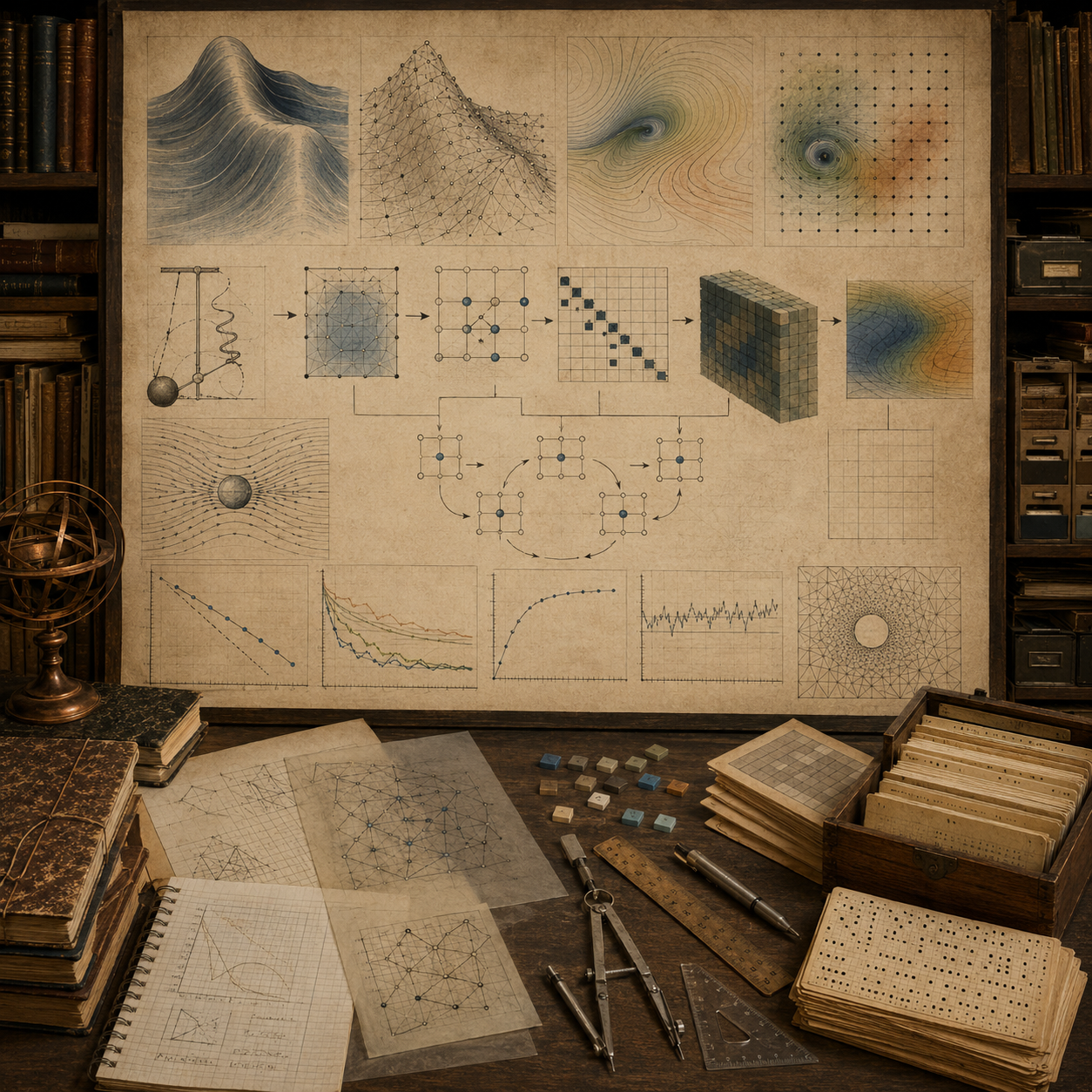
This article explains scientific computing, numerical algorithms, approximation, discretization, floating-point arithmetic, error analysis, convergence, stability, linear algebra, numerical integration, differential equation solvers, optimization, simulation, data processing, high-performance computing, reproducible workflows, computational experiments, validation, uncertainty quantification, visualization, governance, traceability, and representation risk. It emphasizes that scientific computing is not merely programming for science. It is a disciplined way of converting scientific reasoning into auditable computational procedure.
Why Scientific Computing Matters
Scientific computing matters because many important scientific questions cannot be answered by symbolic mathematics, direct observation, or laboratory experiment alone. A model may be known, but its implications may be too complex to derive by hand. A dataset may be available, but extracting signal may require algorithms. A system may be observable, but its future behavior may need simulation. An experiment may be impossible, but computational scenarios can still test structured assumptions.
Scientific computing gives researchers tools for approximation, simulation, comparison, optimization, uncertainty estimation, visualization, and reproducibility. It helps connect theory, data, and computation into a workflow that can be inspected and repeated.
| Scientific challenge | Computational response | Example |
|---|---|---|
| Equation cannot be solved exactly. | Use numerical approximation. | Finite differences, numerical integration, iterative solvers. |
| System evolves over time. | Use simulation or differential equation solvers. | Climate, disease, ecology, mechanical systems. |
| Data is large or noisy. | Use computational data processing. | Filtering, interpolation, statistical modeling, visualization. |
| Parameters are unknown. | Use estimation and optimization. | Calibration, inverse problems, least squares. |
| Uncertainty matters. | Use sampling, ensembles, and sensitivity analysis. | Monte Carlo, uncertainty propagation, scenario ranges. |
| Results must be checked. | Use reproducible workflows and validation. | Versioned code, metadata, tests, diagnostics, provenance. |
Scientific computing is not a shortcut around scientific reasoning. It is one of the ways scientific reasoning becomes operational.
Scientific Computing Defined
Scientific computing is the use of computational algorithms, numerical methods, data structures, software workflows, and computational experiments to support scientific and technical investigation. It includes numerical analysis, simulation, optimization, data processing, visualization, high-performance computing, uncertainty quantification, reproducible research, and scientific software engineering.
The field is broader than coding. It requires attention to mathematical formulation, algorithmic method, numerical error, data quality, model assumptions, validation evidence, computational efficiency, workflow transparency, and interpretation.
| Component | Role in scientific computing | Example |
|---|---|---|
| Mathematical model | Defines relationships, variables, constraints, and assumptions. | Differential equation, optimization problem, statistical model. |
| Numerical algorithm | Turns mathematical problem into computable procedure. | Euler method, Newton method, matrix factorization. |
| Data workflow | Processes observations, measurements, and simulation outputs. | Cleaning, interpolation, aggregation, transformation. |
| Simulation | Runs model behavior under time, uncertainty, or scenarios. | Monte Carlo, agent-based, system dynamics, PDE simulation. |
| Software implementation | Encodes model and algorithm into executable form. | Python, R, Julia, Fortran, C++, Rust, SQL workflows. |
| Evidence and validation | Checks whether results are meaningful for intended use. | Convergence tests, benchmark comparisons, empirical validation. |
Scientific computing is therefore both mathematical and practical. It asks not only what the equations say, but how they can be computed responsibly.
Algorithms as Scientific Procedure
In scientific computing, algorithms are not merely implementation details. They shape what can be known from a model. A numerical method determines how continuous relationships are approximated. A solver determines whether a system of equations can be evaluated efficiently. A sampling method determines how uncertainty is explored. A data pipeline determines what measurements enter the analysis. A visualization algorithm determines what patterns are made visible.
This means that algorithmic choices can affect scientific conclusions. Different step sizes, solvers, tolerances, random seeds, discretizations, convergence criteria, interpolation methods, or preprocessing rules can lead to different results.
| Algorithmic choice | Scientific consequence | Review question |
|---|---|---|
| Time step | Affects accuracy and stability. | Was step size tested for convergence? |
| Solver tolerance | Affects when iteration stops. | Is tolerance appropriate for the scientific question? |
| Discretization method | Affects how continuous space or time is represented. | Does the grid or mesh resolve important behavior? |
| Random seed | Affects reproducibility of stochastic workflows. | Are seeds documented and uncertainty summarized? |
| Data cleaning rule | Affects what observations enter the model. | Are exclusions and transformations justified? |
| Visualization scale | Affects interpretation of patterns. | Does the visual presentation show uncertainty and limits? |
Scientific computing requires algorithmic humility: computational results must be treated as outputs of chosen procedures, not as unmediated facts.
Approximation and Discretization
Approximation is central to scientific computing. Many continuous systems must be represented through finite numbers, finite grids, finite time steps, finite samples, and finite iterations. Discretization turns a continuous problem into a computable one by dividing time, space, or state into pieces.
Discretization is powerful, but it introduces error. A coarse grid may miss important variation. A large time step may create numerical instability. An approximation that works for one system may fail for another. Scientific computing therefore requires convergence tests, error estimates, and careful comparison across resolutions.
| Approximation method | What it does | Risk |
|---|---|---|
| Finite difference | Approximates derivatives through nearby values. | Step size affects truncation and roundoff error. |
| Finite element | Approximates fields over mesh elements. | Mesh quality and basis choices shape results. |
| Finite volume | Conserves quantities over control volumes. | Flux approximations affect stability and accuracy. |
| Quadrature | Approximates integrals through weighted sums. | Sampling points may miss sharp features. |
| Iterative approximation | Refines solution until convergence criterion is met. | May converge slowly, falsely, or to wrong solution. |
| Sampling approximation | Estimates quantities through sampled values. | Sampling error and bias must be quantified. |
Approximation is not a weakness of scientific computing. It is the central craft: representing the infinite, continuous, or complex in a finite, computable, and reviewable way.
Floating-Point Arithmetic, Error, and Stability
Computers represent real numbers approximately. Floating-point arithmetic allows scientific computation to handle a wide range of magnitudes, but it introduces rounding error, cancellation, overflow, underflow, and precision limits. Scientific computing must account for the fact that arithmetic on a computer is not identical to arithmetic over real numbers.
Numerical stability asks whether small errors remain controlled or grow into misleading results. A stable algorithm produces results that are not overly sensitive to small computational perturbations. An unstable method may produce plausible-looking but incorrect outputs.
| Error issue | Meaning | Scientific risk |
|---|---|---|
| Roundoff error | Finite precision cannot represent all real numbers exactly. | Small errors accumulate over many operations. |
| Truncation error | Approximation omits higher-order terms or continuous detail. | Model may be systematically inaccurate. |
| Cancellation | Subtracting nearly equal values loses significant digits. | Important signal can disappear numerically. |
| Overflow | Number exceeds representable range. | Computation fails or returns infinite values. |
| Underflow | Very small value becomes zero or loses precision. | Tiny but important quantities may vanish. |
| Instability | Small error grows rapidly. | Output may reflect algorithmic artifact rather than model behavior. |
A scientific computing workflow should treat numerical error as evidence to be measured, not as inconvenience to be ignored.
Linear Algebra and Solver Workflows
Linear algebra is one of the central languages of scientific computing. Systems of equations, least-squares problems, optimization routines, eigenvalue problems, graph computations, finite element models, machine-learning algorithms, and data transformations often rely on matrices and vectors.
Solver workflows convert mathematical problems into computational steps. Direct solvers may factor a matrix. Iterative solvers may repeatedly improve an approximate solution. Sparse solvers exploit structure. Preconditioners transform a problem into an easier one. Solver choice affects accuracy, speed, memory, scalability, and stability.
| Linear algebra task | Scientific use | Algorithmic concern |
|---|---|---|
| Solving linear systems | Equilibrium, discretized equations, regression, inverse problems. | Conditioning, stability, factorization, sparsity. |
| Least squares | Parameter estimation and model fitting. | Outliers, rank deficiency, regularization. |
| Eigenvalue problems | Stability, vibration, quantum systems, networks. | Convergence, scale, spectral sensitivity. |
| Sparse matrices | Large grids, networks, PDE discretizations. | Storage format, fill-in, solver selection. |
| Matrix factorization | Dimensionality reduction, decomposition, efficient solves. | Numerical stability and interpretability. |
| Preconditioning | Improves iterative solver performance. | Preconditioner must match problem structure. |
In scientific computing, linear algebra is not just notation. It is infrastructure for turning scientific models into efficient computation.
Numerical Integration and Differentiation
Numerical integration and differentiation are foundational operations in scientific computing. Integration estimates accumulated quantities: area, probability, mass, energy, exposure, cost, or total effect. Differentiation estimates rates of change, gradients, slopes, sensitivities, and local behavior.
Both operations are sensitive to resolution and noise. Numerical differentiation can amplify noise because it uses differences between nearby values. Numerical integration can smooth noise but may miss sharp changes if sampling is too coarse. Responsible workflows test step sizes, compare methods, and document expected accuracy.
| Operation | Scientific meaning | Computational issue |
|---|---|---|
| Numerical integration | Approximate accumulation over time, space, or probability. | Quadrature method and sampling resolution matter. |
| Numerical differentiation | Approximate rate of change or sensitivity. | Noise and step size can distort derivatives. |
| Gradient estimation | Supports optimization and sensitivity analysis. | Finite differences can be unstable in high dimensions. |
| Adaptive integration | Uses more effort where function changes sharply. | Error estimates must be reliable. |
| Cumulative quantities | Turn flows into stocks or totals. | Units and time resolution must be consistent. |
| Automatic differentiation | Computes derivatives through program structure. | Requires careful handling of model code and control flow. |
Integration and differentiation show how scientific computing converts change and accumulation into computable operations.
Differential Equation Solvers
Differential equations describe systems where change depends on current state, time, parameters, or external inputs. Scientific computing uses solvers to approximate these systems when analytic solutions are unavailable or insufficient. Ordinary differential equations model dynamic systems over time. Partial differential equations model fields varying over space and time.
Solvers must be chosen carefully. Explicit methods can be simple but unstable for stiff problems. Implicit methods can be more stable but computationally expensive. Adaptive methods adjust step size to control error. PDE solvers require discretization in space and time, boundary conditions, stability analysis, and convergence checks.
| Solver concept | Meaning | Review question |
|---|---|---|
| Initial condition | Starting state of the system. | Is the initial state measured, assumed, or estimated? |
| Boundary condition | Constraint at spatial or system boundary. | Does the boundary match physical or modeling context? |
| Explicit method | Computes next state from current state. | Is the step size stable? |
| Implicit method | Solves equations involving future state. | Is nonlinear solving reliable and efficient? |
| Adaptive step size | Changes step size based on estimated error. | Are tolerances appropriate for interpretation? |
| Stiffness | Multiple time scales make simple methods unstable or inefficient. | Is the solver suited to stiffness? |
Differential equation solvers illustrate a central lesson of scientific computing: model equations and computational methods must be judged together.
Simulation and Computational Experiments
Scientific computing often proceeds through computational experiments. A model is run under controlled assumptions, parameters, resolutions, boundary conditions, initial states, random seeds, or scenarios. Outputs are compared, summarized, visualized, and interpreted.
Computational experiments differ from laboratory experiments because the experiment occurs inside a model and algorithm. But they still require experimental discipline: clear purpose, controlled variation, reproducibility, documentation, interpretation, and uncertainty. Changing too many assumptions at once can make conclusions ambiguous. Running too few simulations can hide variability. Reporting only successful results can distort evidence.
| Computational experiment element | Purpose | Example |
|---|---|---|
| Baseline run | Establish reference behavior. | Default climate scenario, standard solver, control case. |
| Parameter sweep | Explore how outputs respond to inputs. | Vary diffusion coefficient, growth rate, or tolerance. |
| Resolution study | Test discretization effects. | Compare coarse, medium, and fine grids. |
| Stochastic ensemble | Represent randomness and uncertainty. | Monte Carlo runs with random inputs. |
| Stress test | Explore extreme or failure conditions. | High load, rare event, extreme parameter values. |
| Benchmark comparison | Compare against known solution or trusted reference. | Analytic solution, published benchmark, laboratory data. |
Computational experiments are strongest when they are designed like experiments rather than improvised runs.
Optimization and Parameter Estimation
Optimization appears throughout scientific computing. Researchers may seek parameters that best fit data, designs that minimize cost, controls that stabilize a system, policies that improve outcomes, or solutions that satisfy constraints. Parameter estimation turns observations into model values. Inverse problems ask which causes, parameters, or structures could have produced observed data.
Optimization is powerful but risky. A model can fit data for the wrong reason. An objective function may omit important values. A local optimum may be mistaken for a global solution. Regularization may improve stability but change interpretation. Parameter uncertainty may be hidden behind one best estimate.
| Optimization task | Scientific use | Risk |
|---|---|---|
| Least-squares fitting | Estimate parameters from observed data. | Outliers and model misspecification can distort results. |
| Maximum likelihood | Estimate parameters under probabilistic assumptions. | Distributional assumptions may be wrong. |
| Constrained optimization | Find best feasible solution. | Constraints may omit real-world limits. |
| Regularization | Stabilize estimation or reduce overfitting. | Penalty changes the meaning of solution. |
| Gradient-based optimization | Use derivatives to improve solution. | May stall, diverge, or find local optimum. |
| Global search | Explore broader solution space. | Computationally expensive and still approximate. |
Optimization in scientific computing should always ask: best according to what objective, under what assumptions, and with what uncertainty?
Data Processing and Scientific Workflows
Scientific computing often begins and ends with data. Observations must be collected, cleaned, transformed, aligned, interpolated, aggregated, validated, and documented. Simulation outputs must be stored, summarized, visualized, compared, and archived. Models need input files, parameters, metadata, scripts, notebooks, and environment records.
A scientific workflow is the structured path from question to result. It includes data sources, preprocessing, model setup, algorithm selection, execution, outputs, diagnostics, interpretation, and communication. Workflow design affects reproducibility and trust.
| Workflow layer | Purpose | Risk if undocumented |
|---|---|---|
| Data source | Shows where evidence came from. | Results cannot be traced or evaluated. |
| Preprocessing | Transforms raw data into analytic input. | Cleaning choices become invisible. |
| Parameter file | Records assumptions and configuration. | Runs cannot be reproduced. |
| Code version | Identifies implementation used. | Outputs cannot be linked to procedure. |
| Environment | Records libraries, compilers, platforms, and dependencies. | Results may change across machines. |
| Output archive | Preserves generated tables, figures, and logs. | Interpretation cannot be audited later. |
Scientific computing is strongest when code, data, parameters, outputs, and interpretation remain connected.
Convergence, Validation, and Computational Evidence
Convergence asks whether computational results approach a stable answer as resolution improves, iterations continue, or sampling increases. Validation asks whether the model and computation are fit for their intended scientific purpose. Verification asks whether the code correctly implements the intended model and algorithm.
These checks answer different questions. A computation can converge to the wrong model. A model can be valid for one context and invalid for another. A code implementation can pass tests but still be used with inappropriate parameters or interpretation.
| Evidence practice | Question | Example |
|---|---|---|
| Code verification | Does the implementation match the intended algorithm? | Unit tests, invariant checks, benchmark problems. |
| Solution verification | How large is numerical error for this run? | Grid refinement, residual checks, tolerance review. |
| Convergence test | Do outputs stabilize as resolution improves? | Run with multiple grid sizes or time steps. |
| Validation | Does the model fit the intended scientific use? | Compare to observations, experiments, theory, expert review. |
| Benchmarking | Does the method reproduce known cases? | Analytic solution or standard test problem. |
| Uncertainty review | How much confidence should outputs receive? | Sensitivity analysis, ensembles, confidence intervals. |
Computational evidence is not just a result. It is the chain of checks that makes the result interpretable.
Uncertainty Quantification and Sensitivity
Scientific computing must communicate uncertainty. Input data may be noisy. Parameters may be estimated. Model structures may be incomplete. Numerical methods may introduce error. Random sampling may vary across runs. External conditions may shift. Uncertainty quantification attempts to measure, propagate, and communicate these uncertainties.
Sensitivity analysis asks which inputs or assumptions most influence outputs. It helps identify which parameters require better evidence, which conclusions are robust, and which outputs are fragile. Without sensitivity analysis, a scientific computation can appear precise while depending heavily on uncertain assumptions.
| Uncertainty type | Source | Computational response |
|---|---|---|
| Measurement uncertainty | Imperfect observation or instrument limits. | Error models, confidence intervals, propagation. |
| Parameter uncertainty | Estimated or assumed model values. | Parameter sweeps, Bayesian inference, Monte Carlo. |
| Numerical uncertainty | Discretization, solver tolerance, floating-point error. | Convergence study, residuals, error estimates. |
| Structural uncertainty | Alternative model forms or omitted mechanisms. | Model comparison and ensembles. |
| Scenario uncertainty | Future conditions are unknown. | Scenario analysis and stress testing. |
| Interpretive uncertainty | Outputs may be misunderstood or overused. | Clear limits, documentation, and governance review. |
Scientific computing should make uncertainty visible enough for judgment, not hide it behind polished numerical output.
Reproducibility, Provenance, and Governance
Reproducibility is central to scientific computing because computational results depend on code, data, parameters, libraries, hardware, random seeds, compilers, operating systems, and workflow order. A result that cannot be reproduced is difficult to trust. A result that cannot be traced is difficult to audit. A result that cannot be explained is difficult to use responsibly.
Provenance records where data came from, how it was transformed, which code ran, what parameters were used, what environment executed the workflow, and what outputs were produced. Governance defines who approves, reviews, publishes, modifies, and interprets computational results.
| Reproducibility element | Purpose | Example |
|---|---|---|
| Version control | Tracks changes to code and documentation. | Git commit linked to output folder. |
| Data provenance | Records source and transformation of data. | Raw data, cleaned data, transformation log. |
| Parameter record | Documents assumptions used in a run. | JSON, YAML, CSV, or database table. |
| Environment record | Captures dependencies and runtime conditions. | Lockfile, container, compiler version, session info. |
| Random seed | Supports repeatability of stochastic computation. | Seed stored with run metadata. |
| Output manifest | Links results to inputs and code. | Tables, figures, logs, hashes, timestamps. |
Scientific computing governance treats computational output as evidence that must be traceable, reproducible, interpretable, and accountable.
Representation Risk
Representation risk appears when scientific computing outputs are mistaken for direct reality rather than model-conditioned, algorithm-conditioned, data-conditioned, and workflow-conditioned results. A simulation map, convergence plot, estimate, optimization result, or uncertainty band can look authoritative while hiding assumptions.
Scientific computing can also erase important distinctions. A grid may smooth local variation. A model may aggregate heterogeneous populations. A solver may produce a number without showing instability. A visualization may hide uncertainty. A workflow may encode value judgments in parameter choices. A performance metric may become more visible than the scientific question.
| Representation risk | How it appears | Review response |
|---|---|---|
| Output equals truth | Computed result is treated as direct fact. | State model, data, algorithm, and uncertainty conditions. |
| Numerical precision equals certainty | Many decimal places imply unwarranted confidence. | Report meaningful precision and error estimates. |
| Convergence equals validity | Stable numerical result is treated as scientifically correct. | Separate numerical convergence from model validation. |
| Visualization equals evidence | Polished graphics substitute for diagnostics. | Show methods, uncertainty, and validation checks. |
| Scale erasure | Grid or aggregation hides local effects. | Review resolution, heterogeneity, and subgroup patterns. |
| Workflow opacity | Code and data transformations hide assumptions. | Preserve provenance, metadata, and reproducible scripts. |
Scientific computing should clarify how results were produced, not let computation conceal the assumptions behind them.
Examples of Algorithms in Scientific Computing
The examples below show how algorithms support scientific reasoning across modeling, simulation, numerical analysis, data processing, uncertainty, and reproducible workflows.
Finite-difference diffusion
A continuous diffusion equation is approximated on a grid and advanced through time steps.
ODE simulation
A dynamic system is solved numerically when analytic solutions are unavailable or inconvenient.
Monte Carlo uncertainty
Random sampling estimates expected values, risk ranges, or uncertainty propagation.
Matrix solver workflow
A large sparse system is solved using factorization or iterative methods.
Parameter calibration
Model parameters are estimated by comparing simulation outputs with observed data.
Resolution study
A computation is repeated at different grid sizes to check convergence.
Scientific data pipeline
Measurements are cleaned, transformed, validated, and linked to model inputs.
Computational experiment
Scenarios, parameters, solver settings, and outputs are organized as reproducible evidence.
Across these examples, scientific computing turns models and data into executable inquiry.
Mathematics, Computation, and Modeling
A scientific computing workflow can be represented as a translation from model to computable approximation:
\mathcal{M} \xrightarrow{\text{discretize}} \mathcal{M}_h \xrightarrow{\text{algorithm}} \hat{x}_h
\]
Interpretation: A mathematical model \(\mathcal{M}\) is discretized into a computable model \(\mathcal{M}_h\), then solved to produce an approximate result \(\hat{x}_h\).
A finite-difference approximation to a derivative can be represented as:
f'(x) \approx \frac{f(x+h)-f(x)}{h}
\]
Interpretation: A derivative is approximated by a finite change over a small step \(h\), introducing truncation and roundoff considerations.
A numerical integration rule can be represented as:
\int_a^b f(x)\,dx \approx \sum_{i=1}^{n} w_i f(x_i)
\]
Interpretation: An integral is approximated as a weighted sum of function evaluations.
A generic iterative solver can be represented as:
x^{(k+1)} = G(x^{(k)})
\]
Interpretation: An approximate solution is updated repeatedly until a convergence condition is met.
A convergence test can be represented as:
\|x^{(k+1)} – x^{(k)}\| < \varepsilon
\]
Interpretation: Iteration stops when successive approximations differ by less than a chosen tolerance \(\varepsilon\).
A numerical error decomposition can be represented as:
E_{\text{total}} = E_{\text{model}} + E_{\text{discretization}} + E_{\text{roundoff}} + E_{\text{data}} + E_{\text{interpretation}}
\]
Interpretation: Total error can come from the model, discretization, finite precision, data, and interpretation rather than from one source alone.
These formulas show how scientific computing connects mathematical models, approximation, algorithms, numerical error, and interpretation.
Python Workflow: Scientific Computing Algorithm Audit
The Python workflow below creates a dependency-light scientific computing audit. It demonstrates finite-difference derivative approximation, numerical integration, Euler and Runge-Kutta ODE solvers, convergence checks, Monte Carlo estimation, and reproducible output tables. It avoids external dependencies so the workflow can run in a basic Python environment.
# algorithms_in_scientific_computing_audit.py
# Dependency-light workflow for numerical approximation, convergence, and scientific computing review.

from __future__ import annotations

from dataclasses import dataclass, asdict
from pathlib import Path
from statistics import mean, pstdev
import csv
import json
import math
import random

ARTICLE_ROOT = Path(__file__).resolve().parents[1]
TABLES = ARTICLE_ROOT / "outputs" / "tables"
JSON_DIR = ARTICLE_ROOT / "outputs" / "json"


@dataclass(frozen=True)
class ApproximationResult:
    method: str
    step_size: float
    estimate: float
    true_value: float
    absolute_error: float
    interpretation: str


def f(x: float) -> float:
    return math.sin(x)


def df_true(x: float) -> float:
    return math.cos(x)


def derivative_forward(x: float, h: float) -> float:
    return (f(x + h) - f(x)) / h


def derivative_central(x: float, h: float) -> float:
    return (f(x + h) - f(x - h)) / (2.0 * h)


def derivative_study(x: float = 1.0) -> list[dict[str, object]]:
    rows: list[dict[str, object]] = []
    true_value = df_true(x)

    for h in [1e-1, 1e-2, 1e-3, 1e-4, 1e-5]:
        for method_name, estimator in [
            ("forward_difference", derivative_forward),
            ("central_difference", derivative_central),
        ]:
            estimate = estimator(x, h)
            rows.append(asdict(ApproximationResult(
                method=method_name,
                step_size=h,
                estimate=round(estimate, 12),
                true_value=round(true_value, 12),
                absolute_error=round(abs(estimate - true_value), 12),
                interpretation="Derivative approximation error depends on method and step size."
            )))

    return rows


def integrate_trapezoid(a: float, b: float, n: int) -> float:
    h = (b - a) / n
    total = 0.5 * (f(a) + f(b))

    for i in range(1, n):
        total += f(a + i * h)

    return h * total


def integration_study() -> list[dict[str, object]]:
    rows: list[dict[str, object]] = []
    a = 0.0
    b = math.pi
    true_value = 2.0

    for n in [10, 20, 50, 100, 200, 500]:
        estimate = integrate_trapezoid(a, b, n)
        rows.append({
            "method": "trapezoid_rule",
            "interval_start": a,
            "interval_end": b,
            "subintervals": n,
            "estimate": round(estimate, 12),
            "true_value": true_value,
            "absolute_error": round(abs(estimate - true_value), 12),
            "interpretation": "Numerical integration improves as resolution increases for this smooth example."
        })

    return rows


def ode_rhs(t: float, y: float, rate: float = 0.4) -> float:
    return rate * y


def euler_solver(y0: float, t0: float, t_end: float, h: float) -> list[dict[str, float]]:
    rows: list[dict[str, float]] = []
    t = t0
    y = y0

    while t <= t_end + 1e-12:
        rows.append({"time": round(t, 10), "value": y})
        y = y + h * ode_rhs(t, y)
        t += h

    return rows


def rk4_solver(y0: float, t0: float, t_end: float, h: float) -> list[dict[str, float]]:
    rows: list[dict[str, float]] = []
    t = t0
    y = y0

    while t <= t_end + 1e-12:
        rows.append({"time": round(t, 10), "value": y})

        k1 = ode_rhs(t, y)
        k2 = ode_rhs(t + 0.5 * h, y + 0.5 * h * k1)
        k3 = ode_rhs(t + 0.5 * h, y + 0.5 * h * k2)
        k4 = ode_rhs(t + h, y + h * k3)

        y = y + (h / 6.0) * (k1 + 2 * k2 + 2 * k3 + k4)
        t += h

    return rows


def ode_convergence_study() -> list[dict[str, object]]:
    rows: list[dict[str, object]] = []
    y0 = 1.0
    t0 = 0.0
    t_end = 5.0
    rate = 0.4
    true_final = y0 * math.exp(rate * t_end)

    for h in [0.5, 0.25, 0.125, 0.0625]:
        for method_name, solver in [("euler", euler_solver), ("rk4", rk4_solver)]:
            trajectory = solver(y0, t0, t_end, h)
            final_value = trajectory[-1]["value"]
            rows.append({
                "method": method_name,
                "step_size": h,
                "final_estimate": round(final_value, 12),
                "true_final": round(true_final, 12),
                "absolute_error": round(abs(final_value - true_final), 12),
                "trajectory_points": len(trajectory),
                "interpretation": "ODE solver accuracy depends on method order and time-step size."
            })

    return rows


def monte_carlo_pi(samples: int, seed: int) -> dict[str, object]:
    rng = random.Random(seed)
    inside = 0

    for _ in range(samples):
        x = rng.random()
        y = rng.random()
        if x * x + y * y <= 1.0:
            inside += 1

    estimate = 4.0 * inside / samples

    return {
        "samples": samples,
        "seed": seed,
        "pi_estimate": round(estimate, 10),
        "true_pi": round(math.pi, 10),
        "absolute_error": round(abs(estimate - math.pi), 10),
    }


def monte_carlo_study() -> tuple[list[dict[str, object]], list[dict[str, object]]]:
    rows: list[dict[str, object]] = []
    summary_rows: list[dict[str, object]] = []

    for samples in [100, 1000, 10000]:
        estimates = []

        for seed in range(1, 21):
            result = monte_carlo_pi(samples, seed)
            rows.append(result)
            estimates.append(float(result["pi_estimate"]))

        summary_rows.append({
            "samples": samples,
            "runs": len(estimates),
            "mean_estimate": round(mean(estimates), 10),
            "std_estimate": round(pstdev(estimates), 10),
            "mean_absolute_error": round(mean(abs(value - math.pi) for value in estimates), 10),
            "interpretation": "Monte Carlo error generally decreases as sample size increases, but individual runs vary."
        })

    return rows, summary_rows


def workflow_review_checklist() -> list[dict[str, object]]:
    checks = [
        {
            "check": "mathematical_problem_defined",
            "status": "complete",
            "question": "Is the mathematical problem stated before the algorithm is chosen?"
        },
        {
            "check": "algorithm_choice_documented",
            "status": "complete",
            "question": "Is the numerical method documented and justified?"
        },
        {
            "check": "step_size_or_resolution_tested",
            "status": "complete",
            "question": "Has resolution or step-size sensitivity been checked?"
        },
        {
            "check": "floating_point_risk_reviewed",
            "status": "partial",
            "question": "Have roundoff, cancellation, overflow, and precision limits been considered?"
        },
        {
            "check": "convergence_checked",
            "status": "complete",
            "question": "Does the workflow test convergence or stability where relevant?"
        },
        {
            "check": "validation_evidence_linked",
            "status": "partial",
            "question": "Are results compared with theory, benchmark, data, or expert expectations?"
        },
        {
            "check": "uncertainty_communicated",
            "status": "complete",
            "question": "Are uncertainty, variability, or error estimates communicated?"
        },
        {
            "check": "workflow_reproducible",
            "status": "complete",
            "question": "Are scripts, parameters, outputs, and seeds preserved?"
        },
    ]

    return checks


def write_csv(path: Path, rows: list[dict[str, object]]) -> None:
    path.parent.mkdir(parents=True, exist_ok=True)
    if not rows:
        path.write_text("", encoding="utf-8")
        return

    fieldnames = sorted({key for row in rows for key in row.keys()})

    with path.open("w", newline="", encoding="utf-8") as handle:
        writer = csv.DictWriter(handle, fieldnames=fieldnames, extrasaction="ignore")
        writer.writeheader()
        writer.writerows(rows)


def write_json(path: Path, payload: object) -> None:
    path.parent.mkdir(parents=True, exist_ok=True)
    path.write_text(json.dumps(payload, indent=2, sort_keys=True), encoding="utf-8")


def summarize(
    derivative_rows: list[dict[str, object]],
    integration_rows: list[dict[str, object]],
    ode_rows: list[dict[str, object]],
    mc_summary_rows: list[dict[str, object]],
    checklist_rows: list[dict[str, object]],
) -> dict[str, object]:
    best_derivative = min(derivative_rows, key=lambda row: float(row["absolute_error"]))
    best_integral = min(integration_rows, key=lambda row: float(row["absolute_error"]))
    best_ode = min(ode_rows, key=lambda row: float(row["absolute_error"]))
    review_attention = sum(1 for row in checklist_rows if row["status"] in {"partial", "needs_review"})

    return {
        "derivative_methods_reviewed": len(set(row["method"] for row in derivative_rows)),
        "integration_resolutions_reviewed": len(integration_rows),
        "ode_solver_runs": len(ode_rows),
        "monte_carlo_sample_levels": len(mc_summary_rows),
        "best_derivative_method": best_derivative["method"],
        "best_derivative_step_size": best_derivative["step_size"],
        "best_integration_subintervals": best_integral["subintervals"],
        "best_ode_method": best_ode["method"],
        "best_ode_step_size": best_ode["step_size"],
        "review_items_needing_attention": review_attention,
        "interpretation": "Scientific computing requires attention to approximation, discretization, finite precision, solver behavior, convergence, uncertainty, validation, reproducibility, and interpretation."
    }


def main() -> None:
    derivative_rows = derivative_study()
    integration_rows = integration_study()
    ode_rows = ode_convergence_study()
    mc_rows, mc_summary_rows = monte_carlo_study()
    checklist_rows = workflow_review_checklist()
    summary = summarize(derivative_rows, integration_rows, ode_rows, mc_summary_rows, checklist_rows)

    write_csv(TABLES / "finite_difference_derivative_study.csv", derivative_rows)
    write_csv(TABLES / "numerical_integration_study.csv", integration_rows)
    write_csv(TABLES / "ode_convergence_study.csv", ode_rows)
    write_csv(TABLES / "monte_carlo_pi_runs.csv", mc_rows)
    write_csv(TABLES / "monte_carlo_pi_summary.csv", mc_summary_rows)
    write_csv(TABLES / "scientific_computing_workflow_checklist.csv", checklist_rows)
    write_csv(TABLES / "scientific_computing_audit_summary.csv", [summary])

    write_json(JSON_DIR / "finite_difference_derivative_study.json", derivative_rows)
    write_json(JSON_DIR / "numerical_integration_study.json", integration_rows)
    write_json(JSON_DIR / "ode_convergence_study.json", ode_rows)
    write_json(JSON_DIR / "monte_carlo_pi_runs.json", mc_rows)
    write_json(JSON_DIR / "monte_carlo_pi_summary.json", mc_summary_rows)
    write_json(JSON_DIR / "scientific_computing_workflow_checklist.json", checklist_rows)
    write_json(JSON_DIR / "scientific_computing_audit_summary.json", summary)

    print("Algorithms in scientific computing audit complete.")
    print(TABLES / "scientific_computing_audit_summary.csv")


if __name__ == "__main__":
    main()
This workflow treats scientific computing as a reviewable computational process: approximate carefully, test convergence, compare methods, preserve outputs, and document uncertainty.
R Workflow: Numerical Workflow Summary
The R workflow reads the Python-generated scientific computing tables and creates summary outputs and visualizations using base R. It compares derivative error, integration convergence, ODE solver error, Monte Carlo uncertainty, and workflow checklist status.
# algorithms_in_scientific_computing_summary.R
# Base R workflow for summarizing numerical approximation, convergence, and scientific computing outputs.

args <- commandArgs(trailingOnly = FALSE)
file_arg <- grep("^--file=", args, value = TRUE)

if (length(file_arg) > 0) {
  script_path <- normalizePath(sub("^--file=", "", file_arg[1]), mustWork = TRUE)
  article_root <- normalizePath(file.path(dirname(script_path), ".."), mustWork = TRUE)
} else {
  article_root <- getwd()
}

setwd(article_root)

tables_dir <- file.path(article_root, "outputs", "tables")
figures_dir <- file.path(article_root, "outputs", "figures")

if (!dir.exists(tables_dir)) {
  dir.create(tables_dir, recursive = TRUE)
}

if (!dir.exists(figures_dir)) {
  dir.create(figures_dir, recursive = TRUE)
}

derivative_path <- file.path(tables_dir, "finite_difference_derivative_study.csv")

if (!file.exists(derivative_path)) {
  stop(paste("Missing", derivative_path, "Run the Python workflow first."))
}

derivative_data <- read.csv(derivative_path, stringsAsFactors = FALSE)

png(
  file.path(figures_dir, "finite_difference_derivative_error.png"),
  width = 1300,
  height = 850
)

plot(
  derivative_data$step_size,
  derivative_data$absolute_error,
  log = "xy",
  pch = 19,
  xlab = "Step size",
  ylab = "Absolute error",
  main = "Finite Difference Derivative Error"
)

grid()
dev.off()

integration_path <- file.path(tables_dir, "numerical_integration_study.csv")

if (file.exists(integration_path)) {
  integration_data <- read.csv(integration_path, stringsAsFactors = FALSE)

  png(
    file.path(figures_dir, "numerical_integration_error.png"),
    width = 1300,
    height = 850
  )

  plot(
    integration_data$subintervals,
    integration_data$absolute_error,
    log = "xy",
    type = "b",
    pch = 19,
    xlab = "Subintervals",
    ylab = "Absolute error",
    main = "Numerical Integration Error"
  )

  grid()
  dev.off()
}

ode_path <- file.path(tables_dir, "ode_convergence_study.csv")

if (file.exists(ode_path)) {
  ode_data <- read.csv(ode_path, stringsAsFactors = FALSE)

  png(
    file.path(figures_dir, "ode_solver_error_by_step_size.png"),
    width = 1400,
    height = 850
  )

  plot(
    ode_data$step_size,
    ode_data$absolute_error,
    log = "xy",
    pch = 19,
    xlab = "Step size",
    ylab = "Absolute error",
    main = "ODE Solver Error by Step Size"
  )

  grid()
  dev.off()
}

mc_path <- file.path(tables_dir, "monte_carlo_pi_summary.csv")

if (file.exists(mc_path)) {
  mc_summary <- read.csv(mc_path, stringsAsFactors = FALSE)

  png(
    file.path(figures_dir, "monte_carlo_pi_error_by_samples.png"),
    width = 1300,
    height = 850
  )

  plot(
    mc_summary$samples,
    mc_summary$mean_absolute_error,
    log = "xy",
    type = "b",
    pch = 19,
    xlab = "Samples",
    ylab = "Mean absolute error",
    main = "Monte Carlo Error by Sample Size"
  )

  grid()
  dev.off()
}

checklist_path <- file.path(tables_dir, "scientific_computing_workflow_checklist.csv")

if (file.exists(checklist_path)) {
  checklist_data <- read.csv(checklist_path, stringsAsFactors = FALSE)
  status_counts <- table(checklist_data$status)

  png(
    file.path(figures_dir, "scientific_computing_checklist_status.png"),
    width = 1000,
    height = 750
  )

  barplot(
    status_counts,
    ylim = c(0, max(status_counts) + 1),
    ylab = "Count",
    main = "Scientific Computing Workflow Checklist Status"
  )

  grid()
  dev.off()
}

summary_path <- file.path(tables_dir, "scientific_computing_audit_summary.csv")
summary_data <- read.csv(summary_path, stringsAsFactors = FALSE)

r_summary <- data.frame(
  workflow_summary_rows = nrow(summary_data),
  best_ode_method = summary_data$best_ode_method[1],
  best_derivative_method = summary_data$best_derivative_method[1],
  review_items_needing_attention = summary_data$review_items_needing_attention[1]
)

write.csv(
  r_summary,
  file.path(tables_dir, "r_scientific_computing_summary.csv"),
  row.names = FALSE
)

print(r_summary)
This workflow helps summarize numerical accuracy, convergence behavior, stochastic error, and review status so scientific computing outputs remain interpretable rather than merely executable.
GitHub Repository
The companion repository for this article provides reproducible code, synthetic datasets, workflow documentation, generated outputs, numerical approximation examples, finite-difference studies, integration tests, ODE solver comparisons, Monte Carlo examples, convergence diagnostics, workflow checklists, validation scaffolds, uncertainty summaries, governance artifacts, and Canvas-ready materials that extend the article into executable examples.
Complete Code Repository
Companion article folder with Python, R, Julia, SQL, Haskell, C, C++, Fortran, Rust, Go, Java, TypeScript, Prolog, Racket, notebooks, documentation, synthetic teaching data, generated outputs, schemas, and Canvas-ready workflow artifacts for scientific computing, numerical algorithms, approximation, discretization, floating-point arithmetic, error analysis, convergence, stability, linear algebra, numerical integration, differential equation solvers, optimization, simulation, computational experiments, data processing, reproducibility, validation, uncertainty quantification, governance, traceability, and representation risk.
A Practical Method for Scientific Computing Review
A practical scientific computing review begins by asking what scientific question the computation is supposed to answer and how the algorithm supports that question. The review should connect mathematical formulation, numerical method, implementation, data, outputs, uncertainty, and interpretation.
| Step | Question | Output |
|---|---|---|
| 1. Define the scientific question. | What is the computation intended to investigate? | Purpose and scope statement. |
| 2. State the model. | What equations, variables, assumptions, and boundaries are used? | Mathematical model record. |
| 3. Choose the algorithm. | Which numerical method solves or approximates the problem? | Algorithm selection note. |
| 4. Review discretization. | How are continuous quantities made finite? | Grid, time-step, mesh, or sampling specification. |
| 5. Test convergence. | Do results stabilize as resolution improves? | Convergence table or plot. |
| 6. Review error. | What numerical, data, or model errors remain? | Error and uncertainty assessment. |
| 7. Validate results. | Do outputs match evidence, theory, benchmarks, or expert expectations? | Validation report. |
| 8. Preserve workflow. | Can the computation be reproduced? | Code, data, parameters, environment, seed, and output manifest. |
| 9. Interpret responsibly. | What can and cannot be concluded? | Interpretation and limitation note. |
| 10. Govern use. | How will results influence decisions, publication, or action? | Decision-use and governance record. |
A scientific computing review should make the entire chain visible: question, model, algorithm, implementation, evidence, uncertainty, and interpretation.
Common Pitfalls
A common pitfall is treating numerical output as if it were direct scientific truth. A result may be precise but not accurate, converged but not valid, reproducible but not meaningful, visually compelling but weakly supported, or fast but unstable. Scientific computing requires distinguishing computational success from scientific evidence.
Another pitfall is hiding workflow decisions. Data cleaning, parameter choices, solver settings, tolerances, random seeds, and visualization scales can all affect interpretation. If these choices are invisible, the result cannot be properly reviewed.
Common pitfalls include:
- precision overconfidence: reporting many digits without meaningful error estimates;
- convergence confusion: treating numerical convergence as scientific validation;
- undocumented parameters: hiding assumptions in scripts or notebooks;
- inappropriate solver choice: using a method that does not match the problem structure;
- unstable time steps: mistaking numerical artifacts for real dynamics;
- untracked data transformations: losing provenance across cleaning and preprocessing;
- single-run interpretation: ignoring stochastic variation or sensitivity;
- opaque environments: failing to record dependency and platform conditions;
- visualization authority: letting polished plots substitute for diagnostic evidence;
- ungoverned decision use: applying computational outputs beyond validated scope.
The remedy is disciplined workflow design: model documentation, algorithm justification, convergence testing, uncertainty analysis, validation evidence, reproducible code, provenance records, and careful interpretation.
Why Scientific Computing Is Algorithmic Reasoning
Algorithms in scientific computing show how computation becomes part of scientific reasoning. A model is translated into a procedure. A continuous system becomes a grid, a time step, a matrix, a solver, a simulation, or a statistical workflow. A scientific claim becomes connected to code, data, parameters, numerical methods, diagnostics, and reproducible outputs.
This makes scientific computing powerful. It lets researchers explore systems too complex for hand calculation, test scenarios before acting, approximate equations without closed-form solutions, quantify uncertainty, process large datasets, compare models, estimate parameters, visualize behavior, and generate computational evidence.
But scientific computing also requires responsibility. Algorithms shape results. Approximations introduce error. Solvers have limits. Data workflows encode assumptions. Visualizations influence interpretation. Reproducibility depends on preserved context. Scientific computing therefore demands more than technical skill. It requires documentation, validation, uncertainty, governance, and judgment.
The next article turns to numerical methods and algorithmic approximation: how continuous problems become computable through finite procedures, discretized representations, error control, and approximate reasoning.
Related Articles
- Simulation as Computational Reasoning
- Numerical Methods and Algorithmic Approximation
- Monte Carlo Methods and Computational Uncertainty
- Computational Experiments and Reproducible Workflows
- Model Validation, Testing, and Computational Evidence
- Sensitivity Analysis for Algorithms and Models
- Uncertainty Quantification in Computational Workflows
- Algorithms in Systems Modeling
Further Reading
- Ascher, U.M. and Greif, C. (2011) A First Course in Numerical Methods. Philadelphia: SIAM.
- Heath, M.T. (2018) Scientific Computing: An Introductory Survey. 2nd edn. Philadelphia: SIAM.
- Higham, N.J. (2002) Accuracy and Stability of Numerical Algorithms. 2nd edn. Philadelphia: SIAM.
- LeVeque, R.J. (2007) Finite Difference Methods for Ordinary and Partial Differential Equations. Philadelphia: SIAM.
- Press, W.H., Teukolsky, S.A., Vetterling, W.T. and Flannery, B.P. (2007) Numerical Recipes: The Art of Scientific Computing. 3rd edn. Cambridge: Cambridge University Press.
- Quarteroni, A., Sacco, R. and Saleri, F. (2010) Numerical Mathematics. 2nd edn. Berlin: Springer.
- Reproducibility Project: Cancer Biology (2015–2021) Reproducibility Project: Cancer Biology. eLife.
- Stodden, V., Leisch, F. and Peng, R.D. (eds.) (2014) Implementing Reproducible Research. Boca Raton: CRC Press.
- Trefethen, L.N. and Bau, D. (1997) Numerical Linear Algebra. Philadelphia: SIAM.
- Wilson, G. et al. (2014) ‘Best practices for scientific computing’, PLOS Biology, 12(1), e1001745.
References
- Ascher, U.M. and Greif, C. (2011) A First Course in Numerical Methods. Philadelphia: SIAM.
- Heath, M.T. (2018) Scientific Computing: An Introductory Survey. 2nd edn. Philadelphia: SIAM.
- Higham, N.J. (2002) Accuracy and Stability of Numerical Algorithms. 2nd edn. Philadelphia: SIAM.
- LeVeque, R.J. (2007) Finite Difference Methods for Ordinary and Partial Differential Equations. Philadelphia: SIAM.
- Press, W.H., Teukolsky, S.A., Vetterling, W.T. and Flannery, B.P. (2007) Numerical Recipes: The Art of Scientific Computing. 3rd edn. Cambridge: Cambridge University Press.
- Quarteroni, A., Sacco, R. and Saleri, F. (2010) Numerical Mathematics. 2nd edn. Berlin: Springer.
- Stodden, V., Leisch, F. and Peng, R.D. (eds.) (2014) Implementing Reproducible Research. Boca Raton: CRC Press.
- Trefethen, L.N. and Bau, D. (1997) Numerical Linear Algebra. Philadelphia: SIAM.
- Wilson, G. et al. (2014) ‘Best practices for scientific computing’, PLOS Biology, 12(1), e1001745.
- Winsberg, E. (2010) Science in the Age of Computer Simulation. Chicago: University of Chicago Press.