
Last Updated June 28, 2026
Finite difference methods translate calculus into computable local rules. In systems modeling, they approximate derivatives, differential equations, spatial gradients, diffusion, transport, accumulation, and boundary behavior using discrete grids, time steps, and neighboring values.
These methods matter for climate modeling, hydrology, epidemiology, traffic flow, infrastructure stress, heat transfer, pollution transport, ecological movement, resource dynamics, numerical PDEs, and simulation workflows where exact solutions are unavailable or unnecessary.
This article introduces finite difference methods for systems modeling, including discrete grids, time steps, forward differences, backward differences, central differences, second differences, finite-difference stencils, explicit schemes, boundary conditions, stability, convergence, truncation error, numerical diffusion, and responsible interpretation.
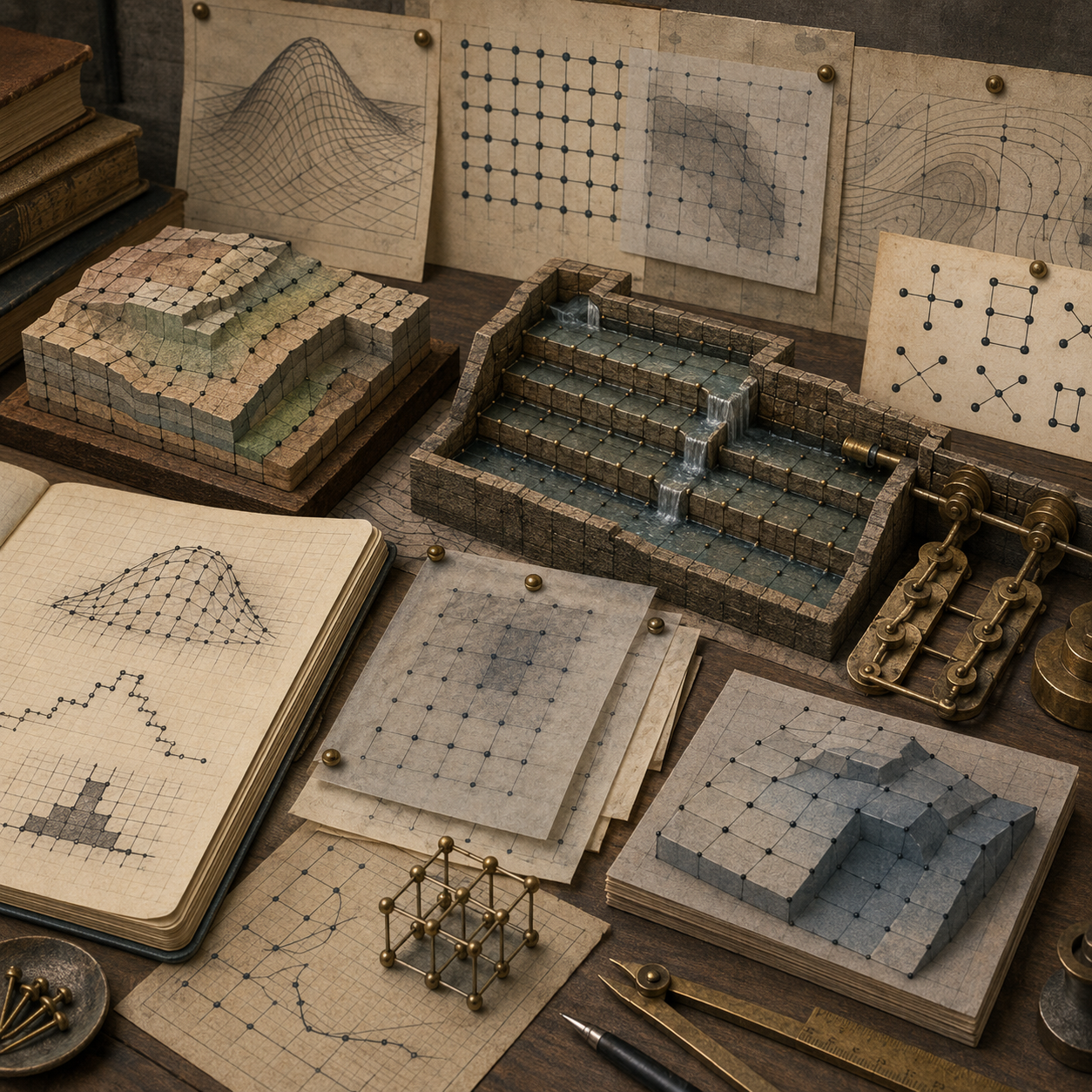
Finite difference methods begin with a practical modeling problem: continuous systems often need to be computed on discrete machines. A river is represented by grid cells, a time interval by steps, a spatial field by values at nodes, and a derivative by differences between neighboring values. The method is simple in principle, but its consequences are profound: the grid, step size, boundary rule, and update formula become part of the model.
Why Finite Difference Methods Matter
Finite difference methods matter because many systems models are too complex for exact analytical solutions. A modeler may know the governing relationship, but still need a numerical approximation to simulate the system through time, across space, or under alternative scenarios.
\frac{du}{dt}\approx \frac{u^{n+1}-u^n}{\Delta t}
\]
Interpretation: A time derivative is approximated by the difference between future and current values divided by the time step.
This turns calculus into an update rule. Instead of solving a continuous equation exactly, the model advances the system one step at a time.
| Modeling need | Finite difference role | Systems meaning |
|---|---|---|
| Estimate change over time. | Approximate time derivatives. | Simulate growth, decay, recovery, pressure, or depletion. |
| Estimate spatial variation. | Approximate spatial derivatives. | Represent gradients, fronts, diffusion, transport, and flow. |
| Simulate differential equations. | Convert equations into update rules. | Advance a system across time steps. |
| Audit computational assumptions. | Record grid, step, stencil, and boundary choices. | Make numerical interpretation visible. |
Finite difference methods are not just technical tools. They are interpretive choices that shape what the model can represent, smooth, distort, or reveal.
From Continuous Change to Discrete Rules
A continuous model describes change at every point in time or space. A finite difference model describes change at selected points. The continuous derivative becomes an algebraic relationship among nearby values.
u_t=D u_{xx}
\]
Interpretation: A diffusion equation says the time change of a field depends on its spatial curvature.
A finite difference approximation replaces the time derivative and spatial derivative with differences on a grid.
\frac{u_i^{n+1}-u_i^n}{\Delta t}
=
D\frac{u_{i+1}^n-2u_i^n+u_{i-1}^n}{(\Delta x)^2}
\]
Interpretation: The continuous diffusion equation becomes a relationship among neighboring grid values.
Rearranging gives an update rule for the next time step.
u_i^{n+1}=u_i^n+\lambda\left(u_{i+1}^n-2u_i^n+u_{i-1}^n\right)
\]
Interpretation: Each new value depends on its current value and neighboring values.
That movement from differential equation to update rule is the core of finite difference modeling.
Grids, Nodes, and Time Steps
Finite difference methods require a grid. The grid defines where the model stores values. In one dimension, the grid may be a sequence of points along a line. In two dimensions, it may be a rectangular mesh. In time, it is a sequence of time steps.
x_i=x_0+i\Delta x,\quad t_n=t_0+n\Delta t
\]
Interpretation: Spatial and temporal coordinates are represented by discrete grid indices.
| Grid element | Meaning | Systems interpretation |
|---|---|---|
| Node. | A point where the field is stored. | A location, time point, grid cell center, or computational sample. |
| Spatial step \(\Delta x\). | Distance between neighboring grid points. | Spatial resolution of the model. |
| Time step \(\Delta t\). | Time between updates. | Temporal resolution of the simulation. |
| Boundary node. | Edge of the modeled domain. | Where inflow, outflow, reflection, containment, or fixed values occur. |
Grid design is a modeling decision. A coarse grid may miss sharp transitions. A fine grid may increase computational cost or expose instability. A poor boundary representation can dominate results.
Forward, Backward, and Central Differences
Finite difference formulas estimate derivatives using neighboring values. The most basic formulas are forward, backward, and central differences.
f'(x_i)\approx \frac{f_{i+1}-f_i}{\Delta x}
\]
Interpretation: A forward difference uses the current value and the next value.
f'(x_i)\approx \frac{f_i-f_{i-1}}{\Delta x}
\]
Interpretation: A backward difference uses the current value and the previous value.
f'(x_i)\approx \frac{f_{i+1}-f_{i-1}}{2\Delta x}
\]
Interpretation: A central difference uses values on both sides of the point.
| Formula type | Common use | Interpretive caution |
|---|---|---|
| Forward difference. | Left boundary, time stepping, explicit updates. | One-sided and lower-order for smooth functions. |
| Backward difference. | Right boundary, implicit updates, retrospective estimates. | One-sided and method-dependent. |
| Central difference. | Interior derivative estimates. | Needs values on both sides and can amplify noise. |
| Higher-order difference. | Smooth data and accuracy-focused schemes. | Uses more points and may be less robust near boundaries. |
The formula choice affects accuracy, stability, boundary behavior, and interpretation.
Second Differences and Curvature
Second differences approximate curvature, acceleration, diffusion, and spatial smoothing. They appear in heat equations, diffusion equations, wave equations, elasticity problems, and many local-structure diagnostics.
f”(x_i)\approx \frac{f_{i+1}-2f_i+f_{i-1}}{(\Delta x)^2}
\]
Interpretation: A central second difference measures how a point differs from its neighbors.
If the value at a node is high relative to its neighbors, the second difference tends to be negative. If the value is low relative to its neighbors, it tends to be positive. This local curvature is why second differences are central to diffusion.
| Second-difference pattern | Meaning | Systems interpretation |
|---|---|---|
| Center greater than neighbors. | Negative curvature. | Hotspot, peak, pressure point, local concentration. |
| Center less than neighbors. | Positive curvature. | Local gap, trough, deficit, low-pressure region. |
| Center near neighbor average. | Near-zero curvature. | Locally flat or linearly changing field. |
| Large magnitude. | Sharp curvature. | Strong local transition or possible numerical artifact. |
Second differences are powerful but noise-sensitive. In empirical grids, they should be interpreted with attention to data quality and resolution.
Finite-Difference Stencils
A finite-difference stencil describes which neighboring points are used in an approximation. Stencils make local computational logic visible.
\left[f_{i-1},\ f_i,\ f_{i+1}\right]
\]
Interpretation: A three-point stencil uses one point to the left, the center point, and one point to the right.
In two dimensions, a common five-point stencil approximates the Laplacian.
\nabla^2 u_{i,j}\approx
\frac{u_{i+1,j}+u_{i-1,j}+u_{i,j+1}+u_{i,j-1}-4u_{i,j}}{(\Delta x)^2}
\]
Interpretation: The two-dimensional Laplacian compares a grid cell to its four neighboring cells.
| Stencil | Used for | Modeling implication |
|---|---|---|
| Two-point one-sided. | Forward or backward first derivative. | Useful near boundaries and time marching. |
| Three-point centered. | First or second derivative. | Useful for interior estimates. |
| Five-point Laplacian. | Two-dimensional diffusion and smoothing. | Represents local neighbor exchange. |
| Wider stencil. | Higher-order approximation. | Can improve accuracy but complicates boundaries. |
Stencils should be documented because they encode how local interaction is represented.
Explicit Update Rules
An explicit finite difference method computes the next state directly from known current values. Explicit rules are intuitive and easy to implement, but they often require strict stability conditions.
u_i^{n+1}=F(u_{i-1}^n,u_i^n,u_{i+1}^n)
\]
Interpretation: The next value is computed from known values at the current time step.
For a simple diffusion model, the explicit update is:
u_i^{n+1}=u_i^n+\lambda(u_{i+1}^n-2u_i^n+u_{i-1}^n)
\]
Interpretation: The next value is adjusted according to local curvature and the diffusion ratio \(\lambda\).
| Explicit method feature | Strength | Limitation |
|---|---|---|
| Direct update. | Simple and transparent. | Can be unstable for large time steps. |
| Local stencil. | Easy to audit and explain. | May require fine grids for accuracy. |
| Step-by-step simulation. | Useful for teaching and scenario exploration. | Accumulated numerical error can shape results. |
| Simple implementation. | Portable across languages. | Not always suitable for stiff or highly coupled systems. |
Explicit update rules are excellent for transparent teaching examples and many simulations, but stability should never be assumed.
Boundary Conditions
Finite difference methods require boundary rules. The model must say what happens at the edge of the grid, where ordinary centered stencils may not have neighboring values on both sides.
u_0^n=0,\quad u_N^n=0
\]
Interpretation: A fixed boundary condition holds edge values at specified levels.
Other boundary conditions represent no-flux, inflow, outflow, reflection, absorption, periodic wrapping, or external forcing.
| Boundary type | Meaning | Systems interpretation |
|---|---|---|
| Fixed value. | Boundary value is imposed. | Maintained temperature, absorbing edge, imposed concentration. |
| No flux. | No movement across boundary. | Insulated, closed, contained, or reflective system edge. |
| Inflow/outflow. | Quantity enters or leaves domain. | Upstream source, drainage, transport path, open boundary. |
| Periodic. | One edge connects to the opposite edge. | Circular domain, idealized repeating system. |
Boundary conditions are often more than technical details. They express what the model assumes about the system’s relation to its surroundings.
Diffusion, Transport, and Wave Examples
Finite difference methods appear across common systems equations. The same basic logic can approximate diffusion, transport, and wave behavior, but each process requires a different update structure and stability logic.
u_t=D u_{xx}
\]
Diffusion: Local curvature drives smoothing or spread.
u_t+v u_x=0
\]
Transport: A field is carried through space by velocity \(v\).
u_{tt}=c^2u_{xx}
\]
Wave behavior: Acceleration depends on spatial curvature.
| Equation family | Finite difference concern | Systems meaning |
|---|---|---|
| Diffusion. | Diffusion ratio and smoothing. | Heat, concentration, spread, mixing, dispersal. |
| Transport. | Courant number and direction. | Flow, traffic, wind, currents, movement through a domain. |
| Wave. | Time-space coupling and propagation speed. | Oscillation, vibration, disturbance propagation. |
| Reaction-diffusion. | Local reaction plus spatial spread. | Ecology, chemistry, epidemiology, pattern formation. |
The equation family determines what kind of finite difference scheme is appropriate. A method that works for diffusion may fail for transport or waves.
Stability, Convergence, and Consistency
Finite difference methods are judged partly by stability, convergence, and consistency. These concepts help distinguish meaningful numerical approximation from computational artifact.
\lambda=\frac{D\Delta t}{(\Delta x)^2}
\]
Interpretation: A diffusion stability ratio links diffusivity, time step, and grid spacing.
For a basic explicit one-dimensional diffusion scheme, \(\lambda\leq 1/2\) is a common stability condition. Different equations and schemes have different conditions.
| Concept | Meaning | Audit question |
|---|---|---|
| Consistency. | The discrete approximation approaches the continuous equation as grid spacing shrinks. | Does the stencil approximate the intended derivative? |
| Stability. | Numerical errors do not grow uncontrollably. | Are time step and grid spacing safe for this scheme? |
| Convergence. | The numerical solution approaches the true solution as resolution improves. | Do results stabilize under grid refinement? |
| Conservation. | Discrete updates preserve expected balances where appropriate. | Do stocks, flows, sources, and sinks reconcile? |
A finite difference result should not be trusted simply because it runs. It should be checked for numerical behavior.
Truncation Error and Numerical Artifacts
Truncation error arises because a finite difference formula approximates a continuous derivative by omitting higher-order terms. Numerical artifacts arise when the approximation creates behavior not present in the intended system.
f(x+\Delta x)=f(x)+\Delta x f'(x)+\frac{(\Delta x)^2}{2}f”(x)+O((\Delta x)^3)
\]
Interpretation: Taylor expansion shows which terms are retained and which are omitted.
| Artifact | What it looks like | Possible cause |
|---|---|---|
| Numerical diffusion. | Sharp fronts smear out too quickly. | Scheme artificially smooths the solution. |
| Oscillation. | Spurious wiggles near steep gradients. | Method poorly matched to transport or discontinuity. |
| Instability. | Values grow explosively or become meaningless. | Step size violates stability conditions. |
| Boundary artifact. | Edge behavior dominates interior results. | Boundary condition or ghost-cell rule is inappropriate. |
Numerical artifacts can look like system behavior. Responsible modeling requires checking whether patterns persist under alternative grid, step, boundary, and method choices.
Systems Modeling Interpretation
Finite difference methods help modelers simulate systems that change continuously but must be computed discretely. They are especially useful when a model involves fields, flows, diffusion, transport, boundary exchange, local interaction, or dynamic updates.
The interpretation should remain conditional. A finite difference simulation is not just the original equation made visible. It is the original equation plus a grid, time step, stencil, boundary rule, update scheme, stability condition, and numerical error structure.
The responsible question is not only “What does the simulation show?” It is “How much of the result comes from the modeled system, and how much comes from the finite difference scheme?”
Mathematical Deepening
This section adds a more formal layer for mathematically advanced readers. Finite difference methods connect Taylor expansions, derivative approximation, stencil design, local truncation error, stability analysis, convergence, conservation, boundary treatment, and computational implementation.
Finite Difference Building Blocks
Grid
A discrete representation of continuous time, space, or parameter domains.
Stencil
The pattern of neighboring values used to approximate a derivative.
Update Rule
An algebraic rule that advances the system from one step to the next.
Boundary Rule
A method for handling domain edges and missing stencil values.
Method Properties
Consistency
The discrete formula approximates the intended continuous equation.
Stability
Numerical error remains controlled under repeated updates.
Convergence
The approximation approaches the true solution as resolution improves.
Conservation
Discrete balances preserve expected stock-flow relationships where required.
Systems Uses
Diffusion Simulation
Approximate smoothing, spread, heat flow, concentration change, or dispersal.
Transport Simulation
Approximate movement through a domain by velocity, current, or flow.
Spatial Gradient Audit
Estimate local changes across fields, surfaces, and grids.
Boundary Scenario Testing
Compare fixed, no-flux, inflow, outflow, and periodic boundary assumptions.
Finite Difference Governance
Grid Record
Document spatial and temporal resolution.
Stencil Record
Document derivative formulas and neighboring values used.
Stability Record
Record stability ratios and scheme-specific checks.
Artifact Review
Check for numerical diffusion, oscillation, boundary artifacts, and instability.
Examples from Systems Modeling
Finite difference methods appear whenever continuous dynamics are approximated on grids, time steps, and local update rules.
Heat and Energy Balance
Finite differences approximate how heat spreads across materials, surfaces, buildings, or environmental fields.
Pollution Transport
Gridded schemes approximate how concentration spreads, moves, decays, and crosses boundaries.
Traffic Density
Finite differences can approximate density changes along roads, bottlenecks, and shock-like transitions.
Hydrology
Water depth, flow, groundwater pressure, and runoff can be approximated across spatial grids and time steps.
Epidemiological Fields
Spatial infection risk or exposure can be approximated through diffusion-like and transport-like update rules.
Infrastructure Stress
Stress, vibration, load, heat, and fatigue can be approximated on surfaces, lines, or structural grids.
Across these examples, finite difference methods make continuous dynamics computable, but they also make numerical assumptions consequential.
Computation and Reproducible Workflows
Computational workflows for finite difference methods should record equation type, grid spacing, time step, stencil, boundary rule, update scheme, stability ratio, convergence check, output summaries, and interpretation warnings.
Because finite difference outputs can be visually persuasive, reproducible workflows should save method metadata, not only plots. A responsible finite difference result includes the numerical logic behind the pattern.
Python Workflow: Finite Difference Audit
The Python workflow below simulates a one-dimensional explicit diffusion scheme and records stability ratio, mass, maximum value, boundary values, and audit warnings.
from __future__ import annotations

from dataclasses import dataclass, asdict
from pathlib import Path
import csv
import json


@dataclass(frozen=True)
class FiniteDifferenceRecord:
    step: int
    time: float
    center_value: float
    total_mass: float
    max_value: float
    left_boundary: float
    right_boundary: float
    diffusion_ratio: float
    stability_status: str
    warning: str


def initialize_field(grid_points: int) -> list[float]:
    field = [0.0 for _ in range(grid_points)]
    field[grid_points // 2] = 1.0
    return field


def update_diffusion(field: list[float], diffusion_ratio: float) -> list[float]:
    updated = field[:]

    for i in range(1, len(field) - 1):
        updated[i] = field[i] + diffusion_ratio * (
            field[i + 1] - 2 * field[i] + field[i - 1]
        )

    updated[0] = 0.0
    updated[-1] = 0.0
    return updated


def simulate_finite_difference_diffusion(
    grid_points: int,
    diffusivity: float,
    dx: float,
    dt: float,
    steps: int
) -> list[FiniteDifferenceRecord]:
    diffusion_ratio = diffusivity * dt / (dx ** 2)
    stability_status = "stable_for_basic_explicit_1d_diffusion" if diffusion_ratio <= 0.5 else "unstable_risk"
    field = initialize_field(grid_points)
    records: list[FiniteDifferenceRecord] = []

    for step in range(steps + 1):
        records.append(
            FiniteDifferenceRecord(
                step=step,
                time=step * dt,
                center_value=field[grid_points // 2],
                total_mass=sum(field) * dx,
                max_value=max(field),
                left_boundary=field[0],
                right_boundary=field[-1],
                diffusion_ratio=diffusion_ratio,
                stability_status=stability_status,
                warning="Finite difference results depend on grid spacing, time step, stencil, boundary condition, stability, and convergence checks."
            )
        )

        field = update_diffusion(field, diffusion_ratio)

    return records


records = simulate_finite_difference_diffusion(
    grid_points=61,
    diffusivity=0.08,
    dx=1.0,
    dt=0.2,
    steps=120
)

output_dir = Path("outputs")
(output_dir / "tables").mkdir(parents=True, exist_ok=True)
(output_dir / "json").mkdir(parents=True, exist_ok=True)

with (output_dir / "tables" / "finite_difference_audit.csv").open("w", newline="", encoding="utf-8") as handle:
    writer = csv.DictWriter(handle, fieldnames=asdict(records[0]).keys())
    writer.writeheader()
    for record in records:
        writer.writerow(asdict(record))

summary = {
    "grid_points": 61,
    "diffusivity": 0.08,
    "dx": 1.0,
    "dt": 0.2,
    "steps": 120,
    "diffusion_ratio": 0.08 * 0.2 / (1.0 ** 2),
    "stability_note": "For a basic explicit one-dimensional diffusion scheme, diffusion_ratio <= 0.5 is a common stability condition.",
    "interpretation": "The workflow audits how a local finite difference stencil evolves a synthetic diffusion field."
}

(output_dir / "json" / "finite_difference_audit.json").write_text(
    json.dumps([asdict(record) for record in records], indent=2),
    encoding="utf-8"
)

(output_dir / "json" / "finite_difference_summary.json").write_text(
    json.dumps(summary, indent=2),
    encoding="utf-8"
)

print("Wrote finite difference audit.")
This workflow keeps the numerical scheme inspectable by saving grid, step, stencil, boundary, stability, and summary records.
R Workflow: Grid Update Diagnostics
The R workflow below performs the same finite difference diffusion audit and writes diagnostic tables.
initialize_field <- function(grid_points) {
  field <- rep(0, grid_points)
  field[[ceiling(grid_points / 2)]] <- 1
  field
}

update_diffusion <- function(field, diffusion_ratio) {
  updated <- field

  for (i in 2:(length(field) - 1)) {
    updated[[i]] <- field[[i]] + diffusion_ratio * (
      field[[i + 1]] - 2 * field[[i]] + field[[i - 1]]
    )
  }

  updated[[1]] <- 0
  updated[[length(updated)]] <- 0
  updated
}

simulate_finite_difference_diffusion <- function(
  grid_points,
  diffusivity,
  dx,
  dt,
  steps
) {
  diffusion_ratio <- diffusivity * dt / (dx ^ 2)
  stability_status <- ifelse(
    diffusion_ratio <= 0.5,
    "stable_for_basic_explicit_1d_diffusion",
    "unstable_risk"
  )

  field <- initialize_field(grid_points)
  records <- list()

  for (step in 0:steps) {
    records[[length(records) + 1]] <- data.frame(
      step = step,
      time = step * dt,
      center_value = field[[ceiling(grid_points / 2)]],
      total_mass = sum(field) * dx,
      max_value = max(field),
      left_boundary = field[[1]],
      right_boundary = field[[length(field)]],
      diffusion_ratio = diffusion_ratio,
      stability_status = stability_status,
      warning = "Finite difference results depend on grid spacing, time step, stencil, boundary condition, stability, and convergence checks."
    )

    field <- update_diffusion(field, diffusion_ratio)
  }

  do.call(rbind, records)
}

results <- simulate_finite_difference_diffusion(
  grid_points = 61,
  diffusivity = 0.08,
  dx = 1,
  dt = 0.2,
  steps = 120
)

summary_table <- data.frame(
  grid_points = 61,
  diffusivity = 0.08,
  dx = 1,
  dt = 0.2,
  steps = 120,
  diffusion_ratio = 0.08 * 0.2 / (1 ^ 2),
  interpretation = "The workflow audits how a local finite difference stencil evolves a synthetic diffusion field."
)

dir.create("outputs/tables", recursive = TRUE, showWarnings = FALSE)
write.csv(results, "outputs/tables/r_finite_difference_audit.csv", row.names = FALSE)
write.csv(summary_table, "outputs/tables/r_finite_difference_summary.csv", row.names = FALSE)

print(head(results))
print(summary_table)
This workflow supports grid refinement, time-step comparison, stability review, and boundary-condition audits.
Haskell Workflow: Typed Grid Records
Haskell can represent finite difference records with explicit fields for grid, time, mass, boundaries, stability, and warnings.
module Main where

data FiniteDifferenceRecord = FiniteDifferenceRecord
  { stepNumber :: Int
  , timeValue :: Double
  , centerValue :: Double
  , totalMass :: Double
  , maxValue :: Double
  , leftBoundary :: Double
  , rightBoundary :: Double
  , diffusionRatio :: Double
  , stabilityStatus :: String
  , warning :: String
  } deriving (Show)

initializeField :: Int -> [Double]
initializeField n =
  [if i == div n 2 then 1.0 else 0.0 | i <- [0..n-1]]

updateDiffusion :: Double -> [Double] -> [Double]
updateDiffusion ratio field =
  zipWith update [0..] field
  where
    n = length field
    update i value
      | i == 0 = 0.0
      | i == n - 1 = 0.0
      | otherwise =
          value + ratio * ((field !! (i + 1)) - 2 * value + (field !! (i - 1)))

simulate :: Int -> Double -> Double -> Double -> Int -> [FiniteDifferenceRecord]
simulate gridPoints diffusivity dx dt steps =
  go 0 (initializeField gridPoints)
  where
    ratio = diffusivity * dt / (dx * dx)
    status =
      if ratio <= 0.5
      then "stable_for_basic_explicit_1d_diffusion"
      else "unstable_risk"
    centerIndex = div gridPoints 2

    go step field
      | step > steps = []
      | otherwise =
          let record = FiniteDifferenceRecord
                step
                (fromIntegral step * dt)
                (field !! centerIndex)
                (sum field * dx)
                (maximum field)
                (head field)
                (last field)
                ratio
                status
                "Finite difference results depend on grid spacing, time step, stencil, boundary condition, stability, and convergence checks."
          in record : go (step + 1) (updateDiffusion ratio field)

main :: IO ()
main =
  mapM_ print (simulate 61 0.08 1.0 0.2 120)
The typed workflow makes it harder to hide the numerical assumptions behind a single simulated trajectory.
SQL Workflow: Finite Difference Assumption Registry
SQL can document finite difference assumptions when gridded simulations support reports, dashboards, policy analysis, engineering review, or model governance.
CREATE TABLE finite_difference_assumption_registry (
    assumption_key TEXT PRIMARY KEY,
    assumption_name TEXT NOT NULL,
    mathematical_role TEXT NOT NULL,
    systems_modeling_role TEXT NOT NULL,
    review_warning TEXT NOT NULL
);

INSERT INTO finite_difference_assumption_registry VALUES
(
  'grid_spacing',
  'Grid spacing',
  'Defines spatial resolution of the finite difference approximation.',
  'Controls what spatial structure the model can represent.',
  'Grid refinement should be tested when gradients or boundaries matter.'
);

INSERT INTO finite_difference_assumption_registry VALUES
(
  'time_step',
  'Time step',
  'Defines temporal resolution of the update scheme.',
  'Controls simulation pace, stability, and temporal detail.',
  'Time-step sensitivity should be tested and documented.'
);

INSERT INTO finite_difference_assumption_registry VALUES
(
  'stencil',
  'Finite difference stencil',
  'Defines which neighboring values approximate derivatives.',
  'Encodes local interaction, smoothing, transport, or curvature.',
  'Stencil choice affects accuracy, stability, and boundary behavior.'
);

INSERT INTO finite_difference_assumption_registry VALUES
(
  'boundary_condition',
  'Boundary condition',
  'Defines behavior at the domain edge.',
  'Represents fixed, no-flux, inflow, outflow, reflective, or periodic boundaries.',
  'Boundary assumptions can dominate results and should be compared.'
);

INSERT INTO finite_difference_assumption_registry VALUES
(
  'stability_condition',
  'Stability condition',
  'Defines whether numerical errors remain controlled under repeated updates.',
  'Protects against simulation artifacts being mistaken for system behavior.',
  'Scheme-specific stability checks should be recorded.'
);

INSERT INTO finite_difference_assumption_registry VALUES
(
  'convergence_check',
  'Convergence check',
  'Compares solutions across grid or time-step refinements.',
  'Tests whether modeled conclusions persist under numerical refinement.',
  'Convergence does not guarantee real-world validity, but lack of convergence is a warning.'
);

SELECT
    assumption_name,
    mathematical_role,
    systems_modeling_role,
    review_warning
FROM finite_difference_assumption_registry
ORDER BY assumption_key;
This registry keeps finite difference interpretation tied to grid spacing, time step, stencil, boundary conditions, stability, convergence, and model governance.
GitHub Repository
The companion repository for this article is designed as a reproducible mathematical-modeling workspace. It supports finite difference audits, explicit diffusion simulations, stencil diagnostics, stability checks, boundary-condition records, convergence review scaffolds, SQL governance tables, generated outputs, advanced mathematical audit reports, and reusable calculator scripts.
Complete Code Repository
Companion article folder with Python, R, Julia, SQL, Haskell, C, C++, Fortran, Rust, Go, notebooks, documentation, synthetic teaching data, generated outputs, schemas, Canvas-ready workflow artifacts, and reusable calculator scripts for finite difference methods, forward differences, backward differences, central differences, second differences, stencils, explicit updates, diffusion schemes, boundary conditions, stability ratios, convergence checks, numerical artifacts, model governance, and responsible mathematical modeling.
Interpretive Limits and Responsible Use
Finite difference methods are powerful because they turn continuous models into computable systems. They are risky because numerical assumptions can become invisible. A result may reflect the modeled process, the grid resolution, the time step, the stencil, the boundary condition, the update method, or an instability artifact.
Responsible use requires several checks. Document the equation, domain, grid, time step, stencil, boundary rule, update scheme, stability condition, convergence test, and uncertainty. Compare alternative step sizes and grid resolutions where possible. Review boundary sensitivity. Watch for numerical diffusion, oscillation, and instability. Preserve method metadata alongside figures and tables.
The central modeling question is not only “What did the finite difference simulation produce?” It is “How was the continuous system discretized, and do the conclusions survive reasonable changes in that discretization?”
Related Articles
- Calculus for Systems Modeling
- Numerical Differentiation for Systems Modeling
- Numerical Integration for Systems Modeling
- Introduction to Partial Differential Equations
- Diffusion, Transport, and Spatial Dynamics
- Gradient, Divergence, and Curl
- Euler’s Method
- Runge–Kutta Methods
- Stability, Error, and Convergence in Numerical Modeling
- Ordinary Differential Equation Solver Workflows
Further Reading
- Atkinson, K.E. (1989) An Introduction to Numerical Analysis. 2nd edn. New York: Wiley.
- Burden, R.L. and Faires, J.D. (2011) Numerical Analysis. 9th edn. Boston, MA: Brooks/Cole.
- Chapra, S.C. and Canale, R.P. (2015) Numerical Methods for Engineers. 7th edn. New York: McGraw-Hill Education.
- Farlow, S.J. (1993) Partial Differential Equations for Scientists and Engineers. Mineola, NY: Dover Publications.
- Heath, M.T. (2018) Scientific Computing: An Introductory Survey. 2nd edn. Philadelphia, PA: Society for Industrial and Applied Mathematics.
- LeVeque, R.J. (2002) Finite Volume Methods for Hyperbolic Problems. Cambridge: Cambridge University Press.
- LeVeque, R.J. (2007) Finite Difference Methods for Ordinary and Partial Differential Equations. Philadelphia, PA: Society for Industrial and Applied Mathematics.
- Morton, K.W. and Mayers, D.F. (2005) Numerical Solution of Partial Differential Equations. 2nd edn. Cambridge: Cambridge University Press.
- Strikwerda, J.C. (2004) Finite Difference Schemes and Partial Differential Equations. 2nd edn. Philadelphia, PA: Society for Industrial and Applied Mathematics.
- Massachusetts Institute of Technology (MIT) OpenCourseWare (2011) Introduction to Numerical Analysis. Cambridge, MA: MIT OpenCourseWare.
References
- Atkinson, K.E. (1989) An Introduction to Numerical Analysis. 2nd edn. New York: Wiley.
- Burden, R.L. and Faires, J.D. (2011) Numerical Analysis. 9th edn. Boston, MA: Brooks/Cole.
- Chapra, S.C. and Canale, R.P. (2015) Numerical Methods for Engineers. 7th edn. New York: McGraw-Hill Education.
- Farlow, S.J. (1993) Partial Differential Equations for Scientists and Engineers. Mineola, NY: Dover Publications.
- Heath, M.T. (2018) Scientific Computing: An Introductory Survey. 2nd edn. Philadelphia, PA: Society for Industrial and Applied Mathematics.
- LeVeque, R.J. (2002) Finite Volume Methods for Hyperbolic Problems. Cambridge: Cambridge University Press.
- LeVeque, R.J. (2007) Finite Difference Methods for Ordinary and Partial Differential Equations. Philadelphia, PA: Society for Industrial and Applied Mathematics.
- Massachusetts Institute of Technology (MIT) OpenCourseWare (2011) Introduction to Numerical Analysis. Cambridge, MA: MIT OpenCourseWare.
- Morton, K.W. and Mayers, D.F. (2005) Numerical Solution of Partial Differential Equations. 2nd edn. Cambridge: Cambridge University Press.
- Strikwerda, J.C. (2004) Finite Difference Schemes and Partial Differential Equations. 2nd edn. Philadelphia, PA: Society for Industrial and Applied Mathematics.