
Last Updated June 15, 2026
Partial differential equations describe systems whose change depends on several variables at once. In systems modeling, they help represent processes distributed across space, time, depth, networks, surfaces, fields, gradients, flows, densities, temperatures, concentrations, pressures, probabilities, and interacting continuous domains.
These ideas matter for climate modeling, diffusion, transport, heat flow, waves, groundwater movement, epidemiological spread, air pollution, traffic flow, population density, infrastructure stress, ecological movement, financial surfaces, and coupled human-natural systems.
This article introduces partial differential equations for systems modeling, including multivariable functions, partial derivatives, state fields, spatial domains, boundary conditions, initial conditions, elliptic equations, parabolic equations, hyperbolic equations, diffusion, transport, wave behavior, numerical approximation, and responsible interpretation.
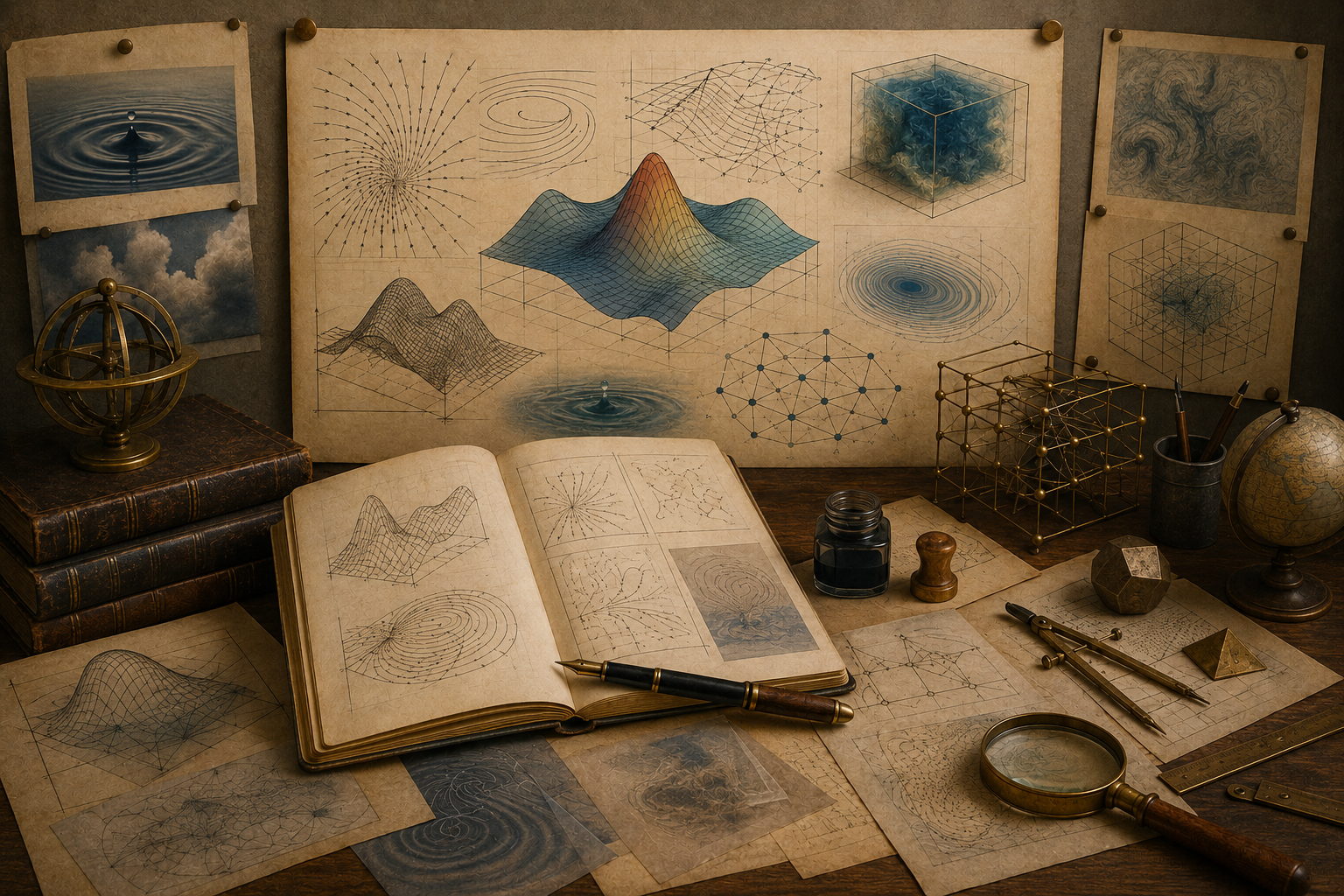
A partial differential equation is an equation involving a function of several variables and its partial derivatives. Instead of modeling one changing quantity over time, PDEs model a field: a value that may vary across time, space, position, depth, surface, or another continuous domain.
Why Partial Differential Equations Matter
Partial differential equations matter because many systems are not only changing through time; they are also distributed across space, position, surfaces, depths, gradients, or interacting variables. Temperature varies across a room. Pollution moves through air. Water flows through soil. Infection risk varies across a region. Traffic density changes along a road. Stress spreads through a structure. These are field-like systems.
u=u(x,t)
\]
Interpretation: A state field \(u\) depends on position \(x\) and time \(t\), rather than time alone.
PDEs give modelers a language for asking how local change, spatial interaction, boundary conditions, and time evolution combine. They help explain why a disturbance in one place can spread, diffuse, reflect, accumulate, disperse, or move through a system.
| Modeling question | PDE concept | Systems meaning |
|---|---|---|
| How does heat spread? | Diffusion equation. | Local gradients drive smoothing over space. |
| How does a pollutant move? | Transport or advection equation. | Flow carries a field through a domain. |
| How does a wave travel? | Wave equation. | Disturbance propagates through a medium. |
| How does equilibrium vary across space? | Elliptic equation. | Boundary conditions determine interior structure. |
PDEs are powerful because they connect local mechanisms to system-wide patterns across continuous domains.
From ODEs to PDEs
An ordinary differential equation usually describes how a quantity changes with respect to one independent variable, often time. A partial differential equation describes how a field changes with respect to more than one independent variable.
\frac{dx}{dt}=f(x,t)
\]
Interpretation: An ODE describes change in a state variable \(x\) over time.
\frac{\partial u}{\partial t}=F\left(u,\frac{\partial u}{\partial x},\frac{\partial^2 u}{\partial x^2},x,t\right)
\]
Interpretation: A PDE describes how a field \(u\) changes across time and space using partial derivatives.
| Feature | ODE | PDE |
|---|---|---|
| State object. | A variable or vector of variables. | A field over a domain. |
| Independent variables. | Usually time. | Time plus space, position, surface, depth, or other variables. |
| Initial information. | Initial value. | Initial field plus boundary conditions. |
| Typical output. | Trajectory through time. | Field evolution across a domain. |
The shift from ODEs to PDEs is a shift from trajectory thinking to field thinking.
Functions of Several Variables
PDEs begin with functions of several variables. A function may depend on time, horizontal position, vertical position, depth, temperature, pressure, concentration, or other continuous coordinates.
u=u(x,y,t)
\]
Interpretation: The field value \(u\) depends on two spatial coordinates and time.
In systems modeling, \(u\) might represent temperature, concentration, density, pressure, risk, elevation, resource level, traffic density, or another distributed quantity.
| Field | Meaning | Possible domain |
|---|---|---|
| \(T(x,y,t)\) | Temperature. | Surface, room, soil layer, atmosphere. |
| \(C(x,y,t)\) | Concentration. | Air, water, groundwater, tissue, city region. |
| \(\rho(x,t)\) | Density. | Road segment, habitat, population corridor. |
| \(p(x,y,z,t)\) | Pressure. | Fluid system, atmosphere, reservoir. |
The field definition determines what the PDE means. A modeler should state what the field represents, what its units are, and where it is defined.
Partial Derivatives and Local Change
Partial derivatives describe how a multivariable function changes with respect to one variable while holding others fixed. PDEs use partial derivatives to represent local rates, gradients, curvature, flux, and spread.
\frac{\partial u}{\partial t},\quad
\frac{\partial u}{\partial x},\quad
\frac{\partial^2 u}{\partial x^2}
\]
Interpretation: These terms represent time change, spatial slope, and spatial curvature of the field.
| Derivative | Mathematical meaning | Systems interpretation |
|---|---|---|
| \(\partial u/\partial t\) | Change over time. | How the field evolves. |
| \(\partial u/\partial x\) | Spatial gradient. | How the field changes across position. |
| \(\partial^2 u/\partial x^2\) | Spatial curvature. | How gradients themselves change. |
| \(\nabla u\) | Multidimensional gradient. | Direction and rate of steepest local change. |
| \(\Delta u\) | Laplacian. | Local spreading, smoothing, or diffusion structure. |
PDE interpretation depends on connecting each derivative term to a real mechanism: storage, spread, transport, force, conservation, smoothing, or propagation.
State Fields and Domains
A PDE is not complete without a domain. The domain defines where the field exists: a line segment, grid, surface, region, volume, network approximation, or abstract variable space.
(x,y)\in \Omega,\quad t\ge 0
\]
Interpretation: The field is defined over spatial domain \(\Omega\) and evolves through time.
The domain is a modeling choice. A rectangular grid, watershed boundary, road segment, city region, ocean basin, biological tissue, or infrastructure surface all imply different assumptions about scale, boundary behavior, resolution, and interaction.
| Domain feature | Meaning | Modeling implication |
|---|---|---|
| Geometry. | Shape of the modeled region. | Affects flow, spread, reflection, and boundaries. |
| Scale. | Spatial and temporal resolution. | Determines what processes are visible. |
| Boundary. | Edge of the modeled region. | Controls inflow, outflow, reflection, or fixed values. |
| Grid. | Numerical representation of the domain. | Controls approximation, stability, and computational cost. |
Domain assumptions are not technical afterthoughts. They define what the model includes, excludes, resolves, and simplifies.
PDE Structure
A PDE combines field values and partial derivatives into an equation that represents a mechanism. Different structures produce different system behavior.
\mathcal{L}u=f
\]
Interpretation: A differential operator \(\mathcal{L}\) acts on field \(u\), often balanced against a source, sink, or forcing term \(f\).
| PDE element | Meaning | Systems interpretation |
|---|---|---|
| State field. | The distributed quantity being modeled. | Temperature, concentration, pressure, density, risk, or load. |
| Derivative terms. | Local change, gradient, curvature, or flux. | Mechanisms of spread, transport, storage, or propagation. |
| Source term. | Addition to the field. | Emission, infection, heat input, demand, or external forcing. |
| Sink term. | Removal from the field. | Decay, absorption, recovery, loss, or extraction. |
| Parameters. | Coefficients controlling rates. | Diffusivity, velocity, conductivity, damping, or reaction strength. |
Understanding a PDE means understanding what each term claims about the system.
Boundary and Initial Conditions
PDEs require more than an equation. They need initial conditions and boundary conditions. The initial condition defines the field at the starting time. Boundary conditions define how the field behaves at the edge of the domain.
u(x,0)=u_0(x)
\]
Interpretation: The initial condition defines the starting field.
u|_{\partial\Omega}=g
\]
Interpretation: A boundary condition defines field behavior at the domain boundary \(\partial\Omega\).
| Condition type | Mathematical form | Systems meaning |
|---|---|---|
| Initial condition. | \(u(x,0)=u_0(x)\) | Starting distribution across the domain. |
| Dirichlet boundary. | \(u=g\) on boundary. | Fixed boundary value. |
| Neumann boundary. | \(\partial u/\partial n=g\) | Fixed flux or gradient at boundary. |
| Robin boundary. | Combination of value and flux. | Exchange with outside environment. |
| Periodic boundary. | Edges connect cyclically. | Idealized repeating domain. |
Boundary conditions often determine model behavior as much as the PDE itself. They should be interpreted, justified, and tested.
Elliptic, Parabolic, and Hyperbolic Equations
PDEs are often grouped into elliptic, parabolic, and hyperbolic types. These categories help identify broad patterns of behavior: equilibrium structure, diffusion-like smoothing, and wave-like propagation.
| PDE type | Canonical example | Typical behavior | Systems interpretation |
|---|---|---|---|
| Elliptic. | \(\Delta u=f\) | Equilibrium field shaped by boundaries. | Steady-state potential, pressure, or spatial balance. |
| Parabolic. | \(u_t=D\Delta u\) | Diffusion and smoothing over time. | Heat, concentration, spread, or smoothing processes. |
| Hyperbolic. | \(u_{tt}=c^2\Delta u\) | Wave propagation. | Signals, shocks, movement, vibration, or transmission. |
These categories are useful guides, not substitutes for interpretation. Real models may combine diffusion, transport, reaction, forcing, nonlinear terms, and boundary interaction.
Diffusion Equations
Diffusion equations model smoothing or spreading driven by local gradients. Heat flows from hot regions to cooler regions. Concentration spreads from high-density regions to lower-density regions. Risk, load, or pressure may also be modeled through diffusion-like approximations when local equalization is the key mechanism.
\frac{\partial u}{\partial t}=D\frac{\partial^2 u}{\partial x^2}
\]
Interpretation: The field changes over time according to spatial curvature, scaled by diffusivity \(D\).
| Term | Meaning | Systems interpretation |
|---|---|---|
| \(u_t\) | Time rate of change. | How the field evolves. |
| \(D\) | Diffusion coefficient. | How quickly the field spreads or smooths. |
| \(u_{xx}\) | Spatial curvature. | Local imbalance that drives spread. |
Diffusion models should not be used merely because something spreads. The mechanism should plausibly involve local gradient-driven movement, mixing, smoothing, or equalization.
Transport and Advection Equations
Transport equations model movement through a field. Instead of smoothing from high to low concentration, transport carries a quantity along a flow, velocity, or direction.
\frac{\partial u}{\partial t}+v\frac{\partial u}{\partial x}=0
\]
Interpretation: The field is transported at velocity \(v\) without changing shape in the simplest idealized case.
Transport matters for pollution, water flow, traffic density, disease movement, supply chains, sediment, wind, ocean currents, and migration-like models.
| Transport feature | Meaning | Systems example |
|---|---|---|
| Velocity. | Direction and speed of movement. | Wind carrying pollutants or water carrying contaminants. |
| Boundary inflow. | What enters the domain. | External demand, upstream pollution, incoming traffic. |
| Boundary outflow. | What leaves the domain. | Drainage, exit traffic, exported load. |
| Source and sink. | Addition or removal during movement. | Emissions, decay, filtering, recovery, absorption. |
Transport models require careful attention to direction, boundary conditions, conservation, and numerical stability.
Wave Equations
Wave equations model propagation, oscillation, vibration, transmission, or signals moving through a medium. Unlike diffusion, waves can carry disturbances without immediate smoothing.
\frac{\partial^2 u}{\partial t^2}=c^2\frac{\partial^2 u}{\partial x^2}
\]
Interpretation: The second time derivative relates to spatial curvature, with propagation speed \(c\).
Wave-like behavior appears in physics, engineering, infrastructure, traffic shockwaves, communication, financial contagion metaphors, and some spatial propagation models. The exact wave equation should be used only when the mechanism supports it.
| Wave feature | Meaning | Systems interpretation |
|---|---|---|
| Propagation speed. | How fast disturbance moves. | Signal, wave front, or shock front speed. |
| Reflection. | Boundary redirects wave. | Infrastructure, traffic, or physical boundary effect. |
| Damping. | Wave loses energy. | Friction, decay, resistance, absorption. |
| Superposition. | Waves combine. | Multiple disturbances interact. |
Wave models are valuable when timing, propagation, and boundary interaction matter more than smoothing alone.
Numerical Simulation
Many PDEs cannot be solved analytically in realistic domains. Numerical methods approximate the field on a grid or mesh. The modeler replaces continuous space and time with discrete points, then updates the field according to the PDE structure.
u_i^{n+1}=u_i^n+\lambda(u_{i+1}^n-2u_i^n+u_{i-1}^n)
\]
Interpretation: A finite-difference update approximates one-dimensional diffusion on a grid.
| Numerical element | Meaning | Responsible practice |
|---|---|---|
| Grid spacing. | Distance between spatial points. | Report resolution and test sensitivity. |
| Time step. | Simulation interval. | Check stability and convergence. |
| Boundary handling. | How edge values are updated. | Document boundary assumptions. |
| Stability condition. | Constraint for reliable computation. | Do not treat unstable output as system behavior. |
| Mesh or grid. | Computational representation of domain. | Make approximation structure visible. |
Numerical PDE models should report not only results but also grid design, boundary choices, stability checks, and approximation error.
Systems Modeling Interpretation
PDEs help systems modelers represent distributed change. They are especially useful when local interactions produce larger spatial or spatiotemporal patterns.
A PDE model can show how a local disturbance spreads through space, how boundaries shape interior behavior, how gradients drive flow, how diffusion smooths unevenness, how transport carries material, how waves propagate disturbances, and how fields evolve across domains.
The responsible interpretation is conditional: if the field definition, domain, boundary conditions, initial conditions, mechanisms, parameters, and numerical method are plausible, then PDE analysis can clarify distributed system behavior. If those assumptions are weak, the PDE may produce visually impressive but misleading surfaces.
Mathematical Deepening
This section adds a more formal layer for mathematically advanced readers. PDE modeling connects multivariable calculus, partial derivatives, gradients, divergence, Laplacians, conservation laws, operators, boundary value problems, initial-boundary value problems, and numerical approximation.
PDE Building Blocks
State Field
A distributed variable defined across a continuous domain.
Partial Derivatives
Rates of local change with respect to one variable at a time.
Operator
A mathematical structure such as gradient, divergence, or Laplacian applied to a field.
Source and Sink
Terms that add to or remove from the field.
PDE Model Conditions
Initial Condition
The field at the starting time.
Boundary Condition
The behavior at the edge of the domain.
Domain Geometry
The shape, size, and structure of the modeled region.
Parameter Field
Coefficients that may vary across space, time, or state.
PDE Behavior Types
Equilibrium
Spatial structure determined by sources, sinks, and boundaries.
Diffusion
Smoothing or spreading driven by local gradients.
Transport
Movement of a field through a domain.
Propagation
Wave-like movement of disturbances through space and time.
PDE Governance
Boundary Judgment
Document what the domain includes and excludes.
Numerical Stability
Check whether the computed solution reflects the model rather than the grid.
Parameter Meaning
Connect coefficients to physical, ecological, social, or operational mechanisms.
Interpretive Limits
Explain where the field model is a useful abstraction and where it may distort.
Examples from Systems Modeling
PDEs appear whenever state, flow, pressure, risk, concentration, or density varies across a continuous domain.
Climate and Heat Flow
Temperature fields evolve across atmosphere, land, ocean, ice, and boundary layers.
Pollution Transport
Concentration fields move, diffuse, decay, and interact with boundaries.
Groundwater and Hydrology
Pressure and concentration fields evolve through porous media and watershed boundaries.
Epidemiological Spread
Risk, infection density, and movement patterns can be represented across space and time.
Traffic Flow
Vehicle density and speed vary along road segments and through bottlenecks.
Infrastructure Stress
Loads, pressures, and stresses vary across surfaces, structures, grids, and networks.
Across these examples, the point is not only to compute a surface. The point is to explain how local rules, boundaries, and interactions produce distributed behavior.
Computation and Reproducible Workflows
Computational workflows for PDEs should record the field definition, domain, grid, boundary conditions, initial conditions, parameters, update rule, stability condition, time step, spatial step, numerical method, output summaries, and interpretation warnings.
Because PDE outputs often produce visually persuasive surfaces, reproducible workflows should save audit tables, metadata, and stability checks alongside figures. The goal is to make the field model inspectable.
Python Workflow: PDE Teaching Grid Audit
The Python workflow below simulates a simple one-dimensional diffusion equation using a finite-difference grid and records stability, boundary assumptions, and field summaries.
from __future__ import annotations

from dataclasses import dataclass, asdict
from pathlib import Path
import csv
import json


@dataclass(frozen=True)
class PDEGridRecord:
    step: int
    time: float
    center_value: float
    total_mass: float
    max_value: float
    min_value: float
    stability_ratio: float
    warning: str


def initialize_field(grid_points: int) -> list[float]:
    field = [0.0 for _ in range(grid_points)]
    center = grid_points // 2
    field[center] = 1.0
    return field


def diffusion_step(field: list[float], stability_ratio: float) -> list[float]:
    updated = field[:]

    for i in range(1, len(field) - 1):
        updated[i] = field[i] + stability_ratio * (
            field[i + 1] - 2 * field[i] + field[i - 1]
        )

    updated[0] = 0.0
    updated[-1] = 0.0
    return updated


def simulate_diffusion(
    grid_points: int,
    diffusivity: float,
    dx: float,
    dt: float,
    steps: int
) -> list[PDEGridRecord]:
    stability_ratio = diffusivity * dt / (dx ** 2)
    field = initialize_field(grid_points)
    records: list[PDEGridRecord] = []

    for step in range(steps + 1):
        time = step * dt
        records.append(
            PDEGridRecord(
                step=step,
                time=time,
                center_value=field[grid_points // 2],
                total_mass=sum(field) * dx,
                max_value=max(field),
                min_value=min(field),
                stability_ratio=stability_ratio,
                warning="Explicit diffusion schemes require stability checks; boundary and grid assumptions shape results."
            )
        )

        field = diffusion_step(field, stability_ratio)

    return records


records = simulate_diffusion(
    grid_points=51,
    diffusivity=0.1,
    dx=1.0,
    dt=0.25,
    steps=100
)

output_dir = Path("outputs")
(output_dir / "tables").mkdir(parents=True, exist_ok=True)
(output_dir / "json").mkdir(parents=True, exist_ok=True)

with (output_dir / "tables" / "pde_diffusion_grid_audit.csv").open("w", newline="", encoding="utf-8") as handle:
    writer = csv.DictWriter(handle, fieldnames=asdict(records[0]).keys())
    writer.writeheader()
    for record in records:
        writer.writerow(asdict(record))

summary = {
    "grid_points": 51,
    "diffusivity": 0.1,
    "dx": 1.0,
    "dt": 0.25,
    "stability_ratio": 0.1 * 0.25 / (1.0 ** 2),
    "stability_rule_of_thumb": "For this explicit one-dimensional diffusion scheme, the stability ratio should usually be no greater than 0.5.",
    "interpretation": "The grid audit records how a concentrated initial field spreads under diffusion-like dynamics."
}

(output_dir / "json" / "pde_diffusion_grid_audit.json").write_text(
    json.dumps([asdict(record) for record in records], indent=2),
    encoding="utf-8"
)

(output_dir / "json" / "pde_diffusion_summary.json").write_text(
    json.dumps(summary, indent=2),
    encoding="utf-8"
)

print("Wrote PDE diffusion grid audit.")
This workflow makes numerical assumptions visible by saving the stability ratio, grid summary, boundary warning, and field statistics at each time step.
R Workflow: Diffusion Grid Diagnostics
The R workflow below performs the same explicit finite-difference diffusion audit and writes diagnostic outputs.
initialize_field <- function(grid_points) {
  field <- rep(0, grid_points)
  center <- ceiling(grid_points / 2)
  field[[center]] <- 1
  field
}

diffusion_step <- function(field, stability_ratio) {
  updated <- field

  for (i in 2:(length(field) - 1)) {
    updated[[i]] <- field[[i]] + stability_ratio * (
      field[[i + 1]] - 2 * field[[i]] + field[[i - 1]]
    )
  }

  updated[[1]] <- 0
  updated[[length(updated)]] <- 0
  updated
}

simulate_diffusion <- function(
  grid_points,
  diffusivity,
  dx,
  dt,
  steps
) {
  stability_ratio <- diffusivity * dt / (dx ^ 2)
  field <- initialize_field(grid_points)
  records <- list()

  for (step in 0:steps) {
    time <- step * dt
    records[[length(records) + 1]] <- data.frame(
      step = step,
      time = time,
      center_value = field[[ceiling(grid_points / 2)]],
      total_mass = sum(field) * dx,
      max_value = max(field),
      min_value = min(field),
      stability_ratio = stability_ratio,
      warning = "Explicit diffusion schemes require stability checks; boundary and grid assumptions shape results."
    )

    field <- diffusion_step(field, stability_ratio)
  }

  do.call(rbind, records)
}

results <- simulate_diffusion(
  grid_points = 51,
  diffusivity = 0.1,
  dx = 1,
  dt = 0.25,
  steps = 100
)

summary_table <- data.frame(
  grid_points = 51,
  diffusivity = 0.1,
  dx = 1,
  dt = 0.25,
  stability_ratio = 0.1 * 0.25 / (1 ^ 2),
  interpretation = "The grid audit records how a concentrated initial field spreads under diffusion-like dynamics."
)

dir.create("outputs/tables", recursive = TRUE, showWarnings = FALSE)
write.csv(results, "outputs/tables/r_pde_diffusion_grid_audit.csv", row.names = FALSE)
write.csv(summary_table, "outputs/tables/r_pde_diffusion_summary.csv", row.names = FALSE)

print(head(results))
print(summary_table)
This workflow supports stability checks, grid refinement comparisons, boundary-condition audits, and synthetic teaching examples.
Haskell Workflow: Typed PDE Records
Haskell can represent PDE grid summaries as typed records, making stability, field summaries, and boundary warnings explicit.
module Main where

data PDEGridRecord = PDEGridRecord
  { stepNumber :: Int
  , timeValue :: Double
  , centerValue :: Double
  , totalMass :: Double
  , maxValue :: Double
  , minValue :: Double
  , stabilityRatio :: Double
  , warning :: String
  } deriving (Show)

initializeField :: Int -> [Double]
initializeField n =
  [if i == div n 2 then 1.0 else 0.0 | i <- [0..n-1]]

diffusionStep :: Double -> [Double] -> [Double]
diffusionStep ratio field =
  zipWith update [0..] field
  where
    n = length field
    update i x
      | i == 0 = 0.0
      | i == n - 1 = 0.0
      | otherwise =
          x + ratio * ((field !! (i + 1)) - 2 * x + (field !! (i - 1)))

simulateDiffusion :: Int -> Double -> Double -> Double -> Int -> [PDEGridRecord]
simulateDiffusion gridPoints diffusivity dx dt steps =
  go 0 (initializeField gridPoints)
  where
    ratio = diffusivity * dt / (dx * dx)
    centerIndex = div gridPoints 2

    go step field
      | step > steps = []
      | otherwise =
          let record = PDEGridRecord
                step
                (fromIntegral step * dt)
                (field !! centerIndex)
                (sum field * dx)
                (maximum field)
                (minimum field)
                ratio
                "Explicit diffusion schemes require stability checks; boundary and grid assumptions shape results."
          in record : go (step + 1) (diffusionStep ratio field)

main :: IO ()
main =
  mapM_ print (
    simulateDiffusion
      51
      0.1
      1.0
      0.25
      100
  )
The typed workflow clarifies that a PDE grid simulation is a structured approximation, not the continuous system itself.
SQL Workflow: PDE Assumption Registry
SQL can document PDE assumptions when distributed models support dashboards, technical reports, operational planning, public communication, or governance review.
CREATE TABLE pde_assumption_registry (
    assumption_key TEXT PRIMARY KEY,
    assumption_name TEXT NOT NULL,
    mathematical_role TEXT NOT NULL,
    systems_modeling_role TEXT NOT NULL,
    review_warning TEXT NOT NULL
);

INSERT INTO pde_assumption_registry VALUES
(
  'state_field',
  'State field',
  'Defines the distributed variable being modeled.',
  'Represents temperature, concentration, pressure, density, risk, load, or another field.',
  'The field should have clear units, domain, and interpretation.'
);

INSERT INTO pde_assumption_registry VALUES
(
  'domain_geometry',
  'Domain geometry',
  'Defines where the field exists.',
  'Represents a line, grid, surface, region, volume, or modeled space.',
  'Domain shape and scale can strongly affect results.'
);

INSERT INTO pde_assumption_registry VALUES
(
  'boundary_condition',
  'Boundary condition',
  'Defines field behavior at the edge of the domain.',
  'Represents fixed values, flux, insulation, exchange, inflow, outflow, or periodicity.',
  'Boundary conditions should be justified and tested.'
);

INSERT INTO pde_assumption_registry VALUES
(
  'initial_condition',
  'Initial condition',
  'Defines the starting field.',
  'Represents the spatial distribution at the beginning of simulation.',
  'Initial-field uncertainty can strongly affect early dynamics.'
);

INSERT INTO pde_assumption_registry VALUES
(
  'stability_ratio',
  'Stability ratio',
  'Controls numerical stability in explicit finite-difference schemes.',
  'Helps distinguish valid approximation from numerical artifact.',
  'Unstable numerical output should not be interpreted as system behavior.'
);

INSERT INTO pde_assumption_registry VALUES
(
  'grid_resolution',
  'Grid resolution',
  'Defines spatial approximation of the continuous domain.',
  'Controls detail, computational cost, and approximation error.',
  'Grid refinement should be tested where results influence interpretation.'
);

SELECT
    assumption_name,
    mathematical_role,
    systems_modeling_role,
    review_warning
FROM pde_assumption_registry
ORDER BY assumption_key;
This registry keeps PDE interpretation tied to fields, domains, boundaries, initial conditions, stability ratios, and grid resolution.
GitHub Repository
The companion repository for this article is designed as a reproducible mathematical-modeling workspace. It supports PDE teaching-grid audits, finite-difference diffusion examples, state-field diagnostics, boundary-condition review, stability checks, SQL governance tables, generated outputs, advanced mathematical audit reports, and reusable calculator scripts.
Complete Code Repository
Companion article folder with Python, R, Julia, SQL, Haskell, C, C++, Fortran, Rust, Go, notebooks, documentation, synthetic teaching data, generated outputs, schemas, Canvas-ready workflow artifacts, and reusable calculator scripts for partial differential equations, state fields, spatial domains, boundary conditions, initial conditions, diffusion, transport, wave behavior, finite-difference grids, numerical stability, model governance, and responsible mathematical modeling.
Interpretive Limits and Responsible Use
PDEs are powerful because they model distributed change across continuous domains. They are risky when field assumptions are vague, boundaries are arbitrary, numerical grids are hidden, stability is ignored, or visually persuasive surfaces are treated as direct observations of reality.
Responsible use requires several checks. Define the state field, units, domain, initial condition, boundary condition, parameters, source terms, sink terms, and numerical method. Explain why a PDE is appropriate rather than a simpler ODE, network model, agent model, or statistical model. Record grid spacing, time step, solver, stability condition, approximation error, and boundary sensitivity. Compare alternative boundary assumptions where possible. Distinguish mathematical fields from measured data.
The central modeling question is not only “What does the surface look like?” It is “What field is being modeled, what domain contains it, what mechanisms govern it, and how do boundary and numerical assumptions shape the result?”
Related Articles
- Calculus for Systems Modeling
- Functions of Several Variables
- Partial Derivatives and Interaction Effects
- Gradient, Divergence, and Curl
- Flux, Circulation, and Spatial Flow
- Differential Equations and Dynamic Systems
- Delay, Memory, and Time-Lagged Dynamics
- Diffusion, Transport, and Spatial Dynamics
- Finite Difference Methods
- Visualization of Continuous Models
Further Reading
- Evans, L.C. (2010) Partial Differential Equations. 2nd edn. Providence, RI: American Mathematical Society.
- Haberman, R. (2013) Applied Partial Differential Equations with Fourier Series and Boundary Value Problems. 5th edn. Boston, MA: Pearson.
- Logan, J.D. (2015) Applied Partial Differential Equations. 3rd edn. Cham: Springer.
- Strauss, W.A. (2008) Partial Differential Equations: An Introduction. 2nd edn. Hoboken, NJ: Wiley.
- Thomas, J.W. (1995) Numerical Partial Differential Equations: Finite Difference Methods. New York: Springer.
- LeVeque, R.J. (2007) Finite Difference Methods for Ordinary and Partial Differential Equations. Philadelphia, PA: Society for Industrial and Applied Mathematics.
- Trefethen, L.N. (1996) Finite Difference and Spectral Methods for Ordinary and Partial Differential Equations. Cornell University lecture notes.
- Massachusetts Institute of Technology (MIT) OpenCourseWare (2011) Linear Partial Differential Equations: Analysis and Numerics. Cambridge, MA: MIT OpenCourseWare.
- OpenStax (2016) Calculus Volume 3. Houston, TX: OpenStax, Rice University.
- Farlow, S.J. (1993) Partial Differential Equations for Scientists and Engineers. Mineola, NY: Dover Publications.
References
- Evans, L.C. (2010) Partial Differential Equations. 2nd edn. Providence, RI: American Mathematical Society.
- Farlow, S.J. (1993) Partial Differential Equations for Scientists and Engineers. Mineola, NY: Dover Publications.
- Haberman, R. (2013) Applied Partial Differential Equations with Fourier Series and Boundary Value Problems. 5th edn. Boston, MA: Pearson.
- LeVeque, R.J. (2007) Finite Difference Methods for Ordinary and Partial Differential Equations. Philadelphia, PA: Society for Industrial and Applied Mathematics.
- Logan, J.D. (2015) Applied Partial Differential Equations. 3rd edn. Cham: Springer.
- Massachusetts Institute of Technology (MIT) OpenCourseWare (2011) Linear Partial Differential Equations: Analysis and Numerics. Cambridge, MA: MIT OpenCourseWare.
- OpenStax (2016) Calculus Volume 3. Houston, TX: OpenStax, Rice University.
- Strauss, W.A. (2008) Partial Differential Equations: An Introduction. 2nd edn. Hoboken, NJ: Wiley.
- Thomas, J.W. (1995) Numerical Partial Differential Equations: Finite Difference Methods. New York: Springer.
- Trefethen, L.N. (1996) Finite Difference and Spectral Methods for Ordinary and Partial Differential Equations. Cornell University lecture notes.