
Last Updated June 15, 2026
Numerical differentiation estimates rates of change from discrete, noisy, incomplete, or simulated data. In systems modeling, it helps translate observed values, model outputs, sensor records, time series, spatial grids, and simulation snapshots into approximate derivatives that reveal speed, acceleration, sensitivity, gradients, and local change.
These ideas matter for climate data, population models, epidemiology, economics, traffic systems, infrastructure monitoring, ecological change, energy systems, financial dynamics, urban systems, numerical PDEs, calibration workflows, and computational model inspection.
This article introduces numerical differentiation for systems modeling, including finite differences, forward differences, backward differences, central differences, local slopes, truncation error, roundoff error, noisy data, smoothing, time-step sensitivity, spatial gradients, derivative audits, and responsible interpretation.
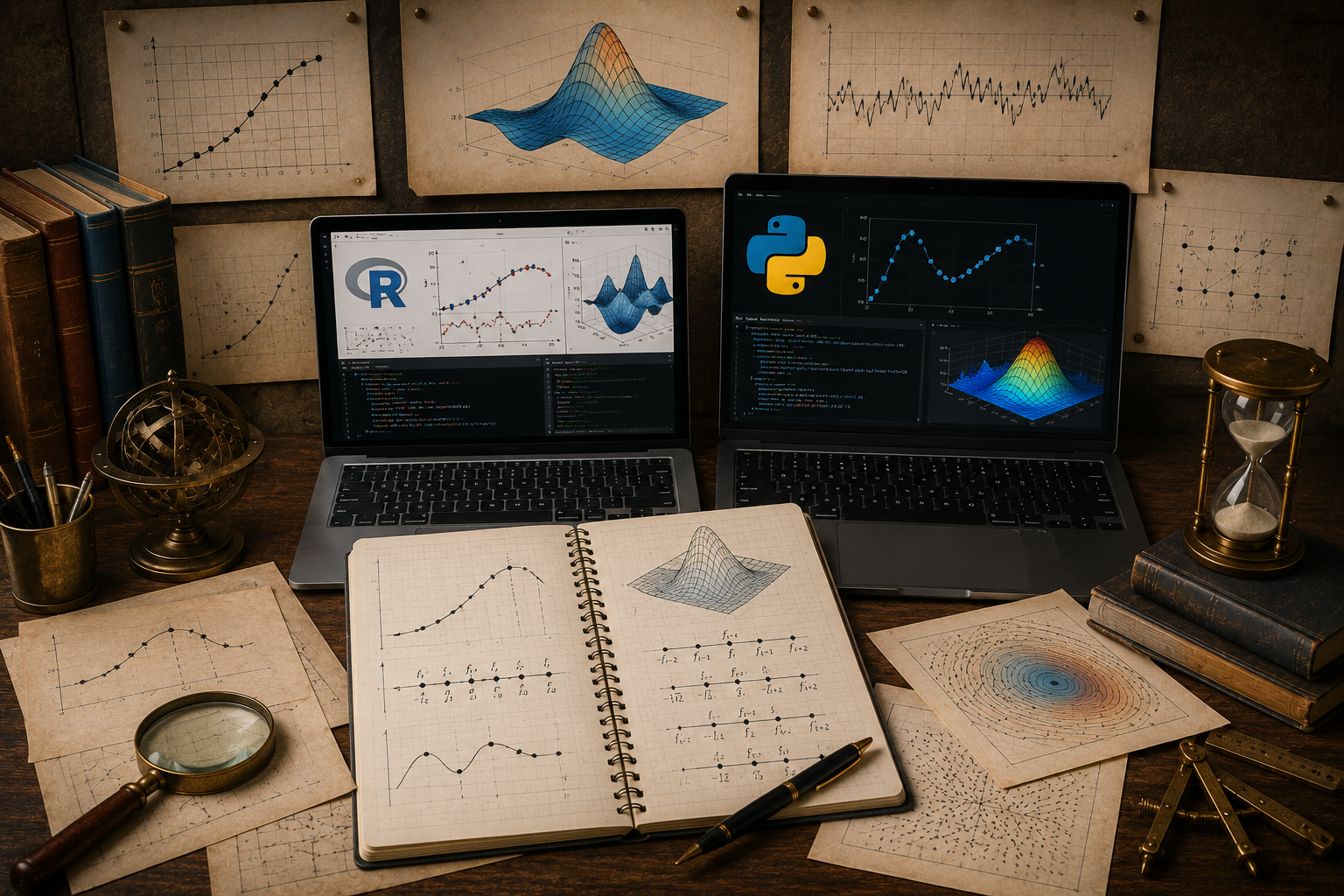
Exact derivatives belong to continuous mathematical functions. Systems modelers often work with something messier: measurements at time points, model outputs at time steps, spatial grids, sampled signals, sensor records, or simulation tables. Numerical differentiation is the discipline of estimating derivatives from those finite values.
Why Numerical Differentiation Matters
Numerical differentiation matters because systems modeling often depends on estimating change from data rather than from closed-form equations. A modeler may want to know whether emissions are accelerating, whether infection growth is slowing, whether groundwater concentration is changing sharply near a boundary, whether traffic density is steepening near a bottleneck, or whether a policy scenario changes faster than a baseline scenario.
f'(t)\approx \frac{f(t+h)-f(t)}{h}
\]
Interpretation: A derivative can be approximated by comparing nearby sampled values separated by step size \(h\).
The approximation is useful, but it is not innocent. The estimate depends on step size, sampling frequency, data quality, numerical precision, smoothing choices, boundary handling, and the structure of the underlying system.
| Modeling question | Derivative estimate | Systems meaning |
|---|---|---|
| How fast is the system changing? | First derivative. | Rate, slope, velocity, marginal change, local trend. |
| Is change speeding up or slowing down? | Second derivative. | Acceleration, curvature, momentum, regime shift warning. |
| Where is the field steepest? | Spatial gradient. | Sharp transition, boundary, front, pressure, exposure difference. |
| How sensitive is output to a parameter? | Numerical sensitivity derivative. | Local response to parameter perturbation. |
Numerical differentiation helps turn sampled values into interpretable rates, but it must be handled with care because differentiation amplifies error and noise.
From Symbolic to Numerical Derivatives
Symbolic differentiation starts with a formula and derives an exact expression for the derivative. Numerical differentiation starts with values and estimates a derivative from neighboring samples.
\frac{d}{dt}t^2=2t
\]
Interpretation: Symbolic differentiation gives an exact derivative for a known formula.
\frac{f(t_{i+1})-f(t_i)}{t_{i+1}-t_i}
\]
Interpretation: Numerical differentiation estimates a derivative from sampled values.
| Approach | Input | Output | Typical use |
|---|---|---|---|
| Symbolic differentiation. | Formula. | Exact derivative expression. | Analytical modeling, theory, local interpretation. |
| Automatic differentiation. | Computational graph or program. | Machine-computed derivative. | Optimization, calibration, machine learning, sensitivity analysis. |
| Numerical differentiation. | Sampled values. | Approximate derivative estimate. | Data, simulations, grids, observed time series. |
| Statistical derivative estimation. | Noisy data and model assumptions. | Smoothed or inferred derivative. | Sensors, empirical systems, uncertain measurements. |
Numerical differentiation is often the practical method when exact formulas are unavailable, inconvenient, or less important than the behavior of sampled outputs.
Finite-Difference Thinking
Finite differences replace infinitesimal change with small but finite change. Instead of asking for the exact derivative at a point, the modeler compares nearby values.
\Delta f=f(t+h)-f(t)
\]
Interpretation: A finite difference measures how much the function changes across a finite step.
The difference becomes a derivative estimate when divided by the step size.
\frac{\Delta f}{h}=\frac{f(t+h)-f(t)}{h}
\]
Interpretation: The finite difference quotient estimates the local rate of change.
| Finite-difference element | Meaning | Systems interpretation |
|---|---|---|
| Sample value. | Observed or simulated state. | Measurement, model output, grid cell, time-series value. |
| Step size. | Distance between samples. | Time interval, spatial interval, parameter perturbation. |
| Difference. | Change across step. | Observed change, scenario shift, local variation. |
| Difference quotient. | Change divided by step. | Approximate rate, slope, gradient, sensitivity. |
Finite-difference thinking is the bridge between calculus and computational data work.
Forward, Backward, and Central Differences
Forward, backward, and central differences use different neighboring values to estimate a derivative. The choice depends on whether future values, past values, or both are available.
f'(t)\approx \frac{f(t+h)-f(t)}{h}
\]
Interpretation: A forward difference estimates the derivative using the current and next value.
f'(t)\approx \frac{f(t)-f(t-h)}{h}
\]
Interpretation: A backward difference estimates the derivative using the current and previous value.
f'(t)\approx \frac{f(t+h)-f(t-h)}{2h}
\]
Interpretation: A central difference estimates the derivative using values on both sides of the point.
| Method | Uses | Strength | Limitation |
|---|---|---|---|
| Forward difference. | Current and next value. | Useful at left boundaries or online updates. | Less accurate than central difference for smooth functions. |
| Backward difference. | Previous and current value. | Useful at right boundaries or real-time monitoring. | Also one-sided and lower accuracy. |
| Central difference. | Previous and next value. | Often more accurate for smooth data. | Requires values on both sides. |
| Higher-order stencil. | Several neighboring values. | Can improve accuracy for smooth functions. | More sensitive to noise and boundary complications. |
Central differences are often preferred for smooth sampled functions, but one-sided differences remain important near boundaries, at the beginning of time series, and in streaming systems.
Time Step and Grid Spacing
The step size controls the derivative estimate. In time-dependent data, the step is usually a time interval. In spatial data, it is a grid spacing. In parameter sensitivity analysis, it is a perturbation size.
h=t_{i+1}-t_i
\]
Interpretation: The derivative estimate depends on the spacing between sampled points.
If \(h\) is too large, the estimate may miss local structure. If \(h\) is too small, roundoff error, noise, and measurement error may dominate.
| Step size problem | What happens | Modeling consequence |
|---|---|---|
| Step too large. | Local variation is averaged away. | Sharp transitions, thresholds, or turning points may be missed. |
| Step too small. | Noise and roundoff dominate. | Derivative estimates become unstable or erratic. |
| Uneven spacing. | Simple formulas may not apply directly. | Derivative estimates require adjusted formulas. |
| Boundary spacing. | One-sided estimates are needed. | Boundary derivatives may be less reliable. |
Choosing a step size is a modeling decision, not just a computational detail.
Truncation Error
Truncation error comes from replacing a derivative with a finite approximation. Taylor series explain why different finite-difference formulas have different accuracy.
f(t+h)=f(t)+hf'(t)+\frac{h^2}{2}f”(t)+O(h^3)
\]
Interpretation: Taylor expansion shows what terms are kept and what terms are omitted in a finite-difference approximation.
The forward difference has error proportional to \(h\) for smooth functions, while the central difference has error proportional to \(h^2\).
\frac{f(t+h)-f(t)}{h}=f'(t)+O(h)
\]
\frac{f(t+h)-f(t-h)}{2h}=f'(t)+O(h^2)
\]
| Formula | Typical truncation error | Interpretation |
|---|---|---|
| Forward difference. | \(O(h)\) | Error shrinks roughly in proportion to step size. |
| Backward difference. | \(O(h)\) | Same order as forward difference. |
| Central difference. | \(O(h^2)\) | Error shrinks faster for smooth functions. |
| Higher-order stencil. | Higher powers of \(h\) | Can improve accuracy if data are smooth and reliable. |
Truncation error improves when step size decreases, but that is only half the story.
Roundoff Error
Roundoff error comes from finite numerical precision. When subtracting nearly equal values, small floating-point errors can become large after division by a tiny step size.
\frac{f(t+h)-f(t)}{h}
\]
Interpretation: If \(h\) is extremely small, the numerator may suffer cancellation before division.
Numerical differentiation therefore has a tradeoff. Smaller \(h\) reduces truncation error but can increase roundoff error. Larger \(h\) reduces roundoff sensitivity but increases approximation error.
| Error source | Gets worse when | Practical response |
|---|---|---|
| Truncation error. | Step size is too large. | Try smaller \(h\) or higher-order formula. |
| Roundoff error. | Step size is too small. | Avoid extremely small perturbations. |
| Measurement noise. | Data are noisy. | Smooth, model, or estimate derivatives statistically. |
| Boundary error. | One-sided values are required. | Report boundary method and uncertainty. |
The best step size is often not the smallest possible step. It is the step that balances approximation error, numerical precision, and data quality.
Noise and Smoothing
Differentiation amplifies noise. A time series may look smooth in level form but become erratic after differencing. This is especially important for sensor data, economic data, epidemiological records, ecological observations, and environmental measurements.
y_i=f(t_i)+\varepsilon_i
\]
Interpretation: Observed data \(y_i\) combine an underlying signal \(f(t_i)\) and noise \(\varepsilon_i\).
Derivative estimates from noisy data should often be paired with smoothing, filtering, regression, uncertainty intervals, or model-based estimation.
| Data condition | Derivative risk | Possible response |
|---|---|---|
| Measurement noise. | False spikes in estimated rate. | Smoothing, filtering, robust methods. |
| Irregular reporting. | Artificial acceleration or slowdown. | Resampling or irregular-grid formulas. |
| Missing values. | Distorted differences. | Interpolation with documented assumptions. |
| Seasonality. | Short-term derivatives hide long-term direction. | Seasonal adjustment or multi-scale derivative review. |
A derivative estimate is not automatically a signal. It may be a noise amplifier unless the workflow handles data quality responsibly.
Second Derivatives and Acceleration
Second derivatives estimate curvature, acceleration, or change in the rate of change. They are useful when the modeler wants to know whether a system is speeding up, slowing down, bending, destabilizing, or approaching a turning point.
f”(t)\approx \frac{f(t+h)-2f(t)+f(t-h)}{h^2}
\]
Interpretation: A central second-difference estimate measures local curvature.
| Second-derivative pattern | Meaning | Systems interpretation |
|---|---|---|
| Positive second derivative. | Rate increasing. | Acceleration, compounding growth, intensifying pressure. |
| Negative second derivative. | Rate decreasing. | Slowdown, saturation, dampening, recovery. |
| Changing sign. | Curvature shift. | Inflection, transition, possible regime change. |
| Large magnitude. | Sharp bending. | Rapid acceleration, abrupt structural change, data artifact risk. |
Second derivatives are especially sensitive to noise. They should be interpreted with stronger caution than first derivatives when data are empirical or irregular.
Spatial Gradients
Numerical differentiation is not limited to time. Spatial gradients estimate how a field changes across space. This is central to PDEs, diffusion, transport, flux, exposure modeling, hydrology, heat flow, infrastructure stress, and environmental risk analysis.
\frac{\partial u}{\partial x}\approx \frac{u_{i+1}-u_{i-1}}{2\Delta x}
\]
Interpretation: A central difference estimates a spatial derivative on a grid.
Spatial derivatives help identify fronts, boundaries, steep gradients, flow directions, pressure changes, stress concentrations, and localized transitions.
| Spatial derivative | Meaning | Systems example |
|---|---|---|
| Gradient. | Direction and steepness of change. | Pollution plume edge, pressure slope, temperature gradient. |
| Divergence. | Net outflow or spreading from a point. | Source region, drainage, expansion, dispersal. |
| Curl. | Local rotation. | Fluid circulation, vortices, rotational flow. |
| Laplacian. | Local curvature or spread structure. | Diffusion, smoothing, heat flow, concentration spread. |
Spatial numerical derivatives require careful grid design. Coarse grids can hide gradients, while noisy grids can create false ones.
Differentiation in Model Calibration
Numerical differentiation also supports calibration and sensitivity analysis. A modeler may perturb a parameter and estimate how much an output changes.
\frac{\partial y}{\partial \theta}\approx \frac{y(\theta+h)-y(\theta-h)}{2h}
\]
Interpretation: A central parameter perturbation estimates local sensitivity of output \(y\) to parameter \(\theta\).
This can help identify influential parameters, diagnose robustness, support calibration routines, or reveal whether a model is locally insensitive to a parameter.
| Calibration use | Derivative role | Interpretive caution |
|---|---|---|
| Parameter sensitivity. | Estimate local output response. | Local sensitivity may not generalize globally. |
| Optimization. | Approximate gradient of loss function. | Step size affects direction and stability. |
| Model comparison. | Compare derivative behavior across models. | Derivative estimates may reflect numerical settings. |
| Robustness check. | Test response to small perturbations. | Noisy outputs can obscure sensitivity. |
Derivative-based calibration should document perturbation size, parameter units, baseline values, response metrics, and uncertainty.
Derivative Audits
A derivative audit records how numerical derivatives were estimated. It should include the method, step size, data source, boundary handling, smoothing choice, error warnings, and interpretation limits.
| Audit item | Why it matters | Responsible documentation |
|---|---|---|
| Difference formula. | Controls accuracy and boundary behavior. | Forward, backward, central, or higher-order stencil. |
| Step size. | Controls error tradeoff. | Record \(h\), units, and sensitivity checks. |
| Data quality. | Noise affects derivative estimates. | Document smoothing, filtering, interpolation, missing values. |
| Boundary method. | Edges require special handling. | Record one-sided formulas and uncertainty. |
| Validation. | Checks whether estimates are plausible. | Compare known analytic cases or simulated benchmarks. |
Derivative audits are especially important when derivative estimates support decisions, claims of acceleration, early warning signals, model calibration, or policy interpretation.
Systems Modeling Interpretation
Numerical differentiation helps modelers interpret change, but it can also distort change. A rate estimate may represent real acceleration, a sampling artifact, a boundary artifact, noise amplification, or a poor step-size choice.
A derivative estimate should be treated as a modeled quantity: something produced by a method under assumptions. It is not automatically the system’s true rate of change.
The responsible interpretation is conditional: if the data are appropriate, the step size is reasonable, the difference formula is documented, smoothing choices are justified, and sensitivity checks are performed, then numerical differentiation can clarify system behavior. If those conditions are weak, derivative estimates should be treated as exploratory signals, not firm evidence.
Mathematical Deepening
This section adds a more formal layer for mathematically advanced readers. Numerical differentiation connects Taylor expansion, finite-difference stencils, truncation error, floating-point arithmetic, noise amplification, regularization, spatial grids, and derivative-based sensitivity analysis.
Difference Methods
Forward Difference
Uses current and next values; useful at left boundaries and in online updates.
Backward Difference
Uses previous and current values; useful at right boundaries and retrospective monitoring.
Central Difference
Uses values on both sides; often more accurate for smooth sampled functions.
Higher-Order Stencil
Uses more neighboring values to improve approximation order when data are smooth.
Error Structure
Truncation Error
Comes from omitting higher-order terms in a finite approximation.
Roundoff Error
Comes from finite numerical precision and cancellation.
Noise Amplification
Occurs because differencing magnifies small measurement variations.
Boundary Error
Appears when one-sided estimates are needed at the edge of data or domains.
Systems Uses
Rate Estimation
Estimate speed of change from observations or simulations.
Acceleration Detection
Estimate whether a process is speeding up or slowing down.
Spatial Gradient
Estimate local change across a grid or spatial field.
Parameter Sensitivity
Approximate how an output responds to small parameter perturbations.
Differentiation Governance
Step-Size Record
Document \(h\), units, and sensitivity to alternative step sizes.
Formula Record
State whether forward, backward, central, or higher-order differences were used.
Noise Record
Document smoothing, filtering, interpolation, and missing-data handling.
Interpretive Limit
Explain whether derivative estimates are exploratory, diagnostic, or decision-supporting.
Examples from Systems Modeling
Numerical differentiation appears whenever modelers estimate change from sampled data, simulation outputs, or computational grids.
Epidemic Growth
Daily case counts can be differentiated to estimate growth rates, acceleration, or slowdown, but reporting noise must be handled carefully.
Climate Trends
Temperature, emissions, and concentration time series can be analyzed for rates of change and acceleration.
Traffic Systems
Vehicle density and speed data can reveal local gradients, shock formation, and congestion propagation.
Infrastructure Monitoring
Sensor streams can be differentiated to detect rapid change, stress buildup, vibration, or deterioration.
Ecological Systems
Population, biomass, resource, or concentration records can be inspected for growth, decline, and curvature.
Model Calibration
Small parameter perturbations can approximate gradients that support calibration, sensitivity, and robustness checks.
Across these examples, derivative estimates should be interpreted as method-dependent approximations, not direct observations of hidden system truth.
Computation and Reproducible Workflows
Computational workflows for numerical differentiation should record data source, sampling interval, difference formula, step size, smoothing method, boundary handling, missing-value treatment, derivative order, validation benchmark, output summaries, and interpretation warnings.
Because derivative estimates can be unstable, reproducible workflows should save derivative audit tables, method metadata, and step-size sensitivity outputs. The goal is to make rate estimates traceable.
Python Workflow: Numerical Differentiation Audit
The Python workflow below compares forward, backward, and central difference estimates for a smooth synthetic signal and records absolute errors against the known derivative.
from __future__ import annotations

from dataclasses import dataclass, asdict
from pathlib import Path
import csv
import json
import math


@dataclass(frozen=True)
class DifferentiationRecord:
    index: int
    x: float
    value: float
    true_derivative: float
    forward_difference: float | None
    backward_difference: float | None
    central_difference: float | None
    central_absolute_error: float | None
    step_size: float
    warning: str


def signal(x: float) -> float:
    return math.sin(x) + 0.1 * x * x


def true_derivative(x: float) -> float:
    return math.cos(x) + 0.2 * x


def finite_difference_audit(
    start: float,
    stop: float,
    step_size: float
) -> list[DifferentiationRecord]:
    n = int(round((stop - start) / step_size))
    xs = [start + i * step_size for i in range(n + 1)]
    values = [signal(x) for x in xs]
    records: list[DifferentiationRecord] = []

    for i, x in enumerate(xs):
        forward = None
        backward = None
        central = None
        central_error = None

        if i < len(xs) - 1:
            forward = (values[i + 1] - values[i]) / step_size

        if i > 0:
            backward = (values[i] - values[i - 1]) / step_size

        if 0 < i < len(xs) - 1:
            central = (values[i + 1] - values[i - 1]) / (2 * step_size)
            central_error = abs(central - true_derivative(x))

        records.append(
            DifferentiationRecord(
                index=i,
                x=x,
                value=values[i],
                true_derivative=true_derivative(x),
                forward_difference=forward,
                backward_difference=backward,
                central_difference=central,
                central_absolute_error=central_error,
                step_size=step_size,
                warning="Numerical derivatives depend on step size, formula choice, boundary handling, smoothness, and noise."
            )
        )

    return records


records = finite_difference_audit(
    start=0.0,
    stop=10.0,
    step_size=0.1
)

output_dir = Path("outputs")
(output_dir / "tables").mkdir(parents=True, exist_ok=True)
(output_dir / "json").mkdir(parents=True, exist_ok=True)

with (output_dir / "tables" / "numerical_differentiation_audit.csv").open("w", newline="", encoding="utf-8") as handle:
    writer = csv.DictWriter(handle, fieldnames=asdict(records[0]).keys())
    writer.writeheader()
    for record in records:
        writer.writerow(asdict(record))

valid_errors = [
    record.central_absolute_error
    for record in records
    if record.central_absolute_error is not None
]

summary = {
    "start": 0.0,
    "stop": 10.0,
    "step_size": 0.1,
    "records": len(records),
    "mean_central_absolute_error": sum(valid_errors) / len(valid_errors),
    "max_central_absolute_error": max(valid_errors),
    "interpretation": "Central differences provide a useful derivative estimate for smooth synthetic data, but boundary and noise behavior require separate review."
}

(output_dir / "json" / "numerical_differentiation_audit.json").write_text(
    json.dumps([asdict(record) for record in records], indent=2),
    encoding="utf-8"
)

(output_dir / "json" / "numerical_differentiation_summary.json").write_text(
    json.dumps(summary, indent=2),
    encoding="utf-8"
)

print("Wrote numerical differentiation audit.")
This workflow records derivative estimates, boundary gaps, known-error comparisons, and method warnings in reusable output files.
R Workflow: Finite-Difference Diagnostics
The R workflow below performs the same derivative audit and writes diagnostic tables.
signal_function <- function(x) {
  sin(x) + 0.1 * x ^ 2
}

true_derivative <- function(x) {
  cos(x) + 0.2 * x
}

finite_difference_audit <- function(start, stop, step_size) {
  xs <- seq(start, stop, by = step_size)
  values <- signal_function(xs)
  records <- list()

  for (i in seq_along(xs)) {
    forward <- NA
    backward <- NA
    central <- NA
    central_error <- NA

    if (i < length(xs)) {
      forward <- (values[[i + 1]] - values[[i]]) / step_size
    }

    if (i > 1) {
      backward <- (values[[i]] - values[[i - 1]]) / step_size
    }

    if (i > 1 && i < length(xs)) {
      central <- (values[[i + 1]] - values[[i - 1]]) / (2 * step_size)
      central_error <- abs(central - true_derivative(xs[[i]]))
    }

    records[[length(records) + 1]] <- data.frame(
      index = i - 1,
      x = xs[[i]],
      value = values[[i]],
      true_derivative = true_derivative(xs[[i]]),
      forward_difference = forward,
      backward_difference = backward,
      central_difference = central,
      central_absolute_error = central_error,
      step_size = step_size,
      warning = "Numerical derivatives depend on step size, formula choice, boundary handling, smoothness, and noise."
    )
  }

  do.call(rbind, records)
}

results <- finite_difference_audit(
  start = 0,
  stop = 10,
  step_size = 0.1
)

valid_errors <- results$central_absolute_error[!is.na(results$central_absolute_error)]

summary_table <- data.frame(
  start = 0,
  stop = 10,
  step_size = 0.1,
  records = nrow(results),
  mean_central_absolute_error = mean(valid_errors),
  max_central_absolute_error = max(valid_errors),
  interpretation = "Central differences provide a useful derivative estimate for smooth synthetic data, but boundary and noise behavior require separate review."
)

dir.create("outputs/tables", recursive = TRUE, showWarnings = FALSE)
write.csv(results, "outputs/tables/r_numerical_differentiation_audit.csv", row.names = FALSE)
write.csv(summary_table, "outputs/tables/r_numerical_differentiation_summary.csv", row.names = FALSE)

print(head(results))
print(summary_table)
This workflow supports step-size comparisons, method audits, and derivative-error diagnostics.
Haskell Workflow: Typed Difference Records
Haskell can represent numerical differentiation records with explicit derivative estimates, boundary cases, and warnings.
module Main where

data DifferentiationRecord = DifferentiationRecord
  { indexValue :: Int
  , xValue :: Double
  , functionValue :: Double
  , trueDerivativeValue :: Double
  , centralDifferenceValue :: Maybe Double
  , centralAbsoluteError :: Maybe Double
  , stepSize :: Double
  , warning :: String
  } deriving (Show)

signal :: Double -> Double
signal x = sin x + 0.1 * x * x

trueDerivative :: Double -> Double
trueDerivative x = cos x + 0.2 * x

centralDifference :: [Double] -> Int -> Double -> Maybe Double
centralDifference values i h
  | i <= 0 = Nothing
  | i >= length values - 1 = Nothing
  | otherwise = Just (((values !! (i + 1)) - (values !! (i - 1))) / (2 * h))

buildRecords :: Double -> Double -> Double -> [DifferentiationRecord]
buildRecords start stop h =
  map build [0..n]
  where
    n = round ((stop - start) / h)
    xs = [start + fromIntegral i * h | i <- [0..n]]
    values = map signal xs

    build i =
      let x = xs !! i
          cd = centralDifference values i h
          err = fmap (\d -> abs (d - trueDerivative x)) cd
      in DifferentiationRecord
          i
          x
          (signal x)
          (trueDerivative x)
          cd
          err
          h
          "Numerical derivatives depend on step size, formula choice, boundary handling, smoothness, and noise."

main :: IO ()
main =
  mapM_ print (buildRecords 0.0 10.0 0.1)
The typed workflow distinguishes available central differences from boundary cases where a centered estimate is not available.
SQL Workflow: Differentiation Assumption Registry
SQL can document numerical differentiation assumptions when derivative estimates support dashboards, reports, calibration pipelines, policy interpretation, or model governance.
CREATE TABLE numerical_differentiation_assumption_registry (
    assumption_key TEXT PRIMARY KEY,
    assumption_name TEXT NOT NULL,
    mathematical_role TEXT NOT NULL,
    systems_modeling_role TEXT NOT NULL,
    review_warning TEXT NOT NULL
);

INSERT INTO numerical_differentiation_assumption_registry VALUES
(
  'difference_formula',
  'Difference formula',
  'Defines how nearby values estimate a derivative.',
  'Controls whether the estimate is forward, backward, central, or higher-order.',
  'The formula should be documented, especially near boundaries.'
);

INSERT INTO numerical_differentiation_assumption_registry VALUES
(
  'step_size',
  'Step size',
  'Defines spacing between sampled values or perturbations.',
  'Controls the balance between truncation error, roundoff error, and data noise.',
  'Step-size sensitivity should be tested.'
);

INSERT INTO numerical_differentiation_assumption_registry VALUES
(
  'boundary_handling',
  'Boundary handling',
  'Defines derivative estimates at the beginning, end, or edge of data.',
  'Controls interpretation near time-series endpoints or spatial boundaries.',
  'Boundary derivatives are often less reliable than interior derivatives.'
);

INSERT INTO numerical_differentiation_assumption_registry VALUES
(
  'noise_treatment',
  'Noise treatment',
  'Defines smoothing, filtering, interpolation, or statistical estimation.',
  'Prevents derivative estimates from amplifying measurement noise unchecked.',
  'Smoothing choices should be justified and not used to hide uncertainty.'
);

INSERT INTO numerical_differentiation_assumption_registry VALUES
(
  'validation_benchmark',
  'Validation benchmark',
  'Compares derivative estimates against known or simulated truth when available.',
  'Helps identify formula, step-size, or implementation errors.',
  'Synthetic benchmarks do not guarantee empirical validity.'
);

INSERT INTO numerical_differentiation_assumption_registry VALUES
(
  'interpretation_scope',
  'Interpretation scope',
  'Defines whether derivative estimates are exploratory, diagnostic, or decision-supporting.',
  'Clarifies how strongly rate estimates should be used in conclusions.',
  'Derivative estimates should not be overstated when data quality is weak.'
);

SELECT
    assumption_name,
    mathematical_role,
    systems_modeling_role,
    review_warning
FROM numerical_differentiation_assumption_registry
ORDER BY assumption_key;
This registry keeps derivative interpretation tied to formulas, step size, boundaries, noise treatment, validation, and scope.
GitHub Repository
The companion repository for this article is designed as a reproducible mathematical-modeling workspace. It supports finite-difference audits, derivative-error diagnostics, step-size sensitivity checks, synthetic benchmark functions, boundary-method review, SQL governance tables, generated outputs, advanced mathematical audit reports, and reusable calculator scripts.
Complete Code Repository
Companion article folder with Python, R, Julia, SQL, Haskell, C, C++, Fortran, Rust, Go, notebooks, documentation, synthetic teaching data, generated outputs, schemas, Canvas-ready workflow artifacts, and reusable calculator scripts for numerical differentiation, finite differences, forward differences, backward differences, central differences, second derivatives, spatial gradients, step-size sensitivity, truncation error, roundoff error, noise amplification, derivative audits, model governance, and responsible mathematical modeling.
Interpretive Limits and Responsible Use
Numerical differentiation is powerful because it estimates rates from sampled data. It is risky because small errors, noise, missing values, irregular spacing, boundary effects, and poorly chosen step sizes can produce misleading derivative estimates.
Responsible use requires several checks. Document the data source, sampling interval, units, difference formula, step size, smoothing method, missing-value treatment, boundary method, and validation benchmark. Compare multiple step sizes where possible. Avoid treating noisy derivative spikes as system acceleration without further evidence. Distinguish model output derivatives from empirical derivatives. Report uncertainty and method dependence.
The central modeling question is not only “What is the estimated derivative?” It is “How was that derivative estimated, how stable is it across reasonable choices, and what assumptions make the rate meaningful?”
Related Articles
- Calculus for Systems Modeling
- Derivatives as Rates of Change
- Second Derivatives, Curvature, and Acceleration
- Directional Derivatives and Gradients
- Gradient, Divergence, and Curl
- Introduction to Partial Differential Equations
- Diffusion, Transport, and Spatial Dynamics
- Numerical Integration for Systems Modeling
- Finite Difference Methods
- Stability, Error, and Convergence in Numerical Modeling
Further Reading
- Atkinson, K.E. (1989) An Introduction to Numerical Analysis. 2nd edn. New York: Wiley.
- Burden, R.L. and Faires, J.D. (2011) Numerical Analysis. 9th edn. Boston, MA: Brooks/Cole.
- Chapra, S.C. and Canale, R.P. (2015) Numerical Methods for Engineers. 7th edn. New York: McGraw-Hill Education.
- Fornberg, B. (1998) A Practical Guide to Pseudospectral Methods. Cambridge: Cambridge University Press.
- Fornberg, B. (1988) ‘Generation of finite difference formulas on arbitrarily spaced grids’, Mathematics of Computation, 51(184), pp. 699–706.
- Heath, M.T. (2018) Scientific Computing: An Introductory Survey. 2nd edn. Philadelphia, PA: Society for Industrial and Applied Mathematics.
- LeVeque, R.J. (2007) Finite Difference Methods for Ordinary and Partial Differential Equations. Philadelphia, PA: Society for Industrial and Applied Mathematics.
- Quarteroni, A., Sacco, R. and Saleri, F. (2007) Numerical Mathematics. 2nd edn. Berlin: Springer.
- Sauer, T. (2017) Numerical Analysis. 3rd edn. Boston, MA: Pearson.
- Massachusetts Institute of Technology (MIT) OpenCourseWare (2011) Introduction to Numerical Analysis. Cambridge, MA: MIT OpenCourseWare.
References
- Atkinson, K.E. (1989) An Introduction to Numerical Analysis. 2nd edn. New York: Wiley.
- Burden, R.L. and Faires, J.D. (2011) Numerical Analysis. 9th edn. Boston, MA: Brooks/Cole.
- Chapra, S.C. and Canale, R.P. (2015) Numerical Methods for Engineers. 7th edn. New York: McGraw-Hill Education.
- Fornberg, B. (1988) ‘Generation of finite difference formulas on arbitrarily spaced grids’, Mathematics of Computation, 51(184), pp. 699–706.
- Fornberg, B. (1998) A Practical Guide to Pseudospectral Methods. Cambridge: Cambridge University Press.
- Heath, M.T. (2018) Scientific Computing: An Introductory Survey. 2nd edn. Philadelphia, PA: Society for Industrial and Applied Mathematics.
- LeVeque, R.J. (2007) Finite Difference Methods for Ordinary and Partial Differential Equations. Philadelphia, PA: Society for Industrial and Applied Mathematics.
- Massachusetts Institute of Technology (MIT) OpenCourseWare (2011) Introduction to Numerical Analysis. Cambridge, MA: MIT OpenCourseWare.
- Quarteroni, A., Sacco, R. and Saleri, F. (2007) Numerical Mathematics. 2nd edn. Berlin: Springer.
- Sauer, T. (2017) Numerical Analysis. 3rd edn. Boston, MA: Pearson.