
Last Updated June 11, 2026
Representation is never only a matter of description. To represent someone is to select, frame, name, image, interpret, simplify, amplify, translate, or speak about them for an audience. Every act of storytelling therefore carries ethical weight.
Storytelling and the Ethics of Representation examines how stories portray people, communities, cultures, histories, suffering, identity, conflict, institutions, and difference. It asks who gets to speak, who is spoken about, who benefits from visibility, who carries risk, who controls context, and who is made legible through stereotypes, symbols, images, archives, testimony, or AI-generated media.
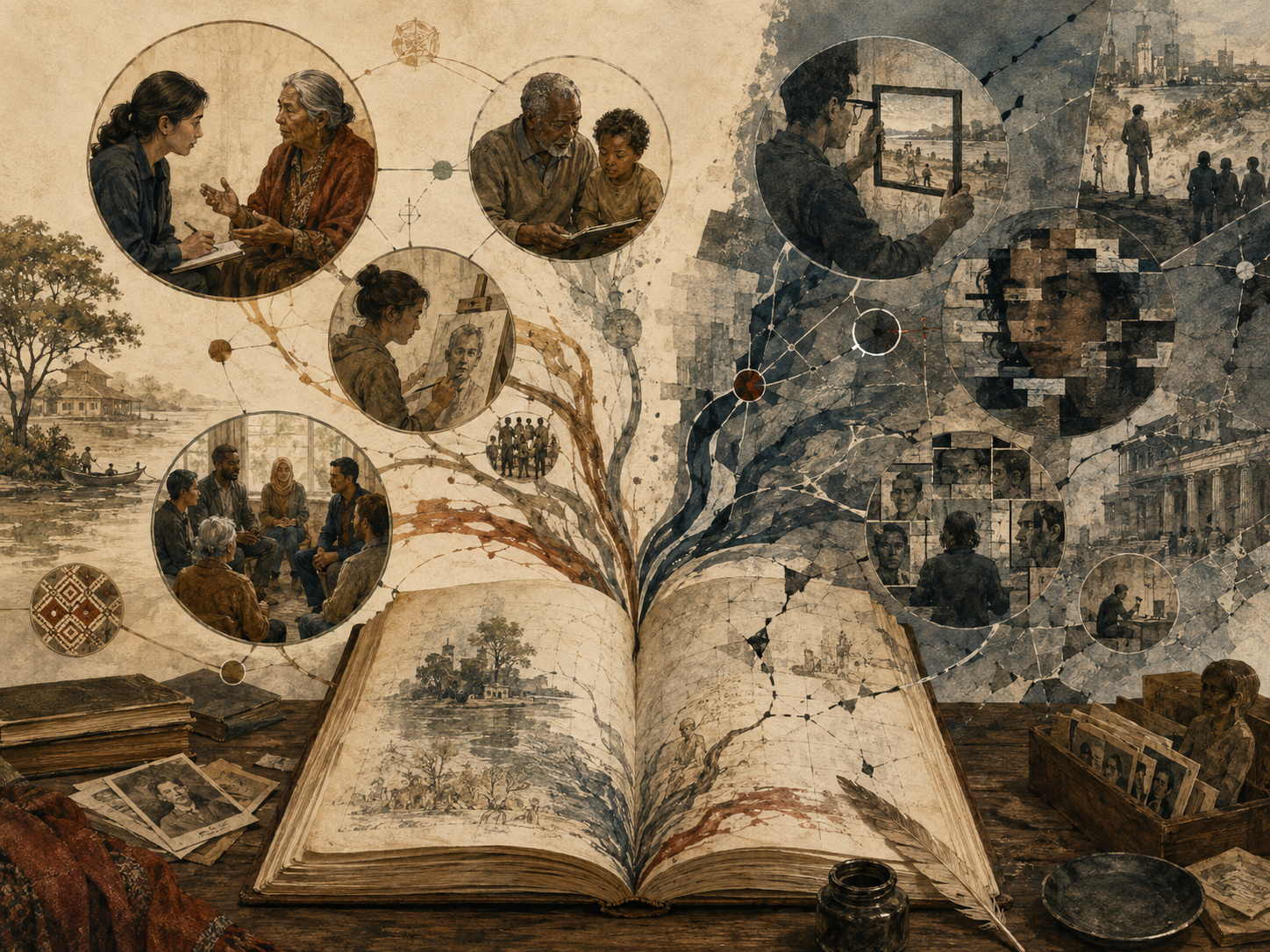
Stories can humanize, but they can also reduce. They can witness injustice, but they can also turn suffering into spectacle. They can preserve memory, but they can also fix people inside an image made by someone else. Ethical representation asks storytellers to move beyond good intentions and examine power, consent, context, accuracy, voice, audience, and consequence.
Why Representation Is Ethical
Representation is ethical because stories do not merely mirror the world. They organize attention. They decide what matters, who appears, who is named, who is backgrounded, who is simplified, who is trusted, who is pitied, who is feared, and who is allowed complexity.
Every story selects. No story can include everything. Selection is not a failure; it is part of narrative form. But selection becomes ethically significant when it involves people, cultures, communities, histories, trauma, political conflict, illness, disability, religion, race, gender, class, nationality, sexuality, migration, poverty, war, or institutional harm.
The ethics of representation does not mean stories must avoid difficult subjects. It means storytellers must ask how difficult subjects are framed, whose interpretation is centered, what evidence supports the portrayal, what context is missing, what harms may follow from visibility, and whether represented people have meaningful agency in the story.
| Representation issue | Ethical question | Risk |
|---|---|---|
| Selection | What is included, excluded, or emphasized? | The story creates a distorted whole from partial evidence. |
| Framing | How is the subject made meaningful? | The story turns people into symbols, problems, or examples. |
| Voice | Who speaks, and who is spoken about? | The storyteller substitutes authority for listening. |
| Context | What background is needed for fair interpretation? | The audience receives feeling without understanding. |
| Visibility | Who benefits or is endangered by exposure? | Publication creates harm for represented people. |
| Consequence | What happens after the story circulates? | Representation becomes extraction, spectacle, or stereotype. |
Ethical representation begins when storytellers recognize that narrative form has social consequence.
Representation and Power
Representation is tied to power because some people and institutions have greater capacity to define others publicly. Media organizations, publishers, schools, museums, governments, corporations, platforms, filmmakers, journalists, researchers, nonprofits, and AI systems can all create public images of people who may have little control over how they are portrayed.
Power affects who is considered expert, who is considered witness, who is considered data, who is considered audience, and who is considered subject. A community may be represented by outsiders with more access to funding, archives, cameras, distribution, or institutional legitimacy. A person may become visible through crisis while lacking control over the frame.
Representation also creates categories. A group may be narrated as vulnerable, dangerous, exotic, backward, inspirational, resilient, broken, traditional, voiceless, modern, criminal, irrational, authentic, or in need of rescue. These categories may appear sympathetic but still reduce complexity.
| Power layer | How it shapes representation | Review question |
|---|---|---|
| Editorial power | Chooses angle, language, image, and conclusion. | Who had authority over the frame? |
| Institutional power | Turns stories into policy, branding, education, or advocacy. | Does the story serve the people represented or the institution? |
| Platform power | Ranks, recommends, moderates, monetizes, and archives visibility. | How will the platform reshape interpretation? |
| Economic power | Funds production and circulation. | Who benefits materially from the portrayal? |
| Archival power | Controls historical evidence and public memory. | Whose records are preserved, classified, or missing? |
| Algorithmic power | Classifies, summarizes, generates, and predicts representation. | What biases or omissions are embedded in the system? |
The ethical question is not only whether a portrayal is positive or negative. It is whether the portrayal is accountable to the people, histories, and power relations it represents.
Voice, Speaking For, and Speaking With
One of the central questions in representation ethics is voice. Who speaks? Who is quoted? Who is interpreted? Who is translated? Who is summarized? Who is positioned as expert? Who is positioned as example? Who is invited to review the story before publication?
Speaking for others is sometimes necessary. Lawyers, translators, journalists, historians, advocates, teachers, curators, and researchers often represent people who cannot or do not speak directly in a given setting. But speaking for becomes ethically dangerous when it replaces the represented person’s agency, community knowledge, or interpretive authority.
Speaking with is different. It involves consultation, consent, collaboration, correction, attribution, and shared accountability. It does not mean every story must be co-authored, but it does require humility about perspective and limits.
| Voice practice | Ethical strength | Risk |
|---|---|---|
| Direct testimony | Allows people to speak in their own words. | Can be extracted, edited, or exposed without adequate care. |
| Quotation | Preserves some source voice. | May be cherry-picked or stripped of context. |
| Paraphrase | Can clarify complex material. | May replace nuance with the storyteller’s interpretation. |
| Translation | Makes stories accessible across language. | Can shift meaning, tone, authority, or cultural reference. |
| Community review | Adds accountability and correction. | Can become tokenistic if feedback is ignored. |
| Collaborative authorship | Shares narrative control. | Requires clear agreements about credit, compensation, and final authority. |
Ethical voice is not only a matter of letting someone speak. It is a matter of protecting the conditions under which speech can be heard without distortion, extraction, or punishment.
Stereotype and Simplification
Stereotypes are not just inaccurate images. They are repeated patterns that reduce people to recognizable shortcuts. A stereotype can be hostile, flattering, sentimental, comic, tragic, exoticizing, heroic, or paternalistic. Even positive stereotypes can limit human complexity.
Storytelling often simplifies because narrative needs focus. But simplification becomes unethical when it turns people into types: the helpless victim, noble sufferer, dangerous outsider, wise elder, angry activist, silent mother, corrupt official, broken refugee, exceptional survivor, exotic tradition bearer, model minority, violent youth, passive community, or inspirational disabled person.
Stereotypes are especially powerful because they feel familiar. Audiences may recognize the type quickly and mistake recognition for truth. Ethical representation interrupts this ease. It adds context, contradiction, interiority, specificity, agency, and uncertainty.
| Stereotype pattern | How it works | Ethical correction |
|---|---|---|
| Victim-only portrayal | Defines people only through suffering. | Include agency, history, relationships, knowledge, and context. |
| Heroic exception | Elevates one person as proof of overcoming. | Show systems, support, barriers, and ordinary complexity. |
| Exotic tradition | Frames culture as colorful, timeless, or mysterious. | Identify living context, internal diversity, and contemporary agency. |
| Dangerous other | Turns difference into threat. | Check evidence, language, image selection, and causal framing. |
| Inspirational suffering | Uses hardship to motivate outsiders. | Center dignity, consent, and the person’s own purpose. |
| Voiceless community | Represents people as needing external rescuers. | Show existing leadership, debate, knowledge, and self-representation. |
The test of representation is not whether a story is emotionally clear. It is whether clarity has been purchased by reducing people to usable types.
Visibility, Consent, and Risk
Visibility is often treated as inherently good. A story “gives voice,” “raises awareness,” “shines a light,” or “brings visibility.” But visibility can also create harm. Public exposure may invite harassment, surveillance, retaliation, stigma, legal risk, family conflict, community pressure, economic harm, or retraumatization.
Consent is therefore central. Ethical consent is more than obtaining a signature or recording permission once. It asks whether people understand where the story will appear, who may see it, how long it may remain available, whether it may be translated, remixed, monetized, archived, summarized, or used to train AI systems, and whether withdrawal is possible.
Consent is especially complex when stories involve children, displaced people, trauma survivors, medical patients, incarcerated people, workers, students, religious communities, refugees, undocumented people, conflict zones, or people dependent on institutions.
| Consent dimension | Question | Risk |
|---|---|---|
| Informed consent | Does the person understand the use and audience? | Consent is given without knowledge of circulation. |
| Ongoing consent | Can consent be revisited as context changes? | A story outlives the person’s comfort or safety. |
| Collective consent | Does the story involve community knowledge or shared memory? | An individual grants access to material that affects others. |
| Platform consent | Does the person understand search, sharing, and archiving? | Visibility expands far beyond the original setting. |
| AI consent | Can material be summarized, generated from, or reused by models? | Likeness, voice, or story becomes synthetic training material. |
| Withdrawal | Can the represented person request removal or correction? | Publication becomes irreversible extraction. |
Visibility should be governed by consent, safety, context, and purpose—not by the storyteller’s desire for impact.
Testimony, Witness, and Trauma
Testimony can be a powerful form of storytelling. It can document harm, preserve memory, challenge denial, support justice, and connect private experience to public truth. But testimony is ethically fragile because it often involves vulnerability, pain, risk, and unequal listening conditions.
A witness story is not raw material. It is a person’s account of experience, often shaped by memory, trauma, fear, courage, uncertainty, and audience pressure. Ethical storytelling should avoid forcing testimony into perfect coherence or dramatic arc. Trauma may be fragmented, repetitive, incomplete, or difficult to narrate.
The ethics of witness also includes audience responsibility. Audiences may demand pain as proof. Institutions may use testimony to create urgency while failing to change conditions. Media may repeat traumatic images until suffering becomes spectacle. Responsible storytelling protects dignity while preserving the seriousness of harm.
| Testimony issue | Ethical question | Warning sign |
|---|---|---|
| Extraction | Who benefits from the testimony? | The witness gives pain while others gain attention, funding, or legitimacy. |
| Coherence pressure | Is the story forced into a neat arc? | Messy memory is edited into inspirational closure. |
| Repetition | How often must the person retell harm? | Retelling becomes a condition of being believed. |
| Evidence burden | Is suffering demanded as proof? | Only graphic detail is treated as credible. |
| Audience consumption | How will viewers use the story? | Witness becomes emotional content without accountability. |
| Aftercare | What support follows publication? | The storyteller leaves after the story is captured. |
Ethical witness does not ask people to turn pain into content. It creates conditions for truth, dignity, safety, and accountability.
Image Ethics and Visual Storytelling
Images are powerful because they appear immediate. A photograph, portrait, video clip, illustration, chart, screenshot, or AI-generated image can make a story feel real before an audience has considered context. Visual storytelling therefore requires special care.
Images select perspective, distance, lighting, angle, moment, crop, background, facial expression, body posture, and setting. These choices can humanize, dramatize, aestheticize, expose, protect, or distort. An image of suffering can bear witness, but it can also turn pain into spectacle. A portrait can dignify, but it can also fix someone inside a role they did not choose.
Visual ethics asks whether the image has consent, context, provenance, caption accuracy, cultural sensitivity, and purpose. It also asks whether an image is necessary. Sometimes withholding an image is the ethical choice.
| Visual choice | Narrative effect | Ethical risk |
|---|---|---|
| Crop | Directs attention and removes context. | Changes meaning by excluding evidence or surroundings. |
| Caption | Frames interpretation. | Misidentifies people, places, causes, or chronology. |
| Graphic image | Communicates severity and urgency. | Turns suffering into spectacle or retraumatizes viewers. |
| Portrait | Creates presence and recognition. | Exposes identity or freezes person into symbolic role. |
| Archival image | Connects story to history. | Repeats historical harm without context or consent. |
| Generated image | Creates visual support without direct documentation. | May be mistaken for evidence or reproduce stereotype. |
Images do not simply show. They argue. Ethical visual storytelling makes that argument accountable.
Cultural Context and Appropriation
Stories often cross cultural boundaries. Translation, adaptation, scholarship, journalism, art, education, documentary, and public communication all involve representing cultures to audiences who may not share the same references, histories, rituals, languages, or power relations.
Cultural representation becomes unethical when it extracts symbols without context, treats living traditions as aesthetic material, uses sacred or restricted knowledge without permission, simplifies internal diversity, or turns culture into brand, costume, exotic scenery, or moral lesson for outsiders.
Responsible cultural representation requires research, consultation, attribution, humility, and awareness of power. It also requires recognizing that communities are not monolithic. There may be internal disagreement about how stories should be told, who may tell them, what can be public, and what must remain protected.
| Cultural representation issue | Risk | Responsible practice |
|---|---|---|
| Sacred material | Restricted knowledge becomes public content. | Follow community protocols and permission structures. |
| Symbol extraction | Images or motifs are used without history. | Provide context, credit, and limits. |
| Translation | Meaning shifts across language and audience. | Use qualified translators and note untranslatable terms. |
| Folk culture | Living practice is treated as ancient or static. | Show contemporary practice and internal diversity. |
| Outsider expertise | External authorities replace community knowledge. | Include local scholars, practitioners, and review processes. |
| Commercial use | Culture becomes marketable style. | Address compensation, consent, and benefit sharing. |
Cultural storytelling is ethical when it treats culture as living relation, not as symbolic inventory.
Institutional Representation
Institutions tell stories about the people they serve, employ, study, regulate, educate, protect, treat, or fund. These stories appear in annual reports, fundraising campaigns, documentaries, policy briefs, museum labels, university pages, hospital narratives, nonprofit appeals, corporate sustainability reports, and public communications.
Institutional representation is ethically sensitive because institutions often have power over the people represented. A nonprofit may portray a community to raise money. A university may portray students to market diversity. A hospital may portray patients to demonstrate care. A corporation may portray workers or communities to support reputation. A government may portray populations to justify policy.
The question is not whether institutions can tell such stories. The question is whether the people represented have consent, agency, context, review, benefit, and protection from harm.
| Institutional setting | Representation risk | Governance question |
|---|---|---|
| Fundraising | People are shown as need, crisis, or gratitude. | Does the story preserve dignity and agency? |
| Diversity marketing | Identity becomes evidence of institutional virtue. | Do represented people benefit from the portrayal? |
| Public policy | Communities are framed as problems to solve. | Are affected people involved in interpretation? |
| Research | Participants become data or case examples. | Are consent, anonymization, and context adequate? |
| Museum/archive | Objects and images are interpreted by curators. | Are source communities involved in labeling and access? |
| Corporate communication | Stakeholder stories support reputation. | Is the story accountable to material practice? |
Institutional stories are ethical only when representation does not become a substitute for accountability.
Audience Responsibility
Representation ethics does not end with the storyteller. Audiences also have responsibility. An audience can consume suffering, reward stereotypes, demand oversimplification, share without context, misread testimony, harass represented people, or treat visibility as entertainment.
Audiences often want stories to be emotionally clear. They may prefer heroes and villains, victims and rescuers, innocence and guilt, authenticity and fraud. Ethical storytelling may require resisting those expectations. Complex representation can make audiences work harder: to notice uncertainty, context, contradiction, and their own interpretive habits.
Audience responsibility is especially important in digital environments. A viewer can share, quote, remix, screenshot, mock, monetize, or summarize someone else’s story within seconds. The audience becomes part of circulation.
| Audience practice | Ethical responsibility | Risk |
|---|---|---|
| Viewing | Recognize framing, selection, and limits. | Taking representation as total truth. |
| Sharing | Preserve context and consent. | Amplifying harm or misinterpretation. |
| Commenting | Respond without harassment or reduction. | Turning represented people into debate objects. |
| Donating | Ask whether fundraising representation is ethical. | Rewarding dignity loss because it feels urgent. |
| Learning | Seek sources beyond a single story. | Using one narrative as proof about a whole group. |
| Remixing | Credit, contextualize, and avoid exploitation. | Transforming someone else’s story into engagement material. |
An ethical audience does not ask only, “Did this story move me?” It asks, “What did this story make visible, what did it hide, and what responsibility follows?”
AI and Synthetic Representation
AI intensifies representation ethics because it can generate images, voices, characters, testimonies, summaries, cultural scenes, historical reconstructions, demographic portraits, and persuasive narratives without direct contact with the people represented. It can create plausible representation at scale.
Synthetic representation can support education, accessibility, translation, prototyping, and privacy-preserving illustration. But it can also reproduce stereotypes, fabricate cultural knowledge, create false testimony, imitate real people, generate images that appear documentary, or summarize communities through biased training data.
The ethics of AI representation requires disclosure, provenance, human review, data awareness, cultural consultation, and limits on use. A generated image of a community is not neutral because it was made without a camera. It may encode assumptions about dress, age, setting, poverty, tradition, modernity, emotion, gender, religion, class, and geography.
| AI representation use | Possible benefit | Risk |
|---|---|---|
| Generated illustration | Protects privacy where photography is unsafe. | Creates stereotyped or misleading imagery. |
| Voice synthesis | Supports accessibility or language production. | Violates identity, consent, or trust. |
| Testimony summary | Helps process large archives. | Flattens uncertainty, emotion, and dissent. |
| Cultural scene generation | Supports educational visualization. | Fabricates cultural authority from patterns in data. |
| Persona generation | Tests audience scenarios. | Turns people into demographic stereotypes. |
| Historical reconstruction | Visualizes lost or inaccessible contexts. | Confuses reconstruction with evidence. |
AI-generated representation should be treated as interpretation under power, not as neutral visual or narrative assistance.
Representation Governance
Representation ethics needs governance because good intentions are not enough. A storyteller may care deeply and still reproduce stereotypes, omit context, expose someone to harm, misread a culture, overstate evidence, or use testimony in extractive ways.
Governance means building review into the storytelling process. It can include consent protocols, source review, community consultation, sensitivity reading, legal review, trauma-informed practice, visual ethics review, archive documentation, AI disclosure, editorial notes, correction procedures, and post-publication accountability.
Governance should not become bureaucratic box-checking. Its purpose is to protect dignity, accuracy, context, and consequence. The process should be proportionate to risk: a low-stakes fictional example needs less review than a public story about real people affected by trauma, conflict, illness, displacement, or institutional harm.
| Governance practice | Purpose | Failure mode |
|---|---|---|
| Consent protocol | Clarifies permission, circulation, reuse, and withdrawal. | Consent is reduced to a form. |
| Source review | Checks accuracy and context. | Review is ignored when inconvenient. |
| Community consultation | Adds lived and cultural knowledge. | Consultation becomes symbolic. |
| Sensitivity reading | Identifies harmful patterns or omissions. | Reader is treated as liability shield. |
| Visual ethics review | Checks images for dignity, context, and provenance. | Image impact is prioritized over safety. |
| Correction process | Allows repair after publication. | Storyteller refuses accountability once published. |
Representation governance turns ethical concern into repeatable editorial practice.
Examples of Representation Ethics Analysis
The examples below show how representation ethics can be evaluated beyond whether a story is sympathetic or well made.
Portrait of a survivor
Weak: The portrait is praised because it is moving.
Stronger: The analysis asks whether consent, safety, caption, context, agency, and aftercare are adequate.
Why it works: It treats visibility as a risk-bearing act.
Community documentary
Weak: The story is praised because it gives attention to an underrepresented group.
Stronger: The analysis asks who shaped the frame, who benefits, who reviewed the portrayal, and what complexity was preserved.
Why it works: It distinguishes representation from extraction.
Institutional fundraising story
Weak: The story is judged by donation response.
Stronger: The analysis asks whether dignity, agency, consent, material benefit, and institutional accountability are present.
Why it works: It prevents need from becoming a marketing asset.
Cultural adaptation
Weak: The adaptation is defended because it is appreciative.
Stronger: The analysis asks whether cultural context, permission, attribution, internal diversity, and commercial benefit are addressed.
Why it works: It recognizes that admiration can still be appropriation.
News image of suffering
Weak: The image is justified because it shows reality.
Stronger: The analysis asks whether the image is necessary, contextualized, dignified, consent-aware, and proportionate to public interest.
Why it works: It separates witness from spectacle.
AI-generated cultural scene
Weak: The image is accepted because it is illustrative and not a real photograph.
Stronger: The workflow audits stereotype risk, cultural consultation, disclosure, provenance, and human review.
Why it works: It treats synthetic representation as interpretive power.
Representation ethics asks what a story makes possible for audiences and what it makes costly for the people represented.
Mathematics, Computation, and Modeling
Representation ethics should not be reduced to numerical scoring, but structured diagnostics can help identify where a story needs review before publication.
A representation integrity score can estimate whether a story preserves voice, context, dignity, and accountability:
R_i = \frac{V_a + C_x + D_g + S_a + P_v + A_c}{6}
\]
Interpretation: Representation integrity \(R_i\) averages voice agency \(V_a\), context preservation \(C_x\), dignity protection \(D_g\), source accuracy \(S_a\), provenance visibility \(P_v\), and accountability capacity \(A_c\).
A representation risk score can estimate when portrayal may cause harm or distortion:
R_r = S_tw_s + E_xw_e + C_lw_c + V_rw_v + P_aw_p + (1 – G_r)w_g
\]
Interpretation: Representation risk \(R_r\) rises with stereotype tendency \(S_t\), exposure risk \(E_x\), context loss \(C_l\), voice replacement \(V_r\), power asymmetry \(P_a\), and weak governance review \(G_r\).
A consent adequacy score can estimate whether publication conditions are ethically clear:
C_a = \frac{I_c + O_c + U_c + P_c + W_c + R_c}{6}
\]
Interpretation: Consent adequacy \(C_a\) averages informed consent \(I_c\), ongoing consent \(O_c\), use clarity \(U_c\), platform-circulation clarity \(P_c\), withdrawal clarity \(W_c\), and reuse/AI clarity \(R_c\).
An AI representation risk score can estimate synthetic representation concerns:
A_r = S_ow_s + L_iw_l + C_fw_c + P_lw_p + E_vw_e + (1 – H_r)w_h
\]
Interpretation: AI representation risk \(A_r\) rises with synthetic opacity \(S_o\), likeness imitation \(L_i\), cultural fabrication \(C_f\), provenance loss \(P_l\), evidence confusion \(E_v\), and weak human review \(H_r\).
| Modeling task | Governance question | Example output |
|---|---|---|
| Representation integrity audit | Does the story preserve voice, context, dignity, and accountability? | Representation integrity score. |
| Risk audit | Could the portrayal create stereotype, exposure, or context loss? | Representation risk score. |
| Consent audit | Are publication, circulation, reuse, and withdrawal conditions clear? | Consent adequacy score. |
| Image ethics audit | Does the image preserve dignity, provenance, and context? | Visual ethics note. |
| Cultural context audit | Are cultural protocols, attribution, and consultation adequate? | Cultural representation review. |
| AI audit | Does synthetic representation risk stereotype, false evidence, or likeness misuse? | AI representation-risk score. |
Computation should support human ethical review; it should never replace listening, consent, context, or accountability.
Python Workflow: Representation Ethics Governance Audit
The Python workflow below follows the advanced Catalyst Canvas standard: typed records, config-driven scoring, validation, governance notes, Canvas-card exports, CSV outputs, JSON outputs, markdown governance queues, and review priorities. The companion repository version includes the shared `python/catalyst_canvas/` layer plus article-specific data for representation integrity, representation risk, consent adequacy, cultural context strength, image ethics strength, and AI representation risk.
# run_representation_ethics_governance_audit.py
from __future__ import annotations

from dataclasses import dataclass
from pathlib import Path
import csv
import json
from hashlib import sha256
from statistics import mean
from typing import Any


ARTICLE_ROOT = Path(__file__).resolve().parents[1]
OUTPUTS = ARTICLE_ROOT / "outputs"


@dataclass(frozen=True)
class RepresentationEthicsGovernanceRecord:
    item: str
    representation_context: str
    voice_agency: float
    context_preservation: float
    dignity_protection: float
    source_accuracy: float
    provenance_visibility: float
    accountability_capacity: float
    stereotype_tendency: float
    exposure_risk: float
    context_loss: float
    voice_replacement: float
    power_asymmetry: float
    governance_review: float
    informed_consent: float
    ongoing_consent: float
    use_clarity: float
    platform_circulation_clarity: float
    withdrawal_clarity: float
    reuse_ai_clarity: float
    cultural_protocols: float
    community_review: float
    attribution_quality: float
    image_context: float
    visual_dignity: float
    caption_accuracy: float
    synthetic_opacity: float
    likeness_imitation: float
    cultural_fabrication: float
    provenance_loss: float
    evidence_confusion: float
    human_review: float
    public_consequence: float
    owner: str = "editorial"
    status: str = "active"
    notes: str = ""


@dataclass(frozen=True)
class RepresentationEthicsGovernanceConfig:
    article_title: str = "Storytelling and the Ethics of Representation"
    article_slug: str = "storytelling-and-the-ethics-of-representation"
    medium_threshold: float = 0.45
    high_threshold: float = 0.62
    allowed_statuses: tuple[str, ...] = ("active", "archive", "review", "revise")


def validate_score(value: float, field_name: str) -> None:
    if value < 0 or value > 1:
        raise ValueError(f"{field_name} must be between 0 and 1.")


def validate_record(record: RepresentationEthicsGovernanceRecord, config: RepresentationEthicsGovernanceConfig) -> None:
    if not record.item.strip():
        raise ValueError("item is required.")
    if not record.representation_context.strip():
        raise ValueError("representation_context is required.")
    if record.status not in config.allowed_statuses:
        raise ValueError(f"Invalid status: {record.status}")

    for field_name, value in record.__dict__.items():
        if isinstance(value, float):
            validate_score(value, field_name)


def representation_integrity(record: RepresentationEthicsGovernanceRecord) -> float:
    return mean([
        record.voice_agency,
        record.context_preservation,
        record.dignity_protection,
        record.source_accuracy,
        record.provenance_visibility,
        record.accountability_capacity,
    ])


def representation_risk(record: RepresentationEthicsGovernanceRecord) -> float:
    return min(
        1.0,
        record.stereotype_tendency * 0.18
        + record.exposure_risk * 0.18
        + record.context_loss * 0.18
        + record.voice_replacement * 0.16
        + record.power_asymmetry * 0.16
        + (1 - record.governance_review) * 0.14,
    )


def consent_adequacy(record: RepresentationEthicsGovernanceRecord) -> float:
    return mean([
        record.informed_consent,
        record.ongoing_consent,
        record.use_clarity,
        record.platform_circulation_clarity,
        record.withdrawal_clarity,
        record.reuse_ai_clarity,
    ])


def cultural_and_visual_strength(record: RepresentationEthicsGovernanceRecord) -> float:
    return mean([
        record.cultural_protocols,
        record.community_review,
        record.attribution_quality,
        record.image_context,
        record.visual_dignity,
        record.caption_accuracy,
    ])


def ai_representation_risk(record: RepresentationEthicsGovernanceRecord) -> float:
    return min(
        1.0,
        record.synthetic_opacity * 0.18
        + record.likeness_imitation * 0.18
        + record.cultural_fabrication * 0.20
        + record.provenance_loss * 0.18
        + record.evidence_confusion * 0.14
        + (1 - record.human_review) * 0.12,
    )


def governance_priority_score(record: RepresentationEthicsGovernanceRecord, config: RepresentationEthicsGovernanceConfig) -> float:
    score = (
        representation_risk(record) * 0.22
        + ai_representation_risk(record) * 0.20
        + (1 - representation_integrity(record)) * 0.18
        + (1 - consent_adequacy(record)) * 0.16
        + (1 - cultural_and_visual_strength(record)) * 0.10
        + record.public_consequence * 0.14
    )

    if record.status == "revise":
        score = max(score, config.high_threshold)
    elif record.status == "review":
        score = max(score, config.medium_threshold)

    return min(1.0, max(0.0, score))


def review_priority(record: RepresentationEthicsGovernanceRecord, config: RepresentationEthicsGovernanceConfig) -> str:
    score = governance_priority_score(record, config)
    if score >= config.high_threshold:
        return "high"
    if score >= config.medium_threshold:
        return "medium"
    return "standard"


def card_id(record: RepresentationEthicsGovernanceRecord, config: RepresentationEthicsGovernanceConfig) -> str:
    raw = f"{config.article_slug}|{record.item}|{record.representation_context}"
    return sha256(raw.encode("utf-8")).hexdigest()[:16]


def governance_note(record: RepresentationEthicsGovernanceRecord, config: RepresentationEthicsGovernanceConfig) -> str:
    priority = review_priority(record, config)
    notes = []

    if priority == "high":
        notes.append("High-priority representation ethics review required.")
    elif priority == "medium":
        notes.append("Medium-priority representation review recommended.")
    else:
        notes.append("Standard editorial review sufficient.")

    if representation_integrity(record) < 0.65:
        notes.append("Representation integrity is limited; strengthen voice agency, context, dignity, source accuracy, provenance, and accountability.")
    if representation_risk(record) >= 0.55:
        notes.append("Representation risk is elevated; review stereotype tendency, exposure risk, context loss, voice replacement, power asymmetry, and governance.")
    if consent_adequacy(record) < 0.65:
        notes.append("Consent adequacy is limited; review informed consent, ongoing consent, use clarity, platform circulation, withdrawal, and reuse/AI clarity.")
    if cultural_and_visual_strength(record) < 0.65:
        notes.append("Cultural/visual strength is limited; review cultural protocols, community review, attribution, image context, visual dignity, and captions.")
    if ai_representation_risk(record) >= 0.55:
        notes.append("AI representation risk is elevated; review synthetic opacity, likeness imitation, cultural fabrication, provenance loss, evidence confusion, and human review.")
    if record.notes:
        notes.append(record.notes)

    return " ".join(notes)


def canvas_card(record: RepresentationEthicsGovernanceRecord, config: RepresentationEthicsGovernanceConfig) -> dict[str, Any]:
    return {
        "schema_version": "1.0.0",
        "card_id": card_id(record, config),
        "card_type": "representation_ethics_governance",
        "article_title": config.article_title,
        "article_slug": config.article_slug,
        "item": record.item,
        "representation_context": record.representation_context,
        "scores": {
            "representation_integrity": round(representation_integrity(record), 4),
            "representation_risk": round(representation_risk(record), 4),
            "consent_adequacy": round(consent_adequacy(record), 4),
            "cultural_and_visual_strength": round(cultural_and_visual_strength(record), 4),
            "ai_representation_risk": round(ai_representation_risk(record), 4),
            "governance_priority_score": round(governance_priority_score(record, config), 4),
        },
        "review": {
            "priority": review_priority(record, config),
            "owner": record.owner,
            "status": record.status,
            "governance_note": governance_note(record, config),
        },
    }


def write_csv(path: Path, rows: list[dict[str, Any]]) -> None:
    path.parent.mkdir(parents=True, exist_ok=True)
    fieldnames = list(rows[0].keys())
    with path.open("w", encoding="utf-8", newline="") as handle:
        writer = csv.DictWriter(handle, fieldnames=fieldnames)
        writer.writeheader()
        writer.writerows(rows)


def write_json(path: Path, payload: Any) -> None:
    path.parent.mkdir(parents=True, exist_ok=True)
    path.write_text(json.dumps(payload, indent=2), encoding="utf-8")


def write_markdown_queue(path: Path, rows: list[dict[str, Any]]) -> None:
    path.parent.mkdir(parents=True, exist_ok=True)
    lines = [
        "# Representation Ethics Governance Queue",
        "",
        "| Item | Context | Integrity | Risk | Consent | AI risk | Priority | Owner |",
        "|---|---|---:|---:|---:|---:|---|---|",
    ]

    for row in rows:
        lines.append(
            f"| {row['item']} | {row['representation_context']} | "
            f"{row['representation_integrity']} | {row['representation_risk']} | "
            f"{row['consent_adequacy']} | {row['ai_representation_risk']} | "
            f"{row['review_priority']} | {row['owner']} |"
        )

    path.write_text("\n".join(lines) + "\n", encoding="utf-8")


def main() -> None:
    config = RepresentationEthicsGovernanceConfig()

    records = [
        RepresentationEthicsGovernanceRecord(
            "Survivor testimony feature",
            "public story using first-person testimony, portrait, and institutional framing",
            0.76, 0.74, 0.78, 0.72, 0.70, 0.68,
            0.42, 0.62, 0.46, 0.38, 0.66, 0.72,
            0.76, 0.64, 0.72, 0.66, 0.58, 0.54,
            0.60, 0.62, 0.68, 0.72, 0.74, 0.70,
            0.24, 0.22, 0.30, 0.28, 0.26, 0.84,
            0.88,
            "editorial", "review",
            "Strong testimony model; review withdrawal clarity, platform circulation, and exposure risk."
        ),
        RepresentationEthicsGovernanceRecord(
            "Institutional fundraising story",
            "nonprofit campaign portraying community need through beneficiary narrative",
            0.48, 0.52, 0.46, 0.58, 0.50, 0.42,
            0.70, 0.76, 0.68, 0.64, 0.80, 0.46,
            0.54, 0.42, 0.48, 0.44, 0.34, 0.30,
            0.42, 0.36, 0.44, 0.50, 0.48, 0.52,
            0.34, 0.30, 0.36, 0.42, 0.34, 0.72,
            0.90,
            "governance", "revise",
            "Escalate; story risks dignity loss, weak agency, power asymmetry, exposure, and unclear benefit to represented people."
        ),
        RepresentationEthicsGovernanceRecord(
            "AI-generated cultural scene",
            "synthetic illustration representing a cultural community for educational storytelling",
            0.36, 0.44, 0.42, 0.40, 0.34, 0.30,
            0.82, 0.58, 0.72, 0.76, 0.84, 0.34,
            0.32, 0.24, 0.36, 0.30, 0.22, 0.18,
            0.24, 0.18, 0.30, 0.36, 0.34, 0.38,
            0.90, 0.78, 0.88, 0.84, 0.80, 0.28,
            0.86,
            "governance", "revise",
            "Escalate; synthetic cultural representation has high stereotype, fabrication, provenance, evidence-confusion, and weak human-review risk."
        ),
    ]

    rows = []
    cards = []

    for record in records:
        validate_record(record, config)
        cards.append(canvas_card(record, config))
        rows.append({
            "item": record.item,
            "representation_context": record.representation_context,
            "representation_integrity": round(representation_integrity(record), 4),
            "representation_risk": round(representation_risk(record), 4),
            "consent_adequacy": round(consent_adequacy(record), 4),
            "cultural_and_visual_strength": round(cultural_and_visual_strength(record), 4),
            "ai_representation_risk": round(ai_representation_risk(record), 4),
            "governance_priority_score": round(governance_priority_score(record, config), 4),
            "review_priority": review_priority(record, config),
            "owner": record.owner,
            "status": record.status,
            "governance_note": governance_note(record, config),
        })

    priority_order = {"high": 3, "medium": 2, "standard": 1}
    rows = sorted(
        rows,
        key=lambda row: (
            priority_order.get(str(row["review_priority"]), 0),
            float(row["governance_priority_score"]),
        ),
        reverse=True,
    )

    queue = [row for row in rows if row["review_priority"] != "standard"]
    queue_cards = [card for card in cards if card["review"]["priority"] != "standard"]

    write_csv(OUTPUTS / "tables" / "representation_ethics_governance_audit.csv", rows)
    write_csv(OUTPUTS / "tables" / "representation_ethics_governance_queue.csv", queue)
    write_json(OUTPUTS / "json" / "representation_ethics_governance_canvas_cards.json", cards)
    write_json(OUTPUTS / "json" / "representation_ethics_governance_queue.json", queue_cards)
    write_markdown_queue(OUTPUTS / "markdown" / "representation_ethics_governance_queue.md", queue)

    print("Representation ethics governance audit complete.")


if __name__ == "__main__":
    main()
This workflow helps distinguish accountable representation from stereotype, exposure risk, consent weakness, cultural context loss, or synthetic representation harm.
R Workflow: Representation Risk Diagnostics
The R workflow below provides a portable base R diagnostic for representation integrity, representation risk, consent adequacy, cultural/visual strength, and AI representation risk.
# representation_ethics_governance_diagnostics.R
# Base R workflow for Storytelling and the Ethics of Representation.

args <- commandArgs(trailingOnly = FALSE)
file_arg <- grep("^--file=", args, value = TRUE)

if (length(file_arg) > 0) {
  script_path <- normalizePath(sub("^--file=", "", file_arg[1]), mustWork = TRUE)
  article_root <- normalizePath(file.path(dirname(script_path), ".."), mustWork = TRUE)
} else {
  article_root <- getwd()
}

setwd(article_root)

tables_dir <- file.path(article_root, "outputs", "tables")
figures_dir <- file.path(article_root, "outputs", "figures")
dir.create(tables_dir, recursive = TRUE, showWarnings = FALSE)
dir.create(figures_dir, recursive = TRUE, showWarnings = FALSE)

records <- data.frame(
  item = c(
    "Survivor testimony feature",
    "Institutional fundraising story",
    "AI-generated cultural scene"
  ),
  representation_context = c(
    "public story using first-person testimony, portrait, and institutional framing",
    "nonprofit campaign portraying community need through beneficiary narrative",
    "synthetic illustration representing a cultural community for educational storytelling"
  ),
  voice_agency = c(0.76, 0.48, 0.36),
  context_preservation = c(0.74, 0.52, 0.44),
  dignity_protection = c(0.78, 0.46, 0.42),
  source_accuracy = c(0.72, 0.58, 0.40),
  provenance_visibility = c(0.70, 0.50, 0.34),
  accountability_capacity = c(0.68, 0.42, 0.30),
  stereotype_tendency = c(0.42, 0.70, 0.82),
  exposure_risk = c(0.62, 0.76, 0.58),
  context_loss = c(0.46, 0.68, 0.72),
  voice_replacement = c(0.38, 0.64, 0.76),
  power_asymmetry = c(0.66, 0.80, 0.84),
  governance_review = c(0.72, 0.46, 0.34),
  informed_consent = c(0.76, 0.54, 0.32),
  ongoing_consent = c(0.64, 0.42, 0.24),
  use_clarity = c(0.72, 0.48, 0.36),
  platform_circulation_clarity = c(0.66, 0.44, 0.30),
  withdrawal_clarity = c(0.58, 0.34, 0.22),
  reuse_ai_clarity = c(0.54, 0.30, 0.18),
  cultural_protocols = c(0.60, 0.42, 0.24),
  community_review = c(0.62, 0.36, 0.18),
  attribution_quality = c(0.68, 0.44, 0.30),
  image_context = c(0.72, 0.50, 0.36),
  visual_dignity = c(0.74, 0.48, 0.34),
  caption_accuracy = c(0.70, 0.52, 0.38),
  synthetic_opacity = c(0.24, 0.34, 0.90),
  likeness_imitation = c(0.22, 0.30, 0.78),
  cultural_fabrication = c(0.30, 0.36, 0.88),
  provenance_loss = c(0.28, 0.42, 0.84),
  evidence_confusion = c(0.26, 0.34, 0.80),
  human_review = c(0.84, 0.72, 0.28),
  public_consequence = c(0.88, 0.90, 0.86),
  owner = c("editorial", "governance", "governance"),
  status = c("review", "revise", "revise"),
  stringsAsFactors = FALSE
)

records$representation_integrity <- rowMeans(records[, c(
  "voice_agency",
  "context_preservation",
  "dignity_protection",
  "source_accuracy",
  "provenance_visibility",
  "accountability_capacity"
)])

records$representation_risk <- pmin(
  1,
  records$stereotype_tendency * 0.18 +
    records$exposure_risk * 0.18 +
    records$context_loss * 0.18 +
    records$voice_replacement * 0.16 +
    records$power_asymmetry * 0.16 +
    (1 - records$governance_review) * 0.14
)

records$consent_adequacy <- rowMeans(records[, c(
  "informed_consent",
  "ongoing_consent",
  "use_clarity",
  "platform_circulation_clarity",
  "withdrawal_clarity",
  "reuse_ai_clarity"
)])

records$cultural_and_visual_strength <- rowMeans(records[, c(
  "cultural_protocols",
  "community_review",
  "attribution_quality",
  "image_context",
  "visual_dignity",
  "caption_accuracy"
)])

records$ai_representation_risk <- pmin(
  1,
  records$synthetic_opacity * 0.18 +
    records$likeness_imitation * 0.18 +
    records$cultural_fabrication * 0.20 +
    records$provenance_loss * 0.18 +
    records$evidence_confusion * 0.14 +
    (1 - records$human_review) * 0.12
)

records$governance_priority_score <- pmin(
  1,
  records$representation_risk * 0.22 +
    records$ai_representation_risk * 0.20 +
    (1 - records$representation_integrity) * 0.18 +
    (1 - records$consent_adequacy) * 0.16 +
    (1 - records$cultural_and_visual_strength) * 0.10 +
    records$public_consequence * 0.14
)

records$review_priority <- ifelse(
  records$status == "revise" | records$governance_priority_score >= 0.62,
  "high",
  ifelse(
    records$status == "review" | records$governance_priority_score >= 0.45,
    "medium",
    "standard"
  )
)

records <- records[order(records$governance_priority_score, decreasing = TRUE), ]

write.csv(records, file.path(tables_dir, "representation_ethics_governance_diagnostics.csv"), row.names = FALSE)
write.csv(records[records$review_priority != "standard", ], file.path(tables_dir, "representation_ethics_governance_queue.csv"), row.names = FALSE)

png(file.path(figures_dir, "representation_integrity_scores.png"), width = 1200, height = 700)
barplot(
  records$representation_integrity,
  names.arg = records$item,
  las = 2,
  ylab = "Representation integrity",
  main = "Representation Integrity"
)
grid()
dev.off()

png(file.path(figures_dir, "representation_risk_scores.png"), width = 1200, height = 700)
barplot(
  records$representation_risk,
  names.arg = records$item,
  las = 2,
  ylab = "Representation risk",
  main = "Representation Risk"
)
grid()
dev.off()

print(records[, c(
  "item",
  "representation_context",
  "representation_integrity",
  "representation_risk",
  "consent_adequacy",
  "ai_representation_risk",
  "review_priority"
)])
This workflow helps distinguish accountable representation from sympathetic but risky portrayal, weak consent, institutional extraction, or synthetic cultural fabrication.
GitHub Repository
The companion repository for this article supports representation ethics governance analysis as a Catalyst Canvas-ready module. It includes advanced additive `python/catalyst_canvas/` governance infrastructure, article-specific representation ethics data, config-driven scoring, validation, governance notes, Canvas card generation, CSV/JSON/markdown exporters, CLI workflows, smoke tests, unit tests, R diagnostics, SQL structures, documentation, and reusable representation review templates.
Complete Code Repository
Companion repository for the article, including advanced Catalyst Canvas-ready code for representation integrity, representation risk, consent adequacy, cultural and visual ethics, AI representation risk, JSON exports, Canvas cards, governance queues, and reproducible research workflows.
articles/storytelling-and-the-ethics-of-representation/
├── canvas/
│   ├── canvas_manifest.json
│   ├── input_schema.json
│   ├── output_schema.json
│   ├── catalyst_canvas_config.json
│   ├── catalyst_canvas_manifest.json
│   ├── catalyst_canvas_cards.json
│   └── catalyst_canvas_governance_queue.json
├── html/
├── css/
├── php/
├── java/
├── python/
│   ├── catalyst_canvas/
│   │   ├── __init__.py
│   │   ├── __main__.py
│   │   ├── cli.py
│   │   ├── models.py
│   │   ├── scoring.py
│   │   ├── validation.py
│   │   ├── governance.py
│   │   └── exporters.py
│   ├── representation_ethics_governance_canvas/
│   │   ├── __init__.py
│   │   ├── models.py
│   │   ├── scoring.py
│   │   ├── validation.py
│   │   ├── governance.py
│   │   └── exporters.py
│   ├── tests/
│   │   ├── test_catalyst_canvas.py
│   │   └── test_representation_ethics_governance_canvas.py
│   ├── run_catalyst_canvas_audit.py
│   └── run_representation_ethics_governance_audit.py
├── r/
│   ├── representation_ethics_governance_diagnostics.R
│   └── run_all_representation_ethics_governance_workflows.R
├── sql/
│   ├── canvas_schema.sql
│   └── canvas_queries.sql
├── docs/
│   ├── article_notes.md
│   ├── modeling_principles.md
│   ├── why_representation_is_ethical.md
│   ├── representation_and_power.md
│   ├── voice_speaking_for_and_speaking_with.md
│   ├── stereotype_and_simplification.md
│   ├── visibility_consent_and_risk.md
│   ├── testimony_witness_and_trauma.md
│   ├── image_ethics_and_visual_storytelling.md
│   ├── cultural_context_and_appropriation.md
│   ├── institutional_representation.md
│   ├── audience_responsibility.md
│   ├── ai_and_synthetic_representation.md
│   ├── representation_governance.md
│   ├── ethical_risk.md
│   ├── responsible_use.md
│   ├── governance_notes.md
│   └── catalyst_canvas_upgrade_notes.md
├── data/
│   ├── representation_ethics_governance_claims.csv
│   ├── representation_integrity_notes.csv
│   ├── consent_adequacy_notes.csv
│   ├── cultural_visual_ethics_notes.csv
│   ├── ai_representation_risk_notes.csv
│   └── catalyst_canvas_assessment.csv
├── outputs/
│   ├── figures/
│   ├── json/
│   ├── markdown/
│   └── tables/
├── notebooks/
├── shared/
│   ├── schemas/
│   ├── narrative-templates/
│   ├── story-archetypes/
│   ├── character-models/
│   ├── plot-structures/
│   ├── rhetorical-frameworks/
│   ├── cultural-memory/
│   ├── representation-ethics-governance/
│   └── governance/
├── tests/
└── README.md
Related Articles
- Digital Storytelling and Platform Culture
- Storytelling in Comparative Perspective
- Law, Evidence, and Narrative Responsibility
- Storytelling in Religion, Politics, and Public Life
- Public Narrative and Social Change
- Narrative Risk and the Misuse of Story
A Practical Method for Ethical Representation Review
1. Identify who is represented
Name individuals, groups, communities, institutions, cultures, histories, or identities affected by the story.
2. Identify who controls the frame
Ask who selected the angle, language, images, quotes, examples, and conclusion.
3. Check voice and agency
Ask whether represented people speak directly, are interpreted, are summarized, or are replaced by outsiders.
4. Review consent
Clarify informed consent, ongoing consent, platform circulation, reuse, AI use, withdrawal, and correction.
5. Test for stereotype
Identify whether the story relies on familiar shortcuts, types, rescue frames, exoticization, or victim-only portrayal.
6. Restore context
Add history, systems, contradiction, internal diversity, and uncertainty where simplification creates distortion.
7. Review images
Check image necessity, dignity, caption accuracy, provenance, consent, and exposure risk.
8. Consult when needed
Use community review, cultural expertise, sensitivity reading, legal review, or trauma-informed review when stakes are high.
9. Audit AI and synthetic media
Disclose generation, check stereotype risk, verify provenance, and avoid synthetic evidence confusion.
10. Plan accountability
Define correction, removal, update, feedback, and repair processes after publication.
The method treats representation as an accountable relationship among storyteller, subject, audience, institution, and public consequence.
Common Pitfalls
Several pitfalls appear when representation is treated as style rather than responsibility.
- Positive stereotype: Assuming flattering portrayal cannot be reductive.
- Visibility optimism: Treating exposure as automatically beneficial.
- Consent minimalism: Treating one-time permission as enough for all circulation, reuse, archiving, and AI processing.
- Voice replacement: Speaking for people while claiming to empower them.
- Trauma extraction: Using testimony or suffering to create impact without support or accountability.
- Context collapse: Allowing stories to circulate into audiences that lack necessary background.
- Institutional self-congratulation: Using represented people as proof of organizational virtue.
- Image spectacle: Choosing powerful images without dignity, consent, or proportionality.
- Cultural inventory: Treating symbols, rituals, clothing, language, or memory as aesthetic resources.
- Synthetic authority: Using AI-generated images, voices, or scenes as if they carried cultural or evidentiary truth.
The central pitfall is mistaking representational presence for representational justice.
Why Representation Requires Accountability
Stories make people visible. That visibility can be generous, necessary, and just. It can also be partial, extractive, dangerous, and distorting. The ethics of representation asks storytellers to take responsibility for this power.
Good representation is not achieved by good intentions alone. A story may be sympathetic and still reduce someone to suffering. It may be beautiful and still aestheticize harm. It may be accurate in detail and still misleading in frame. It may give visibility and still create risk. It may use inclusive language and still deny agency.
Responsible representation is slower. It listens. It checks context. It asks who benefits. It honors consent. It preserves dignity. It avoids stereotypes even when they are emotionally convenient. It treats images as arguments. It recognizes cultural protocols. It discloses synthetic media. It builds correction and review into the process.
Representation is ethical when the people represented are not merely material for meaning. They remain persons, communities, histories, and agents whose dignity is not exhausted by the story told about them.
Further Reading
- Ahmed, S. (2012) On Being Included: Racism and Diversity in Institutional Life. Durham, NC: Duke University Press.
- Azoulay, A.A. (2008) The Civil Contract of Photography. New York: Zone Books.
- Butler, J. (2004) Precarious Life: The Powers of Mourning and Violence. London: Verso.
- Collins, P.H. (2000) Black Feminist Thought: Knowledge, Consciousness, and the Politics of Empowerment. 2nd edn. New York: Routledge.
- Hall, S. (ed.) (1997) Representation: Cultural Representations and Signifying Practices. London: Sage / Open University. Available at: https://uk.sagepub.com/en-gb/eur/representation/book277180
- hooks, b. (1992) Black Looks: Race and Representation. Boston: South End Press.
- Said, E.W. (1978) Orientalism. New York: Pantheon Books. Available at: https://books.google.com/books/about/Orientalism.html?id=dVpxAAAAMAAJ
- Sontag, S. (2003) Regarding the Pain of Others. New York: Farrar, Straus and Giroux. Available at: https://us.macmillan.com/books/9780312422196/regardingthepainofothers/
- Spivak, G.C. (1988) ‘Can the Subaltern Speak?’, in Nelson, C. and Grossberg, L. (eds) Marxism and the Interpretation of Culture. Urbana: University of Illinois Press.
- Tuck, E. and Yang, K.W. (2014) ‘R-Words: Refusing Research’, in Paris, D. and Winn, M.T. (eds) Humanizing Research: Decolonizing Qualitative Inquiry with Youth and Communities. Thousand Oaks, CA: Sage.
References
- Ahmed, S. (2012) On Being Included: Racism and Diversity in Institutional Life. Durham, NC: Duke University Press.
- Azoulay, A.A. (2008) The Civil Contract of Photography. New York: Zone Books.
- Butler, J. (2004) Precarious Life: The Powers of Mourning and Violence. London: Verso.
- Collins, P.H. (2000) Black Feminist Thought: Knowledge, Consciousness, and the Politics of Empowerment. 2nd edn. New York: Routledge.
- Hall, S. (ed.) (1997) Representation: Cultural Representations and Signifying Practices. London: Sage / Open University. Available at: https://uk.sagepub.com/en-gb/eur/representation/book277180
- hooks, b. (1992) Black Looks: Race and Representation. Boston: South End Press.
- Minh-ha, T.T. (1989) Woman, Native, Other: Writing Postcoloniality and Feminism. Bloomington: Indiana University Press.
- Said, E.W. (1978) Orientalism. New York: Pantheon Books. Available at: https://books.google.com/books/about/Orientalism.html?id=dVpxAAAAMAAJ
- Sontag, S. (2003) Regarding the Pain of Others. New York: Farrar, Straus and Giroux. Available at: https://us.macmillan.com/books/9780312422196/regardingthepainofothers/
- Spivak, G.C. (1988) ‘Can the Subaltern Speak?’, in Nelson, C. and Grossberg, L. (eds) Marxism and the Interpretation of Culture. Urbana: University of Illinois Press.
- Tuck, E. and Yang, K.W. (2014) ‘R-Words: Refusing Research’, in Paris, D. and Winn, M.T. (eds) Humanizing Research: Decolonizing Qualitative Inquiry with Youth and Communities. Thousand Oaks, CA: Sage.