
Last Updated June 11, 2026
Serial storytelling turns time into structure. Instead of resolving everything in a single sitting, it asks audiences to return: next week, next season, after a cliffhanger, after a hiatus, after a revelation, after a character changes, after a world becomes more complicated than it first appeared.
Serial Storytelling, Television, and Long-Form Narrative examines how television and long-form popular narrative organize stories through episodes, seasons, arcs, recaps, cliffhangers, ensemble casts, delayed payoffs, character memory, world expansion, platform viewing, and audience interpretation. It treats television not as a lesser form of film or a stretched-out novel, but as a distinctive narrative system built around repetition, variation, duration, recurrence, interruption, and return.
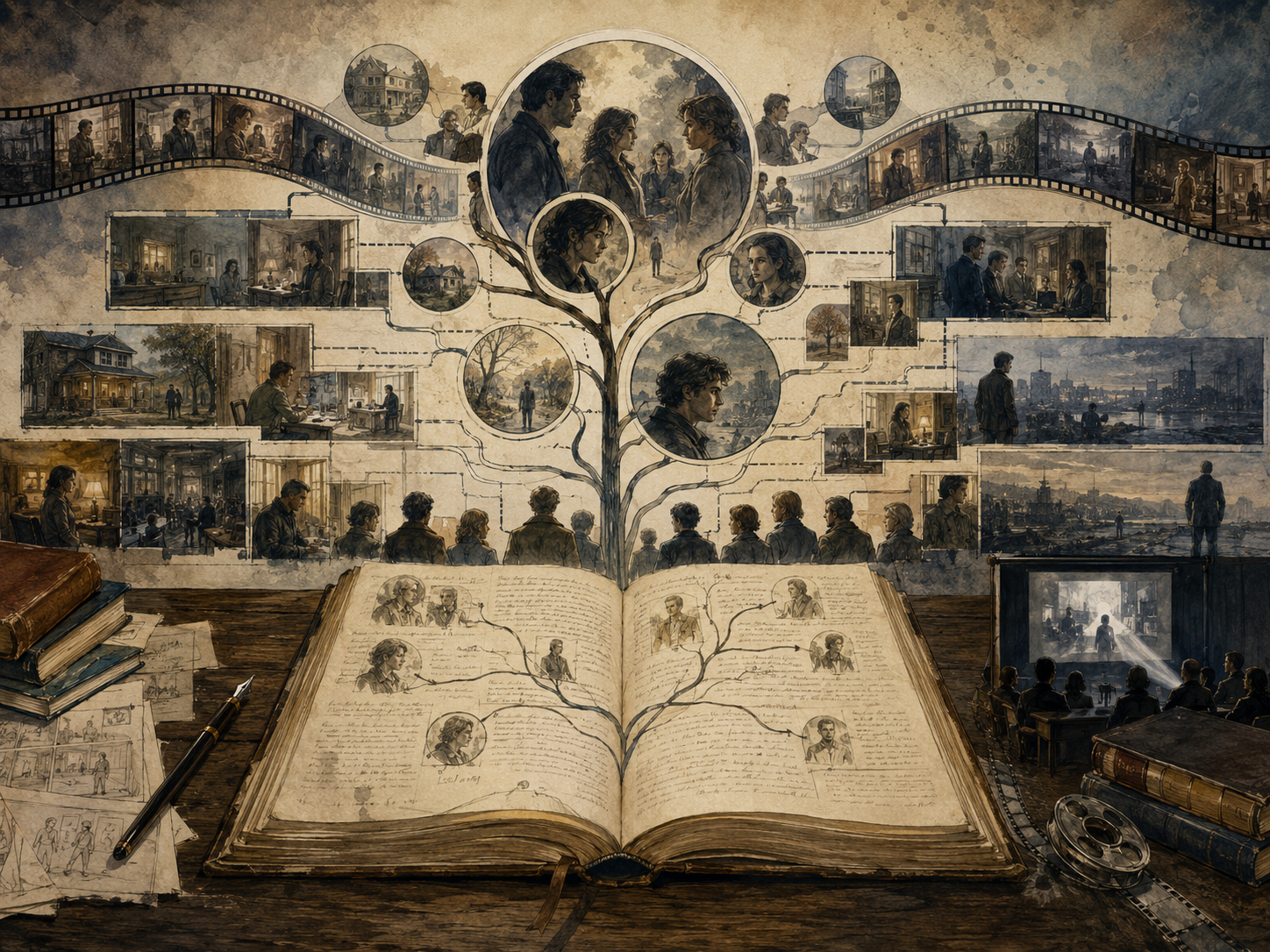
Television is a medium of return. Characters return, settings return, conflicts return, jokes return, wounds return, mysteries return, and audiences return. The power of serial form comes from this rhythm: a story is broken into parts, but those breaks become part of the meaning. Episodes create units of attention. Seasons create larger movements. Series create memory. Long-form narrative asks viewers not only to follow what happens, but to remember what has happened, anticipate what might happen, and revise what earlier events meant.
Why Serial Storytelling Matters
Serial storytelling matters because it makes narrative time social, cumulative, and revisable. A standalone story can produce closure quickly. A serial story asks audiences to live with uncertainty. Viewers wait, speculate, remember, argue, rewatch, forget, catch up, share theories, and reinterpret earlier episodes in light of later revelations.
Television has historically been shaped by schedules: daily, weekly, seasonal, syndicated, rerun, and now platform-based release. These schedules are not merely distribution systems. They shape narrative form. Weekly release encourages suspense, conversation, and anticipation. Binge release encourages immersion, pattern recognition, and rapid arc completion. Seasonal release creates long pauses in memory. Cancellation can leave unresolved arcs. Renewal can extend stories beyond their original design.
Serial storytelling also changes character. Characters do not only act; they accumulate. Their decisions create history. Their habits become meaningful. Their contradictions have time to deepen. A small detail in an early episode can become important later. A side character can become central. A joke can become tragedy. A villain can become familiar. A relationship can change slowly enough that viewers feel they have lived through it.
| Serial feature | Narrative function | Risk |
|---|---|---|
| Return | Creates habit, attachment, and cumulative memory. | Repetition becomes stagnation. |
| Interruption | Builds suspense, anticipation, and reflection. | Delay becomes manipulation. |
| Accumulation | Allows characters, worlds, and conflicts to deepen. | Continuity becomes burdensome. |
| Recurrence | Uses repeated motifs, settings, and conflicts to build pattern. | Formula replaces development. |
| Seasonality | Creates large-scale movements and turning points. | Artificial finales distort pacing. |
| Audience memory | Makes viewers active interpreters of history and payoff. | New viewers may be excluded. |
Serial storytelling matters because it turns narrative into a relationship over time.
Episodes, Seasons, and Series
Television storytelling is structured through nested units: episode, season, and series. Each unit has a different job. An episode provides a discrete experience. It may resolve a case, stage a conflict, focus on a character, deliver a set piece, or advance a larger arc. A season creates a broader pattern: escalation, transformation, mystery, thematic movement, or institutional change. A series creates the long memory that binds everything together.
The episode is not merely a fragment. It can have its own shape: teaser, act breaks, midpoint, reversal, climax, tag, cold open, bottle structure, flashback structure, trial-of-the-week, monster-of-the-week, workplace crisis, dinner episode, holiday episode, courtroom episode, or finale. A strong serial episode both satisfies locally and contributes globally.
The season creates intermediate closure. It can resolve one arc while opening another. It can transform the status quo, shift alliances, reveal deeper structures, move characters into new roles, or leave audiences with a question powerful enough to carry them across a hiatus.
| Narrative unit | Primary function | Governance question |
|---|---|---|
| Scene | Moves action, emotion, or information. | Does the scene serve episode and arc? |
| Episode | Creates a local unit of story experience. | Does it work on its own while advancing the larger pattern? |
| Multi-episode arc | Develops a conflict, relationship, or mystery across installments. | Does delay deepen meaning or merely postpone resolution? |
| Season | Shapes a major movement of change. | Does the season have thematic and structural coherence? |
| Series | Accumulates world, character, memory, and consequence. | Does the whole series honor its long-term promises? |
| Franchise continuation | Extends storyworld across spin-offs or related series. | Does expansion serve meaning or brand extension? |
A serial story succeeds when its smaller units are satisfying and its larger units feel earned.
Series, Serial, and Hybrid Forms
A series traditionally returns to a stable premise each episode. A procedural drama, sitcom, workplace comedy, or case-of-the-week show may restore the status quo after each installment. A serial carries unresolved story forward. Each episode depends on what came before and changes what comes next.
Most modern long-form television uses hybrid forms. A police drama may solve a case each week while slowly developing character trauma, institutional corruption, or family conflict. A comedy may reset its premise while allowing relationships to evolve. A fantasy series may combine episodic adventures with a season-long mythology. An anthology may reset characters and setting each season while retaining theme, tone, or format.
Hybrid structure lets television balance accessibility and accumulation. New viewers can enter through episodic structure, while devoted viewers are rewarded through long arcs. This is one reason television can support both casual viewing and deep fandom.
| Form | How it works | Strength |
|---|---|---|
| Episodic series | Each episode largely resets the premise. | Accessible, repeatable, flexible. |
| Serial | Unresolved events carry across episodes. | Creates suspense, memory, and cumulative consequence. |
| Hybrid procedural | Combines case-of-the-week with character or mythology arcs. | Balances entry points with long-term reward. |
| Anthology | Resets story, cast, or setting across episodes or seasons. | Allows thematic continuity without plot continuity. |
| Limited series | Designed for a finite arc. | Can sustain serial intensity without endless extension. |
| Franchise series | Extends a shared world across multiple shows. | Builds expansive continuity and cross-platform audience memory. |
Serial storytelling is not one structure. It is a spectrum of continuity, reset, accumulation, and return.
Narrative Complexity
Narrative complexity in television arises when a show asks viewers to track multiple arcs, timelines, characters, mysteries, institutions, genres, and storytelling rules over time. Complexity may appear through nonlinear chronology, unreliable narration, ensemble plotting, shifting point of view, mythology, layered callbacks, self-reflexive structure, or intricate worldbuilding.
Complexity is not automatically quality. A show can be complicated without being meaningful. The important question is whether complexity produces richer interpretation, deeper character consequence, more precise worldbuilding, stronger thematic patterning, or more accountable long-term payoff.
Television complexity depends on audience memory. Viewers may need to remember details from earlier seasons, recognize repeated images, connect institutional patterns, compare versions of an event, or notice when a character repeats an old mistake. Rewatching, recap culture, fan wikis, podcasts, and online theory communities have become part of how complex television is interpreted.
| Complexity type | Story function | Risk |
|---|---|---|
| Multi-arc plotting | Tracks several conflicts at once. | Overloads attention without payoff. |
| Nonlinear chronology | Reframes causality and memory. | Confuses viewers without purpose. |
| Ensemble perspective | Distributes meaning across characters. | Fragments emotional investment. |
| Mystery mythology | Creates long-term interpretive suspense. | Promises answers the story cannot deliver. |
| Callback structure | Rewards memory and rewatching. | Turns continuity into fan-service trivia. |
| Institutional layering | Shows systems, organizations, and social forces over time. | Diffuses responsibility so much that consequence disappears. |
Narrative complexity works when the audience’s memory is rewarded with meaning, not merely recognition.
Cliffhangers, Recaps, and Hiatus
Serial television uses interruption as a narrative device. A cliffhanger ends one episode or season at a moment of danger, revelation, uncertainty, or reversal. It makes the gap part of the story. The audience must wait, speculate, and return.
Recaps manage memory. They remind viewers what matters, but they also shape interpretation. A recap can prepare the audience for a returning character, unresolved clue, emotional wound, or forgotten conflict. In this sense, the recap is not neutral. It is a frame that tells viewers which parts of the past should be active in the present.
Hiatus changes narrative experience. A weekly gap, midseason break, year-long wait, strike delay, cancellation threat, or streaming pause can alter how viewers remember a story. Time outside the text becomes part of reception. Fans discuss theories, rewatch episodes, debate endings, and build expectations that the eventual continuation must answer.
| Serial device | Function | Risk |
|---|---|---|
| Cliffhanger | Creates suspense across interruption. | Manipulates attention without meaningful consequence. |
| Recap | Activates relevant memory. | Telegraphs twists or narrows interpretation. |
| Previously-on montage | Reorders past events around current stakes. | Rewrites memory too bluntly. |
| Hiatus | Allows anticipation and interpretation to build. | Expectations exceed narrative design. |
| Season finale | Creates large-scale closure or rupture. | Forces shock at the expense of coherence. |
| Season premiere | Reorients audience memory and stakes. | Resets too much or resolves too quickly. |
The serial gap is not empty time. It is part of how long-form narrative creates attention, memory, and expectation.
Character Memory and Long-Arc Change
Long-form television gives characters time to accumulate history. A character can change slowly, relapse, contradict themselves, repeat old patterns, or grow in ways that become visible only after many episodes. This is one of serial storytelling’s greatest strengths.
A short film can show transformation through decisive events. A long-form series can show transformation through habit, repetition, disappointment, temptation, compromise, grief, work, friendship, betrayal, institutional pressure, and ordinary time. Viewers learn who characters are not only through major choices but through patterns across seasons.
Character memory also creates accountability. If a character harms someone, the harm can return later. If a promise is broken, the relationship can carry the fracture. If a trauma is introduced, the show can choose whether to let it remain meaningful or reduce it to temporary plot fuel.
| Character-arc feature | Serial value | Risk |
|---|---|---|
| Slow change | Makes growth feel earned. | Can become indistinguishable from stalling. |
| Relapse | Shows that change is difficult and unstable. | Can repeat conflict without development. |
| Callback | Links present action to earlier history. | Can become nostalgic recognition only. |
| Accumulated consequence | Makes past actions matter. | Continuity burden overwhelms story clarity. |
| Relationship evolution | Allows intimacy, fracture, repair, or estrangement over time. | Romance or conflict may be prolonged artificially. |
| Long-term wound | Gives emotional history depth. | Trauma may be exploited for repeated drama. |
Serial character is less about sudden transformation than about memory under pressure.
Ensemble Storytelling
Television is especially suited to ensemble storytelling. Because a series has more time than a film, it can distribute attention across multiple characters, households, institutions, workplaces, families, neighborhoods, or social worlds. An ensemble allows the story to compare perspectives, create parallel arcs, shift sympathy, and show how private lives are shaped by shared systems.
Ensemble storytelling can make television feel more social than heroic. The story may not belong to one protagonist. It may belong to a workplace, a city, a family, a school, a hospital, a newsroom, a political office, a criminal network, or an imagined world. Meaning emerges from relation.
The challenge is balance. Some characters receive rich arcs while others become functions. Some plots absorb attention while others disappear. Ensemble television must manage distribution, rhythm, and consequence over time.
| Ensemble feature | Story function | Governance question |
|---|---|---|
| Distributed perspective | Shows events from multiple positions. | Whose perspective is centered or neglected? |
| Parallel arcs | Compares different forms of change. | Do parallels deepen theme or feel mechanical? |
| Rotating focus | Allows different characters to carry episodes. | Does focus produce development or filler? |
| Institutional setting | Connects personal stories to systems. | Does the institution remain coherent over time? |
| Relationship web | Creates social memory and consequence. | Do relationships evolve or merely reset? |
| Background characters | Gives the world texture and continuity. | Are marginal figures treated as disposable atmosphere? |
Ensemble serials reveal that long-form narrative can be less about one destiny than about a field of interdependent lives.
Worldbuilding and Continuity
Serial television builds worlds through accumulation. A setting becomes familiar because viewers return to it. A workplace, town, ship, school, apartment, kingdom, hospital, police precinct, or fantasy realm gains meaning through repeated use. Viewers learn rules, histories, rituals, geography, institutions, and social tensions over time.
Continuity is the memory system of a serial world. It keeps track of past events, character histories, locations, objects, promises, betrayals, deaths, births, rules, and consequences. Continuity rewards attention, but it can become burdensome. A show may become trapped by its own mythology, unable to welcome new viewers or resolve what it has promised.
Worldbuilding is strongest when it supports character, theme, and conflict. It is weakest when lore becomes an end in itself. A world can be richly detailed and narratively empty if its details do not matter.
| Worldbuilding layer | Serial function | Risk |
|---|---|---|
| Setting recurrence | Creates familiarity and attachment. | World becomes static backdrop. |
| Rules | Defines what is possible. | Rule changes break trust. |
| History | Gives events depth and consequence. | Backstory overwhelms present action. |
| Institutions | Connects personal stories to social systems. | Systems become vague or inconsistent. |
| Objects and motifs | Carry memory across episodes. | Symbols become Easter eggs only. |
| Continuity | Preserves cause, consequence, and audience trust. | Canon becomes rigid and exclusionary. |
A serial world is not just where the story happens. It is what the story remembers.
Procedural, Serial, and Anthology Forms
Television has developed many long-form narrative architectures. Procedurals organize episodes around repeatable problems: a case, patient, client, investigation, crisis, or workplace challenge. Serials organize episodes around unresolved continuity. Anthologies reset characters, settings, or plots while preserving theme, genre, premise, or format.
These forms often mix. A legal drama may have weekly cases and a season-long corruption arc. A medical show may solve clinical problems while tracking character relationships. A crime anthology may tell a complete case each season while returning to moral, institutional, or regional concerns. A sitcom may reset each week while allowing emotional continuity to build slowly.
The form chosen affects audience expectation. Viewers of procedurals expect satisfying local resolution. Viewers of serial mystery expect delayed answers. Viewers of anthology expect thematic rather than continuous connection. Problems arise when a show promises one form and delivers another without purpose.
| Form | Audience expectation | Strength |
|---|---|---|
| Procedural | A local problem will be resolved. | Repeatable structure and clear entry points. |
| Soap serial | Relationships and conflicts continue indefinitely. | Deep social memory and emotional recurrence. |
| Prestige serial | Season and series arcs will accumulate meaning. | Long-form thematic development. |
| Anthology episode | Each installment resets story while preserving format. | Conceptual variety and focused experimentation. |
| Season anthology | Each season tells a distinct long-form story. | Finite arc with recurring themes or style. |
| Hybrid series | Local resolution and long arc both matter. | Accessibility plus cumulative reward. |
Serial form is not only about length. It is about how continuity and repetition are organized.
Streaming, Bingeing, and Platform Time
Streaming changed the time of television. Viewers can watch one episode weekly, several episodes in a row, an entire season in a weekend, or an old series years after it ended. Platform time changes pacing, memory, suspense, and discovery.
A binge release reduces waiting but increases immersion. It can make season arcs feel like long films, encourage pattern recognition, and reduce the social force of week-to-week speculation. But it can also flatten episode distinctiveness. When episodes flow automatically into one another, the break between them may lose some of its expressive power.
Weekly streaming release restores collective conversation and anticipation. It gives theories time to circulate and allows individual episodes to stand as cultural events. Platform recommendation systems also change serial storytelling by shaping discovery, visibility, and perceived success.
| Viewing mode | Narrative effect | Risk |
|---|---|---|
| Broadcast weekly | Builds anticipation, conversation, and ritual. | Memory may fade during long gaps. |
| Binge release | Creates immersion and rapid arc completion. | Episodes blur together. |
| Hybrid release | Combines immersion with periodic discussion. | Can confuse intended rhythm. |
| Algorithmic discovery | Introduces viewers outside original schedule. | Platform visibility shapes canon and memory. |
| Rewatching | Reveals structure, foreshadowing, and pattern. | Continuity obsession may overshadow meaning. |
| Delayed catch-up | Lets audiences enter after cultural consensus forms. | Reception is shaped by spoilers and reputation. |
Streaming did not end seriality. It changed how serial time is experienced, compressed, shared, and remembered.
Audience Memory, Fandom, and Interpretation
Serial television creates active audiences because long-form stories require memory. Viewers track clues, recall character histories, compare episodes, notice patterns, build timelines, produce theories, write recaps, make fan art, create podcasts, maintain wikis, debate endings, and evaluate whether payoffs were earned.
Fandom can enrich serial storytelling. It extends interpretation beyond the episode, preserves memory, tests continuity, and creates communities of attention. It can also become possessive. Fans may treat theories as promises, canon as ownership, and change as betrayal. A show can be trapped between narrative surprise and audience expectation.
Audience memory is especially important for long-form storytelling because viewers often remember emotionally rather than archivally. A minor inconsistency may matter less than a broken emotional promise. Conversely, a technically consistent ending may feel wrong if it violates the audience’s long-term understanding of character, theme, or tone.
| Audience practice | Serial function | Risk |
|---|---|---|
| Recap reading | Organizes memory and interpretation. | Critical consensus may replace direct viewing. |
| Theory building | Turns uncertainty into collaborative analysis. | Theory becomes entitlement. |
| Wiki maintenance | Preserves continuity and world detail. | Canon detail overwhelms interpretation. |
| Podcast discussion | Creates extended communal reading. | Speculation shapes expectation too strongly. |
| Fan fiction | Expands relationships and alternative possibilities. | Official story may be judged only against fan desire. |
| Rewatch culture | Reveals structure and foreshadowing. | Every ambiguity becomes a clue to solve. |
Serial viewers are not passive receivers. They are memory workers.
Showrunners, Writers’ Rooms, and Production Constraints
Serial television is also an industrial form. Long-form stories are shaped by writers’ rooms, showrunners, network notes, budgets, actor availability, contracts, production schedules, ratings, platform metrics, strikes, renewals, cancellations, location constraints, and audience response.
This matters because serial storytelling is often adjusted while it is being made. A character may become important because an actor’s performance works. A planned arc may shrink because a show is canceled. A mystery may stretch because a show is renewed. A romance may change because audience response is strong. A bottle episode may emerge from budget constraint and become formally inventive.
Production constraints do not automatically weaken storytelling. Some of television’s most distinctive forms arise from constraints: act breaks, bottle episodes, clip shows, ensemble focus episodes, holiday episodes, and finales built around renewal uncertainty. But constraints should be recognized when analyzing pacing, continuity, and closure.
| Production factor | Story effect | Risk |
|---|---|---|
| Renewal uncertainty | Shapes finales and unresolved arcs. | Story ends without planned closure. |
| Actor availability | Changes character focus or exit. | Arc resolution feels abrupt. |
| Budget limits | Encourages bottle episodes or reduced scale. | World feels smaller than story promises. |
| Network or platform notes | Shapes pacing, tone, length, or accessibility. | Creative direction becomes inconsistent. |
| Writers’ room structure | Supports collaborative long-form plotting. | Voice or continuity can become uneven. |
| Audience response | Influences emphasis, relationships, and survival. | Fan service replaces narrative judgment. |
Serial storytelling is a poetics of both narrative design and production reality.
Ending Long-Form Narratives
Endings are difficult for serial television because long-form stories create many promises. Viewers expect closure for plot arcs, character arcs, relationship arcs, mysteries, institutions, themes, worlds, and emotional patterns. No ending can answer everything, but a strong ending should understand what kind of story it has been telling.
Some endings resolve mystery. Some complete a character transformation. Some restore or destroy a community. Some refuse closure because the system continues. Some return to the beginning with altered meaning. Some reveal that repetition was the point. Some endings fail because they solve plot while ignoring emotional consequence, or because they explain mythology while betraying character.
The longer a series runs, the more difficult closure becomes. Audience memory grows. Expectations multiply. The ending must honor history without becoming a checklist.
| Ending task | What it must answer | Common failure |
|---|---|---|
| Plot closure | What happened? | Answers mechanics but not meaning. |
| Character closure | Who changed, and how? | Forces transformation not supported by prior arcs. |
| Relationship closure | What bonds were repaired, broken, or accepted? | Uses pairing or separation as shortcut. |
| Thematic closure | What has the series argued? | Finale contradicts long-term pattern. |
| World closure | What happens to the system or setting? | World consequences disappear after protagonist resolution. |
| Emotional closure | What should viewers feel about the journey? | Shock or ambiguity replaces earned feeling. |
A serial ending is not only the last event. It is the final interpretation of everything that came before.
AI and Serial Storytelling
AI systems can generate episode outlines, season arcs, continuity summaries, character timelines, recap scripts, fan-theory maps, dialogue drafts, plot alternatives, and franchise expansion plans. These tools can help writers and analysts manage complexity.
They also create risks. AI may reward formula, flatten character memory, overemphasize plot mechanics, generate false continuity, summarize ambiguity as certainty, produce generic cliffhangers, recycle genre beats, or extend a story beyond meaningful purpose. Long-form narrative is especially vulnerable because AI can easily produce plausible arcs that do not carry lived continuity.
AI can be useful for auditing serial structure if the system is used carefully. It can help identify unresolved arcs, continuity contradictions, repeated patterns, missing payoffs, and imbalance across characters. But AI should not become the authority on what a series means. Serial storytelling depends on human judgment about memory, time, consequence, and emotional truth.
| AI use | Possible benefit | Risk |
|---|---|---|
| Continuity summary | Helps track long-term events and callbacks. | Creates false certainty or omits ambiguity. |
| Episode outline generation | Rapidly tests structure. | Produces generic A/B/C plots. |
| Season arc planning | Maps escalation and payoff. | Mistakes symmetry for meaning. |
| Character timeline extraction | Supports memory and consequence tracking. | Reduces character to events. |
| Fan-theory clustering | Surfaces interpretive communities. | Confuses popularity with narrative promise. |
| Franchise expansion | Tests spin-off possibilities. | Extends storyworld without purpose. |
AI should help audit serial continuity and consequence, not automate endless narrative extension.
Ethics of Long-Form Narrative
Long-form storytelling creates ethical responsibilities because it asks audiences to invest time, attention, memory, and emotion. A series can build trust across years. It can also abuse that trust through manipulation, empty cliffhangers, unearned trauma, exploitative twists, fan-baiting, unresolved promises, or endless extension.
Serial ethics includes responsibility to characters. Long-form stories can deepen characters, but they can also repeatedly wound them for drama. They can use marginalized characters as symbolic victims, kill characters for shock, prolong suffering, or reset harmful dynamics for plot convenience.
Serial ethics also includes responsibility to audience memory. If a show asks viewers to remember, it should treat memory seriously. If it plants clues, it should decide whether they are meaningful. If it builds a mystery, it should understand what kind of answer it owes. If it shows institutions, it should track consequences beyond individual arcs.
| Ethical concern | Question | Warning sign |
|---|---|---|
| Audience trust | Does the series honor its long-term promises? | Revelations rewrite stakes without support. |
| Trauma repetition | Is suffering developed responsibly or repeated for drama? | Characters are wounded to restart arcs. |
| Representation | Who receives interiority, memory, and consequence? | Marginal characters are used as plot devices. |
| Cliffhanger ethics | Does suspense deepen story or manipulate attention? | Danger is reversed without consequence. |
| Continuity care | Does the show remember what it asks viewers to remember? | Past events vanish when inconvenient. |
| Ending responsibility | Does closure answer the series’ deepest commitments? | Plot is resolved while theme is abandoned. |
Long-form narrative is ethical when it treats time, memory, and audience trust as real responsibilities.
Examples of Serial Storytelling Analysis
The examples below show how serial television can be analyzed beyond plot summary.
Episode as unit
Weak: The episode is judged only by how much it advances the main plot.
Stronger: The analysis asks how the episode functions locally and how it contributes to season, character, and thematic arcs.
Why it works: It respects the episode as a designed narrative unit.
Season arc
Weak: The season is summarized as a sequence of major events.
Stronger: The analysis tracks escalation, midpoint reversal, thematic development, character pressure, and finale consequence.
Why it works: It treats the season as architecture.
Cliffhanger
Weak: The cliffhanger is praised because it is shocking.
Stronger: The analysis asks whether the interruption changes stakes, deepens uncertainty, and produces meaningful return.
Why it works: It distinguishes suspense from manipulation.
Character relapse
Weak: Relapse is dismissed as repetition.
Stronger: The analysis asks whether repeated behavior reveals unresolved wound, system pressure, or failed transformation.
Why it works: It separates meaningful recurrence from stalling.
Continuity callback
Weak: The callback is treated as fan service.
Stronger: The analysis asks whether the callback changes the meaning of earlier events or merely rewards recognition.
Why it works: It tests memory for meaning.
Series finale
Weak: The finale is judged only by whether every question is answered.
Stronger: The analysis asks whether the ending honors character, theme, world consequence, emotional memory, and the form of the series.
Why it works: It treats closure as interpretation.
Serial analysis asks how narrative time creates memory, expectation, consequence, and responsibility.
Mathematics, Computation, and Modeling
Serial storytelling should not be reduced to formulas, but structured diagnostics can help analyze continuity, pacing, season coherence, payoff integrity, and long-form governance.
A season coherence score can estimate whether a season’s episodes contribute to a meaningful larger movement:
S_c = \frac{E_f + A_p + T_d + C_m + P_i + F_c}{6}
\]
Interpretation: Season coherence \(S_c\) averages episode function \(E_f\), arc progression \(A_p\), thematic development \(T_d\), character memory \(C_m\), payoff integrity \(P_i\), and finale consequence \(F_c\).
A continuity burden score can estimate when long-form memory becomes difficult to manage:
B_c = U_aw_u + L_dw_l + M_ew_m + R_uw_r + C_sw_c + (1 – A_c)w_a
\]
Interpretation: Continuity burden \(B_c\) rises with unresolved arcs \(U_a\), lore density \(L_d\), memory expectation \(M_e\), recap uncertainty \(R_u\), continuity saturation \(C_s\), and weak audience accessibility \(A_c\).
A payoff integrity score can estimate whether delayed resolutions are earned:
P_i = \frac{F_s + C_r + E_p + M_l + R_c + T_a}{6}
\]
Interpretation: Payoff integrity \(P_i\) averages foreshadowing support \(F_s\), character relevance \(C_r\), emotional payoff \(E_p\), mystery logic \(M_l\), retrospective coherence \(R_c\), and thematic alignment \(T_a\).
An AI serial-risk score can estimate when automation is flattening long-form design:
A_s = G_pw_g + C_fw_c + M_ew_m + P_sw_p + F_ew_f + (1 – H_r)w_h
\]
Interpretation: AI serial risk \(A_s\) rises with generic plotting \(G_p\), continuity fabrication \(C_f\), memory erasure \(M_e\), payoff simplification \(P_s\), franchise overextension \(F_e\), and weak human review \(H_r\).
| Modeling task | Governance question | Example output |
|---|---|---|
| Season coherence audit | Do episodes contribute to a meaningful seasonal movement? | Season coherence score. |
| Continuity audit | Is the series tracking its own memory responsibly? | Continuity burden score. |
| Payoff audit | Are delayed resolutions earned? | Payoff integrity score. |
| Character-distribution audit | Does the ensemble receive balanced development? | Character attention profile. |
| Ending audit | Does closure honor character, theme, world, and audience memory? | Finale accountability note. |
| AI audit | Is automation producing generic arcs or false continuity? | AI serial-risk score. |
Computation should help serial stories remember themselves, not turn long-form narrative into mechanical arc management.
Python Workflow: Serial Narrative Governance Audit
The Python workflow below follows the advanced Catalyst Canvas standard: typed records, config-driven scoring, validation, governance notes, Canvas-card exports, CSV outputs, JSON outputs, markdown governance queues, and review priorities. The companion repository version includes the shared `python/catalyst_canvas/` layer plus article-specific data for season coherence, continuity burden, payoff integrity, ensemble balance, ending accountability, and AI serial-risk review.
# run_serial_narrative_governance_audit.py
from __future__ import annotations

from dataclasses import dataclass
from pathlib import Path
import csv
import json
from hashlib import sha256
from statistics import mean
from typing import Any


ARTICLE_ROOT = Path(__file__).resolve().parents[1]
OUTPUTS = ARTICLE_ROOT / "outputs"


@dataclass(frozen=True)
class SerialNarrativeGovernanceRecord:
    item: str
    serial_context: str
    episode_function: float
    arc_progression: float
    thematic_development: float
    character_memory: float
    payoff_integrity_signal: float
    finale_consequence: float
    unresolved_arcs: float
    lore_density: float
    memory_expectation: float
    recap_uncertainty: float
    continuity_saturation: float
    audience_accessibility: float
    foreshadowing_support: float
    character_relevance: float
    emotional_payoff: float
    mystery_logic: float
    retrospective_coherence: float
    thematic_alignment: float
    ensemble_balance: float
    representation_depth: float
    trauma_care: float
    audience_trust: float
    generic_plotting: float
    continuity_fabrication: float
    memory_erasure: float
    payoff_simplification: float
    franchise_overextension: float
    human_review: float
    public_consequence: float
    owner: str = "editorial"
    status: str = "active"
    notes: str = ""


@dataclass(frozen=True)
class SerialNarrativeGovernanceConfig:
    article_title: str = "Serial Storytelling, Television, and Long-Form Narrative"
    article_slug: str = "serial-storytelling-television-and-long-form-narrative"
    medium_threshold: float = 0.45
    high_threshold: float = 0.62
    allowed_statuses: tuple[str, ...] = ("active", "archive", "review", "revise")


def validate_score(value: float, field_name: str) -> None:
    if value < 0 or value > 1:
        raise ValueError(f"{field_name} must be between 0 and 1.")


def validate_record(record: SerialNarrativeGovernanceRecord, config: SerialNarrativeGovernanceConfig) -> None:
    if not record.item.strip():
        raise ValueError("item is required.")
    if not record.serial_context.strip():
        raise ValueError("serial_context is required.")
    if record.status not in config.allowed_statuses:
        raise ValueError(f"Invalid status: {record.status}")

    for field_name, value in record.__dict__.items():
        if isinstance(value, float):
            validate_score(value, field_name)


def season_coherence(record: SerialNarrativeGovernanceRecord) -> float:
    return mean([
        record.episode_function,
        record.arc_progression,
        record.thematic_development,
        record.character_memory,
        record.payoff_integrity_signal,
        record.finale_consequence,
    ])


def continuity_burden(record: SerialNarrativeGovernanceRecord) -> float:
    return min(
        1.0,
        record.unresolved_arcs * 0.20
        + record.lore_density * 0.16
        + record.memory_expectation * 0.18
        + record.recap_uncertainty * 0.14
        + record.continuity_saturation * 0.18
        + (1 - record.audience_accessibility) * 0.14,
    )


def payoff_integrity(record: SerialNarrativeGovernanceRecord) -> float:
    return mean([
        record.foreshadowing_support,
        record.character_relevance,
        record.emotional_payoff,
        record.mystery_logic,
        record.retrospective_coherence,
        record.thematic_alignment,
    ])


def ensemble_and_ethics_strength(record: SerialNarrativeGovernanceRecord) -> float:
    return mean([
        record.ensemble_balance,
        record.representation_depth,
        record.trauma_care,
        record.audience_trust,
        record.character_memory,
        record.finale_consequence,
    ])


def ai_serial_risk(record: SerialNarrativeGovernanceRecord) -> float:
    return min(
        1.0,
        record.generic_plotting * 0.18
        + record.continuity_fabrication * 0.20
        + record.memory_erasure * 0.18
        + record.payoff_simplification * 0.16
        + record.franchise_overextension * 0.16
        + (1 - record.human_review) * 0.12,
    )


def governance_priority_score(record: SerialNarrativeGovernanceRecord, config: SerialNarrativeGovernanceConfig) -> float:
    score = (
        continuity_burden(record) * 0.20
        + ai_serial_risk(record) * 0.20
        + (1 - season_coherence(record)) * 0.16
        + (1 - payoff_integrity(record)) * 0.18
        + (1 - ensemble_and_ethics_strength(record)) * 0.12
        + record.public_consequence * 0.14
    )

    if record.status == "revise":
        score = max(score, config.high_threshold)
    elif record.status == "review":
        score = max(score, config.medium_threshold)

    return min(1.0, max(0.0, score))


def review_priority(record: SerialNarrativeGovernanceRecord, config: SerialNarrativeGovernanceConfig) -> str:
    score = governance_priority_score(record, config)
    if score >= config.high_threshold:
        return "high"
    if score >= config.medium_threshold:
        return "medium"
    return "standard"


def card_id(record: SerialNarrativeGovernanceRecord, config: SerialNarrativeGovernanceConfig) -> str:
    raw = f"{config.article_slug}|{record.item}|{record.serial_context}"
    return sha256(raw.encode("utf-8")).hexdigest()[:16]


def governance_note(record: SerialNarrativeGovernanceRecord, config: SerialNarrativeGovernanceConfig) -> str:
    priority = review_priority(record, config)
    notes = []

    if priority == "high":
        notes.append("High-priority serial narrative governance review required.")
    elif priority == "medium":
        notes.append("Medium-priority serial narrative review recommended.")
    else:
        notes.append("Standard editorial review sufficient.")

    if season_coherence(record) < 0.65:
        notes.append("Season coherence is limited; strengthen episode function, arc progression, thematic development, character memory, payoff integrity, and finale consequence.")
    if continuity_burden(record) >= 0.55:
        notes.append("Continuity burden is elevated; review unresolved arcs, lore density, memory expectation, recap uncertainty, continuity saturation, and audience accessibility.")
    if payoff_integrity(record) < 0.65:
        notes.append("Payoff integrity is limited; strengthen foreshadowing support, character relevance, emotional payoff, mystery logic, retrospective coherence, and thematic alignment.")
    if ensemble_and_ethics_strength(record) < 0.65:
        notes.append("Ensemble/ethics strength is limited; review character distribution, representation, trauma care, audience trust, memory, and finale consequence.")
    if ai_serial_risk(record) >= 0.55:
        notes.append("AI serial risk is elevated; review generic plotting, continuity fabrication, memory erasure, payoff simplification, franchise overextension, and human review.")
    if record.notes:
        notes.append(record.notes)

    return " ".join(notes)


def canvas_card(record: SerialNarrativeGovernanceRecord, config: SerialNarrativeGovernanceConfig) -> dict[str, Any]:
    return {
        "schema_version": "1.0.0",
        "card_id": card_id(record, config),
        "card_type": "serial_narrative_governance",
        "article_title": config.article_title,
        "article_slug": config.article_slug,
        "item": record.item,
        "serial_context": record.serial_context,
        "scores": {
            "season_coherence": round(season_coherence(record), 4),
            "continuity_burden": round(continuity_burden(record), 4),
            "payoff_integrity": round(payoff_integrity(record), 4),
            "ensemble_and_ethics_strength": round(ensemble_and_ethics_strength(record), 4),
            "ai_serial_risk": round(ai_serial_risk(record), 4),
            "governance_priority_score": round(governance_priority_score(record, config), 4),
        },
        "review": {
            "priority": review_priority(record, config),
            "owner": record.owner,
            "status": record.status,
            "governance_note": governance_note(record, config),
        },
    }


def write_csv(path: Path, rows: list[dict[str, Any]]) -> None:
    path.parent.mkdir(parents=True, exist_ok=True)
    fieldnames = list(rows[0].keys())
    with path.open("w", encoding="utf-8", newline="") as handle:
        writer = csv.DictWriter(handle, fieldnames=fieldnames)
        writer.writeheader()
        writer.writerows(rows)


def write_json(path: Path, payload: Any) -> None:
    path.parent.mkdir(parents=True, exist_ok=True)
    path.write_text(json.dumps(payload, indent=2), encoding="utf-8")


def write_markdown_queue(path: Path, rows: list[dict[str, Any]]) -> None:
    path.parent.mkdir(parents=True, exist_ok=True)
    lines = [
        "# Serial Narrative Governance Queue",
        "",
        "| Item | Context | Season coherence | Continuity burden | Payoff integrity | AI risk | Priority | Owner |",
        "|---|---|---:|---:|---:|---:|---|---|",
    ]

    for row in rows:
        lines.append(
            f"| {row['item']} | {row['serial_context']} | "
            f"{row['season_coherence']} | {row['continuity_burden']} | "
            f"{row['payoff_integrity']} | {row['ai_serial_risk']} | "
            f"{row['review_priority']} | {row['owner']} |"
        )

    path.write_text("\n".join(lines) + "\n", encoding="utf-8")


def main() -> None:
    config = SerialNarrativeGovernanceConfig()

    records = [
        SerialNarrativeGovernanceRecord(
            "Season arc audit",
            "episode sequence to season-long transformation",
            0.82, 0.78, 0.80, 0.76, 0.74, 0.72,
            0.46, 0.52, 0.58, 0.42, 0.48, 0.70,
            0.76, 0.74, 0.78, 0.70, 0.72, 0.80,
            0.72, 0.70, 0.74, 0.78,
            0.36, 0.28, 0.34, 0.38, 0.42, 0.82,
            0.84,
            "editorial", "review",
            "Strong season design; review unresolved arcs and audience accessibility."
        ),
        SerialNarrativeGovernanceRecord(
            "Mystery box overload",
            "long-running mythology with unresolved promises",
            0.58, 0.54, 0.60, 0.62, 0.44, 0.40,
            0.86, 0.78, 0.82, 0.74, 0.80, 0.42,
            0.50, 0.46, 0.44, 0.38, 0.42, 0.48,
            0.58, 0.56, 0.52, 0.44,
            0.62, 0.58, 0.66, 0.72, 0.60, 0.64,
            0.88,
            "governance", "revise",
            "Escalate; unresolved mythology and weak payoff integrity threaten audience trust."
        ),
        SerialNarrativeGovernanceRecord(
            "AI-generated season outline",
            "automated episode and franchise arc generation",
            0.50, 0.52, 0.46, 0.42, 0.38, 0.36,
            0.74, 0.70, 0.76, 0.68, 0.72, 0.44,
            0.44, 0.42, 0.40, 0.38, 0.36, 0.40,
            0.46, 0.42, 0.38, 0.40,
            0.90, 0.84, 0.88, 0.82, 0.86, 0.30,
            0.86,
            "governance", "revise",
            "Escalate; generated outline is plausible but weak on memory, payoff, continuity, and human judgment."
        ),
    ]

    rows = []
    cards = []

    for record in records:
        validate_record(record, config)
        cards.append(canvas_card(record, config))
        rows.append({
            "item": record.item,
            "serial_context": record.serial_context,
            "season_coherence": round(season_coherence(record), 4),
            "continuity_burden": round(continuity_burden(record), 4),
            "payoff_integrity": round(payoff_integrity(record), 4),
            "ensemble_and_ethics_strength": round(ensemble_and_ethics_strength(record), 4),
            "ai_serial_risk": round(ai_serial_risk(record), 4),
            "governance_priority_score": round(governance_priority_score(record, config), 4),
            "review_priority": review_priority(record, config),
            "owner": record.owner,
            "status": record.status,
            "governance_note": governance_note(record, config),
        })

    priority_order = {"high": 3, "medium": 2, "standard": 1}
    rows = sorted(
        rows,
        key=lambda row: (
            priority_order.get(str(row["review_priority"]), 0),
            float(row["governance_priority_score"]),
        ),
        reverse=True,
    )

    queue = [row for row in rows if row["review_priority"] != "standard"]
    queue_cards = [card for card in cards if card["review"]["priority"] != "standard"]

    write_csv(OUTPUTS / "tables" / "serial_narrative_governance_audit.csv", rows)
    write_csv(OUTPUTS / "tables" / "serial_narrative_governance_queue.csv", queue)
    write_json(OUTPUTS / "json" / "serial_narrative_governance_canvas_cards.json", cards)
    write_json(OUTPUTS / "json" / "serial_narrative_governance_queue.json", queue_cards)
    write_markdown_queue(OUTPUTS / "markdown" / "serial_narrative_governance_queue.md", queue)

    print("Serial narrative governance audit complete.")


if __name__ == "__main__":
    main()
This workflow helps distinguish meaningful long-form design from unresolved complexity, formulaic season planning, or automated franchise extension.
R Workflow: Season Arc and Continuity Diagnostics
The R workflow below provides a portable base R diagnostic for season coherence, continuity burden, payoff integrity, ensemble/ethics strength, and AI serial risk.
# serial_narrative_governance_diagnostics.R
# Base R workflow for Serial Storytelling, Television, and Long-Form Narrative.

args <- commandArgs(trailingOnly = FALSE)
file_arg <- grep("^--file=", args, value = TRUE)

if (length(file_arg) > 0) {
  script_path <- normalizePath(sub("^--file=", "", file_arg[1]), mustWork = TRUE)
  article_root <- normalizePath(file.path(dirname(script_path), ".."), mustWork = TRUE)
} else {
  article_root <- getwd()
}

setwd(article_root)

tables_dir <- file.path(article_root, "outputs", "tables")
figures_dir <- file.path(article_root, "outputs", "figures")
dir.create(tables_dir, recursive = TRUE, showWarnings = FALSE)
dir.create(figures_dir, recursive = TRUE, showWarnings = FALSE)

records <- data.frame(
  item = c(
    "Season arc audit",
    "Mystery box overload",
    "AI-generated season outline"
  ),
  serial_context = c(
    "episode sequence to season-long transformation",
    "long-running mythology with unresolved promises",
    "automated episode and franchise arc generation"
  ),
  episode_function = c(0.82, 0.58, 0.50),
  arc_progression = c(0.78, 0.54, 0.52),
  thematic_development = c(0.80, 0.60, 0.46),
  character_memory = c(0.76, 0.62, 0.42),
  payoff_integrity_signal = c(0.74, 0.44, 0.38),
  finale_consequence = c(0.72, 0.40, 0.36),
  unresolved_arcs = c(0.46, 0.86, 0.74),
  lore_density = c(0.52, 0.78, 0.70),
  memory_expectation = c(0.58, 0.82, 0.76),
  recap_uncertainty = c(0.42, 0.74, 0.68),
  continuity_saturation = c(0.48, 0.80, 0.72),
  audience_accessibility = c(0.70, 0.42, 0.44),
  foreshadowing_support = c(0.76, 0.50, 0.44),
  character_relevance = c(0.74, 0.46, 0.42),
  emotional_payoff = c(0.78, 0.44, 0.40),
  mystery_logic = c(0.70, 0.38, 0.38),
  retrospective_coherence = c(0.72, 0.42, 0.36),
  thematic_alignment = c(0.80, 0.48, 0.40),
  ensemble_balance = c(0.72, 0.58, 0.46),
  representation_depth = c(0.70, 0.56, 0.42),
  trauma_care = c(0.74, 0.52, 0.38),
  audience_trust = c(0.78, 0.44, 0.40),
  generic_plotting = c(0.36, 0.62, 0.90),
  continuity_fabrication = c(0.28, 0.58, 0.84),
  memory_erasure = c(0.34, 0.66, 0.88),
  payoff_simplification = c(0.38, 0.72, 0.82),
  franchise_overextension = c(0.42, 0.60, 0.86),
  human_review = c(0.82, 0.64, 0.30),
  public_consequence = c(0.84, 0.88, 0.86),
  owner = c("editorial", "governance", "governance"),
  status = c("review", "revise", "revise"),
  stringsAsFactors = FALSE
)

records$season_coherence <- rowMeans(records[, c(
  "episode_function",
  "arc_progression",
  "thematic_development",
  "character_memory",
  "payoff_integrity_signal",
  "finale_consequence"
)])

records$continuity_burden <- pmin(
  1,
  records$unresolved_arcs * 0.20 +
    records$lore_density * 0.16 +
    records$memory_expectation * 0.18 +
    records$recap_uncertainty * 0.14 +
    records$continuity_saturation * 0.18 +
    (1 - records$audience_accessibility) * 0.14
)

records$payoff_integrity <- rowMeans(records[, c(
  "foreshadowing_support",
  "character_relevance",
  "emotional_payoff",
  "mystery_logic",
  "retrospective_coherence",
  "thematic_alignment"
)])

records$ensemble_and_ethics_strength <- rowMeans(records[, c(
  "ensemble_balance",
  "representation_depth",
  "trauma_care",
  "audience_trust",
  "character_memory",
  "finale_consequence"
)])

records$ai_serial_risk <- pmin(
  1,
  records$generic_plotting * 0.18 +
    records$continuity_fabrication * 0.20 +
    records$memory_erasure * 0.18 +
    records$payoff_simplification * 0.16 +
    records$franchise_overextension * 0.16 +
    (1 - records$human_review) * 0.12
)

records$governance_priority_score <- pmin(
  1,
  records$continuity_burden * 0.20 +
    records$ai_serial_risk * 0.20 +
    (1 - records$season_coherence) * 0.16 +
    (1 - records$payoff_integrity) * 0.18 +
    (1 - records$ensemble_and_ethics_strength) * 0.12 +
    records$public_consequence * 0.14
)

records$review_priority <- ifelse(
  records$status == "revise" | records$governance_priority_score >= 0.62,
  "high",
  ifelse(
    records$status == "review" | records$governance_priority_score >= 0.45,
    "medium",
    "standard"
  )
)

records <- records[order(records$governance_priority_score, decreasing = TRUE), ]

write.csv(records, file.path(tables_dir, "serial_narrative_governance_diagnostics.csv"), row.names = FALSE)
write.csv(records[records$review_priority != "standard", ], file.path(tables_dir, "serial_narrative_governance_queue.csv"), row.names = FALSE)

png(file.path(figures_dir, "season_coherence_scores.png"), width = 1200, height = 700)
barplot(
  records$season_coherence,
  names.arg = records$item,
  las = 2,
  ylab = "Season coherence",
  main = "Season Coherence"
)
grid()
dev.off()

png(file.path(figures_dir, "continuity_burden_scores.png"), width = 1200, height = 700)
barplot(
  records$continuity_burden,
  names.arg = records$item,
  las = 2,
  ylab = "Continuity burden",
  main = "Continuity Burden"
)
grid()
dev.off()

print(records[, c(
  "item",
  "serial_context",
  "season_coherence",
  "continuity_burden",
  "payoff_integrity",
  "ai_serial_risk",
  "review_priority"
)])
This workflow helps distinguish meaningful serial complexity from unresolved burden, weak payoff, or automated long-form plotting.
GitHub Repository
The companion repository for this article supports serial narrative governance analysis as a Catalyst Canvas-ready module. It includes advanced additive `python/catalyst_canvas/` governance infrastructure, article-specific serial narrative data, config-driven scoring, validation, governance notes, Canvas card generation, CSV/JSON/markdown exporters, CLI workflows, smoke tests, unit tests, R diagnostics, SQL structures, documentation, and reusable season-arc review templates.
Complete Code Repository
Companion repository for the article, including advanced Catalyst Canvas-ready code for season coherence, continuity burden, payoff integrity, ensemble and ethics strength, AI serial-risk review, JSON exports, Canvas cards, governance queues, and reproducible research workflows.
articles/serial-storytelling-television-and-long-form-narrative/
├── canvas/
│   ├── canvas_manifest.json
│   ├── input_schema.json
│   ├── output_schema.json
│   ├── catalyst_canvas_config.json
│   ├── catalyst_canvas_manifest.json
│   ├── catalyst_canvas_cards.json
│   └── catalyst_canvas_governance_queue.json
├── html/
├── css/
├── php/
├── java/
├── python/
│   ├── catalyst_canvas/
│   │   ├── __init__.py
│   │   ├── __main__.py
│   │   ├── cli.py
│   │   ├── models.py
│   │   ├── scoring.py
│   │   ├── validation.py
│   │   ├── governance.py
│   │   └── exporters.py
│   ├── serial_narrative_governance_canvas/
│   │   ├── __init__.py
│   │   ├── models.py
│   │   ├── scoring.py
│   │   ├── validation.py
│   │   ├── governance.py
│   │   └── exporters.py
│   ├── tests/
│   │   ├── test_catalyst_canvas.py
│   │   └── test_serial_narrative_governance_canvas.py
│   ├── run_catalyst_canvas_audit.py
│   └── run_serial_narrative_governance_audit.py
├── r/
│   ├── serial_narrative_governance_diagnostics.R
│   └── run_all_serial_narrative_governance_workflows.R
├── sql/
│   ├── canvas_schema.sql
│   └── canvas_queries.sql
├── docs/
│   ├── article_notes.md
│   ├── modeling_principles.md
│   ├── why_serial_storytelling_matters.md
│   ├── episodes_seasons_and_series.md
│   ├── series_serial_and_hybrid_forms.md
│   ├── narrative_complexity.md
│   ├── cliffhangers_recaps_and_hiatus.md
│   ├── character_memory_and_long_arc_change.md
│   ├── ensemble_storytelling.md
│   ├── worldbuilding_and_continuity.md
│   ├── procedural_serial_and_anthology_forms.md
│   ├── streaming_bingeing_and_platform_time.md
│   ├── audience_memory_and_fandom.md
│   ├── showrunners_writers_rooms_and_production.md
│   ├── ending_long_form_narratives.md
│   ├── ai_and_serial_storytelling.md
│   ├── ethical_risk.md
│   ├── responsible_use.md
│   ├── governance_notes.md
│   └── catalyst_canvas_upgrade_notes.md
├── data/
│   ├── serial_narrative_governance_claims.csv
│   ├── season_coherence_notes.csv
│   ├── continuity_burden_notes.csv
│   ├── payoff_integrity_notes.csv
│   ├── ai_serial_risk_notes.csv
│   └── catalyst_canvas_assessment.csv
├── outputs/
│   ├── figures/
│   ├── json/
│   ├── markdown/
│   └── tables/
├── notebooks/
├── shared/
│   ├── schemas/
│   ├── narrative-templates/
│   ├── story-archetypes/
│   ├── character-models/
│   ├── plot-structures/
│   ├── rhetorical-frameworks/
│   ├── cultural-memory/
│   ├── serial-narrative-governance/
│   └── governance/
├── tests/
└── README.md
Related Articles
- Adaptation and the Migration of Stories Across Media
- Storytelling Across Oral, Literary, and Visual Media
- Games, Interactivity, and Branching Narrative
- Digital Storytelling and Platform Culture
- Narrative Systems and Story Structure Modeling
- Narrative Risk and the Misuse of Story
A Practical Method for Reading Serial Television
1. Identify the serial form
Ask whether the work is episodic, serial, procedural, hybrid, anthology, limited series, or franchise extension.
2. Analyze the episode
Ask what the episode accomplishes locally: conflict, theme, character focus, reversal, case, comedy, or worldbuilding.
3. Track the season arc
Ask how episodes build escalation, variation, midpoint change, thematic development, and finale consequence.
4. Map character memory
Track wounds, habits, choices, reversals, relationships, and consequences across time.
5. Audit continuity
Identify unresolved arcs, lore density, callbacks, rules, contradictions, and accessibility barriers.
6. Evaluate payoffs
Ask whether delayed resolutions are foreshadowed, emotionally earned, and thematically aligned.
7. Read the ensemble
Ask how attention, interiority, agency, and consequence are distributed across characters.
8. Account for platform time
Ask whether the story is designed for weekly release, binge viewing, delayed catch-up, or rewatching.
9. Consider production realities
Ask how renewal, cancellation, budget, writers’ rooms, actor availability, and platform metrics shaped the narrative.
10. Review the ending
Ask whether the finale honors plot, character, theme, world, emotional memory, and audience trust.
The method treats serial storytelling as cumulative architecture rather than extended plot.
Common Pitfalls
Several pitfalls appear when serial television and long-form narrative are read too narrowly.
- Plot-only reading: Treating each episode only as progress toward a finale.
- Continuity obsession: Valuing canon detail over character, theme, and consequence.
- Cliffhanger inflation: Mistaking shock or unresolved danger for meaningful serial design.
- Mystery-box overload: Accumulating questions without responsible payoff.
- Character stalling: Repeating old conflicts to prolong the series.
- Trauma recycling: Re-wounding characters for dramatic intensity without care.
- Ensemble neglect: Giving some characters long memory while others remain plot functions.
- Platform flattening: Letting binge design erase episode distinctiveness.
- Finale reduction: Judging endings only by answers instead of emotional and thematic coherence.
- AI arc machinery: Using generated season structures that sound plausible but lack memory, consequence, and human judgment.
The central pitfall is treating long-form narrative as simply more story rather than a different kind of story time.
Why Serial Storytelling Requires Patience and Judgment
Serial storytelling is built from return. It asks audiences to come back to people, places, problems, jokes, wounds, mysteries, and worlds over time. This return creates a distinctive form of narrative intelligence. A serial story can show how people change slowly, how institutions persist, how relationships accumulate history, how consequences return, and how meaning develops across repetition and delay.
Television is powerful because it can make viewers live with story time. It can give characters years to change. It can make a city, workplace, family, or fictional world feel inhabited. It can turn audience memory into part of the experience. It can also abuse delay, overload continuity, exploit trauma, stretch conflict, and defer payoff until trust breaks.
The best serial storytelling understands that interruption is not a defect. The break between episodes can create suspense, interpretation, and community. The season can become a poem of recurrence and variation. The series can become an archive of change.
Long-form narrative requires patience because meaning arrives over time. It requires judgment because not all delay is depth, not all complexity is coherence, and not all return is growth.
Further Reading
- Allen, R.C. (1985) Speaking of Soap Operas. Chapel Hill: University of North Carolina Press.
- Buonanno, M. (2008) The Age of Television: Experiences and Theories. Bristol: Intellect.
- Butler, J.G. (2018) Television: Visual Storytelling and Screen Culture. 5th edn. New York: Routledge.
- Feuer, J., Kerr, P. and Vahimagi, T. (eds) (1984) MTM: Quality Television. London: British Film Institute.
- Gray, J. and Lotz, A.D. (2019) Television Studies. 2nd edn. Cambridge: Polity.
- Jenkins, H. (2006) Convergence Culture: Where Old and New Media Collide. New York: New York University Press. Available at: https://nyupress.org/9780814742815/convergence-culture/
- Lotz, A.D. (2014) The Television Will Be Revolutionized. 2nd edn. New York: New York University Press. Available at: https://nyupress.org/9781479865253/the-television-will-be-revolutionized-second-edition/
- Mittell, J. (2015) Complex TV: The Poetics of Contemporary Television Storytelling. New York: New York University Press. Available at: https://nyupress.org/9780814769607/complex-tv/
- O’Sullivan, S. (2019) ‘Six Elements of Serial Narrative’, Narrative, 27(1), pp. 49–64. Available at: https://www.jstor.org/stable/26644124
- Pearson, R. (ed.) (2009) Reading Lost: Perspectives on a Hit Television Show. London: I.B. Tauris.
- Thompson, K. (2003) Storytelling in Film and Television. Cambridge, MA: Harvard University Press.
- Williams, R. (1974) Television: Technology and Cultural Form. London: Fontana.
References
- Allen, R.C. (1985) Speaking of Soap Operas. Chapel Hill: University of North Carolina Press.
- Buonanno, M. (2008) The Age of Television: Experiences and Theories. Bristol: Intellect.
- Butler, J.G. (2018) Television: Visual Storytelling and Screen Culture. 5th edn. New York: Routledge.
- Feuer, J., Kerr, P. and Vahimagi, T. (eds) (1984) MTM: Quality Television. London: British Film Institute.
- Gray, J. and Lotz, A.D. (2019) Television Studies. 2nd edn. Cambridge: Polity.
- Jenkins, H. (2006) Convergence Culture: Where Old and New Media Collide. New York: New York University Press. Available at: https://nyupress.org/9780814742815/convergence-culture/
- Lotz, A.D. (2014) The Television Will Be Revolutionized. 2nd edn. New York: New York University Press. Available at: https://nyupress.org/9781479865253/the-television-will-be-revolutionized-second-edition/
- Mittell, J. (2015) Complex TV: The Poetics of Contemporary Television Storytelling. New York: New York University Press. Available at: https://nyupress.org/9780814769607/complex-tv/
- Mittell, J. (2012) Complex TV: The Poetics of Contemporary Television Storytelling. MediaCommons Press review edition. Available at: https://mcpress.media-commons.org/complextelevision/
- Newman, M.Z. (2006) ‘From Beats to Arcs: Toward a Poetics of Television Narrative’, The Velvet Light Trap, 58, pp. 16–28.
- O’Sullivan, S. (2019) ‘Six Elements of Serial Narrative’, Narrative, 27(1), pp. 49–64. Available at: https://www.jstor.org/stable/26644124
- Pearson, R. (ed.) (2009) Reading Lost: Perspectives on a Hit Television Show. London: I.B. Tauris.
- Thompson, K. (2003) Storytelling in Film and Television. Cambridge, MA: Harvard University Press.
- Williams, R. (1974) Television: Technology and Cultural Form. London: Fontana.