
Last Updated June 11, 2026
Stories rarely remain in one form. They travel from oral performance to manuscript, from book to stage, from novel to film, from comic to animation, from game to series, from testimony to documentary, from archive to exhibition, from franchise to platform, and from memory to remix. Each movement changes the story.
Adaptation and the Migration of Stories Across Media examines how stories change when they move between media, audiences, institutions, technologies, markets, and cultural contexts. It treats adaptation not as simple copying or betrayal, but as transformation: a new work interprets, selects, compresses, expands, translates, contests, or reimagines an earlier source. The question is not only whether an adaptation is faithful, but what it preserves, what it changes, what it makes newly visible, and what it loses.
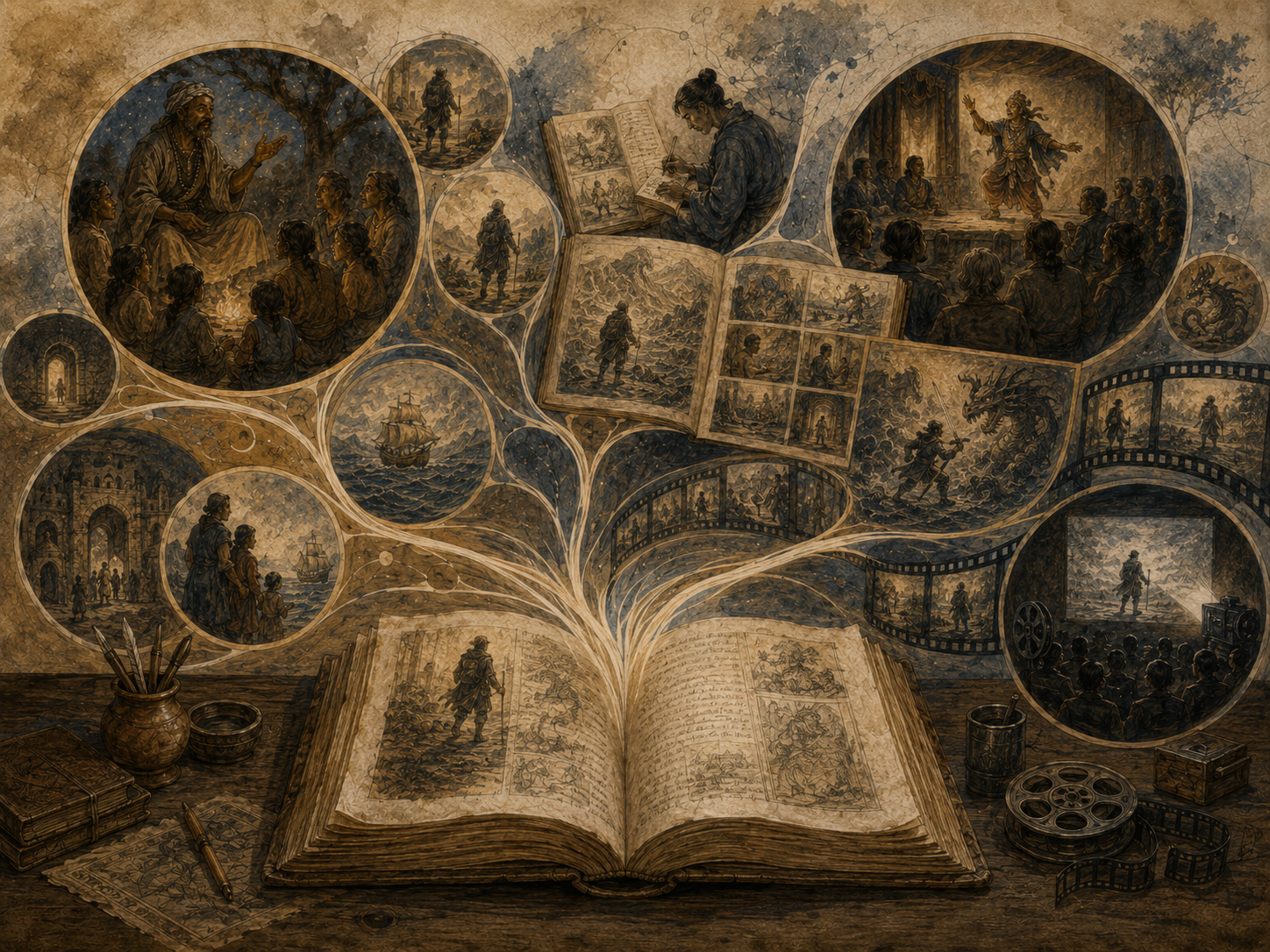
Adaptation is one of the most important ways stories survive. It is also one of the most contested. Audiences ask whether the film honored the book, whether the series betrayed the game, whether the remake understood the original, whether the documentary exploited testimony, whether the franchise diluted the source, or whether the AI-generated version stripped story from culture. Responsible adaptation criticism asks deeper questions about medium, context, authority, consent, audience, memory, and transformation.
Why Adaptation Matters
Adaptation matters because stories live by changing. A story that moves from one medium to another may gain new audiences, new sensory force, new political urgency, new cultural meaning, or new commercial life. Adaptation can rescue neglected works, bring oral or archival materials into public attention, transform literary memory into visual experience, and allow stories to speak to different historical moments.
Adaptation also matters because it reveals what people think a story is. Is a story its plot? Its characters? Its themes? Its voice? Its atmosphere? Its world? Its moral conflict? Its cultural memory? Its emotional rhythm? Its style? Different adaptations answer these questions differently.
A film adaptation may preserve plot while changing tone. A stage version may preserve dialogue while changing scale. A graphic adaptation may preserve sequence while changing visual imagination. A game adaptation may preserve worldbuilding while changing agency. A remake may preserve premise while changing politics. An AI summary may preserve events while losing voice, uncertainty, and context.
| Adaptation question | Why it matters | Risk |
|---|---|---|
| What is being adapted? | Clarifies whether the adaptation preserves plot, world, voice, theme, or atmosphere. | The critic assumes plot is the whole story. |
| What medium receives the story? | Shows what the new form can express or cannot express. | Medium differences are mistaken for failure. |
| Who controls the adaptation? | Identifies authority, ownership, and interpretive power. | Source communities are displaced. |
| Who is the new audience? | Explains shifts in pacing, explanation, tone, and framing. | The adaptation overexplains or oversimplifies. |
| What is lost? | Tracks voice, context, interiority, ambiguity, or cultural meaning. | Loss is hidden by spectacle or polish. |
| What is gained? | Identifies new embodiment, visibility, sound, scale, or participation. | New force is confused with superior interpretation. |
Adaptation is not a secondary form of storytelling. It is one of the central ways stories move through culture.
Beyond Fidelity
Adaptation criticism often begins with fidelity: was the film faithful to the book, the series faithful to the game, the remake faithful to the original, or the stage version faithful to the source? Fidelity can be useful when it asks what an adaptation preserves and why. But fidelity becomes limiting when it treats the source as sacred and the adaptation as automatically inferior.
A better approach asks how the adaptation interprets the source. What does it select? What does it omit? What does it intensify? What does it translate into another medium? What does it challenge? What does it misunderstand? What new audience or historical moment does it address?
No adaptation can carry everything. A novel can represent thought and memory across hundreds of pages. A film must work through image, performance, sound, editing, and duration. A game can make agency part of the story. A comic can use panel structure and visual rhythm. A stage version can use presence, speech, space, and audience relation. Adaptation is therefore always transformation.
| Fidelity question | Adaptation question | Why the second is stronger |
|---|---|---|
| Did it follow the book? | What did it preserve, transform, or omit? | It treats adaptation as interpretation. |
| Was it accurate? | Accurate to what: plot, tone, theme, voice, world, or politics? | It clarifies what counts as the story’s core. |
| Why did it change the ending? | What new audience, medium, or historical pressure shaped the ending? | It connects change to context. |
| Why was that character removed? | What compression, focus, budget, pacing, or ideological decision explains removal? | It treats omission as meaningful. |
| Why does it feel different? | How do medium, performance, image, sound, and pacing alter experience? | It analyzes form, not just content. |
| Did it betray the source? | What ethical, cultural, or interpretive responsibility did it fail or fulfill? | It replaces loyalty language with critical judgment. |
The best adaptation criticism does not abandon fidelity entirely. It places fidelity inside a larger analysis of medium, meaning, authority, and transformation.
Story Migration Across Media
Story migration describes how narratives move through different media forms, audiences, markets, technologies, and institutions. A story may begin as myth, become epic, become manuscript, become novel, become stage play, become film, become television series, become game, become meme, become remix, become classroom text, become merchandise, and become cultural shorthand.
Each migration changes the story’s conditions. Oral performance depends on memory, voice, occasion, and audience response. Print depends on textual stability, sequence, and interpretation. Film depends on image, sound, performance, and editing. Games depend on rules, player action, environment, and feedback. Digital platforms depend on circulation, commentary, fragmentation, and algorithmic visibility.
Migration can preserve story, but it can also produce drift. The story may become simplified, commercialized, decontextualized, intensified, politicized, localized, globalized, or transformed beyond recognition.
| Migration path | Potential gain | Potential loss |
|---|---|---|
| Oral story to written text | Durability, citation, archive, translation. | Voice, gesture, audience relation, occasion. |
| Novel to film | Embodiment, image, sound, shared viewing. | Interior thought, narrative digression, textual style. |
| Film to game | Player agency, exploration, interactive world. | Controlled pacing and fixed dramatic sequence. |
| Comic to animation | Motion, voice, music, dynamic action. | Reader-controlled pacing and panel inference. |
| Archive to exhibition | Public visibility and spatial interpretation. | Documentary complexity and full record context. |
| Source to platform remix | Participatory reinterpretation and circulation. | Authorship, consent, context, and continuity. |
Story migration is not accidental movement. It is a series of interpretive decisions made under material, cultural, economic, and technological constraints.
Medium Affordances and Narrative Change
Every medium offers affordances: things it makes easier to express, organize, or experience. A novel affords interiority and reflective voice. Film affords visual embodiment, motion, sound, and montage. Theater affords presence, space, and live performance. Comics afford panel sequence and reader inference. Games afford agency, choice, systems, and feedback. Podcasts afford voice, intimacy, and temporal attention. Digital platforms afford circulation, interaction, and remix.
Adaptation succeeds when it understands these affordances. A good adaptation does not merely ask how to transfer plot. It asks how to recreate narrative force through the new medium’s strengths.
A novel’s long interior monologue might become a film’s silence, close-up, sound motif, recurring visual image, or altered performance. A film’s chase sequence might become a game’s playable navigation challenge. A comic’s page layout might become animation timing, camera movement, or stillness. A stage soliloquy might become documentary voiceover or direct address.
| Source feature | Adaptation challenge | Possible new-medium solution |
|---|---|---|
| Interior thought | How to show inwardness without prose? | Performance, voiceover, sound design, visual motif, silence. |
| Literary style | How to adapt voice rather than only plot? | Rhythm, narration, production design, editing pattern, dialogue texture. |
| Oral performance | How to preserve presence? | Audio, video, performance notes, speaker context, audience relation. |
| Visual panel structure | How to preserve sequential inference? | Animation timing, still frames, transitions, split screen. |
| Film spectacle | How to make action playable or serial? | Level design, mechanics, episodic arc, environmental storytelling. |
| Game agency | How to adapt choice into fixed sequence? | Branch memory, consequence, perspective shifts, ensemble structure. |
Adaptation is strongest when it translates narrative function, not only narrative content.
Selection, Compression, and Expansion
Adaptation always involves selection. A film cannot include every scene from a long novel. A series may expand a short story into multiple arcs. A game may turn a single setting into an explorable world. A children’s adaptation may simplify language but preserve moral pattern. A contemporary remake may update context while retaining premise.
Compression is not automatically failure. It can sharpen focus, clarify structure, and create dramatic intensity. But compression can also flatten complexity, erase minor characters, remove political context, or reduce ambiguity. Expansion can deepen a world, restore hidden perspectives, or develop supporting characters. But expansion can also dilute meaning, stretch a story for commercial reasons, or turn mystery into overexplained lore.
Selection reveals values. What gets kept? What gets cut? Who disappears? Which relationship becomes central? Which conflict is simplified? Which setting becomes spectacular? Which silence becomes explicit?
| Adaptation operation | Constructive use | Risk |
|---|---|---|
| Compression | Sharpens dramatic structure. | Flattens politics, minor characters, or ambiguity. |
| Expansion | Develops world, backstory, or secondary characters. | Turns story into franchise padding. |
| Reordering | Improves pacing or suspense. | Changes causality or theme unintentionally. |
| Character merging | Simplifies narrative function. | Erases difference or reduces social complexity. |
| Ending change | Addresses new audience or medium demands. | Forces closure or betrays ethical consequence. |
| World expansion | Builds immersive storyworld. | Replaces story with lore accumulation. |
Selection is the grammar of adaptation. Every cut and expansion is an interpretation.
Translation and Transformation
Adaptation is a kind of translation, but not only between languages. It translates between media, cultures, institutions, technologies, markets, and historical moments. A story adapted from one language to another may also move from page to screen, from national context to global market, from adult literature to youth media, from tragedy to musical, from oral memory to museum installation, or from local archive to streaming documentary.
Transformation may be necessary. A story that remains too close to the source may fail in the new medium. A film that tries to reproduce every page of a novel may become inert. A game that copies film scenes may fail to create meaningful player agency. A television adaptation that refuses expansion may not sustain serial attention.
But transformation must still be accountable. Changing form does not eliminate responsibility to source, audience, represented communities, or cultural context. The question is not whether transformation happens. It always does. The question is whether transformation is thoughtful, transparent, and ethically grounded.
| Transformation type | What changes | Governance question |
|---|---|---|
| Medium transformation | Story moves across forms. | What affordances are gained or lost? |
| Cultural transformation | Story enters a new cultural setting. | Who authorizes the relocation? |
| Historical transformation | Story is updated for a new period. | What values are being revised? |
| Genre transformation | Story changes tone or convention. | What does the new genre emphasize or suppress? |
| Audience transformation | Story addresses a different public. | What is simplified, explained, or intensified? |
| Platform transformation | Story becomes modular, interactive, or shareable. | What happens to context and authorship? |
Adaptation is not preservation without change. It is change under responsibility.
Audience, Memory, and Reception
Adaptations are received by audiences with memories. Some viewers know the source intimately. Others know only cultural summaries. Some arrive through fandom. Some arrive through school, family, religion, national memory, genre expectation, or franchise loyalty. These expectations shape reception.
For source-aware audiences, adaptation can feel personal. A change to a character, scene, ending, or tone may feel like a violation because the source has become part of memory. For new audiences, the adaptation may become the primary version. Many people encounter stories first through film, television, game, animation, or meme rather than the earlier source.
Reception also changes over time. An adaptation once dismissed as unfaithful may later be valued as bold interpretation. A beloved adaptation may later be criticized for cultural erasure or ideological simplification. A remake may reveal what earlier versions could not imagine.
| Audience position | Reception pattern | Critical question |
|---|---|---|
| Source loyalist | Measures changes against remembered original. | What kind of fidelity is being valued? |
| New audience | Receives adaptation as primary story. | What version of the story becomes culturally dominant? |
| Fan community | Debates canon, continuity, casting, and interpretation. | How does participation shape meaning? |
| Institutional audience | Uses adaptation in education, museum, archive, or policy context. | What authority does the adaptation claim? |
| Global audience | Reads the story across translation and market context. | What cultural meanings travel or disappear? |
| Future audience | Reinterprets adaptation under new values. | What does later reception reveal about the adaptation? |
Adaptation lives not only between source and new work, but between memory and reception.
Adaptation as Interpretation
Every adaptation makes an argument about its source. It may argue that the story is really about grief, power, childhood, empire, class, gender, desire, memory, violence, faith, survival, or the cost of ambition. It may reinterpret a villain, center a minor character, change the narrator, reframe the ending, update political context, or make visible what the source left implicit.
Adaptation can therefore be criticism in narrative form. A film can critique a novel by changing its point of view. A remake can expose earlier assumptions. A theatrical version can emphasize public speech. A graphic adaptation can reveal visual symbolism. A game can test whether a story’s moral choices survive player agency.
The danger is that interpretation can become appropriation or distortion. An adaptation may claim to honor a source while changing its politics. It may borrow cultural material without understanding its context. It may make a marginalized story more palatable for dominant audiences. Interpretation must be judged by both artistry and responsibility.
| Interpretive move | Constructive use | Risk |
|---|---|---|
| Point-of-view shift | Reveals hidden perspective. | Displaces the source’s ethical center. |
| Minor-character expansion | Restores neglected agency. | Creates false equivalence or overexplains mystery. |
| Historical update | Makes relevance visible. | Projects current values without context. |
| Genre shift | Creates fresh tonal interpretation. | Misreads the source’s emotional contract. |
| Ending revision | Changes moral consequence. | Removes ambiguity or imposes closure. |
| Political reframing | Names power previously hidden. | Turns complexity into simple message. |
An adaptation should be read as a response to a source, not a shadow of it.
Adaptation, Power, and Cultural Authority
Adaptation is never only aesthetic. It is also shaped by power: who owns rights, who funds production, who controls archives, who gets credited, who speaks for a community, who profits, who is visible, and who is expected to accept a new version as authoritative.
This matters especially when stories migrate from marginalized communities into dominant institutions. A story rooted in Indigenous knowledge, religious memory, local testimony, family archive, oral history, or political struggle may become film, exhibit, lesson, franchise, or generated content. Visibility can create recognition, but it can also create extraction.
Power also shapes whose adaptations are treated as legitimate. A prestigious film adaptation may overshadow oral memory. A global franchise may displace local versions. A streaming remake may become the version that future audiences know. A generated summary may make itself appear neutral while erasing source conflict.
| Power question | Why it matters | Warning sign |
|---|---|---|
| Who owns the rights? | Legal control shapes what can be adapted. | Ownership is confused with moral authority. |
| Who controls interpretation? | Creative authority shapes the story’s meaning. | Source communities are excluded from decisions. |
| Who benefits? | Adaptation creates cultural and economic value. | Profit flows away from the story’s community. |
| Who is credited? | Adaptation depends on inherited labor. | Oral, archival, or community sources disappear. |
| Who is represented? | Adaptation reshapes public imagination. | People become symbols without agency. |
| Who can object? | Accountability requires feedback and correction. | Criticism is dismissed as resistance to change. |
Adaptation is responsible only when it recognizes that story migration also migrates authority.
Franchises, Remakes, and Reboots
Modern popular culture is full of adaptations that are not simple one-to-one transfers. Franchises, remakes, reboots, sequels, prequels, spin-offs, legacy sequels, retellings, and alternate-universe versions create ongoing story migration.
A remake may adapt an earlier film for a new generation. A reboot may reset continuity while preserving brand identity. A legacy sequel may preserve memory while introducing new protagonists. A prequel may explain origins. A spin-off may expand a secondary character or world. A franchise may turn a story into a repeatable architecture of settings, characters, conflicts, and merchandise.
These forms can deepen storyworlds, but they can also exhaust them. Repetition may become risk management. Characters may be revived because audiences recognize them. Lore may replace narrative necessity. Adaptation becomes not only interpretation but asset management.
| Popular adaptation form | Story function | Risk |
|---|---|---|
| Remake | Retells a story for a new time or audience. | Repeats surface while missing historical meaning. |
| Reboot | Restarts continuity while keeping brand value. | Uses novelty to conceal repetition. |
| Legacy sequel | Connects old audience memory to new characters. | Turns nostalgia into substitute for story. |
| Prequel | Explains origins and prior events. | Overexplains mystery or inevitability. |
| Spin-off | Expands minor figures or settings. | Turns worldbuilding into endless extension. |
| Franchise universe | Coordinates multiple stories under shared continuity. | Subordinates story to brand architecture. |
Franchise adaptation turns story migration into infrastructure: the story is no longer one text but a managed world.
Transmedia and Storyworlds
Transmedia storytelling differs from ordinary adaptation because the storyworld is intentionally distributed across multiple media. A film may introduce the world, a series may expand character arcs, a game may explore place, a comic may fill backstory, a website may provide documents, and fans may produce commentary or reinterpretation.
In transmedia storytelling, no single medium necessarily contains the whole story. Each platform can contribute something distinct. This can create depth and participation. It can also create confusion, gatekeeping, and commercial overload.
The storyworld becomes central. Instead of adapting one plot, transmedia expands a world that can generate many stories. This can support rich narrative ecosystems, but it can also shift emphasis from meaning to continuity management.
| Transmedia element | Constructive use | Risk |
|---|---|---|
| Storyworld | Creates a shared setting for multiple narratives. | Lore replaces story meaning. |
| Platform specificity | Each medium contributes what it does well. | Content becomes scattered or inaccessible. |
| Fan participation | Expands interpretation and community investment. | Labor is monetized without recognition. |
| Continuity | Builds coherence across media. | Canon policing narrows imagination. |
| Serial expansion | Allows long-term development. | Extension becomes endless delay. |
| World documents | Creates immersion through records, maps, artifacts, or databases. | Fictional evidence is confused with narrative depth. |
Transmedia adaptation asks not only how a story changes form, but how a storyworld becomes distributed across forms.
Digital Platforms and Participatory Adaptation
Digital platforms have made adaptation participatory. Fans create edits, memes, fan fiction, reaction videos, podcasts, timelines, wikis, alternate endings, cosplay, remixes, essays, and speculative readings. Adaptation is no longer only produced by studios, publishers, or theaters. Audiences adapt stories continually through interpretation and reuse.
Participatory adaptation can be creative and democratic. It allows communities to correct exclusions, imagine alternative relationships, restore minor characters, localize global stories, and challenge official canon. It can also create conflict around ownership, authorship, harassment, appropriation, and commercial extraction.
Platforms accelerate adaptation by making fragments easy to circulate. A scene becomes a clip, a line becomes a meme, a character becomes an archetype, a plot becomes a template, and a complex work becomes a set of shareable signals.
| Participatory form | Value | Risk |
|---|---|---|
| Fan fiction | Expands character, relationship, and alternative possibility. | Raises authorship, ownership, and community conflict questions. |
| Meme adaptation | Turns story into cultural shorthand. | Strips context and flattens meaning. |
| Reaction video | Records reception as part of story circulation. | Performance of response replaces interpretation. |
| Wiki or timeline | Organizes complex continuity. | Canon management overtakes meaning. |
| Fan edit | Reorders or reframes narrative experience. | May erase the original work’s structure or politics. |
| Platform remix | Creates new versions and communities of meaning. | Consent and credit become difficult to govern. |
Digital adaptation shows that audiences do not only receive stories; they migrate them.
AI and Automated Adaptation
AI systems can summarize novels, generate screen treatments, convert prose into scene outlines, create storyboards, draft dialogue, translate style, generate images, produce voice, simulate characters, and adapt narratives into multiple formats. This makes adaptation faster and more accessible.
It also raises serious risks. AI may preserve plot while losing voice. It may compress ambiguity into coherence. It may erase cultural context, flatten character complexity, imitate style without authority, generate synthetic visuals that seem documentary, or adapt community stories without consent. It may reproduce familiar adaptation patterns because they are common in training data.
AI adaptation requires governance. The workflow should document source material, copyright status, consent, community authority, medium-specific losses, human review, synthetic elements, and uncertainty. AI should support adaptation analysis and prototyping, not replace interpretive judgment or moral authority.
| AI adaptation use | Possible benefit | Risk |
|---|---|---|
| Plot summary | Helps analyze structure quickly. | Confuses plot retention with story preservation. |
| Screen treatment | Tests adaptation options. | Produces generic film grammar. |
| Style transfer | Explores voice and genre variation. | Imitates without authority or context. |
| Storyboard generation | Visualizes scene possibilities. | Creates synthetic images with false authority. |
| Character simulation | Tests dialogue and perspective. | Overwrites character complexity with pattern prediction. |
| Multimodal adaptation | Moves story across text, image, audio, and video. | Accelerates decontextualized transformation. |
AI can help compare adaptation choices, but it should not decide what a story means or who has the right to transform it.
Ethics of Adaptation
The ethics of adaptation begins with humility. A source is not merely material to be used. It may be a work of art, a community memory, a testimony, a sacred narrative, a family archive, a political document, or a cultural inheritance. Adaptation can honor such material, but it can also extract from it.
Ethical adaptation asks who has authority, what context must be preserved, what changes are justified, what harms may result, and who benefits from the new version. It asks whether the adaptation makes the source more accessible without distorting it, whether it credits inherited labor, whether it protects vulnerable people, and whether it distinguishes interpretation from replacement.
Ethics also includes refusal. Not every story should be adapted into every medium. Some stories may require restricted circulation, community protocols, ritual context, or forms of witness that should not be converted into entertainment, spectacle, or generated content.
| Ethical principle | Question | Warning sign |
|---|---|---|
| Consent | Who authorized this adaptation and its circulation? | Availability is treated as permission. |
| Context | What cultural, historical, or performance setting matters? | The adaptation detaches story from its meaning-world. |
| Credit | Whose labor, memory, or tradition is acknowledged? | Source communities disappear behind brand or author. |
| Provenance | Can audiences trace source and transformation? | The adaptation hides what it changed. |
| Care | What harm could new visibility create? | Exposure is treated as automatically good. |
| Limits | Should this story be adapted in this way? | Market demand overrides cultural responsibility. |
Adaptation is ethical when it treats transformation as stewardship, not extraction.
Examples of Adaptation Analysis
The examples below show how adaptation can be evaluated without reducing everything to fidelity.
Novel to film
Weak: The film is judged only by whether it includes every major scene.
Stronger: The analysis asks how image, sound, performance, editing, and duration translate the novel’s voice, structure, and themes.
Why it works: It treats film as a distinct medium rather than an illustrated book.
Game to television
Weak: The series is judged only by visual resemblance to the game.
Stronger: The analysis asks how player agency, exploration, rules, and environmental storytelling become fixed dramatic sequence.
Why it works: It identifies what is hard to translate when agency becomes viewing.
Oral story to museum exhibit
Weak: The exhibit displays the story as cultural content.
Stronger: The analysis asks who authorized the display, what performance context is preserved, and what community protocols govern circulation.
Why it works: It treats adaptation as cultural responsibility.
Film remake
Weak: The remake is called unnecessary because the original exists.
Stronger: The analysis asks what historical moment, audience, politics, medium, or genre pressure the remake addresses.
Why it works: It asks whether repetition produces new meaning.
Franchise spin-off
Weak: The spin-off is judged only by continuity.
Stronger: The analysis asks whether expansion reveals a new story logic or merely monetizes recognition.
Why it works: It separates storyworld depth from asset extension.
AI-generated adaptation
Weak: The generated treatment is accepted because it has coherent beats.
Stronger: The workflow audits source authority, medium loss, cultural context, consent, provenance, synthetic elements, and human review.
Why it works: It prevents automated coherence from replacing adaptation judgment.
Adaptation analysis asks what changes, why it changes, who controls the change, and what responsibility follows.
Mathematics, Computation, and Modeling
Adaptation should not be reduced to a score, but structured diagnostics can help compare adaptation choices, identify medium loss, and flag governance risks.
An adaptation integrity score can estimate whether the new work preserves core narrative functions while using the new medium responsibly:
A_i = \frac{S_c + M_f + T_p + C_x + R_v + E_g}{6}
\]
Interpretation: Adaptation integrity \(A_i\) averages source-core preservation \(S_c\), medium fit \(M_f\), transformation purpose \(T_p\), context preservation \(C_x\), reception value \(R_v\), and ethical governance \(E_g\).
A transfer-loss score can estimate what is weakened during migration:
L_t = V_lw_v + I_lw_i + C_lw_c + P_lw_p + A_lw_a + (1 – G_r)w_g
\]
Interpretation: Transfer loss \(L_t\) rises with voice loss \(V_l\), interiority loss \(I_l\), context loss \(C_l\), provenance loss \(P_l\), agency loss \(A_l\), and weak governance review \(G_r\).
A franchise-drift score can estimate when adaptation becomes brand extension rather than meaningful transformation:
F_d = R_cw_r + L_ew_l + N_rw_n + C_sw_c + M_ow_m + (1 – S_p)w_s
\]
Interpretation: Franchise drift \(F_d\) rises with repetition compliance \(R_c\), lore excess \(L_e\), nostalgia reliance \(N_r\), continuity saturation \(C_s\), market overextension \(M_o\), and weak story purpose \(S_p\).
An AI adaptation risk score can estimate when automation is flattening transformation:
A_r = P_sw_p + V_sw_v + C_lw_c + S_ow_s + U_ew_u + (1 – H_r)w_h
\]
Interpretation: AI adaptation risk \(A_r\) rises with plot-summary dependence \(P_s\), voice/style imitation \(V_s\), context loss \(C_l\), synthetic opacity \(S_o\), uncertainty erasure \(U_e\), and weak human review \(H_r\).
| Modeling task | Governance question | Example output |
|---|---|---|
| Adaptation integrity audit | Does the adaptation preserve core story functions while using the new medium well? | Adaptation integrity score. |
| Transfer-loss audit | What voice, context, interiority, provenance, or agency is lost? | Transfer-loss score. |
| Medium-fit audit | Does the target medium support the story’s needs? | Medium-fit profile. |
| Franchise audit | Is expansion deepening story or merely extending brand? | Franchise-drift score. |
| Consent audit | Who authorized transformation and circulation? | Consent-governance note. |
| AI audit | Is automation flattening voice, context, and uncertainty? | AI adaptation risk score. |
Computation should support adaptation judgment, not replace interpretive and ethical responsibility.
Python Workflow: Adaptation Governance Audit
The Python workflow below follows the advanced Catalyst Canvas standard: typed records, config-driven scoring, validation, governance notes, Canvas-card exports, CSV outputs, JSON outputs, markdown governance queues, and review priorities. The companion repository version includes the shared `python/catalyst_canvas/` layer plus article-specific data for adaptation integrity, transfer loss, franchise drift, AI adaptation risk, consent, context, and provenance.
# run_adaptation_governance_audit.py
from __future__ import annotations

from dataclasses import dataclass
from pathlib import Path
import csv
import json
from hashlib import sha256
from statistics import mean
from typing import Any


ARTICLE_ROOT = Path(__file__).resolve().parents[1]
OUTPUTS = ARTICLE_ROOT / "outputs"


@dataclass(frozen=True)
class AdaptationGovernanceRecord:
    item: str
    adaptation_context: str
    source_core_preservation: float
    medium_fit: float
    transformation_purpose: float
    context_preservation: float
    reception_value: float
    ethical_governance: float
    voice_loss: float
    interiority_loss: float
    context_loss: float
    provenance_loss: float
    agency_loss: float
    governance_review: float
    repetition_compliance: float
    lore_excess: float
    nostalgia_reliance: float
    continuity_saturation: float
    market_overextension: float
    story_purpose: float
    plot_summary_dependence: float
    voice_style_imitation: float
    synthetic_opacity: float
    uncertainty_erasure: float
    human_review: float
    consent_clarity: float
    source_authority: float
    cultural_context: float
    public_consequence: float
    owner: str = "editorial"
    status: str = "active"
    notes: str = ""


@dataclass(frozen=True)
class AdaptationGovernanceConfig:
    article_title: str = "Adaptation and the Migration of Stories Across Media"
    article_slug: str = "adaptation-and-the-migration-of-stories-across-media"
    medium_threshold: float = 0.45
    high_threshold: float = 0.62
    allowed_statuses: tuple[str, ...] = ("active", "archive", "review", "revise")


def validate_score(value: float, field_name: str) -> None:
    if value < 0 or value > 1:
        raise ValueError(f"{field_name} must be between 0 and 1.")


def validate_record(record: AdaptationGovernanceRecord, config: AdaptationGovernanceConfig) -> None:
    if not record.item.strip():
        raise ValueError("item is required.")
    if not record.adaptation_context.strip():
        raise ValueError("adaptation_context is required.")
    if record.status not in config.allowed_statuses:
        raise ValueError(f"Invalid status: {record.status}")

    for field_name, value in record.__dict__.items():
        if isinstance(value, float):
            validate_score(value, field_name)


def adaptation_integrity(record: AdaptationGovernanceRecord) -> float:
    return mean([
        record.source_core_preservation,
        record.medium_fit,
        record.transformation_purpose,
        record.context_preservation,
        record.reception_value,
        record.ethical_governance,
    ])


def transfer_loss(record: AdaptationGovernanceRecord) -> float:
    return min(
        1.0,
        record.voice_loss * 0.18
        + record.interiority_loss * 0.16
        + record.context_loss * 0.20
        + record.provenance_loss * 0.18
        + record.agency_loss * 0.16
        + (1 - record.governance_review) * 0.12,
    )


def franchise_drift(record: AdaptationGovernanceRecord) -> float:
    return min(
        1.0,
        record.repetition_compliance * 0.18
        + record.lore_excess * 0.18
        + record.nostalgia_reliance * 0.16
        + record.continuity_saturation * 0.16
        + record.market_overextension * 0.16
        + (1 - record.story_purpose) * 0.16,
    )


def ai_adaptation_risk(record: AdaptationGovernanceRecord) -> float:
    return min(
        1.0,
        record.plot_summary_dependence * 0.18
        + record.voice_style_imitation * 0.20
        + record.context_loss * 0.18
        + record.synthetic_opacity * 0.16
        + record.uncertainty_erasure * 0.16
        + (1 - record.human_review) * 0.12,
    )


def consent_and_context_strength(record: AdaptationGovernanceRecord) -> float:
    return mean([
        record.consent_clarity,
        record.source_authority,
        record.cultural_context,
        record.context_preservation,
        1 - record.provenance_loss,
        record.governance_review,
    ])


def governance_priority_score(record: AdaptationGovernanceRecord, config: AdaptationGovernanceConfig) -> float:
    score = (
        transfer_loss(record) * 0.22
        + franchise_drift(record) * 0.16
        + ai_adaptation_risk(record) * 0.20
        + (1 - adaptation_integrity(record)) * 0.16
        + (1 - consent_and_context_strength(record)) * 0.12
        + record.public_consequence * 0.14
    )

    if record.status == "revise":
        score = max(score, config.high_threshold)
    elif record.status == "review":
        score = max(score, config.medium_threshold)

    return min(1.0, max(0.0, score))


def review_priority(record: AdaptationGovernanceRecord, config: AdaptationGovernanceConfig) -> str:
    score = governance_priority_score(record, config)
    if score >= config.high_threshold:
        return "high"
    if score >= config.medium_threshold:
        return "medium"
    return "standard"


def card_id(record: AdaptationGovernanceRecord, config: AdaptationGovernanceConfig) -> str:
    raw = f"{config.article_slug}|{record.item}|{record.adaptation_context}"
    return sha256(raw.encode("utf-8")).hexdigest()[:16]


def governance_note(record: AdaptationGovernanceRecord, config: AdaptationGovernanceConfig) -> str:
    priority = review_priority(record, config)
    notes = []

    if priority == "high":
        notes.append("High-priority adaptation governance review required.")
    elif priority == "medium":
        notes.append("Medium-priority adaptation review recommended before reuse.")
    else:
        notes.append("Standard editorial review sufficient.")

    if adaptation_integrity(record) < 0.65:
        notes.append("Adaptation integrity is limited; strengthen source-core preservation, medium fit, transformation purpose, context preservation, reception value, and ethical governance.")
    if transfer_loss(record) >= 0.55:
        notes.append("Transfer loss is elevated; review voice loss, interiority loss, context loss, provenance loss, agency loss, and governance review.")
    if franchise_drift(record) >= 0.55:
        notes.append("Franchise drift is elevated; review repetition, lore excess, nostalgia reliance, continuity saturation, market overextension, and weak story purpose.")
    if ai_adaptation_risk(record) >= 0.55:
        notes.append("AI adaptation risk is elevated; review plot-summary dependence, voice/style imitation, context loss, synthetic opacity, uncertainty erasure, and human review.")
    if consent_and_context_strength(record) < 0.65:
        notes.append("Consent/context strength is limited; review authorization, source authority, cultural context, provenance, and governance.")
    if record.notes:
        notes.append(record.notes)

    return " ".join(notes)


def canvas_card(record: AdaptationGovernanceRecord, config: AdaptationGovernanceConfig) -> dict[str, Any]:
    return {
        "schema_version": "1.0.0",
        "card_id": card_id(record, config),
        "card_type": "adaptation_governance",
        "article_title": config.article_title,
        "article_slug": config.article_slug,
        "item": record.item,
        "adaptation_context": record.adaptation_context,
        "scores": {
            "adaptation_integrity": round(adaptation_integrity(record), 4),
            "transfer_loss": round(transfer_loss(record), 4),
            "franchise_drift": round(franchise_drift(record), 4),
            "ai_adaptation_risk": round(ai_adaptation_risk(record), 4),
            "consent_and_context_strength": round(consent_and_context_strength(record), 4),
            "governance_priority_score": round(governance_priority_score(record, config), 4),
        },
        "review": {
            "priority": review_priority(record, config),
            "owner": record.owner,
            "status": record.status,
            "governance_note": governance_note(record, config),
        },
    }


def write_csv(path: Path, rows: list[dict[str, Any]]) -> None:
    path.parent.mkdir(parents=True, exist_ok=True)
    fieldnames = list(rows[0].keys())
    with path.open("w", encoding="utf-8", newline="") as handle:
        writer = csv.DictWriter(handle, fieldnames=fieldnames)
        writer.writeheader()
        writer.writerows(rows)


def write_json(path: Path, payload: Any) -> None:
    path.parent.mkdir(parents=True, exist_ok=True)
    path.write_text(json.dumps(payload, indent=2), encoding="utf-8")


def write_markdown_queue(path: Path, rows: list[dict[str, Any]]) -> None:
    path.parent.mkdir(parents=True, exist_ok=True)
    lines = [
        "# Adaptation Governance Queue",
        "",
        "| Item | Context | Integrity | Transfer loss | Franchise drift | AI risk | Priority | Owner |",
        "|---|---|---:|---:|---:|---:|---|---|",
    ]

    for row in rows:
        lines.append(
            f"| {row['item']} | {row['adaptation_context']} | "
            f"{row['adaptation_integrity']} | {row['transfer_loss']} | "
            f"{row['franchise_drift']} | {row['ai_adaptation_risk']} | "
            f"{row['review_priority']} | {row['owner']} |"
        )

    path.write_text("\n".join(lines) + "\n", encoding="utf-8")


def main() -> None:
    config = AdaptationGovernanceConfig()

    records = [
        AdaptationGovernanceRecord(
            "Novel to film adaptation",
            "literary interiority to cinematic image sound and performance",
            0.78, 0.82, 0.76, 0.70, 0.74, 0.68,
            0.42, 0.68, 0.50, 0.38, 0.46, 0.70,
            0.32, 0.38, 0.40, 0.34, 0.36, 0.78,
            0.36, 0.40, 0.34, 0.42, 0.82,
            0.76, 0.78, 0.72, 0.84,
            "editorial", "review",
            "Review interiority loss and verify medium-specific transformation choices."
        ),
        AdaptationGovernanceRecord(
            "Franchise reboot",
            "brand continuity reset and nostalgia-driven remake audit",
            0.58, 0.62, 0.54, 0.50, 0.70, 0.46,
            0.52, 0.46, 0.60, 0.58, 0.42, 0.54,
            0.84, 0.76, 0.88, 0.82, 0.78, 0.36,
            0.44, 0.38, 0.52, 0.48, 0.72,
            0.62, 0.60, 0.54, 0.88,
            "governance", "revise",
            "Escalate; reboot appears driven by brand recognition and nostalgia more than story purpose."
        ),
        AdaptationGovernanceRecord(
            "AI-generated adaptation treatment",
            "automated source summary to screenplay outline",
            0.52, 0.48, 0.44, 0.36, 0.50, 0.30,
            0.74, 0.80, 0.84, 0.76, 0.66, 0.30,
            0.72, 0.70, 0.66, 0.68, 0.74, 0.32,
            0.92, 0.86, 0.88, 0.82, 0.28,
            0.34, 0.40, 0.36, 0.90,
            "governance", "revise",
            "Escalate; generated adaptation preserves plot shape while losing voice, context, provenance, and human judgment."
        ),
    ]

    rows = []
    cards = []

    for record in records:
        validate_record(record, config)
        cards.append(canvas_card(record, config))
        rows.append({
            "item": record.item,
            "adaptation_context": record.adaptation_context,
            "adaptation_integrity": round(adaptation_integrity(record), 4),
            "transfer_loss": round(transfer_loss(record), 4),
            "franchise_drift": round(franchise_drift(record), 4),
            "ai_adaptation_risk": round(ai_adaptation_risk(record), 4),
            "consent_and_context_strength": round(consent_and_context_strength(record), 4),
            "governance_priority_score": round(governance_priority_score(record, config), 4),
            "review_priority": review_priority(record, config),
            "owner": record.owner,
            "status": record.status,
            "governance_note": governance_note(record, config),
        })

    priority_order = {"high": 3, "medium": 2, "standard": 1}
    rows = sorted(
        rows,
        key=lambda row: (
            priority_order.get(str(row["review_priority"]), 0),
            float(row["governance_priority_score"]),
        ),
        reverse=True,
    )

    queue = [row for row in rows if row["review_priority"] != "standard"]
    queue_cards = [card for card in cards if card["review"]["priority"] != "standard"]

    write_csv(OUTPUTS / "tables" / "adaptation_governance_audit.csv", rows)
    write_csv(OUTPUTS / "tables" / "adaptation_governance_queue.csv", queue)
    write_json(OUTPUTS / "json" / "adaptation_governance_canvas_cards.json", cards)
    write_json(OUTPUTS / "json" / "adaptation_governance_queue.json", queue_cards)
    write_markdown_queue(OUTPUTS / "markdown" / "adaptation_governance_queue.md", queue)

    print("Adaptation governance audit complete.")


if __name__ == "__main__":
    main()
This workflow helps identify when adaptation is a responsible transformation and when it drifts into transfer loss, franchise extension, or automated flattening.
R Workflow: Adaptation Transfer Diagnostics
The R workflow below provides a portable base R diagnostic for adaptation integrity, transfer loss, franchise drift, AI adaptation risk, and consent/context strength.
# adaptation_governance_diagnostics.R
# Base R workflow for Adaptation and the Migration of Stories Across Media.

args <- commandArgs(trailingOnly = FALSE)
file_arg <- grep("^--file=", args, value = TRUE)

if (length(file_arg) > 0) {
  script_path <- normalizePath(sub("^--file=", "", file_arg[1]), mustWork = TRUE)
  article_root <- normalizePath(file.path(dirname(script_path), ".."), mustWork = TRUE)
} else {
  article_root <- getwd()
}

setwd(article_root)

tables_dir <- file.path(article_root, "outputs", "tables")
figures_dir <- file.path(article_root, "outputs", "figures")
dir.create(tables_dir, recursive = TRUE, showWarnings = FALSE)
dir.create(figures_dir, recursive = TRUE, showWarnings = FALSE)

records <- data.frame(
  item = c(
    "Novel to film adaptation",
    "Franchise reboot",
    "AI-generated adaptation treatment"
  ),
  adaptation_context = c(
    "literary interiority to cinematic image sound and performance",
    "brand continuity reset and nostalgia-driven remake audit",
    "automated source summary to screenplay outline"
  ),
  source_core_preservation = c(0.78, 0.58, 0.52),
  medium_fit = c(0.82, 0.62, 0.48),
  transformation_purpose = c(0.76, 0.54, 0.44),
  context_preservation = c(0.70, 0.50, 0.36),
  reception_value = c(0.74, 0.70, 0.50),
  ethical_governance = c(0.68, 0.46, 0.30),
  voice_loss = c(0.42, 0.52, 0.74),
  interiority_loss = c(0.68, 0.46, 0.80),
  context_loss = c(0.50, 0.60, 0.84),
  provenance_loss = c(0.38, 0.58, 0.76),
  agency_loss = c(0.46, 0.42, 0.66),
  governance_review = c(0.70, 0.54, 0.30),
  repetition_compliance = c(0.32, 0.84, 0.72),
  lore_excess = c(0.38, 0.76, 0.70),
  nostalgia_reliance = c(0.40, 0.88, 0.66),
  continuity_saturation = c(0.34, 0.82, 0.68),
  market_overextension = c(0.36, 0.78, 0.74),
  story_purpose = c(0.78, 0.36, 0.32),
  plot_summary_dependence = c(0.36, 0.44, 0.92),
  voice_style_imitation = c(0.40, 0.38, 0.86),
  synthetic_opacity = c(0.34, 0.52, 0.88),
  uncertainty_erasure = c(0.42, 0.48, 0.82),
  human_review = c(0.82, 0.72, 0.28),
  consent_clarity = c(0.76, 0.62, 0.34),
  source_authority = c(0.78, 0.60, 0.40),
  cultural_context = c(0.72, 0.54, 0.36),
  public_consequence = c(0.84, 0.88, 0.90),
  owner = c("editorial", "governance", "governance"),
  status = c("review", "revise", "revise"),
  stringsAsFactors = FALSE
)

records$adaptation_integrity <- rowMeans(records[, c(
  "source_core_preservation",
  "medium_fit",
  "transformation_purpose",
  "context_preservation",
  "reception_value",
  "ethical_governance"
)])

records$transfer_loss <- pmin(
  1,
  records$voice_loss * 0.18 +
    records$interiority_loss * 0.16 +
    records$context_loss * 0.20 +
    records$provenance_loss * 0.18 +
    records$agency_loss * 0.16 +
    (1 - records$governance_review) * 0.12
)

records$franchise_drift <- pmin(
  1,
  records$repetition_compliance * 0.18 +
    records$lore_excess * 0.18 +
    records$nostalgia_reliance * 0.16 +
    records$continuity_saturation * 0.16 +
    records$market_overextension * 0.16 +
    (1 - records$story_purpose) * 0.16
)

records$ai_adaptation_risk <- pmin(
  1,
  records$plot_summary_dependence * 0.18 +
    records$voice_style_imitation * 0.20 +
    records$context_loss * 0.18 +
    records$synthetic_opacity * 0.16 +
    records$uncertainty_erasure * 0.16 +
    (1 - records$human_review) * 0.12
)

records$consent_and_context_strength <- rowMeans(cbind(
  records$consent_clarity,
  records$source_authority,
  records$cultural_context,
  records$context_preservation,
  1 - records$provenance_loss,
  records$governance_review
))

records$governance_priority_score <- pmin(
  1,
  records$transfer_loss * 0.22 +
    records$franchise_drift * 0.16 +
    records$ai_adaptation_risk * 0.20 +
    (1 - records$adaptation_integrity) * 0.16 +
    (1 - records$consent_and_context_strength) * 0.12 +
    records$public_consequence * 0.14
)

records$review_priority <- ifelse(
  records$status == "revise" | records$governance_priority_score >= 0.62,
  "high",
  ifelse(
    records$status == "review" | records$governance_priority_score >= 0.45,
    "medium",
    "standard"
  )
)

records <- records[order(records$governance_priority_score, decreasing = TRUE), ]

write.csv(records, file.path(tables_dir, "adaptation_governance_diagnostics.csv"), row.names = FALSE)
write.csv(records[records$review_priority != "standard", ], file.path(tables_dir, "adaptation_governance_queue.csv"), row.names = FALSE)

png(file.path(figures_dir, "adaptation_integrity_scores.png"), width = 1200, height = 700)
barplot(
  records$adaptation_integrity,
  names.arg = records$item,
  las = 2,
  ylab = "Adaptation integrity",
  main = "Adaptation Integrity"
)
grid()
dev.off()

png(file.path(figures_dir, "transfer_loss_scores.png"), width = 1200, height = 700)
barplot(
  records$transfer_loss,
  names.arg = records$item,
  las = 2,
  ylab = "Transfer loss",
  main = "Adaptation Transfer Loss"
)
grid()
dev.off()

print(records[, c(
  "item",
  "adaptation_context",
  "adaptation_integrity",
  "transfer_loss",
  "franchise_drift",
  "ai_adaptation_risk",
  "review_priority"
)])
This workflow helps distinguish adaptation as thoughtful transformation from adaptation as simplification, franchise drift, or automated summary.
GitHub Repository
The companion repository for this article supports adaptation governance analysis as a Catalyst Canvas-ready module. It includes advanced additive `python/catalyst_canvas/` governance infrastructure, article-specific adaptation data, config-driven scoring, validation, governance notes, Canvas card generation, CSV/JSON/markdown exporters, CLI workflows, smoke tests, unit tests, R diagnostics, SQL structures, documentation, and reusable adaptation review templates.
Complete Code Repository
Companion repository for the article, including advanced Catalyst Canvas-ready code for adaptation integrity, transfer loss, medium fit, franchise drift, consent and context review, AI adaptation risk, JSON exports, Canvas cards, governance queues, and reproducible research workflows.
articles/adaptation-and-the-migration-of-stories-across-media/
├── canvas/
│   ├── canvas_manifest.json
│   ├── input_schema.json
│   ├── output_schema.json
│   ├── catalyst_canvas_config.json
│   ├── catalyst_canvas_manifest.json
│   ├── catalyst_canvas_cards.json
│   └── catalyst_canvas_governance_queue.json
├── html/
├── css/
├── php/
├── java/
├── python/
│   ├── catalyst_canvas/
│   │   ├── __init__.py
│   │   ├── __main__.py
│   │   ├── cli.py
│   │   ├── models.py
│   │   ├── scoring.py
│   │   ├── validation.py
│   │   ├── governance.py
│   │   └── exporters.py
│   ├── adaptation_governance_canvas/
│   │   ├── __init__.py
│   │   ├── models.py
│   │   ├── scoring.py
│   │   ├── validation.py
│   │   ├── governance.py
│   │   └── exporters.py
│   ├── tests/
│   │   ├── test_catalyst_canvas.py
│   │   └── test_adaptation_governance_canvas.py
│   ├── run_catalyst_canvas_audit.py
│   └── run_adaptation_governance_audit.py
├── r/
│   ├── adaptation_governance_diagnostics.R
│   └── run_all_adaptation_governance_workflows.R
├── sql/
│   ├── canvas_schema.sql
│   └── canvas_queries.sql
├── docs/
│   ├── article_notes.md
│   ├── modeling_principles.md
│   ├── why_adaptation_matters.md
│   ├── beyond_fidelity.md
│   ├── story_migration_across_media.md
│   ├── medium_affordances_and_narrative_change.md
│   ├── selection_compression_and_expansion.md
│   ├── translation_and_transformation.md
│   ├── audience_memory_and_reception.md
│   ├── adaptation_as_interpretation.md
│   ├── adaptation_power_and_cultural_authority.md
│   ├── franchises_remakes_and_reboots.md
│   ├── transmedia_and_storyworlds.md
│   ├── digital_platforms_and_participatory_adaptation.md
│   ├── ai_and_automated_adaptation.md
│   ├── ethical_risk.md
│   ├── responsible_use.md
│   ├── governance_notes.md
│   └── catalyst_canvas_upgrade_notes.md
├── data/
│   ├── adaptation_governance_claims.csv
│   ├── adaptation_integrity_notes.csv
│   ├── transfer_loss_notes.csv
│   ├── franchise_drift_notes.csv
│   ├── ai_adaptation_risk_notes.csv
│   └── catalyst_canvas_assessment.csv
├── outputs/
│   ├── figures/
│   ├── json/
│   ├── markdown/
│   └── tables/
├── notebooks/
├── shared/
│   ├── schemas/
│   ├── narrative-templates/
│   ├── story-archetypes/
│   ├── character-models/
│   ├── plot-structures/
│   ├── rhetorical-frameworks/
│   ├── cultural-memory/
│   ├── adaptation-governance/
│   └── governance/
├── tests/
└── README.md
Related Articles
- Storytelling Across Oral, Literary, and Visual Media
- The Hero’s Journey in Film and Popular Narrative
- Digital Storytelling and Platform Culture
- Games, Interactivity, and Branching Narrative
- Serial Storytelling, Television, and Long-Form Narrative
- Storytelling and the Ethics of Representation
A Practical Method for Reading Adaptations
1. Identify the source
Ask what source material is being adapted: text, performance, archive, testimony, myth, game, film, comic, or storyworld.
2. Identify the target medium
Ask what the new form can do that the source could not, and what it cannot carry.
3. Define the story core
Ask whether the adaptation preserves plot, theme, voice, world, character, moral conflict, tone, or atmosphere.
4. Track selection
Identify what is kept, cut, merged, reordered, expanded, or reframed.
5. Analyze medium fit
Ask how the new medium translates the source’s narrative functions.
6. Evaluate transformation purpose
Ask why the adaptation changes what it changes.
7. Review audience and reception
Ask who the adaptation addresses and what audience memory it assumes.
8. Audit power and authority
Ask who owns, controls, profits from, and authorizes the adaptation.
9. Check consent and provenance
Document source, permissions, cultural context, credits, and transformation process.
10. Audit AI or platform mediation
Check whether automation, remix, or platform circulation has flattened voice, context, uncertainty, or authorship.
The method treats adaptation as accountable transformation, not secondary imitation.
Common Pitfalls
Several pitfalls appear when adaptation is judged too narrowly or produced too casually.
- Fidelity reduction: Treating adaptation quality as simple closeness to the source.
- Plot-only transfer: Preserving events while losing voice, tone, context, or meaning.
- Medium blindness: Expecting one medium to behave like another.
- Compression erasure: Cutting characters, politics, or ambiguity in ways that distort the source.
- Expansion drift: Stretching a story until worldbuilding becomes padding.
- Brand adaptation: Treating the source mainly as intellectual property.
- Nostalgia substitution: Using audience memory instead of new narrative purpose.
- Cultural extraction: Adapting stories without community authority or context.
- Participatory exploitation: Profiting from fan labor without acknowledgment.
- AI flattening: Using generated treatments that preserve plot while erasing style, uncertainty, and provenance.
The central pitfall is confusing adaptation with transfer. A story does not simply move; it changes.
Why Adaptation Requires Judgment
Adaptation is one of the main ways stories endure. It carries stories into new forms, new publics, new technologies, new markets, and new historical moments. It can revive old works, correct exclusions, deepen worlds, translate experience, and make stories newly visible.
But adaptation also creates risk. It can flatten voice, erase context, commodify memory, overextend franchises, exploit communities, force closure, or replace interpretation with automated summary. The fact that a story can be adapted does not mean every adaptation is responsible.
The most useful question is not whether an adaptation is perfectly faithful. No adaptation is. The better question is whether it understands what must be preserved, what must be transformed, who has authority, what medium requires, what audience needs, what ethics demand, and what consequences follow.
Stories migrate because culture changes. Responsible adaptation makes that migration visible, accountable, and meaningful.
Further Reading
- Bruhn, J., Gjelsvik, A. and Hanssen, E.F. (eds) (2013) Adaptation Studies: New Challenges, New Directions. London: Bloomsbury Academic.
- Cartmell, D. and Whelehan, I. (eds) (2007) The Cambridge Companion to Literature on Screen. Cambridge: Cambridge University Press. Available at: https://www.cambridge.org/core/books/cambridge-companion-to-literature-on-screen/C61F1CEC0C23D121BBEB944E6DA86071
- Corrigan, T. (2011) Film and Literature: An Introduction and Reader. 2nd edn. London: Routledge.
- Hutcheon, L. (2012) A Theory of Adaptation. 2nd edn. London: Routledge. Available at: https://www.routledge.com/A-Theory-of-Adaptation/Hutcheon/p/book/9780415539388
- Jenkins, H. (2006) Convergence Culture: Where Old and New Media Collide. New York: New York University Press. Available at: https://nyupress.org/9780814742815/convergence-culture/
- Leitch, T. (2007) Film Adaptation and Its Discontents: From Gone with the Wind to The Passion of the Christ. Baltimore: Johns Hopkins University Press. Available at: https://www.press.jhu.edu/books/title/9310/film-adaptation-and-its-discontents
- Ryan, M.-L. (ed.) (2004) Narrative across Media: The Languages of Storytelling. Lincoln: University of Nebraska Press. Available at: https://www.nebraskapress.unl.edu/nebraska-paperback/9780803289932/narrative-across-media/
- Ryan, M.-L. and Thon, J.-N. (eds) (2014) Storyworlds across Media: Toward a Media-Conscious Narratology. Lincoln: University of Nebraska Press. Available at: https://www.nebraskapress.unl.edu/nebraska-paperback/9780803245631/storyworlds-across-media/
- Sanders, J. (2015) Adaptation and Appropriation. 2nd edn. London: Routledge.
- Stam, R. and Raengo, A. (eds) (2004) A Companion to Literature and Film. Malden: Blackwell.
References
- Bruhn, J., Gjelsvik, A. and Hanssen, E.F. (eds) (2013) Adaptation Studies: New Challenges, New Directions. London: Bloomsbury Academic.
- Cartmell, D. and Whelehan, I. (eds) (2007) The Cambridge Companion to Literature on Screen. Cambridge: Cambridge University Press. Available at: https://www.cambridge.org/core/books/cambridge-companion-to-literature-on-screen/C61F1CEC0C23D121BBEB944E6DA86071
- Corrigan, T. (2011) Film and Literature: An Introduction and Reader. 2nd edn. London: Routledge.
- Hutcheon, L. (2012) A Theory of Adaptation. 2nd edn. London: Routledge. Available at: https://www.routledge.com/A-Theory-of-Adaptation/Hutcheon/p/book/9780415539388
- Jenkins, H. (2006) Convergence Culture: Where Old and New Media Collide. New York: New York University Press. Available at: https://nyupress.org/9780814742815/convergence-culture/
- Leitch, T. (2007) Film Adaptation and Its Discontents: From Gone with the Wind to The Passion of the Christ. Baltimore: Johns Hopkins University Press. Available at: https://www.press.jhu.edu/books/title/9310/film-adaptation-and-its-discontents
- Pial, T., Salim, S., Pethe, C., Kim, A. and Skiena, S. (2023) ‘Analyzing Film Adaptation through Narrative Alignment’. Available at: https://arxiv.org/abs/2311.04020
- Ryan, M.-L. (ed.) (2004) Narrative across Media: The Languages of Storytelling. Lincoln: University of Nebraska Press. Available at: https://www.nebraskapress.unl.edu/nebraska-paperback/9780803289932/narrative-across-media/
- Ryan, M.-L. and Thon, J.-N. (eds) (2014) Storyworlds across Media: Toward a Media-Conscious Narratology. Lincoln: University of Nebraska Press. Available at: https://www.nebraskapress.unl.edu/nebraska-paperback/9780803245631/storyworlds-across-media/
- Sanders, J. (2015) Adaptation and Appropriation. 2nd edn. London: Routledge.
- Stam, R. and Raengo, A. (eds) (2004) A Companion to Literature and Film. Malden: Blackwell.