
Last Updated May 20, 2026
The bystander effect describes one of the most unsettling findings in social psychology: people may be less likely to help a person in distress when other observers are present than when they believe they are the only witness. Emergencies seem to demand collective action, but the presence of a group can paradoxically reduce individual intervention by diffusing responsibility, increasing social uncertainty, and making inaction appear normal.
The phenomenon matters because it shows that moral action is not governed by empathy alone. People may care, feel concern, and privately recognize that something is wrong, yet still hesitate when responsibility is ambiguous, when others appear calm, when intervention risks embarrassment, or when no one has clearly been assigned to act. The bystander effect therefore reveals a social-psychological boundary condition for altruism: good intentions can fail when the social situation suppresses responsibility.
A research-grade account of the bystander effect must also avoid a simplified origin story. The widely repeated narrative of Kitty Genovese and “38 witnesses” helped motivate bystander research, but later historical work showed that the original media account was significantly overstated. The scientific value of the bystander-effect literature does not depend on preserving that myth. It rests on experimental evidence, meta-analysis, applied research, and the continuing relevance of responsibility, ambiguity, social norms, and intervention design.
Main Library
Publications
Article Map
Social Psychology
Related Topic
Stewardship & Ethics
Related Topic
Institutions & Governance
Related Topic
Behavioral Economics
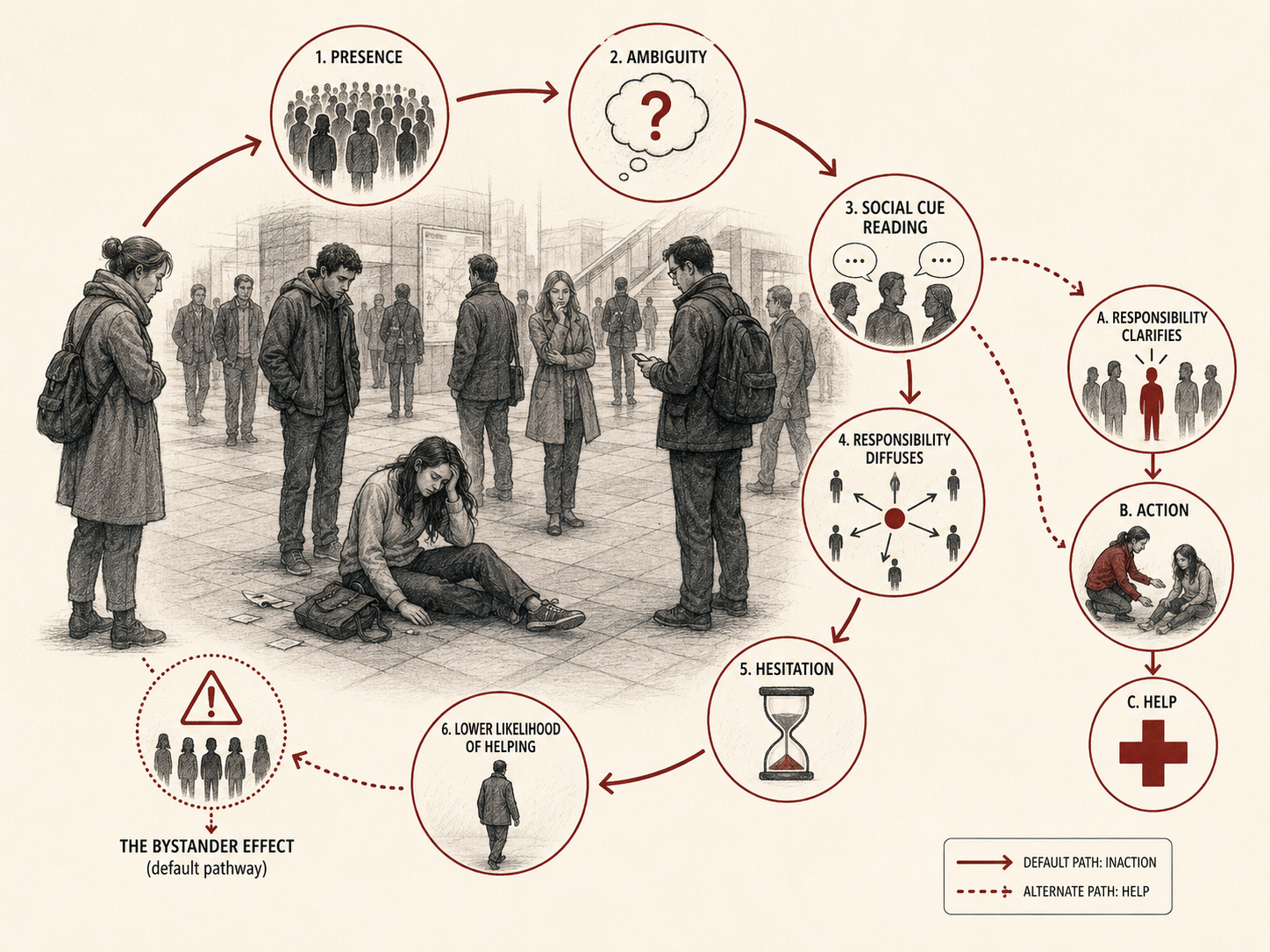
The bystander effect connects directly to prosocial behavior, altruism, diffusion of responsibility, social norms, conformity, social loafing, deindividuation, and collective action. Together these frameworks explain why the presence of others can either support coordinated helping or suppress personal intervention.
What is the bystander effect?
The bystander effect refers to the tendency for people to be less likely to help during an emergency when other people are present. The effect is usually explained through several linked processes: diffusion of responsibility, pluralistic ignorance, evaluation apprehension, uncertainty about how to help, and the social interpretation of other bystanders’ behavior.
The phenomenon is counterintuitive because people often assume that more witnesses should mean more help. In many emergency systems, that assumption is reasonable: more people can mean more resources, more knowledge, more physical capacity, and more chances that someone will act. But psychologically, the presence of others can also reduce the felt obligation of any one person. The group creates capacity, but it can also create ambiguity.
The bystander effect is not evidence that people are inherently cruel or indifferent. It is evidence that helping behavior is socially structured. People often want to help but hesitate because they are unsure whether the situation is an emergency, whether someone else is already acting, whether intervention is their responsibility, whether they will embarrass themselves, or whether they know what to do.
A careful definition should therefore include both behavior and latency. The bystander effect may reduce the probability of intervention, delay intervention, change the form of intervention, or move people toward indirect rather than direct forms of help. In applied contexts, delay can matter as much as nonintervention. A person who eventually helps after a long hesitation may still be affected by the bystander process.
The bystander effect is best understood as a failure of social coordination under uncertainty. The presence of others does not automatically prevent helping. It does so when responsibility remains diffuse, norms remain unclear, and no one breaks the pattern of collective hesitation.
The five-step model of bystander intervention
Latané and Darley’s intervention model remains one of the most useful frameworks for understanding why bystanders do or do not help. It treats intervention as a sequence of psychological steps. Failure at any step can prevent action.
A bystander must generally:
- notice that something is happening;
- interpret the situation as requiring help;
- assume personal responsibility;
- know what form of assistance to provide;
- implement the chosen action.
This model matters because it shows that “failure to help” is not a single psychological event. A person may fail to notice the emergency because they are distracted. They may notice but misinterpret it because the situation is ambiguous. They may recognize danger but assume someone else is responsible. They may feel responsible but lack the knowledge or confidence to act. They may know what to do but hesitate because intervention feels costly, risky, or socially embarrassing.
Each stage corresponds to a different intervention strategy. Attention cues help people notice. Clear emergency signals help people interpret. Direct responsibility assignment helps people assume responsibility. Training increases competence. Institutional support reduces the perceived cost of acting.
The five-step model is especially useful for applied settings because it shifts the problem from vague moral exhortation to design. Instead of simply telling people to “do the right thing,” institutions can ask: which step is failing, and how can the environment be designed so that helping becomes easier, clearer, safer, and more expected?
Kitty Genovese, historical memory, and the origins of research
The murder of Kitty Genovese in Queens, New York, in 1964 became one of the most famous stories in the history of social psychology. Early press accounts claimed that 38 witnesses saw or heard the attack and failed to intervene. The story became a cultural symbol of urban apathy and moral indifference.
That narrative helped inspire Darley and Latané’s research on bystander intervention. It gave public urgency to the question of why people sometimes fail to help in emergencies. But later historical investigations showed that the standard story was not accurate in the simple form repeated in many textbooks and popular accounts. The number of witnesses, what they saw, what they understood, and how some responded were more complicated than the original myth allowed.
This correction is important for scholarly integrity. The bystander-effect literature should not depend on a simplified or misleading account of one murder. The scientific question remains valid: group presence can reduce helping under certain conditions. But the Genovese story should be treated as a historically contested catalyst, not as uncomplicated evidence.
The case also reveals how social psychology itself can be shaped by public narratives. A dramatic media account can become a research origin story, even when later evidence complicates it. A research-grade article should preserve the conceptual importance of the case while resisting mythic simplification.
The deeper lesson is not that urban people were uniquely apathetic. It is that social situations can make responsibility unclear, and that public memory can flatten complex events into moral parables.
Darley and Latané’s experimental research
Darley and Latané transformed the bystander effect from a public moral question into an experimental research program. Their classic seizure experiment placed participants in a discussion situation where they believed another participant was experiencing a medical emergency. The number of perceived other witnesses was manipulated. Participants who believed they were the only witness were more likely to seek help than those who believed others were also present.
The critical feature was perception. Participants did not need to see a crowd physically present. They only needed to believe others were also aware of the event. This showed that the bystander effect depends not only on physical group size, but on perceived responsibility structure.
Latané and Darley’s smoke-filled-room experiment further demonstrated the role of pluralistic ignorance and social cues. Participants alone were more likely to report smoke entering the room, while participants in the presence of passive others were less likely to act. When other people appeared calm, their inaction became information. Participants could reinterpret a potentially dangerous situation as nonurgent because no one else seemed alarmed.
These studies remain foundational because they identified distinct mechanisms: diffusion of responsibility in the seizure paradigm and pluralistic ignorance in the smoke paradigm. Together they showed that bystander inaction is not merely a matter of selfishness. It can emerge from the social interpretation of responsibility and reality itself.
Modern research has refined these mechanisms, but the central insight remains: emergency response is shaped by who else appears to know, who appears responsible, and what other people’s behavior seems to mean.
Diffusion of responsibility
Diffusion of responsibility is one of the central mechanisms of the bystander effect. When multiple people witness an emergency, each person may feel less personally responsible for acting. Responsibility becomes psychologically distributed across the group.
This does not always involve conscious calculation. A bystander may not explicitly think, “Someone else will help.” Instead, the presence of others subtly reduces urgency: surely someone has called for help, someone closer knows what is happening, someone more qualified will intervene, or someone else has more responsibility.
Diffusion is especially powerful when:
- many bystanders are present;
- the roles of bystanders are unclear;
- no one has been directly assigned responsibility;
- the event is visible to many people at once;
- the victim is not personally known;
- the bystander does not feel uniquely capable;
- institutional responsibility is ambiguous;
- online audience size is large and invisible.
Direct responsibility assignment is one of the most effective practical countermeasures. In emergency training, people are often taught to point to a specific person and say, “You, call emergency services.” This converts diffuse group responsibility into individual responsibility.
Diffusion of responsibility also explains failures in organizations. When everyone is copied on an email, everyone may assume someone else will respond. When a safety concern is raised in a meeting without ownership, no one may act. When multiple departments share a problem, each may assume another unit is responsible. The bystander effect is therefore not confined to street emergencies. It appears wherever responsibility is socially distributed but not clearly assigned.
Pluralistic ignorance
Pluralistic ignorance occurs when people privately believe something is wrong but infer from others’ visible calm or inaction that the situation is not serious. Each person may be concerned internally, while publicly appearing calm. The result is collective inaction that no individual fully endorses.
Emergency situations are often ambiguous. A person lying on the ground may be injured, intoxicated, resting, performing, or waiting. A loud argument may be ordinary conflict or escalating violence. Smoke may signal danger or a harmless experiment. Online harassment may be interpreted as joking, conflict, abuse, or group norm enforcement. In ambiguous cases, people look to others for cues.
If other bystanders appear calm, that calm becomes evidence. The problem is that they may also be looking around and trying not to appear alarmed. Everyone reads everyone else’s restraint as information, even though the restraint itself may be driven by uncertainty.
Pluralistic ignorance is especially likely when:
- the emergency is ambiguous;
- others are physically present but passive;
- no one has clear expertise;
- social norms discourage overreaction;
- the cost of false alarm feels high;
- the setting is formal, institutional, or high-status;
- online group norms normalize harmful behavior.
The practical implication is that visible intervention can break the spell. The first person to act changes the informational environment for everyone else. A single clear signal — “This person needs help,” “Call 911,” “This is not okay,” “We need to stop this” — can convert private concern into collective response.
Evaluation apprehension
Evaluation apprehension refers to the fear of being judged, embarrassed, or socially criticized for intervening incorrectly. A bystander may worry about misreading the situation, overreacting, appearing foolish, escalating conflict, violating social norms, or being blamed if the intervention fails.
This mechanism is especially important in ambiguous settings. When the emergency is obvious, the fear of embarrassment may matter less. When the situation is uncertain, social evaluation becomes more powerful. People hesitate because intervention requires publicly defining the event as serious.
Evaluation apprehension can suppress helping in several ways:
- people delay while looking for more information;
- people wait for someone else to act first;
- people avoid direct intervention and choose indirect observation;
- people minimize the situation to avoid social risk;
- people remain silent in meetings, classrooms, or online spaces;
- people worry that intervention will be perceived as intrusive.
The effect can be especially strong where hierarchy, reputation, status, or peer judgment are salient. A student may hesitate to challenge bullying in front of peers. An employee may hesitate to report misconduct in front of senior leaders. A platform user may hesitate to intervene in harassment if the community punishes “overreaction.”
Reducing evaluation apprehension requires making intervention legitimate. Clear norms, training, scripts, institutional backing, and visible support can help people act without feeling socially exposed. When intervention is treated as expected rather than exceptional, embarrassment decreases.
Perceived competence and knowing how to help
Even when people notice an emergency, interpret it correctly, and feel responsible, they may fail to intervene because they do not know what to do. Perceived competence is the belief that one has the knowledge, skill, authority, or practical ability to help effectively.
This factor is sometimes underemphasized in popular accounts of the bystander effect. Nonintervention is not always caused by indifference or cowardice. A person may care deeply but fear making the situation worse. They may not know whether to intervene directly, call for help, document the event, distract, delegate, check on the victim, report through formal channels, or seek assistance from someone with expertise.
Training matters because it reduces this uncertainty. First-aid training, mental-health first aid, anti-harassment bystander training, emergency response protocols, school safety procedures, workplace reporting systems, and online moderation guidance all increase perceived competence.
Competence also changes the psychological meaning of responsibility. If a bystander knows how to act, responsibility becomes actionable. If they do not, responsibility can become anxiety. Effective intervention design should therefore pair moral responsibility with practical scripts.
Useful intervention scripts include:
- direct action when safe;
- delegation to a specific person or authority;
- distraction to interrupt escalation;
- delay and follow-up after immediate danger;
- documentation when appropriate and safe;
- reporting through trusted institutional channels;
- supporting the target rather than confronting the aggressor directly.
The goal is not reckless heroism. The goal is competent, proportionate, safe, and effective helping.
Formalizing the bystander effect
The bystander effect can be represented as a decline in felt responsibility as perceived bystander count rises. A simple diffusion model is:
R_f=\frac{1}{n+1}
\]
Interpretation: Felt responsibility \(R_f\) declines as the perceived number of other bystanders \(n\) increases. The \(+1\) includes the focal bystander.
In practice, responsibility is not determined by group size alone. Direct assignment, shared identity, leadership cues, and intervention norms can counteract diffusion:
R_i=\alpha_0-\alpha_1\log(n_i+1)+\alpha_2D_i+\alpha_3S_i+\alpha_4L_i+\alpha_5N_i
\]
Interpretation: Felt responsibility \(R_i\) falls with perceived bystander count \(n_i\), but rises with direct assignment \(D_i\), shared identity \(S_i\), leadership cues \(L_i\), and intervention norm salience \(N_i\).
Helping probability can be modeled as a logistic function:
P(H_i=1)=\operatorname{logit}^{-1}(\beta_0+\beta_1R_i+\beta_2C_i+\beta_3V_i+\beta_4K_i-\beta_5E_i-\beta_6A_i-\beta_7Z_i)
\]
Interpretation: Helping becomes more likely when responsibility \(R\), emergency clarity \(C\), victim identifiability \(V\), and competence \(K\) are high, and less likely when evaluation apprehension \(E\), ambiguity \(A\), and intervention cost \(Z\) are high.
Pluralistic ignorance can be represented as a gap between private concern and perceived public interpretation:
PI_i = B_{p,i}-B_{o,i}
\]
Interpretation: Pluralistic ignorance \(PI_i\) increases when private belief that help is needed \(B_p\) exceeds the bystander’s inference from others’ visible behavior \(B_o\).
Intervention latency can also be modeled:
\log(T_i)=\theta_0+\theta_1\log(n_i+1)+\theta_2PI_i+\theta_3E_i+\theta_4Z_i-\theta_5C_i-\theta_6D_i-\theta_7K_i
\]
Interpretation: Intervention time \(T_i\) increases with bystander count, pluralistic ignorance, evaluation apprehension, and cost, but declines with emergency clarity, direct assignment, and perceived competence.
At the group level, intervention can be modeled as a threshold process:
P(H_{t+1})=P(H_t)+\delta U_t-\lambda N_t+\phi A_t
\]
Interpretation: Helping probability may rise with urgency \(U_t\) and responsibility assignment \(A_t\), but fall when continued passivity normalizes inaction \(N_t\).
These models clarify that the bystander effect is not caused by numbers alone. Numbers matter because they change responsibility, interpretation, evaluation risk, and perceived necessity.
When the bystander effect is stronger or weaker
The bystander effect is reliable, but it is not uniform. The presence of others does not always reduce helping. Meta-analytic work shows that the effect depends on danger, ambiguity, costs, communication among bystanders, victim identity, shared group membership, and whether the presence of others increases or decreases perceived capacity to act.
The bystander effect tends to be stronger when:
- the situation is ambiguous;
- other bystanders are passive;
- responsibility is not assigned;
- the victim is anonymous or socially distant;
- intervention could be embarrassing;
- the bystander lacks competence;
- the perceived cost of intervention is high;
- the group is large and anonymous;
- online audience size is high;
- platform norms discourage intervention;
- institutional reporting channels are unclear.
The effect tends to be weaker when:
- danger is clear and urgent;
- the victim is identifiable;
- the bystander shares identity with the victim;
- someone directly assigns responsibility;
- a leader models intervention;
- helping norms are salient;
- the bystander knows what to do;
- the bystander has relevant expertise;
- the cost of intervention is manageable;
- institutions support and protect intervention.
This moderation is crucial because it prevents fatalism. The bystander effect is not an unavoidable human defect. It is a situational pattern that can be weakened by better social design.
The strongest practical interventions do not merely tell people to care more. They clarify the event, assign responsibility, normalize intervention, teach concrete scripts, reduce costs, and protect those who act.
Danger, urgency, and emergency clarity
Danger and emergency clarity change the bystander effect in complex ways. When danger is high and the emergency is unambiguous, helping may become more likely because the situation leaves less room for pluralistic ignorance. A visibly injured person, a fire, a medical collapse, or an explicit call for help can reduce uncertainty.
However, danger can also increase perceived cost. A bystander may recognize that intervention is needed but avoid direct action because the situation is physically risky. In such cases, the question is not whether the bystander cares, but whether they believe they can act safely and effectively.
Emergency clarity therefore interacts with competence and cost. If the situation is clear and the bystander knows a safe form of help, intervention becomes more likely. If the situation is clear but dangerous and the bystander lacks safe options, intervention may remain suppressed or shift toward indirect forms of help, such as calling emergency services, alerting authorities, gathering others, documenting, or creating distance.
Ambiguity is especially dangerous because it operates earlier in the decision chain. If the bystander does not define the situation as requiring help, responsibility may never become fully active. This is why visible distress signals, direct requests, and clear institutional protocols matter.
Emergency response training should therefore teach both recognition and safe action. People need to know not only that intervention is morally important, but how to interpret risk and choose an appropriate form of assistance.
Shared identity and victim identifiability
Shared identity can reduce the bystander effect. People are more likely to help when they perceive the victim as part of a shared group, community, institution, neighborhood, team, class, movement, or moral circle. Shared identity makes the victim less abstract and responsibility more personal.
Victim identifiability also matters. An identifiable person with a name, face, story, or visible distress often evokes stronger responsibility than an anonymous or statistically represented victim. This is not because anonymous victims matter less ethically, but because human cognition and emotion respond strongly to vivid, concrete persons.
Shared identity can operate in several ways:
- it increases empathy and concern;
- it makes harm feel closer;
- it creates a norm of mutual obligation;
- it makes intervention feel legitimate;
- it lowers uncertainty about whether help is appropriate;
- it shifts the bystander from observer to responsible group member.
This has important implications for institutions. Schools, workplaces, platforms, and public systems can reduce bystander inaction by strengthening norms of mutual responsibility without narrowing care only to in-groups. The ethical challenge is to build expansive solidarity: people should be more willing to help not only those who are socially close, but also those who are vulnerable, marginalized, or institutionally exposed.
A serious account of the bystander effect must therefore consider power and social distance. People are not equally likely to be helped. Race, gender, class, disability, immigration status, stigmatization, and perceived deservingness can shape who is treated as a victim, who is ignored, and whose distress is misread.
Online bystanders, cyberbullying, and platform environments
Digital platforms create new forms of bystander behavior. In online harassment, cyberbullying, pile-ons, self-harm signals, misinformation, public shaming, and abusive comment threads, many people may witness harm without intervening. The audience can be vast, invisible, anonymous, and asynchronous.
Online bystander effects can be intensified by several platform conditions:
- large visible audience counts;
- unclear responsibility among many observers;
- ambiguity about tone, intent, or seriousness;
- fear of retaliation or becoming a target;
- uncertainty about platform rules;
- low confidence in moderation systems;
- norms that treat intervention as overreaction;
- algorithmic amplification of conflict;
- unclear distinction between joking, criticism, harassment, and abuse;
- lack of easy indirect intervention tools.
At the same time, digital platforms can also support intervention. Users can report content, message the target privately, post support, correct misinformation, de-escalate, document abuse, block coordinated harassment, or alert moderators. The form of help may differ from physical emergencies, but the psychological steps remain similar: notice, interpret, assume responsibility, know what to do, and act.
Platform design matters. Reporting pathways, visible moderation, community norms, friction before abusive posting, target-support tools, anti-dogpiling systems, and trusted escalation channels can reduce online bystander inaction. A platform that treats bystanders as passive viewers will produce different outcomes than one that makes safe intervention legible and supported.
Online bystander research should also avoid simplistic calls for universal public confrontation. In some cases, direct confrontation can escalate harm. Safer intervention may involve private support, reporting, documentation, or coordinated moderation.
Organizations, schools, and institutional reporting
The bystander effect appears in organizations whenever people witness problems but fail to act because responsibility is unclear, risk is high, or others appear passive. This includes harassment, bullying, discrimination, safety violations, ethical misconduct, data manipulation, patient-care concerns, financial wrongdoing, and abusive leadership.
Institutional bystander effects are often more complex than street emergencies because intervention can carry career, social, legal, or reputational costs. Employees may wonder whether the behavior is serious enough, whether others saw it, whether leadership already knows, whether reporting will matter, whether retaliation is possible, or whether the institution will protect them.
Schools and universities face similar dynamics. Students may witness bullying, hazing, harassment, self-harm risk, exclusion, or peer abuse but hesitate because they fear social consequences. The presence of peers can normalize inaction, especially when no one wants to be the first to define the situation as wrong.
Institutional design can reduce bystander inaction through:
- clear reporting pathways;
- visible anti-retaliation protections;
- specific role assignment;
- bystander intervention training;
- anonymous or confidential reporting options;
- trusted escalation channels;
- leadership modeling;
- documented response procedures;
- feedback loops showing that reports are taken seriously;
- norms that treat intervention as responsibility, not disloyalty.
The institutional lesson is that “speak up” messaging is insufficient if systems punish or ignore those who speak. The bystander effect is not only psychological. It is also structural. People intervene when institutions make intervention clear, safe, meaningful, and legitimate.
Public safety and emergency-response design
The bystander effect has direct implications for emergency-response design. Public safety systems cannot assume that people will act simply because they witness danger. Systems must be designed to convert witnessing into action.
Several practical principles follow from the research:
- make emergency cues clear;
- reduce ambiguity about what counts as a problem;
- assign responsibility directly;
- train people in simple intervention scripts;
- normalize calling for help;
- create visible emergency procedures;
- encourage people to delegate rather than freeze;
- teach safe direct and indirect intervention options;
- reduce fear of embarrassment for false alarms;
- protect people who intervene in good faith.
Direct assignment is especially important. A person needing help should not call vaguely into a crowd if they can avoid it. “Someone call 911” is less effective than “You in the red jacket, call 911.” The second command collapses diffusion of responsibility by naming a responsible actor.
Emergency-response design also matters in physical spaces. Signage, lighting, visible emergency phones, panic buttons, staff roles, crowd-management protocols, and trained personnel all shape whether bystanders know what to do.
The public-safety lesson is that intervention is a behavior that can be designed for. Environments can be built to make responsibility easier to perceive and action easier to execute.
Ethical and institutional implications
The bystander effect raises ethical questions about responsibility in collective settings. If social conditions reduce intervention, how should responsibility be understood? A careful answer must hold two truths together. First, individuals remain morally responsible for how they respond to others’ suffering. Second, institutions and environments shape whether responsible action becomes clear, safe, and likely.
Blaming individual bystanders without examining context can be too simple. People may face ambiguity, danger, fear, low competence, institutional retaliation, or social risk. But using the bystander effect to excuse inaction would also be too simple. Social psychology explains mechanisms; it does not erase moral obligation.
The ethical implication is design-oriented. Institutions should not rely on spontaneous heroism. They should create systems that make helping expected and possible. That means clarifying roles, protecting interveners, teaching skills, and ensuring that people who act are supported rather than punished.
The bystander effect also has justice implications. Some victims are more likely to be ignored because their suffering is misread, minimized, stigmatized, or normalized. Racialized people, disabled people, migrants, unhoused people, women, LGBTQ+ people, children, elders, workers in low-power roles, and socially marginalized groups may face unequal recognition as victims. A serious intervention culture must address not only whether people help, but whose distress is interpreted as worthy of help.
The moral task is therefore not simply to create more intervention, but to create more just, competent, and accountable intervention.
The bystander effect in the architecture of social influence
Within the broader architecture of social influence, the bystander effect shows how groups can suppress action without explicit coercion. No one has to order a bystander not to help. Inaction can emerge from uncertainty, passive social cues, shared responsibility, and fear of evaluation.
Prosocial behavior explains helping and care. Altruism examines helping that benefits others at cost to oneself. Social norms explain expectations about what one should do. Conformity explains alignment with perceived group behavior. Diffusion of responsibility explains why obligation weakens in groups.
The bystander effect connects these processes through emergency action. It reveals how people can fail to enact their values when the social environment makes responsibility unclear. It also shows how one act of intervention can change the environment for everyone else by clarifying that help is needed and legitimate.
Seen in this framework, the bystander effect is not merely a finding about emergencies. It is a theory of moral hesitation under social uncertainty. It explains why people may fail to report harm, challenge abuse, interrupt harassment, correct misinformation, or protect vulnerable people when they are surrounded by passive observers.
The concept is therefore central to any serious account of social influence, collective responsibility, and institutional ethics.
Critiques and interpretive cautions
The bystander effect is well established, but it should be interpreted carefully. Popular accounts sometimes present it as proof that people are apathetic, selfish, or morally weak. That reading is too shallow. Many bystanders fail to help because the situation is ambiguous, responsibility is unclear, intervention is risky, or they do not know what to do.
Several cautions are important:
- Do not treat nonintervention as indifference without measuring ambiguity, fear, competence, and cost.
- Do not rely on simplified versions of the Kitty Genovese story.
- Do not assume more bystanders always reduce intervention.
- Do not ignore dangerousness and intervention risk.
- Do not confuse helping intention with actual helping.
- Do not ignore indirect forms of intervention.
- Do not treat all bystanders as equally safe or empowered to act.
- Do not ignore race, gender, disability, class, status, or institutional power.
- Do not assume public confrontation is always the safest intervention.
- Do not frame bystander training as a substitute for institutional accountability.
The strongest use of the bystander effect is diagnostic. Which step failed: noticing, interpretation, responsibility, competence, or action? Which social cues suppressed response? Which institutional features made helping costly? Which design changes would make intervention clearer and safer?
Used carefully, the bystander effect is not a cynical theory of human apathy. It is a practical framework for designing environments where moral concern becomes action.
Measurement, data, and research design
Bystander-effect research uses laboratory experiments, field simulations, emergency vignettes, response-time studies, online harassment experiments, cyberbullying studies, organizational reporting designs, public-safety evaluations, training assessments, and multilevel modeling.
Key variables include:
- participant, session, scenario, site, group, and platform identifiers;
- actual bystander count;
- perceived bystander count;
- emergency clarity;
- danger level;
- victim identifiability;
- shared identity;
- felt responsibility;
- diffusion of responsibility;
- pluralistic ignorance;
- evaluation apprehension;
- perceived competence;
- intervention cost;
- direct responsibility assignment;
- leadership cue;
- intervention norm salience;
- online context;
- platform traceability;
- moderation visibility;
- intervention likelihood;
- actual intervention;
- intervention latency;
- response confidence.
Strong research designs should distinguish objective bystander count from perceived bystander count. A person may physically be alone but believe others are monitoring the situation online, or may be in a crowd but feel uniquely responsible because they were directly addressed.
Researchers should also distinguish helping intention from actual intervention. Self-reported willingness to help often overestimates behavior under real uncertainty, cost, or social pressure. Intervention latency should be measured when possible because delay is a meaningful outcome.
For online research, platform variables are essential. Visible audience size, anonymity, moderation visibility, reporting tools, community norms, traceability, and retaliation risk may all shape whether people intervene in cyberbullying, harassment, or harmful content situations.
Finally, ethical design is crucial. Simulated emergencies and harassment scenarios can cause distress. Studies should protect participants, debrief carefully, avoid real harm, and use institutional review standards appropriate to the sensitivity of the scenario.
R code for bystander-effect research
The following R workflow models intervention, intervention likelihood, felt responsibility, and intervention latency as functions of perceived bystander count, emergency clarity, danger level, victim identifiability, shared identity, diffusion of responsibility, pluralistic ignorance, evaluation apprehension, perceived competence, intervention cost, direct assignment, leadership cues, intervention norms, and online context.
# Install packages if needed:
# pak::pak(c("tidyverse", "lme4", "lmerTest", "emmeans", "broom.mixed", "performance"))

library(tidyverse)
library(lme4)
library(lmerTest)
library(emmeans)
library(broom.mixed)
library(performance)

# Expected columns:
# participant, session_id, scenario_id, site_id, condition, context_type,
# trial, actual_bystander_count, perceived_bystander_count,
# emergency_clarity, danger_level, victim_identifiability,
# shared_identity, felt_responsibility, diffusion_responsibility,
# pluralistic_ignorance, evaluation_apprehension,
# perceived_competence, intervention_cost, direct_assignment,
# leadership_cue, intervention_norm_salience, online_context,
# platform_traceability, moderation_visibility,
# intervention_likelihood, actual_intervention,
# intervention_latency_ms, response_confidence

dat <- read_csv("bystander_effect_trials.csv") %>%
  mutate(
    participant = factor(participant),
    session_id = factor(session_id),
    scenario_id = factor(scenario_id),
    site_id = factor(site_id),
    condition = factor(condition),
    context_type = factor(context_type),
    direct_assignment = as.integer(direct_assignment),
    leadership_cue = as.integer(leadership_cue),
    online_context = as.integer(online_context),
    actual_intervention = as.integer(actual_intervention),
    log_perceived_bystanders = log1p(perceived_bystander_count),
    responsibility_assignment_index = (
      felt_responsibility +
      2 * direct_assignment +
      1.4 * leadership_cue +
      intervention_norm_salience
    ) / 4,
    ambiguity_index = (
      pluralistic_ignorance +
      evaluation_apprehension +
      (10 - emergency_clarity)
    ) / 3,
    helping_capacity_index = (
      perceived_competence +
      response_confidence +
      intervention_norm_salience -
      intervention_cost
    ) / 3,
    log_latency = log(intervention_latency_ms)
  )

summary_table <- dat %>%
  group_by(condition, context_type) %>%
  summarise(
    n = n(),
    participants = n_distinct(participant),
    mean_perceived_bystanders = mean(perceived_bystander_count, na.rm = TRUE),
    intervention_rate = mean(actual_intervention, na.rm = TRUE),
    mean_intervention_likelihood = mean(intervention_likelihood, na.rm = TRUE),
    mean_latency = mean(intervention_latency_ms, na.rm = TRUE),
    mean_responsibility = mean(felt_responsibility, na.rm = TRUE),
    mean_diffusion = mean(diffusion_responsibility, na.rm = TRUE),
    mean_pluralistic_ignorance = mean(pluralistic_ignorance, na.rm = TRUE),
    mean_evaluation_apprehension = mean(evaluation_apprehension, na.rm = TRUE),
    mean_clarity = mean(emergency_clarity, na.rm = TRUE),
    mean_competence = mean(perceived_competence, na.rm = TRUE),
    mean_assignment_index = mean(responsibility_assignment_index, na.rm = TRUE),
    .groups = "drop"
  )

print(summary_table)

intervention_model <- glmer(
  actual_intervention ~
    log_perceived_bystanders +
    emergency_clarity +
    danger_level +
    victim_identifiability +
    shared_identity +
    felt_responsibility +
    diffusion_responsibility +
    pluralistic_ignorance +
    evaluation_apprehension +
    perceived_competence +
    intervention_cost +
    direct_assignment +
    leadership_cue +
    intervention_norm_salience +
    online_context +
    platform_traceability +
    moderation_visibility +
    condition +
    context_type +
    (1 | participant) +
    (1 | scenario_id) +
    (1 | site_id),
  data = dat,
  family = binomial(),
  control = glmerControl(optimizer = "bobyqa")
)

summary(intervention_model)
emmeans(intervention_model, ~ condition, type = "response")

responsibility_model <- lmer(
  felt_responsibility ~
    log_perceived_bystanders +
    direct_assignment +
    leadership_cue +
    shared_identity +
    victim_identifiability +
    emergency_clarity +
    intervention_norm_salience +
    diffusion_responsibility +
    condition +
    context_type +
    (1 | participant) +
    (1 | scenario_id) +
    (1 | site_id),
  data = dat,
  REML = FALSE
)

summary(responsibility_model)

latency_model <- lmer(
  log_latency ~
    log_perceived_bystanders +
    emergency_clarity +
    pluralistic_ignorance +
    evaluation_apprehension +
    intervention_cost +
    direct_assignment +
    leadership_cue +
    perceived_competence +
    actual_intervention +
    condition +
    context_type +
    (1 | participant) +
    (1 | scenario_id) +
    (1 | site_id),
  data = dat %>% filter(intervention_latency_ms >= 150),
  REML = FALSE
)

summary(latency_model)

bystander_summary <- dat %>%
  mutate(
    bystander_band = cut(
      perceived_bystander_count,
      breaks = c(-0.1, 0, 3, 10, 10000),
      labels = c("alone", "small_group", "medium_group", "large_group")
    )
  ) %>%
  group_by(condition, bystander_band) %>%
  summarise(
    n = n(),
    intervention_rate = mean(actual_intervention, na.rm = TRUE),
    mean_likelihood = mean(intervention_likelihood, na.rm = TRUE),
    mean_latency = mean(intervention_latency_ms, na.rm = TRUE),
    mean_responsibility = mean(felt_responsibility, na.rm = TRUE),
    mean_diffusion = mean(diffusion_responsibility, na.rm = TRUE),
    mean_ambiguity = mean(ambiguity_index, na.rm = TRUE),
    .groups = "drop"
  )

write_csv(summary_table, "bystander_effect_summary.csv")
write_csv(bystander_summary, "bystander_effect_bystander_band_summary.csv")

write_csv(
  tidy(intervention_model, effects = "fixed", conf.int = TRUE),
  "bystander_effect_intervention_coefficients.csv"
)

ggplot(
  bystander_summary,
  aes(x = bystander_band, y = intervention_rate, color = condition, group = condition)
) +
  geom_line() +
  geom_point() +
  labs(
    title = "Bystander intervention by perceived group size",
    x = "Perceived bystander-count band",
    y = "Intervention rate"
  ) +
  theme_minimal()
This workflow supports bystander-effect research by modeling actual intervention, felt responsibility, and intervention latency rather than relying only on stated helping intentions.
Python code for bystander-effect research
The Python workflow below parallels the R analysis and adds a threshold simulation for diffusion of responsibility, direct assignment, shared identity, training, and online harassment contexts.
import numpy as np
import pandas as pd
import statsmodels.formula.api as smf
import statsmodels.api as sm
import matplotlib.pyplot as plt

# Expected columns:
# participant, session_id, scenario_id, site_id, condition, context_type,
# trial, actual_bystander_count, perceived_bystander_count,
# emergency_clarity, danger_level, victim_identifiability,
# shared_identity, felt_responsibility, diffusion_responsibility,
# pluralistic_ignorance, evaluation_apprehension,
# perceived_competence, intervention_cost, direct_assignment,
# leadership_cue, intervention_norm_salience, online_context,
# platform_traceability, moderation_visibility,
# intervention_likelihood, actual_intervention,
# intervention_latency_ms, response_confidence

df = pd.read_csv("bystander_effect_trials.csv")

for col in [
    "participant",
    "session_id",
    "scenario_id",
    "site_id",
    "condition",
    "context_type"
]:
    df[col] = df[col].astype("category")

df["actual_intervention"] = df["actual_intervention"].astype(int)
df["direct_assignment"] = df["direct_assignment"].astype(int)
df["leadership_cue"] = df["leadership_cue"].astype(int)
df["online_context"] = df["online_context"].astype(int)

df["log_perceived_bystanders"] = np.log1p(
    df["perceived_bystander_count"]
)

df["responsibility_assignment_index"] = (
    df["felt_responsibility"]
    + 2.0 * df["direct_assignment"]
    + 1.4 * df["leadership_cue"]
    + df["intervention_norm_salience"]
) / 4

df["ambiguity_index"] = (
    df["pluralistic_ignorance"]
    + df["evaluation_apprehension"]
    + (10 - df["emergency_clarity"])
) / 3

df["helping_capacity_index"] = (
    df["perceived_competence"]
    + df["response_confidence"]
    + df["intervention_norm_salience"]
    - df["intervention_cost"]
) / 3

df["log_latency"] = np.log(df["intervention_latency_ms"])

summary_table = (
    df.groupby(["condition", "context_type"], observed=True)
    .agg(
        n=("participant", "size"),
        participants=("participant", "nunique"),
        mean_perceived_bystanders=("perceived_bystander_count", "mean"),
        intervention_rate=("actual_intervention", "mean"),
        mean_intervention_likelihood=("intervention_likelihood", "mean"),
        mean_latency=("intervention_latency_ms", "mean"),
        mean_responsibility=("felt_responsibility", "mean"),
        mean_diffusion=("diffusion_responsibility", "mean"),
        mean_pluralistic_ignorance=("pluralistic_ignorance", "mean"),
        mean_evaluation_apprehension=("evaluation_apprehension", "mean"),
        mean_clarity=("emergency_clarity", "mean"),
        mean_competence=("perceived_competence", "mean"),
        mean_assignment_index=("responsibility_assignment_index", "mean"),
    )
    .reset_index()
)

print(summary_table)

intervention_model = smf.glm(
    "actual_intervention ~ log_perceived_bystanders "
    "+ emergency_clarity + danger_level + victim_identifiability "
    "+ shared_identity + felt_responsibility "
    "+ diffusion_responsibility + pluralistic_ignorance "
    "+ evaluation_apprehension + perceived_competence "
    "+ intervention_cost + direct_assignment + leadership_cue "
    "+ intervention_norm_salience + online_context "
    "+ platform_traceability + moderation_visibility "
    "+ condition + context_type",
    data=df,
    family=sm.families.Binomial()
)

intervention_result = intervention_model.fit(
    cov_type="cluster",
    cov_kwds={"groups": df["participant"]}
)

print(intervention_result.summary())

responsibility_model = smf.ols(
    "felt_responsibility ~ log_perceived_bystanders "
    "+ direct_assignment + leadership_cue "
    "+ shared_identity + victim_identifiability "
    "+ emergency_clarity + intervention_norm_salience "
    "+ diffusion_responsibility + condition + context_type",
    data=df,
)

responsibility_result = responsibility_model.fit(
    cov_type="cluster",
    cov_kwds={"groups": df["participant"]}
)

print(responsibility_result.summary())

latency_model = smf.ols(
    "log_latency ~ log_perceived_bystanders "
    "+ emergency_clarity + pluralistic_ignorance "
    "+ evaluation_apprehension + intervention_cost "
    "+ direct_assignment + leadership_cue "
    "+ perceived_competence + actual_intervention "
    "+ condition + context_type",
    data=df[df["intervention_latency_ms"] >= 150].copy(),
)

latency_result = latency_model.fit(
    cov_type="cluster",
    cov_kwds={
        "groups": df[df["intervention_latency_ms"] >= 150]["participant"]
    },
)

print(latency_result.summary())

def simulate_bystander_threshold(n_cases=8000, seed=42):
    rng = np.random.default_rng(seed)
    rows = []

    conditions = [
        "alone",
        "large_group",
        "direct_assignment",
        "shared_identity",
        "trained_bystander",
        "online_harassment"
    ]

    for condition in conditions:
        for _ in range(n_cases):
            perceived_bystanders = {
                "alone": 0,
                "large_group": 12,
                "direct_assignment": 12,
                "shared_identity": 10,
                "trained_bystander": 30,
                "online_harassment": 30,
            }[condition]

            emergency_clarity = {
                "alone": 8.0,
                "large_group": 7.5,
                "direct_assignment": 8.5,
                "shared_identity": 7.5,
                "trained_bystander": 7.5,
                "online_harassment": 6.2,
            }[condition] + rng.normal(0, 0.8)

            direct_assignment = int(
                condition in ["direct_assignment", "trained_bystander"]
            )

            shared_identity = {
                "shared_identity": 8.0,
                "trained_bystander": 6.0
            }.get(condition, 4.0)

            competence = 8.5 if condition == "trained_bystander" else 6.0
            evaluation_apprehension = (
                6.2 if condition == "online_harassment" else 3.0
            )

            diffusion = np.clip(
                1
                + 1.25 * np.log1p(perceived_bystanders)
                - 2.5 * direct_assignment
                - 0.4 * shared_identity,
                0,
                10
            )

            responsibility = np.clip(
                8.5
                - 0.80 * diffusion
                + 1.8 * direct_assignment
                + 0.35 * shared_identity,
                0,
                10
            )

            latent = (
                -4.0
                + 0.55 * responsibility
                + 0.35 * emergency_clarity
                + 0.30 * competence
                - 0.35 * evaluation_apprehension
                - 0.40 * diffusion
            )

            probability = 1 / (1 + np.exp(-latent))
            intervention = int(rng.random() < probability)

            rows.append({
                "condition": condition,
                "perceived_bystanders": perceived_bystanders,
                "emergency_clarity": emergency_clarity,
                "direct_assignment": direct_assignment,
                "shared_identity": shared_identity,
                "perceived_competence": competence,
                "evaluation_apprehension": evaluation_apprehension,
                "diffusion_responsibility": diffusion,
                "felt_responsibility": responsibility,
                "intervention_probability": probability,
                "actual_intervention": intervention,
            })

    simulation = pd.DataFrame(rows)

    simulation_summary = (
        simulation.groupby("condition")
        .agg(
            n=("condition", "size"),
            mean_bystanders=("perceived_bystanders", "mean"),
            mean_responsibility=("felt_responsibility", "mean"),
            mean_diffusion=("diffusion_responsibility", "mean"),
            mean_probability=("intervention_probability", "mean"),
            intervention_rate=("actual_intervention", "mean"),
        )
        .reset_index()
    )

    return simulation, simulation_summary

simulation, simulation_summary = simulate_bystander_threshold()

print(simulation_summary)

bystander_summary = (
    df.assign(
        bystander_band=pd.cut(
            df["perceived_bystander_count"],
            bins=[-0.1, 0, 3, 10, 10000],
            labels=["alone", "small_group", "medium_group", "large_group"]
        )
    )
    .groupby(["condition", "bystander_band"], observed=True)
    .agg(intervention_rate=("actual_intervention", "mean"))
    .reset_index()
)

fig, ax = plt.subplots(figsize=(8, 5))

for condition, group in bystander_summary.groupby("condition", observed=True):
    ax.plot(
        group["bystander_band"].astype(str),
        group["intervention_rate"],
        marker="o",
        label=condition
    )

ax.set_xlabel("Perceived bystander-count band")
ax.set_ylabel("Intervention rate")
ax.set_title("Bystander intervention by perceived group size")
ax.legend()
plt.tight_layout()
plt.show()

summary_table.to_csv("bystander_effect_summary.csv", index=False)
simulation.to_csv("bystander_threshold_simulation.csv", index=False)
simulation_summary.to_csv("bystander_threshold_simulation_summary.csv", index=False)
This Python workflow supports experimental, applied, and online bystander-effect research by modeling actual intervention, responsibility assignment, diffusion, ambiguity, competence, and intervention latency.
Research data architecture
Bystander-effect research often depends on relational data: participants, sessions, scenarios, sites, conditions, context types, actual bystander count, perceived bystander count, emergency clarity, danger level, victim identifiability, shared identity, felt responsibility, diffusion of responsibility, pluralistic ignorance, evaluation apprehension, perceived competence, intervention cost, direct assignment, leadership cues, intervention norms, online context, platform traceability, moderation visibility, intervention likelihood, actual intervention, intervention latency, and response confidence.
Rather than embedding executable database code directly in the WordPress article body, the companion GitHub repository includes the full SQL schema and example queries for researchers who want to reproduce or extend the data model.
The research data model is designed to support questions such as:
- Does intervention decline as perceived bystander count increases?
- Does direct responsibility assignment increase felt responsibility?
- Does emergency clarity reduce pluralistic ignorance?
- Does evaluation apprehension delay intervention?
- Does perceived competence predict helping?
- Does shared identity reduce bystander inaction?
- Does online audience size suppress intervention?
- Does moderation visibility increase online bystander action?
- Does intervention training increase competence and reduce latency?
The GitHub repository contains the full database schema, example analytical queries, validation logic, and reproducible data workflow. Keeping executable SQL in GitHub avoids WordPress hosting restrictions while preserving the research-grade infrastructure for readers who want to inspect or reuse the model.
View the SQL research data architecture in GitHub.
GitHub repository
The companion repository provides reusable code and research scaffolding for studying the bystander effect, including workflows for diffusion of responsibility, pluralistic ignorance, evaluation apprehension, emergency clarity, victim identifiability, shared identity, direct responsibility assignment, intervention norms, online bystander behavior, cyberbullying intervention, moderation visibility, intervention likelihood, actual intervention, and intervention latency.
Complete Code Repository
Access the full companion repository for this article, including reproducible analysis materials and multi-language code workflows for bystander-effect research.
Why the bystander effect matters
The bystander effect matters because it reveals how moral action can fail in the presence of others. People may care, feel concern, and recognize harm, yet remain passive when responsibility is diffuse, the situation is ambiguous, others appear calm, or intervention feels socially risky.
The concept also matters because it points toward practical solutions. Helping becomes more likely when emergencies are clear, responsibility is assigned, intervention norms are visible, people know what to do, and institutions protect those who act. The goal is not to shame bystanders after failure, but to design environments where responsible action becomes easier before failure occurs.
In public emergencies, schools, workplaces, online platforms, organizations, and civic life, the bystander effect shows that concern is not enough. Systems must convert concern into responsibility, competence, and action.
Read alongside prosocial behavior, altruism, diffusion of responsibility, social norms, social loafing, deindividuation, and Institutions & Governance, the bystander effect becomes more than a classic laboratory finding. It becomes a framework for understanding how collective settings either suppress or activate responsibility.
Related articles
- Social Psychology
- Prosocial Behavior in Social Psychology
- Altruism in Social Psychology
- Diffusion of Responsibility
- Social Norms in Social Psychology
- Conformity and Social Influence
- Social Loafing in Social Psychology
- Deindividuation in Social Psychology
- Collective Action and Social Change
- Social Dilemmas
- Stewardship & Ethics
- Institutions & Governance
Further reading
- American Psychological Association (2018) ‘Bystander effect’, APA Dictionary of Psychology. Available at: https://dictionary.apa.org/bystander-effect.
- American Psychological Association (n.d.) ‘Bystander intervention tip sheet’. Available at: https://www.apa.org/pi/health-equity/bystander-intervention.
- Darley, J.M. and Latané, B. (1968) ‘Bystander intervention in emergencies: Diffusion of responsibility’, Journal of Personality and Social Psychology, 8(4), pp. 377–383. Available at: https://www.ucdenver.edu/docs/librariesprovider102/default-document-library/bystander-intervention-john-darley-and-bibb-latane.pdf.
- Fischer, P., Krueger, J.I., Greitemeyer, T., Vogrincic, C., Kastenmüller, A., Frey, D., Heene, M., Wicher, M. and Kainbacher, M. (2011) ‘The bystander-effect: A meta-analytic review on bystander intervention in dangerous and non-dangerous emergencies’, Psychological Bulletin, 137(4), pp. 517–537. Available at: https://doi.org/10.1037/a0023304.
- Hortensius, R. and de Gelder, B. (2018) ‘From empathy to apathy: The bystander effect revisited’, Current Directions in Psychological Science, 27(4), pp. 249–256. Available at: https://pmc.ncbi.nlm.nih.gov/articles/PMC6099971/.
- Kazerooni, F., Taylor, S.H., Bazarova, N.N. and Whitlock, J. (2018) ‘Cyberbullying bystander intervention: The number of offenders and retweeting predict likelihood of helping a cyberbullying victim’, Journal of Computer-Mediated Communication, 23(3), pp. 146–162. Available at: https://academic.oup.com/jcmc/article/23/3/146/4962534.
- Latané, B. and Darley, J.M. (1968) ‘Group inhibition of bystander intervention in emergencies’, Journal of Personality and Social Psychology, 10(3), pp. 215–221. PubMed record available at: https://pubmed.ncbi.nlm.nih.gov/5704479/.
- Latané, B. and Darley, J.M. (1970) The Unresponsive Bystander: Why Doesn’t He Help? New York: Appleton-Century-Crofts.
- Manning, R., Levine, M. and Collins, A. (2007) ‘The Kitty Genovese murder and the social psychology of helping: The parable of the 38 witnesses’, American Psychologist, 62(6), pp. 555–562. PubMed record available at: https://pubmed.ncbi.nlm.nih.gov/17874896/.
- Piliavin, I.M., Rodin, J. and Piliavin, J.A. (1969) ‘Good Samaritanism: An underground phenomenon?’, Journal of Personality and Social Psychology, 13(4), pp. 289–299. Available at: https://doi.org/10.1037/h0028433.
- Staub, E. (1974) ‘Helping a distressed person: Social, personality, and stimulus determinants’, Advances in Experimental Social Psychology, 7, pp. 293–341. Available at: https://doi.org/10.1016/S0065-2601(08)60040-4.
- You, L. and Lee, Y.H. (2019) ‘The bystander effect in cyberbullying on social network sites’, Computers in Human Behavior, 95, pp. 1–11. Available at: https://doi.org/10.1016/j.chb.2019.01.019.
References
- American Psychological Association (2018) ‘Bystander effect’, APA Dictionary of Psychology. Available at: https://dictionary.apa.org/bystander-effect.
- American Psychological Association (n.d.) ‘Bystander intervention tip sheet’. Available at: https://www.apa.org/pi/health-equity/bystander-intervention.
- Darley, J.M. and Latané, B. (1968) ‘Bystander intervention in emergencies: Diffusion of responsibility’, Journal of Personality and Social Psychology, 8(4), pp. 377–383. Available at: https://www.ucdenver.edu/docs/librariesprovider102/default-document-library/bystander-intervention-john-darley-and-bibb-latane.pdf.
- Fischer, P., Krueger, J.I., Greitemeyer, T., Vogrincic, C., Kastenmüller, A., Frey, D., Heene, M., Wicher, M. and Kainbacher, M. (2011) ‘The bystander-effect: A meta-analytic review on bystander intervention in dangerous and non-dangerous emergencies’, Psychological Bulletin, 137(4), pp. 517–537. Available at: https://doi.org/10.1037/a0023304.
- Hortensius, R. and de Gelder, B. (2018) ‘From empathy to apathy: The bystander effect revisited’, Current Directions in Psychological Science, 27(4), pp. 249–256. Available at: https://pmc.ncbi.nlm.nih.gov/articles/PMC6099971/.
- Kazerooni, F., Taylor, S.H., Bazarova, N.N. and Whitlock, J. (2018) ‘Cyberbullying bystander intervention: The number of offenders and retweeting predict likelihood of helping a cyberbullying victim’, Journal of Computer-Mediated Communication, 23(3), pp. 146–162. Available at: https://academic.oup.com/jcmc/article/23/3/146/4962534.
- Latané, B. and Darley, J.M. (1968) ‘Group inhibition of bystander intervention in emergencies’, Journal of Personality and Social Psychology, 10(3), pp. 215–221. PubMed record available at: https://pubmed.ncbi.nlm.nih.gov/5704479/.
- Latané, B. and Darley, J.M. (1970) The Unresponsive Bystander: Why Doesn’t He Help? New York: Appleton-Century-Crofts.
- Manning, R., Levine, M. and Collins, A. (2007) ‘The Kitty Genovese murder and the social psychology of helping: The parable of the 38 witnesses’, American Psychologist, 62(6), pp. 555–562. PubMed record available at: https://pubmed.ncbi.nlm.nih.gov/17874896/.
- Piliavin, I.M., Rodin, J. and Piliavin, J.A. (1969) ‘Good Samaritanism: An underground phenomenon?’, Journal of Personality and Social Psychology, 13(4), pp. 289–299. Available at: https://doi.org/10.1037/h0028433.
- Staub, E. (1974) ‘Helping a distressed person: Social, personality, and stimulus determinants’, Advances in Experimental Social Psychology, 7, pp. 293–341. Available at: https://doi.org/10.1016/S0065-2601(08)60040-4.
- You, L. and Lee, Y.H. (2019) ‘The bystander effect in cyberbullying on social network sites’, Computers in Human Behavior, 95, pp. 1–11. Available at: https://doi.org/10.1016/j.chb.2019.01.019.