
Last Updated June 2, 2026
Organizational resilience and learning refer to the capacity of organizations to anticipate disturbance, absorb disruption, sustain essential functions, adapt behavior, preserve institutional memory, and transform when existing structures no longer fit the environment. A resilient organization is not simply one that survives crisis. It is one that learns before, during, and after disturbance; recognizes weak signals; coordinates under uncertainty; protects people from avoidable harm; preserves mission-critical functions; and revises routines, assumptions, governance, and strategy when evidence shows that the old model has become fragile.
Organizational resilience is often misunderstood as toughness, speed, or heroic endurance. That framing is too narrow. Organizations can appear resilient because workers absorb impossible workloads, because managers delay acknowledging failure, because public relations masks operational weakness, or because short-term continuity is purchased by exhausting people and degrading institutional trust. In resilience thinking, that is not genuine resilience. It is deferred breakdown. A resilient organization builds adaptive capacity into its structure rather than shifting systemic risk downward onto workers, clients, suppliers, or communities.
Learning is central because organizations rarely fail only from external shock. They also fail from stale assumptions, brittle routines, fragmented information, weak feedback, poor memory, overcentralized decision-making, cultural silence, incentive misalignment, and the inability to change course when early signals appear. Financial crises, supply-chain disruptions, cyber incidents, climate disasters, leadership failures, public-health emergencies, regulatory shocks, reputational crises, workforce burnout, and technological disruption all test whether organizations can learn under pressure.
This article examines organizational resilience and learning as a core part of the Resilience Thinking series. It connects resilience theory, organizational learning, institutional memory, sensemaking, safety culture, adaptive governance, crisis management, workforce systems, knowledge management, feedback loops, business continuity, technology, metrics, and applied modeling. The central argument is that resilient organizations are not merely organizations with emergency plans. They are learning systems with enough structure to preserve function and enough flexibility to revise themselves when the environment changes.
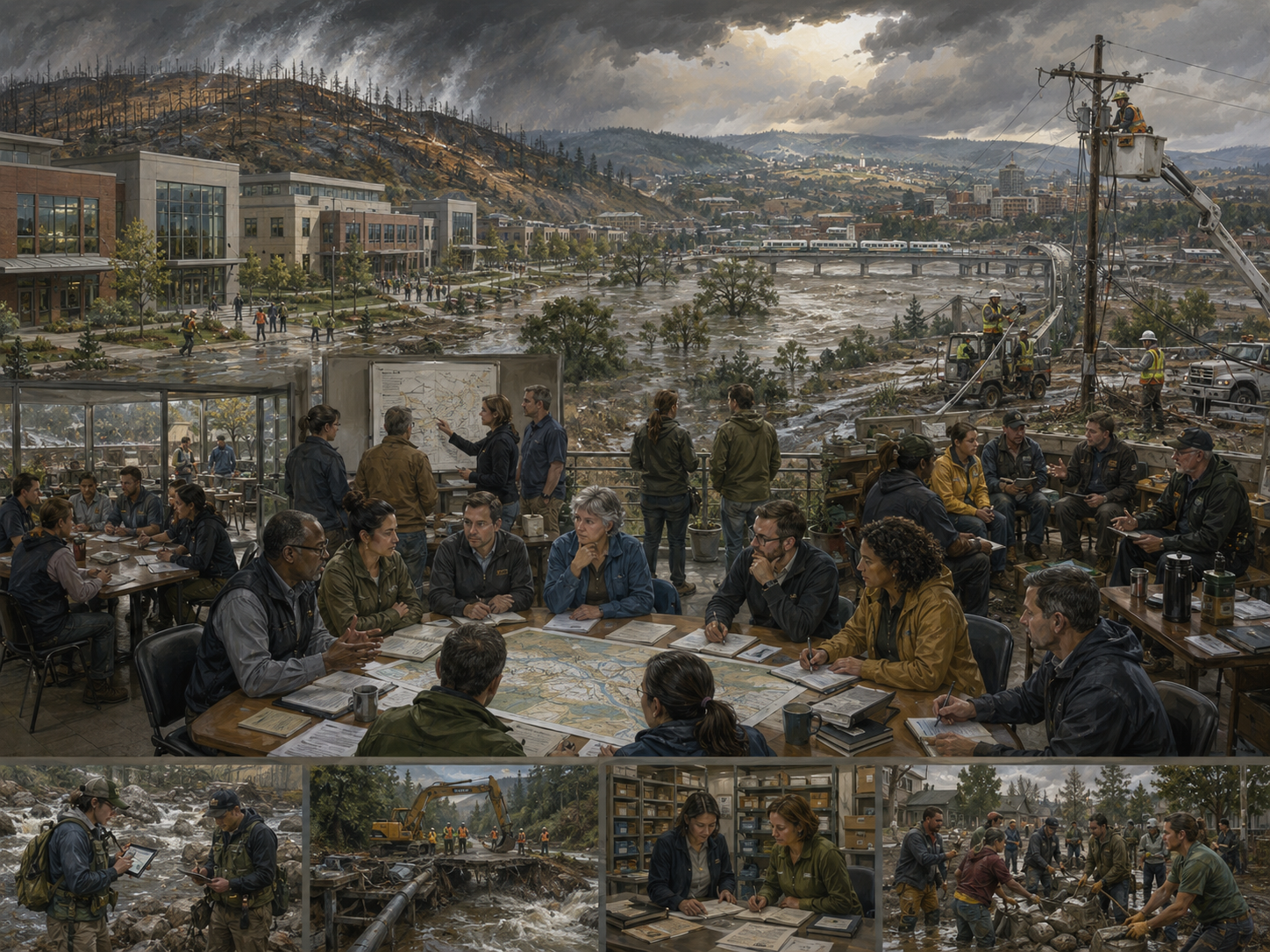
What Organizational Resilience Means
Organizational resilience is the capacity of an organization to sustain essential functions, adapt to changing conditions, recover from disruption, and learn in ways that improve future readiness. It includes the ability to anticipate threats, respond to stress, coordinate across boundaries, protect people, preserve critical knowledge, maintain trust, and transform routines when old assumptions become unsafe or ineffective.
Organizational resilience is different from simple durability. A durable organization may resist change. A resilient organization can absorb disturbance while still learning from it. Durability emphasizes strength; resilience emphasizes function under disturbance, adaptive response, and recovery without unacceptable harm. A bureaucratic organization may persist for decades but still be brittle if it cannot detect weak signals, share knowledge, adapt rules, or correct failures. A fast-moving organization may be flexible but fragile if it lacks redundancy, memory, ethics, and governance.
Resilience also differs from ordinary efficiency. Efficiency asks whether resources are being used with minimal waste under expected conditions. Resilience asks whether the organization can continue functioning when expected conditions no longer apply. The two are not enemies, but they often create tension. Highly optimized organizations may remove slack, cross-training, backup systems, institutional memory, and local discretion in order to reduce short-term cost. Those choices may increase fragility when disruption occurs.
| Concept | Meaning | Organizational example |
|---|---|---|
| Robustness | Ability to withstand a known stress without major change | A backup generator keeps a facility operating during a short power outage. |
| Continuity | Ability to preserve mission-critical functions during disruption | A hospital maintains emergency care while elective services are paused. |
| Adaptation | Ability to change routines, roles, workflows, or resource allocation under stress | A public agency shifts staff and procedures after demand surges unexpectedly. |
| Learning | Ability to convert experience into better future practice | An organization revises procedures after an after-action review reveals coordination failures. |
| Transformation | Ability to change deeper structures when the old model no longer works | A climate-exposed utility redesigns governance, investment, and service priorities around long-term risk. |
Organizational resilience is strongest when continuity, adaptation, and learning are integrated. Continuity without learning repeats old vulnerabilities. Learning without continuity may be too slow to protect essential functions. Adaptation without accountability may become improvisation, confusion, or harm. A resilient organization links all three.
Why Organizational Resilience Matters
Organizational resilience matters because organizations are the operating units through which societies deliver healthcare, education, finance, energy, water, food, transportation, public administration, emergency response, research, social services, infrastructure, technology, production, and civic coordination. When organizations fail, the consequences spread beyond internal performance. They affect households, workers, communities, supply chains, public trust, and institutional legitimacy.
Disruption rarely respects organizational boundaries. A cyber incident can interrupt payments, services, customer support, compliance, and public communication at once. A climate disaster can affect facilities, workers, suppliers, transportation, energy, insurance, and community need simultaneously. A public-health emergency can stress operations, workforce capacity, procurement, leadership, public messaging, and ethical decision-making. Resilience matters because organizations are increasingly exposed to compound disturbance.
Organizational resilience also matters because organizational failure often amplifies broader system risk. A hospital that cannot staff critical units weakens public-health resilience. A financial institution with weak risk governance can contribute to systemic instability. A utility with poor maintenance can magnify infrastructure failure. A government agency with weak learning systems can repeat mistakes during every crisis. Resilient organizations help stabilize larger systems; brittle organizations transmit fragility.
Why organizational resilience is a systems priority
It protects essential functions
Organizations deliver the services, goods, decisions, and coordination that larger systems depend on during stress.
It limits cascading failure
Resilient organizations prevent local disruption from spreading into wider operational, financial, social, or institutional crisis.
It preserves trust
Reliable communication, ethical action, and accountable response help sustain legitimacy when uncertainty is high.
It protects workers
Real resilience does not depend on burnout, silence, heroic overwork, or transferring risk to frontline staff.
It enables adaptation
Organizations must revise routines, structures, technologies, and assumptions as risk environments change.
It sustains learning
Organizations that remember, review, and revise can improve after disruption rather than repeat the same failures.
Organizational resilience is therefore a bridge between individual capacity and system-level resilience. It is where strategy, culture, governance, infrastructure, information, and human labor meet real disturbance.
Organizations as Complex Adaptive Systems
Organizations are complex adaptive systems. They contain multiple actors, roles, routines, incentives, technologies, cultures, informal networks, power relationships, feedback loops, knowledge systems, and external dependencies. Their behavior cannot be understood only from formal charts or policies. Informal communication, trust, habit, professional judgment, organizational memory, leadership signals, resource constraints, and local workarounds often determine whether the organization functions under stress.
This complexity matters because resilience is not located in one department. It is distributed across people, systems, routines, and relationships. A formal crisis plan may fail if information does not flow. A strong leader may fail if middle managers suppress bad news. A well-designed technology platform may fail if users do not trust it or if fallback procedures are absent. A training program may fail if incentives punish learning. Organizational resilience depends on interaction.
Organizations also adapt to what they measure and reward. If leaders reward speed but punish error reporting, people may hide weak signals. If budgets reward short-term efficiency, managers may remove buffers. If promotion rewards optimism, risk warnings may be ignored. If compliance replaces learning, after-action reviews may become paperwork. Resilience thinking requires attention to these feedback loops.
| Complex-system feature | Organizational expression | Resilience implication |
|---|---|---|
| Interdependence | Teams, suppliers, technologies, facilities, data, and governance depend on one another | Failure in one area can affect the whole organization. |
| Feedback loops | Metrics, incentives, culture, and leadership signals shape behavior | Organizations can amplify risk by rewarding fragile behavior. |
| Informal networks | People rely on relationships and tacit knowledge to solve problems | Formal plans must account for informal coordination. |
| Path dependence | Past decisions shape current routines, systems, and assumptions | Legacy practices can become hidden constraints. |
| Adaptive behavior | People improvise, reallocate, bypass, and reinterpret rules under stress | Adaptation can be helpful or harmful depending on governance and learning. |
| Nonlinearity | Small signals can indicate major systemic weakness | Weak-signal detection and escalation matter. |
Understanding organizations as complex adaptive systems helps avoid a common mistake: assuming that resilience can be created by issuing a policy. Policies matter, but resilience emerges from how policies interact with people, routines, power, infrastructure, incentives, and memory.
Organizational Learning and Institutional Memory
Organizational learning is the process by which organizations detect experience, interpret meaning, change behavior, and preserve useful knowledge. It includes individual learning, team learning, procedural learning, strategic learning, and institutional learning. An organization learns when experience changes future action, not merely when information is collected.
Institutional memory is the stored capacity to remember what happened, why it happened, what worked, what failed, who knows what, which assumptions were wrong, and which decisions should not be repeated. Memory may live in documents, databases, procedures, training, stories, professional communities, long-tenured staff, archived decisions, post-incident reviews, and organizational culture. Without memory, organizations repeatedly rediscover the same vulnerabilities.
Learning is not automatic. Organizations can collect data without learning, hold meetings without changing behavior, conduct reviews without accountability, and create dashboards that do not influence decisions. They can also forget deliberately when uncomfortable lessons challenge power, budgets, leadership narratives, or institutional identity. Resilience requires learning systems that are honest enough to confront failure and durable enough to survive leadership turnover.
| Learning mode | Meaning | Resilience value |
|---|---|---|
| Single-loop learning | Correcting errors within existing assumptions | Improves procedures, checklists, response times, and operational consistency. |
| Double-loop learning | Questioning underlying assumptions, goals, incentives, or rules | Identifies when the organization is solving the wrong problem. |
| Team learning | Shared reflection and coordination across groups | Improves cross-functional response under stress. |
| Institutional memory | Preserving lessons across time, turnover, and reorganization | Prevents repeated failure and supports continuity. |
| Adaptive learning | Revising strategy as environments change | Helps organizations respond to climate, technology, markets, regulation, and social expectations. |
| Transformative learning | Changing deeper identity, mission, or operating model | Enables organizations to move away from fragile or harmful structures. |
Learning makes organizational resilience cumulative. Without learning, every crisis is treated as new; with learning, disturbance becomes evidence for better design.
Core Components of Organizational Resilience
Organizational resilience has several recurring components: anticipation, absorption, continuity, adaptation, learning, memory, coordination, psychological safety, and ethical governance. These components are not independent. An organization with strong continuity but weak learning may keep operating while repeating mistakes. An organization with innovation but no redundancy may adapt too late. An organization with data but no psychological safety may never hear the warnings. Resilience emerges from the interaction of these capacities.
Anticipatory Capacity
Anticipatory capacity is the ability to identify weak signals, emerging threats, changing conditions, and hidden dependencies before they become crises. It depends on monitoring, scenario planning, frontline reporting, external scanning, risk intelligence, and the willingness to hear uncomfortable information.
Absorptive Capacity
Absorptive capacity is the ability to withstand disturbance without severe loss of function. It includes buffers, redundancy, backup systems, financial reserves, staffing depth, cross-training, alternative suppliers, continuity plans, and protected time for recovery.
Adaptive Capacity
Adaptive capacity is the ability to change routines, structures, workflows, decision rights, resource allocation, and strategy under changing conditions. It requires local discretion, clear escalation, flexible roles, learning governance, and the ability to revise assumptions.
Learning Capacity
Learning capacity is the ability to convert experience into changed practice. It depends on after-action reviews, feedback loops, data interpretation, psychological safety, documentation, accountability, and mechanisms that turn lessons into budgets, roles, training, and procedures.
Memory Capacity
Memory capacity is the ability to preserve organizational knowledge across turnover, crisis, leadership change, outsourcing, reorganization, and technology migration. It includes institutional archives, knowledge bases, mentoring, procedure libraries, decision records, and communities of practice.
Coordination Capacity
Coordination capacity is the ability to align teams, departments, partners, suppliers, regulators, and external stakeholders under uncertainty. It requires shared situational awareness, clear roles, communication channels, trusted relationships, and decision protocols.
Ethical Governance Capacity
Ethical governance capacity is the ability to protect people, maintain legitimacy, allocate burdens fairly, communicate honestly, and avoid using resilience language to justify exploitation, burnout, secrecy, or abandonment. Resilience without ethics can become institutional self-preservation at others’ expense.
| Component | Primary function | Failure if neglected |
|---|---|---|
| Anticipatory capacity | Detects weak signals and emerging risk | The organization is surprised by avoidable failure. |
| Absorptive capacity | Limits immediate damage during disruption | Small disruptions cause large functional loss. |
| Adaptive capacity | Changes routines and structures under new conditions | The organization keeps using outdated responses. |
| Learning capacity | Turns experience into improved practice | The same failures recur after every crisis. |
| Memory capacity | Preserves lessons across time and turnover | Knowledge disappears when people leave or systems change. |
| Coordination capacity | Aligns action across internal and external boundaries | Teams work at cross-purposes during stress. |
| Ethical governance capacity | Protects legitimacy, fairness, and people under pressure | Resilience becomes self-protection, exploitation, or denial. |
These components turn resilience from a slogan into an organizational design problem. The question is not whether an organization says it values resilience, but whether its structures, incentives, knowledge systems, and governance make resilience possible.
Anticipation and Weak-Signal Detection
Organizations often receive warnings before failure becomes visible. Frontline staff notice workarounds. Customers or clients report recurring problems. Maintenance teams see aging infrastructure. Analysts observe abnormal patterns. Suppliers warn of delays. Communities identify service gaps. Auditors see repeated exceptions. Cyber teams notice unusual activity. Yet many organizations fail to convert weak signals into action because the signals are scattered, inconvenient, politically sensitive, or not aligned with performance metrics.
Anticipatory capacity requires more than risk registers. It requires channels through which information can move from the edge of the organization to decision-makers without being filtered out. It requires leaders who reward early warning rather than punish bad news. It requires systems that distinguish noise from patterns. It requires enough curiosity to ask what an anomaly may reveal about the system.
Weak-signal detection also depends on diversity of perspective. People in different roles see different parts of the system. Frontline workers, customers, community partners, maintenance staff, data analysts, security teams, local managers, suppliers, and external stakeholders may each observe vulnerabilities that senior leadership does not see. Organizations become brittle when only one type of knowledge counts.
| Signal source | What it may reveal | Resilience practice |
|---|---|---|
| Frontline workers | Workarounds, bottlenecks, unsafe routines, customer distress, system overload | Create protected reporting channels and act on recurring patterns. |
| Operational data | Delays, error rates, capacity stress, service gaps, system instability | Track leading indicators, not only lagging performance metrics. |
| External partners | Supplier fragility, ecosystem stress, regulatory change, community needs | Build shared early-warning networks with trusted partners. |
| Incident reports | Near misses, small failures, repeated exceptions, unresolved hazards | Treat near misses as learning evidence rather than paperwork. |
| Community feedback | Access barriers, unequal burden, legitimacy risk, service mismatch | Include affected communities in risk interpretation. |
| Strategic scanning | Technology, climate, market, legal, political, and demographic shifts | Use scenario planning and regular assumption review. |
Anticipation is not prediction with certainty. It is disciplined attention to signals that show the organization’s assumptions may be failing.
Absorption, Redundancy, and Continuity
Absorptive capacity is the ability to take a hit without losing essential function. It depends on slack, redundancy, backup systems, cross-trained staff, financial reserves, distributed decision-making, continuity plans, alternative suppliers, resilient infrastructure, and role clarity. Organizations that remove all slack in the name of efficiency may perform well under normal conditions but fail quickly under stress.
Redundancy is often criticized as waste, but in resilience thinking redundancy is the difference between graceful degradation and collapse. A second trained person, a backup vendor, a manual process, an emergency fund, a spare part, a redundant server, a mutual-aid agreement, or an alternative facility may seem inefficient until the primary pathway fails. The challenge is not to duplicate everything. The challenge is to identify which functions are essential and where backup capacity is necessary.
Continuity planning should focus on functions, not only facilities or departments. The question is: what must continue, at what minimum level, for whom, and for how long? A resilient organization identifies mission-critical functions, dependencies, acceptable downtime, service priorities, backup roles, communication procedures, decision rights, and recovery triggers before crisis.
Absorptive resilience practices
Critical-function mapping
Identify which services, processes, decisions, systems, and relationships must continue during disruption.
Role redundancy
Cross-train people so knowledge and authority do not depend on a single individual.
System backups
Maintain tested alternatives for data, communications, facilities, vendors, and core technology.
Resource buffers
Preserve financial reserves, inventory, staffing depth, spare parts, and recovery time for critical functions.
Mutual aid
Develop agreements with peer organizations, suppliers, public agencies, and community partners before crisis.
Graceful degradation
Define how the organization will reduce nonessential activity while protecting core services and people.
Absorption is not resistance to all change. It is the capacity to prevent disturbance from immediately becoming dysfunction.
Adaptation and Reconfiguration
Adaptation is the ability to change organizational behavior when conditions change. It may include reallocating staff, changing decision rights, modifying services, revising procurement, shifting communication channels, redesigning workflows, changing strategy, partnering with new actors, adopting new technologies, or changing governance. Adaptation becomes necessary when continuity plans are not enough because the operating environment itself has changed.
Organizations often struggle with adaptation because routines create stability. Roles, procedures, budgets, approvals, reporting lines, technologies, and professional identities make action predictable. That predictability is useful, but it can also make organizations slow to change. Under stress, rigid adherence to old routines can become maladaptive. Resilient organizations know when to preserve routines and when to revise them.
Adaptation also requires authority. People closest to disturbance often have the most practical knowledge, but they may not have permission to act. Overcentralized organizations can delay response because every adjustment requires approval. Decentralized organizations can become chaotic if decision rights are unclear. Resilience requires a balance: local discretion within shared principles, escalation rules, and accountability.
| Adaptation challenge | Risk | Resilience response |
|---|---|---|
| Rigid procedures | Rules prevent necessary adjustment under novel conditions | Define emergency flexibility and decision criteria in advance. |
| Overcentralized authority | Local actors cannot act quickly when conditions shift | Delegate decision rights with clear boundaries and escalation paths. |
| Uncoordinated improvisation | Teams solve local problems while creating systemwide confusion | Use shared situational awareness and coordination protocols. |
| Incentive lock-in | Metrics reward old behavior even when it has become fragile | Review incentives during and after disruption. |
| Resource immobility | Budgets, staff, or assets cannot move where needed | Create contingency funds and flexible resource pools. |
| Identity resistance | The organization refuses to change because change threatens its self-image | Use double-loop learning to question assumptions and mission interpretation. |
Adaptation is the organizational ability to remain purposeful without remaining fixed.
Sensemaking and Decision-Making Under Uncertainty
During disruption, organizations face ambiguity. Information is incomplete, conflicting, delayed, or politically charged. People disagree about what is happening, what matters, who should decide, and what risks are acceptable. Sensemaking is the process through which organizations interpret uncertain situations and decide what action means. It is one of the most important capacities in crisis.
Weak sensemaking produces common failure patterns. Leaders may deny evidence because it conflicts with previous assumptions. Teams may work from different interpretations of the same event. Technical experts may see risk that executives discount. Communication may become performative rather than informative. Rumors may fill gaps left by silence. Decisions may be delayed because uncertainty is treated as a reason to wait rather than a condition for action.
Resilient sensemaking requires multiple information channels, structured interpretation, dissent protection, scenario thinking, humility, and clear decision protocols. It also requires the ability to update decisions. Under uncertainty, the first interpretation may be wrong. Resilient organizations make provisional decisions, monitor feedback, and revise action as evidence changes.
| Sensemaking practice | Purpose | Resilience value |
|---|---|---|
| Shared situation reports | Create a common operating picture | Reduces fragmented interpretation across teams. |
| Red-team review | Challenge assumptions and identify blind spots | Prevents premature certainty and groupthink. |
| Escalation thresholds | Define when information must move upward or outward | Prevents weak signals from being trapped locally. |
| Decision logs | Record what was decided, why, and with what evidence | Supports accountability and later learning. |
| Scenario comparison | Compare plausible interpretations of uncertain events | Improves preparedness for multiple futures. |
| Feedback review | Check whether decisions are producing intended effects | Allows correction before failure escalates. |
Organizational resilience depends on the ability to make sense together when certainty is unavailable.
Psychological Safety and Learning Culture
Psychological safety is the shared belief that people can speak up, ask questions, report errors, raise concerns, and challenge assumptions without fear of humiliation, retaliation, or career damage. It is essential to organizational resilience because weak signals often appear first as uncomfortable observations. If people are afraid to speak, the organization loses access to reality.
A learning culture is not a culture of endless positivity. It is a culture that treats evidence, error, uncertainty, and dissent as inputs to improvement. In resilient organizations, reporting problems is not treated as disloyalty. Near misses are examined. Expertise is respected. Frontline knowledge is taken seriously. Leaders ask what the system made possible, not only who can be blamed. Accountability still matters, but accountability is not confused with scapegoating.
Psychological safety is especially important in high-risk environments such as healthcare, aviation, finance, infrastructure, emergency management, cybersecurity, and public administration. In these settings, silence can be dangerous. A minor unreported problem can become a major failure. Organizational resilience depends on a culture where people can tell the truth early.
Learning culture indicators
People report near misses
Staff can describe small failures, close calls, and unsafe conditions without fear of punishment.
Leaders ask better questions
Leadership seeks evidence, dissent, uncertainty, and system causes rather than only reassurance.
Lessons change practice
Reviews lead to changes in procedures, budgets, training, systems, and accountability.
Expertise travels upward
Frontline and technical knowledge can influence strategy and governance decisions.
Errors are differentiated
The organization distinguishes negligence, risky shortcuts, good-faith mistakes, and system design failures.
Dissent is protected
People can challenge assumptions when evidence suggests that current strategy is unsafe or unrealistic.
A resilient organization does not learn because everyone agrees. It learns because people can surface disagreement before failure settles the question for them.
Leadership, Governance, and Accountability
Leadership shapes organizational resilience by determining what is noticed, what is rewarded, what is ignored, what is funded, and what is tolerated. Leaders do not create resilience through speeches alone. They create it through priorities, incentives, decision rights, resource allocation, accountability systems, communication norms, and willingness to revise assumptions.
Governance matters because resilience requires authority and accountability. Someone must be responsible for risk ownership, continuity planning, resource buffers, learning systems, incident review, crisis communication, ethics, and long-term adaptation. If resilience belongs everywhere in general but nowhere in particular, it becomes a slogan. At the same time, resilience cannot be isolated in a single office. It must be embedded across strategy, operations, finance, technology, human resources, communications, legal, procurement, and frontline practice.
Accountability is essential, but it must be designed carefully. Blame-focused accountability can suppress learning. No-accountability cultures can normalize preventable harm. Resilient governance distinguishes between individual misconduct, leadership failure, resource constraints, system design weaknesses, and honest mistakes under uncertainty. The goal is not to avoid responsibility; it is to make responsibility useful.
| Governance function | Resilience contribution | Failure mode |
|---|---|---|
| Risk ownership | Clarifies who is responsible for monitoring and managing major risks | Risk is diffused until crisis reveals no one had authority. |
| Decision rights | Defines who can act under normal and emergency conditions | Response is delayed by confusion or overcentralization. |
| Resource allocation | Funds buffers, training, continuity, infrastructure, and learning | Resilience is expected without capacity. |
| Ethical oversight | Protects people, fairness, transparency, and legitimacy under pressure | The organization preserves itself by shifting harm outward. |
| Review and learning | Ensures experience changes future practice | After-action reviews become symbolic rituals. |
| Board and executive accountability | Connects resilience to strategy and fiduciary responsibility | Resilience is delegated downward while strategic fragility remains untouched. |
Leadership for resilience is not command alone. It is the creation of conditions in which the organization can see, act, learn, and remain accountable under stress.
Workforce Resilience Without Burnout
Workforce resilience is often misused. Organizations may describe workers as resilient when what they mean is that workers tolerate overload, understaffing, uncertainty, unsafe conditions, emotional strain, and poor support without visible collapse. That is not resilience. It is extraction. A resilient workforce system protects people while sustaining function.
Human resilience depends on staffing levels, fair compensation, safe conditions, manageable workload, psychological support, role clarity, training, scheduling, benefits, voice, recovery time, and trust. Workers cannot be treated as infinite buffers for organizational fragility. When organizations rely on unpaid overtime, emotional labor, chronic understaffing, or heroic improvisation, they create hidden fragility that eventually appears as burnout, turnover, error, conflict, illness, or loss of institutional memory.
Workforce resilience also requires participation. Workers often know where systems are fragile because they deal with the consequences of fragile design. They know where procedures do not match reality, where technology fails, where customers are harmed, where capacity is insufficient, and where risk is being hidden. A resilient organization listens to the people who experience the system directly.
| Workforce condition | Resilience value | Risk if neglected |
|---|---|---|
| Staffing depth | Provides capacity during absence, surge demand, and crisis | Minor disruptions become operational overload. |
| Cross-training | Reduces dependence on single individuals | Knowledge bottlenecks and succession risk increase. |
| Recovery time | Prevents chronic exhaustion after disruption | Burnout becomes normalized as resilience. |
| Worker voice | Surfaces weak signals and practical knowledge | Leadership misses reality at the operational edge. |
| Psychological support | Protects people after stress, trauma, conflict, or moral injury | Human harm accumulates quietly. |
| Fairness and trust | Maintains legitimacy during difficult decisions | People disengage, resist, or leave when burdens feel unfair. |
Organizational resilience should be measured partly by whether people can remain well enough, supported enough, and heard enough to sustain the organization’s mission over time.
Knowledge Management and Organizational Memory
Knowledge management is a central resilience capability because organizations depend on what they know, who knows it, where it is stored, and whether it can be used during disruption. Critical knowledge may be formal, such as procedures, data, regulations, contracts, system diagrams, and continuity plans. It may also be tacit, such as practical judgment, relationships, context, historical memory, workaround knowledge, and professional intuition.
Organizational memory is fragile. People leave. Systems migrate. Documents become outdated. Teams reorganize. Contractors replace staff. Archives are poorly indexed. Lessons from past crises disappear. Decision rationales are lost. A resilient organization treats memory as infrastructure. It documents not only what to do, but why decisions were made, what assumptions were used, what tradeoffs were considered, and what warning signs mattered.
Knowledge management must avoid becoming a repository that no one uses. A knowledge base is resilient only if it is searchable, trusted, current, integrated into workflows, governed, and supported by communities of practice. Memory also needs social transmission. Mentoring, peer learning, apprenticeship, post-incident review, tabletop exercises, and cross-functional communities help keep knowledge alive.
Organizational memory practices
Decision records
Record why major decisions were made, what evidence was used, and what assumptions were accepted.
Procedure libraries
Maintain current, accessible procedures for critical functions and emergency modes.
Knowledge maps
Identify who holds critical knowledge and where backup expertise is needed.
After-action archives
Preserve lessons from incidents and track whether recommendations were implemented.
Communities of practice
Support shared learning across roles, sites, departments, and professional groups.
Succession planning
Prevent critical expertise from leaving with individuals or contractors.
Memory is a resilience buffer. It allows organizations to respond with accumulated intelligence rather than starting from zero every time conditions change.
Business Continuity and Operational Resilience
Business continuity planning focuses on maintaining or restoring critical functions after disruption. Operational resilience extends that idea by emphasizing whether the organization can continue delivering important services through disruption, not merely recover systems after failure. It asks what services matter most, what dependencies they require, what level of disruption is tolerable, and how the organization will respond when those tolerances are exceeded.
Operational resilience is especially important in sectors where failure affects public welfare, such as finance, healthcare, energy, water, transportation, communications, food systems, government, education, and emergency services. A backup plan that exists only on paper is not enough. Resilience requires testing, exercises, dependency mapping, scenario planning, vendor review, incident response, recovery time objectives, communication plans, and governance that ensures lessons are implemented.
Continuity planning should account for compound disruption. A cyber incident may coincide with staff absence. A storm may damage facilities while disrupting suppliers. A public-health emergency may increase demand while reducing workforce capacity. A technology outage may also create communication failures. Resilience planning must therefore move beyond single-hazard assumptions.
| Operational-resilience element | Purpose | Key question |
|---|---|---|
| Critical-function inventory | Identifies what must continue | Which services, decisions, systems, and relationships are mission-critical? |
| Dependency mapping | Identifies people, systems, suppliers, data, facilities, and infrastructure needed | What could fail upstream or downstream? |
| Impact tolerance | Defines acceptable disruption limits | How much interruption can the organization and its stakeholders tolerate? |
| Recovery objectives | Sets time and performance targets | How fast must functions be restored, and to what level? |
| Exercise and testing | Tests plans under simulated stress | Do plans work when people, systems, and assumptions are under pressure? |
| Corrective action tracking | Ensures lessons change practice | Were identified weaknesses funded, assigned, and fixed? |
Operational resilience turns organizational resilience into practical preparedness: what matters, what can fail, who acts, what is acceptable, and how learning is enforced.
Networks, Partners, and Ecosystem Resilience
Organizations are embedded in networks. They depend on suppliers, contractors, utilities, regulators, customers, clients, communities, insurers, technology vendors, public agencies, professional associations, funders, logistics systems, and legal institutions. Organizational resilience is therefore partly ecosystem resilience. A well-prepared organization can still fail if critical partners fail.
External dependencies are often underestimated. A continuity plan may assume that suppliers, internet providers, payment processors, transportation systems, emergency services, or public agencies remain available. A cyber plan may assume vendor response. A staffing plan may assume childcare, transportation, housing, and public health systems. A procurement plan may assume market availability. Resilience requires examining these assumptions.
Partner resilience also raises ethical questions. Organizations can shift risk onto suppliers, contractors, outsourced workers, or communities in ways that make the focal organization appear resilient while making the ecosystem more fragile. Genuine resilience should strengthen the network conditions on which the organization depends.
| External dependency | Potential fragility | Resilience response |
|---|---|---|
| Suppliers and contractors | Single-source dependence, weak finances, unsafe labor, limited surge capacity | Supplier diversification, fair contracts, continuity review, and shared preparedness. |
| Technology vendors | Platform concentration, cloud outage, cyber risk, proprietary lock-in | Vendor resilience assessment, backups, exit plans, and interoperability. |
| Public infrastructure | Power, water, transport, broadband, and emergency services may fail | Coordinate with public agencies and invest in backup capacity where necessary. |
| Community systems | Workers and clients depend on housing, care, health, transportation, and public trust | Include community resilience in continuity planning. |
| Regulatory systems | Rules may change during crisis or require urgent compliance | Maintain regulatory intelligence and crisis communication channels. |
| Financial systems | Credit, payments, insurance, and liquidity may tighten | Maintain financial buffers, payment contingencies, and insurance review. |
Organizational resilience is strongest when organizations understand that they are nodes in wider systems, not isolated units.
Digital Systems, Cyber Risk, and AI
Digital systems increasingly structure organizational resilience. Data platforms, cloud infrastructure, enterprise software, communications tools, cybersecurity systems, AI-supported analytics, automation, identity systems, payment platforms, customer portals, knowledge bases, and remote work technologies all shape whether organizations can detect disruption, coordinate response, preserve memory, and maintain function.
Digitalization can improve resilience by increasing visibility, enabling remote operations, automating monitoring, preserving documentation, and supporting faster decision-making. But it can also create fragility through cyber exposure, vendor concentration, data-quality problems, algorithmic opacity, automation bias, platform lock-in, privacy risks, and overdependence on systems without manual fallback. A digital organization is not automatically resilient.
AI raises additional questions. AI systems can help detect anomalies, summarize incidents, support scenario analysis, organize knowledge, and improve forecasting. But they can also produce false confidence, obscure accountability, reproduce bias, leak sensitive information, or make decisions that people do not understand. AI should support human learning and accountable decision-making, not replace them.
| Digital capability | Resilience benefit | Resilience risk | Safeguard |
|---|---|---|---|
| Cloud infrastructure | Supports scalability, remote work, and recovery | Vendor concentration and outage risk | Exit plans, backups, resilience clauses, and continuity testing. |
| Knowledge bases | Preserve institutional memory and procedures | Outdated or poorly governed information | Ownership, review cycles, searchability, and integration into workflows. |
| AI analytics | Can detect patterns and summarize risk signals | False confidence, bias, hallucination, or opacity | Human review, validation, audit trails, and responsible-use boundaries. |
| Automation | Improves speed and consistency | Failure can spread quickly if manual fallback is absent | Fallback processes, monitoring, and graceful degradation. |
| Digital communications | Supports coordination across distributed teams | Outage, misinformation, overload, or channel fragmentation | Emergency channels, communication protocols, and message discipline. |
| Cybersecurity | Protects confidentiality, integrity, availability, and trust | Cyber incidents can stop core operations | Incident response, segmentation, backups, exercises, and recovery plans. |
Digital resilience is not only technical security. It is the organizational ability to keep learning, deciding, communicating, and serving when digital systems are stressed or compromised.
Organizational Resilience and Ethics
Organizational resilience has an ethical dimension because organizations can preserve themselves in ways that harm others. A company may maintain profitability by overworking staff, underpaying contractors, abandoning vulnerable customers, hiding risk, externalizing environmental damage, or using crisis language to justify surveillance and control. A public agency may preserve administrative order while failing the people it exists to serve. An institution may protect reputation rather than truth. These are not resilient outcomes in any serious sense.
Ethical resilience asks who benefits, who bears the burden, who is heard, who is protected, and what values remain nonnegotiable under stress. It examines whether continuity preserves mission or merely preserves the organization’s image. It asks whether adaptation strengthens public purpose or normalizes harm. It asks whether learning includes marginalized voices, frontline knowledge, and affected communities.
Ethical resilience also requires transparency. During crisis, organizations may face genuine uncertainty and difficult tradeoffs. Trust depends partly on whether leaders communicate honestly, acknowledge limits, explain priorities, correct errors, and avoid performative reassurance. Resilience without legitimacy becomes fragile because people stop believing the organization’s account of reality.
Ethical questions for organizational resilience
Who absorbs risk?
Does the organization protect itself by shifting burdens onto workers, clients, suppliers, or communities?
Whose knowledge counts?
Are frontline, local, marginalized, technical, and community perspectives included in learning?
What remains nonnegotiable?
Which commitments to safety, dignity, rights, fairness, and truth remain intact under pressure?
How are tradeoffs made?
Are difficult choices documented, explained, reviewed, and accountable?
Is recovery just?
Do recovery resources reach the people and functions most harmed by disruption?
Does learning change power?
Do lessons lead to structural changes, or only minor procedural adjustments that preserve the old hierarchy?
Organizational resilience is ethically credible only when it protects people and mission, not merely continuity for its own sake.
Measuring Organizational Resilience
Measuring organizational resilience is difficult because resilience includes both visible performance and hidden capacity. An organization may have strong short-term output while relying on exhausted workers, fragile vendors, undocumented workarounds, or aging infrastructure. Another organization may appear slower but have better learning, trust, continuity, and adaptive capacity. Metrics must therefore include both performance under stress and the conditions that make future performance possible.
Useful indicators include recovery time, service continuity, staffing resilience, turnover, burnout, incident reporting, near-miss learning, knowledge retention, dependency mapping, exercise results, continuity test performance, cyber recovery, vendor resilience, financial buffers, decision speed, communication quality, psychological safety, implementation of corrective actions, and stakeholder trust. No single metric is sufficient.
Measurement must also avoid perverse incentives. If organizations are judged only by uptime, they may hide worker exhaustion. If judged only by speed, they may sacrifice safety. If judged only by cost, they may strip redundancy. If judged only by incident count, they may discourage reporting. Resilience metrics must be designed to encourage truth rather than image management.
| Measurement domain | Example indicators | Interpretive caution |
|---|---|---|
| Continuity performance | Service uptime, recovery time, backlog, critical-function availability | Continuity may be maintained by overburdening people. |
| Learning capacity | After-action reviews, corrective-action completion, near-miss reporting, procedure updates | Reviews must change practice, not only produce documents. |
| Workforce resilience | Turnover, absence, workload, burnout, safety reports, psychological safety | Low reporting may mean fear, not safety. |
| Knowledge resilience | Documentation coverage, succession plans, knowledge maps, training completion | Stored knowledge must be current and usable. |
| Operational resilience | Exercise results, dependency maps, vendor risk, cyber recovery, backup tests | Tests must include realistic compound scenarios. |
| Governance and trust | Decision logs, escalation time, stakeholder communication, accountability follow-through | Trust requires transparency and fairness, not messaging alone. |
| Adaptive capacity | Scenario updates, strategy revisions, resource flexibility, innovation adoption | Change should be evidence-based, not constant churn. |
| Ethical resilience | Burden distribution, worker voice, community impact, supplier fairness, rights safeguards | Aggregate performance can hide unequal harm. |
Measurement should help the organization see reality. It should reveal whether resilience is being built structurally or merely performed rhetorically.
A Practical Framework for Organizational Resilience and Learning
A practical organizational resilience process should begin by identifying essential functions, dependencies, vulnerabilities, learning pathways, memory systems, and ethical obligations. It should then connect those insights to governance, budgets, training, technology, continuity plans, workforce systems, stakeholder communication, and review cycles. The goal is to move resilience from aspiration to operational design.
| Step | Question | Output |
|---|---|---|
| Define essential functions | Which functions must continue during disruption? | Critical-function map with minimum service levels and impact tolerances. |
| Map dependencies | Which people, systems, suppliers, facilities, data, and external partners make those functions possible? | Dependency map and single-point-of-failure inventory. |
| Identify weak signals | Where do early warnings appear, and can they reach decision-makers? | Weak-signal reporting channels and escalation thresholds. |
| Assess buffers | Where are redundancy, reserves, cross-training, backup systems, and recovery capacity needed? | Buffer and continuity investment plan. |
| Evaluate learning systems | How does the organization convert incidents into changed practice? | After-action, corrective-action, and learning-governance process. |
| Protect institutional memory | Where is critical knowledge stored, and who can use it? | Knowledge map, documentation plan, succession plan, and archive structure. |
| Strengthen psychological safety | Can people report problems, dissent, and uncertainty without retaliation? | Culture, reporting, leadership, and accountability interventions. |
| Test under stress | Do plans work under realistic compound disruption? | Scenario exercises, stress tests, and improvement backlog. |
| Review ethical burden | Who carries the cost of continuity and adaptation? | Worker, supplier, community, and stakeholder impact review. |
| Institutionalize revision | How will resilience strategy change as conditions change? | Governance cycle for review, funding, reporting, and adaptation. |
The framework is intentionally practical. Organizational resilience is not achieved by declaring resilience as a value. It is achieved by designing the organization so information, authority, resources, memory, and ethics still work under stress.
Mathematical Lens: Modeling Organizational Resilience, Learning, and Memory
Organizational resilience cannot be reduced to a single equation, but formal models can clarify how resilience depends on absorptive capacity, adaptive capacity, learning, memory, coordination, and ethical burden. One useful abstraction is to model organizational resilience value \(R_i\) as a weighted function:
R_i = w_a A_i + w_b B_i + w_l L_i + w_m M_i + w_c C_i + w_g G_i – w_h H_i
\]
Interpretation: \(A_i\) represents anticipatory capacity, \(B_i\) absorptive capacity, \(L_i\) learning capacity, \(M_i\) memory capacity, \(C_i\) coordination capacity, \(G_i\) governance capacity, and \(H_i\) human or ethical burden.
Organizational function under disruption can be modeled dynamically. Let functional performance at time \(t\) be \(F_t\), shock intensity be \(D_t\), adaptive response be \(A_t\), coordination quality be \(C_t\), and workforce strain be \(W_t\):
F_{t+1} = F_t – \alpha D_t + \beta A_t + \gamma C_t – \delta W_t
\]
Interpretation: Performance changes as disturbance, adaptation, coordination, and workforce strain interact over time.
Learning can be represented as a feedback process. Let organizational learning stock \(L_t\) increase when incidents are reviewed and lessons are implemented, but decay when memory is lost or recommendations are ignored:
L_{t+1} = L_t + \eta I_t Q_t – \mu O_t
\]
Interpretation: \(I_t\) represents incident evidence, \(Q_t\) review quality, \(O_t\) organizational forgetting or turnover, \(\eta\) learning efficiency, and \(\mu\) memory decay.
Institutional memory can also be linked to turnover and documentation quality. Let memory \(M_t\) decline with turnover \(T_t\) and increase with documentation, mentoring, and knowledge transfer \(K_t\):
M_{t+1} = M_t – \lambda T_t + \rho K_t
\]
Interpretation: Organizations lose resilience when knowledge leaves faster than it is captured, shared, and embedded.
Ethical adjustment can penalize resilience claims that depend on burnout, inequity, or shifted burden:
R_i^{*} = R_i – \theta E_i
\]
Interpretation: \(E_i\) represents ethical burden, such as burnout, worker harm, supplier exploitation, community harm, or hidden inequality. A system is less resilient when continuity is maintained by transferring harm downward.
These equations are simplifications. Their value is that they make assumptions visible. They show that organizational resilience depends not only on performance, but on learning, memory, coordination, governance, and human cost.
Advanced R Workflow: Comparing Organizational Resilience Strategies
The R workflow below compares organizational resilience strategies across anticipation, absorption, adaptation, learning, memory, coordination, governance, workforce protection, and implementation burden. It shows how strategy rankings change under different priorities.
# Install packages if needed:
# install.packages(c("tidyverse", "scales"))

library(tidyverse)
library(scales)

# -------------------------------------------------------------------
# Example organizational resilience strategies.
# Higher workforce_burden and implementation_burden are worse.
# Values are synthetic and for methodological demonstration only.
# -------------------------------------------------------------------

strategies <- tibble(
  strategy = c(
    "Critical Function and Dependency Mapping",
    "Cross-Training and Role Redundancy Program",
    "After-Action Learning and Corrective Action System",
    "Institutional Memory and Knowledge Architecture Program",
    "Psychological Safety and Weak-Signal Reporting System",
    "Operational Resilience and Continuity Exercise Program"
  ),
  anticipation = c(8.5, 7.7, 8.1, 8.0, 8.8, 8.4),
  absorption = c(8.2, 8.8, 7.8, 7.9, 7.6, 8.7),
  adaptation = c(8.1, 8.4, 8.6, 8.2, 8.5, 8.6),
  learning = c(7.9, 8.0, 9.2, 8.7, 8.8, 8.4),
  memory = c(8.1, 8.4, 8.5, 9.3, 8.0, 8.2),
  coordination = c(8.7, 8.1, 8.2, 8.0, 8.4, 8.8),
  governance = c(8.6, 8.0, 8.8, 8.4, 8.5, 8.7),
  workforce_protection = c(8.0, 8.4, 8.2, 8.0, 8.9, 8.1),
  workforce_burden = c(3.2, 3.1, 3.0, 3.2, 2.8, 3.4),
  implementation_burden = c(3.1, 3.3, 3.2, 3.5, 3.0, 3.4)
)

# -------------------------------------------------------------------
# Weighted resilience value function.
# -------------------------------------------------------------------

score_strategies <- function(data, wa, wb, wd, wl, wm, wc, wg, wp, wh, wi) {
  data %>%
    mutate(
      resilience_value =
        wa * anticipation +
        wb * absorption +
        wd * adaptation +
        wl * learning +
        wm * memory +
        wc * coordination +
        wg * governance +
        wp * workforce_protection -
        wh * workforce_burden -
        wi * implementation_burden,
      learning_gap = pmax(0, 8.4 - learning),
      memory_gap = pmax(0, 8.3 - memory),
      workforce_gap = pmax(0, 8.2 - workforce_protection),
      adjusted_value =
        resilience_value -
        0.06 * learning_gap -
        0.06 * memory_gap -
        0.08 * workforce_gap,
      diagnostic = case_when(
        workforce_burden >= 3.4 ~ "workforce-burden review needed",
        implementation_burden >= 3.5 ~ "implementation-burden review needed",
        learning < 8.0 ~ "learning-system review needed",
        memory < 8.0 ~ "institutional-memory review needed",
        workforce_protection < 8.0 ~ "workforce-protection review needed",
        TRUE ~ "promising but requires stress testing"
      )
    ) %>%
    arrange(desc(adjusted_value))
}

# -------------------------------------------------------------------
# Scenario weights for different organizational priorities.
# -------------------------------------------------------------------

scenarios <- tribble(
  ~scenario,                  ~wa,  ~wb,  ~wd,  ~wl,  ~wm,  ~wc,  ~wg,  ~wp,  ~wh,  ~wi,
  "Balanced",                 0.11, 0.11, 0.11, 0.12, 0.12, 0.11, 0.11, 0.12, 0.05, 0.04,
  "Continuity-first",         0.10, 0.28, 0.10, 0.10, 0.10, 0.12, 0.10, 0.08, 0.04, 0.03,
  "Learning-first",           0.10, 0.09, 0.12, 0.30, 0.14, 0.09, 0.10, 0.10, 0.04, 0.02,
  "Memory-first",             0.10, 0.09, 0.10, 0.14, 0.30, 0.09, 0.10, 0.10, 0.04, 0.02,
  "Coordination-first",       0.10, 0.10, 0.10, 0.10, 0.10, 0.30, 0.12, 0.10, 0.04, 0.02,
  "Governance-first",         0.10, 0.10, 0.10, 0.12, 0.10, 0.10, 0.30, 0.10, 0.04, 0.02,
  "Workforce-protection",     0.09, 0.09, 0.10, 0.11, 0.11, 0.09, 0.10, 0.30, 0.07, 0.02,
  "Implementation-aware",     0.11, 0.11, 0.11, 0.12, 0.12, 0.11, 0.11, 0.12, 0.04, 0.10
)

# -------------------------------------------------------------------
# Evaluate strategies across scenarios.
# -------------------------------------------------------------------

scenario_results <- scenarios %>%
  rowwise() %>%
  do(
    score_strategies(
      strategies,
      wa = .$wa,
      wb = .$wb,
      wd = .$wd,
      wl = .$wl,
      wm = .$wm,
      wc = .$wc,
      wg = .$wg,
      wp = .$wp,
      wh = .$wh,
      wi = .$wi
    ) %>%
      mutate(scenario = .$scenario)
  ) %>%
  ungroup()

ranked_results <- scenario_results %>%
  group_by(scenario) %>%
  arrange(desc(adjusted_value), .by_group = TRUE) %>%
  mutate(rank = row_number()) %>%
  ungroup()

print(ranked_results)

# -------------------------------------------------------------------
# Visualize ranking shifts across priorities.
# -------------------------------------------------------------------

ggplot(ranked_results, aes(x = strategy, y = adjusted_value, group = scenario)) +
  geom_point(size = 3) +
  geom_line(aes(color = scenario), linewidth = 1) +
  coord_flip() +
  labs(
    title = "Organizational Resilience Strategy Value Across Priority Scenarios",
    x = "Strategy",
    y = "Adjusted Organizational Resilience Value",
    color = "Scenario"
  ) +
  theme_minimal(base_size = 12)

# -------------------------------------------------------------------
# Summarize which strategies rank first most often.
# -------------------------------------------------------------------

top_rank_summary <- ranked_results %>%
  filter(rank == 1) %>%
  count(strategy, name = "times_ranked_first") %>%
  arrange(desc(times_ranked_first))

print(top_rank_summary)

# -------------------------------------------------------------------
# Export results for review.
# -------------------------------------------------------------------

write_csv(ranked_results, "organizational_resilience_strategy_rankings.csv")
write_csv(top_rank_summary, "organizational_resilience_top_rank_summary.csv")
This workflow shows why organizational resilience choices depend on strategic priorities. Critical-function mapping, cross-training, after-action learning, knowledge architecture, psychological safety, and continuity exercises may rank differently depending on whether leaders prioritize continuity, learning, memory, coordination, governance, workforce protection, or implementation feasibility.
Advanced Python Workflow: Simulating Organizational Learning Under Disruption
The Python workflow below models organizational function, learning stock, memory stock, workforce strain, and adaptive response over time. It uses synthetic values to show how organizations with stronger learning and memory systems recover differently under repeated disruption.
# Install packages if needed:
# pip install pandas numpy matplotlib

import numpy as np
import pandas as pd
import matplotlib.pyplot as plt

# ---------------------------------------------------------------------
# Synthetic organizational profiles.
# Values range from 0 to 1.
# ---------------------------------------------------------------------

organizations = pd.DataFrame({
    "organization": [
        "Highly efficient but brittle organization",
        "Continuity-focused organization",
        "Learning-oriented resilient organization",
        "Overloaded organization with hidden fragility"
    ],
    "initial_function": [0.86, 0.82, 0.84, 0.80],
    "anticipation": [0.50, 0.66, 0.82, 0.54],
    "absorption": [0.48, 0.82, 0.78, 0.50],
    "adaptation": [0.52, 0.68, 0.86, 0.58],
    "learning_capacity": [0.45, 0.65, 0.90, 0.48],
    "memory_capacity": [0.42, 0.70, 0.88, 0.44],
    "coordination": [0.56, 0.76, 0.86, 0.58],
    "governance": [0.58, 0.74, 0.86, 0.55],
    "workforce_protection": [0.46, 0.68, 0.86, 0.36],
    "initial_strain": [0.50, 0.42, 0.30, 0.72]
})

# ---------------------------------------------------------------------
# Disruption events.
# ---------------------------------------------------------------------

events = {
    10: {"name": "cyber and communications disruption", "intensity": 0.62},
    25: {"name": "staffing and demand surge", "intensity": 0.70},
    42: {"name": "supplier and facility disruption", "intensity": 0.66},
    60: {"name": "reputational and governance crisis", "intensity": 0.74},
    75: {"name": "compound disruption", "intensity": 0.82}
}

# ---------------------------------------------------------------------
# Simulation.
# ---------------------------------------------------------------------

rows = []
n_steps = 90
rng = np.random.default_rng(42)

for _, org in organizations.iterrows():
    function = org["initial_function"]
    learning_stock = org["learning_capacity"]
    memory_stock = org["memory_capacity"]
    workforce_strain = org["initial_strain"]

    for t in range(n_steps):
        event = events.get(t)
        if event is None:
            event_name = "background operating pressure"
            disruption = 0.06 + rng.normal(0, 0.01)
        else:
            event_name = event["name"]
            disruption = event["intensity"]

        disruption = np.clip(disruption, 0, 1)

        adaptive_response = (
            0.16 * org["anticipation"]
            + 0.16 * org["absorption"]
            + 0.18 * org["adaptation"]
            + 0.16 * learning_stock
            + 0.14 * memory_stock
            + 0.12 * org["coordination"]
            + 0.08 * org["governance"]
        )

        ethical_buffer = org["workforce_protection"]
        strain_increase = 0.18 * disruption + 0.08 * max(0, disruption - org["absorption"])
        strain_recovery = 0.10 * ethical_buffer + 0.06 * org["governance"]
        workforce_strain = np.clip(workforce_strain + strain_increase - strain_recovery, 0, 1)

        function = (
            function
            - 0.30 * disruption
            + 0.24 * adaptive_response
            + 0.10 * org["coordination"]
            - 0.18 * workforce_strain
        )
        function = np.clip(function, 0, 1)

        review_quality = (
            0.35 * org["learning_capacity"]
            + 0.25 * org["governance"]
            + 0.20 * org["coordination"]
            + 0.20 * org["workforce_protection"]
        )

        incident_evidence = disruption
        organizational_forgetting = 0.015 + 0.04 * workforce_strain

        learning_stock = np.clip(
            learning_stock + 0.10 * incident_evidence * review_quality - organizational_forgetting,
            0,
            1
        )

        knowledge_transfer = (
            0.30 * org["memory_capacity"]
            + 0.25 * org["learning_capacity"]
            + 0.20 * org["governance"]
            + 0.15 * org["coordination"]
            + 0.10 * org["workforce_protection"]
        )

        memory_stock = np.clip(
            memory_stock + 0.04 * knowledge_transfer - 0.035 * workforce_strain,
            0,
            1
        )

        resilience_score = np.clip(
            0.20 * function
            + 0.18 * learning_stock
            + 0.18 * memory_stock
            + 0.16 * adaptive_response
            + 0.14 * org["coordination"]
            + 0.14 * org["workforce_protection"],
            0,
            1
        )

        rows.append({
            "organization": org["organization"],
            "time": t,
            "event": event_name,
            "disruption": disruption,
            "function": function,
            "adaptive_response": adaptive_response,
            "learning_stock": learning_stock,
            "memory_stock": memory_stock,
            "workforce_strain": workforce_strain,
            "resilience_score": resilience_score
        })

simulation = pd.DataFrame(rows)

summary = (
    simulation
    .groupby("organization")
    .agg(
        mean_function=("function", "mean"),
        minimum_function=("function", "min"),
        final_function=("function", "last"),
        mean_learning_stock=("learning_stock", "mean"),
        final_learning_stock=("learning_stock", "last"),
        mean_memory_stock=("memory_stock", "mean"),
        final_memory_stock=("memory_stock", "last"),
        maximum_workforce_strain=("workforce_strain", "max"),
        final_resilience_score=("resilience_score", "last")
    )
    .reset_index()
    .sort_values("final_resilience_score", ascending=False)
)

print(summary)

# ---------------------------------------------------------------------
# Plot organizational function over time.
# ---------------------------------------------------------------------

plt.figure(figsize=(10, 6))
for organization, subset in simulation.groupby("organization"):
    plt.plot(subset["time"], subset["function"], label=organization)

plt.xlabel("Time")
plt.ylabel("Functional performance")
plt.title("Organizational Function Under Repeated Disruption")
plt.legend()
plt.tight_layout()
plt.show()

# ---------------------------------------------------------------------
# Plot learning stock over time.
# ---------------------------------------------------------------------

plt.figure(figsize=(10, 6))
for organization, subset in simulation.groupby("organization"):
    plt.plot(subset["time"], subset["learning_stock"], label=organization)

plt.xlabel("Time")
plt.ylabel("Learning stock")
plt.title("Organizational Learning Stock Under Disruption")
plt.legend()
plt.tight_layout()
plt.show()

# ---------------------------------------------------------------------
# Export results.
# ---------------------------------------------------------------------

simulation.to_csv("organizational_resilience_learning_simulation.csv", index=False)
summary.to_csv("organizational_resilience_learning_summary.csv", index=False)
The simulation illustrates a key resilience principle: organizations that protect learning, memory, coordination, and workforce capacity may not always look maximally efficient in ordinary conditions, but they are better positioned to recover and adapt under repeated stress. The most fragile organization may be the one that looks efficient while hidden strain and memory loss accumulate.
GitHub Repository
The companion GitHub repository for this article is designed as an organizational resilience and learning modeling scaffold. It translates anticipation, absorption, adaptation, learning capacity, memory capacity, coordination, governance, workforce protection, workforce burden, implementation burden, and repeated disruption into reproducible workflows for resilience analysis.
Complete Code Repository
Companion code for organizational resilience and learning modeling, including strategy scoring, weak-signal and continuity diagnostics, learning-stock and memory-stock simulation, workforce strain review, implementation-burden analysis, Monte Carlo uncertainty examples, responsible-use notes, and multi-language computational examples.
The companion article directory is articles/organizational-resilience-and-learning/. It is structured to support a professional modeling workflow: Python for simulation and uncertainty analysis; R for strategy comparison and ranking sensitivity; SQL for resilience strategies, indicators, organizational profiles, disruption scenarios, model runs, and outputs; Julia for resilience pathway examples; and Rust, Go, C, C++, and Fortran for lightweight diagnostic and simulation utilities.
The modeling objective is to explore how anticipation, absorption, adaptation, learning, memory, coordination, governance, workforce protection, and ethical burden shape organizational resilience under uncertainty. The scaffold includes synthetic data, validation notes, responsible-use documentation, generated outputs, and notebook placeholders.
This repository extends the article from conceptual organizational resilience analysis into applied systems modeling. It gives readers a reproducible foundation for examining when resilience strategies reduce fragility, when they risk burnout or symbolic compliance, and how priorities shift under different uncertainty assumptions.
Conclusion
Organizational resilience and learning matter because organizations are the living institutions through which societies respond to disruption. They hold knowledge, coordinate action, allocate resources, deliver services, maintain infrastructure, employ people, interpret risk, and preserve public trust. When organizations are resilient, they help wider systems absorb disturbance. When they are brittle, they transmit fragility outward.
Resilience is not the same as hardness, speed, optimism, or survival at any cost. A resilient organization is not one that forces people to endure impossible pressure. It is one that builds enough capacity, memory, learning, redundancy, coordination, governance, and ethical accountability to remain useful under stress. It can preserve essential functions without denying reality, and it can change when experience shows that old assumptions are no longer safe.
The learning dimension is decisive. Organizations that do not learn may recover on the surface while retaining the same vulnerabilities. Organizations that do learn can transform disruption into institutional intelligence. They can revise procedures, improve governance, protect people, strengthen memory, and redesign systems before the next disturbance arrives. In that sense, organizational resilience is cumulative: it grows when experience is honestly interpreted and structurally embedded.
In the broader Resilience Thinking series, organizational resilience connects financial system resilience, institutional resilience, adaptive governance, system thresholds, feedback loops, social vulnerability, local knowledge, infrastructure resilience, and ethics. The central lesson is that organizations become resilient not by declaring themselves resilient, but by becoming better learning systems under pressure.
Related Articles
- Financial System Resilience
- Institutional Resilience
- Adaptive Governance and Resilience
- Learning, Memory, and Adaptive Management
- Feedback Loops in Resilient Systems
- System Thresholds and Tipping Points
- Modularity and Cascading Failure
- Resilience Metrics and Measurement
Further Reading
- Argyris, C. and Schön, D.A. (1978) Organizational Learning: A Theory of Action Perspective. Reading, MA: Addison-Wesley.
- Duchek, S. (2020) ‘Organizational resilience: a capability-based conceptualization’, Business Research, 13, pp. 215–246. Available at: https://doi.org/10.1007/s40685-019-0085-7.
- Edmondson, A.C. (2018) The Fearless Organization: Creating Psychological Safety in the Workplace for Learning, Innovation, and Growth. Hoboken, NJ: Wiley.
- Hollnagel, E., Woods, D.D. and Leveson, N. (eds.) (2006) Resilience Engineering: Concepts and Precepts. Aldershot: Ashgate.
- International Organization for Standardization (2017) ISO 22316:2017 Security and resilience — Organizational resilience — Principles and attributes. Available at: https://www.iso.org/standard/50053.html.
- Lengnick-Hall, C.A., Beck, T.E. and Lengnick-Hall, M.L. (2011) ‘Developing a capacity for organizational resilience through strategic human resource management’, Human Resource Management Review, 21(3), pp. 243–255. Available at: https://doi.org/10.1016/j.hrmr.2010.07.001.
- Senge, P.M. (1990) The Fifth Discipline: The Art and Practice of the Learning Organization. New York: Doubleday.
- Weick, K.E. and Sutcliffe, K.M. (2007) Managing the Unexpected: Resilient Performance in an Age of Uncertainty. 2nd edn. San Francisco: Jossey-Bass.
References
- Argyris, C. and Schön, D.A. (1978) Organizational Learning: A Theory of Action Perspective. Reading, MA: Addison-Wesley.
- Boin, A. and van Eeten, M.J.G. (2013) ‘The resilient organization’, Public Management Review, 15(3), pp. 429–445. Available at: https://doi.org/10.1080/14719037.2013.769856.
- Duchek, S. (2020) ‘Organizational resilience: a capability-based conceptualization’, Business Research, 13, pp. 215–246. Available at: https://doi.org/10.1007/s40685-019-0085-7.
- Edmondson, A.C. (1999) ‘Psychological safety and learning behavior in work teams’, Administrative Science Quarterly, 44(2), pp. 350–383. Available at: https://doi.org/10.2307/2666999.
- Edmondson, A.C. (2018) The Fearless Organization: Creating Psychological Safety in the Workplace for Learning, Innovation, and Growth. Hoboken, NJ: Wiley.
- Holling, C.S. (1973) ‘Resilience and stability of ecological systems’, Annual Review of Ecology and Systematics, 4, pp. 1–23. Available at: https://doi.org/10.1146/annurev.es.04.110173.000245.
- Hollnagel, E., Woods, D.D. and Leveson, N. (eds.) (2006) Resilience Engineering: Concepts and Precepts. Aldershot: Ashgate.
- International Organization for Standardization (2017) ISO 22316:2017 Security and resilience — Organizational resilience — Principles and attributes. Available at: https://www.iso.org/standard/50053.html.
- Lengnick-Hall, C.A., Beck, T.E. and Lengnick-Hall, M.L. (2011) ‘Developing a capacity for organizational resilience through strategic human resource management’, Human Resource Management Review, 21(3), pp. 243–255. Available at: https://doi.org/10.1016/j.hrmr.2010.07.001.
- Senge, P.M. (1990) The Fifth Discipline: The Art and Practice of the Learning Organization. New York: Doubleday.
- Weick, K.E. (1995) Sensemaking in Organizations. Thousand Oaks, CA: Sage.
- Weick, K.E. and Sutcliffe, K.M. (2007) Managing the Unexpected: Resilient Performance in an Age of Uncertainty. 2nd edn. San Francisco: Jossey-Bass.