
Last Updated June 1, 2026
Resilience thinking and systems thinking are closely related intellectual traditions, but they are not identical. Systems thinking provides the language for understanding interdependence, feedback loops, stocks and flows, delays, nonlinearity, leverage points, boundaries, and system structure. Resilience thinking builds on that systems logic to ask how complex systems absorb disturbance, adapt to changing conditions, avoid dangerous thresholds, and reorganize without losing essential function.
The relationship between the two fields is deep because resilience cannot be understood through isolated variables. A community, watershed, institution, city, supply chain, ecosystem, or infrastructure network becomes resilient—or fragile—through relationships among parts. Feedback loops amplify or dampen disturbance. Delays cause decision-makers to respond too late. Boundaries determine what is seen and what is ignored. Stocks accumulate slowly before failure becomes visible. Leverage points determine whether interventions merely treat symptoms or change the structure generating vulnerability.
Systems thinking asks: what structure is producing this behavior? Resilience thinking asks: can that structure remain viable under disturbance, and should it persist in its current form? Together, they provide one of the strongest frameworks for understanding adaptation, vulnerability, threshold risk, and transformation in complex systems.
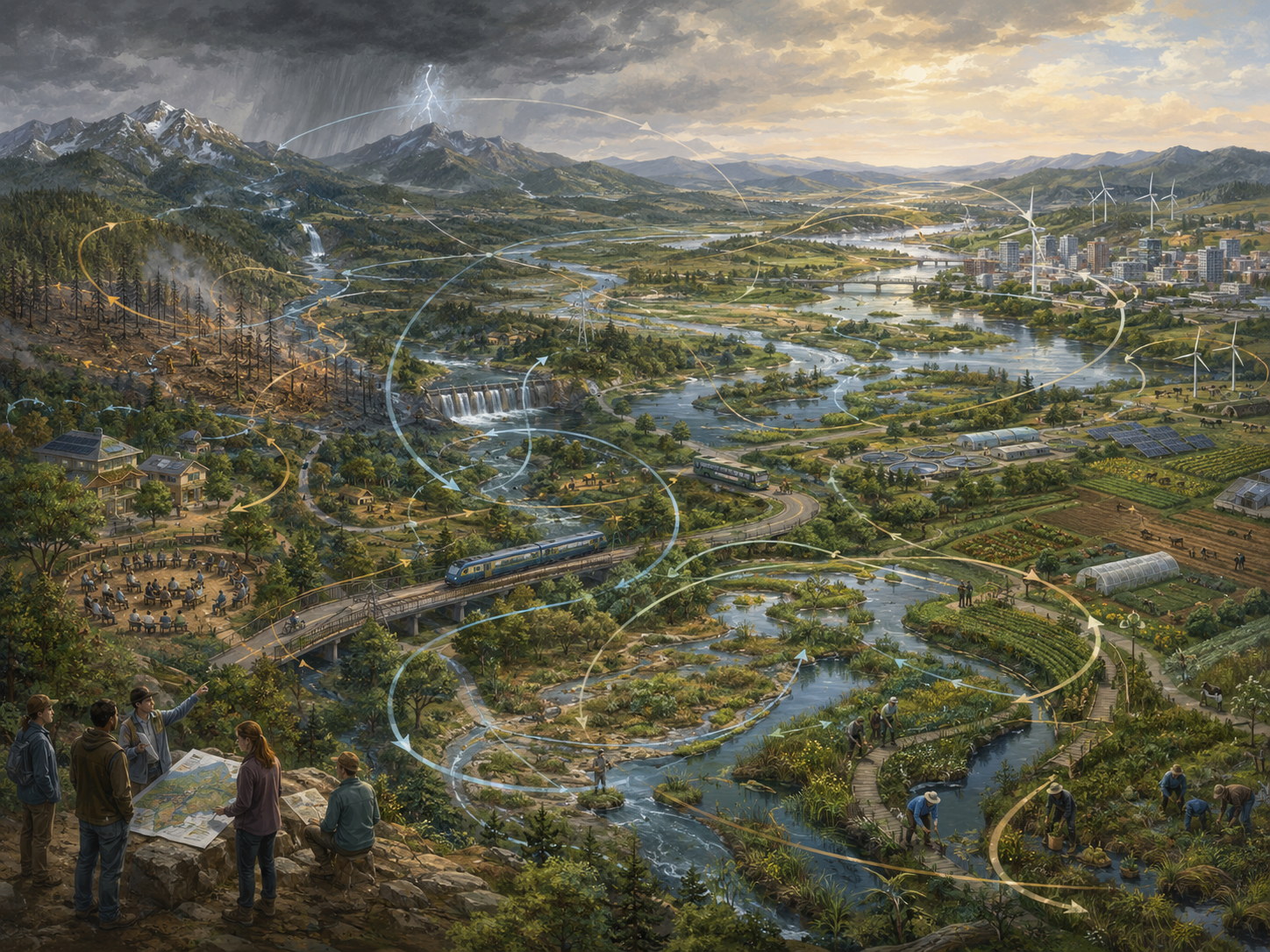
Why the Relationship Matters
The relationship between systems thinking and resilience thinking matters because resilience is not a property of isolated parts. It is a property of relationships, structure, feedback, memory, thresholds, and adaptive capacity. A hospital may have strong equipment but weak staffing resilience. A city may have strong floodwalls but weak housing security. A watershed may appear stable while groundwater, soil structure, biodiversity, or institutional trust erodes below the surface. In each case, the system’s resilience depends on the arrangement of relationships, not merely the quality of individual components.
Systems thinking gives analysts a way to see those relationships. It asks how parts interact, how feedback loops generate behavior, how stocks accumulate, how delays distort perception, how boundaries shape responsibility, and how structure produces recurring patterns. Resilience thinking then adds a disturbance-centered question: what happens when this system is stressed, shocked, overloaded, or forced to adapt?
This relationship is especially important because many resilience failures are not caused by one broken part. They arise from system structure. A supply chain fails because dependencies are concentrated. A community becomes vulnerable because housing, health, transportation, income, and environmental exposure interact. A lake crosses a nutrient threshold because land use, runoff, policy incentives, and ecological feedbacks reinforce one another. An institution loses legitimacy because feedback from affected people is delayed, filtered, ignored, or punished.
The relationship in plain terms
Systems thinking reveals structure
It asks how feedback loops, stocks, flows, delays, boundaries, incentives, information, and mental models create recurring system behavior.
Resilience thinking tests viability
It asks whether the system can absorb disturbance, adapt to changing conditions, avoid thresholds, and preserve essential function.
Together they explain failure
They show why systems can appear stable while becoming fragile, why recovery can reproduce vulnerability, and why deep interventions must change structure.
Systems thinking without resilience can become descriptive: it maps relationships but may not ask whether the system can survive disturbance. Resilience thinking without systems thinking can become vague: it praises adaptation without explaining the structure that produces vulnerability. The strongest analysis requires both.
What Is Systems Thinking?
Systems thinking is a way of understanding reality through relationships, feedback, structure, and behavior over time. Instead of explaining outcomes only through isolated causes, systems thinking asks how parts interact within a whole. It looks for recurring patterns, feedback loops, accumulations, delays, boundaries, incentives, and mental models that produce system behavior.
A systems-thinking approach does not assume that a problem is caused by one event, one actor, or one variable. It asks what structure makes the problem recurring. Traffic congestion, public-health failures, supply-chain fragility, climate vulnerability, institutional distrust, and ecosystem degradation are rarely explained by single causes. They emerge from interacting conditions.
Systems thinking is therefore especially useful for complex problems where intervention in one area produces unexpected consequences elsewhere. A policy designed to reduce one risk may increase another. A technology introduced to improve efficiency may reduce redundancy. A short-term fix may create long-term dependence. A local success may shift burden to another community or ecosystem.
| Systems-thinking concept | Basic meaning | Why it matters for resilience |
|---|---|---|
| Feedback loop | A circular relationship where system outputs influence future inputs | Feedback can amplify disturbance, stabilize function, or delay corrective action. |
| Stock | An accumulated quantity or condition | Resilience often depends on slowly changing stocks such as trust, soil fertility, savings, biodiversity, or infrastructure condition. |
| Flow | The rate at which a stock increases or decreases | Disturbance and recovery depend on inflows, outflows, depletion, renewal, and repair. |
| Delay | A time lag between cause and visible effect | Delays can cause late response, overshoot, underinvestment, and threshold crossing. |
| Boundary | The line separating what is inside and outside the analysis | Boundaries determine whose vulnerability, costs, and ecological impacts are counted. |
| Leverage point | A place where intervention can shift system behavior | Resilience improves when interventions address structure, rules, information, and goals rather than symptoms alone. |
Systems thinking is not only a set of diagrams. It is a discipline of asking better questions: what is connected, what is accumulating, what feedbacks dominate, where are delays, what assumptions shape decisions, and what system purpose is being served?
What Is Resilience Thinking?
Resilience thinking is a systems-oriented framework for understanding how complex systems absorb disturbance, adapt to change, reorganize after disruption, and remain viable without losing essential function. It emerged from ecological research but now informs sustainability science, climate adaptation, disaster risk reduction, infrastructure planning, public health, governance, economics, and community resilience.
Resilience thinking begins from the recognition that disturbance is normal. Systems are not always near equilibrium. They may fluctuate, self-organize, cross thresholds, shift regimes, or transform. A resilient system is not necessarily one that remains unchanged. It is one that can preserve essential function while adapting to stress, uncertainty, and changing conditions.
This makes resilience thinking different from simple recovery logic. Recovery asks whether the system returns after disruption. Resilience asks whether the system remains viable across disturbance and whether return is even desirable. A city may recover quickly from a flood while leaving exposed communities vulnerable to the next one. A forest may not return to its prior composition but still preserve ecological function. An institution may maintain formal continuity while losing legitimacy. Resilience thinking makes these distinctions visible.
Core resilience-thinking questions
Resilience of what?
The system boundary must be clear: ecosystem, community, institution, infrastructure network, supply chain, city, watershed, or social-ecological system.
Resilience to what?
The disturbance must be specified: flood, drought, fire, economic shock, cyberattack, institutional crisis, disease outbreak, climate stress, or compound hazard.
Resilience for whom?
The benefits and burdens must be named. A system may be resilient for powerful actors while transferring risk to marginalized communities or ecosystems.
Resilience at what scale?
A system may be resilient locally but fragile regionally, or resilient in the short term while eroding long-term adaptive capacity.
Resilience thinking therefore depends on systems thinking, but adds a sharper focus on disturbance, thresholds, adaptation, transformability, and normative judgment.
Shared Foundations
Systems thinking and resilience thinking share several foundations. Both reject simple linear causality. Both study relationships rather than isolated variables. Both treat feedback as central. Both emphasize behavior over time. Both recognize that system structure can generate unexpected consequences. Both are concerned with patterns that become visible only when the system is understood as a whole.
The difference is emphasis. Systems thinking is broader: it can analyze any system behavior, whether resilient, fragile, exploitative, stable, adaptive, or destructive. Resilience thinking is more specific: it asks how systems respond to disturbance and whether they can maintain or transform essential function under stress.
| Shared foundation | Systems-thinking emphasis | Resilience-thinking emphasis |
|---|---|---|
| Interdependence | Parts interact to produce system behavior. | Interdependence can create adaptive capacity or cascading failure. |
| Feedback | Feedback loops generate growth, stability, decline, or oscillation. | Feedback loops can preserve function, amplify disturbance, or lock in vulnerability. |
| Nonlinearity | Cause and effect are not always proportional. | Small changes can push systems across thresholds into different regimes. |
| Delays | Effects may appear long after causes. | Delayed response can allow vulnerability to accumulate before crisis becomes visible. |
| Boundaries | Analytical boundaries shape what is included and excluded. | Resilience claims depend on whose risk, cost, and recovery are counted. |
| Learning | Systems can adapt through information and feedback. | Learning capacity is a core part of resilience under uncertainty. |
These shared foundations explain why systems thinking is often a prerequisite for serious resilience work. Without systems thinking, resilience may be reduced to toughness, recovery, or motivational language. With systems thinking, resilience becomes a structural question: what relationships allow the system to absorb shock, learn, reorganize, and remain viable?
Feedback Loops and Resilience Dynamics
Feedback loops are central to both systems thinking and resilience thinking. A feedback loop occurs when a change in one part of a system influences other parts that eventually affect the original condition. Feedback can be reinforcing or balancing. Reinforcing feedback amplifies change. Balancing feedback resists change and stabilizes the system.
Resilience depends on feedback structure. Some feedback loops protect systems. A thermostat detects temperature deviation and activates heating or cooling. A floodplain absorbs excess water and reduces downstream flood peaks. Community mutual aid networks distribute resources during crisis. Institutional accountability can detect harm and trigger correction. These are balancing or adaptive feedbacks.
Other feedback loops amplify vulnerability. Drought reduces vegetation, which increases erosion, which reduces water retention, which worsens drought effects. Poverty reduces access to health care, which worsens illness, which reduces income, which deepens poverty. Infrastructure disinvestment increases failures, which raises emergency costs, which reduces funds for maintenance, which increases future failures. These are reinforcing feedbacks that erode resilience.
Feedback patterns in resilience
Protective balancing feedback
Monitoring, early warning, repair capacity, emergency response, ecological buffering, and institutional accountability can help stabilize essential function.
Fragility-amplifying feedback
Disinvestment, resource depletion, inequality, biodiversity loss, misinformation, and institutional distrust can reinforce vulnerability over time.
Adaptive feedback
Learning from disturbance can change rules, improve design, diversify dependencies, strengthen trust, and increase future resilience.
Maladaptive feedback
A system may respond to crisis by hardening control, suppressing feedback, transferring risk, or restoring the same structure that produced vulnerability.
Resilience analysis should therefore map feedback loops explicitly. It should ask which loops are stabilizing essential function, which loops are amplifying harm, and which loops are missing because information is delayed, distorted, or ignored.
Stocks, Flows, and Slow Variables
Systems thinking uses the language of stocks and flows to describe accumulation and change. A stock is something that accumulates: water in a reservoir, carbon in the atmosphere, trust in an institution, biodiversity in a landscape, money in a household emergency fund, maintenance backlog in infrastructure, or knowledge in an organization. A flow is the rate at which that stock increases or decreases.
Resilience thinking depends heavily on stocks and flows because many resilience conditions change slowly. Systems can appear stable while underlying stocks are being depleted. Soil fertility may decline before crop failure becomes visible. Trust may erode before institutional legitimacy collapses. Groundwater may fall before wells run dry. Biodiversity may decline before ecosystem function fails. Maintenance backlog may accumulate before infrastructure breaks.
These slow variables are often more important than visible performance. A system may continue functioning because accumulated reserves, buffers, or hidden subsidies are being consumed. If decision-makers monitor only outputs, they may miss the slow erosion of resilience capacity.
| Stock or slow variable | Flow that changes it | Resilience significance |
|---|---|---|
| Institutional trust | Transparency, responsiveness, corruption, exclusion, accountability | Trust affects compliance, coordination, legitimacy, and crisis response. |
| Soil fertility | Nutrient cycling, erosion, extraction, restoration, organic matter | Soil condition shapes agricultural resilience under drought and climate stress. |
| Infrastructure condition | Maintenance, wear, underinvestment, repair, modernization | Hidden backlog can turn routine disturbance into cascading failure. |
| Biodiversity | Habitat loss, restoration, invasion, protection, climate stress | Functional diversity supports ecological renewal and disturbance absorption. |
| Household savings | Income, expenses, debt, shocks, social support | Financial buffers shape household resilience during illness, job loss, or disaster. |
| Organizational knowledge | Training, turnover, documentation, learning, memory loss | Institutional memory affects adaptive capacity and response quality. |
Systems thinking helps identify the stocks. Resilience thinking asks whether those stocks are sufficient to absorb disturbance and whether the flows are replenishing or depleting the system’s future capacity.
Delays, Blind Spots, and Late Response
Delays are among the most important reasons systems become fragile. A delay is a time lag between action and consequence, signal and response, damage and visibility, or intervention and recovery. Delays make systems difficult to govern because decision-makers often respond to current conditions while the system is already being shaped by past decisions.
In resilience thinking, delays are dangerous because they allow threshold risk to accumulate. By the time the problem is visible, the system may already be close to regime shift. A lake may appear healthy while nutrients accumulate. A public-health system may appear adequate until staffing shortages and supply-chain vulnerabilities converge. An institution may appear legitimate while trust erodes in communities whose feedback is ignored.
Delays also produce overcorrection. If leaders respond too late to a slow-moving problem, they may impose abrupt interventions that create new instability. If they respond only to visible crises, they may underinvest in prevention, maintenance, and adaptive capacity. If feedback from affected communities is delayed or filtered, institutions may misread the system entirely.
Delay patterns that weaken resilience
Detection delay
The system is changing, but monitoring is too weak to detect the change early enough.
Interpretation delay
Signals are visible, but decision-makers misread them, discount them, or treat them as isolated events.
Response delay
The problem is understood, but institutions move slowly because of incentives, bureaucracy, politics, or resource constraints.
Recovery delay
Intervention begins, but repair, ecological renewal, trust rebuilding, or capacity restoration takes longer than expected.
A systems-informed resilience strategy therefore invests in early warning, local feedback, monitoring of slow variables, rapid learning, and governance structures that can respond before crisis becomes irreversible.
Thresholds and Nonlinear Change
Thresholds are where resilience thinking extends systems thinking into a theory of persistence and regime change. A threshold is a boundary beyond which a system reorganizes into a different state. The change may be difficult to reverse because feedback loops, incentives, ecological relationships, or institutional conditions have shifted.
Systems thinking already recognizes nonlinearity: small causes can have large effects, and large interventions can have little effect if system structure resists change. Resilience thinking makes this concrete by asking how close the system is to a threshold. A system may appear stable, efficient, or recoverable while its threshold distance is shrinking.
Thresholds matter in ecosystems, infrastructure, institutions, public health, supply chains, and communities. A forest may shift to shrubland. A coral reef may shift to algal dominance. A power grid may experience cascading failure. A democracy may lose legitimacy. A household may fall into a debt trap. A supply network may collapse when a concentrated dependency fails.
| System | Possible threshold | Systems-thinking explanation | Resilience-thinking concern |
|---|---|---|---|
| Lake ecosystem | Clear-water state shifts to eutrophic state | Nutrient inflows and ecological feedbacks reinforce algae growth. | How close is the lake to a regime shift, and can nutrient flows be reduced in time? |
| Infrastructure network | Localized failure becomes cascading outage | Tight coupling and dependency concentration transmit disruption. | Can the system isolate failure and preserve essential service? |
| Public institution | Formal authority loses practical legitimacy | Feedback from affected people is ignored, trust erodes, compliance declines. | Can legitimacy and adaptive capacity be restored before breakdown? |
| Household economy | Temporary shock becomes poverty trap | Debt, health, income, and housing insecurity reinforce one another. | Can buffers and support prevent long-term loss of capability? |
| Supply chain | Disruption becomes systemic shortage | Supplier concentration, just-in-time inventory, and limited substitutes amplify shock. | Can redundancy, visibility, and substitution prevent cascading failure? |
Threshold thinking changes the meaning of prevention. Prevention is not only stopping immediate harm. It is preserving the buffer, diversity, trust, redundancy, and adaptive capacity that keep the system from crossing into a degraded regime.
System Boundaries and Resilience of What?
Every systems analysis depends on boundaries. A boundary determines what is included, what is excluded, who is counted, what costs are visible, and what forms of harm are ignored. Resilience thinking makes boundary choices especially important because resilience claims are never neutral. A system can be resilient for one group while transferring risk to another.
For example, a supply chain may be resilient for a corporation if profits and delivery schedules are preserved, but fragile for workers if the system shifts risk onto precarious labor. A flood-control project may protect one district while increasing downstream exposure. A city may recover economically after disaster while displaced residents never return. An ecosystem management strategy may preserve commodity output while degrading biodiversity.
Systems thinking asks analysts to draw boundaries carefully. Resilience thinking asks whether those boundaries hide vulnerability, responsibility, or injustice. The classic resilience question—resilience of what, to what, for whom, and over what time horizon—is fundamentally a boundary question.
Boundary questions for resilience analysis
What is inside the system?
Are we analyzing an asset, network, institution, ecosystem, community, watershed, city, economy, or social-ecological system?
Who is outside the frame?
Which communities, workers, species, places, or future generations are affected but not represented in the analysis?
What costs are externalized?
Does the system remain resilient by transferring harm to ecosystems, marginalized people, public budgets, or later generations?
What time horizon matters?
A system may look resilient over days or months while becoming fragile over years or decades.
Boundary work is not a technical detail. It is central to whether resilience thinking becomes a serious analytical framework or a vague claim that hides power.
Leverage Points and Resilience Interventions
Systems thinking is especially valuable because it distinguishes shallow interventions from deeper leverage points. A shallow intervention treats symptoms. A deeper intervention changes the structure that produces the symptoms. Resilience thinking depends on this distinction because many systems recover from crisis without becoming less vulnerable to the next one.
A shallow resilience intervention might add emergency response capacity without addressing why risk is increasing. A deeper intervention might change land use, investment patterns, governance rules, information flows, or institutional incentives. A shallow intervention might restore infrastructure after failure. A deeper intervention might redesign dependencies, maintenance funding, ecological buffers, and community participation.
Donella Meadows’ work on leverage points is especially useful here because it shows that changing numbers and parameters is often less powerful than changing information flows, rules, goals, and paradigms. Resilience improves most when interventions reach the structures that create vulnerability.
| Intervention level | Systems-thinking meaning | Resilience implication |
|---|---|---|
| Parameters | Adjust numbers such as budgets, rates, capacities, or thresholds | Can help, but may not change the structure producing vulnerability. |
| Buffers | Increase stocks such as reserves, backups, savings, or ecological capacity | Can improve disturbance absorption and buy time for adaptation. |
| Information flows | Change who receives what signals and when | Can improve early warning, accountability, learning, and response. |
| Rules | Change incentives, constraints, rights, procedures, or governance structures | Can alter the behavior that produces risk or adaptation capacity. |
| Goals | Change what the system optimizes for | Can shift from efficiency or growth toward viability, justice, and ecological limits. |
| Paradigms | Change the underlying worldview or mental model | Can redefine what counts as resilience, whose knowledge matters, and what must transform. |
This is where systems thinking and resilience thinking become most powerful together. Systems thinking identifies where intervention can change behavior. Resilience thinking evaluates whether that change increases adaptive capacity, reduces threshold risk, and supports a more viable future.
Mental Models, Paradigms, and Resilience Traps
Mental models are the assumptions people use to interpret systems. They shape what decision-makers notice, what they ignore, what they measure, and what they believe is possible. In systems thinking, mental models are often among the deepest sources of system behavior. In resilience thinking, they can either support adaptation or trap systems in fragile patterns.
A system governed by an efficiency-first mental model may reduce redundancy until it becomes brittle. A growth-first mental model may treat ecological limits as externalities until thresholds are crossed. A control-first mental model may suppress disturbance and feedback until vulnerability accumulates. A recovery-first mental model may restore harmful normality rather than transform the conditions that produced risk.
Resilience traps occur when a system persists in a damaging regime because feedbacks, incentives, institutions, and mental models reinforce one another. Poverty traps, rigidity traps, ecological degradation traps, infrastructure disinvestment traps, and institutional legitimacy traps all involve systems that are resilient in the descriptive sense: they persist. But their persistence is harmful.
Mental models that can weaken resilience
Efficiency above all
Reduces slack, redundancy, diversity, and buffers until the system performs well only under normal conditions.
Control as security
Suppresses variability, feedback, dissent, or disturbance in ways that can create hidden fragility.
Recovery as success
Measures resilience by return speed even when the prior state was unjust, degraded, or unstable.
Vulnerability as local failure
Blames communities or ecosystems for fragility while ignoring structural causes, historical injustice, and policy decisions.
A resilient system is not only technically adaptive. It must also be capable of revising its mental models. When assumptions no longer fit reality, the ability to learn becomes a form of resilience.
Cross-Scale Systems and Panarchy
Systems thinking and resilience thinking both become more powerful when applied across scales. A household is nested in a neighborhood. A neighborhood is nested in a city. A city is nested in regional infrastructure, watersheds, markets, climate systems, and governance institutions. An ecosystem is nested in landscape, regional, and planetary processes. Resilience at one scale can depend on conditions at another.
Panarchy, a key concept in resilience theory, describes nested adaptive cycles across scales. Smaller, faster systems may generate innovation, experimentation, and disturbance. Larger, slower systems may provide memory, constraint, resources, or stability. Cross-scale interactions can either support resilience or create cascading risk.
For example, local community networks may support disaster response, but they depend on regional infrastructure and national funding. A city may improve stormwater systems, but watershed-scale land use may still increase flood risk. A farm may adopt resilient practices, but climate, markets, debt, and policy shape its viability. A public-health clinic may adapt locally, but supply chains, workforce policy, insurance, and trust determine the larger system.
| Scale | Systems-thinking concern | Resilience-thinking concern |
|---|---|---|
| Local | Immediate relationships, feedback, lived experience, local resources | Mutual aid, exposure, adaptive capacity, place-based knowledge |
| Organizational | Rules, routines, information flows, incentives, learning | Institutional memory, flexibility, legitimacy, response capacity |
| Regional | Infrastructure networks, watersheds, housing markets, logistics | Cascading risk, redundancy, ecological buffers, coordinated adaptation |
| National | Policy, finance, regulation, public investment, emergency systems | Social protection, infrastructure funding, climate adaptation, governance capacity |
| Planetary | Climate, biodiversity, resource flows, global markets, migration | Planetary boundaries, systemic risk, transformation, intergenerational responsibility |
Cross-scale analysis prevents resilience thinking from becoming localist or technocratic. It shows that vulnerability is often produced across scales, and that resilience cannot be built only at the point where harm becomes visible.
Applications Across Domains
Systems thinking and resilience thinking are most useful when applied to real systems where disturbance, interdependence, uncertainty, and contested values interact. Their combined value lies in explaining why surface-level fixes fail and why deeper structural analysis is needed.
Where the two frameworks work together
Climate adaptation
Systems thinking maps exposure, infrastructure, land use, social vulnerability, ecosystems, and governance. Resilience thinking asks whether communities can adapt without crossing ecological or social thresholds.
Urban planning
Systems thinking reveals housing, transportation, water, energy, and public health interdependence. Resilience thinking tests whether the city can absorb shocks equitably and remain livable.
Public health
Systems thinking maps care access, workforce capacity, supply chains, communication, and trust. Resilience thinking asks whether the system can respond to crisis while preserving essential care.
Infrastructure
Systems thinking identifies dependencies and cascading risk. Resilience thinking evaluates redundancy, repair capacity, threshold margins, and adaptation under changing hazards.
Ecosystem management
Systems thinking maps ecological feedbacks, nutrient flows, species interactions, and land-use pressures. Resilience thinking asks whether core functions can persist under disturbance.
Institutional governance
Systems thinking reveals rules, incentives, feedback, legitimacy, and information flows. Resilience thinking asks whether institutions can learn, adapt, and retain public trust.
Across these domains, the combined frameworks help analysts avoid the trap of treating symptoms as causes. They push analysis toward structure, feedback, thresholds, and adaptive capacity.
Design Principles for Resilient Systems
Designing resilient systems requires more than strengthening parts. It requires designing relationships, feedback, redundancy, learning, boundaries, and adaptive capacity. Systems thinking helps identify the structure. Resilience thinking helps evaluate whether that structure can survive and adapt under stress.
| Design principle | Systems-thinking logic | Resilience contribution |
|---|---|---|
| Diversity | Different components provide different functions, perspectives, and pathways. | Reduces dependence on one solution and supports adaptation under novelty. |
| Redundancy | Multiple components can perform similar critical functions. | Prevents single-point failure and preserves function under disturbance. |
| Modularity | Subsystems are connected but not so tightly coupled that every failure spreads. | Limits cascading collapse while preserving coordination and learning. |
| Feedback visibility | Signals about system condition reach decision-makers and affected communities. | Supports early warning, accountability, and adaptive response. |
| Adaptive learning | The system updates behavior based on evidence and experience. | Improves response to uncertainty, novelty, and changing conditions. |
| Threshold monitoring | Slow variables and nonlinear risks are tracked before crisis appears. | Helps prevent regime shifts and preserves future options. |
| Distributed capacity | Capability is not concentrated in one node, actor, or institution. | Improves response, legitimacy, and continuity when parts of the system fail. |
| Transformability | The system can change its structure when existing patterns become untenable. | Prevents resilience from becoming harmful persistence of a failing regime. |
These design principles do not always maximize short-term efficiency. That is the point. Systems optimized only for efficiency may perform well under normal conditions but fail under disturbance. Resilience-oriented design preserves capacity that may look inefficient until crisis reveals its value.
Ethical and Political Cautions
Systems thinking and resilience thinking can both be misused if they become too abstract. Systems language can obscure responsibility by treating injustice as merely a system pattern. Resilience language can normalize hardship by praising people for surviving conditions they should not have been forced to endure. A serious approach must keep ethics and power visible.
Resilience is not automatically good. A harmful system can be resilient. An exploitative labor arrangement, exclusionary institution, polluting industry, unequal housing market, or authoritarian regime can adapt and persist. Systems thinking may explain how such persistence occurs, but resilience thinking must ask whether that persistence is defensible.
This is why the question “resilience for whom?” is not optional. A flood system may protect wealthy districts and expose poorer ones. A supply chain may protect corporate continuity while transferring risk to workers. A city may recover economically while displaced residents lose their homes. An institution may preserve itself while suppressing feedback from marginalized communities.
Ethical cautions for systems-based resilience work
Do not hide agency
Systems language should not erase the decisions, institutions, incentives, and power relations that create vulnerability.
Do not romanticize survival
Communities should not be praised for resilience while being denied investment, protection, rights, or public responsibility.
Do not preserve harmful regimes
Some systems should transform rather than persist. Resilience must be evaluated ethically, not merely descriptively.
Do not count only visible recovery
Recovery metrics can hide displacement, trauma, ecological loss, informal labor, and long-term vulnerability.
The best systems-informed resilience work connects structure with responsibility. It asks not only how systems behave, but how they should be changed.
Mathematical Lens: Feedback, Resilience Margin, and Threshold Risk
Systems thinking often represents feedback through dynamic equations. A simple reinforcing-feedback process can be written as:
\frac{dx}{dt} = ax
\]
Interpretation: \(x\) is a system stock and \(a\) is a growth or amplification parameter. If \(a > 0\), the stock grows through reinforcing feedback. This can describe beneficial growth, but also runaway vulnerability.
A balancing-feedback process can be written as return toward a target:
\frac{dx}{dt} = -b(x – x^{*})
\]
Interpretation: \(x^{*}\) is a reference state and \(b > 0\) determines correction speed. This captures stabilizing feedback, such as repair, regulation, or recovery.
Resilience thinking adds a margin concept:
R_t = B_t – D_t + A_t
\]
Interpretation: \(R_t\) is resilience margin, \(B_t\) is buffer or basin width, \(D_t\) is disturbance load, and \(A_t\) is adaptive capacity. A system becomes vulnerable when disturbance erodes margin faster than buffers and adaptation can replenish it.
Threshold risk can then be represented as:
V_t =
\begin{cases}
1, & R_t \geq \theta \\
0, & R_t < \theta
\end{cases}
\]
Interpretation: \(V_t\) indicates whether the system remains viable at time \(t\), and \(\theta\) is the minimum resilience margin needed to preserve essential function. This connects systems dynamics to resilience thresholds.
The mathematical distinction is simple but powerful. Systems thinking explains how feedback generates behavior. Resilience thinking asks whether that behavior preserves viability under disturbance.
Python Workflow: Modeling Feedback, Disturbance, and Resilience Margin
The Python workflow below simulates systems with different feedback and adaptive-capacity profiles. It shows how reinforcing vulnerability, balancing repair, disturbance load, and adaptive response interact to determine resilience margin over time.
# Install packages if needed:
# pip install pandas numpy matplotlib

import numpy as np
import pandas as pd
import matplotlib.pyplot as plt

# ------------------------------------------------------------
# Python Workflow:
# Systems Thinking + Resilience Thinking
#
# Purpose:
#   Simulate how feedback loops, disturbance, adaptive capacity,
#   and threshold margins shape system viability over time.
# ------------------------------------------------------------

np.random.seed(42)

time_steps = np.arange(1, 101)

systems = pd.DataFrame({
    "system_type": [
        "High Feedback Visibility",
        "Delayed Response System",
        "Efficiency-Optimized System",
        "Diverse Adaptive System",
        "Rigid Control System"
    ],
    "reinforcing_vulnerability": [0.16, 0.22, 0.28, 0.12, 0.24],
    "balancing_repair": [0.30, 0.18, 0.14, 0.26, 0.20],
    "adaptive_capacity": [0.72, 0.48, 0.36, 0.86, 0.42],
    "buffer_capacity": [0.68, 0.52, 0.40, 0.74, 0.55],
    "feedback_delay": [1, 5, 4, 2, 6],
    "threshold": [0.25, 0.25, 0.25, 0.25, 0.25]
})

base_disturbance = 0.05 + 0.03 * np.sin(time_steps / 6)
shock = np.zeros(len(time_steps))
shock[[19, 39, 64, 82]] = [0.28, 0.34, 0.26, 0.31]
disturbance = base_disturbance + shock

def simulate_system(row):
    vulnerability_stock = np.zeros(len(time_steps))
    resilience_margin = np.zeros(len(time_steps))
    viability = np.zeros(len(time_steps))

    vulnerability_stock[0] = 0.20
    resilience_margin[0] = row["buffer_capacity"] + row["adaptive_capacity"] - vulnerability_stock[0]
    viability[0] = 1 if resilience_margin[0] >= row["threshold"] else 0

    delayed_disturbance = np.zeros(len(time_steps))

    for t in range(1, len(time_steps)):
        delay = int(row["feedback_delay"])
        observed_index = max(0, t - delay)
        delayed_disturbance[t] = disturbance[observed_index]

        reinforcing_growth = row["reinforcing_vulnerability"] * vulnerability_stock[t - 1]
        disturbance_effect = 0.55 * disturbance[t]
        repair_effect = row["balancing_repair"] * delayed_disturbance[t]
        adaptation_effect = 0.018 * row["adaptive_capacity"]

        vulnerability_stock[t] = (
            vulnerability_stock[t - 1]
            + reinforcing_growth
            + disturbance_effect
            - repair_effect
            - adaptation_effect
        )

        vulnerability_stock[t] = np.clip(vulnerability_stock[t], 0, 1.5)

        resilience_margin[t] = (
            row["buffer_capacity"]
            + row["adaptive_capacity"]
            - vulnerability_stock[t]
            - 0.35 * disturbance[t]
        )

        viability[t] = 1 if resilience_margin[t] >= row["threshold"] else 0

    return pd.DataFrame({
        "system_type": row["system_type"],
        "time": time_steps,
        "disturbance": disturbance,
        "vulnerability_stock": vulnerability_stock,
        "resilience_margin": resilience_margin,
        "viability": viability,
        "threshold_flag": np.where(resilience_margin < row["threshold"], "threshold risk", "viable margin")
    })

simulation = pd.concat(
    [simulate_system(row) for _, row in systems.iterrows()],
    ignore_index=True
)

summary = (
    simulation
    .groupby("system_type")
    .agg(
        minimum_margin=("resilience_margin", "min"),
        average_margin=("resilience_margin", "mean"),
        threshold_risk_steps=("threshold_flag", lambda x: (x == "threshold risk").sum()),
        maximum_vulnerability=("vulnerability_stock", "max")
    )
    .reset_index()
    .sort_values("minimum_margin")
)

print(summary.round(3))

# ------------------------------------------------------------
# Plot resilience margin by system type.
# ------------------------------------------------------------
plt.figure(figsize=(10, 6))

for system_name in simulation["system_type"].unique():
    subset = simulation[simulation["system_type"] == system_name]
    plt.plot(subset["time"], subset["resilience_margin"], label=system_name)

plt.axhline(0.25, linestyle="--", linewidth=1, label="Viability threshold")
plt.xlabel("Time Step")
plt.ylabel("Resilience Margin")
plt.title("Feedback, Disturbance, and Resilience Margin")
plt.legend(fontsize=8)
plt.tight_layout()
plt.show()

# ------------------------------------------------------------
# Export results.
# ------------------------------------------------------------
systems.to_csv("systems_resilience_profiles.csv", index=False)
simulation.to_csv("systems_resilience_simulation.csv", index=False)
summary.to_csv("systems_resilience_summary.csv", index=False)
This workflow shows why resilience cannot be evaluated from a single shock or one recovery metric. Feedback delays, reinforcing vulnerability, balancing repair, buffer capacity, and adaptive capacity interact over time. The system that looks efficient under ordinary conditions may accumulate vulnerability faster than it can repair. The system with stronger feedback visibility and adaptive capacity may preserve margin even under repeated disturbance.
R Workflow: Comparing Systems Thinking and Resilience Thinking Indicators
The R workflow below compares synthetic systems across systems-thinking and resilience-thinking dimensions. It is useful for showing how feedback visibility, leverage capacity, boundary clarity, adaptive capacity, redundancy, threshold distance, and vulnerability pressure can be analyzed together.
# Install packages if needed.
# install.packages(c("tidyverse"))

library(tidyverse)

# ------------------------------------------------------------
# R Workflow:
# Systems Thinking and Resilience Thinking Indicators
#
# Purpose:
#   Compare synthetic systems across structural systems-thinking
#   indicators and resilience-thinking indicators.
# ------------------------------------------------------------

systems <- tibble(
  system_type = c(
    "Watershed Governance",
    "Urban Infrastructure",
    "Public Health System",
    "Supply Chain Network",
    "Community Adaptation System",
    "Institutional Governance"
  ),
  feedback_visibility = c(0.72, 0.58, 0.66, 0.46, 0.78, 0.52),
  boundary_clarity = c(0.68, 0.62, 0.56, 0.50, 0.70, 0.48),
  leverage_capacity = c(0.64, 0.55, 0.60, 0.42, 0.76, 0.50),
  delay_management = c(0.58, 0.52, 0.57, 0.40, 0.72, 0.46),
  adaptive_capacity = c(0.70, 0.60, 0.68, 0.44, 0.82, 0.54),
  redundancy = c(0.66, 0.64, 0.58, 0.38, 0.70, 0.50),
  threshold_distance = c(0.74, 0.56, 0.60, 0.42, 0.76, 0.48),
  vulnerability_pressure = c(0.52, 0.68, 0.63, 0.78, 0.55, 0.66)
)

systems <- systems %>%
  mutate(
    systems_thinking_score =
      0.28 * feedback_visibility +
      0.24 * boundary_clarity +
      0.24 * leverage_capacity +
      0.24 * delay_management,
    resilience_thinking_score =
      0.30 * adaptive_capacity +
      0.24 * redundancy +
      0.28 * threshold_distance -
      0.18 * vulnerability_pressure,
    combined_system_resilience =
      0.50 * systems_thinking_score +
      0.50 * resilience_thinking_score,
    diagnostic = case_when(
      systems_thinking_score < 0.55 & resilience_thinking_score < 0.55 ~
        "Weak structure visibility and weak resilience capacity",
      systems_thinking_score >= 0.65 & resilience_thinking_score >= 0.65 ~
        "Strong structural understanding and resilience capacity",
      systems_thinking_score > resilience_thinking_score ~
        "System structure is visible, but resilience capacity needs strengthening",
      TRUE ~
        "Resilience capacity exists, but system structure needs clearer mapping"
    )
  )

print(systems)

# ------------------------------------------------------------
# Long format for comparison plotting.
# ------------------------------------------------------------
systems_long <- systems %>%
  select(
    system_type,
    systems_thinking_score,
    resilience_thinking_score,
    combined_system_resilience
  ) %>%
  pivot_longer(
    cols = c(
      systems_thinking_score,
      resilience_thinking_score,
      combined_system_resilience
    ),
    names_to = "index",
    values_to = "score"
  )

ggplot(
  systems_long,
  aes(x = reorder(system_type, score), y = score, fill = index)
) +
  geom_col(position = "dodge") +
  coord_flip() +
  labs(
    title = "Systems Thinking and Resilience Thinking Indicators",
    x = "System Type",
    y = "Score",
    fill = "Index"
  ) +
  theme_minimal(base_size = 12)

# ------------------------------------------------------------
# Export results.
# ------------------------------------------------------------
write_csv(systems, "systems_resilience_indicator_profiles.csv")
write_csv(systems_long, "systems_resilience_indicator_profiles_long.csv")
The R workflow helps distinguish structural understanding from resilience capacity. A system may be well mapped but still fragile if adaptive capacity and threshold distance are weak. Another system may have strong local resilience but poor boundary clarity, weak feedback visibility, or unclear leverage points. The strongest systems have both: structural visibility and adaptive viability.
GitHub Repository
The companion GitHub repository for this article is designed as an advanced systems-resilience modeling scaffold. It translates the relationship between systems thinking and resilience thinking into reproducible workflows for feedback-loop analysis, disturbance simulation, resilience-margin diagnostics, threshold-risk detection, indicator comparison, and scenario-based interpretation.
Complete Code Repository
Companion code for modeling the relationship between systems thinking and resilience thinking, including feedback-loop simulations, stocks-and-flows examples, delay diagnostics, resilience-margin modeling, threshold-risk analysis, leverage-point mapping, and multi-language computational examples.
The companion article directory is articles/resilience-thinking-and-systems-thinking/. It is structured to support a professional modeling workflow: Python for feedback, disturbance, and resilience-margin simulations; R for indicator comparison and systems-resilience profile analysis; SQL for system, feedback, stock, flow, disturbance, threshold, and model-run schemas; Julia for nonlinear feedback and threshold examples; and Rust, Go, C, C++, and Fortran for lightweight diagnostic and simulation utilities.
The modeling objective is to show how system structure shapes resilience outcomes. The scaffold includes synthetic data, feedback-loop models, delay diagnostics, vulnerability-stock simulations, threshold-risk flags, indicator scoring, documentation, validation notes, responsible-use guidance, and generated outputs.
This repository extends the article from conceptual synthesis into applied systems-resilience modeling. It gives readers a reproducible foundation for exploring how feedback visibility, boundary clarity, leverage capacity, delay management, adaptive capacity, redundancy, threshold distance, vulnerability pressure, and disturbance load interact over time.
Conclusion
Systems thinking and resilience thinking are mutually reinforcing frameworks. Systems thinking reveals the structure that produces behavior. Resilience thinking asks whether that structure can remain viable under disturbance, uncertainty, and change. One explains interdependence; the other tests adaptive capacity.
Their relationship matters because resilience failures are rarely isolated events. They are usually produced by feedback loops, accumulations, delays, boundary choices, mental models, incentives, and cross-scale relationships. A system may recover visibly while losing resilience invisibly. It may appear efficient while becoming brittle. It may persist while externalizing harm. It may adapt in ways that preserve injustice.
Systems thinking helps identify why these patterns recur. Resilience thinking helps decide whether the system should recover, adapt, or transform. Together, they move analysis beyond symptoms and toward structure, beyond stability and toward viability, beyond recovery and toward responsible transformation.
The most important lesson is that resilient systems are not created by isolated fixes. They are created by relationships that preserve adaptive capacity, feedback that supports learning, boundaries that count real costs, institutions that respond before thresholds are crossed, and values that ask whose resilience is being protected.
Related Articles
- What Is Resilience Thinking?
- Resilience vs Stability vs Robustness
- The History of Resilience Theory
- Engineering Resilience and Ecological Resilience
- Adaptive Capacity in Complex Systems
- System Thresholds and Tipping Points
- Systems Thinking
Further Reading
- Holling, C.S. (1973) ‘Resilience and stability of ecological systems’, Annual Review of Ecology and Systematics, 4, pp. 1–23. Available at: https://www.annualreviews.org/content/journals/10.1146/annurev.es.04.110173.000245.
- Meadows, D.H. (1999) Leverage Points: Places to Intervene in a System. The Sustainability Institute. Available at: https://donellameadows.org/archives/leverage-points-places-to-intervene-in-a-system/.
- Meadows, D.H. (2008) Thinking in Systems: A Primer. White River Junction, VT: Chelsea Green Publishing. Available at: https://research.fit.edu/media/site-specific/researchfitedu/coast-climate-adaptation-library/climate-communications/psychology-amp-behavior/Meadows-2008.-Thinking-in-Systems.pdf.
- Gunderson, L.H. and Holling, C.S. (eds.) (2002) Panarchy: Understanding Transformations in Human and Natural Systems. Washington, DC: Island Press. Available at: https://islandpress.org/books/panarchy.
- Walker, B. and Salt, D. (2006) Resilience Thinking: Sustaining Ecosystems and People in a Changing World. Washington, DC: Island Press. Available at: https://islandpress.org/books/resilience-thinking.
- Senge, P.M. (2006) The Fifth Discipline: The Art and Practice of the Learning Organization. Revised edition. New York: Doubleday.
References
- Anderies, J.M., Janssen, M.A. and Ostrom, E. (2004) ‘A framework to analyze the robustness of social-ecological systems from an institutional perspective’, Ecology and Society, 9(1), 18. Available at: https://ecologyandsociety.org/vol9/iss1/art18/.
- Béné, C., Wood, R.G., Newsham, A. and Davies, M. (2012) ‘Resilience: New utopia or new tyranny? Reflection about the potentials and limits of the concept of resilience in relation to vulnerability reduction programmes’, IDS Working Papers, 2012(405), pp. 1–61. Available at: https://doi.org/10.1111/j.2040-0209.2012.00405.x.
- Biggs, R., Schlüter, M. and Schoon, M.L. (eds.) (2015) Principles for Building Resilience: Sustaining Ecosystem Services in Social-Ecological Systems. Cambridge: Cambridge University Press. Available at: https://www.cambridge.org/core/books/principles-for-building-resilience/557CAECDFDFA305625E100D99B193718.
- Folke, C. (2006) ‘Resilience: The emergence of a perspective for social-ecological systems analyses’, Global Environmental Change, 16(3), pp. 253–267. Available at: https://doi.org/10.1016/j.gloenvcha.2006.04.002.
- Folke, C., Carpenter, S.R., Walker, B., Scheffer, M., Chapin, T. and Rockström, J. (2010) ‘Resilience thinking: Integrating resilience, adaptability and transformability’, Ecology and Society, 15(4), 20. Available at: https://ecologyandsociety.org/vol15/iss4/art20/.
- Gunderson, L.H. and Holling, C.S. (eds.) (2002) Panarchy: Understanding Transformations in Human and Natural Systems. Washington, DC: Island Press. Available at: https://islandpress.org/books/panarchy.
- Holling, C.S. (1973) ‘Resilience and stability of ecological systems’, Annual Review of Ecology and Systematics, 4, pp. 1–23. Available at: https://www.annualreviews.org/content/journals/10.1146/annurev.es.04.110173.000245.
- Meadows, D.H. (1999) Leverage Points: Places to Intervene in a System. The Sustainability Institute. Available at: https://donellameadows.org/archives/leverage-points-places-to-intervene-in-a-system/.
- Meadows, D.H. (2008) Thinking in Systems: A Primer. White River Junction, VT: Chelsea Green Publishing. Available at: https://research.fit.edu/media/site-specific/researchfitedu/coast-climate-adaptation-library/climate-communications/psychology-amp-behavior/Meadows-2008.-Thinking-in-Systems.pdf.
- Resilience Alliance (no date) Key Concepts. Available at: https://www.resalliance.org/key-concepts.
- Senge, P.M. (2006) The Fifth Discipline: The Art and Practice of the Learning Organization. Revised edition. New York: Doubleday.
- Walker, B., Holling, C.S., Carpenter, S.R. and Kinzig, A. (2004) ‘Resilience, adaptability and transformability in social-ecological systems’, Ecology and Society, 9(2), 5. Available at: https://ecologyandsociety.org/vol9/iss2/art5/.