
Last Updated June 1, 2026
Scenario modeling is a way of thinking systematically about possible futures without pretending that the future can be predicted with certainty. In systems thinking, scenarios help analysts explore how complex systems may behave under different assumptions, interventions, shocks, delays, feedback loops, constraints, and social choices. A scenario is not a forecast. It is a structured possibility: a disciplined way to ask what could happen if certain conditions change.
Scenario modeling matters because complex systems rarely move along one obvious path. A public-health system may improve under early prevention and deteriorate under delayed response. A city may become more resilient through maintenance, ecological restoration, and housing stability, or more fragile through deferred infrastructure, displacement, and climate exposure. An organization may stabilize through capacity investment or enter a burnout spiral through short-term productivity pressure. A policy may succeed under one set of assumptions and fail under another. Scenarios make those branching futures visible.
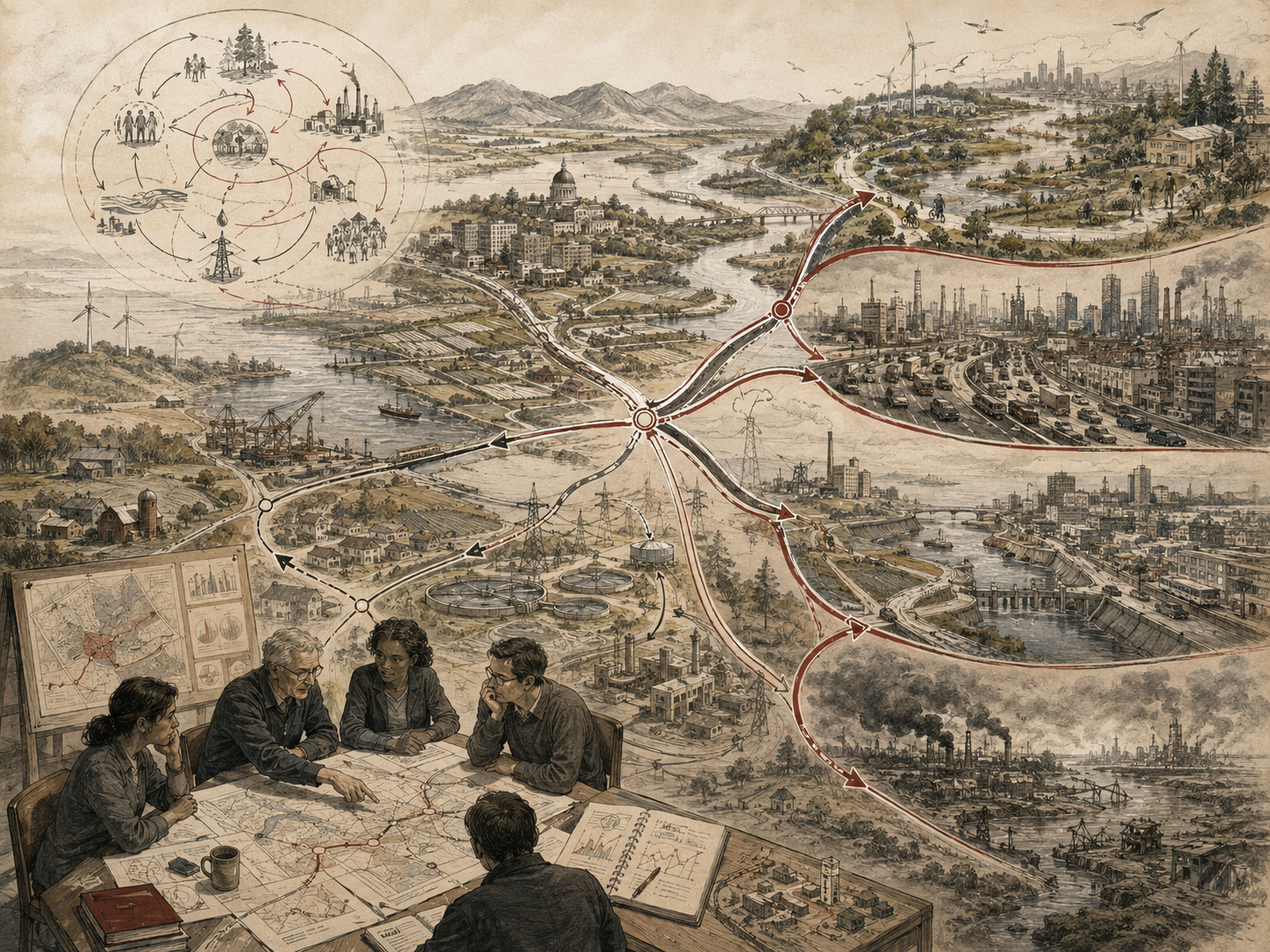
This article explains scenario modeling as a core systems-thinking practice. It examines how scenarios differ from forecasts, how assumptions shape futures, how scenario models connect to feedback loops and stock-flow structures, and why scenario analysis is useful for policy, governance, sustainability, institutions, technology systems, and social change. It also examines the ethical stakes of scenario modeling: whose future is imagined, whose risks are included, whose harms are discounted, and how scenario work can either expand or restrict public responsibility.
Why Scenario Modeling Matters
Scenario modeling matters because systems decisions are made under uncertainty. Institutions rarely know exactly how demand, climate, technology, behavior, trust, funding, policy, conflict, capacity, or ecological conditions will change. Yet decisions still must be made. Waiting for certainty can mean waiting until harm has accumulated, capacity has eroded, or the window for prevention has closed.
Scenario modeling helps decision-makers reason under uncertainty without reducing complexity to a single prediction. It allows analysts to compare plausible futures, examine how assumptions shape outcomes, test whether interventions remain useful under different conditions, and identify where a system is fragile. It also helps reveal whether a policy is robust, meaning that it performs reasonably well across multiple plausible futures rather than only under optimistic assumptions.
In systems thinking, scenarios are especially useful because they allow analysts to vary structural conditions. What happens if feedback arrives late? What happens if trust is already low? What happens if demand grows faster than capacity? What happens if maintenance remains underfunded? What happens if a reinforcing loop accelerates? What happens if an ecological threshold is crossed? What happens if public cooperation declines? What happens if a policy improves one stock while depleting another?
| Scenario purpose | Systems question | Example |
|---|---|---|
| Explore uncertainty | What could happen under different assumptions? | High-demand, low-funding, delayed-response, and early-prevention cases. |
| Compare interventions | Which pathway changes system behavior most durably? | Capacity investment versus short-term enforcement. |
| Test resilience | How does the system behave under stress? | Climate shock, budget cut, workforce loss, infrastructure failure. |
| Reveal hidden assumptions | What must be true for the preferred policy to work? | Assumed cooperation, stable funding, low delay, high institutional capacity. |
| Examine distribution | Who gains, who loses, and when? | Neighborhood-level exposure, household burden, worker fatigue, future generations. |
Scenario modeling is useful not because it eliminates uncertainty, but because it makes uncertainty discussable. It gives institutions, communities, researchers, and policymakers a structured way to ask: which futures are plausible, which futures are dangerous, which futures are just, and which choices today make better futures more likely?
Scenarios Are Not Predictions
A scenario is not a prediction. A prediction tries to say what will happen. A scenario asks what could happen under specified assumptions. This distinction is essential. When scenario models are treated as predictions, they can create false certainty. When they are treated as structured explorations, they can improve judgment.
Scenarios are especially useful when uncertainty is deep. Deep uncertainty exists when analysts do not know which model is correct, which assumptions will hold, which values should dominate, or how actors will respond. In such conditions, a single forecast may be misleading. A scenario set can show multiple plausible paths and help decision-makers prepare for uncertainty rather than deny it.
For example, a city planning for climate resilience should not rely on one rainfall projection, one population estimate, one infrastructure cost, or one housing-demand forecast. It should examine multiple plausible futures: moderate warming, extreme rainfall, rapid development, fiscal constraint, population displacement, infrastructure failure, strong ecological restoration, and weak governance. The point is not to know exactly which future will occur. The point is to design systems that remain responsible across futures.
\text{Scenario} = f(\text{Assumptions}, \text{Structure}, \text{Interventions}, \text{Uncertainty})
\]
Interpretation: A scenario describes how a system could behave under a defined set of assumptions, structural relationships, interventions, and uncertainties.
Scenarios should therefore be presented with clear assumptions. A scenario that does not state its assumptions can become a hidden forecast. It may smuggle in optimism, austerity, growth assumptions, political preferences, technological faith, or institutional blind spots. A responsible scenario says what it assumes about demand, capacity, funding, behavior, ecological conditions, governance, feedback, delay, and distribution.
Scenario modeling also differs from fantasy. A scenario does not need to be certain, but it should be plausible, coherent, and relevant. It should be grounded in system structure, observed behavior, historical evidence, stakeholder knowledge, scientific understanding, and realistic uncertainty. A useful scenario expands imagination while remaining disciplined.
The value of a scenario is not whether it comes true exactly. Its value lies in the questions it forces: what are we assuming, what could go wrong, what would make this future more likely, what should we monitor, what should we prepare for, and what choices today would keep better futures open?
The Systems Logic of Scenario Modeling
Scenario modeling becomes more powerful when it is grounded in systems logic. A weak scenario simply describes a future state: more growth, less funding, higher demand, more automation, worse climate risk. A stronger scenario explains how that future emerges from feedback loops, stocks, flows, delays, constraints, incentives, and institutional behavior.
Systems scenarios are not only stories about external conditions. They are structured pathways. A scenario should explain how one change leads to another, how effects accumulate, how feedback amplifies or dampens change, and how delays alter perception and response. It should show how the system gets from present conditions to future outcomes.
For example, a workforce-collapse scenario should not simply say that staffing declines. It should show how workload increases stress, stress increases errors and rework, rework increases workload, stress increases turnover, turnover reduces capacity, reduced capacity increases workload, and hiring delays prevent timely correction. The scenario is credible because it contains a feedback structure.
A resilience scenario should not simply say that the system improves. It should show how preventive maintenance reduces failure risk, reduced failures protect public trust, public trust supports funding legitimacy, stable funding increases maintenance capacity, and improved asset condition reduces emergency repair costs. The scenario is credible because it shows a reinforcing repair loop or an effective balancing loop.
S^{(k)}_{t+1} = F(S^{(k)}_t, P^{(k)}_t, X^{(k)}_t, \theta^{(k)})
\]
Interpretation: In scenario \(k\), the future system state depends on the current state, policy choices, external conditions, and scenario-specific assumptions.
Systems logic gives scenarios explanatory force. It helps distinguish plausible futures from arbitrary futures. It also makes scenario disagreements more precise. Stakeholders may disagree about whether trust will recover, whether automation will reduce burden, whether funding will remain stable, whether maintenance will prevent failure, or whether public cooperation will rise. Scenario modeling can turn those disagreements into testable assumptions.
Good systems scenarios answer four questions:
- What initial conditions define the scenario?
- What feedback loops drive the scenario forward?
- What stocks accumulate or deplete?
- What delays, thresholds, or constraints shape the outcome?
Scenario modeling is therefore not only future storytelling. It is dynamic explanation under uncertainty.
Baselines, Counterfactuals, and Alternative Futures
Scenario modeling often begins with a baseline. The baseline describes what might happen if current structure, policy, behavior, and trends continue. A baseline is not neutral. It is a scenario too. It assumes continuity: current funding, current demand, current feedback, current capacity, current political behavior, current ecological trends, and current institutional response.
Baselines are useful because they make continuation visible. Many systems are already moving. Backlog may be growing. Trust may be eroding. Debt may be compounding. Ecological stress may be accumulating. Workforce capacity may be declining. A baseline scenario shows that doing nothing is not static. It is a pathway.
A counterfactual asks what would happen under a different condition. What if intervention began earlier? What if funding had not been cut? What if administrative burden had been reduced? What if maintenance had been sustained? What if public trust had been included as a central outcome? Counterfactuals help reveal the cost of past decisions and the value of alternative choices.
Alternative futures compare different pathways. One scenario may represent short-term cost cutting. Another may represent preventive investment. Another may represent delayed emergency response. Another may represent participatory repair. Another may represent high-demand stress. Another may represent ecological restoration. The comparison helps analysts see not only outcomes, but trajectories.
| Scenario type | Core question | Systems use |
|---|---|---|
| Baseline | What happens if current structure continues? | Shows the trajectory of continuation. |
| Counterfactual | What would have happened under different conditions? | Reveals the cost or value of past choices. |
| Intervention scenario | What happens if a policy changes one or more flows? | Tests policy pathways. |
| Stress scenario | What happens under shock, scarcity, or disruption? | Tests resilience and failure modes. |
| Transformational scenario | What happens if goals, incentives, or feedback structures change? | Explores deeper system redesign. |
Baselines and counterfactuals are ethically important. A baseline may normalize harm if current conditions are unjust. A counterfactual may reveal preventable damage. A future scenario may show that present decisions are transferring costs to vulnerable communities or future generations. Scenario modeling helps make responsibility visible across time.
Drivers, Uncertainties, and Assumptions
Scenarios are built from drivers, uncertainties, and assumptions. A driver is a force that shapes system behavior: population change, climate stress, funding, technology adoption, public trust, institutional capacity, market behavior, regulation, political legitimacy, ecological condition, or social conflict. Some drivers are relatively predictable. Others are uncertain.
Uncertainty is not a single category. Some uncertainty concerns data. Some concerns causal relationships. Some concerns human behavior. Some concerns political choices. Some concerns technological change. Some concerns ecological thresholds. Some concerns values and priorities. A strong scenario model names these uncertainties rather than burying them inside one projection.
Assumptions connect drivers and uncertainties to model behavior. For example, a scenario may assume that demand grows by 3 percent annually, staffing remains flat, trust declines when delay exceeds a threshold, preventive maintenance reduces failure risk after a two-year delay, or public cooperation depends on perceived legitimacy. Each assumption should be visible enough to question.
Y^{(k)} = f(D^{(k)}, U^{(k)}, A^{(k)})
\]
Interpretation: Scenario outcome \(Y^{(k)}\) depends on the selected drivers \(D\), uncertainties \(U\), and assumptions \(A\) for scenario \(k\).
Scenarios become weak when assumptions are treated as facts. An optimistic technology scenario may assume rapid adoption, low cost, high public trust, and minimal unintended consequences. A fiscal austerity scenario may assume that service quality can be maintained despite capacity reduction. A growth scenario may assume infrastructure, ecology, and housing can absorb expansion. A governance scenario may assume cooperation without repairing legitimacy. These assumptions may or may not hold.
Assumption discipline requires documentation:
- What does the scenario assume about demand?
- What does it assume about capacity?
- What does it assume about trust and cooperation?
- What does it assume about ecological limits?
- What does it assume about funding and political will?
- What does it assume about technology performance?
- What does it assume about delay and implementation?
- What does it assume about distribution and burden?
Scenario modeling is strongest when assumptions are transparent and revisable. The goal is not to hide uncertainty. The goal is to structure it well enough that better decisions can be made.
Feedback, Accumulation, and Scenario Behavior
Scenarios in systems thinking should track feedback and accumulation. Without feedback, scenarios can become linear projections. Without accumulation, they can miss the stocks that shape long-term behavior. A useful scenario asks what builds up, what drains away, what reinforces itself, what stabilizes, and what crosses a threshold.
Consider a public trust scenario. Trust is a stock. It changes through reliable service, fairness, transparency, accountability, harm, delay, exclusion, and repair. A high-trust scenario might show cooperation increasing, service performance improving, and trust continuing to grow. A low-trust scenario might show cooperation declining, administrative friction increasing, performance weakening, and distrust deepening. The same system can move along different trajectories depending on feedback.
Consider an infrastructure scenario. Maintenance backlog is a stock. It grows through deterioration and deferred repair. It shrinks through preventive maintenance and replacement. A deferred-maintenance scenario may show backlog growing slowly at first, then failure risk rising, emergency repair costs increasing, and preventive maintenance being crowded out. A stewardship scenario may show stable funding reducing backlog, lowering failures, and preserving public trust.
S^{(k)}_{t+1} = S^{(k)}_t + I^{(k)}_t – O^{(k)}_t
\]
Interpretation: In each scenario \(k\), the stock follows a different trajectory depending on scenario-specific inflows and outflows.
Feedback can make scenario differences widen over time. Small differences in initial trust, funding, capacity, or ecological resilience may compound through reinforcing loops. A system with slightly better capacity may deliver better service, build legitimacy, gain cooperation, and improve further. A system with slightly worse capacity may produce delay, lose trust, increase conflict, and deteriorate. Scenario modeling helps identify where small differences may have large future consequences.
Accumulation also explains why early intervention can be powerful. Preventing backlog, debt, distrust, ecological damage, or fatigue from accumulating may be easier than repairing the stock later. A scenario that includes stock dynamics can show the long-term value of prevention even when short-term benefits look modest.
Scenario modeling should therefore track stocks, not only events. A future is not only a list of things that happen. It is an accumulation path.
Intervention Scenarios and Policy Pathways
Intervention scenarios compare different ways of changing the system. They ask what happens if a policy alters a flow, changes feedback, reduces delay, shifts incentives, expands capacity, protects a buffer, or changes the system goal. This is where scenario modeling becomes directly useful for policy and strategy.
A weak intervention scenario tests only whether an action has an immediate effect. A stronger systems scenario tests how the system responds over time. For example, a backlog-reduction scenario should not only ask how many cases can be processed this month. It should ask whether the intervention changes workload, error, rework, staff fatigue, turnover, trust, appeal volume, and future demand. Otherwise, the scenario may miss policy resistance.
Intervention scenarios can compare:
- short-term relief versus long-term capacity building;
- enforcement versus trust repair;
- technology deployment versus process simplification;
- preventive maintenance versus emergency repair;
- centralized control versus local adaptation;
- one-time funding versus sustained repair flows;
- output pressure versus workload redesign;
- late correction versus early prevention;
- narrow metric improvement versus whole-system resilience.
\Delta Y^{(k)} = Y^{(k)}_{\text{intervention}} – Y_{\text{baseline}}
\]
Interpretation: The effect of intervention scenario \(k\) can be evaluated by comparing its outcome trajectory with the baseline trajectory.
Intervention scenarios should evaluate multiple outcomes. A policy may reduce one risk while increasing another. A technology may reduce processing time while increasing oversight burden. A regulation may reduce visible harm while shifting activity elsewhere. A program may improve average outcomes while worsening distribution. Scenario modeling should therefore include outcome sets, not only a single success metric.
| Intervention type | Scenario question | Possible system effect |
|---|---|---|
| Capacity investment | Does increasing capacity reduce delay and prevent reinforcing decline? | May build trust, reduce backlog, and stabilize service. |
| Enforcement escalation | Does enforcement solve the problem or erode cooperation? | May reduce visible behavior while increasing distrust. |
| Preventive maintenance | Does early repair reduce future failure and emergency costs? | May look costly early but avoid collapse later. |
| Burden reduction | Does simplifying access improve participation and trust? | May increase legitimate access while reducing appeals and conflict. |
| Technology deployment | Does automation increase capacity or create new dependency and error? | May improve throughput while requiring oversight, appeal, and governance. |
A good intervention scenario does not ask whether a policy is attractive in isolation. It asks how the policy changes the structure that generates behavior.
Stress Testing, Resilience, and Failure Conditions
Scenario modeling is especially useful for stress testing. A stress scenario asks how a system behaves under pressure: higher demand, lower funding, climate shock, workforce loss, public distrust, cyber failure, supply disruption, legal challenge, ecological disturbance, or political instability. Stress testing reveals whether a system is resilient or fragile.
Resilience is not proven by performance under normal conditions. A system can appear efficient because it has no slack. It can appear stable because it has not been stressed. It can appear legitimate because trust has not yet been tested. Stress scenarios reveal whether the system has buffers, redundancy, repair capacity, adaptive governance, and legitimate feedback.
Stress testing can identify failure conditions. At what level of demand does backlog begin to grow rapidly? How much staff loss produces service collapse? How long can deferred maintenance continue before emergency repair dominates the budget? How much climate exposure can infrastructure absorb? How much administrative burden causes eligible people to exit the system? How much trust loss causes cooperation to fall?
R = f(B, C, D, A, L)
\]
Interpretation: Resilience \(R\) can be understood as a function of buffers \(B\), capacity \(C\), delay \(D\), adaptability \(A\), and load \(L\). Stress scenarios test how these factors interact.
Stress scenarios are not pessimistic exercises. They are stewardship exercises. They help systems prepare before failure. They also reveal whether current performance depends on hidden depletion. A hospital operating near full capacity may look efficient until a surge arrives. A public agency with no staffing buffer may look lean until demand rises. A supply chain with minimal redundancy may look optimized until disruption occurs. A city with deferred maintenance may look fiscally responsible until assets fail.
Stress testing should include social and ethical stress, not only technical stress. What happens to low-income households under price increases? What happens to disabled applicants under digital-only service? What happens to frontline workers under emergency conditions? What happens to public trust after a harmful error? What happens to ecosystems under repeated shocks?
A resilient system is not one that never experiences stress. It is one that can absorb, adapt, recover, learn, and avoid shifting unacceptable harm onto those least able to bear it.
Distributional Scenarios: Who Benefits and Who Bears Risk?
Scenario modeling should be distributional. Aggregate outcomes can hide unequal effects. A scenario may improve average cost, average travel time, average service speed, average emissions, or average health while worsening conditions for particular groups or places. In social and ecological systems, averages are often morally insufficient.
A distributional scenario asks who benefits, who bears costs, who is exposed to risk, who gains capacity, who loses access, and who inherits the future consequences. It may disaggregate by neighborhood, income, race, age, disability, gender, citizenship status, household type, occupation, ecosystem, generation, or institutional role. The relevant categories depend on the system and the harm being studied.
For example, a citywide flood-resilience scenario may show improved aggregate protection. But if protection is concentrated in high-value districts while low-income neighborhoods remain exposed, the scenario reveals unequal resilience. A digital-service scenario may reduce average processing time while increasing exclusion for people without reliable internet, language access, disability accommodations, or trust in automated systems. A climate transition scenario may reduce emissions while shifting job loss and pollution burdens onto specific workers and communities.
Y^{(k)}_{g,t} = f(S^{(k)}_{g,t}, P^{(k)}_t, X^{(k)}_{g,t})
\]
Interpretation: Scenario outcomes should be examined for group \(g\) over time, not only for the system average. Different groups may experience different stock trajectories under the same policy.
Distributional scenario modeling asks:
- Whose outcomes improve?
- Whose outcomes worsen?
- Who experiences benefits first?
- Who experiences costs later?
- Who has buffers?
- Who lacks buffers?
- Who is excluded from the model boundary?
- What burdens are shifted across place, group, or generation?
Distributional scenarios help prevent false success. A system can become more efficient by shifting work to households. It can become more profitable by externalizing ecological damage. It can become more secure by increasing surveillance of marginalized groups. It can become more resilient in one area by increasing vulnerability elsewhere. Scenario modeling should reveal these shifts, not hide them.
Responsible futures work asks not only what future is plausible, but for whom it is livable.
Ethics, Power, and Future Imagination
Scenario modeling has ethical stakes because futures are not imagined equally. Institutions with power often define the assumptions, boundaries, risks, goals, and acceptable tradeoffs. They decide which futures are modeled, which are dismissed, which communities are included, which harms are counted, and which uncertainties matter. Scenario modeling can expand democratic imagination, but it can also narrow it.
Power enters scenarios through the definition of success. A scenario may define success as growth, efficiency, cost reduction, adoption, output, or stability. But growth for whom? Efficiency for which institution? Cost reduction by shifting burden to whom? Adoption under what conditions? Output at what human or ecological cost? Stability of which order? A scenario that does not ask these questions may reproduce the values of those already in control.
Power also enters through time horizon. A short scenario may favor immediate gains and hide delayed harm. A long scenario may reveal intergenerational costs, ecological depletion, infrastructure decay, or slow trust erosion. Time horizon is an ethical choice because it determines whose future matters.
Scenario modeling should also include futures that powerful actors may not prefer. What if affected communities designed the policy? What if care work were counted? What if ecological restoration were treated as a constraint rather than an optional add-on? What if administrative burden were treated as institutional harm? What if future generations were included in the boundary? What if marginalized knowledge were treated as evidence?
Ethical scenario modeling asks:
- Who defines the scenario set?
- Whose assumptions shape the model?
- Which futures are considered plausible?
- Which futures are excluded as unrealistic?
- What harms are included?
- What harms are externalized?
- What time horizon is used?
- Who can contest the scenario?
- What decisions will the scenario influence?
- What responsibilities follow if a harmful scenario is foreseeable?
Scenario modeling should not become a way to aestheticize uncertainty while avoiding responsibility. If a scenario reveals foreseeable harm, the institution cannot claim surprise later. Scenario work creates obligations: to monitor, prepare, prevent, repair, and include those most affected by the futures being imagined.
Examples Across Systems
Scenario modeling can be applied across social, ecological, institutional, and technical systems. The examples below show how systems scenarios help compare possible futures, test assumptions, examine stress, and connect uncertainty to action.
Public health
A public-health scenario model might compare early prevention, delayed response, trust-building, misinformation growth, service expansion, and access failure. The model could track infection risk, healthcare capacity, public trust, vaccination uptake, communication quality, and delayed outcomes. A distributional version would ask which communities receive early protection and which bear accumulated exposure.
Infrastructure
An infrastructure scenario model might compare preventive maintenance, deferred repair, emergency-only spending, climate stress, and asset renewal. The model could track maintenance backlog, asset condition, failure risk, emergency cost, public trust, and service disruption. Scenario comparison can reveal why deferred maintenance appears cheaper early but produces higher long-term risk.
Organizations
An organizational scenario model might compare workload growth, staffing investment, hiring delay, burnout, turnover, automation support, and priority reduction. The model could show how short-term productivity pressure produces long-term capacity loss, or how workload redesign and recovery time prevent collapse.
Education
An education scenario model might compare tutoring, attendance enforcement, family support, teacher staffing, belonging-centered practice, and exclusionary discipline. The model could track learning, belonging, attendance, teacher capacity, student stress, and long-term capability. Scenarios can reveal whether policies build durable learning or merely raise short-term metrics.
Artificial intelligence systems
An AI governance scenario model might compare rapid deployment, cautious deployment, audit-based governance, strong appeal rights, low oversight, data drift, and institutional dependency. The model could track model performance, user reliance, error accumulation, oversight capacity, public trust, and contestability. Scenario modeling can reveal whether efficiency gains are accompanied by accountability loss.
Climate and ecology
A climate scenario model might compare emissions pathways, adaptation investment, ecological restoration, delayed policy, extreme weather, and social vulnerability. The model could track atmospheric concentration, infrastructure exposure, ecological resilience, displacement risk, and community capacity. Distributional scenarios can show that climate futures are experienced unevenly.
Economic systems
An economic scenario model might compare debt growth, household income, housing cost, employment volatility, public investment, austerity, and inflation stress. The model could track wealth, debt, household resilience, public capacity, inequality, and demand. Scenario work can reveal how short-term growth may create long-term fragility if it depends on debt, extraction, or underinvestment.
Public administration
A public-administration scenario model might compare verification-heavy policy, burden reduction, staffing expansion, digital automation, appeal support, and trust repair. The model could track processing delay, administrative burden, staff workload, eligible participation, public trust, appeals, and unmet need. Scenarios can show whether a policy reduces error by increasing exclusion.
Across these domains, scenario modeling helps systems thinkers ask not only what may happen, but how futures are produced through structure, feedback, accumulation, and choice.
Mathematics, Computation, and Modeling
Scenario modeling can be qualitative, quantitative, computational, participatory, or mixed-method. The formal structure depends on the purpose. Some scenarios are narrative pathways supported by causal-loop diagrams. Others are stock-flow simulations. Others use agent-based models, network models, time-series projections, decision trees, Monte Carlo simulation, or sensitivity analysis. The common feature is that assumptions vary across futures.
A general scenario model can be represented as:
X^{(s)}_{t+1} = F\left(X^{(s)}_t, P^{(s)}_t, E^{(s)}_t, \theta^{(s)}\right)
\]
Interpretation: In scenario \(s\), the future state \(X_{t+1}\) depends on the current state, policy choices \(P\), external conditions \(E\), and scenario-specific assumptions \(\theta\).
A stock-flow scenario model can be written as:
S^{(s)}_{t+1} = S^{(s)}_t + I^{(s)}_t – O^{(s)}_t
\]
Interpretation: Each scenario produces a different stock trajectory by changing inflows, outflows, or both.
An intervention comparison can be represented as:
\Delta Y^{(s)}_t = Y^{(s)}_t – Y^{(\text{baseline})}_t
\]
Interpretation: The difference between a scenario outcome and the baseline shows how much the intervention pathway changes the system trajectory over time.
A distributional scenario can be represented as:
Y^{(s)}_{g,t} = F\left(X^{(s)}_{g,t}, P^{(s)}_t, \theta^{(s)}_g\right)
\]
Interpretation: Scenario outcomes can be tracked for group \(g\), allowing the analyst to examine unequal effects across groups, places, or generations.
A robustness test can be represented conceptually as:
R(P) = \min_{s \in \mathcal{S}} U(P,s)
\]
Interpretation: A robust policy \(P\) can be evaluated by its performance \(U\) across the scenario set \(\mathcal{S}\), including difficult or unfavorable futures.
| Computational task | Scenario question | Example output |
|---|---|---|
| Baseline simulation | What happens if current structure continues? | Trajectory for backlog, trust, debt, exposure, capacity, or risk. |
| Intervention comparison | Which policy pathway changes the trajectory? | Scenario table comparing prevention, delay, enforcement, and repair. |
| Stress test | Where does the system fail under pressure? | Thresholds for demand, funding loss, delay, or capacity depletion. |
| Sensitivity analysis | Which assumptions matter most? | Parameter sensitivity table or ranked uncertainty drivers. |
| Distributional analysis | Who benefits or bears burden? | Group-level outcomes across scenarios. |
| Robustness assessment | Which policy performs across many futures? | Policy ranking under optimistic, baseline, and stress scenarios. |
Scenario modeling requires transparency. The model should document scenario definitions, assumptions, variables, parameter values, uncertainty ranges, data sources, and limitations. Synthetic data should be clearly labeled. Results should be presented as structured possibilities, not certainty. The goal is not to predict the future; it is to improve responsibility toward the futures that present choices make more or less likely.
Python Workflow: Scenario Modeling, Stress Testing, Robustness, and Distributional Diagnostics
The Python workflow below turns scenario modeling into a small reproducible systems model. It compares four scenario pathways: baseline continuation, delayed response stress case, capacity and prevention pathway, and adaptive justice-centered resilience. It also includes a simple sensitivity analysis for key scenario assumptions. The script uses only the Python standard library, writes CSV outputs relative to the article folder, and is designed as a clear starting point for companion repository work.
# scenario_modeling_systems_thinking_workflow.py
# Dependency-light workflow for scenario modeling, baseline futures,
# intervention pathways, stress tests, robustness checks, sensitivity,
# and distributional outcome diagnostics.
# Writes outputs relative to the article root.

from __future__ import annotations

from dataclasses import dataclass, replace
from pathlib import Path
import csv
from statistics import mean

ARTICLE_ROOT = Path(__file__).resolve().parents[1]
TABLES = ARTICLE_ROOT / "outputs" / "tables"


@dataclass
class ScenarioPathway:
    name: str
    demand_growth: float
    capacity_investment: float
    prevention_strength: float
    feedback_delay: float
    trust_repair: float
    stress_shock: float
    distributional_protection: float
    ecological_or_social_buffer: float
    adaptive_governance: float
    accountability: float


def clamp(value: float, low: float = 0.0, high: float = 140.0) -> float:
    return max(low, min(high, value))


def run_scenario(scenario: ScenarioPathway, periods: int = 60) -> list[dict[str, object]]:
    backlog = 44.0 + scenario.demand_growth * 18.0
    capacity = 42.0 + scenario.capacity_investment * 24.0
    trust = 40.0 + scenario.trust_repair * 24.0
    buffer_stock = 34.0 + scenario.ecological_or_social_buffer * 32.0
    vulnerable_group_burden = 38.0 + scenario.stress_shock * 22.0
    institutional_learning = 30.0 + scenario.adaptive_governance * 24.0
    backlog_history: list[float] = [backlog]
    rows: list[dict[str, object]] = []

    delay_steps = max(0, int(round(scenario.feedback_delay * 8.0)))

    for period in range(periods + 1):
        delayed_index = max(0, len(backlog_history) - 1 - delay_steps)
        perceived_backlog = backlog_history[delayed_index]

        demand_inflow = clamp(
            scenario.demand_growth * 18.0
            + scenario.stress_shock * 14.0
            + max(0.0, 55.0 - trust) * 0.10
            - scenario.prevention_strength * 7.0,
            0.0,
            100.0
        )

        service_outflow = clamp(
            capacity * 0.22
            + scenario.capacity_investment * 12.0
            + scenario.accountability * 6.0
            - max(0.0, vulnerable_group_burden - 55.0) * 0.07,
            0.0,
            100.0
        )

        prevention_effect = clamp(
            scenario.prevention_strength * 18.0
            + scenario.ecological_or_social_buffer * 8.0
            + scenario.distributional_protection * 6.0
            - scenario.feedback_delay * 4.0,
            0.0,
            100.0
        )

        adaptive_correction = clamp(
            scenario.adaptive_governance * 16.0
            + institutional_learning * 0.12
            + scenario.accountability * 8.0
            + max(0.0, perceived_backlog - 50.0) * 0.12
            - scenario.feedback_delay * 5.0,
            0.0,
            100.0
        )

        backlog = clamp(
            backlog
            + demand_inflow * 0.18
            - service_outflow * 0.15
            - prevention_effect * 0.10
            - adaptive_correction * 0.08,
            0.0,
            140.0
        )

        capacity = clamp(
            capacity
            + scenario.capacity_investment * 1.8
            + scenario.adaptive_governance * 1.2
            + scenario.accountability * 1.1
            - max(0.0, backlog - 70.0) * 0.04
            - scenario.stress_shock * 0.8,
            0.0,
            100.0
        )

        buffer_stock = clamp(
            buffer_stock
            + scenario.ecological_or_social_buffer * 1.6
            + scenario.prevention_strength * 1.2
            - scenario.stress_shock * 1.8
            - max(0.0, backlog - 65.0) * 0.05,
            0.0,
            100.0
        )

        vulnerable_group_burden = clamp(
            vulnerable_group_burden
            + scenario.stress_shock * 2.1
            + max(0.0, backlog - capacity) * 0.08
            + scenario.demand_growth * 0.9
            - scenario.distributional_protection * 2.2
            - scenario.accountability * 1.0,
            0.0,
            100.0
        )

        trust = clamp(
            trust
            + scenario.trust_repair * 1.6
            + scenario.accountability * 1.4
            + max(0.0, service_outflow - demand_inflow) * 0.04
            - vulnerable_group_burden * 0.04
            - max(0.0, backlog - 60.0) * 0.035,
            0.0,
            100.0
        )

        institutional_learning = clamp(
            institutional_learning
            + scenario.adaptive_governance * 1.8
            + scenario.accountability * 1.4
            + max(0.0, perceived_backlog - 50.0) * 0.04
            - scenario.feedback_delay * 0.8
            - vulnerable_group_burden * 0.025,
            0.0,
            100.0
        )

        fragility_index = clamp(
            backlog * 0.18
            + vulnerable_group_burden * 0.22
            + max(0.0, 45.0 - buffer_stock) * 0.18
            + scenario.stress_shock * 12.0
            + scenario.feedback_delay * 8.0
            - capacity * 0.10
            - trust * 0.08
            - institutional_learning * 0.08,
            0.0,
            100.0
        )

        robustness_score = clamp(
            capacity * 0.20
            + trust * 0.18
            + buffer_stock * 0.18
            + institutional_learning * 0.18
            + scenario.distributional_protection * 12.0
            + scenario.accountability * 10.0
            - backlog * 0.16
            - vulnerable_group_burden * 0.16
            - fragility_index * 0.12,
            0.0,
            100.0
        )

        rows.append({
            "period": period,
            "scenario": scenario.name,
            "backlog": round(backlog, 3),
            "capacity": round(capacity, 3),
            "trust": round(trust, 3),
            "buffer_stock": round(buffer_stock, 3),
            "vulnerable_group_burden": round(vulnerable_group_burden, 3),
            "institutional_learning": round(institutional_learning, 3),
            "perceived_backlog": round(perceived_backlog, 3),
            "demand_inflow": round(demand_inflow, 3),
            "service_outflow": round(service_outflow, 3),
            "prevention_effect": round(prevention_effect, 3),
            "adaptive_correction": round(adaptive_correction, 3),
            "fragility_index": round(fragility_index, 3),
            "robustness_score": round(robustness_score, 3),
        })

        backlog_history.append(backlog)

    return rows


def write_csv(path: Path, rows: list[dict[str, object]]) -> None:
    path.parent.mkdir(parents=True, exist_ok=True)
    if not rows:
        raise ValueError(f"No rows to write: {path}")
    with path.open("w", newline="", encoding="utf-8") as handle:
        writer = csv.DictWriter(handle, fieldnames=list(rows[0].keys()))
        writer.writeheader()
        writer.writerows(rows)


def summarize(rows: list[dict[str, object]]) -> list[dict[str, object]]:
    output: list[dict[str, object]] = []
    for scenario_name in sorted({row["scenario"] for row in rows}):
        subset = [row for row in rows if row["scenario"] == scenario_name]
        final = subset[-1]
        avg_fragility = mean(float(row["fragility_index"]) for row in subset)
        avg_burden = mean(float(row["vulnerable_group_burden"]) for row in subset)
        avg_robustness = mean(float(row["robustness_score"]) for row in subset)

        if float(final["robustness_score"]) >= 65 and float(final["fragility_index"]) <= 35:
            diagnostic = "robust across the modeled pathway"
        elif avg_fragility >= 55:
            diagnostic = "fragility dominates this future pathway"
        elif avg_burden >= 60:
            diagnostic = "distributional burden remains high"
        elif avg_robustness >= 55:
            diagnostic = "partial resilience with remaining scenario risk"
        else:
            diagnostic = "weak scenario performance under current assumptions"

        output.append({
            "scenario": scenario_name,
            "final_robustness_score": final["robustness_score"],
            "final_fragility_index": final["fragility_index"],
            "final_backlog": final["backlog"],
            "final_capacity": final["capacity"],
            "final_vulnerable_group_burden": final["vulnerable_group_burden"],
            "final_buffer_stock": final["buffer_stock"],
            "average_fragility_index": round(avg_fragility, 3),
            "average_vulnerable_group_burden": round(avg_burden, 3),
            "average_robustness_score": round(avg_robustness, 3),
            "diagnostic": diagnostic,
        })

    return output


def sensitivity_analysis(base: ScenarioPathway) -> list[dict[str, object]]:
    base_final = float(run_scenario(base)[-1]["robustness_score"])
    tests = [
        ("demand_growth", -0.10),
        ("demand_growth", 0.10),
        ("capacity_investment", -0.10),
        ("capacity_investment", 0.10),
        ("feedback_delay", -0.10),
        ("feedback_delay", 0.10),
        ("distributional_protection", -0.10),
        ("distributional_protection", 0.10),
        ("adaptive_governance", -0.10),
        ("adaptive_governance", 0.10),
    ]

    rows: list[dict[str, object]] = []
    for parameter, delta in tests:
        current_value = getattr(base, parameter)
        revised_value = max(0.0, min(1.0, current_value + delta))
        revised = replace(base, name=f"{base.name} sensitivity {parameter} {delta:+.2f}", **{parameter: revised_value})
        revised_final = float(run_scenario(revised)[-1]["robustness_score"])
        rows.append({
            "parameter": parameter,
            "delta": delta,
            "base_final_robustness_score": round(base_final, 3),
            "revised_final_robustness_score": round(revised_final, 3),
            "score_change": round(revised_final - base_final, 3),
        })

    return rows


def main() -> None:
    scenarios = [
        ScenarioPathway("Baseline continuation", 0.62, 0.42, 0.32, 0.58, 0.34, 0.42, 0.34, 0.38, 0.34, 0.36),
        ScenarioPathway("Delayed response stress case", 0.72, 0.34, 0.22, 0.74, 0.26, 0.72, 0.24, 0.28, 0.24, 0.28),
        ScenarioPathway("Capacity and prevention pathway", 0.52, 0.70, 0.72, 0.38, 0.62, 0.38, 0.58, 0.66, 0.62, 0.60),
        ScenarioPathway("Adaptive justice-centered resilience", 0.42, 0.82, 0.82, 0.24, 0.80, 0.32, 0.84, 0.84, 0.84, 0.82),
    ]

    rows: list[dict[str, object]] = []
    for scenario in scenarios:
        rows.extend(run_scenario(scenario))

    write_csv(TABLES / "scenario_modeling_timeseries.csv", rows)
    write_csv(TABLES / "scenario_modeling_summary.csv", summarize(rows))
    write_csv(TABLES / "scenario_modeling_sensitivity_analysis.csv", sensitivity_analysis(scenarios[-1]))

    print("Scenario modeling workflow complete.")
    print(TABLES / "scenario_modeling_timeseries.csv")


if __name__ == "__main__":
    main()
The workflow is intentionally simple enough to inspect. It shows how backlog, capacity, trust, buffers, vulnerable-group burden, institutional learning, feedback delay, stress, and adaptive governance change across possible futures. It also demonstrates why scenario modeling should test difficult cases, not only preferred futures. The model is synthetic and illustrative; it supports disciplined inquiry rather than replacing domain expertise, stakeholder evidence, or ethical judgment.
R Workflow: Scenario Summary and Future Pathway Visualization
The R workflow reads the Python-generated time-series and sensitivity outputs, creates scenario summaries, and exports base R plots for backlog, capacity, trust, buffers, vulnerable-group burden, fragility, and robustness. It uses only base R so it remains portable across simple local environments.
# scenario_modeling_systems_thinking_diagnostics.R
# Base R workflow for scenario summary and future pathway visualization.

args <- commandArgs(trailingOnly = FALSE)
file_arg <- grep("^--file=", args, value = TRUE)

if (length(file_arg) > 0) {
  script_path <- normalizePath(sub("^--file=", "", file_arg[1]), mustWork = TRUE)
  article_root <- normalizePath(file.path(dirname(script_path), ".."), mustWork = TRUE)
} else {
  article_root <- getwd()
}

setwd(article_root)

tables_dir <- file.path(article_root, "outputs", "tables")
figures_dir <- file.path(article_root, "outputs", "figures")

if (!dir.exists(tables_dir)) {
  dir.create(tables_dir, recursive = TRUE)
}

if (!dir.exists(figures_dir)) {
  dir.create(figures_dir, recursive = TRUE)
}

timeseries_path <- file.path(tables_dir, "scenario_modeling_timeseries.csv")

if (!file.exists(timeseries_path)) {
  stop(paste("Missing", timeseries_path, "Run the Python workflow first."))
}

data <- read.csv(timeseries_path, stringsAsFactors = FALSE)

last_by_scenario <- do.call(
  rbind,
  lapply(split(data, data$scenario), function(df) df[nrow(df), ])
)

avg_fragility <- aggregate(fragility_index ~ scenario, data = data, FUN = mean)
avg_burden <- aggregate(vulnerable_group_burden ~ scenario, data = data, FUN = mean)
avg_robustness <- aggregate(robustness_score ~ scenario, data = data, FUN = mean)

names(avg_fragility)[2] <- "average_fragility_index"
names(avg_burden)[2] <- "average_vulnerable_group_burden"
names(avg_robustness)[2] <- "average_robustness_score"

final_fields <- last_by_scenario[, c(
  "scenario",
  "robustness_score",
  "fragility_index",
  "backlog",
  "capacity",
  "vulnerable_group_burden",
  "buffer_stock"
)]

names(final_fields) <- c(
  "scenario",
  "final_robustness_score",
  "final_fragility_index",
  "final_backlog",
  "final_capacity",
  "final_vulnerable_group_burden",
  "final_buffer_stock"
)

summary_table <- Reduce(
  function(x, y) merge(x, y, by = "scenario"),
  list(avg_fragility, avg_burden, avg_robustness, final_fields)
)

summary_table$diagnostic <- ifelse(
  summary_table$final_robustness_score >= 65 &
    summary_table$final_fragility_index <= 35,
  "robust across the modeled pathway",
  ifelse(
    summary_table$average_fragility_index >= 55,
    "fragility dominates this future pathway",
    ifelse(
      summary_table$average_vulnerable_group_burden >= 60,
      "distributional burden remains high",
      ifelse(
        summary_table$average_robustness_score >= 55,
        "partial resilience with remaining scenario risk",
        "weak scenario performance under current assumptions"
      )
    )
  )
)

write.csv(
  summary_table,
  file.path(tables_dir, "scenario_modeling_r_summary.csv"),
  row.names = FALSE
)

plot_metric <- function(metric, label, file_name) {
  png(file.path(figures_dir, file_name), width = 1200, height = 700)
  scenarios <- unique(data$scenario)
  plot(
    NA,
    xlim = range(data$period),
    ylim = range(data[[metric]], na.rm = TRUE),
    xlab = "Period",
    ylab = label,
    main = paste(label, "by Scenario Pathway")
  )
  for (scenario_name in scenarios) {
    subset_data <- data[data$scenario == scenario_name, ]
    lines(subset_data$period, subset_data[[metric]], lwd = 2)
  }
  legend("topleft", legend = scenarios, lwd = 2, cex = 0.8, bty = "n")
  grid()
  dev.off()
}

plot_metric("backlog", "Backlog", "backlog_trajectories.png")
plot_metric("capacity", "Capacity", "capacity_trajectories.png")
plot_metric("trust", "Trust", "trust_trajectories.png")
plot_metric("buffer_stock", "Buffer stock", "buffer_stock_trajectories.png")
plot_metric("vulnerable_group_burden", "Vulnerable group burden", "vulnerable_group_burden_trajectories.png")
plot_metric("fragility_index", "Fragility index", "fragility_index_trajectories.png")
plot_metric("robustness_score", "Robustness score", "robustness_score_trajectories.png")

sensitivity_path <- file.path(tables_dir, "scenario_modeling_sensitivity_analysis.csv")
if (file.exists(sensitivity_path)) {
  sensitivity <- read.csv(sensitivity_path, stringsAsFactors = FALSE)
  sensitivity <- sensitivity[order(abs(sensitivity$score_change), decreasing = TRUE), ]
  write.csv(
    sensitivity,
    file.path(tables_dir, "scenario_modeling_sensitivity_ranked.csv"),
    row.names = FALSE
  )
}

print(summary_table)
This workflow supports the article’s central methodological claim: scenarios are structured possibilities, not predictions. The R outputs help readers compare pathways, identify fragile assumptions, and see how futures diverge through feedback, accumulation, stress, and governance choices.
GitHub Repository
The companion repository for this article should help readers build baseline scenarios, intervention scenarios, stress tests, distributional scenario models, robustness comparisons, and sensitivity workflows using synthetic datasets and reproducible code.
Complete Code Repository
Companion repository for the article, including scenario modeling workflows, baseline and counterfactual simulations, intervention pathway comparisons, stress tests, distributional outcome analysis, robustness checks, synthetic datasets, documentation assets, and multi-language scaffolds for systems analysis.
articles/scenario-modeling-in-systems-thinking/
├── python/
│   ├── scenario_modeling_systems_thinking_workflow.py
│   ├── baseline_scenario_model.py
│   ├── intervention_scenario_comparison.py
│   ├── stress_test_scenarios.py
│   ├── distributional_scenario_analysis.py
│   ├── robustness_assessment.py
│   ├── scenario_sensitivity_workflow.py
│   ├── validation_checks.py
│   └── run_all_scenario_modeling_workflows.py
├── r/
│   ├── scenario_modeling_systems_thinking_diagnostics.R
│   ├── scenario_trajectory_plots.R
│   ├── baseline_counterfactual_tables.R
│   ├── intervention_comparison.R
│   ├── stress_test_visualization.R
│   ├── distributional_scenario_summary.R
│   └── run_all_scenario_modeling_workflows.R
├── julia/
│   ├── dynamic_scenario_simulation.jl
│   ├── nonlinear_scenario_paths.jl
│   └── robustness_scan.jl
├── sql/
│   ├── schema_scenario_definitions.sql
│   ├── schema_scenario_assumptions.sql
│   ├── schema_interventions.sql
│   ├── schema_stress_tests.sql
│   ├── schema_distributional_outcomes.sql
│   └── schema_model_runs.sql
├── rust/
│   └── scenario_diagnostics_cli.rs
├── go/
│   └── scenario_runner_utility.go
├── cpp/
│   ├── efficient_scenario_simulation.cpp
│   └── robustness_scan.cpp
├── fortran/
│   └── recurrence_scenario_model.f90
├── c/
│   └── low_level_scenario_engine.c
├── docs/
│   ├── modeling_principles.md
│   ├── article_notes.md
│   ├── scenario_design_framework.md
│   ├── assumptions_register.md
│   ├── ethics_and_distribution_notes.md
│   ├── assumptions_and_limitations.md
│   └── responsible_use.md
├── data/
│   ├── synthetic_scenario_definitions.csv
│   ├── synthetic_scenario_assumptions.csv
│   ├── synthetic_interventions.csv
│   ├── synthetic_stress_tests.csv
│   ├── synthetic_distributional_outcomes.csv
│   └── synthetic_model_outputs.csv
├── outputs/
│   ├── figures/
│   └── tables/
└── notebooks/
    ├── python_scenario_modeling_walkthrough.ipynb
    └── r_scenario_visualization_placeholder.ipynb
This repository structure supports the article’s central argument: scenario modeling helps systems thinkers compare plausible futures under uncertainty. The data/ folder separates scenario definitions, assumptions, interventions, stress tests, distributional outcomes, and model outputs. The python/ and r/ folders support baseline modeling, counterfactual comparison, intervention pathway testing, stress testing, distributional analysis, robustness assessment, and sensitivity workflows. The julia folder supports dynamic and nonlinear scenario paths. The sql folder defines schemas for scenario assumptions, interventions, stress tests, outcomes, and model runs. The lower-level language folders provide scaffolds for diagnostics, scenario execution, recurrence modeling, robustness scanning, and low-level simulation.
A Practical Method for Scenario Modeling
Scenario modeling can become practical through a disciplined sequence of steps. The goal is not to generate a large number of speculative futures. The goal is to develop a scenario set that improves systems judgment, reveals assumptions, and supports responsible intervention.
1. Define the focal system behavior
Begin with the behavior that needs exploration: rising backlog, declining trust, climate vulnerability, institutional capacity loss, housing insecurity, debt accumulation, workforce burnout, ecological degradation, or policy resistance.
2. Establish the baseline scenario
Describe what may happen if current structures, trends, policies, and feedback loops continue. Treat the baseline as a scenario, not as neutral reality.
3. Identify key drivers
Name the forces that shape future behavior: demand, funding, climate stress, trust, technology, policy, demographics, infrastructure condition, political will, ecological resilience, or market pressure.
4. Identify critical uncertainties
Determine which uncertainties matter most. These may include growth rates, delay length, cooperation, funding stability, technology performance, public legitimacy, or threshold effects.
5. Define scenario assumptions
Document what each scenario assumes. Assumptions should be visible, testable where possible, and open to challenge.
6. Map feedback and stock-flow structure
Show how scenario conditions affect stocks, flows, feedback loops, delays, and intervention pathways.
7. Build scenario pathways
Create a limited set of coherent scenarios: baseline continuation, early prevention, delayed response, stress case, capacity investment, structural reform, or ecological restoration.
8. Compare outcomes over time
Evaluate trajectories, not only end points. Track stock accumulation, burden, resilience, risk, trust, capacity, and distribution across time.
9. Test robustness and sensitivity
Ask which policies work across multiple scenarios and which assumptions drive results.
10. Connect scenarios to action
Use scenarios to identify monitoring signals, early warning indicators, adaptive triggers, repair obligations, and intervention priorities.
This method treats the future as a field of responsibility. Scenarios do not tell us what will happen. They help us see what present choices may make possible, likely, fragile, unjust, or preventable.
Common Pitfalls
Scenario modeling can be misused when it becomes vague, overconfident, or detached from system structure. Several pitfalls are common.
- Treating scenarios as predictions: A scenario is a structured possibility, not a guarantee. Presenting scenario output as certainty undermines responsible decision-making.
- Creating too many scenarios: Too many scenarios can overwhelm interpretation. A smaller set of coherent, well-documented scenarios is usually more useful.
- Using scenarios without feedback structure: Scenario narratives should explain how futures emerge through feedback, accumulation, delay, and intervention, not merely describe end states.
- Hiding assumptions: Scenarios are only useful if their assumptions are visible. Hidden assumptions create false neutrality.
- Ignoring distribution: A scenario may improve aggregate outcomes while shifting burden to specific groups or places. Distributional analysis is essential.
- Confusing optimism with strategy: A preferred future is not a plan unless the scenario identifies the flows, capacities, feedback changes, and governance needed to reach it.
- Ignoring stress cases: Only modeling favorable futures can hide fragility. Responsible scenario work includes difficult futures.
- Failing to connect scenarios to action: Scenarios should inform monitoring, intervention, adaptation, and accountability. Otherwise, they remain speculative exercises.
The central pitfall is treating scenario modeling as future-themed storytelling rather than disciplined systems analysis. Strong scenarios connect uncertainty to structure and structure to action.
Why Scenario Modeling Changes Systems Practice
Scenario modeling changes systems practice because it helps people think responsibly under uncertainty. Complex systems do not offer one guaranteed future. They offer pathways shaped by feedback, accumulation, delay, constraint, intervention, power, and choice. Scenarios make those pathways visible enough to compare.
A good scenario model does not claim to know the future. It clarifies assumptions, tests interventions, explores stress, reveals distributional consequences, and identifies early warning signals. It asks what present choices are likely to build resilience, what choices may deepen fragility, what futures require repair, and what harms are foreseeable enough to demand prevention.
Scenario modeling is especially important for sustainability, governance, public institutions, infrastructure, technology, climate adaptation, organizational design, and social systems because these domains involve delayed consequences and uneven risk. Decisions made now can accumulate into futures that are difficult to reverse.
To model scenarios is to acknowledge uncertainty without surrendering responsibility. The future is not fully knowable, but it is not random. It is shaped by structures we can study, assumptions we can question, and choices we can make differently.
Related Articles
- Stock-Flow Thinking in Social Systems
- System Dynamics and Simulation Modeling
- Stocks, Flows, and the Architecture of Change
- Dynamic Complexity and Policy Resistance
- Delayed Feedback and Policy Timing
- Overshoot, Collapse, and Correction
- Sensitivity Analysis for System Interventions
- Leverage Points and Structural Intervention
Further Reading
- Schwartz, Peter. The Art of the Long View: Planning for the Future in an Uncertain World. Doubleday.
- Wack, Pierre. “Scenarios: Uncharted Waters Ahead.” Harvard Business Review.
- Schoemaker, Paul J.H. “Scenario Planning: A Tool for Strategic Thinking.” Sloan Management Review.
- Sterman, John D. Business Dynamics: Systems Thinking and Modeling for a Complex World. Irwin/McGraw-Hill.
- Meadows, Donella H. Thinking in Systems: A Primer. Chelsea Green Publishing.
- van der Heijden, Kees. Scenarios: The Art of Strategic Conversation. Wiley.
- Amer, Muhammad, Daim, Tugrul U., and Jetter, Antonie. “A Review of Scenario Planning.” Futures.
- Walker, Warren E., Lempert, Robert J., and Kwakkel, Jan H. “Deep Uncertainty.” In Encyclopedia of Operations Research and Management Science.
References
- Amer, M., Daim, T.U. and Jetter, A. (2013) “A Review of Scenario Planning.” Futures, 46, pp. 23–40.
- Lempert, R.J., Popper, S.W. and Bankes, S.C. (2003) Shaping the Next One Hundred Years: New Methods for Quantitative, Long-Term Policy Analysis. Santa Monica, CA: RAND Corporation. Available at: https://www.rand.org/pubs/monograph_reports/MR1626.html
- Meadows, D.H. (2008) Thinking in Systems: A Primer. White River Junction, VT: Chelsea Green Publishing. Available at: https://www.chelseagreen.com/product/thinking-in-systems/
- Schoemaker, P.J.H. (1995) “Scenario Planning: A Tool for Strategic Thinking.” Sloan Management Review, 36(2), pp. 25–40.
- Schwartz, P. (1991) The Art of the Long View: Planning for the Future in an Uncertain World. New York: Doubleday.
- Sterman, J.D. (2000) Business Dynamics: Systems Thinking and Modeling for a Complex World. Boston: Irwin/McGraw-Hill.
- van der Heijden, K. (2005) Scenarios: The Art of Strategic Conversation. 2nd edn. Chichester: Wiley.
- Wack, P. (1985) “Scenarios: Uncharted Waters Ahead.” Harvard Business Review, 63(5), pp. 73–89.
- Walker, W.E., Lempert, R.J. and Kwakkel, J.H. (2013) “Deep Uncertainty.” In Gass, S.I. and Fu, M.C. (eds.) Encyclopedia of Operations Research and Management Science. Boston: Springer.